专题14 阅读理解七选五-2023 年高考真题及模拟题汇编
2023 年高考真题
Passage 1
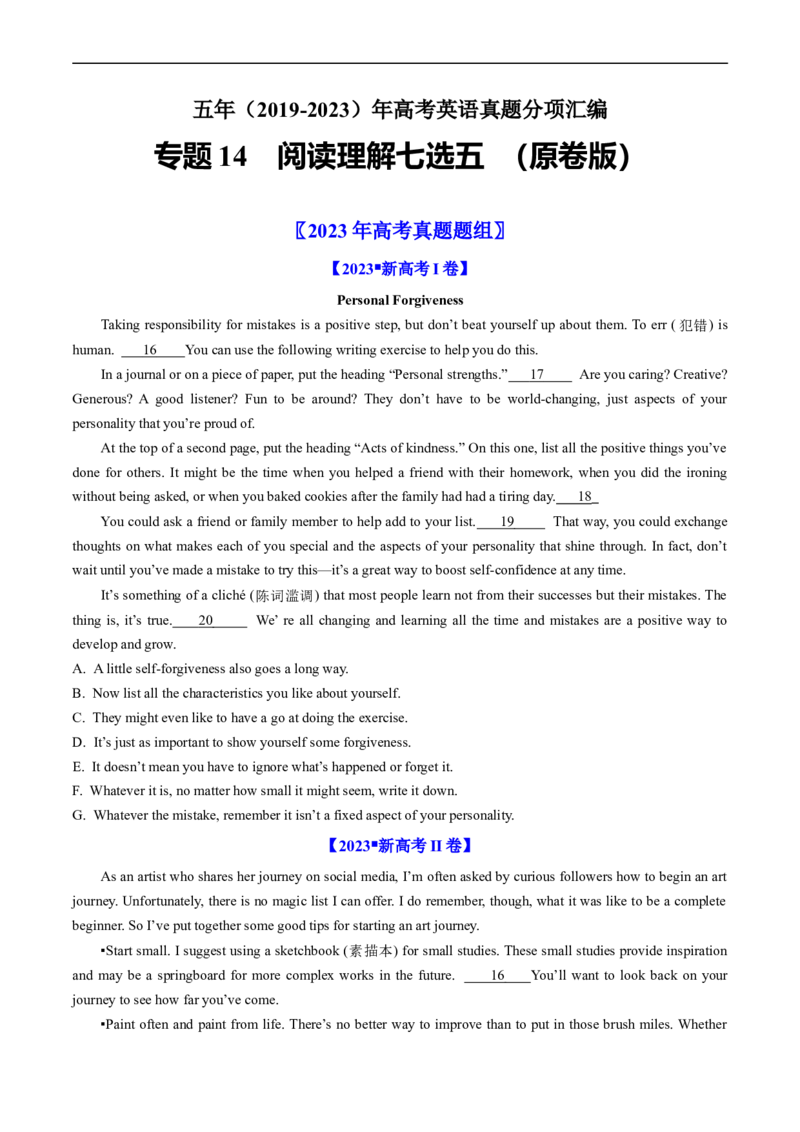
【2023 年新高考全国Ⅰ卷】Personal Forgiveness
Taking responsibility for mistakes is a positive step, but don’t beat yourself up about them. To err ( 犯错) is
human. ____16____ You can use the following writing exercise to help you do this.
In a journal or on a piece of paper, put the heading “Personal strengths.” ____17____ Are you caring?
Creative? Generous? A good listener? Fun to be around? They don’t have to be world-changing, just aspects of your
personality that you’re proud of.
At the top of a second page, put the heading “Acts of kindness.” On this one, list all the positive things you’ve
done for others. It might be the time when you helped a friend with their homework, when you did the ironing
without being asked, or when you baked cookies after the family had had a tiring day. ____18____
You could ask a friend or family member to help add to your list. ____19____ That way, you could exchange
thoughts on what makes each of you special and the aspects of your personality that shine through. In fact, don’t
wait until you’ve made a mistake to try this—it’s a great way to boost self-confidence at any time.
It’s something of a cliché (陈词滥调) that most people learn not from their successes but their mistakes. The
thing is, it’s true. ____20____ We’ re all changing and learning all the time and mistakes are a positive way to
develop and grow.
A. A little self-forgiveness also goes a long way.
B. Now list all the characteristics you like about yourself.
C. They might even like to have a go at doing the exercise.
D. It’s just as important to show yourself some forgiveness.
E. It doesn’t mean you have to ignore what’s happened or forget it.
F. Whatever it is, no matter how small it might seem, write it down.
G. Whatever the mistake, remember it isn’t a fixed aspect of your personality.
Passage 2
【2023 年新高考全国Ⅱ卷】As an artist who shares her journey on social media, I’m often asked by curious
followers how to begin an art journey. Unfortunately, there is no magic list I can offer. I do remember, though, what
it was like to be a complete beginner. So I’ve put together some good tips for starting an art journey.
·Start small. I suggest using a sketchbook (素描本) for small studies. These small studies provide inspiration
and may be a springboard for more complex works in the future. ___16___ You’ll want to look back on your
journey to see how far you’ve come.
·Paint often and paint from life. There’s no better way to improve than to put in those brush miles. Whether
you paint still lifes, portraits, or landscapes, paint from life as much as possible. ___17___
·Continually challenge yourself to try something new. ___18___ Artistic growth can be a bit painful.
Welcome to the club;we’ve all been there. I love taking on challenges. I once took up a challenge to create a
painting every day for a month and post the works online.
·___19___ Seeking and accepting constructive feedback (反馈) is crucial to growth. I post my work on social
media and, in turn, have met some of the kindest people. They make me feel valued and respected, no matter my
level of artistic ability.
The journey you’re on won’t follow a straight path. ___20___ Push through, give it time and put in the effort.
You will harvest the rewards of an artistic life.
A Get out of your comfort zone.
B. Make career plans and set goals.
C. Don’t throw away your beginner art.
D. Share your work if you feel comfortable doing so.
E. You’ll hit roadblocks, and you’ll feel discouraged at times.
F. Evaluate your performance and, if needed, redefine your role.
G. You’ll develop that painting muscle memory that only comes with repetition.
Passage 3
【2023 年全国乙卷】Indoor plants might look as if they just sit around not doing much, but in many ways
they are the unsung heroes of the home. ____16____, but studies have shown that they can promote people’s
wellbeing by improving their mood (心情), reducing stress and helping their memory. What’s more, indoor plants
are easy to look after and are not very expensive.
What are indoor plants?
Indoor plants, also known as houseplants or pot plants, are plants that like to grow indoors. Many of these
species (物种) are not ideally suited to growing outside in the UK, especially in the winter. ____17____.
Why are indoor plants good for you?
Will Spoelstra, who works at the Royal Botanic Gardens, says, “____18____. I find during the winter months,
plants around the house can really lift your mood.” Several studies have backed this up and found that indoor plants
can improve creativity, focus and memory. There is also research showing that pot plants can clean the air around
them by removing harmful gases, such as carbon dioxide. They also remove some harmful chemicals from paints or
cooking. ____19____.
Which plants can you grow?
Aloe vera, peace lilies and spider plants are some of the species that are easy to grow indoors. You can buy
plants from supermarkets, garden centres or online. Younger plants are often cheaper than fully grown ones, and
you get to care for them as they mature — which is part of the joy of owning plants. “____20____,” Spoelstra says.
“It can bring a new interest and focus into people’s lives and help to make the link between home and nature.”
A. All plants are different
B. Not only do they look beautiful
C. There are many benefits to growing plants indoors
D. Instead, they grow better inside, where it is warmer
E. Plants like peace lilies and devil’s tongue are among the best
F. Changing the pot of your plant from time to time will also help
G. Learning about the requirements of each plant can be very rewarding
Passage 4
【2023 年全国甲卷】Tricks To Becoming A Patient Person
Here’s a riddle: What do traffic jams, long lines and waiting for a vacation to start all have in common? There
is one answer. ___16___.
In the Digital Age, we’re used to having what we need immediately and right at our fingertips. However,
research suggests that if we practiced patience, we’d be a whole lot better off. Here are several tricks.
●Practice gratitude (感激)
Thankfulness has a lot of benefits: Research shows it makes us happier, less stressed and even more optimistic.
___17___. “Showing thankfulness can foster self-control,” said Ye Li, researcher at the University of California.
● Make yourself wait
Instant gratification (满足) may seem like the most “feel good” option at the time, but psychology research
suggests waiting for things actually makes us happier in the long run. And the only way for us to get into the habit
of waiting is to practice. ___18___. Put off watching your favorite show until the weekend or wait 10 extra
minutes before going for that cake. You’ll soon find that the more patience you practice, the more you start to apply
it to other, more annoying situations.
● ___19___.
So many of us have the belief that being comfortable is the only state we will tolerate, and when we
experience something outside of our comfort zone, we get impatient about the circumstances. You should learn to
say to yourself, “___20___.” You’ll then gradually become more patient.
A. Find your causes
B. Start with small tasks
C. Accept the uncomfortable
D. All this adds up to a state of hurry
E. It can also help us practice more patience
F. This is merely uncomfortable, not intolerable
G. They’re all situations where we could use a little extra patience
2023 年名校模拟题
Passage 1
(2023·广东佛山·统考模拟预测)Involvement in activities outside of schoolwork makes high school a lot
more interesting and fun.     1     Through extracurricular activities, you can develop important skills, such as
teamwork, public speaking, creativity, leadership, and self-awareness.
The first step is to explore.     2     While you can’t do everything, try to get involved in as many clubs,
teams, and activities that you find interesting. There is not a required one-size-fits-all list of activities. What matters
is that you find clubs and programs that interest you!
You won’t know if you like something if you don’t try it.     3     For example, if you think you might be
interested in earning a business degree, find out if your high school has a financial association. If you think you’d
like a career in politics, check to see if your high school has a Model Unite Nations project.
While you want to appear “well rounded,” it is important that you don’t take on too much.     4     It can
be helpful to see freshman year as the time to try a lot of things. In your sophomore year, you can begin limiting
your involvement to your most important activities. This will allow you to spend more time on fewer things.
    5     Develop it into a true passion and try to be an expert in it. This is what makes you unique and
allows you to shine on a college application or qualify for a scholarship.
A.Bear in mind what is most important to you.
B.You may feel it hard to make choices at the very beginning.
C.Participate in various extracurricular activities with interest.
D.As you start high school, you will find you have many new opportunities.
E.Allow yourself enough time to do well in the activities you care about most.
F.These activities help you gain abilities you couldn’t learn through textbooks and tests alone
G.Keep an eye out for clubs that may specifically help you prepare for a particular college major.
Passage 2
(2023·湖南长沙·湖南师大附中校考一模)You’ve comeback from your holiday and you feel amazingly
recharged. Then, you open your inbox with hundreds of unanswered emails. Suddenly, your calm starts to disappear
and your blood pressure starts to rise.    6    Yet, you’ve only been back at work for an hour or two. That’s no
way to start your first day at work after a holiday. So, here’s what you do to keep your stress to a minimum after a
break.
Give yourself half a day before jumping back into work. Take this time to unpack, do some laundry, and fill
the fridge with food.    7    Doing this, you’re much more likely to suffer from less stress going back into work
because your personal parts are already sorted. You will also feel more prepared going back into work.
   8    This enables you to focus on dealing with your overflowing inbox and getting your priorities straight.
9    Split them into sorts like urgent, non-urgent, quick responses and no action needed. Then, start by focusing on
the urgent ones (one by one!), before diving into the quick responses.
Up your fun the week you’re back. Go out for a meal with your friends. Walk your favorite route in your
neighborhood. Look at the pictures from your holiday. Post-holiday blues can be very common if you go straight
into all work and no play. Hence, make a little time for play your first week back.    10
A.Limit your scheduled commitments the first week back.
B.Well, you’ve got ready for everything.
C.Do whatever you need to do to wrap up the holiday stuff.
D.You may feel like you’re decades behind.
E.It is advisable to categorize your unread emails.
F.You’re supposed to deal with your emails instantly.
G.You’ll feel happy even if your holiday is over.
Passage 3
(2023·北京·首都师范大学附属中学校考模拟预测)Children love getting dirty.     11     But getting
muddy could have a powerful effect on their wellbeing, too.
“Don’t get dirty!” was once a constant family warning, as parents despairingly watched their children spoil
their best clothes. Whether they were running through farmers’ fields, climbing trees or catching tadpoles, it was
inevitable that children’s whites would turn brown before the day was over.
Today, many parents may secretly wish their children had the chance to pick up a bit of dirt. With the rise of
urbanism, and the temptation of video games and social media, contact with nature is much rarer than in the past.
12
What is gained in laundry bills may be lost in the child’s wellbeing. According to recent research, the dirt
outside is teaming with friendly microorganisms.     13
Many of the psychological benefits of outdoor play are already well established. Natural scenes provide the
perfect level of stimulation, which is thought to help recharge the brain when it is tired and easily distractible.
Supporting this theory, one study from 2009 found that children with ADHD ( 多动症) were better able to
concentrate following a 20-minute walk in the park, compared to a 20-minute walk on the streets of a well-kept
urban area.     14     The authors recommended using such “doses of nature” as a safe and accessible way of
supporting children with ADHD, alongside other tools.
    15     For example, the act of mudding and kneading materials like mud or sand can help children
develop the way their senses and movement interact, known as sensorimotor development. This allows the child to
gradually understand his or her bodily signals.
A.For many, there is simply no opportunity to get muddy.
B.Being close to grass and trees seemed to have had a beneficial effect on their minds.
C.Besides these restorative effects, outdoor play can offer valuable learning experiences.
D.They are drawn to puddles like muddy magnets, with no regard for footwear or the color of their clothing.
E.As for the child’s physical health, the most obvious advantage of outdoor play may be the exercise.
F.People who grow up on farms are less likely to develop asthma, allergies, or auto-immune disorders.
G.They can train the immune system and build resilience to a range of illnesses, including allergies and
asthma.
Passage 4
(2023·北京·人大附中校考三模)In some ways, it is surprising that languages change. After all, they are
passed down through the generations reliably enough for parents and children to communicate with each other.
16     For example, while Japanese has changed relatively little over a thousand years, English evolved rapidly in
just a few centuries. Many present day speakers find Shakespear’s sixteenth-century plays difficult and Chaucer’s
fourteenth-century The Canterbury Tales nearly impossible to read.
Languages change for a variety of reasons. Large-scale shifts often occur in response to social, economic, and
political pressures, as there are many examples of language change fueled by invasions, colonization, and
migration.      17      Frequently, the needs of speakers drive language change. New technologies industries,
products and experiences simply require new words. By using new and emerging terms, we all drive language
change. But the unique way that individuals speak also fuels language change because no two individuals use a
language in exactly the same way.     18     Through our day-to-day interactions, we pick up words and savings
from other people and integrate them into our speech. Teens and young adults, for example, often use different
words and phrases from their parents. Some of them spread through the population and slowly change the language.
    19     Vocabulary can change quickly as new words are borrowed from other languages, or as words get
coined, combined, or shortened. Some words are even created through misinterpretation of form. As noted in the
Linguistic Society of America’s publication Is English Changing?, the word pea is one such example. Up until
about four hundred years ago, pease could refer to either a single pea or many peas. At some point, people assumed
that pease was the plural form of a new word, pea, based on the way pease sounded. While vocabulary can change
quickly, sentence structure — the order of words in a sentence changes more slowly.     20     For example,
during the Great Vowel Shift five hundred years ago, the pronunciation of vowels in English changed dramatically.
This shift represents the biggest difference between the pronunciation of Middle English and Modern English.
A.Changes in sound are somewhat harder to document but just as interesting.
B.Yet linguists find that all living languages change over time — at different rates though.
C.As long as people are using a language, that language will undergo some change.
D.All natural languages change, and language change affects all areas of language use.
E .The three main areas of language that change over time are vocabulary, sentence structure, and
pronunciation.
F.Even without these kinds of influences, a language can change dramatically if enough users adopt a new
way of speaking.
G.The vocabulary and phrases people use depend on where they live, their age, education level, social status
and other factors.
Passage 5
(2023·江西·江西师大附中校考三模)During job or school interviews, you’re likely to be asked what your
strengths and weaknesses are, because the interviewers are interested in how your areas of strengths and
weaknesses might affect your performance in this position.     21     For instance, you may be skilled in
cooking, but if you’re applying for an office job, this strength may be irrelevant.
However, knowing your personal areas of strengths and weaknesses is not a piece of cake. It takes self-
awareness and self-reflection.    22     Or, ask some of your friends what they see as your best qualities or
shortcomings.
    23     For example, let’s say my strength is creativity and yours is planning; we both want to have the
same career. We might go about getting there in very different ways. If I did something creative to get my dream
job and you planned carefully, we’d both likely be successful. But if I tried planning and you tried something
creative, both of us might fail.    24
Having a weakness doesn’t have to be a bad thing. It could be something you struggle with, but it could also
be something you haven’t spent time developing yet.    25     For example, maybe your area of weakness is
relevant to gratitude. You just haven’t spent a lot of time thinking about gratitude before. But now you engage in a
bunch of activities that help you turn gratitude into an area of strength. Hey, now you’ve got one more skill!
A.Is it proper to begin with a truthful answer?
B.So ask yourself what you are good or weak at.
C.Our areas of strengths can help us achieve our goals.
D.Thus, it’s helpful to know your strengths related to the role.
E.Many job applicants are unsure how to approach this question.
F.By turning a weakness into a strength, you build other important skills.
G.That’s why it is important to know and use our strengths to reach goals.
Passage 6
(2023·浙江·校联考模拟预测)Your moral compass, conscience, and ethics may all sound like the same set
of values, but your moral compass can sometimes steer you away from rigid societal laws. Thus, when you’re faced
with a decision, how you react is often driven by personal values you’ve acquired.     26
What is your moral compass?
Morality is what defines whether an action is perceived as good or bad. Morals guide your individual behavior
within a society, which aren’t fixed.     27     Your moral compass provides guidance in making ethical
decisions, while your conscience serves as an internal alarm system to alert you when you have violated our moral
code. As for ethics, they tend to be the cultural and societal standards that outline how “everyone” is expected to
behave.
    28
According to modern psychologists, moral development is a part of three phases in childhood.
· Pre-conventional phase: Behaviors are driven by punishment avoidance and rewards.
· Conventional phase: Laws and rules of society are considered to gain others’ approval.
· Post-Conventional phase: Moral decisions are made from the perspective of individual rights.
How to find your moral compass?
It’s not always easy to know right from wrong, but you can try the following methods. Your moral compass is
made up of your beliefs, so it may be helpful to actively review them.     29     You may also find it helpful to
speak with people who can engage in open discussions about their moral positions.
    30     It is what guides your behavior in times when societal rules regarding human rights and conduct
conflict with your beliefs. Just hold it firmly and properly.
A.How does your moral compass develop?
B.Your moral compass is your personal guide.
C.What are the modern concepts of moral compass?
D.Not everyone would reach the final level in their lifetime.
E.Another way is by learning about the societies around you.
F.They may change as you face new experiences and gain life lessons.
G.Some of these values, which affect your judgement, make up your moral compass.
Passage 7
(2023·山东聊城·统考三模)Long before metal oven racks (架子) were invented, many people would place
the things that they wanted to bake onto stones to keep them from burning in ovens or even directly on heat.    31
However, there are actually many applications for its use in baking.
Typical baking stones can be made of various materials, and tend to be either round or rectangular in shape.
The clay stone is popular, but some people like marble. Some have a shiny surface and others don’t have.    32
Some people suggest that heading to the local kitchen supply store to purchase a baking stone is a waste of time and
instead they purchase tiles (瓦片) from kitchen or gardening stores.    33    They may contain high amounts of
lead and cooks would need to test them for the presence of lead before using them to cook.
   34    Baking stones absorb and keep heat very well, so when you put them in the oven and allow the oven
to run for a while, the stones heat up. They transfer heat directly to the bottom of your bread or other goods, as the
goods can be placed directly on the stone so they never start out on a cold surface. This allows bread to bake more
evenly all over, resulting in a much nicer crust (酥皮)—particularly for artisan bread.
There are many benefits of using a baking stone to cook pizza or bread.    35    For another, the stone is
also praised for its ability to evenly heat the crust and lessen chances that pizza or other bread will burn.
A.The way that baking stones work is simple.
B.Baking stones can be found in all shapes and sizes.
C.For one thing, it tends to produce more desirable qualities.
D.That makes them uniquely useful for many cooking creations.
E.Today, the baking stone is associated most with cooking pizza.
F.So you can choose from a great variety of stones on the market.
G.However, most of these products are not rated for safety in cooking.
Passage 8
(2023·河南安阳·统考三模)Winter is one of the most magical times of the year to get moving.     36

However, when you wake up in the morning, it can be hard to follow through on an exercise commitment. Here are
ways to keep that drive going throughout the cold months.
Work out with a group.    37    This gives you social support and can help with making friends. When you
exercise with a group, flaking out (入睡) is no longer an option.
Dress for the weather. When you are working out in the winter, especially if you are exercising outdoors, keep
yourself out of the cold in warm layers (层).    38    Make sure the top layer keeps out the snow and rain. If you
plan to exercise outside in the dark or in bad weather, where visibility is poorer, wear bright and reflective clothing
for safety.
Change up your workout.     39     Doing the same type of training can be demotivating. Those who vary
their workout routines are 20% likelier to enjoy the exercise session. Switching up your routine can give you a
boost of motivation, and help keep winter workouts fun and enjoyable.
    40     Using phone apps, or a fitbit, or even going low tech and marking your calendar in red pen can
help you visualize how you’ve progressed thus far. Finding a system that lets you track your exercise achievements
can give you the extra push to get you going when the going gets hard.
New Year’s resolutions are a great opportunity to start an exercise routine. Sure working out during the winter
may be an uphill battle, but there are strategies to get us over the hill, and onto a healthier, happier new year.
A.Track your training.
B.Variety is important to enjoy exercise.
C.You can make your workouts enjoyable.
D.Your layers should be, not just warm, but dry.
E.Use an app to remind you of an exercise routine.
F.Winter workouts give us energy to get through winter’s cold days.
G.One way to stay motivated during winter is to work out with a group or a partner.
Passage 9
(2023·浙江·校联考模拟预测)It’s commonly thought that people get into bad financial situations because
of poor decision-making skills.     41     In fact, several studies over the last decade have demonstrated that the
cause and effect may be more complex than is widely believed.
    42    Scientists first asked the study participants a series of questions that made them think about their
personal income and savings. They were then asked to solve a number of puzzles. Those in better financial
situations performed better at solving the puzzles than those in financial trouble. However, when the test was
repeated without making the participants think about their own finances, the differences in performance between
the rich and poor disappeared.     43
In a separate study conducted in 2018 at the University of Texas, the brains of more than 300 people aged
between 20 and 89 were scanned and analyzed for signs of good cognitive function. Among those aged between 35
and 64, it was found that those with better financial situations had healthier brains, including characteristics linked
to having a better memory and a lower risk of dementia when elderly. However, in younger adults (those aged 20 to
34), there did not seem to be any connection between wealth and brain health.     44
It’s not difficult to guess why poverty might have these effects. People who live in poorer conditions often
have difficulty affording healthy food.     45     And always worrying about having enough money to pay rent
or put food on the table puts constant demands on the brain, leaving less processing power available for critical
thinking. Indeed, it could be said that poverty is a vicious cycle, keeping people trapped by taking away their best
means of escape-their ability to make smart decisions.
A.But is poverty really caused by poor thinking?
B.Unwise decisions people make, to a greater degree, contribute to tight budgets.
C.They are more affected by negative environmental elements such as pollution.
D.Taken together, these results indicate that long-term poverty only gradually causes wear and tear on the
brain.
E .Therefore, the scientists concluded that poor thinking plays a major part in one’s future financial
condition.
F.This suggested that the distraction of worrying about their bad finances made the poor people perform
worse than those with no financial worries.
G .One study in the journal Science in 2013 showed that people’s abilities to solve problems can be
significantly affected by their current financial situation.
Passage 10
(2023· 河南· 校联考三模)Keeping a schedule for your day will help you manage your time more
efficiently.    46    Scheduling your day allows you to self- regulate and track your own behavior by keeping
records of what you need to do and have done.
Obtain a calendar or planner. Make sure the calendar has appropriate space for you to list your tasks. Some
calendars offer weekly, daily, or hourly planners. A notebook can also be used. Choose whatever best suits your
wants and needs. Whatever you choose, commit to your choice. Do not try to have one planner for work, one for
school, etc.    47
Organize your tasks. Electronic calendars allow you to mark tasks in different colors. For example, you can
color work-related things red, school-related things blue, housework green, vacations orange, and exercise pink.

48    Simply use colored pens or pencils or highlighters. Once you’ve differentiated the different types of tasks
you need to schedule, you can work to prioritize them.
Schedule a time for each task.    49    For example, you may have scheduled time in a given day to study
(2 hours), work out (1 hour), write two emails (30 minutes), and walk the dog (30 minutes). It’s key to allow you
the necessary amount of time to complete each task; you’ll only stress yourself out if you schedule yourself too
tightly and aren’t realistic about the amount of time things take.
    50    Keep some free space at the bottom of your schedule for low-priority things coming up later in the
week. If you have time today or at any other point during your week, you can begin working on those items to get
ahead. These additional tasks might include going through your closet or organizing your tax filing system at home.
A.Mark your prioritized tasks.
B.Leave space in your schedule.
C.Everything should be in one place.
D.Write how long you expect to spend on each task.
E.You can get more done and are less likely to forget tasks.
F.Most people generally underestimate the amount of time tasks take.
G.You can also do this easily if you’re using a paper calendar or notebook.