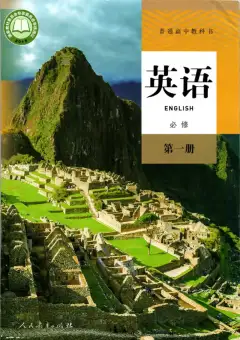
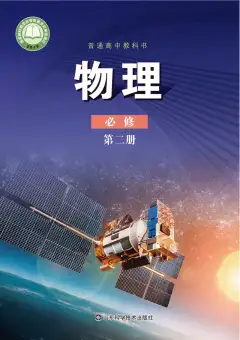
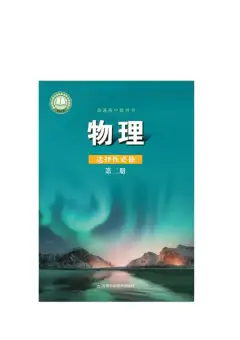
普通高中教科书
第二册
必修
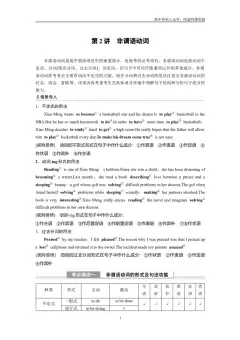
主
编:陈
琳
普通高中教科书
第二册
必修
北京
主 编:陈 琳
副 主 编:张连仲
编 者:刘 晓 李陆桂 张京生 钱建源 徐 浩 雷传利
(按照姓氏笔画排序)
项目策划:王 芳 王 勇
项目负责:张黎新 郎 崧 张 涛
基础教育出版分社:
地 址:北京市西三环北路19 号 外研社大厦 基础教育出版分社(100089)
咨询电话:(010)88819117/88819688
传 真:(010)88819423
本教材是外语教学与研究出版社根据教育部制定的《普通高中英语课程标准(2017 年版)》,在充分
调研和科学论证的基础上推出的中小学“一条龙”英语教材——《英语》(新标准)的高中部分。
本教材的主编为北京外国语大学陈琳教授,副主编为张连仲教授,编写团队包括国内高校的知名专家
学者、教研人员和一线教师。陈琳教授秉承周恩来总理提出的“一条龙”外语教学理念,总结自己从事
外语教育工作70 年的经验,提出了符合中国外语教育实践的教育理论——辩证实践外语教育途径,并在
《英语》(新标准)教材中贯彻实施。
根据教育部2017 年新课程标准的精神,我们启动了《英语》(新标准)高中教材的修订工作。本次
修订全面依托新课程标准要求,坚持陈琳教授的特色理论,由陈琳教授、张连仲教授指导编写团队,在充
分考虑我国英语教育实际学情和教情的前提下,进行了全面的框架重建和内容设计,保证了理论与实践的
紧密结合。
《英语》(新标准)高中教材共分10 册:1—3 册为必修课程教材,4—7 册为选择性必修课程教材,
8—10 册为选修课程中的提高类教材。
必修课程教材具备良好的体系性、延伸性和接续性,能够帮助学生根据自己的需求不断提升个性化的
语言能力,确保学生达到高中毕业基本要求,为日后进入选择性必修课程打下坚实的基础。《英语》(新标
准)必修课程教材的主要特色如下:
一、坚持立德树人根本任务。在教材的选材、内容、语言等各个方面突出学科的育人本质,帮助学生更好
地培育中国情怀,坚定文化自信,拓展国际视野,形成正确的世界观、人生观和价值观。
二、突出学科核心素养的重要性,全面培养学生的语言能力、文化意识、思维品质和学习能力,帮助学生
逐步形成正确的价值观念、必备品格和关键能力。
三、坚持理论与实践的辩证关系。从语言实践的角度设计教材的主题架构、内容结构直至每一项具体活
动,确保有实践、可实践,并通过实践促进提升,帮助学生形成素养,发展素养。
四、遵循“理解—发展—实践”的原则,以“主题”为纲设计单元任务,重要题材在各册教材中均得到体
现,且内容逐步扩展加深、螺旋式上升,符合语言教学规律。
五、语篇题材多样、体裁丰富,语言地道鲜活、难度适中,符合学生的兴趣特点,同时能够提升学生的语
篇意识,丰富语言感知与学习体验,有利于学生通过与主题语篇互动,培养在获取信息、处理信息、
重构信息过程中的逻辑思维、多元思维和批判性思维。
六、活动设计紧密围绕主题语境,注重整合语言技能和学习技能,充分体现了英语学习活动观;同时强调
交际情境的真实性和丰富性,帮助学生掌握语言技能、建构完善的知识基础,在实践中逐步形成交际
能力。
七、强调学习策略的培养,鼓励学生通过体验、实践、讨论、合作、探究等方式,利用各种学习资源完成
学习任务,解决学习中的困难,从而形成自主学习能力。
八、突出文化意识(尤其是跨文化意识)的建构与发展。通过介绍及比较中外文化,帮助学生更好地理解
文化异同,学会理解和包容不同文化,提升道路自信、文化自信,将文化知识内化为正确的文化价值
观和有利于国家和个人发展的跨文化态度与意识。
九、为教师编写了流程清晰、内容丰富的教师用书,帮助教师快速理解教材内容和相关背景知识,明确教
学目标,掌握教学节奏;同时开发了配套的网络教材和其他多媒体配套资源,丰富课程资源,拓展教
学模式。
我们希望,《英语》(新标准)高中必修课程教材能够初步培养学生的语言能力、文化意识、思维品质
和学习能力等英语学科核心素养,为他们继续学习英语和终身发展打下坚实的基础。
《英语》(新标准)系列教材
高中阶段编委会
前 言
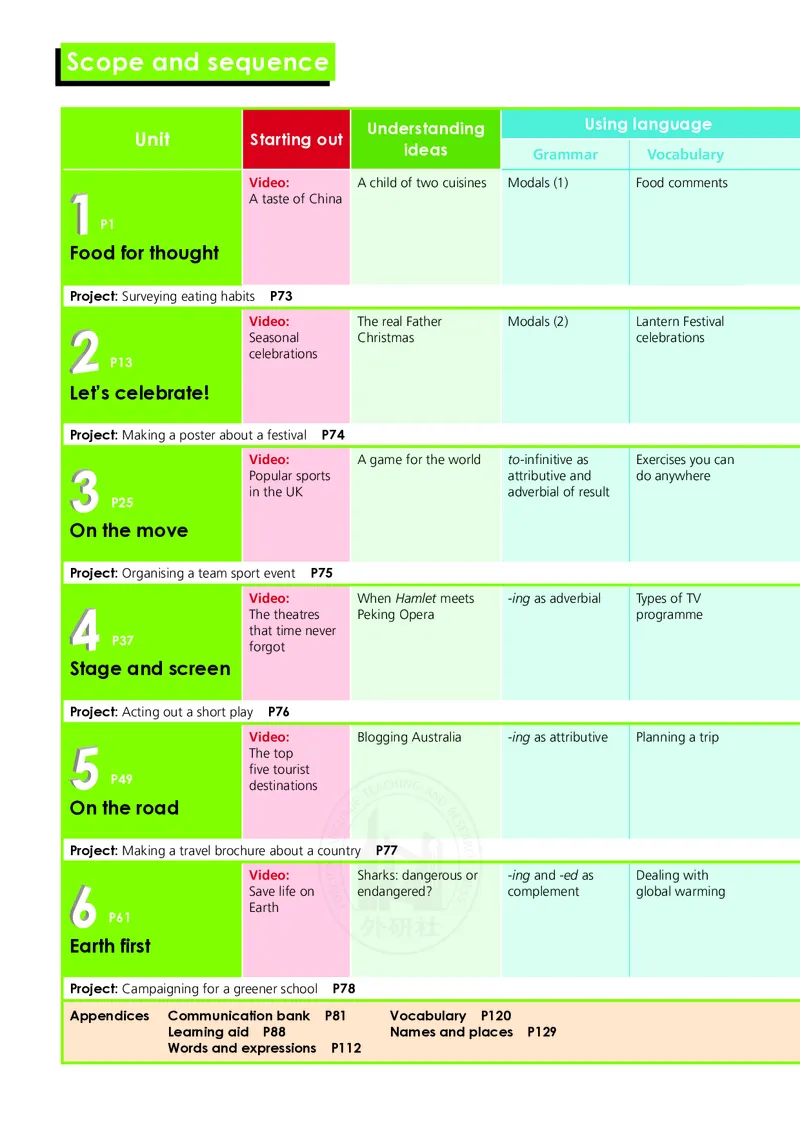
Scope and sequence
Unit
Starting out
Understanding
ideas
Using language
Grammar
Vocabulary
P1
Food for thought
Video:
A taste of China
A child of two cuisines
Modals (1)
Food comments
Project: Surveying eating habits P73
P13
Let’s celebrate!
Video:
Seasonal
celebrations
The real Father
Christmas
Modals (2)
Lantern Festival
celebrations
Project: Making a poster about a festival P74
P25
On the move
Video:
Popular sports
in the UK
A game for the world
to-infinitive as
attributive and
adverbial of result
Exercises you can
do anywhere
Project: Organising a team sport event P75
P37
Stage and screen
Video:
The theatres
that time never
forgot
When Hamlet meets
Peking Opera
-ing as adverbial
Types of TV
programme
Project: Acting out a short play P76
P49
On the road
Video:
The top
five tourist
destinations
Blogging Australia
-ing as attributive
Planning a trip
Project: Making a travel brochure about a country P77
P61
Earth first
Video:
Save life on
Earth
Sharks: dangerous or
endangered?
-ing and -ed as
complement
Dealing with
global warming
Project: Campaigning for a greener school P78
Appendices Communication bank P81
Vocabulary P120
Learning aid P88
Names and places P129
Words and expressions P112
Self-assessment
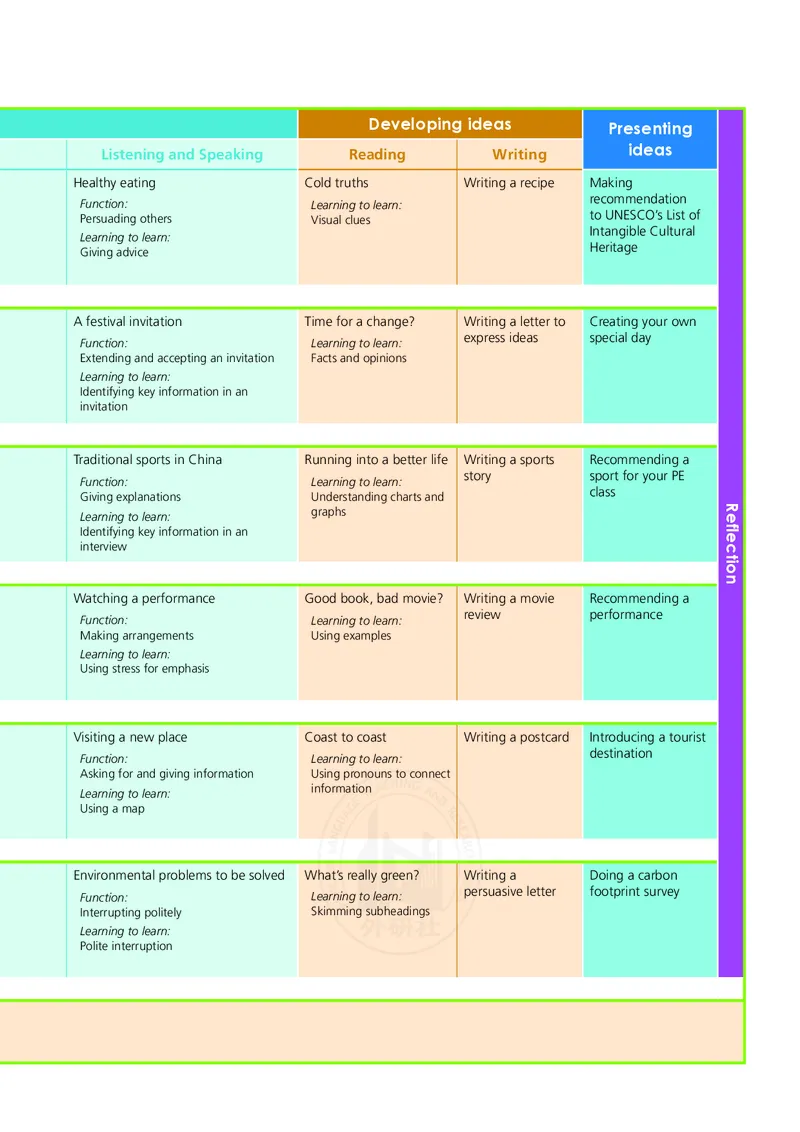
Developing ideas
Presenting
ideas
Listening and Speaking
Reading
Writing
Healthy eating
Function:
Persuading others
Learning to learn:
Giving advice
Cold truths
Learning to learn:
Visual clues
Writing a recipe
Making
recommendation
to UNESCO’s List of
Intangible Cultural
Heritage
A festival invitation
Function:
Extending and accepting an invitation
Learning to learn:
Identifying key information in an
invitation
Time for a change?
Learning to learn:
Facts and opinions
Writing a letter to
express ideas
Creating your own
special day
Traditional sports in China
Function:
Giving explanations
Learning to learn:
Identifying key information in an
interview
Running into a better life
Learning to learn:
Understanding charts and
graphs
Writing a sports
story
Recommending a
sport for your PE
class
Watching a performance
Function:
Making arrangements
Learning to learn:
Using stress for emphasis
Good book, bad movie?
Learning to learn:
Using examples
Writing a movie
review
Recommending a
performance
Visiting a new place
Function:
Asking for and giving information
Learning to learn:
Using a map
Coast to coast
Learning to learn:
Using pronouns to connect
information
Writing a postcard
Introducing a tourist
destination
Environmental problems to be solved
Function:
Interrupting politely
Learning to learn:
Polite interruption
What’s really green?
Learning to learn:
Skimming subheadings
Writing a
persuasive letter
Doing a carbon
footprint survey
Reflection
同学们,欢迎大家继续学习《英语》(新标准)高中教材!
由教育部制定并颁布的《普通高中英语课程标准(2017 年版)》明确规定:普通高中英语课程
作为一门学习及运用英语语言的课程,与义务教育阶段的课程相衔接,旨在为学生继续学习英语和
终身发展打下良好基础。普通高中英语课程强调对学生语言能力、文化意识、思维品质和学习能力
的综合培养。也就是说,发展学科素养是同学们高中阶段英语学习的方向和目标。经过必修课程教
材第一册的学习,大家对高中阶段英语的学习已有了基本认识,并取得了一定的进步。在此基础上,
同学们应该对自己的学习目标提出更高的要求。
《英语》(新标准)高中必修课程教材遵循“为用而学,在用中学,在学中用,学而能用”的原
则,为同学们提供了语言地道、优美的阅读文章和灵活多样的学习活动,力图使大家逐步获得独立
学习和自主学习的能力。
必修课程教材第二册进一步展开话题,从饮食文化、节日传统,到体育与健康、戏剧与影视,
再到旅行与环保,帮助大家加深对人与自我、人与社会、人与自然三大主题语境的认识,进一步发
展英语学科核心素养。本册共六个单元,单元结构如下:
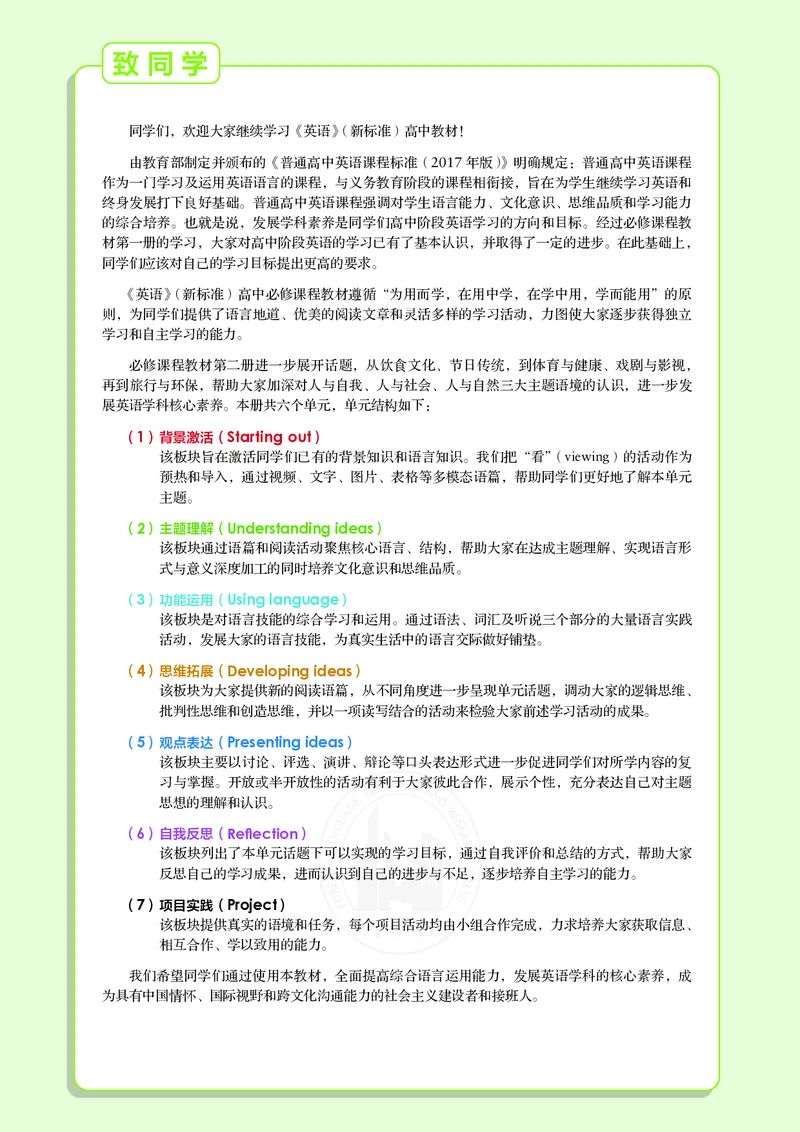
(1) 背景激活(Starting out)
该板块旨在激活同学们已有的背景知识和语言知识。我们把“看”(viewing)的活动作为
预热和导入,通过视频、文字、图片、表格等多模态语篇,帮助同学们更好地了解本单元
主题。
(2) 主题理解(Understanding ideas)
该板块通过语篇和阅读活动聚焦核心语言、结构,帮助大家在达成主题理解、实现语言形
式与意义深度加工的同时培养文化意识和思维品质。
(3) 功能运用(Using language)
该板块是对语言技能的综合学习和运用。通过语法、词汇及听说三个部分的大量语言实践
活动,发展大家的语言技能,为真实生活中的语言交际做好铺垫。
(4) 思维拓展(Developing ideas)
该板块为大家提供新的阅读语篇,从不同角度进一步呈现单元话题,调动大家的逻辑思维、
批判性思维和创造思维,并以一项读写结合的活动来检验大家前述学习活动的成果。
(5) 观点表达(Presenting ideas)
该板块主要以讨论、评选、演讲、辩论等口头表达形式进一步促进同学们对所学内容的复
习与掌握。开放或半开放性的活动有利于大家彼此合作,展示个性,充分表达自己对主题
思想的理解和认识。
(6) 自我反思(Reflection)
该板块列出了本单元话题下可以实现的学习目标,通过自我评价和总结的方式,帮助大家
反思自己的学习成果,进而认识到自己的进步与不足,逐步培养自主学习的能力。
(7) 项目实践(Project)
该板块提供真实的语境和任务,每个项目活动均由小组合作完成,力求培养大家获取信息、
相互合作、学以致用的能力。
我们希望同学们通过使用本教材,全面提高综合语言运用能力,发展英语学科的核心素养,成
为具有中国情怀、国际视野和跨文化沟通能力的社会主义建设者和接班人。
致 同 学
Food for thought
U
N
I
T
p
a
st
a
c
u
rr
y
1
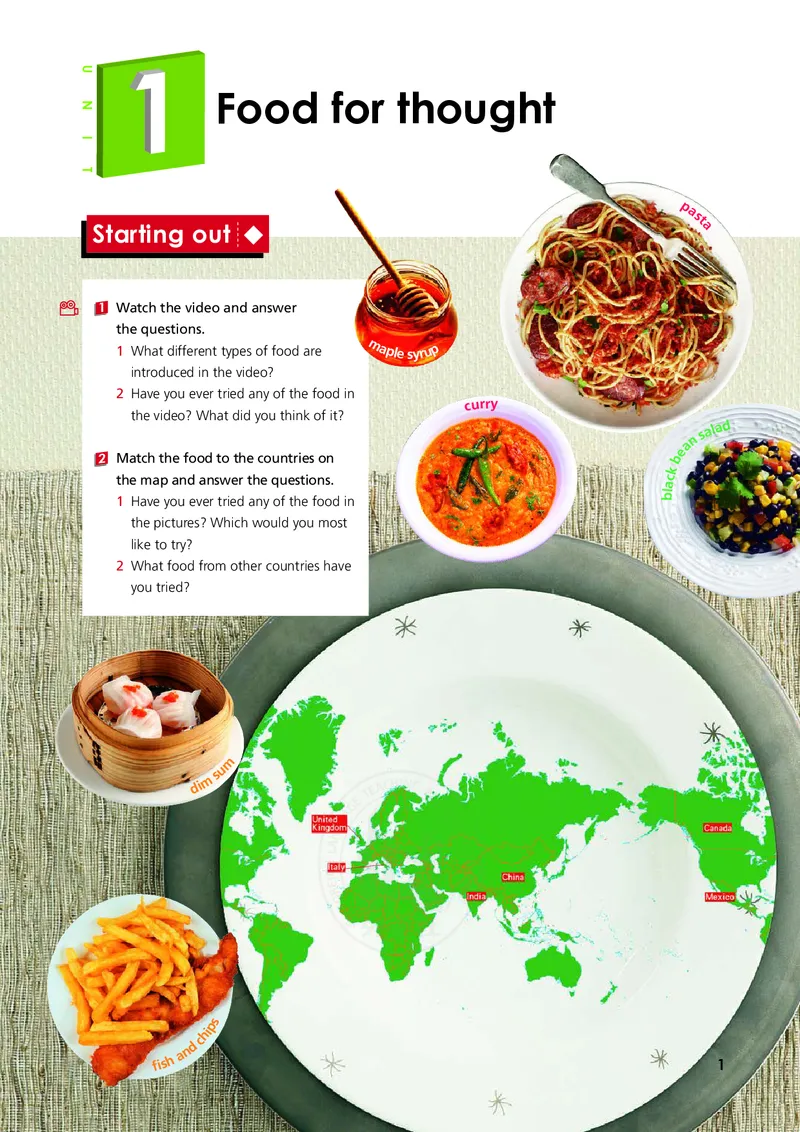
Watch the video and answer
the questions.
1 What different types of food are
introduced in the video?
2 Have you ever tried any of the food in
the video? What did you think of it?
2
Match the food to the countries on
the map and answer the questions.
1 Have you ever tried any of the food in
the pictures? Which would you most
like to try?
2 What food from other countries have
you tried?
d
i
m
s
u
m
m
a
p
l
e
s
y
r
u
p
b
l
a
c
k
b
e
a
n
s
a
l
a
d
Starting out
fi
s
h
a
n
d
c
h
i
p
s
1
1
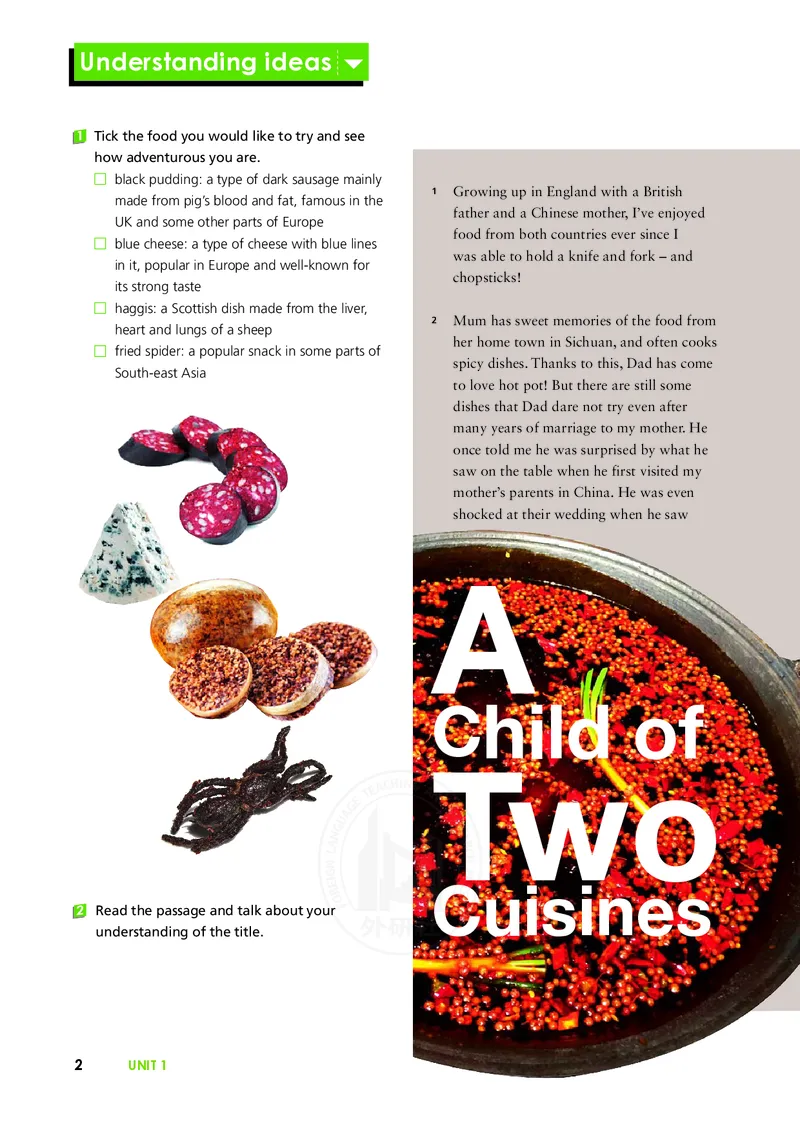
Tick the food you would like to try and see
how adventurous you are.
black pudding: a type of dark sausage mainly
made from pig’s blood and fat, famous in the
UK and some other parts of Europe
blue cheese: a type of cheese with blue lines
in it, popular in Europe and well-known for
its strong taste
haggis: a Scottish dish made from the liver,
heart and lungs of a sheep
fried spider: a popular snack in some parts of
South-east Asia
2
Read the passage and talk about your
understanding of the title.
1
Growing up in England with a British
father and a Chinese mother, I’ve enjoyed
food from both countries ever since I
was able to hold a knife and fork – and
chopsticks!
2
Mum has sweet memories of the food from
her home town in Sichuan, and often cooks
spicy dishes. Thanks to this, Dad has come
to love hot pot! But there are still some
dishes that Dad dare not try even after
many years of marriage to my mother. He
once told me he was surprised by what he
saw on the table when he first visited my
mother’s parents in China. He was even
shocked at their wedding when he saw
Child of
A
Two
Cuisines
Understanding ideas
2
UNIT 1
I came across stinky tofu, a horrible grey
thing that looked and smelt like a burnt
sports shoe. “You needn’t try it if you don’t
want to,” Mum said, but I gathered all my
courage to take a bite and was amazed to
find it wasn’t so bad. It reminded me of blue
cheese, a similarly strong smelling type of
food you either love or hate. Maybe I’ll fall
in love with stinky tofu – someday.
6
People say that one man’s meat is another
man’s poison, but I feel at home with
food from both my cultures. To me,
there’s nothing better than a cross-cultural
afternoon tea of English biscuits
and a cup of Chinese oolong tea
in a fine china cup!
how the Chinese ate almost every part of an
animal. Even today, he still does not easily
take to eating things like chicken feet.
3
But I enjoy that sort of food myself. Last
week, I went to the butcher’s and asked,
“Do you have pigs’ ears?” “No,” the butcher
said, pulling at his own ears, “just these
ordinary ones.” He must have thought I was
joking.
4
Dad can cook a super “full English breakfast”
of bacon, eggs, beans, sausages and toast
with butter – Mum and I just have to find
a way to get him into the kitchen! He also
does a typical Sunday roast. We all love roast
beef and vegetables, but Mum says we’d
better not eat too much roast food as it may
make us suffer from heat inside our bodies,
according to traditional Chinese medicine.
5
I’ll never forget my first visit to China. Mum
encouraged me to try different kinds of
food, and I did! I loved everything.
But just when I thought I
could deal with all
Chinese food,
Food for thought
3
3
Choose the main idea of the passage.
1 How the family stays healthy by eating Chinese food.
2 What the family has done to promote Chinese food.
3 How the family cooks both Chinese and English food.
4 How the family combines food from two cultures.
4
Choose the correct symbols and complete the table with information from
the passage.
Sichuan
hot pot
Opinion
Supporting
details
Animal parts
Opinion
Supporting
details
Full English
breakfast
Opinion
Supporting
details
Sunday roast
Opinion
Supporting
details
Stinky tofu
Opinion
Supporting
details
Mum
Dad
Son
N/A
N/A
N/A
N/A
N/A
N/A
N/A
N/A
N/A
N/A
N/A
N/A
N/A
N/A
N/A
Think Share
&
1 What does the author mean by saying “one man’s meat is
another man’s poison”? Do you know of any similar sayings in Chinese?
2 What food from other regions in China or other countries has made an
impression on you? Why?
4
UNIT 1
Modals (1)
2
Underline the modals in the
introduction to an app and talk
about their meanings.
3
Complete the tips for good table manners with the
correct form of the modals in Activity 1.
• You
1 wait until everyone else has been served before you start eating.
• Sometimes there are so many knives and forks that you
2 pick them up in case
you get it wrong. The trick is to start with the ones on the outside.
• When you finish your meal, you
3 place the knife and fork together on your plate
with the handles at the four o’clock position.
Table manners, however, can differ in different situations.
For example, you
4 use a knife and fork
when eating a hamburger or pizza. Just remember:
when in Rome, do as the Romans do, and you
will
5 enjoy the local cuisine!
While going on your first trip to the UK is exciting,
new and different customs can also be confusing.
Table manners are no exception. But don’t worry –
here are some tips:
a … I was able to hold a knife and fork – and chopsticks!
b But there are still some dishes that Dad dare not try
even after many years of marriage to my mother.
c … Mum and I just have to find a way to get him into
the kitchen!
d … we’d better not eat too much roast food as it may
make us suffer from heat inside our bodies, …
e “You needn’t try it if you don’t want to,” Mum said, …
1
Look at the sentences from the reading passage. Think
and work out the meanings of the words in bold.
Now talk about the function of modals. Then match the
meanings to the words in bold above.
1 be afraid to do something
2 not be necessary to do something
3 give advice to do or not to do something
4 be necessary or give strong advice to do something
5 have the ability to do something
Using language
87%
If you dare not try a “painful” diet to
stay healthy, this new app is the perfect
solution – and you needn’t pay for it!
The app works by quickly showing
photos of different food. All you have
to do is select the photos of healthy
food. Then you’ll be able to train your
brain to select healthy food in real
situations. So, if you’re a sugar addict
and aren’t able to say no to chocolate
or cola, you had better download
it now! Soon, you’ll be filling your
cupboards with real healthy food.
Healthy Eating Trainer
Health & Fitness
Download
Details
Reviews
Related
(96)
Food for thought
5
Food comments
5
Underline the words that describe food in Activity 4 and put them into the table.
Add any more you can think of.
4
Read and match the comments to the pictures.
6
Work in pairs. Talk about your favourite food using the words you have learnt.
A: What’s your favourite food?
B: My favourite food is...
A: How does it look / smell / taste / feel?
B: It looks / smells / tastes / feels…
…
1 Backyard BBQ, Kansas City, US
The most tender steak I’ve ever had! The barbecue gives it
that famous smoky flavour, and it comes with a shiny sauce
that’s very, very spicy!
2 Bund 59, Shanghai, China
A bowl of soup with a large, round meatball! The meatball is
cooked through, which looked slightly pink inside. Incredibly
soft and juicy – it melts in the mouth!
3 Antonio’s Pizzeria, London, UK
Worst pizza ever! I ordered a large vegetarian pizza, but it
was tiny! It was served cold and came with some sort of
sticky sauce which tasted bitter and smelt really fishy! The
waiter even spilled some beer on me!
4 Madame Laurent’s Bakery, Paris, France
You’ve got to try the strawberry cheesecake. It’s smooth and
creamy with fresh strawberries, which give it a lovely sweet
and fruity taste. Highly recommended!
98 reviews
86 reviews
95 reviews
a
b
c
d
56 reviews
Appearance
Smell
Taste
Feel
6
UNIT 1
Healthy eating
7
Listen to the conversation and tick the food
and drinks ordered.
8
Listen again and complete the notes.
Now talk about what Harriet says to persuade
Janet. Listen again if necessary.
9
Work in pairs. Act out the conversation to
persuade a customer to buy a new mixed fruit
drink.
Student A: Turn to Page 81.
Student B: Turn to Page 84.
10
Work in pairs. Think of a similar situation and
have a conversation.
a salad with
dressing
a glass of
water
yoghurt
a glass of
juice
a glass of
cola
a salad without
dressing
?
Did You Know
• The sugar in soft drinks forms acid and
attacks our teeth for about 20 minutes
each time we drink them.
• About 30% of the world’s population
is overweight.
a double hamburger
with French fries
Food and drinks
Janet wants
to order
Harriet’s views
a lot of sugar,
1 and
unhealthy 2
just a small 3
of real fruit in it
has as much sugar as
4
a lot of sugar to improve
the 5 , which
can be 6
salad with
dressing
•
•
•
•
fruit juice
fat-free yoghurt
When giving advice, it’s usual to give your opinion
within your first sentence. This makes the listener
more interested in what you are saying. Here are
some examples: Not a good idea. Did you know that…?
Sorry, but there’s a problem with…
Learning to learn
Food for thought
7
b
a
d
c
e
1
Work in pairs. Talk about what you usually eat
for dinner and decide who eats more healthily.
2
Read the passage and match the pictures of
the fridges to their owners.
Cold Truths
Developing ideas
8
UNIT 1
There’s not enough room
to swing a cat in my small
apartment, so I don’t cook very often. My
fridge is usually half empty and I’m often
too tired to eat much anyway. I often end up
saving part of my meal for the next day.
Some evenings, I’ll just have something quick,
like toast, or even just a yoghurt with honey.
As a doctor, I know I had better change the
way I eat, but I just don’t have the time or the
energy right now.
My husband and I avoid all
products that come from
animals. This means we don’t eat meat,
and any milk or cheese had better be dairy-
free. We like cooking at home and make
our meals from fresh, seasonal fruit and
vegetables. Cooking together gives us a
chance to relax and catch up on each other’s
days. If we have children, I want to bring
them up just like us, but my husband says
that everyone should be able to make their
own lifestyle choices.
Ellie 24
Junior doctor
Jenny 31
Teacher
There are five of us living in
our shared student house. My
mum says I need to have three healthy meals
a day, but I’m too busy studying and meeting
friends! We don’t really buy fresh food, and I
suppose the fridge could be kind of cleaner…
I daren’t let my mum see this photo!
Max 19
College student
Is there any truth behind the saying “You are
what you eat”? We put this to the test by asking
five people to open their fridge doors and talk
about their lifestyles. Can you guess which
fridge belongs to which person? Maybe you can
recognise your own fridge here!
With five children, we’re one big
family! My wife and I both work
full-time, so life can get pretty busy! Like a
lot of chefs I know, I don’t really do much
cooking at home. Sometimes I bring home
food from the restaurant where I work. Once
a week, we do a big shop and buy a lot of
frozen food. I know we should eat more fresh
fruit and vegetables, but ready meals are so
convenient.
Mike 49
Chef
Each day at the construction site
is more or less the same – tiring!
When I get back home, there’s nothing more
satisfying than a big meat dinner. I guess
I’ve always been a big meat eater and in this
house, no family meal is complete without
some form of meat. I still don’t think that
anything can beat my mum’s homemade
sausages, though.
Ted 35
Construction worker
Healthy You!
Visual information, such as photos and illustrations, can
support reading and help you identify the theme and
content of a text. Make the most of these images to
look for clues to help you understand the text.
Learning to learn
Food for thought
9
3
Find out who might say the sentences below.
1 “There is a lot of food from my workplace in our fridge.”
2 “You might find bean products in our fridge, but hamburgers?
Never!”
3 “My fridge is a total mess! All I do is party and hit the books.”
4 “There isn’t really much in my fridge. I’m just too busy and
tired to cook at home!”
5 “If you’re someone who avoids animal products, you wouldn’t
find anything to eat in my fridge!”
4
Work in groups. Make comments and suggestions about the lifestyle
of each person in the passage.
1 Discuss the lifestyle of each person. Use the table to make notes.
Name
Lifestyle
2 Organise your ideas following the steps below.
• Describe the lifestyle of each person in the passage.
• Explain the possible problems with their lifestyles.
• Make suggestions about how they can improve their lifestyles.
3 Share your ideas with the class.
Jenny
Mike
Ellie
Max
Ted
Think Share
&
1 What do you think the saying “You
are what you eat” means?
2 Do you know of any Chinese sayings about food and
health? What is your understanding of them?
3 Which person’s eating habits are most similar to yours?
4 What can you do to improve your eating habits from
now on?
a
b
c
d
e
10
UNIT 1
5
Read the food blog and answer the questions.
Writing a recipe
6
Think of your favourite dish and complete the recipe.
Gong Bao Chicken (also known as Kung Pao Chicken)
was originally a family dish of Ding Baozhen, or Ding
Gongbao, a high-ranking court official of the Qing
Dynasty who helped reconstruct the Dujiangyan
Irrigation System in Chengdu, Sichuan. Over the years,
it has become one of the most popular dishes in Chinese
restaurants throughout the world.
Instructions
1 Heat the oil over a high heat.
2 When the oil is hot, add the chillies and
stir them for about 30 seconds.
3 Add the spring onions and stir them
for about 30 seconds.
4 Add the chicken and cook it through.
5 Add the soy sauce, vinegar and sugar.
6 Add the peanuts and dried tofu and
cook for another 1 to 2 minutes.
7 Season with salt and serve.
Ingredients
chicken breast··························300g
roasted peanuts··························50g
small pieces of dried tofu············50g
cooking oil·························2 spoons
dried chillies····························5 or 6
spring onions····················· a handful
soy sauce·························1 teaspoon
vinegar····························1 teaspoon
sugar····························· 2 teaspoons
salt··································1 teaspoon
The combination of spicy, salty, sweet and sour flavours
makes Gong Bao Chicken hard to resist. What’s more,
it is easy to make and can be adapted to individual tastes.
So, don’t forget to pick up some chicken on your way home and try this recipe out!
1 What is the origin of
Gong Bao Chicken?
2 What are the two main
parts of a recipe?
3 How do you cook Gong
Bao Chicken? Describe
the process in your own
words.
7
Share your recipe with the class. Try cooking the dish at home.
My favourite dish:
Ingredients:
Instructions:
RECIPE
Food for thought
11
2
Work in groups. Talk about your
recommendation following the
steps below.
1 Say what food or drink you would
like to recommend.
2 Give a description of it.
3 State why you would like to
recommend it.
• We would like to recommend…
• It comes from…
• It is famous for…
• It looks / tastes / smells…
• We recommend it because…
Useful expressions
1
Look at the food and drink on the list of China’s
Intangible Cultural Heritage and think of other typical
ones you know. Recommend one you wish to add to the
UNESCO list.
green tea
roast duck
Food / Drink
mooncake
Description
Reasons for recommendation
1
After completing this unit, I can rate my
performance 1 (excellent), 2 (good) or
3 (in need of improvement).
express opinions about food
encourage others to develop healthy eating habits
understand how different lifestyles can affect
people’s diets
write a recipe for my favourite dish
appreciate different food cultures
2
I’ve learnt to make use of the following
words and expressions:
3
I still need to improve:
Presenting ideas
Now discuss and decide on a
winning food or drink.
3
Present your food or drink to the
class. Use the expressions in the box
to help you.
Reflection
12
UNIT 1
Let’s celebrate!
U
N
I
T
1
Watch the video and answer
the questions.
1 What festivals are mentioned in
the video?
2 Why do people celebrate these
festivals?
2
Read the festival descriptions and
complete the sentences.
______________ is to celebrate the harvest.
______________ is to celebrate a season.
______________ is to honour an event.
______________ is to honour a person.
3
Work in groups. Talk about:
• other festivals of each type
• other reasons to celebrate a festival
Freedom Day is held every year on
27 April to celebrate South Africa’s
first fully-participated elections
in 1994, in which everyone was
allowed to vote regardless of skin
colour. It celebrates the end of
racial inequality in the country.
May Day is a festival to celebrate
the start of summer, with
celebrations held across Europe
and in parts of North America.
People prepare decorations
with flowers and dance around
maypoles.
Thanksgiving is celebrated mainly
in North America, in October or
November. Traditionally, it was a chance
to give thanks for a good harvest. Now,
it is also a time for families to get
together for a big dinner.
Dragon Boat Festival celebrations take
place in China on the fifth day of the fifth
lunar month. They are held in memory of
Qu Yuan, a poet and statesman in Ancient
China. It was the first traditional Chinese
festival added to UNESCO’s List of
Intangible Cultural Heritage.
13
Starting out
1
Read the introduction to Tolkien and answer
the questions.
1
Many people still remember the magic of
Father Christmas from when they were
children. As parents, they try to keep that
magic alive for their children for as long as
they can.
2
That is why Letters from Father Christmas
could be the perfect book for those who
regard Christmas as a special time of year.
The man who wrote these letters is one
of the most famous names in English
literature – J.R.R. Tolkien, author of The
Lord of the Rings. The letters were Tolkien’s
way of keeping Father Christmas alive for
his four children, over a period of more
than twenty years.
3
Every Christmas, an envelope with a North
Pole stamp arrived. It was addressed to
J.R.R. Tolkien (1892–1973)
was an English writer, poet and
university professor, best known as
the author of some of the world’s
most popular high-fantasy novels.
With his limitless imagination, he
created new worlds for his readers
to explore. His novels The Hobbit
and The Lord of the Rings have
been made into films.
1 Have you ever read any of Tolkien’s books or
seen any of the films based on them? What
do you think of them?
2 What else do you know about Tolkien? Find
out more about him and share your research
with the class.
2
Read the passage and find out what Letters
from Father Christmas is about and why
Tolkien wrote these letters.
Understanding ideas
14
UNIT 2
Tolkien’s children. Who could it be from?
The children must have been very excited
as they opened it. Inside, they would find a
handwritten letter from Father Christmas.
The letters were also beautifully illustrated –
each must have taken its true author, Tolkien,
a long time to complete.
4
The letters told wonderful stories about Father
Christmas’s life and adventures at the North
Pole. A regular character in the letters was
Polar Bear, who once climbed the North Pole
(an actual pole in this case) and fell through the
roof of Father Christmas’s house. In another
letter, Father Christmas complained about how
he could not stop his helpers playing games
with the toys instead of wrapping them up.
Interestingly, the letters did not contain the
usual warnings to children that they might not
receive their presents if they were not good.
The letters did, however, change as Tolkien’s
children got older:
... but if you find that not many of the things
you asked for have come, and not perhaps
quite as many as sometimes, remember that
this Christmas all over the world there are a
terrible number of poor and starving people.
5
Letters from Father Christmas tells us that
as well as enjoying the adventures of Father
Christmas, Polar Bear and other characters at
the North Pole, we can all share the true spirit
of giving at Christmas time. By expressing
love for his children in such a special way,
Tolkien may indeed have been the real
Father Christmas.
The Real
Father
Christmas
Book Review
Let’s celebrate!
15
3
Choose the sentence that best explains the title of
the passage.
1 The real Father Christmas was actually Tolkien himself.
2 Tolkien is the real Father Christmas, because he wrote
letters using the name “Father Christmas”.
3 Tolkien’s love and care for his children made him very
like Father Christmas.
4
Complete the notes with expressions from the passage.
Think Share
&
1 Would you like to read the book Letters from Father
Christmas? Give your reasons.
2 What is the most special gift you have received from your family? Why is it
special to you?
Title of the book:
1_________________________
Author:
2_________________________
Background information:
Every Christmas, Tolkien’s children would get an envelope
with
3_________________________. Inside it, they would find
4_________________________. Of course, the letters were written
by Tolkien.
Contents of the letters:
They tell wonderful stories about
5_________________________.
In one letter, Polar Bear
6_________________________ and
7_________________________ of Father Christmas’s house.
In another letter, Father Christmas complained about
8_________________________ with the toys.
16
UNIT 2
Modals (2)
3
Look at the picture and make as many sentences as possible using can / could,
may / might and must.
Chris: I spent ages putting up all the balloons
and flowers last night.
Jean: I expect you are feeling tired now!
Chris: Yes, I am. Look, that guy is dressed
as Batman. Is that Mike?
Jean: It’s possibly him. Check out that girl
over there dressed as a bride. I’m sure
that’s Lucy.
Chris: No, I don’t think that’s Lucy. Lucy isn’t
that tall.
Jean: Look at those two guys dressed as
chickens! Oh, they’re
waving at us! Maybe
they’re from our school.
Chris: Let’s go and find out.
2
Rewrite the underlined sentences in the
conversation using can / could, may / might
and must.
a That is why Letters from Father Christmas
could be the perfect book…
b The children must have been very excited
as they opened it.
c … they might not receive their presents if
they were not good.
1
Look at the sentences from the reading
passage and answer the questions.
1 What do the words in bold indicate: an order,
a request, ability or possibility?
2 Will the meaning of sentence (a) change if we
replace “could” with “must” or “might”?
3 What happens if we change “must” and
“might” in sentences (b) and (c) into “could”?
Now look for more sentences with modals in
the reading passage.
(At a fancy dress party.)
Black Friday is one of
the busiest shopping
days of the year. Stores
have big sales and open
their doors very early.
Using language
The customers must
have got up very early.
Let’s celebrate!
17
Lantern Festival celebrations
5
Describe a festival celebration using the words and expressions you have learnt.
To celebrate…, we often drink / eat…, give… as gifts, decorate with…
4
Underline the words and expressions about celebrations during the Lantern Festival in the speech
bubbles and complete the mind map. Add any more you can think of.
Food
Activities
Decorations
we give / receive
Things
Celebrations
In our restaurant, we
offer Western dinners
and desserts. But to
celebrate this festival, we
prepare Chinese dishes,
too. Rice balls are very
popular.
The lantern fair attracts
a lot of people, so it’s
one of the busiest times
of year for the traffic
police. We do our best
to help the traffic police
keep everyone safe.
To celebrate the Lantern
Festival, we decorate our
windows with balloons
and posters. We’ll hold a
lantern riddles competition,
too. Come and join us!
Today, I gave
my aunt some
flowers and a
scarf. I received
a red envelope
from her.
The fireworks will start at 8:00 this
evening in Renmin Square...
18
UNIT 2
A festival invitation
6
Listen to the conversation and
complete the sentences with the
correct ending.
1 Tony would like to _____.
2 Hugo wants to find out _____.
3 On that day they will _____.
a go to Hugo’s apartment to
give thanks
b invite Hugo to his apartment to
celebrate Thanksgiving
c what he needs to bring to the party
d what he should say at the party
e go shopping together and watch
the parade
f watch an American football game
on TV
Now talk about what the speakers say to extend
and accept an invitation. Listen again if necessary.
7
Listen again and complete the notes.
Occasion: a
1_________________ party
When: the fourth 2_________________ in
3_________________
Where: Tony's
4_________________
What to eat: a
5_________________ with all the
side dishes and homemade
6_________________
What to bring: some flowers or
7_________________
What to wear:
8_________________
?
Did You Know
Traditionally, people send written
invitations for formal events such as
weddings. Similarly, these invitations are
answered in writing. For more informal
events, however, spoken invitations are
more common.
Remember to arrive on time if you
accept the invitation. Depending on
regional customs, it may be acceptable
to be 15 to 30 minutes late. It is not
advisable to be early, as the host may
not be ready.
When you are extending or accepting an invitation, pay special
attention to the following information: the date and time, what
to bring, where to meet, etc.
Learning to learn
8
Work in pairs. Act out the conversation about
extending and accepting an invitation.
Student A: Turn to Page 81.
Student B: Turn to Page 85.
9
Work in pairs. Think about a similar situation and
have a conversation.
Let’s celebrate!
19
1
Look at the pictures and talk about
Chinese Spring Festival traditions.
2
Read the passage and find out each
person’s point of view.
Dear Editor,
1
We have eaten out for the Spring Festival family dinner
for the last three years, and we have enjoyed it no less
than eating at home. I don’t understand why some
people refuse to embrace the change.
2
Can’t they admit that the preparations for the dinner are
hard work? I really don’t think it’s worth the effort of
spending so much time preparing for a single meal, and
then another hour cleaning up the mess after it’s over. We
work all year, so why can’t one day be about spending
time with family and relaxing?
3
Eating out is a good choice and it has nothing to do
with loss of traditions. We still have the dinner with the
same people, just in a different place. The occasion is
more enjoyable without all that tiring cooking, and the
dishes taste better!
4
In my opinion, what or where we eat on Spring
Festival Eve really doesn’t matter. Eating out may
change the form of this tradition, but the love between
the family members sitting around the table together
remains the same.
Wang Peng, software engineer
A family dinner is an important tradition to celebrate
Spring Festival. Nowadays, some people choose to have
the dinner in a restaurant, but not everyone is keen on
this idea. What do our readers think?
Social Insights
Developing ideas
20
UNIT 2
Time for a
Dear Editor,
1
For this year’s Spring Festival family dinner, my son has booked a table at the best
restaurant in town, but I’m a bit unhappy about it. For me, it just won’t feel like Spring
Festival having the dinner out.
2
When I was a little boy, the dinner on the eve of Spring Festival was what I looked
forward to most. It was not only for the delicious food that we seldom got to eat, but
for the opportunity to have our whole family gathered together. I would run around
the house, listening to the adults chatting about their year. I’d get under my mother’s
feet in the kitchen, watching her make dumplings. She’d put tokens in some dumplings:
candies for a sweet life and peanuts for a long and healthy one. In the evening, all of us
would sit around the table, enjoying the food and being together
again. We toasted each other, we laughed, and the simple,
homemade dishes tasted more delicious than anything
cooked by a top chef.
3
I hope my children and their children will still value our
memories of preparing the dinner together. To me, the
process is even more important than the dinner itself.
Liu Yonghui, retired teacher
Change?
Let’s celebrate!
21
3
Read the sentences from the passage and decide
if they are facts (F) or opinions (O).
1 Eating out is a good choice and it has nothing
to do with loss of traditions. _____
2 ... what or where we eat on Spring Festival Eve
really doesn’t matter. _____
3 ... it just won’t feel like Spring Festival having
the dinner out. _____
4 I’d get under my mother’s feet in the kitchen,
watching her make dumplings. _____
5 She’d put tokens in some dumplings... _____
A fact is something that exists
or has happened, for example,
an object, event or experience.
Facts are statements that
can be proved by evidence.
An opinion can be a general
or individual view, belief or
impression. Opinions can
sometimes be identified by
the presence of words such as
‘‘feel”, ‘‘believe” and ‘‘think”.
Learning to learn
4
Work in groups. Give a talk about the importance of the Spring Festival family
dinner for Chinese people.
1 Think about why Chinese people value the Spring Festival family dinner and
make notes.
Reasons:
Think Share
&
1 What do you think the retired teacher means by ‘‘To me, the
process is even more important than the dinner itself”?
2 Which of the two opinions do you agree with? Why?
3 How would you describe a Spring Festival family dinner to a friend from overseas?
4 Can you think of any other Chinese festival traditions? Share them with the class.
2 Organise your talk following the steps below.
• State the importance of the Spring Festival family dinner for Chinese people.
• Explain why it is important.
• Share your personal experience about the family dinner.
• End by summarising the main points in your talk.
3 Give your talk to the class.
22
UNIT 2
• What the phenomenon is:
• What reasons lie behind it:
• How you feel about it:
5
Read the editorial column and answer the questions.
6
Complete the notes to help organise your ideas.
• In my opinion / For me…
• I (don’t) think…
• On the contrary, …
• It’s not only…, but…
• I hope…
Useful expressions
7
Share your letter with the class.
Chinese Spring Festival Going Global
Writing a letter to express ideas
Nowadays, more and more countries around the world are holding celebrations for Chinese Spring
Festival. What’s more, not only are these attended and enjoyed by Chinese citizens living abroad, but
by many other nationalities, too.
With colourful decorations of lanterns and lamps, shopping centres have been organising events and
activities to celebrate Chinese Spring Festival for years, while concerts and other performances are
also proving a big success. Tickets for the 2017 Grand Chinese New Year Concert in St Petersburg
sold out, with 90% of the audience local Russians. People are also discovering the fun of interacting
with the celebrations, rather than simply watching as part of an audience. To celebrate the 2017
festival, over 1,000 Ghanaian junior high school students got up on stage to perform Chinese songs
and dances. Students in New York City, meanwhile, have since 2016 been able to enjoy an official
day’s holiday for Chinese Spring Festival.
It seems that Chinese Spring Festival is becoming a global celebration of joy and love. What do you
think of this phenomenon? Write to us to share your opinion!
1 Which countries are mentioned and how do they celebrate Chinese Spring Festival?
2 Which event would you most like to attend? Why?
3 Why do you think Chinese Spring Festival is ‘‘going global”?
Now write a letter to the editor
to express your ideas. Use the
expressions in the box to help you.
Let’s celebrate!
23
1
Look at the pictures and answer the questions.
1 Do you know any of these days?
2 Why do you think people create these days?
3
Work in groups. Talk about
your ideas following the
steps below.
1 Say what day you would like
to create and when it is.
2 State why you would like to
create it.
3 Talk about special activities
to celebrate it.
• Our day is called…
• It celebrates…
• It could be held on…
• Everyone would…
• The activities include…
Useful expressions
1
Rate your performance from 1 (very poor)
to 5 (very good).
Finishing the study of this module,
I can talk about personalities.
I can make a speech and express myself clearly.
I can write a short biography in order of time.
I’m ready to do voluntary work and help others.
I’ve realized water shortage around the world
and found ways to solve it.
2
In doing so, I’ve learnt to make use of the
following words and expressions:
3
I still need to improve:
2
Think of a special day you would like to create. Complete the
table to help organise your ideas.
4
Present your special day to
the class. Use the expressions
in the box to help you.
World Smile Day
World Health Day
World Book Day
1
After completing this unit, I can rate my
performance 1 (excellent), 2 (good) or
3 (in need of improvement).
give details about the Lantern Festival
celebrations
extend and accept an invitation
write a letter to express ideas
observe and compare cultural phenomena and
changes of traditions
cherish Chinese culture and traditions
2
I’ve learnt to make use of the following
words and expressions:
3
I still need to improve:
Presenting ideas
Now discuss and decide on a
winning day.
Reflection
Name
Date
Reasons to create it
Activities
24
UNIT 2
On the move
U
N
I
T
rock climbing
cycling
yoga
surfing
1
Watch the video and answer
the questions.
1 What sports are mentioned in the
video?
2 Which one do you like best? Why?
2
Look at the pictures and answer
the questions.
1 Have you tried any of these sports?
2 Which would you most like to
try? Why?
3 What benefits can you get from
doing sports?
tennis
Starting out
25
1
Talk about what you think these things
represent in a football game.
1
These days, football is one of the
most popular sports in the world.
Given that Neil Armstrong wanted
to take a football to the Moon,
we could even say that it is also the
most popular sport out of this world!
The history of the game goes back
over two thousand years to Ancient
China. It was then known as cuju
(kick ball), a game using a ball of
animal skins with hair inside. Goals
were hung in the air. Football as
we know it today started in Great
Britain, where the game was given
new rules.
2
That football is such a simple game
to play is perhaps the basis of its
popularity. It is also a game that is
very cheap to play. You don’t need
expensive equipment; even the ball
doesn’t have to cost much money.
All over the world you can see kids
playing to their hearts’ content with
a ball made of plastic bags; just like
Pelé did when he was a boy.
3
Another factor behind football’s
global popularity is the creativity
and excitement on the field. It is
fun enough to attract millions of
people. You do not have to be a fan
to recognise the skill of professional
players – how they use their bodies to
pass, score and defend can be amazing
to see – or to feel the excitement of a
game ending with a surprising twist.
2
Read the passage and find out where
modern football started.
11
Understanding ideas
26
UNIT 3
4 What’s more, football has become
one of the best ways for people to
communicate: it does not require words,
but everyone understands it. It breaks
down walls and brings people together
on and off the field. Take, for example,
the famous football game on Christmas
Day 1914. World War I had broken out
months before, but British and German
soldiers put down their guns and played
football together – one moment of peace
to remember during years of conflict.
Wo
5
“Some people believe football is a
matter of life and death, ... ” said Bill
Shankly, the famous footballer and
manager. “I can assure you it is much,
much more important than that.” This
might sound funny, but one only has to
think about the Earth to realise that our
planet is shaped like a football.
A Game for
the
On the move
27
3
Choose the author’s purpose in writing the passage.
1 To talk about the history of football.
2 To express his / her love of football.
3 To explain why football is such a popular game.
4 To prove that he / she is a professional football fan.
4
Complete the chart with expressions from the passage.
Think Share
&
1 What is your understanding of the last sentence of the passage?
2 What other sports are as popular as football in China? What makes them
so popular?
Reason 1
It is
2__________________.
Example
The young Pelé played football
to his heart’s content with
3__________________.
Reason 2
It is a game with
4__________________.
Example
It is amazing to see how
professional players use their
bodies to
5__________________.
Reason 3
It breaks down walls and
6__________________.
Example
British and German soldiers
put down their guns and
7__________________ on
Christmas Day 1914.
Football is much more than just a sport.
Conclusion
Football enjoys popularity all over the world and it has a
history that goes back to
1___________________.
Opening
28
UNIT 3
to-infinitive as attributive and adverbial of result
2
Join the sentences using the to-infinitive form.
1 The rules of the game are so simple. They make the game
easy to play.
2 The ball is small enough. It fits into most sports bags.
3 Give me a list of the teams. They can enter the
competition.
4 The footballer has a dream. He wants to play for a
top team.
5 We arrived at the stadium. We found that the game had
been cancelled.
DX Sports Watch
Are you looking for a sports watch
that can help you keep track of
your fitness and chart your training
progress?
Whether you’re a professional athlete
or keen sportsperson, DX Sports
Watch is the ideal choice for you.
It has a digital display that records
your steps, speed and distance, as
well as monitoring your heart rate
and calories burnt. It also has a voice
control setting that enables you to
stay hands-free, while its waterproof
band is fully adjustable so that it is
comfortable to wear.
DX Sports Watch is only available
online, so go to our
website and place your
order today!
a That football is such a simple game to play is perhaps
the basis of its popularity.
b It is fun enough to attract millions of people.
c That football is such a simple game that people play is
perhaps the basis of its popularity.
d It is so fun that it attracts millions of people.
1
Look at the sentences from the reading passage and
answer the questions.
1 What is the function of “to play” in sentence (a)? Is it
used to give description or show result?
2 What is the function of “to attract” in sentence (b)? Is it
used to give description or show result?
Compare them with the following sentences and
answer the questions.
3 What is the difference between the two groups of
sentences?
4 Why does the author choose to use sentences (a) and (b)
in the reading passage?
Now look for more sentences with these structures in
the reading passage.
3
Rewrite the underlined parts using
the to-infinitive form.
Using language
On the move
29
Exercises you can do anywhere
5
Read and match the descriptions to the exercises in Activity 4. Underline the words
and expressions describing their benefits.
1 You have to keep your body very still. This develops your core muscles and strengthens
your lower back.
2 This develops your chest and shoulder muscles. Remember to keep your back
completely straight.
3 Using only a rope, you can develop your footwork and balance. It’s good for your
heart and you’ll burn a lot of calories without going anywhere!
4 Find a bar that will support your weight. This builds strength in your upper body,
especially in your arms and back.
5 This develops the muscles in your stomach region and improves the way you stand.
6 This gives you improved heart and lung function. It also helps build strong leg bones.
4
Look at the pictures and answer the questions.
sit-up
plank
1 What do you know about these exercises?
2 Which of these exercises have you tried?
jogging
d
pull-up
a
push-up
c
e
skipping
b
f
6
Work out your weekly exercise plan. Then use the words and expressions you have
learnt to share the reasons behind your plan with the class.
30
UNIT 3
Traditional sports in China
7
Listen to the interview and choose
the points mentioned.
1 Difficulties of studying in China.
2 A tai chi school in China.
3 First visit to China.
4 A great master of yoga.
5 Reasons for learning tai chi.
6 Reasons for keeping going.
7 Reasons for choosing Yangshuo.
8
Listen again and complete the journalist’s notes.
Now talk about the explanations Leah gives for
doing tai chi. Listen again if necessary.
?
Did You Know
Chinese martial arts are famous all
around the world. Each year, tens
of thousands of people from other
countries come to China to learn
Chinese martial arts. Tai chi, which is a
martial art with a long history, is usually
a popular choice. It involves doing very
slow physical exercises to relax your
mind and calm your body.
9
Work in pairs. Act out the interview between a
sports journalist and a member of a dragon
boat team.
Student A: Turn to Page 82.
Student B: Turn to Page 85.
10
Work in pairs. Think about another interview
with a fan of a traditional sport in China and have
a similar conversation.
• loves watching 1____________ films and took
2____________; fell in love with tai chi due
to the classes
• first went to China 3____________ years ago
• reasons for choosing Yangshuo:
a 4____________ of tai chi lives there;
the beautiful 5____________ views
• challenges: learning to use Chinese; practising
basic 6____________; getting up early
• benefits of tai chi: helps relax and
brings 7____________; a simple way to
8____________; improves 9____________
Leah and Tai Chi
When you listen to an interview,
it is important to find out who is
being interviewed and the purpose
of the interview. Before listening
to the interview, think about what
topics might be discussed. During
the interview, listen carefully to each
question and try to understand the
main ideas within the interviewee’s
responses.
Learning to learn
On the move
31
1
Look at the chart and answer
the questions.
2
Read the passage and talk about
your understanding of the title.
This global site is a place for runners to
share their stories about running. So, if
you are a runner with a story to tell, get in
touch – we’d love to hear from you!
Running into
a Better Life
I was born with asthma and I never thought
I’d be a runner! I only joined my local athletics
club because my doctor told me that in my
particular case exercise could improve how
my lungs work. But before I knew it, I was
taking part in local races. As my fitness and
my running improved, I started running in
national competitions. This year I won silver
in the under 18’s 10,000 metres! And who
knows, next year I could win gold!
1 What key information is shown
in this chart?
2 What reasons lie behind the
phenomenon?
Marathon participants
in China
Number of participants
(ten thousands)
280
260
240
220
200
180
160
140
120
100
80
60
40
20
0
2012
2013
2014
2015
2016
50
75
90
150
280
When learning about a new topic, it is
important to collect facts and figures.
These are often represented through
charts or graphs, because they can
make information quicker and easier
to interpret. Bar charts are used to
show how something changes over
time, or can be used to compare data.
It’s important to read its title to know
what the facts and figures represent,
to read the labels along the vertical
and horizontal sides, and to look at and
understand the key information.
Learning to learn
Li Yue, 16, Beijing
Developing ideas
32
UNIT 3
Not so long ago, I didn’t
do any exercise – not
even any jogging! Then
I discovered an app called
Running Power. It lists
your performance against
other runners in your
social network. At first,
I kept running just to see
my name in the top five.
Soon, I found that I was
not alone – I came across
As a computer engineer,
there’s always a new
challenge just around
the corner! It can be
quite stressful at times,
though, which in turn
makes me feel anxious.
To help deal with this,
I go running as often as
I possibly can. Whether
I’m at the gym or on
the road, my nervous
other runners in the same area running for the
same purpose! Now I no longer use the app, but I’ve
fallen in love with running, and still do it with my
running friends.
energy pushes me through mile one. By mile
two, the tension has moved from my mind to
my legs. By the end of the run, all my stress has
disappeared and I’m ready to face the next day
at work!
This year I entered the Great Gorilla Run in
London. This is a programme run by The Gorilla
Organization to raise money to save the world’s
last remaining gorillas from dying out. Each runner
receives a gorilla suit and off they go! It’s a bit hot
and sweaty inside the suit, and my legs ache, but
it’s a lot of fun. The funniest moment was when
someone watching the race offered me a banana –
a real treat for a running gorilla! I had a great day
out in London, as well as helping to save gorillas!
David, 52, New York
On the move
33
Reasons for starting running
Benefits gained from running
Running could improve
1___________________ and help
him treat his asthma.
Running
2___________________ and
led him to achieve things he never
thought he could do.
She discovered an app that
3___________________ and she
wanted to see her name in the
top five.
She came across
4___________________ and fell in love
with running.
His job sometimes
5___________________ and
makes him feel anxious. To help
deal with this, he started running.
After running,
6___________________
and he is ready to face the next day
at work.
She participated in a programme
run to
7___________________.
She had a great day in London, as well
as
8___________________.
3
Complete the table with expressions from the passage.
Runner’s name:
Age:
When he / she started running:
What he / she thinks about running:
4
Work in groups. Give a talk about a runner you know.
1 Use the notes to help plan your talk.
2 Organise your talk following the steps below.
• Give details about the runner.
• Talk about his / her experience of running.
• End by saying why he / she inspires you.
3 Give your talk to the class.
Think Share
&
1 Which of these running stories impresses you most? Why?
2 What can you learn from these people?
3 In what ways do you think apps and social media can help us do sports?
4 Do you know of any running events in China? Have you ever participated
in any of them?
34
UNIT 3
5
Read the notice and post and answer the questions.
Writing a sports story
6
Think of your own sports story and
make notes.
Now write your own sports story.
Use the expressions in the box to
help you.
7
Share your story with the class.
This new global site is a place for sports
lovers to share their stories. We are
looking for stories to inspire our readers.
Do you want to share your story? Send it
to us right now!
Sport:
How you got started with the sport:
How you feel about the sport:
What you've done to improve:
What you hope to achieve in the future:
Stories
wanted!
• When I was younger, …
• I never thought…
• The first time…
• Before I knew it, …
• Soon I found…
Useful expressions
1 What kind of stories does the website want?
2 Why is the website looking for stories?
3 What information is included in Nick’s story?
I was so proud when my team won the ice
hockey competition. It made me feel like I
could achieve anything. Only three years ago, I
was terrified of sports like skiing and skating. To
deal with this, I decided to join a skating club.
I really envied the other club members, who
were so confident and dynamic on the ice. But
my teacher was great and before I knew it, I
was able to skate. He then persuaded me to try
ice hockey. I loved it and was soon practising
with my local team almost every evening.
We’re now training for national competitions
and hope to be champions one day, but my
ultimate goal is to be an ice hockey teacher
and help people learn to play this game.
Nick
31 Oct
11:00 am
On the move
35
1
Work in groups. Recommend a sport for your PE class and complete the table.
2
Talk about your recommendation
following the steps below.
1 Say what sport you would like
to recommend.
2 Talk about its rules.
3 State why you would like to
recommend it.
• The sport is called…
• The rules are as follows: …
• It’s a sport which needs…
• It can bring us such benefits as…
Useful expressions
Sport
Rules for the sport
Reasons for recommendation
1
After completing this unit, I can rate my
performance 1 (excellent), 2 (good) or
3 (in need of improvement).
talk about the benefits of doing sports
ask questions and give explanations in an
interview
write a personal sports story
promote Chinese culture through sports
handle pressure and improve fitness through
sports
2
I’ve learnt to make use of the following
words and expressions:
3
I still need to improve:
3
Present your sport to the class. Use the
expressions in the box to help you.
Presenting ideas
Reflection
36
UNIT 3
Stage and screen
U
N
I
T
2
Watch the video and answer the questions.
1 What theatres are mentioned in the video?
2 What are the differences between them?
In what ways are they similar?
1
Look at the posters and answer the questions.
1 Which of these types of entertainment are you
most familiar with?
2 What other types of entertainment have
you seen?
3 Which do you like most? Why?
22 & 23 December 8 pm
Palace Theatre
Nutcracker
The
The Old Teahouse
Sichuan Opera
Face-changing
Waiting
for
Godot
26 October 7 pm
Royal Theatre
29 May
6 pm
EAST THEATRE
CHINESE
CROSSTALK
SHOW
LISA
CENTRAL STADIUM
7 July 7 pm
9 April
2 pm & 7 pm
BROWN
Gala
10 February
8 pm
Starting out
37
1
Look at the pictures of two performances and
talk about their differences and similarities.
Consider the following:
• orchestra
• costumes and masks
• stage set
• performers’ movements
2
Read the passage and find out what aspects
of Peking Opera most impressed the author.
1
I thought I knew a lot about Hamlet. As
a high school student with English literature
as one of my main subjects, I have to!
Shakespeare’s Hamlet is probably the most
important play by the most important writer
in English. Almost everybody knows “To be,
or not to be”, right? Having seen quite a few
productions of Hamlet and read the play
many times, I was full of confidence – until
the Peking Opera came to town!
2
Dating back to the 18th century, Peking
Opera has over two hundred years of
history. Does this mean it’s easier than
a Shakespeare play to understand? To find
out the answer, I just had to go and see The
Revenge of Prince Zidan – the Peking Opera
version of Hamlet.
3
Starting with an orchestra playing
traditional Chinese instruments, the opera
brought a completely new sound to my
Western ears. At first, I thought what
I heard was a violin, but later I learnt that
it was an instrument with two strings called
jinghu. Then, seeing the main characters
come on stage, I was surprised! The
costumes and masks were amazing. The
performers of course sang in Chinese, but
the music, exaggerated movements and
mime helped get the meanings across to the
audience. The voices themselves sounded
really unique – some of the female voices
were so high that I was sure they could
break glass! And the stage was really simple:
a decorated whip represented a horse, and
Understanding ideas
38
UNIT 4
a screen with Chinese characters, a study. Using
such techniques, the opera had transformed
a small stage into the whole universe.
4
Easily my favourite part of the show was how
the characters moved on stage. I had never
seen Prince Hamlet do a backflip before! That
was simply incredible. It was so dazzling and
energetic that I wasn’t sure if the characters
were performers or athletes! Everyone was
clapping.
5
Before experiencing The Revenge of Prince
Zidan, I wasn’t sure if I would enjoy it. But,
in fact, I was on the edge of my seat! Feeling
the strong emotions of love, anger, fear
and grief in the performance, I could easily
recognise the theme of Hamlet. So, if you want
to see a show that combines music, singing,
drama, poetry and costume design with
explosive effect, The Revenge of Prince Zidan
ticks all the right boxes!
HAMLET
PEKING
OPERA
meets
When
Stage and screen
39
Think Share
&
1 Why does the author say “The Revenge of Prince Zidan ticks all
the right boxes”?
2 How could you help a friend from overseas understand Peking Opera?
3
Choose the author’s purpose in writing the passage.
1 To prove that Peking Opera is a better way to perform Hamlet.
2 To inform the readers how to perform Hamlet through Peking Opera.
3 To share the unique experience of seeing a Peking Opera version of Hamlet.
4 To make a comparison between Eastern and Western cultures.
4
Complete the chart with words and expressions from the passage.
THE REVENGE OF
PRINCE ZIDAN
Feelings
Reasons
• He thought
2___________________.
• He wondered if Peking Opera is easier
than a Shakespeare play to understand.
•
4___________________ were amazing.
• The voices
5___________________.
• The stage
6___________________.
• The movements of the characters were
7___________________.
• He felt
8___________________.
•
1____________
• curious
•
3____________
• impressed
Before the
performance
During the
performance
After the
performance
40
UNIT 4
-ing as adverbial
3
Rewrite the paragraph using the -ing form.
2
Complete the journal entry with the correct form of
the verbs in brackets.
Friday 15 May
Today I performed in the school play. I did a good job!
1____________ (see) all my family and friends in the
audience applaud me, I 2____________ (feel) so confident
and grateful.
At first, I hadn’t realised how much work it would be.
The teacher was very strict, 3____________ (make) me
so nervous that I would forget my lines. I often stayed up
late at night 4____________ (practise) my part.
5____________ (feel) extremely discouraged, I almost gave
up. But thanks to the support of my teacher, parents and
friends, I overcame my fears, 6____________ (know) that
I did the best I could.
It’s an unforgettable experience. No pain, no gain, as the
saying goes.
1
Look at the sentences from the
reading passage and answer the
questions.
a Having seen quite a few
productions of Hamlet and read
the play many times, I was full
of confidence – until the Peking
Opera came to town!
b ... seeing the main characters come
on stage, I was surprised!
c Since I had seen quite a few
productions of Hamlet and read
the play many times, I was full
of confidence – until the Peking
Opera came to town!
d ... when I saw the main characters
come on stage, I was surprised!
1 In sentence (a), who had seen quite a
few productions of Hamlet and read
the play many times? In sentence (b),
who saw the main characters come
on stage?
2 Is this structure used more often in
spoken or written English?
Compare them with the following
sentences and answer the questions.
3 What is the difference between the
two groups of sentences?
4 Why does the author choose to use
sentences (a) and (b) in the reading
passage?
Now look for more sentences with
this structure in the reading passage.
Using language
I went to watch the ballet The Peony Pavilion last
night. Because I thought ballet was more or less the
same everywhere, I was totally unprepared for its
unique beauty. As soon as the curtain rose, I was
absorbed. The performance borrowed a lot from
Chinese dance and music, so the Eastern
influence on the ballet was clear. The
production was full of colours and
romantic symbols, and challenged
my senses in new ways. I enjoyed
it so much that it’s changed my
opinion about ballet. I can’t wait
to go again!
Stage and screen
41
Types of TV programme
6
Work in pairs. Talk about your favourite TV programme
using the words and expressions you have learnt.
A: What’s your favourite TV programme?
B: My favourite TV programme is… It’s a…
A: Why do you like it?
…
4
Look at the pictures and answer
the questions.
5
Read and match the descriptions to the types of TV
programme in Activity 4. Underline the words and
expressions describing them.
cartoon
nature documentary
1 What do you know about these
types of TV programme?
2 Can you think of some examples
of each type?
1 I absolutely loved last night’s episode of Best Singer! It
was very exciting and totally unforgettable. Each of the
contestants put on a wonderful performance – they all
really wanted to win! The final winner was so talented.
2 The Real Lives of Leopards – what an amazing
programme! Leopards are such appealing creatures and
the cubs are adorable! Incredible photography of them in
the wild. Highly recommended!
3 I used to love A Good Laugh and I watched it every week.
It was so popular, but now it’s got really boring. The jokes
aren’t funny at all. What a waste of time! I’m going to
delete it from my favourites list.
4 Monkey King: Hero is Back is my favourite! The Monkey
King is really cool, and definitely a hero to me! I also
enjoy the creative plot and settings. The writers and artists
have such great imaginations. I’m thrilled to see Chinese
culture presented in such an amazing and magical way.
5 I like to know what’s going on in the world first thing in
the morning, so I never miss this programme! It has all
the headlines and market information you could possibly
need. And there’s a handy traffic report, too!
6 I watched Talk King last night, but I didn’t like it. What a
rude person the host was! He hardly let his guests say a
word! It’s a wonder they didn’t walk out of the studio.
comedy
news programme
talent show
talk show
a
b
c
d
e
Linda’s Show
f
42
UNIT 4
?
Did You Know
Watching a performance
7
Listen to the conversation and choose the
correct memo.
9
Work in pairs. Act out the conversation
about making arrangements to go to a
comedy show.
Student A: Turn to Page 82.
Student B: Turn to Page 86.
10
Work in pairs. Make arrangements to attend
a concert in another city.
Dating back to the 1970s, Glastonbury Festival
is a music and arts festival that takes place on a
large farm in Somerset in South-west England.
Most of the organisers are volunteers and much
of the money raised from ticket sales goes to
charity. Many famous bands have performed at
the festival over the years, and the number of
people attending has grown to about 200,000.
8
Listen again and complete the flyer.
Now talk about how Josh makes
arrangements. Listen again if necessary.
By train at
Cost
How to get there
From
to
June
1 Meet at London Paddington
Take a train to Castle Cary
Stay in a hotel for four nights
Take a rain jacket and food
2 Meet at London Victoria
Take a coach to Castle Cary
Camp for four nights
Take a tent and a rain jacket
3 Meet at London Victoria
Take a coach to the festival site
Camp for four nights
Take a tent and an umbrella
First bus leaves Castle Cary at
Last bus leaves for the festival site at
*Free bus service from station:
By coach at
Cost
*Public transport:
Words within a complete sentence can be
pronounced in two different ways: weak and
strong. The strong, or stressed, pronunciation is
less common as it is used to emphasise the most
important words in a sentence. It helps clearly
convey meaning and also creates a natural rhythm
to the sentence.
Learning to learn
Festival
Stage and screen
43
1
Look at the pictures and answer
the questions.
2
Scan the passage. Find out which of the
books in Activity 1 are mentioned.
1
They say that “a picture is worth
a thousand words”, but the briefest
look at books and the movies based on
them would have anyone questioning
this common saying. All too often, great
words end up being turned into cinematic
“turkeys”.
2
Good movies need good stories. If so,
why has one of the earliest and greatest
works in Western storytelling, Homer’s
The Odyssey, never had an equally great
movie based on it? Movies need strong
characters. So why have the movies
based on The Great Gatsby never been
praised as “great”? Movies of course need
impressive images, so why has Alice in
Wonderland only resulted in movies best
described as “interesting”?
3
One of the key reasons behind this is that
while a book usually takes a few days
to read, a movie typically lasts under
1 Have you ever read any of these books?
What are they about?
2 Have you ever seen the movies or TV plays
based on these books? What do you think
of them?
Good Book,
Developing ideas
44
UNIT 4
two hours. This means that great books can lose plot details and
characters when they move to the big screen. This is something that
even the highly successful Harry Potter movies can’t escape from,
with fans of the books disappointed not to see some of their favourite
characters in the movie versions.
4
Movies also disappoint us when things don’t look the way we imagined
them in the books. Take, for example, the epic movie Troy, which is
in part based on Homer’s The Iliad and was met with mixed reviews
from the audience. The most questionable issue was the actress chosen
to play the part of Helen. Many people thought she didn’t live up to
Helen’s title of “the most beautiful woman in the world”, influencing
opinions of the movie to some extent.
5
There are a thousand Hamlets in a thousand people’s eyes.
Furthermore, books and movies are two different forms of media and
therefore have different rules. With this in mind, perhaps we should
judge a movie in its own right, and not against its original source.
Interestingly, audiences have in recent years turned to television series
such as Sherlock or Mad Men, which can have many characters
and gradual plot development. Perhaps, one day, readers of F. Scott
Fitzgerald’s most admired work will find themselves glued to their
screens by episodes of The Great Gatsby.
Bad Movie?
Examples in argumentative essays can serve
several purposes. They can be used to explain
ideas and concepts, to support arguments, and
also as a way of providing additional information.
Learning to learn
Stage and screen
45
Title of the book:
Your point of view (successful / disappointing):
Reasons:
3
Match the author’s opinions about the movie adaptations to the examples from
the passage.
1 Some parts of the story and some characters are missing in the movie.
2 The visual images are not as striking as the descriptions in the book.
3 The movie is not as great as the book.
4 The movie doesn’t look the way we visualised while reading the book.
5 The characters do not stand out.
4
Work in groups. Give a talk about a movie adapted from a book.
1 Use the notes to help plan your talk.
2 Organise your talk following the steps below.
• Introduce the book.
• Describe the movie adaptation.
• Give your opinion of the movie adaptation.
3 Give your talk to the class.
The
Odyssey
Alice in
W nderland
a
b
c
d
e
Think Share
&
1 What does the saying “There are a thousand Hamlets in a
thousand people’s eyes” mean? Do you know of any similar sayings in Chinese?
2 What books would you like to see made into movies? Why?
3 What other reasons do you think make movie adaptations less satisfactory than
the original books?
The ILIAD
o
46
UNIT 4
5
Read the movie review and answer the questions.
Writing a movie review
6
Choose a Chinese movie that you
have seen recently and complete
the table.
General introduction
Main plot
The most memorable scene
Comments
The Princess Diaries is a movie about a teenager named Mia
Thermopolis. Shortly before her sixteenth birthday, she is
shocked by the life-changing news that she is the princess
of a fictional kingdom called Genovia. Starring Anne
Hathaway, it is definitely a movie you should not miss!
Mia, a socially awkward American girl, becomes princess of
Genovia when her long-absent father, the Crown Prince,
dies. She’s taught how to behave perfectly. However,
things get out of hand when the media gets hold of the
story, putting Mia in the spotlight. On top of this, she must
make a choice between continuing the normal life of a San
Francisco teen and stepping up to the throne.
The movie explores the theme of responsibility in an
intelligent and humorous way. The most memorable scene
is towards the end of the movie when, during Mia’s darkest
moment of self-doubt, she is touched by a letter her father
left her. “Courage is not the absence of fear, but rather
the judgement that something else is more important than
fear.” It’s one of the most unforgettable lines from the movie.
The Princess Diaries is an interesting movie. It’s about being
and bettering yourself, and about knowing who your real
friends are. Watch it now!
The Princess Diaries
Viewer reviews
★★★★★What an interesting movie
2 March | by Jane
1 What is the movie about?
2 Who is the main character?
3 What is the most memorable scene in the movie?
4 What does the viewer think of the movie?
Now write your movie review.
Use the expressions in the box
to help you.
7
Share your review with the class.
• … is a… movie about…
• The main character(s) is / are…
• The movie explores…
• The most memorable scene is…
• I (don’t) like the movie. I think it’s…
Useful expressions
Stage and screen
47
1
Think about a performance that you want
to recommend to the class and complete the
notes.
1
After completing this unit, I can rate my
performance 1 (excellent), 2 (good) or
3 (in need of improvement).
describe and comment on TV programmes
make arrangements to attend events
write a movie review
discover and analyse connections between
different types of entertainment
appreciate and enjoy art forms from
different cultures
2
I’ve learnt to make use of the following
words and expressions:
3
I still need to improve:
• We’d like to tell you about a performance
of…
• We highly recommend this performance. It’s
called…
• You’ve just got to see…
• It’s about / It’s a story of…
• It makes you feel…
Useful expressions
3
Present your recommendation to the class.
Use the expressions in the box to help you.
2
Work in groups. Talk about your
recommendation following the steps below.
1 Say what performance you would like to
recommend.
2 Give a description of it.
3 State why you would like to recommend it.
Title
General introduction
Why you recommend it
Presenting ideas
Now discuss and decide on a winning
performance.
Reflection
48
UNIT 4
On the road
U
N
I
T
1
Watch the video and answer the
questions.
1 What are the top five tourist
destinations?
2 Which country do you want to visit
most? Why?
2
Do the quiz and answer the
questions.
1 What is your next destination?
Are you pleased with your result?
2 What do you know about your
next destination?
3 Where else would you like to
travel? Why?
1 Have you ever gone on holiday on your own?
a Yes, and I met some great people along the way.
b No, but I would like to try.
c No, I wouldn’t like to do that.
2 What is your ideal type of accommodation?
a A tent under the stars.
b A room in a local family home.
c A luxury hotel with great facilities.
3 What’s the first thing you do when you arrive in a new city?
a Set off to explore and talk to the locals.
b Take a bus tour.
c Visit the top ten sites in the guidebook.
4 Some locals invite you to their home for dinner. Will you go?
a Of course – it’ll be an amazing experience!
b Probably, but I wouldn’t go alone.
c No, I would feel uncomfortable in that situation.
5 You are offered some unusual local food, like fried insects.
Will you try it?
a Of course! Travel is all about trying new things.
b Maybe, but only if it doesn’t look dangerous.
c No way.
Turn to Page 87 to find out your result.
Travel Quiz
Starting out
49
1
Read the saying and answer the questions.
1 What do you think the saying means?
2 Do you agree with the saying? Give some
examples to support your opinion.
2
Read the interview and write the
questions on the lines.
a What do you love most about
Western Australia?
b What is your connection to
Western Australia?
c Who are you and what do you do?
d Does your photography support
environmental protection?
e How does your love of nature
influence your photography?
1 �
My name is Lauren Elizabeth Pirie Bath. Until
a few years ago I was a chef, and a happy
one at that, but I wanted more out of life.
I wanted to TRAVEL. At that time I discovered
blogging and found that I took pretty good
pictures. So I decided to post pictures on my
blog. In less than 18 months, there were over
200,000 people reading my blog! At first, I only
regarded it as a hobby, but companies started
paying me to take photos and publish them.
In 2013, I was determined to make my dream
come true: I would become Australia’s first
professional photo blogger. It was a challenging
job, but I did it. Now I spend three weeks
out of every month travelling and have over
464,000 fans following me online. I’ve got to
know more about this country and its people.
2 �
I first visited Western Australia for work in
2013. I fell in love with northern WA and have
been back six times. Some of my favourite
photographs were taken there. I have made over
140 work trips, but my best work trip ever was
to Broome in the Kimberley region.
Home
About
“Travel
broadens
the mind.”
Understanding ideas
50
UNIT 5
3 �
It is extremely beautiful and you can experience the indigenous Australia
there more than anywhere else. The Kimberley region, in particular,
is unique and untouched. As a photographer, I love the bright light and
amazing colours: red rocks, green plants, blue-green waters and blue skies.
4 �
To work full time in travel, you have to love nature. I try to take every
opportunity to get outside and admire the natural world. I love to
photograph the rising sun, so I force myself into the natural world by
waking early each day. I also enjoy photographing animals, such as
dolphins and kangaroos.
5 �
I hope so. I use my photography to make an impact on people, especially
when it comes to environmental issues. Today I’ve been photographing
a crocodile swimming close to our boat, the Kimberley Quest, all day.
When I post the picture online, I will make a comment about how bad it is
to feed wild crocodiles. This crocodile is used to passengers throwing food
from boats and now she is becoming familiar with humans. Over time, this
could make her a danger to people living in the area. If I can do something
to make others aware of the problem, then that’s part of the solution.
Gallery
Blog
Media
Services
Events
Contact
On the road
51
3
Choose the best description of the interview with Lauren Bath.
1 Why Lauren Bath quit her job as a chef and chose a different profession.
2 Where Lauren Bath loves to travel and how she helps protect the environment.
3 How Lauren Bath turned her hobby into a career and her story of being a blogger.
4
Complete the blogger profile with words and expressions from the passage.
Think Share
&
1 Why was Lauren Bath determined to change from being a chef
to a photographer?
2 How do Lauren Bath’s travel experiences influence her and the readers of her
blog?
3 What other jobs involve travel? Which would you most like to do? Why?
Favourite place to visit
4
Subject of photos
5
Example of important work and its story
Lauren Bath is using her photography to make people aware of
6 . For example,
one of her photos shows a crocodile that is used to passengers
7 and is
becoming
8 . Over time, this could make her
9 to humans.
People should stop
10 .
Name Lauren Bath
Previous job
1
Present job
2
Number of fans
3
Star Blogger
52
UNIT 5
-ing as attributive
The Bernina Express follows a route
that runs from Eastern Switzerland
to Northern Italy. People who travel
aboard the Bernina Express have
the chance to see incredible views.
The landscape that lines the route is
beautiful and dramatic, with snowy
mountains and green valleys. There
is no doubt that the Bernina Express
is a journey for travellers who want
to get back to nature: the train
window becomes
the TV screen,
and the natural
world is the
show.
a ... there were over 200,000 people reading my blog!
b I love to photograph the rising sun, …
c ... there were over 200,000 people who read my blog!
d I love to photograph the sun that is rising, …
1
Look at the sentences from the interview and answer
the questions.
3
Rewrite the advertisement using the -ing form to make it more compact and coherent.
2
Rewrite the underlined words
using the -ing form.
1 In sentence (a), who read the blog?
2 In sentence (b), what is rising?
3 When do we put the -ing form before the noun it
modifies and when do we put it after?
Compare them with the following sentences and answer
the questions.
4 What is the difference between the two groups of
sentences?
5 Why does the author choose to use sentences (a) and (b)
in the reading passage?
Now look for more sentences with this structure in the
interview.
Using language
Are you one of those people who work around
the clock? Are you getting “itchy feet”? Take
a look at our new offer: a once-in-a-lifetime
adventure to the beautiful islands of Hawaii!
Go on a boat trip to see whales that jump out
of the water and hear the song of dolphins
that sing. Watch surfers who catch the
waves – and maybe even give it a go yourself!
Put on your hiking boots and explore islands
with waterfalls and active volcanoes. And at
the end of the day, you won’t want to miss the
view of the sun that is setting on the sea!
Itchy Feet Travel
Time for a Break in Hawaii!
On the road
53
Planning a trip
4
Read the emails. Underline the tasks Andrew and Matt have to do before going on a trip.
5
Complete the chart with the tasks in Activity 4.
6
Work in groups. Choose a destination and prepare your trip together. Use the chart in Activity 5
to help you.
•
1
• do research
• book flights or other transport
•
2
• arrange transfer to hotel
check if you need to
3
exchange foreign currency if
necessary
•
4
• check the weather
•
5
print boarding pass
or collect tickets in
advance
Make travel
arrangements
Choose a
destination
Get ready
to go
*
*
Hey Matt,
Hey Matt,
Good news for our trip! I checked the embassy
Good news for our trip! I checked the embassy
website and we don’t need to apply for a visa now.
website and we don’t need to apply for a visa now.
We can get one when we arrive at the airport in
We can get one when we arrive at the airport in
Jakarta. I’ve also booked accommodation based
Jakarta. I’ve also booked accommodation based
on the budget we made. I found the Holiday Hotel
on the budget we made. I found the Holiday Hotel
chain when I was doing research online. According
chain when I was doing research online. According
to the reviews, these hotels are clean, central and
to the reviews, these hotels are clean, central and
inexpensive. By the way, did you buy the plane
inexpensive. By the way, did you buy the plane
tickets?
tickets?
Andrew
Andrew
Hey Andrew,
Hey Andrew,
I‘ve bought the plane tickets and arranged
I‘ve bought the plane tickets and arranged
transfer from the airport to the hotel. So we are
transfer from the airport to the hotel. So we are
almost set! Don’t forget to check in online and
almost set! Don’t forget to check in online and
print your boarding pass in advance. Then all we
print your boarding pass in advance. Then all we
have to do is pack luggage. Remember to bring
have to do is pack luggage. Remember to bring
your camera! Oh, one last thing… Have you
your camera! Oh, one last thing… Have you
exchanged foreign currency? I don’t have a credit
exchanged foreign currency? I don’t have a credit
card. I’d like to buy souvenirs for my family so I’m
card. I’d like to buy souvenirs for my family so I’m
going to take $300 just in cash. Can’t wait!
going to take $300 just in cash. Can’t wait!
Matt
Matt
From
Subject
From
Subject
To
To
Andrew
Matt
Matt
Andrew
Travel arrangements
Re: Travel arrangements
*
Now think of other things you may have to do before a trip and add them to the chart.
Now think of other things you may have to do before a trip and add them to the chart.
54
UNIT 5
8
Listen again and complete the map and the information
for the tourist.
?
Did You Know
Visiting a new place
7
Listen to the conversation and find
out where it takes place.
Different types of tourism:
• Food tourism: travellers
choose their destination
for its food.
• Cultural tourism: travellers
go to theatres, museums and
festivals to learn about local art,
history and lifestyle.
• Adventure tourism: travellers
explore unusual or remote
destinations, often engaging in
risky activities.
1 History Museum • behind
1
• opens at
2
2 Paul’s Restaurant • next to
3
• serves
4
3 boat race
• between
5
and
6 universities
• starts
7
Now talk about how the speakers ask for and give
information. Listen again if necessary.
9
Work in pairs. Act out asking for and giving information.
Student A: Turn to Page 83.
Student B: Turn to Page 86.
10
Work in pairs. Draw your own map and have a
similar conversation.
a
b
c
When you visit a place for the first time, a map is a great help for
getting to know the place better. An online map on your mobile
phone is convenient. But if you don’t have Internet connection
when you travel, a paper map is still an option. You should be able
to find one in your hotel or at the local tourist information centre.
Whenever someone gives you directions, mark your destination
and draw an arrow to show the route.
Learning to learn
On the road
55
1
Read and answer the questions to see
how much you know about Canada.
1 What is the capital of Canada?
a Toronto.
b Ottawa. c Montreal.
2 Which is not an official language in
Canada?
a French.
b English.
c Spanish.
3 What is on the Canadian national flag?
a An oak leaf.
b A maple leaf.
c A laurel leaf.
4 What is the most popular sport in
Canada?
a Gymnastics.
b Soccer.
c Ice hockey.
5 What animal is a national symbol of
Canada?
a Moose. b Beaver.
c Polar bear.
2
Scan the email and write the places on
the map.
Coast
to Coast
Rocky Mountains Vancouver
Newfoundland Quebec
Developing ideas
56
UNIT 5
Hi Amy,
1
We made it! My family and I have managed to cross the North American
continent, from western to eastern Canada, in two weeks! I can’t wait to share
the stories with you.
2
We started from Vancouver, where we picked up our vehicle for the trip – a home
on wheels. It took us where we wanted, when we wanted. Dad did the driving
but he has a poor sense of direction. We got lost a few times even with the help
of GPS, but eventually we managed to cross the Rocky Mountains. I was hoping
to see a bear or even an eagle, but all I saw was a small group of deer. The views
were fantastic, though. There were forests, mountains with snowy tops and
masses of ice. It’s like another world.
3
We reached Quebec on the eighth day, where most people speak French. Well,
actually, they speak Quebecois, which is a type of Canadian French. The funniest
thing happened on that day. I’d fallen asleep, when I heard Dad’s phone ringing.
He was driving, so I answered it. Guess who it was? Mum! It was then that I
realised her seat was empty! How did that happen? Well, while I was sleeping,
Dad stopped for some petrol and Mum also got out to take photos, and you can
guess the rest… She was so mad! To cheer her up, we went to a typical Quebec
restaurant for lunch. We had the famous “poutine”, which is a dish of French
fries, fresh cheese and a hot brown sauce called “gravy”. It’s usually followed by
pancakes with maple syrup – delicious!
4
So, we’re now in Newfoundland, the very eastern part of Canada and the end
of our journey. To celebrate, we went on a boat trip yesterday. Mum was using
Dad’s phone to take photos of the colourful little houses along the coast when we
saw something amazing – a killer whale! Mum was so excited that she dropped
the phone into the sea. This time it was Dad’s turn to get mad! Anyway, another
family from Quebec was also on the boat and they got some great photos of the
whale. They’re going to send them to us when they get back home. What’s more,
their son’s the same age as me. He’s so cool! We’re going to keep in touch, so I
now have someone to practise French with!
With love,
Eva
From
Subject
To
Eva
Amy
Coast to coast
On the road
57
3
Find out what the underlined words
refer to.
1 It took us where we
wanted, ... (Paragraph 2)
2 The funniest thing happened
on that day. (Paragraph 3)
3 How did that happen? (Paragraph 3)
4
Work in groups. Imagine you are Eva and give a talk about your travel experience.
1 Use the table to help plan your talk.
Things you enjoyed
Problems you faced
Pronouns such as “it”, “this”, “that”, “these”
and “those” are used to make connections
between parts of a text. These pronouns
may refer to a word, a phrase or a sentence,
or even several words, phrases or sentences.
They can refer back to previous information
or forward to new information.
Learning to learn
Think Share
&
1 Why do you think Eva and her family chose to travel by motor home?
2 What do you think Eva enjoyed most about the trip?
3 What do you think was the most memorable moment of their trip?
4 Have you ever travelled with your family? Share your experience with the class.
2 Organise your talk following the steps below.
• Say where you went and who you went with.
• Share what you enjoyed about the trip.
• Describe what problems you faced.
• End by talking about your overall feelings about the trip.
3 Give your talk to the class.
58
UNIT 5
UNIT 5
55%
5
Read the postcard and answer the questions.
6
Read the message and write a postcard to Sam.
Use the expressions in the box to help you.
Greeting
Signature
Stamp
Hi Emma,
I'm having a really great time in
Yunnan, China! At the moment, we're
at the foot of Yulong Snow Mountain.
We spent the whole day hiking and I
even saw some huge yaks! The landscape
is so beautiful! Tomorrow we're going
to visit the famous old town of Lijiang.
Let's pray for good weather! It's going
to be a lot of fun!
I've got to go, but miss you a lot.
Alice
Emma Brooke
184 Collins Street
Melbourne,VIC 3000
Australia
Main body
Recipient’s address
Hey! I haven’t heard from you
since you left. You must be having
a great time! How’s your trip been
so far? What have you seen? Have
you met anybody interesting?
Hope to hear from you soon.
Please send me a postcard!
Writing a postcard
7
Show your postcard to the class.
• I’ve been in… for…
• At the moment, I’m at…
• The weather is…
• I’m going to…
• Bye for now.
• Take care.
Useful expressions
1 Who wrote the postcard and from
where did she send it?
2 Who is receiving the postcard and
where is she?
3 What has the writer done so far?
4 What is the writer going to do next?
Sam
16 May
Close
On the road
59
1
Work in groups. Look at the logos and decide which Chinese cities they
represent. Find out what each city is best known for.
2
Choose a different place you know well and talk about why
it is worth visiting. Design a logo to represent it.
3
Prepare a short presentation for tourists about the place
you’ve chosen, following the steps below.
1 Write a short introduction about why the place is
worth visiting.
2 Explain what the logo represents.
3 Practise giving your presentation.
4
Give your presentation to the class, showing your logo. Use
the expressions in the box to help you.
• I’m going to introduce…
• It’s famous for…
• The best part of it is…
• The logo represents…
Useful expressions
1
After completing this unit, I can rate my
performance 1 (excellent), 2 (good) or
3 (in need of improvement).
make plans for a trip
ask for and give information
write a postcard
develop a broader understanding of the world
and have an open mind
respect different cultures and appreciate cultural
diversity
2
I’ve learnt to make use of the following
words and expressions:
3
I still need to improve:
Presenting ideas
Reflection
60
UNIT 5
61
Earth first
1
Watch the video and answer
the questions.
1 Which of the facts in the video do
you find most alarming?
2 What does the video want to
tell us?
2
Look at the cartoons and answer
the questions.
1 What environmental problem
does each cartoon refer to?
2 What are the causes of
these problems?
3 What do you think is the most
serious environmental problem we
face today? What should be done
to help solve it?
U
N
I
T
North Pole
Starting out
61
62
UNIT 6
1
Tick the words that you would use to describe
sharks. Add any more you can think of.
dangerous
powerful
endangered
interesting
man-eating
terrifying
cute
intelligent
huge
W
e see a woman swimming
at night in a dark sea.
Suddenly, she is pulled
underwater. She surfaces, cries in fear,
then disappears forever. This is the
opening scene from the 1975 film Jaws,
showing a shark attack. It tells the
story of a great white shark that attacks
and kills swimmers. Jaws was a great
success, attracting huge audiences and
winning many awards. It strengthened
people’s long-held idea of the great
white shark as a dangerous animal.
2
People have always been scared of
sharks, but Jaws made things worse.
It made people frightened of sharks,
especially of the great white shark.
Many people who saw the film started
to believe that sharks were bad animals
that ate humans. Some people stopped
swimming in the sea, afraid of the
horrible creature from the film. Other
people started fishing for sharks, killing
as many as they could. At that time,
nobody cared if sharks were killed,
or how many were killed. People just
wanted them killed.
3
After 1975, the number of large sharks
around America fell quickly, and soon
fell around the world. This was not only
due to fear of sharks, but also finning.
Finning is a type of fishing where sharks
are caught and their fins cut off. The
sharks are thrown back into the sea
1
Understanding ideas
Now compare your choices with the class.
Share what you know about sharks.
2
Read the passage and find out how sharks
are described in the film Jaws.
62
UNIT 6
63
DANGEROUS OR ENDANGERED?
where they die slowly and painfully. The
fins are used in shark fin soup. Finning
kills millions of sharks a year.
4
Finning would have an unexpected effect
upon Peter Benchley, the man who wrote
the book the film Jaws was based on. In
1980, Benchley was diving when he came
across an awful sight. It was an area where
fishermen were finning, and the sea floor
was covered with dead sharks. Benchley
saw sharks being killed and this caused
a deep change in him. He came to see
people as a danger to sharks, rather than
the other way round. From that day on,
he fought to protect sharks. He admitted
that his book was wrong about sharks’
behaviour. “Sharks don’t target humans,”
he said. Experts have proved that sharks
do not see people as food, and they attack
us by mistake. Only around six people are
killed by sharks every year.
5
Fortunately, not everyone who watched
the film Jaws became afraid of sharks –
some became interested in understanding
them. Today, as we learn more about
sharks, more people than ever want to
protect them from extinction.
Earth first
63
64
UNIT 6
Think Share
&
1 How do you think Peter Benchley felt after diving in 1980?
2 What other films or books do you know that feature wild animals? Do they “paint”
a good or bad picture of these animals? Say how the animals are described.
• People have always been
scared of sharks because
they are considered
1 .
• People who saw the film Jaws
believed
2 .
• Some people stopped
3 while others
started to
4 .
• The number of large sharks fell
quickly due to
5 .
• Peter Benchley admitted that his book
6 and fought
7 them.
• Experts have proved that
8 , and they attack us
by mistake.
• Some people became interested in
9 and more are
willing to
10 .
People are more frightened
of sharks.
More people are against finning and
wish to protect sharks.
People have a normal
fear of sharks.
3
Choose the author’s purpose in writing the passage.
1 To criticise Peter Benchley’s misleading description of sharks in his book and advocate
the protection of sharks.
2 To explain people’s misunderstanding of sharks and raise awareness of shark protection.
3 To inform people about sharks and recommend the film and the book to them.
4
Complete the chart showing how attitudes towards sharks have changed with
words and expressions from the passage.
64
UNIT 6
65
-ing and -ed as complement
3
Rewrite the underlined sentences in the
interview, using the -ing and -ed forms to
make it more compact and coherent.
Attracted / Attracting by mermaids since she
was a child, Hannah Fraser created her first tail
when she was only nine years old. Now, she
is a model and performance artist devoted /
devoting to ocean conservation. She can be
seen worn / wearing mermaid clothing and
dived / diving up to 50 feet underwater to
swim with dolphins, sharks and whales. She
appeared in The Cove, a documentary aiming
at highlighting the cruelty of dolphin hunting.
Besides performing and modelling, Hannah
travels the world given / giving presentations
and talks, getting more people involved /
involving in the conservation of ocean life.
Reporter: Hello from Sanjiangyuan National
Nature Reserve (SNNR). With me
today is Lin Feng, a staff member
working here. Lin Feng, can you tell
us a bit about SNNR?
Lin Feng: Well, SNNR was established in
2000 and is the highest and second
largest nature reserve in China. Here,
you can see dramatic landscapes.
They change from mountains
to grasslands, forests to rivers.
Most importantly, it contains the
headwaters of the Yellow River, the
Changjiang River and the Lancang
River.
Reporter: What’s the biggest problem faced by
SNNR?
Lin Feng: In recent years, we have seen large
areas of wetland that were damaged
by human activity. This has had a
negative impact on the unique plants
and animals living there. We’ve also
seen droughts and floods caused
by these changes, which affect the
water supply downstream. It is an
integrated system, you see.
Reporter: And what sort of work are you doing
to help solve these problems?
Lin Feng: Our job is to protect and restore the
natural environment. This includes
keeping the original environment
from being touched, as well as
adopting new, sustainable ways of
feeding farm animals.
a We see a woman swimming at night in a
dark sea.
b It made people frightened of sharks, ...
1
Look at the sentences from the reading
passage and answer the questions.
2
Read the passage and choose the correct form
of the verbs.
1 In sentence (a), who is swimming at night?
2 In sentence (b), who is frightened of sharks?
3 Why does the author choose to use different
forms of verbs in the two sentences?
Now look for more sentences with these
structures in the reading passage.
Using language
Earth first
65
66
UNIT 6
Dealing with global warming
5
Complete the brochure with the expressions in Activity 4.
4
Share what you know about these expressions.
6
Work in pairs. Discuss what you can do to help deal with global warming,
using the words and expressions you have learnt.
A: I will go to school by bike to reduce my carbon footprint.
B: I will ask for an electronic receipt when I go shopping.
…
carbon footprint
greenhouse effect
LED bulb
renewable energy
reusable water bottle
water conservation
• Reduce waste by choosing
reusable products – get a(n)
1 , for
example.
Six things you can
do NOW to help
stop global warming
• Try to reduce your
2 . Walk
or ride a bike instead of
taking a car.
• Use
3
such as solar energy and
wind power.
• The less energy you use,
the less carbon dioxide is
released. Replacing a regular
light bulb with a(n)
4 is a
great start.
•
5 is
important because clean
water is a limited resource.
Also, we use a lot of energy
to process clean water.
• Planting trees can help a lot
in reducing the
6
because trees absorb the
carbon dioxide in the air.
66
UNIT 6
67
Environmental problems to be solved
7
Listen to the lecture and choose the
topics that are covered.
1 What the word “smog” means.
2 When the word “smog” appeared.
3 What caused smog in the past.
4 What causes smog now.
5 The effects of smog on the environment.
6 How governments try to reduce smog.
7 What will happen if we don’t
reduce smog.
8
Listen again and complete the slides.
Now talk about what the students say to
interrupt the lecturer politely. Listen again if
necessary.
9
Work in pairs and talk about recycling.
Student A: Turn to Page 84.
Student B: Turn to Page 87.
10
Work in pairs. Talk about another environmental
problem and have a similar conversation.
Term created in:
1
Big problem in London:
2
in December 1952
Causes of the problem: burning too much coal
and
3
Smog in the past
Causes of the problem:
4
and factories
Measures: rules about using
5 in
factories and
6 in
the city centre
Smog in the present
?
Did You Know
Smog comes from the words “smoke”
and “fog”, and it is used to describe
the air pollution in cities caused mainly
by traffic and factories. Smog can be
dangerous because it causes severe
breathing problems and infections.
A polite interruption is usually framed
as a request for permission to interrupt
someone, often starting with If…, May I…?
or Can I…? This may be preceded with an
apology such as Sorry, … or Excuse me, …
Usually we interrupt someone when they
pause for breath, or during the slight pause
between spoken clauses.
Learning to learn
Earth first
67
68
UNIT 6
1
Look at the questions about “green
living” and tick your answers.
M
ost of us are aware that we must take care
of the environment, and the majority of
us take steps to save energy and reduce waste
and pollution. But recently, some “green truths”
have been shown to be only half true, or even
completely false. Here are some common ones.
Which are really green?
Paper shopping bags are
better than plastic ones.
Plastic bags cause litter and are a danger to
wild animals, which mistake them for
food. It takes hundreds of years for
plastic to break down, but much less
time for paper. Because of this, people
think paper bags are the better
environmental choice.
However, making a paper bag
uses four times as much energy
as making a plastic bag and up to
three times the amount of water.
The process also produces more
greenhouse gases.
In fact, both kinds of bags are bad for
the environment. So, take a reusable
bag with you when you go shopping.
As subheadings expand on the main
heading or title, they can be slightly longer
than the main heading. Although not every
paragraph needs a subheading, they can
be skimmed to give the reader an overall
understanding of the content of a text.
Learning to learn
What’s
?
Developing ideas
1 Which shopping bag is more
environmentally friendly?
A plastic bag.
A paper bag.
Neither of these.
2 What should you do to save energy
when leaving your home?
Turn off a device.
Unplug a device.
Neither of these.
3 What food is better for the environment?
�Food produced near to where
you live.
�Food produced far from where
you live.
It depends.
4 Which uses less water?
Taking a bath.
Taking a shower.
It depends.
Now work in groups and see
if other people share your ideas.
2
Read the four subheadings in
the passage and decide if they
are true or false. Then read the
passage and check your answers.
68
UNIT 6
69
When you turn off a device, it
stops using power.
It’s better to take a shower
than a bath.
When we turn off a device,
such as television, it goes
into stand-by mode.
Devices in this mode still
use power, and older
devices in stand-by mode
can use even more. This
happens because electricity
Eating local food is good for
the environment.
It seems like common sense: eating local food
should be better for the environment, because it
does not need to be transported long distances and
kept cold during transport. Unfortunately, it is not
really
?
green
continues to leak from the device, even when it is
turned “off”. To make sure your appliance is in
fact off, remove the plug from its power supply.
that simple. It is the production of food, not
its transport, that uses most of the energy
and produces most of the greenhouse gases.
In some cases, local produce might have used
more energy and produced more greenhouse
gases than produce grown a long way away –
even taking into account its transport.
?
?
?
Environmental awareness is now part of daily
life. But it’s worth checking common ideas
and opinions to see what’s really green.
It depends on how long you spend in the
shower and how large your bath is. If you
spend more than eight minutes in a shower,
you’ll use as much water as in a bath – about
50 litres of water. Therefore, the key is to keep
your shower time as short as possible.
Earth first
69
70
UNIT 6
3
Read the effects and complete the causes of these according to the passage.
4
Work in groups. Give a talk about one of the “green truths” in the passage.
1 Use these questions to help plan your talk.
• Which “green truth” are you going to talk about?
• Why do people believe it is “green”?
• Why is it not completely true?
• What can you do to become “greener”?
2 Organise your talk following the steps below.
• Start your talk by stating the topic.
• Describe your chosen “green truth” in more detail.
• Explain why it is not completely “green”.
• End your talk by encouraging your audience to become “greener”.
3 Give your talk to the class.
Think Share
&
1 Which of the “green truths” surprises you most? Give your reasons.
2 Are you aware of any other “green truths” that are not true? Share them with the class.
3 How “green” are you? Share your “green actions” with the class.
4 What can you do to become “greener”?
1 �Making a paper bag uses more energy
and water than making a plastic bag.
It also produces more greenhouse gases.
CAUSES
EFFECTS
Paper bags are not good for the
environment.
2
Turning off a device won’t stop it
from using power.
3
Eating local food isn’t always better
for the environment.
4
It’s not always better to take a
shower than a bath.
70
UNIT 6
71
5
Read the letter and answer the questions.
Writing a persuasive letter
6
Work in groups. Discuss another
environmental issue about which
to write a persuasive letter and
make notes.
Now write a persuasive letter.
Use the expressions in the box to
help you.
• We are writing this letter to raise
your awareness of…
• We are concerned that…
• We would like to suggest…
• We hope that you will consider…
• One of the reasons for this is…
• In order to improve the situation,
we should…
Useful expressions
7
Share your letter with the class.
1 What is the purpose of the letter?
2 What is the existing problem?
3 What are the proposed actions from Class 8?
Problem:
Cause(s):
Solution(s):
Dear Friends,
We are writing this letter to call on everyone to take part
in the Clear Your Plate campaign. It urges people to save
food by not wasting anything on the dining table. You
may not know over 30% of the world’s food is wasted,
while many people in poor areas do not have enough to
eat. In order to save food, we propose:
1 Do not order more than you need in the
school canteen.
2 Order less and take leftover food home when
dining in restaurants.
3 Call on family members and friends to take
part in the campaign.
Reducing daily food waste by just 5% could save millions
of people from starvation. Let’s start doing what we can
to make the world a greener, cleaner place!
With best wishes,
Class 8
Earth first
71
72
UNIT 6
1
Work in groups. Look at the three items that
contribute to a carbon footprint. Add any
more you can think of.
2
Create a carbon footprint survey. Think of
two questions and possible answers for
each topic. Give each answer a score from
1 (a low carbon footprint) to 3 (a high
carbon footprint).
• The average score of our group is…
• The results show that…
• The biggest problem is…
• We’re glad to see that…
• In order to…, we suggest…
Useful expressions
4
Report the results of your survey and your
ideas to the class. Use the expressions in the
box to help you.
3
Carry out the survey and use the results
to come up with ways to reduce carbon
footprint.
• transport
• meat products
• modern appliances
Carbon footprint survey
1 How often do you walk, cycle or take public
transport to school?
Never (3) One to three times a week (2) Almost every day (1)
…
1
After completing this unit, I can rate my
performance 1 (excellent), 2 (good) or
3 (in need of improvement).
talk about environmental issues
interrupt someone politely
write a persuasive letter to raise awareness
of an environmental issue
challenge views or assumptions and make
informed decisions
live a greener life at home and at school
2
I’ve learnt to make use of the following
words and expressions:
3
I still need to improve:
Presenting ideas
Reflection
72
UNIT 6
Investigate
Plan
Surveying eating habits
As a teenager, your body is going through many physical changes, which need to
be supported by a healthy, balanced diet. With good eating habits, you will be able
to get the energy and nutrients you need to allow your body to grow and develop
properly.
1 Present your survey results and suggestions on healthier eating habits
to the class.
2 Vote as a class for the group with the healthiest eating habits.
1 Work in groups. Find out what makes a healthy diet:
• nutritional requirements for a healthy diet (protein, fat, carbohydrate, etc)
• main sources of the nutrients (fruit and vegetables for fibre; dairy products for
protein; meat for protein and fat, etc)
1 Decide what specific information you’d like to collect in the survey
concerning eating habits. Consider the following:
• What food or drink do the subjects of the survey have most frequently?
• What food or drink do they have least frequently?
• How much time do they spend having each meal?
1 Carry out the survey among another group and collect data.
2 Discuss the survey results in your own group. Identify any unhealthy eating
habits and decide how they could be changed.
UNIT 1
Project
Create
Present
2 Research methods to carry out a survey.
2 Decide how you’d like to carry out the survey and prepare related
documents.
Project
73
Investigate
Plan
Create
Present
1 Choose a festival that interests you. It can be a festival in China or elsewhere
in the world.
1 Decide what information should be included in your poster.
2 Organise the information into categories for your poster. Consider the
following:
• Why is the festival celebrated?
• When and how often is it celebrated?
• What are its origins and history?
• How has it changed over time?
1 Write a short paragraph about each piece of information.
2 Find some pictures and add them to the poster.
Present your poster to the class and find out if it makes them interested in this
festival. Develop your poster into a web page and upload it to the Internet
if possible.
Making a poster about a festival
Every nation has its own festivals celebrating different things. Each is special, but
many are little known to us. Choose a festival and make a poster to help more
people learn about it.
UNIT 2
Project
2 Research information about the chosen festival, including its origins,
history, celebrations, etc.
74
Investigate
Plan
Create
Present
1 Think about different types of team sports. For example:
• tug-of-war
• football / basketball / volleyball
• relay race
• long-rope skipping
Work in groups. Choose one of the sports and plan a team sport event.
Think about:
1 Take part in your team sport event, making sure that:
• Everyone is fit enough to take part.
• You have examined the equipment for safety before you start.
• You have enough drinking water and some healthy, high-energy snacks.
2 Record the activity by taking photos or shooting a video.
1 In your group, talk about how taking part in the team sport event made you
feel and what benefits it brought you.
2 Share your experiences of the team sport event with the class.
Organising a team sport event
Team sports are a great thing for young people. They can be a lot of fun and a good
way to make friends. Team sports also teach teamwork and build social skills.
UNIT 3
Project
2 Search online to find out more about team sports.
• time
• place
• rules of the team sport
• things to prepare
Project
75
Investigate
Plan
Create
Present
1 Refer back to Book 1 Unit 3 to review the features of a play.
2 Go online or to a library to find out roles in the theatre.
1 Work in groups. Decide on a story you would like to use. You can choose
a real story from your life, or make one up.
2 Divide your group into the following roles:
• author(s)
• actor(s) / actress(es)
• costume and set designer(s)
• director
• cameraman / camerawoman
1 Write the play, using the story you decided on earlier.
2 After the play is written, the actor(s) / actress(es), director and cameraman /
camerawoman can work together on how to say the lines, and decide
where the actor(s) / actress(es) should be on stage.
3 Meanwhile, the costume and set designer(s) should prepare the costumes
and sets.
4 Rehearse with everyone together. You might need to do this more than once.
Make the last practice a dress rehearsal on set.
5 Record your performance by taking photos or shooting a video.
Show your photos or video to the class. Share your opinions of the plays.
Acting out a short play
Have you ever wanted to be part of the magic of the theatre? Here is your chance!
Work with your very own theatre group to create a great work!
UNIT 4
Project
76
Investigate
Plan
Create
Present
Present your travel brochure to the class. Find out if they would like to visit your
chosen country and why.
1 Work in groups. Collect some travel brochures about other countries and find
out what information they include, such as:
2 Choose a country that you are all interested in and collect information and
pictures about it. You may use the pictures below for inspiration.
1 Decide what information and pictures you are going to include in your
brochure.
2 Draft the layout of your brochure, thinking about how you will organise
the information, what headings you will use and where you will insert
the pictures.
1 Write the content for your brochure – remember that it must fit into your
chosen layout. Make sure you leave room for your pictures!
2 Arrange the written content and pictures together to form the finished
brochure.
Making a travel brochure about a country
People say that travel broadens the mind, but what if you can’t travel anywhere
right now? Small in size but full of information, a travel brochure can be a great
way to find out all about another country, including its culture, people, geography
and many other details.
UNIT 5
Project
• geography
• population
• culture
• food
• climate
• famous scenic sites
Project
77
Investigate
Plan
Create
Present
1 Identify areas in your school that would benefit from greater environmental
awareness.
2 Work in groups. Discuss in which areas you can make a difference. Research
information about:
• energy saving
• water conservation
• tree planting
1 Decide what you can do to make your school a greener place.
2 Consider your target audience and the best way to reach them. For example:
• posters, stickers or advertisements
• messages via school website or magazine
• speeches and lectures
• meetings or other events
Make a detailed plan for your campaign. You may want to consider:
1 Present your campaign plan to the class.
2 Evaluate all the plans.
3 Vote as a class for the best campaign plan. If possible, carry out the campaign
together as a class.
Campaigning for a greener school
Climate change and pollution are issues that affect us all, so everyone has a
responsibility to protect the environment. Look around and find what you can do
to make your school a greener place.
UNIT 6
Project
• date, time and location
• how the campaign will be carried out
• any materials you need to prepare
• duties for each group member
78
Appendices
• Communication bank
• Learning aid
• Words and expressions
• Vocabulary
• Names and places
81
Communication bank
UNIT
Healthy eating
9
Work in pairs. Act out the conversation to persuade a
customer to buy a new mixed fruit drink.
Student A
You are a salesperson. You want to persuade a customer
to buy a new mixed fruit drink. You have the following
information about the drink:
• It’s a mixture of six different fruits and vegetables.
• It’s rich in fibre and vitamins.
• It’s good for our digestive system.
• It’s 15 yuan per bottle.
• Customers can get 20% off if they buy five bottles or more
at a time.
UNIT
A festival invitation
8
Work in pairs. Act out the conversation about extending
and accepting an invitation.
Student A
You are inviting a teacher from overseas to celebrate a
traditional festival. You need to give him / her the following
information:
• It‘s called the Double Ninth Festival.
• It’s on the ninth day of the ninth lunar month.
• It’s a traditional Chinese festival celebrating good health
and a long life.
• It’s a good opportunity to visit elderly relatives.
• People celebrate the festival by climbing mountains,
appreciating chrysanthemum flowers and drinking
chrysanthemum wine.
• Remember to wear comfortable walking shoes.
• He / She doesn’t need to bring anything.
• Did you know that…?
• It’s made from…
• It’s rich in…
• Absolutely. It’s good for…
• There’s… off the total price.
Useful expressions
• Are you free…?
• Would you like to…?
• It’s celebrated for… on…
• You can wear…
• You can… if you like.
Useful expressions
Communication bank
Communication bank
82
UNIT
Watching a performance
9
Work in pairs. Act out the conversation about making
arrangements to go to a comedy show.
Student A
You want to go to a comedy show this weekend. Tell
Student B about the show and make arrangements to go
and see it together.
• I’ve got tickets…
• It’s close to…
• It starts at…
• We can…
• I think…
• Let’s meet at… at…
• I suggest…
Useful expressions
UNIT
Traditional sports in China
9
Work in pairs. Act out the interview between a sports
journalist and a member of a dragon boat team.
Student A
You are a sports journalist and are about to interview a
member of a dragon boat team. You want to find out the
following information:
• why he / she chose dragon boat racing
• the best and worst things about the sport
• the challenges he / she faced
• why he / she keeps going
• his / her plan for the future
• Can you tell me something
about…?
• Why did you choose…?
• What’s the best / worst thing
about…?
• What challenges did you face?
• What makes you keep going?
• What’s your plan…?
• Thank you for sharing your story
with us.
Useful expressions
Argentina’s Famous Mime Comedian
Nana Stuart
Comedy Club
(near the Central Station)
17 & 18 April 6 pm
Tickets $25 at the door (cash only)
83
Communication bank
UNIT
Visiting a new place
9
Work in pairs. Act out asking for and giving
information.
Student A
You’re visiting a new town and want to find places to do
the following things:
• buy a souvenir for a friend
• find information on the history of the town
• taste the famous local food
Ask Student B for information. Take notes while you listen
and try to find the places correctly, marking your route on the
map. Don’t hesitate to ask Student B for further information
about the town.
Science
Museum
Bookshop
Sports Centre
Blue Café
East Park
Train Station
You are here.
High Street
Queen Street
Green Street
Cherry Street
South Street
Park Road
Water Street
?
?
?
Senior High School
Flower Shop
Petrol
Station
• I was wondering where the… is.
• Could you please tell me how I
can get to…?
• When does… open / close?
• Could you recommend any…?
• What else do you recommend?
• Do you happen to know…?
• I’d like to know…
Useful expressions
Communication bank
84
UNIT
Healthy eating
9
Work in pairs. Act out the conversation to persuade a
customer to buy a new mixed fruit drink.
Student B
You are a customer. Student A is selling a new mixed fruit
drink, but you want to make sure that it’s healthy. Ask
Student A for the following information about the drink and
decide if you want to buy it:
• ingredients
• taste
• benefits from drinking it
• price
UNIT
Environmental problems to be solved
9
Work in pairs and talk about recycling.
Student A
Tell Student B about recycling using the information below.
Be prepared to be corrected by Student B.
• The classification of household waste aims to help people
separate different types of waste. This is important because
these different types of waste can be disposed of or
recycled appropriately and effectively.
• Household waste can be roughly divided into:
* food waste
* non-recyclable waste
* recyclable waste, including paper, glass, plastic and used
batteries
• China plans to introduce household waste classification
and sorting in the first batch of cities by 2020. Only Beijing,
Shanghai, Tianjin and Chongqing are included in the first
batch.
• The target recycling rate in these cities has been set at
55% by 2020.
• Please feel free to stop me if you
have any questions.
• Sorry, I’ve made a mistake.
• You’re right, …
• I’m afraid…
• Well, …
Useful expressions
• What’s… made from?
• Does it have any… in it?
• Is it good for…?
• How much is it?
Useful expressions
85
Communication bank
UNIT
A festival invitation
8
Work in pairs. Act out the conversation about extending
and accepting an invitation.
Student B
You are a teacher from overseas working in China. One of
your Chinese students invites you to celebrate a traditional
festival. Accept the invitation, but ask for the following
information:
• what the festival is called
• when the festival takes place
• what it celebrates
• what the customs are
• what you need to bring
UNIT
Traditional sports in China
9
Work in pairs. Act out the interview between a sports
journalist and a member of a dragon boat team.
Student B
You are a member of a dragon boat team and are about
to be interviewed by a sports journalist. Answer his / her
questions using the following information:
• You were born in a city with a long history of dragon
boat races.
• Building a strong body is the best reward from the sport.
• You once missed a national dragon boat race because of
injuries.
• How to keep going was the biggest challenge in the sport.
• You enjoy and love the sport.
• You hope to spread the Chinese dragon boat culture to
the world.
• The main reason was…
• The best / worst thing is…
• My biggest challenge was…
• What keeps me going is…
• I hope that…
• It’s been a pleasure.
Useful expressions
• Yes, I’d love to…
• When does…?
• What’s the origin of…?
• Do I need to…?
• Should I bring… with me?
Useful expressions
Communication bank
86
Science
Museum
Shopping
Centre
Sports Centre
Blue Café
Library
Senior High School
East Park
John’s
Pizza
Petrol
Station
Train Station
Flower Shop
High Street
Queen Street
Green Street
Cherry Street
South Street
Park Road
Water Street
Bookshop
You are here.
• It’s on… Street / Road.
• Take the first / second turning on
your right / left.
• Go straight on.
• It opens / closes at…
• There’s a… called… It’s…
• I’d recommend…
• You can…
Useful expressions
UNIT
Visiting a new place
9
Work in pairs. Act out asking for and giving
information.
Student B
Student A is visiting your town and has a list of things to
do. Give directions and be prepared to provide further
information about your town.
• Did you manage to get tickets
for…?
• Where is…?
• When does it start?
• How can we get there?
• How about…?
• Where / When shall we meet?
• Should I bring…?
Useful expressions
UNIT
Watching a performance
9
Work in pairs. Act out the conversation about making
arrangements to go to a comedy show.
Student B
Student A wants to go to a comedy show this weekend.
Listen for information about the show and make
arrangements to go and see it together. You will need to ask
for the following information:
• time and place of the show
• how to get there
• where and when to meet
• what to take with you
87
Communication bank
• Sorry to interrupt, but…
• Excuse me, but can I just ask…?
• Could I just stop you again to
check…?
• Do you mind if I ask another
question?
• Sorry, but I was wondering
whether…
• Is it OK if I jump in for a second?
Useful expressions
UNIT
Environmental problems to be solved
9
Work in pairs and talk about recycling.
Student B
Listen to Student A talking about recycling. Interrupt politely
to correct him / her using the following information:
• Used batteries are usually regarded as non-recyclable waste
and should be disposed of separately.
• The first batch of cities to introduce household waste
classification and sorting includes Beijing, Shanghai, Tianjin,
Chongqing and all capitals of provinces and autonomous
regions.
• The target recycling rate in these cities has been set at
35% by 2020.
Mostly ‘‘a”: You’re a true adventurer.
You believe travel is about broadening your mind and growing as
a person. You love trying new things, experiencing new places and
meeting new people. The world is one ultimate adventure to you.
Bring it on!
Your next destination: the Antarctic, to journey to the South Pole.
Mostly ‘‘b”: You’re a curious traveller.
While climbing Mount Qomolangma might be a step too far,
you have a healthy sense of adventure. Too many risks would
take the fun out of travel, but you are still keen to embrace new
experiences. Follow your curiosity and see where it takes you
next!
Your next destination: Thailand, to visit some islands.
Mostly ‘‘c”: You’re a traditional tourist.
You prefer to feel safe and comfortable when you travel. There’s
nothing wrong with this, but don’t miss out on new experiences
for fear of the unknown. Take a few steps off the well-beaten path
and give yourself a bit more room for adventure!
Your next destination: London, to go sightseeing.
Results of the quiz on Page 49
Learning aid
1 But there are still some dishes that Dad dare not try even
after many years of marriage to my mother. He once told
me he was surprised by what he saw on the table when
he first visited my mother’s parents in China.
2 Dad can cook a super “full English breakfast” of bacon,
eggs, beans, sausages and toast with butter – Mum and
I just have to find a way to get him into the kitchen!
He also does a typical Sunday roast. We all love roast
beef and vegetables, but Mum says we’d better not eat
too much roast food as it may make us suffer from
heat inside our bodies, according to traditional Chinese
medicine.
some dishes that Dad dare not try → Dad does not
have enough courage to try some of the Chinese
dishes.
dare 在此句中是一个情态动词,没有人称和数的变化,
dare not 表示“不敢”。
Q: dare 只能用在否定句中吗?
A: dare 作情态动词主要用于否定句和疑问句,
形式分别是dare not (daren’t) 和Dare I / you /
he…? 等,后面跟动词原形。在肯定句中,通
常只用于I dare say这一习惯用语,表示“我想;
我敢说”。
Q: dare 可以作实义动词吗?
A: dare 作为实义动词,意为“敢,敢于”,在人称、
数和时态等形式变化上与其他实义动词相同。
比如在此句中,dare 也可以改为实义动词的用
法,即:There are still some dishes Dad does
not dare to try.
U N I T
Key expressions
hot pot
take to doing
suffer from
traditional Chinese medicine
come across
remind… of
one man’s meat is another
man’s poison
feel at home with
had better
put… to the test
belong to
not enough room to swing
a cat
end up doing
dairy-free
catch up
bring… up
88
We could also say
Dad can cook a super “full English breakfast”of bacon, eggs, beans, sausages
and toast with butter if Mum and I can find a way to get him into the kitchen!
He also can make a typical Sunday roast. We all love roast beef and vegetables,
but Mum says that, according to traditional Chinese medicine, our bodies will
get hot and wear out after we eat too much roast food.
have to: 表示“必须,不得不”,人称、数和时态的变化形式为has to 和had to,否
定形式为don’t / doesn’t have to 和didn’t have to。
Q: have to 和must 有什么区别?
A: must 表示说话人主观上认为必须做的事以及职责、义务等。例如:I must get
up early tomorrow. There are many things I want to do. have to 表示由于客观
情况造成的必须要做的事。例如:I have to get up early tomorrow. The train
leaves at 7:30.
Q: don’t have to 和mustn’t 有什么区别?
A: must 用于否定形式表示“禁止”,have to 用于否定形式表示“没必要”。
比如,You mustn’t tell others. 相当于Don’t tell others. 即不要告诉别人;而
You don’t have to tell others. 则相当于You needn’t tell others. 即不用告诉别
人,自己知道就可以了。
Background information
• Sunday roast is a traditional British main meal, typically served on Sunday.
It consists of roast meat, roast potatoes and vegetables. Traditional
accompaniments such as Yorkshire pudding, sausages, stuffing and gravy
are also served.
• According to traditional Chinese medicine, “heat inside our bodies” is a
general condition of hyperactivity that arises as a result of a fundamental
physical imbalance. When we eat too much roast or spicy food, or undergo
too much physical or emotional stress, our bodies will get “hot”, and we
will become unwell.
3 But just when I thought I could deal with all Chinese food, I came across stinky tofu,
a horrible grey thing that looked and smelt like a burnt sports shoe.
come across: to meet, find or discover someone or something by chance
eg I came across my uncle in the gym.
89
Learning aid
Learning aid
7 Cooking together gives us a chance to relax and catch up on each other’s days. If
we have children, I want to bring them up just like us, but my husband says that
everyone should be able to make their own lifestyle choices.
not enough room to swing a cat: used for saying that a room is very small and
there is not enough space to live comfortably in it
eg How can you cook in such a small kitchen? There’s not enough room to
swing a cat.
dairy-free: -free combines with nouns to form adjectives that indicate that
something does not have the thing mentioned. Here it means containing no food
made from dairy. 以-free 构成的词还有fat-free,duty-free,trouble-free 等。
eg Dairy-free recipes often use oil instead of butter.
catch up: to spend time finding out what has been happening while you have
been away or during the time you have not seen someone
eg Come over tomorrow and we can catch up.
bring… up: to look after a child until he / she becomes an adult
eg She brought up three sons on her own.
one man’s meat is another man’s poison: used for saying that something that
one person likes may not be liked by someone else
eg Jack loves to travel to remote areas, but that’s not for Lucy – one man’s
meat is another man’s poison, you know.
4 People say that one man’s meat is another man’s poison, but I feel at home with food
from both my cultures.
5 There’s not enough room to swing a cat in my small apartment, so I don’t cook very often.
6 My husband and I avoid all products that come from animals. This means we don’t
eat meat, and any milk or cheese had better be dairy-free.
90
Background information
The Lord of the Rings is an epic high-fantasy novel
written by J.R.R. Tolkien, the sequel to his earlier
work, The Hobbit. The Lord of the Rings was
published in three volumes in 1954 and 1955, and
has become one of the world’s best-selling novels.
That is why Letters from Father Christmas could
be the perfect book… → That is why Letters from
Father Christmas is possibly the perfect book…
情态动词could 在此句中表示可能性,在时间上指的是
现在或将来。
Q: could 也可以作can 的过去式来使用吗?
A: 是的,could 作为can 的过去式意为“能,会”。
例如:Ten years ago I could run as fast as you.
Q: could 也可以表示对过去的推测吗?
A: could 后加“have + 过去分词”才能表示对过
去的推测,意为“可能已经”。例如:The
present is not in my bag. I could have left it
in the classroom. 而“could not + have + 过去
分词”则表示对过去否定的推测。例如:She
couldn’t have joined the party yesterday. She
went abroad last week.
1 That is why Letters from Father Christmas could be the
perfect book for those who regard Christmas as a special
time of year. The man who wrote these letters is one of
the most famous names in English literature – J.R.R.
Tolkien, author of The Lord of the Rings.
regard… as: to think of someone or something in a
particular way
eg Mid-Autumn Festival is regarded as a time for
families to get together in China.
U N I T
Key expressions
keep… alive
as… as
regard… as
address… to
complain about
wrap… up
be keen on
eat out
have… to do with
in one’s opinion
not only… but (also)
91
Learning aid
Learning aid
2 Every Christmas, an envelope with a North Pole stamp arrived. It was addressed
to Tolkien’s children.
3 The letters were also beautifully illustrated – each must have taken its true author,
Tolkien, a long time to complete.
4 Interestingly, the letters did not contain the usual warnings to children that they
might not receive their presents if they were not good.
address… to: to write on an envelope, package, etc the name and address of the
person who receives it
eg That letter was addressed to me.
they might not receive their presents if they were not good → they would
probably not receive their presents if they did not behave
情态动词might 在此句中表示推测,意为“可能”,主要用于肯定句和否定句。
We could also say
Tolkien had made beautiful pictures and put them in the letters, which had
probably taken him a long time.
each must have taken its true author, Tolkien, a long time to complete → each
letter had probably taken Tolkien a long time to finish
“must + have + 过去分词”表示对过去相当肯定的推测,意为“一定(已经)”。
Q: “must + have + 过去分词”这个结构应该如何表示否定呢?
A: “must + have + 过去分词”只能用于肯定句。否定句中要用“cannot / could
not have done”,意为“不可能(已经)”。例如:Jane walked past me
without speaking. She can’t have seen me.
92
be keen on: to like someone or something
eg I’m not keen on cabbage.
6 Nowadays, some people choose to have the dinner in a restaurant, but not everyone
is keen on this idea.
5 … but if you find that not many of the things you asked for have come, and not
perhaps quite as many as sometimes, remember that this Christmas all over the
world there are a terrible number of poor and starving people.
Q: may 也可以表示推测吗?
A: 是的,might 比may 表示的可能性更为不确定。例如:Mum may be
preparing for the festival in the kitchen. Let’s go and see!
Q: 在表示推测时,might 和could 有什么区别呢?
A: might 和could 均可表示“可能性”,在肯定句中二者意思相近,用于否定
句时二者含义不同。could not / cannot 表示“不可能”,might not / may
not 表示“可能不”。比如,It could not be Lucy. 意为“那个人不可能是露西”;
It might not be Lucy. 意为“那个人可能不是露西”。
We could also say
… but when you find that you have not received the presents, or as many as
the presents you asked for, you should remember that a large number of people
around the world are still suffering from lack of food during this Christmas.
93
Learning aid
Learning aid
We could also say
When I was a little boy, I couldn’t wait for the dinner on the eve of Spring
Festival to come, because at that time we could enjoy the delicious food that
we rarely had at other times, and more importantly, it was an opportunity for
our whole family to get together.
not only… but (also): used for emphasising that, although something is true,
something else is also true or is more important
eg In China, Dragon Boat Festival is celebrated not only as a festival but also
as a public holiday.
7 When I was a little boy, the dinner on the eve of Spring Festival was what I looked
forward to most. It was not only for the delicious food that we seldom got to eat, but
for the opportunity to have our whole family gathered together.
94
U N I T
Key expressions
given that
go back
to one’s heart’s content
take… for example
put down
a matter of life and death
list… against
social network
around the corner
in turn
raise money
save… from
die out
as well as
1 Given that Neil Armstrong wanted to take a football
to the Moon, we could even say that it is also the most
popular sport out of this world!
2 The history of the game goes back over two thousand
years to Ancient China. It was then known as cuju (kick
ball), a game using a ball of animal skins with hair inside.
given that: taking something into account
eg Usually, I am sensible with money, given that I
don’t earn that much.
Background information
Neil Armstrong was born in the US in 1930. He
was the commander of the Apollo 11 manned lunar
landing mission, and was the first man to step on
the lunar surface. Armstrong passed away in 2012
at the age of 82.
go back: to have existed since or for a particular time
eg Some of these houses go back to the early
19th century.
Background information
Cuju was an ancient football game in China. It’s
a form of sport and entertainment which was
influential in China for more than 2,000 years. In
the Chinese language, cu means “to kick” and ju
means “a ball made of leather”. Therefore, cuju
literally means “to kick a ball with the foot”.
95
Learning aid
Learning aid
3 All over the world you can see kids playing to their hearts’ content with a ball made
of plastic bags; just like Pelé did when he was a boy.
4 Another factor behind football’s global popularity is the creativity and excitement on
the field. It is fun enough to attract millions of people.
to one’s heart’s content: to do something as much as one wants
eg I was delighted to be able to eat my favourite dishes to my heart’s content.
Background information
Edson Arantes do Nascimento, known as Pelé, was born in 1940 in Brazil and
grew up in poverty. He developed a talent for football by kicking a ball made of
rubbish around the streets. Pelé played professionally in Brazil for two decades,
winning three World Cups along the way, and is considered to be one of the
greatest football players.
It is fun enough to attract millions of people. → It is so fun that it attracts
millions of people.
动词不定式to attract 在句中作结果状语,表示足球非常有趣,足以吸引成千上万的人。
Q: … enough to do 是固定搭配吗?
A: 动词不定式在作结果状语时往往用于某些特定的句型结构中,… enough to
do 即是其中之一,该结构中enough 可置于形容词之后。比如,The room is
large enough to take a third bed. 意为“这个房间很大,足够放下第三张床”。
Q: 动词不定式作结果状语还有哪些特定结构呢?
A: 最常见的结构之一就是only to do,用以引出意想不到的或不愉快的结果,
表示说话人并不希望它发生。比如,We hurried to the railway station, only
to find that the train had just left. 意为“我们匆忙赶到火车站,结果却发现
火车刚刚出站了”。如果把此处的动词不定式only to find 当作目的状语,
就会误解为“我们匆忙赶到火车站,目的就是为了看火车开走”,出现谬以
千里的情况。
Q: 动词不定式作结果状语只能用在上面提到的特定结构中吗?
A: 在某些情况下,动词不定式也可以直接在句中作结果状语。比如,He lived
to be a hundred years old. 意为“他活到了一百岁”。又如,What have I
done to offend you? 意为“我做什么得罪了你?”。
96
6 Take, for example, the famous football game on Christmas Day 1914. World War I
had broken out months before, but British and German soldiers put down their guns
and played football together – one moment of peace to remember during years of
conflict.
one moment of peace to remember during years of conflict → a moment that
can be remembered for the soldiers and the world in times of war
动词不定式to remember 作定语,起形容词作用,修饰名词moment。
Q: 动词不定式作定语时,都放在所修饰的名词后面吗?
A: 是的。需要注意的是,当动词不定式与其所修饰的名词构成逻辑上的动宾关
系,而该动词为不及物动词时,其后须加上适当的介词,构成及物动词短语。
例如:There is nothing to worry about. 但是,当动词不定式修饰的名词是
time,place 或way 时,不定式中的介词一般可以省去。例如:He had no
money and no place to live.
Q: 动词不定式作定语时,可以使用被动形式吗?
A: 当动词不定式所修饰的名词是不定式动作的承受者时,不定式既可以用主动
形式,也可用被动形式,但其含义有所不同。比如,Do you have anything
to send? 意为“你有需要寄的东西吗?”,“寄东西”的执行者是“你”;
而Do you have anything to be sent? 意为“你有什么需要我(或别人)去寄
的东西吗?”,动作的执行者是问话者或其他人。
5 You do not have to be a fan to recognise the skill of professional players – how
they use their bodies to pass, score and defend can be amazing to see – or to feel the
excitement of a game ending with a surprising twist.
We could also say
Even if you are not a football fan, it can be amazing to watch professional
players use their bodies to pass, score and defend. You will also become excited
at a game which has an unexpected ending.
97
Learning aid
Learning aid
Background information
Bill Shankly (1913–1981) was one of Britain’s most successful and respected
football managers. He was also a good player, but his career was interrupted
during World War II. In 1959, he took charge of Liverpool Football Club and
established it as one of the major forces in the English and European football.
Shankly retired from Liverpool in 1974.
7 “Some people believe football is a matter of life and death, …” said Bill Shankly, the
famous footballer and manager.
8 As a computer engineer, there’s always a new challenge just around the corner! It can
be quite stressful at times, though, which in turn makes me feel anxious. To help deal
with this, I go running as often as I possibly can.
around the corner: likely to happen soon
eg Spring is just around the corner.
in turn: as a result of something that is part of a connected series of events
eg Her mother taught her, and she in turn taught her own daughter.
take… for example: used to give an example of something you have just been
talking about
eg Take, for example, Journey to the West; it has been considered as one of the
most successful TV adaptations of Chinese literature.
put down: to put someone or something onto a surface, especially the floor
eg Emma put her bag down and went upstairs.
Background information
World War I began in 1914 and lasted until 1918. During the conflict, Germany,
Austria-Hungary, Bulgaria and the Ottoman Empire (the Central Powers) fought
against the British Empire, France, Russia and other countries (the Allied Powers).
It ended with the defeat of the Central Powers, at a huge cost in human lives.
98
die out: to disappear or stop existing completely
eg The tribe’s traditional way of life is dying out.
Background information
• The annual Great Gorilla Run is to help save gorillas, a species on the
edge of extinction. Since the first Great Gorilla Run in 2003, thousands
of people have joined the 8 km fun run route in gorilla suits through the
city of London. It has raised over £2 million for gorilla conservation and
poverty reduction projects in Central Africa.
• The Gorilla Organization works on gorilla conservation projects in
Rwanda, Uganda and the Democratic Republic of Congo. Its field staff
in Africa oversee a range of grassroots conservation projects, all of them
aimed at addressing the key threats facing gorillas today.
9 This year I entered the Great Gorilla Run in London. This is a programme run by
The Gorilla Organization to raise money to save the world’s last remaining gorillas
from dying out.
99
Learning aid
Learning aid
Having seen quite a few productions of Hamlet
and read the play many times… → Since I had seen
quite a few productions of Hamlet and read the
play many times…
现在分词的完成式作原因状语,强调该动作在句子的
谓语动词之前发生,表示以前看过很多《哈姆雷特》
的戏剧并读过很多遍《哈姆雷特》的剧本。
Q: 在什么情况下可以使用现在分词作状语?
A: 现在分词作状语时,分词的逻辑主语和句子的
主语要保持一致,一般用在句首。在此句中,
having seen 的逻辑主语是I,和句子I was full
of confidence… 的主语是一致的,表示两个动
作是由一个人完成的。
Q: 为什么这句话中的现在分词要用完成式?
A: 现在分词的完成式强调该分词所表示的动作在
句子谓语动词所表示的动作开始之前就已经完
成。例如:Having finished his homework, he
went to play football. 表示他先完成了家庭作
业,然后才去踢足球。
U N I T
1 Shakespeare’s Hamlet is probably the most important
play by the most important writer in English. Almost
everybody knows “To be, or not to be”, right? Having
seen quite a few productions of Hamlet and read the
play many times, I was full of confidence – until the
Peking Opera came to town!
Key expressions
be full of confidence
Peking Opera
get across
transform… into
on the edge of one’s seat
tick all the right boxes
base… on
all too often
result in
live up to
to some extent
with… in mind
in one’s own right
turn to
100
Background information
• William Shakespeare is regarded as England’s national poet and is
considered the greatest playwright of all time. His works are known
throughout the world, though few details are known about his life. He
wrote a total of 37 plays, which are classified as histories, tragedies,
comedies and tragicomedies. His plays remain popular today and are
often reinterpreted in performances with wide-ranging cultural and
historical contexts.
• Hamlet is a tragedy written by William Shakespeare. As his longest play,
it is considered among the most powerful and influential works of world
literature. Prince Hamlet is called upon by the supernatural to take
revenge upon his uncle, Claudius, who has murdered his brother the king,
seized the throne and married the dead king’s widow in unseemly haste.
Concerned with love, death and betrayal, Hamlet gives no easy answers
to the questions it raises, and everyone understands it in a personal way.
• “To be, or not to be” is the opening phrase spoken by Prince Hamlet in
William Shakespeare’s play Hamlet, Act III, Scene I. These are possibly
the most famous words in English literature and introduce Hamlet’s
meditations upon life – “To be, or not to be” refers to the choice to be made
between dying or continuing to live. The speech also contains a reference
to Hamlet’s hesitation to avenge his father’s murder on his uncle, King
Claudius.
2 To find out the answer, I just had to go and see The Revenge of Prince Zidan – the
Peking Opera version of Hamlet.
Background information
The Revenge of Prince Zidan is an adaptation of Hamlet into Peking Opera
by Shanghai Jingju Theatre Company. The plot follows that of Hamlet, with
Prince Zidan taking revenge upon his evil uncle, who has murdered Prince
Zidan’s father and married his mother. The production includes some of
Shakespeare’s famous lines, such as the “To be, or not to be” speech.
101
Learning aid
Learning aid
get across: to succeed in communicating an idea or a piece of information to
someone
eg What message is the director trying to get across to us?
on the edge of one’s seat: waiting excitedly to see what happens next
eg This film will keep you on the edge of your seat.
3 The performers of course sang in Chinese, but the music, exaggerated movements
and mime helped get the meanings across to the audience.
4 Before experiencing The Revenge of Prince Zidan, I wasn’t sure if I would enjoy it.
But, in fact, I was on the edge of my seat!
5 So, if you want to see a show that combines music, singing, drama, poetry and costume
design with explosive effect, The Revenge of Prince Zidan ticks all the right boxes!
6 All too often, great words end up being turned into cinematic “turkeys”.
tick all the right boxes: (informal) if something ticks all the right boxes, it does
everything that you wanted it to do or is everything you wanted it to be
eg The newest thriller ticks all the right boxes the author’s fans will be hoping for.
We could also say
It happens rather often that people make very bad films based upon very
good books.
all too often: used for saying that something makes you sad or upset because it
happens more often than you think it should
eg All too often, parents leave their children at home alone.
turkey: (informal) movies or plays that are very unsuccessful
eg That movie is one of Hollywood’s biggest turkeys of all time.
102
Background information
• Homer is traditionally regarded as the author of two epic poems from
Ancient Greece, The Iliad and The Odyssey. He is supposed to have lived
sometime between the 9th and 8th centuries BC, possibly on the coast of
Asia Minor. Scholars still debate whether a single poet named Homer ever
existed, as the poems were transmitted orally for many years before they
were written down, and may have been worked on by many different poets.
Nonetheless, The Iliad and The Odyssey have had an enormous effect on
Greek and subsequent Western culture.
• The Odyssey is the second of the two epic poems attributed to the Ancient
Greek poet Homer. It tells the story of the Greek hero Odysseus and his
ten-year voyage home to his island kingdom of Ithaca after the Trojan
War, which is the subject of The Iliad. It has had a strong influence on
later European literature. Modern English still uses the word “odyssey” to
describe an epic voyage or journey.
• The Great Gatsby is a 1925 novel written by American author F. Scott
Fitzgerald. Though now regarded as one of the greatest American novels,
the book sold poorly to begin with and Fitzgerald died before it received
acclaim. Set in the Jazz Age of the 1920s, the story primarily concerns
the young and mysterious millionaire Jay Gatsby and his passion for the
beautiful Daisy Buchanan. As the narrative progresses, it shows Gatsby’s
rise from humble origins to immense wealth, all in a quest to win back
Daisy, his first love.
• Alice’s Adventures in Wonderland is an 1865 novel written by English
mathematician Charles Lutwidge Dodgson, better known by his pen name
Lewis Carroll. It tells the story of a girl named Alice, who falls through
a rabbit hole into a fantasy world where she has some highly illogical
adventures with the peculiar characters that live there. The book was an
immediate success with children and adults, and has remained popular
ever since.
7 If so, why has one of the earliest and greatest works in Western storytelling,
Homer’s The Odyssey, never had an equally great movie based on it? Movies need
strong characters. So why have the movies based on The Great Gatsby never been
praised as “great”? Movies of course need impressive images, so why has Alice in
Wonderland only resulted in movies best described as “interesting”?
result in: to cause something, or to produce something
eg The car accident resulted in the death of two passengers.
103
Learning aid
Learning aid
8 Take, for example, the epic movie Troy, which is in part based on Homer’s The Iliad
and was met with mixed reviews from the audience. The most questionable issue was
the actress chosen to play the part of Helen. Many people thought she didn’t live up
to Helen’s title of “the most beautiful woman in the world”, influencing opinions of
the movie to some extent.
live up to: if something or someone lives up to a particular standard or
promise, they do as well as they were expected to, or what they promised, etc
eg The film has certainly lived up to my expectations.
to some extent: used for saying how true something is or how great an effect or
change is
eg To some extent this was the truth.
Background information
• Troy is a 2004 American movie directed by Wolfgang Petersen and loosely
based on Homer’s epic The Iliad. The movie shows the assault on Troy by
the Greek forces and described the fates of the men involved.
• The Iliad is an epic poem, reputedly by the Ancient Greek poet Homer,
which recounts the last weeks of the Trojan War. The Iliad is considered to
be the earliest work in the Western literary tradition, and has featured in
many other later Greek, Roman and Renaissance writings.
• In Greek mythology, Helen was known as the most beautiful woman in the
world, and her abandonment of her Spartan husband Menelaus for Paris of
Troy provided the pretext for the Trojan War.
104
9 With this in mind, perhaps we should judge a movie in its own right, and not against
its original source. Interestingly, audiences have in recent years turned to television
series such as Sherlock or Mad Men, which can have many characters and gradual
plot development.
with… in mind: while thinking about someone or something
eg With that in mind, let us turn to Page 77.
in one’s own right: as a result of one’s own ability, achievements, qualifications,
etc and not because of anyone or anything else
eg Her father is a well-known author, but she is an excellent writer in her
own right.
turn to: to start doing something new or different from what you were doing
before
eg The ex-football star later turned to acting.
Background information
• Sherlock is a crime drama series based on Sir Arthur Conan Doyle’s
Sherlock Holmes detective stories. Unlike the original stories, it is set in
modern times and features modern technologies such as computers and
smartphones. The character of Sherlock Holmes, however, remains close in
tone to the original.
• Mad Men is an American television drama series. Set in the 1960s, it tells
the story of one of New York’s best advertisement agencies, focusing on the
firm’s mysterious but talented advertisement executive, Don Draper. The
series won critical acclaim for its scripts and high production values.
105
Learning aid
Learning aid
Background information
Western Australia is one of the six states of
Australia. As the name suggests, it is located on
the west of the continent, and takes up about one-
third of the continent’s landmass. Though much of
Western Australia is desert, its great size means that
it has a diverse climate, flora and fauna. Its capital
city is Perth.
Background information
• Located 2,240 kilometres north of Perth,
Broome is a coastal tourist town in the
Kimberley region of Western Australia. It is
one of Western Australia’s most popular
tourist destinations, as it provides access to the
Kimberley region’s wilderness areas.
• The Kimberley region covers Australia’s
northwestern corner, and is well known for
its spectacular wilderness. It has a complex
landscape that includes great gorges, waterfalls
and cave systems, pockets of rainforest and a
large variety of wildlife.
U N I T
1 I first visited Western Australia for work in 2013.
2 I have made over 140 work trips, but my best work trip
ever was to Broome in the Kimberley region.
Key expressions
post pictures on a blog
be determined to do
fall in love with
work full time
make an impact on
make a comment about
be used to
over time
can’t wait to do
pick up
a sense of direction
fall asleep
cheer… up
keep in touch
106
3 This crocodile is used to passengers throwing food from boats and now she is
becoming familiar with humans. Over time, this could make her a danger to people
living in the area.
be used to: if you are used to doing something, it is familiar to you because
you have often done it before
eg I am used to travelling up and down the country.
4 We started from Vancouver, where we picked up our vehicle for the trip – a home on
wheels. It took us where we wanted, when we wanted.
We could also say
The starting point of our trip was Vancouver. There we rented a motor home
and drove to any places at any time we liked.
pick up: to collect something that has been left elsewhere
eg I picked up a car and drove to Rome.
Background information
Vancouver is a major seaport on the coast of Southwestern British Columbia,
Canada. With its beautiful views, mild climate and friendly people, Vancouver is
known as both a popular tourist attraction and a good place to live in. It is also
ethnically diverse, and has a high proportion of immigrants from China.
people living in the area → people who live in the area
living in the area 是一个现在分词短语,修饰people,补充更多信息,表示“那些住
在该地区的”人。
Q: 现在分词结构的作用是什么?
A: 现在分词结构具有主动意义,可以替代定语从句,从而使语言更加简洁而正式。
Q: 现在分词结构放在名词前还是名词后?
A: 单个分词作定语,一般置于所修饰的名词前,其作用相当于形容词;分词短
语作定语,置于所修饰的名词后。
107
Learning aid
Learning aid
5 We got lost a few times even with the help of GPS, but eventually we managed to
cross the Rocky Mountains.
6 We reached Quebec on the eighth day, where most people speak French. Well,
actually, they speak Quebecois, which is a type of Canadian French.
GPS: abbreviation for Global Positioning System, a system for finding exactly
where you are anywhere in the world using satellites
Background information
The Rocky Mountains are a broad mountain range running some 4,800
kilometres from Northern Alberta and British Columbia in Canada to New
Mexico in the United States.
Background information
• Quebec is an eastern province of Canada, with Quebec City as its capital
and Montreal the economic and cultural centre. The name “Quebec” was
taken from an Algonquin word meaning “where the river narrows”.
• Quebecois is the variety of French spoken in the province of Quebec, often
called “Quebec French” in English.
7 So, we’re now in Newfoundland, the very eastern part of Canada and the end of our
journey.
Background information
Newfoundland is part of the easternmost province of Canada, known since
2001 as Newfoundland and Labrador. The province of Newfoundland and
Labrador is divided into two unequal areas: Labrador is the much larger
mainland territory to the north, while Newfoundland is the smaller island to
the south.
108
U N I T
1 We see a woman swimming at night in a dark sea.
Suddenly, she is pulled underwater. She surfaces, cries in
fear, then disappears forever. This is the opening scene
from the 1975 film Jaws, showing a shark attack.
see a woman swimming at night → see a woman
who is swimming at night
swimming at night 是一个现在分词短语,在句中作宾
语补足语,修饰woman,补充更多信息,表示看见一
个女人在夜晚游泳。
Q: 现在分词作宾语补足语的用法是什么?
A: 现在分词作宾语补足语有两个典型的结构,一
是“see / smell / hear / feel / … + 宾语+ 现在
分词”,表示动作正在进行。例如:Do you
smell something burning? 意为“你有没有闻
到什么东西烧煳了?”,强调“烧煳了”这个
动作正在进行。二是“have / get / … + 宾语+
现在分词”,表示“让……一直做某事”。例如:
The farmers had the tractor working day and
night at harvest time. 意为“农忙时,农民们
让拖拉机夜以继日地干活”,强调拖拉机一直
在运转。
Q: 过去分词可以作宾语补足语吗?
A: 可以。过去分词作宾语补足语的结构与前面讲
过的现在分词作宾语补足语的结构相同,但
是意义不同。过去分词在see,smell 等动词后
作宾语补足语,强调被动的状态。例如:He
heard his name called. 意为“他听见有人叫他
的名字”,表示名字是“被叫”的。在have,
get 等动词后作宾语补足语,常表示动词的
主语请别人来完成该动作。例如:He got his
tooth pulled out yesterday. 意为“他昨天拔牙
了”,含有请牙医完成拔牙这个动作的含义。
in fear: used when you are afraid or worried that
something bad is going to happen
eg The children looked at her in fear.
Key expressions
in fear
be scared / frightened /
afraid of
cut… off
have a(n)… effect upon
see… as
the other way round
mistake… for
break down
stand-by mode
common sense
take… into account
109
Learning aid
Learning aid
2 Finning would have an unexpected effect upon Peter Benchley, the man who wrote
the book the film Jaws was based on.
3 Benchley saw sharks being killed and this caused a deep change in him. He came to
see people as a danger to sharks, rather than the other way round.
the other way round: the opposite of what you have just mentioned
eg Students practise translating from Chinese into English and the other
way round.
Background information
Peter Benchley (1940–2006) was an American author and screenwriter. He is
best known for his best-selling novel Jaws, which was later adapted as a film
by Steven Spielberg. Some of his other works were also adapted for cinema,
including The Deep, The Island and White Shark. Benchley later regretted
writing sensationalist works about sharks, and became a strong advocate for
marine conservation.
Background information
Jaws is a 1975 American film, a thriller by noted director Steven Spielberg.
It is based on Peter Benchley’s 1974 novel of the same name. In the story, a giant
man-eating white shark attacks beachgoers at an American seaside town. The
local police chief teams up with a marine biologist and an old shark hunter to
hunt it down.
110
5 In some cases, local produce might have used more energy and produced more
greenhouse gases than produce grown a long way away – even taking into account
its transport.
We could also say
Sometimes, even when we consider food transport, local food might have used
more energy and produced more greenhouse gases than food that is grown
a long way away.
take… into account: to consider something when you are trying to make
a decision
eg A good transport strategy must take into account the environmental issues.
4 It takes hundreds of years for plastic to break down, but much less time for paper.
break down: if a substance breaks down or is broken down into parts,
it separates into the parts that it is made up of
eg The substance is easily broken down by bacteria.
111
Learning aid
Words and expressions
112
注:词汇表中,未加符号的单词为必修单词;加▫的为选择性必修单词;加* 的为未做要求的单词。
gather /ˈɡæðə/ v. 聚集�
3
bite /baɪt/ n. 咬�
3
▫cheese /tʃiːz/ n. 干酪,奶酪�
3
* someday /ˈsʌmdeɪ/ adv. 将来会有一天,
有朝一日�
3
poison /ˈpɔɪz(ə)n/ n. 毒素,毒物,毒药�
3
* oolong /ˈuːˌlɒŋ/ n. 乌龙茶�
3
china /ˈtʃaɪnə/ n. 瓷,瓷料�
3
symbol /ˈsɪmb(ə)l/ n. 象征,标志�
4
opinion /əˈpɪnjən/ n. 意见,看法�
4
function /ˈfʌŋkʃ(ə)n/ n. (事物的)功能;作用�
5
download /ˌdaʊnˈləʊd/ v. 下载(信息或程序)�
5
▫related /rɪˈleɪtɪd/ adj. 有关系的,相关的�
5
diet /ˈdaɪət/ n. 日常饮食�
5
addict /ˈædɪkt/ n. 对……着迷的人�
5
tip /tɪp/ n. 指点,建议�
5
custom /ˈkʌstəm/ n. 风俗,习惯,传统�
5
▫manners /ˈmænəz/ n. 礼貌,礼仪�
5
in case 以防万一�
5
▫trick /trɪk/ n. 诀窍,技巧,技法�
5
plate /pleɪt/ n. 盘,碟�
5
▫handle /ˈhændl/ n. 柄,把手�
5
▫differ /ˈdɪfə/ v. 不同,不一样,有区别�
5
▫BBQ /ˈbɑːbɪkjuː/ n. (barbecue 的缩写)烧烤野餐� 6
* tender /ˈtendə/ adj. 嫩的,软的(尤指烹饪恰到
好处)�
6
UNIT 1
maple /ˈmeɪp(ə)l/ n. 枫树,槭树�
1
pudding /ˈpʊdɪŋ/ n. 布丁�
2
black pudding 血肠,黑香肠�
2
snack /snæk/ n. (正餐以外的)小吃,点心�
2
▫cuisine /kwɪˈziːn/ n. 烹饪(法)�
2
* spicy /ˈspaɪsi/ adj. (食物)加有香料的,辛辣的� 2
hot pot 火锅�
2
▫dare /deə/ modal verb 胆敢,敢于�
2
marriage /ˈmærɪdʒ/ n. 婚姻�
2
wedding /ˈwedɪŋ/ n. 婚礼�
2
sort /sɔːt/ n. 种,类�
3
▫butcher /ˈbʊtʃə/ n. 肉贩�
3
super /ˈsuːpə/ adj. 极好的,了不起的�
3
▫bacon /ˈbeɪkən/ n. (通常切成薄片的)咸猪肉,
熏猪肉�
3
▫sausage /ˈsɒsɪdʒ/ n. 香肠�
3
▫toast /təʊst/ n. 烤面包(片),吐司�
3
butter /ˈbʌtə/ n. 黄油,牛油�
3
typical /ˈtɪpɪk(ə)l/ adj. 典型的,有代表性的�
3
▫roast /rəʊst/ �n. 大块烤肉�
adj. 烤好的,烤制的�
3
suffer /ˈsʌfə/ v. (身体或精神上)受苦�
3
* stinky /ˈstɪŋki/ adj. 难闻的,有臭味的�
3
▫tofu /ˈtəʊfuː/ n. 豆腐�
3
horrible /ˈhɒrəb(ə)l/ adj. 糟糕的�
3
113
Words and expressions
▫steak /steɪk/ n. 牛排�
6
* sauce /sɔːs/ n. 调味汁,酱汁�
6
slightly /ˈslaɪtli/ adv. 略微,稍微�
6
▫incredibly /ɪnˈkredɪbli/ adv. 极端地,非常地�
6
* pizzeria /ˌpiːtsəˈriːə/ n. 比萨饼餐厅�
6
* vegetarian /ˌvedʒɪˈteəriən/ adj. (全是)蔬菜的,
没有肉类的�
6
▫bitter /ˈbɪtə/ adj. 苦的,有苦味的�
6
▫bakery /ˈbeɪkəri/ n. 面包店,糕饼店�
6
* cheesecake /ˈtʃiːzkeɪk/ n. 干酪蛋糕�
6
▫creamy /ˈkriːmi/ adj. 似奶油的,软厚平滑的,
光滑细软的�
6
recommend /ˌrekəˈmend/ v. 推荐�
6
▫acid /ˈæsɪd/ n. 酸�
7
attack /əˈtæk/ v. 侵袭,侵蚀�
7
yoghurt /ˈjɒɡət/ n. 酸乳,酸奶�
7
within /wɪðˈɪn/ prep. 在……里�
7
* lifestyle /ˈlaɪfstaɪl/ n. 生活方式�
9
belong /bɪˈlɒŋ/ v. 属于�
9
belong to 属于�
9
▫swing /swɪŋ/ v. (使)(前后)摆动,(使)摇摆�
9
end up (尤指经历一系列意外后)最终处于,
到头来�
9
honey /ˈhʌni/ n. 蜂蜜�
9
catch up 打听(不在时所发生的事情),
别后叙谈�
9
▫construction /kənˈstrʌkʃ(ə)n/ n. 建造,建筑�
9
satisfying /ˈsætɪsfaɪ-ɪŋ/ adj. 令人高兴的,
令人满意的�
9
* homemade /ˌhəʊmˈmeɪd/ adj. 自制的,家里做的� 9
▫chef /ʃef/ n. 厨师�
9
convenient /kənˈviːniənt/ adj. 方便的,便利的�
9
identify /aɪˈdentɪfaɪ/ v. 确定,发现�
9
▫recipe /ˈresɪpi/ n. 烹饪法,食谱�
11
blog /blɒɡ/ �v. 写博客�
n. 博客,网络日志�
11
originally /əˈrɪdʒɪn(ə)li/ adv. 原先,最初�
11
▫ranking /ˈræŋkɪŋ/ n. 排行,排名�
11
official /əˈfɪʃ(ə)l/ n. 官员,高级职员�
11
▫reconstruct /ˌriːkənˈstrʌkt/ v. 重建,再建�
11
▫salty /ˈsɔːlti/ adj. 含盐的,咸的�
11
▫sour /saʊə/ adj. 酸(味)的�
11
▫resist /rɪˈzɪst/ v. 忍住,按捺�
11
adapt /əˈdæpt/ v. (使)适应,(使)适合�
11
pick up 买,购买�
11
▫breast /brest/ n. (禽类的)胸脯肉�
11
▫onion /ˈʌnjən/ n. 洋葱(头)�
11
UNIT 2
honour /ˈɒnə/ v. 向……表示敬意�
13
dragon /ˈdræɡən/ n. 龙�
13
▫lunar /ˈluːnə/ adj. 月球的�
13
▫poet /ˈpəʊɪt/ n. 诗人�
13
▫harvest /ˈhɑːvɪst/ n. 收成�
13
Words and expressions
114
decoration /ˌdekəˈreɪʃ(ə)n/ n. 装饰物�
13
▫freedom /ˈfriːdəm/ n. 自由,自由权利�
13
▫participate /pɑːˈtɪsɪpeɪt/ v. 参加,参与�
13
▫vote /vəʊt/ v. 投票,表决�
13
regardless /rɪˈɡɑːdləs/ adv. 不管,不顾�
13
inequality /ˌɪnɪˈkwɒləti/ n. (社会上的)不平等� 13
▫fantasy /ˈfæntəsi/ n. 幻想,想象�
14
▫novel /ˈnɒv(ə)l/ n. (长篇)小说�
14
▫limitless /ˈlɪmɪtləs/ adj. 无限的�
14
regard /rɪˈɡɑːd/ v. 认为,看作�
14
regard… as… 把……视作……�
14
literature /ˈlɪt(ə)rətʃə/ n. 文学�
14
envelope /ˈenvələʊp/ n. 信封�
14
pole /pəʊl/ n. (行星的)地极,(尤指地球的)
北极或南极�
14
* handwritten /ˌhændˈrɪtn/ adj. 手写的�
15
regular /ˈreɡjʊlə/ adj. 频繁的,经常的�
15
▫polar /ˈpəʊlə/ adj. 极地的�
15
▫roof /ruːf/ n. (建筑物、汽车、帐篷等的)顶,
顶部�
15
▫complain /kəmˈpleɪn/ v. 抱怨,不满,发牢骚�
15
▫warning /ˈwɔːnɪŋ/ n. 警告,警示,告诫�
15
▫starving /ˈstɑːvɪŋ/ adj. 挨饿的,即将饿死的�
15
indicate /ˈɪndɪkeɪt/ v. 表明,显示�
17
request /rɪˈkwest/ n. 请求,要求�
17
fancy /ˈfænsi/ adj. 花哨的,别致的�
17
fancy dress 化装服�
17
guy /ɡaɪ/ n. (尤指青年)男子�
17
▫wave /weɪv/ v. 挥手,招手�
17
lantern /ˈlæntən/ n. 灯笼�
18
▫dessert /dɪˈzɜːt/ n. (饭后的)甜食,甜品,甜点� 18
attract /əˈtrækt/ v. 吸引,引起……的兴趣�
18
* firework /ˈfaɪəwɜːk/ n. 烟火,烟花�
18
decorate /ˈdekəreɪt/ v. 装饰,布置,美化�
18
▫riddle /ˈrɪdl/ n. 谜,谜语�
18
▫competition /ˌkɒmpɪˈtɪʃ(ə)n/ n. 比赛,竞赛�
18
formal /ˈfɔːm(ə)l/ adj. 正式的�
19
host /həʊst/ n. 东道主,主人�
19
occasion /əˈkeɪʒ(ə)n/ n. 场合,时刻�
20
editor /ˈedɪtə/ n. (报纸、杂志的)主编,编辑�
20
* embrace /ɪmˈbreɪs/ v. 欣然接受,乐意采纳
(新思想、意见等)�
20
admit /ədˈmɪt/ v. (不情愿地)承认�
20
effort /ˈefət/ n. 力气,精力�
20
loss /lɒs/ n. 失去,丧失�
20
eve /iːv/ n. 前夕,前一天�
20
software /ˈsɒftweə/ n. (计算机)软件�
20
adult /ˈædʌlt/ n. 成人,成年人�
21
* token /ˈtəʊkən/ n. 象征,标志�
21
process /ˈprəʊses/ n. (为达到某目标的)过程,
进程�
21
retired /rɪˈtaɪəd/ adj. 退休的�
21
exist /ɪɡˈzɪst/ v. 存在,实际上有�
22
overseas /ˌəʊvəˈsiːz/ adv. 在海外,在外国�
22
115
Words and expressions
global /ˈɡləʊb(ə)l/ adj. 全球的,全世界的�
23
▫citizen /ˈsɪtɪz(ə)n/ n. 公民,市民�
23
nationality /ˌnæʃəˈnæləti/ n. 国籍;民族�
23
audience /ˈɔːdiəns/ n. 听众,观众�
23
▫interact /ˌɪntərˈækt/ v. 互动�
23
joy /dʒɔɪ/ n. 欢欣,愉快,喜悦�
23
▫phenomenon /fɪˈnɒmɪnən/ n. 现象�
23
UNIT 3
surfing /ˈsɜːfɪŋ/ n. 冲浪(运动)�
25
represent /ˌreprɪˈzent/ v. 代表,表示�
26
goal /ɡəʊl/ n. 球门�
26
basis /ˈbeɪsɪs/ n. 基础;根据�
26
equipment /ɪˈkwɪpmənt/ n. 装备,设备,用具� 26
content /kənˈtent/ n. 满意,满足�
26
to one’s heart’s content 尽情地;心满意足地� 26
▫plastic /ˈplæstɪk/ adj. 塑料制的�
26
factor /ˈfæktə/ n. 因素,要素�
26
▫defend /dɪˈfend/ v. (在比赛中)防守,防卫�
26
* twist /twɪst/ n. (形势或事态的)意外转折�
26
▫soldier /ˈsəʊldʒə/ n. 士兵,军人�
27
▫conflict /ˈkɒnflɪkt/ n. 武装冲突,战斗,战争�
27
death /deθ/ n. 死,死亡�
27
* assure /əˈʃʊə/ v. 向……保证,使确信�
27
▫chart /tʃɑːt/ v. 记录,跟踪(变化或进展)�
29
▫ideal /ˌaɪˈdɪəl/ adj. 理想的,最好的�
29
▫display /dɪˈspleɪ/ n. 显示器�
29
▫monitor /ˈmɒnɪtə/ v. 监视,监测�
29
▫setting /ˈsetɪŋ/ n. (机器、仪器等调控装置的)
设定位置,调节点�
29
▫adjustable /əˈdʒʌstəb(ə)l/ adj. 可调整的,
可调节的�
29
▫available /əˈveɪləb(ə)l/ adj. 可用的,可获得的� 29
▫skip /skɪp/ v. 跳绳�
30
* plank /plæŋk/ n. 平板支撑�
30
balance /ˈbæləns/ n. 平衡�
30
bar /bɑː/ n. 横木�
30
upper /ˈʌpə/ adj. (位置)较上的,较高的,
上面的�
30
bone /bəʊn/ n. 骨头,骨�
30
▫involve /ɪnˈvɒlv/ v. 包含,需要�
31
master /ˈmɑːstə/ n. 大师,能手�
31
response /rɪˈspɒns/ n. 回答,答复�
31
▫interpret /ɪnˈtɜːprɪt/ v. 理解,了解,解释�
32
data /ˈdeɪtə/ n. 资料,数据�
32
▫label /ˈleɪb(ə)l/ n. 标签,标记�
32
* asthma /ˈæsmə/ n. 哮喘(病)�
32
▫lung /lʌŋ/ n. 肺�
32
power /ˈpaʊə/ n. 力量�
33
▫network /ˈnetwɜːk/ n. 人际关系网,联络网�
33
tension /ˈtenʃ(ə)n/ n. 紧张,焦虑�
33
disappear /ˌdɪsəˈpɪə/ v. 消失,不见�
33
* gorilla /ɡəˈrɪlə/ n. 大猩猩�
33
die out 消失,绝迹,灭绝�
33
Words and expressions
116
sweaty /ˈsweti/ adj. 满是汗的,被汗水湿透的�
33
ache /eɪk/ v. (持续而隐隐地)作痛�
33
inspire /ɪnˈspaɪə/ v. 鼓舞,激励�
34
am /ˌeɪˈem/ 午前,上午�
35
▫persuade /pəˈsweɪd/ v. 说服,劝服�
35
champion /ˈtʃæmpiən/ n. (尤指体育比赛中的)
冠军,第一名�
35
▫ultimate /ˈʌltɪmɪt/ adj. (目标等)最终的�
35
UNIT 4
opera /ˈɒp(ə)rə/ n. 歌剧�
37
movement /ˈmuːvmənt/ n. 运动,动作�
38
aspect /ˈæspekt/ n. 方面�
38
* revenge /rɪˈvendʒ/ n. 报复,报仇�
38
* prince /prɪns/ n. 王子�
38
▫version /ˈvɜːʃ(ə)n/ n. 版本�
38
▫string /strɪŋ/ n. (乐器的)弦�
38
* exaggerated /ɪɡˈzædʒəreɪtɪd/ adj. (声音或动作)
夸张的�
38
* mime /maɪm/ n. (演戏等时的)做手势(或其他
示意动作)�
38
get across 解释清楚,传达�
38
female /ˈfiːmeɪl/ adj. 女(性)的�
38
* whip /wɪp/ n. 鞭子�
38
technique /tekˈniːk/ n. 技巧,手法�
39
▫transform /trænsˈfɔːm/ v. 使改观,使变形,
使转化�
39
▫universe /ˈjuːnɪvɜːs/ n. 宇宙,天地,万物�
39
* backflip /ˈbækflɪp/ n. 直体后空翻�
39
▫incredible /ɪnˈkredɪb(ə)l/ adj. 难以置信的�
39
* dazzling /ˈdæz(ə)lɪŋ/ adj. 令人印象深刻的,
特别吸引人的�
39
energetic /ˌenəˈdʒetɪk/ adj. 精力充沛的,
充满活力的�
39
clap /klæp/ v. 拍(手),鼓(掌)�
39
▫edge /edʒ/ n. 边缘�
39
on the edge of one’s seat 极为激动�
39
▫emotion /ɪˈməʊʃ(ə)n/ n. 强烈的情感�
39
▫anger /ˈæŋɡə/ n. 愤怒,怒火�
39
* grief /ɡriːf/ n. 悲痛�
39
▫combine /kəmˈbaɪn/ v. (使)结合,(使)组合� 39
poetry /ˈpəʊɪtri/ n. 诗,诗歌�
39
▫explosive /ɪkˈspləʊsɪv/ adj. 爆炸(式)的,
爆发的�
39
tick all the right boxes 事情发展如人所愿,
一切顺利�
39
▫applaud /əˈplɔːd/ v. (为……)鼓掌�
41
▫grateful /ˈɡreɪtf(ə)l/ adj. 感谢的,感激的�
41
extremely /ɪkˈstriːmli/ adv. 极度,极其�
41
▫overcome /ˌəʊvəˈkʌm/ v. 控制(感情),克服
(困难)�
41
ballet /ˈbæleɪ/ n. 芭蕾舞剧,芭蕾舞表演�
41
▫absorbed /əbˈsɔːbd/ adj. 专心致志的�
41
romantic /rəʊˈmæntɪk/ adj. 浪漫的�
41
117
Words and expressions
▫comedy /ˈkɒmɪdi/ n. 喜剧�
42
documentary /ˌdɒkjʊˈment(ə)ri/ n. 纪录片�
42
absolutely /ˈæbsəluːtli/ adv. 完全地,绝对地�
42
▫episode /ˈepɪsəʊd/ n. (电视连续剧或广播连载
节目中的)一集�
42
put on 表演(节目)�
42
▫appealing /əˈpiːlɪŋ/ adj. 有吸引力的,有趣的�
42
definitely /ˈdefɪnɪtli/ adv. 确切地,肯定地�
42
▫plot /plɒt/ n. (书、电影、戏剧的)情节�
42
▫rude /ruːd/ adj. 粗鲁的,无礼的�
42
transport /ˈtrænspɔːt/ n. 交通运输系统,
运输方式�
43
arrangement /əˈreɪndʒmənt/ n. 安排,筹划�
43
brief /briːf/ adj. 短暂的�
44
* cinematic /ˌsɪnɪˈmætɪk/ adj. 电影的�
44
turkey /ˈtɜːki/ n. (电影或戏剧的)失败之作�
44
* storytelling /ˈstɔːrɪˌtelɪŋ/ n. 讲故事,说书�
44
* wonderland /ˈwʌndəlænd/ n. (故事中的)仙境,
奇境�
44
escape /ɪˈskeɪp/ v. (从危险或糟糕的处境中)
逃离,逃避,摆脱�
45
▫disappointed /ˌdɪsəˈpɔɪntɪd/ adj. 失望的,
沮丧的�
45
* epic /ˈepɪk/ adj. 史诗般的;壮丽的,宏大的�
45
live up to 符合(标准),不负(盛名)�
45
extent /ɪkˈstent/ n. 程度�
45
to some extent 在某种程度上�
45
in one’s own right 凭借自身,靠自己�
45
original /əˈrɪdʒɪn(ə)l/ adj. 原先的,最初的�
45
▫fictional /ˈfɪkʃ(ə)nəl/ adj. 虚构的,编造的,
小说(中)的�
47
awkward /ˈɔːkwəd/ adj. 紧张的;不舒适的�
47
▫behave /bɪˈheɪv/ v. 表现�
47
normal /ˈnɔːm(ə)l/ adj. 正常的,平常的�
47
▫responsibility /rɪˌspɒnsɪˈbɪlɪti/ n. 责任�
47
▫absence /ˈæbs(ə)ns/ n. 缺乏,没有�
47
UNIT 5
destination /ˌdestɪˈneɪʃ(ə)n/ n. 目的地,终点�
49
▫gallery /ˈɡæləri/ n. 美术馆,画廊�
51
* indigenous /ɪnˈdɪdʒ(ə)nəs/ adj. 本地的,
土生土长的�
51
kangaroo /ˌkæŋɡəˈruː/ n. 袋鼠�
51
* crocodile /ˈkrɒkədaɪl/ n. 鳄鱼�
51
* quest /kwest/ n. (长期的)寻求,探索,追求�
51
quit /kwɪt/ v. 离开(工作岗位、学校等);离任� 52
▫profession /prəˈfeʃ(ə)n/ n. (需要高等教育和
训练的)专业,行业�
52
previous /ˈpriːviəs/ adj. 以前的,先前的�
52
▫route /ruːt/ n. 路线�
53
▫aboard /əˈbɔːd/ prep. 在(船、飞机、火车)上� 53
▫landscape /ˈlændskeɪp/ n. (陆上的)风景,景致� 53
▫dramatic /drəˈmætɪk/ adj. 激动人心的;给人
印象深刻的�
53
Words and expressions
118
▫hike /haɪk/ v. 在……徒步旅行,远足�
53
volcano /vɒlˈkeɪnəʊ/ n. 火山�
53
* embassy /ˈembəsi/ n. 大使馆�
54
* visa /ˈviːzə/ n. (护照上的)签证�
54
▫budget /ˈbʌdʒɪt/ n. 预算�
54
chain /tʃeɪn/ n. 连锁店,连锁集团�
54
* transfer /ˈtrænsfɜː/ n. 转乘,换乘�
54
* luggage /ˈlʌɡɪdʒ/ n. 行李�
54
* currency /ˈkʌrənsi/ n. 货币,通货�
54
credit /ˈkredɪt/ n. 赊购,信贷�
54
credit card 信用卡�
54
* souvenir /ˌsuːvəˈnɪə/ n. 纪念品,纪念物�
54
cash /kæʃ/ n. 现款,现金�
54
flight /flaɪt/ n. 航班,班机�
54
▫remote /rɪˈməʊt/ adj. 偏僻的,偏远的�
55
▫engage /ɪnˈɡeɪdʒ/ v. 参与,参加�
55
café /ˈkæfeɪ/ n. 咖啡馆,小餐馆�
55
soccer /ˈsɒkə/ n. 英式足球�
56
continent /ˈkɒntɪnənt/ n. 洲,大洲,大陆�
57
vehicle /ˈviːɪk(ə)l/ n. 交通工具,车辆�
57
deer /dɪə/ n. 鹿�
57
mass /mæs/ n. 大量,许多�
57
* poutine /puːˈtɪn/ n. 肉汁乳酪薯条(加拿大一种
食品)�
57
* gravy /ˈɡreɪvi/ n. (调味用的)肉汁�
57
UNIT 6
▫shark /ʃɑːk/ n. 鲨(鱼)�
62
scare /skeə/ v. 使(某人)惊恐,吓唬�
62
due to 由于,因为�
62
* fin /fɪn/ �v. 切去(鱼的)鳍�
n. 鱼鳍�
62
▫dive /daɪv/ v. (通常指使用呼吸设备的)潜水�
63
target /ˈtɑːɡɪt/ v. 把……作为目标�
63
fortunately /ˈfɔːtʃ(ə)nətli/ adv. 幸运地�
63
extinction /ɪkˈstɪŋkʃ(ə)n/ n. 灭绝,绝种�
63
attitude /ˈætɪtjuːd/ n. (尤指通过行为表现出的
对某事的一般)看法,态度�
64
▫devote /dɪˈvəʊt/ v. 致力,献身,倾注�
65
ocean /ˈəʊʃ(ə)n/ n. 海洋,大海�
65
▫highlight /ˈhaɪlaɪt/ v. 使……突出,使注意力
集中于�
65
▫cruelty /ˈkruːəlti/ n. 残忍,残酷,残暴�
65
▫hunting /ˈhʌntɪŋ/ n. 打猎,狩猎�
65
▫presentation /ˌprez(ə)nˈteɪʃ(ə)n/ n. 报告,
(观点的)陈述,说明�
65
▫reserve /rɪˈzɜːv/ n. (野生生物)保护区�
65
staff /stɑːf/ n. 员工�
65
establish /ɪˈstæblɪʃ/ v. 建立,设立�
65
▫damage /ˈdæmɪdʒ/ v. 破损,损害,损伤�
65
drought /draʊt/ n. 旱灾,干旱�
65
119
Words and expressions
flood /flʌd/ n. 洪水,水灾�
65
▫affect /əˈfekt/ v. 影响�
65
supply /səˈplaɪ/ n. (煤气、电力、自来水等)
供应(系统)�
65
▫restore /rɪˈstɔː/ v. 使恢复�
65
▫adopt /əˈdɒpt/ v. 采取(某种方法)�
65
▫sustainable /səˈsteɪnəb(ə)l/ adj. 可持续的,
不破坏环境的�
65
* bulb /bʌlb/ n. 灯泡�
66
* renewable /rɪˈnjuːəb(ə)l/ adj. (能源)可更新的,
可再生的,可恢复的�
66
carbon /ˈkɑːbən/ n. 碳�
66
greenhouse /ˈɡriːnhaʊs/ n. 温室,暖房�
66
* reusable /riːˈjuːzəb(ə)l/ adj. 可再度使用的,
可多次使用的�
66
brochure /ˈbrəʊʃə/ n. 小册子�
66
reduce /rɪˈdjuːs/ v. 减少,降低�
66
▫solar /ˈsəʊlə/ adj. 利用太阳光(能)的�
66
▫release /rɪˈliːs/ v. 释放,排放�
66
smog /smɒɡ/ n. 烟雾,雾霾�
67
▫fog /fɒɡ/ n. 雾�
67
▫severe /sɪˈvɪə/ adj. (问题、伤势、疾病等)
很严重的�
67
▫infection /ɪnˈfekʃ(ə)n/ n. 感染,传染病�
67
lecture /ˈlektʃə/ n. (尤指大学里的)讲座,
讲课,演讲�
67
permission /pəˈmɪʃ(ə)n/ n. 允许,许可�
67
slide /slaɪd/ n. 幻灯片�
67
majority /məˈdʒɒrəti/ n. 多数,大多数
(人或物)�
68
▫false /fɔːls/ adj. 不正确的,错误的�
68
amount /əˈmaʊnt/ n. 数量,数额�
68
▫device /dɪˈvaɪs/ n. 设备,仪器,装置�
69
* stand-by /ˈstændbaɪ/ adj. 备用的�
69
▫mode /məʊd/ n. (机器、设备的)运行方式,
状态,模式�
69
electricity /ɪˌlekˈtrɪsɪti/ n. 电�
69
▫leak /liːk/ v. (使)漏,(使)渗漏�
69
* appliance /əˈplaɪəns/ n. 家用电器,家用器具�
69
remove /rɪˈmuːv/ v. 移走,搬走,去掉�
69
▫plug /plʌɡ/ n. (电)插头�
69
take… into account 把……考虑进去�
69
* litre /ˈliːtə/ n. 升,公升�
69
▫campaign /kæmˈpeɪn/ n. (宣传)活动�
71
▫urge /ɜːdʒ/ v. 竭力主张,强烈要求,敦促�
71
▫canteen /kænˈtiːn/ n. (工厂、学校等的)食堂,
餐厅�
71
concerned /kənˈsɜːnd/ adj. 焦急的,担忧的�
71
contribute /kənˈtrɪbjuːt/ v. 促成,造成(某事
发生)�
72
average /ˈæv(ə)rɪdʒ/ adj. 平均(数)的�
72
Vocabulary
120
A
▫aboard /əˈbɔːd/ prep. 在(船、飞机、火车)上� 53
▫absence /ˈæbs(ə)ns/ n. 缺乏,没有�
47
absolutely /ˈæbsəluːtli/ adv. 完全地,绝对地�
42
▫absorbed /əbˈsɔːbd/ adj. 专心致志的�
41
ache /eɪk/ v. (持续而隐隐地)作痛�
33
▫acid /ˈæsɪd/ n. 酸�
7
adapt /əˈdæpt/ v. (使)适应,(使)适合�
11
addict /ˈædɪkt/ n. 对……着迷的人�
5
▫adjustable /əˈdʒʌstəb(ə)l/ adj. 可调整的,
可调节的�
29
admit /ədˈmɪt/ v. (不情愿地)承认�
20
▫adopt /əˈdɒpt/ v. 采取(某种方法)�
65
adult /ˈædʌlt/ n. 成人,成年人�
21
▫affect /əˈfekt/ v. 影响�
65
am /ˌeɪˈem/ 午前,上午�
35
amount /əˈmaʊnt/ n. 数量,数额�
68
▫anger /ˈæŋɡə/ n. 愤怒,怒火�
39
▫appealing /əˈpiːlɪŋ/ adj. 有吸引力的,有趣的�
42
▫applaud /əˈplɔːd/ v. (为……)鼓掌�
41
* appliance /əˈplaɪəns/ n. 家用电器,家用器具�
69
arrangement /əˈreɪndʒmənt/ n. 安排,筹划�
43
aspect /ˈæspekt/ n. 方面�
38
* assure /əˈʃʊə/ v. 向……保证,使确信�
27
* asthma /ˈæsmə/ n. 哮喘(病)�
32
attack /əˈtæk/ v. 侵袭,侵蚀�
7
attitude /ˈætɪtjuːd/ n. (尤指通过行为表现出的
对某事的一般)看法,态度�
64
attract /əˈtrækt/ v. 吸引,引起……的兴趣�
18
audience /ˈɔːdiəns/ n. 听众,观众�
23
▫available /əˈveɪləb(ə)l/ adj. 可用的,可获得的� 29
average /ˈæv(ə)rɪdʒ/ adj. 平均(数)的�
72
awkward /ˈɔːkwəd/ adj. 紧张的;不舒适的�
47
B
* backflip /ˈbækflɪp/ n. 直体后空翻�
39
▫bacon /ˈbeɪkən/ n. (通常切成薄片的)咸猪肉,
熏猪肉�
3
▫bakery /ˈbeɪkəri/ n. 面包店,糕饼店�
6
balance /ˈbæləns/ n. 平衡�
30
ballet /ˈbæleɪ/ n. 芭蕾舞剧,芭蕾舞表演�
41
bar /bɑː/ n. 横木�
30
basis /ˈbeɪsɪs/ n. 基础;根据�
26
▫BBQ /ˈbɑːbɪkjuː/ n. (barbecue 的缩写)烧烤野餐� 6
▫behave /bɪˈheɪv/ v. 表现�
47
belong /bɪˈlɒŋ/ v. 属于�
9
belong to 属于�
9
bite /baɪt/ n. 咬�
3
▫bitter /ˈbɪtə/ adj. 苦的,有苦味的�
6
black pudding 血肠,黑香肠�
2
blog /blɒɡ/ �v. 写博客�
n. 博客,网络日志�
11
bone /bəʊn/ n. 骨头,骨�
30
121
Vocabulary
▫breast /brest/ n. (禽类的)胸脯肉�
11
brief /briːf/ adj. 短暂的�
44
brochure /ˈbrəʊʃə/ n. 小册子�
66
▫budget /ˈbʌdʒɪt/ n. 预算�
54
* bulb /bʌlb/ n. 灯泡�
66
▫butcher /ˈbʊtʃə/ n. 肉贩�
3
butter /ˈbʌtə/ n. 黄油,牛油�
3
C
café /ˈkæfeɪ/ n. 咖啡馆,小餐馆�
55
▫campaign /kæmˈpeɪn/ n. (宣传)活动�
71
▫canteen /kænˈtiːn/ n. (工厂、学校等的)食堂,
餐厅�
71
carbon /ˈkɑːbən/ n. 碳�
66
cash /kæʃ/ n. 现款,现金�
54
catch up 打听(不在时所发生的事情),
别后叙谈�
9
chain /tʃeɪn/ n. 连锁店,连锁集团�
54
champion /ˈtʃæmpiən/ n. (尤指体育比赛中的)
冠军,第一名�
35
▫chart /tʃɑːt/ v. 记录,跟踪(变化或进展)�
29
▫cheese /tʃiːz/ n. 干酪,奶酪�
3
* cheesecake /ˈtʃiːzkeɪk/ n. 干酪蛋糕�
6
▫chef /ʃef/ n. 厨师�
9
china /ˈtʃaɪnə/ n. 瓷,瓷料�
3
* cinematic /ˌsɪnɪˈmætɪk/ adj. 电影的�
44
▫citizen /ˈsɪtɪz(ə)n/ n. 公民,市民�
23
clap /klæp/ v. 拍(手),鼓(掌)�
39
▫combine /kəmˈbaɪn/ v. (使)结合,(使)组合� 39
▫comedy /ˈkɒmɪdi/ n. 喜剧�
42
▫competition /ˌkɒmpɪˈtɪʃ(ə)n/ n. 比赛,竞赛�
18
▫complain /kəmˈpleɪn/ v. 抱怨,不满,发牢骚�
15
concerned /kənˈsɜːnd/ adj. 焦急的,担忧的�
71
▫conflict /ˈkɒnflɪkt/ n. 武装冲突,战斗,战争�
27
▫construction /kənˈstrʌkʃ(ə)n/ n. 建造,建筑�
9
content /kənˈtent/ n. 满意,满足�
26
continent /ˈkɒntɪnənt/ n. 洲,大洲,大陆�
57
contribute /kənˈtrɪbjuːt/ v. 促成,造成(某事
发生)�
72
convenient /kənˈviːniənt/ adj. 方便的,便利的�
9
▫creamy /ˈkriːmi/ adj. 似奶油的,软厚平滑的,
光滑细软的�
6
credit /ˈkredɪt/ n. 赊购,信贷�
54
credit card 信用卡�
54
* crocodile /ˈkrɒkədaɪl/ n. 鳄鱼�
51
▫cruelty /ˈkruːəlti/ n. 残忍,残酷,残暴�
65
▫cuisine /kwɪˈziːn/ n. 烹饪(法)�
2
* currency /ˈkʌrənsi/ n. 货币,通货�
54
custom /ˈkʌstəm/ n. 风俗,习惯,传统�
5
D
▫damage /ˈdæmɪdʒ/ v. 破损,损害,损伤�
65
▫dare /deə/ modal verb 胆敢,敢于�
2
data /ˈdeɪtə/ n. 资料,数据�
32
Vocabulary
122
* dazzling /ˈdæz(ə)lɪŋ/ adj. 令人印象深刻的,
特别吸引人的�
39
death /deθ/ n. 死,死亡�
27
decorate /ˈdekəreɪt/ v. 装饰,布置,美化�
18
decoration /ˌdekəˈreɪʃ(ə)n/ n. 装饰物�
13
deer /dɪə/ n. 鹿�
57
▫defend /dɪˈfend/ v. (在比赛中)防守,防卫�
26
definitely /ˈdefɪnɪtli/ adv. 确切地,肯定地�
42
▫dessert /dɪˈzɜːt/ n. (饭后的)甜食,甜品,甜点� 18
destination /ˌdestɪˈneɪʃ(ə)n/ n. 目的地,终点�
49
▫device /dɪˈvaɪs/ n. 设备,仪器,装置�
69
▫devote /dɪˈvəʊt/ v. 致力,献身,倾注�
65
die out 消失,绝迹,灭绝�
33
diet /ˈdaɪət/ n. 日常饮食�
5
▫differ /ˈdɪfə/ v. 不同,不一样,有区别�
5
disappear /ˌdɪsəˈpɪə/ v. 消失,不见�
33
▫disappointed /ˌdɪsəˈpɔɪntɪd/ adj. 失望的,
沮丧的�
45
▫display /dɪˈspleɪ/ n. 显示器�
29
▫dive /daɪv/ v. (通常指使用呼吸设备的)潜水�
63
documentary /ˌdɒkjʊˈment(ə)ri/ n. 纪录片�
42
download /ˌdaʊnˈləʊd/ v. 下载(信息或程序)�
5
dragon /ˈdræɡən/ n. 龙�
13
▫dramatic /drəˈmætɪk/ adj. 激动人心的;给人
印象深刻的�
53
drought /draʊt/ n. 旱灾,干旱�
65
due to 由于,因为�
62
E
▫edge /edʒ/ n. 边缘�
39
editor /ˈedɪtə/ n. (报纸、杂志的)主编,编辑�
20
effort /ˈefət/ n. 力气,精力�
20
electricity /ɪˌlekˈtrɪsɪti/ n. 电�
69
* embassy /ˈembəsi/ n. 大使馆�
54
* embrace /ɪmˈbreɪs/ v. 欣然接受,乐意采纳
(新思想、意见等)�
20
▫emotion /ɪˈməʊʃ(ə)n/ n. 强烈的情感�
39
end up (尤指经历一系列意外后)最终处于,
到头来�
9
energetic /ˌenəˈdʒetɪk/ adj. 精力充沛的,
充满活力的�
39
▫engage /ɪnˈɡeɪdʒ/ v. 参与,参加�
55
envelope /ˈenvələʊp/ n. 信封�
14
* epic /ˈepɪk/ adj. 史诗般的;壮丽的,宏大的�
45
▫episode /ˈepɪsəʊd/ n. (电视连续剧或广播连载
节目中的)一集�
42
equipment /ɪˈkwɪpmənt/ n. 装备,设备,用具� 26
escape /ɪˈskeɪp/ v. (从危险或糟糕的处境中)
逃离,逃避,摆脱�
45
establish /ɪˈstæblɪʃ/ v. 建立,设立�
65
eve /iːv/ n. 前夕,前一天�
20
* exaggerated /ɪɡˈzædʒəreɪtɪd/ adj. (声音或动作)
夸张的�
38
exist /ɪɡˈzɪst/ v. 存在,实际上有�
22
123
Vocabulary
▫explosive /ɪkˈspləʊsɪv/ adj. 爆炸(式)的,
爆发的�
39
extent /ɪkˈstent/ n. 程度�
45
extinction /ɪkˈstɪŋkʃ(ə)n/ n. 灭绝,绝种�
63
extremely /ɪkˈstriːmli/ adv. 极度,极其�
41
F
factor /ˈfæktə/ n. 因素,要素�
26
▫false /fɔːls/ adj. 不正确的,错误的�
68
fancy /ˈfænsi/ adj. 花哨的,别致的�
17
fancy dress 化装服�
17
▫fantasy /ˈfæntəsi/ n. 幻想,想象�
14
female /ˈfiːmeɪl/ adj. 女(性)的�
38
▫fictional /ˈfɪkʃ(ə)nəl/ adj. 虚构的,编造的,
小说(中)的�
47
* fin /fɪn/ �v. 切去(鱼的)鳍�
n. 鱼鳍�
62
* firework /ˈfaɪəwɜːk/ n. 烟火,烟花�
18
flight /flaɪt/ n. 航班,班机�
54
flood /flʌd/ n. 洪水,水灾�
65
▫fog /fɒɡ/ n. 雾�
67
formal /ˈfɔːm(ə)l/ adj. 正式的�
19
fortunately /ˈfɔːtʃ(ə)nətli/ adv. 幸运地�
63
▫freedom /ˈfriːdəm/ n. 自由,自由权利�
13
function /ˈfʌŋkʃ(ə)n/ n. (事物的)功能;作用�
5
G
▫gallery /ˈɡæləri/ n. 美术馆,画廊�
51
gather /ˈɡæðə/ v. 聚集�
3
get across 解释清楚,传达�
38
global /ˈɡləʊb(ə)l/ adj. 全球的,全世界的�
23
goal /ɡəʊl/ n. 球门�
26
* gorilla /ɡəˈrɪlə/ n. 大猩猩�
33
▫grateful /ˈɡreɪtf(ə)l/ adj. 感谢的,感激的�
41
* gravy /ˈɡreɪvi/ n. (调味用的)肉汁�
57
greenhouse /ˈɡriːnhaʊs/ n. 温室,暖房�
66
* grief /ɡriːf/ n. 悲痛�
39
guy /ɡaɪ/ n. (尤指青年)男子�
17
H
▫handle /ˈhændl/ n. 柄,把手�
5
* handwritten /ˌhændˈrɪtn/ adj. 手写的�
15
▫harvest /ˈhɑːvɪst/ n. 收成�
13
▫highlight /ˈhaɪlaɪt/ v. 使……突出,使注意力
集中于�
65
▫hike /haɪk/ v. 在……徒步旅行,远足�
53
* homemade /ˌhəʊmˈmeɪd/ adj. 自制的,家里做的� 9
honey /ˈhʌni/ n. 蜂蜜�
9
honour /ˈɒnə/ v. 向……表示敬意�
13
horrible /ˈhɒrəb(ə)l/ adj. 糟糕的�
3
host /həʊst/ n. 东道主,主人�
19
hot pot 火锅�
2
▫hunting /ˈhʌntɪŋ/ n. 打猎,狩猎�
65
Vocabulary
124
I
▫ideal /ˌaɪˈdɪəl/ adj. 理想的,最好的�
29
identify /aɪˈdentɪfaɪ/ v. 确定,发现�
9
in case 以防万一�
5
in one’s own right 凭借自身,靠自己�
45
▫incredible /ɪnˈkredɪb(ə)l/ adj. 难以置信的�
39
▫incredibly /ɪnˈkredɪbli/ adv. 极端地,非常地�
6
indicate /ˈɪndɪkeɪt/ v. 表明,显示�
17
* indigenous /ɪnˈdɪdʒ(ə)nəs/ adj. 本地的,
土生土长的�
51
inequality /ˌɪnɪˈkwɒləti/ n. (社会上的)不平等� 13
▫infection /ɪnˈfekʃ(ə)n/ n. 感染,传染病�
67
inspire /ɪnˈspaɪə/ v. 鼓舞,激励�
34
▫interact /ˌɪntərˈækt/ v. 互动�
23
▫interpret /ɪnˈtɜːprɪt/ v. 理解,了解,解释�
32
▫involve /ɪnˈvɒlv/ v. 包含,需要�
31
J
joy /dʒɔɪ/ n. 欢欣,愉快,喜悦�
23
K
kangaroo /ˌkæŋɡəˈruː/ n. 袋鼠�
51
L
▫label /ˈleɪb(ə)l/ n. 标签,标记�
32
▫landscape /ˈlændskeɪp/ n. (陆上的)风景,景致� 53
lantern /ˈlæntən/ n. 灯笼�
18
▫leak /liːk/ v. (使)漏,(使)渗漏�
69
lecture /ˈlektʃə/ n. (尤指大学里的)讲座,
讲课,演讲�
67
* lifestyle /ˈlaɪfstaɪl/ n. 生活方式�
9
▫limitless /ˈlɪmɪtləs/ adj. 无限的�
14
literature /ˈlɪt(ə)rətʃə/ n. 文学�
14
* litre /ˈliːtə/ n. 升,公升�
69
live up to 符合(标准),不负(盛名)�
45
loss /lɒs/ n. 失去,丧失�
20
* luggage /ˈlʌɡɪdʒ/ n. 行李�
54
▫lunar /ˈluːnə/ adj. 月球的�
13
▫lung /lʌŋ/ n. 肺�
32
M
majority /məˈdʒɒrəti/ n. 多数,大多数
(人或物)�
68
▫manners /ˈmænəz/ n. 礼貌,礼仪�
5
maple /ˈmeɪp(ə)l/ n. 枫树,槭树�
1
marriage /ˈmærɪdʒ/ n. 婚姻�
2
mass /mæs/ n. 大量,许多�
57
master /ˈmɑːstə/ n. 大师,能手�
31
* mime /maɪm/ n. (演戏等时的)做手势(或其他
示意动作)�
38
▫mode /məʊd/ n. (机器、设备的)运行方式,
状态,模式�
69
▫monitor /ˈmɒnɪtə/ v. 监视,监测�
29
movement /ˈmuːvmənt/ n. 运动,动作�
38
125
Vocabulary
N
nationality /ˌnæʃəˈnæləti/ n. 国籍;民族�
23
▫network /ˈnetwɜːk/ n. 人际关系网,联络网�
33
normal /ˈnɔːm(ə)l/ adj. 正常的,平常的�
47
▫novel /ˈnɒv(ə)l/ n. (长篇)小说�
14
O
occasion /əˈkeɪʒ(ə)n/ n. 场合,时刻�
20
ocean /ˈəʊʃ(ə)n/ n. 海洋,大海�
65
official /əˈfɪʃ(ə)l/ n. 官员,高级职员�
11
on the edge of one’s seat 极为激动�
39
▫onion /ˈʌnjən/ n. 洋葱(头)�
11
* oolong /ˈuːˌlɒŋ/ n. 乌龙茶�
3
opera /ˈɒp(ə)rə/ n. 歌剧�
37
opinion /əˈpɪnjən/ n. 意见,看法�
4
original /əˈrɪdʒɪn(ə)l/ adj. 原先的,最初的�
45
originally /əˈrɪdʒɪn(ə)li/ adv. 原先,最初�
11
▫overcome /ˌəʊvəˈkʌm/ v. 控制(感情),克服
(困难)�
41
overseas /ˌəʊvəˈsiːz/ adv. 在海外,在外国�
22
P
▫participate /pɑːˈtɪsɪpeɪt/ v. 参加,参与�
13
permission /pəˈmɪʃ(ə)n/ n. 允许,许可�
67
▫persuade /pəˈsweɪd/ v. 说服,劝服�
35
▫phenomenon /fɪˈnɒmɪnən/ n. 现象�
23
pick up 买,购买�
11
* pizzeria /ˌpiːtsəˈriːə/ n. 比萨饼餐厅�
6
* plank /plæŋk/ n. 平板支撑�
30
▫plastic /ˈplæstɪk/ adj. 塑料制的�
26
plate /pleɪt/ n. 盘,碟�
5
▫plot /plɒt/ n. (书、电影、戏剧的)情节�
42
▫plug /plʌɡ/ n. (电)插头�
69
▫poet /ˈpəʊɪt/ n. 诗人�
13
poetry /ˈpəʊɪtri/ n. 诗,诗歌�
39
poison /ˈpɔɪz(ə)n/ n. 毒素,毒物,毒药�
3
▫polar /ˈpəʊlə/ adj. 极地的�
15
pole /pəʊl/ n. (行星的)地极,(尤指地球的)
北极或南极�
14
* poutine /puːˈtɪn/ n. 肉汁乳酪薯条(加拿大一种
食品)�
57
power /ˈpaʊə/ n. 力量�
33
▫presentation /ˌprez(ə)nˈteɪʃ(ə)n/ n. 报告,
(观点的)陈述,说明�
65
previous /ˈpriːviəs/ adj. 以前的,先前的�
52
* prince /prɪns/ n. 王子�
38
process /ˈprəʊses/ n. (为达到某目标的)过程,
进程�
21
▫profession /prəˈfeʃ(ə)n/ n. (需要高等教育和
训练的)专业,行业�
52
pudding /ˈpʊdɪŋ/ n. 布丁�
2
put on 表演(节目)�
42
Vocabulary
126
Q
* quest /kwest/ n. (长期的)寻求,探索,追求�
51
quit /kwɪt/ v. 离开(工作岗位、学校等);离任� 52
R
▫ranking /ˈræŋkɪŋ/ n. 排行,排名�
11
▫recipe /ˈresɪpi/ n. 烹饪法,食谱�
11
recommend /ˌrekəˈmend/ v. 推荐�
6
▫reconstruct /ˌriːkənˈstrʌkt/ v. 重建,再建�
11
reduce /rɪˈdjuːs/ v. 减少,降低�
66
regard /rɪˈɡɑːd/ v. 认为,看作�
14
regard… as… 把……视作……�
14
regardless /rɪˈɡɑːdləs/ adv. 不管,不顾�
13
regular /ˈreɡjʊlə/ adj. 频繁的,经常的�
15
▫related /rɪˈleɪtɪd/ adj. 有关系的,相关的�
5
▫release /rɪˈliːs/ v. 释放,排放�
66
▫remote /rɪˈməʊt/ adj. 偏僻的,偏远的�
55
remove /rɪˈmuːv/ v. 移走,搬走,去掉�
69
* renewable /rɪˈnjuːəb(ə)l/ adj. (能源)可更新的,
可再生的,可恢复的�
66
represent /ˌreprɪˈzent/ v. 代表,表示�
26
request /rɪˈkwest/ n. 请求,要求�
17
▫reserve /rɪˈzɜːv/ n. (野生生物)保护区�
65
▫resist /rɪˈzɪst/ v. 忍住,按捺�
11
response /rɪˈspɒns/ n. 回答,答复�
31
▫responsibility /rɪˌspɒnsɪˈbɪlɪti/ n. 责任�
47
▫restore /rɪˈstɔː/ v. 使恢复�
65
retired /rɪˈtaɪəd/ adj. 退休的�
21
* reusable /riːˈjuːzəb(ə)l/ adj. 可再度使用的,
可多次使用的�
66
* revenge /rɪˈvendʒ/ n. 报复,报仇�
38
▫riddle /ˈrɪdl/ n. 谜,谜语�
18
▫roast /rəʊst/ �n. 大块烤肉�
adj. 烤好的,烤制的�
3
romantic /rəʊˈmæntɪk/ adj. 浪漫的�
41
▫roof /ruːf/ n. (建筑物、汽车、帐篷等的)顶,
顶部�
15
▫route /ruːt/ n. 路线�
53
▫rude /ruːd/ adj. 粗鲁的,无礼的�
42
S
▫salty /ˈsɔːlti/ adj. 含盐的,咸的�
11
satisfying /ˈsætɪsfaɪ-ɪŋ/ adj. 令人高兴的,
令人满意的�
9
* sauce /sɔːs/ n. 调味汁,酱汁�
6
▫sausage /ˈsɒsɪdʒ/ n. 香肠�
3
scare /skeə/ v. 使(某人)惊恐,吓唬�
62
▫setting /ˈsetɪŋ/ n. (机器、仪器等调控装置的)
设定位置,调节点�
29
▫severe /sɪˈvɪə/ adj. (问题、伤势、疾病等)
很严重的�
67
▫shark /ʃɑːk/ n. 鲨(鱼)�
62
▫skip /skɪp/ v. 跳绳�
30
slide /slaɪd/ n. 幻灯片�
67
127
Vocabulary
slightly /ˈslaɪtli/ adv. 略微,稍微�
6
smog /smɒɡ/ n. 烟雾,雾霾�
67
snack /snæk/ n. (正餐以外的)小吃,点心�
2
soccer /ˈsɒkə/ n. 英式足球�
56
software /ˈsɒftweə/ n. (计算机)软件�
20
▫solar /ˈsəʊlə/ adj. 利用太阳光(能)的�
66
▫soldier /ˈsəʊldʒə/ n. 士兵,军人�
27
* someday /ˈsʌmdeɪ/ adv. 将来会有一天,
有朝一日�
3
sort /sɔːt/ n. 种,类�
3
▫sour /saʊə/ adj. 酸(味)的�
11
* souvenir /ˌsuːvəˈnɪə/ n. 纪念品,纪念物�
54
* spicy /ˈspaɪsi/ adj. (食物)加有香料的,辛辣的� 2
staff /stɑːf/ n. 员工�
65
* stand-by /ˈstændbaɪ/ adj. 备用的�
69
▫starving /ˈstɑːvɪŋ/ adj. 挨饿的,即将饿死的�
15
▫steak /steɪk/ n. 牛排�
6
* stinky /ˈstɪŋki/ adj. 难闻的,有臭味的�
3
* storytelling /ˈstɔːrɪˌtelɪŋ/ n. 讲故事,说书�
44
▫string /strɪŋ/ n. (乐器的)弦�
38
suffer /ˈsʌfə/ v. (身体或精神上)受苦�
3
super /ˈsuːpə/ adj. 极好的,了不起的�
3
supply /səˈplaɪ/ n. (煤气、电力、自来水等)
供应(系统)�
65
surfing /ˈsɜːfɪŋ/ n. 冲浪(运动)�
25
▫sustainable /səˈsteɪnəb(ə)l/ adj. 可持续的,
不破坏环境的�
65
sweaty /ˈsweti/ adj. 满是汗的,被汗水湿透的�
33
▫swing /swɪŋ/ v. (使)(前后)摆动,(使)摇摆�
9
symbol /ˈsɪmb(ə)l/ n. 象征,标志�
4
T
take… into account 把……考虑进去�
69
target /ˈtɑːɡɪt/ v. 把……作为目标�
63
technique /tekˈniːk/ n. 技巧,手法�
39
* tender /ˈtendə/ adj. 嫩的,软的(尤指烹饪恰到
好处)�
6
tension /ˈtenʃ(ə)n/ n. 紧张,焦虑�
33
tick all the right boxes 事情发展如人所愿,
一切顺利�
39
tip /tɪp/ n. 指点,建议�
5
to one’s heart’s content 尽情地;心满意足地� 26
to some extent 在某种程度上�
45
▫toast /təʊst/ n. 烤面包(片),吐司�
3
▫tofu /ˈtəʊfuː/ n. 豆腐�
3
* token /ˈtəʊkən/ n. 象征,标志�
21
* transfer /ˈtrænsfɜː/ n. 转乘,换乘�
54
▫transform /trænsˈfɔːm/ v. 使改观,使变形,
使转化�
39
transport /ˈtrænspɔːt/ n. 交通运输系统,
运输方式�
43
▫trick /trɪk/ n. 诀窍,技巧,技法�
5
turkey /ˈtɜːki/ n. (电影或戏剧的)失败之作�
44
Vocabulary
128
* twist /twɪst/ n. (形势或事态的)意外转折�
26
typical /ˈtɪpɪk(ə)l/ adj. 典型的,有代表性的�
3
U
▫ultimate /ˈʌltɪmɪt/ adj. (目标等)最终的�
35
▫universe /ˈjuːnɪvɜːs/ n. 宇宙,天地,万物�
39
upper /ˈʌpə/ adj. (位置)较上的,较高的,
上面的�
30
▫urge /ɜːdʒ/ v. 竭力主张,强烈要求,敦促�
71
V
* vegetarian /ˌvedʒɪˈteəriən/ adj. (全是)蔬菜的,
没有肉类的�
6
vehicle /ˈviːɪk(ə)l/ n. 交通工具,车辆�
57
▫version /ˈvɜːʃ(ə)n/ n. 版本�
38
* visa /ˈviːzə/ n. (护照上的)签证�
54
volcano /vɒlˈkeɪnəʊ/ n. 火山�
53
▫vote /vəʊt/ v. 投票,表决�
13
W
▫warning /ˈwɔːnɪŋ/ n. 警告,警示,告诫�
15
▫wave /weɪv/ v. 挥手,招手�
17
wedding /ˈwedɪŋ/ n. 婚礼�
2
* whip /wɪp/ n. 鞭子�
38
within /wɪðˈɪn/ prep. 在……里�
7
* wonderland /ˈwʌndəlænd/ n. (故事中的)仙境,
奇境�
44
Y
yoghurt /ˈjɒɡət/ n. 酸乳,酸奶�
7
129
Names and places
NAMES
Antonio /ænˈtəʊniəʊ/ 安东尼奥�
6
Laurent /ˈlɒrənt/ 劳伦特�
6
Janet /ˈdʒænɪt/ 珍妮特�
7
Harriet /ˈhæriɪt/ 哈丽雅特�
7
Ellie /ˈeli/ 埃莉�
9
Jenny /ˈdʒeni/ 珍妮�
9
Ted /ted/ 特德�
9
Mike /maɪk/ 迈克�
9
Max /mæks/ 马克斯�
9
J.R.R. Tolkien /ˈtɒlkiːn/ J.R.R. 托尔金�
14
Chris /krɪs/ 克里斯�
17
Jean /dʒiːn/ 琼�
17
Tony /ˈtəʊni/ 托尼�
19
Hugo /ˈhjuːɡəʊ/ 雨果�
19
Neil Armstrong /niːl ˈɑːmstrɒŋ/ 尼尔·阿姆斯
特朗�
26
Pelé /ˈpeleɪ/ 贝利�
26
Bill Shankly /bɪl ˈʃæŋkli/ 比尔·香克利�
27
Leah /lɪə/ 利亚�
32
Grace /ɡreɪs/ 格雷丝�
33
Nick /nɪk/ 尼克�
35
Brown /braʊn/ 布朗�
37
Shakespeare /ˈʃeɪkspɪə(r)/ 莎士比亚�
38
Hamlet /ˈhæmlɪt/ 哈姆雷特�
39
Margaret Mitchell /ˈmɑːɡərɪt ˈmɪtʃəl/ 玛格丽
特·米切尔�
44
Jane Austen /dʒeɪn ˈɒstɪn/ 简·奥斯汀�
44
F. Scott Fitzgerald /skɒt fɪtsˈdʒerəld/ F. 斯科特·
菲茨杰拉德�
44
Arthur Conan Doyle /ˈɑːθə ˈkəʊnən dɔɪl/ 阿瑟·
柯南·道尔�
44
Homer /ˈhəʊmə(r)/ 荷马�
44
Harry Potter /ˈhæri ˈpɒtə(r)/ 哈利·波特�
45
Helen /ˈhelɪn/ 海伦�
45
Mia Thermopolis /ˈmɪːə ˈθɜːmɒpəlɪs/ 米娅·
泰梅波莉斯�
47
Anne Hathaway /æn ˈhæθəweɪ/ 安妮·海瑟薇� 47
Lauren Elizabeth Pirie Bath /ˈlɒr(ə)n iˈlɪzəbəθ
ˈpɪri bɑːθ/ 劳伦·伊丽莎白·皮里·巴思�
50
Andrew /ˈændruː/ 安德鲁�
54
Amy /ˈeɪmi/ 埃米�
57
Eva /ˈiːvə/ 伊娃�
57
Brooke /brʊk/ 布鲁克�
59
Peter Benchley /ˈpiːtə ˈbentʃli/ 彼得·本奇利�
63
Hannah Fraser /ˈhænə ˈfreɪzə(r)/ 汉娜·弗雷泽� 65
John /dʒɒn/ 约翰�
86
PLACES
Italy /ˈɪtəli/ 意大利(国家)�
1
Rome /rəʊm/ 罗马(意大利首都)�
5
Kansas /ˈkænzəs/ City 堪萨斯城(美国城市)�
6
Paris /ˈpærɪs/ 巴黎(法国首都)�
6
Names and places
Names and places
130
Dujiangyan Irrigation /ˌɪrɪˈɡeɪʃən/ System
都江堰�
11
St Petersburg /seɪnt ˈpiːtəzbɜːɡ/ 圣彼得堡
(俄罗斯城市)�
23
Montreal /ˌmɒntriˈɔːl/ 蒙特利尔(加拿大城市)� 33
Glastonbury /ˈɡlæstənb(ə)ri/ 格拉斯顿伯里
(英国城镇)�
43
Somerset /ˈsʌməset/ 萨默塞特(英国郡名)�
43
London Paddington /ˈpædɪŋtən/ 伦敦帕丁顿
(英国火车站)�
43
Castle Cary /ˈkeəri/ 凯里堡(英国城镇)�
43
Genovia /ˈdʒenəviə/ 捷诺维亚(虚拟的国家)�
47
Broome /bruːm/ 布鲁姆(澳大利亚城镇)�
50
the Kimberley /ˈkɪmbəli/ region 金伯利地区
(澳大利亚西北部)�
50
Switzerland /ˈswɪtsələnd/ 瑞士(国家)�
53
Hawaii /həˈwaɪiː/ 夏威夷(美国州名)�
53
Jakarta /dʒəˈkɑːtə/ 雅加达(印度尼西亚首都)�
54
Toronto /təˈrɒntəʊ/ 多伦多(加拿大城市)�
56
Ottawa /ˈɒtəwə/ 渥太华(加拿大首都)�
56
Rocky /ˈrɒki/ Mountains 落基山脉�
56
Vancouver /vænˈkuːvə(r)/ 温哥华(加拿大城市)� 56
Newfoundland /ˈnjuːfəndlənd/ 纽芬兰(加拿大
省名)�
56
Quebec /kwɪˈbek/ 魁北克(加拿大省名)�
56
Collins /ˈkɒlɪnz/ Street 科林斯街�
59
Melbourne /ˈmelbən/ 墨尔本(澳大利亚城市)� 59
the Antarctic /ænˈtɑːktɪk/ 南极地区�
87
Thailand /ˈtaɪlænd/ 泰国(国家)�
87
后 记
为了在高中英语学科教育中全面贯彻党的教育方针,落实立德树人根
本任务,外语教学与研究出版社以党的十九大精神为指引,组织专业团队,
在深入领会《普通高中英语课程标准(2017 年版)》精神的基础上,对
《英语》(新标准)高中教材进行了全面修订。
在主编陈琳教授的指导下,副主编张连仲教授带领作者团队、编辑团
队和设计团队精心设计、反复打磨,确保全面落实党的教育方针,实现从
学科角度培养学生的核心素养,提升高中学生的英语应用能力和学习能力。
我们对整个团队的艰辛努力表示由衷的感谢。
此次修订得到了广大教研员和一线教师的无私帮助。他们丰富细致的
意见和建议,确保修订后的教材具有更为合理的内容和结构设计,更加贴
合一线教学需求。我们向各位可敬的教研员和老师致以诚挚的谢意。
此次修订也得到了英方编审专家、中外社会各界人士及组织的大力
支持。本册的英方编审专家是:Simon Greenall,Ingrid Wisniewska,
Carmel Reilly,Chris Rose,Robert Gott,Sharon Dalgleish,Melanie
Guile,Naomi Buneman。本册第一单元“主题理解”部分课后活动4 的
一家三口照片由刘怡女士(美国籍)提供。第二单元“主题理解”部分
的图片及语篇中部分语段由哈珀柯林斯出版集团授权使用(Reprinted by
permission of HarperCollins Publishers Ltd © 2009 J.R.R. Tolkien)。第
五单元“观点表达”部分的三幅城市徽标图片由设计师石昌鸿先生授权使
用。他们的支持保证了教材的语言真实地道、内容鲜活多样。在此,我们
一并向他们表示真诚的感谢。
教材是学生学习与教师教学的重要内容和手段,是落实学科课程标准
的重要介质。时代在前进,教材的建设也将持续发展,教材编写工作是永
无止境的。我们热切期待修订后的《英语》(新标准)高中教材得到业内
专家持续指正,在未来的实践中亦将广泛征求使用者的意见,使之更加完
善,适应我国高中英语教育的不断发展,为学生继续学习英语和终身发展
打下良好基础,为培养具有中国情怀、国际视野和跨文化沟通能力的社会
主义建设者和接班人做出应有的贡献。
外语教学与研究出版社
2019 年3 月
N
e
w
S
t
a
n
d
a
r
d