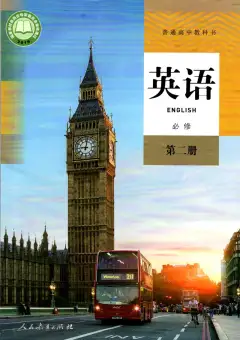
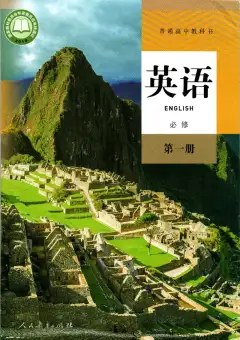
普通高中教科书
第二册
选择性必修
普通高中教科书
第二册
选择性必修
主
编:陈
琳
北京
主 编:陈 琳
副 主 编:张连仲
编 者:刘 晓 李陆桂 张京生 钱建源 徐 浩 雷传利
(按照姓氏笔画排序)
项目策划:王 芳 王 勇
项目负责:张黎新 郎 崧 张 涛
基础教育出版分社:
地 址:北京市西三环北路19 号 外研社大厦 基础教育出版分社(100089)
咨询电话:(010)88819117/88819688
传 真:(010)88819423
本教材是外语教学与研究出版社根据教育部制定的《普通高中英语课程标准(2017 年版)》,在充分
调研和科学论证的基础上推出的中小学“一条龙”英语教材——《英语》(新标准)的高中部分。
本教材的主编为北京外国语大学陈琳教授,副主编为张连仲教授,编写团队包括国内高校的知名专家
学者、教研人员和一线教师。陈琳教授秉承周恩来总理提出的“一条龙”外语教学理念,总结自己从事
外语教育工作70 年的经验,提出了符合中国外语教育实践的教育理论——辩证实践外语教育途径,并在
《英语》(新标准)教材中贯彻实施。
根据教育部2017 年新课程标准的精神,我们启动了《英语》(新标准)高中教材的修订工作。本次
修订全面依托新课程标准要求,坚持陈琳教授的特色理论,由陈琳教授、张连仲教授指导编写团队,在充
分考虑我国英语教育实际学情和教情的前提下,进行了全面的框架重建和内容设计,保证了理论与实践的
紧密结合。
《英语》(新标准)高中教材共分10 册:1—3 册为必修课程教材,4—7 册为选择性必修课程教材,
8—10 册为选修课程中的提高类教材。
选择性必修课程教材与必修课程教材形成递进关系,进一步夯实基础,为学生的深度发展与进阶做好
准备,既适应今后高考的普遍要求,也能够适应学生今后人生和职业发展的语言需求。《英语》(新标准)
选择性必修课程教材的主要特色如下:
一、坚持立德树人根本任务。在教材的选材、内容、语言等各个方面突出学科的育人本质,帮助学生更好
地培育中国情怀,坚定文化自信,拓展国际视野,形成正确的世界观、人生观和价值观。
二、突出学科核心素养的重要性,全面培养学生的语言能力、文化意识、思维品质和学习能力,帮助学生
逐步形成正确的价值观念、必备品格和关键能力。
三、坚持理论与实践的辩证关系。从语言实践的角度设计教材的主题架构、内容结构直至每一项具体活
动,确保有实践、可实践,并通过实践促进提升,帮助学生形成素养,发展素养。
四、遵循“理解—发展—实践”的原则,以“主题”为纲设计单元任务,重要题材在各册教材中均得到体
现,且内容逐步扩展加深、螺旋式上升,符合语言教学规律。
五、语篇题材多样、体裁丰富,语言地道鲜活、难度适中,符合学生的兴趣特点,同时能够提升学生的语
篇意识,丰富语言感知与学习体验。
六、活动设计紧密围绕主题语境,更加突出综合技能的整合训练,充分体现了英语学习活动观;同时强调
交际情境的真实性和丰富性,帮助学生掌握语言技能、建构完善的知识基础,在实践中逐步形成交际
能力,培养在获取信息、处理信息、重构信息过程中的逻辑思维、多元思维和批判性思维。
七、强调学习策略的培养,鼓励学生通过体验、实践、讨论、合作、探究等方式,利用各种学习资源完成
学习任务、解决学习中的困难;同时鼓励学生在学习过程中及时进行自我反思和评价,进一步提升自
主学习能力。
八、突出文化意识(尤其是跨文化意识)的建构与发展。通过介绍及比较中外文化,帮助学生更好地理解
文化异同,学会理解和包容不同文化,提升道路自信、文化自信,将文化知识内化为正确的文化价值
观和有利于国家和个人发展的跨文化态度与意识。
九、为教师编写了流程清晰、内容丰富的教师用书,帮助教师快速理解教材内容和相关背景知识,明确教
学目标,掌握教学节奏;同时开发了配套的网络教材和其他多媒体配套资源,丰富课程资源,拓展教
学模式。
我们希望,《英语》(新标准)高中选择性必修课程教材能够进一步培养学生的语言能力、文化意识、
思维品质和学习能力等英语学科核心素养,为他们继续学习英语和终身发展打下坚实的基础。
《英语》(新标准)系列教材
高中阶段编委会
前 言
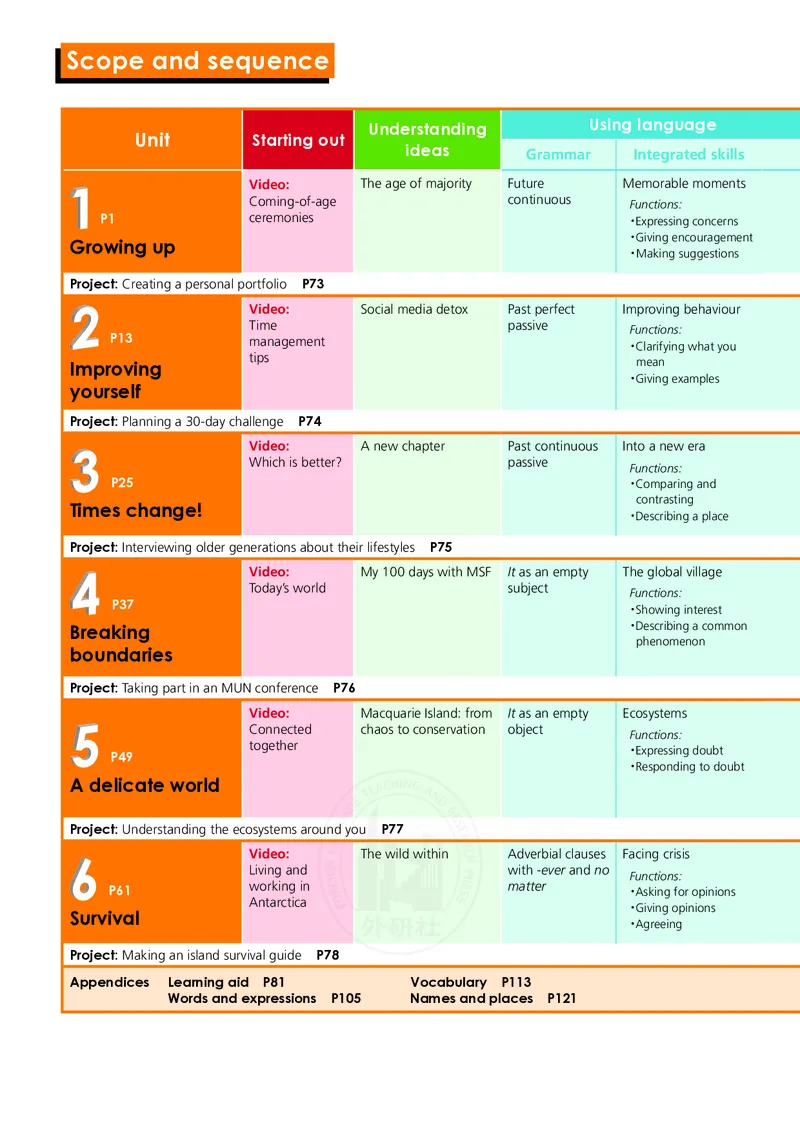
Scope and sequence
Unit
Starting out
Understanding
ideas
Using language
Grammar
Integrated skills
P1
Growing up
Video:
Coming-of-age
ceremonies
The age of majority
Future
continuous
Memorable moments
Functions:
・Expressing concerns
・Giving encouragement
・ Making suggestions
Project: Creating a personal portfolio P73
P13
Improving
yourself
Video:
Time
management
tips
Social media detox
Past perfect
passive
Improving behaviour
Functions:
・Clarifying what you
mean
・Giving examples
Project: Planning a 30-day challenge P74
P25
Times change!
Video:
Which is better?
A new chapter
Past continuous
passive
Into a new era
Functions:
・Comparing and
contrasting
・Describing a place
Project: Interviewing older generations about their lifestyles P75
P37
Breaking
boundaries
Video:
Today’s world
My 100 days with MSF
It as an empty
subject
The global village
Functions:
・Showing interest
・Describing a common
phenomenon
Project: Taking part in an MUN conference P76
P49
A delicate world
Video:
Connected
together
Macquarie Island: from
chaos to conservation
It as an empty
object
Ecosystems
Functions:
・Expressing doubt
・Responding to doubt
Project: Understanding the ecosystems around you P77
P61
Survival
Video:
Living and
working in
Antarctica
The wild within
Adverbial clauses
with -ever and no
matter
Facing crisis
Functions:
・Asking for opinions
・Giving opinions
・Agreeing
Project: Making an island survival guide P78
Appendices Learning aid P81 Vocabulary P113
Words and expressions P105
Names and places P121
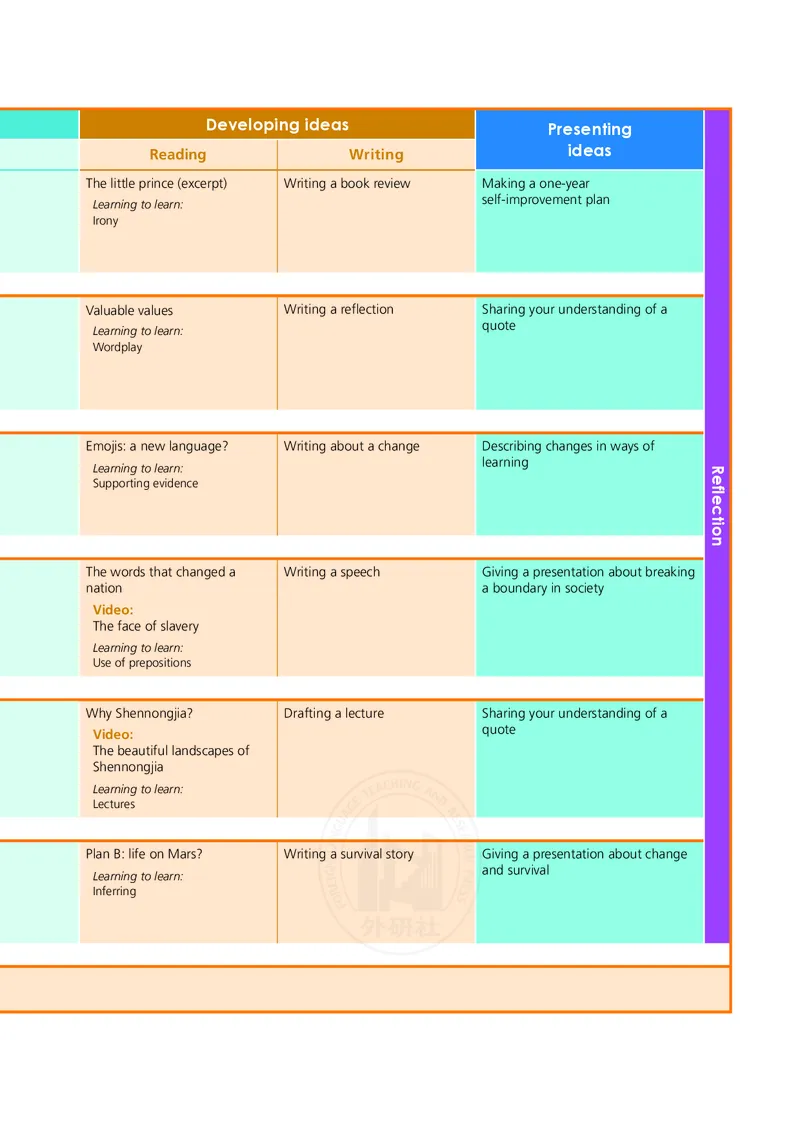
Developing ideas
Presenting
ideas
Reading
Writing
The little prince (excerpt)
Learning to learn:
Irony
Writing a book review
Making a one-year
self-improvement plan
Valuable values
Learning to learn:
Wordplay
Writing a reflection
Sharing your understanding of a
quote
Emojis: a new language?
Learning to learn:
Supporting evidence
Writing about a change
Describing changes in ways of
learning
The words that changed a
nation
Video:
The face of slavery
Learning to learn:
Use of prepositions
Writing a speech
Giving a presentation about breaking
a boundary in society
Why Shennongjia?
Video:
The beautiful landscapes of
Shennongjia
Learning to learn:
Lectures
Drafting a lecture
Sharing your understanding of a
quote
Plan B: life on Mars?
Learning to learn:
Inferring
Writing a survival story
Giving a presentation about change
and survival
Reflection
同学们,欢迎大家继续《英语》(新标准)高中教材的学习!
经过必修课程教材的学习,大家已经打下了更为扎实的英语基础,达到了高中英语学业质量水
平一的要求。现在大家应根据升学或就业的需要,对自己的学习目标提出更高的要求。由教育部制
定并颁布的《普通高中英语课程标准(2017 年版)》明确规定:普通高中英语课程作为一门学习及
运用英语语言的课程,与义务教育阶段的课程相衔接,旨在为学生继续学习英语和终身发展打下良
好基础。普通高中英语课程强调对学生语言能力、文化意识、思维品质和学习能力的综合培养。这
就是同学们在高中阶段学习英语的方向和目标。
要达到这个目标,需要大家的主观努力,也需要一套适应更高更广的语言学习需求的教材。《英
语》(新标准)高中选择性必修课程教材在延续了必修课程教材的基础上,为有升学要求或有个性化
发展需求的学生设计,在话题内容、语言理论、语言技能、跨文化意识、思维能力、学习能力等方
面,都提出了更高的要求,延伸出了如下特点:
一、作为必修课程教材的延续,选择性必修课程教材的话题选择更注意广度和深度,既关注话题的
现实意义,又关注语言学习的思想内涵,充分反映语言的发展和社会的进步,力求培养同学们
的文化意识和思维能力。
二、选择性必修课程教材具体语篇内容的选择将会引导大家进入英语语言学习的较高阶段。课文中
不但会出现更有挑战性的阅读篇章,同时还会根据每个单元的主题补充更多语篇供大家阅读并
赏析,提高语言水平和鉴赏能力。
三、思维方面,选择性必修课程教材对高阶思维做了更多要求,且对思维过程的启动、运行和开展
均做了更多的过程分解与清晰化设计,更强调基于同学们头脑中已有的内容及其再加工,与新
的语言和内容输入相结合,产生更丰富、更复杂的认知互动,深化思维发展活动。
四、在新课标规定的英语学习活动观的指导下,遵循“理解—发展—实践”的原则,对活动的要求
进一步提升,在“功能运用”板块中,将原有的词汇和听力部分整合成综合语言运用活动,通
过创设符合单元主题的话题,设计一系列首尾呼应、前后紧密关联的活动串,灵活融入听、说、
读、看、写等各项技能的训练,兼顾学习策略、功能和文化的引导与思考,帮助大家全方位提
升综合语言运用水平。
五、根据该阶段教学特点、教学内容和教学要求,充分遵循循序渐进的原则,强调对义务教育阶段
和高中必修阶段语言知识的复现、综合练习与重新认识,以形成内化的语用能力。
六、在呈现更为丰富多彩的文化现象的同时,更加强调中外文化对比,尤其是中国文化、中国故事、
中国传统价值观和世界问题的中国视角的介绍,让大家更好地理解文化异同,形成正确的文化
价值观和有利于国家、个人发展的跨文化态度与意识。
七、在单元学习的过程中帮助大家总结学习成果,发现问题并及时解决,最后通过对单元主题、语
言、文化思维等多方面提出问题,帮助大家写出自我反思日志,既完成了对学习目标、语言知
识和技能、思维品质、文化意识等维度的自我评价和总结,更显性体现了学习和思维的过程,
帮助大家进一步培养自主学习和反思总结的能力。
我们衷心希望,同学们能够通过学习本教材,了解到更加丰富的信息,在理解祖国文化、坚定
文化自信的同时,发展跨文化交流能力,更好地适应宽广的世界。愿《英语》(新标准)伴随同学们
度过有意义的高中时代!
致 同 学
1
Watch the video and answer the questions.
1 What is a coming-of-age ceremony? How
do people celebrate in the video?
2 Which celebration makes the greatest
impression on you? Why?
2
Listen and read the poem. Answer the
questions.
1 What is the poem about?
2 According to Kipling, what qualities does
his son need to “be a Man”? Tick those
mentioned in the poem and add your own
ideas.
self-belief
honesty
confidence
kindness
modesty
pride
integrity
patience
other _________________________
3 Which of these qualities are most important
to you as you grow up?
Growing up
U
N
I
T
If you can keep your head when all about you
Are losing theirs and blaming it on you;
If you can trust yourself when all men doubt you,
But make allowance for their doubting too;
If you can wait and not be tired by waiting,
Or, being lied about, don’t deal in lies,
Or, being hated, don’t give way to hating,
And yet don’t look too good, nor talk too wise;
…
If you can talk with crowds and keep your virtue,
Or walk with kings – nor lose the common touch;
If neither foes nor loving friends can hurt you;
If all men count with you, but none too much;
If you can fill the unforgiving minute
With sixty seconds’ worth of distance run –
Yours is the Earth and everything that’s in it,
And – which is more – you’ll be a Man, my son!
(Excerpts from If – by Rudyard Kipling)
If –
Starting out
1
1
Discuss at what age you are allowed
to do the following things in China.
• Get a credit card.
• Get a driver’s licence.
• Get a full-time job.
• Get the right to vote.
• Get a bank loan.
• Rent an apartment.
In most countries, turning 18 marks the start
of adulthood. But what does reaching this
milestone, the age of majority, really mean?
Will you be completely in charge of your own
life and able to express yourself in new and
exciting ways? What new responsibilities will this
freedom bring? Here, three young people tell us
what turning 18 means, or meant, to them.
Understanding ideas
2
Read the passage and find out
the meaning of “the age of
majority”.
Majority
The Age of
2
UNIT 1
2
I celebrated my 18th birthday just before I went to university.
I expected to feel instantly different, as if I had closed the door on
my childhood and stepped into a whole new adult world. But it
wasn’t like that. When I woke up the next day, there were still rules
to obey and lessons to attend. In fact, the change has been more
subtle and gradual than I imagined. Instead of being the selfish
teenager I used to be, I have begun to feel more aware of other
people and to develop a stronger sense of social responsibility.
To give an example, I will be signing an organ donation agreement
this time tomorrow. This was a big decision for me and I made it
without asking my parents (although I knew they would approve).
Turning 18 also changed the way that society viewed me. I was
really surprised when a bank contacted me with a credit card offer.
Of course, I would like to have more freedom with money and no
doubt I will be getting a credit card at some point, but I currently
don’t have a steady income, so getting a credit card might tempt
me to spend more money than I have!
Lin Ning
19, Shanghai, China
Bethany
16, Victoria, Australia
Morgan
20, Florida, the US
1
I can’t wait to be 18. One reason is that although I’ve been working
ever since leaving school, I won’t be voting in the next general
election. Why? Because I still won’t be old enough. Surely, if you’re
old enough to earn a wage and pay taxes, you should be allowed
to have a say on how the government spends them! I’ve also been
taking driving lessons, and in fact I will be taking my driving test
on the very day I turn 18. My mum worries about me being behind
the wheel. As an ambulance driver, she’s seen a lot of car accidents
involving teenagers and thinks the legal age for getting a driving
licence should be 21. But I think I’m already mature enough to
understand that driving a car also means taking responsibility for
my life and the lives of other people.
3
People say that 18 marks a new chapter in our lives, and that we
should become more independent. I used to believe this, but the
reality for me has been very different. I assumed I’d already have
a well-paid job and that I’d be moving into a rented apartment as
soon as I turned 18, but how wrong I was! My librarian’s salary
means that I’ll be living at home with my parents for a while
longer. Because I contribute to the household bills and my commute
to work is quite expensive, I find it hard to save any money. I’ll
be starting a new job next month, however, so maybe things will
get easier. I know I could get a bank loan to pay the deposit on
my very own apartment, but I don’t feel ready to make that kind
of commitment, and I do like my mom’s cooking. I guess some
responsibilities are more about attitude than age.
Growing up
3
Think Share
&
1 Do you think the minimum age limits in the passage are sensible?
Why or why not?
2 What right are you most looking forward to having as an adult? Why?
3 What do you think it means to be a responsible adult?
4 How can you use the language you have learnt in the passage to express your
ideas clearly?
3
Choose another suitable title for the passage and give your reasons.
1 Eighteen – the Age of Indecision
2 Teenagers’ Hopes for the Future
3 The Right to Vote – Your Views
4 Turning Eighteen – What Does It Mean?
4
Organise information from the passage and complete the table.
5
Read the sentences from the passage and decide if they are facts (F) or opinions (O).
1 Surely, if you’re old enough to earn a wage and pay taxes, you should be allowed to
have a say on how the government spends them! _____
2 … I will be taking my driving test on the very day I turn 18. _____
3 When I woke up the next day, there were still rules to obey and lessons to attend. _____
4 I guess some responsibilities are more about attitude than age. _____
Now look for more opinions in the passage and talk about whether you agree
with them.
I think it’s strange that I can
now take
1_________________,
yet I still can’t vote – I don’t
think that’s fair, given that
2_________________.
I should have a say on
3_________________.
I’m mature enough to
4_________________.
At 18, I can do things like getting
a credit card. More importantly,
I can act on my desire to
help others, for example by
5_________________. But
although a lot of doors have
opened for me, there are still
6_________________.
I thought that once I was 18
and in a full-time job I’d be able
to
7_________________, but
my salary is not high enough.
I also find it hard to save money
because of
8_________________
and high commuting costs.
Lin Ning
19, Shanghai, China
Bethany
16, Victoria, Australia
Morgan
20, Florida, the US
4
UNIT 1
Future continuous
1
Look at the sentences and answer the
questions. Sentence (a) is from the reading
passage.
a … I will be signing an organ donation
agreement this time tomorrow.
b … I will sign an organ donation agreement
tomorrow.
2
Work in pairs. Take turns to ask and answer
questions based on the information in
the schedule.
3
Complete the email with the correct form
of the verbs in brackets. Use the future
continuous tense where possible.
4
Write a reply to Diana to tell her about your
own plans for the future.
A: What will you be doing at 8:50?
B: I’ll be attending the welcoming ceremony.
What will you be doing at 9:30?
A: …
08:45–09:00
welcoming ceremony
09:10–11:30
archery lessons
12:00–13:00
lunch
13:30–15:30
treasure hunt
16:00–18:00
swimming
18:30–19:30
dinner
Dear George,
It’s great to hear from you. Thanks for the
birthday card!
You asked if I have been thinking a lot about
the future now that I’m 17. The answer is
yes! Things change so quickly, don’t they?
I mean, in just a year’s time, I
1____________
(be) an adult. And this time next year,
I
2____________ (take) my final school exams.
Hopefully I
3____________ (pass) them! Then,
in a couple of years’ time, I
4____________
(study) at university. It seems like no time at
all! I
5____________ (choose) law, I think.
After graduation, I
6____________ (look) for
a job related to law. In the long term, I hope
that 20 years from today, I
7____________
(work) as a judge. Let’s see how things go.
What are you hoping to do in the future?
Tell me about your plans.
Kind regards,
Diana
From:
Diana
To:
George
Subject: Plans for the future
SUMMER CAMP
SUMMER CAMP
SCHEDULE
1
DAY
Using language
1 Which sentence signifies an activity in progress
at a particular time in the future?
2 Why does the author choose to use sentence (a)
instead of sentence (b)?
Now look for more sentences with the future
continuous tense in the reading passage, and
summarise its use in your own words.
Growing up
5
Memorable moments
7
Listen again and complete the table.
Concerns
Suggestions
I’ve never been away from
home, so I don’t know how to
1_________________.
Think how it will
help you prepare for
2_________________,
and ask others
3_________________.
I might have a different routine
to
4_________________ and
they might not be very pleasant
to
5_________________.
When living in a group,
6_________________ are
really important.
I will no longer be able to
7_________________ as much
as before if I have to follow a
strict dorm schedule.
Try joining some clubs.
You might make
8_________________.
I suppose that I will
9_________________.
Speak to them regularly
over the phone or via
10_________________.
Now work in pairs. Talk about other difficulties the girl
may face and make suggestions.
8
Complete the boxes with the expressions from the
conversation.
• I’m afraid I can’t…
• Don’t be afraid!
• I’m worried that…
• What if…?
• It’s a good idea to…
• I’m concerned that…
• Perhaps you could…?
• How about…?
• Good luck with…
Expressing concerns
Giving encouragement
Making suggestions
5
Read the passage and answer
the questions.
1 What is your understanding of the
first sentence?
2 What is the author’s attitude
towards life? Do you agree with it?
6
Listen to the conversation and
answer the questions.
1 What is the relationship between
the speakers?
2 What are they talking about?
Like a musical symphony, life
has high and low moments, and
somewhere in between are those
moments we call “bittersweet”.
As students, it’s likely that those
moments are mainly about school
life, such as sitting a major exam,
giving a presentation, or becoming
a boarder for the first time. But as
life continues, we’re presented with
more varied experiences: starting
university, getting a job and raising
a family. Whatever our choices are,
we should cherish and embrace
these moments in life. After all,
each step we take is one more step
forward to becoming a stronger
and better person.
9
Work in pairs. Discuss a challenging moment in your life.
6
UNIT 1
11
Complete the online message board with the correct
form of the words and expressions in Activity 10.
10
Listen to the conversation and tick the
words and expressions mentioned.
12
Work in pairs. Share a most memorable moment
from your life using the words and expressions in
this section.
Now think about your performance. How well
did you understand your partner and give an
effective response?
get a job
get married
have children
learn to walk
retire
start school
graduate from
college
Share your special moments with us!
1 I’ve been working for 40 years and am going to
next month. I’m going to practise
calligraphy in my free time.
5 I first
when I was 16 years old.
Serving customers at a restaurant is hard work
but I managed to stick at it.
6 I
before I was one. Mum said I was
curious about everything around me and caused a lot
of trouble!
7
is the greatest thing that’s happened
to us. They bring us so much happiness, despite the
hard work.
8 When I got a full-time job, I decided to
and
rent my own apartment. I enjoy the freedom and the sense
of independence.
2 I’ll
this June, and leave the
campus I’ve lived on for four years.
3 We
in our early 20s. We’ve had our
ups and downs, but we’ve now been married for ten
mostly happy years!
4 I was a little scared when I
at six
years old. But I soon made a lot of new friends and fell
in love with school!
leave home
Growing up
7
1
Read the introduction to Antoine
de Saint-Exupéry and answer the
questions.
1
Once when I was six years old I saw a magnificent
picture in a book, called True Stories from
Nature, about the primeval forest. It was a picture
of a boa constrictor in the act of swallowing an
animal. Here is a copy of the drawing.
2
In the book it said: “Boa constrictors swallow
their prey whole, without chewing it. After that
they are not able to move, and they sleep through
the six months that they need for digestion.”
3
I pondered deeply, then, over the adventures of
the jungle. And after some work with a colored
pencil I succeeded in making my first drawing.
My Drawing Number One. It looked like this:
4
I showed my masterpiece to the grown-ups, and
asked them whether the drawing frightened them.
5
But they answered: “Frighten? Why should anyone
be frightened by a hat?”
6
My drawing was not a picture of a hat. It was
a picture of a boa constrictor digesting an
elephant. But since the grown-ups were not able to
understand it, I made another drawing: I drew the
inside of the boa constrictor, so that the grown-
ups could see it clearly. They always need to have
things explained. My Drawing Number Two
looked like this:
The Little Prince
1 What experience made the author
write The Little Prince?
2 What kind of person do you think
Saint-Exupéry was?
2
Look at the three drawings and
predict what the story is about.
Now read the passage and check
your prediction.
Antoine de Saint-
Exupéry (1900–
1944) was a French
writer and pilot.
As a young boy, he
was obsessed with
aeroplanes, riding
in one for the first time at the age of
12. He spent much of his life flying
and writing about his adventures.
Saint-Exupéry’s most successful work,
The Little Prince, is one of the best-
selling books ever published. The story
was probably inspired by his plane
crash in the desert in 1935. Saint-
Exupéry nearly died, and wandered
around for four days before being
rescued. In 1944, Saint-Exupéry left
on a wartime mission over occupied
France, from which he never returned.
Although the remains of his plane
were discovered in 2000, Saint-
Exupéry’s body has never been found,
and the cause of his death remains
unknown.
Developing ideas
8
UNIT 1
7
The grown-ups’ response, this time, was to
advise me to lay aside my drawings of boa
constrictors, whether from the inside or
the outside, and devote myself instead to
geography, history, arithmetic and grammar.
That is why, at the age of six, I gave up what
might have been a magnificent career as a
painter. I had been disheartened by the failure
of my Drawing Number One and my Drawing
Number Two. Grown-ups never understand
anything by themselves, and it is tiresome for
children to be always and forever explaining
things to them.
8
So then I chose another profession, and learned
to pilot airplanes. I have flown a little over all
parts of the world; and it is true that geography
has been very useful to me. At a glance I can
distinguish China from Arizona. If one gets lost
in the night, such knowledge is valuable.
9
In the course of this life, I have had a great
many encounters with a great many people
who have been concerned with matters of
consequence. I have lived a great deal among
grown-ups. I have seen them intimately, close
at hand. And that hasn’t much improved my
opinion of them.
10 Whenever I met one of them who seemed to
me at all clear-sighted, I tried the experiment of
showing him my Drawing Number One, which
I have always kept. I would try to find out, so,
if this was a person of true understanding. But,
whoever it was, he, or she, would always say:
11 “That is a hat.”
12 Then I would never talk to that person about
boa constrictors, or primeval forests, or stars.
I would bring myself down to his level. I would
talk to him about bridge, and golf, and politics,
and neckties. And the grown-up would be
greatly pleased to have met such a sensible man.
(Excerpt from The Little Prince by Antoine
de Saint-Exupéry)
Growing up
9
3
Choose the author’s attitude towards grown-ups and find evidence to support
your choice.
1 Grown-ups are more practical than children. They want to teach children knowledge
that will be useful in the future.
2 Grown-ups are no better than children. They lack imagination and only care about
matters of consequence.
3 Grown-ups are more knowledgeable than children. They can understand everything
by themselves.
4
Read the sentences from the passage and answer the questions.
Think Share
&
1 What were the
grown-ups’ responses to the
author’s Drawing Number One and
Drawing Number Two? Why do you
think they responded in this way?
2 According to the author, what is a
child’s most valuable trait? Do you
agree with him?
3 After reading the two passages
in this unit, think about what you
may acquire and lose as you grow
up. Share your ideas with the class.
Opinions:
Examples:
5
Work in groups. Give a talk about your attitude
towards grown-ups.
1 Decide whether you agree with the author’s attitude
towards grown-ups and why.
2 Think of some examples to support your opinions and
make notes.
3 Organise your talk following the steps below.
• Explain the author’s attitude towards grown-ups.
• State your own opinions.
• Give supporting examples.
• Conclude by summarising your opinions.
4 Give your talk to the class.
Now think about your performance during the group
discussion. How well did you actively participate and
contribute ideas?
Irony is a subtle figure of speech that refers
to things one says that are the opposite of
what one really means. It has a humorous,
emphatic or sarcastic effect. For example:
Fine, don’t buy me an airline ticket. I’ll just swim
across the ocean!
Learning to learn
… I have had a great many encounters with a great many people who have been
concerned with matters of consequence.
And the grown-up would be greatly pleased to have met such a sensible man.
1 What does the author really mean by these sentences?
2 What figure of speech does the author use? How does this figure of speech help to
express the author’s attitude?
10
UNIT 1
6
Read the book review and find the information
on the right.
Writing a book review
• the title of the book
• the name of the author
• the genre
• a memorable character
• a quote from the book
7
Read the book review again and answer
the questions.
1 What is the plot of the book?
2 What is the key message of the book?
3 What does the reviewer think of the book?
8
Choose a book that means a lot to you. Plan
a review of it and make notes.
9
Work in pairs. Make improvements to each
other’s book reviews and share them with
the class.
BOOK REVIEW
Now write your book review.
General facts about the book:
Plot of the book:
Comments:
Conclusion and recommendation:
The Little Prince was written and illustrated by the
French writer Antoine de Saint-Exupéry during
World War II. It is a children’s fantasy book, but it
is also enjoyed by adults.
It tells a story about a pilot who has crashed in
the desert. While he is trying to fix his aeroplane,
a little prince comes to him. Visiting from another
planet, the little prince recounts his adventures to
the pilot, and the two become friends.
The book talks about the importance of looking
beneath the surface of things to uncover their real
meanings. I like it because it is simple, and yet it
really made me think a lot about life and death,
love and responsibility, friendship and loneliness.
One of the most memorable characters in the
book is a rose, which the little prince fell in love
with. I was really touched by the line – “It’s the
time you spent on your rose that makes your rose
so important.” – because it shows how we form
special bonds with others by caring and taking
responsibility for them.
Personally, I think this is a touching
book that everyone should read,
whatever their age.
The Little Prince
Growing up
11
1
Work in groups and discuss how to make a one-year
self-improvement plan. Consider the following:
• what you have learnt from the past
• what you plan to achieve
• what you plan to avoid
• what you plan to overcome
2
Complete the table to help you draft your plan.
Goals
What to do
healthy living
Eat more fruit and vegetables.
Drink more water. Do exercise
three times a week.
positive thinking
3
Share your draft with your group and suggest ways to make
improvements to each other’s plans.
4
Prepare a short presentation about your plan. Consider the following:
1 the structure of your presentation
2 useful words, expressions and structures
5
Give your presentation to the class. Check your self-improvement
plan one year from now to see if you have achieved your goals.
Presenting ideas
Write a reflection after completing this unit. Consider the following:
1 What is your understanding of growing up?
2 What text types have you learnt about? What are their features?
3 What words, expressions and structures have you learnt?
4 What improvement have you made in understanding different cultures?
5 What improvement have you made in using learning strategies and exploring effective ways
of learning?
6 What improvement have you made in analysing and solving problems?
Reflection
12
UNIT 1
Improving yourself
1
Watch the video and answer
the questions.
1 What is the video about?
2 What other tips are there to
make full use of your time?
Share your ideas with the class.
2
Complete the questionnaire
and find out how good your
self-control is.
U
N
I
T
1 Do you ever lose your temper with your family, friends,
or classmates?
a Never.
b Sometimes. c Always.
2 Do you find it difficult to resist temptations such as
junk food?
a Never.
b Sometimes. c Always.
3 Do you have any bad habits that you cannot break?
a None whatsoever! b Some. c Where do I start?
4 Do you sometimes fail to get work done because you
cannot concentrate?
a Never.
b Sometimes. c Always.
5 Do you ever offend people by speaking carelessly?
a Never.
b Sometimes. c Always.
Turn to Page 88 to find out your result.
SELF-CONTROL
Questionnaire
Starting out
13
1
Read the facts and answer
the questions.
1 What conclusions can you draw
from the facts?
2 How much time do you spend
on social media each day? What
negative effects does this have
on you?
2
Look at the title of the passage
and the pictures. Predict what the
passage is about.
Now read the passage and check
your prediction.
• On average, Chinese Internet
users each spend two hours a day
on social media: a total of 730
hours each year.
• The average age of social media
users in China in 2017 was 33.1
years old, as against 32.4 in 2016
and 31.2 in 2015.
• The top four negative aspects of
social media as ranked by Chinese
users are: reduced time for reading
printed books, poorer eyesight,
privacy and information security
concerns, and reduced sleep time.
Understanding ideas
I lasted two days. The detox was more
difficult to tolerate than I had expected.
I felt like I had lost an arm! Not eating for
two days would have been easier! But on
reflection, I can see how much of my time had
been occupied with checking my phone. I’m
now trying to spend less time online and more
time picking up my hobbies.
I lasted four days. On Monday, my classmate
and I spoke about what we did at the
weekend – it felt really strange not to already
know what he had done. We would usually
have posted pictures and updated our profiles.
Doing the detox meant we had to talk and
explain what we were doing and thinking!
It made me realise the value of real contact
that I had forgotten.
Today marks the last day of the Social Media
Detox, Brenton High’s fundraising campaign
for new sports equipment. At the start of the
detox, over 100 students had been persuaded
to stop using social media, in ANY form, for
seven days. This meant no messaging friends, no posting
photos, no blogging – nothing. They had been promised
money by family and friends for each day spent without
using social media. They were excited. They were nervous.
But could they do it?
With the detox now finished, they’ve switched on their
devices and they’re back online. I bet you’re as eager as
I am to find out just how many have been motivated
enough to last the full seven days! And what, if anything,
has been learnt from the experience?
Anna
17
Devon
16
Moderator
14
UNIT 2
SOCIAL MEDIA DETOX
Cindy
18
George
16
Max
17
I managed the whole week! At first,
I really felt I was missing out. Then,
instead of messaging my friend,
I went round to her house. Without
our phones, we had a proper
conversation for over two hours,
without being distracted by messages
from other people. It felt so good!
Then I decided to visit a different
friend every day. By the fifth day,
I wondered – was I really missing out
by not constantly checking my phone
to see what everyone else was up to?
I did all seven days, too! To be honest,
I didn’t find the detox too difficult,
but I did give my phone to my dad to
avoid giving in! My brother thought
I should make full use of the time
without my phone, so he took me to
check out our local sports centre.
An hour’s sport each day left me tired
out and wanting to go to bed early.
The detox made me healthier!
The detox raised a total of
£1,632.82 for new school sports
equipment! Well done, everyone
who took part! After reading the
posts on this forum, it seems that
something other than money has also been raised
through the detox. Awareness of just how much
we rely on social media can help us step away
from it and communicate with each other better.
Moderator
I’m embarrassed to say that I threw in
the towel on the first day! I knew there
was a party happening that evening,
but without access to social media
I couldn’t remember where it was! In
the end, I turned on my phone to check,
but couldn’t resist having a quick look
at my social media accounts. What’s
worse, I then spent so much time
catching up on news, I almost missed
the party!
Improving yourself
15
Think Share
&
1 What is your understanding of “something” in “After reading the
posts on this forum, it seems that something other than money
has also been raised through the detox”?
2 Do you think the detox was worthwhile? Why?
3 What would you do if you had to give up social media for a week?
4 Have you encountered any difficulties in understanding the main idea of the
passage? Share them with the class and ask for advice.
3
Choose the benefits of the social media detox and find evidence to support
your choices.
1 It helped students learn how to best communicate using social media.
2 It raised money for school sports equipment.
3 It made students want to spend even more time on social media.
4 It made students realise how much time they had been spending on social media.
5 It encouraged students to find new ways to communicate and try new activities.
4
Organise information from the passage and complete the summaries.
Devon
Reaction: When he saw a classmate on
Monday, he felt
3____________ not to
already know what his classmate had
done at the weekend.
Result: They had to talk and explain
what they were doing and thinking!
It made him realise
4____________.
Anna
Reaction: It was more
difficult than she had
expected. She felt like
1____________!
Result: She can now see
how much time had been
taken up with checking
her phone. She is now
trying to spend more time
2____________.
Cindy
Reaction: At first, she
really felt
5____________.
Result: Without their
phones, she and her friend
6____________ for over
two hours. By the fifth
day, she realised that she
hadn’t been missing out
on anything.
George
Reaction: He didn’t find the detox too difficult,
but he did give his phone to his dad to avoid
7____________.
Result: An hour’s sport each day left him tired
out and ready for bed early. The detox made him
8____________!
Max
Reaction: He
9____________ on the first day. He
used his phone to check where a party was.
Result: He spent so much time using his phone to
10____________ on social media, and he almost
missed the party.
Social
Media
Detox
Now work in pairs. Choose the person that you most identify with and give advice
on what they should do next.
2 Days
4 Days
7 Days
7 Days
Less than 1 Day
16
UNIT 2
Past perfect passive
a At the start of the detox, over 100 students had been persuaded to stop using social media,
in ANY form, for seven days.
b At the start of the detox, people had persuaded over 100 students to stop using social media,
in ANY form, for seven days.
1 Were the students in sentence (a) persuaded before the detox started, or afterwards?
2 What is the difference between sentences (a) and (b)?
3 Why does the author choose to use a passive form instead of an active form?
Now look for more sentences with the past perfect passive in the reading passage, and summarise
its use in your own words.
2
Complete Jack’s blog post with the correct form of
the verbs in brackets.
4
Work in pairs. Talk about what had
happened before you started a new
habit of your own. Use the past
perfect passive where appropriate.
1
Look at the sentences and answer the questions. Sentence (a) is from the reading passage.
Two weeks ago
Before I turned over a new leaf,
I had always been a very lazy
student. I was careless about
handing in my homework, and none
of my assignment deadlines
1____________ (meet).
Indeed, I would deliberately “lose” my homework
in my incredibly messy room, so that I could put off
2____________ (do) it! My parents soon worked out this
trick, though, and one day I came home to find that
my room
3____________ (clean), and my homework
4____________ (put) right in the centre of a spotlessly
clean desk! A present
5____________ (leave) on the
desk, too (I think Mum did that): a book called The Art
of Procrastination.
The author, John Perry, said that procrastination was
about
6____________ (avoid) the hardest and most
important tasks. So,
7____________ (make) sure you
do your homework, put it second or third on your
to-do list, not at the top. Then put one or two really
hard things you don’t want to do at the top of the list.
You will procrastinate to avoid the hard stuff – by doing
your homework!
Posted by Jack at 13:34
But two weeks ago, Jack’s room was like
this:…
Using language
Yesterday morning
3
Work in pairs. Describe the pictures
using the past perfect passive.
Jack started the habit of cleaning his
room last week. This is what his room
looked like yesterday morning.
Improving yourself
17
Improving behaviour
5
Match the sentences to the signs. Pay attention to the words and expressions in bold.
1 Do not litter.
2 Do not talk loudly in public.
3 Do not spit in public.
4 Do not walk on the grass.
5 Do not smoke.
6 Do not take photos.
6
Complete the conversations with the correct form of the words and expressions in
Activity 5.
1 A: What do you do when people __________________?
B: I put my headphones on. I don’t want to hear other people’s conversations.
2 A: How can we stop people __________________?
B: We should tell them it’s dirty and it can spread diseases.
3 A: What would you do if you saw people __________________?
B: I would go up to them and ask them to put the litter into a rubbish bin.
4 A: How can we prevent people from __________________?
B: If we keep the grass looking really neat, maybe people will realise they shouldn’t
walk on it.
5 A: What would you do if you saw someone __________________ where it’s not allowed?
B: I’d politely remind them it’s not permitted, and that they should be considerate
of others.
6 A: What would you do if you saw someone __________________ in a museum?
B: I’d ask them to stop, because it can damage the exhibits.
Now work in pairs. Think of more types of inappropriate behaviour and talk about
what you think is the right thing to do when faced with them.
a
d
b
e
c
f
18
UNIT 2
9
Complete the boxes with the
expressions from the interview.
10
Work in groups. Discuss how to
promote values education at
your school using the words and
expressions in this section.
Now talk about how well you did in
offering effective advice or ideas and
developing effective solutions in the
group discussion.
Now work in pairs. Talk about the significance of
promoting values education in schools.
• I can give a couple of examples.
• That is…
• Let me clarify…
• For instance, …
• I mean…
• Take… as an illustration.
• To put it another way, …
Clarifying what you mean
Giving examples
7
Listen to the interview and choose a topic for it.
1 How to promote values education.
2 How to inspire students to work hard.
3 How to introduce school programmes.
4 How to fairly distribute books and umbrellas.
8
Listen again and complete the newspaper report.
A school in our city came up with an innovative
programme to promote the traditional value of
1_________________. School principal Ms Wu gave
several examples of how the programme works.
To begin with, the school introduced an activity
called the “unsupervised examination” for some of
the classes. That means during this examination,
there is no teacher
2_________________. Before
taking this examination, students first need
to
3_________________. Students generally
expressed that it’s good to feel
4________________
and they quite enjoyed
5_________________
in the examination. In turn, they developed
6_________________.
The school also introduced what is called the
7“_________________”. Printed on each umbrella
was a short statement about
8_________________.
At the end of the term, all the umbrellas were
returned
9_________________. None of them had
been lost or damaged.
Now Ms Wu and her colleagues plan to introduce
the programme to
10_________________. Everyone
needs to work together to build a culture of
honesty. They hope more teachers and students
will get involved.
Improving yourself
19
1
Look at the chart and answer the questions.
1
The spending power of young people
varies from person to person. Each,
however, is faced with the same question:
what to do with their money? Some handle
this less well than others. Recent headlines
have seen more and more teens maxing
out their parents’ credit cards on games or
other online activities.
2
In contrast to these big spenders, there are
also teens that prove age is no barrier to
making good use of money. With the help
of her grandmother, eight-year-old Khloe
Thompson started making “Kare Bags” for
the homeless people in her district. Inside
the bags are necessities such as toothpaste,
soap and socks, bought first with her
pocket money and then through crowd
funding. These items helped to make the
lives of poor and homeless people a little
bit easier. On receiving a Kare Bag, one
woman said, “You make me feel like a
human being.”
V
aluable
Developing ideas
Values
Spending
1 What are the top three things students from
this school spend their money on?
2 What else do you think students often spend
their money on?
Now think about what you spend your
money on. Draw a chart to show your
spending habits and share it with the class.
2
Read the passage and find out the meaning
of the title.
Wordplay uses the sounds and meanings of similar
words in an amusing or clever way, for example:
I was trying to discover how lightning worked, and then
it struck me! It can also be used to reinforce the
meanings of themes: in the title The Importance of
Being Earnest, “Earnest” is an adjective as well as
a character’s name.
Learning to learn
snacks
books and magazines
clothes
sports
computer games
parties
school supplies
films and concerts
other
presents
15.5%
11.7%
17.5%
17.5%
5.8%
3.9%
9.7%
1.9%
5.8%
10.7%
Spending habits of students at
No.1 Senior High School
20
UNIT 2
3
However people intend to use their money,
managing it seems to be unprecedentedly
important to younger generations. A 2016
study said 17 states of the US require high
school students to take courses in personal
finances. For those who have no access to
courses, help might be at hand thanks to
Jerry Witkovsky and his method of using
four jars to teach teenagers how to spend
their money wisely.
4
When Jerry’s grandchildren turned 13, his
present to each of them was three jars: one
for Spending, one for Saving, and another
for Giving – he has since added a fourth jar
for Investing. It was from then on that his
grandchildren started to be in control of what
to do with the money they receive: spend, save,
invest or give? Jerry’s birthday present to his
grandchildren is, however, much more than
money and a few jars – he is giving them the
opportunity to learn lifelong values.
5
The value taught with the Spending jar is that
you are responsible for your own happiness.
Money gives you independence and the
opportunity to buy something you like. After
all, it’s OK to be nice to yourself!
6
While the Spending jar is about the here and
now, the Saving jar gives you a vision for the
future. This could involve saving for university,
but it could also mean saving for that special
something you’ve seen in the stores – it’s up
to you.
7
The Investing jar not only represents a vision
for the future, but gives the opportunity to
build for the future. Although this could
likewise involve putting aside money for your
university education, it also means investing
in yourself.
8
The Giving jar is all about kindness and
helping. Whether you want to help out a
friend, give money to an animal charity or to
children in another country, it’s your money
to give to whatever cause you believe in.
9
The wider aim of the jars is to encourage
teenagers to think more objectively about
money and the things that it can do, so that
they grow up understanding, if you like, the
value of the valuable. In this way, they will be
better equipped in their adult lives to make
informed choices about how they use the
money they have. Indeed, the small
change inside their jars could mean
a big change in how they manage
their money.
Investing
Saving
Giving
Improving yourself
21
3
Organise information from the passage and complete the diagram.
Think Share
&
1 Why does the author use the example of Khloe Thompson?
2 How does the passage inspire you to improve your spending habits?
3 If you were given 1,000 yuan, how much money would you put in each jar?
Give your reasons.
4 What methods of self-management have you learnt in the two reading passages in
this unit? What else do you need to improve?
4
Work in groups. Give a talk about your understanding of the values represented by
the four jars.
1 Read the passage again and think about which jar you believe is the most important.
2 Organise your ideas by completing the notes.
It is all about
7_________________.
Whoever or whatever the recipient,
it’s your money to give to
8_________________.
Valuable
Values
You are responsible for
1_________________. Money gives you
independence and
2_________________.
It gives you a vision for
3_________________. This could involve
saving for university or saving for
4_________________.
It represents a vision for the future and
the opportunity to
5_________________.
In addition to putting money aside
for university education, it also means
6_________________.
The most important jar:
3 Share your ideas with the group.
4 Choose a group member to summarise your group’s opinions to the class.
Now think about the method Jerry Witkovsky used to give advice. How did it help
you to better understand the topic?
Supporting examples:
Reasons:
Spending jar
Investing jar
Giving jar
Saving jar
22
UNIT 2
5
Read the story and answer the questions.
Writing a reflection
There once was a little boy who had a bad temper. His
father gave him a bag of nails and told him that every time
he lost his temper, he must hammer a nail into the back of
the fence.
The first day, the boy hammered so many nails into the
fence that his father had to give him a whole new bag.
Over the next few weeks, as he learnt to control his anger,
he hammered fewer and fewer nails into the fence each
day. He had learnt that it was easier to hold his temper than to hammer nails into the
fence. Finally, the day came when the boy didn’t lose his temper all day, not even once.
He told his father, who said that now the boy should pull out one nail for each day that
he was able to hold his temper.
The days passed by and the boy was finally able to tell his father that all the nails were
gone. The father took his son and led him to the fence. He said, “You’ve done well, son,
but look at all the holes in the fence! That fence will never be the same. When you say
something in anger, it leaves a hole in someone’s heart, just like your nails have left holes
in the fence. It doesn’t matter how many times you say sorry. The hole is still there.”
7
Work in pairs. Make improvements to each other’s reflections and share them with
the class.
Now write your reflection.
1 What aspect of self-management is the passage about?
2 What message do you think the story conveys?
6
Make notes about the story in Activity 5.
Conclusion:
My thoughts:
Summary of the story:
Improving yourself
23
Presenting ideas
1
Work in groups. Talk about the meanings of the quotes and
complete the table.
Quotes
Meanings
a
b
c
d
e
2
Choose one quote and make notes.
Write a reflection after completing this unit. Consider the following:
1 What is your understanding of self-management?
2 What text types have you learnt about? What are their features?
3 What words, expressions and structures have you learnt?
4 What improvement have you made in understanding different cultures?
5 What improvement have you made in using learning strategies and exploring effective ways
of learning?
6 What improvement have you made in analysing and solving problems?
Reflection
What is the main message of the quote?
What can you learn from this quote?
What example(s) can you find to support this quote?
3
Prepare a short presentation about the quote. Consider the
following:
1 the structure of your presentation
2 useful words, expressions and structures
4
Give your presentation to the class.
Procrastination is like a credit
card: it’s a lot of fun until you get
the bill.
�
Christopher Parker
b
No man is free who is not
master of himself.
�
Epictetus
c
Change your thoughts, and you
change your world.
�
Norman Vincent Peale
d
Don’t say you don’t have enough
time. You have exactly the same
number of hours per day that
were given to Helen Keller,
Pasteur, Michelangelo, …
Leonardo da Vinci, Thomas
Jefferson, and Albert Einstein.
�
H. Jackson Brown Jr
e
The superior man must be watchful
over himself when he is alone.
�
Zeng Zi
君子必慎其独也。
曾子
a
24
UNIT 2
Times change!
1
Watch the video and answer the
questions.
1 What is the video about?
2 Which do you prefer, a faster pace
of life or a slower pace of life?
2
Look at the pictures and answer
the questions.
1 What kinds of changes do the
pictures show?
2 What else can you think of that
has changed in recent decades?
3 Imagine you could travel 40 years
back in time. What would you
want to experience? Why?
U
N
I
T
Starting out
25
1
Look at the charts and answer the questions.
1 What information do the charts show?
2 What conclusions can you draw from
these charts?
2
Look at the title of the passage and the
pictures. Think about what the title means.
Now read the passage and check your answer.
1
The day I heard that the Rainbow Bookstore
was closing after 50 years of business, I was
heartbroken. The bookstore, which was a
legendary fixture in the neighborhood, was
a place where anyone could drop in and
connect through their love of books.
2
When I hurried to the store, I saw that the
books were already being packed into boxes.
I had a long chat with Casey, the store’s
elderly owner. Sighing deeply, he told me
how it was becoming difficult to run an
independent bookstore. Most young people
preferred reading e-books on tablets. More
and more customers were being attracted by
chain stores and online discounts. I tried to
think of some words of sympathy, but
I had to admit that the Rainbow Bookstore
couldn’t stay in business much longer.
3
Childhood memories came back to me
so clearly, as if the events had happened
only yesterday. A bunch of us kids would
frequently drop by the store after school.
We’d look at the new books, or just chat
with Old Casey. He knew every book in
the store and would always pick the perfect
one for us from a dusty shelf. We spent
Understanding ideas
Sales made by physical bookstores in China
(hundred million yuan)
338
335
330
343
344
336
344
2011
2012
2013
2014
2015
2016
2017
0
100
200
300
400
500
Sales made by online bookstores in China
(hundred million yuan)
A
New
Chapter
2011
2012
2013
2014
2015
2016
2017
90
130
170
210
280
365
459
0
100
200
300
400
500
26
UNIT 3
hours reading, seated on the store’s old but
comfortable furniture. Casey encouraged us to
share our ideas and comments on the books,
by writing them on a large board in one corner
of the store.
4
When I left the bookstore, it was becoming cold
and dark outside. I turned to wave goodbye
to Casey, but both he and his bookstore were
already hidden in a thick mist. It made me
realize that the bookstore and all that Old
Casey had given to the community could soon
disappear for good.
5
A few months later, I was back in the
neighborhood during my spring break and was
surprised to see that the Rainbow Bookstore
was still there and open for business. Its old
brick exterior hadn’t changed, but inside it
was like a different world. In one area, a book
reading was being delivered. Nearby, customers
were poring over shelves selling stationery,
posters and other best-seller-themed gifts. The
large board in the corner had been replaced by
a big screen, where customers’ comments on
the month’s best-seller were being displayed.
Clearly, the Rainbow Bookstore was in good,
creative hands.
6
I was told that the community had decided
to work together on a campaign to save the
Rainbow Bookstore. The campaign had been
led by Jennifer Oakley, a saleswoman who had
grown up in the neighborhood and who had
now taken over the bookstore from Casey.
7
Under Jennifer’s leadership, the bookstore was
being turned into a place for literature-loving
members of the community to get together.
It had a café selling organic food, and there
were now more community events such as
book readings, poetry recitals and even jazz
concerts and movie nights, where people could
gather to share an experience that couldn’t
be downloaded.
8
I joined Casey, who was looking up at the
screen on which readers’ comments kept
popping up. “Well, as you can see, corporate
knowledge combined with creativity has
brought my humble bookstore into the 21st
century! I’m so pleased to see that everything
I wanted it to offer to the community is
still here.”
Times change!
27
Similarities
Think Share
&
1 Do the author’s childhood memories make the passage more
appealing? Why or why not?
2 What do you think of the changes made to the bookstore?
3 What changes do you think will happen to the bookstores around you?
4 How does the diagram help you to better understand the passage?
Now describe the author’s feeling towards the Rainbow Bookstore in your
own words.
• owned by Casey
• sells books
• owned by Jennifer
Old Bookstore
New Bookstore
3
Choose the ideas conveyed in the passage and find evidence to support
your choices.
1 Traditional bookstores can’t compete with large bookstore chains.
2 People’s love of reading never changes.
3 Technology has been a key factor in bringing the Rainbow Bookstore back to life.
4 Creativity plays an important role in the new Rainbow Bookstore.
4
Organise information from the passage and complete the diagram.
28
UNIT 3
Past continuous passive
a When I hurried to the store,
I saw that the books were
already being packed into boxes.
b When I hurried to the store,
I saw that the books were
already packed into boxes.
1 What is the difference between
sentences (a) and (b)?
2 Which sentence emphasises
process and which emphasises
result?
Now look for more sentences with
the past continuous passive in the
reading passage, and summarise
its use in your own words.
2
Rewrite the passage using the past
continuous passive.
3
Look at the two groups of pictures and describe
the changes in the news industry using the past
continuous passive where appropriate.
4
Describe the changes in another industry using the past
continuous passive where appropriate.
1
Look at the sentences and answer
the questions. Sentence (a) is from
the reading passage.
interview / do / online
news / release / the Internet
news / read / online
news / print / paper
interview / do / face to face
newspaper / deliver / at the door
Using language
Walking home a few days ago,
I saw that people were doing
reconstruction work on the old
market. It would be turned into
a modern shopping mall. Some
people were tearing down the old
gate. Some were removing the
wooden stands. Some were clearing
away rubbish from the floor. While
all this was going on, a journalist
was taking photos. The resulting
story in the local newspaper divided
the people of the town: some were
in favour of the new shopping mall,
and some were against it.
news / edit / computer
news / edit / pen
Yesterday, I watched a documentary about the news
industry in the past. I saw that an interview was being done
face to face. But now, interviews can be done online…
Times change!
29
Into a new era
5
Read the passage and answer the
questions. Pay attention to the
expressions in bold.
1 What is the passage about?
2 Can you explain the meaning of
the expressions in bold in your own
words?
7
Listen to the interview and choose its purpose.
1 To find out what changes Shenzhen has undergone
after the introduction of the reform and opening-up
policy.
2 To understand how people feel about the way life has
changed in Shenzhen this century.
3 To show what the first special economic zone looks
like now.
4 To figure out how life is different for the older and
younger generations in Shenzhen.
More than 40 years ago, China
began to implement the reform and
opening-up policy, starting out on a
journey that would pave the way for
China to become a fully-modernised
socialist country. The policy has
had a great influence on Chinese
society. It has allowed China to
accomplish in just four decades what
took Western industrialised countries
more than 200 years to achieve,
breaking new ground in the history
of human achievement. This ongoing
journey is allowing China to share
the fruits of its success and develop
further alongside other countries.
What’s more, the Belt and Road
Initiative will mean a new dawn
for trade and investment between
countries, leading into a new era
of prosperity.
6
Complete the speech with the correct form of the
expressions in Activity 5.
Dear friends,
Thank you for coming together to celebrate the first
anniversary of Tech-Hub Business Park. It’s great to
see so many of you representing the many different
companies that have made the park their professional
home. What started as an idea by local entrepreneurs
1_____________________ for this town to become
known as a centre of technology and formed a solid
basis for future business development.
Like everyone else in this town, we are proud
that the Tech-Hub companies continue
2_____________________ in technology.
Such innovation will, without doubt,
3_____________________ of technological
discovery. What’s more, it seems that Tech-Hub
4_____________________ on local schools, with
more students than ever applying to study Computer
Science at university. Tech-Hub remains thankful to the
community and promises
5_____________________ of
our success with the town.
Thank you!
30
UNIT 3
8
Listen again and complete the interview record.
9
Complete the boxes with the
expressions from the interview.
• … has undergone rapid
development…
• At that time…
• … was only a small town…
• There’s been a huge change!
• It has developed into… with…
• Compared with the past, …
• In the past, …
• But now…
• … is a very special place.
• It’s full of…
• … is a place where…
Comparing and contrasting
Describing a place
10
Work in pairs. Describe the changes
in your home town using the
expressions in this section.
Now think about how well you can
use the language you have learnt
to express yourself.
INTERVIEWEE
Personal information
Has lived in Shenzhen for
1_________________
Occupation:
2_________________
Impression of Shenzhen
In the past
Shenzhen was a small town
3_________________. There
were not many people living there and there were
no
4_________________. People made a living from
5_________________.
In the present
It has developed into
6_________________ with modern
skyscrapers and a population of
7_________________.
Life in Shenzhen
In the past
People stayed in the same area, and one day
8_________________.
In the present
Each day brings something new.
9_________________
keep coming.
Life is
10 _________________ and it’s certainly interesting!
Comments on Shenzhen today
Shenzhen is a special place full of
11_________________.
It is a place where young people can
12_________________.
Now talk about the changes in Shenzhen in your
own words.
No.1
Times change!
31
1
Look at the messages and answer
the questions.
1 Which message is easier to understand?
Which message do you prefer? Why?
2 Which way do you use to send messages?
2
Look at the title of the passage and predict
the author’s attitude towards emojis.
Now read the passage and check your
prediction.
1
While waiting outside the cafeteria,
I received the following message from
my friend:
2
It took me a minute before I realised what
it meant. The signs he used were to say
that he’d be running late and would be
there soon. Instead of replying with
a simple “OK, don’t rush”, I searched for
emojis on my phone that would express
the same message:
3
This was my attempt to follow the trend
of communicating with emojis. Emojis
are used everywhere, from text messages
to emails, blogs and other social media
networks. With the rapid development
of social media, emojis are becoming an
integral component of the language we use
to express ourselves.
4
The word “emoji” comes from Japanese,
literally meaning “picture character”.
HBD! Won’t tell ppl
how old U R!
We’re what to have 4
I but J wants U?
Today 9:44 AM
Today 9:44 AM
Happy birthday! I won’t tell
people how old you are! Ha! Ha!
We’re thinking about what to
have for dinner. I love sushi, but
Jason wants pizza. What would
you like?
Max
Max
Messages
Messages
Details
Details
13:34 PM
20%
13:34 PM
20%
Developing ideas
32
UNIT 3
Emojis are small symbols representing ideas,
emotions or feelings. They come in different
categories, such as faces and people, plants and
animals, and food and drink.
5
When first introduced in Japan in 1999, emojis
were limited to 176 simple designs. Now there
are more than 3,000 emojis that expand upon
the way in which we communicate. Due to
their popularity, the Oxford Dictionaries Word
of the Year in 2015 was, for the first time ever,
a pictograph
instead of a traditional word.
6
In today’s world, emojis have become more
and more popular. It seems that emojis have
clear advantages over written language. People
like them because they add emotional meaning,
and are quick and easy to use. In fact, this is
similar to the gestures we use when we speak.
With a smiling or sad face added to a message
or post, your reader can “see” your facial
expression while reading your words. Emojis
can also help people express their feelings
when they cannot find the appropriate words.
For instance, if your friend is moving across
the country, you may just send them a string
of crying faces to express your sadness over
your separation.
7
The use of emojis has even spread to classical
literature. A Shakespeare series for young
readers has taken William Shakespeare’s
popular plays and replaced some words with
textspeak and emojis. The intention of these
adaptations is to make the classics more
accessible to young readers. Some people,
however, believe that these new versions
have taken away the heart and soul of
Shakespeare’s plays.
8
As we can see, emojis have a tendency to
pop up all over the place. Users of emojis
say that they facilitate the way in which we
communicate and express ourselves. But this
makes others, especially educators, worry
that we are losing the ability to communicate
properly using the written word, or even the
spoken word. After all, how many of us today
would rather send a message packed with
emojis than make a telephone call? Perhaps
people will one day choose to communicate
in pictures, and forget how to write properly.
On that day, emojis will have become a real
pictorial “language”. But, for now, maybe it’s
best that we just enjoy using them.
15:55 PM
80%
Emojis: a new language?
Times change!
33
3
Choose the author’s purpose in writing the passage and give your reasons.
1 To guide readers to use emojis properly.
2 To discuss the development and influence of emojis.
3 To criticise the increased use of emojis.
4 To entertain readers with examples of how emojis have been used.
Think Share
&
1 Do you think the Shakespeare series with emojis is an effective way
to encourage young readers to read the classics? Give your reasons.
2 What do you think about the way people use emojis?
3 What lifestyle changes does each reading passage in this unit focus on? What is the
common message conveyed in both passages?
4
Work in groups. Give a talk about the sentence from the passage.
Perhaps people will one day choose to communicate in pictures, and forget how to
write properly.
1 Read the sentence and decide whether you agree or disagree with it.
2 Provide three reasons to support your ideas and give evidence for each reason. Make notes.
Now think about what you have learnt from the
opinions of your classmates. Have they helped to
change your opinion in any way?
Reasons:
Evidence:
When you give your opinion, your argument will be stronger
if it is supported by evidence. Evidence can come from
primary sources, such as original documents and interviews,
or secondary sources, such as books and magazines.
Learning to learn
3 Give your talk to the class.
34
UNIT 3
5
Read the passage and answer the questions.
Writing about a change
I was watching a superhero film the other day and
a thought occurred to me: where does Superman get
changed these days? In the comics and earlier films,
Clark Kent would pop into a phone box to change into
his Superman costume. But these days, phone boxes are
hard to find. The main reason for this is simply that we
don’t need them anymore. Almost everyone these days
carries a mobile phone with them. It is certainly more
convenient to take out a mobile and make a call at the
touch of a button than to press a series of long numbers
on a telephone. And anyone who happens to leave their
mobile phone at home will still have no use for a phone
box. Why? Because they are unlikely to remember the
number they want to call – that’s something that our
mobile phones do for us these days. And even if we could
remember a number and needed to call it urgently, it
would still be more convenient to borrow a mobile phone
from someone else than walk around looking for a phone
box. So, the phone box is becoming a thing of the past.
Poor Clark Kent will have to find somewhere else
to change!
6
Think about something that might
disappear in the future and complete
the table.
Something that will not be around
in the future
Reasons
Supporting arguments
Now write your passage.
7
Work in pairs. Make improvements to
each other’s passages and share them
with the class.
1 Why does the author start the passage by writing
about Superman?
2 What will disappear in the future according to
the passage? What is the major reason for this
phenomenon?
3 What supporting arguments does the author give
to make the point convincing?
Lifestyle
Where Does
Get Changed
These Days?
SUPERMAN
SUPERMAN
Times change!
35
1
Work in groups. Look at the pictures and answer the questions.
1 What can you see in the pictures?
2 What changes in our ways of learning do the pictures show?
2
Think about how learning will change in the future and
complete the table.
Learning activities
Changes
homework
exam
3
Prepare a short presentation. Consider the following:
1 the structure of your presentation
2 useful words, expressions and structures
4
Give your presentation to the class.
Presenting ideas
Write a reflection after completing this unit. Consider the following:
1 What is your understanding of the driving force behind the changes to our lifestyles?
2 What text types have you learnt about? What are their features?
3 What words, expressions and structures have you learnt?
4 What improvement have you made in understanding different cultures?
5 What improvement have you made in using learning strategies and exploring effective ways
of learning?
6 What improvement have you made in analysing and solving problems?
Reflection
36
UNIT 3
1
Watch the video and answer the
questions.
1 Which statistic surprises you most?
2 What message do you think the
video conveys?
2
Look at the pictures and answer
the questions.
1 What kind of problem do the
people have in each picture?
2 Which of these problems have you
experienced? Give an example.
U
N
I
T
Breaking boundaries
Starting out
37
1
Read the information about MSF
and answer the questions.
1
Today we celebrate. It’s exactly one month since the
last reported case. But it is vital not to take any chances.
So, 20 health care workers from almost as many
countries, comrades in arms, raise virtual glasses to
each other.
2
I arrived in Liberia with MSF almost three months ago.
When I saw the tragic scenes on the news, I felt it was
my duty as a doctor to go there and offer my help.
I knew I was putting my life at risk, but I thought,
“If I don’t do it, who will?” It is important to remember
that Ebola doesn’t respect national boundaries. There
are no borders for doctors, for patients or for anyone
else involved in combating this terrible disease.
3
My mission was to relieve Emma, a Canadian specialist
in infectious diseases at the end of her posting. Emma
spent an hour with me in the staff room talking me
through the daily routine. As she talked, I could hear
at least three different languages being spoken at the
tables around us. Later, Emma introduced me to some
of the others working for or alongside MSF: Wilton,
a young local man, who helped carry the very sick into
the treatment clinic and who disinfected clothing and
surfaces; Maisy, a retired public health official from
Darwin, Australia, whose local team of volunteers
educated people on preventing infection; Alfonso,
a soft-spoken Argentinian doctor in his 50s, who
had previously worked on Ebola outbreaks in Sierra
Leone and Guinea. The list went on. I found that I
was the only Chinese doctor among people of all ages,
1 When was MSF founded and what
does it do?
2 What is the top priority of MSF?
3 What else do you know about it?
2
Read the journal of an MSF doctor
and find out what problem he was
involved in tackling.
Understanding ideas
Médecins Sans Frontières (MSF),
or Doctors Without Borders in
English, was founded in Paris in
1971 by a group of doctors and
journalists. It is an independent,
non-profit organisation whose
mission is to provide medical care
to those affected by conflict,
epidemics, disasters or a lack of
access to health care. It assists
people based on need, regardless
of which country they are from.
The top priority goes to those in
the most serious and immediate
danger. Today, MSF has
over 67,000 team
members from
over 150 countries
and regions.
MY 100 DAYS
WITH MSF
22 March 2015
38
UNIT 4
colours and beliefs, from every continent except Antarctica. With
each person I met, I felt a growing sense of pride as part of this
extraordinary team, whose devotion to the cause shone from
their eyes.
4
In the few weeks since then, I have come to know these people
very well. We have worked together, surrounded by blood, vomit
and death. But, although the death rate is very high, we will never
give up on a patient, and our efforts do sometimes end in miracles.
5
Just after my arrival, a family of six were brought here in the back
of a van. All of them were infected. The twin girls and their parents
soon died. We knew there was little hope for the brothers, but we
did everything we could to save them. When we visited the ward
the next morning, we were amazed to see that against all odds,
both boys were still alive. Pascal and Daniel have since made a full
recovery. This small but unexpected success compensated for many
other less fortunate cases.
6
To be caught up in such a crisis creates powerful bonds between
people, not only between carers and patients, but also between all
those who have come from different parts of the world and joined
together in a common cause. It is so inspiring to have colleagues
like Wilton, Maisy and Alfonso, not to mention all the others I
have worked with.
7
Now my time is almost up. In a few days, someone else will arrive
to step into my shoes, and the tireless work that the MSF members
do in more than 70 countries and regions around the world will
go on. In a world still facing so many problems, it is absolutely
essential for us all to collaborate to create a global community
with a shared future of peace and prosperity.
Breaking boundaries
39
Time
Experiences
Feelings
Before
arrival
How I made up my mind: _____________________________
My 100
days
What I did on arrival: _________________________________
What my daily work was like: __________________________
___________________________________________________
An unforgettable case: _______________________________
___________________________________________________
Now
What is special about today: _______________________
What we are doing: __________________________________
3
Choose the ideas conveyed in the passage and find evidence to support your choices.
1 It is not the first time the author has worked with MSF.
2 The work with MSF in Liberia is life-threatening.
3 The author enjoyed working together with all his colleagues.
4 The author always felt frustrated with the high death rate.
Now use five adjectives to describe the spirit of MSF doctors and give your reasons.
4
Organise information from the passage and complete the table.
Now read the information and answer the questions.
1 What is your understanding of “a community with a shared future for mankind”?
2 How is the idea reflected in the MSF doctor’s journal?
Think Share
&
1 What is your understanding of the first sentence in Paragraph 6?
2 What difficulties do you think the author might have faced during his work?
3 Do you know of any other similar organisations? What do they do?
4 What have you learnt from the passage that can help you talk about “a community
with a shared future”?
We call on the people of all countries to work together to build a community with a
shared future for mankind, to build an open, inclusive, clean, and beautiful world that
enjoys lasting peace, universal security, and common prosperity.
From Xi Jinping’s report at the 19th CPC National Congress
40
UNIT 4
It as an empty subject
3
Describe the city using the
information provided and it as
an empty subject.
a But it is vital not to take any chances.
b But not to take any chances is vital.
c It is important to remember that Ebola doesn’t respect
national boundaries.
d To remember that Ebola doesn’t respect national
boundaries is important.
1 What does “it” refer to in sentences (a) and (c)?
2 What is the difference between the sentences in each
group? Why does the author choose to use sentences (a)
and (c) instead of (b) and (d)?
Now look for more sentences with this structure in
the reading passage, and summarise its use in your
own words.
Beijing
• not a surprising thing / students
see different skin colours in the
same class
• possible / people hear many
different languages and dialects
• easy / people find products from
all over the world
• not difficult / foreigners settle
down and find a job
• a common thing / people from
different countries work in the
same company
Beijing today is multicultural. It is not a
surprising thing for students to see…
4
Describe one of the cities using
it as an empty subject where
appropriate. Do online research
if necessary.
• Toronto
• Shanghai
• London
• Sydney
According to the “2017 Hollywood Diversity Report”,
to get roles in American film and television is no
longer quite so difficult for women and minorities.
This is another small but important advance against
gender and racial discrimination.
The report analysed 200 films released in 2015 and
1,206 TV shows from 2014 to 2015, and discovered
that to become a leading actor in Hollywood is now
a more realistic hope for minority actors. In more
good news, to write and direct Hollywood films is
more common than before for women.
The bad news is that there is still a long way to go.
Leading roles are more likely to be given to white
actors. Asian American actors, in particular, still face
problems. Even now, to cast white actors as Asian
characters is seen as acceptable by film studios. But
at least the report shows that things are moving
slowly in the right direction.
1
Look at the sentences and answer the questions.
Sentences (a) and (c) are from the reading passage.
Using language
2
Rewrite the underlined parts using it as an empty subject.
Breaking boundaries
41
The global village
5
Read the passage and answer the questions.
Pay attention to the expressions in bold.
6
Complete the letter with the correct form of
the expressions in Activity 5.
Nowadays, people
all over the world
are becoming
more and more
connected, as if
the world were
getting smaller – as
if we were living in a
“global village”.
Technology is largely responsible for
bringing people together. Channels of
communication, such as the mobile phone
and the Internet, have made it possible
to speak instantly with someone on the
other side of the planet, enabling us to
form close connections with people of
completely different cultures. The television,
meanwhile, is a window on the world,
giving us quick and easy access to other
cultures and lifestyles.
Cultural exchange helps us to be more
inclusive and to overcome culture shock.
But inclusiveness doesn’t mean that our
cultures will merge into one another.
Rather, it’s about countries and people
making a joint effort to come together
to create a more harmonious and
understanding world, so that we can
all enjoy the mutual benefits.
1 What phenomenon does the passage
describe?
2 What effect does technology have on
cultural exchange?
Dear Editor,
Your article about living in a global village
really struck a chord with me because I’ve just
returned from a teaching project in Cambodia
and Thailand. I had been worried about the
1______________, but fortunately the other
volunteers and local teachers were really
welcoming. We were able to
2_____________
each other as well as our students.
Throughout, we made
3______________ to
make our classes a success, so that we could
all enjoy the
4______________ of working well
together. It was rewarding to see how our
work helped
5______________ from different
cultures. Before I went, TV and the Internet
were my
6______________, but being there in
person was even better. I think the experience
has taught me to
7______________ and I can’t
wait to do it all over again.
Paul
7
Listen to the conversation and choose the
main idea.
1 More and more foreign words and expressions
are entering the English language, especially
those about food.
2 Chinese food is popular in the UK, and many
Chinese words and expressions are entering
English dictionaries as a result.
3 Intercultural communication is increasing,
and people all over the world have a better
understanding of each other.
4 World sports are bringing people together in
the same way that food is.
42
UNIT 4
8
Listen again and complete the table.
Phenomena
Examples
More and more
1____________________ into
dictionaries these days.
From Devon: grockle
From Chinese: wok, chow mein,
2____________________ and chop suey
Besides words, changes also happen to
3____________________.
In a large Asian supermarket, there are
4____________________ from Asia.
There are
5____________________ in the male
speaker’s city, such as
6____________________.
Many European people can
7____________________.
Sports also play an important role in
8____________________.
It is not a surprise to see
9____________________
while watching the UEFA Champions League
live and not unusual to find people enjoying
10____________________ on the other side of
the world.
Now talk about more examples of each phenomenon.
9
Complete the boxes with the expressions
from the conversation.
• Really?
• That’s interesting.
• Is it really?
• It is really amazing…
• I also find it interesting to see…
• No wonder it isn’t a surprise to see…
• It is not unusual to find…
Showing interest
Describing a common phenomenon
10
Work in pairs. Talk about another
phenomenon of the global village using
the expressions in this section.
Now think about any difficulties you
encountered during your discussion and
what you did to overcome them.
Breaking boundaries
43
1
Watch the video and answer the
questions.
1 How did slave owners regard their
slaves?
2 What was a slave’s life like?
2
Look at the title and skim the passage.
Choose the book in which you would
most likely find the passage.
1 The Power of Speech
2 Famous US Presidents
3 Great Battles in History
1
On a grey afternoon on 19 November 1863,
a tall, thin man mounted a platform in a field in
Gettysburg, Pennsylvania and began to speak.
The place was the site of a recent battle where
thousands of soldiers had died. The man was
Abraham Lincoln, President of the United States
of America, and he was there in memory of the
soldiers who had died. The speech he gave was
just 268 words long and lasted two minutes. But
this address to the crowd changed the minds of his
people and helped shape a nation.
2
At that time, America was bitterly divided. For
two years, its people had been deep in a civil war
between the slave-owning Confederate Southern
States and the “free” Northern States of the Union.
The worst battle lasted three days and took place
at Gettysburg in 1863. The Union side won, but at
a great cost. Over 50,000 soldiers were killed or
wounded, and people lost hope and purpose.
What was all this suffering for?
3
Lincoln understood the feelings of the civilian
people. His speech gave them hope, belief and a
reason to look to the future. He gave them a new
vision of what the United States of America should
be, based on the ideals set down by its Founding
Fathers 87 years before. It was what the soldiers
had died for. Now it was up to the living to
remove not only the divisions between North
and South, but the boundaries between black and
white, and work step by step towards the equality
of humankind.
Developing ideas
The Words That
Changed A Nation
44
UNIT 4
F
our score and seven years ago our fathers brought forth, upon this
continent, a new nation, conceived in Liberty, and dedicated to the
proposition that all men are created equal.
5
Now we are engaged in a great civil war, testing whether that nation,
or any nation, so conceived, and so dedicated, can long endure. We are
met here on a great battlefield of that war. We have come to dedicate a
portion of it as a final resting place for those who here gave their lives
that that nation might live. It is altogether fitting and proper that we
should do this.
6
But in a larger sense, we can not dedicate – we can not consecrate –
we can not hallow this ground. The brave men, living and dead, who
struggled here, have consecrated it far above our poor power to add
or detract. The world will little note, nor long remember, what we say
here, but can never forget what they did here. It is for us, the living,
rather to be dedicated here to the unfinished work which they have,
thus far, so nobly carried on. It is rather for us to be here dedicated to
the great task remaining before us – that from these honored dead we
take increased devotion to that cause for which they here gave the last
full measure of devotion – that we here highly resolve that these dead
shall not have died in vain; that this nation shall have a new birth of
freedom; and that this government of the people, by the people, for the
people, shall not perish from the earth.
(“The Gettysburg Address” by Abraham Lincoln)
4
Breaking boundaries
45
3
Organise information from the passage and complete the notes.
4
Work in groups. Give a talk about the
significance of abolishing slavery in
the US.
1 Organise your ideas by answering the
questions.
• What was the US like before
slavery was abolished?
• How was it different afterwards?
• In what ways did the abolition of
slavery help to break boundaries?
2 Do research to find more evidence to
support your ideas.
3 Give your talk to the class.
Now think about effective ways to find
information to support your ideas.
Think Share
&
1 What was Lincoln’s purpose in
giving the speech?
2 Lincoln talked about government “of the people, by
the people, for the people”. What does this mean?
3 What other speeches can you think of that stress
the importance of breaking boundaries?
4 What efforts to break boundaries are described in
the two reading passages in this unit?
In English, prepositions can be used to show ideas in a clear and
concise way. An example is within the speech: “government of
the people, by the people, for the people”.
Learning to learn
• Speaker: Abraham Lincoln
• Setting (date & place):
___________________________
___________________________
• Background event:
___________________________
___________________________
How did Lincoln describe the founding of the US?
________________________________________________
________________________________________________
What challenges did the Civil War bring to the nation?
________________________________________________
________________________________________________
How did Lincoln describe the men who fought in the war?
________________________________________________
________________________________________________
What was the “great task” that Lincoln described?
________________________________________________
________________________________________________
Who would be responsible for carrying out this task?
________________________________________________
________________________________________________
The
Gettysburg
Address
46
UNIT 4
5
Read the speech on Edgar Snow and answer
the questions.
Writing a speech
6
Complete the table to organise your
own speech about another person who
has helped to increase understanding
between two countries.
Opening
Who the person is:
What boundary he / she has broken:
Body
How he / she achieved this:
Summary
Comments on him / her:
Hello, everyone. Today,
I’m going to introduce
Edgar Snow. Edgar
Snow was an American
journalist who wrote
influential books and
articles about China in
the 1930s. At a time
when relatively little
was known about our
country in the Western
world, his 1937 book Red Star over China broke
ideological boundaries by telling the stories of the
Chinese communist movement from the inside.
Although Snow was not the only international
journalist to set foot in China during the early
decades of the 20th century, what set him apart
from the others was that he actually spent time
with the Chinese Red Army. He listened to their
stories and observed their day-to-day lives, as well as
conducting interviews with Mao Zedong and other
leaders. His biographical accounts and depictions of
historical events, such as the Long March, therefore
captured the spirit of the period and the people living
through it with unprecedented authenticity. Snow is
considered “our American friend”.
I admire Snow’s special insight and bravery, risking
his life during the war to get to the heart of the story
and correct prejudice. For me, Snow’s writing, and
in particular Red Star over China, is a must-read for
anyone with an interest in that period.
1 Who was Edgar Snow?
2 What did he do and what boundaries did he break?
Now write your speech.
7
Work in pairs. Make improvements to
each other’s speeches and share them
with the class.
Now give your speech to the class.
Breaking boundaries
47
1
Work in groups. Look at the pictures and make a list of
boundaries in society.
2
Choose one of the boundaries you have listed and talk about
how to break that boundary by answering the questions.
• What led to the boundary?
• Who is affected by the boundary?
• What can be done to remove the boundary?
• How would society change if the boundary were removed?
3
Prepare a short presentation. Consider the following:
1 the structure of your presentation
2 useful words, expressions and structures
4
Give your presentation to the class.
Boundaries in society:
Presenting ideas
Write a reflection after completing this unit. Consider the following:
1 What is your understanding of breaking boundaries?
2 What text types have you learnt about? What are their features?
3 What words, expressions and structures have you learnt?
4 What improvement have you made in understanding different cultures?
5 What improvement have you made in using learning strategies and exploring effective ways
of learning?
6 What improvement have you made in analysing and solving problems?
Reflection
48
UNIT 4
49
1
Watch the video and answer
the questions.
1 Are humans part of Earth’s
ecosystems? Why?
2 In what ways can humans
affect ecosystems?
2
Look at the satellite images and
answer the questions.
1 What is happening to the
area according to the satellite
images?
2 What do you think a later
satellite image would show?
3 What do you think caused
these changes?
A delicate world
U
N
I
T
Starting out
Satellite Images of Aral Sea, Central Asia
1990
2000
2010
50
UNIT 5
1
Look at the picture and answer the
questions.
2
Read the passage and find out what
happened to Macquarie Island.
1
I am standing on Macquarie Island, in the South-west
Pacific Ocean, halfway between Australia and Antarctica.
Strong winds and stormy seas have helped sculpt its
long, thin shape. The green grass and bare rock of its
landscape contrast dramatically, giving it a wild and
natural beauty. No visitor would think it surprising that
the island is a UNESCO World Heritage Site. Nor would
they fail to imagine how its native inhabitants, including
royal penguins, king penguins, and elephant seals,
existed in perfect harmony with their natural habitat
for thousands of years.
2
But the island’s more recent history tells a different story.
It’s a tragic story that began in 1810 when humans
arrived on the island. In their ships they unknowingly
brought rats and mice. These small animals quickly took
over the island, eating the birds’ eggs and attacking baby
birds. Cats were brought to the island to control the rats
and mice. Unfortunately, the cats subsequently developed
an appetite for the birds, too.
3
Meanwhile, rabbits were introduced to the island as a
source of food for humans. Loose on the island, they did
what rabbits do best – they multiplied rapidly and began
eating the native vegetation and digging holes, which
caused soil erosion. The exploding rabbit population
provided plentiful food for the cats, meaning that the
number of cats also increased. This in turn led to more
cats hunting the birds. The end result was that parakeets,
once large in number and native to the island, died out
in 1891.
Understanding ideas
1 What animals can you see in the
picture?
2 What kind of changes would take
place if cats, rats and rabbits
were introduced to an environment
like this?
51
A delicate world
MACQUARIE ISLAND:
4
Even after Macquarie Island became an
official nature reserve in the 1970s, the
rabbits remained out of control. Experts felt it
necessary to come up with a plan to remove all
the rabbits from the island. With this goal in
mind, a virus was released onto the island. But
although the virus caused the rabbit population
to decrease from 130,000 to around 10,000,
it also meant less food for the cats. The cats in
consequence turned their attention – and their
stomachs – back to the native birds, killing
up to 60,000 each year. In the 1980s, traps
and dogs were used to catch the cats. The last
Macquarie Island cat was caught in 2000.
5
But as the saying goes, “While the cat’s away,
the mice will play.” With the departure of
the cats from the island, the mouse and rat
population started to increase. And remember
those 10,000 or so rabbits? It turned out that
they developed an immunity to the virus, and
their numbers exploded once again. Then, in
2006, the rabbits’ digging caused some land
to collapse, and killed a substantial number of
penguins. This incident made it clear that the
rat, mouse and rabbit problem needed solving
once and for all.
6
So, I am here on Macquarie Island to
participate in the programme to tackle this
very problem. The first step involved poison
being dropped from helicopters. The next
step is to remove the last remaining invading
species, and that’s where I come in – with my
dogs. They have been trained to find every last
one, without harming the native animals. This
intervention is a long, much-delayed ending to
a sad story, but we humans owe it to the island
to give it a happy ending.
from Chaos to Conservation
Postscript: In 2014, Macquarie Island was
declared pest-free and the island’s ecology is
finally on the road to recovery.
52
UNIT 5
3
Choose the author’s purpose in writing the passage and give your reasons.
1 To analyse how Macquarie Island was saved from destruction.
2 To inform readers of the chaos caused on Macquarie Island by humans.
3 To entertain readers with a funny story about what happened on Macquarie Island.
4 To suggest ways in which an ecosystem can be protected.
4
Organise information from the passage and complete the flow chart.
Think Share
&
1 What is your understanding of “… we humans owe it to the
island to give it a happy ending”?
2 Do you think it was right to eradicate the “pests” from Macquarie Island?
Give your reasons.
3 How could similar situations be avoided in the future?
4 What language can you use to talk about cause and effect? How would you
apply it to your reading and writing?
Humans arrived on
Macquarie Island.
To live there.
Rats and mice were brought there by
accident, and _____________________.
To control the rats and
mice.
Rabbits multiplied and caused soil
erosion, and ______________________.
ACTION(S)
PURPOSE(S)
RESULT(S)
Now talk about how human interference led to such severe consequences for
Macquarie Island.
53
A delicate world
The red-eared slider, a species of freshwater turtle,
is native to the Southern United States and Northern
Mexico. Due to its cute appearance, many people think
keeping this turtle as a pet is a good idea. Recent years
have seen more and more pet sliders escaping or being
released from homes, and some owners believe to release
them into the wild is no big issue.
These days, people have found to release these turtles
into the wild is a threat to other species. Experts consider
owners keeping their pets in an
enclosed area important, and
anyone unable to keep their
pets should take them to an
appropriate animal shelter.
It as an empty object
2
Rewrite the underlined parts using it as an
empty object.
a No visitor would think it surprising that the island
is a UNESCO World Heritage Site.
b No visitor would think that the island being
a UNESCO World Heritage Site is surprising.
c Experts felt it necessary to come up with a plan to
remove all the rabbits from the island.
d Experts felt to come up with a plan to remove all
the rabbits from the island was necessary.
3
Look at the pictures of the Saihanba
National Forest Park and describe its
changes using it as an empty object
where appropriate. You may refer to
the words and expressions in the table
for help.
4
Describe how a place you know has
changed using it as an empty object
where appropriate.
1 What does “it” refer to in sentences (a) and (c)?
2 What is the difference between the sentences in
each group?
Now look for more sentences with this structure
in the reading passage, and summarise its use in
your own words.
1
Look at the sentences and answer the questions.
Sentences (a) and (c) are from the reading passage.
nouns / adjectives
to do / that
breakthrough
impossible
likely
unrealistic
…
grow
investigate
plant trees
transform
…
1960s
present day
Using language
I think it a breakthrough to transform
a desert into a forest…
Ecosystems
54
UNIT 5
5
Look at the diagram and answer the questions. Pay attention to the words and
expressions in bold.
Producers absorb water and
dissolved nutrients from the
soil. They also make their own
food by absorbing light from
the sun.
Primary consumers rely
on vegetation to provide
energy. They feed on
green plants.
Secondary consumers prey
on primary consumers,
as well as eating other
animal matter.
Decomposers break down dead animal and vegetable matter into nutrients. The dissolved
chemicals are then released back into the food chain, to be used by producers.
1 What does the diagram show?
2 What are the relationships between the living things?
6
Complete the passage with the correct form of the words and expressions
in Activity 5.
In a woodland ecosystem, trees and other plants are producers. They
1____________
water, and take in nutrients from the soil and energy from the sun. Insects are an
example of a primary consumer. They
2____________ the producers to provide food
for them, and are
3____________ by secondary consumers: small mammals and birds.
They
4____________ the primary consumers. Fungi and bacteria are decomposers.
They
5____________ animal waste and the remains of living things. The chemicals
these decomposers
6____________ fertilise the soil and give the plants the nutrients
they need to grow.
55
A delicate world
?
Did You Know
7
Listen to the conversation and choose the true statements.
1 Bees are very important to our food supply because they
provide honey.
2 The bee population is declining.
3 Without bees, humans would die out.
4 All human crops depend on bees for pollination.
5 If bees became extinct, other insects could pollinate
enough crops.
6 Humans are responsible for the decline in the
bee population.
8
Listen again and complete the flow chart.
9
Complete the boxes with the
expressions from the conversation.
• One of the oldest species in the ecosystem, the honey bee
has been in existence for millions of years.
• A honey bee can fly as fast as 24 kilometres per hour and
its wings can beat 200 times per second.
• In just one journey to collect pollen and nectar, one single
honey bee can pollinate as many as 50 to 100 flowers.
• You must be kidding!
• I don’t believe it!
• It’s a fact!
• Don’t forget that…
• Are you sure about…?
• Check it out for yourself…
• According to statistics…
10
Work in pairs. Talk about what
would happen to the ecosystem
if another species died out. Use
the words and expressions in
this section.
Now think about how your
knowledge helped you contribute
to the discussion.
Expressing doubt
Responding to doubt
Now talk about the importance of bees.
A combination of things damages bee habitats, mainly
1____________.
The bee population is
2____________. According to
statistics, bee numbers in the US
3____________ in just
one year.
➟
➟
Humans have nothing to eat and
die out.
Animals that live on the crops
7_____________.
➟
➟
Without bees, crops would
4_____________.
5___________ would not be able to compensate for the loss
of bees, because
6_____________ of the species of crops.
56
UNIT 5
1
Watch the video and answer the
questions.
1 Where is Shennongjia and what is
it famous for?
2 What else do you know about
Shennongjia?
2
Look at the title of the passage
and think about what it means.
Now read the passage and check
your answer.
1
Good morning, everyone. It is my great pleasure to
give a lecture here on behalf of the Be at One with
Nature Association.
2
As we know, in 2016, Shennongjia made it onto the
UNESCO World Heritage List. But there are so many
important places not yet on this list. So you might
ask: why Shennongjia? Is it its forests that stretch on
and on like great green seas? Is it the legendary father
of Chinese herbal medicine, Shennong, after whom
the park is named? Or is it the mysterious creature
called “Yeren” (wild man) that has captured the
imagination of the world?
3
UNESCO awarded Shennongjia this status because
it meets two criteria required by the list. It contains
a naturally-balanced environment that allows the
many and various species to live and prosper. It is
also one of the rare locations in the world where
scientists can observe in real time the ecological and
biological processes that occur as the plants and
animals develop and evolve.
Developing ideas
The lecture is one of the oldest
teaching methods, and is still widely
used today. A typical lecture often starts
with addressing the topic directly. Data,
examples and comparisons are then
used to support the main ideas. Both
verbal and visual information is used in
order to maintain the audience’s interest.
The end of a lecture is often followed
by a short question-and-answer session.
Learning to learn
57
A delicate world
4
For the first criterion, Shennongjia is
apparently one of the most “complete” natural
areas in the world. The region rises from about
400 metres to over 3,000 metres above sea
level, giving it the name the “Roof of Central
China”. The vast range in altitude results in
a great variation in climatic conditions. This
allows a wide variety of species to thrive.
Some of the plants and animals have survived
millions of years, and are regarded as
living fossils.
5
For the second criterion, we can see that
Shennongjia has incredible biodiversity. Look
at this slide. According to official statistics,
over 3,000 plant species have been recorded
there. This represents more than ten per cent
of China’s total floral richness. Shennongjia
supports more than 600 vertebrate species,
including the Golden Snub-nosed Monkey and
the Clouded Leopard. Additionally, around
4,300 insect species have been recorded.
6
It is a challenge to look after so many species.
In winter, scientists brave heavy snow and
freezing temperatures to supply food to the
Golden Snub-nosed Monkey. Thanks to their
efforts, the monkey’s population has doubled
since the 1980s. Their number reached over
1,300 in 2015 and continues to grow.
7
But the most impressive aspect of Shennongjia
is the local people, who take things from
nature without causing damage. I visited
a local village which is known for its
home-made honey. What is special about the
honey is that it is produced by the earliest
species of Chinese bee. Every spring, the
villagers place beehives around their houses
to attract these wild bees from the forest.
Although endangered elsewhere in China due
to the invasion of foreign species, the bees
of Shennongjia have coexisted with the local
people for centuries. By providing the bees
with a secure home, the villagers collect their
honey in return. This is just one of the ways in
which people of Shennongjia live and work in
harmony with nature.
8
All of this explains why Shennongjia earned –
and deserves – its place on the UNESCO World
Heritage List, as well as highlighting how
understanding, awareness and hard work have
contributed towards protecting a unique and
wonderful part of our natural world.
9
Thank you for listening. Now, does anyone
have any questions?
Why Shennongjia?
58
UNIT 5
4
Work in groups. Give a talk comparing Macquarie Island and Shennongjia.
1 Think about the similarities and differences between Macquarie Island and
Shennongjia and make notes.
3
Read the sentences from the passage and decide if they serve to give data (D),
examples (E) or make comparisons (C).
1 The region rises from about 400 metres to over 3,000 metres above sea level, …
_____
2 … over 3,000 plant species have been recorded there. This represents more than ten
per cent of China’s total floral richness. _____
3 Shennongjia supports more than 600 vertebrate species, including the Golden
Snub-nosed Monkey and the Clouded Leopard. _____
4 In winter, scientists brave heavy snow and freezing temperatures to supply food to
the Golden Snub-nosed Monkey. _____
5 Although endangered elsewhere in China due to the invasion of foreign species, the
bees of Shennongjia have coexisted with the local people for centuries. _____
Think Share
&
1 What roles do the questions in Paragraph 2 play?
2 According to the passage, what has been done to protect the ecology of Shennongjia?
3 Which part of Shennongjia interests you most? Why?
2 Decide what conclusions you can draw from
comparing the two places and what you
would like to include in your talk.
3 Give your talk to the class.
Similarities:
• Both have unique animals.
• Macquarie is an island, while
Shennongjia is a mountainous area.
Differences:
Now think about how effectively you used the
language you have learnt to talk about the
similarities and differences.
59
A delicate world
5
Read the passage and answer the questions.
Drafting a lecture
6
Complete the outline to organise your lecture
draft based on the information in Activity 5.
Do online research if necessary.
Now draft your lecture about Fanjing Mountain.
7
Work in pairs. Make improvements to each
other’s lecture drafts and share them with
the class.
Now think about how well you understood the
features of a lecture, and what you should pay
attention to when drafting a lecture.
1 Where is Fanjing Mountain? Why is it
significant?
2 Why was Fanjing Mountain selected for
inclusion in the UNESCO World
Heritage List?
If you haven’t already heard of Fanjing
Mountain, you soon will! A “must” for anyone
visiting Guizhou Province, Fanjing Mountain
has now been added to the UNESCO World
Heritage List, bringing the total number of
UNESCO sites in China to 53. The main reason
for its inclusion is its biological diversity, with
approximately 50 endangered plant and animal
species found in its protected area. One of the
first national nature reserves in China, Fanjing
Mountain represents one of the country’s
greatest achievements in environmental
protection. It is also renowned for its
breathtaking scenery as a summer resort.
Opening:
1) greeting
2) introduction to the topic:
_____________________________________
Reason for selection:
_____________________________________
_____________________________________
Other information:
1) __________________________________
__________________________________
2) __________________________________
__________________________________
Conclusion:
_____________________________________
_____________________________________
Q&A
60
UNIT 5
Presenting ideas
Write a reflection after completing this unit. Consider the following:
1 What is your understanding of ecosystems and what should we do to protect them?
2 What text types have you learnt about? What are their features?
3 What words, expressions and structures have you learnt?
4 What improvement have you made in understanding different cultures?
5 What improvement have you made in using learning strategies and exploring effective ways
of learning?
6 What improvement have you made in analysing and solving problems?
Reflection
1
Read the quote and answer the questions.
2
Work in groups. Talk about your understanding
of the quote. Find example(s) that can prove it
and make notes.
3
Prepare a short speech. Consider the following:
1 the structure of your speech
2 useful words, expressions and structures
4
Give your speech to the class. Vote for the
best speech.
1 What is your understanding of “clear waters
and lush mountains” and “gold and silver”?
2 What message is conveyed by the quote?
Clear Waters and Lush
Mountains Are as Valuable as
Gold and Silver.
My understanding:
My example(s):
Conclusion:
Xi Jinping
Survival
U
N
I
T
1
Look at the pictures and answer
the questions.
1 What does each picture show?
2 What difficulties would people
have surviving in these situations?
2
Watch the video and answer
the questions.
1 Where do the people in the
video live?
2 What difficulties do they face?
How do they overcome those
difficulties?
3 What part of the life there
would be most challenging for
you? Why?
earthquake
disease outbreak
Starting out
shipwreck
jungle
water shortage
space
61
1
The crime took place in a seaside suburb of Cape Town.
Spotting the car with its window left open, the greedy
thief didn’t hesitate. Within seconds, he had reached
inside and run away with a bag of shopping. No
matter how many crimes he committed, the police were
powerless to arrest him. You see, this was no ordinary
criminal: it was a chacma baboon. Once almost unheard
of, scenes like this one in Cape Town are now common
all over the world. With foxes in London, mountain lions
in San Francisco and wild pigs in Hong Kong, it is almost
as if our cities are being taken over by wild animals.
2
_______________________________________________
Most of us would assume that urban development and
climate change are responsible for pushing the animals
out of their natural habitats. However true this is, we
also need to consider that some of these so-called “urban
animals” have never moved at all – it’s we humans
who have moved into their territory. Wherever they
go, animals find towns and cities in their way. With
nowhere else to make their homes, they have no choice
but to move in with us.
3
_______________________________________________
As our cities become greener, they offer increasingly
appealing spaces to animals looking for new habitats.
Out of reach from many of their natural predators,
these newcomers often flourish in their new city lives.
Today, foxes can be seen all over London – one even
being found living on the 72nd floor of the Shard
building when it was under construction! What’s more,
hungry animals are finding plenty to eat in our gardens
and in the leftovers we throw away.
4
_______________________________________________
There is evidence that urban racoons are more
intelligent than their wild cousins, as they frequently
have to figure out difficult problems such as how to
open rubbish bins and other containers which they
would not find in the wild. Some animals have even
changed their living habits to fit in with their new
homes. Although naturally active at night, urban foxes
come out in daylight if the reward is good enough.
Their city location also means that they are getting a
taste for the multicultural cuisine on offer from the
1
Look at the pictures and answer
the questions.
2
Look at the title of the passage
and the picture. Think about what
the title means.
Now read the passage and check
your answer.
Understanding ideas
fox
leopard
bear
chacma baboon
racoon
hedgehog
1 Where would you normally expect
to find these animals?
2 Would you be surprised to see these
animals in a city? Why or why not?
3 What problems could they
encounter in cities?
62
UNIT 6
garbage, such as hamburgers, lamb kebabs and
even garlic bread!
5
________________________________________
Unable to distinguish between blue sky and
glass, birds crash into windows at speeds of
about 50 kilometres per hour. Recent studies
estimate that between 400 million and 1 billion
birds die from window impacts each year in
the US alone. Shockingly, these deaths amount
to around ten per cent of the total US bird
population. Some species are more affected
than others. One theory behind this is that
these birds have yet to change their migratory
Within
Wild
The
routes that take them through cities with
high-rise buildings.
6
However they adapt to our ways of urban
living, it’s important that we get a better
understanding of and even learn to appreciate
our wild neighbours. Only then can we look
towards harmoniously sharing our urban
habitats. Whatever the reasons behind these
species entering our cities, one thing is for sure –
as it’s often a means of their survival, they
could be with us to stay.
Survival
63
Reasons for
migration:
• Urban development
and climate change
push the animals
1_________________.
•
2_________________
__________________
__________________
__________________
More and more wild animals are entering cities.
Benefits of cities
for animals:
• Appealing spaces as
habitats.
•
3_________________
__________________
__________________
•
4_________________
__________________
__________________
Animals’ adaption
to cities:
• Urban animals are
more
5____________
__________________
__________________.
•
6_________________
__________________
__________________
__________________
Dangers for some
animals:
•
7_________________
__________________
__________________
__________________
•
8_________________
__________________
__________________
__________________
Think Share
&
1 How would you describe the relationship between people and
urban animals in the passage?
2 What figure of speech is used in the first paragraph? Why does the author choose
to start the passage this way?
3 Some environmentalists argue that we should restrict urban development to leave
enough natural habitats for wild animals. Do you agree with this? Give your reasons.
3
Choose the topic sentences for Paragraphs 2–5 and write them on the lines to
complete the passage.
a One thing crucial to the increasing number of “urban animals” is their ability to adapt.
b People often wonder about the reasons behind this mass urban migration.
c For those animals that don’t adapt, the city can be a dangerous or even deadly place.
d Yet, for its newest and wildest inhabitants, a city can offer many benefits.
4
Organise information from the passage and complete the diagram.
We should learn to better understand and
appreciate our wild neighbours, and
9______
________________________________________.
Now think about what people can do to achieve a balance between the need for
urban development and the protection of wild animals.
64
UNIT 6
Adverbial clauses with -ever and no matter
a Wherever they go, animals find towns and cities in
their way.
b Animals always find towns and cities in their way
as they go.
c No matter how many crimes he committed, the
police were powerless to arrest him.
d Even though he committed many crimes, the police
were powerless to arrest him.
1 What is the difference between the sentences in each
group?
2 What is the meaning of -ever and no matter? Why does
the author choose to use sentences (a) and (c)?
3 What other words can be combined with -ever and no
matter to form adverbial clauses?
Now look for more sentences with adverbial
clauses with -ever and no matter in the reading
passage, and summarise their uses in your
own words.
2
Rewrite the underlined sentences using adverbial
clauses with -ever and no matter.
3
Read the story and complete the
sentences using adverbial clauses with
-ever and no matter.
4
Think of another survival story and
tell the class about it using adverbial
clauses with -ever and no matter. Do
online research if necessary.
1
Look at the sentences and answer the questions.
Sentences (a) and (c) are from the reading passage.
Spending time in the wild is highly
rewarding, but it can be dangerous.
You may be a first-time hiker
or an experienced camper. Regardless of your past
experience, please read these survival tips carefully:
• Leave the area quickly but calmly if a wildfire breaks out
at any time.
• Often, when people get lost in the wild, they split up and
try to get home. Whether there are few or many people
in your group, don’t split up. Instead, stay together and
wait for help.
• Everywhere you go in the wild, take a first aid kit with
you. It could save someone’s life, or yours!
Using language
At age 12, Jane was diagnosed with
a rare and deadly cancer, and was
informed that high-risk surgery was
her only chance of getting better. Jane
received the surgery, and things got
extremely hard during the two-year
treatment that followed – she couldn’t
even remember how many times she
was rushed to the ICU. However, she
never gave up hope and, thankfully,
she survived. Shortly after recovery, she
decided to help find out the cause of
this disease. In doing so, she took an
internship at a medical lab, despite being
quite busy with her schoolwork, and
invited people to donate tissue samples
for research purposes everywhere
she went. She is determined to live
a fulfilling life regardless of what the
future holds, and to try her best to help
patients with this cancer recover in spite
of the various difficulties she might face.
1 __________________________ (how),
Jane never gave up hope.
2 __________________________ (where),
Jane would invite people to donate
tissue samples for research purposes.
3 Jane is determined to live a fulfilling life
__________________________ (what).
4 __________________________ (what),
Jane is determined to help patients
recover from this cancer.
SURVIVING
in the Wild
Survival
65
Facing crisis
8
Read the passage and answer
the questions.
5
Listen to the conversation and choose the ideas NOT
conveyed by the speakers.
1 The story of Robinson Crusoe is a very sad survival story.
2 It takes great patience for Robinson Crusoe to survive on
the island.
3 Robinson Crusoe is a clever and optimistic man.
4 Robinson Crusoe’s words are good suggestions when we
are faced with a crisis.
5 The most important reason for Robinson Crusoe’s survival
is his calmness.
7
Complete the boxes with the
expressions from the conversation.
• What do you think…?
• The way I see it, …
• I can’t agree more.
• Personally, I think / believe…
• I think you are right.
• What’s your take on this?
• I think so, too.
• That’s true.
• I’m quite impressed…
• What surprises me more is…
Asking for opinions
Giving opinions
Agreeing
1 What kinds of crises do you know
people are facing in different parts
of the world?
2 What can we do when facing such
crises?
Daniel Defoe was an English writer,
who is best known for his novel
Robinson Crusoe, although he also
wrote hundreds of other works. He
published Robinson Crusoe in 1719
at the age of 59. Today, it remains
one of the most famous tales of
survival ever told. Countless readers
have been encouraged by Robinson
Crusoe’s qualities, which go beyond
his survival on a desert island. Such
qualities can help us cope in a crisis,
no matter what or where it is.
6
Listen again and complete the diagram.
Now talk about the qualities that help Robinson
Crusoe to survive. Do further research if necessary.
Experiences
Qualities
calmness
being wise and
8_____________
patience and
perseverance
14_____________
Robinson Crusoe doesn’t
1_____________, but
2_____________ from the ship.
He
3_____________ and
4_____________ to keep himself
safe. And he
5_____________ by
rubbing wood together.
He makes tools that are
important for survival, such as
spades
6_____________ and cups
out of clay. He even makes his
own clothes by
7_____________.
He takes days to
9_____________
with tools made of wood. After
the cave is
10_____________, he
doesn’t
11_____________, but
quickly
12_____________.
He
13_____________, and
considers what he enjoys rather
than what he wants.
66
UNIT 6
9
Read the newspaper reports and answer the
questions. Pay attention to the words and
expressions in bold.
Doctors battle new disease
Doctors are flying to an island off the coast of West Africa
after an outbreak of a new disease caused by a flu virus.
They will be testing various medicines in a struggle to find
a cure.
Scientists act to eliminate
introduced species from island
Scientists are implementing a three-year programme
to kill all rats, cats and foxes that were accidentally
introduced to King Island early in the 20th century and
are now threatening the survival of local species.
Europe Struggles with Heat Wave
Countries in Southern Europe have issued warnings
after temperatures rose to 40°C. They advise people to
stay indoors and avoid exercise. Swimming pools and
beaches are crowded with people trying to cool down.
Country Is Coping With Oil Shortage
The President has announced emergency measures to limit
fuel consumption. Meanwhile, scientists are working on
energy-saving measures and new fuel sources to supplement
oil supplies.
Firefighters bring blaze under control
Local firefighters successfully prevented further spreading
of a huge fire caused by high temperatures in the south-west
yesterday, after battling for hours in fierce conditions.
1 What situations are mentioned in the headlines?
2 How do people and organisations react to these crises?
10
Read the advertisement and rewrite
the underlined expressions with
the correct form of the words and
expressions in Activity 9.
11
Work in pairs. Think of another issue
concerning survival and talk about
how to deal with it. Use the words and
expressions in this section.
A: How do you think people should react
to…?
B: I think people should keep / stay / be…
A: Yes, but apart from that, I believe it is
more important for people to…
B: But what if… / what about…?
A: In that case, perhaps we could…
Now comment on each other’s
performances in using the words
and expressions.
SURVIVOR is a new
monthly magazine
for people interested
in ecosystem
and disaster
management. Each
issue looks at some
of the most urgent problems of our
time. Our first issue has a special focus
on
1fighting against global warming.
Temperatures are rising, and nations
are failing to
2respond to it. As islands
3wrestle with rising sea levels, what is
to be done? Plus, it also includes a free
poster illustrating new plans to
4get rid of
the Ebola virus once and for all. We invite
you to read Survivor and learn how we
might
5stop our problems from
getting worse!
Survival
67
1
Work in pairs. Complete the quiz
and find out how much you know
about Mars. Try to guess if you are
not sure of the answers.
How much
do you know
about
1 Mars is the ______ smallest planet in
the solar system.
a second
b third
c fourth
2 The surface of Mars is covered in
______.
a rocks
b water
c grass
3 The average recorded temperature on
Mars is ______.
a 40°C
b 2°C
c −63°C
4 One day on Mars is about ______ long.
a 18 hours
b 24 hours
c 37 hours
2
Read the passage and find out why
humans might live on Mars.
1
In the 1960s and 1970s, the greatest fear was
that the human race, and possibly all advanced
life forms on the planet, could be wiped out by
nuclear missiles, just at the push of a button. Today,
however, environmental problems have taken
over as the greatest risk to life on Earth. Scientists
are thinking of ways to lower this risk, such as
replacing coal and oil with forms of renewable
energy. But they are also preparing for the worst:
what can we do if the terrifying scenes in films such
as The Day After Tomorrow happen in real life?
What is our Plan B for Earth?
2
One option is to explore other planets to see if
we could live on them. The most likely choice is
Mars, which is relatively close to Earth and has an
environment less hostile than that of other planets.
Mars has fascinated people since ancient times,
and today our interest in Martian exploration is
greater than ever before. Films such as The Martian
enjoy worldwide popularity. More governments
and organisations are making efforts to educate the
public on the Red Planet, for example, the Mars
Desert Research Station in the Utah desert of the
US and the Mars Village in North-west China’s
Qinghai Province.
3
Since the 1960s, we have been sending unmanned
spacecraft to Mars. Our probes have orbited the
planet, sending back valuable data and stunning
images. Our robots have explored the Martian
surface, testing the soil and searching for resources,
water and signs of life. Encouraged by discoveries
Developing ideas
?
MARS
Pl
a
n
B:
68
UNIT 6
over the years, space agencies of various
countries are planning manned missions to
Mars that could take place within the next
25 years.
4
There is no doubt that humankind is drawn
towards Mars, with dreams of making it
our second home. However, sending people
there will require all the skill, courage and
intelligence of the human race. While the
Moon can be reached within days, it would
take months to reach Mars, travelling through
dangerous solar radiation. And even if the
first settlers do reach Mars safely, they may
not be able to return to Earth – ever. Staying
alive will be a daily challenge, but as proved
by the Biosphere 2 experiment, not impossible.
As early as the 1980s, scientists were building
Biosphere 2 in the Arizona desert. It consisted
of a closed space in which people, animals and
plants could live together. The “closed” concept
meant that the space was designed to function
with its own oxygen, food and water, needing
nothing from the outside world. Although
the two-year experiment was not a success,
it did provide us with a better understanding
of how humans might be able to live on
another planet. More recently, scientists have
succeeded in growing a variety of plants in
an environment similar to that on Mars. That
definitely is a big step forward.
5
For now, human settlement of Mars is still
decades away. In the meantime, scientific
research shows that the planet Earth is getting
warmer. This change is being caused by human
activity and is having a terrible effect on the
biosphere. Until we are finally able to live on
another planet, we need to take much better
care of our own. Right now, it’s the only one
we have!
Li
fe
on
Ma
rs?
Survival
69
3
Choose the magazine in which you
would most likely find the passage
and give your reasons.
1 The Traveller
2 All About Space
3 Environmental Concerns
4 Biology for Fun
4
Choose the statements that can be
inferred from the passage.
1 Humans have yet not visited Mars.
2 People want to go to Mars on
holiday.
3 There are plants growing on Mars.
4 The greatest risk to life on Earth
used to be nuclear missiles.
5 One day, humans will have to go
and live on another planet.
6 Our Plan A includes developing
renewable energy resources.
7 The Biosphere 2 experiment ended
in failure.
Now work in pairs. Find evidence
to support your choices.
Think Share
&
1 Would you like to be one of the first
people to live on Mars? Why or why not?
2 Which is better, to live on Mars or to solve Earth’s
problems? Why?
3 Can you think of a “Plan C” to save people from the
problems on Earth? Share it with the class.
4 What theme do the two reading passages in this
unit have in common? On what aspects does each
passage focus?
Questions
• What can you see from the window of the spacecraft?
• Can you go outside?
• How do you get food on Mars?
• What do you miss about Earth?
Answers
3 Act out the interview with your partner.
Now think about how well you performed in the
interview. Vote in class for the best interview.
5
Work in pairs. Conduct an interview about living on Mars.
1 Decide your roles.
2 Look at the sample questions about living on Mars and add
any more you can think of. Then write down some answers.
Sometimes, we need to form opinions
and draw conclusions that are not
directly stated within the given
information. For example, from the
sentence “While the Moon can be
reached within days, it would take
months to reach Mars, travelling
through dangerous solar radiation”, we
can infer that the Moon is less exposed
to dangerous radiation than Mars.
Headings and pictures can also help us
make educated guesses about a text.
Learning to learn
70
UNIT 6
6
Read the story and answer the questions.
Writing a survival story
1 Where is the person in the story?
2 What difficulties is he facing?
3 What has he already done to stay alive?
4 What will he do next?
Now write your story.
8
Work in pairs. Make improvements to
each other’s stories and share them
with the class.
7
Imagine you have to survive in a
dangerous place. Plan your story by
answering the questions.
• Where is the dangerous place?
(eg Antarctica, space, the jungle)
• What are the dangers? (eg animals,
the cold, no air)
• How do you manage to survive?
(eg catch fish, melt snow, make a fire)
• How do you feel? (eg confident,
anxious, optimistic)
It’s been a week since the other astronauts left Mars and
went back to Earth, accidentally leaving me here alone. I was
caught in a dust storm and lost contact with them.
After resuming communication with the base five days
later, I was informed that it will be eight months before
a rescue mission arrives from Earth. Fortunately, I have
shelter, because the landing capsule protects me from
the deadly radiation outside. The capsule is powered by a
small nuclear plant. It might have just enough electricity
for eight months, if nothing goes wrong. What’s more,
my spacesuit keeps me safe from exposure to the
Martian surface for up to several hours at a time. Water
and oxygen were my biggest worries at first, but I’ve
discovered an underground ice deposit nearby. I can reach
the ice with our survey tools. That’s lucky, because I can
drink the water from the ice and also use it to produce
oxygen when I run low.
Now I am worried about food. There is only enough for
one person for four months – four months short of what I
need. Part of our mission was to experiment with growing
plants in the Martian soil, so I have seeds of various kinds.
I must work out how to farm on Mars. If I can solve that
challenge, and if the electricity supply holds, I can survive
until I am rescued. There’s still hope!
Survival
71
1
Read the passage and answer
the questions.
Presenting ideas
Write a reflection after completing this unit. Consider the following:
1 What is your understanding of the survival of humankind and other species?
2 What text types have you learnt about? What are their features?
3 What words, expressions and structures have you learnt?
4 What improvement have you made in understanding different cultures?
5 What improvement have you made in using learning strategies and exploring effective ways
of learning?
6 What improvement have you made in analysing and solving problems?
Reflection
2
Work in groups. Find evidence to back up the main
message and make notes. Do further research if
necessary.
The green lizards that lived in the lower
branches and trunks of Florida’s trees
found themselves in trouble when a
tougher species, the brown lizards,
were introduced from Cuba. Without
enough food to go around, and under
pressure from the new arrivals, the
green lizards moved higher up the
trees, where it is harder to keep a grip
on the smoother branches. The green
lizards adapted quickly over a relatively
short time of 15 years, and now they
have bigger pads on their toes and
stickier scales to help them stay high
in the trees –
and well away
from their
troublesome
neighbours!
1 What happened to the green lizards?
What did they do to cope with it?
2 What is the main message of the
passage?
Evidence in nature:
Evidence in society:
4
Prepare a short presentation. Consider the following:
1 the structure of your presentation
2 useful words, expressions and structures
5
Give your presentation to the class.
What the message means to you:
Situations that you could apply this message to:
Examples:
3
Talk about the main message in more detail and
make notes.
72
UNIT 6
Investigate
Plan
Create
Present
Creating a personal portfolio
A personal portfolio is a great way to record important moments in your life and
your achievements, and it can also improve your self-esteem and self-confidence.
Start yours today, if you haven’t already!
1 Share your portfolio with your group.
2 Choose one representative to present their portfolio to the class.
3 Remember to add things to your portfolio to keep it up-to-date.
1 Discuss what you will put in your portfolio. Talk about the following:
• Have you entered any contests? Have you got any awards from them?
• What have been your most special family moments? What do you have to
remember these by?
• Have you received any special gifts from your best friends? Do you have any
mementos of your friendships?
• Have you got any souvenirs from your travels in China or overseas?
• Have you read any books or watched any films that made a particular impression
on you? Have you written any reviews or made any notes about them?
• What have you kept to remind you of the special moments in your life?
2 Plan your personal portfolio and complete the table.
1 Go online to find inspiration for things to put in a personal portfolio.
2 Work in groups and share what you have found out.
1 Use the table to prepare documents for your portfolio. You can also include
photos, tickets, souvenirs, postcards, notes and anything else you can find
that you think is relevant.
2 Prepare some folders or boxes to put your materials in. Make sure to organise
them into categories.
3 Decorate your portfolio.
UNIT 1
Project
Categories
Things to put in my portfolio
My achievements
My family
My friends
My travel experiences
...
Project
73
Investigate
Plan
Create
Present
1 Work as a class. Talk about the various areas of self-management and what
each of them involves.
2 Think about the areas in which you would most like to improve, such as study
or free time activities.
1 Create a table like the one below to record your progress.
2 Carry out your self-improvement plan. Make sure to give each other
encouragement and take photos or make videos to record your progress.
1 After you have completed your 30-day challenge, share your experiences
with your group.
2 Present your challenge and the plan to the class. Describe your experience,
showing any photos or videos, and explaining what you have learnt and
achieved from the process.
Planning a 30-day challenge
Learning to manage yourself better isn’t about changing who you are as a person.
Rather, it’s about helping yourself have a well-balanced, fulfilling, happy and healthy
life. Knowing where your weaknesses lie is one of the first and most challenging
steps in this process. Then, making concrete plans for improvement will bring you
a step closer to better self-management.
UNIT 2
Project
1 Work in groups to focus on an area of self-management.
2 Discuss strategies for improving in this area of self-management and compile
a 30-day plan. Consider the following:
• What do you want to achieve in 30 days?
• When will you start?
• How much time do you need each day or week? When is it best for you to carry
out the plan?
• What activities could help you achieve your goals? What kind of help might you
need from the people around you?
• Is it best to carry out your plan in pairs or in groups?
Day 1
Day 2
Day 3
…
Progress check (
or )
Reflections
74
Investigate
Plan
Create
Present
Interviewing older generations about their lifestyles
Times change, and so do people. With each generation come fresh ideas and
attitudes, new opportunities and technological developments, all of which
come together to craft new lifestyles. When we look to the future, it’s worth
remembering that there’s a lot we can learn from the past and from those who
lived through it.
Present your slides to the class. Find out which of the changes in lifestyle they
think is the most interesting and why.
1 Decide who, and how many people, you would like to interview. They could
be your parents or grandparents, their friends or work colleagues.
2 Talk about what questions you would like to ask them and write a list. If you
think of any other questions during the interviews, it is fine to ask them, too.
3 Divide your group into pairs and decide who each pair will interview.
• eating habits
• entertainment
• shopping habits
• living conditions
1 Work in groups. Do research online or in the library and make a list of the
areas in which things have changed over time, for example:
2 Talk about the ways in which you think each of the areas has changed.
1 Carry out the interviews, making notes of your interviewees’ answers as you
go along. If possible, video the interviews so that you can watch them later.
2 Ask your interviewees if they have any visual or written records of the past
that you could borrow.
3 After the interviews are all completed, put all the information you have
gathered into a slide presentation. You should include:
• introduction to your interviewees
• how they used to live
• how their lifestyles have changed
• what you think we can learn from these changes
UNIT 3
Project
Project
75
Investigate
Plan
Create
Present
1 Work in groups. Talk about the following humanitarian issues and the
country or countries they are affecting.
1 Prepare your draft resolution, following this standard format:
Heading
2 Go online to find out more information about preparing a draft resolution.
Preambulatory clauses
The preamble of a draft resolution states the reasons why an issue is being
addressed. Preambulatory clauses can include:
• recognition of the efforts of organisations in dealing with the issue
• general statements on the issue, its significance and its effect
Operative clauses
Operative clauses offer solutions to issues addressed earlier through the
preambulatory clauses and focus on actions.
• Each clause should be numbered.
• They should support one another, and continue to build on your solution.
For example:
1 Building more schools in rural areas to encourage more families to keep their
children in full-time education;
Bring your draft resolution to the floor for debate. Find out whether the class
approve or veto the resolution, and what other solutions they suggest.
Taking part in an MUN conference
MUN, or Model United Nations, is an opportunity for students to learn about
diplomatic relations and write a draft resolution to solve issues concerning the
international community. The draft resolution will be brought to the floor for
debate at an MUN conference.
UNIT 4
Project
• famine
• natural disaster or climate change
• disease
• barriers to education
• committee name
• sponsors (authors of the resolution)
• signatories (committee delegates)
• the topic
2 Individually, choose a country to investigate further. Go online and find out:
• what the specific issue is and how long it has been going on
• why finding a solution to it is a matter of urgency
• measures that may have already been taken to solve it
1 Choose a humanitarian issue and prepare a draft resolution.
2 Talk about possible solutions to this issue. You may give your own ideas and /
or do further research online or in the library.
76
Investigate
Plan
Create
Present
Understanding the ecosystems around you
Ecosystems are all around us. They are essential to human life, and being aware
of their importance and understanding them is an essential part of learning how
to protect them.
Present the ecosystem to the class. Ask if they have any questions and whether
they have any further ideas about ways to reduce the impact of human activity
on it.
1 Decide how you will further investigate each of these aspects when you
visit the ecosystem.
2 Decide how best to present your information, for example:
• a leaflet
• a poster
• a report
• a slide presentation
1 Work in groups. Think about what ecosystems there are in your local area.
Go online or to a library to find out how you might investigate them.
For example, how do you test water quality? How do you identify plants?
1 Visit the ecosystem and carry out your investigation. Make notes and
take photos.
2 Write the text for your presentation.
3 Look for suitable photos, maps, diagrams, charts and any other visuals.
4 Put all the content together into your chosen presentation format.
UNIT 5
Project
• location
• climate
• plants and animals
• human activity
• human impact
2 Choose one of the ecosystems in your local area and go online to find out
about:
Project
77
• a map
• a compass
• a rope
• a knife
• a bucket
• old newspapers
• today’s newspaper
• a spade
• a box of matches
Investigate
Plan
Create
Present
Making an island survival guide
When caught in an unusual situation, we need innovative thinking and good
decision-making skills to survive. Imagine that after a terrible shipwreck, you
find yourself the only survivor on a remote, uninhabited island. What can you
do to survive?
1 Present your survival guide to the class.
2 Collect feedback from the class and revise your guide if necessary.
3 Vote in class for the most effective and creative survival guide.
1 Discuss what you might find on the island to help you survive.
2 Number the things you would look for in order of priority. Think carefully
about where each might be found on the island – you don’t want to be
walking a long way without something to drink!
3 Discuss how your items from the ship will help you to make use of the things
you find on the island.
1 Before you abandon the ship, you have just enough time to grab three useful
items. Which of the following do you choose? Do research if necessary into
how each item can be used for survival.
2 Work in groups. Look at the map of the island and consider these questions:
• What are the main features of the landscape?
• What natural resources are on the island?
1 Write the island survival guide within the group. You may include:
• a general introduction to the island
• survival tips with items from the ship and natural resources on the island
2 Look for or create visuals to illustrate your survival guide.
3 Decide on the format of your guide, such as a poster or a leaflet.
UNIT 6
Project
78
Appendices
• Learning aid
• Words and expressions
• Vocabulary
• Names and places
Learning aid
1 In most countries, turning 18 marks the start of
adulthood. But what does reaching this milestone, the
age of majority, really mean?
“will + be + 现在分词”构成将来进行时,表示在将来某
一时间正在进行的动作或者预计会发生的事情。
Q: 将来进行时与一般将来时有什么区别?
A: 一是将来进行时只是单纯地谈论未来的情
况,一般不表示意愿,常与时间状语soon,
tomorrow,this evening,by this time 等连用;
而一般将来时除了表示将来的时间概念外,
还往往带有感情色彩,表示意愿。例如:Jane
won’t go shopping tomorrow afternoon. 意为
“简不想明天下午去逛街”;Jane won’t be
going shopping tomorrow afternoon. 意为“简
明天下午不会去逛街”。二是将来进行时是表
示在将来某个时间点正在做的事情,而一般将
来时是对将来的预测,表示将要做的事情。例
如:I’ll be watching a film tomorrow evening. 意
为“我明天晚上会在看电影”;I’ll watch a film
tomorrow evening. 意为“我明天晚上要看电影”。
Background information
The age of majority is the point at which a child
reaches adulthood, as recognised by law. It is when
a person is no longer considered to be a minor and
is expected to become responsible for their own
actions and decisions, instead of that responsibility
belonging to their parents or guardians. In most
countries, the age of majority is 18. However, there
may still be age-based restrictions for certain rights
and responsibilities, such as the right to vote.
2 I can’t wait to be 18. One reason is that although I’ve
been working ever since leaving school, I won’t be voting
in the next general election.
U N I T
Key expressions
have a say on
behind the wheel
take responsibility for
no doubt
tempt somebody to do
in the act of
ponder over
lay aside
devote oneself to
at a glance
distinguish… from
be concerned with
close at hand
be pleased to do
81
Learning aid
Learning aid
5 Of course, I would like to have more freedom with money and no doubt I will be
getting a credit card at some point, but I currently don’t have a steady income, so
getting a credit card might tempt me to spend more money than I have!
no doubt: used for emphasising that something seems certain or very likely
eg No doubt she’ll tell me everything when she’s ready.
behind the wheel: driving a car
eg I can’t wait to get behind the wheel again.
have a say on: to have the right to give your opinion and be involved in a
discussion about something
eg Residents are being given a chance to have a say on the future of their town.
tempt somebody to do: to try to persuade somebody to do something by making
it seem attractive
eg Nothing could tempt him to make such a decision.
3 Surely, if you’re old enough to earn a wage and pay taxes, you should be allowed to
have a say on how the government spends them!
4 My mum worries about me being behind the wheel.
ponder over: to spend time thinking carefully and seriously about a problem,
a difficult question, or something that has happened
eg Scientists still ponder over the origin of humans.
6 I pondered deeply, then, over the adventures of the jungle. And after some work with
a colored pencil I succeeded in making my first drawing.
82
They always need to have things explained. → They always need others to
explain things for them.
在“have + something + 过去分词”结构中,宾语something 后面用过去分词作宾语
补足语,说明宾语与过去分词表示的动作之间是被动关系。一般意为“让 / 请别人做
某事”。例如:We had the television set mended this morning. 意为“今天上午我们
请人维修了电视机”。
Q: “have + something + 过去分词”除了意为“让 / 请别人做某事”,还有其他
用法吗?
A: “have + something + 过去分词”除了意为“让 / 请别人做某事”,还可以
表示自己主动完成某事。例如:He had the stove lighted. 意为“他把炉子点
着了”。此外,也可以表示意外或不幸遭遇了某事。例如:He had his bag
stolen in the market. 意为“他的包在市场里被偷了”。
7 But since the grown-ups were not able to understand it, I made another drawing:
I drew the inside of the boa constrictor, so that the grown-ups could see it clearly.
They always need to have things explained.
devote oneself to: to spend all or most of your time and effort doing something
eg Ben retired and devoted himself to charity work.
8 The grown-ups’ response, this time, was to advise me to lay aside my drawings of
boa constrictors, whether from the inside or the outside, and devote myself instead
to geography, history, arithmetic and grammar.
at a glance: if you realise something at a glance, you realise it immediately
eg I could see at a glance that it wasn’t his own work.
distinguish… from: to recognise the differences between things
eg The colours were so similar that it was difficult to distinguish one from
the other.
9 At a glance I can distinguish China from Arizona.
83
Learning aid
Learning aid
be concerned with: to give your attention to something because you think it
is important
eg He’s more concerned with what people think of him than anything else.
Supplementary reading
Youth
By Samuel Ullman
Youth is not a time of life; it is a state of mind; it is not a matter of rosy cheeks, red lips
and supple knees; it is a matter of the will, a quality of the imagination, a vigor of the
emotions; it is the freshness of the deep springs of life.
Youth means a temperamental predominance of courage over timidity of the appetite,
for adventure over the love of ease. This often exists in a man of sixty more than a boy
of twenty. Nobody grows old merely by a number of years. We grow old by deserting
our ideals.
Years may wrinkle the skin, but to give up enthusiasm wrinkles the soul. Worry, fear,
self-distrust bows the heart and turns the spirit back to dust.
Whether sixty or sixteen, there is in every human being’s heart the lure of wonder,
the unfailing child-like appetite of what’s next, and the joy of the game of living. In
the center of your heart and my heart there is a wireless station; so long as it receives
messages of beauty, hope, cheer, courage and power from men and from the infinite,
so long are you young.
When the aerials are down, and your spirit is covered with snows of cynicism and the
ice of pessimism, then you are grown old, even at twenty, but as long as your aerials are
up, to catch the waves of optimism, there is hope you may die young at eighty.
10 �In the course of this life, I have had a great many encounters with a great many
people who have been concerned with matters of consequence.
84
U N I T
At the start of the detox, over 100 students had
been persuaded to stop using social media… →
Before the detox started, we had persuaded over
100 students to stop using social media…
“had + been + 过去分词”构成过去完成时的被动语态,
表示动作在过去某一时间或某一动作之前已经发生或完
成,且主语与谓语动词之间存在被动关系。例如:The
room had been cleaned when we came.
Q: 过去完成时的被动语态有哪些用法呢?
A: 过去完成时被动语态的用法大致有下列几种:
(1)用在told,said,knew,thought 等动
词后的宾语从句中,表示宾语从句中的动作
已被做完。例如:He said that the books had
already been sold out. (2)当before,when,
by the time,until 等引导的时间状语从句的谓
语是一般过去时,以及by,before 后接过去的
时间时,主句的动作发生在从句的动作或过去
的时间之前且表示被动时,要用过去完成时的
被动语态。例如:By the end of last year, 120
bridges had been built. (3)在It was the first /
second / … time that… 从句中,主语是动作的
承受者时,要用过去完成时的被动语态。例如:
It was the second time that his bike had been
stolen. (4)在虚拟语气中,条件句表示与过
去的事实相反,且主语是动作的承受者时,要
用过去完成时的被动语态。例如:If I had been
invited earlier, I would have gone with you.
1 At the start of the detox, over 100 students had been
persuaded to stop using social media, in ANY form, for
seven days. This meant no messaging friends, no posting
photos, no blogging – nothing.
be persuaded to do: to have somebody make you
decide to do something, especially by giving you
reasons why you should do it, or asking you many
times to do it
eg She was persuaded to change her mind.
Key expressions
be persuaded to do
switch on
on reflection
be occupied with
miss out
be distracted by
check out
be embarrassed to do
throw in the towel
without access to
awareness of
step away from
vary from… to
max out
barrier to
in control of
the here and now
put aside
85
Learning aid
Learning aid
switch on: to turn on something such as a light or a machine using a switch
eg Don’t switch on the light.
on reflection: after thinking about something carefully
eg At the time I thought I was right, but on reflection I think perhaps I wasn’t.
miss out: to lose an opportunity to do or have something
eg We will be repeating the questions later, so you won’t miss out.
be occupied with: to be busy doing something
eg He’s still fully occupied with writing his report.
2 With the detox now finished, they’ve switched on their devices and they’re back online.
3 But on reflection, I can see how much of my time had been occupied with checking
my phone.
4 I managed the whole week! At first, I really felt I was missing out.
be distracted by: to be prevented from concentrating on something because
somebody or something else has your attention
eg She was distracted by the sound of running water.
5 Without our phones, we had a proper conversation for over two hours, without
being distracted by messages from other people.
86
throw in the towel: to stop trying to do something because you think you
cannot win
eg Don’t throw in the towel.
max out: to use something such as money or supplies so that there is none left
eg I found training for the half marathon really difficult. I maxed out after
running 10 km.
without access to: not having the right or opportunity to have or use something
eg There are still a lot of people without access to clean water in the world.
6 I’m embarrassed to say that I threw in the towel on the first day! I knew there
was a party happening that evening, but without access to social media I couldn’t
remember where it was!
7 Recent headlines have seen more and more teens maxing out their parents’ credit
cards on games or other online activities.
barrier to: a rule or problem that prevents people from doing something,
or limits what they can do
eg A lack of education is a barrier to many good jobs.
8 In contrast to these big spenders, there are also teens that prove age is no barrier to
making good use of money.
in control of: to have the power to make decisions, or make something happen
in the way you want
eg Mr Green is the person in control of all medical decisions at the hospital.
9 It was from then on that his grandchildren started to be in control of what to do
with the money they receive: spend, save, invest or give?
87
Learning aid
Learning aid
put aside: to save money regularly, usually for a particular purpose
eg She put at least 100 yuan a week aside for trips.
We could also say
Although this could mean saving money for your university tuition fees, it also
means making an investment in yourself in other ways.
Results of the questionnaire on Page 13
Mostly “a”
You are the captain of self-control, the ruler of self-regulation! Not only are you conscientious
and in control of your emotions, it also seems you can resist temptation. Be careful not to take
everything so seriously though. Try to relax more and once in a while, do something impulsive.
Mostly “b”
Hmm… whilst you seem to have grasped the basics of self-management, there is still room
for improvement! Take a step back and think about how you could be more focused on your
goals and gain more control of your emotions.
Mostly “c”
Far from being in control, it seems your emotional impulses and temptations are controlling
you! Don’t just sit back and let things happen. Assess and find out what’s going wrong and
draw up a plan of action. Try to stick with it!
10 �Although this could likewise involve putting aside money for your university
education, it also means investing in yourself.
Supplementary reading
Two Very Different Sisters
Sense and Sensibility tells the story of the Dashwood family: sensible and self-controlled
Elinor, passionate and impulsive Marianne, their mother and their younger sister,
Margaret. At the beginning of the novel, the Dashwood ladies suddenly find themselves
forced out of their home and must learn to live within their significantly reduced means.
Greatly upset, Marianne and her mother cannot hide their emotions; Elinor feels the
impact of their situation as deeply as they do, but is able to govern her emotions and
88
make calm and practical decisions to help her family. She is a great source of comfort
and guidance for them as they learn to live with the changes thrust upon them.
Elinor, this eldest daughter, whose advice was so effectual, possessed a strength of
understanding, and coolness of judgment, which qualified her, though only nineteen,
to be the counsellor of her mother, and enabled her frequently to counteract, to the
advantage of them all, that eagerness of mind in Mrs Dashwood which must generally
have led to imprudence. She had an excellent heart; – her disposition was affectionate,
and her feelings were strong; but she knew how to govern them: it was a knowledge
which her mother had yet to learn; and which one of her sisters had resolved never to
be taught.
Marianne’s abilities were, in many respects, quite equal to Elinor’s. She was sensible and
clever; but eager in everything: her sorrows, her joys, could have no moderation. She
was generous, amiable, interesting: she was everything but prudent. The resemblance
between her and her mother was strikingly great.
Elinor saw, with concern, the excess of her sister’s sensibility; but by Mrs Dashwood
it was valued and cherished. They encouraged each other now in the violence of their
affliction. The agony of grief which overpowered them at first, was voluntarily renewed,
was sought for, was created again and again. They gave themselves up wholly to their
sorrow, seeking increase of wretchedness in every reflection that could afford it, and
resolved against ever admitting consolation in future. Elinor, too, was deeply afflicted;
but still she could struggle, she could exert herself. She could consult with her brother,
could receive her sister-in-law on her arrival, and treat her with proper attention; and
could strive to rouse her mother to similar exertion, and encourage her to similar
forbearance.
(Excerpt from Sense and Sensibility by Jane Austen)
89
Learning aid
Learning aid
“was / were + being + 过去分词”构成的是过去进行时的
被动语态,主语是动作的承受者,表示在过去的某个时
间点正在进行的被动动作。
Q: 过去进行时的被动语态与一般过去时的被动语
态有什么区别?
A: 过去进行时的被动语态强调的是在过去的某
个时间点正在进行的被动动作。例如:The
research was being done when the professor
went into the lab last night. 而一般过去时的被
动语态表示的是某个被动的动作已经发生了。
例如:Some computers were stolen last night.
drop in: to visit somebody or somewhere informally,
usually without having arranged to do so in advance
eg Why not drop in for a chat?
1 The bookstore, which was a legendary fixture in the
neighborhood, was a place where anyone could drop in
and connect through their love of books.
3 It made me realize that the bookstore and all that Old
Casey had given to the community could soon disappear
for good.
2 When I hurried to the store, I saw that the books were
already being packed into boxes.
We could also say
I realized that the bookstore and Old Casey’s
concern and support for our community could soon
disappear forever.
Key expressions
drop in
drop by
wave goodbye to
for good
in good hands
take over
pop up
reply with
search for
a string of
spread to
90
in good hands: being dealt with or taken care of by somebody who can be trusted
eg Every parent wants to make sure they’re leaving their child in good hands.
take over: to take control of something
eg I’m going to take over the company one day.
4 Clearly, the Rainbow Bookstore was in good, creative hands.
5 The campaign had been led by Jennifer Oakley, a saleswoman who had grown up in
the neighborhood and who had now taken over the bookstore from Casey.
for good: forever, without the possibility of change in the future
eg The sports centre closed down for good.
6 The use of emojis has even spread to classical literature. A Shakespeare series for
young readers has taken William Shakespeare’s popular plays and replaced some
words with textspeak and emojis.
spread to: to get larger and affect more people or a larger area
eg It appears the bad weather has spread to the coast.
Supplementary reading
Old People, New Technology
“Ring-ring! Ring-ring!” That once-familiar sound in your home can only mean one
thing: your grandparents are calling. Despite them having a mobile phone, it is all too
often turned off (“No point in switching it on, when I’m not using it.”), or it can’t be
found because it hasn’t been used in weeks (“Now, where did I last see it…?”). Indeed,
nothing seems to upset the elderly so much as the ever-present smartphone, along with
91
Learning aid
Learning aid
its cousins the laptop, the tablet and the PC. And you know what they are always
saying about these machines: “What do I want one of those for? It’s too difficult for me
to understand.” “Why should I use a messenger? What’s wrong with sending a normal
letter by post?” And, of course, “What do I do when it goes wrong?”
While there once might have been a grain of truth in such stereotypes, the reality is that
nowadays even your grandmother is not likely to call you on your landline. Evidence
indicates that the elderly are in fact adapting to new technology quite easily, especially
as digital technology continues to become ever more user-friendly. For those who do
have difficulty, help is at hand.
In many countries, the elderly can receive free training in the use of computers, and
learn how to correspond by email, how to send photos and voice messages, and how
to use the Internet for shopping and other services. Across the world, centres for the
elderly report that their most popular classes are in the use of smartphones and tablets.
It is clear that the elderly have already come to rely on digital technology to help them
remain independent and keep in touch with friends and relatives.
Elderly people also like to use technology for the same reason the rest of us do:
entertainment and leisure. Having plenty of free time, many elderly people like to
find out new things or write down their experiences. Being able to use a computer,
smartphone or tablet makes this easier to do, and can open the door to interesting
hobbies. Many social media sites developed for the younger generation are now being
enjoyed by the elderly, too. “Our granddaughter helped me set up a social media
profile,” one explained. “I soon found lots of people to chat with and some invited me to
join their online puzzle groups. I play about three hours a day. It keeps my brain active.”
And for elderly people who may be unable to leave their homes without assistance,
communication with the outside world is essential, to prevent loneliness and to allow
them to call for help in emergencies. In Singapore, the elderly are even turning to robots
to keep them in good physical shape. These robots not only lead daily workouts, but
can provide senior citizens with feedback on their performance, as well as sending
photos via social media.
So it would seem that rather than being afraid of new technology, the elderly have much
to gain from it, and are embracing it fully. As digital technology comes down in price, and
becomes easier to operate, it could help to transform old age for millions of people.
92
But it is vital not to take any chances. → But not to
take any chances is vital.
it 在此是一个形式主语,起先行引导作用,本身无词
义,它所指代的是not to take any chances.
Q: it 作为形式主语的用法是什么?
A: it 作为形式主语,所代替的是句子的逻辑主语,
并无实际词义。这可以保持句子的结构平衡,
避免主语太长,显得头重脚轻。
Q: it 作为形式主语可以分为几种情况?
A: it 作为形式主语主要分为三种情况。一是代表
不定式,根据句子的谓语又可以分为四种类
型:(1)“be + 形容词 + 不定式”。例如:It
is difficult to translate the book.(2)“be + 名
词 + 不定式”。例如:It was her duty to clean
the room.(3)“be + 介词短语 + 不定式”。
例如:It was against my principle to do that.
(4)“及物动词 + 宾语 + 不定式”。例如:It
cost 150 yuan to buy the dress. 二是代表动名
词,一般以“be + 名词”作谓语。例如:It is
no use doing that. 也可以以“be + 形容词”作
谓语。例如:It’s pleasant sitting here. 三是代
表从句,具体又可以分为四种类型:(1)“it +
be + 形容词 + 从句”。例如:It is natural that
she knows everything about it.(2)“it + be +
名词 + 从句”。例如:It is a question how he
did it.(3)“it + 动词的被动语态 + 从句”。
例如:It is not decided who will take over the
company.(4)“it + be / 其他系动词 + that 从
句”。例如:It may be / seems that he views
the issue from a different perspective.
1 Today we celebrate. It’s exactly one month since the last
reported case. But it is vital not to take any chances.
take any chances: to do something that involves risks
eg It is just not worth taking any chances.
U N I T
Key expressions
take any chances
comrade in arms
put… at risk
against all odds
step into somebody’s shoes
in memory of
at a great cost
suffer for
look to
die for
bring forth
dedicate to
engage in
in a larger sense
in vain
93
Learning aid
Learning aid
put… at risk: to make somebody or something be in a situation in which
something unpleasant or dangerous could happen
eg These measures will put many small businesses at risk.
against all odds: used for saying that despite difficulties or conditions that make
success unlikely, people succeed in doing something
eg Against all odds, he recovered from his illness.
step into somebody’s shoes: to take over somebody’s duty or job
eg When he inherited the business, he had to step into his father’s shoes.
Background information
Ebola is a virus that can infect humans and other primates. Symptoms usually
start two days to three weeks following infection, and include fever, sore throat,
muscular pain and headaches. Vomiting, diarrhoea and rash often follow, along
with reduced liver and kidney function. Internal and external bleeding may also
occur at this point. The average death rate of those infected is about 50%. Ebola
was first identified in 1976 in a village near the Ebola River, in the Democratic
Republic of the Congo. Outbreaks tend to occur in tropical regions of sub-
Saharan Africa, the largest to date being the 2013–2016 epidemic in West
Africa, which infected 28,616 people and claimed 11,310 lives.
3 When we visited the ward the next morning, we were amazed to see that against all
odds, both boys were still alive.
2 I arrived in Liberia with MSF almost three months ago. When I saw the tragic scenes
on the news, I felt it was my duty as a doctor to go there and offer my help. I knew I
was putting my life at risk, but I thought, “If I don’t do it, who will?” It is important
to remember that Ebola doesn’t respect national boundaries.
4 In a few days, someone else will arrive to step into my shoes, and the tireless work
that the MSF members do in more than 70 countries and regions around the world
will go on.
94
5 Lincoln understood the feelings of the civilian people. His speech gave them hope,
belief and a reason to look to the future. He gave them a new vision of what the United
States of America should be, based on the ideals set down by its Founding Fathers
87 years before. It was what the soldiers had died for. Now it was up to the living to
remove not only the divisions between North and South, but the boundaries between
black and white, and work step by step towards the equality of humankind.
die for: to give up one’s life in the name of something one strongly
believes in
eg They were ready to die for their country.
Background information
The Founding Fathers are the leaders who founded the United States, including
the 39 dignitaries who signed the US Constitution at the Constitutional
Convention of 1787, and the 56 signers of the Declaration of Independence.
Among them, some of the most recognised are John Adams, Samuel Adams,
Benjamin Franklin, Francis Hopkinson, Thomas Jefferson and George Walton.
bring forth: to produce something or make it appear
eg Her letter to the paper brought forth a flood of supportive comments.
dedicate to: to spend your time and effort doing something
eg He dedicated himself to academic work.
We could also say
Eighty-seven years ago, our ancestors created a new nation on this continent.
Liberty was the basis of their endeavours, as well as the idea that every
individual is created equal.
6 Four score and seven years ago our fathers brought forth, upon this continent,
a new nation, conceived in Liberty, and dedicated to the proposition that all men are
created equal.
95
Learning aid
Learning aid
engage in: to take part in a particular activity, especially something that takes a
lot of time or effort
eg He is currently engaged in a dispute with his former business partner.
7 Now we are engaged in a great civil war, testing whether that nation, or any
nation, so conceived, and so dedicated, can long endure. We are met here on a great
battlefield of that war. We have come to dedicate a portion of it as a final resting
place for those who here gave their lives that that nation might live. It is altogether
fitting and proper that we should do this.
Supplementary reading
The Slave Warehouse
A little before the sale commenced, a short, broad, muscular man, in a checked shirt
considerably open at the bosom, and pantaloons much the worse for dirt and wear,
elbowed his way through the crowd, like one who is going actively into a business; and,
coming up to the group, began to examine them systematically… This man proceeded
to a very free personal examination of the lot. He seized Tom by the jaw, and pulled
open his mouth to inspect his teeth; made him strip up his sleeve, to show his muscle;
turned him round, made him jump and spring, to show his paces.
“Where was you raised?” he added, briefly, to these investigations.
“In Kintuck, Mas’r,” said Tom, looking about, as if for deliverance.
“What have you done?”
“Had care of Mas’r’s farm,” said Tom.
“Likely story!” said the other, shortly, as he passed on. He paused a moment before
Dolph; then spitting a discharge of tobacco-juice on his well-blacked boots, and giving
a contemptuous umph, he walked on. Again he stopped before Susan and Emmeline.
He put out his heavy, dirty hand, and drew the girl towards him; passed it over her
neck, felt her arms, looked at her teeth, and then pushed her back against her mother,
whose patient face showed the suffering she had been going through at every motion of
the hideous stranger.
96
The girl was frightened, and began to cry.
“Stop that!” said the salesman; “no whimpering here, – the sale is going to begin.” And
accordingly the sale begun.
Adolph was knocked off, at a good sum, to the young gentlemen who had previously
stated his intention of buying him; and the other servants of the St. Clare lot went to
various bidders.
“Now, up with you, boy! d’ye hear?” said the auctioneer to Tom.
Tom stepped upon the block, gave a few anxious looks round; all seemed mingled in a
common, indistinct noise, – the clatter of the salesman crying off his qualifications in
French and English, the quick fire of French and English bids; and almost in a moment
came the final thump of the hammer, and the clear ring on the last syllable of the word
“dollars,” as the auctioneer announced his price, and Tom was made over. – He had
a master!
He was pushed from the block; – the short, bullet-headed man seizing him roughly by
the shoulder, pushed him to one side, saying, in a harsh voice, “Stand there, you!”
Tom hardly realized anything; but still the bidding went on, – ratting, clattering, now
French, now English. Down goes the hammer again, – Susan is sold! She goes down
from the block, stops, looks wistfully back, – her daughter stretches her hands towards
her. She looks with agony in the face of the man who has bought her, – a respectable
middle-aged man, of benevolent countenance.
“O, Mas’r, please do buy my daughter!”
“I’d like to, but I’m afraid I can’t afford it!” said the gentleman, looking, with painful
interest, as the young girl mounted the block, and looked around her with a frightened
and timid glance.
The blood flushes painfully in her otherwise colorless cheek, her eye has a feverish
fire, and her mother groans to see that she looks more beautiful than she ever saw her
before. The auctioneer sees his advantage, and expatiates volubly in mingled French
and English, and bids rise in rapid succession.
(Adaptation from Uncle Tom’s Cabin by Harriet Beecher Stowe)
97
Learning aid
Learning aid
No visitor would think it surprising that the island
is a UNESCO World Heritage Site. → No visitor
would think that the island being a UNESCO
World Heritage Site is surprising.
it 在此是一个形式宾语,在think 后面起先行引导的
作用,本身并无词义。它所指代的是the island is a
UNESCO World Heritage Site.
Q: it 作为形式宾语的用法是什么?
A: 当不定式、动名词或从句在某个句子中作宾语
时,为了保持句子的结构平衡,常用it 作为形
式宾语,而将真正的宾语放到句子后部去。
Q: it 作为形式宾语可以分为几种情况?
A: it 作为形式宾语可以分为两种情况:(1)代
表不定式。例如:I don’t feel it difficult to
understand the passage. (2)代表连接代词或
副词引导的从句或动名词。例如:He hasn’t
made it clear when he is coming back.
1 No visitor would think it surprising that the island is
a UNESCO World Heritage Site. Nor would they fail
to imagine how its native inhabitants, including royal
penguins, king penguins, and elephant seals, existed in
perfect harmony with their natural habitat for thousands
of years.
in harmony with: to agree with another idea or
feeling, and look good with other things
eg We must ensure that tourism development is in
harmony with the environment.
2 The end result was that parakeets, once large in number
and native to the island, died out in 1891.
Key expressions
fail to do
in harmony with
develop an appetite for
be introduced to
soil erosion
out of control
remove… from
decrease from… to
in consequence
turn out
a substantial number of
once and for all
every last
owe it to… to do
coexist with
98
Background information
The parakeet is a kind of small to medium-sized parrot with brightly-coloured
and long tail feathers. Many different species of parakeets are bred and sold
commercially as pets, the budgerigar being the third most popular pet in the
world, after dogs and cats. They have an average length of about 18 cm and an
average weight of about 31–41 g.
in consequence: used for saying that one thing is the result of another
eg He worked hard, and in consequence he passed the examination.
3 The cats in consequence turned their attention – and their stomachs – back to the
native birds, killing up to 60,000 each year.
once and for all: completely and finally
eg The Supreme Court’s ruling should decide this matter once and for all.
4 This incident made it clear that the rat, mouse and rabbit problem needed solving
once and for all.
Supplementary reading
Thinking Like a Mountain
A deep chesty bawl echoes from rimrock to rimrock, rolls down the mountain, and
fades into the far blackness of the night. It is an outburst of wild defiant sorrow, and of
contempt for all the adversities of the world.
Every living thing (and perhaps many a dead one as well) pays heed to that call. To the
deer it is a reminder of the way of all flesh, to the pine a forecast of midnight scuffles
and of blood upon the snow, to the coyote a promise of gleanings to come, to the
cowman a threat of red ink at the bank, to the hunter a challenge of fang against bullet.
Yet behind these obvious and immediate hopes and fears there lies a deeper meaning,
99
Learning aid
Learning aid
known only to the mountain itself. Only the mountain has lived long enough to listen
objectively to the howl of a wolf.
Those unable to decipher the hidden meaning know nevertheless that it is there, for it
is felt in all wolf country, and distinguishes that country from all other land. It tingles
in the spine of all who hear wolves by night, or who scan their tracks by day. Even
without sight or sound of wolf, it is implicit in a hundred small events: the midnight
whinny of a pack horse, the rattle of rolling rocks, the bound of a fleeing deer, the way
shadows lie under the spruces. Only the ineducable tyro can fail to sense the presence
or absence of wolves, or the fact that mountains have a secret opinion about them.
My own conviction on this score dates from the day I saw a wolf die. We were eating
lunch on a high rimrock, at the foot of which a turbulent river elbowed its way. We saw
what we thought was a doe fording the torrent, her breast awash in white water. When
she climbed the bank toward us and shook out her tail, we realized our error: it was a
wolf. A half-dozen others, evidently grown pups, sprang from the willows and all joined
in a welcoming melee of wagging tails and playful maulings. What was literally a pile of
wolves writhed and tumbled in the center of an open flat at the foot of our rimrock.
In those days we had never heard of passing up a chance to kill a wolf. In a second we
were pumping lead into the pack, but with more excitement than accuracy: how to aim
a steep downhill shot is always confusing. When our rifles were empty, the old wolf was
down, and a pup was dragging a leg into impassable slide-rocks.
We reached the old wolf in time to watch a fierce green fire dying in her eyes. I realized
then, and have known ever since, that there was something new to me in those eyes –
something known only to her and to the mountain. I was young then, and full of
trigger-itch; I thought that because fewer wolves meant more deer, that no wolves
would mean hunters’ paradise. But after seeing the green fire die, I sensed that neither
the wolf nor the mountain agreed with such a view.
(Excerpt from “Thinking Like a Mountain” by Aldo Leopold)
100
No matter how many crimes he committed, the
police were powerless to arrest him. → Even
though he committed many crimes, the police were
powerless to arrest him.
“no matter + 疑问词”在此引导让步状语从句,意为
“无论……,不管……”。
Q: “疑问词 + -ever”同样也意为“无论……,不
管……”,那么它和“no matter + 疑问词”在
任何情况下都能相互替换吗?
A: 不能。“疑问词 + -ever”可以分为两种类型:
(1)“疑问副词 + -ever”,比如,wherever,
whenever, however。“疑问副词 + -ever”一
般情况下只能引导让步状语从句,和“no
matter + 疑问副词”可以相互替换。例如:
Whenever I visited her, she was busy with her
work. 也可以说,No matter when I visited
her, she was busy with her work. (2)“疑问
代词 + -ever”,比如,whatever, whichever,
whoever, whomever。“疑问代词 + -ever”既
可以引导让步状语从句,又可以引导名词性从
句。引导让步状语从句时,“疑问代词 + -ever”
可以和“no matter + 疑问代词”相互替换。例
如:Whoever comes to the party, he will receive
a gift. 也可以说,No matter who comes to the
party, he will receive a gift. 但是引导名词性
从句时,只能用“疑问代词 + -ever”,不能
用“no matter + 疑问代词”。例如:Whoever
comes here will receive a gift.
1 No matter how many crimes he committed, the police
were powerless to arrest him. You see, this was no
ordinary criminal: it was a chacma baboon.
Key expressions
in one’s way
have no choice but to do
out of reach
under construction
fit in with
get a taste for
crash into
amount to
in the meantime
Background information
The chacma baboon, also known as the Cape
baboon, is one of the largest of all monkeys. It is
perhaps the longest species of monkey and also
one of the heaviest: a male’s body length can reach
50–115 cm, with a tail length of 45–84 cm, while
it can weigh 21– 45 kg; a female’s body weight
101
Learning aid
Learning aid
in one’s way: blocking a road or somebody’s path, so that they cannot move
forwards easily
eg Can I move the books? They’re in my way.
out of reach: not near enough to be reached or touched
eg Keep her food out of reach when you’re not home.
2 Wherever they go, animals find towns and cities in their way.
3 Out of reach from many of their natural predators, these newcomers often flourish
in their new city lives.
crash into: to hit something hard and fast, making a loud noise and often
causing damage
eg The car crashed into a tree.
4 Unable to distinguish between blue sky and glass, birds crash into windows at speeds
of about 50 kilometres per hour.
We could also say
No matter why these animals enter our cities, it is likely that they will stay in
order to survive.
5 Whatever the reasons behind these species entering our cities, one thing is for sure – as
it’s often a means of their survival, they could be with us to stay.
can range 12–25 kg. It is generally dark brown to grey in colour, with a patch
of rough hair on the nape of its neck. It is primarily found in southern Africa,
including South Africa, Angola, Zambia and Mozambique.
102
7 Mars has fascinated people since ancient times, and today our interest in Martian
exploration is greater than ever before. Films such as The Martian enjoy worldwide
popularity.
Background information
The Day After Tomorrow is a 2004 American science-fiction disaster film.
The film is based on the book The Coming Global Superstorm by Art Bell and
Whitley Strieber. The film depicts the catastrophic effects of climate change,
with extreme weather events leading to global cooling and a new ice age.
6 But they are also preparing for the worst: what can we do if the terrifying scenes in
films such as The Day After Tomorrow happen in real life?
Background information
2015 American science-fiction film The Martian, directed by Ridley Scott and
starring Matt Damon, is based on Andy Weir’s 2011 novel of the same name.
It is about an astronaut who is mistakenly presumed dead and left behind on
Mars. The film depicts his struggle to survive and others’ efforts to rescue him.
Supplementary reading
A Sudden Shock
It was just after noon, on a bright October day. I was coming down Third Street. The
only objects moving anywhere in sight in that densely built and crowded quarter were
a man in a horse and cart behind me, and a street car going slowly up the street.
Otherwise, all was silent and empty.
As I turned the corner, by a wooden house, there was a sudden great shaking, and it
occurred to me that perhaps there was a fight going on in the house. Before I could
turn and find the door, there came a huge shock; the ground seemed to roll under me
in waves, interrupted by a violent shaking up and down. There was a heavy crashing
noise like brick houses collapsing. I fell against the wooden house and hurt my arm. I
knew what it was now! A third and still more severe shock came, and as I swayed on
the pavement trying to keep my footing, I saw an extraordinary sight! The entire front
103
Learning aid
Learning aid
of a tall four-story brick building on Third Street was pushed outwards like a door and
fell across the street, raising huge clouds of dust.
Suddenly the cart turned over and the man was thrown across it – in no time at all
small fragments of the vehicle were violently thrown along the street. The street car had
stopped, the horses were pulling back and jumping, the passengers were pouring out at
both ends, and a fat man had crashed halfway through a glass window on one side of
the car, got wedged fast, and was twisting and screaming in agony. From every door of
every house, as far as the eye could see, a stream of frightened people were pouring into
the street.
The plastering that fell from ceilings in San Francisco that day, would have covered
several miles of ground. For some days afterwards, groups of eyeing and pointing men
stood about many a building, looking at long zig-zag cracks that extended from the
roofs of buildings to the ground.
A crack a hundred feet long lay open six inches wide in the middle of one street and
then shut together again with such force, as to close up the earth like a narrow grave.
A lady sitting in her rocking and shaking home, saw the wall part from the ceiling, open
and shut twice, like a mouth, and then drop the end of a brick on the floor like a tooth.
She was a woman easily annoyed by silly behavior, and she got up from her chair and
went out of there.
Such another destruction of ornaments and bottles as the earthquake created, San
Francisco never saw before. Hanging pictures were thrown down, but more often, by
a curious freak of the earthquake’s humor, they were whirled completely around with
their faces to the wall! There was a great difference of opinion, at first, as to the course
or direction the earthquake traveled, but water that splashed out of various tanks and
buckets settled that. Thousands of people were made so seasick by the rolling and
violent movement of floors and streets that they were weak and bedridden for hours,
and some few for even days afterwards. – Hardly an individual escaped nausea entirely.
The strange earthquake – episodes that formed the main body of San Francisco gossip
for the next week would fill a much larger book than this, and so I will now change
the subject.
(Adaptation from Roughing It by Mark Twain)
104
105
Words and expressions
注:词汇表中,未加符号的单词为选择性必修单词;加* 的为未做要求的单词。
Words and expressions
UNIT 1
integrity /ɪnˈteɡrɪti/ n. 正直诚实�
1
virtue /ˈvɜːtʃuː/ n. 美德�
1
licence /ˈlaɪs(ə)ns/ n. 执照�
2
loan /ləʊn/ n. (银行等的)贷款�
2
* adulthood /ˈædʌlthʊd/ n. 成年�
2
* milestone /ˈmaɪlstəʊn/ n. 重大事件,里程碑�
2
election /ɪˈlekʃ(ə)n/ n. 选举�
3
wage /weɪdʒ/ n. (按小时、日或周计算的)工资,
薪金�
3
tax /tæks/ n. 税�
3
have a say 有发言权�
3
behind the wheel 在驾驶汽车�
3
ambulance /ˈæmbjʊləns/ n. 救护车�
3
legal /ˈliːɡ(ə)l/ adj. 合法的�
3
mature /məˈtʃʊə/ adj. 成熟的,明白事理的�
3
instantly /ˈɪnstəntli/ adv. 立即,马上�
3
* childhood /ˈtʃaɪldhʊd/ n. 童年,儿童时代�
3
* obey /əʊˈbeɪ/ v. 服从;遵守�
3
* subtle /ˈsʌtl/ adj. 难以察觉的;微妙的�
3
gradual /ˈɡrædʒuəl/ adj. 逐渐的,逐步的�
3
* selfish /ˈselfɪʃ/ adj. 自私的�
3
organ donation 器官捐献�
3
approve /əˈpruːv/ v. 赞成,同意�
3
* steady /ˈstedi/ adj. 稳定的�
3
* tempt /tempt/ v. 诱惑,引诱�
3
librarian /laɪˈbreəriən/ n. 图书馆管理员�
3
household /ˈhaʊshəʊld/ adj. 家庭的�
3
* commute /kəˈmjuːt/ n. 每天上班的路程�
3
* deposit /dɪˈpɒzɪt/ n. 订金�
3
commitment /kəˈmɪtmənt/ n. 投入,花费�
3
suitable /ˈsuːtəb(ə)l/ adj. 合适的�
4
minimum /ˈmɪnɪməm/ adj. 最小的,最少的�
4
* bittersweet /ˌbɪtəˈswiːt/ adj. 苦乐参半的�
6
* boarder /ˈbɔːdə/ n. 寄宿生,住校生�
6
varied /ˈveərid/ adj. 各种各样的�
6
* cherish /ˈtʃerɪʃ/ v. 重视,珍视�
6
routine /ruːˈtiːn/ n. 惯例,习惯�
6
* primeval /praɪˈmiːv(ə)l/ adj. 原始的,远古的�
8
boa constrictor 蟒蛇�
8
* swallow /ˈswɒləʊ/ v. 吞下,咽下�
8
* prey /preɪ/ n. 猎物�
8
chew /tʃuː/ v. 咀嚼�
8
digestion /daɪˈdʒestʃ(ə)n/ n. 消化(过程)�
8
* ponder /ˈpɒndə/ v. 仔细考虑,深思�
8
* masterpiece /ˈmɑːstəpiːs/ n. 杰作�
8
digest /daɪˈdʒest/ v. 消化(食物)�
8
lay aside 把……搁置一边�
9
devote oneself to 致力于,献身于�
9
* arithmetic /əˈrɪθmətɪk/ n. 算术�
9
Words and expressions
106
* disheartened /dɪsˈhɑːtnd/ adj. 沮丧的,灰心的�
9
* tiresome /ˈtaɪəs(ə)m/ adj. 烦人的,令人厌烦的�
9
at a glance 一瞥,看一眼�
9
consequence /ˈkɒnsɪkwəns/ n. 后果�
9
* intimately /ˈɪntəmɪtli/ adv. 亲密地;密切地�
9
golf /ɡɒlf/ n. 高尔夫球运动�
9
politics /ˈpɒlɪtɪks/ n. 政治�
9
* necktie /ˈnektaɪ/ n. 领带�
9
evidence /ˈevɪd(ə)ns/ n. 证据�
10
airline /ˈeəlaɪn/ n. 航空公司�
10
* memorable /ˈmem(ə)rəb(ə)l/ adj. 难忘的�
11
bond /bɒnd/ n. 纽带,关系�
11
conclusion /kənˈkluːʒ(ə)n/ n. 结论�
11
UNIT 2
security /sɪˈkjʊərɪti/ n. 安全�
14
* moderator /ˈmɒdəreɪtə/ n. 主持人�
14
* detox /ˈdiːtɒks/ n. 脱瘾�
14
* fundraising /ˈfʌndˌreɪzɪŋ/ n. 募捐,筹款�
14
switch /swɪtʃ/ v. (用开关)改变,转换�
14
switch on (用开关)开,打开�
14
motivate /ˈməʊtɪveɪt/ v. 激发,激励�
14
occupy /ˈɒkjʊpaɪ/ v. 占用,占去(时间)�
14
profile /ˈprəʊfaɪl/ n. 概况�
14
* distract /dɪˈstrækt/ v. 分散(注意力),使分心�
15
constantly /ˈkɒnstəntli/ adv. 持续不断地;
经常地�
15
towel /ˈtaʊəl/ n. 毛巾�
15
throw in the towel 认输�
15
access /ˈækses/ n. 接触的机会�
15
rely /rɪˈlaɪ/ v. (为生活或生存而)依赖�
15
rely on 依靠,依赖�
15
deadline /ˈdedlaɪn/ n. 截止时间;最后期限�
17
* procrastination /prəˌkræstɪˈneɪʃ(ə)n/ n. 拖延�
17
appropriate /əˈprəʊpriət/ adj. 恰当的;合适的� 17
* spit /spɪt/ v. 吐口水,吐唾沫�
18
* headphones /ˈhedfəʊnz/ n. (头戴式)耳机�
18
* bin /bɪn/ n. 垃圾箱�
18
* considerate /kənˈsɪd(ə)rɪt/ adj. 替他人着想的�
18
promote /prəˈməʊt/ v. 促进,增进�
19
clarify /ˈklærɪfaɪ/ v. 澄清,讲清楚,阐明�
19
* headline /ˈhedlaɪn/ n. 媒体报道的热门话题;
标题�
20
max out (钱)花光;(信用卡)刷爆�
20
in contrast to 与……形成对比�
20
district /ˈdɪstrɪkt/ n. 地区,区域�
20
* necessity /nɪˈsesɪti/ n. 必需品�
20
* toothpaste /ˈtuːθpeɪst/ n. 牙膏�
20
* soap /səʊp/ n. 肥皂�
20
item /ˈaɪtəm/ n. 一件商品(或物品)�
20
107
Words and expressions
* unprecedentedly /ʌnˈpresɪdentɪdli/ adv. 空前地� 21
personal finances (个人的)财务管理�
21
* jar /dʒɑː/ n. (玻璃)罐子,广口瓶�
21
invest /ɪnˈvest/ v. 投资�
21
* lifelong /ˈlaɪflɒŋ/ adj. 终身的�
21
vision /ˈvɪʒ(ə)n/ n. 构想,设想�
21
* likewise /ˈlaɪkwaɪz/ adv. 同样地;相似地�
21
objectively /əbˈdʒektɪvli/ adv. 客观地�
21
* equip /ɪˈkwɪp/ v. 使有知识和技能,使能够胜任� 21
nail /neɪl/ n. 钉子�
23
UNIT 3
decade /ˈdekeɪd/ n. 十年;十年期�
25
* legendary /ˈledʒ(ə)nd(ə)ri/ adj. 大名鼎鼎的,
传奇式的�
26
* fixture /ˈfɪkstʃə/ n. 固定存在物�
26
elderly /ˈeldəli/ adj. 年老的�
26
tablet /ˈtæblɪt/ n. 平板电脑�
26
sympathy /ˈsɪmpəθi/ n. 同情�
26
bunch /bʌntʃ/ n. 一群,一伙�
26
a bunch of 一群�
26
dusty /ˈdʌsti/ adj. 布满灰尘的�
26
shelf /ʃelf/ n. 搁板,架子�
26
furniture /ˈfɜːnɪtʃə/ n. 家具�
27
mist /mɪst/ n. 薄雾,雾霭�
27
brick /brɪk/ n. 砖,砖块�
27
* exterior /ɪkˈstɪəriə/ n. 外部,外观�
27
* stationery /ˈsteɪʃən(ə)ri/ n. 文具�
27
saleswoman /ˈseɪlzˌwʊmən/ n. 女销售员�
27
leadership /ˈliːdəʃɪp/ n. 领导;领导地位�
27
organic /ɔːˈɡænɪk/ adj. 有机的;绿色的�
27
* recital /rɪˈsaɪtl/ n. 朗诵会�
27
jazz /dʒæz/ n. 爵士乐�
27
pop up 突然出现,冒出来�
27
humble /ˈhʌmb(ə)l/ adj. 简陋的�
27
compete /kəmˈpiːt/ v. 竞争�
28
emphasise /ˈemfəsaɪz/ v. 强调�
29
reconstruction /ˌriːkənˈstrʌkʃ(ə)n/ n. 重建;
修复�
29
journalist /ˈdʒɜːn(ə)lɪst/ n. 新闻工作者;
新闻记者�
29
era /ˈɪərə/ n. 时代,年代�
30
reform /rɪˈfɔːm/ n. 改进;改革�
30
reform and opening-up 改革开放�
30
* pave /peɪv/ v. 铺(路、地面等)�
30
pave the way 铺平道路;创造条件�
30
socialist /ˈsəʊʃ(ə)lɪst/ adj. 社会主义的�
30
alongside /əˌlɒŋˈsaɪd/ prep. (与……)一起�
30
initiative /ɪˈnɪʃətɪv/ n. 倡议�
30
the Belt and Road Initiative “一带一路”倡议� 30
solid /ˈsɒlɪd/ adj. 坚实的�
30
economic /ˌekəˈnɒmɪk/ adj. 经济(上)的�
30
Words and expressions
108
occupation /ˌɒkjʊˈpeɪʃ(ə)n/ n. 工作,职业�
31
cafeteria /ˌkæfɪˈtɪəriə/ n. 自助餐厅�
32
* emoji /ɪˈməʊdʒi/ n. 表情符号�
32
* integral /ˈɪntɪɡrəl/ adj. 不可缺少的�
32
component /kəmˈpəʊnənt/ n. 组成部分�
32
category /ˈkætɪɡ(ə)ri/ n. 类别�
33
expand /ɪkˈspænd/ v. (使)扩大;增加�
33
* pictograph /ˈpɪktəɡrɑːf/ n. 象形图�
33
emotional /ɪˈməʊʃ(ə)nəl/ adj. 情绪(上)的,
情感(上)的�
33
* gesture /ˈdʒestʃə/ n. 手势,姿势�
33
* facial /ˈfeɪʃ(ə)l/ adj. 脸上的;面部的�
33
* textspeak /ˈtekstˌspiːk/ n. 短信简写语�
33
intention /ɪnˈtenʃ(ə)n/ n. 意图,目的�
33
adaptation /ˌædæpˈteɪʃ(ə)n/ n. 改编版�
33
accessible /əkˈsesɪb(ə)l/ adj. 易懂的�
33
soul /səʊl/ n. 精神�
33
tendency /ˈtendənsi/ n. 趋势�
33
facilitate /fəˈsɪlɪteɪt/ v. 促进;使便利�
33
educator /ˈedjʊkeɪtə/ n. 教育工作者�
33
* pictorial /pɪkˈtɔːriəl/ adj. 图画的�
33
secondary /ˈsekənd(ə)ri/ adj. 次要的,第二位的� 34
comic /ˈkɒmɪk/ n. 连环漫画�
35
costume /ˈkɒstjʊm/ n. 化装服�
35
urgently /ˈɜːdʒ(ə)ntli/ adv. 紧急地;急迫地�
35
convincing /kənˈvɪnsɪŋ/ adj. 有说服力的,
使人信服的�
35
UNIT 4
boundary /ˈbaʊnd(ə)ri/ n. 分界线;边界�
37
statistic /stəˈtɪstɪk/ n. (一项)统计数据�
37
assist /əˈsɪst/ v. 协助,帮助�
38
tackle /ˈtæk(ə)l/ v. 处理,对付(难题)�
38
vital /ˈvaɪtl/ adj. 极其重要的�
38
* comrade /ˈkɒmrɪd/ n. 同志;朋友�
38
* tragic /ˈtrædʒɪk/ adj. 悲惨的,不幸的�
38
* Ebola /ɪˈbəʊlə/ n. 埃博拉病毒�
38
* combat /ˈkɒmbæt/ v. 防止,抑制�
38
* relieve /rɪˈliːv/ v. 给(某人)换班�
38
specialist /ˈspeʃ(ə)lɪst/ n. 专家�
38
infectious /ɪnˈfekʃəs/ adj. 传染性的�
38
clinic /ˈklɪnɪk/ n. 诊所;门诊部�
38
disinfect /ˌdɪsɪnˈfekt/ v. 为……消毒,
给……杀菌�
38
* outbreak /ˈaʊtbreɪk/ n. 爆发,突然发生�
38
devotion /dɪˈvəʊʃ(ə)n/ n. 奉献�
39
* vomit /ˈvɒmɪt/ n. 呕吐物�
39
* miracle /ˈmɪrək(ə)l/ n. 意外的幸运事;奇迹�
39
* van /væn/ n. 小型货车�
39
twin /twɪn/ adj. 双胞胎的�
39
109
Words and expressions
ward /wɔːd/ n. 病房�
39
* compensate /ˈkɒmpənseɪt/ v. 弥补,补偿�
39
* collaborate /kəˈlæbəreɪt/ v. 合作,协作�
39
mankind /ˌmænˈkaɪnd/ n. 人类�
40
realistic /rɪəˈlɪstɪk/ adj. (目标、希望)能够
实现的�
41
minority /maɪˈnɒrɪti/ n. 少数派;少数�
41
cast /kɑːst/ v. 选派(角色)�
41
* inclusive /ɪnˈkluːsɪv/ adj. 包容广阔的�
42
culture shock 文化冲击�
42
joint /dʒɔɪnt/ adj. 联合的,共同的�
42
harmonious /hɑːˈməʊniəs/ adj. 和睦的,融洽的� 42
* mutual /ˈmjuːtʃuəl/ adj. 共有的,共同的�
42
rewarding /rɪˈwɔːdɪŋ/ adj. 值得做的,有意义的� 42
mount /maʊnt/ v. 走上,登上�
44
civil /ˈsɪv(ə)l/ adj. 公民的,国民的�
44
civil war 内战�
44
* slave /sleɪv/ n. 奴隶�
44
* confederate /kənˈfed(ə)rɪt/ adj. (美国内战期间)
南部联邦的�
44
* union /ˈjuːnjən/ n. 联邦�
44
civilian /sɪˈvɪljən/ adj. 平民的;百姓的�
44
division /dɪˈvɪʒ(ə)n/ n. 分歧,分裂�
44
bring forth 使产生,使出现�
45
* conceive /kənˈsiːv/ v. 构想,设想�
45
liberty /ˈlɪbəti/ n. 自由�
45
* dedicate /ˈdedɪkeɪt/ v. 致力于,献身于�
45
* endure /ɪnˈdjʊə/ v. 持续存在�
45
* battlefield /ˈbætlfiːld/ n. 战场�
45
* portion /ˈpɔːʃ(ə)n/ n. 一部分�
45
altogether /ˌɔːltəˈɡeðə/ adv. 完全�
45
* consecrate /ˈkɒnsɪkreɪt/ v. 宣布……为神圣之处� 45
* hallow /ˈhæləʊ/ v. 使成为神圣�
45
* detract /dɪˈtrækt/ v. 减低,破坏,损害�
45
nobly /ˈnəʊbli/ adv. 高尚地,崇高地�
45
in vain 白白地�
45
* perish /ˈperɪʃ/ v. 死亡�
45
influential /ˌɪnfluˈenʃ(ə)l/ adj. 有影响力的�
47
communist /ˈkɒmjʊnɪst/ adj. 共产主义的�
47
UNIT 5
* halfway /ˌhɑːfˈweɪ/ adj. 中间的,半途的�
50
dramatically /drəˈmætɪkli/ adv. 显著地�
50
* heritage /ˈherɪtɪdʒ/ n. 遗产;传统�
50
* inhabitant /ɪnˈhæbɪtənt/ n. 栖居的动物�
50
* penguin /ˈpeŋɡwɪn/ n. 企鹅�
50
habitat /ˈhæbɪtæt/ n. 栖息地�
50
* rat /ræt/ n. 大老鼠�
50
subsequently /ˈsʌbsɪkwəntli/ adv. 后来,随后� 50
appetite /ˈæpətaɪt/ n. 胃口,食欲�
50
multiply /ˈmʌltɪplaɪ/ v. (使)大大增加,
(使)倍增�
50
Words and expressions
110
* vegetation /ˌvedʒɪˈteɪʃ(ə)n/ n. 植物,草木
(总称)�
50
* erosion /ɪˈrəʊʒ(ə)n/ n. 侵蚀�
50
* parakeet /ˈpærəkiːt/ n. 长尾(小)鹦鹉�
50
chaos /ˈkeɪɒs/ n. 大混乱;紊乱�
51
conservation /ˌkɒnsəˈveɪʃ(ə)n/ n. 保护�
51
virus /ˈvaɪərəs/ n. 病毒�
51
decrease /dɪˈkriːs/ v. (使)变小,(使)减少�
51
trap /træp/ n. 夹子,陷阱�
51
departure /dɪˈpɑːtʃə/ n. 离开�
51
* immunity /ɪˈmjuːnɪti/ n. 免疫力�
51
explode /ɪkˈspləʊd/ v. 突然增加�
51
collapse /kəˈlæps/ v. 倒坍;塌下�
51
substantial /səbˈstænʃ(ə)l/ adj. 大量的,多的�
51
incident /ˈɪnsɪd(ə)nt/ n. 事件�
51
intervention /ˌɪntəˈvenʃ(ə)n/ n. 干预,介入�
51
owe /əʊ/ v. 应该做;对……负有……的义务�
51
* postscript /ˈpəʊsˌskrɪpt/ n. 附言�
51
* pest /pest/ n. 有害小动物;害虫�
51
ecology /ɪˈkɒlədʒi/ n. 生态�
51
* dissolve /dɪˈzɒlv/ v. (使)溶解�
54
nutrient /ˈnjuːtriənt/ n. 养分,营养物�
54
comparison /kəmˈpærɪs(ə)n/ n. 比较�
56
visual /ˈvɪʒuəl/ adj. 视觉的�
56
session /ˈseʃ(ə)n/ n. 一段时间�
56
on behalf of 代表�
56
* herbal /ˈhɜːb(ə)l/ adj. 用香(药)草制成的�
56
* mysterious /mɪˈstɪəriəs/ adj. 神秘的�
56
* status /ˈsteɪtəs/ n. 地位;身份�
56
criterion /kraɪˈtɪəriən/ n. 标准,准则�
56
* prosper /ˈprɒspə/ v. 兴旺,发达�
56
rare /reə/ adj. 稀有的,罕见的�
56
biological /ˌbaɪəˈlɒdʒɪk(ə)l/ adj. 生物的,
与生物有关的�
56
apparently /əˈpærəntli/ adv. 据说;看来,似乎� 57
vast /vɑːst/ adj. 巨大的;广大的�
57
* altitude /ˈæltɪtjuːd/ n. 海拔(高度)�
57
variation /ˌveəriˈeɪʃ(ə)n/ n. 差异;变化�
57
* thrive /θraɪv/ v. 茁壮成长�
57
* fossil /ˈfɒs(ə)l/ n. 化石�
57
* floral /ˈflɔːrəl/ adj. 花的�
57
* vertebrate /ˈvɜːtɪbrɪt/ n. 脊椎动物�
57
* beehive /ˈbiːhaɪv/ n. 蜂房,蜂箱�
57
* endangered /ɪnˈdeɪndʒəd/ adj. 濒临灭绝的�
57
elsewhere /elsˈweə/ adv. 在别处�
57
* invasion /ɪnˈveɪʒ(ə)n/ n. 涌入�
57
* coexist /ˌkəʊɪɡˈzɪst/ v. 共存,共处�
57
secure /sɪˈkjʊə/ adj. 稳固的;安全的�
57
greeting /ˈɡriːtɪŋ/ n. 问候,招呼�
59
111
Words and expressions
UNIT 6
fox /fɒks/ n. 狐狸�
62
chacma baboon 南非大狒,大狒狒�
62
crime /kraɪm/ n. 罪,罪行�
62
* seaside /ˈsiːsaɪd/ adj. 海滨的�
62
suburb /ˈsʌbɜːb/ n. 郊区,城郊�
62
greedy /ˈɡriːdi/ adj. 贪婪的,贪心的�
62
thief /θiːf/ n. 小偷,贼�
62
commit /kəˈmɪt/ v. 犯(错误或罪行)�
62
urban /ˈɜːbən/ adj. 城镇的,城市的�
62
* predator /ˈpredətə/ n. 掠食动物,捕食性动物�
62
* newcomer /ˈnjuːkʌmə/ n. 新来者�
62
* flourish /ˈflʌrɪʃ/ v. 生长茂盛,兴盛�
62
* racoon /rəˈkuːn/ n. 浣熊�
62
* container /kənˈteɪnə/ n. 容器�
62
garbage /ˈɡɑːbɪdʒ/ n. 垃圾�
63
lamb /læm/ n. 羔羊肉�
63
* kebab /kɪˈbæb/ n. 烤(肉)串�
63
garlic /ˈɡɑːlɪk/ n. (大)蒜�
63
estimate /ˈestɪmeɪt/ v. 估计,估算�
63
* migratory /maɪˈɡreɪt(ə)ri/ adj. 迁徙的�
63
appreciate /əˈpriːʃieɪt/ v. 欣赏;赏识�
63
crucial /ˈkruːʃ(ə)l/ adj. 至关重要的,关键性的� 64
restrict /rɪˈstrɪkt/ v. 限制,控制�
64
hiker /ˈhaɪkə/ n. 徒步旅行者,远足者�
65
kit /kɪt/ n. 成套工具�
65
optimistic /ˌɒptɪˈmɪstɪk/ adj. 乐观的;
乐观主义的�
66
clay /kleɪ/ n. 黏土�
66
cave /keɪv/ n. 洞穴�
66
heat wave 酷热期,热浪期�
67
* indoors /ˌɪnˈdɔːz/ adv. 在室内�
67
cope with 应付�
67
fuel /ˈfjuːəl/ n. 燃料�
67
consumption /kənˈsʌmpʃ(ə)n/ n. (精力、油、
电等的)消耗量�
67
* supplement /ˈsʌplɪment/ v. 补充,增补,增加� 67
* eliminate /ɪˈlɪmɪneɪt/ v. 消除,根除�
67
* firefighter /ˈfaɪəˌfaɪtə/ n. 消防队员�
67
bring… under control 使……处于控制之下�
67
* blaze /bleɪz/ n. 烈火,大火�
67
* fierce /fɪəs/ adj. 恶劣的,极端的�
67
react /riˈækt/ v. (作出)反应�
67
monthly /ˈmʌnθli/ adj. 每月一次的�
67
get rid of 摆脱,除去�
67
Mars /mɑːz/ n. 火星�
68
* advanced /ədˈvɑːnst/ adj. 高级的;先进的�
68
* wipe /waɪp/ v. 擦,拭,揩�
68
wipe out 彻底摧毁,消灭�
68
nuclear /ˈnjuːkliə/ adj. 核武器的�
68
* terrifying /ˈterɪfaɪɪŋ/ adj. 极其可怕的,
骇人听闻的�
68
Words and expressions
112
* hostile /ˈhɒstaɪl/ adj. (生长环境)恶劣的�
68
* unmanned /ˌʌnˈmænd/ adj. 无人驾驶(操纵)的� 68
* spacecraft /ˈspeɪskrɑːft/ n. 航天器,宇宙飞船�
68
orbit /ˈɔːbɪt/ v. 环绕……运行�
68
* stunning /ˈstʌnɪŋ/ adj. 极具吸引力的;
令人惊奇的�
68
agency /ˈeɪdʒ(ə)nsi/ n. 机构;(尤指政府内的)
局,部,处�
69
consist /kənˈsɪst/ v. 组成�
69
consist of 由……构成,由……组成�
69
in the meantime 在此期间,与此同时�
69
infer /ɪnˈfɜː/ v. 推断,推定�
70
expose /ɪkˈspəʊz/ v. 使暴露(于险境)�
70
astronaut /ˈæstrənɔːt/ n. 宇航员,太空人�
71
dust /dʌst/ n. 沙土,尘土�
71
capsule /ˈkæpsjuːl/ n. (航天器的)密封舱,
太空舱�
71
exposure /ɪkˈspəʊʒə/ n. 暴露�
71
trunk /trʌŋk/ n. 树干�
72
113
Vocabulary
A
a bunch of 一群�
26
access /ˈækses/ n. 接触的机会�
15
accessible /əkˈsesɪb(ə)l/ adj. 易懂的�
33
adaptation /ˌædæpˈteɪʃ(ə)n/ n. 改编版�
33
* adulthood /ˈædʌlthʊd/ n. 成年�
2
* advanced /ədˈvɑːnst/ adj. 高级的;先进的�
68
agency /ˈeɪdʒ(ə)nsi/ n. 机构;(尤指政府内的)
局,部,处�
69
airline /ˈeəlaɪn/ n. 航空公司�
10
alongside /əˌlɒŋˈsaɪd/ prep. (与……)一起�
30
* altitude /ˈæltɪtjuːd/ n. 海拔(高度)�
57
altogether /ˌɔːltəˈɡeðə/ adv. 完全�
45
ambulance /ˈæmbjʊləns/ n. 救护车�
3
apparently /əˈpærəntli/ adv. 据说;看来,似乎� 57
appetite /ˈæpətaɪt/ n. 胃口,食欲�
50
appreciate /əˈpriːʃieɪt/ v. 欣赏;赏识�
63
appropriate /əˈprəʊpriət/ adj. 恰当的;合适的� 17
approve /əˈpruːv/ v. 赞成,同意�
3
* arithmetic /əˈrɪθmətɪk/ n. 算术�
9
assist /əˈsɪst/ v. 协助,帮助�
38
astronaut /ˈæstrənɔːt/ n. 宇航员,太空人�
71
at a glance 一瞥,看一眼�
9
B
* battlefield /ˈbætlfiːld/ n. 战场�
45
* beehive /ˈbiːhaɪv/ n. 蜂房,蜂箱�
57
behind the wheel 在驾驶汽车�
3
* bin /bɪn/ n. 垃圾箱�
18
biological /ˌbaɪəˈlɒdʒɪk(ə)l/ adj. 生物的,
与生物有关的�
56
* bittersweet /ˌbɪtəˈswiːt/ adj. 苦乐参半的�
6
* blaze /bleɪz/ n. 烈火,大火�
67
boa constrictor 蟒蛇�
8
* boarder /ˈbɔːdə/ n. 寄宿生,住校生�
6
bond /bɒnd/ n. 纽带,关系�
11
boundary /ˈbaʊnd(ə)ri/ n. 分界线;边界�
37
brick /brɪk/ n. 砖,砖块�
27
bring forth 使产生,使出现�
45
bring… under control 使……处于控制之下�
67
bunch /bʌntʃ/ n. 一群,一伙�
26
C
cafeteria /ˌkæfɪˈtɪəriə/ n. 自助餐厅�
32
capsule /ˈkæpsjuːl/ n. (航天器的)密封舱,
太空舱�
71
cast /kɑːst/ v. 选派(角色)�
41
category /ˈkætɪɡ(ə)ri/ n. 类别�
33
cave /keɪv/ n. 洞穴�
66
chacma baboon 南非大狒,大狒狒�
62
chaos /ˈkeɪɒs/ n. 大混乱;紊乱�
51
* cherish /ˈtʃerɪʃ/ v. 重视,珍视�
6
Vocabulary
Vocabulary
114
chew /tʃuː/ v. 咀嚼�
8
* childhood /ˈtʃaɪldhʊd/ n. 童年,儿童时代�
3
civil /ˈsɪv(ə)l/ adj. 公民的,国民的�
44
civil war 内战�
44
civilian /sɪˈvɪljən/ adj. 平民的;百姓的�
44
clarify /ˈklærɪfaɪ/ v. 澄清,讲清楚,阐明�
19
clay /kleɪ/ n. 黏土�
66
clinic /ˈklɪnɪk/ n. 诊所;门诊部�
38
* coexist /ˌkəʊɪɡˈzɪst/ v. 共存,共处�
57
* collaborate /kəˈlæbəreɪt/ v. 合作,协作�
39
collapse /kəˈlæps/ v. 倒坍;塌下�
51
* combat /ˈkɒmbæt/ v. 防止,抑制�
38
comic /ˈkɒmɪk/ n. 连环漫画�
35
commit /kəˈmɪt/ v. 犯(错误或罪行)�
62
commitment /kəˈmɪtmənt/ n. 投入,花费�
3
communist /ˈkɒmjʊnɪst/ adj. 共产主义的�
47
* commute /kəˈmjuːt/ n. 每天上班的路程�
3
comparison /kəmˈpærɪs(ə)n/ n. 比较�
56
* compensate /ˈkɒmpənseɪt/ v. 弥补,补偿�
39
compete /kəmˈpiːt/ v. 竞争�
28
component /kəmˈpəʊnənt/ n. 组成部分�
32
* comrade /ˈkɒmrɪd/ n. 同志;朋友�
38
* conceive /kənˈsiːv/ v. 构想,设想�
45
conclusion /kənˈkluːʒ(ə)n/ n. 结论�
11
* confederate /kənˈfed(ə)rɪt/ adj. (美国内战期间)
南部联邦的�
44
* consecrate /ˈkɒnsɪkreɪt/ v. 宣布……为神圣之处� 45
consequence /ˈkɒnsɪkwəns/ n. 后果�
9
conservation /ˌkɒnsəˈveɪʃ(ə)n/ n. 保护�
51
* considerate /kənˈsɪd(ə)rɪt/ adj. 替他人着想的�
18
consist /kənˈsɪst/ v. 组成�
69
consist of 由……构成,由……组成�
69
constantly /ˈkɒnstəntli/ adv. 持续不断地;
经常地�
15
consumption /kənˈsʌmpʃ(ə)n/ n. (精力、油、
电等的)消耗量�
67
* container /kənˈteɪnə/ n. 容器�
62
convincing /kənˈvɪnsɪŋ/ adj. 有说服力的,
使人信服的�
35
cope with 应付�
67
costume /ˈkɒstjʊm/ n. 化装服�
35
crime /kraɪm/ n. 罪,罪行�
62
criterion /kraɪˈtɪəriən/ n. 标准,准则�
56
crucial /ˈkruːʃ(ə)l/ adj. 至关重要的,关键性的� 64
culture shock 文化冲击�
42
D
deadline /ˈdedlaɪn/ n. 截止时间;最后期限�
17
decade /ˈdekeɪd/ n. 十年;十年期�
25
decrease /dɪˈkriːs/ v. (使)变小,(使)减少�
51
* dedicate /ˈdedɪkeɪt/ v. 致力于,献身于�
45
departure /dɪˈpɑːtʃə/ n. 离开�
51
115
Vocabulary
* deposit /dɪˈpɒzɪt/ n. 订金�
3
* detox /ˈdiːtɒks/ n. 脱瘾�
14
* detract /dɪˈtrækt/ v. 减低,破坏,损害�
45
devote oneself to 致力于,献身于�
9
devotion /dɪˈvəʊʃ(ə)n/ n. 奉献�
39
digest /daɪˈdʒest/ v. 消化(食物)�
8
digestion /daɪˈdʒestʃ(ə)n/ n. 消化(过程)�
8
* disheartened /dɪsˈhɑːtnd/ adj. 沮丧的,灰心的�
9
disinfect /ˌdɪsɪnˈfekt/ v. 为……消毒,
给……杀菌�
38
* dissolve /dɪˈzɒlv/ v. (使)溶解�
54
* distract /dɪˈstrækt/ v. 分散(注意力),使分心�
15
district /ˈdɪstrɪkt/ n. 地区,区域�
20
division /dɪˈvɪʒ(ə)n/ n. 分歧,分裂�
44
dramatically /drəˈmætɪkli/ adv. 显著地�
50
dust /dʌst/ n. 沙土,尘土�
71
dusty /ˈdʌsti/ adj. 布满灰尘的�
26
E
* Ebola /ɪˈbəʊlə/ n. 埃博拉病毒�
38
ecology /ɪˈkɒlədʒi/ n. 生态�
51
economic /ˌekəˈnɒmɪk/ adj. 经济(上)的�
30
educator /ˈedjʊkeɪtə/ n. 教育工作者�
33
elderly /ˈeldəli/ adj. 年老的�
26
election /ɪˈlekʃ(ə)n/ n. 选举�
3
* eliminate /ɪˈlɪmɪneɪt/ v. 消除,根除�
67
elsewhere /elsˈweə/ adv. 在别处�
57
* emoji /ɪˈməʊdʒi/ n. 表情符号�
32
emotional /ɪˈməʊʃ(ə)nəl/ adj. 情绪(上)的,
情感(上)的�
33
emphasise /ˈemfəsaɪz/ v. 强调�
29
* endangered /ɪnˈdeɪndʒəd/ adj. 濒临灭绝的�
57
* endure /ɪnˈdjʊə/ v. 持续存在�
45
* equip /ɪˈkwɪp/ v. 使有知识和技能,使能够胜任� 21
era /ˈɪərə/ n. 时代,年代�
30
* erosion /ɪˈrəʊʒ(ə)n/ n. 侵蚀�
50
estimate /ˈestɪmeɪt/ v. 估计,估算�
63
evidence /ˈevɪd(ə)ns/ n. 证据�
10
expand /ɪkˈspænd/ v. (使)扩大;增加�
33
explode /ɪkˈspləʊd/ v. 突然增加�
51
expose /ɪkˈspəʊz/ v. 使暴露(于险境)�
70
exposure /ɪkˈspəʊʒə/ n. 暴露�
71
* exterior /ɪkˈstɪəriə/ n. 外部,外观�
27
F
* facial /ˈfeɪʃ(ə)l/ adj. 脸上的;面部的�
33
facilitate /fəˈsɪlɪteɪt/ v. 促进;使便利�
33
* fierce /fɪəs/ adj. 恶劣的,极端的�
67
* firefighter /ˈfaɪəˌfaɪtə/ n. 消防队员�
67
* fixture /ˈfɪkstʃə/ n. 固定存在物�
26
* floral /ˈflɔːrəl/ adj. 花的�
57
* flourish /ˈflʌrɪʃ/ v. 生长茂盛,兴盛�
62
Vocabulary
116
* fossil /ˈfɒs(ə)l/ n. 化石�
57
fox /fɒks/ n. 狐狸�
62
fuel /ˈfjuːəl/ n. 燃料�
67
* fundraising /ˈfʌndˌreɪzɪŋ/ n. 募捐,筹款�
14
furniture /ˈfɜːnɪtʃə/ n. 家具�
27
G
garbage /ˈɡɑːbɪdʒ/ n. 垃圾�
63
garlic /ˈɡɑːlɪk/ n. (大)蒜�
63
* gesture /ˈdʒestʃə/ n. 手势,姿势�
33
get rid of 摆脱,除去�
67
golf /ɡɒlf/ n. 高尔夫球运动�
9
gradual /ˈɡrædʒuəl/ adj. 逐渐的,逐步的�
3
greedy /ˈɡriːdi/ adj. 贪婪的,贪心的�
62
greeting /ˈɡriːtɪŋ/ n. 问候,招呼�
59
H
habitat /ˈhæbɪtæt/ n. 栖息地�
50
* halfway /ˌhɑːfˈweɪ/ adj. 中间的,半途的�
50
* hallow /ˈhæləʊ/ v. 使成为神圣�
45
harmonious /hɑːˈməʊniəs/ adj. 和睦的,融洽的� 42
have a say 有发言权�
3
* headline /ˈhedlaɪn/ n. 媒体报道的热门话题;
标题�
20
* headphones /ˈhedfəʊnz/ n. (头戴式)耳机�
18
heat wave 酷热期,热浪期�
67
* herbal /ˈhɜːb(ə)l/ adj. 用香(药)草制成的�
56
* heritage /ˈherɪtɪdʒ/ n. 遗产;传统�
50
hiker /ˈhaɪkə/ n. 徒步旅行者,远足者�
65
* hostile /ˈhɒstaɪl/ adj. (生长环境)恶劣的�
68
household /ˈhaʊshəʊld/ adj. 家庭的�
3
humble /ˈhʌmb(ə)l/ adj. 简陋的�
27
I
* immunity /ɪˈmjuːnɪti/ n. 免疫力�
51
in contrast to 与……形成对比�
20
in the meantime 在此期间,与此同时�
69
in vain 白白地�
45
incident /ˈɪnsɪd(ə)nt/ n. 事件�
51
* inclusive /ɪnˈkluːsɪv/ adj. 包容广阔的�
42
* indoors /ˌɪnˈdɔːz/ adv. 在室内�
67
infectious /ɪnˈfekʃəs/ adj. 传染性的�
38
infer /ɪnˈfɜː/ v. 推断,推定�
70
influential /ˌɪnfluˈenʃ(ə)l/ adj. 有影响力的�
47
* inhabitant /ɪnˈhæbɪtənt/ n. 栖居的动物�
50
initiative /ɪˈnɪʃətɪv/ n. 倡议�
30
instantly /ˈɪnstəntli/ adv. 立即,马上�
3
* integral /ˈɪntɪɡrəl/ adj. 不可缺少的�
32
integrity /ɪnˈteɡrɪti/ n. 正直诚实�
1
intention /ɪnˈtenʃ(ə)n/ n. 意图,目的�
33
intervention /ˌɪntəˈvenʃ(ə)n/ n. 干预,介入�
51
* intimately /ˈɪntəmɪtli/ adv. 亲密地;密切地�
9
117
Vocabulary
* invasion /ɪnˈveɪʒ(ə)n/ n. 涌入�
57
invest /ɪnˈvest/ v. 投资�
21
item /ˈaɪtəm/ n. 一件商品(或物品)�
20
J
* jar /dʒɑː/ n. (玻璃)罐子,广口瓶�
21
jazz /dʒæz/ n. 爵士乐�
27
joint /dʒɔɪnt/ adj. 联合的,共同的�
42
journalist /ˈdʒɜːn(ə)lɪst/ n. 新闻工作者;
新闻记者�
29
K
* kebab /kɪˈbæb/ n. 烤(肉)串�
63
kit /kɪt/ n. 成套工具�
65
L
lamb /læm/ n. 羔羊肉�
63
lay aside 把……搁置一边�
9
leadership /ˈliːdəʃɪp/ n. 领导;领导地位�
27
legal /ˈliːɡ(ə)l/ adj. 合法的�
3
* legendary /ˈledʒ(ə)nd(ə)ri/ adj. 大名鼎鼎的,
传奇式的�
26
liberty /ˈlɪbəti/ n. 自由�
45
librarian /laɪˈbreəriən/ n. 图书馆管理员�
3
licence /ˈlaɪs(ə)ns/ n. 执照�
2
* lifelong /ˈlaɪflɒŋ/ adj. 终身的�
21
* likewise /ˈlaɪkwaɪz/ adv. 同样地;相似地�
21
loan /ləʊn/ n. (银行等的)贷款�
2
M
mankind /ˌmænˈkaɪnd/ n. 人类�
40
Mars /mɑːz/ n. 火星�
68
* masterpiece /ˈmɑːstəpiːs/ n. 杰作�
8
mature /məˈtʃʊə/ adj. 成熟的,明白事理的�
3
max out (钱)花光;(信用卡)刷爆�
20
* memorable /ˈmem(ə)rəb(ə)l/ adj. 难忘的�
11
* migratory /maɪˈɡreɪt(ə)ri/ adj. 迁徙的�
63
* milestone /ˈmaɪlstəʊn/ n. 重大事件,里程碑�
2
minimum /ˈmɪnɪməm/ adj. 最小的,最少的�
4
minority /maɪˈnɒrɪti/ n. 少数派;少数�
41
* miracle /ˈmɪrək(ə)l/ n. 意外的幸运事;奇迹�
39
mist /mɪst/ n. 薄雾,雾霭�
27
* moderator /ˈmɒdəreɪtə/ n. 主持人�
14
monthly /ˈmʌnθli/ adj. 每月一次的�
67
motivate /ˈməʊtɪveɪt/ v. 激发,激励�
14
mount /maʊnt/ v. 走上,登上�
44
multiply /ˈmʌltɪplaɪ/ v. (使)大大增加,
(使)倍增�
50
* mutual /ˈmjuːtʃuəl/ adj. 共有的,共同的�
42
* mysterious /mɪˈstɪəriəs/ adj. 神秘的�
56
Vocabulary
118
N
nail /neɪl/ n. 钉子�
23
* necessity /nɪˈsesɪti/ n. 必需品�
20
* necktie /ˈnektaɪ/ n. 领带�
9
* newcomer /ˈnjuːkʌmə/ n. 新来者�
62
nobly /ˈnəʊbli/ adv. 高尚地,崇高地�
45
nuclear /ˈnjuːkliə/ adj. 核武器的�
68
nutrient /ˈnjuːtriənt/ n. 养分,营养物�
54
O
* obey /əʊˈbeɪ/ v. 服从;遵守�
3
objectively /əbˈdʒektɪvli/ adv. 客观地�
21
occupation /ˌɒkjʊˈpeɪʃ(ə)n/ n. 工作,职业�
31
occupy /ˈɒkjʊpaɪ/ v. 占用,占去(时间)�
14
on behalf of 代表�
56
optimistic /ˌɒptɪˈmɪstɪk/ adj. 乐观的;
乐观主义的�
66
orbit /ˈɔːbɪt/ v. 环绕……运行�
68
organ donation 器官捐献�
3
organic /ɔːˈɡænɪk/ adj. 有机的;绿色的�
27
* outbreak /ˈaʊtbreɪk/ n. 爆发,突然发生�
38
owe /əʊ/ v. 应该做;对……负有……的义务�
51
P
* parakeet /ˈpærəkiːt/ n. 长尾(小)鹦鹉�
50
* pave /peɪv/ v. 铺(路、地面等)�
30
pave the way 铺平道路;创造条件�
30
* penguin /ˈpeŋɡwɪn/ n. 企鹅�
50
* perish /ˈperɪʃ/ v. 死亡�
45
personal finances (个人的)财务管理�
21
* pest /pest/ n. 有害小动物;害虫�
51
* pictograph /ˈpɪktəɡrɑːf/ n. 象形图�
33
* pictorial /pɪkˈtɔːriəl/ adj. 图画的�
33
politics /ˈpɒlɪtɪks/ n. 政治�
9
* ponder /ˈpɒndə/ v. 仔细考虑,深思�
8
pop up 突然出现,冒出来�
27
* portion /ˈpɔːʃ(ə)n/ n. 一部分�
45
* postscript /ˈpəʊsˌskrɪpt/ n. 附言�
51
* predator /ˈpredətə/ n. 掠食动物,捕食性动物�
62
* prey /preɪ/ n. 猎物�
8
* primeval /praɪˈmiːv(ə)l/ adj. 原始的,远古的�
8
* procrastination /prəˌkræstɪˈneɪʃ(ə)n/ n. 拖延�
17
profile /ˈprəʊfaɪl/ n. 概况�
14
promote /prəˈməʊt/ v. 促进,增进�
19
* prosper /ˈprɒspə/ v. 兴旺,发达�
56
R
* racoon /rəˈkuːn/ n. 浣熊�
62
rare /reə/ adj. 稀有的,罕见的�
56
* rat /ræt/ n. 大老鼠�
50
react /riˈækt/ v. (作出)反应�
67
119
Vocabulary
realistic /rɪəˈlɪstɪk/ adj. (目标、希望)能够
实现的�
41
* recital /rɪˈsaɪtl/ n. 朗诵会�
27
reconstruction /ˌriːkənˈstrʌkʃ(ə)n/ n. 重建;
修复�
29
reform /rɪˈfɔːm/ n. 改进;改革�
30
reform and opening-up 改革开放�
30
* relieve /rɪˈliːv/ v. 给(某人)换班�
38
rely /rɪˈlaɪ/ v. (为生活或生存而)依赖�
15
rely on 依靠,依赖�
15
restrict /rɪˈstrɪkt/ v. 限制,控制�
64
rewarding /rɪˈwɔːdɪŋ/ adj. 值得做的,有意义的� 42
routine /ruːˈtiːn/ n. 惯例,习惯�
6
S
saleswoman /ˈseɪlzˌwʊmən/ n. 女销售员�
27
* seaside /ˈsiːsaɪd/ adj. 海滨的�
62
secondary /ˈsekənd(ə)ri/ adj. 次要的,第二位的� 34
secure /sɪˈkjʊə/ adj. 稳固的;安全的�
57
security /sɪˈkjʊərɪti/ n. 安全�
14
* selfish /ˈselfɪʃ/ adj. 自私的�
3
session /ˈseʃ(ə)n/ n. 一段时间�
56
shelf /ʃelf/ n. 搁板,架子�
26
* slave /sleɪv/ n. 奴隶�
44
* soap /səʊp/ n. 肥皂�
20
socialist /ˈsəʊʃ(ə)lɪst/ adj. 社会主义的�
30
solid /ˈsɒlɪd/ adj. 坚实的�
30
soul /səʊl/ n. 精神�
33
* spacecraft /ˈspeɪskrɑːft/ n. 航天器,宇宙飞船�
68
specialist /ˈspeʃ(ə)lɪst/ n. 专家�
38
* spit /spɪt/ v. 吐口水,吐唾沫�
18
* stationery /ˈsteɪʃən(ə)ri/ n. 文具�
27
statistic /stəˈtɪstɪk/ n. (一项)统计数据�
37
* status /ˈsteɪtəs/ n. 地位;身份�
56
* steady /ˈstedi/ adj. 稳定的�
3
* stunning /ˈstʌnɪŋ/ adj. 极具吸引力的;
令人惊奇的�
68
subsequently /ˈsʌbsɪkwəntli/ adv. 后来,随后� 50
substantial /səbˈstænʃ(ə)l/ adj. 大量的,多的�
51
* subtle /ˈsʌtl/ adj. 难以察觉的;微妙的�
3
suburb /ˈsʌbɜːb/ n. 郊区,城郊�
62
suitable /ˈsuːtəb(ə)l/ adj. 合适的�
4
* supplement /ˈsʌplɪment/ v. 补充,增补,增加� 67
* swallow /ˈswɒləʊ/ v. 吞下,咽下�
8
switch /swɪtʃ/ v. (用开关)改变,转换�
14
switch on (用开关)开,打开�
14
sympathy /ˈsɪmpəθi/ n. 同情�
26
T
tablet /ˈtæblɪt/ n. 平板电脑�
26
tackle /ˈtæk(ə)l/ v. 处理,对付(难题)�
38
tax /tæks/ n. 税�
3
Vocabulary
120
* tempt /tempt/ v. 诱惑,引诱�
3
tendency /ˈtendənsi/ n. 趋势�
33
* terrifying /ˈterɪfaɪɪŋ/ adj. 极其可怕的,
骇人听闻的�
68
* textspeak /ˈtekstˌspiːk/ n. 短信简写语�
33
the Belt and Road Initiative “一带一路”倡议� 30
thief /θiːf/ n. 小偷,贼�
62
* thrive /θraɪv/ v. 茁壮成长�
57
throw in the towel 认输�
15
* tiresome /ˈtaɪəs(ə)m/ adj. 烦人的,令人厌烦的�
9
* toothpaste /ˈtuːθpeɪst/ n. 牙膏�
20
towel /ˈtaʊəl/ n. 毛巾�
15
* tragic /ˈtrædʒɪk/ adj. 悲惨的,不幸的�
38
trap /træp/ n. 夹子,陷阱�
51
trunk /trʌŋk/ n. 树干�
72
twin /twɪn/ adj. 双胞胎的�
39
U
* union /ˈjuːnjən/ n. 联邦�
44
* unmanned /ˌʌnˈmænd/ adj. 无人驾驶(操纵)的� 68
* unprecedentedly /ʌnˈpresɪdentɪdli/ adv. 空前地� 21
urban /ˈɜːbən/ adj. 城镇的,城市的�
62
urgently /ˈɜːdʒ(ə)ntli/ adv. 紧急地;急迫地�
35
V
* van /væn/ n. 小型货车�
39
variation /ˌveəriˈeɪʃ(ə)n/ n. 差异;变化�
57
varied /ˈveərid/ adj. 各种各样的�
6
vast /vɑːst/ adj. 巨大的;广大的�
57
* vegetation /ˌvedʒɪˈteɪʃ(ə)n/ n. 植物,草木
(总称)�
50
* vertebrate /ˈvɜːtɪbrɪt/ n. 脊椎动物�
57
virtue /ˈvɜːtʃuː/ n. 美德�
1
virus /ˈvaɪərəs/ n. 病毒�
51
vision /ˈvɪʒ(ə)n/ n. 构想,设想�
21
visual /ˈvɪʒuəl/ adj. 视觉的�
56
vital /ˈvaɪtl/ adj. 极其重要的�
38
* vomit /ˈvɒmɪt/ n. 呕吐物�
39
W
wage /weɪdʒ/ n. (按小时、日或周计算的)工资,
薪金�
3
ward /wɔːd/ n. 病房�
39
* wipe /waɪp/ v. 擦,拭,揩�
68
wipe out 彻底摧毁,消灭�
68
121
Names and places
NAMES
Rudyard Kipling /ˈrʌdjəd ˈkɪplɪŋ/ 拉迪亚德·
吉卜林�
1
Bethany /ˈbeθ(ə)ni/ 贝萨妮�
3
Morgan /ˈmɔːɡ(ə)n/ 摩根�
3
Diana /daɪˈænə/ 黛安娜�
5
George /dʒɔːdʒ/ 乔治�
5
Antoine de Saint-Exupéry /ɑːnˈtwæn də seɪnt
eksʊˈperi/ 安托万·德·圣埃克苏佩里�
8
Devon /ˈdev(ə)n/ 德文�
14
Khloe Thompson /ˈkləʊi ˈtɒmps(ə)n/ 科洛·
汤普森�
20
Jerry Witkovsky /ˈdʒeri wɪtkɒvski/ 杰里·
维特科夫斯基�
21
Christopher Parker /ˈkrɪstəfə ˈpɑːkə/
克里斯托弗·帕克�
24
Epictetus /ˌepɪkˈtiːtəs/ 爱比克泰德�
24
Norman Vincent Peale /ˈnɔːmən ˈvɪns(ə)nt piːl/
诺曼·文森特·皮尔�
24
Pasteur /pæsˈtɜː/ 巴斯德�
24
Leonardo da Vinci /ˌliːəˈnɑːdəʊ də ˈvɪntʃiː/
列奥纳多·达·芬奇�
24
Thomas Jefferson /ˈtɒməs ˈdʒefəs(ə)n/ 托马斯·
杰斐逊�
24
Albert Einstein /ˈælbət ˈaɪnstaɪn/ 艾伯特·
爱因斯坦�
24
Casey /ˈkeɪsi/ 凯西�
26
Jennifer Oakley /ˈdʒenɪfə ˈəʊkli/ 珍妮弗·
奥克利�
27
William Shakespeare /ˈwɪljəm ˈʃeɪkspɪə/
威廉·莎士比亚�
33
Clark Kent /klɑːk kent/ 克拉克·肯特�
35
Wilton /ˈwɪltən/ 威尔顿�
38
Maisy /ˈmeɪzi/ 梅茜�
38
Alfonso /ælˈfɒnsəʊ/ 阿方索�
38
Pascal /pæsˈkæl/ 帕斯卡尔�
39
Paul /pɔːl/ 保罗�
42
Abraham Lincoln /ˈeɪbrəhæm ˈlɪŋkən/
亚伯拉罕·林肯�
44
Edgar Snow /ˈedɡə snəʊ/ 埃德加·斯诺�
47
Daniel Defoe /ˈdænjəl dɪˈfəʊ/ 丹尼尔·笛福�
66
PLACES
Victoria /vɪkˈtɔːriə/ 维多利亚(澳大利亚州名)�
3
Arizona /ˌærɪˈzəʊnə/ 亚利桑那(美国州名)�
9
Liberia /laɪˈbɪəriə/ 利比里亚(国家)�
38
Darwin /ˈdɑːwɪn/ 达尔文(澳大利亚城市)�
38
Sierra Leone /siˌerə liˈəʊn/ 塞拉利昂(国家)�
38
Guinea /ˈɡɪni/ 几内亚(国家)�
38
Cambodia /ˌkæmˈbəʊdiə/ 柬埔寨(国家)�
42
Gettysburg /ˈɡetizbɜːɡ/ 葛底斯堡(美国城镇)�
44
Names and places
Names and places
122
Pennsylvania /ˌpensɪlˈveɪniə/ 宾夕法尼亚
(美国州名)�
44
Aral /ˈɑːrəl/ Sea 咸海�
49
Macquarie /məˈkwɒri/ Island 麦夸里岛�
50
Cape Town /ˈkeɪp taʊn/ 开普敦(南非城市)�
62
West Africa /west ˈæfrɪkə/ 西非�
67
Utah /ˈjuːtɑː/ 犹他(美国州名)�
68
Cuba /ˈkjuːbə/ 古巴(国家)�
72
后 记
为了在高中英语学科教育中全面贯彻党的教育方针,落实立德树人根
本任务,外语教学与研究出版社以党的十九大精神为指引,组织专业团队,
在深入领会《普通高中英语课程标准(2017 年版)》精神的基础上,对
本套教材进行了全面修订。
在主编陈琳教授的指导下,副主编张连仲教授带领作者团队、编辑团
队和设计团队精心设计、反复打磨,确保全面落实党的教育方针,实现从
学科角度培养学生的核心素养,提升高中学生的英语应用能力和学习能力。
我们对整个团队的艰辛努力表示由衷的感谢。
本套教材在修订过程中得到了广大教研员和一线教师的无私帮助。他
们丰富细致的意见和建议,确保修订后的教材具有更为合理的内容和结构
设计,更加贴合一线教学需求。我们向各位可敬的教研员和老师致以诚挚
的谢意。
本套教材的修订也得到了英方编审专家的大力支持。本册的英方编审
专家是:Simon Greenall,Ingrid Wisniewska,Chris Rose,Robert Gott,
Sharon Dalgleish,Melanie Guile。他们的支持保证了本套教材的语言真
实地道、内容鲜活多样。在此,我们一并向他们表示真诚的感谢。
教材是学生学习与教师教学的重要内容和手段,是落实学科课程标准
的重要介质。时代在前进,教材的建设也将持续发展,教材编写工作是永
无止境的。我们热切期待《英语》(新标准)高中教材得到业内专家持续
指正,在未来的实践中亦将广泛征求使用者的意见,使之更加完善,适应
我国高中英语教育的不断发展,为学生继续学习英语和终身发展打下良好
基础,为培养具有中国情怀、国际视野和跨文化沟通能力的社会主义建设
者和接班人做出应有的贡献。
外语教学与研究出版社
2019 年3 月
N
e
w
S
t
a
n
d
a
r
d