第1页/共16页
学科网(北京)股份有限公司
绝密★启用前
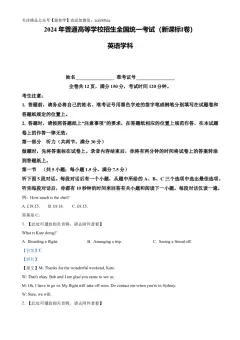
2024 年普通高等学校招生全国统一考试(新课标Ⅱ卷)
英语学科
本试卷共12 页。考试结束后, 将本试卷和答题卡一并交回。
注意事项: 1. 答题前, 考生先将自己的姓名、准考证号码填写清楚, 将条形码准确粘贴在考生
信息条形码粘贴区。
2. 选择题必须使用 2B 铅笔填涂; 非选择题必须使用 0.5 毫米黑色字迹的签字笔书写, 字体
工整、笔迹清楚。
3. 请按照题号顺序在答题卡各题目的答题区域内作答, 超出答题区域书写的答案无效; 在草
稿纸、试卷上答题无效。
4. 作图可先使用铅笔画出, 确定后必须用黑色字迹的签字笔描黑。
5. 保持卡面清洁, 不要折叠, 不要弄破、弄皱, 不准使用涂改液、修正带、刮纸刀。
英语听力
注意事项: 英语听力共两节,20 小题,每小题1.5 分,满分30 分。
第一部分听力(共两节,满分30 分)
做题时,先将答案标在试卷上。录音内容结束后,你将有两分钟的时间将试卷上的答案转涂到答
题卡上。
第一节(共5 小题;每小题1.5 分,满分7.5 分)
听下面5 段对话。每段对话后有一个小题,从题中所给的A、B、C 三个选项中选出最佳选项。
听完每段对话后,你都有10 秒钟的时间来回答有关小题和阅读下一小题。每段对话仅读一遍。
例: How much is the shirt?
A. £19.15.         B. £9.18.         C. £9.15.
答案是 C。
1. 【此处可播放相关音频,请去附件查看】
What did the woman do yesterday evening?
A. She watched TV.
B. She went shopping.
C. She attended a show.
2. 【此处可播放相关音频,请去附件查看】


第2页/共16页
学科网(北京)股份有限公司
What is the man’s suggestion?
A. Taking a rest.
B. Going for a coffee.
C. Having a snack.
3. 【此处可播放相关音频,请去附件查看】
What are the speakers mainly talking about?
A. A weekend plan.
B. A wedding invitation.
C. A business deal.
4. 【此处可播放相关音频,请去附件查看】
Where is Barbara going tonight?
A. To a gym.
B. To her grandma’s.
C. To the doctor’s.
5. 【此处可播放相关音频,请去附件查看】
What is Alex doing?
A. He’s having breakfast.
B. He’s feeding a cat.
C. He’s reading a book.
第二节(共15 小题;每小题1.5 分,满分22.5 分)
听下面5 段对话或独白。每段对话或独白后有几个小题,从题中所给的A、B、C 三个选项中
选出最佳选项。听每段对话或独白前,你将有时间阅读各个小题,每小题5 秒钟:听完后,各小题
将给出5 秒钟的作答时间。每段对话或独白读两遍。
听下面一段较长对话,回答以下小题。【此处可播放相关音频,请去附件查看】
6. Where does the conversation probably take place?
A. In a fitness center.
B. In a sports shop.
C. In a clinic.
7. What does the man advise the woman to do?
A. Buy high-quality sportswear.
B. Keep working out regularly.
C. Avoid over-exercising.
听下面一段较长对话,回答以下小题。【此处可播放相关音频,请去附件查看】
8. Why does the man make the call?
A. To reserve a table.
B. To ask about a party.
C. To postpone a meeting.
9. What time should the man arrive on Friday evening?
A. At 5:30.
B. At 6:30.
C. At 8:00.
10. What is the man’s name?
A. Brown.
B. Anderson.
C. Howard.


第3页/共16页
学科网(北京)股份有限公司
听下面一段较长对话,回答以下小题。【此处可播放相关音频,请去附件查看】
11. Why does Sarah come to talk to Jacob?
A. To make an appointment.
B. To seek his advice.
C. To explain a decision.
12. How many people are there in Sarah’s group?
A. Three.
B. Four.
C. Five.
13. What is the relationship between the speakers?
A. Classmates.
B. Fellow workers.
C. Teacher and student.
听下面一段较长对话,回答以下小题。【此处可播放相关音频,请去附件查看】
14. How often does the band come to perform in the park?
A. Three times a year.
B. Once a year.
C. Every other year.
15. What kind of music will be played this evening?
A. Country music.
B. Jazz.
C. Rock and roll.
16. What will Jannie do next?
A. Catch a bus.
B. Listen to a lecture.
C. Go to the library.
听下面一段独白,回答以下小题。【此处可播放相关音频,请去附件查看】
17. Why did the speaker go to the hotel?
A. To deliver a speech.
B. To arrange a conference.
C. To interview Mr. Rochester.
18. What did Mr. Rochester do soon after he bought the hotel?
A. He talked with the staff members.
B. He had the old carpets replaced.
C. He ran a six-month training project.
19. What did Susan do when she met Mr. Rochester the second time?
A. She was a cleaner.
B. She was a secretary.
C. She was a receptionist.
20. What does the speaker think is key to Mr. Rochester’s success?
A. Managing time efficiently.
B. Valuing human relationships.
C. Possessing a good memory.


第4页/共16页
学科网(北京)股份有限公司
第二部分 阅读(共两节, 满分50 分)
第一节(共15 小题; 每小题 2.5 分, 满分 37.5 分)
阅读下列短文, 从每题所给的A、B、C、D 四个选项中选出最佳选项。
A
Choice of Walks for Beginner and Experienced Walkers
The Carlow Autumn Walking Festival is a great opportunity for the beginner, experienced or advanced walker
to enjoy the challenges of Carlow’s mountain hikes or the peace of its woodland walks.
Walk 1 — The Natural World
With environmentalist Éanna Lamhna as the guide, this walk promises to be an informative tour. Walkers are
sure to learn lots about the habitats and natural world of the Blackstairs.
Date and Time: Saturday, 1st October, at 09:00
Start Point: Scratoes Bridge
Walk Duration: 6 hours
Walk 2 — Introduction to Hillwalking
Emmanuel Chappard, an experienced guide, has a passion for making the great outdoors accessible to all. This
mountain walk provides an insight into the skills required for hillwalking to ensure you get the most from future
walking trips.
Date and Time: Sunday, 2nd October, at 09:00
Start Point: Deerpark Car Park
Walk Duration: 5 hours
Walk 3 — Moonlight Under the Stars
Walking at night-time is a great way to step out of your comfort zone. Breathtaking views of the lowlands of
Carlow can be enjoyed in the presence of welcoming guides from local walking clubs. A torch (手电筒) along with
suitable clothing is essential for walking in the dark. Those who are dressed inappropriately will be refused
permission to participate.
Date and Time: Saturday, 1st October, at 18:30
Start Point: The Town Hall
Walk Duration: 3 hours
Walk 4 — Photographic Walk in Kilbrannish Forest
This informative walk led by Richard Smyth introduces you to the basic principles of photography in the wild.
Bring along your camera and enjoy the wonderful views along this well-surfaced forest path.


第5页/共16页
学科网(北京)股份有限公司
Date and Time: Sunday, 2nd October, at 11:45
Start Point: Kilbrannish Forest Recreation Area
Walk Duration: 1.5 hours
21. Which walk takes the shortest time?
A. The Natural World.
B. Introduction to Hillwalking.
C. Moonlight Under the Stars.
D. Photographic Walk in Kilbrannish Forest.
22. What are participants in Walk 3 required to do?
A. Wear proper clothes.
B. Join a walking club.
C. Get special permits.
D. Bring a survival guide.
23. What do the four walks have in common?
A. They involve difficult climbing.
B. They are for experienced walkers.
C. They share the same start point.
D. They are scheduled for the weekend.
B
Do you ever get to the train station and realize you forgot to bring something to read? Yes, we all have our
phones, but many of us still like to go old school and read something printed.
Well, there’s a kiosk (小亭) for that. In the San Francisco Bay Area, at least.
“You enter the fare gates (检票口) and you’ll see a kiosk that is lit up and it tells you can get a one-minute, a
three-minute, or a five-minute story,” says Alicia Trost, the chief communications officer for the San Francisco Bay
Area Rapid Transit — known as BART. “You choose which length you want and it gives you a receipt-like short
story.”
It’s that simple. Riders have printed nearly 20,000 short stories and poems since the program was launched last
March. Some are classic short stories, and some are new original works.
Trost also wants to introduce local writers to local riders. “We wanted to do something where we do a call to
artists in the Bay Area to submit stories for a contest,” Trost says. “And as of right now, we’ve received about 120
submissions. The winning stories would go into our kiosk and then you would be a published artist.”
Ridership on transit (交通) systems across the country has been down the past half century, so could short
stories save transit?
Trost thinks so.
“At the end of the day all transit agencies right now are doing everything they can to improve the rider
experience. So I absolutely think we will get more riders just because of short stories,” she says.
And you’ll never be without something to read.


第6页/共16页
学科网(北京)股份有限公司
24. Why did BART start the kiosk program?
A. To promote the local culture.
B. To discourage phone use.
C. To meet passengers’ needs.
D. To reduce its running costs.
25. How are the stories categorized in the kiosk?
A. By popularity.
B. By length.
C. By theme.
D. By language.
26. What has Trost been doing recently?
A. Organizing a story contest.
B. Doing a survey of customers.
C. Choosing a print publisher.
D. Conducting interviews with artists.
27. What is Trost’s opinion about BART’s future?
A. It will close down.
B. Its profits will decline.
C
 It will expand nationwide.
D. Its ridership will increase.
C
We all know fresh is best when it comes to food. However, most produce at the store went through weeks of
travel and covered hundreds of miles before reaching the table. While farmer’s markets are a solid choice to reduce
the journey, Babylon Micro-Farm (BMF) shortens it even more.
BMF is an indoor garden system. It can be set up for a family. Additionally, it could serve a larger audience
such as a hospital, restaurant or school. The innovative design requires little effort to achieve a reliable weekly
supply of fresh greens.
Specifically, it’s a farm that relies on new technology. By connecting through the Cloud, BMF is remotely
monitored. Also, there is a convenient app that provides growing data in real time. Because the system is
automated, it significantly reduces the amount of water needed to grow plants. Rather than watering rows of soil,
the system provides just the right amount to each plant. After harvest, users simply replace the plants with a new
pre-seeded pod (容器) to get the next growth cycle started.
Moreover, having a system in the same building where it’s eaten means zero emissions (排放) from
transporting plants from soil to salad. In addition, there’s no need for pesticides and other chemicals that pollute
traditional farms and the surrounding environment.
BMF employees live out sustainability in their everyday lives. About half of them walk or bike to work. Inside
the office, they encourage recycling and waste reduction by limiting garbage cans and avoiding single-use plastic.
“We are passionate about reducing waste, carbon and chemicals in our environment,” said a BMF employee.
28. What can be learned about BMF from paragraph 1?


第7页/共16页
学科网(北京)股份有限公司
A. It guarantees the variety of food.
B. It requires day-to-day care.
C. It cuts the farm-to-table distance.
D. It relies on farmer’s markets.
29. What information does the convenient app offer?
A. Real-time weather changes.
B. Current condition of the plants.
C. Chemical pollutants in the soil.
D. Availability of pre-seeded pods.
30. What can be concluded about BMF employees?
A. They have a great passion for sports.
B. They are devoted to community service.
C. They are fond of sharing daily experiences.
D. They have a strong environmental awareness.
31. What does the text mainly talk about?
A. BMF’s major strengths.
B. BMF’s general management.
C. BMF’s global influence.
D. BMF’s technical standards.
D
Given the astonishing potential of AI to transform our lives, we all need to take action to deal with our AI-
powered future, and this is where AI by Design: A Plan for Living with Artificial Intelligence comes in. This
absorbing new book by Catriona Campbell is a practical roadmap addressing the challenges posed by the
forthcoming AI revolution (变革).
In the wrong hands
 such a book could prove as complicated to process as the computer code (代码) that
powers AI but, thankfully, Campbell has more than two decades’ professional experience translating the heady into
the understandable. She writes from the practical angle of a business person rather than as an academic, making for
a guide which is highly accessible and informative and which, by the close, will make you feel almost as smart as
AI.
As we soon come to learn from AI by Design, AI is already super-smart and will become more capable,
moving from the current generation of “narrow-AI” to Artificial General Intelligence. From there, Campbell says,
will come Artificial Dominant Intelligence. This is why Campbell has set out to raise awareness of AI and its future
now — several decades before these developments are expected to take place. She says it is essential that we keep
control of artificial intelligence, or risk being sidelined and perhaps even worse.
Campbell’s point is to wake up those responsible for AI—the technology companies and world leaders—so
they are on the same page as all the experts currently developing it. She explains we are at a “tipping point” in


第8页/共16页
学科网(北京)股份有限公司
history and must act now to prevent an extinction-level event for humanity. We need to consider how we want our
future with AI to pan out. Such structured thinking, followed by global regulation, will enable us to achieve
greatness rather than our downfall.
AI will affect us all, and if you only read one book on the subject, this is it.
32. What does the phrase “In the wrong hands” in paragraph 2 probably mean?
A. If read by someone poorly educated.
B. If reviewed by someone ill-intentioned.
C. If written by someone less competent.
D. If translated by someone unacademic.
33. What is a feature of AI by Design according to the text?
A. It is packed with complex codes.
B. It adopts a down-to-earth writing style.
C. It provides step-by-step instructions.
D. It is intended for AI professionals.
34. What does Campbell urge people to do regarding AI development?
A. Observe existing regulations on it.
B. Reconsider expert opinions about it.
C. Make joint efforts to keep it under control.
D. Learn from prior experience to slow it down.
35. What is the author’s purpose in writing the text?
A. To recommend a book on AI.
B. To give a brief account of AI history.
C. To clarify the definition of AI.
D. To honor an outstanding AI expert.
第二节(共5 小题; 每小题2.5 分, 满分12.5 分)
阅读下面短文, 从短文后的选项中选出可以填入空白处的最佳选项。选项中有两项为多余选项
Overtourism Is For Real: How Can You Help?
Travel promotes understanding, expands our minds, makes us better people, and boosts local economies and
communities, but the rapid growth of travel has led to overtourism in certain regions and destinations. ___36___
Certainly not. The loss of what travel offers would be unacceptable in today’s world. Here are some tips on making
wise decisions to minimize pressure on the places we visit and improve our experience.
●Choose mindfully. Overvisited destinations are that way for a reason: they’re special. With so many online
posts featuring the same places, it’s easy to feel like you’re missing out. Go somewhere only when the landscape,
culture or food deeply draws you. ___37___
●Get creative. The best way to ease pressure on over-touristed destinations is to go somewhere else. Though
overtourism is described as a problem affecting the entire world
 it’s actually concentrated to a small number of
extremely popular spots. That means you have tons of less-visited options to choose from. ___38___ Why not try a


第9页/共16页
学科网(北京)股份有限公司
regional alternative or check out a popular destination’s lesser-known sights?
●___39___ Minimize impact and maximize experience by skipping major holidays or rush hour. You’ll compete
with fewer tourists, save money, experience a different side of a popular place, and boost the economy when tourism is
traditionally slower.
Visiting a place that others call home is a privilege (荣幸). Do your part to preserve what makes a destination
special in the first place. ___40___ You may be amazed how much closer you’ll feel to the people there.
A. Visit during off-peak times.
B. So, should we stop traveling?
C. Travel for you and no one else.
D. Can overtourism be avoided then?
E. You can still find relatively undiscovered places.
F. You’ll find yourself virtually alone, or close to it.
G. Consider giving back to the communities you’re visiting.
第三部分 语言运用(共两节, 满分30 分)
第一节(共15 小题; 每小题1 分, 满分15 分)
阅读下面短文, 从每题所给的A、B、C、D 四个选项中选出最佳选项。
When I decided to buy a house in Europe ten years ago
 I didn't think too long. I liked traveling in
France, but when it came to picking my favorite spot to ___41___, Italy was the clear winner.
During my first visit to Italy, I ___42___ to ask for directions or order in a restaurant. But every time I tried
to ___43___ a sentence of  Italian together, the locals smiled at me and ___44___ my language skills. That
encouragement helped me to get through the language ___45___. After I made Italy my permanent home, I
discovered how ___46___ Italians are. Neighbors will bring me freshly made cheese and will come to my door to
___47___ me to close the window in my car when rain is coming. It's these small ___48___ of kindness that
make a new country feel like home.
As a foodie, the way to my heart is through my stomach, and nowhere fuels my ___49___ quite like Italy.
Each town has its own traditional ____50____, and every family keeps a recipe passed from one generation to
another. Families ____51____ for big meals on Sundays, birthdays, and whatever other excuses they can
____52____. These meals are always ____53____ by laughter and joy. Whatever ____54____ life in Italy might
have, the problems are ____55____ once you sit down to a big meal with friends and family.
41. A. study
B. rent
C. visit
D. settle


第10页/共16页
学科网(北京)股份有限公司
42. A. planned
B. struggled
C. refused
D. happened
43. A. string
B. hang
C. mix
D. match
44. A. improved
B. assessed
C. admired
D. praised
45. A. course
B. barrier
C. area
D. test
46. A. open-minded
B. strong-willed
C. warm-hearted
D. well-informed
47. A. remind
B. allow
C. persuade
D. order
48. A. tricks
B. promises
C. acts
D. duties
49. A. ambition
B. success
C. appetite
D. growth
50. A. costume
B. dish
C. symbol
D. tale
51. A. gather
B. cheer
C. leave
D. wait
52. A. put up with
B. stand up for
C. come up with
D. make up for
53. A. signaled
B. confirmed
C. represented
D. accompanied
54. A. disadvantages
B. meanings
C. surprises
D. opportunities
55. A. created
B. forgotten
C. understood
D. identified
第二节(共10 小题; 每小题 1.5 分, 满分15 分)
阅读下面短文, 在空白处填入 1 个适当的单词或括号内单词的正确形式。
Chinese cultural elements commemorating (纪念) Tang Xianzu, ___56___ is known as “the Shakespeare of
Asia,” add an international character to Stratford-upon-Avon, William Shakespeare’s hometown.
Tang and Shakespeare were contemporaries and both died in 1616. Although they could never have met, there
are common ___57___ (theme) in their works, said Paul Edmondson, head of research for the Shakespeare Birthplace
Trust. “Some of the things that Tang was writing about ___58___ (be) also Shakespeare’s concerns. I happen to
know that Tang’s play The Peony Pavilion (《牡丹亭》) is similar in some ways ___59___ Romeo and Juliet.”
A statue commemorating Shakespeare and Tang was put up at Shakespeare’s Birthplace Garden in 2017. Two
years later, a six-meter-tall pavilion, ___60___ (inspire)by The Peony Pavilion, ___61___ (build)at the Firs Garden,
just ten minutes’ walk from Shakespeare’s birthplace.
Those cultural elements have increased Stratford’s international ___62___ (visible), said Edmondson, adding
that visitors walking through the Birthplace Garden were often amazed ___63___ (find)the connection between the two
great writers.
___64___ (recall)watching a Chinese opera version of Shakespeare’s play Richard III in Shanghai and meeting
Chinese actors who came to Stratford a few years ago to perform parts of The Peony Pavilion, Edmondson said, “It
was very exciting to hear the Chinese language ____65____ see how Tang’s play was being performed.”


第11页/共16页
学科网(北京)股份有限公司
第四部分 写作(共两节, 满分40 分)
第一节(满分15 分)
66. 假定你是李华,上周五你们班在公园上了一堂美术课。请你给英国朋友Chris 写一封邮件分享这次经历,
内容包括:
(1)你完成的作品;
(2)你的感想。
注意:
(1)写作词数应为80 个左右;
(2)请按如下格式在答题纸的相应位置作答。
Dear Chris,
I’m writing to share with you an art class I had in a park last Friday.
____________________________________________________________________________________________
____________________________________________________________________________________________
____________________________________________________________________________________________
____________________________________________________________________________________________
______________________________________________________________________________________
Yours,
Li Hua
第二节(满分25 分)
67. 阅读下面材料,根据其内容和所给段落开头语续写两段,使之构成一篇完整的短文。
I met Gunter on a cold
 wet and unforgettable evening in September. I had planned to fly to Vienna and
take a bus to Prague for a conference. Due to a big storm, my flight had been delayed by an hour and a half. I touched
down in Vienna just 30 minutes before the departure of the last bus to Prague. The moment I got off the plane, I ran
like crazy through the airport building and jumped into the first taxi on the rank without a second thought.
That was when I met Gunter. I told him where I was going, but he said he hadn't heard of the bus station. I
thought my pronunciation was the problem, so I explained again more slowly, but he still looked confused. When I
was about to give up, Gunter fished out his little phone and rang up a friend. After a heated discussion that lasted for
what seemed like a century, Gunter put his phone down and started the car.
Finally, with just two minutes to spare we rolled into the bus station. Thankfully, there was a long queue ( 队
列) still waiting to board the bus. Gunter parked the taxi behind the bus, turned around, and looked at me with a big


第12页/共16页
学科网(北京)股份有限公司
smile on his face. "We made it," he said.
Just then I realised that I had zero cash in my wallet. I flashed him an apologetic smile as I pulled out my
Portuguese bankcard. He tried it several times, but the card machine just did not play along. A feeling of helplessness
washed over me as I saw the bus queue thinning out.
At this moment, Gunter pointed towards the waiting hall of the bus station. There, at the entrance, was a cash
machine. I jumped out of the car, made a mad run for the machine, and popped my card in, only to read the message:
"Out of order. Sorry."
注意:
(1)续写词数应为150 个左右;
(2)请按如下格式在答题纸的相应位置作答。
I ran back to Gunter and told him the bad news.
____________________________________________________________________________________________
____________________________________________________________________________________________
____________________________________________________________________________________________
____________________________________________________________________________________________
______________________________________________________________________________________
Four days later, when I was back in Vienna, I called Gunter as promised.
____________________________________________________________________________________________
____________________________________________________________________________________________
____________________________________________________________________________________________
____________________________________________________________________________________________
______________________________________________________________________________________


第13页/共16页
学科网(北京)股份有限公司
绝密★启用前
2024 年普通高等学校招生全国统一考试(新课标Ⅱ卷)
英语学科
本试卷共12 页。考试结束后, 将本试卷和答题卡一并交回。
注意事项: 1. 答题前, 考生先将自己的姓名、准考证号码填写清楚, 将条形码准确粘贴在考生
信息条形码粘贴区。
2. 选择题必须使用 2B 铅笔填涂; 非选择题必须使用 0.5 毫米黑色字迹的签字笔书写, 字体
工整、笔迹清楚。
3. 请按照题号顺序在答题卡各题目的答题区域内作答, 超出答题区域书写的答案无效; 在草
稿纸、试卷上答题无效。
4. 作图可先使用铅笔画出, 确定后必须用黑色字迹的签字笔描黑。
5. 保持卡面清洁, 不要折叠, 不要弄破、弄皱, 不准使用涂改液、修正带、刮纸刀。
英语听力
注意事项: 英语听力共两节,20 小题,每小题1.5 分,满分30 分。
第一部分听力(共两节,满分30 分)
做题时,先将答案标在试卷上。录音内容结束后,你将有两分钟的时间将试卷上的答案转涂到答
题卡上。
第一节(共5 小题;每小题1.5 分,满分7.5 分)
听下面5 段对话。每段对话后有一个小题,从题中所给的A、B、C 三个选项中选出最佳选项。
听完每段对话后,你都有10 秒钟的时间来回答有关小题和阅读下一小题。每段对话仅读一遍。
例: How much is the shirt?
A. £19.15.         B. £9.18.         C. £9.15.
答案是 C。
【1 题答案】
【答案】B
【2 题答案】
【答案】A


第14页/共16页
学科网(北京)股份有限公司
【3 题答案】
【答案】A
【4 题答案】
【答案】B
【5 题答案】
【答案】C
第二节(共15 小题;每小题1.5 分,满分22.5 分)
听下面5 段对话或独白。每段对话或独白后有几个小题,从题中所给的A、B、C 三个选项中
选出最佳选项。听每段对话或独白前,你将有时间阅读各个小题,每小题5 秒钟:听完后,各小题
将给出5 秒钟的作答时间。每段对话或独白读两遍。
【6~7 题答案】
【答案】6. A    7. B
【8~10 题答案】
【答案】8. A    9. C    10. B
【11~13 题答案】
【答案】11. C    12. B    13. A
【14~16 题答案】
【答案】14. B    15. A    16. C
【17~20 题答案】
【答案】17. B    18. A    19. C    20. B
第二部分 阅读(共两节, 满分50 分)
第一节(共15 小题; 每小题 2.5 分, 满分 37.5 分)
阅读下列短文, 从每题所给的A、B、C、D 四个选项中选出最佳选项。
A
【21~23 题答案】
【答案】21. D    22. A    23. D
B
【24~27 题答案】
【答案】24. C    25. B    26. A    27. D
C
【28~31 题答案】


第15页/共16页
学科网(北京)股份有限公司
【答案】28. C    29. B    30. D    31. A
D
【32~35 题答案】
【答案】32. C    33. B    34. C    35. A
第二节(共5 小题; 每小题2.5 分, 满分12.5 分)
阅读下面短文, 从短文后的选项中选出可以填入空白处的最佳选项。选项中有两项为多余选项
【36~40 题答案】
【答案】36. B    37. C    38. E    39. A    40. G
第三部分 语言运用(共两节, 满分30 分)
第一节(共15 小题; 每小题1 分, 满分15 分)
阅读下面短文, 从每题所给的A、B、C、D 四个选项中选出最佳选项。
【41~55 题答案】
【答案】41. D    42. B    43. A    44. D    45. B    46. C    47. A    48. C    49. C    50. B    51. A    52. C    53. D    54. A
55. B
第二节(共10 小题; 每小题 1.5 分, 满分15 分)
【56~65 题答案】
【答案】56. who
57. themes    58. were
59. to    60. inspired
61. was built
62. visibility
63. to find
64. Recalling
65. and
第四部分 写作(共两节, 满分40 分)
第一节(满分15 分)
【66 题答案】
【答案】
Dear Chris,
I’m writing to share with you an art class I had in a park last Friday.
We were tasked to draw or paint something that impressed us most. Inspired by the fantastic scenery, I decided


第16页/共16页
学科网(北京)股份有限公司
to create a watercolor painting of the small bridge over the park’s pond, surrounded by blooming flowers.
The entire experience was incredibly refreshing. Being surrounded by nature not only sparked my creativity
but also offered a much-needed break from the usual hustle and bustle of school life. I felt a deep sense of peace as
I painted.
In a word, it was not just an art class; it was a moment of connection with nature that I truly cherished.
Yours,
Li Hua
第二节(满分25 分)
【67 题答案】
【答案】参考范文
Para 1
I ran back to Gunter and told him the bad news. He looked at me in disbelief, asking me what to do. Flashing
him another apologetic smile, I begged him for a delayed payment. “If I miss this last bus to Prague, I’ll be late for
the conference which is so important that I can’t afford to miss it!” I explained. “May I have your phone number? I
will call you and return the money I owe you. I promise I will keep my word or you keep my watch!” I added,
handing him my watch as well as my business card. Gunter accepted my business card but rejected my watch. He
wrote down his phone number and gave it to me. “Just keep your promise, Sir.” A feeling of gratitude washed over
me as I heard his words. Giving him a firm handshake, I jumped out of the car, made a mad run for the bus, and
jumped onto it just before its departure.
Para 2
Four days later, when I was back in Vienna, I called Gunter as promised. He picked me up at the bus station
where he had dropped me off four days before. Beaming a warm smile at him, I gave him a big hug the moment I
saw him. We chatted happily on the way to the airport. I told him that thanks to his generosity and timely help,
everything had gone smoothly. When he stopped his taxi outside the airport, I paid him for the “double car ride”,
back and forth from the airport to the bus station, together with a generous tip that he turned down. I also gave him
an attractive souvenir I had bought at Prague, which he accepted with delight. We became good friends and kept in
touch with each other regularly. I felt blessed to have such a warm-hearted friend like Gunter.