第21 讲 如何增添提分修辞
目录
知识点1 比喻.................................................................................................................................................. 1
知识点2 拟人..............................................................................................................................................6
知识点3 夸张..............................................................................................................................................9
知识点4 排比............................................................................................................................................10
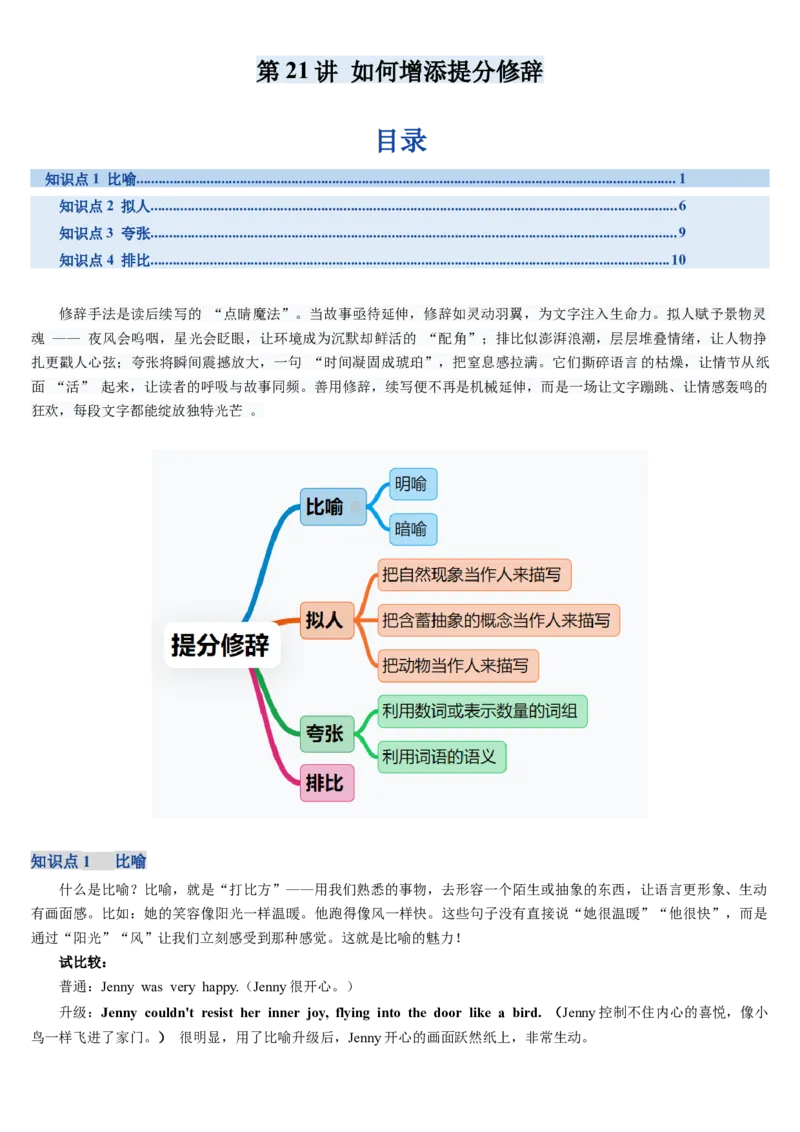
修辞手法是读后续写的 “点睛魔法”。当故事亟待延伸,修辞如灵动羽翼,为文字注入生命力。拟人赋予景物灵
魂 —— 夜风会呜咽,星光会眨眼,让环境成为沉默却鲜活的 “配角”;排比似澎湃浪潮,层层堆叠情绪,让人物挣
扎更戳人心弦;夸张将瞬间震撼放大,一句 “时间凝固成琥珀”,把窒息感拉满。它们撕碎语言的枯燥,让情节从纸
面 “活” 起来,让读者的呼吸与故事同频。善用修辞,续写便不再是机械延伸,而是一场让文字蹦跳、让情感轰鸣的
狂欢,每段文字都能绽放独特光芒 。
知识点1   比喻
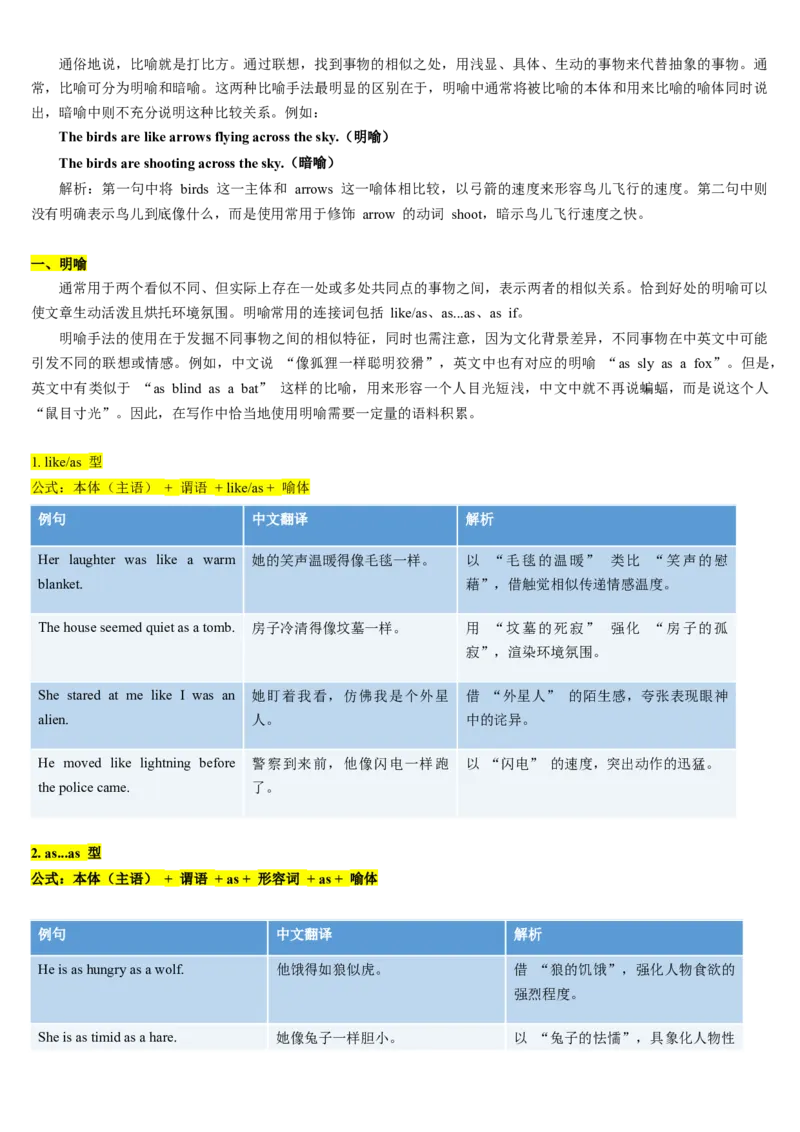
什么是比喻?比喻,就是“打比方”——用我们熟悉的事物,去形容一个陌生或抽象的东西,让语言更形象、生动
有画面感。比如:她的笑容像阳光一样温暖。他跑得像风一样快。这些句子没有直接说“她很温暖”“他很快”,而是
通过“阳光”“风”让我们立刻感受到那种感觉。这就是比喻的魅力!
试比较:
普通:Jenny was very happy.(Jenny 很开心。)
升级:Jenny couldn't resist her inner joy, flying into the door like a bird. (Jenny 控制不住内心的喜悦,像小
鸟一样飞进了家门。) 很明显,用了比喻升级后,Jenny 开心的画面跃然纸上,非常生动。
通俗地说,比喻就是打比方。通过联想,找到事物的相似之处,用浅显、具体、生动的事物来代替抽象的事物。通
常,比喻可分为明喻和暗喻。这两种比喻手法最明显的区别在于,明喻中通常将被比喻的本体和用来比喻的喻体同时说
出,暗喻中则不充分说明这种比较关系。例如:
The birds are like arrows flying across the sky.(明喻)
The birds are shooting across the sky.(暗喻)
解析:第一句中将 birds 这一主体和 arrows 这一喻体相比较,以弓箭的速度来形容鸟儿飞行的速度。第二句中则
没有明确表示鸟儿到底像什么,而是使用常用于修饰 arrow 的动词 shoot,暗示鸟儿飞行速度之快。
一、明喻
通常用于两个看似不同、但实际上存在一处或多处共同点的事物之间,表示两者的相似关系。恰到好处的明喻可以
使文章生动活泼且烘托环境氛围。明喻常用的连接词包括 like/as、as...as、as if。
明喻手法的使用在于发掘不同事物之间的相似特征,同时也需注意,因为文化背景差异,不同事物在中英文中可能
引发不同的联想或情感。例如,中文说 “像狐狸一样聪明狡猾”,英文中也有对应的明喻 “as sly as a fox”。但是,
英文中有类似于 “as blind as a bat” 这样的比喻,用来形容一个人目光短浅,中文中就不再说蝙蝠,而是说这个人
“鼠目寸光”。因此,在写作中恰当地使用明喻需要一定量的语料积累。
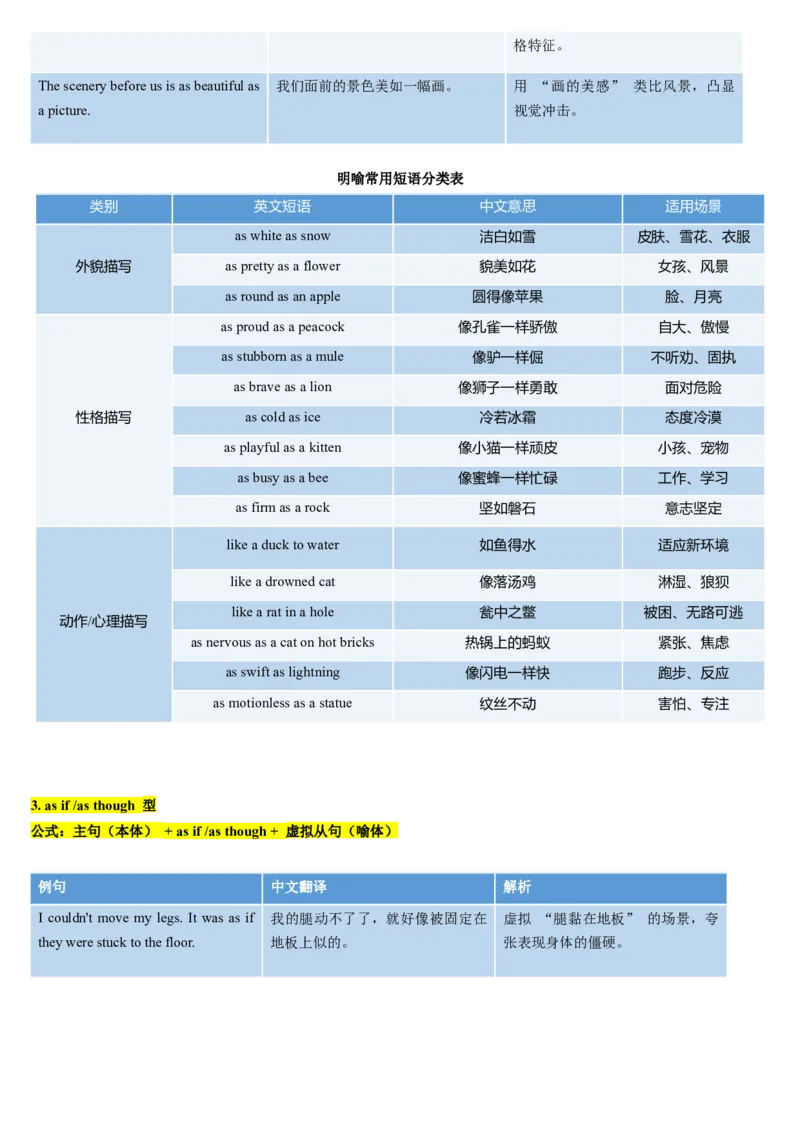
1. like/as 型
公式:本体(主语) + 谓语 + like/as + 喻体
例句
中文翻译
解析
Her laughter was like a warm
blanket.
她的笑声温暖得像毛毯一样。
以 “毛毯的温暖” 类比 “笑声的慰
藉”,借触觉相似传递情感温度。
The house seemed quiet as a tomb.
房子冷清得像坟墓一样。
用 “坟墓的死寂” 强化 “房子的孤
寂”,渲染环境氛围。
She stared at me like I was an
alien.
她盯着我看,仿佛我是个外星
人。
借 “外星人” 的陌生感,夸张表现眼神
中的诧异。
He moved like lightning before
the police came.
警察到来前,他像闪电一样跑
了。
以 “闪电” 的速度,突出动作的迅猛。
2. as...as 型
公式:本体(主语) + 谓语 + as + 形容词 + as + 喻体
例句
中文翻译
解析
He is as hungry as a wolf.
他饿得如狼似虎。
借 “狼的饥饿”,强化人物食欲的
强烈程度。
She is as timid as a hare.
她像兔子一样胆小。
以 “兔子的怯懦”,具象化人物性
格特征。
The scenery before us is as beautiful as
a picture.
我们面前的景色美如一幅画。
用 “画的美感” 类比风景,凸显
视觉冲击。
明喻常用短语分类表
类别
英文短语
中文意思
适用场景
外貌描写
as white as snow
洁白如雪
皮肤、雪花、衣服
as pretty as a flower
貌美如花
女孩、风景
as round as an apple
圆得像苹果
脸、月亮
性格描写
as proud as a peacock
像孔雀一样骄傲
自大、傲慢
as stubborn as a mule
像驴一样倔
不听劝、固执
as brave as a lion
像狮子一样勇敢
面对危险
as cold as ice
冷若冰霜
态度冷漠
as playful as a kitten
像小猫一样顽皮
小孩、宠物
as busy as a bee
像蜜蜂一样忙碌
工作、学习
as firm as a rock
坚如磐石
意志坚定
动作/心理描写
like a duck to water
如鱼得水
适应新环境
like a drowned cat
像落汤鸡
淋湿、狼狈
like a rat in a hole
瓮中之鳖
被困、无路可逃
as nervous as a cat on hot bricks
热锅上的蚂蚁
紧张、焦虑
as swift as lightning
像闪电一样快
跑步、反应
as motionless as a statue
纹丝不动
害怕、专注
3. as if /as though 型
公式:主句(本体) + as if /as though + 虚拟从句(喻体)
例句
中文翻译
解析
I couldn't move my legs. It was as if
they were stuck to the floor.
我的腿动不了了,就好像被固定在
地板上似的。
虚拟 “腿黏在地板” 的场景,夸
张表现身体的僵硬。
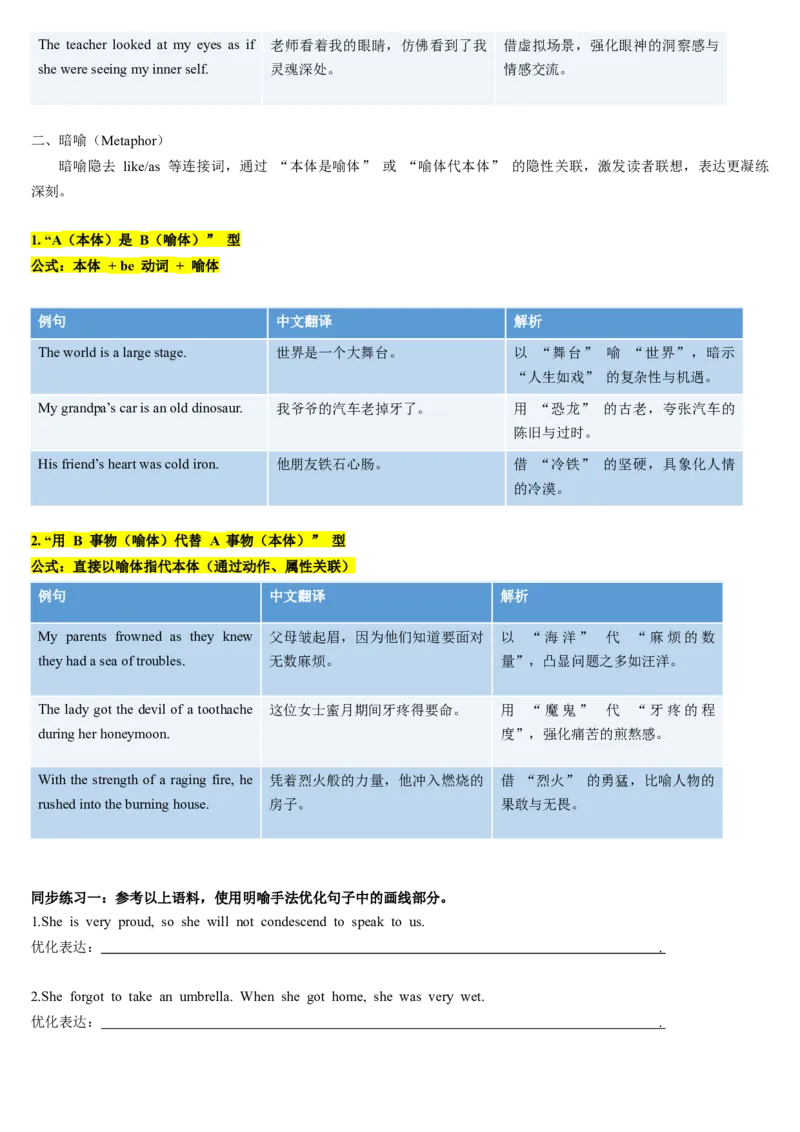
The teacher looked at my eyes as if
she were seeing my inner self.
老师看着我的眼睛,仿佛看到了我
灵魂深处。
借虚拟场景,强化眼神的洞察感与
情感交流。
二、暗喻(Metaphor)
暗喻隐去 like/as 等连接词,通过 “本体是喻体” 或 “喻体代本体” 的隐性关联,激发读者联想,表达更凝练
深刻。
1. “A(本体)是 B(喻体)” 型
公式:本体 + be 动词 + 喻体
例句
中文翻译
解析
The world is a large stage.
世界是一个大舞台。
以 “舞台” 喻 “世界”,暗示
“人生如戏” 的复杂性与机遇。
My grandpa’s car is an old dinosaur.
我爷爷的汽车老掉牙了。
用 “恐龙” 的古老,夸张汽车的
陈旧与过时。
His friend’s heart was cold iron.
他朋友铁石心肠。
借 “冷铁” 的坚硬,具象化人情
的冷漠。
2. “用 B 事物(喻体)代替 A 事物(本体)” 型
公式:直接以喻体指代本体(通过动作、属性关联)
例句
中文翻译
解析
My parents frowned as they knew
they had a sea of troubles.
父母皱起眉,因为他们知道要面对
无数麻烦。
以 “ 海洋” 代 “ 麻烦的数
量”,凸显问题之多如汪洋。
The lady got the devil of a toothache
during her honeymoon.
这位女士蜜月期间牙疼得要命。
用 “ 魔鬼” 代 “ 牙疼的程
度”,强化痛苦的煎熬感。
With the strength of a raging fire, he
rushed into the burning house.
凭着烈火般的力量,他冲入燃烧的
房子。
借 “烈火” 的勇猛,比喻人物的
果敢与无畏。
同步练习一:参考以上语料,使用明喻手法优化句子中的画线部分。
1.She is very proud, so she will not condescend to speak to us.
优化表达:

 .
2.She forgot to take an umbrella. When she got home, she was very wet.
优化表达:

 .
3.While waiting outside the professor’s office, he is very nervous, because he knows the professor is going to talk
about his cheating in the exam.
优化表达:

 .
同步练习二:使用明喻手法翻译句子。
1.这个年幼的小女孩像小猫一样,天生顽皮。


 .
2.艾伦被吓得要死,站在树下纹丝不动。
Scared to death, Ellen                                                                  .

同步练习三:使用明喻手法翻译句子。
(1) 他像被蛰了似的跳了起来。


 .
(2) 露西看起来很伤心,没精打采的,好像她的世界只剩黑白两种颜色。


 .
同步练习四:根据括号内的提示,为画线部分加入暗喻,优化句子。
1.For the young mother, the baby boy was very important in her life. (light)
优化表达:____________________________________________________
2.Friends should not lie to each other, as mistrust will ruin the relationship. (poison)
优化表达:____________________________________________________
3.The computers in the library are very old, so few students would like to use them to do homework. (dinosaur)
优化表达:____________________________________________________
4.My brother’s answer to the problem could to some extent alleviate the problem, but could not solve it completely. (Band - Aid)
优化表达:____________________________________________________
5.I don’t know what it is to see into the heart of a friend through the eyes; I can only “see” through my fingertips the outline of the
face. (window)
优化表达:____________________________________________________
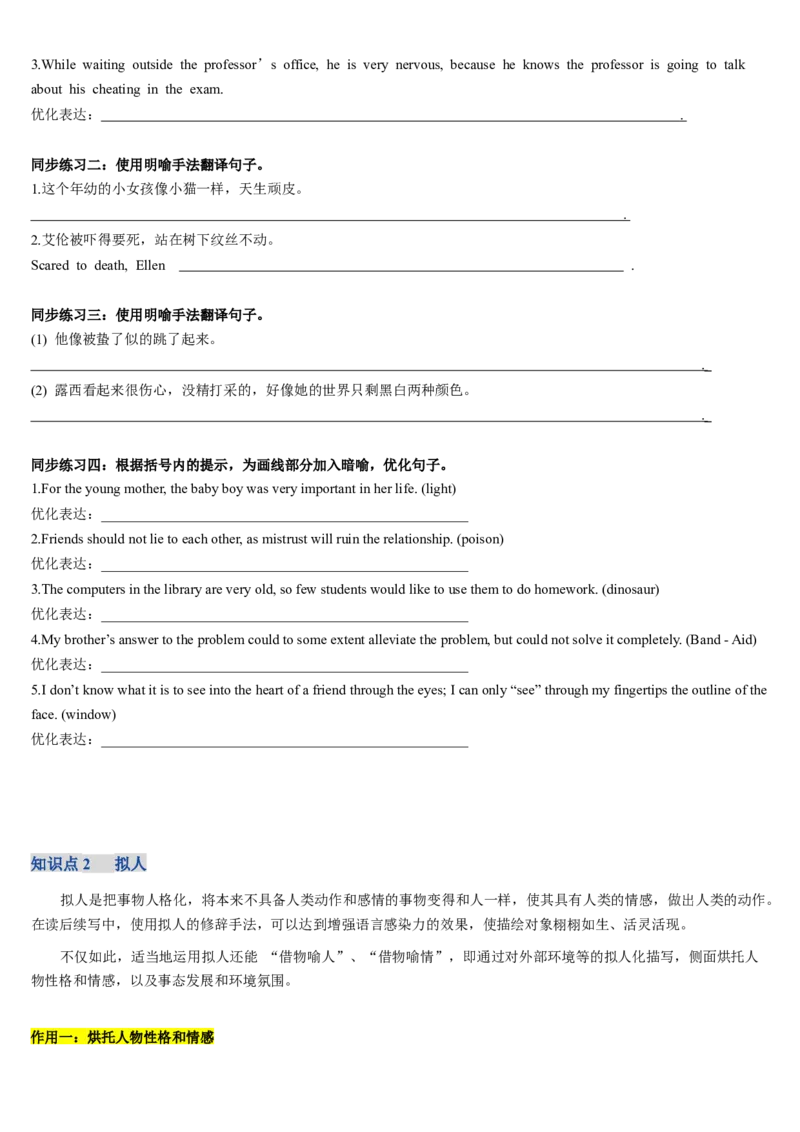
知识点2   拟人
拟人是把事物人格化,将本来不具备人类动作和感情的事物变得和人一样,使其具有人类的情感,做出人类的动作。
在读后续写中,使用拟人的修辞手法,可以达到增强语言感染力的效果,使描绘对象栩栩如生、活灵活现。
不仅如此,适当地运用拟人还能 “借物喻人”、“借物喻情”,即通过对外部环境等的拟人化描写,侧面烘托人
物性格和情感,以及事态发展和环境氛围。
作用一:烘托人物性格和情感
例 1:My heart was singing.  我的心在唱歌。
解析:“唱歌” 是人的动作,心脏作为人体器官不可能真正唱歌。句中运用拟人的修辞手法,让心脏唱歌,能够很好
地突显 “我” 的愉悦心情。
例 2:“Help, let me in, please let me in!” But the houses were cold and unfriendly.
“救命,让我进去,让我进去!” 然而那些房子却冷漠无情,一点也不友好。
解析:“冷漠无情” 和 “不友好” 是人的情感,句子通过运用拟人的修辞手法,把这种情感和动作赋予房子,使语
言更生动形象,而且能够侧面反映故事中人物无能为力的绝望感。
例 3:I will wage war against destiny. It shall not overcome me completely.
我要与命运斗争。我决不会让它彻底击败我。
解析:在这里将命运比拟成与 “我” 斗争的敌人,侧面烘托出主人公顽强的意志以及必胜的信心。
2.作用二:烘托事态发展和环境氛围
例 1: The rose in the garden gave me a smile of victory.花园中的玫瑰给了我一个胜利的微笑。
解析:通过拟人的修辞手法,让玫瑰 “微笑”,含蓄地表达出事态发展顺利,已然胜利在望。
例 2: The angry sea took hungry bites from the shore.愤怒的大海不断吞噬着海岸。
解析:此句中,把大海比拟成愤怒且饥饿的人,狼吞虎咽,大口吞食,从而形象地描绘出海浪的汹涌,以衬托情况的危
急。
例 3: The handsome houses on the street were not fully awake, but they looked friendly.
街上那些漂亮的房子并没有完全睡醒,但他们看起来很友好。
解析:此句中将房屋比拟成人,房屋虽未 “醒来”,但展现出 “友好的姿态”,以此暗示事物在往好的方向发展。
方法一:把自然现象当作人来描写
例:The angry storm howled in pain. 愤怒的暴风雨在痛苦中呼啸。
解析:“愤怒” 和 “痛苦” 是人类才有的情感,将这些情感赋予暴风雨,能够很形象地勾勒出狂风暴雨的画面。
示例:
1)The feathery snowflakes danced in the night air. 鹅毛般的雪花在空中飞舞。
2)The mist swallowed him up. 薄雾把他包围起来。
3)The volcano spit out lava from its mouth. 火山口喷出岩浆。
4)The moon played hide and seek (捉迷藏) with the clouds. 月亮和云彩做迷藏一样时隐时现。
5)The mist swallowed him up. 薄雾把他包围起来。
技法体验:
1)The breeze gently kissed her cheeks.  (景物描写)微风轻柔地亲吻着她的脸庞。
2)The feathery snowflakes danced in the night air, making a beautiful picture. (景物描写)鹅毛般的雪花在空中飞舞,
像一幅美丽的图画。
3)The icy wind started howling, stinging my face. (景物描写)寒风开始咆哮,刺痛了我的脸。
4)Stars winked at me in a darkening sky. (景物描写)夜空中星星向我眨眼睛。
5)Immediately, an absolute darkness ruled the forest. (景物描写)顷刻间,黑暗统治了森林。
方法二:把含蓄抽象的概念当作人来描写
示例:
1)Fear seized / swallowed him.   (情感描写)恐惧吞噬了他。
2)Anger choked my words.        (情感描写)我气得说不出话来。
3)A good idea suddenly struck me.   我突然想到一个好主意。
技法体验:
1)Anxiety torn him into pieces.      (情感描写)   她焦虑不安,十分崩溃。
2)Confidence deserted him.          (情感描写)他没信心了。
3)Excitement deprived me of all power of speech.(情感描写)我兴奋的啥也说不出来了。
4)Excitement deprived me of all power of speech.(情感描写)      我兴奋的啥也说不出来了。
5)Anxiety torn him into pieces.(情感描写)她焦虑不安,十分崩溃。
方法三:把动物当作人来描写
技法体验:
1)Birds on the tree are singing a beautiful song. (景物描写)
树上的小鸟在树上唱着美妙的歌曲。
2)The frogs are giving a concert---mixed chorus. (景物描写)
青蛙在举办音乐会---混声大合唱。
3)Fireflies patrol the grass with small lanterns. (景物描写)
萤火虫提着小灯笼在草丛中巡逻。
4)In the dead of night, the crickets played on the terrace of the house.
寂静的夜,蟋蟀旁若无人地在房子的阳台上玩。(景物描写)
练习:根据括号内的提示,为画线部分加入拟人手法,优化句子。
1.I really like that rose.(为 rose 增添动作:blush)
优化表达:
2.The war was dangerous for us.(为 war 增添动作:threaten)
优化表达:
3.In the night, we watched the stars in the sky.(凸显顽皮的性格)
优化表达:
4.At night, the moon light was reflected on the lake. (the moon’s smiling face)
优化表达:
5.I stood in fear and couldn’t move.(把 fear 比拟为人,增添动作:seize; prevent)
优化表达:
6.In the evenings, they sit in the village square and listen to frogs.(凸显热闹的氛围)
优化表达:
7.When autumn comes, the golden rice is ripe.(把 rice 比拟为人,增添动作:raise head ,结合拟人逻辑,稻子成熟
常呈 低头 姿态,故答案为如下 )
“
”
优化表达:
8.I was surprised when knowing the truth at the last moment.(把 truth 比拟为人,增添动作:hit)
优化表达:
9.We got lost in the forest: the road under our feet led to nowhere.(把 road 比拟为人,凸显境况不友好)
优化表达:
10.Under the light, I studied in the reading room.(把 light 比拟为人,凸显环境适合学习)
优化表达:
知识点3   夸张
夸张是指对表达对象进行有违常理或不合逻辑的描写,以此来达到强调的效果,给读者留下鲜明深刻的印象。在读
后续写中,运用夸张修饰往往能够更生动地表达出主人公的情绪,从而间接表达出作者的情感态度。夸张的手法主要包
括故意扩大或缩小事物的形象、数量、特征、作用等。在读后续写中,常用到的夸张方法有四种。
(一)利用数词或表示数量的词组
例:
1.He was miles out in his calculation.他的计算大错特错。
2.I have told you to clean your room a million times! 我都和你说了一百万次了,打扫一下你的房间吧!
3.Bob loves running risks, and he once dived from an overhanging cliff that seemed about ten thousand feet high into the sea.鲍勃
喜欢冒险,他曾从约一万英尺高的悬崖上跃入海中。
解析:以上三个句子利用数词或表示数量的词组进行夸张,句子中所描述的程度明显是不符合现实逻辑的,但通过这样
的夸张描写,更能够突出作者的写作意图。
(二)利用词语的语义
在读后续写中,可以利用词语的语义进行夸张性描写,包括动词、名词或名词词组、形容词和副词最高级等。
1. 动词
She almost died laughing.她快要笑死了。
He was so tall that his head touched the clouds.他太高了,头都快要顶到云彩了。
解析:在现实中,“她” 不会真的笑死,“他” 也不会真的高到头顶碰到云彩。用动词 “ die” 和 “touch the clouds”
这样的夸张描写,让文字充满画面感,惟妙惟肖,能够很好地突出 “她” 认为很好笑,以及 “他” 身材高大。
2. 名词或名词词组
His brain is the size of a pea.他的脑子只有豌豆那么大。
Hearing the news, she found scores of arrows were piercing her chest.听到这个消息,她感到万箭穿心。
解析:同样,“他” 的大脑不会小到和豌豆一样,“她” 也不会真的遭受万箭穿心的酷刑。通过使用名词 “pea” 和
名词词组 “scores of arrows”,能够很形象地描绘出 “他” 的蠢笨,以及 “她” 的绝望和痛苦。
3. 形容词和副词最高级
This must be the best burger in the world.这一定是世界上最好的汉堡了。
This is the worst day of my entire life.这是我一生中最糟糕的一天。
解析:这两个句子分别用了最高级 “best” 和 “worst” 来突显汉堡的美味和这一天的艰辛。
经典夸张句欣赏:
1.His father — a violent, restless, “God-fearing” man — was a police officer.
他的父亲,一个脾气暴烈、性格急躁得 “连上帝都害怕” 的人,是一位警察。
2.His teeth are so yellow that every time he smiles in traffic all the cars slow down to see whether they should stop or not.
他的牙齿特别黄,以至于每当他在街上露出笑容时,所有的汽车都会减速查看是否需要停车。
3.Splendid cheeses they were, ripe and mellow, and with a two hundred horse-power scent about them that might have been
warranted to carry three miles, and knock a man over at two hundred yards.
这些奶酪又香又醇,好极了。四溢的香气足有二百马力那么强大,保管三英里以外都可以闻到,二百码外的人都会被熏
倒。
4.You must never let anyone know that it was I who supplied you with this information, for the persons of whom I am about to
talk are rich and powerful, and if they only laid the tips of their figures on me, I should break to pieces like glass.
无论何时你都绝不能让任何人知道,是我把这些信息提供给你的,因为我即将讲到的那些人有钱有势,只要他们把指尖
放在我身上,我就会像玻璃一样成为碎片。
练习:使用夸张手法优化句子中的画线部分。
1.I have a lot of questions.
优化表达:
2.He was so angry. (burst his belly)
优化表达:
3.I had a bad sleep these last two nights. (a wink)
优化表达:
4.He will defend his pride. (last drop of his blood)
优化表达:
5.We were very tired on reaching the mountain top.
优化表达:
6.He had just told an old joke, and nobody found it funny.
优化表达:
7.When he is performing on stage, he is like a shining star.
优化表达:
8.He ran down the avenue, making a loud noise. (ten horses at a gallop)
优化表达:
9.It was so cold that even polar bears couldn’t bear it. (scarves and coats)
优化表达:
10.The young girl gave an outstanding performance of ballet dance. (bring the house down)
优化表达:
知识点3   排比
也称平行, 是把结构相同或相似、意思密切相关、语气一致的词语或句子成串地排列的一种修辞方法,利用意义相
关或相近,结构相同或相似和语气相同的词组 (主、谓、动、宾) 或句子并排 (三句或三句以上),达到一种增强语气、
充分抒情、 集中说理的作用。
示例:
1. If there is anyone out there who still doubts that America is a place when all things are possible,who still wonders if
the dream of our founders is alive in our time,who still questions the power of our democracy, tonight is your answer.
这三个排比组合句是奥巴马竞选总统获胜演讲的开场白。通过这三个排比句, 奥巴马言简意赅地表达了他获胜的
意义:显示出 “美国梦” 的独特性和普遍价值, 肯定他的获胜是对美国政治文化传统的继承而不是背离。
2. As a player, Lang Ping brought honour and glory to her country. As a coach, she led the China women’s volleyball team to
medals at world championships and the Olympics. As
    a    person

 , Lang Ping is loved by fans at home and abroad.
人物介绍,运用三个 as a ...描述出了郎平无论是作为一名运动员还是一名教练亦或是一个人, 她都是非常成功的。
句意为:作为一名球员,郎平给她的国家带来了荣誉和荣耀。作为一名教练,她带领中国女排在世界锦标赛和奥运会上
获得奖牌。 作为一个人, 郎平深受国内外粉丝的喜爱。
3. Music gave me happiness. ... Music gave me strength and brought me relief. ... Moreover, music gave me hope and a sense of
satisfaction. ...
作者运用三个 music gave me... 排比句, 层层递进,增强了语言感染力, 排比手法的运用突出了音乐带给我的积极影
响。句意为:音乐给了我幸福。音乐给了我力量,给我带来了解脱。而且,音乐给了我希望和满足感。
4. When it comes to wildlife protection, all species --- the good, the bad, and the ugly --- should be treated equally.
运用三个排比短语,强调了不管什么样的野生动物都应该受到平等对待和保护。句意为:当涉及到野生动物保护时,
所有物种——好的、坏的和丑陋的——都应该得到平等的对待。
5. A list of buildings undestroyed was now only a few ad dresses. A list of the brave men and women would fill a library. A list of
all those killed will never be made.
运用三项 “a list of ...” 排比, 阐述了地震的破坏性。句意为:幸存的建筑清单上现在只有几个地址了。 英雄的名
单则可以填满一个图书馆。 而遇难者的名单却再也无法统计了。
技法体验:
1. Mother was very busy gathering the laundry, dusting the furniture and washing the dishes.(动作描写)
母亲正忙着收拾要洗的衣服, 掸去家具上的灰尘, 洗碗。
2. Whether in class, at work, or at home, James was always busy.(情景描写)
无论是在课堂上, 在工作中, 还是在家里,  詹姆斯总是很忙。
3. Don’t make promise when you are in joy. Don’t reply when you are sad. Don’t take decision when you are angry.
(生活哲理)
别在喜悦的时候许下承诺;别悲伤的时候做出回答;别在愤怒的时候做出决定。
4. Pain makes you stronger, tears make you braver, heartbreak makes you wiser, so thank the past for a better future.
(哲理)
痛苦, 会让你更强大; 眼泪, 会让你更勇敢; 心碎, 会让你更睿智,所以为了更好的未来感谢过去吧。
5. This is not only just what I wanted, but also just what I needed.
这不仅是我想要的,也是我需要的。
6. The morning sun shone on the ground warmly and gently,the gentle warm wind blew softly on the face and the
tall green trees waved quietly on the roadsides.(场景描写)
练习:根据括号内的提示,使用排比手法完成句子。
1.We were in the midst of shock — but we acted. We acted ____________________(迅速地、大胆地、果断地).
2.My cousin likes ____________________(巧克力、薯条、糖果), and ____________________(任何能让人长胖的东
西).
3.He was considered to be a good employee because he was always ____________________(准时的、有动力的、自律
的).
4.Her dream is to become a famous actress whose works ____________________(不仅带给观众欢乐),
____________________(而且启发观众思考).
5.My forgetful mom often forgets to ____________________(拿钥匙), ____________________(带钱包), and even
____________________(锁门).
6.This is a tough decision to make, especially for a girl who ____________________(缺乏相关经验),
____________________(意志薄弱), and ____________________(不擅长适应新环境).
7.As a typical student favored by teachers, he is ____________________(上学从不迟到), ____________________(课堂上
总是很积极), and ____________________(对同学总是很友好).
8.Stumped by a tough question, he ____________________(深呼吸), ____________________(镇定下来), and
____________________(微笑面对面试官), while searching for the answer in his mind.
9.From time to time, my father repeated his life motto: for success in life, one needs to pursue his goal with
____________________(决心和毅力).
10.While getting off the mountain, the woman ____________________(与队友争吵), ____________________(摔倒很多
次), and then finally ____________________(掉队了).