第19 讲 如何替换高分词汇
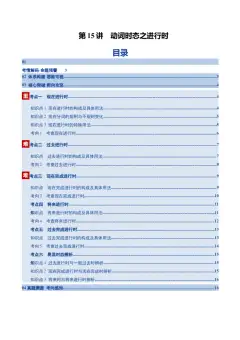
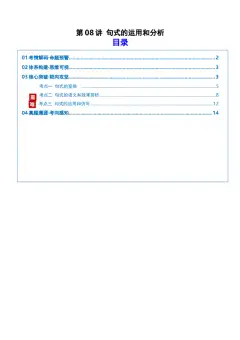
目录
知识点1  笼统词变具体词............................................................................................................................ 1
知识点2  单词变短语...............................................................................................................................11
知识点3  金句:各种不同的“看”......................................................................................................16
知识点4  金句:各种不同的“说”......................................................................................................21
知识点5  金句:各种不同的“走”或“跑”......................................................................................25
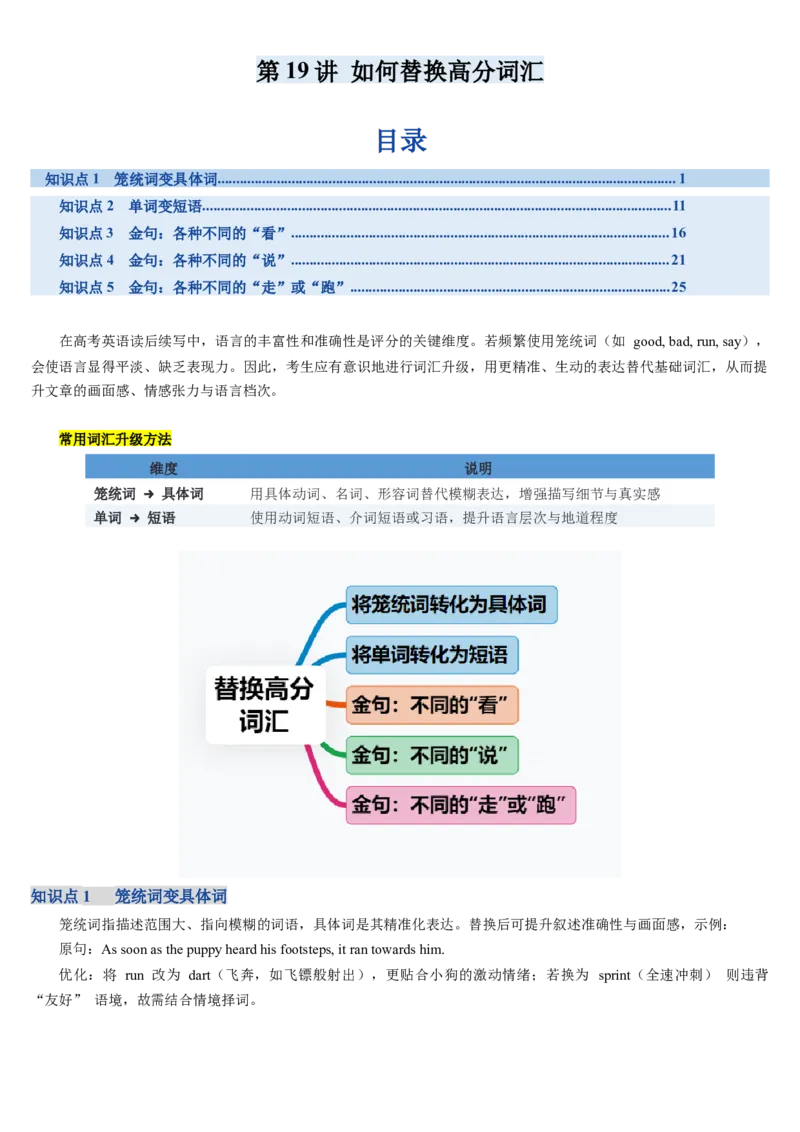
在高考英语读后续写中,语言的丰富性和准确性是评分的关键维度。若频繁使用笼统词(如 good, bad, run, say),
会使语言显得平淡、缺乏表现力。因此,考生应有意识地进行词汇升级,用更精准、生动的表达替代基础词汇,从而提
升文章的画面感、情感张力与语言档次。
常用词汇升级方法
维度
说明
笼统词  具体词
→
用具体动词、名词、形容词替代模糊表达,增强描写细节与真实感
单词  短语
→
使用动词短语、介词短语或习语,提升语言层次与地道程度
知识点1   笼统词变具体词
笼统词指描述范围大、指向模糊的词语,具体词是其精准化表达。替换后可提升叙述准确性与画面感,示例:
原句:As soon as the puppy heard his footsteps, it ran towards him.
优化:将 run 改为 dart(飞奔,如飞镖般射出),更贴合小狗的激动情绪;若换为 sprint(全速冲刺) 则违背
“友好” 语境,故需结合情境择词。
(一)名词(笼统词具体词)
→
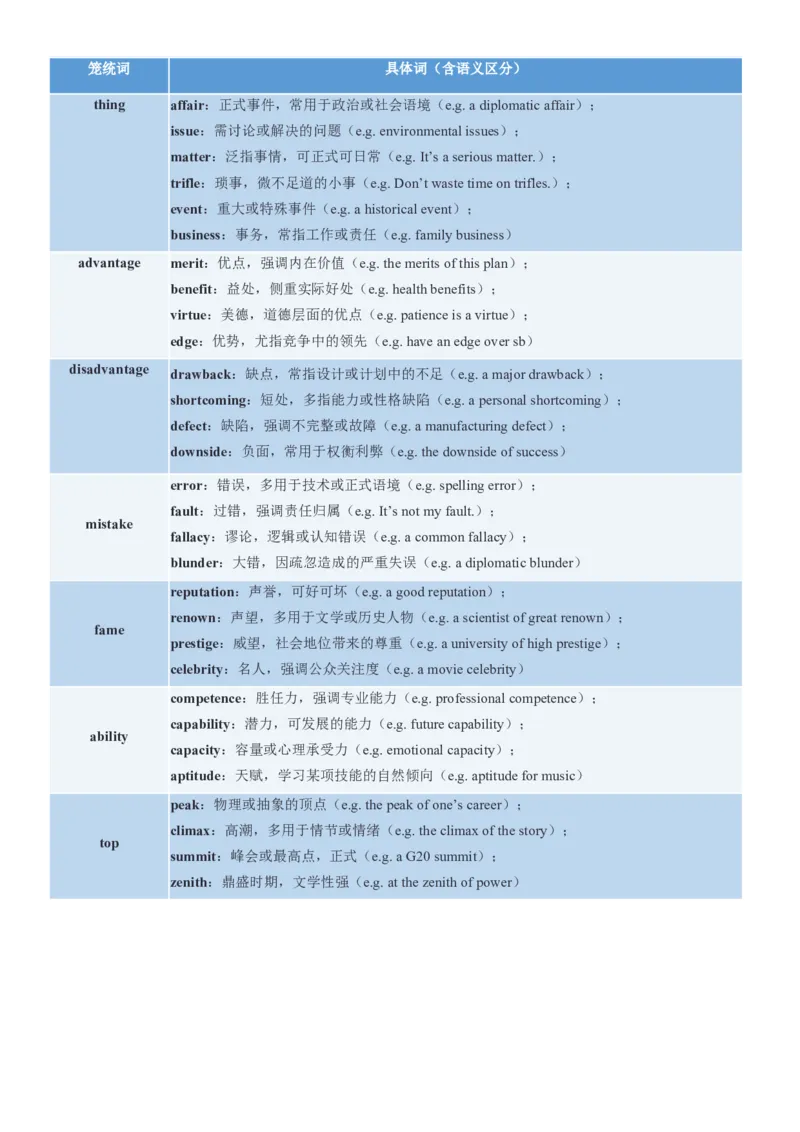
笼统词
具体词(含语义区分)
thing
affair:正式事件,常用于政治或社会语境(e.g. a diplomatic affair);
issue:需讨论或解决的问题(e.g. environmental issues);
matter:泛指事情,可正式可日常(e.g. It’s a serious matter.);
trifle:琐事,微不足道的小事(e.g. Don’t waste time on trifles.);
event:重大或特殊事件(e.g. a historical event);
business:事务,常指工作或责任(e.g. family business)
advantage
merit:优点,强调内在价值(e.g. the merits of this plan);
benefit:益处,侧重实际好处(e.g. health benefits);
virtue:美德,道德层面的优点(e.g. patience is a virtue);
edge:优势,尤指竞争中的领先(e.g. have an edge over sb)
disadvantage
drawback:缺点,常指设计或计划中的不足(e.g. a major drawback);
shortcoming:短处,多指能力或性格缺陷(e.g. a personal shortcoming);
defect:缺陷,强调不完整或故障(e.g. a manufacturing defect);
downside:负面,常用于权衡利弊(e.g. the downside of success)
mistake
error:错误,多用于技术或正式语境(e.g. spelling error);
fault:过错,强调责任归属(e.g. It’s not my fault.);
fallacy:谬论,逻辑或认知错误(e.g. a common fallacy);
blunder:大错,因疏忽造成的严重失误(e.g. a diplomatic blunder)
fame
reputation:声誉,可好可坏(e.g. a good reputation);
renown:声望,多用于文学或历史人物(e.g. a scientist of great renown);
prestige:威望,社会地位带来的尊重(e.g. a university of high prestige);
celebrity:名人,强调公众关注度(e.g. a movie celebrity)
ability
competence:胜任力,强调专业能力(e.g. professional competence);
capability:潜力,可发展的能力(e.g. future capability);
capacity:容量或心理承受力(e.g. emotional capacity);
aptitude:天赋,学习某项技能的自然倾向(e.g. aptitude for music)
top
peak:物理或抽象的顶点(e.g. the peak of one’s career);
climax:高潮,多用于情节或情绪(e.g. the climax of the story);
summit:峰会或最高点,正式(e.g. a G20 summit);
zenith:鼎盛时期,文学性强(e.g. at the zenith of power)
(二)动词(笼统词具体词)
→
笼统词
具体词(含语义与使用场景)
walk
stroll:悠闲散步(e.g. stroll in the park);
trudge:艰难跋涉,疲惫感(e.g. trudge through snow);
tiptoe:蹑手蹑脚,怕被发现(e.g. tiptoe into the room);
stagger:踉跄而行,受伤或醉酒(e.g. stagger after the accident);
creep:缓慢潜行,带神秘或恐惧感(e.g. creep down the hallway);
march:步伐坚定,常用于军队或抗议(e.g. march for justice)
run
dart:突然飞奔,如箭射出(e.g. The cat darted across the street.);
sprint:短距离冲刺(e.g. sprint to the finish line);
charge:猛冲,带攻击性(e.g. The bull charged at him.);
gallop:奔腾(多用于马或想象e.g. gallop across the plain);
scamper:小动物或小孩欢快奔跑(e.g. children scampering in the yard);
hurry:匆忙赶路,强调时间紧迫(e.g. hurry to catch the bus)
look
glance:快速一瞥(e.g. glance at the clock);
gaze:凝视,长时间专注(e.g. gaze at the stars);
stare:盯着看,可能失礼(e.g. Don’t stare!);
glare:怒视,充满敌意(e.g. glare at the bully);
peek:偷看,偷偷摸摸(e.g. peek through the keyhole);
scan:扫视,寻找信息(e.g. scan the crowd for a friend);
observe:观察,带分析意味(e.g. observe animal behavior)
say / talk
announce:正式宣布(e.g. announce the winner);
whisper:耳语,秘密(e.g. whisper a secret);
murmur:低语,含情绪(e.g. murmur in fear);
complain:抱怨(e.g. complain about the noise);
argue:争论(e.g. argue with a friend);
debate:辩论,正式(e.g. debate an issue);
笼统词
具体词(含语义区分)
competitor
rival:长期竞争者,常带情感色彩(e.g. a business rival);
opponent:对手,多用于辩论或体育(e.g. a political opponent);
contestant:参赛者,中性(e.g. a game show contestant);
challenger:挑战者,地位较低的一方(e.g. a challenger in the election)
way
approach:方法,强调策略性(e.g. a new approach to teaching);
method:方法,系统性强(e.g. the scientific method);
avenue:途径,多用于抽象(e.g. an avenue for expression);
means:手段,常用于“by means of”(e.g. by means of technology)
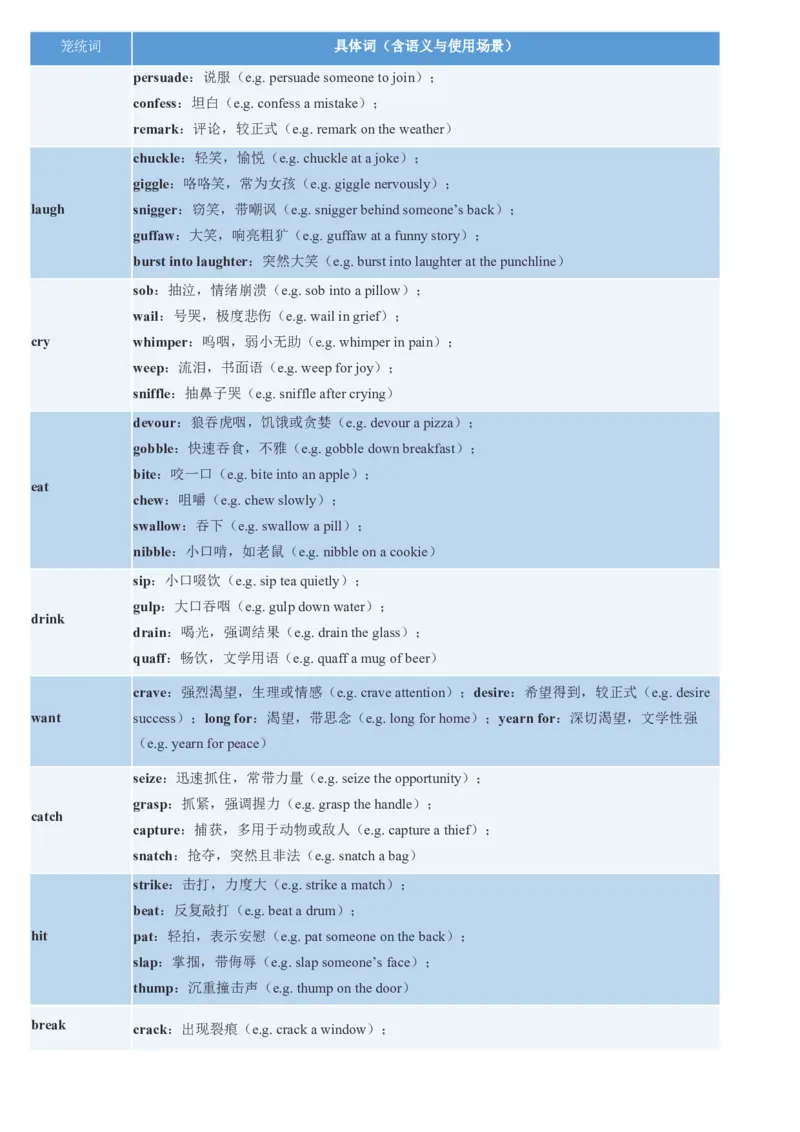
笼统词
具体词(含语义与使用场景)
persuade:说服(e.g. persuade someone to join);
confess:坦白(e.g. confess a mistake);
remark:评论,较正式(e.g. remark on the weather)
laugh
chuckle:轻笑,愉悦(e.g. chuckle at a joke);
giggle:咯咯笑,常为女孩(e.g. giggle nervously);
snigger:窃笑,带嘲讽(e.g. snigger behind someone’s back);
guffaw:大笑,响亮粗犷(e.g. guffaw at a funny story);
burst into laughter:突然大笑(e.g. burst into laughter at the punchline)
cry
sob:抽泣,情绪崩溃(e.g. sob into a pillow);
wail:号哭,极度悲伤(e.g. wail in grief);
whimper:呜咽,弱小无助(e.g. whimper in pain);
weep:流泪,书面语(e.g. weep for joy);
sniffle:抽鼻子哭(e.g. sniffle after crying)
eat
devour:狼吞虎咽,饥饿或贪婪(e.g. devour a pizza);
gobble:快速吞食,不雅(e.g. gobble down breakfast);
bite:咬一口(e.g. bite into an apple);
chew:咀嚼(e.g. chew slowly);
swallow:吞下(e.g. swallow a pill);
nibble:小口啃,如老鼠(e.g. nibble on a cookie)
drink
sip:小口啜饮(e.g. sip tea quietly);
gulp:大口吞咽(e.g. gulp down water);
drain:喝光,强调结果(e.g. drain the glass);
quaff:畅饮,文学用语(e.g. quaff a mug of beer)
want
crave:强烈渴望,生理或情感(e.g. crave attention);desire:希望得到,较正式(e.g. desire
success);long for:渴望,带思念(e.g. long for home);yearn for:深切渴望,文学性强
(e.g. yearn for peace)
catch
seize:迅速抓住,常带力量(e.g. seize the opportunity);
grasp:抓紧,强调握力(e.g. grasp the handle);
capture:捕获,多用于动物或敌人(e.g. capture a thief);
snatch:抢夺,突然且非法(e.g. snatch a bag)
hit
strike:击打,力度大(e.g. strike a match);
beat:反复敲打(e.g. beat a drum);
pat:轻拍,表示安慰(e.g. pat someone on the back);
slap:掌掴,带侮辱(e.g. slap someone’s face);
thump:沉重撞击声(e.g. thump on the door)
break
crack:出现裂痕(e.g. crack a window);
笼统词
具体词(含语义与使用场景)
shatter:粉碎,玻璃等(e.g. shatter a vase);
demolish:拆除建筑(e.g. demolish an old house);
destroy:彻底毁灭(e.g. destroy evidence);
rupture:破裂,多用于关系或器官(e.g. rupture a friendship)
(三)形容词和副词(笼统词具体词)
→
笼统词
具体词
beautiful
handsome:英俊的(多用于男性);
attractive:吸引人的(通用);
graceful:优雅的(动作或姿态);
fine:精美的(物品或工艺);
gorgeous:惊艳的(e.g. a gorgeous dress);
breathtaking:令人屏息的美(e.g. a breathtaking view)
glad
excited:兴奋的(期待某事);
pleasant:愉快的(心情或环境);
joyful:欢喜的(节日或重逢);
delighted:欣喜的(正式);
thrilled:激动的(e.g. thrilled to meet you)
important
vital:至关重要的(e.g. vital information);
critical:决定性的(e.g. a critical moment);
significant:意义重大的(e.g. a significant change);
primary:首要的(e.g. primary goal);
profound:深刻的(e.g. profound impact)
bad
mean:卑鄙的(e.g. a mean comment);
evil:邪恶的(e.g. an evil plan);
selfish:自私的(e.g. a selfish act);
disgusting:令人厌恶的(e.g. disgusting food);
horrible:可怕的(e.g. a horrible accident)
good
excellent:优秀的(e.g. excellent work);
awesome:令人惊叹的(口语);
outstanding:杰出的(e.g. outstanding performance);
remarkable:非凡的(e.g. a remarkable achievement);
superb:极好的(e.g. superb quality)
poor
impoverished:赤贫的(e.g. impoverished communities);
poverty-stricken:一贫如洗的(强调极度贫困);
needy:贫困的(需要帮助的);
underprivileged:弱势的(教育/资源不足)
very
terribly:极度地(e.g. terribly sorry);
extremely:极其(通用);
highly:非常(多用于抽象名词前,e.g. highly effective);
greatly:大大地(e.g. greatly improved);
acutely:剧烈地(多用于疼痛或焦虑)
nearby
adjacent:毗连的(e.g. adjacent buildings);
neighboring:邻近的(e.g. neighboring countries);
in the vicinity of:在
附近(正式)
……
all
completely:彻底地(e.g. completely wrong);
absolutely:绝对地(e.g. absolutely sure);
fully:充分地(e.g. fully aware)
only
merely:只不过(略带轻视);
solely:单独地;唯(e.g. solely responsible);
simply:只不过(口语化)
usually
periodically:周期性地(e.g. periodically check);
regularly:定期地(e.g. regularly exercise);
frequently:频繁地(e.g. frequently visit)
练习1:结合语境,将句中笼统词替换为具体词,优化表达
1.Because of her hatred, she looked at him.
Because of her hatred, she ____ at him.
2.With only twenty seconds left, I ran to the line.
With only twenty seconds left, I ____ to the line.
3.He fell, hitting his head on the edge of the desk.
He fell, ____ his head on the edge of the desk.
4.It had taken them a week to catch the escaped pigs.
It had taken them a week to ____ the escaped pigs.
5.With only two minutes left, he ate his meal.
With only two minutes left, he ____ his meal.
6.I don’t want to stay up all night over such an unimportant thing.
I don’t want to stay up all night over such a(n) ____.
7.They walked onwards with exhausted bodies through the desert.
They ____ onwards with exhausted bodies through the desert.
8.I decided that I am very bad. I’ve been mainly concerned with myself.
I decided that I am very ____. I’ve been mainly concerned with myself.
9.Bathsheba was at this time in her room, dressing for the solemn event.
Bathsheba was at this time in her room, dressing for the solemn ____.
10.It was only a flicker of light in the distance, yet it filled them with hope.
It was ____ a flicker of light in the distance, yet it filled them with hope.
11.After two weeks of hard work, he detected the falseness of her argument.
After two weeks of hard work, he detected the ____ of her argument.
12.He’s not really good-looking, but he’s handsome in a strange kind of way.
He’s not really good-looking, but he’s ____ in a strange kind of way.
13.She heard her mother say quietly as she walked down the hall, “Don’t wake your father up.”
She heard her mother ____ as she ____ down the hall, “Don’t wake your father up.”
14.Those girls talked hotly about the question of the most beautiful princess in fairy tales.
Those girls ____ hotly about the question of the most beautiful princess in fairy tales.
15.She choked and began coughing. When he pushed a glass of water to her mouth, she drank all of it.
She choked and began coughing. When he pushed a glass of water to her mouth, she ____ it.
参考答案:
1.glared   2. darted   3. striking   4. capture
5..gobbled   6. trifle    7. trudged    8. selfish
9.occasion  10. merely   11. fallacy   12. attractive
13.whisper; tiptoed/crept 14. argued/debated 15. drained
1.Because of her hatred, she ____ at him.
中文翻译:由于她的仇恨,她____着他。
答案:glared
解析:“glare”意为“怒视”,带有强烈的愤怒和敌意,比普通的“look”更能体现“仇恨”情绪,生动准确。
2.With only twenty seconds left, I ____ to the line.
中文翻译:只剩二十秒了,我____向终点线。
答案:dashed / sprinted
解析:“dash”或“sprint”都表示“猛冲、冲刺”,强调速度和紧迫感,比“ran”更具画面感和紧张氛围。
3.He fell, ____ his head on the edge of the desk.
中文翻译:他摔倒了,头____在书桌边缘上。
答案:striking
解析:“strike”意为“击打、撞击”,比“hit”更正式有力,突出撞击的力度和疼痛感,适合描写意外事故。
4.It had taken them a week to ____ the escaped pigs.
中文翻译:他们花了一周时间才____逃走的猪。
答案:capture
解析:“capture”意为“捕获”,常用于动物或逃犯,比“catch”更正式、更符合“追捕逃逸动物”的语境。
5.With only two minutes left, he ____ his meal.
中文翻译:只剩两分钟了,他____吃完了饭。
答案:gobbled / devoured
解析:“gobble”或“devour”都表示“狼吞虎咽”,体现急切和匆忙,比“ate”更形象地表现时间紧迫下的进食状态。
6.I don’t want to stay up all night over such a(n) ____thing.
中文翻译:我不想为了这么一件____的事熬一整夜。
答案:trifle
解析:“trifle”意为“琐事、微不足道的小事”,比“thing”更精准,强调不值得为此耗费精力。
7.They ____ onwards with exhausted bodies through the desert.
中文翻译:他们拖着疲惫的身体,在沙漠中____前行。
答案:trudged
解析:“trudge”意为“艰难跋涉”,体现疲惫和行走的艰辛,比“walked”更具情感和画面感。
8.I decided that I am very ____. I’ve been mainly concerned with myself.
中文翻译:我意识到自己非常____。我一直只关心自己。
答案:selfish
解析:“selfish”意为“自私的”,准确描述“只关心自己”的行为,比笼统的“bad”更具体、合理。
9.Bathsheba was at this time in her room, dressing for the solemn ____.
中文翻译:芭丝谢芭此刻正在房间里,为这个庄重的____做着打扮。
答案:occasion
解析:“occasion”意为“场合”,强调正式和庄重,比“event”更贴合“ dressing for”这种仪式感强的场景。
10.It was ____ a flicker of light in the distance, yet it filled them with hope.
中文翻译:那只是远处的一丝微光,____如此,却让他们充满了希望。
答案:merely
解析:“merely”意为“仅仅、只不过”,强调光的微弱,与后文“充满希望”形成强烈对比,增强情感张力。
11.After two weeks of hard work, he detected the ____ of her argument.
中文翻译:经过两周的努力,他发现了她论点中的____。
答案:fallacy
解析:“fallacy”意为“谬误、逻辑错误”,比“falseness”更专业,适合用于“argument”(论点)的语境。
12.He’s not really good-looking, but he’s ____ in a strange kind of way.
中文翻译:他其实不算英俊,但以某种奇怪的方式,他很____。
答案:attractive
解析:“attractive”意为“有吸引力的”,不强调传统外貌,而是整体魅力,比“handsome”更灵活自然。
13.She heard her mother ____ as she ____ down the hall, “Don’t wake your father up.”
中文翻译:她听见母亲____着,同时____走过走廊:“别吵醒你爸爸。”
答案:whisper; tiptoed / crept
解析:“whisper”表示“低声说”,“tiptoe”或“creep”表示“蹑手蹑脚”,都体现“怕惊醒”父亲的小心动作,配合默
契。
14.Those girls ____ hotly about the question of the most beautiful princess in fairy tales.
中文翻译:那几个女孩就童话中最美的公主这个问题____地争论着。
答案:argued / debated
解析:“argue”或“debate”表示“争论、辩论”,比“talked”更准确体现“hotly”(激烈地)的情绪和互动。
15.She choked and began coughing. When he pushed a glass of water to her mouth, she ____ it.
中文翻译:她哽住了,开始咳嗽。当他将一杯水推到她嘴边时,她____了它。
答案:drained
解析:“drain”意为“喝光、饮尽”,强调动作的彻底性,体现她极度口渴的状态,比“drank”更生动有力。
练习2:结合语境,用具体词完成下列句子翻译。
1.她趁着没人看见就蹑手蹑脚走出了房间。
2.扫视着孩子们脸上的笑容,她深感宽慰。
3.有个女孩在山顶上大喊大叫,疯狂地挥舞着双手。
4.当她的思绪回到他们婚礼那一天时,她心满意足地笑了。
5.她傻笑以掩饰自己的尴尬。
6.嚼着东西和别人说话是不礼貌的,东西咽下去之后再说话。
7.他的脸上掠过惊恐的神色,他开始发抖。
8.他沉默地低着头,终于承认这一切都是他的错。
9.她优雅地摇了摇头,拒绝他的邀请。
10.她兴奋地走上舞台,开始了她的舞蹈表演。
参考答案:
1. She tiptoed out of the room while no one was looking.
语法结构:while 引导 时间状语从句,强调 “蹑手蹑脚离开” 与 “没人看” 的同步性。
tiptoed(蹑手蹑脚走)是 动作副词化,精准刻画 “偷偷行动” 的姿态。
亮点:用 tiptoed 替代普通动词 walked,瞬间强化 “小心翼翼” 的画面感;while 压缩从句,让句子更紧凑。
2. Scanning the smiles on children’s faces, she felt a sense of relief.
语法结构:Scanning... 是 现在分词短语作伴随状语(逻辑主语为 she,主动关系),表 “扫视笑容” 与 “感到宽
慰” 的先后衔接。
亮点:非谓语动词替代复杂从句(如 When she scanned...),让动作更连贯;a sense of relief 比 relieved 更细腻,体现
“宽慰感” 的渐进。
3. A girl at the top of the mountain was shouting and waving her hands wildly.
语法结构:过去进行时 was shouting and waving 表 持续动作,wildly 是 副词修饰动作,强化疯狂程度。at the top of
the mountain 是 地点状语,明确场景。
亮点:并列动作 shouting + waving 营造 “激动失控” 的画面;wildly 从幅度上放大情绪,让人物更鲜活。
4. When her thoughts flashed back to their wedding day, she smiled contentedly.
语法结构:when 引导 时间状语从句,flashed back(思绪闪回)是 动态短语,表记忆突然复苏。
contentedly 是 副词修饰微笑,精准传递 “满足感”。
亮点:flashed back 比 thought of 更生动(像 “闪电般回溯”);contentedly 让微笑有了 “心理重量”,而非单纯动
作。
5. She giggled to cover up her embarrassment.
语法结构:to cover up... 是 不定式表目的,giggled(傻笑)是 精准动词(区别于 laughed,更贴合 “掩饰尴尬” 的
局促)。
亮点:用 giggled 替代普通动词,瞬间强化 “尴尬时的不自然笑容”;cover up 比 hide 更具 “刻意掩饰” 的画面感。
6. It’s impolite to chew food while talking with others. Talk after you have swallowed it.
语法结构:第一句:it 作 形式主语,真正主语是 to chew...;while talking 是 省略式状语从句(省略 you are,主从句
主语一致时可省略)。
第二句:have swallowed 是 现在完成时,强调 “咽下去” 的动作完成后再说话。
亮点:省略式从句让表达更简洁;have swallowed 明确时间逻辑(先咽再说话),比 after swallowing 更强调 “完成”。
7. With a look of terror flashing across his face, he began trembling.
语法结构:with 复合结构(with + 宾语 + 宾补):a look of terror 是宾语,flashing(现在分词,主动关系,因 “惊恐
神色” 主动 “闪过” 脸)作宾补。
亮点:用 with 结构替代从句(如 When a look of terror flashed...),让句子更紧凑;flashing 动态呈现 “惊恐瞬间浮
现”,比 appeared 更有画面张力。
8. Ducking his head silently, he finally admitted that it was all his fault.
语法结构:Ducking his head 是 现在分词短语作伴随状语(逻辑主语 he,主动关系,“低头” 是主动动作)。that 引
导 宾语从句,明确承认的内容。
亮点:ducking(快速低头,像躲避般)比 lowering 更生动,强化 “愧疚时的肢体语言”;silently 从氛围上渲染 “沉
默认错” 的沉重感。
9. She shook her head gracefully and refused his invitation.
语法结构:gracefully 是 副词修饰动作,shook 和 refused 是 并列谓语,体现 “摇头” 与 “拒绝” 的连贯动作。
亮点:gracefully 赋予 “摇头” 优雅感,让人物形象更立体;并列动作避免句式单调,自然呈现 “拒绝” 的过程。
10. She stepped excitedly onto the stage and began her dancing performance.
语法结构:excitedly 是 副词修饰动作,stepped 和 began 是 并列谓语,表 “上台” 与 “开始表演” 的衔接。
亮点:excitedly 直接传递情绪,比 She was excited and stepped... 更简洁;stepped onto 生动表现 “踏上舞台” 的动作,
让场景更具象。
知识点2   单词变短语
在英语写作(尤其是读后续写)中,使用短语替代单一单词,不仅能避免语言单调,还能增强表达的正式性、生动
性和地道感。短语的使用往往比单词更自然、更符合英语母语者的表达习惯。
常见替换类型包括:
动词
 动词短语(如
→
 think → mull over)
副词
 副词短语(如
→
 usually → more often than not)
形容词
 “
→
of + 抽象名词”结构(如 important → of importance)
介词
 介词短语(如
→
 about → with regard to)
掌握这些替换,能显著提升语言档次,让作文更具表现力。
原词(词性)
替换短语
中文释义
使用场景与说明
like(v.)
have a passion for
对
充满热
……
情
用于表达强烈的兴趣或爱好,比 like 更正式、情感更强烈。适合描
写人物动机或成长主题。 例:She has a passion for painting.
start / begin
(v.)
be initiated to
开始接触,初
步了解
多用于正式或书面语,强调“初次接触某事物”。 例:He was
initiated to music at the age of six.

⚠️注意:不用于“开始做某事”的
日常表达(如 start working)。
begin(v.)
get down to
开始认真做
(某事)
强调“进入正题、着手处理”,常接名词或动名词。 例:It’s time
to get down to business. / get down to studying.
appreciated
(v.)
be indebted to
感激,对……
心怀感激
语气正式,常用于书面表达或情感升华段落,表达对他人帮助的深
切感谢。 例:I am deeply indebted to my teacher for her support.
raise(v.)
put forward
提出(建议、用于“提出想法、建议”,比 raise 更书面化,适合议论文或人物对
原词(词性)
替换短语
中文释义
使用场景与说明
观点)
话描写。 例:He put forward a new plan during the meeting.
desire(v./n.)long for
渴望,怀念
表达强烈的情感渴望,常用于思乡、亲情、梦想等主题。 例:She
longs for her childhood days.
use(v.)
make use of
利用,使用
更正式,强调“有效利用资源或机会”,适合描述解决问题的过
程。 例:We should make good use of our time.
decide(v.)
make up one’s
mind
下定决心
强调心理决策过程,常用于人物心理描写,体现成长或转变。 例:
After much thought, she made up her mind to leave.
cry(v.)
burst into tears
突然大哭
生动描写情绪爆发瞬间,比 cry 更具画面感,常用于悲伤、感动、
委屈等情节。 例:When she heard the news, she burst into tears.
come(v.)
draw near
接近,临近
多用于时间或距离的接近,文学性强,适合描写节日、结局或紧张
时刻的来临。 例:The final exam is drawing near.
meet(v.)
come across
偶然遇见
强调“偶然性”,适合描写意外相遇的情节,如老友重逢、发现线
索等。 例:I came across an old friend in the park.
think(思考)
(v.)
mull over
仔细考虑,反
复思索
强调深思熟虑的过程,适合描写人物内心挣扎或决策前的心理活
动。 例:He mull over the decision for days.
think(认为)
(v.)
hold the view
持有
观点
……
正式表达“某人认为”,适合议论文或人物对话中的观点陈述。
例:Many experts hold the view that climate change is serious.
bear(v.)
put up with
忍受,容忍
口语和书面语皆可,比 bear 更自然,常用于表达对困难、噪音、坏
习惯的忍耐。 例:I can’t put up with his laziness anymore.
affect(v.)
have an effect on
对
产生影
……
响
结构更清晰,适合书面表达,强调因果关系。 例:Smoking has a
bad effect on health.
原词(词性)
替换短语
中文释义
使用场景与说明
remember
(v.)
bear...in mind
牢记,记住
强调“在心中记住某事”,常用于提醒或建议。 例:Always bear in
mind the importance of safety.
own(v.)
be in possession of 拥有,持有
正式表达“拥有某物”,适合描述贵重物品或正式场合。 例:He is
in possession of a rare book.
believe(v.)
be convinced of
深信,确信
强调坚定的信念,情感更强,适合描写人物态度转变后的心理状
态。 例:I’m convinced of his honesty.
tired(adj.)
worn out
精疲力尽的
比 tired 程度更深,强调身体或精神的极度疲惫,适合描写长途跋
涉、重体力劳动后状态。 例:After the hike, we were all worn out.
stress(v.)
lay emphasis on
强调,重视
正式表达“强调某事的重要性”,适合议论文或人物演讲场景。
例:The teacher laid great emphasis on teamwork.
solve(v.)
work out / figure
out
解决,弄清楚
work out 常用于解决难题、矛盾;figure out 更口语化,强调“想明
白”。 例:We finally worked out a solution. / I can’t figure out this
math problem.
replace(v.)
take the place of
取代,代替
常用于描述角色、技术、物品的更替,适合科技、家庭、社会类话
题。 例:Electric cars may take the place of gasoline cars.
see(v.)
catch sight of
看到,瞥见
强调“突然看见”,带有惊喜或意外感,适合描写重逢、发现线索
等情节。 例:She caught sight of her lost dog across the street.
suit(v.)
be suitable for
适合于……
更正式,常用于描述衣服、工作、环境是否合适。 例:This job is
suitable for someone with experience.
refuse(v.)
turn down
拒绝(提议、
邀请)
常用于口语和书面语,比 refuse 更自然,多用于拒绝请求或机会。
例:He turned down the job offer.
attract(v.)
appeal to
吸引,引起兴
趣
常用于抽象吸引力,如兴趣、情感、美感等。 例:This design
appeals to young people.
练习:结合语境,将单词替换成短语以优化表达。
1.Usually, he would walk alone by the lake in a daze.
____, he would walk alone by the lake in a daze.
2.It has given us a richer understanding of certain learning mechanisms, particularly about non-humans.
It has given us a richer understanding of certain learning mechanisms, particularly ____ non-humans.
3.It is a truth universally acknowledged that a single man owning a good fortune must be in want of a wife.
It is a truth universally acknowledged that a single man ____ a good fortune must be in want of a wife.
4.The minute I heard the first note of her voice, I cried.
The minute I heard the first note of her voice, I ____.
5.Remember that the rules we’re talking about here are not rules you explicitly know.
____ that the rules we’re talking about here are not rules you explicitly know.
6.I’m not going to bear it and I’m going to do whatever it takes.
I’m not going to ____ it and I’m going to do whatever it takes.
7.If you want to be outstanding, you must first believe that you can be successful.
If you want to be outstanding, you must first ____ your capability to succeed.
8.Keep an eye out for the beautiful, observe the unusual, and see the surprising.
Keep an eye out for the beautiful, observe the unusual, and ____ the surprising.
9.It is important to keep calm in such an emergency.
It is ____ to keep calm in such an emergency.
10.I tried to think about the problem and then figure out how to solve it.
I tried to ____ the problem and then figure out how to solve it.
参考答案:结合语境,将单词替换成短语以优化表达
1.____, he would walk alone by the lake in a daze.
答案: More often than not
解析: "More often than not" 是 "usually" 的同义短语,表示“通常情况下”。中文:“通常情况下,他会恍惚地独自在
湖边散步。”
 2. It has given us a richer understanding of certain learning mechanisms, particularly ____ non-humans.
答案: with regard to
解析: "with regard to" 替换 "about",表示“关于”。中文:“它使我们对某些学习机制有了更丰富的理解,尤其是关于
非人类的。”
3. It is a truth universally acknowledged that a single man ____ a good fortune must be in want of a wife.
答案: in possession of
解析: "in possession of" 替换 "owning",表示“拥有”。中文:“普遍认为,一个拥有良好财富的单身男子必定需要一
位妻子。”
4.The minute I heard the first note of her voice, I ____.
答案: burst into tears
解析: "burst into tears" 替换 "cried",表示“突然大哭起来”。中文:“当我听到她声音的第一个音符时,我突然大哭起
来。”
5. ____ that the rules we’re talking about here are not rules you explicitly know.
答案: Bear in mind
解析: "Bear in mind" 替换 "Remember",表示“记住”。中文:“请记住,我们在这里讨论的规则并不是你明确知道的
规则。”
6.I’m not going to ____ it and I’m going to do whatever it takes.
答案: put up with
解析: "put up with" 替换 "bear",表示“忍受”。中文:“我不会忍受它,并且会做任何必要的事情。”
7.If you want to be outstanding, you must first ____ your capability to succeed.
答案: be convinced of
解析: "be convinced of" 替换 "believe",表示“确信”。中文:“如果你想脱颖而出,你必须首先确信自己能够成
功。”
8.Keep an eye out for the beautiful, observe the unusual, and ____ the surprising.
答案: catch sight of
解析: "catch sight of" 替换 "see",表示“看到”。中文:“留意美丽的事物,观察不寻常的事物,并发现令人惊讶的事
物。”
9.It is ____ to keep calm in such an emergency.
答案: of importance
解析: "of importance" 替换 "important",表示“重要的”。中文:“在这样的紧急情况下保持冷静是重要的。”
10. I tried to ____ the problem and then figure out how to solve it.
答案: mull over
解析: "mull over" 替换 "think about",表示“仔细考虑”。中文:“我试着仔细考虑这个问题,然后找出解决方法。”
知识点3   各种不同的“看”
(1) 瞥一眼(glance、glimpse)
金句 1:
He glanced at the clock and realised he was late.
•结构:简单句,含 并列谓语(glanced + realised),realised 后接 宾语从句。
•亮点:
◦glance 精准体现 快速扫一眼 的动作,比
“
”
look 更具画面感;
◦并列谓语让 看钟表
意识到迟到 的逻辑瞬间衔接,无需冗余连词。
“
→
”
金句 2:
Seeing the mess around the room, Mum shot me a blaming glance.
•结构:现在分词短语(Seeing...)作原因状语 + 简单句,shot me a glance 是固定搭配(投来目光)。
“
”
•亮点:
◦blaming 修饰 glance,直接强化 责备的眼神,省去
“
”
“Mum looked at me angrily” 的啰嗦;
◦非谓语状语压缩从句,让句子更紧凑,场景更连贯。
(2) 盯着看(stare、gaze)
金句 1:
The little girl stared at the fireworks in awe, her eyes wide with wonder.
•结构:简单句 + 独立主格结构(her eyes wide...)作伴随状语。
•亮点:
◦stare 强调 呆呆地盯,
“
”
in awe 补充 惊叹的状态;
“
”
◦独立主格用 眼睛睁大 的细节,把 看烟花 的震撼具象化,比
“
”
“
”
“she was very surprised” 更生动。
金句 2:
She stood by the window, gazing thoughtfully into the distance.
•结构:简单句 + 现在分词短语(gazing...)作伴随状语。
•亮点:
◦gaze 比 stare 更柔和,表 凝视、沉思;
“
”
◦thoughtfully 修饰动作,直接传递 若有所思 的情绪,让人物更立体。
“
”
(3) 怒目而视(glare)
金句 1:
Jim glared at Paul, but contained his anger, saying nothing.
•结构:简单句(含 并列谓语 glared + contained) + 现在分词短语(saying...)作伴随状语。
•亮点:
◦glare 自带 愤怒盯视 的冲击力,比
“
”
look angrily 更精准;
◦怒视
克制愤怒
沉默 的动作链,通过并列谓语和伴随状语,瞬间呈现 情绪冲突。
“
→
→
”
“
”
金句 2:
The teacher’s angry glare swept over the students, scaring the misbehaving boys into silence.
•结构:简单句 + 现在分词短语(scaring...)作结果状语。
•亮点:
◦glare 作主语,把 愤怒的眼神 当武器,强化威慑力;
“
”
◦swept over (扫视)+ scaring...into silence(吓得沉默),用结果状语放大 怒视 的效果,画面感炸裂。
“
”
(4) 扫视(scan、wander)
金句 1:
She scanned the street nervously, looking for the mother and son.
•结构:简单句 + 现在分词短语(looking...)作伴随状语。
•亮点:
◦scan 表 快速扫视(找东西),比
“
”
look around 更具目的性;
◦nervously 修饰动作,直接传递 焦急 的情绪,让 扫视 有了心理重量。
“
”
“
”
金句 2:
With a quick scan of the shelf, I found the book I was looking for.
•结构:介词短语(With...)作方式状语 + 主句 + 定语从句(I was looking for)。
•亮点:
◦a quick scan 把 扫视 名词化,更强调动作的 快速、高效;
“
”
“
”
◦介词短语压缩从句(如 After I scanned the shelf quickly...),让句子更简洁,动作更干脆。
(5) 偷看(peek、peep)
金句 1:
“Close your eyes. Don’t peek!” Jim exclaimed. But I was so curious that I couldn’t resist peeping through my fingers.
•结构:
◦直接引语 + 简单句;
◦主句 + so...that 结果状语从句。
•亮点:
◦peek( general 偷看 )和 peep( 透过缝隙偷看 )分工明确,细节精准;
◦引语和结果从句形成 命令
违背 的冲突,把 好奇 的张力拉满,比单纯描述更有故事感。
“
→
”
“
”
金句 2:
She quickly glanced at her phone under the table, stealing a peek at the incoming message.
•结构:简单句 + 现在分词短语(stealing...)作伴随状语。
•亮点:
◦glanced( 快速看 )+ stealing a peek( 偷偷看 ),用两个动作叠加,强化 偷偷摸摸 的画面;
“
”
◦under the table 补充场景,让 偷看 更具真实感,仿佛能看到她的紧张。
“
”
(6) 观看(watch、observe)
金句 1:
I stood and watched my old friend join the crowd until he was out of sight.
•结构:主句(含 并列谓语 stood + watched) + until 时间状语从句。
•亮点:
◦watch 表 持续注视,比
“
”
look at 更强调 目送 的过程;
“
”
◦并列谓语 + 时间从句,把 站立
目送
消失 的情感链自然展开,含蓄又深情。
“
→
→
”
金句 2:
He attentively watched the chef prepare the dish, quietly observing each step in the cooking process.
•结构:简单句 + 现在分词短语(observing...)作伴随状语。
•亮点:
◦watch( 看动作 )和 observe( 观察细节 )近义互补,体现 专注度升级;
“
”
◦attentively( 专注 )和 quietly( 安静 )修饰动作,把 认真观察 的状态刻画得淋漓尽致。
“
”
(7) 目光落在
金句 1:
As Tim was thinking about what gift to give Dana, his eyes fell on the plastic rat ball on the desk.
•结构:as 时间状语从句(表 思考时)
“
”
+ 主句。
•亮点:
◦fell on 表 目光突然落在,比
“
”
saw 更有 偶然发现 的画面感;
“
”
◦从句和主句衔接自然,把 思考
发现礼物 的过程瞬间呈现,场景真实。
“
→
”
金句 2:
As he looked around the room, his eyes were drawn to a pile of books in the corner.
•结构:as 时间状语从句(表 环视时)
“
”
+ 主句。
•亮点:
◦were drawn to 表 被吸引,把 目光 拟人化,体现 书籍主动吸引注意;
“
”
“
”
“
”
◦looked around 和 drawn to 呼应,让目光的移动更自然,细节生动。
(8) 目光转向
金句 1:
After hearing my sister’s words, my father turned his eyes towards me.
•结构:介词短语(After...)作时间状语 + 简单句。
•亮点:
◦turned his eyes towards 表 目光转向,比
“
”
looked at 更强调 方向变化;
“
”
◦hearing 触发 转向,逻辑清晰,体现 话语对动作的影响。
“
”
“
”
金句 2:
As she entered the party, everybody turned their head and all eyes were directed towards her.
•结构:as 时间状语从句 + and 连接的并列句。
•亮点:
◦turned their head( 转头 )+ eyes were directed( 目光投射 ),从 肢体 到 眼神 层层递进,强化 众人
“
”
“
”
“
聚焦 的画面;
”
◦从句和并列句结合,把 她入场
众人反应 的场景瞬间点燃,热闹感拉满。
“
→
”
(9) 目不转睛
金句 1:
His eyes were glued to the screen as I tried to talk to him.
•结构:主句 + as 时间状语从句。
•亮点:
◦were glued to ( 粘在 上 )形象化表达 目不转睛,比
…
“
”
stared at 更具画面冲击力;
◦对比 我说话 和 他看屏幕,用冲突强化 专注,让场景更有故事感。
“
”
“
”
“
”
金句 2:
The children’s eyes were fixed on the magician’s hands, fascinated by the tricks being performed before them.
•结构:主句 + 过去分词短语(fascinated...)作伴随状语。
•亮点:
◦were fixed on ( 固定在 上 )表 死死盯着,比
…
“
”
stared at 更强调 无法移开;
“
”
◦fascinated 补充 着迷 的情绪,把 看魔术 的沉浸感拉满,细节封神。
“
”
“
”
(10) 眼角余光
金句 1:
During the presentation, he noticed, out of the corner of his eye, his teacher nodding approvingly at him.
•结构:时间状语 + 简单句(含 宾语补足语(nodding...)) + 介词短语(out of...)作方式状语。
•亮点:
◦out of the corner of his eye ( 眼角余光 )精准表视角,比 He saw...from the side 更简洁;
◦nodding approvingly 作宾补,把 老师点头 的细节嵌入,瞬间传递 被认可 的喜悦。
“
”
“
”
金句 2:
While waiting at the bus stop, from the corner of my eye, I observed a homeless man sitting by the roadside.
•结构:省略式时间状语从句(While waiting...) + 介词短语作方式状语 + 主句(含 宾语补足语(sitting...))。
•亮点:
◦省略从句(省略 I was)让句子更紧凑,符合 读后续写求简洁 的规律;
“
”
◦observed + sitting 表 看到某人正在做某事,细节真实,仿佛 眼角余光扫到 的瞬间被定格。
“
”
“
”
(11) 映入眼帘
金句 1:
As I opened the door, a clean, tidy and well-decorated room came into sight.
•结构:as 时间状语从句 + 主句。
•亮点:
◦came into sight ( 映入眼帘 )比 I saw 更强调 画面突然出现,有 惊喜感;
“
”
“
”
◦三个形容词(clean, tidy, well-decorated)叠加,瞬间勾勒房间的精致,视觉冲击强。
金句 2:
Upon reaching the top of the mountain, a huge red sun came into view and took my breath away.
•结构:介词短语(Upon...)作时间状语 + 简单句(含 并列谓语 came + took)。
•亮点:
◦came into view ( 映入视野 )比 appeared 更具 探索感,呼应 到达山顶 的场景;
“
”
“
”
◦took my breath away ( 让我屏息 )强化 红日壮观 的感受,把 看 的体验升级为 震撼,情感更饱满。
“
”
“
”
“
”
知识点4   各种不同的“说”
(1)用
的声音或语气说(
……
say in a … voice /tone)
金句:“Try again,” he said in an encouraging / patient tone.
【句意】再试一次。 他用鼓励
“
”
/ 耐心的语气说。
【结构】直接引语 + 简单句 + 介词短语作状语(形容词 encouraging/patient 修饰 tone)
金句:“I trust you,” she said in a steady / reassuring voice.
【句意】我相信你。 她用坚定
“
”
/ 安心的声音说。
【结构】直接引语 + 简单句 + 介词短语作状语(形容词 steady/reassuring 修饰 voice)
(2)大声叫喊(exclaim、cry、shout、yell)
金句:“Watch out!” he yelled at the top of his lungs.
【句意】小心! 他用尽全力大喊。
“
”
【结构】直接引语 + 简单句 + 介词短语作状语(at the top of his lungs 表 用尽全力)
“
”
【生词短语】
・
at the top of one’s lungs 用尽全力(呼喊)
金句:“Why did you do this?” she cried out in despair.
【句意】你为什么这么做? 她绝望地哭喊。
“
”
【结构】直接引语 + 简单句 + 介词短语作状语(in despair 表情绪)
(3)低声说(whisper、murmur)
金句:“Keep it a secret,” he whispered into her ear.
【句意】保守秘密。 他对着她的耳朵低语。
“
”
【结构】直接引语 + 简单句 + 介词短语作状语(into her ear 表位置)
金句:“The flowers are beautiful,” she murmured, smiling softly.
【句意】花很漂亮。 她轻声低语,温柔地笑着。
“
”
【结构】直接引语 + 简单句 + 现在分词短语(smiling softly)作伴随状语
(4)含糊地说(mumble、mutter)
金句:“I didn’t hear you,” he mumbled, rubbing his sleepy eyes.
【句意】我没听见你说的。 他咕哝着,揉着惺忪的睡眼。
“
”
【结构】直接引语 + 简单句 + 现在分词短语(rubbing his sleepy eyes)作伴随状语
【生词】sleepy adj. 困乏的
金句:“This is useless,” she muttered, tossing the broken pen aside.
【句意】这东西没用。 她嘟囔着,把坏钢笔扔到一边。
“
”
【结构】直接引语 + 简单句 + 现在分词短语(tossing the broken pen aside)作伴随状语
(5)脱口而出(blurt out)
金句:“How much did you pay for it?” he blurted out curiously.
【句意】你买这个花了多少钱? 他好奇地脱口而出。
“
”
【结构】直接引语 + 简单句 + 副词(curiously)作状语
金句:“I forgot my keys!” she blurted out, panicking instantly.
【句意】我忘带钥匙了! 她脱口而出,立刻慌了神。
“
”
【结构】直接引语 + 简单句 + 现在分词短语(panicking instantly)作伴随状语
(6)结巴地说(stammer、stutter)
金句:“I-I can’t do it,” he stammered, his face turning red.
【句意】我、我做不到。 他结结巴巴地说,脸涨得通红。
“
”
【结构】直接引语 + 简单句 + 独立主格结构(his face turning red)作伴随状语
金句:“A-are you sure?” she stuttered, avoiding eye contact.
【句意】你、你确定吗? 她结巴地问,不敢直视对方。
“
”
【结构】直接引语 + 简单句 + 现在分词短语(avoiding eye contact)作伴随状语
(7)试探式询问(inquire)
金句:“Is this seat taken?” he inquired politely, nodding toward the chair.
【句意】这个座位有人吗? 他礼貌地询问,朝椅子点了点头。
“
”
【结构】直接引语 + 简单句 + 现在分词短语(nodding toward the chair)作伴随状语
【生词】inquire v. 询问
金句:“Could you explain it again?” she inquired timidly, fidgeting with her notebook.
【句意】你能再解释一遍吗? 她胆怯地询问,摆弄着笔记本。
“
”
【结构】直接引语 + 简单句 + 现在分词短语(fidgeting with her notebook)作伴随状语
(8)得意式宣称(declare)
金句:“I’ve won the competition!” he declared triumphantly, holding up the trophy.
【句意】我赢了比赛! 他得意地宣称,高高举起奖杯。
“
”
【结构】直接引语 + 简单句 + 现在分词短语(holding up the trophy)作伴随状语
【生词】declare v. 宣称;triumphantly adv. 得意地
金句:“We’re the best team here,” she declared confidently, planting her hands on her hips.
【句意】我们是这儿最棒的队伍。 她自信地宣称,双手叉腰。
“
”
【结构】直接引语 + 简单句 + 现在分词短语(planting her hands on her hips)作伴随状语
(9)无奈式叹息(sigh)
金句:“It’s no use,” he sighed, slumping back into the chair.
【句意】没用的。 他叹息道,颓然倒回椅子里。
“
”
【结构】直接引语 + 简单句 + 现在分词短语(slumping back into the chair)作伴随状语
【生词】slump v. 颓然倒下
金句:“We’ll have to start over,” she sighed, running a hand through her hair.
【句意】我们得重新开始了。 她叹息着,捋了捋头发。
“
”
【结构】直接引语 + 简单句 + 现在分词短语(running a hand through her hair)作伴随状语
(10)急切式催促(urge)
金句:“Hurry, the bus is coming!” he urged, grabbing her arm gently.
【句意】快点,公交车来了! 他急切催促,轻轻抓住她的胳膊。
“
”
【结构】直接引语 + 简单句 + 现在分词短语(grabbing her arm gently)作伴随状语
金句:“Finish your homework now,” she urged, tapping the desk impatiently.
【句意】现在就写作业。 她催促道,不耐烦地敲着桌子。
“
”
【结构】直接引语 + 简单句 + 现在分词短语(tapping the desk impatiently)作伴随状语
知识点5   各种不同的“走”和“跑”
(1)闲逛式走(stroll/saunter)
金句 1:
They strolled along the boulevard, hand in hand, chatting about their childhood memories.
【句意】他们手牵手沿着林荫大道闲逛,聊着童年的回忆。
【结构】简单句 + 现在分词短语(chatting about...)作伴随状语
【生词短语】
・
boulevard n. 林荫大道;hand in hand 手牵手
金句 2:
She sauntered through the park, pausing now and then to admire the blooming roses.
【句意】她在公园里闲逛,时不时停下来欣赏盛开的玫瑰。
【结构】简单句 + 现在分词短语(pausing...to...)作伴随状语
【亮点】sauntered 比 walked 更显悠闲,pausing now and then 细节强化 随性闲逛 的状态
“
”
(2)蹑手蹑脚走(tiptoe)
金句 1:
He tiptoed into the bedroom, trying not to wake the sleeping baby.
【句意】他蹑手蹑脚地走进卧室,尽量不吵醒熟睡的婴儿。
【结构】简单句 + 现在分词短语(trying not to...)作目的状语
【亮点】tiptoed 精准体现 轻步走,比
“
”
walked quietly 更具动作画面感
金句 2:
She tiptoed past the study, her breath held, 生怕 her father heard the noise.
【句意】她屏住呼吸蹑手蹑脚地走过书房,生怕父亲听到动静。
【结构】简单句 + 独立主格结构(her breath held)作伴随状语
【生词】held(hold 的过去分词)v. 屏住(呼吸)
(3)蹒跚式走(stagger/stumble)
金句 1:
The drunk man staggered down the alley, knocking over a pile of trash cans.
【句意】那个醉汉沿着胡同蹒跚行走,撞倒了一堆垃圾桶。
【结构】简单句 + 现在分词短语(knocking over...)作结果状语
【生词】alley n. 胡同;trash can 垃圾桶
金句 2:
She stumbled up the stairs, her legs weak from exhaustion after the long run.
【句意】长跑后她双腿乏力,跌跌撞撞地爬上楼梯。
【结构】简单句 + 独立主格结构(her legs weak...)作原因状语
【亮点】stumbled 比 walked unsteadily 更生动,双腿乏力 的细节强化狼狈感
“
”
(4)大步式走(stride/march)
金句 1:
He strode across the square, his head held high, ignoring the curious stares.
【句意】他昂首大步穿过广场,无视那些好奇的目光。
【结构】简单句 + 独立主格结构(his head held high)作伴随状语
【生词】stride v. 大步走;square n. 广场
金句 2:
The soldiers marched along the high street, their boots hitting the ground in perfect rhythm.
【句意】士兵们沿着大街列队行进,靴子踏在地上节奏整齐。
【结构】简单句 + 独立主格结构(their boots hitting...)作伴随状语
【亮点】marched 体现 列队走 的纪律性,节奏整齐 的细节强化场景感
“
”
“
”
(5)仓促式跑(dash/rush)
金句 1:
She dashed for the bus stop, clutching her bag tightly as the rain started pouring.
【句意】雨开始下大时,她攥紧包冲向公交站。
【结构】简单句 + 现在分词短语(clutching...as...)作伴随状语
【生词】clutch v. 攥紧;pour v. 倾盆而下
金句 2:
He rushed into the classroom, out of breath, just as the bell stopped ringing.
【句意】铃声刚停,他就气喘吁吁地冲进教室。
【结构】简单句 + 介词短语(out of breath)作伴随状语 + as 引导的时间状语从句
【亮点】rushed 比 ran 更显急切,out of breath 细节强化 匆忙 的状态
“
”
(6)疾奔式跑(sprint/jog)
金句 1:
The athlete sprinted toward the finish line, his muscles burning with effort.
【句意】运动员向终点线疾奔,肌肉因用力而发烫。
【结构】简单句 + 独立主格结构(his muscles burning...)作伴随状语
【生词】sprint v. 疾奔;finish line 终点线
金句 2:
They jogged along the riverside path every morning, chatting and laughing loudly.
【句意】他们每天早上沿着河边小路慢跑,大声说说笑笑。
【结构】简单句 + 现在分词短语(chatting and laughing...)作伴随状语
【亮点】jogged 特指 慢跑,区别于快速奔跑,场景更贴合日常锻炼
“
”
(7)鬼祟式走(sneak)
金句 1:
He sneaked out of the house through the back door, avoiding the security camera.
【句意】他从后门偷偷溜出房子,避开了监控摄像头。
【结构】简单句 + 现在分词短语(avoiding...)作目的状语
【搭配】sneak out of 偷偷溜出
金句 2:
She sneaked into the kitchen, her eyes fixed on the jar of cookies on the shelf.
【句意】她鬼鬼祟祟地溜进厨房,眼睛盯着架子上的饼干罐。
【结构】简单句 + 独立主格结构(her eyes fixed on...)作伴随状语
【亮点】sneaked 比 walked secretly 更具 偷偷摸摸 的画面感
“
”
(8)吃力式走(trudge/plod)
金句 1:
We trudged up the muddy hill, our feet sinking into the soft ground with each step.
【句意】我们吃力地爬上泥泞的小山,每一步脚都陷进松软的泥土里。
【结构】简单句 + 独立主格结构(our feet sinking...)作伴随状语
【生词】trudge v. 吃力地走;muddy adj. 泥泞的
金句 2:
He plodded along the crowded street, carrying a heavy suitcase in each hand.
【句意】他双手各拎一个沉重的行李箱,在拥挤的街道上缓慢吃力地走着。
【结构】简单句 + 现在分词短语(carrying...)作伴随状语
【亮点】plodded 强调 沉重缓慢,比
“
”
walked heavily 更精准
(9)跌撞式跑(stumble/leap)
金句 1:
She stumbled forward in the dark, tripping over a stone and scraping her knee.
【句意】她在黑暗中跌跌撞撞地向前跑,被一块石头绊倒,擦伤了膝盖。
【结构】简单句 + 现在分词短语(tripping...and scraping...)作结果状语
【生词】scrape v. 擦伤;knee n. 膝盖
金句 2:
He leapt over the fence, landing smoothly on the other side and sprinting away.
【句意】他跳过围栏,平稳落在另一边,然后飞奔而去。
【结构】简单句 + 现在分词短语(landing...and sprinting...)作伴随状语
【亮点】leapt 体现 跃跑 的爆发力,动作连贯有画面张力
“
”
(10)列队式跑(march/dash in line)
金句 1:
The students dashed in line toward the playground, cheering loudly for the sports meet.
【句意】学生们列队冲向操场,为运动会大声欢呼。
【结构】简单句 + 现在分词短语(cheering...)作伴随状语
【搭配】dash in line 列队奔跑
金句 2:
They marched through the forest, their boots crunching on the fallen leaves as they hurried.
【句意】他们列队穿过森林,匆忙行进时靴子踩在落叶上发出嘎吱声。
【结构】简单句 + 独立主格结构(their boots crunching...)作伴随状语
【生词】crunch v. 发出嘎吱声;fallen leaves 落叶