专题08 同义替换词汇 → 【 阅卷偏爱·换词表】(专项训
练)
目  录
单词·拼写演练...............................................................................................................................................................1
基础·阅读演练...............................................................................................................................................................4
拔高·阅读演练.............................................................................................................................................................26
真题·阅读演练.............................................................................................................................................................48
 单词·拼写演练
题目 01:写出单词 beneficial 的中文释义
答题区:________________________
题目 02:根据汉语释义写出英文单词:提升;促进(动词,高级替换 improve)
答题区:________________________
题目 03:写出单词 tackle 的中文释义
答题区:________________________
题目 04:根据汉语释义写出英文单词:显著地(副词,修饰数据、变化)
答题区:________________________
题目 05:写出单词 abundant 的中文释义
答题区:________________________
题目 06:根据汉语释义写出英文单词:不可或缺的(形容词,高分替换 important)
答题区:________________________
题目 07:写出单词 consequently 的中文释义
答题区:________________________
题目 08:根据汉语释义写出英文短语:应对;处理(高级短语,替换 deal with)
答题区:________________________
题目 09:写出单词 nevertheless 的中文释义
答题区:________________________
题目 10:根据汉语释义写出英文短语:此外;而且(递进衔接短语)
答题区:________________________
题目 11:写出单词 collaborate 的中文释义
答题区:________________________
题目 12:根据汉语释义写出英文单词:保护;维护(正式动词,替换 protect)
答题区:________________________
题目 13:写出单词 sustainable 的中文释义
答题区:________________________
题目 14:根据汉语释义写出英文单词:缓解;减轻(动词,搭配压力、伤痛)
答题区:________________________
题目 15:写出单词 tedious 的中文释义
答题区:________________________
题目 16:根据汉语释义写出英文单词:多样的;多元的(高级形容词,替换 different)
答题区:________________________
题目 17:写出单词 precisely 的中文释义
答题区:________________________
题目 18:根据汉语释义写出英文单词:致力于;奉献(动词)
答题区:________________________
题目 19:写出单词 prevalent 的中文释义
答题区:________________________
题目 20:根据汉语释义写出英文单词:可行的;可实施的(形容词)
答题区:________________________
题目 21:写出单词 astonishing 的中文释义
答题区:________________________
题目 22:根据汉语释义写出英文单词:逐步地;渐渐地(副词)
答题区:________________________
题目 23:写出单词 conserve 的中文释义
答题区:________________________
题目 24:根据汉语释义写出英文单词:克服(动词,搭配困难、阻碍)
答题区:________________________
题目 25:写出单词 perspective 的中文释义
答题区:________________________
题目 26:根据汉语释义写出英文单词:极其;极大地(副词,替换 very)
答题区:________________________
题目 27:写出单词 acquire 的中文释义
答题区:________________________
题目 28:根据汉语释义写出英文短语:总而言之(作文标准结尾衔接短语)
答题区:________________________
题目 29:写出单词 temporary 的中文释义
答题区:________________________
题目 30:根据汉语释义写出英文单词:充足的;充分的(正式形容词,替换 enough)
答题区:________________________
 基础·阅读演练
(2026·湖南长沙·三模)Four Free Community Courses
Handwriting Improvement
This practical course is specially designed for teenagers and adult beginners who want to standardize their
handwriting and improve writing neatness. Professional calligraphy teachers from local art associations will deliver
systematic offline teaching and teach standard writing skills for English words and Chinese characters. The official
courses start every Monday afternoon and last for one and a half hours per session. All writing tools including
practice papers and special pens are provided uniformly, so participants do not need to prepare anything in advance.
After four weeks of systematic learning and daily targeted training, learners will gain obvious progress in
handwriting neatness, standardization and fluency, which can greatly improve their daily homework and exam
paper presentation.
Public Speaking
The public speaking course is open to all students aged 12–18 in the community and surrounding schools.
Different from traditional rote training, this course focuses on cultivating learners’ oral expression skills, logical
thinking ability and on-site adaptability. Each class is divided into theoretical explanation, model appreciation and
practical speech practice links. Teachers will guide students to design speech frameworks, polish language
expressions and overcome stage fright step by step. Fixed classes are held every Wednesday evening after school
hours to avoid conflicting with students’ daily study. The course has no entry threshold and warmly welcomes all
beginners who are interested in speech and eager to exercise themselves.
Home Cooking
The home cooking course is suitable for people of all ages, including primary and secondary school students,
office workers and retired residents. The course aims to teach simple, delicious and healthy home-style dishes,
while guiding learners to develop scientific cooking habits and a healthy diet concept. Course ingredients, kitchen
utensils and protective tools are all provided for free by the community activity center. The fixed course time is
every Friday morning from nine to eleven o’clock, lasting two hours each time. Teachers will demonstrate on-site
and guide students to operate in groups, focusing on teaching low-oil, low-salt and nutritious daily dishes, helping
learners master practical life skills suitable for family daily meals.
Photography Basics
This basic photography course is tailored for ordinary photography lovers with no professional foundation.
Breaking the misunderstanding that photography requires expensive professional cameras, the course focuses on
teaching practical mobile phone shooting skills suitable for daily life. Professional photography teachers will teach
composition skills, light utilization, color matching and scene shooting techniques for landscapes, portraits and
daily trivial matters. All courses are arranged on weekends to adapt to the free time of students and working people.
Through systematic learning, learners can skillfully record beautiful moments in study, life and travel, and discover
the beauty hidden in ordinary daily life with the lens.
1.Which course starts on weekdays afternoon?
A.Handwriting Improvement
B.Public Speaking
C.Home Cooking
D.Photography Basics
2.What do we know about Public Speaking?
A.It is free for adults
B.It needs professional tools
C.It trains logical thinking
D.It is held on weekends
3.Who is the text intended for?
A.Course teachers
B.Community residents
C.School students
D.Professional trainers
(2026·河南南阳·模拟预测)Admission Guidelines for Yale School of Art
Admission to Yale’s MFA program is for the fall term only, annually. Preliminary ( 初步的) admission
decisions and finalist notification will be sent in early February. Offers of admission are sent in early March. To
apply for more than one area of concentration, separate applications and supporting documentation must be
submitted.
Deadline: The application for academic year 2027 — 2028 will open in October 2026. Take time to prepare,
review, and revise application materials, get familiar with the system, and request letters and report cards in
advance. The application will be due Saturday, January 9, 2027 at 11:59 PM Eastern Standard Time.
Instructions for All Applicants
Follow all instructions carefully to ensure that your application is viewed to your best advantage. For an
explanation of specific requirements for each area of study, please refer to the departmental sections that follow.
Submit the following materials to complete your application:
• Application form: Open from early October until the early January deadline.
• Fee: Follow payment instructions at https://apply.art.yale.edu/apply/ to submit your $100 non-refundable
fee. Yale School of Art practices “need-blind admission”, as such fee waivers (费用减免) are not available.
• Statement: A one-page statement addressing your current practice, interests, influences, and/ or lived
experiences relative to the subject matter of your work and research, and goals for graduate study. Applicants to the
Painting/ Printmaking program should make reference in their statements to the “representative work” in the
portfolio (作品集); this is not critical for the other programs.
• Recommendations: Letters from three references, ideally who are practicing or teaching in your area of
interest. It is recommended to seek letters of support from those familiar with your practice, community values, and
potential for growth in Yale’s MFA program.
• Report cards: An undergraduate academic report card showing dates of attendance, coursework, and grades
from your degree-issuing institution. Junior or community college report cards are not necessary to include when
submitting report cards.
4.When will the application for the MFA program be closed?
A.In early October 2026.
B.In early March 2027.
C.In early February 2027.
D.In early January, 2027.
5.What should applicants know about the application fee?
A.It’s refundable if the application fails.
B.It should be paid via the specified website.
C.It offers a discount for multiple concentrations.
D.It’s waivable depending on the financial situation.
6.What’s special about the Painting/ Printmaking program’s statement?
A.Mentioning the typical work.
B.Setting goals for graduate study.
C.Focusing on community values and growth.
D.Describing undergraduate coursework and grades.
(2026·四川成都·模拟预测)Summer Combo Deal: Qiaolezi Ice Cream + Sprite
Get ready for the hottest promotion of the season! From July 15th to August 25th, participating convenience
stores nationwide are offering an exclusive combo deal on Qiaolezi Ice Cream and Sprite.
The Deal:Buy any 2 Qiaolezi Ice Cream products (any flavor) and 1 can of Sprite (330ml), and get one extra
Sprite free.
How to Participate:
1. Find the “Summer Combo” sign at any partner store (including 7-Eleven, FamilyMart, and Lawson).
2.Pick your favorite Qiaolezi flavors — options include Classic Chocolate, Strawberry Swirl, and Mango
Mochi.
3.Grab two cans of Sprite (one will be automatically discounted at checkout).
4.Scan the store’s loyalty QR code before payment to activate the offer. No paper coupon is needed.
Bonus Reward:
After purchasing the combo, upload a photo of your receipt to the official Qiaolezi WeChat mini-program
before August 30th. The first 1,000 participants will receive a limited-edition summer fan (available in 4 colors).
Terms & Conditions:
1.Offer valid while stocks last.
2.Cannot be combined with other promotions or student discounts.
3.Each customer can redeem the combo up to three times per day.
4.The free Sprite must be claimed at the time of the original purchase.
7.What do you need to do to get the extra free Sprite?
A.Show a paper coupon from a newspaper.
B.Scan the store’s loyalty QR code before paying.
C.Buy three Qiaolezi ice creams instead of two.
8.What is the deadline to receive the limited-edition summer fan?
A.August 25th
B.August 30th
C.July 15th
9.According to the promotion rules, which of the following is TRUE?
A.The free Sprite can be taken on a separate day.
B.A student can still use their student discount with this combo.
C.You can get this deal three times on the same day.
(2026·云南·三模)4 Bullet Train Journeys across China
China is blazing a new future with its record-breaking bullet trains. These trains make crossing the country’s
huge landmass accessible on a shorter visit.
Silk Road
Time:8 hours| Distance:690 miles
Spanning Gansu’s northwest deserts, this high-speed journey traces ancient camel trails once used to trade
silk and philosophy. Today, you can make the trip in days, exploring grand Buddha statues, night markets, temples,
and sweeping landscapes. From Lanzhou, the train sails through the Hexi Corridor, passing Zhangye and Jiayuguan
(Great Wall’s western end) — before reaching Dunhuang, home to giant dunes and the Mogao Caves, a priceless
Buddhist art treasury.
Tibetan Plateau
Time: 20 hours| Distance:1,215 miles
The Qinghai-Tibet Railway, technically the only non-high-speed train here, is an engineering wonder built
on permafrost (冻土) across extreme terrain. Departing Xining, this overnight journey passes Qinghai Lake —
China’ s largest — before crossing the Tibetan Plateau into the Himalayas, arriving next morning in Lhasa.
Wintery Northeast
Time: 4.5 hours| Distance: 771 miles
This high-speed route shoots northeast from Beijing through the vast plains of Dongbei. You’ ll pass through
Shenyang before reaching Harbin, a city with onion-domed churches, frozen rivers, and a mix of cultures including
Chinese, Russian, Mongolian, etc. Time your journey for January/ February to catch the Harbin Ice and Snow
Festival, where ice palaces glow with neon.
Skyscrapers to Coast
Time:4 hours| Distance:351 miles
Board a bullet train in Hong Kong coastward. The route zips past fishing villages and river estuaries to
Xiamen — a port city with 1850s architecture and sea views. Detour inland to explore Fujian’ s Tulou, a UNESCO
site of circular Hakka clan houses made of packed earth and timber, some over 700 years old.
10.What can you do in Silk Road?
A.Do some silk trade.
B.Visit Buddhist temples.
C.Explore ancient markets.
D.View the whole Great Wall.
11.Which journey covers the longest distance?
A.Silk Road.
B.Tibetan Plateau.
C.Wintery Northeast.
D.Skyscrapers to Coast.
12.What do the last two journeys have in common?
A.They pass through frozen rivers.
B.They provide amazing sea views.
C.They enjoy a mix of foreign cultures.
D.They feature uniquely styled buildings.
(2026· 安徽合肥· 模拟预测)Generative AI (GenAI) has long been credited as the next industrial
revolution, with global enterprise investment hitting $ 30-40 billion in recent years. Yet a groundbreaking 2025
report by MIT Technology Review reveals a cruel reality: this massive investment of money has failed to translate
into visible value for the vast majority of organizations. The study, based on surveys of 1,200 enterprises and
analysis of 300 real-world implementations (实施), introduces the concept of the “GenAI Divide” — a gap between
the few firms that gain significant profits from their AI attempts and the majority that cannot.
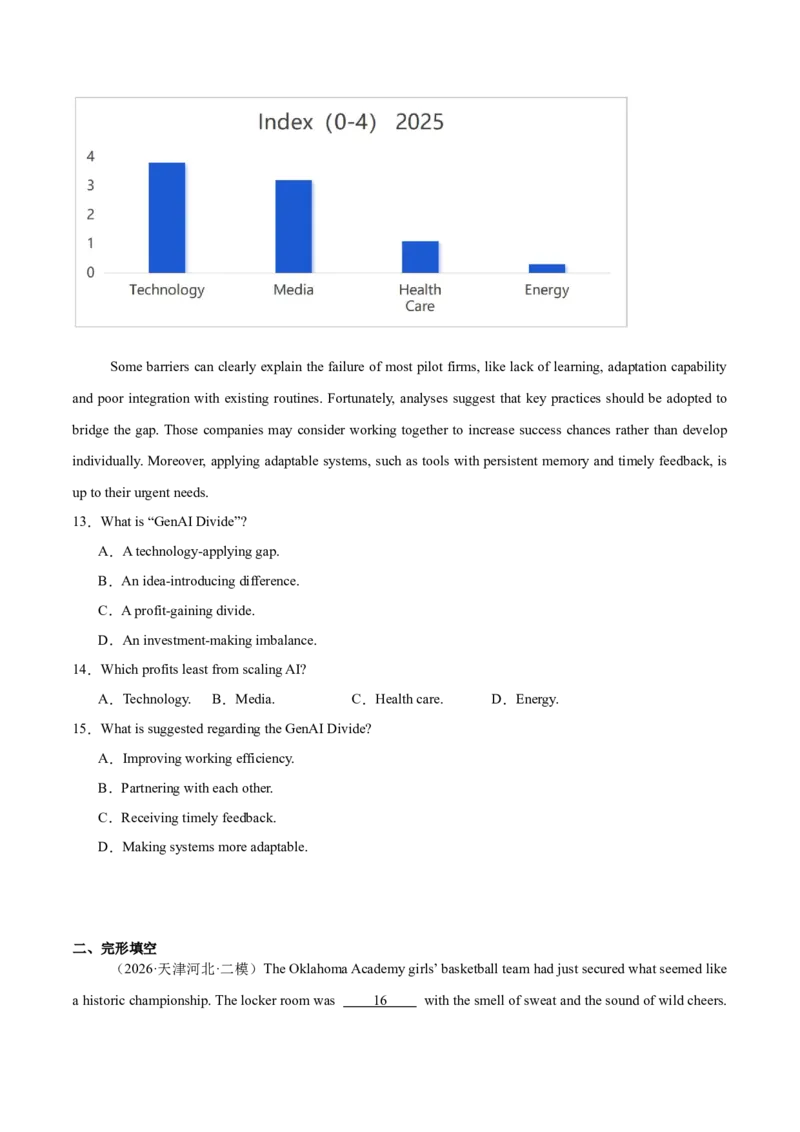
Taking industry as an example, the distinction is equally noticeable. An AI Market Disruption Index (ranging
from 0 to 4), which measures factors like market share shifts and AI-native firm growth, paints a clear picture.
Technology and media sectors lead the pack with scores of 3.8 and 3.2 respectively, while healthcare and energy are
far behind.
Some barriers can clearly explain the failure of most pilot firms, like lack of learning, adaptation capability
and poor integration with existing routines. Fortunately, analyses suggest that key practices should be adopted to
bridge the gap. Those companies may consider working together to increase success chances rather than develop
individually. Moreover, applying adaptable systems, such as tools with persistent memory and timely feedback, is
up to their urgent needs.
13.What is “GenAI Divide”?
A.A technology-applying gap.
B.An idea-introducing difference.
C.A profit-gaining divide.
D.An investment-making imbalance.
14.Which profits least from scaling AI?
A.Technology.
B.Media.
C.Health care.
D.Energy.
15.What is suggested regarding the GenAI Divide?
A.Improving working efficiency.
B.Partnering with each other.
C.Receiving timely feedback.
D.Making systems more adaptable.
二、完形填空
(2026·天津河北·二模)The Oklahoma Academy girls’ basketball team had just secured what seemed like
a historic championship. The locker room was     16     with the smell of sweat and the sound of wild cheers.
However, in the middle of the loud celebration, Coach Brendan King couldn’t escape a growing     17     of
worry. Deep down, he had a bad feeling that something wasn’t quite right.
That night, while the rest of the town slept, King sat alone in his quiet house, watching the game video over
and over. His eyes were     18     on the screen as he carefully started     19     every point with a heavy
heart. Soon, his worst fear was painfully     20    : they had actually lost by a single point. In the chaos of the
final quarter, a shot that clearly missed the hoop was     21     recorded as a basket by the scorekeeper.
The sun rose on a difficult morning. The players arrived at the school gym still    22   , their faces bright
with pride from the     23     night, completely unaware of what was coming until King     24     the
news. The gym fell from laughter into shocked silence — a hard moment to watch. Admitting they weren’t the
rightful winners was a bitter pill to     25    , because it meant giving up their big moment. Yet, honesty     26
more than the prize. Within minutes, the team reached a consensus (共识) that they would     27     the trophy
(奖杯) and medals to Apache High School, the true winners.
With the gold trophy sitting silently in his passenger seat, King began the long drive to Apache to set things
28    . When he arrived, Coach Amy admitted she had     29     the error during the game but was told the
score was final. However, moved by King’s proof and his team’s amazing honesty, the league made a rare     30
to the rules. In the Apache gym, King finally     31     the medals. The Apache players, finally getting what
they earned, were     32     for real this time, their faces wet with genuine tears of joy.
We often think a     33     is something you can hold in your hands or see on the scoreboard. But the
Academy team proved that the greatest win is the one you carry in your heart. It takes a special kind of     34

to admit mistakes and the grace to do what’s right, even when it     35     them the trophy. The Academy team
lost the game, but by doing the right thing, they remained true to themselves and won something far greater than a
trophy.
16.A.crowded
B.associated
C.equipped
D.filled
17.A.dream
B.sense
C.chance
D.picture
18.A.repaired
B.glanced
C.reflected
D.fixed
19.A.collecting
B.counting
C.regulating
D.achieving
20.A.confirmed
B.acknowledged
C.contradicted
D.resolved
21.A.automatically B.regularly
C.mistakenly
D.informally
22.A.overjoyed
B.relaxed
C.embarrassed
D.ashamed
23.A.following
B.previous
C.precious
D.former
24.A.exchanged
B.gathered
C.broke
D.invented
25.A.taste
B.choose
C.digest
D.swallow
26.A.mattered
B.benefited
C.devoted
D.required
27.A.gain
B.return
C.receive
D.keep
28.A.direct
B.correct
C.straight
D.plain
29.A.explained
B.believed
C.imagined
D.noticed
30.A.attempt
B.appointment
C.exception
D.appeal
31.A.put away
B.took over
C.handed over
D.showed off
32.A.celebrating
B.performing
C.competing
D.interviewing
33.A.victory
B.reputation
C.responsibility
D.ambition
34.A.opportunity
B.courage
C.strength
D.interest
35.A.pays
B.values
C.helps
D.costs

(2026·内蒙古赤峰·三模)Howard transformed a dying 110-year-old tree, which had stood in her yard
since her family bought the house, into a magical library.
Although the tree needed to come down, Howard says she had a hard time     36    . One day, after a
branch dropped, the end     37     arrived. However, she was unwilling to     38     the stump (树桩)
entirely. “What if we turned it into one of those Little Free Libraries?” she wondered,     39     a tree library.
The Little Free Library is a movement to promote literacy and community with the     40     of “take a
book, share a book”. Howard had long     41     the movement. Seeing the hollow (空的) stump as a perfect
opportunity, she started her project. She     42     a box inside the stump. That box became the functional part
of the library, into which shelving and books were ultimately placed. The finished stump     43     a wooden
roof, a lamp, and a door.
When Howard shared her     44     on Facebook, local media quickly     45     the story, followed
by national outlets. Since then, visitors have arrived, with people often waiting their turn to     46     this
library.
Howard works at a library. For her, the little library was a(n)     47     of her job. She is     48     to
share her love of reading. Reflecting on the     49    , she says, “Little Free Libraries     50     people to
experience the surprise of finding something to read.”
36.A.letting go
B.holding on
C.getting over
D.making believe
37.A.quietly
B.finally
C.naturally
D.dramatically
38.A.sell
B.burn
C.remove
D.transport
39.A.judging
B.guessing
C.picturing
D.understanding
40.A.will
B.faith
C.insight
D.concept
41.A.founded
B.admired
C.monitored
D.discovered
42.A.fitted
B.repaired
C.exchanged
D.measured
43.A.restored
B.improved
C.featured
D.illustrated
44.A.creation
B.product
C.research
D.discovery
45.A.made up
B.picked up
C.took down
D.passed down
46.A.check
B.report
C.explore
D.decorate
47.A.praise
B.reward
C.investment
D.extension
48.A.curious
B.serious
C.patient
D.passionate
49.A.project
B.outcome
C.challenge
D.adventure
50.A.urge
B.allow
C.force
D.qualify
(2026·上海·二模)A new study has found that bumblebees can process the duration of light flashes and
use this information to find food. This is the     51     evidence of such an ability in insects, according to
Elisabetta Versace from Queen Mary University of London. Versace told CNN that the finding could settle a long-
standing debate among scientists about whether insects are able to process complex patterns, as many experts
previously     52     their cognitive (认知) abilities.
“In the past, people thought insects were just simple reflex machines without any flexibility,” Versace
explained. To test their idea and prove that bees could process time-related information, the researchers built a(n)
53     designed maze (迷宫) where individual bumblebees traveled when leaving their nests for food.
In the maze, the bees were shown two distinct     54     clues: one circle that flashed briefly for 0.5
seconds and the other for a longer period of 5 seconds. When the bees approached these     55     circles, they
found sweet, preferred food at one and bitter, unwanted food at the other. Even though the circles’ positions
changed in each part of the maze, the bees gradually learned over time to fly toward the     56     flash, which
was consistently linked to the sweet food.
To     57     the possibility that the bees were relying on seeing or smelling the sweet food, Versace and
her team members then tested the bees’ behavior when no food was present at all. They found that the bees could
still tell the circles apart based    58     on flash duration, not other potential cues like color or shape. “This
shows the bees are    59    using the time difference between the flashes to guide their food-seeking choices,”
she said.
Versace noted that the bees’ ability to use such novel stimuli—flashes they would never encounter in their
natural environment — to solve tasks flexibly is truly    60   . “This finding makes perfect sense, as bees must
carefully manage their time while looking for food to maximize rewards and minimize the     61     of
returning to the nest,” she said. The study also found that bumblebees are among a small group of animals,
including humans and pigeons, that can     62     between short and long flashes, a skill humans use to
understand Morse code, where short and long signals represent different letters.
While the neural mechanisms (神经机制) behind bees’     63     ability remain unclear, the team plans
to investigate them further in future research. They also aim to study bees living freely in colonies rather than
individually, and explore why some bees learn to     64     time duration faster than others. The findings    65
the long-held idea that bees are just instinct-driven machines. Besides, they highlight bees’ complex cognition and
offer new insights into how animals perceive time.
51.A.direct
B.first
C.concrete
D.physical
52.A.developed
B.possessed
C.demonstrated
D.underestimated
53.A.abstractly
B.carefully
C.complexly
D.conventionally
54.A.visual
B.verbal
C.potential
D.important
55.A.dark
B.wide
C.complete
D.respective
56.A.short
B.bright
C.sudden
D.complete
57.A.allow for
B.look into
C.rule out
D.open up
58.A.typically
B.simply
C.specially
D.purposefully
59.A.actually
B.accidentally
C.maximumly
D.casually
60.A.unique
B.doubtful
C.remarkable
D.measurable
61.A.fees
B.rates
C.costs
D.losses
62.A.shift
B.range
C.alternate
D.distinguish
63.A.food-seeking
B.time-setting
C.time-judging
D.food-processing
64.A.assess
B.reduce
C.invest
D.combine
65.A.convey
B.develop
C.explore
D.challenge
三、语法填空
(2026·北京大兴·三模)阅读下列短文,根据短文内容填空。在未给提示词的空白处仅填写1 个适当的单
词,在给出提示词的空白处用括号内所给词的正确形式填空。
For many years, scientists     66     (know) that wild pigs in Germany have a unique problem that is
both a mystery and something of a     67     (threaten). In short, a significant portion of the German wild boar
(野猪) population — more than 1 in 3 in certain locals is radioactive. This is particularly concerning in places like
Bavaria, Germany,     68     wild boar meat is a popular form of game meat.
(25-26 高三下·重庆沙坪坝·阶段检测)阅读下面材料,在空白处填入1 个适当的单词或括号内单词的正确
形式。
In the heart of Milan, just steps from the Brera Gallery, a restaurant is drawing locals with an unexpected
combination: Chinese dishes paired with Italian wine.
At ZioZio, many Italian food enthusiasts are discovering the unique flavors of Sichuan-style cuisine,     69
(know) for its bold, spicy dishes influenced by the region’s climate and use of Sichuan peppers.
Diners are often surprised when they find     70     perfectly these rich flavors are paired with Italian
wines, creating a unique balance     71     Eastern cuisine and Western wine.
Founders Wang Haoran and Zeng Xiaotang, both art     72     (graduate) with backgrounds in music and
design, wanted to create a restaurant that would connect with the local community. “By pairing Chinese dishes with
the red wines Italians love, we hope to inspire     73     (curious) and introduce people to the diversity of
China’s regional food cultures,” they say.
Their concept is well-received by Milan’s locals. “Since several years ago, more authentic Chinese cuisines
74     (appear) in Italy and Europe, offering greater variety and cultural experiences that people     75

(true) appreciate,” says regular customer Gianluca Corrias.
ZioZio’s space of 15 square meters is filled with lively talk of locals. Some guests drop by after work     76
(enjoy) wine with braised beef and bamboo shoots, while others stay and chat with friends. On the Mid-Autumn
Day last year, Wang and Zeng     77     (prepare) mooncakes, inviting Italian customers to taste     78

traditional Chinese dessert and learn about its symbolism of family reunion and happiness.
拔高·阅读演练
(2026·浙江·三模)The Amazon rainforest may be shifting from a massive carbon sink to a net carbon
emitter. Since 1985, human activity has destroyed more than 10% of the Amazon's forest cover, releasing
substantial amounts of CO2 previously sequestered in trees and soil. Deforestation through fires releases 1.5
billion tonnes of CO2 annually, driving climate warming. Vegetation changes alter atmospheric composition,
surface reflectivity, and cloud properties, which can either intensify or slow warming.  The replacement of dark
forest cover by brighter grasses increases  surface reflectivity, leading to more reflection of solar radiation, though
weaker than in snow-covered regions. Among these, how clouds respond to forest loss remains the least
understood.
Previous studies on cloud cover yielded conflicting results: some reported reductions after deforestation,
while others reported increases. This difference arises from strong regional and seasonal variations. Notably, prior
studies examined long-term associations rather than immediate deforestation impacts such as fire aerosols. To
resolve this, Dror and Feingold analyzed two decades of MODIS and CERES satellite data, comparing deforested
regions with nearby undisturbed areas. Their findings reveal that cloud cover rises systematically with deforestation
year-round,peaking during the dry season. In areas where forest loss surpassed 50%, cloud cover grew by 3.1% on
average,reaching 5.1% in the most heavily cleared zones.
Moreover, cloud tops sat at lower altitudes over cleared lands. These low-altitude clouds enhanced reflection
of incoming solar radiation rather than trapping outgoing heat. The resulting cooling effect from this cloud increase
proved at least twice as strong as that from surface reflectivity changes alone.
While increased cloudiness thus reduces part of the CO2-driven warming, other factors like non-CO2
greenhouse gases remain uncertain. and aerosols such as methane and ozone remain uncertain, with either warming
or cooling effects through complex pathways. Current evidence suggests that even combined biophysical effects
cannot fully cancel out the warming. Therefore, maintaining and restoring Amazon forest cover remains essential
for climate protection.
1.What does the underlined word“sequestered” in paragraph 1 most probably mean?
A.Stored.
B.Produced.
C.Released.
D.Transformed.
2.How did Dror and Feingold carry out their study?
A.By measuring CO2 levels in heavily cleared forest areas.
B.By conducting ground surveys of vegetation in Amazon areas.
C.By analyzing seasonal rainfall patterns across Amazon regions.
D.By comparing satellite data between cleared and undisturbed areas.
3.What accounts for the stronger cooling effect over cleared lands?
A.Greater ground reflectivity from grasses. B.More trapping of outgoing heat by low clouds.
C.Higher altitude of cloud tops over cleared lands.
D.Lower cloud tops reflecting more solar radiation.
4.What can be inferred from the last paragraph?
A.Cloud feedback alone stabilizes climate.
B.Future drying will enhance cloud cooling.
C.Biophysical factors lead to ineffective results.
D.Forest restoration is essential despite partial cooling.
(2026·浙江·三模)Within the scientific community, dreams are still something of a mystery. However,
improvements in brain imaging and recent physiological studies have brought us one step closer to answering the
question of why some people remember their dreams more than others.     5    Gender
    6     Researchers arent exactly sure why, but Barrett says it could be a biological or hormonal difference.
Barrett notes that differences between  men and women in regard to dream recall are“modest” and that there are
greater differences within each gender than between the genders.Age
As we get older, it often gets harder to recall our dreams. Your ability to remember dreams improves in late
childhood and adolescence, and tends to peak in your twenties, Barrett says    7     However, there are
exceptions,and people sometimes experience the opposite.Amount of sleep
The amount of sleep one gets is one of the most important factors.     8     However, those rapid eye
movement periods get longer throughout the night, meaning that you’re doing the most dreaming toward the
morning generally right before you wake up.Brain activity
Thanks to brain imaging, scientists now have a better idea of which parts of the brain are associated with
dreaming. A part of the brain that processes information and emotions is more active in people who remember their
dreams more often.     9     In turn, this may promote something called intrasleep (睡眠期间) wakefulness.
If you don’t remember anything, Barrett says it's still helpful to assess how you feel when you first awaken.
“Sometimes if you just stay with whatever emotion you woke up with,” she says, “a dream will come rushing
back.”
A.Dr. Deirdre Barrett shared a few of the factors.
B.Women, on average, recall more dreams than men.
C.So what can you do to help you remember your dreams?
D.This region may help people pay more attention to external cues.
E.Similarly, the “high recallers” tend to exhibit more brain activity.
F.After that point, people often experience a gradual drop-off in dream recall.
G.People dream every 90 minutes during the rapid eye movement sleep cycle.
(2026·浙江·三模)At 56, I am beginning to feel the physical effects of ageing. I won’t bore you with the
details, but none of them is great fun. Yet researchers now suggest that one of the most damaging effects may not be
physical at all. It may begin with how people come to see ageing itself.
They call it internalised ageism: the tendency to hold negative expectations about one’s own health simply
because of age. When older adults are repeatedly assumed to be slow, forgetful, or incapable of learning, such ideas
do not always stay outside them. Over time, they can become part of how people see themselves. Once that
happens, behaviour may change: a person who expects decline may exercise less, pay less attention to diet, and
treat every sign of weakness as proof of something worse.
Research shows that internalised ageism can affect how people age. A Harvard study found that older adults
with the most positive views showed slower physical and mental decline and kept healthier habits than those with
the most negative views. Crucially, researchers ruled out the simpler explanation — poor health did not simply
cause pessimism. Instead, a person’s attitude at the  start predicted how their health changed over time. Becca Levy
at YaleSchool of Public Health found further support: among people over 65 with mild memory problems, those
with a positive outlook were far more likely to recover. Her research also shows that such negative thinking
generates over three million extra disease cases in the US each year, at a combined cost of over eleven billion
dollars.
Yet internalised ageism doesn’t just come from within. Negative images of older people spread through the
media, advertising, and even the advice of medical professionals. Because these messages appear so naturally in
daily life, they are seldom questioned. By the time most people notice them, they have already taken root.
A partial answer exists. Research shows attitudes towards ageing can shift through positive messages. But
changing deeply held beliefs takes generations, as the long struggle against racial prejudice shows. I’m not going to
let it get me down. Instead, I’m going to try to make my own ageing process great fun.
10.What is the root cause of internalized ageism?
A.Less attention to exercise and diet.
B.Gradual loss of learning capability.
C.Constant fear over physical decline.
D.Repeated exposure to age prejudice.
11.What can we learn about ageing from the Harvard study?
A.Attitude affects the rate of ageing.
B.Pessimism results from faster ageing.
C.Mindset alone defines ageing process.
D.Healthy habits promise slower ageing.
12.Why is internalised ageism hard to change?
A.Its roots take time to appear.
B.It is backed by professionals.
C.Its sources are widely varied.
D.It is established as a social norm.
13.Which is the most suitable title for the text?
A.Age Prejudice: A Long Battle for Society
B.The Elderly: A Group Misunderstood by Society
C.Social Messages: A Silent Force Behind Age Bias
D.Negative Expectations: A Hidden Threat in Ageing
(2026·浙江·二模)The storied, celebrated Alcatraz and Black Point Historic Gardens in Golden Gate National
Recreation Area owe their charm to skilled Parks Conservancy gardeners and dedicated volunteers. Now you can
apply their national park expertise to your own backyard!Top Winter Gardening & Planting Tips for the San
Francisco Bay Area
● Resist working in the garden on a rainy day — air pockets are a very important part of the recipe for healthy soil
and plants, and working in your garden when it’s very wet will firm your soil.
● Double check your seedling identification during weeding! Desired plants can look similar to invasive weeds
during their seedling stage.
● Keep fallen leaves on the ground. They provide important shelter for butterflies and moths in the winter, and keep
the soil covered and protected through the season.
● See if there’s a way to install a rainwater catchment into your garden.
● Make notes now of how your garden did this year — what plants did well, what struggled, what you’d like to try
for next year.
Recommended California Native Plants
Plant native wildflowers and perennials (多年生植物); they’re perfectly adapted to our local climate and
support our native ecosystems. If you plant them with the winter rains, they’ll be strong and need minimal care
throughout the rest of the year.
Some of our favorite native plants for the garden include: Clarkia “Farewell to Spring,” Baby Blue Eyes, Globe
Gilia, Ceanothus “Yankee Point,” Coyote Mint, California Fuchsia, Yarrow, Heuchera maxima, Douglas Iris, and of
course California Poppy.Get Involved
Ready to take your newfound skills to the parks? No matter the season, Black Point Historic Gardens needs
extra hands and volunteering support, or you can become a guide on Alcatraz. Trowels up, in the parks and at
home!
14.What can we learn from the winter gardening tips?
A.Garden growth need not be recorded.
B.Fallen leaves ought to be cleared away.
C.Working in wet soil helps keep soil loose.D.Weed carefully to protect desired seedlings.
15.What is the advantage of planting California native plants?
A.They demand less care in later growth. B.They fit in well with the local climate.
C.They needn’t match local ecosystem.
D.They grow much faster than other plants.
16.Where is the text most likely taken from?
A.A local gardening newsletter.
B.A home decoration magazine.
C.A national park research paper.
D.A travel brochure of scenic spots.
(2026·浙江·二模)Small Talk: More Than Just Chit-Chat
People often complain about small talk, describing it as “painful” or “dishonest”.    17    However, this
common opinion fails to recognize the true value of small talk in our daily interactions.
As a matter of fact, small talk serves as an essential social “safety zone”.    18    According to etiquette
expert Lizzie Post, discussing light topics like hobbies or recent events establishes initial harmony. This foundation
makes it easier to transition to more substantial conversations later, whether in a work setting or a new friendship.
Some argue that small talk is boring, but this often reflects poor communication skills rather than a flaw in
the activity itself. Effective small talk requires genuine engagement.    19    This means putting away your
phone, making eye contact, and actively turning into the other person’s reactions. If they lean in and smile at a
topic, you can explore it further; if they glance away or give short answers, politely shift to a new topic or invite
them to share their own perspective.
   20    During a two-hour flight, I began with simple talk about travel plans with my seatmate. Gradually,
both of us felt more comfortable opening up to each other. This casual start eventually led to a meaningful
discussion about life changes and personal growth. We reached this depth precisely because we started with
accessible, low-pressure topics.
Small talk isn’t about being superficial — it’s a practical social tool that facilitates human connection.    21
In fact, it smooths our daily social encounters and opens doors to deeper conversations that might never occur
otherwise. Without these simple, everyday exchanges, our social interactions would feel much more awkward and
less satisfying.
A.Its value, however, is often overlooked.
B.It demands full presence and careful observation of the other person.
C.They generally claim it lacks depth and avoids meaningful topics.
D.Consider this real-life example from my own experience.
E.Good small talk depends on more than just the words you say.
F.Without proper skills, small talk can feel shallow and forced.
G.It creates a comfortable atmosphere before deep conversations begin.
二、完形填空
(2026·浙江·三模)True was a four-year-old boy. Born with heart disease requiring     22    , he spent
his earliest years in foster (寄养) care. On his operation day at Children’s Nebraska hospital, True was admitted for
the surgery by himself.
That’s when Dr. Amy Beethe walked in. True’s 7-hour surgery made Amy keep thinking about the sweet
little kid who was     23     it all by himself.
Dr. Amy     24     True’s case worker and learned he had six siblings (兄弟姐妹), none of whom were
doing well. Few families were willing to offer a     25     home for True considering his demanding medical
needs.
Then the social worker asked Amy: Are you a(n)     26    ? The answer was already in Amy’s heart. She
was      27     a mom of six — three biological and three     28    . But she knew her family, and her heart,
had     29     for one more.
When Amy’s husband, Ryan,     30     True in the hospital, he immediately fell in love with him — and
the 4-year-old      31     the Beethe family.
Something even more     32     followed. The Beethes realized how close True was with his siblings, so
Amy sought to find them foster homes to keep the kids     33    . Amy’s sister adopted one girl, her sister-in-
law’s family adopted another, a coworker adopted two more, and Amy and Ryan opened their     34     and
home again to adopt True’s sister Laney.
The little boy     35     the hospital alone for heart surgery, but he left with a     36     — and a
heart full of love.
22.A.transplant
B.surgery
C.protection
D.consultation
23.A.talking about
B.looking for
C.going through
D.showing off
24.A.supported
B.recognized
C.contacted
D.identified
25.A.comfortable
B.peaceful
C.spacious
D.permanent
26.A.option
B.assistant
C.doctor
D.witness
27.A.currently
B.naturally
C.unfortunately
D.obviously
28.A.confused
B.adopted
C.abandoned
D.ignored
29.A.plans
B.excuses
C.room
D.responsibility
30.A.followed
B.admired
C.treated
D.met
31.A.helped
B.called
C.joined
D.respected
32.A.complicated
B.remarkable
C.interesting
D.strange
33.A.amused
B.calmed
C.educated
D.connected
34.A.door
B.mouths
C.hearts
D.hospital
35.A.entered
B.explored
C.changed
D.survived
36.A.dream
B.family
C.souvenir
D.lesson

(2026·江苏·二模)I have always been indecisive when it came to travel. I’d watch endless videos of
destinations and read scores of     37     online. But more often than not,     38     fell far short of what
was promised. The colourful images I’d come across online would turn out to be totally disappointing in real life.
So, a year ago, I made a change. I banned myself from too much     39     for a trip. Instead, I chose an
area I wanted to     40    . I couldn’t rely on my phone. It wasn’t easy at first. I felt rudderless (漫无目的的)
without my phone to guide me while wandering through     41     neighbourhoods. I was so accustomed to
42     every detail about each place I visited and without that, I was exposed.
But that’s exactly why it’s so fun. Going in unprepared opens you up to     43    . Without being glued to
directions on my phone, I was     44     so much more of my surroundings, noticing details that would
otherwise have     45     passed me by.
Travelling without planning has made me more     46     with making decisions. I no longer     47
if the view isn’t as breathtaking as in the photos — because I’m not comparing my     48     to anyone else’s.
Trying to have the     49     holiday is no longer the point for me; it’s about living in the present and
making good     50    . And in an era where we can see the best of everything through our phones, it’s been
totally     51     to have an experience that’s entirely mine.
37.A.newsletters
B.reviews
C.ebooks
D.notices
38.A.reality
B.bookings
C.demand
D.objectives
39.A.budget
B.longing
C.planning
D.luggage
40.A.conserve
B.occupy
C.explore
D.rejuvenate
41.A.unfriendly
B.ethnic
C.peaceful
D.unknown
42.A.creating
B.knowing
C.assessing
D.modifying
43.A.surprises
B.routines
C.duties
D.traps
44.A.laying out
B.relying on
C.taking in
D.cleaning up
45.A.purposely
B.fortunately
C.completely
D.temporarily
46.A.comfortable
B.stuck
C.patient
D.concerned
47.A.bear
B.care
C.feel
D.see
48.A.wealth
B.experience
C.achievement
D.health
49.A.luxurious
B.secure
C.casual
D.perfect
50.A.excuses
B.investments
C.predictions
D.memories
51.A.hesitant
B.freeing
C.plain
D.demanding
(2026·广东佛山·模拟预测)Everyone knows that science is important. The aim of science is to     52
how the world, everything in it and beyond it, works. Some people,     53    , claim that much of what is done
in the name of science is a waste of time and money. What is the     54     in investigating how atoms behave
or in studying stars billions of kilometres away? Science, they argue, is     55     only if it has some practical
application.
Yet history shows that curiosity-driven research often leads to     56     breakthroughs. When the
Scottish physicist James Clerk Maxwell     57     experiments with electricity and magnetism in the late 19th
century, he had no specific end in     58     and was certainly not     59     to earn money; he was simply
trying to understand more about how the world works. Despite this, his work laid the     60     for our modern
way of life. Computers, satellites, the Internet, mobile phones and medical scanners all owe their existence to the
fact that a scientist     61     the need to understand the world a little better.
Maxwell's candle-lit laboratory was quiet once more, but the ideas he sparked continue to     62    our
world. Now more students     63     to ask questions without obvious answers. Such curiosity     64

seeds that may take years, decades or even centuries to bear fruits. Every experiment, every observation, every
failure brings us closer to understanding. The value of science lies not only in what it produces but in the     65
it shapes.
And that, ultimately, is the     66     of science.
52.A.set up
B.figure out
C.carry out
D.make up
53.A.therefore
B.moreover
C.however
D.likewise
54.A.cause
B.outcome
C.point
D.basis
55.A.stable
B.profitable
C.available
D.valuable
56.A.unexpected
B.huge
C.little
D.limited
57.A.conducted
B.invented
C.learned
D.designed
58.A.need
B.mind
C.hand
D.sight
59.A.instructed
B.trained
C.practicing
D.aiming
60.A.conclusion
B.foundation
C.source
D.theory
61.A.met
B.avoided
C.chose
D.felt
62.A.darken
B.rule
C.light
D.decorate
63.A.hesitate
B.pretend
C.dare
D.refuse
64.A.plants
B.removes
C.destroys
D.collects
65.A.mindset
B.competition
C.cooperation
D.history
66.A.challenge
B.example
C.proof
D.significance
三、语法填空
(2026·浙江·三模)阅读下面短文,在空白处填入1 个适当的单词或括号内单词的正确形式.
Fujian tulou, or earthen buildings, are traditional homes in Fujian. Ju chose Changrong Building,    67
homestay transformed from a tulou, because she wanted to experience     68     it was like to live there.
The homestay keeps its old exterior(外观) but     69    (house)12 modern rooms. After a2023 repair
project by a Xiamen University team, the building,    70     central hall now serves as a reading space, offers
tea-picking and costume experiences, while the team avoided the risk of the building     71     (reduce) to a
lifeless display.
Fujian tulou buildings     72     (add) to the UNESCO World Heritage List in 2008. Since then, local
tourism has shifted from basic sightseeing to high-quality stays. This change is also     73     (evidence) in
Hua’an, where old houses have become galleries, coffee shops and libraries.
    74    (engage) younger guests, local teams have added playful activities and digital souvenirs. Some
tulou models make it possible for tourists to play videos by tapping phones against them. During Spring Festival,
Hua’ an launched a China-chic game. In the game, tourists took part     75     characters, completing tasks
involving folk dances and traditional sports. These efforts aim to move beyond visiting a single building to creating
a destination where visitors experience a life that begins with nature, continues through local customs      76

returns to the warmth of the home.
(2026·浙江·二模)阅读下列文章,在空白处填入1 个适当的单词或括号内单词的正确形式。
Root carving is an art form that relies on subtraction (减法) rather than addition.    77    other arts where
materials are added, root carving follows the natural form of the wood and removes the unnecessary    78
(reveal) its inner beauty. “Where nature has already shaped something perfectly, there is no need for further human
intervention,” insists Chen Xing,    79    renowned root carving artist.
Creating a root carving involves several stages: washing, peeling, shaping and carving. Among them,
shaping is the most demanding, requiring keen    80    (judge) and rich experience. Chen first studies its grain
and growth patterns to determine the best direction and theme, when    81    (present) with a new root.
Selecting the right root is also a great challenge. “Root growth is not controlled by humans; we must adapt
82   (we) to the wood,” Chen says. The true creativity of root carving lies not in transforming nature, but in
complementing its imperfections,    83    (create) a harmonious blend of art and nature.
As a practitioner of this intangible cultural heritage, Chen is committed to passing it on. He teaches by
bringing root carving into local schools    84    he offers theoretical courses and opens his workshop to students.
“Root carving requires patience; it can’t    85    (rush),” he says.
Today, Chen’s works have gained wider recognition through his Guinness World Record, giving Chinese root
carving a    86    (broad) stage for display. They preserve nature’s authenticity and reflect deep cultural
thinking, embodying the elegance of Eastern aesthetics (美学).
真题·阅读演练
(2025·上海·高考真题)The pet food industry has received unkind remarks as to the true origin of its
ingredients (原料) for decades. Now the industry faces another source of criticism as a new book starts a debate
about the environmental impact of owning a well-fed pet.
The New Scientist magazine, in a recent editorial, largely agreed with the book’s findings that some pets, due
to the food they eat, have a surprisingly high “ecological footprint”, which is a way of quantifying human demand
on the planet’s ecosystems using a measure called “global hectares”.
According to the authors of the book, “A shocking comparison is that in 2004, the average citizen of some
poor countries had an eco-footprint of 0.76 hectares. The eco-footprint of a cat is about 0.15 hectares, almost the
same as what is needed to run a small car. In a world where resources are already limited, can people really justify
keeping pets that require more than some people?”
The authors of the book say that they were “genuinely surprised” when calculating the environmental impact
of pets. And some of the ideas they put forward to attenuate this are likely to shock some pet owners. For example,
the book suggests catching pests such as field mice and processing them into a “natural” cat food, or raising pets
like chickens that provide both company and fresh eggs. When feeding a pet, however, the advice is to favour pet
foods made from chicken meat, which is less damaging to the environment than red meat and fish.
As you might expect, the Pet Food Manufacturers Association (PFMA) puts up a spirited defence, arguing
that the vast majority of meat and fish used in pet foods is of sufficient quality for human consumption but more
than humans need. “If we didn’t recycle animal by-products to sell, they might instead be abandoned and buried
under the earth, which is not very green,” says the director. In addition, he points out that pets should not be viewed
just on their carbon footprint. “Our environment is greatly enriched by the part they play in our lives. Pets in the
home inspire responsibility, encourage social awareness and have positive health benefits.”
1.What is suggested in the book to make pet food production greener?
A.Making processed pet foods out of pests
B.Feeding pets primarily with fish and meat.
C.Increasing the use of red meat in pet foods.
D.Avoiding using animal by-products in pet foods.
2.The word “attenuate” (para 4) is closest in meaning to “_______”.
A.assess
B.blame
C.drive
D.reduce
3.Which argument does PFMA make to defend the industry?
A.The use of meat and fish in pet foods can prevent waste.
B.Pet food production is both sustainable and cost-efficient.
C.Pet food ingredients are as nutritious as those for humans.
D.The eco-footprints of humans far outnumber those of pets.
4.What is the main focus of the passage?
A.The origin of pet food ingredients.
B.Calculation of pet carbon footprint.
C.Environmental impact of pet foods.
D.A spirited debate over pet ownership.
(2025·上海·高考真题)The Louis Department of Education (LDOE)’s AI integration framework (框架)
is a comprehensive, responsible approach to maximizing AI’s benefits. Adopting a continuous cycle of exploration
and improvement, it empowers schools to adopt AI responsibly while prioritizing student safety and future
readiness. The framework aims to create a sustainable environment that improves teaching, learning, and outcomes
through research, policy, community involvement, and ongoing evaluation.
 Purpose & Research:    This
component stresses setting clear goals for AI
integration. It involves researching evidence-
based practices, assessing AI’s benefits and
challenges, and identifying tools in line with
the city’s educational objectives to ensure
purposeful and informed application.
 Evaluation & Monitoring:     This
component centers on assessing the impact of
AI application in educational settings. It
involves tracking student progress, measuring
the effectiveness of AI tools and resources,
and identifying areas for improvement.
Regular monitoring ensures that AI initiatives
are in line with educational goals and adapt to
the changing needs of students and educators.
 Engage Stakeholders:     Recognizing
that AI integration impacts various key
participants, this component emphasizes
active engagement and cooperation.
Stakeholders like educators, administrators,
students, parents, policymakers, and
community members are involved in the
process to gather different perspectives,
address concerns, and build support for AI
initiatives. This approach promotes trust,
ownership, and joint responsibility in shaping
the future of AI in education.

Policy & Guidance:
    This
component addresses the need for clear
guidelines and policies that govern AI’s
responsible use in educational settings. It
involves developing frameworks for data
privacy, ensuring access to AI resources, and
establishing standards for designing and
using AI tools. Policy and guidance provide a
structured approach to handling the
complexities of AI integration and ensuring
that it follows legal and educational
principles.
WJXSAT
5.What is the framework mainly intended to do?
A.Encourage students to explore AI tools.
B.Prepare schools for responsible AI use.
C.Improve teaching by increasing AI use.
D.Guarantee student safety with AI tools.
6.What does the component “Evaluation & Monitoring” focus on?
A.Examining the effects of AI use.
B.Monitoring students’ use of AI.
C.Assessing student development in AI.
D.Locating the weakness of AI tools.
7.A school in the city of Louis is planning to introduce an AI tool to help students with learning. The teacher in
charge is looking for ways to avoid the misuse of students’ personal data. Which component should the teacher
mainly refer to?
A.Purpose & Research
B.Policy & Guidance
C.Engage Stakeholders
D.Evaluation & Monitoring
(2025·上海·高考真题)Andreas Schleicher sat down quietly toward the back of the room, trying not to
attract attention. He did this sometimes, wandering into classes he had no intention of taking.
It was the mid-1980s, and he was studying physics at the University of Hamburg, one of Germany’s leading
universities. In his free time, however, he slipped into lectures the way other people watched television. This class
was taught by Thomas Neville Postlethwaite, who called himself an “educational scientist.” Schleicher found the
title curious.
Schleicher’s father was an education professor at the university and had always talked about education as a
kind of mysterious art. “You cannot measure what matters in education — the human qualities,” his father liked to
say. From what Schleicher could tell, there was nothing scientific about education, which was why he preferred
physics. But this British fellow whose last name he could not pronounce seemed to think the other way around.
Postlethwaite was part of a new group of researchers who were trying to analyze a soft subject in a hard way, much
like a physicist might study education if he could.
Schleicher listened carefully to the debate about statistics and sampling. In his mind, he started imagining
what might happen if one really could compare what kids knew around the world, while controlling for factors like
race or poverty in the analysis. He found himself raising his hand and joining the discussion.
In Schleicher’s experience, German schools had not been as exceptional as German educators seemed to
think. As a boy, he’d felt bored much of the time and earned ordinary grades. But, as a teenager, several teachers
had encouraged his fascination with science and numbers, and his grades had improved. In high school, he’d won a
national science prize, which meant he was more or less guaranteed a well-paying job in a private company after
college. That was exactly what he’d planned to do, until he stepped into Postlethwaite’s lecture.
At the end of class, the professor asked Schleicher to stay behind. He could tell that there was something
different about this young man.
“Would you like to help me with this research?”
Schleicher stared back at him, shocked. “I know nothing about education.”
“Oh, that doesn’t matter,” Postlethwaite said, smiling.
After that, the two men began to team up, eventually creating the first international reading test, a test that
measured reading ability globally.
8.Which of the following is true of Schleicher in his university years?
A.He benefited from watching TV.
B.He often debated with his classmates.
C.He dropped in at different lectures.
D.He felt dissatisfied with his grades.
9.What can be learned about Schleicher’s father from the passage?
A.He measured human qualities in a hard way.
B.He had conflicting ideas with Postlethwaite.
C.He considered education both art and science.
D.He had a preference for physics over education.
10.What does the word “That” (para.5) probably refer to?
A.Obtaining a decent job.
B.Winning a national prize.
C.Joining heated discussions.
D.Designing a reading test.
11.Why was Schleicher different in Postlethwaite’s eyes?
A.He was recommended by his high school teachers.
B.He had the potential for quantitative educational research.
C.He had good academic records during his school years.
D.He was influenced by his father’s research approach.
(2025·天津·高考真题)I first encountered tai chi in Ottawa’s Chinatown. Men and women gathered in
loose formation. Their actions combined to achieve a meditative (冥想的) dance. I was amazed by its beauty and
grace. It was like watching a water lily opening.
Yet I couldn’t see the point. I could achieve my fitness goals from exercise classes, swimming and cycling —
and moving so slowly didn’t seem to build muscle, my objective for all activities. I chose only to admire this
martial art (武术) but kept my distance.
Years later, a recommendation from my doctor brought me to a training group for tai chi beginners led by a
caring instructor. I had thought that my goal would be to master the 108 moves. Technically right, but wrong on so
many counts.
The class was full of lovely people who glided effortlessly, seemingly never confused about where to move
next. They assured me that they had been beginners once too, and that I would be able to remember all the moves
within three or four years. Three to four years! Graduate degrees took less time. But I could see they were right.
Commit and improve: That was the only path.
Another realization came to me when I attended an advanced class. We began with foundation exercises, and
almost immediately, the instructor singled me out for instruction. To be singled out was an honour, but I was
mortified. All the others in the class stopped and turned to watch me while the instructor corrected my positioning.
“Don’t bend, “he said, and I repeated the movement. “Straighten your back, “he urged, and on it went — probably
for only a few minutes, but it seemed like hours.
I couldn’t say, “Yeah, I get it.” I had to show that I did. I concentrated as I had never done before, listening to
what the instructor was saying, watching his movement and then willing my body to move in imitation. I was
unlearning and learning, overcoming awkwardness to focus. I realized that I was learning a new way of being in the
world—truly listening and open to correction.
I don’t know that I will ever master the 108 moves. What I do know is that I have found an activity in my life
where change and growth are not just possible but expected, even when my stubborn ( 固执的) personality
tendencies re-emerge at every turn.
12.What was the author’s first impression of tai chi?
A.Pleasant to the eye but not of much use. B.Too slow to be regarded as a martial art.
C.Helpful in accomplishing fitness goals. D.Mysterious and difficult to master.
13.In the beginners’ class, the author realized that mastering tai chi required_________.
A.discipline
B.leadership
C.persistence
D.teamwork
14.What does the underlined word “mortified” in paragraph 5 probably mean?
A.Angered
B.Confused
C.Disappointed
D.Embarrassed
15.How did the author respond to the instructions in the advanced class?
A.She denied her weaknesses and carried on.
B.She stayed focused and followed attentively.
C.She worked hard and displayed her talent.
D.She opened up her mind and sought advice.
16.Which of the following can be concluded from the author’s experience?
A.Tai chi empowers people to improve.
B.Tai chi keeps the balance of the body.
C.Tai chi fires people’s passion for sports. D.Tai chi facilitates healthy relationships.
(2025·天津·高考真题)阅读短文,按照题目要求用英语回答问题。
In the small town where I grew up, graduating from high school was already a big thing. But I was driven to
pursue my education and become a lawyer like my best friend’s dad, one of the few role models available. After
completing my first degree at a university near my parents’ house, I started my graduate study of law at the
University of North Carolina, as I had planned for the past 15 years.
It was my 23rd birthday, and I was celebrating it as I had for years: by watching the annual Perseid meteor
shower (英仙座流星雨). But this year was different. I was away from the small town for the first time and was
meeting people in fields that were new to me. My horizons had been opened up, and I began to question my life
path. Should I stick to my long-standing plans? Could my lifelong love for astronomy be more than a hobby?
Coincidentally, a solar eclipse ( 日食) helped me make the decision. I made a trip along the winding
mountain roads and found a peaceful spot in a valley. When the Moon gradually slid in front of the Sun, the world
around me became dark. The water was still, and the sunset surrounded me. That moment, I knew what I had to do.
I dropped out of law school to pursue my passion.
Now, about to get my doctoral degree in astronomy, I realize that my exposure to the night sky gave me a
great gift. It bestowed a broad view: In the vast universe, our individual desires and insecurities are insignificant. It
liberated me from allowing worries or self-doubt to stand in the way of chasing new dreams.
During this year’s Perseid meteor shower, I’ll be presenting my research at an international conference in
Cape Town. It will be my first trip out of the country. And the little girl inside me who watched the shooting stars
from her parents? backyard can’t wait to watch the same stars flash across the South African sky.
17.Why did the author want to become a lawyer? (no more than 10 words)

18.How were the author’s horizons expanded? (no more than 15 words)

19.What decision did the author make after watching the solar eclipse? (no more than 10 words)

20.What does the underlined word mean in Paragraph 4? (1 word)

21.What do you think is the key factor in choosing your college major? Please explain why. (no more than 20
words)

二、完形填空
(2016· 上海· 高考真题)In the 1960s, Douglas McGregor, one of the key thinkers in the art of
management, developed the mow famous Theory X and Theory Y. Theory X is the idea that people instinctively
22     work and will do anything to avoid it. Theory Y is the view that everyone has the potential to find
satisfaction in work.
In any case, despite so much evidence to the     23    , many managers still agree to Theory X. They
believe,     24     , that their employees need constant supervision if they are to work effectively, or that
decisions must be imposed from     25     without consultation. This, of course, makes for authoritarian (专制
的) managers.
Different cultures have different ways of     26     people. Unlike authoritarian management, some
cultures, particularly in Asia, are well known for the consultative nature of decision-making — all members of the
department or work group are asked to     27     to this process. This is management by the collective opinion.
Many western companies have tried to imitate such Asian ways of doing things, which are based on general     28
. Some experts say that women will become more effective managers than men because they have the power to
reach common goals in a way that traditional     29     managers cannot.
A recent trend has been to encourage employees to use their own initiative, to make decisions on their own
without     30     managers first. This empowerment (授权) has been part of the trend towards downsizing:
31     the number of management layers in companies. After de-layering in this way, a company may be     32
with just a top level of senior managers, front-line managers and employees with direct contact with the public.
Empowerment takes the idea of delegation ( 委托) much further than has     33     been the case.
Empowerment and delegation mean new forms of management control to     34     that the overall business
plan is being followed, and that operations become more profitable under the new organization, rather than less.
Another trend is off-site or     35     management, where teams of people linked by e-mail and the
Internet work on projects from their own houses. Project managers evaluate the     36     of the team members
in terms of what they produce for projects, rather than the amount of time they spend on them.
22.A.desire
B.seek
C.lose
D.dislike
23.A.contrary
B.expectation
C.degree
D.extreme
24.A.vice versa
B.for example
C.however
D.otherwise
25.A.outside
B.inside
C.below
D.above
26.A.replacing
B.assessing
C.managing
D.encouraging
27.A.refer
B.contribute
C.object
D.apply
28.A.agreement
B.practice
C.election
D.impression
29.A.bossy
B.experienced
C.western
D.male
30.A.asking
B.training
C.warning
D.firing
31.A.doubling
B.maintaining
C.reducing
D.estimating
32.A.honored
B.left
C.crowded
D.compared
33.A.economically B.traditionally
C.inadequately
D.occasionally
34.A.deny
B.admit
C.assume
D.ensure
35.A.virtual
B.ineffective
C.day-to-day
D.on-the-scene
36.A.opinion
B.risk
C.performance
D.attractiveness
(2018·上海·高考真题)Humans hate markedly to give workers more than they deserve;and indeed many
will settle for less to compensate work equitably. But is this impulse     37    ? Perhaps not, says psychological
scientist Marie Schafer in Germany. According to Schafer, nobody has ever looked at how young children from
different     38     think about merit when sharing rewards. There is reason to suspect that meritocracy may be
more of a Western concept and value, so she and several colleagues decided to put this to the test, studying the
39     of children, four to 11 years old, in three different cultures.
The idea was to test how much the children valued merit. So each child was given a number of sweets equal
to the total number of fish in the catch, and was told to distribute the sweets any way he or she wanted — without
adults in the room to influence them. If they valued merit, children should     40     the sweets according to
shares of the catch. That is, if they had landed the same number of fish, they would choose to reward each one
41    , but if one fared much better at fishing, rewards would also be disproportionate. In the case where they
were simply given the fish, rewards should be unrelated to catch size — since no effort was involved.
    42    matters. That’s the main finding among many from the study, as described in a forthcoming
issue of the journal Psychological Science. The German children distributed the spoils of the day precisely in
proportion to     43    , even when this meant a very unbalanced distribution of rewards. By contrast, children
from the two rural African forager( 狩猎) societies barely took merit into consideration at all. These findings
suggest that the basic notion of merit and distributive justice is far from universal in our species, and that     44
is culturally defined.
But why? The scientists offer some     45     on this. It could be that in large-scale societies like
Germany, a meritocracy is       46       for regulating transactions between people who don’t know each
other and may not interact again. The focus is on equitable interactions, because things won’t be “evened out” in
the future. In small scale societies,       47      , most exchanges take place between people who are       48
with one another. It may be more important in such societies to build long-term relationships based on equity —
rather than to insist on equity in a single transaction. In egalitarian forager societies, such as the Haillom,      49
is an important leveling mechanism,       50       asymmetries in wealth and increasing harmony. Children
may internalize these social values early on, and apply them even when the fishing trip is       51      .
37.A.unblocked
B.universal
C.unconscious
D.unique
38.A.cultures
B.cases
C.companies
D.aspects
39.A.mood
B.behavior
C.emotion
D.habit
40.A.collect
B.load
C.stress
D.distribute
41.A.really
B.deliberately
C.equally
D.happily
42.A.Scene
B.Object
C.Culture
D.Trend
43.A.productivity
B.benefit
C.interest
D.survey
44.A.tiredness
B.business
C.thickness
D.fairness
45.A.feelings
B.thoughts
C.lives
D.emotions
46.A.useful
B.major
C.small
D.important
47.A.in a word
B.in addition
C.by contrast
D.what’s more
48.A.familiar
B.delighted
C.satisfied
D.same
49.A.cooperating
B.smiling
C.equaling
D.sharing
50.A.forcing
B.judging
C.balancing
D.experiencing
51.A.creative
B.imaginary
C.innovative
D.logic
(2009·上海·高考真题)Most people believe they don’t have much imagination. They are     52    .
Everyone has imagination, but most of us, once we become adults, forget how to     53     it. Creativity isn’t
always     54     with great works of art or ideas. People at work and in their free time     55     think of
creative ways to solve problems. Maybe you have a goal to achieve, a tricky question to answer or you just want to
expand your mind! Here are three techniques to help you.
Making connections This technique involves taking     56     ideas and trying to find links between
them. First, think about the problem you have to solve or the job you need to do. Then find an image, word, idea or
object, for example, a candle. Write down all the idea/words     57     with candles: light, fire, matches, wax,
night, silence, etc. Think of as many as you can. The next stage is to relate the     58     to the job you have to
do. So imagine you want to buy a friend an original     59    ; you could buy him tickets to match or take him
out for the night.
NO limits! Imagine that normal limitations don’t     60    . You have as much time/space/money, etc. as
you want. Think about your goal and the new     61    . If your goal is to learn to ski,    62    , you can now
practise skiing every day of your life (because you have the time and the money). Now     63     this to reality.
Maybe you can practise skiing ever day in December, or every Monday in January.
Be someone else! Look at the situation from a     64     point of view. Good businessmen use this
technique in trade, and so do writes. Fiction writers often imagine they are the     65     in their books. They
ask question: What does this character want? Why can’t she get it? What changes must she make to get what she
wants? If your goal involves other people, put yourself in their     66    . The best fishermen think like fish!
52.A.wrong
B.unbelievable
C.reasonable
D.realistic
53.A.put up with
B.catch up with
C.make use of
D.keep track of
54.A.equipped
B.compared
C.covered
D.connected
55.A.skillfully
B.routinely
C.vividly
D.deeply
56.A.familiar
B.unrelated
C.creative
D.imaginary
57.A.presented
B.marked
C.lit
D.associated
58.A.ideas
B.ambitions
C.achievement
D.technique
59.A.experience
B.service
C.present
D.object
60.A.work
B.last
C.exist
D.change
61.A.possibilities
B.limitations
C.tendency
D.practice
62.A.in fact
B.in particular
C.as a whole
D.for example
63.A.devote
B.adapt
C.lead
D.keep
64.A.private
B.global
C.different
D.practical
65.A.features
B.themes
C.creatures
D.characters
66.A.positions
B.dreams
C.images
D.directions
三、语法填空
(2022·上海·高考真题)Directions: After reading the passage below, fill in the blanks to make the passages
coherent and grammatically correct. For the blanks with a given word, fill in each blank with the proper form of the
given word; for the other blanks, use one word that best fits each blank.
The Lights of Aurora
On the night of 2 September 1859, the dark sky over Europe and North America was suddenly full of light.
The light did not come from the sun or the moon — and it had a strange colour. The light moved across the sky,
67     (come) and going, like clouds in a strong wind. In the United States, a man in Boston was using the
telegraph to speak to a man in Portland, 160 km away. They both turned off the electricity for the telegraph, but
68     could still speak to each other for the next two hours. The electricity was coming from the light in the sky.
How was this possible? And what was the light in the sky?
The light is called the aurora. Usually, you can see it only at the very north of the earth,     69     it is
called aurora borealis or Northern Lights, or at the very south, where it is the aurora australis or Southern Lights.
But in 1859, something happened in the sun — a very large storm — and it moved the aurora across the middle of
the earth. We do not think that his ever happened before 1859, and we know that it     70     (not happen) since
then.
Why does the aurora happen? And why can we only see it at the top or bottom of the earth? The aurora is
made by something     71     (call) the ‘solar wind’ (wind from the sun). We cannot see this wind, or touch it. It
is a wind of particles that travel away from the sun all the time at about 400 kilometres a second. Most of the
particles never touch the earth. The earth has a kind of ‘wall’ around it that defends it     72     these particles.
This wall is called the earth's magnetic field, and it pushes the particles away on either side. But the earth's
magnetic field has two ‘windows’ in it: the magnetic north, and the magnetic south. At these places, the earth's
magnetic field turns down into the earth. And some of the particles from the solar wind come through these
magnetic ‘windows’. These solar particles crash into the particles that are already in our sky. And     73     this
happens, we see the beautiful lines or clouds of light of the aurora.
Alaska is a good place     74     (see) the aurora borealis, and you can also go to places like Iceland,
Siberia, the north of Greenland, Norway, Sweden, and Scotland. To see the aurora australis, go to the south of
Australia, Tasmania, or New Zealand.
People travel thousands of kilometres to see the aurora, and they can never be sure     75     it will
happen. But    76     does see it says that they will never forget it.
(2015·上海·高考真题) Directions: After reading the passages below, fill in the blanks to make the passages
coherent and grammatically correct. For the blanks with a given word, fill in each blank with the proper form. of
the given word; for the other blanks, use one word that best fits each blank.
Ask helpful Hannah
Dear helpful Hannah,
I’ve got a problem with my husband, Sam. He bought a smart phone a couple of months ago and he took it
on our recent ski vacation to Colorado, it was a great trip except for one problem. He has a constant urge     77
(check) for next messages; he checks his phone every five minutes! He’s so addicted to it that he just can’t stand the
idea     78     there may be an important text. He can’t help checking even at inappropriate times like when we
are eating in a restaurant and I am talking to him! He behaves     79     any small amount of boredom can
make him feel the need to check his phone even when he know he shouldn’t. The temptation to see     80     is
connecting him is just too great. When I ask him to put down the phone and stop     81     (ignore) me, he say,
“In a minute.” but still checks to see if     82     has posted something new on the Internet. Our life     83
(interrupt). If we go somewhere and I ask him to have the phone at home, he suffers from withdrawal symptom.
May this dependency on his smart phone has become more than an everyday problem.
I recently read an article about “nomophobia,”     84     is a real illness people can’t suffer from the fear
of being without your phone! I am worried that Sam maybe suffering from this illness because he feels anxious if
he doesn’t have his phone with him, even for a short time.
Who would have thought that little devices like these could have brought so much trouble!
Sick and Tired Sadie