第23 讲 如何写出高分动作
目录
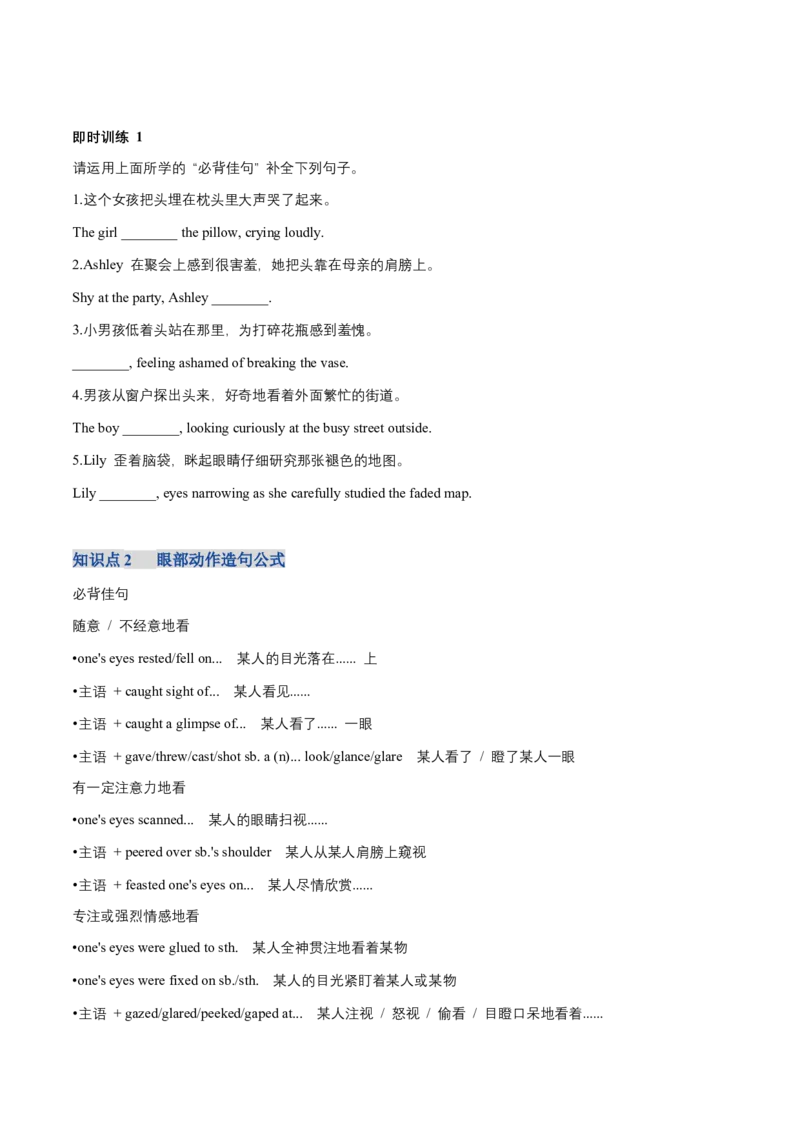
知识点1 头部动作造句公式.......................................................................................................................... 2
知识点2 眼部动作造句公式......................................................................................................................3
知识点3 嘴部动作造句公式......................................................................................................................6
知识点4 手部动作造句公式......................................................................................................................8
知识点5 腿部动作造句公式......................................................................................................................9
知识点6 脚部动作造句公式....................................................................................................................12
知识点7 原则1:细化动作,形成动作链..............................................................................................17
知识点8 原则2:精选动词,精准描述..................................................................................................19
知识点9 原则3:添加修饰,生动描写..................................................................................................21
在高中英语读后续写中,动作描写扮演着至关重要的角色。它不仅是推动情节发展的动力,更是塑
造人物形象和增强故事画面感的关键。通过生动、细致的动作描写,考生能够使故事情节更加连贯、丰满,
语言表达也更为生动。然而,许多学生在续写时常常遇到情节构思与前文不连接、内容欠丰满、语言空洞
等问题,其中一个主要原因就是缺乏对主要人物动作的生动描写。
、
一
体
动作
身
部位
身体部位动作如头部、眼部、嘴部、手部、腿部和脚部的动作描写也是不可或缺的,它们能使人物
形象栩栩如生,个性特征更加鲜明。通过这些方法,考生可以有效地提升读后续写的水平,使文章情节真
实、内容丰富、人物鲜活、语言生动。
知识点1   头部动作造句公式
必背佳句
•主语 + nodded/shook one's head  某人点头 / 摇头
•主语 + raised/lifted one's head  某人抬起头
•主语 + lowered/bent/bowed/hung/ducked one's head  某人低下头
•主语 + swiveled/rolled one's head  某人转动头部
•主语 + tilted one's head  某人歪着脑袋
•主语 + straightened one's neck  某人挺直脖子
•主语 + stretched/craned one's neck  某人伸展 / 伸长脖子
•主语 + buried one's head in...  某人把头埋在
 里面
……
•主语 + poked/stuck one's head out of...  某人从
 当中探出头
……
•主语 + rested one's head on sb.'s shoulder  某人把头靠在某人的肩上
高频造句公式:
公式1:主语 + raised/lowered/bowed one's head, (with + 情感/原因)
解析:表达人物情绪(如羞愧、尊敬、悲伤)的典型动作。
 例:She lowered her head, ashamed of her mistake.她低下了头,对自己的错误感到羞愧。
公式2:主语 + tilted one's head, (as if + 从句 / 逗号 + 动作/心理描写)
 解析:表现疑惑、思考或好奇,增强人物心理刻画。
 例:He tilted his head, as if trying to understand what she meant.他歪了歪头,似乎在试图理解她的意思。
公式3:Burying one's head in + 名词 / one's hands, 主语 + 动作 / 情感描写
解析:强调极度悲伤、害羞或逃避情绪。
 例:Burying her head in the pillow, she burst into tears.她把头埋在枕头里,哭了起来。
即时训练 1
请运用上面所学的 “必背佳句” 补全下列句子。
1.这个女孩把头埋在枕头里大声哭了起来。
The girl ________ the pillow, crying loudly.
2.Ashley 在聚会上感到很害羞,她把头靠在母亲的肩膀上。
Shy at the party, Ashley ________.
3.小男孩低着头站在那里,为打碎花瓶感到羞愧。
________, feeling ashamed of breaking the vase.
4.男孩从窗户探出头来,好奇地看着外面繁忙的街道。
The boy ________, looking curiously at the busy street outside.
5.Lily 歪着脑袋,眯起眼睛仔细研究那张褪色的地图。
Lily ________, eyes narrowing as she carefully studied the faded map.
知识点2   眼部动作造句公式
必背佳句
随意 / 不经意地看
•one's eyes rested/fell on...  某人的目光落在
 上
……
•主语 + caught sight of...  某人看见……
•主语 + caught a glimpse of...  某人看了
 一眼
……
•主语 + gave/threw/cast/shot sb. a (n)... look/glance/glare  某人看了 / 瞪了某人一眼
有一定注意力地看
•one's eyes scanned...  某人的眼睛扫视……
•主语 + peered over sb.'s shoulder  某人从某人肩膀上窥视
•主语 + feasted one's eyes on...  某人尽情欣赏……
专注或强烈情感地看
•one's eyes were glued to sth.  某人全神贯注地看着某物
•one's eyes were fixed on sb./sth.  某人的目光紧盯着某人或某物
•主语 + gazed/glared/peeked/gaped at...  某人注视 / 怒视 / 偷看 / 目瞪口呆地看着……
•主语 + met/avoided sb.'s look/gaze/stare  某人迎上 / 避开某人的目光 / 凝视
伴随强烈情感
•one's eyes were wide with horror  某人惊恐地瞪大了眼睛
•one's eyes were shining with excitement  某人眼里闪烁着兴奋的光芒
•one's eyes were filled with tears  某人的眼里充满泪水
高频造句公式:
公式1:主语 + caught sight of + 名词 / 从句, (and + 动作反应)
解析:表示突然看见某物,引发后续情节。
例:I caught sight of my mother in the crowd and waved frantically.我在人群中看到了母亲,拼命地挥手。
公式2:主语's eyes were fixed/glued to + 名词 / 从句, (as if + 从句)
解析:突出专注、震惊或恐惧,营造紧张氛围。
例:His eyes were glued to the screen, as if he couldn’t believe what he saw.他的眼睛紧盯着屏幕,好
像不敢相信自己所看到的。
公式3:主语 + gave/threw a (n) ... look at sb., (and + 动作 / 语言)
解析:通过眼神传递情绪(愤怒、鼓励、怀疑等),推动人际互动。
例:She gave him a sharp glare and turned away without a word.她狠狠地瞪了他一眼,一句话也没说就
转身离开了。
即时训练 2
请运用上面所学的 “必背佳句” 补全下列句子。
1.女孩从她爸爸的肩膀上窥视,想看看他在手机上看什么。
The girl ________, trying to see what he was reading on his phone.
2.她尽情地欣赏着那壮丽的日落,品味着天空上绘制的每一种生动色彩。
She ________ the magnificent sunset, savoring every vibrant color painted across the sky.
3.她的目光落在我和她在我四岁生日聚会上的照片上。
________ the photos of her and me at my fourth birthday party.
4.双胞胎热切地注视着他们的妈妈,她的眼里充满了激动的泪水。
Eagerly, the twins ________ their mother, whose eyes were filled with tears of excitement.
5.孩子们看见远处游乐园色彩缤纷的游乐设施时,眼里闪烁着兴奋的光芒。
________ as they ________ the amusement park's colorful rides in the distance.
6.看见一条大蛇正朝她爬来,Mary 惊恐地瞪大了眼睛。
Seeing a huge snake slithering towards her, ________.
7.她转过身,看了一眼正试图躲在树后的小男孩。
Turning around, she ________ the little boy trying to hide behind the tree.
知识点3   嘴部动作造句公式
必背佳句
•one's mouth dropped open in surprise  某人惊讶得张大了嘴
•one's mouth widened to a smile  某人咧着嘴笑
•one's mouth twisted into a bitter smile  某人的嘴角露出一丝苦笑
•one's lips pressed tighter together  某人的嘴越抿越紧
•主语 + bit/curled one's lip/licked one's lips  某人咬嘴唇 / 撇嘴 / 舔嘴唇
•主语 + pouted/puckered/pursed one's lips  某人噘嘴
•主语 + cupped/covered one's mouth  某人捂住嘴
•主语 + chewed/gnawed on/at...  某人咀嚼 / 咬……
•主语 + spat out/sucked at/on...  某人吐出 / 吸吮……
•主语 + gasped for air/breath  某人气喘吁吁
•主语 + laughed from ear to ear  某人笑得合不拢嘴
•主语 + stuck one's tongue out at...  某人向
 吐舌头
……
•主语 + muttered to oneself  某人自言自语
高频造句公式:
公式1:主语 + bit/curled/pursed one's lips, (as + 情绪 / 心理暗示)
解析:表现克制、不满或思考,细腻刻画内心活动。
例:He bit his lip, trying to hold back his anger.他咬了咬嘴唇,试图压抑住自己的愤怒。
公式2:主语's mouth dropped open in surprise / shock at + 名词 / 从句
解析:突出惊讶、震惊,适合情节转折点。
例:Her mouth dropped open in shock at the sight of the broken vase.她看到摔碎的花瓶时,嘴巴惊讶地
张开了。
公式3:主语 + muttered to oneself, “...” (while + 动作 / 神态)
解析:展现内心独白,增强真实感与代入感。
例:He muttered to himself, “I can’t believe this is happening,” while pacing the room.他自言自语道:
“我简直不敢相信这会发生,”同时在房间里踱来踱去。
即时训练 3
请运用上面所学的 “必背佳句” 补全下列句子。
1.小女孩看到父母带回家的小狗,笑得合不拢嘴。
The little girl ________ when she saw the puppy her parents had brought home.
2.看着桌上美味的菜肴,Jack 舔了舔嘴唇。
Looking at the delicious dishes on the table, Jack ________.
3.他一边看着窗外,一边咬着嘴唇,仿佛在思考。
He ________ as he looked out the window, as if thinking.
4.魔术师从帽子里变出一只兔子,孩子们惊讶得张大了嘴。
The magician pulled a rabbit out of the hat, and ________.
5.当 Stacie 看到首饰盒里失散已久的项链时,她捂住嘴,泪水瞬间涌出。
When Stacie saw the long - lost necklace in the jewelry box, ________, tears welling up instantly.
6.疲惫不堪的徒步旅行者瘫倒在岩石上,气喘吁吁。
The exhausted hiker collapsed onto a rock, ________.
7.在这场玩笑式的争论中获胜后,Lily 朝哥哥吐了吐舌头,然后蹦蹦跳跳地跑开了。
After winning the playful argument, ________, then skipped away.
8.想起自己付出所有努力却仍未达成目标时,他嘴角露出一丝苦笑。
As he thought of all the efforts he had made but still failed to achieve his goal, ________.
知识点4   手部动作造句公式
必背佳句
•one's fingers tapped lightly on one's cheek  某人用手轻轻敲打脸颊
•主语 + reached out to grasp sb.'s hand  某人伸手握住某人的手
•主语 + spread one's hands (out)  某人摊开双手
•主语 + clapped one's hands  某人拍手
•主语 + cupped one's hand (s) over/around...  某人捂住……
•主语 + rubbed one's eyes  某人揉眼睛
•主语 + rubbed one's hands together  某人搓着双手
•主语 + hid one's face in one's hands  某人用手捂住脸
•主语 + balled one's hand into a fist  某人攥起拳头
•主语 + reached into one's pocket  某人把手伸进口袋
•主语 + pointed (with) one's finger at...  某人用手指指着……
•主语 + patted sb. on the shoulder  某人轻轻拍某人的肩膀
•主语 + shrugged one's shoulders  某人耸了耸肩
•主语 + threw oneself/ran into sb.'s arms  某人投入某人的怀抱
•主语 + gathered sb. into one's arms/wrapped one's arms around sb.  某人把某人抱在怀里
•主语 + 谓语 + with one's head in one's hands  某人双手抱着头……
高频造句公式:
公式1:主语 + reached out to + 动词原形 / sb.'s + 名词, (with + 情感/动作细节)
解析:表现关心、帮助或渴望,常用于情感高潮。
例:She reached out to touch his hand, her eyes filled with concern.她伸出手去触摸他的手,眼中满是担
忧。
公式2:主语 + balled one's hands into fists, (at + 情境 / 人物)
解析:表达愤怒、决心或压抑情绪。
例:He balled his hands into fists at the injustice he had just heard.他听到刚刚的不公,愤怒地握紧了拳
头。
公式3:主语 + patted / placed one's hand on sb.'s shoulder, (and + 语言 / 动作)
解析:体现安慰、鼓励或亲密关系。
例:My father patted me on the shoulder and whispered, “You’ve done well.”我父亲拍了拍我的肩膀,
低声说:“你做得很好。”
请运用上面所学的 必背佳句 补全下列句子。
“
”

1.情绪激动,Helen 用双手捂住脸,试图控制住即将流出的泪水。
Overwhelmed with emotion, Helen ________, trying to contain the tears threatening to spill over.
2.妈妈满心欢喜,把孩子们抱在怀里,用温暖的怀抱将他们紧紧包围着。
Filled with joy, Mom ________, holding them close in a warm embrace.
3.感到非常沮丧,Tom 攥起拳头,努力控制自己的情绪。
Feeling very frustrated, Tom ________ as he struggled to contain his emotions.
4.面对批评,Tracy 耸了耸肩,装作毫不在意,但颤抖的手指暴露了她的真实情绪。
________ at the criticism, pretending not to care, but her trembling fingers betrayed her true feelings.
5.得知这个令人心碎的消息后,May 的泪水夺眶而出,默默伸手握住妹妹的手。
After hearing the heart - breaking news, May's tears welled up and ________.
6.当绚丽的北极光照亮夜空时,她不敢相信地揉了揉眼睛,怀疑自己是不是在做梦。
________ as the stunning northern lights lit up the night sky, wondering if she was dreaming.
知识点5   眼部动作造句公式
必背佳句
•主语 + crossed one's legs  某人盘腿
•主语 + 谓语 + with one's legs crossed  某人跷着二郎腿
•主语 + crouched/squatted down  某人蹲下
•主语 + dragged one's heavy legs  某人拖着沉重的双腿
•主语 + drew one's knees up  某人曲起双膝
•主语 + shuffled off...  某人拖着脚步离开……
•主语 + slipped/stole into...  某人溜进……
•主语 + slipped out of...  某人从
 滑出
……
•主语 + crawled on hands and knees towards...  某人手脚并用向
 爬去
……
•主语 + made a sprint for...  某人向
 冲刺
……
•主语 + dashed/strode back to...  某人冲回 / 大步返回……
•主语 + bounced around  某人蹦蹦跳跳
•主语 + paced up and down  某人走来走去
•主语 + dashed straight into...  某人直冲入……
•主语 + jerked one's legs  某人猛地抽动双腿
•主语 + sprawled with legs apart  某人叉开腿躺着 / 坐着
高频造句公式:
公式1:主语 + paced up and down, (with + 情绪 / 原因)
解析:表现焦虑、等待或思考,常用于紧张场景。
例:She paced up and down the hallway, waiting for the doctor’s call.她在走廊里来回踱步,等待医生
的电话。
公式2:主语 + dashed/strode toward(s) + 地点, (with + 情感 / 目的)
解析:表现急切、果断或愤怒的情绪。
例:He dashed toward the door, determined to stop her.他冲向门口,决心要阻止她。
公式3:主语 + drew/crossed one's legs, (while + 动作 / 语言)
解析:用于描写坐姿,体现从容、紧张或防御心理。
例:She crossed her legs while calmly explaining her plan.
她交叉双腿,冷静地解释她的计划。
即时训练 5
请运用上面所学的 “必背佳句” 补全下列句子。
1.这个男人焦躁地在屋子里走来走去,无法平静下来。
________ around the house, unable to calm down.
2.这个运动员向着终点冲刺,决心成为第一名。
The athlete ________ the finish line, determined to be the first.
3.他心情沉重,拖着脚步离开了操场,把同学们的笑声留在了身后。
With a heavy heart, ________, leaving behind the laughter of his classmates.
4.大雨倾盆而下时,孩子们冲回屋里,笑声在花园里回荡。
When the rain started pouring, ________, their laughter echoing through the garden.
5.疲惫不堪的 Stella 拖着沉重的双腿冲过终点线,一越过终点便瘫倒在地。
________ across the finish line, collapsing onto the ground the moment she crossed it.
6.被雷声吓到,Mary 猛地抽动双腿,差点从公园长椅上摔下来。
Startled by thunderclap, ________ and nearly toppled off the park bench.
7.母亲蹲下来,直视着哭泣的孩子的眼睛,温柔地安慰他。
The mother ________ to look her crying child in the eyes and comforted him gently.
知识点6   脚部动作造句公式
•主语 + rose/got/struggled to one's feet  某人起立 / 挣扎着站起来
•主语 + jumped/leaped/sprang to one's feet  某人突然跳起来
•主语 + staggered to one's feet  某人摇摇晃晃地站起身来
•主语 + planted one's feet on the ground  某人双脚钉在地上
•主语 + tapped/stamped one's feet  某人跺脚
•主语 + put one's feet up  某人跷起脚休息
•主语 + slowed one's stride  某人放慢脚步
•主语 + shuffled one's feet  某人拖着脚走
•主语 + raised oneself on tiptoe  某人踮起脚尖
•主语 + tiptoed over to...  某人蹑手蹑脚地走向……
•主语 + quickened one's pace  某人加快步伐
•主语 + kicked at the ground in frustration  某人烦躁地用脚踢地面
•主语 + edged forward cautiously  某人小心翼翼地前行
•主语 + tapped out a rhythm with one's feet  某人用脚打拍子
•主语 + turned/spun on one's heel  某人突然转身
•主语 + froze midway  某人中途突然停步
高频造句公式:
公式1:主语 + jumped/sprang to one's feet, (at + 惊讶事件)
解析:表现震惊、警觉或激动,推动情节突变。
例:She sprang to her feet at the sound of the scream.听到尖叫声,她立刻站了起来。
公式2:主语 + tiptoed over to + 地点, (to + 目的 / 动作)
解析:表现小心翼翼、偷偷摸摸,适合悬疑或温情场景。
例:He tiptoed over to the baby’s crib to check if she was asleep.
他踮着脚走到婴儿床边,查看她是否睡着了。
公式3:主语 + quickened/slowed one's pace, (as + 从句 / 情景变化)
解析:体现心理变化或环境影响,增强节奏感。
例:She quickened her pace as the sky darkened with storm clouds.随着天空布满乌云,她加快了脚步。
即时训练 6
请运用上面所学的 “必背佳句” 补全下列句子。
1.Thomas 悄悄地下了床,蹑手蹑脚地走向窗户。
Thomas slipped out of bed and ________.
2.我的弟弟突然跳起来冲过去追她。
My younger brother ________ and rushed after her.
3.孩子们看到外面大雪纷飞,开心地跺着脚。
________ when they saw that it was snowing heavily outside.
4.陷入沉思的他放慢脚步,对周围的喧嚣浑然不觉。
Lost in thought, ________, unaware of to the hustle and bustle around him.
5.再次考试失利后,Tom 烦躁地用脚踢着地面。
After failing the exam again, ________.
6.长跑过后精疲力竭,她摇摇晃晃地站起身来,双腿颤抖,双手紧紧抓着栏杆借力。
Exhausted from the long - distance run, ________, legs trembling and hands clutching the railing for support.
7.坐在音乐厅里,她闭上眼睛,用脚打着拍子,完全沉浸在悠扬的交响乐中。
Seated in the concert hall, she closed her eyes and ________, completely immersed in the melodious symphony.
、动作描写的
二
三个原则
为了提升动作描写的质量, 需要掌握几个基本原则。首先,细化动作,写出动作过程,如连续的
动作直接用并列谓语表达,同时发生的动作则用现在分词形式。其次,精选动词,做到描述精准,用精准
动词代替笼统动词,用恰当短语代替普通动词。最后,添加修饰成分,利用介词短语、副词等修饰动作,
使描写更加细腻。
知识点7  原则1:细化动作,形成动作链
在描写动作时,要细化动作,把动作过程分解成一连串细微的动作,形成动作链。学会描写动作时不
仅表现 “在做什么”,而且表现 “在怎样做”,如通过动词填空练习,用恰当的动词补全动作过程;通过动词
分解练习,将一个动作环节分解成多个动作,形成动作链;通过情景写作训练,根据给定情景写出人物的
动作过程。
1.
的动作
连续
,直接用并列谓语表达:Sb.

谓语B and

谓语C。
她冲向前,跳起来,一把紧紧地抱住那个男孩。
She dashed forward,jumped up and hugged the boy tightly.
思考:
(1) 孩子们跳入湖中嬉戏。想像一下都有哪些动作?
冲向湖边 + 脱掉衣服 + 跳入水中
分解为:
→
ran to the lake + took off their clothes + jumped into the water
即:孩子们兴奋地冲到湖边,脱下衣服,跳进了水里。
The boys rushed excitedly to the lake,took off their clothes and jumped into the water.
(2) 我早上匆忙去上学。分解成 穿上外套,抓起书包,冲去学校。
“
”
I put on my coat hurriedly,grabbed my bag and rushed to school this morning.
2.
的动作
作
同时发生
,可以用现在分词
状语表达,Doing/Having done,主句。
例:看到戒指后,麦子感到很震惊。
Seeing the ring,she felt shocked.
思考:我在台上开始唱歌。可分解为 “扫视观众 + 深吸一口气 + 开始演唱”。
即:我站在台上,扫视一下观众,深吸一口气,开始演唱。
Standing on the stage,I anxiously glanced at the audience,took a deep breath and began to sing.
【即时训练】完成句子。
1.受惊吓的 Mac 冲到车的后座,在狼袭击到他之前把门关上了。


2.麦克毫不犹豫跳下自行车,冲向车的后门,猛然地关上车门。


3.想到狼血淋淋的嘴,麦克吓得要死,喘不上气。


4.经理安静地坐在办公室里,眼睛闭着。


5.那个男孩站在那里,脸上因愤怒而僵硬。


知识点8  原则2:精选动词,精准描述
在描写动作时,要准确抓住人物在特定情景中行动的特点,所选动作要体现人物特征,比如年龄、性
格、性别、身份、环境、情景等。
首先,要扩大词汇量,尤其是动词词汇,熟练甄别相近动词的意义和适用语境;其次,发挥教材和其
他阅读文本的示范作用,体会和感悟动词用法并学习借鉴。
比如:人教版高中英语教材选修七 Unit 3 UNDER THE SEA 中这样描写 Old Tom 的动作:We ran
down to the shore in time to see an enormous animal opposite us throwing itself out of the water and then crashing
down again. 句中用了 throwing 和 crashing 两个动词,相比于其他动词(如 jumping 和 dropping)更为
精准,让读者充分感受到了 Old Tom 的重量和动作的力量。
1.
动
动
用精准
词代替笼统
词
词
笼统
词
具体
walk
tiptoe (蹑手蹑脚地走)
run
dash/rush (猛冲)
look
glance (瞥见) glare (怒视)
stare (凝视)
say/talk
chat (闲聊) whisper (耳语)
cry
weep/sob (啜泣)
eat
bite (咬) chew (咀嚼)
swallow (吞下)
2.
动
用恰当短语代替普通
词
动词
普通
语
恰当短
start/begin
get down to doing
decide
make up one’s mind
cry
burst into tears
remember
keep in mind
tired
worn out
see
catch sight of
attract
appeal to
知识点9  原则3:添加修饰,生动描写
动作描写中最常见的修饰成分就是状语,如副词、介词短语等。例如,在体现动作的迅速和短暂时
间,我们可以添加以下修饰语:suddenly,immediately,instantly,swiftly,rapidly,hastily,speedily,
promptly,without pausing,without delay 等。
另外,把动作和表情、心理结合起来描写,能写出人物的动作所表现出的神态、想法,从而能更生动
地刻画人物性格。
例如,将动作 looked at,reached for 和 with wonder,was amazed 以及 “How absurd!”“He was just a
machine!” 等表情和心理描写结合起来,更好地表现了难以置信。
1.
、
动作
加介词短语
副词修饰
①恶狼呲着牙盯着 Mac。
The fierce wolf stared at Mac with its sharp/bloody/frightening/scary/terrible teeth.
解析:在这个句子中,“fierce”(凶猛的)作为形容词,直接修饰名词 “wolf”,生动形象地展现出狼的凶狠
特质,让读者脑海中能够迅速勾勒出一只极具威胁性的狼的形象。而 “with its
sharp/bloody/frightening/scary/terrible teeth” 这一介词短语,则是对狼盯着 Mac 时的具体状态进行补充说
明。其中,“sharp” 表示锋利的,“bloody” 表示带血的,“frightening”“scary”“terrible” 都有可怕的、令人恐惧
的含义。这些形容词修饰 “teeth”(牙齿),通过描述狼呲着的牙齿的特点,进一步强化了狼的凶猛与可怕,
使整个场景更加具有画面感和冲击力,让读者能深切感受到 Mac 所面临的危险。
②他从自行车上跳下来,冲进汽车。
Immediately/Instantly/Hurriedly/Breathlessly (adv.),he jumped off the bicycle and dashed into the car.
解析:在这个句子里,“Immediately”“Instantly” 都有立即、马上的意思,“Hurriedly” 表示匆忙地,
“Breathlessly” 意为气喘吁吁地。这些副词放在句首,强调了动作发生的紧急性和迅速性。“jumped off” 和
“dashed into” 是两个关键的动词短语,“jumped off the bicycle” 描述了他从自行车上跳下来这个动作,
“dashed into the car” 则表示他迅速冲进汽车的行为。副词的使用让整个动作过程更加生动,体现出他当
时可能处于一种紧急、慌张的状态,比如可能是在躲避危险,所以才会如此迅速且匆忙地从自行车转移到
汽车里,让读者能更好地理解他的行为动机和当时紧张的氛围。
③由于狼快要追上 Mac,他瞪大了眼睛。
As the hungry wolf was almost reaching him,Mac’s eyes were wide open in fear/panic/horror/shock.
解析:“As the hungry wolf was almost reaching him” 这是一个由 “as” 引导的原因状语从句,“hungry”(饥
饿的)这个形容词修饰 “wolf”,表明狼处于饥饿状态,而饥饿的狼往往攻击性更强,这就进一步说明了
Mac 所面临的危险程度在加剧。主句 “Mac’s eyes were wide open” 描述了 Mac 的外在表现,即他的眼睛
睁得很大。“in fear/panic/horror/shock” 这些 “in + 名词” 的介词短语,用来具体说明 Mac 出现这种状态
(眼睛瞪大)的原因是处于恐惧、惊慌、惊恐、震惊之中。通过这样的表达,能够让读者深切体会到 Mac
内心极度害怕的情绪,比单纯说他很害怕更加生动形象,也让整个场景的紧张感跃然纸上 。
2.
体动作
描写
动
利用肢
,使
更加生
。
站在空空的路上,眼望天空,感受这珍贵的平静。
Standing (肢体) beside the empty road,they looked (面部) up to the sky,feeling (心理) the precious peace.
解析:Standing (站立):这是一个基础姿态动作,确立了人物的存在和场景的稳定性。它暗示了一种停顿、
一种专注的开始,而不是匆匆走过。Looked up (仰望):这是一个有方向的肢体和面部动作。“向上看”这个
动作本身 often associated with 希望、深思、释然或寻求慰藉。它将读者的视线也引向了天空,打开了画
面的空间感,不再局限于地面。Feeling (感受):这是前两个动作引发的内在心理结果。因为先“站立”静心,
再“仰望”开阔的天空,所以“感受到平静”变得水到渠成、非常自然。效果: 这种分解使静态的场景充满了
动态的流程,读者仿佛能看到一幅连贯的动画,而不是一张静止的照片。
【即时训练】完成句子。
1.他拦下出租车,拿着箱子跳上去,告诉司机去警察局。


2.被母亲误解后,她跑回房间,哭得很伤心。


3.被她的善良所感动,我决定把这份无私的爱传递下去,将来帮助更多的人。


4.看到一辆车开过来,他猛烈地挥手,希望能搭车。