2026 年高考第二次模拟考试(天津专用)
高三英语
(考试时间:120 分钟  试卷满分:150 分)
注意事项:
1.答卷前,考生务必将自己的姓名、准考证号等填写在答题卡和试卷指定位置上。
2.回答选择题时,选出每小题答案后,用铅笔把答题卡上对应题目的答案标号涂黑。如需改动,用
橡皮擦干净后,再选涂其他答案标号。回答非选择题时,将答案写在答题卡上。写在本试卷上无效。
3.考试结束后,将本试卷和答题卡一并交回
第 Ⅰ 卷(共 115 分)
第一部分:听力(共两节,满分20 分)
第一节(共 5 小题;每小题1 分,满分5 分)
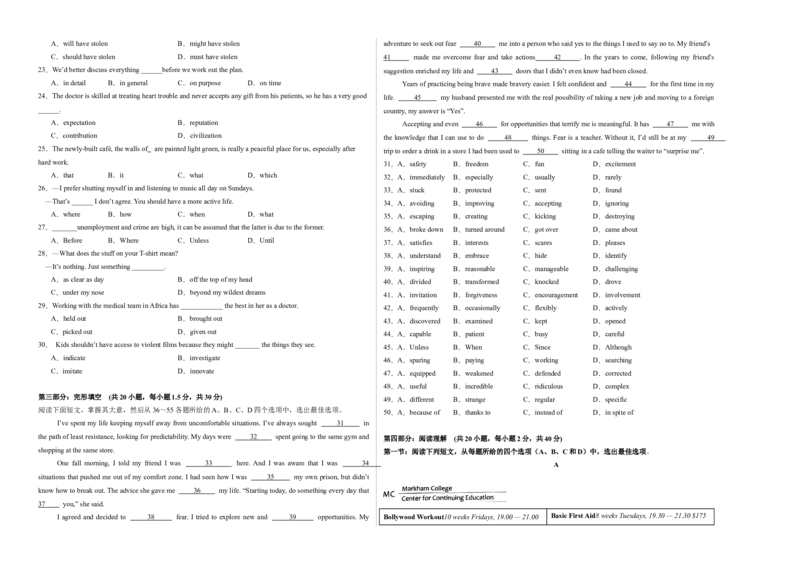
听下面 5 段对话,每段对话后有一个小题。从题中所给的 A, B, C 三个选项中选出最佳选项,并标在试卷
的相应位置。听完每段对话后,你都有10 秒钟的时间来回答有关小题和阅读下一小题。每段对话仅读一
遍。
1.What does the woman want to do?
A.Borrow a phone.
B.Buy a map.
C.Ask the way.
2.What does the woman like collecting best?
A.Train tickets.
B.Coins.
C.Stamps.
3.What are the speakers mainly talking about?
A.A study.
B.A country.
C.The songs.
4.What does the woman ask the boy to do after school?
A.Put away his school bag.
B.Move the kitchen table.
C.Hang up his coat.
5.How many tickets has the woman got?
A.Two.
B.Three.
C.Four
第二节(共10 小题;每小题1.5 分,满分15 分)
听下面5 段对话或独白。每段对话或独白后有几个小题,从题中所给的A、B、C 三个选项中选出最佳选
项。听每段对话或独白前,你将有时间阅读各个小题,每小题5 秒钟;听完后,各小题将给出5 秒钟的作答
时间。每段对话或独白读两遍。
听下面一段较长对话,回答以下小题。
6.Where will the man spend this summer?
A.In Eastern Europe.
B.In California.
C.In Hawaii.
7.Where did the man get to know Brandon?
A.In a travel agency.
B.On the train.
C.In a law firm.
8.Why are the man’s family a little disappointed?
A.He will miss the family trip.
B.They aren’t interested in Budapest.
C.His work is below their expectation.
听下面一段较长对话,回答以下小题。
9.What is probably Veronique?
A.A clothes designer.
B.A pop singer.
C.A student.
10.What does Veronique like to do in her spare time?
A.Taste different food.
B.Enjoy French songs.
C.Travel around.
11.What does Veronique usually have for lunch?
A.Sandwiches.
B.Hamburgers.
C.Chips.
听下面一段独白,回答以下小题。
12.When will North High School hold a concert?
A.On Monday.
B.On Thursday.
C.On Friday.
13.What can the listeners enjoy on Wednesday evening?
A.A party.
B.A concert.
C.A film.
14.What will the listeners do first on Saturday?
A.Make a timetable for the day.
B.Enjoy the beautiful lake views.
C.Visit places of interest of the city.
15.What is the speaker’s phone number?
A.89098980.
B.89099880.
C.89099980.
第二部分:单项选择 (共15 小题,每小题1 分,共15 分)
16.---Don’t worry, Mum. The doctor said it was only the flu.
---____! I’ll tell Dad there’s nothing serious.
A.What a relief
B.Congratulations
C.How surprising
D.I’m so sorry
17.The president hopes that the people will be better off when he quits than when he_______.
A.has started
B.starts
C.started
D.will start
18.

  an important decision more on emotion than on reason, you will regret it sooner or later.
A.Based
B.Basing
C.Base
D.To base
19.Days later, my brother called to say he was all right, but _______say where he was.
A.mustn’t
B.shouldn’t
C.wouldn’t
D.mightn’t
20.—Tommy is planning to buy a car.
— I know. By next month, he ____ enough for a used one.
A.saves
B.saved
C.will save
D.will have saved
21.In that school, English is compulsory for all students, but French and Russian are _______.
A.special
B.regional
C.optional
D.original
22.——I left my handbag on the train, but luckily someone gave it to a railway official.
——How unbelievable to get it back! I mean, someone ______ it.
A.will have stolen
B.might have stolen
C.should have stolen
D.must have stolen
23.We’d better discuss everything ______before we work out the plan.
A.in detail
B.in general
C.on purpose
D.on time
24.The doctor is skilled at treating heart trouble and never accepts any gift from his patients, so he has a very good
______.
A.expectation
B.reputation
C.contribution
D.civilization
25.The newly-built café, the walls of  are painted light green, is really a peaceful place for us, especially after
hard work.
A.that
B.it
C.what
D.which
26.—I prefer shutting myself in and listening to music all day on Sundays.
—That’s ______ I don’t agree. You should have a more active life.
A.where
B.how
C.when
D.what
27._______unemployment and crime are high, it can be assumed that the latter is due to the former.
A.Before
B.Where
C.Unless
D.Until
28.—What does the stuff on your T-shirt mean?
—It’s nothing. Just something _________.
A.as clear as day
B.off the top of my head
C.under my nose
D.beyond my wildest dreams
29.Working with the medical team in Africa has ____________ the best in her as a doctor.
A.held out
B.brought out
C.picked out
D.given out
30. Kids shouldn’t have access to violent films because they might _______ the things they see.
A.indicate
B.investigate
C.imitate
D.innovate
第三部分:完形填空  (共20 小题,每小题1.5 分,共30 分)
阅读下面短文,掌握其大意,然后从36~55 各题所给的A、B、C、D 四个选项中,选出最佳选项。
I’ve spent my life keeping myself away from uncomfortable situations. I’ve always sought     31     in
the path of least resistance, looking for predictability. My days were     32     spent going to the same gym and
shopping at the same store.
One fall morning, I told my friend I was     33     here. And I was aware that I was     34

situations that pushed me out of my comfort zone. I had seen how I was     35     my own prison, but didn’t
know how to break out. The advice she gave me     36     my life. “Starting today, do something every day that
37     you,” she said.
I agreed and decided to     38     fear. I tried to explore new and     39     opportunities. My
adventure to seek out fear     40     me into a person who said yes to the things I used to say no to. My friend’s
41     made me overcome fear and take actions    42    . In the years to come, following my friend’s
suggestion enriched my life and     43     doors that I didn’t even know had been closed.
Years of practicing being brave made bravery easier. I felt confident and     44     for the first time in my
life.     45     my husband presented me with the real possibility of taking a new job and moving to a foreign
country, my answer is “Yes”.
Accepting and even     46     for opportunities that terrify me is meaningful. It has     47     me with
the knowledge that I can use to do     48     things. Fear is a teacher. Without it, I’d still be at my     49

trip to order a drink in a store I had been used to     50     sitting in a cafe telling the waiter to “surprise me”.
31.A.safety
B.freedom
C.fun
D.excitement
32.A.immediately
B.especially
C.usually
D.rarely
33.A.stuck
B.protected
C.sent
D.found
34.A.avoiding
B.improving
C.accepting
D.ignoring
35.A.escaping
B.creating
C.kicking
D.destroying
36.A.broke down
B.turned around
C.got over
D.came about
37.A.satisfies
B.interests
C.scares
D.pleases
38.A.understand
B.embrace
C.hide
D.identify
39.A.inspiring
B.reasonable
C.manageable
D.challenging
40.A.divided
B.transformed
C.knocked
D.drove
41.A.invitation
B.forgiveness
C.encouragement
D.involvement
42.A.frequently
B.occasionally
C.flexibly
D.actively
43.A.discovered
B.examined
C.kept
D.opened
44.A.capable
B.patient
C.busy
D.careful
45.A.Unless
B.When
C.Since
D.Although
46.A.sparing
B.paying
C.working
D.searching
47.A.equipped
B.weakened
C.defended
D.corrected
48.A.useful
B.incredible
C.ridiculous
D.complex
49.A.different
B.strange
C.regular
D.specific
50.A.because of
B.thanks to
C.instead of
D.in spite of
第四部分:阅读理解  (共20 小题,每小题2 分,共40 分)
第一节:阅读下列短文,从每题所给的四个选项(A、B、C 和D)中,选出最佳选项。
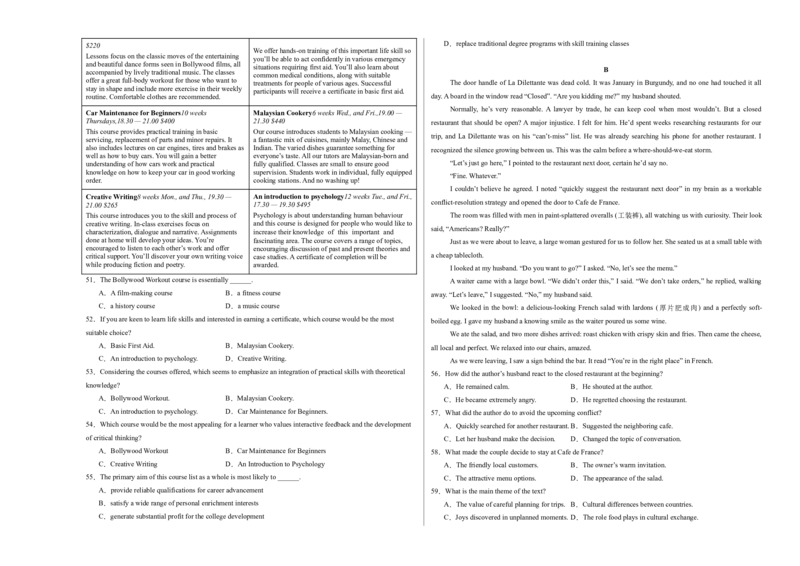
A
Bollywood Workout10 weeks Fridays, 19.00 — 21.00
Basic First Aid8 weeks Tuesdays, 19.30 — 21.30 $175
$220
Lessons focus on the classic moves of the entertaining
and beautiful dance forms seen in Bollywood films, all
accompanied by lively traditional music. The classes
offer a great full-body workout for those who want to
stay in shape and include more exercise in their weekly
routine. Comfortable clothes are recommended.
We offer hands-on training of this important life skill so
you’ll be able to act confidently in various emergency
situations requiring first aid. You’ll also learn about
common medical conditions, along with suitable
treatments for people of various ages. Successful
participants will receive a certificate in basic first aid.
Car Maintenance for Beginners10 weeks
Thursdays,18.30 — 21.00 $400
This course provides practical training in basic
servicing, replacement of parts and minor repairs. It
also includes lectures on car engines, tires and brakes as
well as how to buy cars. You will gain a better
understanding of how cars work and practical
knowledge on how to keep your car in good working
order.
Malaysian Cookery6 weeks Wed., and Fri.,19.00 —
21.30 $440
Our course introduces students to Malaysian cooking —
a fantastic mix of cuisines, mainly Malay, Chinese and
Indian. The varied dishes guarantee something for
everyone’s taste. All our tutors are Malaysian-born and
fully qualified. Classes are small to ensure good
supervision. Students work in individual, fully equipped
cooking stations. And no washing up!
Creative Writing8 weeks Mon., and Thu., 19.30 —
21.00 $265
This course introduces you to the skill and process of
creative writing. In-class exercises focus on
characterization, dialogue and narrative. Assignments
done at home will develop your ideas. You’re
encouraged to listen to each other’s work and offer
critical support. You’ll discover your own writing voice
while producing fiction and poetry.
An introduction to psychology12 weeks Tue., and Fri.,
17.30 — 19.30 $495
Psychology is about understanding human behaviour
and this course is designed for people who would like to
increase their knowledge  of  this  important  and
fascinating area. The course covers a range of topics,
encouraging discussion of past and present theories and
case studies. A certificate of completion will be
awarded.
51.The Bollywood Workout course is essentially ______.
A.A film-making course
B.a fitness course
C.a history course
D.a music course
52.If you are keen to learn life skills and interested in earning a certificate, which course would be the most
suitable choice?
A.Basic First Aid.
B.Malaysian Cookery.
C.An introduction to psychology.
D.Creative Writing.
53.Considering the courses offered, which seems to emphasize an integration of practical skills with theoretical
knowledge?
A.Bollywood Workout.
B.Malaysian Cookery.
C.An introduction to psychology.
D.Car Maintenance for Beginners.
54.Which course would be the most appealing for a learner who values interactive feedback and the development
of critical thinking?
A.Bollywood Workout
B.Car Maintenance for Beginners
C.Creative Writing
D.An Introduction to Psychology
55.The primary aim of this course list as a whole is most likely to ______.
A.provide reliable qualifications for career advancement
B.satisfy a wide range of personal enrichment interests
C.generate substantial profit for the college development
D.replace traditional degree programs with skill training classes
B
The door handle of La Dilettante was dead cold. It was January in Burgundy, and no one had touched it all
day. A board in the window read “Closed”. “Are you kidding me?” my husband shouted.
Normally, he’s very reasonable. A lawyer by trade, he can keep cool when most wouldn’t. But a closed
restaurant that should be open? A major injustice. I felt for him. He’d spent weeks researching restaurants for our
trip, and La Dilettante was on his “can’t-miss” list. He was already searching his phone for another restaurant. I
recognized the silence growing between us. This was the calm before a where-should-we-eat storm.
“Let’s just go here,” I pointed to the restaurant next door, certain he’d say no.
“Fine. Whatever.”
I couldn’t believe he agreed. I noted “quickly suggest the restaurant next door” in my brain as a workable
conflict-resolution strategy and opened the door to Cafe de France.
The room was filled with men in paint-splattered overalls (工装裤), all watching us with curiosity. Their look
said, “Americans? Really?”
Just as we were about to leave, a large woman gestured for us to follow her. She seated us at a small table with
a cheap tablecloth.
I looked at my husband. “Do you want to go?” I asked. “No, let’s see the menu.”
A waiter came with a large bowl. “We didn’t order this,” I said. “We don’t take orders,” he replied, walking
away. “Let’s leave,” I suggested. “No,” my husband said.
We looked in the bowl: a delicious-looking French salad with lardons ( 厚片肥成肉) and a perfectly soft-
boiled egg. I gave my husband a knowing smile as the waiter poured us some wine.
We ate the salad, and two more dishes arrived: roast chicken with crispy skin and fries. Then came the cheese,
all local and perfect. We relaxed into our chairs, amazed.
As we were leaving, I saw a sign behind the bar. It read “You’re in the right place” in French.
56.How did the author’s husband react to the closed restaurant at the beginning?
A.He remained calm.
B.He shouted at the author.
C.He became extremely angry.
D.He regretted choosing the restaurant.
57.What did the author do to avoid the upcoming conflict?
A.Quickly searched for another restaurant. B.Suggested the neighboring cafe.
C.Let her husband make the decision.
D.Changed the topic of conversation.
58.What made the couple decide to stay at Cafe de France?
A.The friendly local customers.
B.The owner’s warm invitation.
C.The attractive menu options.
D.The appearance of the salad.
59.What is the main theme of the text?
A.The value of careful planning for trips. B.Cultural differences between countries.
C.Joys discovered in unplanned moments. D.The role food plays in cultural exchange.
60.What does the sign “You’re in the right place” imply?
A.The unexpected choice turned out to be a perfect one.
B.The couple had been looking for this specific cafe.
C.The cafe provides professional navigation services.
D.The cafe was the only one open in the neighborhood.
C
Feelings of worry or fear characterize anxiety. People often feel anxious about things that are about to happen,
or situations that could happen in the future. People feel anxious before giving presentations or before moving to a
new place. The feeling of anxiety can help us prepare for what is to come.
Unfortunately, anxiety can become a problem. It can make it difficult to live life the way you want.
Sometimes feelings of anxiety can be too strong or last longer than they should or longer than is helpful. These
feelings can cause people to avoid situations or make it hard to do things they enjoy. Some types of anxiety can also
lead to panic attacks.
There are many types of anxiety. Climate change anxiety, also sometimes called eco-anxiety, is the extreme
worry about current and future harm to the environment because of human activities. The dangers of climate change
include natural disasters, such as flooding, wildfires, and stronger hurricanes. People also worry about the loss of
plants and animals. People who have climate change anxiety may worry about the well-being of: individuals, future
generations, life on Earth, and the planet.
Scientists measure climate change anxiety using the Climate Change Anxiety Scale (CCAS). The CCAS has a
list of statements about feelings and behaviors related to climate change. Most researchers use scores on the CCAS
to tell if a person has symptoms of climate change anxiety. But they do not have a specific score to diagnose a person
with climate change anxiety. We wanted to use data to determine cut-off scores (临界值) for the CCAS. These cut-
off scores could be important for future health care professionals to properly assess and help people with climate
change anxiety.
We used an online survey to collect data from 877 people in Australia. All the people who participated were
between the ages of 16 and 25. The survey questions included background information and the CCAS statements.
There were 13 climate change statements. People gave a score about how often the statement was true. They used a
five-point scale from 1 (never) to 5 (almost always). Then we calculated their total score by adding up the scores
from all statements. A higher score means a person has greater anxiety.
We also had participants take a test related to anxiety, stress, and depression. Then we connected the scores on
the CCAS with the scores on this test. First, we determined the sensitivity of the CCAS. The sensitivity is the ability
of the test to correctly identify a person with anxiety, stress, and depression symptoms. Then, we determined the
specificity of the CCAS. The specificity is the test’s ability to correctly identify a person without anxiety. We
analyzed the data to find two cut-off scores. One score identifies people with mild to medium symptoms of climate
change anxiety. The second score identifies people with severe climate change anxiety. The cut-off scores were the
total scores when the sensitivity and the specificity were the closest together.
We found that a total CCAS score of 21 means a person has mild to moderate symptoms of climate change
anxiety. A score of 23 or above means a person has severe symptoms of climate change anxiety. Using these scores,
about 50 percent of the people surveyed had mild to moderate symptoms. About 44 percent had severe symptoms of
climate change anxiety.
61.What can be learnt from the first two paragraphs?
A.Anxiety just occurs before big events like moving.
B.Normal anxiety brings no benefits to people.
C.Too much anxiety can mess up daily life.
D.All anxiety results in panic attacks.
62.What is the author’s purpose in writing Paragraph 3?
A.To introduce a new research method.
B.To present different types of anxiety.
C.To give a definition of climate change anxiety.
D.To list the causes of climate change anxiety.
63.What was the main goal of this research study?
A.To find score cut-offs for different anxiety levels. B.To prove that climate change is not a real problem.
C.To improve the effectiveness of the CCAS.
D.To increase the number of people taking the CCAS.
64.How were the cut-off scores for climate change anxiety determined?
A.By randomly selecting two scores from the total scores.
B.By choosing the scores when sensitivity and specificity are the farthest apart.
C.By taking the average of all the participants’ scores.
D.By finding the total scores when sensitivity and specificity are the closest together.
65.What could be the best title for the passage?
A.Climate Anxiety Cut-offs Identified in Youth Study
B.Most Young Australians Have Climate Anxiety
C.Youth Report Feelings on Climate Change
D.New Climate Anxiety Disorder defined
D
Psychologists have long been in disagreement as to whether competition is a learned or a genetic component
of human behavior. Whatever it is, you cannot but recognize the effect competition is exerting in academics and
many other areas of contemporary life.
Psychologically speaking, competition has been seen as an inevitable consequence of human drives.
According to Sigmund Freud, humans are born screaming for attention and full of organic drives for fulfillment in
various areas. Initially, we compete for the attention of our parents. Thereafter, we are at the mercy of a battle
between our base impulses for self-fulfillment and social and cultural norms which prohibit pure indulgence.
Current work in anthropology (人类学) has suggested,however,that this view of the role of competition in
human behavior may be incorrect. Thomas Hobbes, one of the great philosophers of the seventeenth century, is
perhaps best remembered for his characterization of the “natural world,” that is, the world before the imposition of
the will of humanity, as being “nasty, brutish, and short.” This image of the pre-rational world is still widely held,
reinforced by Charles Darwin’s highly influential work, The Origin of Species, which established the doctrine of
natural selection. This doctrine, which takes for granted that those species best able to adapt to and master the natural
environment in which they live will survive, has suggested that the struggle for survival is an inherent human trait
which determines a person’s success. Darwin’s theory has even been summarized as “survival of the fittest” — a
phrase Darwin himself never used-further highlighting competition’s role in success. As it has often been pointed
out, however, there is nothing in the concept of natural selection that suggests that competition is the most successful
strategy for “survival of the fittest.” Darwin asserted in The Origin of Species that the struggles he was describing
should be viewed as metaphors and could easily include dependence and cooperation.
Many studies have been conducted to test the importance placed on competition as opposed to other values,
such as cooperation — by various cultures, and generally conclude that Americans uniquely praise competition as
natural, inevitable, and desirable. In 1937, the world-renowned anthropologist Margaret Mead published
Cooperation and Competition among Primitive Peoples, based on her studies of several societies that did not prize
competition, and, in fact, seemed at times to place a negative value on it. One such society was the Zuni Indians of
Arizona, and they, Mead found, valued cooperation far more than competition. After studying dozens of such
cultures, Mead’s final conclusion was that competitiveness is a culturally created aspect of human behavior, and that
its prevalence in a particular society is relative to how that society values it.
66.What does the author think is easy to see in many areas of contemporary life?
A.The disagreement on the inevitability of competition.
B.The consequence of psychological investigation.
C.The effect of human drives.
D.The impact of competition.
67.According to psychology, what do people strive to do following the initial stage of their life?
A.Fulfill individual needs without incurring adverse effects of human drives.
B.Indulge in cultural pursuits while keeping their base impulses at bay.
C.Gain extensive recognition without exposing pure indulgence.
D.Satisfy their own desires while observing social conventions.
68.What do we learn about the “natural world” characterized by Thomas Hobbes?
A.It gets misrepresented by philosophers and anthropologists.
B.It gets distorted in Darwin’s The Origin of Species.
C.It is free from the rational intervention of humans.
D.It is the pre-rational world rarely appreciated nowadays.
69.What can we conclude from Darwin’s assertion in The Origin of Species?
A.All species inherently depend on others for survival.
B.Struggles for survival do not exclude mutual support.
C.Competition weighs as much as cooperation as a survival strategy.
D.The strongest species proves to be the fittest in natural selection.
70.What conclusion did Margaret Mead reach after studying dozens of different cultures?
A.It is characteristic of humans to be competitive.
B.Americans are uniquely opposed to cooperation.
C.Competition is relatively more prevalent in Western societies.
D.People’s attitude towards competition is actually culture-bound.
第 Ⅱ 卷(共35 分)
第一节: 阅读表达(共5 小题;每小题2 分,共10 分)
阅读短文,按照题目要求用英语回答问题。
Sophia had always been the best art student in her class. Her paintings were colorful and full of energy, and
her teacher often praised her skill. So when the school announced an art competition with the theme “Connection,”
everyone expected Sophia to win. However, for the first time, Sophia found herself staring at a blank sheet of paper,
unsure of where to start.
Sophia found the word “connection” vague and difficult to explain. She tried drawing different ideas — a
family holding hands, a busy marketplace — but none of them seemed to capture the deeper meaning she felt the
theme required. “Is it just about people being together?” she wondered. “Or something more invisible, like feelings
or memories?” Her classmates eagerly talked about their ideas, showing their early drawings and laughing as they
worked. Sophia, however, felt stuck, and the pressure to meet everyone’s expectations only made things worse.
One afternoon, Sophia decided to take a walk in the park to relax. As she wandered, she noticed a young boy
trying to fly a kite. The kite shook in the air before falling to the ground. The boy sighed but didn’t give up. He
carefully adjusted the string, ran faster, and tried again. His face showed how determined he was as he focused on
the kite. Finally, the kite rose high into the sky, and the boy’s face lit up with happiness. Watching him, Sophia
stopped in her tracks. She suddenly felt inspired, as if the boy’s patience and determination had unlocked her own
creativity.
She rushed home and began painting, showing the boy’s hard work, the kite’s bright colors, and the invisible
connection between them. Her brush moved quickly, and her style was simple and direct, unlike her usual detailed
work.
On the day of the competition, Sophia showed her painting. Some classmates whispered that it wasn’t her best
work. Sophia felt unsure but stood by her piece. Though she didn’t win first place, she received a special award for
“Most Creative Artwork.” As Sophia packed up her painting, she realized art wasn’t about being perfect — it was
about showing what truly mattered.
71.What made Sophia stand out as an art student? (no more than 10 words)


72.What does the underlined word “vague” mean in Paragraph 2? (no more than 3 words)


73.What did Sophia see in the park that helped her with her painting? (no more than 15 words)


74.What did Sophia learn about art at the end? (no more than 10 words)


75.Do you think Sophia’s painting deserved the special award? Why or why not? (no more than 20 words)


第二节:书面表达 (共25 分)
SCHOOL COMMITTEENOTICE
We’re going to host an International Cultural Exchange Week for senior high students. This event will last for
one week, and will involve overseas students and teachers coming to our school. It will begin with an opening
ceremony to showcase Chinese culture. The format of the ceremony is yet to be decided, and we would like to
hear your ideas about the events and performances that could be included.
Contact us at: cultureclub@bjsh.edu.cn
假设你是晨光中学的学生李津。你所在学校的“文化俱乐部”正在为即将举办的“国际文化交流周”
(International Cultural Exchange Week)开幕式策划方案,并面向全校学生征集建议。请你阅读学校委员会
的通知,给俱乐部负责人Mr. Brown 写一封邮件提出建议。
(1)推荐一个能够代表中华优秀传统文化的展示项目,并阐述推荐理由;
(2)具体描述你推荐的展示项目将如何呈现(包括形式、互动方式等)。
注意:
(1)词数不少于100;
(2)可适当加入细节,使内容充实、行文连贯。
(3)开头和结尾已给出,并不计入总词数
Dear Mr. Brown,
I am Li Jin, a student from Chenguang Middle School.
_____________________________________________________________________________________________
_____________________________________________________________________________________________
_____________________________________________________________________________________________
_____________________________________________________________________________________________
_____________________________________________________________________________________________
_____________________________________________________________________________________________
_____________________________________________________________________________________________
_____________________________________________________________________________________________
_____________________________________________________________________________________________
_____________________________________________________________________________________________
_____________________________________________________________________________________________
_____________________________________________________________________________________________
_____________________________________________________________________________________________
_____________________________________________________________________________________________
_____________________________________________________________________________________________
_____________________________________________________________________________________________
_____________________________________________________________________