绝密★考试结束前
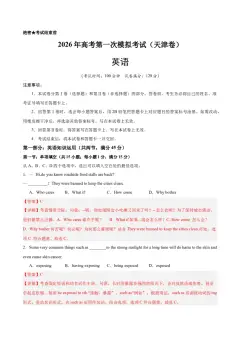
2026 年高考第二次模拟考试(天津卷)
英语
(考试时间:100 分钟  试卷满分:130 分)
注意事项:
1.本试卷分第Ⅰ卷(选择题)和第Ⅱ卷(非选择题)两部分。答卷前,考生务必将自己的姓名、准
考证号填写在答题卡上。
2.回答第Ⅰ卷时,选出每小题答案后,用2B 铅笔把答题卡上对应题目的答案标号涂黑。如需改动,
用橡皮擦干净后,再选涂其他答案标号。写在本试卷上无效。
3.回答第Ⅱ卷时,将答案写在答题卡上。写在本试卷上无效。
4.考试结束后,将本试卷和答题卡一并交回。
第一部分:英语知识运用(共两节,满分45 分)
第一节:单项填空(共15 小题;每小题1 分,满分15 分)
从A、B、C、D 四个选项中,选出可以填入空白处的最佳选项。
1.—I’ve booked two tickets for the concert, but my sister can’t make it. Would you like to join me?
—________. I’ve been longing to see that band live!
A.You bet
B.Not really
C.I’ll pass
D.No problem
2.The historic library, which ________ countless rare manuscripts, was severely damaged in the flood last
month.
A.observes
B.sustains
C.preserves
D.reserves
3.The documentary provides a(n) ________ analysis of climate change, backed by decades of scientific data.
A.superficial
B.comprehensive
C.arbitrary
D.conservative
4.The principal emphasized the importance of ________ cultural differences when organizing international
exchange programs.
A.being respected
B.respected
C.to respect
D.respecting
5.After months of research, the team finally ________ a revolutionary method to recycle plastic waste.
A.put up with
B.came up with
C.kept up with
D.looked forward to
6.________ in the lab until midnight, the researchers finally observed the chemical reaction they had predicted.
A.Having worked
B.Working
C.To work
D.Worked
7.A series of experiments ________ in the coming weeks to test the new vaccine's effectiveness.
A.are conducting
B.conducted
C.will be conducted
D.had conducted
8.What puzzled the archaeologists was ________ the ancient city had been abandoned so abruptly.
A.where
B.how
C.when
D.why
9.The battery life of this smartphone surpasses ________ of its predecessor by nearly 30%.
A.It
B.those
C.that
D.these
10.The businesswoman, ________ innovative business model revolutionized e-commerce, announced her
retirement yesterday.
A.whom
B.whose
C.which
D.who
11.________ his lack of formal training, the self-taught programmer developed an award-winning app.
A.By means of
B.On account of
C.In terms of
D.In spite of
12.________ the government increases funding for renewable energy, the carbon emission goals cannot be
achieved.
A.Even if
B.Whereas
C.Now that
D.Unless
13.The sudden ________ of the CEO left the board of directors scrambling to find a replacement.
A.resignation
B.reputation
C.resolution
D.restriction
14.— The professor’s lecture on AI ethics was way over my head.
— ________. Maybe we can discuss the slides after class.
A.That’s a relief
B.I’m with you there
C.Don’t push it
D.You’re on the right track
15.By the time the rescue team arrived at the earthquake site, over 50 survivors ________ from the rubble.
A.have been pulled
B.were pulled
C.had been pulled
D.would be pulled
第二节:完形填空(共20 小题;每小题1.5 分,满分30 分)
阅读下面短文,掌握其大意,然后从16-35 各题所给的A、B、C、D 四个选项中,选出最佳选项。
I Taught My Student About Scientific Failure
As a Ph.D.student, I went through many     16     cycles developing theories that would later prove
to be failures because of uncertain experimental results. When I graduated, I was not willing to     17     so
many hours away from my young children with so little to show for it.     18     I embraced my love of
teaching by working as a lecturer.
A decade later, with my kids in school, my scientific     19     came out of hibernation (冬眠状态) and
I     20     a position at a liberal arts college (文理学院), where I established my own small lab. In my
undergraduate classes, I asked my students to complete lab experiments that were virtually     21     to get
interpretable data. But after a few years, I grew     22     with the gap between those picture-perfect
experiments and my own research projects. Yes, my students left lab sessions with results, feeling their time had
been     23    . However, I worried I was cheating them out of the actual experience of practicing science,
which     24     produces data on the first try.
I decided to develop a new course that would give our students experience     25     real experiments,
ones that had the     26     to fail. I gave the students a collection of papers to read.
During group brainstorming sessions, they identified new questions that arose from what had already been
done and collectively     27     their own theories. After spending time learning lab methods required to test
their theories, they got to work performing their first experiment.
On the day of data analysis, I handed them 14 Western blot ( 免疫印迹法) printouts and asked them to
28     the images and discuss their findings. Most     29     that their blots were correct — that the
background bands they saw represented the proteins they had hoped to discover—and immediately jumped to
interpreting the data. But I     30     to let them move on.
After hours of struggle, one student finally spoke up. “It doesn’t     31    ,” he said. “The bands look
the same size, but the proteins should be different sizes.” Terrific! This breakthrough helped his classmates start to
look at the results with more     32     eyes. Within minutes, they were filled with ideas about what could
have gone     33    . We spent the next two hours covering the blackboard with plans to study the procedures.
My students were thinking like scientists — a development no amount of advance planning could have created.
Research is messy and full of failed     34    . Trying to protect students from that reality does     35
to them. My students had a hard lesson in scientific failure and how to be resilient in the face of it. It is a lesson I
wish I had learned before starting graduate school.
16.A.frustrating
B.unforgettable
C.demanding
D.checkable
17.A.sacrifice
B.devote
C.invest
D.spare
18.A.Besides
B.Instead
C.Nevertheless
D.Otherwise
19.A.curiosity
B.generosity
C.productivity
D.sensitivity
20.A.secured
B.offered
C.filled
D.occupied
21.A.attracted
B.guaranteed
C.opposed
D.restricted
22.A.unavailable
B.uncomfortable
C.unforgivable
D.unsuitable
23.A.well-spent
B.fast-paced
C.never-ending
D.badly-consuming
24.A.constantly
B.definitely
C.rarely
D.usually
25.A.witnessing
B.recording
C.checking
D.performing
26.A.alternative
B.intention
C.potential
D.right
27.A.looked forward to B.came up with
C.ran out of
D.stayed away from
28.A.look over
B.pick out
C.search for
D.throw away
29.A.doubted
B.denied
C.assumed
D.guessed
30.A.determined
B.expected
C.hesitated
D.refused
31.A.bear risk
B.gain access
C.make sense
D.take effect
32.A.competitive
B.imaginative
C.negative
D.objective
33.A.crazy
B.virtual
C.wild
D.wrong
34.A.attempts
B.desires
C.promises
D.regrets
35.A.benefit
B.favor
C.harm
D.honor
第二部分:阅读理解(共20 小题;每小题2.5 分,满分50 分)
阅读下列短文,从每题所给的A、B、C、D 四个选项中,选出最佳选项。
A
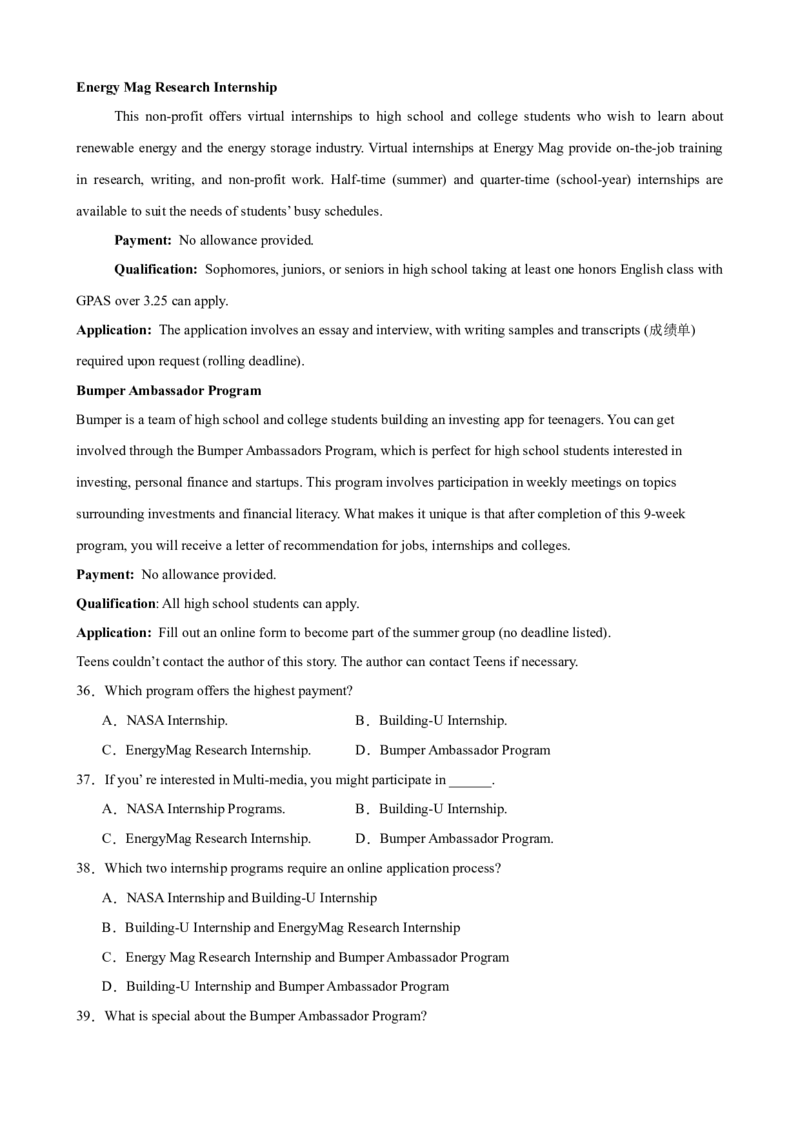
Online internship (实习) opportunities for high school studentsNASA Internship Programs
NASA’s internship programs provide training, mentoring and career development opportunities both remote
and in-person. In addition to their Pathways Internship, NASA lists a range of internships on their “Explore Our
Opportunities” page. For example, the listing “Connecting the Local Urban Fabric to Global Climate Change” is a
virtual internship intended for both high schoolers in grades 10-12 and undergraduates.
Payment: Most interns receive a paid allowance.
Qualification: US citizens grades 10-12 (and ages 16 and up) can apply.
Application: Application materials and deadlines depend on the specific internship.
Building-U Internship
Centered around helping high school students as they move forward into postsecondary experiences,
Building-U offers 3-month internships to high school students year-round. Interns can join various high school
teams, including Resource Development, Multi-media, Marketing, Blog Squad, Coding, Business, Social Media
and more.
Payment: No allowance provided.
Qualification: Currently enrolled high school students can apply.
Application: Send an email with your resume to the organization (rolling deadline).
Energy Mag Research Internship
This non-profit offers virtual internships to high school and college students who wish to learn about
renewable energy and the energy storage industry. Virtual internships at Energy Mag provide on-the-job training
in research, writing, and non-profit work. Half-time (summer) and quarter-time (school-year) internships are
available to suit the needs of students’ busy schedules.
Payment: No allowance provided.
Qualification: Sophomores, juniors, or seniors in high school taking at least one honors English class with
GPAS over 3.25 can apply.
Application: The application involves an essay and interview, with writing samples and transcripts (成绩单)
required upon request (rolling deadline).
Bumper Ambassador Program
Bumper is a team of high school and college students building an investing app for teenagers. You can get
involved through the Bumper Ambassadors Program, which is perfect for high school students interested in
investing, personal finance and startups. This program involves participation in weekly meetings on topics
surrounding investments and financial literacy. What makes it unique is that after completion of this 9-week
program, you will receive a letter of recommendation for jobs, internships and colleges.
Payment: No allowance provided.
Qualification: All high school students can apply.
Application: Fill out an online form to become part of the summer group (no deadline listed).
Teens couldn’t contact the author of this story. The author can contact Teens if necessary.
36.Which program offers the highest payment?
A.NASA Internship.
B.Building-U Internship.
C.EnergyMag Research Internship.
D.Bumper Ambassador Program
37.If you’ re interested in Multi-media, you might participate in ______.
A.NASA Internship Programs.
B.Building-U Internship.
C.EnergyMag Research Internship.
D.Bumper Ambassador Program.
38.Which two internship programs require an online application process?
A.NASA Internship and Building-U Internship
B.Building-U Internship and EnergyMag Research Internship
C.Energy Mag Research Internship and Bumper Ambassador Program
D.Building-U Internship and Bumper Ambassador Program
39.What is special about the Bumper Ambassador Program?
A.It guarantees a paid allowance.
B.It requires investing experience.
C.It offers a recommendation letter.
D.It involves monthly meetings.
40.Where can we probably find this article?
A.In a career guide for high school students.
B.On a university’s official job website.
C.In a magazine focusing on postgraduate studies.
D.On a website about renewable energy internships.
B
In my senior year of high school, while living with my grandparents, I discovered a unique talent: perfect
timing. This discovery of my perfect timing was so astonishing that I kept it to myself, thinking no one would
believe my ability to time my arrival at school with extraordinary precision.
My mother passed away when I was 13, leaving me, the oldest of four, in the care of our grandparents. Our
father was absent, so financial challenges were part of our daily life. This prompted my grandfather to work as the
janitor (门卫) of our school—a large building for grades 1-12. To help out, I started assisting him after school to
ease his burden, such as sweeping rooms and emptying wastebaskets, earning a small wage in the process. I
continued this work until my final year of high school.
By that time, Grandpa was eight years past retirement age. When the first cold snap of that year arrived, he
fired up the school’s furnace (火炉). He quickly realized how difficult it had become for him to shovel the huge
pile of coal chips required to fill the hopper (漏斗) of the furnace’s stoker (司炉).
I volunteered to take on that job, a commitment that required me to set my alarm clock an hour earlier each
morning. I’d fumble into coal-darkened jeans, go over to the school, and shovel a half-ton of coal into the hopper,
enough to keep the fire blazing for 24 hours. The next morning, I’d fill it again.
After finishing that chore, I’d go home, clean up, change clothes, and eat breakfast. I’d pace my
preparations by glancing at the clock in the dining room—it would be years before I’d have a watch. Then I’d
head back to school, always at the last minute. It was during those morning rushes to school that I discovered my
superpower.
What initially seemed like mere coincidence—arriving at the exact moment the first bell rang—quickly
became a deliberate challenge. I meticulously ( 小心翼翼地) planned each morning to maintain this precise
timing, revealing in the master y of my routine.
Years later, at a school reunion, I recounted this story to Harold Spiry, the school headmaster during my
time. I boasted about my perfect timing, recalling with pride how I had mastered my mornings to the second. ‘Oh
that,’ he said, his eyes narrowing as he thought back to that time. ‘Do you recall that my desk and office windows
looked out over the front of the building? I often saw you coming. And when you hit the sidewalk, I’d ring the
bell.’ Oh, my ‘perfect timing’ was actually his doing.
41.What can we infer about the author’s character from his perfect timing?
A.He lacks confidence.
B.He is naturally lucky.
C.He prefers to work alone.
D.He values precision and discipline.
42.Why did the author’s grandfather work as a janitor?
A.He was passionate about cleaning.
B.He found it was the only job available.
C.He needed the job to support the family financially.
D.He wanted to stay close to his grandchildren at school.
43.What motivated the author to take over the task of shoveling coal for the furnace?
A.He wanted to learn a new skill.
B.He needed extra money for personal expenses.
C.He wanted to relieve his grandfather’s workload.
D.He was interested in the mechanical operation of the furnace.
44.What can we learn from Paragraph 4?
A.The author’s devotion to aiding his grandfather with coal shoveling.
B.The author’s daily routine of waking up early to attend school.
C.The author’s development of a new skill in coal shoveling.
D.The author’s realization of the importance of punctuality.
45.What message does the author’s story convey?
A.Our accomplishments are often supported by unseen kindness.
B.Challenges can only be overcome through personal hardships.
C.Personal talents bring pride and joy to an individual’s life.
D.Perseverance leads to the development of unique skills.
C
Life’s journey can often be a lonely one without the comforting presence of companionship. While the
significance of friendship is frequently praised, the true essence ( 本质) of being a genuine friend is often
overlooked. A true friend is like family, and the bond you share is strong enough to stand the test of even long
periods without talking. Then what contributes to true friendship?
Will Smith’s words, “If you’re absent during my struggle, don’t expect to be present during my success,”
capture the essence of real friendship. We all face tough times, feeling depressed or even hopeless at times. A
genuine friend stands by their companion through both the ups and downs of life. While it’s effortless to share
joyous moments, friendship shines through during tough times. True friends do not abandon each other in times of
trouble; instead, they face challenges together, providing mutual support even if it goes against their own interests.
True friends not only stand by you through thick and thin, but also offer constructive criticism when
necessary. Oscar Wilde once said, “The truth is rarely pure and never simple,” highlighting how tough it can be to
tell friends things they might not want to hear. While delivering criticism is never easy, a genuine friend is
unafraid to point out mistakes or misguided paths. Giving constructive criticism, along with helpful advice, is a
key part of true friendship. A true friend will speak up if they see you heading down a harmful path, even if it’s
uncomfortable. The reluctance to speak up against a friend’s bad decision may lead to regret. As Wilde suggests,
truth can be complex, but it’s important to express genuine concern. In a strong friendship, honest and caring
advice weaves a web of trust and mutual growth.
In conclusion, the essence of true friendship lies in the willingness to sacrifice personal comfort for the
benefit of a friend. Genuine friends are not fair-weather companions; they are present through highs and lows,
and provide constructive criticism with care. To have even one true friend is a blessing that should be treasured.
Let us strive to be true friends and, in turn, cherish the true friends we encounter on life’s journey.
46.In Paragraph 1, the author presents ______.
A.the essential nature of true friendship
B.the significance of family bonds over friendship
C.the challenges of maintaining lasting relationships
D.the contribution of personal qualities to true friendship
47.What can be learnt about true friendship from Paragraph 2?
A.It merely exists during moments of success.
B.It relies on criticizing friends during tough times.
C.It prioritizes personal interests over companionship.
D.It involves mutual support during both highs and lows.
48.The author develops his arguments through ______.
A.adopting proper exaggerations
B.employing famous quotes
C.sharing personal experiences
D.providing statistical evidence
49.What does the underlined part “fair-weather companions” in Paragraph 4 mean?
A.Friends who are always reliable and trustworthy.
B.Friends who offer constructive criticism with care.
C.Friends who only support you during good times. D.Friends who show little interest in your success.
50.What can be concluded from the passage?
A.Better an honest enemy than a false friend.
B.Friendship is the only ship that never sinks.
C.Friendship is like money, easier made than kept.
D.Friends catch you when you fall and push you forward.
D
Teenagers are perhaps those who are most susceptible (易受影响的) to peer pressure. In simple terms, peer
pressure is what drives you to do something, whether it is negative or positive, in order to feel liked and respected
by your peers.
We’re constantly warned against peer pressure, given its negative connotation (含义). It’s often the main
cause that makes you give in when someone tries to convince you to skip school with them, or to try and get away
with cheating, stealing, etc.
On the other hand, however, peer pressure has the capacity to have a positive influence over young lives.
We go to volunteering events when our friends do. We study more when we hear that our friends got high marks
on the last exam. We go to the gym because we see our friends getting more fit and want to become more
physically attractive or healthy ourselves.
So how do we cultivate a culture of positive peer pressure? The examples listed above are bonded together
by a pair of common themes: friendly competitiveness and egalitarianism (平等主义).
As children we were motivated by our teachers to obtain as many stars for our good behavior as we could
possibly get. This worked because as humans, we love to have a feeling of accomplishment, especially when
competing against those with relatively equal abilities and capacities. We’re negatively reinforced to work harder
when we’re falling behind because we want to keep up and not get left behind. As long as the competition doesn’t
grow to be too aggressively fierce, and as long as the playing field between competitors is relatively equal, this
kind of competition can promote and improve the frequency of good behavior. Even if we’re not the winner, we
still want to be on the same level as most so as not to feel left out.
In my opinion, one of the most impressive things in my high school was the positive peer pressure we
experienced against drunk driving. People planned out who the designated driver would be before a party and saw
him or her as someone to be respected. Likewise, if someone planned on drinking without having someone that
was sober (清醒的) who could drive them home, the host would sometimes let that person drive to the party and
sleep over with their car parked in the driveway.
Above all else, what most adolescents want, and frankly crave, is acceptance. Since the definition of what
is “cool” and what is not is malleable (有延展性的) and within our control, we can create a culture of positive
peer pressure that promotes values that are in our own best interests, and that starts with how each of us acts
individually.
51.Why is it easy for teenagers to be subject to peer pressure?
A.Because they are more sensitive than adults.
B.Because they are very respectful in this period.
C.Because they are unable to tell right from wrong.
D.Because they are eager to gain peer recognition.
52.What’s the function of paragraph 2?
A.To support the author’s opinion.
B.To give a summary of the passage.
C.To introduce the topic of the argument.
D.To make the author’s argument objective.
53.What leads to positive changes on account of peer pressure?
A.Encouraging teens to compete aggressively with their peers.
B.Motivating teens to study harder when their friends excel academically.
C.Reinforcing negative behavior in order to make teens keep up with peers.
D.Creating a feeling of accomplishment when engaging in risky activities.
54.In the author’s high school, what is an example of positive peer pressure discussed in the passage?
A.Students pressuring others to skip school and engage in risky behaviors.
B.Planning for a designated driver before parties to prevent drunk driving.
C.Allowing students to drive home after drinking without a sober driver.
D.Encouraging competition between friends to see who can drink the most.
55.Which is the best title of the passage?
A.The Comparison between Positive and Negative Peer Pressure
B.The Ways to Resist Negative Peer Pressure
C.The Power of Positive Peer Pressure
D.The Impact of Competitive Peer Pressure
第二部分:写作(共两节,满分35 分)
第一节:阅读表达(共5 小题;每小题2 分,满分10 分)
阅读下面短文,并根据短文内容完成下列各题。
When 16-year-old Colin Moore is out on the football field, he is putting his heart into the game and looks
just like any other teenage athlete out there. But what makes him different than the rest, is that he’s playing
without part of his arm.
Moore was born without the lower part of his right arm, but he’s never let that stop him from achieving
anything he’s put his mind to in his life, including football. “I’ve always had to have a mind of steel, heart of gold,
and just move forward no matter what.” Moore said.
Although his arm difference has never got in the way of anything, it’s been a challenge for him. But in
everything he does, he’s worked twice as hard as everyone else to make sure he would succeed. Moore’s goal is to
be a starting center, which requires a lot of body strength. Even though he is missing an arm, he makes up for it
with his fast movements and strength, making him the perfect choice for this position.
Moore looks up to the Philadelphia Eagles center Jason Kelce, and aims to be just like him one day.
Moore’s hard work even got him noticed by his hero. After seeing a video of Moore playing football, Kelce sent
him one back. Kelce told Moore that his perseverance is a great encouragement to him. He even invited Moore to
join him and the Eagles at their training camp so they could meet him.
Moore’s coach Frank Holmes agrees with Kelce and compliments Moore’s perseverance. “The thing I can
say about Colin is this: he was born with a challenging situation, but every day he has a positive attitude and
focuses fully on whatever he does. He trains hard.”
56.What makes Moore different from other athletes? (no more than 10 words)


57.How did Moore achieve his goal? (no more than 5 words)


58.What did Jason Kelce do after seeing Moore play? (no more than 20 words)


59.What is the meaning of the underlined word in the last paragraph? (1 word)


60.How does Moore’s story inspire you? Please explain. (no more than 20 words)


第二节:书面表达(满分25 分)
61.假设你是晨光中学的李津,你校近期举办了“航天科技主题展”(Aerospace Technology
Exhibition),通过图片和视频等多种方式,展示了中国航天事业的飞速发展和伟大成就。请你以
“Reaching for the Stars”为题,为学校公众号英文栏目写一篇活动报道。
内容提示:
(1)主题展的主要内容(天宫空间站建设、月球探测成果、航天工作者贡献等);
(2)师生们对展览活动的反响;
(3)你参观展览后的感受。
注意:(1)词数不少于100;(2)可适当增加细节,使行文连贯。
参考词汇:月球探测 lunar exploration;自主创新 independent innovation
___________________________________________________________________________________________
___________________________________________________________________________________________
___________________________________________________________________________________________
___________________________________________________________________________________________
___________________________________________________________________________________________