Unit5 Poems
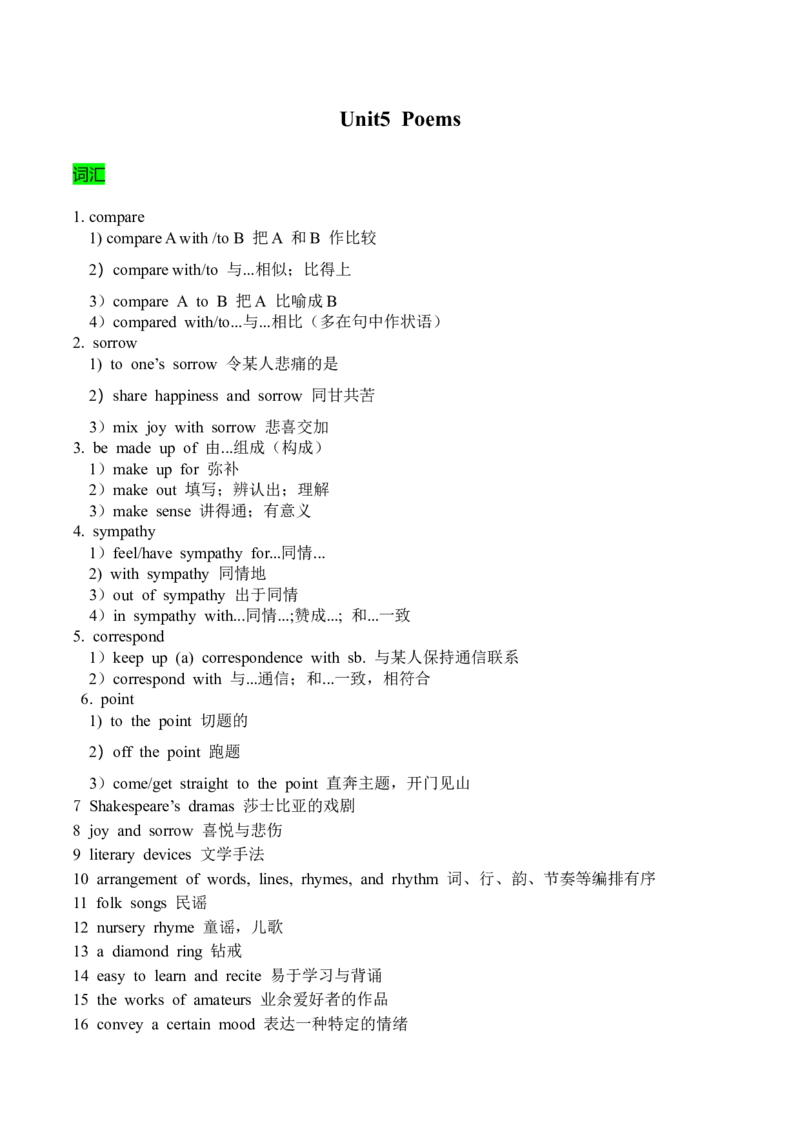
词汇
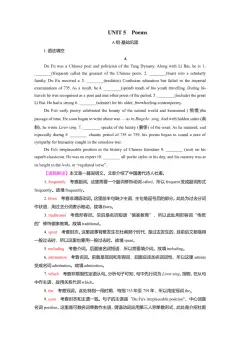
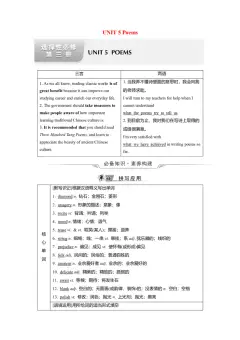
1. compare
1) compare A with /to B 把A 和B 作比较
2)compare with/to 与...相似;比得上
3)compare A to B 把A 比喻成B
4)compared with/to...与...相比(多在句中作状语)
2. sorrow
1) to one’s sorrow 令某人悲痛的是
2)share happiness and sorrow 同甘共苦
3)mix joy with sorrow 悲喜交加
3. be made up of 由...组成(构成)
1)make up for 弥补
2)make out 填写;辨认出;理解
3)make sense 讲得通;有意义
4. sympathy
1)feel/have sympathy for...同情...
2) with sympathy 同情地
3)out of sympathy 出于同情
4)in sympathy with...同情...;赞成...; 和...一致
5. correspond
1)keep up (a) correspondence with sb. 与某人保持通信联系
2)correspond with 与...通信;和...一致,相符合
6. point
1) to the point 切题的
2)off the point 跑题
3)come/get straight to the point 直奔主题,开门见山
7 Shakespeare’s dramas 莎士比亚的戏剧
8 joy and sorrow 喜悦与悲伤
9 literary devices 文学手法
10 arrangement of words, lines, rhymes, and rhythm 词、行、韵、节奏等编排有序
11 folk songs 民谣
12 nursery rhyme 童谣,儿歌
13 a diamond ring 钻戒
14 easy to learn and recite 易于学习与背诵
15 the works of amateurs 业余爱好者的作品
16 convey a certain mood 表达一种特定的情绪17 a format of three lines 三行诗的格式
18 containing 5, 7 and 5 syllables respectively 依次包含5个,7个和5个音节
19 a delicate butterfly 一只精致的蝴蝶
20 poetry comprehension 诗歌理解
21 books on shelves 书架上的书
22 the core of the text 文章的核心
23 blank verse 无韵诗
24 from civilians to kings 从平民到国王
25 The English version of the poem 诗歌的英语版本
26 innocent childhood 天真无邪的童年
27 Victorian era 维多利亚时代
29 sow the seeds of love 播下爱情的种子
30 the deadline for the poetry contest 诗歌竞赛的截止日期
31 polish an article 润色文章
32 the string of kite 风筝之线
33 complicated formats 复杂的格式
34 Langston Hughes’s Dream Variation 兰斯顿休斯的《梦想变奏》
35 racial prejudice 种族偏见
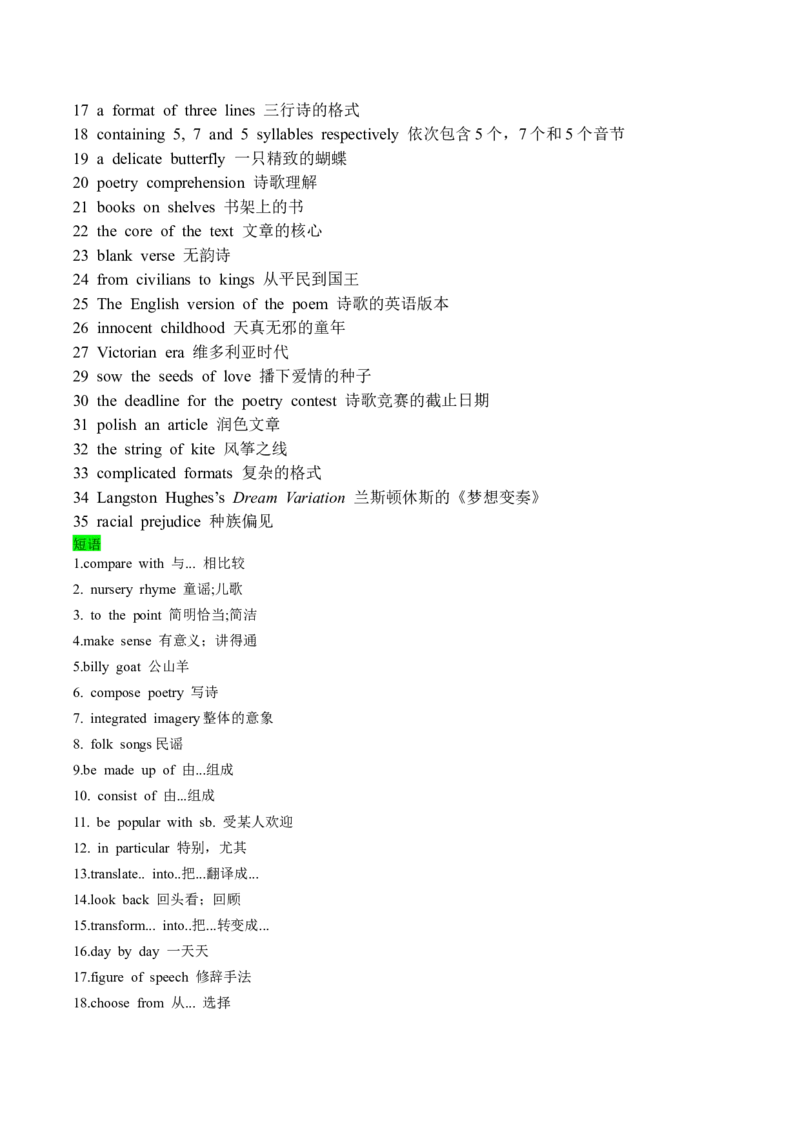
短语
1.compare with 与... 相比较
2. nursery rhyme 童谣;儿歌
3. to the point 简明恰当;简洁
4.make sense 有意义;讲得通
5.billy goat 公山羊
6. compose poetry 写诗
7. integrated imagery整体的意象
8. folk songs民谣
9.be made up of 由...组成
10. consist of 由...组成
11. be popular with sb. 受某人欢迎
12. in particular 特别,尤其
13.translate.. into..把...翻译成...
14.look back 回头看;回顾
15.transform... into..把...转变成...
16.day by day 一天天
17.figure of speech 修辞手法
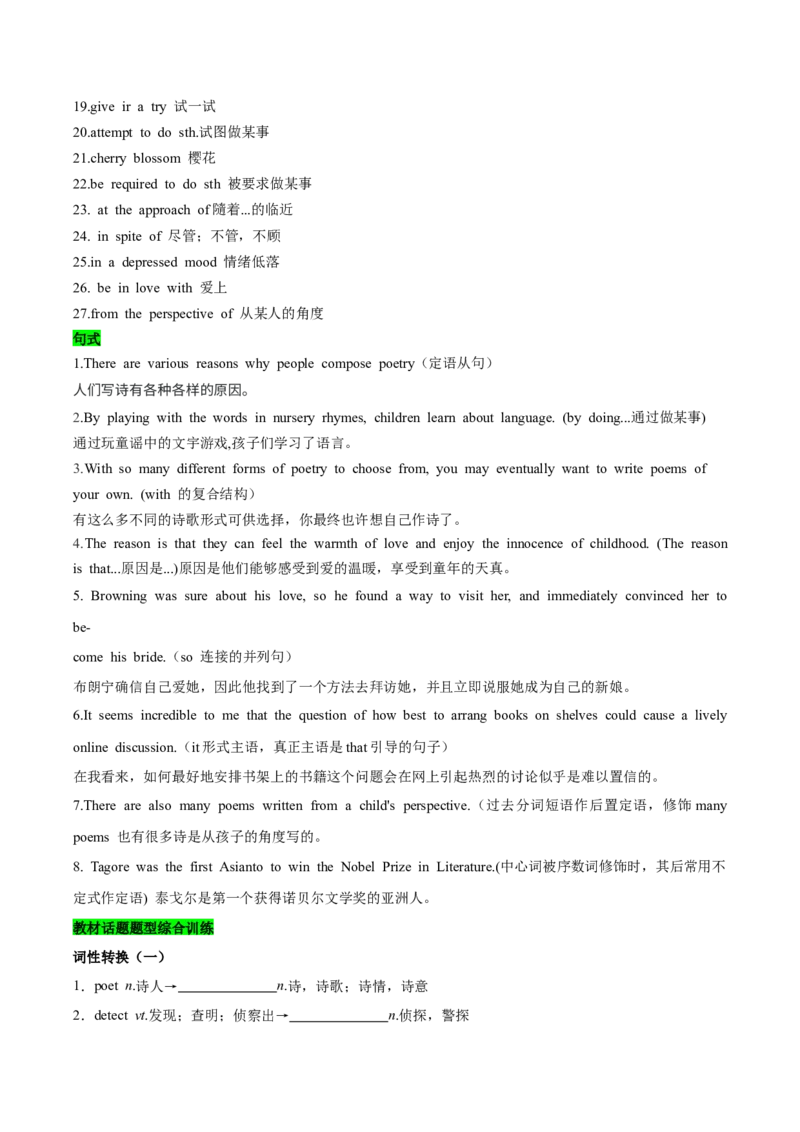
18.choose from 从... 选择19.give ir a try 试一试
20.attempt to do sth.试图做某事
21.cherry blossom 樱花
22.be required to do sth 被要求做某事
23. at the approach of隨着...的临近
24. in spite of 尽管;不管,不顾
25.in a depressed mood 情绪低落
26. be in love with 爱上
27.from the perspective of 从某人的角度
句式
1.There are various reasons why people compose poetry(定语从句)
人们写诗有各种各样的原因。
2.By playing with the words in nursery rhymes, children learn about language. (by doing...通过做某事)
通过玩童谣中的文宇游戏,孩子们学习了语言。
3.With so many different forms of poetry to choose from, you may eventually want to write poems of
your own. (with 的复合结构)
有这么多不同的诗歌形式可供选择,你最终也许想自己作诗了。
4.The reason is that they can feel the warmth of love and enjoy the innocence of childhood. (The reason
is that...原因是...)原因是他们能够感受到爱的温暖,享受到童年的天真。
5. Browning was sure about his love, so he found a way to visit her, and immediately convinced her to
be-
come his bride.(so 连接的并列句)
布朗宁确信自己爱她,因此他找到了一个方法去拜访她,并且立即说服她成为自己的新娘。
6.It seems incredible to me that the question of how best to arrang books on shelves could cause a lively
online discussion.(it形式主语,真正主语是that引导的句子)
在我看来,如何最好地安排书架上的书籍这个问题会在网上引起热烈的讨论似乎是难以置信的。
7.There are also many poems written from a child's perspective.(过去分词短语作后置定语,修饰 many
poems 也有很多诗是从孩子的角度写的。
8. Tagore was the first Asianto to win the Nobel Prize in Literature.(中心词被序数词修饰时,其后常用不
定式作定语) 泰戈尔是第一个获得诺贝尔文学奖的亚洲人。
教材话题题型综合训练
词性转换(一)
1.poet n.诗人→ n.诗,诗歌;诗情,诗意
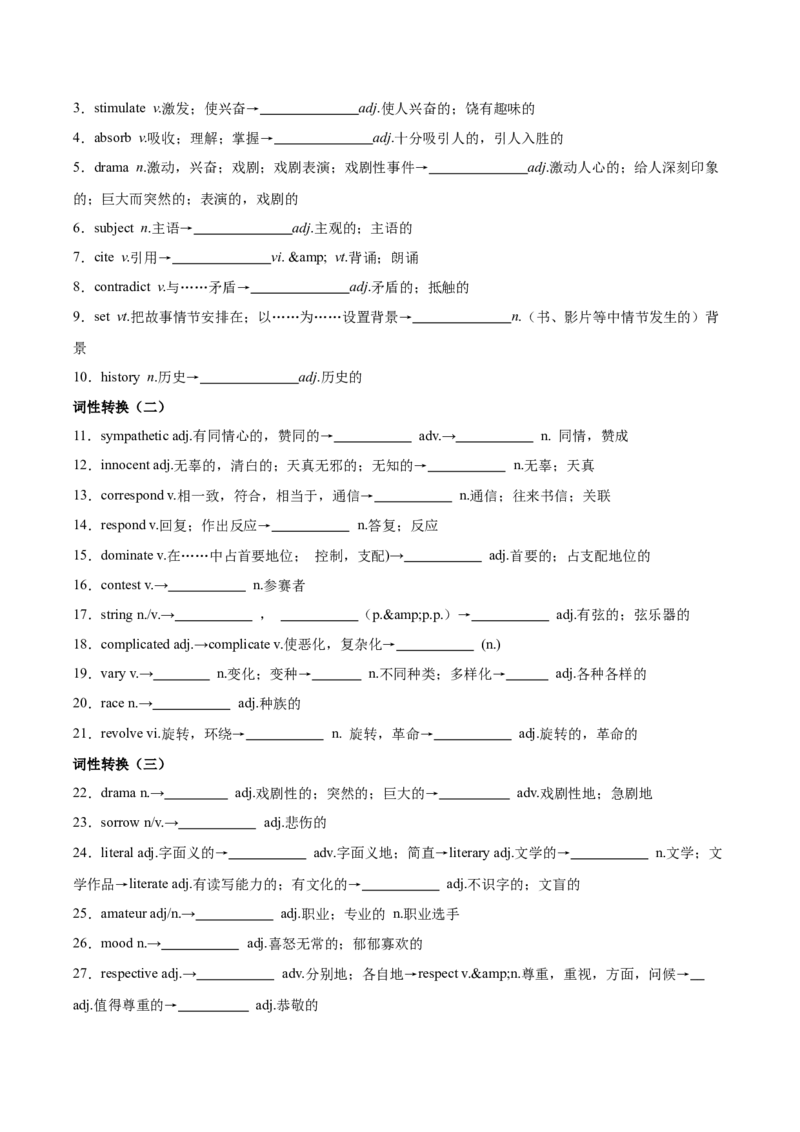
2.detect vt.发现;查明;侦察出→ n.侦探,警探3.stimulate v.激发;使兴奋→ adj.使人兴奋的;饶有趣味的
4.absorb v.吸收;理解;掌握→ adj.十分吸引人的,引人入胜的
5.drama n.激动,兴奋;戏剧;戏剧表演;戏剧性事件→ adj.激动人心的;给人深刻印象
的;巨大而突然的;表演的,戏剧的
6.subject n.主语→ adj.主观的;主语的
7.cite v.引用→ vi. & vt.背诵;朗诵
8.contradict v.与……矛盾→ adj.矛盾的;抵触的
9.set vt.把故事情节安排在;以……为……设置背景→ n.(书、影片等中情节发生的)背
景
10.history n.历史→ adj.历史的
词性转换(二)
11.sympathetic adj.有同情心的,赞同的→ adv.→ n. 同情,赞成
12.innocent adj.无辜的,清白的;天真无邪的;无知的→ n.无辜;天真
13.correspond v.相一致,符合,相当于,通信→ n.通信;往来书信;关联
14.respond v.回复;作出反应→ n.答复;反应
15.dominate v.在……中占首要地位; 控制,支配)→ adj.首要的;占支配地位的
16.contest v.→ n.参赛者
17.string n./v.→ , (p.&p.p.)→ adj.有弦的;弦乐器的
18.complicated adj.→complicate v.使恶化,复杂化→ (n.)
19.vary v.→ n.变化;变种→ n.不同种类;多样化→ adj.各种各样的
20.race n.→ adj.种族的
21.revolve vi.旋转,环绕→ n. 旋转,革命→ adj.旋转的,革命的
词性转换(三)
22.drama n.→ adj.戏剧性的;突然的;巨大的→ adv.戏剧性地;急剧地
23.sorrow n/v.→ adj.悲伤的
24.literal adj.字面义的→ adv.字面义地;简直→literary adj.文学的→ n.文学;文
学作品→literate adj.有读写能力的;有文化的→ adj.不识字的;文盲的
25.amateur adj/n.→ adj.职业;专业的 n.职业选手
26.mood n.→ adj.喜怒无常的;郁郁寡欢的
27.respective adj.→ adv.分别地;各自地→respect v.&n.尊重,重视,方面,问候→
adj.值得尊重的→ adj.恭敬的28.delicate adj.纤细的;精致的→ n.精美雅致;微妙周到;美味
29.comprehend v.→ n.理解→ adj.全面的;详尽的
30.shelf n.→ (pl.) proof→ roof→roofs belief→
31.civil 国民的,民用的adj.→ n.平民→civilized/civilised adj.文明的;有教养的→
n.文明
词性转换(四)
32. adj. 普通的,平常的→ordinarily adv. 普通地,平常地,正常地;一般情况下,通常
33. v. 进餐→diner n. (尤指餐馆的)就餐者(比较: n. 晚餐,晚宴;宴会;正餐)
34. n. 大笔的钱,巨款→ adj. 幸运的;带来幸运的;侥幸的→ adv. 幸运地
→unfortunate adj. 不幸的;倒霉的;令人遗憾的→unfortunately adv. 不幸地
35. v. 通信→correspondence n. 通信;信件
36. v. 任命;委派;安排,确定(时间、地点)→ adj. 约定的,指定的→ n.
任命,委任;职务,职位;约会,预约,约定
37.bitter adj. 苦的;痛苦的;尖刻的;充满仇恨的→ adv. 痛苦地,愤恨地
38. adj. 感到不好意思的,难为情的→unashamed adj. 不害臊的;不感觉难为情的
39. v. 折叠,对折→ v. (卷着的东西)展开,打开 un-不;未;非;反
40. v. 把……安置在(或建造于);找出……的准确位置→ n. 地点,位置
41. vt. 围绕;环绕;包围→surrounding adj. 周围的,附近的→ n. 周围的事物,环境
完成句子
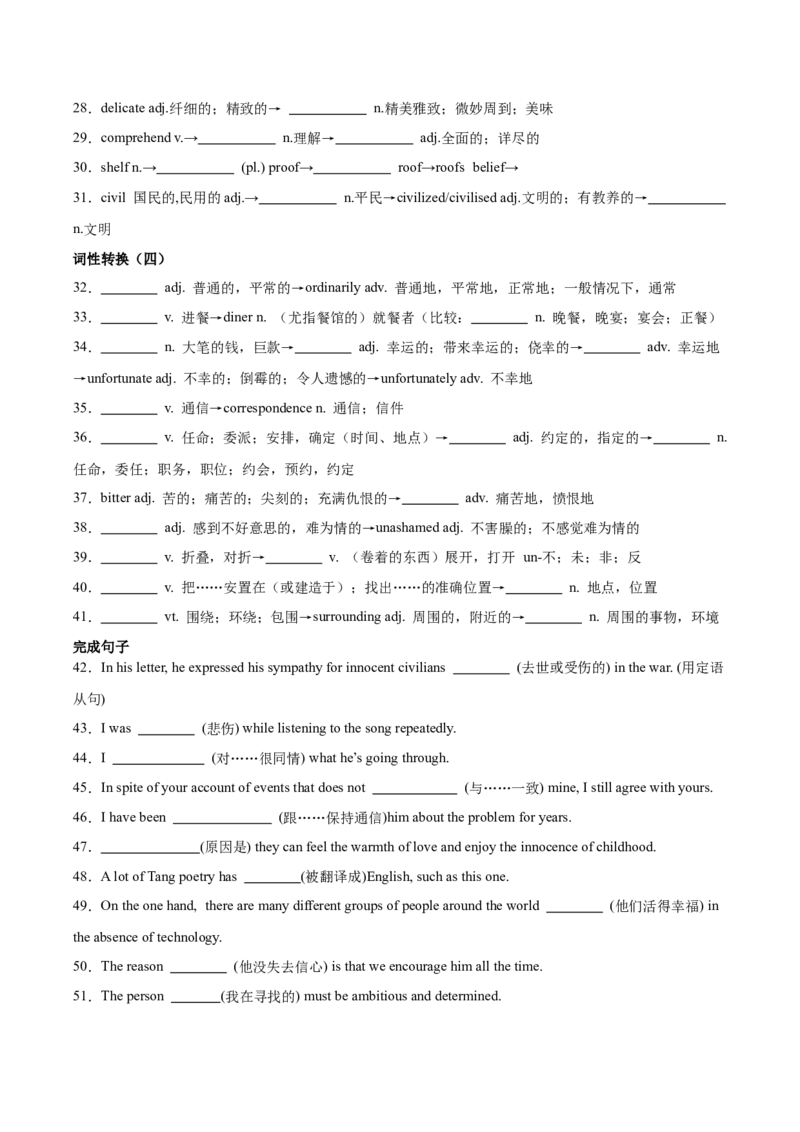
42.In his letter, he expressed his sympathy for innocent civilians (去世或受伤的) in the war. (用定语
从句)
43.I was (悲伤) while listening to the song repeatedly.
44.I (对……很同情) what he’s going through.
45.In spite of your account of events that does not (与……一致) mine, I still agree with yours.
46.I have been (跟……保持通信)him about the problem for years.
47. (原因是) they can feel the warmth of love and enjoy the innocence of childhood.
48.A lot of Tang poetry has (被翻译成)English, such as this one.
49.On the one hand, there are many different groups of people around the world (他们活得幸福) in
the absence of technology.
50.The reason (他没失去信心) is that we encourage him all the time.
51.The person (我在寻找的) must be ambitious and determined.52.He wrote a silly letter, (使得整个局面更复杂).
53.A person’s knowledge structure should (由……组成)many aspects.
54.It’s amazing that these famous poets (对他们的创作有完全的控制力).
55.Generally speaking, poetry has a(n) (规则的格律或节奏).
56.I’m sorry. (诗歌大赛申请的截止日期) is May 27th. You have missed it.
翻译
57.疲惫的一天过后他想要的就是好好休息。
58.这个旅行发烧友如愿以偿在社群中找到了一个很合得来的旅游搭子。(share)
59.我要告诉你我今年夏天参加的一个很有趣的项目。
60.我们选择Windsor的原因是我有一个姑姑住那儿。
61.曾有一段时间英国食品非常单调。
阅读理解
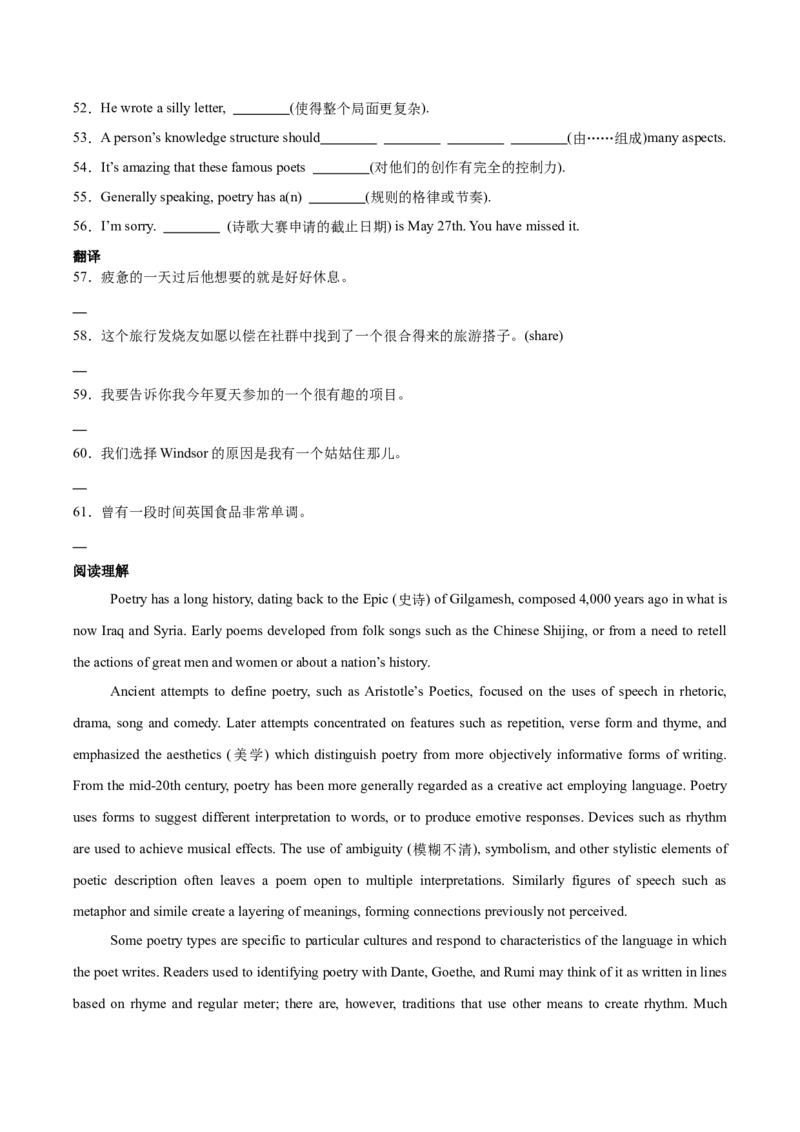
Poetry has a long history, dating back to the Epic (史诗) of Gilgamesh, composed 4,000 years ago in what is
now Iraq and Syria. Early poems developed from folk songs such as the Chinese Shijing, or from a need to retell
the actions of great men and women or about a nation’s history.
Ancient attempts to define poetry, such as Aristotle’s Poetics, focused on the uses of speech in rhetoric,
drama, song and comedy. Later attempts concentrated on features such as repetition, verse form and thyme, and
emphasized the aesthetics (美学) which distinguish poetry from more objectively informative forms of writing.
From the mid-20th century, poetry has been more generally regarded as a creative act employing language. Poetry
uses forms to suggest different interpretation to words, or to produce emotive responses. Devices such as rhythm
are used to achieve musical effects. The use of ambiguity (模糊不清), symbolism, and other stylistic elements of
poetic description often leaves a poem open to multiple interpretations. Similarly figures of speech such as
metaphor and simile create a layering of meanings, forming connections previously not perceived.
Some poetry types are specific to particular cultures and respond to characteristics of the language in which
the poet writes. Readers used to identifying poetry with Dante, Goethe, and Rumi may think of it as written in lines
based on rhyme and regular meter; there are, however, traditions that use other means to create rhythm. Muchmodern poetry reflects a criticism of poetic tradition, playing with and testing the principle of rhyme itself,
sometimes altogether giving up rhyme or set rhythm. In today’s increasingly globalized world, poets often adapt
forms, styles and techniques from diverse cultures and languages.
62.What did early poetry originate from?
A.Folk songs. B.Ethnic music.
C.Ancient stories. D.Historical events.
63.What do we know about poetry according to paragraph 2?
A.Modern poetry study focuses on the uses of speech.
B.Poetry uses rhythm to achieve good visual effects.
C.Poetry has been treated as a creative act for years.
D.Form makes poetry different from other writings.
64.What can be inferred about modern poetry?
A.Poets will strictly follow the principle of rhyme.
B.Poets will adapt more diverse forms and styles.
C.Poets will emphasize local language characteristics.
D.Poets will develop new forms of figures of speech.
65.Where is the text most probably taken from?
A.Science fiction. B.Newspaper.
C.Fashion magazine. D.Encyclopedia.
七选五
When my school offered the opportunity to take part in a School Challenge, I didn’t hesitate to sign up for
the initial meeting. 66 We decided to plan a three-week adventure in Romania.
Of course, it was not a case of simply signing up and paying the money. 67 We arranged a variety of
events for the purpose. We had decided to go to a remote rural village and to work with a team of local people to
improve the school buildings.
We had been warned that our trip would not be a holiday and that things would not always go to plan. We
certainly experienced the difficulties during the trip. 68 This meant that they were too weak to continue
walking and we were not able to travel as far as we had intended. In fact, one of the team quit the journey.
69 I never got tired of watching the sun rise every morning over the pine forests. Feeding the bears in
the sanctuary was also incredible. I would never have imagined that these powerful creatures could be so gentle and
calm. My best memory, though, was working on the school building project. I will never forget the hospitality andkindness of the villagers. They cooked us amazing meals and did everything they could to make us feel comfortable
and welcome.
My School Challenge trip influenced my life in so many ways. It gave me a taste for independence and
adventure, and certainly made me want to travel more. 70 Not having television, internet and hot running
water for three weeks was certainly a challenge, but in many ways enjoyed living a simpler life for a short time.
A.This had to be raised by us to fund the trip.
B.Despite the obstacles, it was a truly amazing trip.
C.Above all though, it has made me realise how easy my life is.
D.It was much more challenging than I thought it would be at times.
E.This was where we met other team members and chose our destination.
F.However, we wouldn’t be spending any time there until the end of the trip.
G.For example, a few people became ill because we were so high up in the mountains.
完形填空
Most schools put great importance on how well students can do in math or science, but life skills or social
skills are rarely prioritized (优先考虑). However, a teacher, Jennifer Thiessen, thinks 71 and makes sure
that her students are well-equipped for life.
“There are so many 72 life lessons I wanted to teach them outside of the 73 “ said
Thiessen, a teacher at Canada’s Watson Primary School. Thiessen and a fellow teacher 74 a plan which
was related to 75 goodwill. They called it the “Kindness Project.”
Thiessen told her third-grade students, “If we could be that spark (火花) of kindness, we could 76
others to do acts of 77 .” And the students did wonders. Students from two different third-grade classes
made cupcakes at home and 78 them for $1 during the bake sales in school. They made about $400 from
it and then 79 the money to buy small gifts like flowers, dog treats, chocolate bars, and coffees. They
then gave them out to 80 near the school.
The students felt like they did something that actually 81 . The teacher said that the gift recipients
seemed “caught off guard” in the beginning. But they 82 the gifts when they 83 what the
project was about, and some were even in tears. “This is a lesson we can’t teach in a classroom,” Thiessen said.
After this experience, Thiessen 84 to make it an annual activity for third-graders-at the school.
“This is an everybody project. It doesn’t have any 85 when it comes to ability,” she said.
71.A.calmly B.carefully C.honestly D.differently
72.A.seeming B.important C.private D.painful73.A.classroom B.family C.industry D.workplace
74.A.signed up for B.came up with C.stepped in with D.gave way to
75.A.demanding B.needing C.spreading D.appreciating
76.A.force B.persuade C.allow D.inspire
77.A.kindness B.forgiveness C.bravery D.honesty
78.A.covered B.wrapped C.sold D.decorated
79.A.used B.withdrew C.borrowed D.earned
80.A.friends B.parents C.strangers D.teachers
81.A.happened B.changed C.existed D.mattered
82.A.recognized B.accepted C.discovered D.deserved
83.A.remembered B.agreed C.examined D.realized
84.A.pretended B.decided C.hesitated D.regretted
85.A.limitations B.questions C.connection D.influence
单句语法填空
86.Seeing those people, the woman turned around to hide her (grieve).
87.All my (correspond)is handled by my assistant.
88.He is (sympathy) by nature and is always ready to help others.
89.It is impossible only to recite English without (comprehend).
90. (sympathy) as she was to those homeless people, she could do nothing but provide them with some
food to relieve their temporary hunger.
91.I have been in (correspond) with him about the problem.
92.I didn't feel at all (sympathy) towards him.
93.I was (sympathy) to Jack because the injury left a scar on his eyebrow.
94.The new policy will help the realization of (race) and economic equality.
95.All those wounded in the explosion were (innocence) victims.
96.The problem is not as (complicate) as he imagined.
97.Browning fell in love with her poetry and then they (enter) into personal correspondence.
98.I think your article needs (polish) before publication.
99.We have entered into an age dreams have the best chance of coming true.
语篇填空
Writing a poem is all about 100 (observe) the world around you. In fact, you can write anything
101 you like. Most people choose love as their topic; some people choose people as their topic; some peopleeven choose the gate of the old farm as their topic.
If you are 102 (interest) in writing poems but don’t know 103 to write, you can read or
listen to poems first. It is almost certain that poets improve their 104 (skill) by reading or listening to good
poems. A poem may be born at any time. That’s what’s usually called 105 (inspire). Once you have the
beginning, you simply need to build the rest of the poem around it.
At other times, you may want to write about a thing 106 an idea. Write down all the words and
phrases that come to your mind when you think of that idea. Allow yourself 107 (put) all your ideas into
words. It may sound difficult, but do not be afraid to express your feelings. Feelings make poems, and if you lie
about your feelings, it can be 108 (easy) known in the poem. Think of the words you use. Some words
109 (fit) together perfectly but some won’t, so choose your words carefully. You should use only those words
that are necessary.
应用文写作
端午节期间,你校为因故无法回家团聚的住校生举办了一次包粽子比赛。请你就此写一篇英语短文向英语
校刊投稿,内容包括:
1.比赛情况介绍;
2.你的感受。
注意:
1.写作词数应为80个左右;
2.请按如下格式在答题卡的相应位置作答。
A rice dumpling wrapping competition
____________________________________________________________________________________________
____________________________________________________________________________________________
____________________________________________________________________________________________
____________________________________________________________________________________________
____________________________________________________________________________________________
_______________