绝密★考试结束前
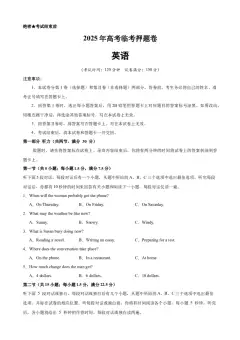
2025 年高考最后一卷
英语
(考试时间:120分钟 试卷满分:150分)
注意事项:
1.本试卷分第Ⅰ卷(选择题)和第Ⅱ卷(非选择题)两部分。答卷前,考生务必将自己的姓名、准
考证号填写在答题卡上。
2.回答第Ⅰ卷时,选出每小题答案后,用2B铅笔把答题卡上对应题目的答案标号涂黑。如需改动,
用橡皮擦干净后,再选涂其他答案标号。写在本试卷上无效。
3.回答第Ⅱ卷时,将答案写在答题卡上。写在本试卷上无效。
4.考试结束后,将本试卷和答题卡一并交回。
第一部分 听力(共两节,满分 30 分)
做题时,请先将答案标在试卷上。录音内容结束后,你将有两分钟的时间将试卷上的答案转涂到答
题卡上。
第一节(共5小题;每小题1.5分,满分7.5分)
听下面5段对话。每段对话后有一个小题,从题中所给的A、B、C三个选项中选出最佳选项。听完每段
对话后,你都有10秒钟的时间来回答有关小题和阅读下一小题。每段对话仅读一遍。
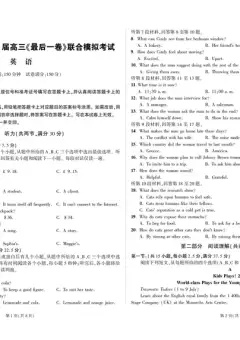
1.When does the man plan to reach the station?
A.At 3:50. B.At 4:00. C.At 4:30.
2.What does the woman advise the man to do?
A.Retake maths. B.Keep his plan. C.Learn history.
3.What are the speakers talking about?
A.The weather report. B.The East Coast. C.The weekend plan.
4.What does the man mean?
A.The movie is popular. B.The woman is forgettable. C.The science fair is due soon.
5.What is the woman doing?
A.Celebrating Jim’s birthday.
B.Making an invitation.
C.Planning a birthday party.第二节(共15小题;每小题1.5分,满分22.5分)
听下面 5 段对话或独白。每段对话或独白后有几个小题,从题中所给的A、B、C三个选项中选出最佳
选项,并标在试卷的相应位置。听每段对话或独白前,你将有时间阅读各个小题,每小题 5 秒钟;听完
后,各小题将给出 5 秒钟的作答时间。每段对话或独白读两遍。
听下面一段较长对话,回答以下小题。
6.Why did Peter leave London?
A.He lost his work. B.He failed to graduate there. C.Living there cost too much.
7.What was the probable relationship between the speakers?
A.Classmates. B.Relatives. C.Colleagues.
听下面一段较长对话,回答以下小题。
8.Where is the man going?
A.To Gary Street. B.To Bridge Street. C.To a gas station.
9.How is the man traveling?
A.On foot. B.By bike. C.In his car.
10.What should the man do next?
A.Drive straight forward. B.Make a U-turn. C.Turn left at the end.
听下面一段较长对话,回答以下小题。
11.How does Charlie feel at first?
A.Nervous. B.Excited. C.Relieved.
12.Why does the woman change the settings of the computer?
A.To ensure safety. B.To hide photos. C.To save information.
13.What does Charlie think is scary?
A.His photos have been uploaded.
B.Some information is hard to delete.
C.Everyone wants to see his information.
14.Where did Charlie write down his password?
A.In the computer. B.On the desk. C.On a notebook.
听下面一段较长对话,回答以下小题。
15.What is wrong with the woman?
A.She hates class. B.She lacks concentration. C.She is too busy.
16.Why does the woman feel worried?A.She often gets lost.
B.She often loses things.
C.She doubts her memory.
17.Where does the conversation probably take place?
A.In the classroom. B.In the yard. C.At the doctor’s.
听下面一段独白,回答以下小题。
18.Who is the most likely to use the new product?
A.A man in his thirties. B.A woman aged forty. C.A girl student.
19.What can we know about this product?
A.It has one size.
B.It is convenient to use.
C.It is available now.
20.What is probably the speaker?
A.A salesman. B.A tourist. C.A hair designer.
第二部分 阅读(共两节,满分50分)
第一节(共15小题;每小题2.5分,满分37.5分)
阅读下列短文,从每题所给的A、B、C、D四个选项中选出最佳选项。
A
Dear Valued Guest,
Warmest greetings.
We are delighted that you have chosen to stay with us and we will make every effort to ensure that it will be a
memorable experience for you.
Housekeeping:
Morning Service 10 a. m. — 2 p. m.
Turndown Service 6 p. m. — 9 p. m.
Your privacy is our highest priority. Please be assured that our staff respects your personal space and will only
enter your room for necessary housekeeping and maintenance services. If you prefer not to be disturbed, kindly
use the “Do Not Disturb” sign provided.
Check-out:
Please note that the hotel’s check-out time is 12 p. m. Should you like to continue exploring the hotel after
check-out, we are happy to offer the hotel’s facilities to you until your departure.· Express Check-out:
Let us know your desired departure time for a smooth check-out process.
· Late Departure Charges:
While we understand the desire to extend your staycation, kindly note that the standard departure time is 12
p. m. In order for the hotel to have sufficient time to prepare the room for another arriving visitor, we please ask
that you pay attention to the departure time as mentioned. Any departure after the standard check-out time will
cause a late departure surcharge as follows:
Departure between 12:30 p. m. and 6 p. m. will cause a half-day rate surcharge, which means being charged
50% of the room rate. Departure after 6 p. m. will cause a full-day rate surcharge.
To discover our dining outlets, to see our in-room dining menu or to view the TV channel list, please scan
the QR code (二维码). For further assistance, please do not hesitate to approach our duty managers or dial
extension “1”.
Thank you and we wish you a pleasant stay!
Best regards,
Rooms Manager
21.Where can the text probably be found?
A.At the airport. B.On an advertisement.
C.In a hotel room. D.In a school dormitory.
22.When can a guest be offered housekeeping service?
A.10 p. m. B.9 a. m. C.5:30 p. m. D.1 p. m.
23.What is the consequence of checking out late?
A.Further assistance cannot be offered. B.Room service is not available next time.
C.An additional fee payment is required. D.Access to the hotel’s facilities is forbidden.
B
In Sichuan Province, long-time resident French artist Vincent Cazeneuve, is integrating traditional Chinese
lacquerware (漆器) skills with techniques taken from Western modern art into his creations.
Born in Toulouse, Vincent has been living in southwest China for more than a decade. With the influence of
French artists Jean Dunand and Gaston Suisse, his journey to unravel the secrets of Chinese lacquerware and his
fascination for lacquer art started. “I studied their artworks and often wondered why they used Chinese lacquer. In
those days, lacquer could not be found in France.” said the artist.
Native to Asia, lacquer trees are planted and tapped for their liquid. It is almost impossible to find lacquertrees in Europe. So, instead of continually transporting lacquer back to France, Vincent chose to send himself to
China.
Having explored his connections with lacquer over the years, the artist also learned a range of techniques,
which he integrated into his own artworks. To dive deep into the art of lacquerware, Vincent traveled to Liangshan
Yi Autonomous Prefecture (自治州) in Sichuan Province, where lacquer craftsmanship is famous. In fact, he
actually met two lacquerware craftsmen, who taught him almost everything they knew.
“I used to know about lacquerware of Yi just by looking at it. But I had never seen the Yi people before. I
have never heard their language. I’ve never seen their villages. It’s only when I came here that I felt the power of
their culture.” said Vincent.
This field trip gave the artist new inspiration for his exhibition. After seeing Vincent’s exhibition, Liu
Guanzhong, a professor at the School of Fine Arts of Tsinghua University said, “What he presents is China in his
eyes. Vincent has explored a path: the ideas of a modern artist, but rooting the ancient skills in modern life. He
finds new soil for an old seed to bloom into a new flower.”
24.What is Vincent devoted to according to the text?
A.Creating western modern art. B.Combining Chinese and Western art.
C.Making Chinese lacquerware. D.Introducing Chinese lacquerware to France.
25.What does the underlined word “unravel” mean in paragraph 2?
A.Discover. B.Hide C.Keep D.Handle.
26.Why did Vincent travel to Liangshan Yi Autonomous Prefecture?
A.To become a famous craftsman. B.To explore the history of Yi people.
C.To make friends with the craftsmen. D.To understand more about lacquer techniques.
27.What would Liu Guanzhong agree with about the exhibition?
A.It was idealized. B.It featured modern art.
C.It was innovative. D.It explored the root of art.
C
On a recent afternoon in northern Albania, workers gathered armfuls of freshly-cut plants covered in yellow
flowers, leaving them to dry in the sun. This was no ordinary harvest, however. The farm is both a mine, growing
plants that store nickel (镍) in their leaves and stems, and a carbon sink, its soil spread with crushed rocks that
remove carbon dioxide (CO ) from the atmosphere.
2
The idea of mining with plants isn’t new. But Metalplant is combining this “phytomining (植物采矿)” with
a method of removing CO from the atmosphere, called enhanced rock weathering, which involves spreading rock
2dust on fields. This dust can both catch CO and increase the nickel picked up by the plants.
2
Demand for nickel to make electric vehicle (EV) batteries is forecast to double to more than 6 million
tonnes (吨) per year by 2040. Yet mining and refining it is environmentally destructive and, depending on where
and how it is produced, mining a tonne of nickel generates between 10 and 59 tonnes of CO . Phytomining for
2
nickel avoids these problems.
However, phytomining only works where there is a lot of the metal in the soil. Albania is attracting interest
due to the high nickel content of its soils: the rocks that compose its mountains are made up of a mineral called
olivine (橄榄石), which contains too little nickel for conventional mining, but enough to build up in certain plants.
In June, Metalplant workers harvested 3 hectares of O. decipiens (a kind of plant), and this area was then
spread with a few dozen tonnes of olivine dust. “Yet the amount of nickel that could feasibly ( 可行地) be
produced is too small to compete with conventional mining,” says Marie Odile Simonot at the University of
Lorraine in France. “Any environmental benefit also depends on the way it is done. Expanding phytomining farms
on ecologically sensitive land could have the same environmental impacts as any other form of agriculture, for
instance. Metalplant’s approach — using olivine dust from a nearby mine — won’t completely replace
conventional mining.”
28.What is special about the farm in northern Albania?
A.It combines mining with CO removal.
2
B.It grows flowers that are particularly bright.
C.It produces the highest quality nickel in the world.
D.It harvests plants that absorb large amounts of CO .
2
29.What role does rock dust play in Metalplant’s approach?
A.Improving soil quality.
B.Providing nutrients for the plants.
C.Promoting the plants’ nickel intake.
D.Serving as a protective cover for the soil.
30.What does paragraph 3 mainly want to tell us?
A.The great need for nickel.
B.The main reasons for phytomining.
C.The practical application of phytomining.
D.The disadvantages of conventional mining.
31.What’s Marie’s attitude towards phytomining?A.Uncaring. B.Favorable.
C.Tolerant. D.Doubtful.
D
The early 19th century French writer Jean-Anthelme Brillat-Savarin, famous for his observations about the
pleasures of food and eating, beautifully summarized the positive power of eating outdoors.
He called outdoor dining, “perfect freedom,” in which “the universe is diners’ drawing room and the sun
their lamp.” He continues, noting that eating outdoors, people “have appetite, nature’s special gift, which lends to
such a meal the liveliness unknown indoors, however beautiful the indoor surroundings.”
Research supports Brillat-Savarin’s poetic insights with suggestions that eating outdoors can offer benefit
of stress reduction. This stands to reason, given that studies have shown that as little of 20minutes outdoors-with
or without food and drink-can lower the stress hormone cortisol (激素皮质醇).
In a food context, this lower stress level helps us pay attention to what we’re eating. We enjoy and taste
food in a more focused way than when we’re inside. Eating with attention, the wellness writer Mitra Malek notes,
increases both concentrationand joy: “Being mentally present when we eat...helps us better notice how pleasurable
food is.” If you’ve ever thought that even a simple sandwich tastes better at the beach, you naturally understand
the connection between fresh, open air and the mental space to enjoy every bite.
Research also shows that eating outdoors can heighten immunity (免疫力). Our immune systems are better
equipped to resist the attack of diseases when we spend time in nature. One Japanese study linked time in the
woods increased immune-boosting cells called NK cells, with the benefit lasting up to seven days after the natural
experience.
As you taste a crisp salad,a dish of ice cream or a meal fresh off the grill (烤架), take the time to
congratulate yourself for choosing to eat in Brillat-Savarin’s universal outdoor drawing room, investing in your
health and welness-and just enjoying the beautiful world in which you live.
32.What does Brillat-Savarin mean by saying outdoor dining provide “perfect freedom”?
A.Human can feel close to nature. B.People can get more diet freedom.
C.Life is independent of the environment. D.Beautiful surroundings matters.
33.Why do researchers highly recommend eating outdoors?
A.It can increase the stress hormone cortisol.
B.It can ease pressure and boost immunity.
C.It can raise our environmental awareness.
D.It can help people spend more time in nature.34.How does a lower stress level help us when eating outdoors?
A.It makes us eat faster and save time.
B.It makes us more focused on the food.
C.It makes us enjoy the surroundings more.
D.It exercises our immune system’s strength.
35.What does the author encourage readers to do when eating outdoors?
A.Care about the weather. B.Rush through their meals.
C.Appreciate the experience. D.Eat salads and ice cream.
第二节(共5小题;每小题2.5分,满分12.5分)
阅读下面短文,从短文后的选项中选出可以填入空白处的最佳选项。选项中有两项为多余选项。
With planes, cars, buses, cruises, and all sorts of new technologies out there, you might wonder: Why do
people still travel by train? 36 Whether you’re rolling through the hills of Scotland, or traveling
domestically on our Canadian Rockies tour, the benefits will become clearer than the rivers and lakes you’ll pass
by along the way.
It’s easy.
The number one reason to why you should travel by train is because there’s a lot less trouble. No need to
arrive hours in advance, no lengthy check-in process, and no need to worry about the amount of liquids in your
bag. 37 You can even bring your own food and drinks on board in most countries-especially in Europe
on trips like Dublin, Edinburgh & London.
38
If you’re on a train, it’s easy to get up and stretch your legs. You can walk to the buffet car or go to toilet at
any time. Nearly every train you’ll come aboard - whether in Switzerland, Spain, or the French Riviera-has
spacious seats, temperature - controlled cabins (客舱), and sizable spots for luggage. Some trains even offer
snacks, charging facilities and WiFi.
You get to enjoy the scenery.
One of the greatest advantages of traveling by train is sightseeing between destinations. Instead of long
roads, you’ll see deep forests, untouched lakes, mountains, and remote villages. 39 It can give you the
most authentic views around.
It’s better for the planet.
One of the top advantages of train travel is that it’s the most eco-friendly way to travel, apart from walking
or bicycling. Rail trips send out 75% less greenhouse gas than cars. In some countries, trains account for less than3% of all transport gas emissions. 40
A.It’s comfortable.
B.It’s a historic mode of travel.
C.Simply walk on the train, and you’re set.
D.Just hop on board any of our train tours and find out!
E.The use of high-tech products during travel is increasing.
F.Trains also explore parts of the country that don’t even have roads.
G.There’s nothing like seeing the world while also helping to preserve it.
第三部分 语言运用(共两节,满分30分)
第一节 (共15小题;每小题1分,满分15分)
阅读下面短文,从每题所给的A、B、C、D四个选项中选出可以填入空白处的最佳选项。
A school flag football team needed a center. They let me try out for the 41 . I was excited and 42
— excited at the thought of doing something unusual, but afraid that as a 39 woman, I was too old to 43
athletic twenty-year-olds. My husband thought I was 44 , but it was a now-or-never moment to me.
I 45 nervously for the tryout. 46 , no other candidates came, so it was mine.
It turned out to be a journey of 47 . I went through tough times. Hiking the ball was the most 48
part. This part quickly became a muscle memory movement through 49 , though, and wasn’t problematic
again. Also, I got tired very easily but, similarly, I 50 it by running as much as possible. We only 51
once the entire season and ended up winning the championship. Then, one day, I suddenly realized I could do
anything I put my mind to. I found the 52 placed within myself.
Yes, it was a learning experience of a lifetime. I learned so much from it. 53 , taking chances can
open doors to opportunities you never thought 54 —one of the most important lessons. And, being open
to doing the 55 and ridiculous is incredibly exciting!
41.A.position B.game show C.status D.holiday job
42.A.lucky B.scared C.curious D.enthusiastic
43.A.break away from B.take place of C.keep track of D.keep up with
44.A.crazy B.sensible C.courageous D.confused
45.A.stepped back B.showed up C.gave in D.turned back
46.A.Obviously B.Unhappily C.Surprisingly D.Pitifully
47.A.cooperation B.self-discovery C.harmony D.character-building
48.A.challenging B.effortless C.interesting D.violent49.A.education B.reflection C.practice D.entertainment
50.A.tolerated B.accepted C.confirmed D.overcame
51.A.lost B.performed C.hesitated D.argued
52.A.regret B.power C.friendliness D.struggle
53.A.As usual B.In contrast C.For example D.In addition
54.A.necessary B.possible C.different D.unique
55.A.ordinary B.well-known C.illegal D.far-out
第二节(共10小题;每小题1. 5分, 满分15分)
阅读下面材料,在空白处填入适当的内容(1个单词)或所给单词的正确形式。
The lantern fair in Zigong, Southwest China’s Sichuan province, boasts (拥有) a history of more than 1,
000 years. To mark the Year of the Dragon, many of the lanterns at the show feature the Chinese sign of the zodiac
(生肖), but there are also 56 wide variety of other lantern designs to meet different needs. Visitors
57 prefer traditional lanterns can find lanterns with flowers and birds, and legendary figures, while lanterns
with modern patterns such as cultural trends and online games are gaining 58 (popular) among young
people.
So far, modern technologies such as 3D printing and artificial intelligence 59 (use)to make the
lanterns nicer and more vivid. The lantern show is also accepting the concept of 60 (environment)
protection. A set of lanterns 61 (recreate) the famous Chinese statue “Bronze Galloping Horse Treading
on a Flying Swallow” from the Eastern Han Dynasty (25-220 AD) was created by using 21 different kinds of
waste materials, including 62 (tire), and plastics to form its outside decorations.
This year’s show will run until July 30. The sets of lanterns will be updated 63 (keep)up with the
coming two traditional Chinese festivals-the Qingming Festival 64 the Dragon Boat Festival. Visitors
can also enjoy folk arts, and Chinese music performances during 65 (they)lantern-viewing tours.
第四部分 写作(共两节, 满分40分)
第一节(满分15分)
66.假定你是李华,上周五你们班上了一节京剧课。请给你的英国朋友 Chris写一封邮件分享这次经历,
内容包括:
1. 上课情况;
2. 你的感受。
注意:1. 写作词数应为80个左右;2. 请按如下格式在答题卡的相应位置作答。
Dear Chris,
___________________________________________________________________________________________
___________________________________________________________________________________________
___________________________________________________________________________________________
___________________________________________________________________________________________
___________________________________________________________________________________________
_____
Yours,
Li Hua
第二节(满分25分)
67.阅读下面材料,根据其内容和所给段落开头语续写两段,使之构成一篇完整的短文。
It’s been many years since I stood at the end of Pusheck Road in Bellwood, waiting for the school bus. Yet,
I remember one particular day from my childhood so vividly as if it were yesterday.
It was a sunlit morning in the spring of 1963, and I was a second - grader at St. Simeon’s Elementary
School. Every morning, my mom would pack up a bagged lunch for me, usually a peanut butter and jelly
sandwich with an apple for dessert. I loved those lunches; they were a simple pleasure, a little piece of home to
carry with me throughout the school day.
That particular morning, the sky was clear and blue. As I reached the corner of Pusheck Road, I carefully
placed my lunch on the sidewalk in order to shift my school books to a more comfortable position in my arms.
(These were pre - backpack times!)
The familiar yellow bus rolled up. Distracted(分心) by the excitement of the school day ahead, I got on
the bus without a second thought about my lunch bag left behind. The bus driver, a middle - aged man with a
friendly face, greeted me with his usual nod. Then I settled - into my seat, my mind already wandering to the day’s
activities.
It was only when the bus had left the stop and was halfway to school that I began to feel discomfort in my
stomach. Then I realized that I had left my lunch on the sidewalk. Panic set in. My eyes filled with tears as I
thought of missing out on my peanut butter and jelly sandwich and the apple that my mother had carefully
selected.As we pulled into the school parking lot, I could no longer hold back my tears. The bus driver, noticing my
distress(悲伤), pulled over slightly and asked gently, “What’s wrong?” I choked out the story between sobs
(啜泣), explaining how I had left my lunch behind and how I was facing a long, hungry day.Paragraph 1:
He listened carefully and then said, “Don’t worry too much.”
___________________________________________________________________________________________
___________________________________________________________________________________________
___________________________________________________________________________________________
___________________________________________________________________________________________
________________________________________________________________________________________
Paragraph 2:
At noon, our teacher, with a curious expression, approached me with a bag.
___________________________________________________________________________________________
___________________________________________________________________________________________
___________________________________________________________________________________________
___________________________________________________________________________________________
________________________________________________________________________________________参考答案
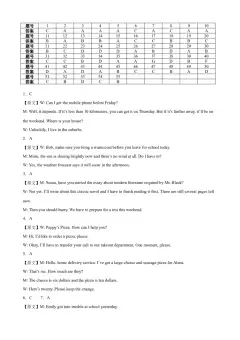
题号 1 2 3 4 5 6 7 8 9 10
答案 A C A C B C A B C B
题号 11 12 13 14 15 16 17 18 19 20
答案 A A B C B C B A B A
题号 21 22 23 24 25 26 27 28 29 30
答案 C D C B A D C A C B
题号 31 32 33 34 35 36 37 38 39 40
答案 D A B B C D C A F G
题号 41 42 43 44 45 46 47 48 49 50
答案 A B D A B C B A C D
题号 51 52 53 54 55
答案 A B C B D
1.A
【原文】W: When will you leave for the station?
M: The train leaves at 4:30. I plan to arrive there forty minutes before it leaves. So, I’ll have
enough time to have my ticket checked.
2.C
【原文】M: I didn’t get the grades I need in maths or science. I’m not sure whether to retake
them or change my plan.
W: Maybe you should major in history instead of science. I heard you got an A in it.
3.A
【原文】W: John, what does the forecast look like in the weekend? Will it snow?
M: No, but I’m afraid we won’t have a sunny weekend. There is a storm moving through the East
Coast.
4.C
【原文】W: Can I see the movie on Thursday? It’s very popular.
M: Yes, it’s really interesting. But you’d better forget that idea. The science fair at school is on
Friday, right? You must finish your project then.
5.B
【原文】W: Tom, it’s Jim’s birthday next week and we’re going to have a surprise celebration
this weekend. Do you want to come with us?
M: Yeah, that would be great.
6.C 7.A
【原文】W: Peter? Is that you? I thought you’d moved to London.
M: I was in London for a couple of years. But it didn’t work out. London is great but it’s soexpensive. I mean, just the rent on a flat is ... uh... crazy expensive. So, I came back. What about
you?
W: Me? I never left here since we graduated. I’m married now. My husband and I have just
celebrated our tenth anniversary.
M: I’m happy for you.
8.B 9.C 10.B
【原文】M: Excuse me, I’m lost. Could you point me in the direction of Bridge Street, please?
W: Sure, it’s not too far from here. In fact, it’s just around the corner.
M: You’re a lifesaver. I’ve been driving in circles for ages.
W: You should have made a left-hand turn a few streets back. Do a U-turn now and take the third
street on the right. It’s called Gary Street. There’s a gas station on the corner. Make your way
along Gary Street to the end. It ends at Bridge Street.
M: Thanks a lot.
W: Glad to help.
11.A 12.A 13.B 14.C
【原文】M: Mom! That’s my computer!
W: I know, Charlie. Don’t worry, I’m changing your privacy settings.
M: Privacy settings? What are the privacy settings for?
W: To make you safe online. You want to be safe, don’t you? And for the right people to see your
information, not everyone.
M: Everyone?
W: Yes. If you don’t change your privacy settings, when you upload a photo, anyone can see it.
It’s important to change them so that only your friends can see them.
M: But I can delete things, can’t I?
W: Well, you can, but it’s very difficult. Some things stay there forever.
M: That’s really scary, Mom.
W: Don’t worry, but you must learn how to stay safe. You mustn’t tell anyone your password!
M: I won’t!
W: Is this your password Crazy Charlie one two one? It’s on your notebook. Right beside your
computer on your desk. It isn’t a very secret place, is it?
M: No, it isn’t. I should put it in the drawer.15.B 16.C 17.B
【原文】M: Hi, how are you? I haven’t seen you in class for a while.
W: I’m struggling a bit. I’ve not been sleeping well and I can’t concentrate. And all these things
are just going around and around in my head.
M: Mmm... that doesn’t sound good.
W: What’s worse, I’m afraid of going outside. I find myself worrying about stupid things like what
if I forget the way home. Or, what if I go to class thinking it’s Monday but actually it’s Friday. It
sounds even more stupid when I say it out loud.
M: It doesn’t sound stupid at all. It actually sounds a lot like me last year. I used to have panic
attacks. And you’d be surprised how common they are. Our professor once told me that lots of
people have them; they just don’t talk about it.
W: How did you get over them?
M: I actually talked to a doctor about it, and I think you should too. But I’ve learned some
practical things. We’ll talk about it later in the classroom, OK? It’s a little cold here in the yard.
W: OK.
18.A 19.B 20.A
【原文】Hi, everyone. Thanks for coming to this short presentation on our new product design.
As you know, we’ve already redeveloped our “Adventure” hair-care product to make it more
modern and appealing. And we’ve renamed it “Adventure Tech”. The target market is men in the
18 to 40 age range who like to be outdoors. I’d like to talk to you through the following points.
Firstly, let’s look at the design. It can fit smoothly in your hand and can be easily opened using
one hand. Then I’d like to tell you about the sizes. It comes in two sizes: the regular size and a
small travel size. We were thinking of starting with a small one and following with the travel-size
in a few months, but we’ve worked hard and both are ready now. Finally, I’m going to talk to you
about our timeline for production. You’ve probably heard that we’re going to be on the market in
two months. In preparation for that, we’re starting the marketing campaign next month. OK. So,
any questions? Feel free to email me for further information.
21.C 22.D 23.C
【导语】这是一篇应用文。文章主要介绍了旅馆的入住事宜。
21.推理判断题。根据Housekeeping部分中“Please be assured that our staff respects your
personal space and will only enter your room for necessary housekeeping and maintenanceservices. If you prefer not to be disturbed, kindly use the “Do Not Disturb” sign provided.(请放心,
我们的工作人员尊重您的私人空间,只会进入您的房间进行必要的清洁和维护服务。如果
您不希望被打扰,请使用提供的“请勿打扰”标志)”以及文章主要介绍了旅馆的入住事宜。
可知,文章可能出现在旅馆房间里。故选C。
22.细节理解题。根据Housekeeping部分中“Morning Service 10 a. m. — 2 p. m.;
Turndown Service 6 p. m. — 9 p. m.(早班服务:上午10点至下午2点;晚班服务:下午6点
到晚上9点)”可知,下午1点可以为客人提供客房服务。故选D。
23.细节理解题。根据Check-out部分中“Departure between 12:30 p. m. and 6 p. m. will
cause a half-day rate surcharge, which means being charged 50% of the room rate. Departure after
6 p. m. will cause a full-day rate surcharge.(中午12:30到下午6点之间离开的客人将收取半天
的房价附加费,也就是说要收取房费的50%。下午6点以后出发将收取全天附加费)”可知,
退房晚了需要支付额外费用。故选C。
24.B 25.A 26.D 27.C
【导语】这是一篇记叙文。主要讲述了一位出生于图卢兹的艺术家文森特,他一直在探索
中国漆器的秘密,并把中国漆器艺术融入到自己的作品中。
24.细节理解题。根据第一段“In Sichuan Province, long-time resident French artist Vincent
Cazeneuve, is integrating traditional Chinese lacquerware (漆器) skills with techniques taken from
Western modern art into his creations. (在四川省,长期居住在这里的法国艺术家文森特·卡泽
纳夫(Vincent Cazeneuve)正在将中国传统漆器技艺与西方现代艺术的技巧融合到他的创
作中。)”可知,文森特致力于中西艺术的结合。故选B项。
25.词句猜测题。根据划线单词句中“his journey to…the secrets of Chinese lacquerware and
his fascination for lacquer art started. (他开始了……中国漆器秘密的旅程,并开始了对漆器艺
术的迷恋。)”以及下文““I studied their artworks and often wondered why they used Chinese
lacquer. In those days, lacquer could not be found in France.” said the artist. (“我研究了他们的作
品,经常想知道他们为什么要用中国漆。那时候,法国找不到漆。”画家说。)”由此可知,
此处为他开始了揭示中国漆器秘密的旅程。故可猜测划线单词unravel为“揭示,发现”的
意思,和A选项Discover“发现”意思相近。故选A项。
26.细节理解题。根据第四段中“To dive deep into the art of lacquerware, Vincent traveled to
Liangshan Yi Autonomous Prefecture (自治州) in Sichuan Province, where lacquer craftsmanship
is famous. (为了深入了解漆器艺术,文森特来到了漆器工艺闻名的四川省凉山彝族自治州。)”可知,文森特去凉山彝族自治州是为了了解更多的漆器艺术。故选D项。
27.推理判断题。根据最后一段中““What he presents is China in his eyes. Vincent has
explored a path: the ideas of a modern artist, but rooting the ancient skills in modern life. He finds
new soil for an old seed to bloom into a new flower.” (“他呈现的是他眼中的中国。文森特探索
了一条道路:现代艺术家的思想,但扎根于现代生活的古老技能。他为一颗老种子找到了
新的土壤,让它绽放出新的花朵。”)”可推知,刘冠中认为这次展览会是创新的。故选C
项。
28.A 29.C 30.B 31.D
【导语】本文是一篇说明文。文章主要介绍了Metalplant公司的增强岩石风化方法,该方
法涉及在田地上散布岩尘。这些岩尘既可以捕获二氧化碳,又可以促进植物吸收镍。
28.细节理解题。根据第一段的“The farm is both a mine, growing plants that store nickel
(镍) in their leaves and stems, and a carbon sink, its soil spread with crushed rocks that remove
carbon dioxide (CO2) from the atmosphere.(这个农场既是一个矿山,种植的植物在叶子和茎
中储存镍,也是一个碳汇,它的土壤覆盖着碎石,可以从大气中去除二氧化碳)”可知,该
农场既是一个矿场(种植可以吸收镍的植物),又是一个二氧化碳沉淀池(洒满粉碎岩石的土
壤可以去除空气中的二氧化碳),即这个农场的特殊之处在于它将采矿和去除二氧化碳结合
在一起。故选A。
29.细节理解题。根据第二段的“This dust can both catch CO2 and increase the nickel picked
up by the plants.(这些灰尘既能吸收二氧化碳,又能增加植物吸收的镍)”可知,岩尘的作用
是促进植物吸收镍。故选C。
30.主旨大意题。根据第三段“Demand for nickel to make electric vehicle (EV) batteries is
forecast to double to more than 6 million tonnes (吨) per year by 2040. Yet mining and refining it
is environmentally destructive and, depending on where and how it is produced, mining a tonne of
nickel generates between 10 and 59 tonnes of CO2. Phytomining for nickel avoids these problems.
(预计到2040年,用于制造电动汽车电池的镍需求量将翻一番,达到每年600多万吨。然
而,开采和提炼镍对环境是有害的,而且根据镍的产地和生产方式的不同,开采一吨镍会
产生10至59吨的二氧化碳。植物镍的开采避免了这些问题)”可知,本段主要介绍了植物
采矿的原因:镍的需求量大,现行的开采方式存在的缺点。最后一句总结本段内容,植物
采矿可以避免这些问题。由此推断,本段主要介绍采用植物采矿的原因。故选B。
31.推理判断题。根据最后一段中Marie说的话““Yet the amount of nickel that couldfeasibly (可行地) be produced is too small to compete with conventional mining,” says Marie
Odile Simonot at the University of Lorraine in France. “Any environmental benefit also depends
on the way it is done. Expanding phytomining farms on ecologically sensitive land could have the
same environmental impacts as any other form of agriculture, for instance. Metalplant’s approach
— using olivine dust from a nearby mine — won’t completely replace conventional mining.”(法
国洛林大学的玛丽·奥迪尔·西莫诺说:“然而,可行的镍产量太少,无法与传统采矿竞
争。”“任何环境效益也取决于做这件事的方式。例如,在生态敏感的土地上扩大植物采
矿农场可能会产生与任何其他形式的农业相同的环境影响。Metalplant的方法——使用附近
矿山的橄榄石粉尘——不会完全取代传统采矿。”)”可推断,Marie对植物采矿持怀疑态度。
故选D。
32.A 33.B 34.B 35.C
【导语】本文是一篇说明文,文章主要讲的是户外就餐的益处,鼓励读者户外就餐时要享
受就餐体验。
32.推理判断题。根据第二段“He called outdoor dining “perfect freedom” in which “the
universe is diners’ drawing room and the sun their lamp.” He continues, noting that eating
outdoors, people “have appetite, nature’s special gift, which lends to such a meal the liveliness
unknown indoors, however beautiful the indoor surroundings.” (他把户外用餐称为“完美的自
由”,其中“宇宙是食客的客厅,太阳是他们的灯。”他继续指出,在户外吃饭,人们
“胃口大开,这是大自然的特殊礼物,无论室内环境多么美丽,这都给这样一顿饭带来了
室内所没有的活力。”)”。由此可知,萨瓦兰说户外用餐提供了“完美的自由”主要是想
表达在户外人类能感受到亲近自然。故选A项。
33.细节理解题。根据第三段首句“Research supports Brillat-Savarin’s poetic insights with
suggestions that eating outdoors can offer benefit of stress reduction.(研究支持布里亚特-萨瓦林
诗意的见解,建议在户外吃饭可以减轻压力。)”可知研究表明在户外用餐可以减轻压力;
根据第五段首句“Research also finds that eating outdoors can heighten immunity(免疫力).(研
究还发现,在户外吃饭可以增强免疫力。)”可知,户外吃饭可以提高免疫力,所以户外吃
饭可以减轻压力和提高免疫力。故选B项。
34.细节理解题。根据第四段“In a food context, this lower stress level helps us pay attention
to what we’re eating. We enjoy and taste food in a more focused way than when we’ re inside.(在
食物环境中,这种较低的压力水平有助于我们注意我们正在吃的东西。我们享受和品尝食物的方式比我们在室内时更专注。)”可知当我们在户外吃饭时,较低的压力水平让我们更
专注于食物。故选B项。
35.推理判断题。根据最后一段“As you taste a crisp salad, a dish of ice cream or a meal fresh
off the grill(烤架), take the time to congratulate yourself for choosing to eat in Brillat-Savarin’s
universal outdoor drawing room, investing in your health and welness-and just enjoying the
beautiful world in which you live.(当你品尝一份脆脆的沙拉、一盘冰淇淋或一顿刚从烤架上
扒下来的饭菜时,花点时间祝贺自己选择在Brillat-Savarin的通用户外会客厅吃饭,为你的
健康和健康投资,享受你生活的美丽世界。)”可知作者鼓励读者户外就餐时要享受就餐体
验。故选C项。
36.D 37.C 38.A 39.F 40.G
【导语】本文是一篇说明文。文章主要介绍了火车旅游的优势。
36.上文“With planes, cars, buses, cruises, and all sorts of new technologies out there, you
might wonder: Why do people still travel by train? (飞机、汽车、巴士、游轮以及各种新技术
层出不穷,你可能会想:为什么人们仍然选择乘火车旅行呢?)”提出疑问人们为什么还会
选择火车旅行,下文“Whether you’re rolling through the hills of Scotland, or traveling
domestically on our Canadian Rockies tour, the benefits will become clearer than the rivers and
lakes you’ll pass by along the way. (无论您是翻越苏格兰的山丘,还是参加我们的加拿大落基
山脉之旅,其好处都将比您沿途经过的河流和湖泊更加明显。)”是对这一疑问的回答,说
明乘火车旅行的好处,D选项“那么,登上我们的任意火车之旅并找出答案吧!”承上启
下,既回答了上文的问题,又引出下文对乘火车旅行好处的介绍,符合语境。故选D。
37.上文“The number one reason to why you should travel by train is because there’s a lot less
trouble. No need to arrive hours in advance, no lengthy check-in process, and no need to worry
about the amount of liquids in your bag. (您应该乘坐火车旅行的首要原因是这样可以减少很
多麻烦。无需提前几个小时到达,无需冗长的办理登机手续,也无需担心行李中的液体数
量。)”表明乘坐火车可以节省很多麻烦,C项“只需登上火车就可以了。”进一步说明乘
火车旅行的简单之处,对应本段小标题“It’s easy. (它很方便。)”,符合语境。故选C。
38.下文“If you’re on a train, it’s easy to get up and stretch your legs. You can walk to the
buffet car or go to toilet at any time. Nearly every train you’ll come aboard-whether in
Switzerland, Spain, or the French Riviera-has spacious seats, temperature-controlled cabins, and
sizable spots for luggage. Some trains even offer snacks, charging facilities and WiFi. (如果你在火车上,起身活动一下双腿是很容易的。你可以在任何时间走到餐车去或者去洗手间。你
乘坐的几乎所有火车无论是在瑞士、西班牙还是法国蔚蓝海岸——都拥有宽敞的座位、温
度可控的车厢和足够的行李空间。有些火车甚至提供零食,充电设施和WiFi。)”表明乘坐
火车很舒服,A项“它很舒服。”概括本段中心思想,适合作为本段的小标题,符合语境。
故选A。
39.上文“One of the greatest advantages of traveling by train is sightseeing between
destinations. Instead of long roads, you’ll see deep forests, untouched lakes, mountains, and
remote villages. (乘火车旅行的最大优势之一是可以在目的地之间观光。你看到的是蜿蜒曲
折的森林、未受污染的湖泊、山脉和遥远的村庄,而不是漫长的公路。)”表明你可以欣赏
沿途的风景,下文“It can give you the most authentic views around. (它能给你带来最真实的
周边景观。)”是对上文的补充说明,F项“火车还可以探索这个国家甚至没有公路的部分地
区。”承接上文,表明火车可以到达没有公路的地方,并引出下文,符合语境。故选F。
40.上文“One of the top advantages of train travel is that it’s the most eco-friendly way to
travel, apart from walking or bicycling. Rail trips send out 75% less greenhouse gas than cars. In
some countries, trains account for less than 3% of all transport gas emissions. (乘火车旅行的最
大优势之一是,除了步行或骑自行车外,它是最环保的旅行方式。火车旅行产生的温室气
体比汽车少75%。在一些国家,火车的运输气体排放量占所有运输气体排放量的比例不到
3%。)”说明乘火车旅行对环保的贡献,G项“没有什么比在看世界的同时也有助于保护它
更好的了。”表明乘坐火车可以在旅游的同时保护我们的世界,总结本段内容,符合语境。
故选G。
41.A 42.B 43.D 44.A 45.B 46.C 47.B 48.A 49.
C 50.D 51.A 52.B 53.C 54.B 55.D
【导语】这是一篇记叙文。文章讲述了一位39岁的女性决定尝试加入学校的橄榄球队,虽
然在与年轻队员的对抗中感受到挑战,但经过不懈的努力和自我发现,她不仅克服了身体
上的困难,还在心理上获得了力量,最终实现了意想不到的成就。
41.考查名词词义辨析。句意:他们让我去试下一这个位置。A. position位置;B. game
show游戏节目;C. status状态;D. holiday job假期工作。根据上文“A school flag football
team needed a center.”可知,他们让我去试一个位置。故选A。
42.考查形容词词义辨析。句意:想到能做一些不同寻常的事情,我既兴奋又害怕——兴奋不已,但也害怕以39岁的年龄参加比赛,我太老了,跟不上20岁运动员的步伐。A.
lucky幸运的;B. scared害怕的;C. curious好奇的;D. enthusiastic热情的。根据“afraid
that as a 39 woman”可知,作者有些害怕。故选B。
43.考查动词短语辨析。句意:想到能做一些不同寻常的事情,我既兴奋又害怕——兴奋
不已,但也害怕以39岁的年龄参加比赛,我太老了,跟不上20岁运动员的步伐。A. break
away from突破;B. take place of取代;C. keep track of跟踪;D. keep up with跟上。根据上
文“I was too old”可知,作者怕跟不上年轻运动员的步伐。故选D。
44.考查形容词词义辨析。句意:我丈夫认为我疯了,但对我来说,这是一个“不做就永
远不会做”的时刻。A. crazy疯狂的;B. sensible明智的;C. courageous有勇气的;D.
confused困惑的。丈夫的想法与作者是一种对比,说明丈夫并不支持作者,认为她“疯
狂”的想法。故选A。
45.考查动词短语辨析。句意:我紧张地出现在试训中。A. stepped back后退;B. showed
up出现;C. gave in屈服;D. turned back回头。根据下文“no other candidates came, so it
was mine.”可知,作者出现在试训中。故选B。
46.考查副词词义辨析。句意:令人惊讶的是,没有其他候选人来了,所以它是我的。A.
Obviously显然地;B. Unhappily不高兴地;C. Surprisingly令人惊讶地;D. Pitifully可怜地。
根据后文“no other candidates came, so it was mine”可知,这种情况很令人惊讶。故选C。
47.考查名词词义辨析。句意:结果这是一个自我发现的旅程。A. cooperation合作;B.
self-discovery自我发现;C. harmony和谐;D. character-building个性塑造。根据下文
“Then, one day, I suddenly realized I could do anything I put my mind to.”可知,作者感受到了
自己的潜力,通过努力的过程是一个自我发现的过程。故选B。
48.考查形容词词义辨析。句意:踢球是最具挑战性的部分。A. challenging具挑战性的;
B. effortless毫不费力的;C. interesting有趣的;D. violent暴力的。结合下文“wasn’t
problematic again”可知,一开始踢球是个巨大的挑战。故选A。
49.考查名词词义辨析。句意:通过练习,这一部分很快成为肌肉记忆动作。A. education
教育;B. reflection反思;C. practice练习;D. entertainment娱乐。根据语境以及上文
“muscle memory movement”可知,通过练习掌握了这个动作。故选C。
50.考查动词词义辨析。句意:同样,我通过尽可能多地跑步来克服它。A. tolerated忍受;
B. accepted接受;C. confirmed确认;D. overcame克服。根据上文“by running as much as
possible.”可知,作者是通过奔跑克服了疲惫。故选D。51.考查动词词义辨析。句意:整个赛季我们只输了一次,最终赢得了冠军。A. lost输掉;
B. performed执行;C. hesitated犹豫;D. argued争论。结合下文“once the entire season and
ended up winning the championship”可知,表示只输了一次。故选A。
52.考查名词词义辨析。句意:我发现了自己内心的力量。A. regret后悔;B. power力量;
C. friendliness友好;D. struggle斗争。根据上文“Then, one day, I suddenly realized I could
do anything I put my mind to.”可知,作者内心感受到了力量。故选B。
53.考查介词短语辨析。句意:例如,抓住机会可以打开你从未想过的机会之门——这是
最重要的经验之一。A. As usual像往常一样;B. In contrast相反;C. For example例如;D.
In addition此外。根据下文“taking chances can open doors to opportunities you never
thought ___14___”可知,前文说作者学到很多,后文举例说明所学到的东西,所以用for
example“例如”。故选C。
54.考查形容词词义辨析。句意:参见上题。A. necessary必要的;B. possible可能的;C.
different不同的;D. unique独特的。结合上文“chances can open doors to opportunities”可知,
勇于尝试可打开你无法想象的可能的机会大门。故选B。
55.考查形容词词义辨析。句意:而且,乐于做一些新奇的和荒唐的事情是难以置信的令
人兴奋的!A. ordinary普通的;B. well-known著名的;C. illegal非法的;D. far-out新奇的。
根据下文“ridiculous”可知,乐于做一些新奇的和荒唐的事情是难以置信的令人兴奋。故选
D。
56.a 57.who/that 58.popularity 59.have been used 60.environmental
61.recreating 62.tires 63.to keep 64.and 65.their
【导语】本文是说明文。主要介绍了中国四川省自贡市的灯会,包括其历史、特色以及现
代技术在灯会中的应用。
56.考查冠词。句意:为了庆祝龙年,灯展上的许多灯笼都以中国的十二生肖为特色,但
也有各种各样的其他灯笼设计来满足不同的需求。短语a wide variety of表示“各种各样
的”。故填a。
57.考查定语从句。句意:喜欢传统灯笼的游客可以看到花鸟和传奇人物的灯笼,而带有
文化潮流和网络游戏等现代图案的灯笼也越来越受年轻人的欢迎。定语从句修饰先行词
Visitors,在从句作主语,指人,故填who/that。
58.考查名词。句意:喜欢传统灯笼的游客可以看到花鸟和传奇人物的灯笼,而带有文化潮流和网络游戏等现代图案的灯笼也越来越受年轻人的欢迎。作动词的宾语,应用名词
popularity,不可数。故填popularity。
59.考查时态语态。句意:到目前为止,3D打印和人工智能等现代技术已经被用来制作更
漂亮、更生动的灯笼。主语modern technologies与谓语构成被动关系,根据上文So far可
知为现在完成时的被动语态,助动词用have。故填have been used。
60.考查形容词。句意:灯会也接受了环保的理念。分析句子结构,空白处在句子中作定
语,修饰名词protection,使用形容词environmental,故填environmental。
61.考查非谓语动词。句意:这组灯笼重现了中国东汉(公元25-220年)著名的“铜马踏
燕”雕像,用21种不同的废料制作了灯笼的外部装饰,包括轮胎和塑料。此处recreate与
逻辑主语lanterns构成主动关系,故用现在分词作定语。故填recreating。
62.考查名词的数。句意:这组灯笼重现了中国东汉(公元25-220年)著名的“铜马踏
燕”雕像,用21种不同的废料制作了灯笼的外部装饰,包括轮胎和塑料。tire为可数名词,
无不定冠词修饰和限定,用复数表示泛指。故填tires。
63.考查非谓语动词。句意:随着清明节和端午节这两个中国传统节日的到来,灯组也将
不断更新。此处keep在句中作目的状语,应用不定式。故填to keep。
64.考查连词。句意:随着清明节和端午节这两个中国传统节日的到来,灯组也将不断更
新。结合前后文语境可知为并列关系,应用连词and。故填and。
65.考查代词。句意:游客还可在观灯之旅中欣赏民间艺术和中国音乐表演。修饰名词
tours应用形容词性物主代词their。故填their。
66.Dear Chris,
I had an exciting experience last Friday. Our music teacher organized a special class about
Beijing Opera! We learned to sing a piece from a famous Beijing Opera. The melodies were quite
complex, but the teacher made the lesson really engaging and taught us line by line patiently.
The experience was enlightening. I have gained a deeper appreciation for the art form and
its unique combination of singing, dancing, and acrobatics. It’s rich in history and expressive in
delivery. I can’t wait to learn more about it!
Yours,
Li Hua
【导语】本篇书面表达属于应用文写作中的告知信。要求考生给英国朋友 Chris写封信,
告知其班里上的京剧课一事。
【详解】1.词汇积累令人激动的:exciting→ thrilling
著名的:famous→ renowned
耐心地:patiently→ with patience
获得:gain→ acquire
2.句式拓展
简单句变复合句
原句:The experience was enlightening. I have gained a deeper appreciation for the art form and
its unique combination of singing, dancing, and acrobatics.
拓展句:The experience was enlightening, through which I have gained a deeper appreciation for
the art form and its unique combination of singing, dancing, and acrobatics.
【点睛】【高分句型1】The melodies were quite complex, but the teacher made the lesson
really engaging and taught us line by line patiently.(运用了but连接的并列句)
【高分句型2】I can’t wait to learn more about it!(运用了非谓语动词担当宾语)
67. He listened carefully and then said, Don’t worry too much.'' He paused for a moment and
then added, I’ve got an extra sandwich and apple in my lunch box. You can have them.'' I was so
surprised and grateful. Are you sure?'' I asked. He nodded and handed me his lunch. I eagerly
accepted, feeling a mix of relief and appreciation for his kindness. As I ate, I couldn’t help but
think how fortunate I was to have such a thoughtful bus driver.
At noon, our teacher, with a curious expression, approached me with a bag. Is this yours?'' she
asked, holding it up. I recognized it immediately as my lunch bag. Yes, it is!'' I exclaimed, taking it
from her hands. Where did you find it?'' I asked, puzzled. She explained that a kind lady had
brought it to the school office, saying she found it on the sidewalk near Pusheck Road. Thank you
so much,'' I said, tears welling up in my eyes again, this time not from sadness, but from gratitude.
I was overwhelmed with relief, knowing that I had not only been helped by the bus driver but also
by a stranger who went out of her way to return my lunch.
【导语】本文以午餐袋为线索展开,讲述了作者小时候在乘坐校车时,由于粗心大意将自
己的午餐袋遗忘在了路边,校车司机知道后将自己的午餐分享给了作者,后来午餐袋被一
位好心的女士捡到并送到了学校,作者对此非常感激的故事。
【详解】1.段落续写:
①由第一段首句内容“他仔细听了听,然后说:‘别太担心。’”可知,第一段可描写校
车司机如何安慰作者,并拿出自己的午餐给作者吃。②由第二段首句内容“中午,我们的老师带着好奇的表情,拿着一个袋子向我走来。”可
知,第二段可描写老师把作者的午餐袋交给作者,作者询问后得知是一位女士把它送到学
校的。
2.续写线索:安慰——午餐——好奇——午餐袋——感谢
3.词汇激活
行为类
①别担心:don’t worry/don’t be anxious
②归还:return/give back
③认出:recognize/identify
④(眼泪)涌出:well up/pour
情绪类
①感激的:grateful/thankful
②困惑的:puzzled/confused
【点睛】[高分句型1] I eagerly accepted, feeling a mix of relief and appreciation for his
kindness.(运用了现在分词feeling作伴随状语)
[高分句型2] I was overwhelmed with relief, knowing that I had not only been helped by the bus
driver but also by a stranger who went out of her way to return my lunch.(运用了分词knowing
作状语、that引导的宾语从句以及who引导的限制性定语从句)