高中英语语法核心知识点详解(讲义)
Part 16 语气篇 Moods
16.1 类别 Classification
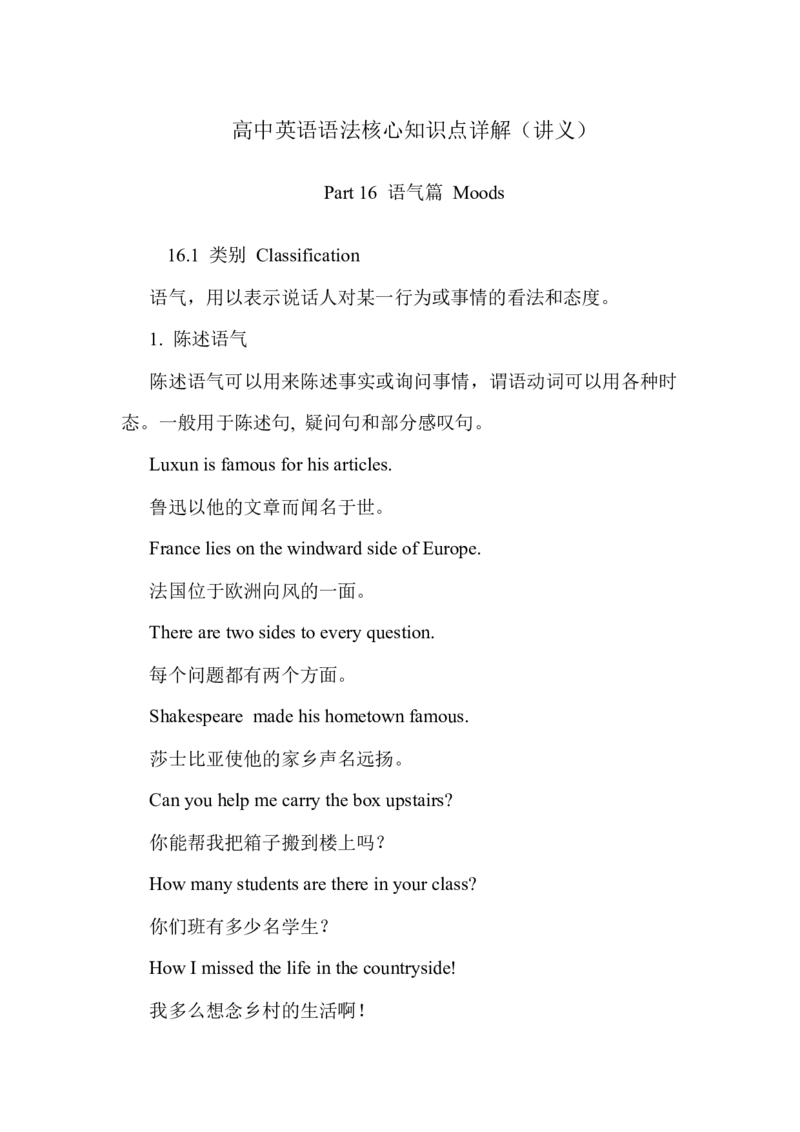
语气,用以表示说话人对某一行为或事情的看法和态度。
1. 陈述语气
陈述语气可以用来陈述事实或询问事情,谓语动词可以用各种时
态。一般用于陈述句, 疑问句和部分感叹句。
Luxun is famous for his articles.
鲁迅以他的文章而闻名于世。
France lies on the windward side of Europe.
法国位于欧洲向风的一面。
There are two sides to every question.
每个问题都有两个方面。
Shakespeare made his hometown famous.
莎士比亚使他的家乡声名远扬。
Can you help me carry the box upstairs?
你能帮我把箱子搬到楼上吗?
How many students are there in your class?
你们班有多少名学生?
How I missed the life in the countryside!
我多么想念乡村的生活啊!2. 祈使语气
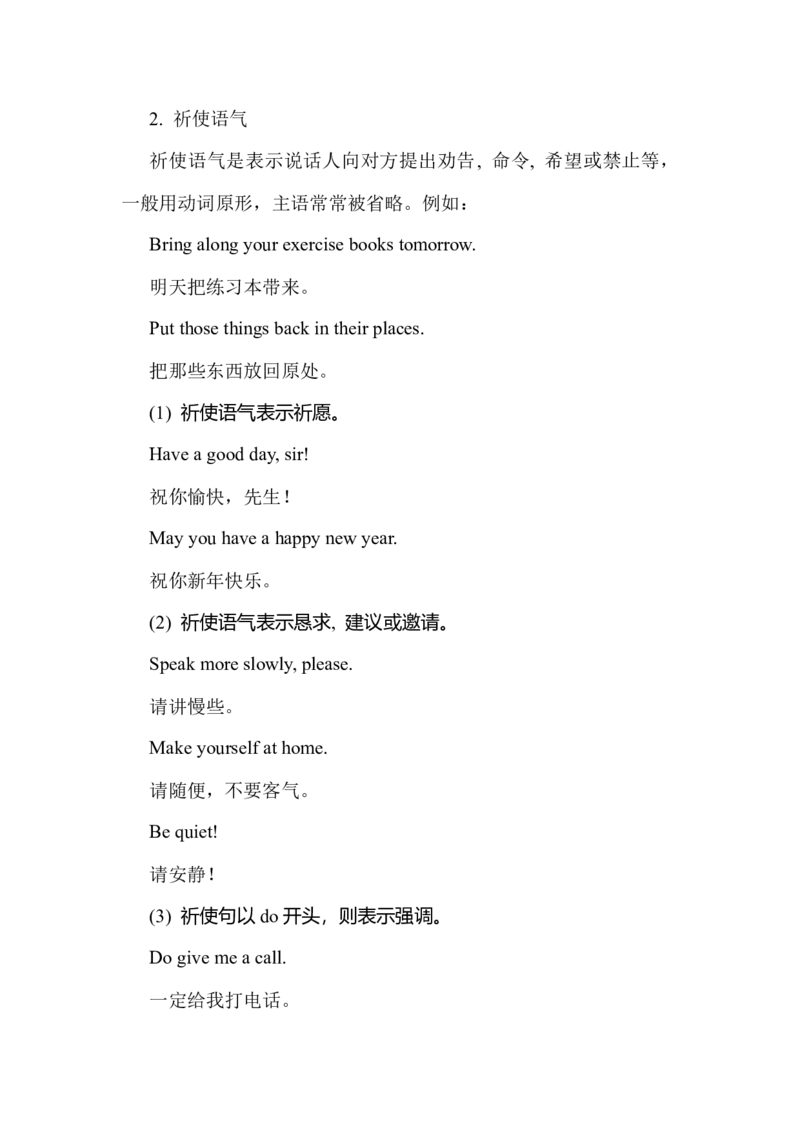
祈使语气是表示说话人向对方提出劝告, 命令, 希望或禁止等,
一般用动词原形,主语常常被省略。例如:
Bring along your exercise books tomorrow.
明天把练习本带来。
Put those things back in their places.
把那些东西放回原处。
(1) 祈使语气表示祈愿。
Have a good day, sir!
祝你愉快,先生!
May you have a happy new year.
祝你新年快乐。
(2) 祈使语气表示恳求, 建议或邀请。
Speak more slowly, please.
请讲慢些。
Make yourself at home.
请随便,不要客气。
Be quiet!
请安静!
(3) 祈使句以do开头,则表示强调。
Do give me a call.
一定给我打电话。Do be quiet a moment.
一定要安静一会儿。
Do let me go.
一定让我去吧。
(4) 否定祈使句的构成通常为 don't + 动词原形,但有时也用
never + 动词原形构成。
Don't be so nervous!
别这么紧张!
Don't touch me!
不要碰我!
Never do that again!
别再那么做了!
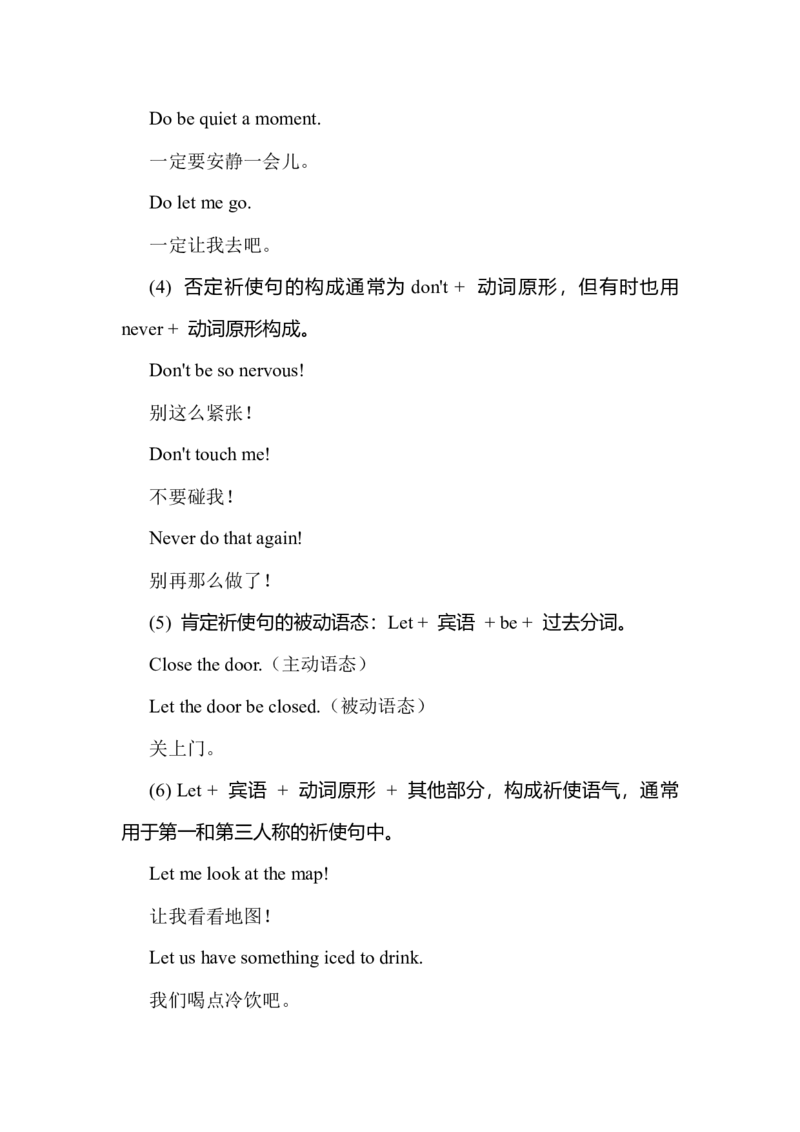
(5) 肯定祈使句的被动语态:Let + 宾语 + be + 过去分词。
Close the door.(主动语态)
Let the door be closed.(被动语态)
关上门。
(6) Let + 宾语 + 动词原形 + 其他部分,构成祈使语气,通常
用于第一和第三人称的祈使句中。
Let me look at the map!
让我看看地图!
Let us have something iced to drink.
我们喝点冷饮吧。Let's not waste our time discussing such a thing.
咱们别浪费时间讨论这件事了。
(7) 由动词原形 + and + 动词原形构成的祈使语气。
Wait and see.
等着瞧。
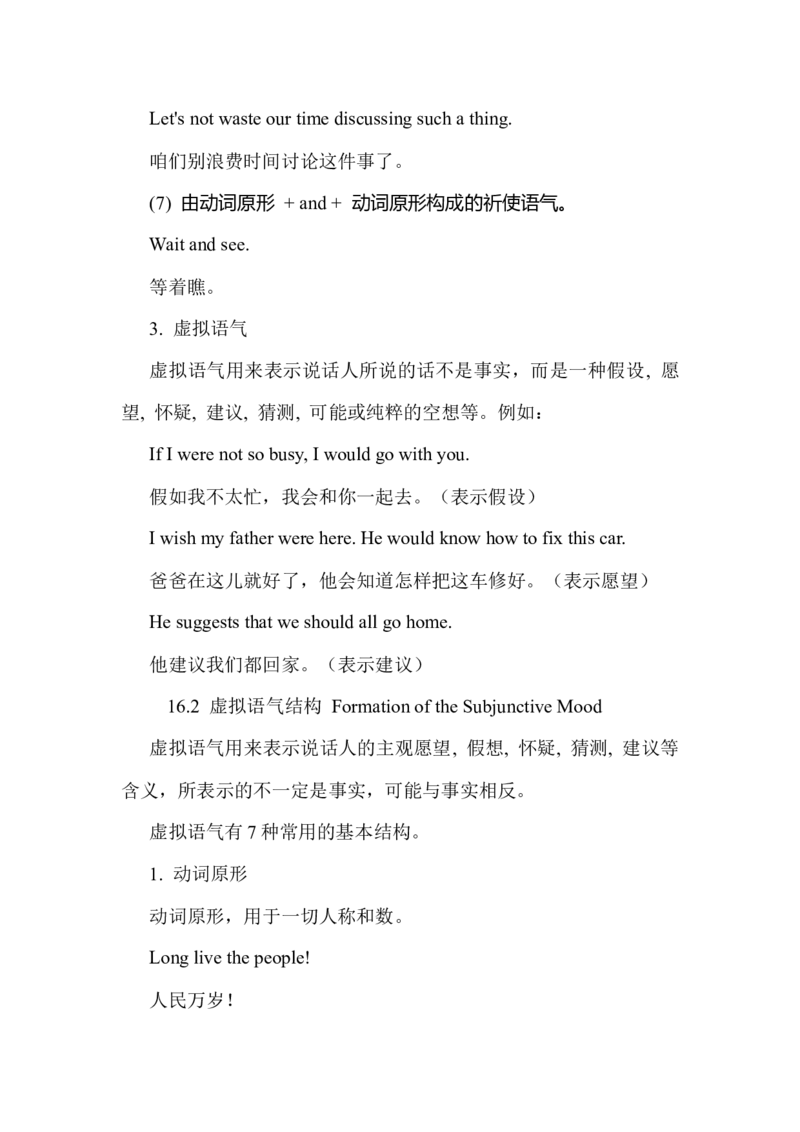
3. 虚拟语气
虚拟语气用来表示说话人所说的话不是事实,而是一种假设, 愿
望, 怀疑, 建议, 猜测, 可能或纯粹的空想等。例如:
If I were not so busy, I would go with you.
假如我不太忙,我会和你一起去。(表示假设)
I wish my father were here. He would know how to fix this car.
爸爸在这儿就好了,他会知道怎样把这车修好。(表示愿望)
He suggests that we should all go home.
他建议我们都回家。(表示建议)
16.2 虚拟语气结构 Formation of the Subjunctive Mood
虚拟语气用来表示说话人的主观愿望, 假想, 怀疑, 猜测, 建议等
含义,所表示的不一定是事实,可能与事实相反。
虚拟语气有7种常用的基本结构。
1. 动词原形
动词原形,用于一切人称和数。
Long live the people!
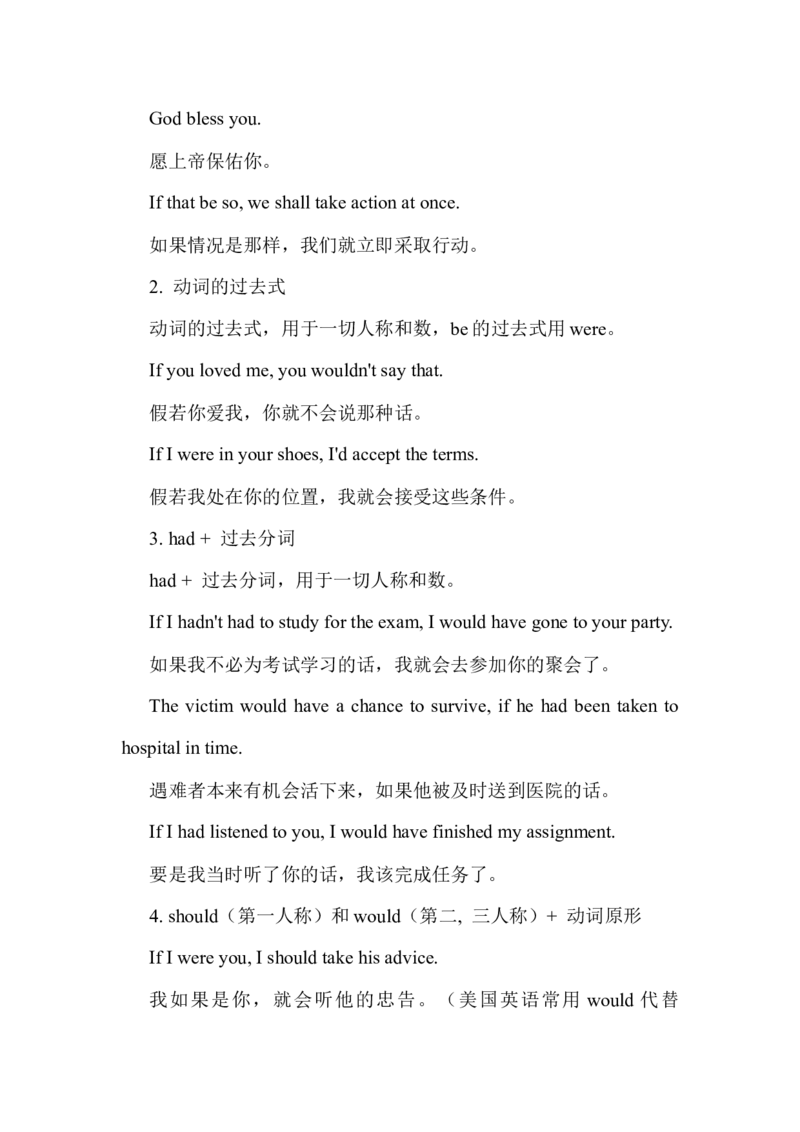
人民万岁!God bless you.
愿上帝保佑你。
If that be so, we shall take action at once.
如果情况是那样,我们就立即采取行动。
2. 动词的过去式
动词的过去式,用于一切人称和数,be的过去式用were。
If you loved me, you wouldn't say that.
假若你爱我,你就不会说那种话。
If I were in your shoes, I'd accept the terms.
假若我处在你的位置,我就会接受这些条件。
3. had + 过去分词
had + 过去分词,用于一切人称和数。
If I hadn't had to study for the exam, I would have gone to your party.
如果我不必为考试学习的话,我就会去参加你的聚会了。
The victim would have a chance to survive, if he had been taken to
hospital in time.
遇难者本来有机会活下来,如果他被及时送到医院的话。
If I had listened to you, I would have finished my assignment.
要是我当时听了你的话,我该完成任务了。
4. should(第一人称)和would(第二, 三人称)+ 动词原形
If I were you, I should take his advice.
我如果是你,就会听他的忠告。(美国英语常用 would 代替should)
He said he would go if I went.
他说,如果我去他就去。
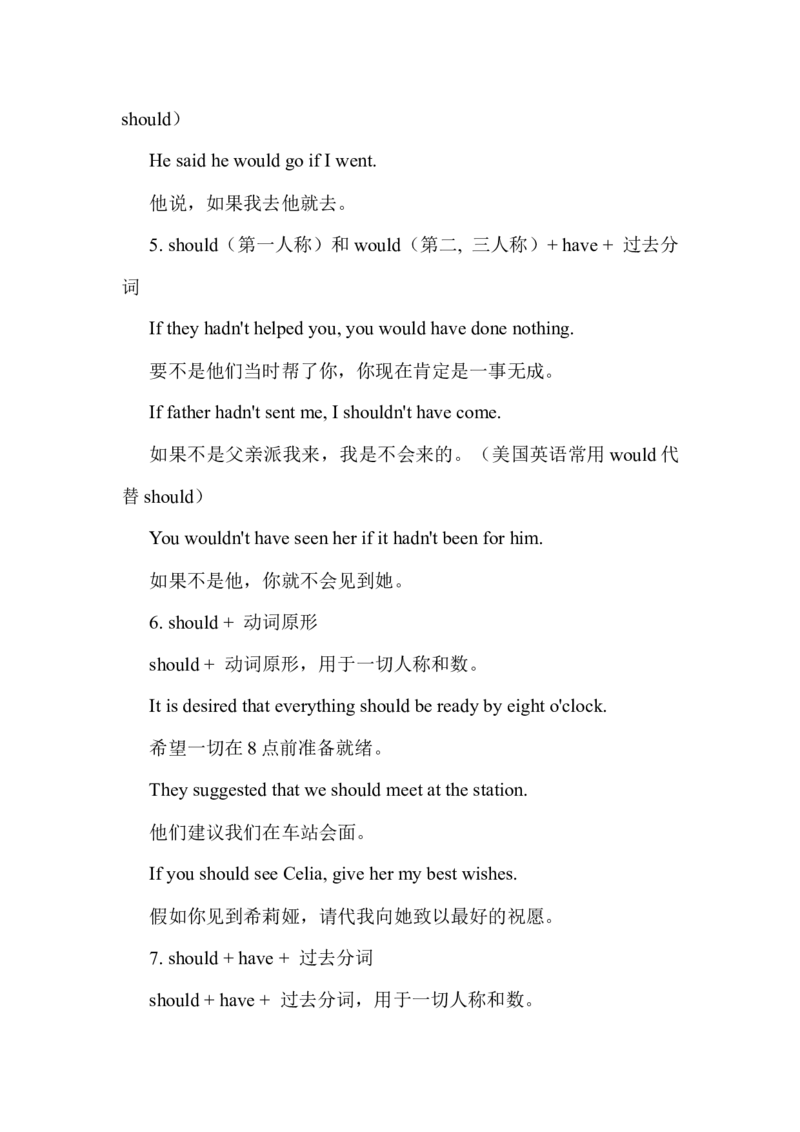
5. should(第一人称)和would(第二, 三人称)+ have + 过去分
词
If they hadn't helped you, you would have done nothing.
要不是他们当时帮了你,你现在肯定是一事无成。
If father hadn't sent me, I shouldn't have come.
如果不是父亲派我来,我是不会来的。(美国英语常用would代
替should)
You wouldn't have seen her if it hadn't been for him.
如果不是他,你就不会见到她。
6. should + 动词原形
should + 动词原形,用于一切人称和数。
It is desired that everything should be ready by eight o'clock.
希望一切在8点前准备就绪。
They suggested that we should meet at the station.
他们建议我们在车站会面。
If you should see Celia, give her my best wishes.
假如你见到希莉娅,请代我向她致以最好的祝愿。
7. should + have + 过去分词
should + have + 过去分词,用于一切人称和数。We all think that she should have done the work.
我们都认为她应该完成这项工作。
I should have taken his advice.
我真该接受他的忠告。
If the steamer should have left the port at noon, it will be passing
through the canal now.
轮船如果中午离港,现在大概正在穿过运河。
注 上述某些虚拟动词形式和陈述语气的某些动词形式相同,但
用法及其所表示的时间概念则完全不同,二者切不可混淆。
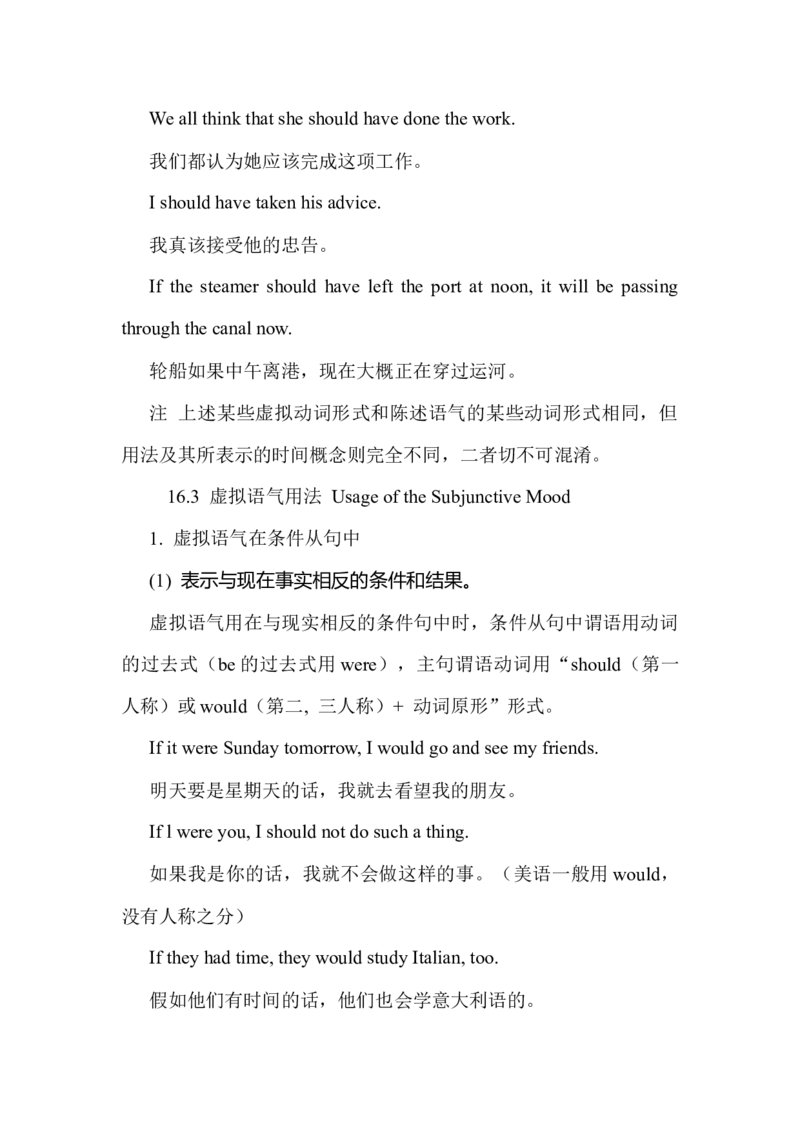
16.3 虚拟语气用法 Usage of the Subjunctive Mood
1. 虚拟语气在条件从句中
(1) 表示与现在事实相反的条件和结果。
虚拟语气用在与现实相反的条件句中时,条件从句中谓语用动词
的过去式(be 的过去式用 were),主句谓语动词用“should(第一
人称)或would(第二, 三人称)+ 动词原形”形式。
If it were Sunday tomorrow, I would go and see my friends.
明天要是星期天的话,我就去看望我的朋友。
If l were you, I should not do such a thing.
如果我是你的话,我就不会做这样的事。(美语一般用 would,
没有人称之分)
If they had time, they would study Italian, too.
假如他们有时间的话,他们也会学意大利语的。(2) 表示与过去事实相反的条件和结果。
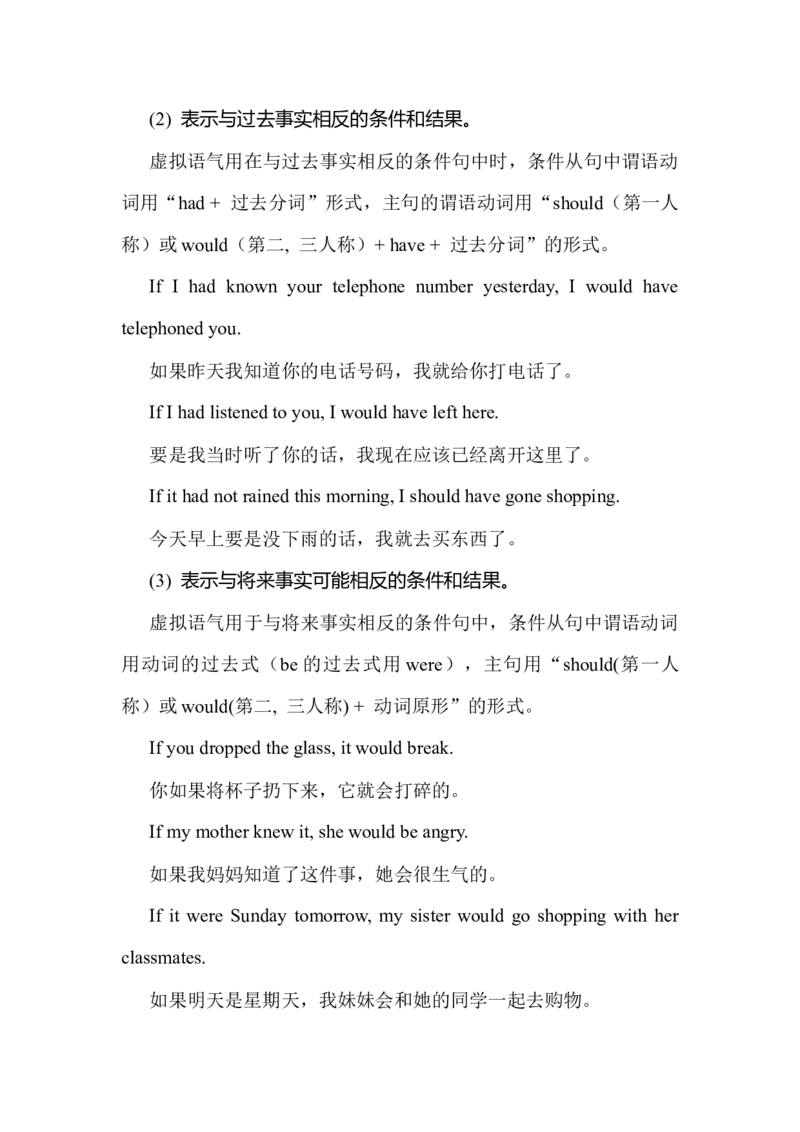
虚拟语气用在与过去事实相反的条件句中时,条件从句中谓语动
词用“had + 过去分词”形式,主句的谓语动词用“should(第一人
称)或would(第二, 三人称)+ have + 过去分词”的形式。
If I had known your telephone number yesterday, I would have
telephoned you.
如果昨天我知道你的电话号码,我就给你打电话了。
If I had listened to you, I would have left here.
要是我当时听了你的话,我现在应该已经离开这里了。
If it had not rained this morning, I should have gone shopping.
今天早上要是没下雨的话,我就去买东西了。
(3) 表示与将来事实可能相反的条件和结果。
虚拟语气用于与将来事实相反的条件句中,条件从句中谓语动词
用动词的过去式(be 的过去式用 were),主句用“should(第一人
称)或would(第二, 三人称) + 动词原形”的形式。
If you dropped the glass, it would break.
你如果将杯子扔下来,它就会打碎的。
If my mother knew it, she would be angry.
如果我妈妈知道了这件事,她会很生气的。
If it were Sunday tomorrow, my sister would go shopping with her
classmates.
如果明天是星期天,我妹妹会和她的同学一起去购物。注 在表示与将来事实可能相反的条件从句中,条件从句的谓语
也可以用“were to + 动词原形”(比较正式,常用于书面体中)和
“should + 动词原形”形式。表示假想性很强,而实现的可能性很
小。例如:
If you were to come tomorrow, I might have time to see you.
如果你明天来的话,我或许会有时间见你。
If I were to see her tomorrow, I would tell her about your decisions.
我明天如果见到她,就把你的决定告诉她。
If you should meet Susan, tell her I want to see her.
你如果见到苏珊,告诉她我想见她。
If it should rain tomorrow, what would we do?
万一明天下雨,我们该做什么?
(4) 当条件从句中的动作和主句中的动作所发生的时间不一致时
(例如一个是过去发生的,一个是现在发生的)时,虚拟语气的谓
语动词形式应根据它所表示的时间加以调整。
If he had followed the doctor's advice, he would be quite all right
now.
他当时若是听医生的话,现在就会痊愈了。(从句说明过去,主
句说明现在。)
If I were you, I would have gone to the theatre.
假如我是你,我会去剧场。(从句的时间表明现在,主句说明过
去。)If I were not busy, I would have come to see you.
如果我不忙的话,我就去看你。(从句的时间说明过去,主句说
明从过去到现在。)
If you hadn't helped me, I couldn't have finished it on time and most
likely I would be still working now.
假如你没有帮助我,我就不可能按时完成工作,很可能现在我还
在做。
(从句说明过去,主句说明过去和现在。)
(5) 比较:用陈述语气表示条件和结果。
在现代英语里,多用陈述语气表示条件和结果。陈述语气的条件
和结果所表示的往往是事实。
如果不是事实,其可能性也比虚拟语气要大。
If it rains tomorrow, we shall not go out.
假如明天下雨的话,我们就不出去。
The dog won't attack you if you sit still.
如果你安静地坐着,狗是不会咬你的。
If the train leaves at eight thirty, there is no time to lose.
火车如果是8点半开,就不能再拖延时间了。
2. 虚拟语气结构中的省略
虚拟语气结构中,从句或主句有时形式上可以省略,而并不影响
意义表达。
(1) 省去了结果主句的虚拟语气结构,常用来表示愿望。If he were here!
假如他在这里该多好啊!
If I had never married.
如果我从未结婚就好了。
这种结构也常用if only开头。
If only I were ten years younger!
我要是能年轻10岁该多好啊!
If only I could speak several foreign languages!
我要是能讲几种外语就好了!(用would/could表示将来)
If you would only try harder!
你如果再努力些就好了。(only亦可置于would等助动词之后)
If only you had told me the truth before.
要是你以前告诉我真相就好了。(用过去完成时表示过去)
注 有时if only只表示条件,不表示愿望。例如:
If only I had known earlier, I'd have phoned you.
如果我知道得早一些,就会打电话给你了。
(2) 省去了条件从句的虚拟语气结构。
You might stay here forever.
你可以永远待在这里。(省去了if you wanted或类似条件)
That would be fine.
那就太好了。(省去了if you should do it或类似条件)
I would not have done it.我是不会做那件事的。(省去了if I were you或类似条件)
3. 虚拟语气中不用if的条件从句结构
在书面语中,条件从句有时可以不用连词 if,而把谓语中的过去
式 were, had 或 should 移至主语之前。但如果从句没有 were, had 或
should,则一般不能省略if。
Were it necessary, I might go without delay.
如果需要的话,我可以立即去。
Had you taken my advice, you wouldn't have failed in the exam.
你要是听了我的建议,就不会考试不及格了。
Should I have time, I would call on her.
要是有时间,我就去看她。
Should they have time, they would take part in your party.
如果他们有时间,他们会来参加你的聚会。
Should they come, tell them not to wait for me.
他们要是来了,让他们别等我了。
Should it rain tomorrow, the sports meeting would be postponed.
如果明天下雨,运动会将会延期举行。
注 有时候,虚拟语气可以不用条件从句,而用介词短语, 动词
不定式等来表示。例如:
We could not have done the work well without their help.
要是没有他们的帮助,我们不可能做好这项工作。
All this would have been impossible ten years ago.这一切在10年前是不可能有的。
4. 虚拟语气的其他用法
(1) 虚拟语气用在主语从句中。
虚拟语气除主要用于条件句(即状语从句),还可用于主语从
句。在主语从句中,虚拟语气的谓语动词用“should + 动词原形
(或 should + have + 过去分词)”,或只用动词原形(尤其用于美
国英语中)。should 在此结构中是时态助动词,没有实义,这种主
语从句通常由连词 that 所引导,用在 It is natural/ necessary/ strange/
important/ essential/ impossible/ possible that... 这类句型里。
It was arranged that you should go and help Susan.
已经做了安排,由你去帮助苏珊。
It is necessary that the question should be settled at once.
必须马上解决这个问题。
It is important that we should speak politely.
我们说话要有礼貌,这是很重要的。
It is essential that we should tell her the truth.
我们有必要告诉她真相。
It is strange that he should have gone away without telling us.
真奇怪,他没有通知我们就走了。
(2) 虚拟语气用在宾语从句中。
1) 在动词 wish 后的宾语从句(常常省去连词 that),表示不可实
现的愿望。宾语从句中的动词如用过去式,则表示与现在事实相反;如用过去完成式,则表示与过去事实相反。
I wish I knew my husband's secret.
我要是知道我丈夫的秘密就好了。(=I don't know my husband's
secret.)
I wish I were a scientist.
但愿我是个科学家。(=I am not a scientist.)
I wish he hadn't gone.
他要是没走该多好!(=I'm sorry he has gone.)
We wish you had come to our evening party.
我们真希望你来参加我们的晚会。(=but you did not)
注 动词 wish 如果是过去式,后面宾语从句的动词的虚拟语气形
式不变,仍用过去式或过去完成式。例如:
She wished she knew how to play golf.
她希望自己会打高尔夫球。(和过去的事实相反)
I wished I hadn't been so forgetful. Then I shouldn't have missed the
concert.
我要是不这样健忘该多好,那我就不会错过那场音乐会。(和过
去的过去的事实相反)
2) 有时在宾语从句中可用 would或might加动词原形,表示有可
能实现的愿望。
I wish he might live with me.
我希望他和我住在一起。He wishes I would go with him.
他希望我和他一起去。
I wish you would be quiet.
我希望你安静一些。
3) 动词 demand 要求, command 命令, desire 希望, maintain 保
持, urge 鼓励, direct 指导, arrange 安排, suggest 建议, order 命令,
insist 坚持, propose 建议等词后接宾语从句,可以用“should(用于
所有的人称)+ 动词原形”,或只用动词原形来表示虚拟语气。
The expert proposed that children shouldn't spend much time on TV.
专家建议孩子不要过多地看电视。
My little daughter suggested that we should hold a family meeting.
我的小女儿建议我们开个家庭会议。
The committee proposed that we should discuss this question next
time.
委员会提议我们下次再讨论这个问题。
Most students insist that they should have more English classes.
多数同学坚持要多上英语课。
(3) 虚拟语气用在定语从句中。
虚拟语气也能用于 It is time (that)... 句型中的定语从句里。从句
的谓语动词常用虚拟语气表示将来,动词用过去式形式:意思是
“该干某件事了,时间已经有些晚了”。
It is time we left.我们该走了。
It is time we went to bed.
我们该睡觉了。
It is time we summed up our results.
我们该总结我们的成绩了。
(4) 虚拟语气用于表语从句和同位语从句。
虚拟语气也可用于表语从句和同位语从句中,在表示建议, 劝告,
命令等含义的名词后的表语从句和同位语从句中,谓语动词要用
“should + 动词原形”或动词原形。
My advice/suggestion is that you (should) practise English as often as
possible.
我的建议是你要尽可能地经常练习英语。
The demand is that the composition (should) be finished tomorrow.
要求是作文必须明天完成。
The boss gave orders that the work (should) be finished this weekend.
老板发令说,这项工作必须这周末完成。
It is my desire that all the members of the family (should) gather once
a year.
我的愿望是所有家庭成员一年团圆一次。
(5) 虚拟语气用在状语从句中。
1) 由 as if 或 as though 所引导的状浯从句表示比较或方式时,从
句中的谓语动词常用虚拟语气。动词形式用动词的过去式(be 用were)或“had + 过去分词”。My mother looked after the orphan as
if he were her own child.
我母亲像照料自己孩子一样照料这个孤儿。
You speak as if you had really been there.
你说得好像你真的去过那里似的。
注 下面这个句子中的as if从句是用作表语。
It looks as if it might rain.
天好像要下雨似的。
2) 在由 lest 和 in case 等引导的目的状语从句中,用“should +
动词原形”(should可省略)。
I'll keep a T-shirt for you in case you should change your mind.
我给你留一件T恤,说不定你会改变主意的。
My boyfriend explained again and again in case I (should)
misunderstand him.
我男朋友解释了一遍又一遍,生怕我误解他。
注 in case 等引导的目的状语从句中的谓语有时也可用陈述语
气。此时,从句表示的就是真实情况,而不是虚拟情况。例如:
Take warm clothes in case the weather is cold.
带上厚衣服,以防天气变冷。
In case he doesn't have your phone number, could you tell me what it
is?
也许他并没有你的电话号码,以防万一,你可以告诉我你的号码吗?
3) 由连接词 whether, if, even if/though, whatever, so long as 引导的
条件状语从句中,可用虚拟语气,其谓语动词用动词原形。
I won't let you in whoever you may be.
不管你是谁,我都不会让你进去。
Whether the answer be right or not, I have to be rechecked.
不管答案正确与否,我都得重新核对。
However hard the task may be, I must fulfill it on time.
不管任务多么艰巨,我都必须按时完成。
4) 以 so that, in order that 或起同样作用的 that 引导的结果状语从
句,谓语多用“may/might + 动词原形”结构构成,在口语中也常用
“can/could + 动词原形”结构。I live so that others may live better.
我活着为的是使别人活得更好。
In order that people might understand this new product, I made a
practical demonstration of it.
为了让人们了解这个新产品,我做了一次示范表演。
(6) 虚拟语气和情态动词。
虚拟结构(不论从句还是主句)常可用情态动词的过去式,即
could, might, would等加不带to的动词不定式,或不带 to的动词不定
式完成式,来作谓语动词。这些情态动词除表示虚拟结构外,本身
还有独立的意思。
If she were here, she might come with you.假如她在这里,她会跟你一起去的。
If I were you, I would join in the army.
如果我是你,我就去参军。
But for your help, we could not have succeeded.
要不是你们的帮助,我们是不可能成功的。
If she left at six, she should arrive in time.
如果她6点动身,就会按时赶到。