专题03 阅读理解(记叙文+新闻报道+议论文+书评)
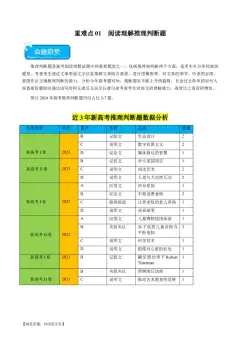
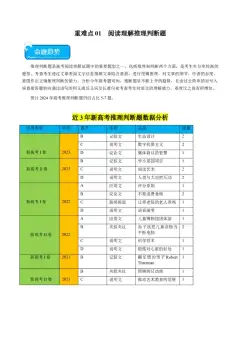
考查范围:主题、语篇范围
题号
难度
知识点
一、阅读理解
1
较易
人与动植物,记叙文
2
适中
记叙文,生活故事,当代教育问题
3
较易
记叙文,个人经历
4
适中
医疗 ,新闻报道
5
较易
哲理感悟,记叙文,个人经历
6
较易
科普知识 ,说明文
7
较易
议论文,人工智能
8
适中
记叙文,个人经历,励志故事
9
适中
哲理感悟,记叙文,个人经历
10
适中
科学技术 ,议论文
11
适中
社会问题与社会现象,议论文
12
适中
发明与创造 ,新闻报道
13
适中
新闻报道,人工智能
14
适中
家人和亲人 ,记叙文,生活故事
15
较难
语言与文化 ,说明文
16
适中
社会问题与社会现象,说明文
(一)
(2025 届新疆维吾尔自治区喀什地区高三下学期一模)
My job is to train rats to find landmines ( 地雷) so the dangers can be cleared to save lives. I work for a
Belgian non-governmental organization called Apopo that operates from Morogoro, in my home country of
Tanzania. The rats I train are used in mine-clearing programs around the world, including in Angola, Azerbaijan
and Cambodia.
The animals we use are a species of African giant rat called Cricetomys ansorgei (非洲巨鼠). They are born
in sub-Saharan Africa and are the size of a small cat, which makes them easy to catch. They also live longer than
other rats, which is helpful for the program, because it takes between nine months and a year to train one fully.
My colleagues and I use a method called clicker training: we teach the rats to relate a click with a food
reward, and then use clicks to gradually reward behaviour. Rats are naturally curious, so they will explore, and their
great sense of smell means they can find buried landmines.
To teach the rats what to look for, we place small amounts of TNT explosives in some tea eggs and mix them
with some filled with other things. We reward the rats for touching these, then move on to reward them only when
they touch a tea egg filled with explosives, rather than ones filled with other things, such as hair, flowers and so on.
The rats need to perform perfectly at each stage of training before they move to the next stage. In the final stage, we
use real landmines in a training field.
As trainers, we build a connection with the rats we train. Some are slow learners; others know the process
very quickly. Most of the rats make it through, eventually. I work with our resident scientist to continually follow
and improve our training program, because the rats are so clever that they can be smarter than trainers!
1.Why did the author choose to use Cricetomys ansorgei?
A.They’re easy to get.
B.They can be seen commonly.
C.They’re quickly trained.
D.They live for up to a year.
2.What’s the key to the training?
A.Making the rats get used to the click.
B.Increasing the difficulty gradually.
C.Exercising rats’ sense of smell.
D.Linking behavior and rewards.
3.What can be learn from the training process?
A.Rats can find out all the explosives accurately.
B.The training won’t stay the same.
C.Real landmines aren’t used in training.
D.Most rats are quick learners.
4.Which is the best title for the text?
A.How I Train Rats to Find Explosives?
B.Why Giant Rats Can Be Useful?
C.How Rats Contribute to Saving Life?
D.Why We Use Clicker to Train Rats?
(二)
(2025 届黑龙江省哈尔滨市东北三省四市教研联合体高三下学期一模)
Every great idea begins with a spark (火花) of realization — and for Snehha Naarsaria, an accountant and a
mom in Portugal, that spark came from her own home.
Financial literacy (素养) is no longer a skill reserved for adults; it is becoming a fundamental part of a
child’s education. But teaching financial concepts to a child turned out to be harder than Snehha Naarsaria had
expected. There were no engaging tools, no reliable materials, and no clear ways to introduce these basic skills to a
young mind. This disconnection between knowledge and application struck her deeply and that was when the idea
for Fin Free Kid was born.
Fin Free Kid is an innovative initiative that equips children with necessary money management skills
through appealing books, flashcards, DIY kits, posters, and an immersive ( 沉浸式的) course. It offers
comprehensive learning aids which cover different aspects of financial literacy. The resources aren’t just about
teaching — they’re about empowering kids to think independently, make informed decisions, and develop habits
that will serve them for life.
With a strong focus on quality and customer satisfaction, the program has earned widespread praise for its
exceptional service and transformative impact on young learners. Parents have reported a noticeable shift in their
children’s attitudes and behaviors after using Fin Free Kid’s products. Many children have developed the habit of
saving money and learned to make more thoughtful spending choices. A feature in The Economic Times described
Fin Free Kid as “a pioneer in financial education for kids, bridging the gap in a crucial area of learning”.
With its growing popularity and the trust of parents across Portugal, Fin Free Kid plans to introduce
advanced learning materials for older children and expand its partnerships with schools to integrate financial
literacy into courses. “Our mission is to make sure that every child has the tools and knowledge to deal with the
complexities of the financial world,” says Snehha Naarsaria, “The changes we’ve seen in children so far are just the
beginning. Together, we’re building financially literate generations.”
5.What inspired Snehha Naarsaria to create Fin Free Kid?
A.Rising concerns about overspending.
B.Lack of effective educational resources.
C.Her success as a professional accountant.
D.Children’s desire to learn financial concepts.
6.What is an advantage of Fin Free Kid?
A.It improves reading skills.
B.It guarantees financial success.
C.It attaches importance to theories.
D.It contributes to lifelong development.
7.Why does the author quote the feature in The Economic Times?
A.To criticize traditional financial education.
B.To compare Fin Free Kid with other programs.
C.To highlight the program’s groundbreaking role.
D.To illustrate the significance of financial education.
8.What is the ultimate goal of Fin Free Kid according to Snehha?
A.To strengthen its cooperation with schools.
B.To make it influential throughout the world.
C.To promote financial literacy for generations.
D.To prepare kids to handle real-world challenges.
(三)
(2025 届黑龙江省名校协作体高三下学期一模)
At 73, Jean Lahey couldn’t decide what to do next to keep her mind sharp and body fit. As a lifelong teacher,
she could either return to the role of student by taking a college course, or try initial training for Les Mills’
BODYFLOW, a new generation yoga class. She chose the latter. She was looking for a new challenge and new
experience.
Stepping back into the role of student made her both excited and nervous. Her goal was to earn full
certification, but rather to experience a Les Mills initial training and expand her knowledge base. Her many years
of dance and fitness helped her feel confident about learning the choreography ( 编舞) required for the training.
“My approach was to learn the track as a dance to be performed on stage,” she explains.
Physical fitness has always been a central part of Lahey’s life. She’s been a dancer, choreographer, and
physical education teacher. She added Tai Chi instructor to her resume (简历) in her 70s when she earned a Tai Chi
certification. “My father was a master in TaiChi Chuan. He was a strong influence in my returning to Tai Chi,” says
Lahey, “I wanted to rearrange my fitness program and get back to my roots. Tai Chi has helped me mentally and
emotionally focus on balance, core strength, relaxation, meditation, and better sleep patterns. ”
While Lahey attended as a student, she ended up teaching the entire group many valuable lessons. Les Mills
Instructor Jessica Griffin says Lahey showed her what is possible in fitness and life. “She truly inspired the rest of
us and showed us age is not a factor.” Says Griffin: “We are all capable, even as senior citizens, to continue our
growth, knowledge, and learning.”
9.Why did Jean Lahey attend BODYFLOW?
A.To earn full certification.
B.To cure her physical illness.
C.To be a famous dancer.
D.To learn something new.
10.What method did Jean use to learn the choreography in the initial training?
A.Memorizing every move.
B.Taking it as a stage dance.
C.Seeking guidance from a dancer.
D.Relying on her teaching experience.
11.What inspired Jean to start teaching Tai Chi?
A.Her father’s great influence on her.
B.Her need to earn a new certification.
C.Her desire to broaden knowledge base.
D.Her passion to help the elderly people.
12.What can we learn from Jean Lahey?
A.Keep on learning as long as you live.
B.Fitness is important for the elderly people.
C.Teaching is more rewarding than learning.
D.People should always return to their roots.
(四)
(2025 届黑龙江省示范性高中专业委员会高三下学期一模)
In the mountainous regions of Nepal, 34-year-old Dr. Anika Gurung has transformed healthcare delivery
through her “Solar Health Backpack” initiative. Honored with the 2023 International Medical Innovation Award,
Gurung’s mission sparked at age 25 when she treated a child dying from preventable pneumonia ( 肺炎) during a
storm. “No life should fade for lack of a thermometer.” she vowed.
Her solution? Backpacks equipped with solar-powered diagnostic tools (portable ECG) and medicines,
carried by trained villagers to inaccessible settlements.
Since its 2019 launch, these mobile units carried by locally trained “mountain doctors” have navigated
mountain trails and clear streams to reach 237 settlements across 15 valleys. Each doctor doubles as a preventive
care educator, using augmented ( 增强的) reality glasses to demonstrate “medical techniques”. “Western-style
clinics fell apart here,” Gurung explains gesturing at landslide-scarred slopes. “But knowledge carried on human
backs. That’s unbreakable.”
Preparation involves months of mapping footpaths with elderly guides. “These mountains demand humility,”
she notes, unrolling a hand-drawn map marked with Sherpa symbols. “Modern GPS fails where people still
remember their ancestors well.” The combination of old and new things has cut the newborn death rate by 58% in
the areas we serve. Some people initially dismissed her model as “idealistic”, but its success in reducing the rate of
getting tuberculosis (肺结核) by 42% has inspired others to follow suits.
For Gurung, medical health isn’t about fancy hospitals. “It’s about making dignity portable,” she declares in
her WHO speech. Her team now cooperates with engineers to develop landslide-proof drone delivery systems for
medicines.
13.What did Gurung promise to do when she was 25?
A.Win an international award.
B.Prevent a disastrous storm.
C.Design an accessible thermometer.
D.Develop medical backpacks.
14.What are the backpacks additionally used for?
A.Storing emergency supplies.
B.Generating solar energy.
C.Transporting medical staff.
D.Conducting health education.
15.How does Gurung prepare her medical teams?
A.By using GPS technology.
B.By learning local geography.
C.By honoring Sherpa ancestors.
D.By unfolding a hand-drawn map.
16.What is Gurung’s opinion about healthcare?
A.It should be physically accessible.
B.Technology determines its quality.
C.Urban models need to be reproduced.
D.Hospitals should work with other industries.
(五)
(2025 届三省三校(黑龙江省哈师大附中、东北师大附中、辽宁省实验中学)高三下学期一模)
Until recently, most evenings, after my kid had finally fallen asleep, I would sink into the sofa, turn on
Netflix, and watch episode after episode until either my exhaustion or my husband would call time on this pitiful
sight. Turning the television off, I'd experience a surge of self-disgust at how dry my eyes felt, and disappointment
that the whole evening had disappeared. I would be momentarily but overwhelmingly surprised by my re-entry into
a world in which there were no socially-awkward-but-brilliant private detectives, but just a dishwasher that needed
loading and a child who would be waking all too soon. I felt crushed by this return to my life.
I started to think more about what was happening as I turned the TV on — why I would plan to watch just
one episode, but when I came to the end of it, I'd find myself unable to stop. It was as if I had no space in my mind
to make any other choice; I was swallowing up episodes without digesting them, without even chewing them over,
swallowing each one whole.
There is a way of consuming TV, and perhaps everything, that makes it very difficult to feel what the“right
amount” is, because it is more about getting away from something, rather than digesting something. Of course, we
all need a little escapism every now and then. But if we escape ourselves completely, and for too long, we can lose
touch with the ordinary, deeply meaningful moments of our day-to-day lives, such as cooking a nice meal for
dinner.
Between my child and my job and my odd detective TV shows, I have not been very good at cooking. Eating
has come to feel like something I do to survive, rather than something I enjoy. I've lost my appetite—not in the
sense of not being hungry, but in the sense of losing contact with a part of myself — my appetite for life. Recently,
I decided to have a night off from watching TV. I didn't turn it on and I was amazed by how much time I had. I
tidied the kitchen and felt satisfied by the ordinary, everyday experience of contributing something useful to family
life, rather than escaping it. I felt I wanted more evenings like that, and not so many lost in TV. But does it have to
be all or nothing? Or can I stay in contact with my appetite and find my way to an amount that feels right?
17.Why did the author feel disappointed when turning the TV off?
A.Because her eyes felt dry.
B.Because her child would wake soon.
C.Because the whole evening had been wasted.
D.Because her husband put an end to the night.
18.What may happen if we escape ourselves thoroughly?
A.Getting away from watching TV.
B.Missing daily highlights.
C.Avoiding a chance to survive.
D.Losing touch with detectives.
19.Which of the following can best describe the author?
A.Self-reflective and sensible.
B.Self-content and honest.
C.Thoughtful and modest.
D.Talented and passionate.
20.What can be the best title for the text?
A.What is a wasteful night?
B.How can you relax at night?
C.How can you regain your appetite for life?
D.What do you feel exhausted about?
(六)
(2025 届三省三校(黑龙江省哈师大附中、东北师大附中、辽宁省实验中学)高三下学期一模)
When Kari Leibowitz first arrived in the Norwegian city of Tromsø, she was both attracted by.and fearful of,
the approaching winter. Two hundred miles north of the Arctic Circle, the city does not see the sun from mid-
November to mid-January, a far cry from Stanford, California, where she had been studying before travelling to
Norway.
In many countries, the short days of winter are thought to cause low mood, yet Tromsø’s residents do not
show the similar wintertime depression. As a psychologist, Leibowitz was curious about the ways they lived with
the long“polar night”.
Previous research shows that people who see stressful events as “challenges”, with an opportunity to learn
and adapt, tend to cope much better than those who focus more on the threatening aspects — like the possibility of
failure or embarrassment. To test whether a different outlook could also explain the resilience (适应力) of Tromsə’s
residents, Leibowitz designed the “wintertime mindset scale”, asking participants to rate how much they agreed or
disagreed with statements about winter such as“I love the coziness of winter.” and “Winter is boring.”
She found that participants’answers predicted their well-being over the coming months: the more they saw
the winter as an exciting opportunity to enjoy an icy climate, the higher levels of overall mental health they have.
Besides, Leibowitz found that these attitudes actually increase with latitude(纬度) — the positive mindset is most
common where it’s most needed.
Indeed, many of Leibowitz’s friends embraced the possibility of skiing in the mountains, or having a warm
drink in the candlelight. “There is this interaction between the culture you’re part of and the mindset growing out of
it,” says Joar Vittersø, Leibowitz’s colleague at the Arctic University of Tromso.
Soon, Leibowitz found her own mindset shifting: She learned to love long walks with a headlamp guiding
her path, and came to appreciate the“soft, peaceful” appearance of the city in the darkness. “Most people just hate
the winter and feel like there’s nothing they can do about it... But once you put it in people’s heads that they have
control over their mindset, that’s when something powerful happens,” says Leibowitz.
21.What do we know about the residents of Tromsø?
A.They are longing for the coming winter.
B.They see winter as an opportunity to work out.
C.They are likely to become depressed in winter.
D.They are seldom influenced by winter stress.
22.Why did Leibowitz carry out her research?
A.To prove wintertime depression as a challenge.
B.To suggest the ways to deal with the hard winter.
C.To find out whether the previous theory applies to Tromsø.
D.To help the local inhabitants get through the long polar night.
23.What can we conclude from Leibowitz’s findings?
A.A positive mindset may indicate a high life satisfaction in winter.
B.Winter offers people a better opportunity to interact with friends.
C.People in high latitude are less optimistic when facing long dark nights.
D.Tromsø’s residents are negatively influenced by the environment.
24.Which of the following will Leibowitz most probably agree with?
A.People hate winter because they can do nothing.
B.Long walks help to change people’s mindset.
C.Awareness of control over mindset makes a difference.
D.It’s of great fun to ski in the winter mountains.
(七)
(2025 届三省三校高三下学期一模)
In a drawing room in rural Oxfordshire, an artist slowly and deliberately puts pen to paper. Her arm moves
across the canvas, the marks gradually integrating into a portrait of herself. It seems like a moment of creative
expression. But this is no ordinary artist—she is the world’s first humanoid robot artist, Ai-Da. By design, her very
existence brings into question how we define art, and who, or in this case, what, can create it.
Will AI algorithms (算法) and robots like Ai-Da mean the end of human creativity and artistry,or can they
strengthen our own creative potential? When Marcel Duchamp proposed that a urinal (小便池) be considered art,
he flipped the art world on its head. In much the same way, AI-created artworks are changing the standards of the
art world, because both were controversial and contain objects that haven’t technically been created by an “artist’s”
hand.
Someone argues that a humanoid artist like Ai-Da represents society’s current fears — the rise of job-
stealing AI algorithms and potential robot domination. But technological revolutions like artificial intelligence
don’t necessarily mean the “end of art” as many fear. Instead, they can help to kickstart an artistic transformation
and move us towards different ways of seeing and creating. “AI might kick us into being creative again as
humans,” says mathematician du Sautoy, who sees it as a powerful partner in the pursuit of human creativity.
However, questions of authorship haunt the artificial intelligence story. Artists Holly Herndon and Mat
Dryhurst co-founded Spawning AI, which aimed at empowering human creators to prohibit AI from using their
works. But there are also artists who see AI as a new outlet for their own creativity. Some artists are now even
training algorithms in an attempt to push their own creative boundaries.
It’s clear that AI algorithms and machines like Ai-Da are having an impact on the art world. Their works are
exhibited alongside more traditional forms of art worldwide. Next year we’ll see the world’s first AI art gallery
open its doors in LA .Eva Jäger, the creative AI lead, is also helping to bring AI art to the masses, with a
programme of exhibitions leading to critical discussion about the impact of technology on art. She sees the
cooperation between human and machine as a space for real creative potential.
25.What does the phrase “flipped the art world on its head” in paragraph 2 probably mean?
A.Overturned the art standards.
B.Dominated the art world.
C.Broadened artists’ horizons.
D.Recognized artists’ wisdom.
26.What influence will Ai-Da generate on the art world?
A.It will increase the commercial value.
B.It will replace human artists soon.
C.It may boost human creativity.
D.It may help artists protect their works.
27.What can be inferred from the last two paragraphs?
A.Spawning AI helps produce better art works. B.Some artists trained AI to work for them.
C.AI art gallery will win over more visitors.
D.Eva looks favorably to the future of AI.
28.What’s the author’s purpose in writing the text?
A.To argue that AI will eventually outperform human artists.
B.To explore the impact of AI on art definition and creativity.
C.To promote the idea that artworks created by AI lacks value.
D.To record the history of art movements and their significance.
(八)
(2025 届吉林省通化市梅河口市第五中学高三下学期一模)
Suzanne Heywood was just seven years old when her parents told her she, along with her younger brother
Jonathan, would be pulled out of school to go on a three-year voyage around the world. The family of four from the
UK set out on their exploration to recreate Captain Cook’s voyage around the globe, which ended up taking a
decade instead of the promised three years.
Now 55 years old, Suzanne has shared her tale of survival on TikTok, and recalled her 10 years at sea in her
tell-all memoir (回忆录) Wave Walker. “I spent that time trapped on a boat, unable to go to school or have normal
friendships.” Despite her father assuring her the trip would be safe, Suzanne claimed it was “incredibly dangerous
but great as well”, sharing details of a risky journey from South Africa to Australia where the boat hit an enormous
storm.
In order to get through her very strange childhood, Suzanne recalled how she was determined to get an
education to live a normal life. “As it became clear my parents had no intention of going back, I decided I had to
educate myself as it was the only lifeline that I had,” she told the hosts of The Morning Show.
She began studying in the small cabin of the boat, which she found challenging both practically and
academically, as she “had missed a lot of education”. Then, when she was 16, and her brother 15, her parents
enrolled (注册) the two teenagers into a school in New Zealand while they continued sailing.
Despite the gaps in her education, Suzanne landed a spot at Oxford University, and after saving up money
she’ d earned working on a farm, Suzanne bought a one-way plane ticket back to the UK.
Since going public with her story, Suzanne’s book instantly became a bestseller, and she continues to work
through the trauma (创伤) caused by her “unstable” childhood. Suzanne’s extraordinary tale has captured the hearts
of millions, with thousands of online fans applauding her for her bravery.
29.Why did Suzanne’s family set out their voyage?
A.To meet the challenges of their life.
B.To realize the dream of family traveling.
C.To admire the beauty of great oceans.
D.To follow in the footsteps of a great explorer.
30.What did education mean to Suzanne during the voyage?
A.An approach to pleasing her parents.
B.A tool for killing time on the vast sea.
C.A means of struggling for a better future.
D.A support of her admission into Oxford University.
31.What message does Suzanne’s experience convey?
A.A strong will can free a person from family support.
B.A lack of education can affect a person’s intelligence.
C.A unique life can equip a person with special qualities.
D.A crazy upbringing always leads to greater achievements.
32.What’s the author’s purpose of writing the text?
A.To analyze the impact of family decisions and give warnings.
B.To record Suzanne’s remarkable life journey and inspire others.
C.To evaluate Suzanne’s educational achievements and praise her.
D.To promote Suzanne’s memoir Wave Walker and excite readers.
(九)
(2025 届吉林省长春市吉大附中实验学校高三下学期一模)
Two years ago, fueled by my envy for those with gardens, I signed up for a plot, a place where I could read
and write in the sun, safe from distractions. Surprisingly, I was presented one month later, a half-plot of available
land. The plot, which was bigger than I could dream of, was beautiful but overgrown — getting it started would
require hard work. I wasn’t sure if I had it in me.
Now, after seeking guidance from my family and watching beginners’ gardening videos, I spend hours a
week sowing, weeding, watering and harvesting. My summer at the plot has so far offered countless lessons, the
most important one being learning more about how food actually grows. Take the humble cauliflower (菜花) — a
common sight in the supermarket, yet it demands patient tending for up to six months, all for a short moment on the
plate.
However, abundant harvests come with a lesson in temporary. Fresh produce gees off quickly once ripened
and picked. And so I’ve turned to the old craft of preservation — learning what to boil and freeze, or make into jam
— to make things last. When the harvest has been more than I can manage, I’ve shared the abundance with friends
and family, spreading the joy.
While gardening is a welcome escape from the chaos of the modern world, you can’t avoid the reality of the
climate crisis. It’s one thing to read these in the news or see them reflected in prices, but it’s quite another when you
have to be in tune with weather patterns, praying for prolonged sunshine without the unbearable heat.
As I continue to tend my plot, I do so with a sense of humility, wonder and excitement. What started as a
desire for a small patch of green has grown into something much more significant — a connection to my local
environment, a respect for the food I eat and an awareness of the fragile natural systems that sustain us. In the
beginning, I was worried I would fail the plot; instead, I’m finding myself growing alongside it.
33.How did the author feel about the plot initially?
A.Proud but anxious.
B.Amazed but worried.
C.Grateful but puzzled.
D.Moved but disappointed.
34.What did the author learn from working on the plot?
A.To identify common plants.
B.To create some family recipes.
C.To understand the clock of nature.
D.To share preservation skills with friends.
35.What challenge does the author face concerning climate impact?
A.Rising food prices.
B.Unstable weather issues.
C.Frequent extreme heat.
D.Reduced produce quality.
36.What does the author’s experience tell us?
A.Labor is the most reliable wealth.
B.One should stay hungry for constant progress.
C.The land is made better and so is the gardener.
D.Every season brings lessons and reveals wisdom.
(十)
(2025 届吉林省长春市吉大附中实验学校高三下学期一模)
A man in a lab coat bends under a dim light with tight eyes looking at a microscope. Time is short, the pays-
off are high, and only this scientist can save everyone. That kind of romanticized picture of science was standard
for a long time. But it’s far from the truth.
Some scientists search for the causes of some observable effects, such as the link between destroyed forests
and Earth’s temperature increase. Others may investigate the “what” rather than the “why” of things. For example,
ecologists build models to estimate gray wolf abundance in Montana, US. It’s impractical to spot them all and
count them, Abundance models are not 100 percent accurate, but they offer estimates that seem good enough to set
harvesting quotas (限额) and maintain the ecosystem.
Beyond the “what” and the “why”, scientists may focus on the “how”. For instance, the lives of people living
with illnesses can be improved by research on how to relieve symptoms, even if the true causes of their disorders
are largely unknown to current medicine.
People often think “real science” should provide definite, complete and perfect answers to their questions.
However, given various limitations and the world’s complexity, keeping multiple perspectives in play is often the
best way for scientists to reach their goals and solve the problems at hand.
In the world of science, disagreement is a feature, not a bug. Science is a social process in which the
community’s scrutiny ( 审查) ensures we have the best available knowledge. “Best available” does not mean
“definitive”, but the best we have until we find out how to improve it.
The long history of atomism (原子论) shows how science is a process rather than a fast delivery of results
set in stone. As scientist Jean Baptiste Perrin conducted his 1908 experiments that seemingly settled all discussion
regarding atoms, questions about the atom’s properties were about to spark decades of controversy with the birth of
quantum (量子) physics. Similar discussions continue to the present day.
So, real science is a collective, imperfect and many-sided process in which scientists contribute multiple and
often partial solutions to complex and diverse problems.
37.How does the author introduce the topic of the article?
A.By presenting a typical misconception. B.By giving an example of scientific failure.
C.By describing a scientific research process.
D.By telling a scientist’s personal experience.
38.What do Paragraph 2 and 3 mainly talk about?
A.The history of scientific research.
B.The challenges faced by scientists.
C.The methods scientists use to share results.
D.The specific attention of scientists on their research.
39.What is the author’s view on disagreement in science?
A.It inspires critical thinking.
B.It seeks universal standards.
C.It creates confusion and delays conclusions.
D.It indicates imperfection in research approaches.
40.What does the real scientific process emphasize?
A.Complete and immediate solutions.
B.Individual achievements and final results.
C.Diverse contributions and ongoing revisions. D.Definitive answers and complete certainty.
(十一)
(2025 届吉林省延边朝鲜族自治州高三下学期一模)
Most have probably heard of Henry David Thoreau and his book Walden, even though his message of
simplicity may sound outdated. Nowadays, smartphones flood us with text messages. Many consumers are buying
the latest digital devices, from tablets and fitness trackers to commercial drones. Simple living seems to be a thing
of the past.
Thoreau would beg to differ. As a writer who advocated the value of simplicity almost two centuries ago, he
was a contrarian (叛逆者) for his time. He lived during the height of the Industrial Age, distinguished by the rise of
large factories, expanding urban developments, and powerful machines.
Turned off by the constant busyness of this time, Thoreau withdrew from city life to live alone in the woods.
He brought with him only the necessities of life and wrote about this adventure in his book Walden. In the book,
Thoreau is basically making a philosophical statement. We are not living meaningful lives due to modern
technology. We created powerful machines to make life more convenient. Unfortunately, these machines have done
the opposite. In his words, “men have become the tools of their tools”.
That is to say, we are not the ones controlling technology. Technology is controlling us. Every few minutes,
smartphones may distract us with messages. At least half of Americans check their phones several times an hour.
Meanwhile, information overload from social media can weaken our concentration and heighten confusion.
When technology causes that much distraction and confusion, it may be healthy to simplify life by reducing
technology overuse. Personally, I’ve done so in two ways. First, I use very little data on my phone and keep the
apps on it to a minimum. Most time, I only use my phone to call or text. Second, I quit most social media. Sure,
those two things aren’t as extreme as Thoreau withdrawing into the woods. Nevertheless, they’re realistic moves I
can make toward living a more meaningful life.
41.Why does the author refer to Thoreau’s book Walden in Paragraph1?
A.To tell the characters of Thoreau.
B.To attract more consumers.
C.To bring in the concept of simple life.
D.To discuss the advantage of smartphones.
42.What might drive Thoreau to live in the woods?
A.The purpose to keep fit.
B.His plan of writing a book.
C.The pace of his time.
D.His worry about technology.
43.What is the author’s attitude to Thoreau’s words “men have become the tools of their tools”?
A.Tolerant.
B.Doubtful.
C.Approving.
D.Critical.
44.What is the author’s main argument in this text?
A.Modern technology improves our lives. B.Simplicity in a way helps live a meaningful life.
C.We should withdraw from modern society.
D.Powerful machines are necessary for progress.
(十二)
(2025 届辽宁省锦州市高三下学期一模)
In 2024, TIME Magazine named 34-year-old Marí a González its “Person of the Year” for her extraordinary
efforts to bring renewable energy to remote Amazonian communities. Born in a riverside village in Peru, Maria
grew up in a home lit by kerosene (煤油) lamps. Her father, a fisherman, often risked his life sailing through dark
waters at night. When María was 12, a storm tipped over his boat. He survived but lost his sight due to untreated
injuries. “I watched him struggle to relearn even basic tasks,” María recalled, “which made me promise to prevent
others from suffering the same fate.”
She graduated with honors after earning a scholarship to study engineering in Lima. Returning to the
Amazon in 2018, she proposed solar-powered lanterns made from recycled materials. Her original model — a rusty
tin can wired to a broken calculator battery — exploded during a rainstorm. Local elders doubted her “magic
boxes”, and funding was scarce. María spent nights testing designs in her hut. She studied traditional basket-
weaving techniques to improve waterproofing and partnered with a women’s cooperative to collect plastic waste. A
breakthrough came in 2022 when she created a durable solar lamp using recycled plastic bottles and smartphone
batteries donated by a tech nonprofit.
Her project, Green Light, has since equipped over 200 villages with affordable solar energy. In the
Yurimaguas district alone, childhood respiratory ( 呼吸的) illnesses from kerosene smoke dropped by 60%.
Children now study after sunset, clinics refrigerate vaccines, and fishermen like her father sail safely. “The forest
taught me toughness,” Maria said in her TIME interview. “Every failure was a root growing deeper, helping me
stand taller.”
Despite international fame, Maria rejects to patent (申请专利) her designs. “Light belongs to everyone,” she
insists. Her next goal? Training 1,000 women across the Amazon to become solar engineers by 2025. Meanwhile,
María’s designs have inspired similar projects in Congo and Bangladesh. “True sustainability,” she says, “is when
solutions grow from the soil of a community itself.”
45.What motivated Maria to start her project?
A.A family accident caused by poor lighting.
B.Her great passion for environmental science.
C.The severe lack of electricity in her hometown.
D.Encouragement from her engineering professors.
46.What dose the underlined phrase “magic boxes” in Paragraph 2 refer to?
A.Recycled materials.
B.Broken calculator batteries.
C.Maria’s initial solar lantern models.
D.Containers for storing medical supplies.
47.Which benefit is NOT mentioned in the article?
A.Better medical storage in local clinics.
B.Enhanced safety for nighttime fishermen.
C.Improved education opportunities for children.
D.Equipping each village with affordable solar energy.
48.What does Maria’s refusal to register her inventions reveal about her character?
A.She possesses an innovative spirit.
B.She fears industrial competition.
C.She values community access over profit.
D.She prioritizes personal recognition.
(十三)
(2025 届辽宁省锦州市高三下学期一模)
With rapid evolution of artificial intelligence, DeepSeek has emerged as a revolutionary force redefining the
boundaries of machine learning applications. Established in 2023, this AI enterprise has distinguished itself through
its focus on developing self-improving algorithms ( 算法) while addressing the complex dilemmas caused by
advanced AI systems.
At the core of DeepSeek’s innovation lies DeepSeek-V3, a multimodal neural ( 神经的) network that
combines transformer architecture with latest strengthened learning mechanisms. Unlike conventional Al models
requiring periodic human updates, this self-promoting system processes over 2.3 trillion parameters (参数) in real-
time through its special automatic weighting system. The model’s language processing capabilities extend beyond
mere pattern recognition, enabling it to analyse confusing phrases like medical terms or cultural idioms with 94.7%
accuracy in clinical trials.
The company’s breakthroughs have particularly pioneered diagnostic medicine. DeepSeek’s medical AI
toolset, MedAnalytica-X, recently outperformed X-ray experts in detecting early-stage cancer through its analysis
of CT scans and genetic data. By identifying tumor (肿瘤) patterns invisible to the human eye, the system achieved
99.1% accuracy in a 15,000-patient multicenter study, reducing diagnostic delays by an average of 14.3 months.
However, the company sparked panic when its workforce automation tools replaced 23% of customer
service positions at partner organizations. In response, DeepSeek established the first AI Transition Fund, setting
aside 7% of annual profits to retraining programs focused on AI supervision and computing maintenance.
Looking ahead, DeepSeek’s upcoming Project Hermes seeks to translate complex Al decisions into causal
reasoning chains understandable to non-experts. As governments debate AI regulation, DeepSeek’s researchers
stand up for adaptive management frameworks that balance innovation with algorithmic responsibility.
While doubters question whether any private company should have such transformative power, DeepSeek’s
commitment to open-source its safety algorithms has eased some concerns. The company’s track suggests a future
where AI doesn’t merely copy human intelligence but creates new models for human-machine cooperation.
49.What differs DeepSeek-V3 from conventional AI models?
A.Periodic manual updates from engineers.
B.Superior performance in language translation only.
C.Real-time self-improvement through adaptive weighting.
D.Its ability to process language through pattern recognition.
50.How did MedAnalytica-X improve cancer diagnosis?
A.By analyzing confusing medical terms.
B.By investigating genetic data and tumor patterns.
C.By focusing solely on traditional imaging techniques.
D.By cooperating with human X-ray experts in clinical trials.
51.What measure did DeepSeek take to relieve job replacement concerns?
A.Fighting against AI regulation policies.
B.Reducing the price of medical diagnostic tools.
C.Suspending all the automation research permanently.
D.Creating retraining programs funded by company profits.
52.What is the best title of the passage?
A.AI Innovation and Its Challenges: The Story of DeepSeek
B.Concerns Caused by DeepSeek’s Automation: Unemployment
C.A Breakthrough in Multimodal Neural Networks: DeepSeek-V3
D.Accuracy of Cancer Diagnosis is Improving: DeepSeek’s Medical AI
(十四)
(2025 届辽宁省抚顺市省重点高中六校协作体高三下学期一模)
Electronic devices are a blessing and a curse. They have made our lives easier but many of us become too
attached. Recognizing their dependence on electronics, a British family decided to do a “detox (排毒)” for a week.
“Wait, can’t I have my smartphone for a week?” Jennings’ 15-year-old daughter asked, but the mom insisted
on its benefit. Her 8-year-old son, who was addicted to watching Internet videos, was up for the challenge, but her
husband was skeptical. Jennings had to work through the “detox”, so she could keep her laptop. But she and her
husband could only use their phones to make calls, not as a morning alarm or anything else.
“Something unusual happened later on the first day. We all spent time together, and it was lovely. We chatted
and joked with each other. I think after one day without our devices, we were all blissful,” she wrote.
Jennings’ teen admitted that she used a friend’s phone to check her social media account, but the mom was
glad that the teen confessed (坦白). The girl found the experiment “embarrassing” and told her friends that her
phone was broken to save face.
Jennings also shared that she and her husband wrote each other notes instead of texting.
She also began calling him frequently, which was really annoying him.
“I’m surprised at all of us managing to go the whole week without our phones and tablets,” Jennings
admitted. She was especially proud of her teenager, who described the experience as the most challenging in the
family. Ultimately, her son decided to use his tablet less, and her husband became less dependent on his phone.
“This has been a really good thing for our family to do,” Jennings wrote. “We have reconnected as a family and that
has been truly wonderful.”
53.What is the “detox” of Jennings’ family?
A.Giving up watching Internet videos.
B.Staying away from electronic devices.
C.Beginning to chat and joke together.
D.Contacting each other through notes.
54.What does the underlined word “blissful” in paragraph 3 mean?
A.Inactive.
B.Careful.
C.Happy.
D.Uncomfortable.
55.How did Jennings’ daughter respond to the “detox”?
A.She objected to it.
B.She tried to make it.
C.She was angry about it.
D.She told it to her friends.
56.Which word can best describe the ending?
A.Unexpected.
B.Bittersweet.
C.Heartbreaking.
D.Satisfactory.
(十五)
(2025 届辽宁省名校联盟高三下学期一模)
Language is so deeply embedded in almost every aspect of the way we interact with the world that it’s hard
to imagine what it would be like not to have it. What would be the consequence if we didn’t have names for things
or didn’t have experience talking about things that hadn’t actually happened? Would we be able to think? What
would our thoughts be like?
The answer to the question of whether thought is possible without language depends on what you mean by
“thought”. Can you experience impressions and feelings without language? Yes, and very few would argue
otherwise. But there is a difference between being able to experience “pain” and possessing the concept “pain”.
Most would say true thought involves having the concept.
Many artists and scientists, in describing their own inner processes while they work, say they do not use
words to solve problems, but images. The autistic (患自闭症的) author Temple Grandin, in explaining how she
thinks visually rather than linguistically, says that concepts for her are collections of images.
Of course, Grandin has language, and knows how to use it, so it is hard to say how much of her thinking has
been influenced by it, but it’s not unimaginable — and probably likely — that there are people who are deficient in
the ability to use language and think in the way she describes.
There is evidence that deaf people cut off from language possess the ability to think before being exposed to
language. Also, the sign languages developed by deaf students without language models display the kind of
thinking that goes far beyond mere sensory impression or practical problem solving.
However, while it appears that we can indeed think without language, there are certain kinds of thinking that
are made possible by language. Language gives us symbols we can use to fix ideas, reflect on them, and hold them
up for observation. It allows for a level of abstract reasoning we wouldn’t have otherwise. The philosopher Peter
Carruthers has argued that there is a type of inner, explicitly linguistic thinking that allows us to bring our own
thoughts into conscious awareness. We may be able to think without language, but language lets us know we are
thinking.
57.What does the author intend to show with the experience of Temple Grandin?
A.People without language can’t think.
B.Language has no influence on thinking.
C.Some people may think in a non-linguistic way.
D.Autistic people have a special way of using language.
58.Which of the following best explains “deficient” underlined in paragraph 4?
A.Flexible.
B.Lacking.
C.Confident.
D.Experienced.
59.What could we learn from the last paragraph?
A.Language facilitates abstract reasoning.
B.Language is merely useful for reflection.
C.Language is a must for people to perceive the world.
D.Language restricts people’s ability to think visually.
60.What is the writing purpose of the text?
A.To stress the importance of language in daily life.
B.To advocate the thinking modes of scientists and artists.
C.To demonstrate the cognitive abilities of average individuals.
D.To show the relationship between thought and language.
(十六)
(2025 届内蒙古自治区赤峰市高三下学期一模)
We all know someone like the ‘know-it-all’, who will enthusiastically lecture you about any topic or area,
despite obviously having little to no expertise in what they’re talking about-and often, even though you do. Why
would anyone assume superior knowledge to everyone else, about every possible subject matter? There are several
quirks of human psychology that help explain this behaviour.
One is the phenomenon of ‘naive realism’, which describes how people naturally assume that their
perception of the world reflects objective reality. In actuality, everything we perceive and ‘know’ about the world
has been filtered through a complex net of cognitive biases ( 认知偏差), sensory shortcuts and more. Once we
encounter people whose understanding of the world is very different to our own, naive realism leads us to assume
they are wrong.
Another potential cognitive bias at work is ‘The illusion (错觉) of information adequacy’. Put simply, this
describes how though many people lack sufficient information to make correct judgements about something, they’ll
assume the opposite. It’s logically very hard to recognise and take account of what we don’t know.
For example, someone notices their female co-worker running to the bathroom to be sick every morning.
Based on just this information, they could conclude “she’s pregnant!” and plan to congratulate her. However, she
reveals her sickness is due to chemotherapy ( 化疗). Since the first person made a conclusion with painfully
insufficient evidence, they had the illusion of information adequacy.
A combination of illusion of information adequacy and naive realism can make people believe they know
more than they actually do. But even then, there’s still clearly more at work. For instance, some psychologists
believe that the human brains tend to seek a sense of autonomy also accounts for the ‘know-it-all’ phenomenon.
Besides, the pursuit of social status may drive the ‘know-it-all’ people to keep their superiority and dominance as
well.
Thus, the contradiction emerges: to become a ‘know-it-all’, you have to know far too little.
61.According to the passage, people with “naive realism” likely_____.
A.think their perception is always right
B.quickly change their world view
C.have complex cognitive biases
D.respect others’ different views
62.Why does the author mention the example of the female co-worker?
A.To show how people make correct judgments.
B.To illustrate “illusion of information adequacy”.
C.To clarify the link between pregnancy and chemotherapy.
D.To explain the importance of having sufficient information.
63.How does the pursuit of social status influence “know-it-all” behavior?
A.It has no direct connection.
B.It urges theme to learn more.
C.It encourages more modesty.
D.It forces them to seek authority.
64.What does the author imply by the underlined words?
A.People with a lot of knowledge are less likely to be “know-it-all”.
B.“Know-it-all” actually have vast amounts of knowledge but don’t show it.
C.The more knowledge one has, the more likely they are to be “know-it-all”.
D.There is no relationship between knowledge amount and being “know-it-all”.