专题04 七选五阅读
主题01 人与自我——身心健康;健康饮食;时间管理;心理成长;兴趣爱好;个人体验;
自律;生活习惯;健康体态;写作认知;个人成长;健康运动;目标设定;自我认知
Passage 1
(2026·高三·河北邢台市·二模)
If you spend any time gardening, you probably understand what I mean when I say it feels good — despite the
lifting, sweating and muscle pain involved. Yes, acts like digging in the dirt are good for my body.     1     Even
the smell of the soil makes me happy.
    2     There’s an entire field called horticultural therapy (园艺疗法) using plant-based and garden-based
activities to support people with treatment needs. Research suggests 20 – 30 minutes of gardening a few times a week
can reduce stress and lift one’s mood, and that the more regularly one gardens, the greater the benefits are.
Gardening requires more than just staying outdoors.     3     Such active engagement over time adds a
unique layer of meaning and satisfaction that passive outdoor time does not. In addition, gardening has been shown
to ease symptoms of anxiety and depression, and to develop a sense of calm, purpose and achievement.
A study backs this up. The researchers provide one group of participants with an instructional gardening class,
seeds, starter plants and a community gardening plot.     4     The gardening group report stronger social
connections, lower stress levels and about a 7% increase in fiber intake. They also report a 42-minute weekly increase
in physical activity, which the non-gardening group don’t report.
“Physically, gardening improves strength, flexibility and balance. Mentally, it develops problem-solving skills
and creativity,” says Sarah Thompson, a professionally registered horticultural therapist, adding that it’s a highly
adaptable activity. “    5     And its benefits are accessible to everyone.” Deep down, we gardeners have always
believed this. Now, we have the science to prove it.
A.Almost all gardeners have this understanding.
B.As it turns out, there are scientific reasons for this.
C.Gardening can be suited to any space, ability or age.
D.They also have a group without gardening for two years.
E.Most of the participants enjoy the pleasure of being outdoors.
F.We should always tend plants with enthusiasm and a willing heart.
G.However, apart from the physical benefits, they help lift my spirits.
Passage 2
(2026·高三·河北保定市·二模)
A new study published in Neurology suggests that what you eat can directly impact the health of your brain
as you age. The study tracked over 1,600 adults who closely followed the MIND diet for about 12 years and found a
clear link between diet and brain shrinkage (萎缩).     1
The MIND diet is a mix of two healthy eating plans: the Mediterranean diet and the DASH diet.     2

The key is to choose foods packed with nutrients that support brain function. These include green leafy vegetables,
berries, nuts, beans, and fish. At the same time, the diet recommends limiting foods that are less healthy, such as red
meat, fried foods, and ultra-processed snacks.
Starting a healthy diet doesn’t require a complete and sudden change to your eating habits. You can simply
change your usual dessert for a bowl of mixed berries, or replace ground beef with ground chicken.     3     When
done regularly, they can add up over time and contribute to better brain health.
While eating fresh, organic foods might be ideal, it can sometimes be expensive.     4     One simple and
effective strategy is to visit the frozen food section of your local grocery store. Frozen fruits and vegetables are just
as nutritious as fresh ones. They are often more affordable and available year-round.
    5     You can buy them in bulk (大量) without worrying about them going bad quickly. This not only
saves money but also reduces food waste, making it a smart choice for both your health and your wallet. So, by
making mindful choices at the grocery store, you can nourish your brain without breaking the bank.
A.These small changes can make a difference.
B.However, a brain-healthy diet doesn’t need to cost much.
C.It focuses on foods that are particularly good for the brain.
D.These mental benefits are why the MIND diet is so popular.
E.Another benefit of frozen foods is that they help reduce waste.
F.The study also found that exercise beats diet in preventing memory loss.
G.This diet makes brains 2.5 years younger on scans than those following it least.
Passage 3
(2026·高三·河北邯郸市·二模)
Research shows that a satisfying life requires regularly experiencing three elements: achievement,
meaningfulness and joy. Many ambitious professionals excel in the first two but struggle with joy. Based on studies
of professionals who have found joy, here are five strategies to maximize it in your limited time.
★ Engage with others.
    1     The Harvard Study of Adult Development found that strong, supportive relationships are the
strongest factor of life satisfaction. Shared experiences increase joy — activities done with others are almost always
more enjoyable than solo pursuits, regardless of personality type.
★     2
After a demanding day, many unwind with passive leisure like TV or social media. However, active pursuits
like exercising, hobbies, or volunteering bring significantly more joy (scoring 2.4 vs. 1.7 on a 0-3 scale). Increasing
time in active activities boosts life satisfaction, while passive habits reduce it.
★ Follow your passion.
Joy arises when we choose activities consistent with our personal values, not external expectations.     3
Pursuits you find personally rewarding increase life satisfaction four times more than generic “beneficial” activities.
True joy comes from doing what you love.
★ Diversify your activities.
    4     Variety prevents boredom and the loss of enjoyment over time, where repeated exposure reduces
enjoyment. Balancing different activities keeps experiences fresh and exciting, enhancing overall happiness.
★ Protect your time.
Professionals often let work take over free time, but overworking reduces well-being. Studies show that
psychologically avoiding work improves happiness and even job performance. Dedicating time to leisure — such as
hobbies, socializing, or family — boosts joy and creates a virtuous cycle, enhancing both personal and professional
life.     5
By protecting leisure time, prioritizing social and active experiences, following personal passions, and
embracing variety, you can find more joy within the time you already have.
A.Avoid passive pursuits.
B.Pursue leisure and joy.
C.Overcommitting to one hobby can decrease joy.
D.Inner motivation is a key driver of life satisfaction.
E.While socializing requires effort, the benefits outweigh the costs.
F.You don’t need more hours or to sacrifice meaning and achievement.
G.Most professionals believe that joy comes at the price of intense efforts.
Passage 4
(2026·高三·江苏南通市·二模)
Mistakes are an unavoidable part of life. They can range from minor errors to significant missteps that change
our life’s direction. Instead of getting lost in regret, it’s crucial to learn how to heal and grow from those
experiences.     1     Here are the tips you can try the next time you want to forgive yourself.
Understand the impact of past mistakes.
Past mistakes often leave emotional marks. Feelings such as guilt, shame, and regret can overshadow our lives.
Recognizing how these emotions affect us is the first step to healing. It’s vital to remember that making mistakes is
a normal part of being human.     2     Embracing this shared experience can help you approach it with
understanding rather than harsh judgment.
    3
Releasing guilt and shame is essential for healing. These negative feelings can trap you in a loop of self-blame.
To break free, start by reflecting on your mistake and its consequences. Self-compassion is key. Treat yourself as you
would treat a friend who made a similar mistake. Remind yourself that everyone fails and that your past actions do
not define your worth.
Learn from mistakes.
Every error comes with a lesson. Identifying these lessons is crucial. Spend time analyzing what went wrong.
For instance, if poor time management led to missing a deadline at work, consider strategies to improve this skill.

 4
Write about the mistake and the lessons learned. This not only helps you think clearly but also creates a record of
your growth.
Embrace change and move forward.
After releasing guilt and learning from errors, it’s time to embrace change. Set new, realistic goals based on
your lessons learned. This could be as simple as committing to improving a specific skill within three months.     5
For example, if you want to enhance your decision-making skills, practice making small, low-risk decisions daily.
This will build your confidence over time.
A.Practice mindfulness.
B.Let go of guilt and shame.
C.Everyone messes up at some point.
D.Easier said than done though, right?
E.Consider adopting supportive habits.
F.Life is a mixture of pleasure and pain.
G.Journaling can be a useful tool for this.
Passage 5
(2026·高三·浙江宁波市·二模)
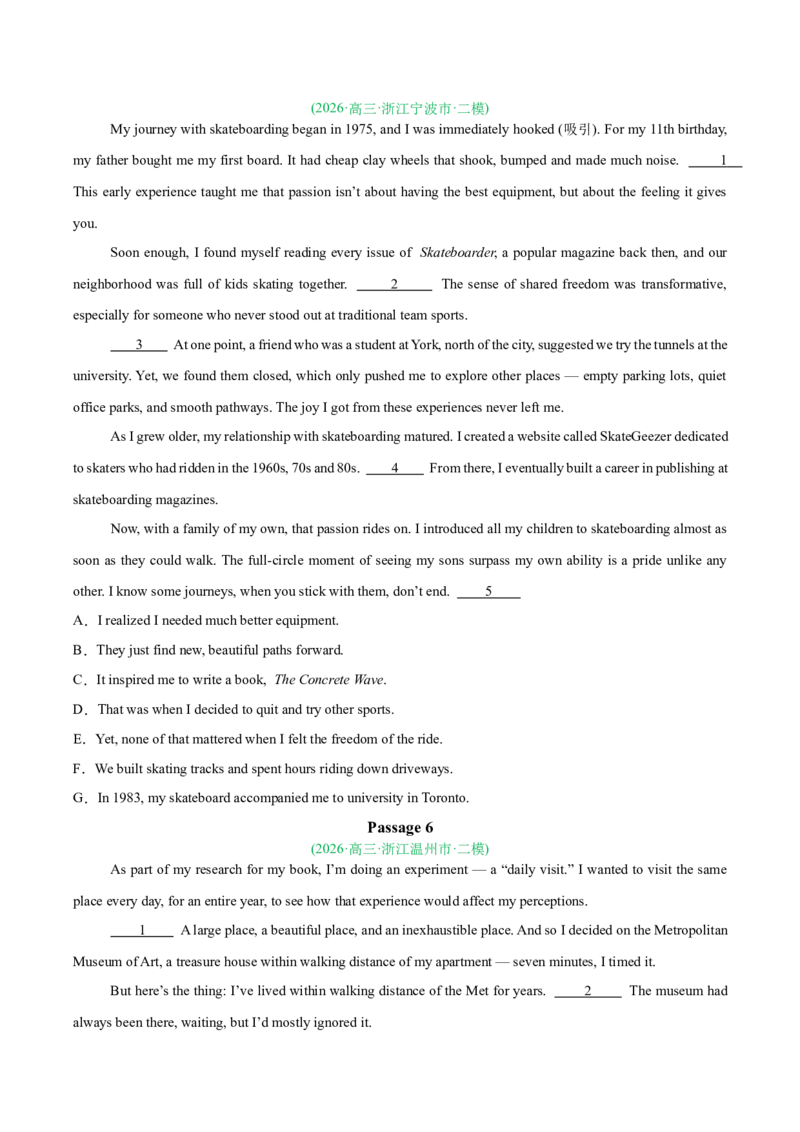
My journey with skateboarding began in 1975, and I was immediately hooked (吸引). For my 11th birthday,
my father bought me my first board. It had cheap clay wheels that shook, bumped and made much noise.     1
This early experience taught me that passion isn’t about having the best equipment, but about the feeling it gives
you.
Soon enough, I found myself reading every issue of Skateboarder, a popular magazine back then, and our
neighborhood was full of kids skating together.     2     The sense of shared freedom was transformative,
especially for someone who never stood out at traditional team sports.
    3     At one point, a friend who was a student at York, north of the city, suggested we try the tunnels at the
university. Yet, we found them closed, which only pushed me to explore other places — empty parking lots, quiet
office parks, and smooth pathways. The joy I got from these experiences never left me.
As I grew older, my relationship with skateboarding matured. I created a website called SkateGeezer dedicated
to skaters who had ridden in the 1960s, 70s and 80s.     4     From there, I eventually built a career in publishing at
skateboarding magazines.
Now, with a family of my own, that passion rides on. I introduced all my children to skateboarding almost as
soon as they could walk. The full-circle moment of seeing my sons surpass my own ability is a pride unlike any
other. I know some journeys, when you stick with them, don’t end.     5
A.I realized I needed much better equipment.
B.They just find new, beautiful paths forward.
C.It inspired me to write a book, The Concrete Wave.
D.That was when I decided to quit and try other sports.
E.Yet, none of that mattered when I felt the freedom of the ride.
F.We built skating tracks and spent hours riding down driveways.
G.In 1983, my skateboard accompanied me to university in Toronto.
Passage 6
(2026·高三·浙江温州市·二模)
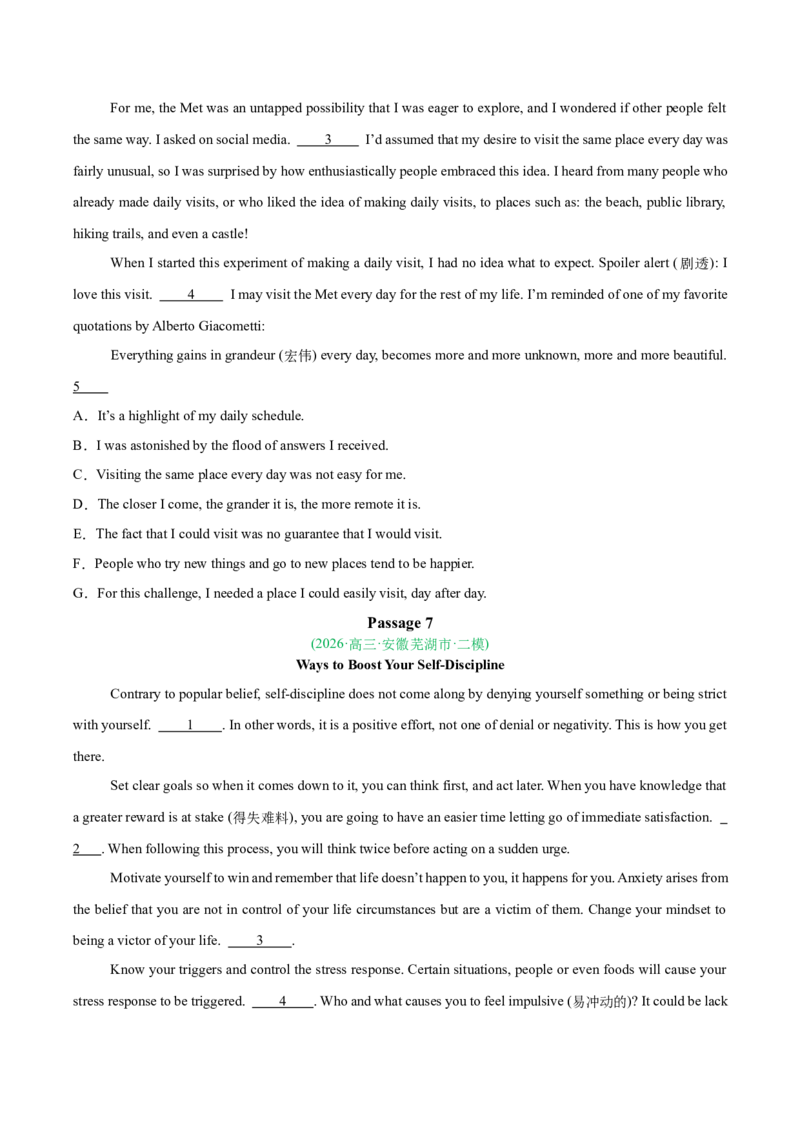
As part of my research for my book, I’m doing an experiment — a “daily visit.” I wanted to visit the same
place every day, for an entire year, to see how that experience would affect my perceptions.
    1     A large place, a beautiful place, and an inexhaustible place. And so I decided on the Metropolitan
Museum of Art, a treasure house within walking distance of my apartment — seven minutes, I timed it.
But here’s the thing: I’ve lived within walking distance of the Met for years.     2     The museum had
always been there, waiting, but I’d mostly ignored it.
For me, the Met was an untapped possibility that I was eager to explore, and I wondered if other people felt
the same way. I asked on social media.     3     I’d assumed that my desire to visit the same place every day was
fairly unusual, so I was surprised by how enthusiastically people embraced this idea. I heard from many people who
already made daily visits, or who liked the idea of making daily visits, to places such as: the beach, public library,
hiking trails, and even a castle!
When I started this experiment of making a daily visit, I had no idea what to expect. Spoiler alert ( 剧透): I
love this visit.     4     I may visit the Met every day for the rest of my life. I’m reminded of one of my favorite
quotations by Alberto Giacometti:
Everything gains in grandeur (宏伟) every day, becomes more and more unknown, more and more beautiful.
5
A.It’s a highlight of my daily schedule.
B.I was astonished by the flood of answers I received.
C.Visiting the same place every day was not easy for me.
D.The closer I come, the grander it is, the more remote it is.
E.The fact that I could visit was no guarantee that I would visit.
F.People who try new things and go to new places tend to be happier.
G.For this challenge, I needed a place I could easily visit, day after day.
Passage 7
(2026·高三·安徽芜湖市·二模)
Ways to Boost Your Self-Discipline
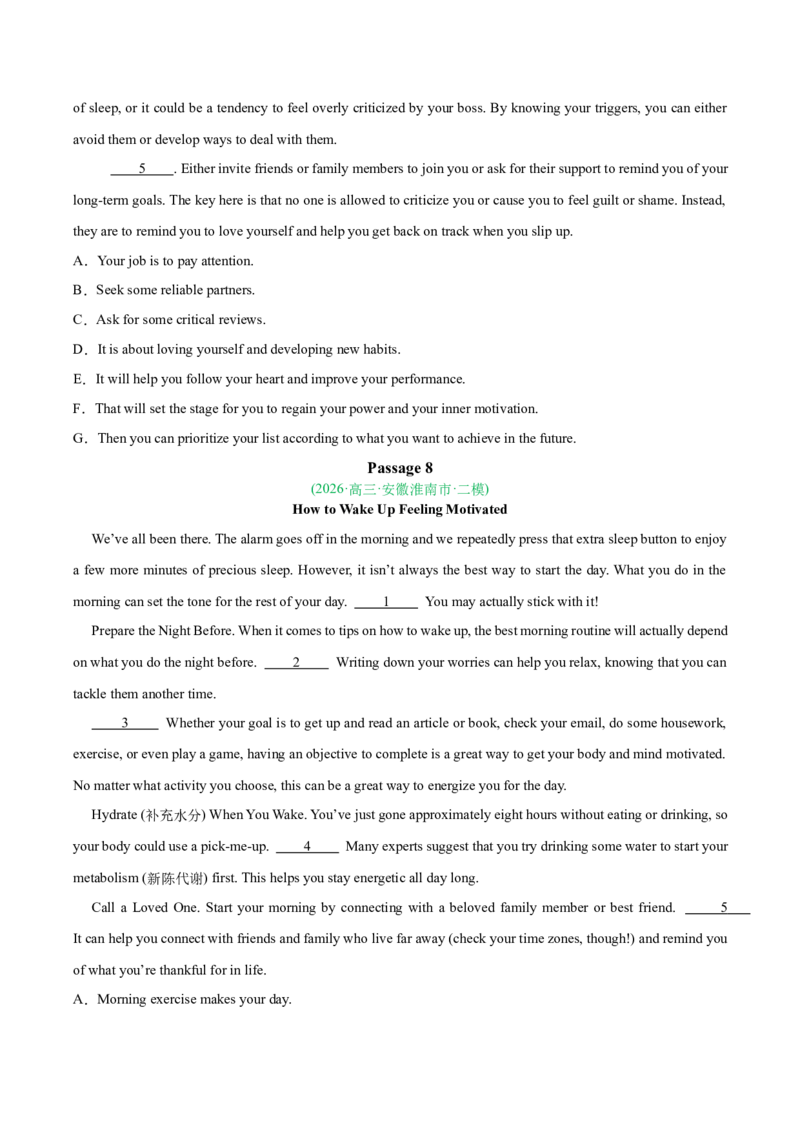
Contrary to popular belief, self-discipline does not come along by denying yourself something or being strict
with yourself.     1    . In other words, it is a positive effort, not one of denial or negativity. This is how you get
there.
Set clear goals so when it comes down to it, you can think first, and act later. When you have knowledge that
a greater reward is at stake (得失难料), you are going to have an easier time letting go of immediate satisfaction.
2   . When following this process, you will think twice before acting on a sudden urge.
Motivate yourself to win and remember that life doesn’t happen to you, it happens for you. Anxiety arises from
the belief that you are not in control of your life circumstances but are a victim of them. Change your mindset to
being a victor of your life.     3    .
Know your triggers and control the stress response. Certain situations, people or even foods will cause your
stress response to be triggered.     4    . Who and what causes you to feel impulsive (易冲动的)? It could be lack
of sleep, or it could be a tendency to feel overly criticized by your boss. By knowing your triggers, you can either
avoid them or develop ways to deal with them.
    5    . Either invite friends or family members to join you or ask for their support to remind you of your
long-term goals. The key here is that no one is allowed to criticize you or cause you to feel guilt or shame. Instead,
they are to remind you to love yourself and help you get back on track when you slip up.
A.Your job is to pay attention.
B.Seek some reliable partners.
C.Ask for some critical reviews.
D.It is about loving yourself and developing new habits.
E.It will help you follow your heart and improve your performance.
F.That will set the stage for you to regain your power and your inner motivation.
G.Then you can prioritize your list according to what you want to achieve in the future.
Passage 8
(2026·高三·安徽淮南市·二模)
How to Wake Up Feeling Motivated
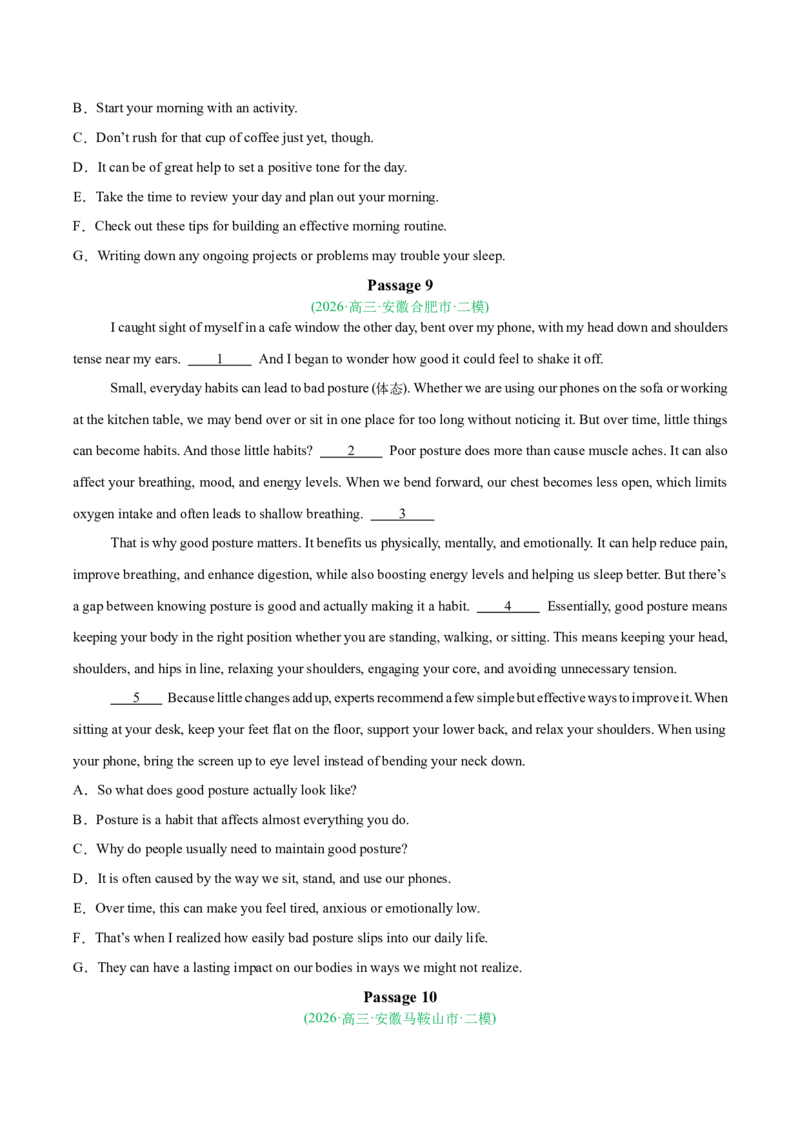
We’ve all been there. The alarm goes off in the morning and we repeatedly press that extra sleep button to enjoy
a few more minutes of precious sleep. However, it isn’t always the best way to start the day. What you do in the
morning can set the tone for the rest of your day.     1     You may actually stick with it!
Prepare the Night Before. When it comes to tips on how to wake up, the best morning routine will actually depend
on what you do the night before.     2     Writing down your worries can help you relax, knowing that you can
tackle them another time.
    3     Whether your goal is to get up and read an article or book, check your email, do some housework,
exercise, or even play a game, having an objective to complete is a great way to get your body and mind motivated.
No matter what activity you choose, this can be a great way to energize you for the day.
Hydrate (补充水分) When You Wake. You’ve just gone approximately eight hours without eating or drinking, so
your body could use a pick-me-up.     4     Many experts suggest that you try drinking some water to start your
metabolism (新陈代谢) first. This helps you stay energetic all day long.
Call a Loved One. Start your morning by connecting with a beloved family member or best friend.     5

It can help you connect with friends and family who live far away (check your time zones, though!) and remind you
of what you’re thankful for in life.
A.Morning exercise makes your day.
B.Start your morning with an activity.
C.Don’t rush for that cup of coffee just yet, though.
D.It can be of great help to set a positive tone for the day.
E.Take the time to review your day and plan out your morning.
F.Check out these tips for building an effective morning routine.
G.Writing down any ongoing projects or problems may trouble your sleep.
Passage 9
(2026·高三·安徽合肥市·二模)
I caught sight of myself in a cafe window the other day, bent over my phone, with my head down and shoulders
tense near my ears.     1     And I began to wonder how good it could feel to shake it off.
Small, everyday habits can lead to bad posture (体态). Whether we are using our phones on the sofa or working
at the kitchen table, we may bend over or sit in one place for too long without noticing it. But over time, little things
can become habits. And those little habits?     2     Poor posture does more than cause muscle aches. It can also
affect your breathing, mood, and energy levels. When we bend forward, our chest becomes less open, which limits
oxygen intake and often leads to shallow breathing.     3
That is why good posture matters. It benefits us physically, mentally, and emotionally. It can help reduce pain,
improve breathing, and enhance digestion, while also boosting energy levels and helping us sleep better. But there’s
a gap between knowing posture is good and actually making it a habit.     4     Essentially, good posture means
keeping your body in the right position whether you are standing, walking, or sitting. This means keeping your head,
shoulders, and hips in line, relaxing your shoulders, engaging your core, and avoiding unnecessary tension.
    5     Because little changes add up, experts recommend a few simple but effective ways to improve it. When
sitting at your desk, keep your feet flat on the floor, support your lower back, and relax your shoulders. When using
your phone, bring the screen up to eye level instead of bending your neck down.
A.So what does good posture actually look like?
B.Posture is a habit that affects almost everything you do.
C.Why do people usually need to maintain good posture?
D.It is often caused by the way we sit, stand, and use our phones.
E.Over time, this can make you feel tired, anxious or emotionally low.
F.That’s when I realized how easily bad posture slips into our daily life.
G.They can have a lasting impact on our bodies in ways we might not realize.
Passage 10
(2026·高三·安徽马鞍山市·二模)
Ordinary and universal, the act of writing changes the brain. In my work as a professor of writing studies, I
research how people use writing to practice resilience (迅速恢复的能力). I have witnessed thousands of students
turn to the written word to work through emotions and find a sense of belonging.     1     Now I share my
research-backed tips in the hope that they can help you develop a writing practice.
Write by hand whenever possible. In contrast to typing or tapping on a device, handwriting requires greater
mental effort.     2     It also allows you to process information, form connections and make meaning.
Write daily.     3     Even writing brief notes about your day — what happened, what you’re feeling, what
you’re planning or intending — can help you get thoughts out of your head and clear your mind.
    4     When strong feelings come up, write them down first. Keep a notebook within reach and make it a habit
to write before you say. Doing so can support reflective thinking, helping you act with purpose.
Write a letter you never send. Don’t just write down your feelings.     5     Even writing a letter to yourself
can provide a safe space for release without the pressure of someone else’s reaction.
I want to remind you that writing takes time. Each draft you make and each piece of advice you receive helps
you look at things from a different perspective. When you revise your work, you build self-awareness and
confidence.
A.Write before acting.
B.It slows your thinking.
C.Write after discussing.
D.You can start small and make it regular.
E.However, illustrate your feelings if you can.
F.Their writing habits suggest writing builds their capacity to adapt.
G.Instead, address them to the person or situation that’s troubling you.
Passage 11
(2026·高三·福建厦门市·二模)
For most of my life, I always treated taste as fixed. When I moved to London, I threw myself into work while
my housemates were endlessly trying new things. My automatic “no” to anything that “wasn’t my thing” only kept
me trapped in the same daily routine. That left me feeling flat and a little empty. I began to question whether my taste
is fixed or could be trained. I once read that children need eight to fifteen tries to accept a new food.    1
I decided to start small. When a friend invited me to a book club, I resisted the instinct (本能) to dismiss it
despite my longstanding dislike of reading and went anyway.    2    Now I spend mornings reading physical
books instead of wandering aimlessly.
Then came music and performance — all things I had previously disregarded.    3    Gradually, I became
fascinated by the unfamiliar rhythms and movements and felt proud of my survival in the end.
   4    However, I stopped saying no before I had even begun. Most recently, I tried out my local library’s
chess club. I was easily 30 years younger than everyone else, but that didn’t matter. Sitting opposite people with
wildly different life stories made me realize how rarely I speak with other generations. We talked about their past
careers, local news and new chess moves. Interestingly, I felt more connected there than with people of my age.
Research suggests that engaging your curiosity in new activities can help protect against age - related
cognitive (认知的) decline.    5    Getting outside my comfort zone now gives me a rush.
A.Yet, I was eager for engagement.
B.I didn’t love everything straight away.
C.For me, it is far more than brain health.
D.Initially, I was awkward and sometimes confused.
E.As expected, new tastes rarely come without discomfort.
F.To my surprise, I enjoyed the discussion and the people there.
G.Why shouldn’t the same principle apply to social activities for adults?
Passage 12
(2026·高三·江西萍乡市·二模)
Many rely on puzzles or apps to sharpen minds.     1     Our study of over 250,000 participants confirms that
physical activity enhances cognitive abilities at any age.
Activities such as walking or cycling can increase the size of the hippocampus ( 海马结构), the part of the
brain responsible for memory and learning.     2     More intense workouts, such as running or high-intensity
interval training, can further boost the brain’s ability to adapt and rewire itself. This helps you learn more quickly and
stay mentally sharp.
The world’s population is aging. By 2030, one in six people will be aged over 60. With that comes a rising risk
of cognitive disorders.     3     Adults should aim for at least 150 minutes of moderate-intensity exercise each
week, or at least 75 minutes of more vigorous activity, like running. It’s also important to include muscle-strengthening
exercises, such as lifting weights, into workouts at least twice a week.
You don’t need to run marathons or lift heavy weights to benefit.     4     Importantly, these forms of
movement are inclusive. They can be done at home or outdoors, suiting all fitness levels. Still, find time for structured
exercise like regular yoga classes for full brain benefits.
If you’re a grandparent, consider playing virtual tennis or bowling with your grandchild. If you’re a teenager
with signs of ADHD, try a dance class, and see if it impacts your concentration in class. If you’re a busy parent,
squeeze in 20 minutes of yoga for a clearer head.     5
Workplaces and schools are taking note: adding physical activity boosts attention and academic performance.
Exercise remains a powerful, accessible tool for brain health.
A.Meanwhile, one in three adults aren’t active enough.
B.Different exercises benefit brain function differently.
C.Here are practical ways to add exercise to your daily life.
D.In each case, you’re tuning your brain, not just exercising.
E.Low-intensity activities like yoga can be equally effective.
F.But research shows exercise also boosts memory and brain health.
G.One study shows a year of aerobic exercise grew older adults’ hippocampi by 2%.
Passage 13
 (2026·高三·山东泰安市·二模)
For many kids, setting a big goal and achieving it can feel like climbing a slippery hill.     1     Teaching
children to create goals that are specific, measurable, achievable, relevant, and time-bound builds a can-do attitude
and helps them face obstacles in life.
SMART goals deconstruct larger goals into smaller, actionable steps. They remove guesswork and make goals
easier to track.     2     For example, an unclear goal like “do better at math” can be reframed as “practice
multiplication tables for 10 minutes after dinner every day”.
When you set SMART goals with kids, the key is to keep them collaborative and simple.     3     They can
make kids feel overwhelmed, so it’s better to focus on one simple goal at a time until it becomes a habit.
It’s also important to avoid common mistakes.     4     Praising only the results instead of the effort will
make kids discouraged when they face setbacks. What’s more, don’t set goals for your kids — let them take ownership
of their own goals.
Setting the goal is just the first step; sticking to it is more important.     5     Regular check-ins, celebrating
small progress and adjusting goals when needed can all help kids stay on track with their SMART goals. In the end,
SMART goals are not just about achieving something, but about building life skills like time management and self-
discipline for kids.
A.Goals should be specific and detailed.
B.One of them is paying no attention to process.
C.Children should be encouraged to set their own goals.
D.First, avoid making goals too big or setting too many of them.
E.There are several tips to help kids stick to their SMART goals.
F.You need to prepare a lot of professional tools to track the goals.
G.But SMART goals can give them the tools to conquer it with confidence.
Passage 14
 (2026·高三·山东聊城市·二模)
Many of us set grand goals, yet ultimately give in to hopelessness when progress remains snail-paced or
invisible, failing to realize that lasting success is rarely achieved in no time.     1
Small steps serve as the core foundation of remarkable achievements. Consider the transformation of a seed
into a towering forest giant. This process unfolds gradually, not in a flash.     2     Day by day, it takes in sunlight
and water, growing deeper roots until it finally stands tall and resiliently — a proof of patience and persistence (坚
持). Our goals mirror that seed: they demand time and daily care.
    3     For example, reading a short English passage daily is better than finishing a thick book in a
weekend. The former builds a sustainable routine; the latter just tires you out. Consistency is key, and small steps
make consistency possible by keeping the task manageable.
Another noticeable advantage of small steps lies in their capacity to lessen anxiety. When faced with a huge
task, feeling nervous is an instinctive response.     4     However, splitting it into small steps helps. Each modest
victory fosters a sense of fulfillment, which in turn strengthens your perseverance. This positive cycle can turn even
the hardest goals into something easy to achieve.
Small steps teach an invaluable lesson in personal growth.     5     Thus, the next time you are confronted
with a monumental objective, don’t be afraid to start small. Bear in mind: every great journey begins with a single
step.
A.We may even abandon the effort before we begin.
B.It transforms quietly and steadily beneath the surface.
C.Small steps contribute to the formation of good habits.
D.Make gradual progress on the demanding task each day.
E.To change this situation, the best solution is to take small steps.
F.Small steps are by no means capable of changing the circumstance.
G.They remind us that progress, rather than perfection, is what truly counts.
主题02 人与社会——人际沟通;语言文化;家庭亲情;校园安全;职业故事;校园成长;
饮食文化;邻里关系;人工智能;社交职场;性格差异;科技生活;人工智能;人际沟通
Passage 1
(2026·高三·江苏基地大联考·二模)
We’re all taught from a young age to say sorry when we make mistakes and to say thank you when someone
does something kind. Yet over the years, “I’m sorry” seems to have multiplied, while “thank you” has almost
disappeared. We apologise for many silly things. Someone knocks into us—we say sorry. We miss a phone call —
we say sorry. This constant apologising has gotten out of control.    1
Of course, we should still apologise when we truly make a mistake or when we hurt someone.     2

But many apologies are not necessary. They happen automatically, almost without thought. We do it to avoid conflict.
We do it because we’ve been taught that politeness matters above all else. We assume that saying sorry will make
people feel good.
    3     Sometimes unnecessary apologies make everything awkward. They distract us from the real issue
and even weaken our relationships. If we are always saying sorry, will our true apologies still sound sincere? Probably
not. And when we apologise for things that aren’t our fault, we only make ourselves feel worse.
Yet something changes when we start saying thank you instead and confidence grows. We stop trying to please
everyone.     4     It helps us value what we have and judge ourselves less harshly. It reminds us that there is
still good in the world —  and in ourselves. And soon, the people around us will notice a change in our attitude.
Replacing sorry with thank you is a small change with a big impact.     5     It improves how we feel and
how others respond to us. And if everyone took a moment to sincerely express gratitude each day, the world might
quickly become a kinder place.
A.It needs to stop.
B.Gratitude also shifts our perspective.
C.However, we ignore our own feelings.
D.However, it doesn’t always work that way.
E.This has always been true and will never change.
F.A simple word shapes our mindset and relationships.
G.We stop trying to put ourselves in others’ shoes directly.
Passage 2
(2026·高三·浙江台州市·二模)
In everyday communication, we exchange not only logical information but also emotions, attitudes and inner
states. Since human beings are emotional creatures, our decisions, whether significant or trivial, are often driven more
by emotions than by pure reason. Therefore, to express strong emotions clearly, we tend to use words like very, so
and truly in daily language.     1
Verbal intensifiers (强化词) are special function words that enhance the meaning, especially the emotional
meaning of the words they are attached to.     2     According to Buzarov (1998), intensification is a stable and vital
feature of informal language. Words such as awfully, deeply, tremendously, and truly help speakers strengthen
emotional impact and influence listeners’ psychological perception.
    3     In English, we often say “I am deeply grateful” or “He is dead tired.” Other languages also have
similar words: очень in Russian, sehr in German, très in French. Some new intensifiers are even created by combining
words, like fantabulous from fantastic and fabulous.
To make the most of intensifiers, we should use them with a clear purpose. Do not use them mindlessly.     4
Connect them with your genuine attitude and focus on conveying precise emotions. This way, appropriate use of
intensifiers will make our words more powerful and sincere.
Intensifiers, like any other linguistic tool, work best in the right context.     5     However, overusing
them without necessity will only weaken their expressive effect and make our words sound empty. Mastering them
wisely helps us become more proficient and persuasive communicators.
A.Proper use is a smart linguistic choice.
B.These function words have great expressive value.
C.You’d better use them to express real ideas and emotions.
D.Using intensifiers at will influences emotional expression.
E.Intensifiers are used to simplify the meaning of other words.
F.This is why verbal intensifiers have emerged in languages worldwide.
G.They are commonly employed across languages and take on diverse forms.
Passage 3
(2026·高三·安徽滁州市·二模)
A Son Repays A Debt
Sho Dewan and his wife sat down with his parents at the dining room table in their cozy home in the Los
Angeles suburbs.     1     Inside was a Mother’s Day card that read “Best Mum Ever!”
First, some Dewan history: Nearly 30 years ago, the family lived in Bangladesh. Sho’s father was a mechanical
engineer, and his mother a teacher. But when Sho was 5, the family packed their bags and moved to Southern
California.     2     The couple’s professional qualifications didn’t transfer over here, and they had to take
whatever jobs they could find. Sho’s dad fried chicken at a KFC. His mother worked at a hotel.
They never complained, nor did they push Sho to chase money blindly.    3     They went back to school in
their 40s, and over time, Sho’s parents got better-paying jobs. Eventually, the couple bought a house. Meanwhile,
Sho followed his parents’ advice and launched his dream company.
    4     Sho was a success. But his parents, now retired, were still making a monthly mortgage payment.
For Sho, it was time to give back. After all they’d endured, his mother and father deserved a leisurely life.
Back at the dining room table: Inside the envelope, Sho’s mother found a simple drawing of their house with
“Our home!” written at the top. It was drawn on the back of a check. “It was always a dream of mine,” Sho says. “
5     ”
A.It was tough going at first.
B.His parents’ efforts had paid off.
C.Sho handed his mother an envelope.
D.There was a small gift box on the table.
E.I’d love to take care of my parents for their love.
F.Instead, they encouraged him to pursue his dreams.
G.His company soon opened some offices in big cities.
Passage 4
(2026·高三·山东淄博市·二模)
Walking around university campuses day and night, students can easily see glowing blue emergency phones
spread over every functional area. These devices can quickly connect users to emergency help.    1    Universities
carry out various practical safety measures to build a reliable safety barrier for teachers and students on campus.
Most young students in lower grades say they can feel a strong sense of safety on campus all the time. They
mention that they can get timely help right away if they run into sudden risks or unexpected troubles on the way to
classrooms and dorm buildings. Standard campus layout and complete supporting safety facilities greatly reduce
students’ worries about daily personal safety.    2
However, safety equipment arranged by schools alone cannot achieve full protection around the clock.    3
Many students will kindly remind their peers to avoid quiet, dimly-lit lonely paths when walking back late at night.
They look out for one another during after-school outdoor activities and choose to move in groups instead of walking
alone after dark.
   4    Campus safety risks have stayed at a very low level. Personal safety accidents and public property
loss rarely take place on campus all year round. The data further indicates that the combination of school management
and student caution is highly effective.
In a word, campus safety relies on joint efforts.    5    Only with close cooperation can people keep the
campus stable, orderly and safe for daily study and peaceful life.
A.While challenges remain, current approaches show promising results.
B.Though emergency phones are useful, high-tech systems remain essential.
C.Students generally feel secure with current safety arrangements on campus.
D.Professional security patrols and real-time alerts are also provided by colleges.
E.Campus safety records demonstrate the success of combined preventive efforts.
F.Student initiative and mutual care significantly enhance overall campus protection.
G.Active participation from institutions and individuals can achieve long-term security.
Passage 5
(2026·高三·山东青岛市·二模)
As a child growing up there are many different paths available to navigate one’s way through adolescence into
adulthood. I was fortunate to have had the guidance of my father, who had many hobbies in his life.     1     He loved
talking about them to anyone who would listen.
    2     I was always looking for pennies — whether given as change or picked up off the ground — and
checking to see if they were “Wheaties”, pennies made from 1909 to 1958. Some Lincoln Wheat Cents were quite
valuable, but for me, the real joy was the search itself.
My father passed away last week. Although he will be missed, there is no sadness in his passing. He lived
nearly 97 years of a full and meaningful life. During his final moments, I whispered in his ear that I needed a sign
after he left us.     3
The next day, my sister and I were going through his old clothes when something fell out and hit the floor —
it was a 1928 Wheat penny. There was no way to know how long it had been there. Some might call it a
coincidence.     4     The fact that it was also a Wheat penny proved what I already knew — it was him. It could
have easily been put aside with the clothes, but it found its way to me.
Later, I was talking to my neighbor and told him the story.     5     However, a few days later, he came
over with a bag of pennies he had. Inside it, he found two more 1928 Wheat pennies — one for each of my sisters.
Our father is no longer with us, but he is still here.
A.He passed the habit on to me.
B.I figured he wouldn’t think any more of it.
C.To me, it was my father handing me the coin.
D.Old coins carried the quiet weight of the past.
E.Collecting coins was one of his greatest interests.
F.It specifically involved a 1928 coin — the year he was born.
G.His soft words and warm hands supported me through my youth.
Passage 6
(2026·高三·湖北宜昌市·二模)
Museum guides do much more than lead tours; they help visitors connect deeply with history and science. At
New York City’s Intrepid Museum, Jonathan Milard excels in this role. As the manager of school and teacher
engagement, he designs educational experiences that inspire young minds. Milard has served here for ten years.     1
Through hard work, he gradually advanced to his current position. Every day is different.
Milard’s workday begins early. He rises at 7 a.m., prepares his lunch, and commutes (通勤) by subway from
Queens to Manhattan. He typically arrives by 9 a. m., using his travel time efficiently.     2     A full list of
activities awaits him at the museum.
    3     After settling in, Milard researches and plans with his team. Student groups start arriving around
10:30 for guided tours. The museum welcomes learners of all ages — from kindergarteners to high schoolers. “I have
the privilege of sharing aviation, space, and history with them,” Milard says. To make lessons memorable, he often
wears costumes matching the day’s theme. His sessions are highly interactive, filled with questions and observations.
Students are encouraged to think critically. It’s lively learning.
Afternoons shift to teamwork and management. Milard leads a team of twenty educators, discussing program
improvements and upcoming projects. A significant portion of their work involves creating accessible experiences
for visitors with disabilities. Since many programs are paid for by special funds, careful planning and reporting are
essential. Milard also develops lesson plans and monitors program outcomes.     4
By 5 p.m., Milard prepares to wrap up. He reviews progress and sets priorities for the following days. On the
subway home, he reads sci-fi or listens to music.     5     “We’re not just teaching facts; we’re waking up
curiosity,” he notes. That interest, he believes, can last a lifetime.
A.Milard is always ready to offer help.
B.His career began as a part-time educator.
C.It’s detailed work, but he finds it rewarding.
D.Students are asked what they think about the lessons.
E.Morning hours are focused on preparation and interaction.
F.Reflecting on his career, he feels a deep sense of purpose.
G.During the ride, he reviews his schedule and answers emails.
Passage 7
(2026·高三·湖南永州市·二模)
Many families find themselves questioning whether there’s a need for their children to do chores at home. But
Dr. Harris believes chores aren’t just about keeping a clean home.     1
Assigning regular household duties can enhance children’s cognitive development. According to Dr. Harris,
chores strengthen core management skills — the brain’s ability to plan, focus, change between tasks and manage
time effectively.     2     . They develop stronger working memory, better emotional regulation and more mental
flexibility.
Chores can foster children’s independence and sense of responsibility at different ages. Younger children love
to feel capable. Cleaning up toys or wiping down and setting the table, simple tasks like these develop
independence.     3     . Dr. Harris encourages parents to frame these not as punishments, but as opportunities
to grow. When kids feel a sense of ownership, they’re more likely to follow through. And giving them a say in what
they do can go a long way.
     4     . “One symptom of depression is lack of motivation, and the best solution to that is activity,” Dr.
Harris explains. “A set routine, even a small, manageable responsibility can help get kids moving and thinking.” In
the case of anxiety, chores can offer a sense of control and predictability. “An anxious brain works well with structure,”
she adds. “Doing something real and productive can ease distracting thoughts and provide a break from chaotic
thoughts.”
Of course, every minute of a typical family life today can be accounted for, leaving parents to wonder whether
to insist on chores at all. Dr. Harris acknowledges this tension and encourages flexibility. “When life gets busy, it’s
okay to pull back,” she says. “     5     .” Actually, kids don’t need to do everything, but they should do something
when they have time.
A.Chores help children build confidence and empathy
B.But when there’s room, lean into those opportunities
C.These are skills that serve them well, far into adulthood
D.Kids who have chores are typically better self-managers
E.Asking kids to help out around the house can have powerful lifelong benefits
F.Chores can also support mental health, particularly for kids with anxiety or depression
G.For older children and teens, tasks can become more complex such as helping cook meals
Passage 8
(2026·高三·江苏徐州市·二模)
As the college entrance examination was approaching, I was under great pressure in senior three. I fixed my
mind entirely on review every day, wishing to improve my grades steadily. The constant chirps from a bird nest in
the old banyan tree outside the window always disturbed my study.     1     I even discussed with my classmates
whether we could ask the school to remove the nest.
    2     He did not criticize our selfish idea at all. In his reply, he told us that every small life should be
respected, and we needed to learn to live in harmony with birds while pursuing our dreams. To help us study better,
the school prepared thick sound-proof curtains and changed part of our evening self-study time properly.
We were moved by the headmaster’s kindness.     3     The teacher introduced that these birds were in
their breeding period and would leave campus soon. She also told us the importance of protecting wild birds and
keeping the ecological balance. My annoyance with the chirps disappeared little by little.
One day after class, I went close to the banyan tree to watch the nest. I saw the mother bird flying back and
forth with food for her babies. The warm picture made me feel soft in my heart.     4
This experience has changed my attitude towards life.     5     I finally understood that real growth is not only
gaining excellent academic results but also learning to be tolerant, gentle and respectful to all lives around us. This
warm memory will stay in my heart forever.
A.I lost my focus completely.
B.I no longer saw the chirps as noise.
C.The headmaster replied to us warmly.
D.We attended a special biology lecture.
E.It taught me what real growth truly means.
F.I tried to find a quiet place to study alone.
G.Small and lovely lives deserve our care and protection
Passage 9
(2026·高三·湖北襄阳市·二模)
Instant noodles, a food that holds unique emotional value for many, have experienced a remarkable
transformation in modern diets. Initially created to provide quick meals, they offered an economical, long-lasting
solution for times when cooking wasn’t practical.     1     Their core value was to satisfy hunger quickly and
cheaply, with taste being a secondary consideration to function and cost.
Today, consumers are paying closer attention to labels and actively seeking cleaner ingredients when making
food choices. As a result, traditional instant noodles are increasingly viewed as outdated or even unhealthy.     2
Consumers can choose takeout or ready-to-cook meals, which typically offer a more favorable mix of convenience
and nutrition compared to traditional instant noodles.
    3     Some brands offer organic, low-additive, or entirely plant-based options, while others focus on
eco-friendly packaging. High-end instant noodle lines, often inspired by regional cuisines, are also gaining popularity,
turning a basic snack into a dining pleasure.
Despite these improvements, even “healthier” instant noodles still remain nutritionally limited. To enjoy them
more mindfully, try boosting their nutritional value by adding fresh vegetables, eggs, or meat, and using only half or
less of the seasoning packet (调料包) to reduce salt and additives.     4
In conclusion, the story of instant noodles is one of adaptation as well as a reminder to make thoughtful food
choices in our fast-paced lives.     5     As technology advances and consumer expectations rise, the next
generation of instant meals will likely be tastier, cleaner, and more sustainable. Yet sometimes all we really need is a
warm bowl of comfort — prepared wisely.
A.Several factors have made them less popular lately.
B.Therefore, they were criticized for being unhealthy.
C.In response, demand has moved towards healthier choices.
D.Driven by these trends, the industry is reinventing the product.
E.For decades, instant noodles stood for convenience and affordability.
F.In the future, instant noodles need to balance tradition with innovation.
G.Above all, just save instant noodles for emergencies, not everyday dinners.
Passage 10
(2026·高三·广东深圳市·二模)
For years, I kept a careful distance from the people around me. Living in a busy city apartment, I learned to
move through shared spaces quietly.     1     It wasn’t that I disliked others; keeping to myself just seemed easier.
Independence mattered to me, and needing no one felt like part of being a grown-up.
    2     Without warning, the power went out. The building fell into complete darkness. I sat alone in my
apartment, the cold air pressing in as my phone went dead. The silence was familiar. Yet this time, it seemed different.
Less comforting. More exposed.
A soft knock broke the stillness. It was my neighbour from 3B, someone I recognised but hardly knew. She
held a candle and mentioned that a few residents were gathering in the hallway and invited me to join them. I hesitated.
Staying alone felt safe, but something felt unsettled.     3
People sat on the floor, sharing blankets, tea, and quiet conversation. I listened more than I spoke. The man I
had once assumed was unfriendly turned out to be a retired doctor with a dry sense of humour.     4     I realized
how easily distance can turn into detachment (疏离).
When the lights finally returned, the hallway looked the same, but it felt different. I didn’t suddenly become
outgoing, nor did I abandon my need for space.     5     It’s about knowing when to let them in. Now, when I
step into the elevator, I don’t automatically lower my eyes. Sometimes, I look up.
A.After a moment, I stepped outside.
B.I avoided eye contact and unnecessary conversation.
C.I began to question my decision to join the conversation.
D.Most neighbours in the building kept to themselves as well.
E.As the night progressed, my long-held belief began to loosen.
F.But I understood something new: maturity isn’t about shutting others out.
G.That belief was challenged one night when a violent storm swept through the city.
Passage 11
(2026·高三·浙江金丽衢十二校·二模)
At the Beijing World of Robots, located in the robotics industrial park in Beijing’s Yizhuang, the vision of an
intelligent future is coming to reality with all kinds of robots. With advanced AI capabilities, they are increasingly
transitioning from industrial applications to domestic environments with human-like appearances and skillful body
and hand movements.     1
Embedded AI (具身智能), which integrates AI with physical objects such as robots, is emerging as a game-
changing technology with limitless potential.     2     For instance, Unitree Robotics, known for its dancing
robots showcased at CCTV’s Spring Festival Gala, demonstrates cutting-edge applications of embedded AI.
In industrial and agricultural settings, embedded AI can dramatically enhance operational efficiency.     3
For homes and healthcare sectors, it offers personalized and intelligent solutions, such as AI-powered smart home
systems that have already been widely adopted. Additionally, autonomous driving technologies, though still under
refinement and testing, represent another promising avenue for embedded AI.
    4     This innovative solution, jointly launched by Meituan Medicine and Galbot, represents the world’s
first humanoid robot-powered smart pharmacy system. It made its debut at the China International Fair for Trade in
Services in September 2024.     5     It autonomously plans its route, navigates to the required item, and uses
advanced AI-powered vision and grasping technology to complete the task. This cutting-edge technology shows how
AI is revolutionizing healthcare services.
A.It can also reduce costs and enable precise management.
B.China has played a leading role in the development of elderly care robots.
C.Several Chinese companies have already made significant strides in this area.
D.These robots can bring intelligent assistance to various aspects of everyday life.
E.One groundbreaking example of AI-driven robotics is the Galbot humanoid robot.
F.Designed for 24/7 autonomous operation, a Galbot robot can restock items efficiently.
G.Meanwhile, the automotive industry is also experiencing a rapid AI-driven transformation.
Passage 12
(2026·高三·福建宁德市·二模)
Perhaps, you are a smart person with good knowledge and creative ideas, but when you enter a brand-new
environment, it is not easy for new people to recognize and respect you immediately. Luckily, there are several
practical ways to deal with these problems.
Be curious and be willing to learn new things actively. In a new environment, you may face many challenges
outside your own field.     1     They can be more flexible and better meet new job requirements.
Have a good sense of judgment. When working or studying in new surroundings, you should make wise and
careful decisions.     2     Instead, you should focus on long-term goals and insist on what is truly right.
Be confident and make eye contact while communicating. Looking confident is necessary when talking with
others.     3     Before entering, you can encourage yourself, hold your head high and smile. Looking others in
the eye helps you build trust and connection.
Set clear goals and express your ideas properly. When working with others, a clear goal and practical plan are
quite important. Let others know your goals clearly.     4     Besides, treat your teammates with respect as
equals.
Be ready to help others warmly. Don’t just focus on your own work. After finishing your own tasks, offer help
to others patiently.     5
A.It’s unnecessary to wait for others to help you.
B.For example, you may feel nervous in a job interview.
C.You should not be troubled by unimportant short-term choices.
D.Many people find it hard to adapt to new environment smoothly.
E.In this way, you can quickly get along well with people around you.
F.People who keep an open mind to new knowledge have an advantage.
G.Try to find the ideas that can bring people together and express them clearly.
Passage 13
(2026·高三·广东汕头市·二模)
Human personalities are typically sorted into two categories: the introverted (内向的) and the extroverted.
Introverts prefer quiet reflection, while extroverts lean toward lively interactions. These differing tendencies shape
distinct behaviors, often causing misunderstandings. Thus, it is vital to understand them.
Introversion and extroversion are at opposite extremes, yet most people fall somewhere in between.     1
For instance, people often become more introverted as they age, a shift driven by changes in motivation, energy
levels, and lifestyle. Context also plays a crucial role. Someone who lacks regular social interaction might become
outgoing in a new environment.     2     Instead, recognize their dynamic personalities shaped by time and
circumstance.
When a friend’s behavior unsettles you, first trace the root to their basic nature, which naturally shapes their
everyday actions. An introvert may perceive a private question as impolite, while an extrovert might intend friendliness
with it.     3     In this way, a solid bond can be formed.
Since these character differences easily cause tensions, open dialogue becomes crucial when conflicts arise.
4     And since this is a shared effort, you and your friend must both speak up. If you’re more introverted, you can request
pauses to share your ideas; if your friend is more extroverted, he can focus on listening more, which fosters balanced
interaction.
    5     Introverts do well in quiet reflection, offering others a sense of calm and ease. Extroverts, by
contrast, shine with energy, lifting spirits and breaking the stillness. This is why we should embrace each friend with
an admiring mindset. We must reject rigid labels, honor differences, and bridge gaps through respect.
A.Personality styles are never fixed.
B.The first step is to clearly voice your needs.
C.However, these conflicts can be worked out.
D.Such misunderstandings don’t come from rudeness, just differences.
E.Given these differences, set aside judgment and respect these distinctions.
F.Every personality, whether introverted or extroverted, has remarkable strengths.
G.Therefore, avoid labeling friends simply as absolute “introverts” or “extroverts”.
Passage 14
(2026·高三·山东东营市·二模)
For many constantly connected to digital devices, a complete tech break sounds increasingly appealing. In the
hit show The White Lotus, guests at a high-end hotel are asked to hand in their phones for a full digital “detox”.
Off screen, the tech-free reset idea has gained huge popularity, from weekend getaways to apps claiming to help you
quit other apps.     1
Before answering that question, we must define what a digital detox really means. It is not just full abandonment
of all digital tech, but partial avoidance of overused features, like quitting a problematic social app or silencing
endless notifications (通知). More and more people try detoxes to reclaim attention control and build healthier digital
habits.     2     While positive online reviews sound persuasive, they are often one-sided. Only well-controlled
experimental studies offer reliable answers.
The findings, however, tell a more complex story, contrary to popular belief.     3     Instead, the most
reliable effects come from partial, lasting changes over at least two weeks, like limiting daily phone use, rather than
total avoidance.
Then how does digital detox work to improve wellbeing? Our “non-smart phone study” offers clear explanations.
4     At its core, it cut overall digital media consumption, which in turn freed up daily time for meaningful offline
activities. Most critically, this reduced constant distractions, helping people stay fully present in daily life.
    5     Identify harmful content, replace screen time with joyful offline activities, and reduce phone
distractions in social settings. This ensures long-term effectiveness. In our digital world, it is more than a trend —
it’s a practical way to protect your attention and well-being.
A.What is digital detox?
B.Does digital detox actually work?
C.Still, popularity doesn’t prove effectiveness.
D.To maximize detox benefits, start with practical steps.
E.Improvements come from psychological and behavioral shifts.
F.We found the improvement originates from interconnected changes.
G.No solid evidence proves total, short detoxes bring long-term benefits.
Passage 15
(2026·高三·山东济南市·二模)
Why struggle with an essay when AI can generate one on your behalf in seconds? Why personally respond to an
email when AI can instantly produce automatic replies filled with all the typical greetings and talking-points?     1
Nevertheless, the ease is not necessarily a good thing. Writing still can’t be replaced even in the AI-driven era.
Writing serves as a fundamental cognitive (认知的) exercise through which we realize what we truly understand,
acknowledge the limits of our knowledge, and develop structured reasoning. More crucially, it is precisely by the
very act of writing that we individuals ultimately make new sense of the world around us and arrive at a deeper
understanding of who we are.     2
Paul Graham, a well-known computer scientist, once observed, “Good writers do not simply think and then record
thoughts casually.     3    ” Writing helps us generate ideas we have never had before.
Another critical but often overlooked function of writing is the compression (凝练) of ideas.     4     When
done poorly, this process loses precious insights. When done well, it generates the insights and removes the unnecessary
parts. Compression requires thinking, which is one reason why writing is so difficult.
AI can write for us, but it won’t help us learn to think or understand a problem with deep fluency. And we need
deep fluency to solve hard problems. A world of common thinking available on demand will encourage people to
outsource their thinking and reward people who don’t.     5     Original thinking will only become more
valuable in the future.
A.It bridges the gap between ideas.
B.Many people depend heavily on AI.
C.AI has made writing surprisingly effortless.
D.They always uncover insights in the act of writing.
E.Those who can think and write independently will stand out.
F.This journey of self-discovery is in essence a vital form of learning.
G.Writing requires us to keep to a point and organize our ideas logically.
主题03 人与自然——园艺植物;环保园艺
Passage 1
(2026·高三·江苏南京市·二模)
In Shakespeare’s The Winter’s Tale, he announced the emergence of the daffodil (水仙花) as the telling sign
that we had reached “the sweet o’ the year,” that the winds of March’s beauty had arrived, and that a brighter season
had begun.
In choosing daffodils, the classic yellow type remains a popular choice. However, there are more elegant
varieties to pepper throughout your borders, including “Paperwhite” and “Moonlight Sensation”.     1

Fortunately, planting and growing daffodils is a simple task that will gain rich springtime rewards.
Planting daffodil bulbs (球茎) requires you to think ahead. The ideal planting time is at the beginning of
autumn, before the weather becomes too cold.     2     Late October to November is perfect for regions of mild
climates. Additionally, soil with good drainage (排水) is a must, as bulbs won’t produce a wonderful spring display
if they sit in water for a long time.     3    What’s more, plant your daffodil bulbs at a depth that is roughly 3
times the bulb’s height, and allow 4-6 inches between them.     4     Otherwise, your daffodils would look
unnatural.
    5     They enjoy bright light but can also grow healthily in low light. Water the bulbs regularly during
growth — there’s no need for frequent watering, as they tolerate slight dryness well. A small amount of general
fertiliser is sufficient when shoots emerge to support growth, and this regular application can fully meet their nutrient
needs.
A.Avoiding planting in rigid rows is a nice trick.
B.Daffodils ask for strict light and water control.
C.This allows them to establish roots before winter.
D.Daffodil lovers have devoted much time and energy.
E.Add organics to improve its nutrition for additional care.
F.Prized for toughness, daffodils require a light touch in care.
G.A spring garden is incomplete without the cheerful daffodil.
Passage 2
(2026·高三·湖南湘潭市·二模)
A beautiful flower garden begins with preparation. It is not just about choosing pretty flowers.     1     For
beginners, this step is especially important. The steps below outline the key factors to consider before getting
started.Know your site
The first step in creating the perfect flower garden is to familiarize yourself with the area you want to plant.
Landscape architect, Mary Ellen Cowan suggests, “Really know your site.     2     Be honest with light,
moisture (水分) conditions, and the shape of the land.”Know your soil
Healthy soil is the foundation of a successful flower garden.     3     One reliable way to do this is through a soil
test. Erin Benzakein, owner of Floret Flower Farm, explains how to collect soil samples: Dig about one foot deep
and take small amounts from different areas. Then send it to a testing lab for analysis. The results will help you decide
how to improve your soil.Know your flowers
Cowan also says, “Learn what plants grow well in your soil.     4    ” Carol Bornstein, expert at the Santa
Barbara Botanic Garden, recommends “visiting nearby natural areas that mimic (与……相似) your conditions in the
wild to discover the flowers that you like”.Know your limitations
In her book, A Beautiful and Easy-Care Flower Garden, Stacy Ling reminds us to “think through your lifestyle
before you design, plant, and decorate your garden spaces. Every spring it’s tempting to want to do it all, but be
realistic with how much time you have available to maintain your garden.     5    ”
A.You can always add more next year.
B.You should understand your garden first.
C.The plants will fill in faster and cut down on weeds.
D.On this basis, you can figure out what to plant wisely.
E.Listen to mother nature to learn about the land’s quality.
F.You can’t have everything screaming at you in the garden.
G.Before planting, it pays to understand what nutrients it already has.
主题01 人与自然——环保创意;环保行动;环保水资源
Passage 1
(2026·高三·江西上饶市·二模)
Waste can be turned into treasure in daily life, and eggshells are a perfect example of this.     1     Next
time you make a pie or bake a cake, you may want to think twice before throwing eggshells in the trash. They have
a variety of practical uses in our everyday life.
    2     Tap the small end with a spoon to crack it, then carefully remove the top and empty the egg.
Simply fill eggshells with soil, plant seeds just below the surface, and place them near a sunny window. When your
seedlings (幼苗) are ready to plant outdoors, simply bury the entire eggshell. The shell will break down and provide
extra nutrients for your plants, which accounts for another function of leftover eggshells.     3    . Adding
powdered shells to garden soil also helps prevent common diseases.
Would you like to make your own sidewalk chalk at home? Now eggshells can make your dream come true in
an easy way. Crush clean eggshells into a fine powder.     4     Add food coloring to it, shape it into sticks, and
let it dry for three days before use.
Brewing coffee with powdered eggshells greatly reduces its strong bitterness.     5     Besides, you can
use eggshells mixed with vinegar to calm minor skin irritations (敏感).
In short, eggshells are far more useful than we often realize, turning waste into value in simple, smart ways.
A.This is why people throw them everyday.
B.Stir it into hot water to make a thick mixture.
C.This easy trick can make your coffee taste much milder.
D.The taste of coffee depends closely on its preparation method.
E.Eggshells are an excellent source of micro-nutrients for plants.
F.Eggshells work well as small containers for growing young plants.
G.Yet many people throw them away without knowing their hidden value.
Passage 2
(2026·高三·江西新余市·二模)
Litter Crisis and Individual Action
Each year, approximately 51 billion pieces of litter are scattered along U.S. roads and waterways, which
amounts to about 147 pieces per person based on the nation’s 347 million population. Environmental efforts have
been increasing in frequency over time.     1     Litter hot spots can be easily found in almost every community, and
addressing this crisis requires joint efforts from all of us.
Having lived along highways for my entire life, I have long noticed excessive litter.     2     This deep
concern about littering followed me from my hometown to New York, motivating me to take practical action.
In late October, I organized a clean-up event along the Genesee River Trail. With five fellow students joining
in, we collected two large garbage bags of trash. Though it is not a large-scale project or headline-grabbing climate
campaign, such small but consistent actions can accumulate and bring visible improvement.     3
What matters is that the Rochester city council offered full support by providing all the supplies needed.     4
You simply determine the area, contact the official department, fill out a form, and the city will take care of delivering
and collecting the materials.
    5     Only when we care for the environment can we reduce pollution, beautify our communities and
protect the Earth that has sustained us for thousands of years. It is high time we joined hands to repay the planet that
has always taken care of us.
A.It can attract more people to join the clean-up.
B.For instance, it was thrown from car windows.
C.True change starts with individual responsibility.
D.For those environmentalists, the process is simple.
E.However, such severe pollution remains unsolved.
F.They make public spaces cleaner and more pleasant.
G.Therefore, it helps solve many environmental problems.
Passage 3
(2026·高三·广东东莞市·二模)
For many people, leaping into the water on the edge of a major urban area might be uninviting. Floating rubbish
and unpleasant smells are enough to keep them away.     1
What is Swimmable Cities?
Rivers have long been polluted by wastewater, making them unsafe for humans and many animals. Swimmable
Cities is an international organization calling for global cooperation to make urban waterways clean enough to swim in.
    2
Its appeal is broad, spanning governments, businesses, academics, swimmers, nonprofits and beyond. And now it has
already reached 100 cities worldwide.
    3
Many people never think twice about where their waste goes after leaving their homes. Stormwater from city
rains picks up pollutants, finally ending up flowing into rivers. Even with legal frameworks and wastewater treatment
in place, many urban rivers still carry dangerous levels of harmful bacteria, which can cause many health issues.
4     Thus, good water quality is essential to cities.
What progress has been made?
Environmental protection always comes with many benefits, including healthier habitats for animals and
reduced flooding.     5     Harmful bacteria levels have dropped greatly, fish have returned to the rivers, and
urban waterways are becoming significantly cleaner and safer. As once-polluted waterways are restored, swimmable
cities are within reach.
Beyond recreation, cleaning rivers restores ecosystems, turning a once-impossible goal into a shared global
mission.
A.What happened to our rivers?
B.How can we keep good water quality?
C.Urban areas have different water treatments.
D.Its goal is to improve water quality in urban rivers.
E.But Swimmable Cities aims to get people to do just that.
F.Cities across the globe are also achieving pleasant results.
G.It is not just an ecosystem issue, but a critical health concern.
主题02 人与自我——情绪管理;心理健康;思维方法;心理激励;建康健身;思维方法;
自信心;思维模式;思维能力;心理学;技术认知;认知偏差;人生哲理
Passage 1
(2026·高三·河北唐山市·二模)
Guilt is a common human emotion. It can guide us, but it can also hurt us. Guilt is usually defined as a feeling of
responsibility or regret for something we have done wrong, or even for something we only imagine we have done
wrong. It often comes from our values and expectations, which shape how we judge our own behavior.     1     It
reflects our awareness of right and wrong. It shows that we care.
    2     Some guilt is helpful. This kind of guilt appears when we break a promise, hurt someone, or fail
to meet an important responsibility, and it pushes us to correct our mistakes and improve ourselves. It is useful.
However, there is also harmful guilt. This type often comes from unrealistic standards, past events we cannot change,
or even other people’s expectations.     3     Unlike helpful guilt, it does not lead to action but instead weakens
our confidence and wears out our energy.
When you feel guilty, pause for a moment. Ask yourself where the feeling comes from and whether it is based
on facts or assumptions, because not all guilt is reasonable. Then consider its effect: does it encourage you to take
positive action, or does it simply make you feel bad without offering a solution?     4     By questioning your
guilt, you begin to understand it instead of being controlled by it.
If your guilt is helpful, take action. Apologize, make changes, or complete what you have left unfinished, so
that your behavior matches your values. If your guilt is harmful, learn to let it go, even though this may take time and
effort. Remind yourself that no one is perfect, and that growth often comes from mistakes.     5     Only when
you learn to use it wisely can you move forward with confidence and create a better life.
A.This step is important.
B.Not all guilt is the same.
C.It’s never too late to regret.
D.They can be corrected later.
E.It makes us feel unworthy or stuck.
F.In this sense, guilt is not simply negative.
G.Guilt should guide your life instead of controlling it.
Passage 2
(2026·高三·浙江金华十校·二模)
Helping others can be one of the most meaningful things you do, but it can also take a lot out of you, making
you lose sight of the fact that you need support, too. You might think pushing through is normal.     1     You
need to learn how to invest in yourself and pay attention to your mental well-being.
Burnout doesn’t always look like exhaustion.
Burnout isn’t always obvious.     2     It can be irritability (易怒), lack of focus, or feeling like you’re
disconnected from the work you used to enjoy. Being aware of the emotional signs early makes it easier to step in
and make changes. That might mean adjusting your schedule, taking breaks when you can, or just giving yourself
permission to unplug after a long day.
Learning something new boosts mental energy.
Doing the same routine every day can start to feel dull.     3     Adding something fresh to your day, like
learning a new technique or exploring a new topic, can bring your energy back. A few minutes a day reading an
article, watching a short tutorial, or engaging in a new task can refresh your mindset.
    4
If you want to know how to invest in yourself, having control over your schedule can make a huge difference
in how you feel day to day. When you’re able to choose how and when you complete tasks, it reduces stress and helps
you feel more balanced.
Small wins matter for motivation.
Sometimes big goals feel out of reach. That’s why small wins are so important. Checking something off your
list — even if it’s just attending a class — builds positive drive.     5     Over time, those small wins lead to
larger milestones.
A.When that happens, your interest and motivation can fade.
B.Purpose is a powerful mental health tool.
C.Sometimes it can mean saying yes to extra tasks.
D.It doesn’t only appear as physical tiredness.
E.But the truth is, constantly putting yourself last isn’t sustainable.
F.Time flexibility leads to emotional stability.
G.Each time you complete a step, you prove to yourself that progress is happening.
Passage 3
(2026·高三·浙江绍兴市·二模)
The work is piling up, pressure is mounting, and deadlines are approaching. How can we still get useful results
if we need to make quick judgments and fast decisions?     1     Here’s how we can upgrade our minds.
Firstly, challenge your key assumptions. Based on past experience, our mind constantly makes assumptions
about the world. However, what saves us time and energy can lead to wrong conclusions if they remain unchallenged.
Start by working in a team and questioning each other’s assumptions.     2
You should also consider alternative explanations. Humans seek explanations, and we prefer the one that comes
to mind first.     3     It pays to naturally look beyond the most obvious explanations. This is to avoid confirmation
bias; when we ignore evidence that goes against a prior belief. A master thinker treats their preferred explanation just
as an assumption.
    4     They simply refer to the main factors influencing how things have been going or how they will
go. If we practice watching for driving factors when we have time to think, we’ll be able to identify them more
instinctively on occasions when we’re in a hurry. The master thinker prioritizes the factors that impact an issue the
most.
Finally, consider the overall context. The master thinker considers the circumstances and conditions of an
issue.     5     A few minutes to orient ourselves and reflect on the situation as a whole can once more save us
time down the road. Only then is it time to consider the details and incorporate them back into said picture.
A.Moreover, try to focus on key drivers.
B.Attempt to think about problems wisely.
C.However, that isn’t necessarily the correct one.
D.This habit involves looking at the big picture first.
E.True expert thinkers know the limitations of their minds.
F.This collaborative approach enables your thinking to be challenged.
G.Actually, the habits of master thinkers can help in reasoning and making decisions.
Passage 4
(2026·高三·浙江嘉兴市·二模)
Have you ever found yourself reciting your grocery list out loud in the supermarket or saying something
encouraging to yourself before a big moment? If so, you are not alone. Talking to ourselves, either within our heads
or out loud, is a common behavior. Psychologists refer to it as “self-talk,” a mental tool like a Swiss army knife.     1
Saying something out loud, whether it’s positive or negative, can make the thought that you’re expressing
seem more official, or public, than if you merely think about it.     2     For them, working through a problem
aloud helps them think more clearly and see how things fit together.
Some people report using self-talk to help them calm down in periods of negative mental states. Research, for
instance, has found that when people are anxious or stressed, they are more likely to engage in self-talk.     3

It is like giving yourself the support a friend would.
    4     “I really do believe in the power of positive self-talk, at the gym, in the mirror, before a big meeting
— all of that,” says Carol Bergman, 52. She does it before she works out with “Come on, you got this!” or with “You
look great!” if she needs to hear some kind words about herself from time to time.
In fact, we learn to talk to ourselves in childhood, where it is associated with better performance on tasks and
challenging activities.     5     As adults, we may return to speaking out loud when mentally or emotionally
challenged. In such moments, it serves as an extra tool to help us focus and think and solve problems. So talking to
yourself is not being as strange as you think you are.
A.However, we do it less as we grow older.
B.Self-talk also helps people stay motivated.
C.Here are some ways to put it into practice.
D.It’s a superpower that we all naturally possess.
E.It can be useful in many different situations in life.
F.Speaking emotions aloud makes them manageable.
G.Some people use self-talk to sort through a challenge.
Passage 5
(2026·高三·安徽蚌埠市·二模)
Getting back into exercise can be a challenge in the best of times, but with gyms and in-person exercise classes
off-limits to many people these days, it can be tricky to know where to start. And it’s important to get the right amount
of activity. “Too much too soon either results in injury or burnout,” says Mary Yoke, PhD.

 1
    2     Don’t try to go back to what you were doing before your break. If you were walking 3 miles a
day, playing 18 holes of golf three times a week, or lifting 10-pound dumbbells for three sets of 10 reps, reduce
activity to half a mile every other day. Increase time, distance, and intensity gradually. “This isn’t something you can
do overnight,” says Keri L. Denay, MD.
If you’re breathing too hard to talk in complete sentences, back off. If you feel good, go a little longer or
faster.     3     Go easier next time. And stay alert to serious symptoms, such as chest pain or pressure, severe
shortness of breath or dizziness, or faintness, and seek medical attention immediately.
Consistency is the key to getting stronger and building endurance. Ten minutes of activity per day is a good
start.     4     All the experts we spoke with highly recommend walking because it’s the easiest, most accessible form
of exercise. Although it can be a workout on its own, if your goal is to get back to Zumba classes, tennis, cycling, or
any other activity, walking is also a great first step.
Even if you can’t yet do a favorite activity, you can practice the moves. With or without a club or racket, swing
like you’re hitting the ball. Paddle like you’re in a boat. Copy your favorite swimming moments.     5
A.Start Low, Go Slow.
B.Aim High, Push Hard.
C.Feeling wiped out after a session?
D.You can also join a livestream exercise class.
E.It can lay a solid foundation for your future exercise plans.
F.This action will remind you of the joy the activity brought you.
G.The following strategies will help you return to exercise safely after a break.
Passage 6
(2026·高三·福建泉州市·二模)
Glance through your WeChat Moments or TikTok feed, and you’ll see all kinds of posts: a friend strongly
recommending a “magic study method” that guarantees top grades or a video claiming “eating chocolate every day
prevents colds”.     1     The answer lies in critical thinking.
Critical thinking doesn’t mean being negative or arguing with everyone. It simply means taking a step back,
asking questions, and refusing to accept information at face value.     2     We tend to believe things that fit our existing
ideas or that lots of people are talking about. But this autopilot mode can mislead us.
Imagine your teammate suggests a plan that everyone else nods along with immediately in a group discussion. A
critical thinker won’t just agree to avoid conflict. They’ll ask: Do we have the resources to pull this off?     3

Is there a better way to divide the work? These questions don’t make you a troublemaker — they make the project
stronger.
    4     You’ve probably heard “you’re either a math person or a language person”. A critical thinker
would look for evidence. Research on learning styles proves while people have preferences, anyone can improve at
math or languages with the right method. Critical thinking turns you from a passive learner into an active one who
takes charge of their own education.
Next time you’re about to hit“share”on a post or accept a“fact”as true, stop for 10 seconds.     5

You’ll be surprised by how much better your decisions become and how much more confident you feel in your own
voice. After all, the smartest students aren’t the ones who know all the answers — they’re the ones who know how
to ask the right questions.
A.Our brains love shortcuts.
B.Turn off your brain’s autopilot.
C.Does this plan fit our deadline?
D.Why might they share this information?
E.How do you decide which of these to believe?
F.Social media is where critical thinking is most needed.
G.Critical thinking also shines in facing study misconceptions.
Passage 7
(2026·高三·广东广州市·二模)
Confidence is infectious. Someone who speaks with total certainty is more likely to inspire than someone who
is hesitant.     1     It found that more confident letters were associated with more successful commercial co-
operations.
Confidence — even overconfidence — can also lead to higher status. In a 2012 study, MBA students were
asked to take an online survey. The questionnaire asked them if they knew certain names, events and works of art.       2


At the end of the term, classmates rated the overly confident students — those who had picked the most fictional
entries — as the most influential.
    3     One study found that overconfident bosses were more likely to buy other companies. These
purchases were also more likely to fail. Another paper looked at the link between CEOs’ confidence and their earning
forecasts. Researchers found that bosses with too much self-belief were slower to adjust their forecasts when they
were wrong.     4
This leads to two broad suggestions for managers to reflect on. First, overconfident people need clear rules. A
newspaper found that puffed-up bosses at high-tech firms had a better record of making breakthrough innovations if
they were watched by powerful and expert boards. Second, self-doubters need encouragement to fulfil their
potential.     5     Studies showed that when people were reminded of their own power, they performed better
in interviews and presentations. Confidence can be natural. It can also be stimulated.
A.They didn’t know that some of the choices were made up.
B.A study analysed the language used in letters from investors.
C.Simply put, overconfident bosses stayed wrong for a longer time.
D.Overconfident people tend to be promoted to leadership positions.
E.As much as confidence brings rewards, however, it also brings danger.
F.Therefore, experts suggest creating a more relaxing work environment.
G.This support can come from managers, advisors, or even from themselves.
Passage 8
(2026·高三·安徽江南十校·二模)
In a world crazy about grades and rankings, it’s easy to define our worth by external outcomes. However,
psychologist Carol Dweck’s concept of “mindset” offers a different path. She distinguishes between a fixed mindset
(the belief that our intelligence is stable) and a growth mindset (the belief that abilities can be developed through
dedication and hard work).     1     They shape our relationship with challenges and effort.
So, how does this play out in daily life? The answer lies in how we handle difficulties. Those with a fixed
mindset tend to avoid challenges, fearing that failure might expose a lack of intelligence.     2     They understand
that struggle is not a sign of weakness but an essential part of mastering something new. For them, effort is what
actually strengthens their abilities.
This perspective is backed by neuroscience.     3     When we step out of our comfort zone and tackle
difficult problems, our brain forms new neural connections. This process, known as neuroplasticity, proves that we
can literally make ourselves smarter through learning and practice.
How can we develop this mindset? Start by listening to your inner voice. When you think, “I can’t do this,”
add one simple word: “yet”     4     It transforms a statement of limitation into a promise of future potential.
This small shift in self-talk can be the first step toward embracing lifelong growth.
Ultimately, a growth mindset frees us from the need for constant confirmation. It allows us to see setbacks not
as judgments of our worth, but as valuable feedback.     5     We begin to value the process of learning itself,
finding joy in the journey of improvement rather than just the final destination.
A.This tiny word implies that learning is a gradual process.
B.However, the other group of people do exactly the opposite.
C.There is a scientific explanation for why this mindset works.
D.These two mindsets fundamentally alter how we view ourselves.
E.They firmly believe that true potential is unknown and achievable.
F.Therefore, we should avoid difficult tasks to protect our self-esteem.
G.It also helps us separate our core identity from the outcomes we experience.
Passage 9
(2026·高三·福建南平市·二模)
Divergent (发散性) thinking is an ability to generate multiple approaches to solving a problem. The divergent
thinkers typically answer simple questions like “What are the uses for a flower pot?” in many ways.     1     A
genius of divergent thinking would come up with a hundred possible answers, and they do this by changing the
concepts of already existing thinking.
Research shows that divergent thinking is mostly found among people who know how to ask questions.
Divergent thinking is not so much about finding answers as it is about asking the question to get to those answers.       2


The more you ask clear questions that explore the differences, the better your chance of succeeding.
    3     This technique is a tool that builds upon ideas. Allow everyone to think more freely in the group
atmosphere. Don’t pursue a practical solution. Instead, gather ideas relevant to the problem itself. Besides
brainstorming, you can also keep a journal. Using a journal enables you to capture and record various ideas that
people can have during unusual times and places.     4
Another effective way is to create a subject or mind-mapping visual.     5     And make sure the visuals
show the relationships among these ideas. Take “Start a Charity” for example. Come up with necessary subtopics,
and use lines and circles to visualize the topic. After generating ideas in these ways, you can arrange your ideas in an
innovative manner.
A.This method is used to exchange ideas.
B.It helps find the answers to the questions.
C.Put the related ideas in the form of a chart or a picture.
D.Asking the right questions will get what you are seeking.
E.Brainstorming is one way to improve your divergent thinking.
F.An average person would have 10 to 15 answers to this question.
G.Later, it can become a source book of ideas to develop and organize.
Passage 10
(2026·高三·浙江新阵地教育联盟·二模)
What Do Our Dreams Tell Us?
Dreams are an integral part of healthy sleep. The average person spends roughly two hours dreaming each
night. Yet even with this significant time, the phenomenon remains mysterious.
What role do dreams play? Dream researcher Alan Siegel calls dreams an entrance to our inner selves — they
help process emotions and tackle tough problems we struggle with while awake. Meanwhile, expert Robert Stickgold
argues that dreams spring from memory.    1    It lets us absorb lessons, heal from hurt, and grow wiser through
experience. Put simply, their research shows that dreams are the brain’s innate way to work through our inner struggles
and make sense of our memories.
Certain dream themes feel universal across cultures.    2    Whether tumbling from a great height or
tripping down stairs, these dreams often spark intense fear. A sense of helplessness lingers too. They tend to symbolize
lost control or hidden insecurity. In contrast, flying dreams are deeply uplifting. Soaring through the air, weightless
and free — it fills dreamers with joy.    3    Such dreams usually reflect a yearning for freedom or
independence.
Dreaming of exams is another widespread experience. These dreams often come from anxiety — about being
unprepared, rushed, or judged in real life.    4    Even negative pre-exam dreams can boost actual test performance.
After all, the brain processes stress ahead of time. Similarly, dreams of getting lost are frequent. Wandering unfamiliar
streets, missing a train, or struggling to find a destination — these reflect uncertainty and confusion. They often
mirror life’s transition periods: career changes, relationship shifts, or personal growth.    5
Dreams are deeply personal. You’re the best interpreter of your own dreams. Paying attention to their themes
and the feelings they stir can unlock profound insights. These insights help you better understand your inner world
and build greater self-awareness.
A.Falling is one of the most common.
B.Interestingly, there exists a silver lining.
C.It also brings a strong sense of empowerment.
D.Such mental activities simply sort unconnected ideas.
E.Replaying past events, big and small, is nature’s clever design.
F.In these times, it’s normal to feel adrift or unsure of our next steps.
G.Transition periods usually disappear when confusion fades in dreams.
Passage 11
(2026·高三·福建三明市·二模)
Using digital tools helps us understand how our minds work— our cognitive processes. Recently, I have used
DeepSeek to guide my thinking, which leads to a surprising conclusion.      1      By reflecting our thoughts,
it allows us to see our ideas from a fresh perspective.
I often start by asking AI to question my thinking. For instance, I might request an analysis that flags the
difference between hard facts and my opinions.      2      It reveals the hidden beliefs I hold and encourages
more mindful thinking. Through this dialogue, the tool becomes a true partner in individual growth.
     3      Accepting the AI’s response without our own reflection is digitally convenient but functionally
useless. True learning requires personal effort. Without questioning how the response fits with our thinking, we lose
the chance to sharpen our minds. It is the active engagement, not the tool itself, that creates the value.
Instead of seeing AI tools as sources of truth, we should treat them as cognitive aids.      4      This
provides a space to look into our inner thoughts clearly. It helps us identify our biases and improve our reasoning. By
doing this, we turn digital feedback into an opportunity for self-discovery, ensuring we stay in control of the
conversation.
The goal of using AI, the cognitive mirror, is not merely to obtain information quickly.      5      By
treating digital systems as partners, we gain a clearer view of our inner logic. This ensures that while technology may
provide the answers, our human spirit of inquiry remains the driving force behind the evolution of our mental
frameworks.
A.It is about saving our time.
B.The digital tool can act as a mirror.
C.The reply showcases my thinking patterns.
D.Yet having these convenient dialogues takes time.
E.It is about understanding and developing our minds.
F.We should employ them to test and challenge our ideas.
G.But the value of self growth depends on personal engagement.
Passage 12
(2026·高三·福建莆田市·二模)
Humans can be poor judges of their own ability.     1     Psychologists have found the less expertise (专
业素养) you have in something, the more likely you are to overestimate your competence in it. And in a digital era
where confident social media influencers give you “life tricks” (生活技巧), and face-to-face conversation is more
limited, this psychological phenomenon seems important to remember.
This is called the Dunning-Kruger effect, named after the psychologists David Dunning and Justin Kruger.
Back in the 90s, they found a connection between a person’s lack of skills and ability and a lack of awareness of lack
of ability. He is ignorant to his own limitations.     2     Dunning told BBC Radio 4 that, one third of the time,
doctors disagree with patients who use internet sources rather than see a medical professional. Whether it’s judging
jokes, logical reasoning, or grammar, the pattern is the same: the less skilled you are, the more over-confident you
are.
On the other side is intellectual humility.     3     Elizabeth Krumrei-Mancuso, Professor of Psychology
at Pepperdine University, told the BBC that a higher willingness to acknowledge cognitive (认知的) limitations, and
the ability to accept diverse perspectives, is connected with a more accurate perception of intelligence.
    4     Tenelle Porter, a psychologist at Rowan University, told the BBC that knowing this “opens us up
to being intellectually humble, to admitting everything that we don’t yet know”. This quality can help us grow and
learn from others. And current studies suggest that those with higher intellectual humility are more open to negotiating
and exploring information.
    5
A.How can we use this knowledge to help us in everyday life?
B.The Dunning-Kruger effect isn’t just limited to medical fields.
C.So, you might not be as good, or as bad, as you think you are.
D.It can also lead to poor decision-making in our personal lives.
E.This plays out in various areas of life, such as in medical cases.
F.This means having a modest view of your own competence or abilities.
G.Hence, welcome the unknown and remember, there’s always more to learn.
Passage 13
(2026·高三·湖南常德市·二模)
We’ve engineered our lives to be frictionless or effortless, from one-tap grocery delivery to AI assistants that
draft our emails.    1    Actually, struggles, frustrations and things like these in our life can be good things.
They’re building something important. Here’s why we need friction in our life.
Struggle builds resilience ( 韧性). No amount of AI or convenience can eliminate failure, heartbreak or
disappointment from life. What protects us in life isn’t avoiding pain or failure, but knowing, from experience, that
we can survive it. Resilience isn’t something you download or automate.    2    Skip those experiences, and you never
develop the resilience for the really hard stuff.
Inconvenience strengthens memory.    3    We tend to forget facts more easily when they are not stored
along with an emotional memory. This explains why you recall every detail of that epic road trip where everything
went wrong, but barely remember last year’s perfectly organized vacation.
    4    It is essential for connection. Some friction in a relationship — like a disagreement we need to
negotiate — is what develops the connection. And remember being bored as a kid? Actually, boredom is the nursery of
originality. If we constantly fill each momentary gap with scrolling (滚屏), we never allow our minds to enter the
quiet time where new ideas occur.
So, choose to stay engaged with our own life, even when there’s an easier way out. Let’s take this message to
heart:    5
A.Friction is where the living happens.
B.AI doesn’t just assist us to save time.
C.Problem-solving trains your reasoning ability.
D.Pain deepens relationships and stimulates creativity.
E.It’s something the brain earns through lived experiences.
F.Without emotional processing, we can’t remember things well.
G.But experts say all that convenience might be making us worse off.
Passage 14
(2026·高三·江西九江市·二模)
Festive Fitness
The holidays are always the most stressful part of my year. No matter how much I plan, my usual workout
routine disappears in the chaos. But I’m determined to change that this time.     1     With it in mind, I’m going to
get creative to keep it up.
Staying fit doesn’t require long hours. To be efficient, I focus on high-intensity interval training (高强度间
歇训练). Research shows it’s one of the most effective methods. It involves short bursts of maximum effort followed
by a brief rest. A classic study found that just 4 minutes of this pattern, done regularly, improved fitness more than
an hour of moderate exercise.     2
Even minutes of intensive activity count.     3     For example, a recent study linked 3. 5 minutes of daily
intensive activity to a lower heart disease risk in women. Another analysis found such bursts cut the risk of heart
attack and stroke by 20% for everyone.
    4     I think of them as “exercise snacks.” Chasing a bus, carrying heavy groceries, or sprinting through
an airport all qualify. Even taking the stairs quickly helps — a study showed that intensively climbing stairs several
times a week can boost cardiovascular (心血管的) fitness by 5% in just weeks.
Don’t underestimate the power of walking. While 10,000 steps is a common goal, a new study found that 7,000
steps daily is enough to significantly lower the risk of heart disease, diabetes, and other conditions.     5     Going
for long walks with family becomes a perfect way to stay active and reconnect during the holidays.
A.So we can achieve a lot in very little time.
B.This makes walking a more practical activity.
C.These short bursts of intensive activity happen naturally.
D.Moderate exercise like walking is also valuable for health.
E.Consistency is key to fitness, and that requires adaptability.
F.In fact, these micro-workouts offer significant health benefits.
G.Taking a traditional approach to exercise ensures steady progress.
主题03 人与社会——科学传播;科技人际;人际交往;科技健康;心理学;心理认知;睡
眠健康;人际沟通;性格差异;适应变化
Passage 1
(2026·高三·浙江宁波“十校”·二模)
People favor humor, as it lights up daily moments, eases awkwardness and makes every interaction warm and
enjoyable. This magic of humor doesn’t just work in daily life; it also shines in the field of science, especially
online.     1
Firstly, humor simplifies tough scientific knowledge.     2     For example, explaining AI in self-driving
cars with a funny analogy about “machines learning like clumsy toddlers” makes abstract ideas easy for non-
professional groups to understand.     3     Scientists sharing clever and humorous stories about laboratory
experiments on social media often attract more interactions than dry academic posts. Additionally, humor humanizes
scientists, as seen in popular science lectures where light-hearted jokes help audiences feel closer to researchers.
    4     The hidden risks deserve our attention. If the content itself is untrue, humor can even replace facts,
leading the audience to form wrong opinions about scientific knowledge just based on the amusing posts they see.
Overusing sarcasm or negative humor also has the opposite effect, as it will quickly make scientists lose the public’s
trust and damage their credibility.
Proper humor use requires a balance between vivid expression and professional precision. It should neither
overshadow the core scientific information nor be so shallow that it loses seriousness.     5     Scientists who
master this balance can effectively narrow the divide with the public, making science more welcoming and popular.
A.Overuse harms professionalism.
B.It also boosts audience engagement effectively.
C.It helps break the impression of scientists being cold and distant.
D.A little humor can greatly enhance scientists’ communication effect.
E.Humor in scientific communication is a double-edged sword, though.
F.It’s a helper in making complex concepts understandable to ordinary people.
G.It is believed humor needs to be used with great care in such communication.
Passage 2
(2026·高三·安徽安庆市·二模)
Tips for Talking to a Chatbot
How often do you talk to an AI assistant? A few times a week? Every day? Short conversations with AI can be
helpful or entertaining.     1     Here are tips to keep in mind when talking to AI-powered tools.
Your voice matters. You should feel proud to make your unique voice heard. Sometimes you might feel
discouraged or embarrassed as your own writing can’t live up to the smooth sentences and clever vocabulary of a
chatbot.     2
Look to real people for important advice. When you need help, you should reach out to real people who you
know and trust will get you meaningful, honest feedback.     3     By contrast, a chatbot doesn’t know you and
can’t comfort you. A very serious mental-health crisis can be horribly mishandled by a chatbot.
Don’t fall for flattery (奉承). Chatbots love to shower praise and they’ll agree with almost anything you say.
But sometimes you don’t need a cheerleader so much as a firm coach. After all, people know that criticism and
correction help us learn and grow. Also, watch out for made-up facts.     4     When an honest person doesn’t
know the answer to a question, they’ll say, “I don’t know.” However, chatbots don’t do that. They tend to confidently
answer every question. So if you’re using a chatbot for something important, you’d better be very, very careful.
    5     That means you shouldn’t share very personal information. Talking with a free chatbot is like
posting on social media. On free mode, the company that built the bot and anyone they hire can see and use your
data. Anything you say has the potential to spread far and wide.
A.Don’t use free chatbots.
B.But sometimes, things go wrong.
C.Keep private information to yourself.
D.Have you ever seen chatbots saying this?
E.The answers you’re getting may not be what you really need.
F.A true friend will call you out when you do something wrong.
G.But what you’re creating matters more than what a machine creates.
Passage 3
(2026·高三·湖北荆州市·二模)
How to Handle Difficult People Without Losing Your Cool
You have spent hours on a project, only to have a coworker or superior criticize it for countless, non-existent
flaws (瑕疵).     1     Your friend is ignoring you, and when you ask what the matter is, she replies, “Nothing,” and
continues doing it anyway. People who are unreasonable or demanding — in work, family, or friendship — get on
our nerves daily.
Dealing with difficult people requires thoughtful and consistent approaches.     2     Hypercritical
colleagues may find fault with your report. It’s natural to get cross when they do so, but try to keep your eye on the
ball. Your brother comments repeatedly that you organize family events poorly. Instead of engaging in a tense back-
and-forth, ignore it and focus on issues that matter more. A friend complains all the time about your being late. Try
not to conflict with him head on.     3
Besides, empathy and humour can be powerful tools to minimize the friction. You don’t have to accept their
behaviour, but acknowledging their feelings can lower their defensiveness and make the conversation more
constructive. Humour, when gentle and respectful, can lighten the mood and remove tension. However, don’t let the
joke go too far.     4     Avoid sarcasm (讥讽) which may make things worse.
    5     Be clear about what you will and will not tolerate. If someone crosses the line, it’s okay to step
back. You don’t have to engage in arguments or explain yourself endlessly. Instead, you can end the conversation on
a friendly but firm note.
A.The first rule is to brush it off.
B.It’s also important to set boundaries.
C.Above all, fight back if you get cross.
D.Instead, let it go so as not to sour the outing.
E.There’s a fine line between humor and offense.
F.Your teacher reminds you mildly of the paper deadline.
G.Your mother is breathing down your neck about your schedule.
Passage 4
(2026·高三·湖北黄石市·二模)
Psychologist Bennet Murdock first demonstrated the recency effect in a 1962 paper.    1
Participants listened to word lists containing 10 to 40 items.    2    Murdock’s findings revealed that
memory performance varied with a word’s position in the list. The first few words were well - remembered, a trend
called the primacy effect. Memory accuracy dropped sharply after these initial items but rose for the last eight words
in the list. The final few words were the easiest to recall — that is the recency effect.
Murdock’s results formed the serial position curve:    3    It drops sharply for middle ones and rises again for
final items. Importantly, the recency effect only occurs with immediate memory tests — a brief distraction removes
it, while the primacy effect stays. This suggests the two effects rely on different cognitive processes. Though, its
mechanism is more complex.
   4    They have found the last thing you hear often affects your judgment most. For example, if a friend
describes someone as kind, smart, generous, and boring, the final trait “boring” may excessively influence your
judgment, leading to a less positive impression. Context shapes which effect dominates: recency is stronger with long
lists or immediate impression - forming, while primacy prevails if you know you will judge beforehand.
In short, the recency effect refers to our tendency to better remember recently encountered information.    5
Items in the middle of a sequence are typically the most easily forgotten.
A.Memory is high for initial items.
B.The recency effect has been applied in education.
C.Social psychologists have also explored the recency effect.
D.The primacy effect, by contrast, favors items presented first.
E.The recency effect is an essential part of the serial position effect.
F.He examined how the order of words in a list influences human memory.
G.Immediately after, they were given 90 seconds to recall as many words as possible.
Passage 5
(2026·高三·湖南岳阳市·二模)
There’s a long-standing belief that ostriches (鸵鸟) like to “bury” their heads in the sand when they face
danger. This idea has long been proved false-ostriches don’t actually do this. Ironically, however, humans often
behave in exactly this way.
Many people deliberately choose not to know certain things: avoiding bad news, ignoring uncomfortable
truths, or postponing unpleasant updates. This “the less I know, the better” mindset is surprisingly common in adults
but has an unclear origin-children are naturally curious, constantly asking questions.     1
A 2025 study published in Psychological Science set out to answer this question. Researchers studied
information avoidance and tested children aged 5 to 10 in scenarios where they could choose to seek or avoid
information. As expected, younger children were highly curious and eager to learn, even if they later made selfish
choices.     2     Researchers explained that as children grow older, they care more about appearing fair. By
avoiding information, they create “moral wiggle room” (道德回旋余地) to act selfishly while still seeming moral.
    3     First, people avoid information to protect themselves from negative emotions. Second, it helps
them preserve a positive self-image. Third, it allows them to act in their own self-interest without feeling guilty. These
patterns continue into adulthood.
While ignorance may bring temporary comfort, it often leads to serious long-term costs. Avoiding health
checks, ignoring relationship problems, or dismissing social issues can all result in lasting harm.     4
Early avoidance in childhood can even contribute to broader social challenges. Repeatedly avoiding
uncomfortable ideas can lead to ideological rigidity.     5     This “developmental paradox” — from curious
explorers to “ostriches” — shapes our choices and limits our growth.
A.So how to stay curious as adults?
B.So when and why do we become selectively ignorant?
C.However, older children increasingly avoid information, acting selfishly.
D.The study identified three main motivations behind information avoidance.
E.Ignoring climate change may feel safe, but threatens long-term global stability.
F.In the end, the short-term relief pales in comparison to the long-term consequences.
G.As research shows, this shift creates a “developmental paradox” with lifelong effects.
Passage 6
(2026·高三·广东清远市·二模)
How to choose the right workout partner
The right workout partner can make all the difference in staying motivated and achieving real results. If you’re
wondering who to invite to your next session, consider these essential tips for choosing someone who will truly help
you level up.
First and foremost, choose someone with similar goals. For example, you may want to run a marathon, while
your partner may only want to tone up.     1     This is far from ideal. When you share the same goals, you not
only train side by side but also motivate each other more effectively, since you are working toward the same
outcome.
It is also vital to find someone with a similar ability level. According to social comparison theory, people tend
to mirror the behaviors of those around them.     2     If the gap between you is too large, one of you may feel
discouraged, which can quickly hurt motivation. By choosing someone with a similar fitness level, you can challenge
each other in a healthy way and make steady progress in strength, speed, and overall performance.
    3     You and your workout partner should agree on training frequency and intensity. When your
expectations are the same, you can support each other consistently — pushing through tough sessions, staying
accountable, and offering encouragement when it’s needed most.
Finally, make sure you both share a long-term vision.     4     Since fitness involves both immediate
targets and distant goals, you need a companion who is in it for the entire journey.
Choosing wisely not only boosts your motivation and progress but also makes every training session more
effective and enjoyable.     5
A.Simply put, your partner choice is vital.
B.In that case, you may end up training separately.
C.It is equally important to schedule your training time.
D.In a fitness setting, this relates to the abilities of your partner.
E.Furthermore, ensure you share the same level of commitment.
F.It’s essential to find a partner with a level of ambition that matches yours.
G.In addition, look for a partner who approaches life with a positive attitude.
Passage 7
(2026·高三·湖北恩施州·二模)
In the age of constant digital exposure, there is a widespread problem — sleep could be challenging to get.
1    They are struggling with nonstop information, unfinished text message exchanges, strong desires to check
social media, work worries, and self-reflections. To prevent overthinking stealing your sleep, here are three easy-to-
apply ways.
Give your thoughts a place to land
When your mind believes it must hold on to every thought, these thoughts can feel like planes circling to touch
down.    2    A good old-fashioned paper and pen next to your bed is far better than picking up your phone to
write on your notes app. Phone in hand, you will likely start checking social media or news. Writing down your
thoughts on paper tells your brain they are not ignored but safely stored, relaxing your mind.
   3
Any gathering of mindfulness experts would provide enough evidence of how overthinking lives in imagined
futures and in replayed (often mistakenly) pasts. Healthy sleep lives only in the here and now. So, feel the warmth of
your blanket, the comfort of your body on your bed, and that super pleasant feeling of letting yourself go before
falling asleep.    4
Realize sleep isn’t from removing all thoughts
Your goal for a good night’s sleep is not to push all your thoughts away.    5    Gently reminding yourself how
far you have come in life will help you stop worrying about what you have to do. Sleep is not about clearing your
thoughts, but instead about how you hold on to them when you pull the blanket over you at night.
A.So, land them on a paper runway.
B.Clarify your thoughts to the fullest
C.Secure your thoughts to the present
D.This helps win your sleep back instantly.
E.Overthinking in bed is difficult to address.
F.Rather, the best way is to respond to them properly.
G.Many people are lying in bed with their minds overthinking.
Passage 8
(2026·高三·山东济宁市·二模)
There may be times when you may feel that enveloping your message in a generous coat of “nice” will make
communication with others better.     1     Sugarcoating your words — whatever your reasons are — not only
does not push meaningful relationships forward but may actually endanger otherwise healthy interactions. While, at
best, sugarcoating can be an attempt at kindness, at worst, it could be viewed as a form of manipulation — trying to
communicate in a way that controls the other person’s experience, instead of allowing them to have their own real
reaction.
    2     “For many, this pattern began in childhood,” says psychologist Carolyn Hextall. “Love may have
felt conditional, and an unconscious decision was made that being pleasing, agreeable, or undemanding was the safest
route to acceptance and connection.”     3     You might notice that you would rather validate others, stay quiet or
soften your truth because you fear the consequence of voicing your own thoughts.
Opposed to sugarcoating, saltcoating goes in the opposite direction.     4     But often, it crosses the line
from being honest to being rude. People who use saltcoating often ignore others’ feelings, speaking their minds
without any consideration, which easily leads to misunderstandings and conflicts.
To avoid these, Carolyn suggests stopping using global, absolute statements such as “you always” or “you
never”.     5     Instead, be specific in your feedback, and use “I” statements, which clearly communicate your
experience without assigning any blame. For example, you might say: “When you said you’d meet me and then
canceled, I felt upset and hurt.” This centers your emotional experience, and helps the other person understand the
impact of their behavior.
A.Yet in fact, the opposite is preferred.
B.Often, sugarcoating is deeply rooted in people.
C.It can be presented as being straight and direct.
D.These tend to cause defensiveness very quickly.
E.But a nice wrapper does not necessarily make a gift better.
F.In adulthood, this early adaptation can continue to play out.
G.These two approaches are two extremes that are better off avoided.
Passage 9
(2026·高三·山东滨州市·二模)
If there is anything constant in life, it is change. As you move from primary to secondary school, you may
experience significant changes — new school, new friends, new teachers.     1     Change is never easy, as it
forces you to come out of your comfort zone. How do you keep upbeat in the face of such new challenges?
Acknowledge that change is happening.     2     Only then can you realize how it is affecting you, and
think about what you can do about it. You may not be able to control the event that is causing the change, but you
certainly can choose how you respond to it.
    3     There is always an upside to change, in this case, moving to a new school. It gives you a chance
to start over and helps you to experience a new environment with new friends, which keeps life interesting for you.
Even when the challenge feels tough and overwhelming at first, the new situation often pushes you to develop skills
and strengths you never knew you had inside you.
Be open about new friendships.     4     It does not help to compare your current classmates with your
friends in your previous school. You have to be more open-minded and welcome new people into your social circle.
Don’t shut yourself off just because you feel uncomfortable with unfamiliar faces at the beginning.
Keep these tips in mind the next time you experience change, and trust in life’s renewable and sustainable
potential. Change does not always have to be uncomfortable.     5
A.Cope with changes.
B.Focus on the positives.
C.Do not be too quick to judge people.
D.You may even experience anxiety and frustration.
E.It can be welcoming too, if you change your mindset.
F.You need to accept that you are experiencing a change.
G.Just remember “a smooth sea never makes a skilful sailor”.