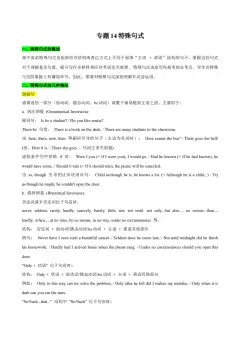
专题14 特殊句式
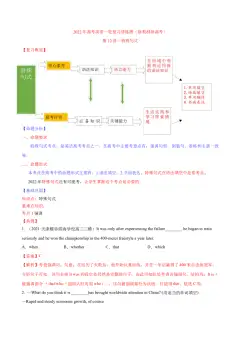
一、特殊句式的概述
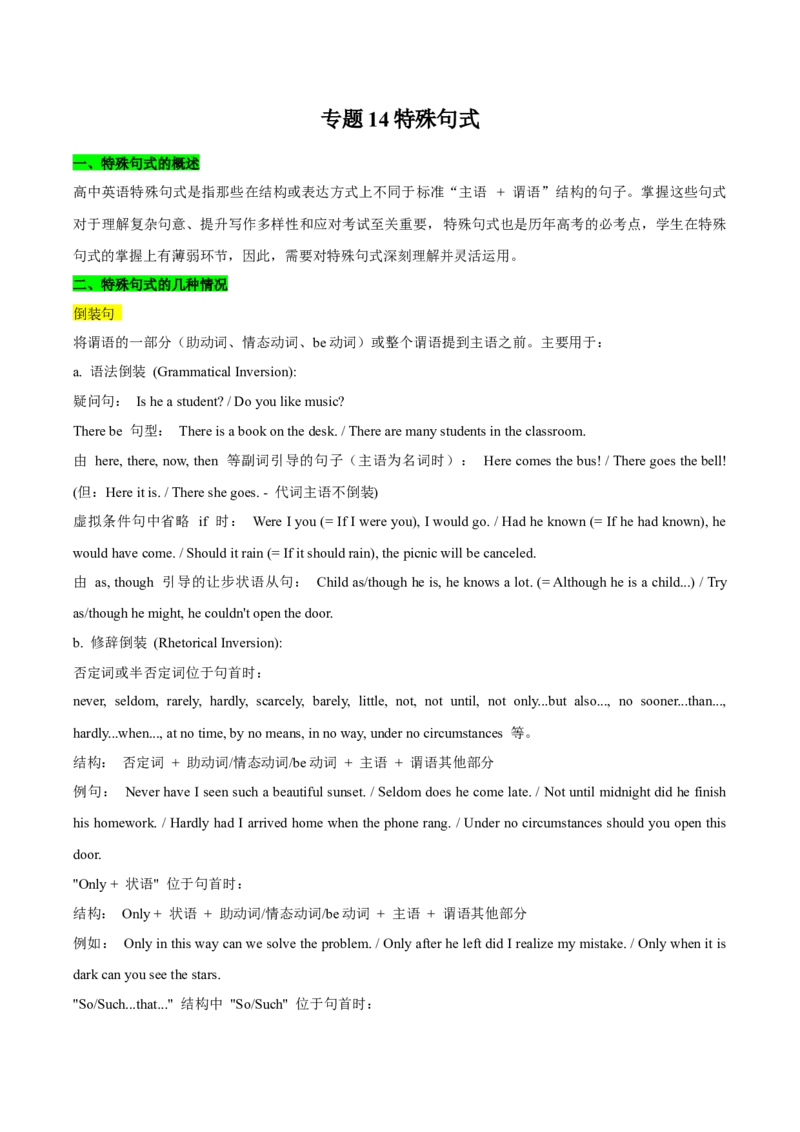
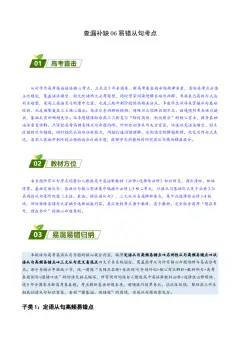
高中英语特殊句式是指那些在结构或表达方式上不同于标准“主语 + 谓语”结构的句子。掌握这些句式
对于理解复杂句意、提升写作多样性和应对考试至关重要,特殊句式也是历年高考的必考点,学生在特殊
句式的掌握上有薄弱环节,因此,需要对特殊句式深刻理解并灵活运用。
二、特殊句式的几种情况
倒装句
将谓语的一部分(助动词、情态动词、be 动词)或整个谓语提到主语之前。主要用于:
a. 语法倒装 (Grammatical Inversion):
疑问句: Is he a student? / Do you like music?
There be 句型: There is a book on the desk. / There are many students in the classroom.
由 here, there, now, then 等副词引导的句子(主语为名词时): Here comes the bus! / There goes the bell!
(但:Here it is. / There she goes. - 代词主语不倒装)
虚拟条件句中省略 if 时: Were I you (= If I were you), I would go. / Had he known (= If he had known), he
would have come. / Should it rain (= If it should rain), the picnic will be canceled.
由 as, though 引导的让步状语从句: Child as/though he is, he knows a lot. (= Although he is a child...) / Try
as/though he might, he couldn't open the door.
b. 修辞倒装 (Rhetorical Inversion):
否定词或半否定词位于句首时:
never, seldom, rarely, hardly, scarcely, barely, little, not, not until, not only...but also..., no sooner...than...,
hardly...when..., at no time, by no means, in no way, under no circumstances 等。
结构: 否定词 + 助动词/情态动词/be 动词 + 主语 + 谓语其他部分
例句: Never have I seen such a beautiful sunset. / Seldom does he come late. / Not until midnight did he finish
his homework. / Hardly had I arrived home when the phone rang. / Under no circumstances should you open this
door.
"Only + 状语" 位于句首时:
结构: Only + 状语 + 助动词/情态动词/be 动词 + 主语 + 谓语其他部分
例如: Only in this way can we solve the problem. / Only after he left did I realize my mistake. / Only when it is
dark can you see the stars.
"So/Such...that..." 结构中 "So/Such" 位于句首时:
结构: So + 形容词/副词 + 助动词/情态动词/be 动词 + 主语 + that... / Such + (a/an) + (形容词) + 名词 +
助动词/情态动词/be 动词 + 主语 + that...
例如: So fast did he run that I couldn't catch up with him. / Such a lovely day was it that we decided to go hiking.
表示地点、方向或拟声的副词置于句首(主语为名词且谓语为不及物动词): Out rushed the children. /
Down fell the leaves. / Bang went the door.
表示祝愿的句子: Long live our motherland! / May you succeed!
强调句型
It is/was + 被强调部分 + that/who + 句子其余部分
用于强调句子的主语、宾语、状语(时间、地点、原因、方式等)。
强调人时可用 who/whom,其他情况一般用 that(尤其在非正式文体中,that 可通用于强调人)。
去掉 "It is/was...that/who" 后,句子结构仍然完整,意思基本不变。
例如:
Tom met Mary in the park yesterday. (原句)
It was Tom that/who met Mary in the park yesterday. (强调主语)
It was Mary that/who(m) Tom met in the park yesterday. (强调宾语)
It was in the park that Tom met Mary yesterday. (强调地点状语)
It was yesterday that Tom met Mary in the park. (强调时间状语)
It was because he was ill that he didn't come. (强调原因状语从句 - 注意:原因状语从句强调时只能用 that)
省略句
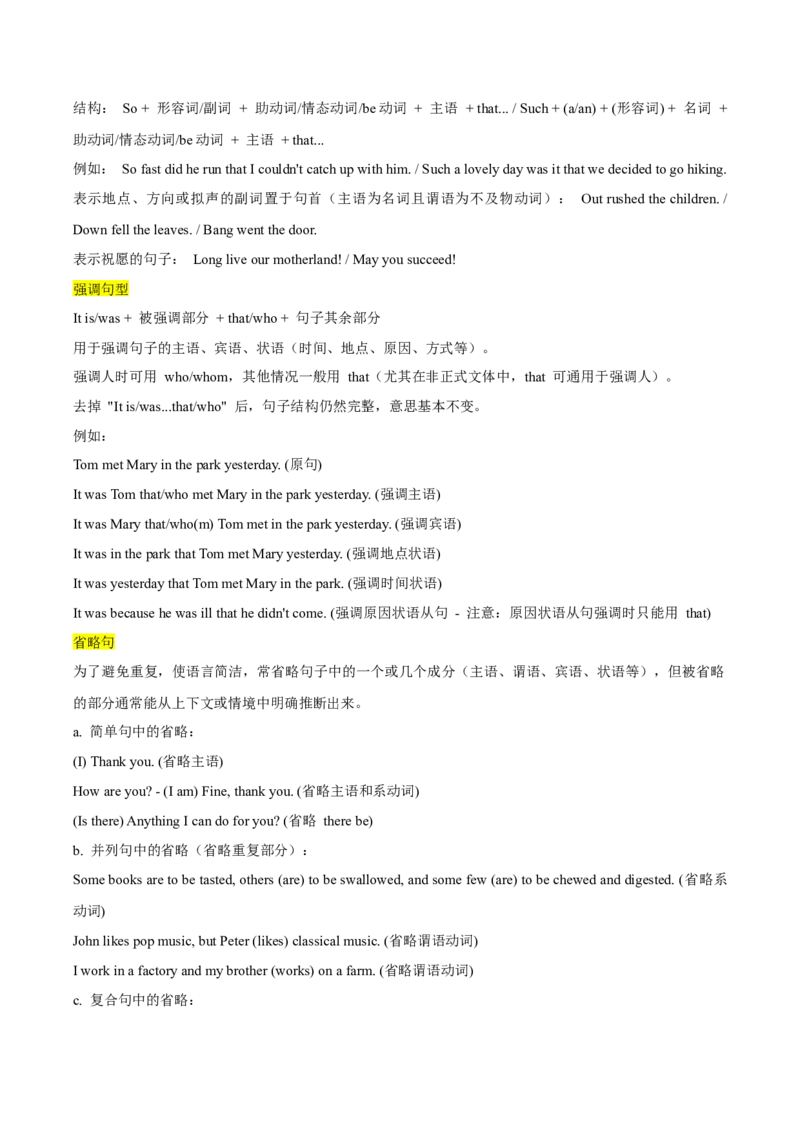
为了避免重复,使语言简洁,常省略句子中的一个或几个成分(主语、谓语、宾语、状语等),但被省略
的部分通常能从上下文或情境中明确推断出来。
a. 简单句中的省略:
(I) Thank you. (省略主语)
How are you? - (I am) Fine, thank you. (省略主语和系动词)
(Is there) Anything I can do for you? (省略 there be)
b. 并列句中的省略(省略重复部分):
Some books are to be tasted, others (are) to be swallowed, and some few (are) to be chewed and digested. (省略系
动词)
John likes pop music, but Peter (likes) classical music. (省略谓语动词)
I work in a factory and my brother (works) on a farm. (省略谓语动词)
c. 复合句中的省略:
状语从句: When (he was) asked about his plans, he smiled. (时间状语从句中省略主语和be 动词) / If (it is)
possible, please arrive early. (条件状语从句中省略主语和be 动词) / He worked as hard as (he) could (work). (比
较状语从句中省略主语和谓语的一部分)
定语从句: The man (who/that) I met yesterday is my teacher. (省略关系代词作宾语) / This is the place (where)
we met last year. (在口语或非正式文体中,有时省略关系副词 where/when,但语法上不完全规范,写作中
应谨慎)
宾语从句: He didn't come, but I don't know why (he didn't come). (省略整个宾语从句,保留疑问词) / - Will
he come? - I think so. (省略宾语从句,用 so/not 替代)
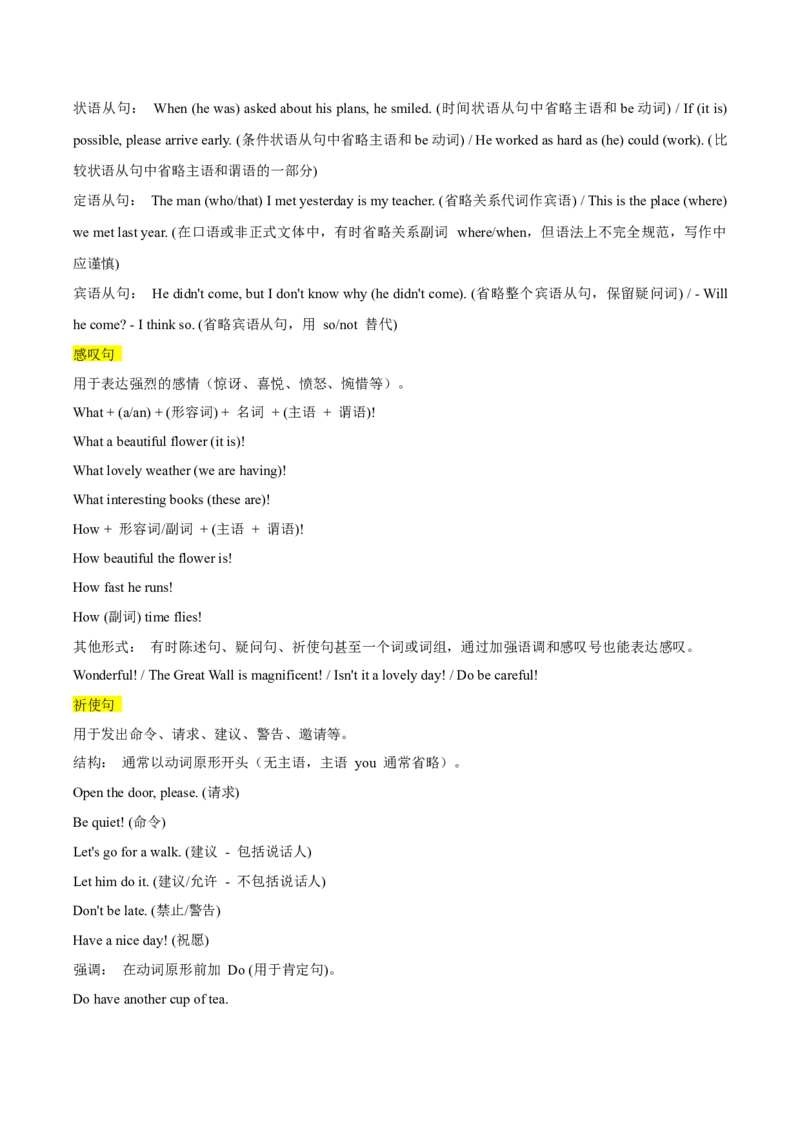
感叹句
用于表达强烈的感情(惊讶、喜悦、愤怒、惋惜等)。
What + (a/an) + (形容词) + 名词 + (主语 + 谓语)!
What a beautiful flower (it is)!
What lovely weather (we are having)!
What interesting books (these are)!
How + 形容词/副词 + (主语 + 谓语)!
How beautiful the flower is!
How fast he runs!
How (副词) time flies!
其他形式: 有时陈述句、疑问句、祈使句甚至一个词或词组,通过加强语调和感叹号也能表达感叹。
Wonderful! / The Great Wall is magnificent! / Isn't it a lovely day! / Do be careful!
祈使句
用于发出命令、请求、建议、警告、邀请等。
结构: 通常以动词原形开头(无主语,主语 you 通常省略)。
Open the door, please. (请求)
Be quiet! (命令)
Let's go for a walk. (建议 - 包括说话人)
Let him do it. (建议/允许 - 不包括说话人)
Don't be late. (禁止/警告)
Have a nice day! (祝愿)
强调: 在动词原形前加 Do (用于肯定句)。
Do have another cup of tea.
Do be careful!
存在句
主要表示“某处有某物/某人”或“某时存在某情况”,核心结构是 There + be + 主语 + (地点/时间状语)。
There is/are/was/were... (最常用)
There seems/appears to be...
There used to be...
There must/can/may be...
There happened to be...
There exist(s)/remain(s)/live(s)... (使用不及物动词表示存在)
例如: There is a book on the table. / There are many students in the classroom. / There seems to be a problem. /
There once lived an old fisherman by the sea.
独立主格结构
结构:名词/代词(逻辑主语) + 分词/形容词/副词/介词短语/不定式(逻辑谓语)。整个结构在句中作状
语,表示时间、原因、条件、伴随等,相当于一个状语从句。
特点:逻辑主语与主句主语不一致;结构本身没有谓语动词(使用非谓语形式);用逗号与主句隔开。
功能:使句子结构紧凑,描述更生动。
例如:
Weather permitting (If weather permits), we'll go hiking tomorrow. (条件)
The meeting over (When the meeting was over), everyone went home. (时间)
He came into the room, his face (being) red with cold. (伴随)
There being no buses (Because there were no buses), we had to walk home. (原因)
With the work done (After the work was done), we felt relieved. (时间/伴随 - 常用 with 引导)
The teacher to help us (If the teacher were to help us), we would finish the task easily. (条件 - 不定式表将来)
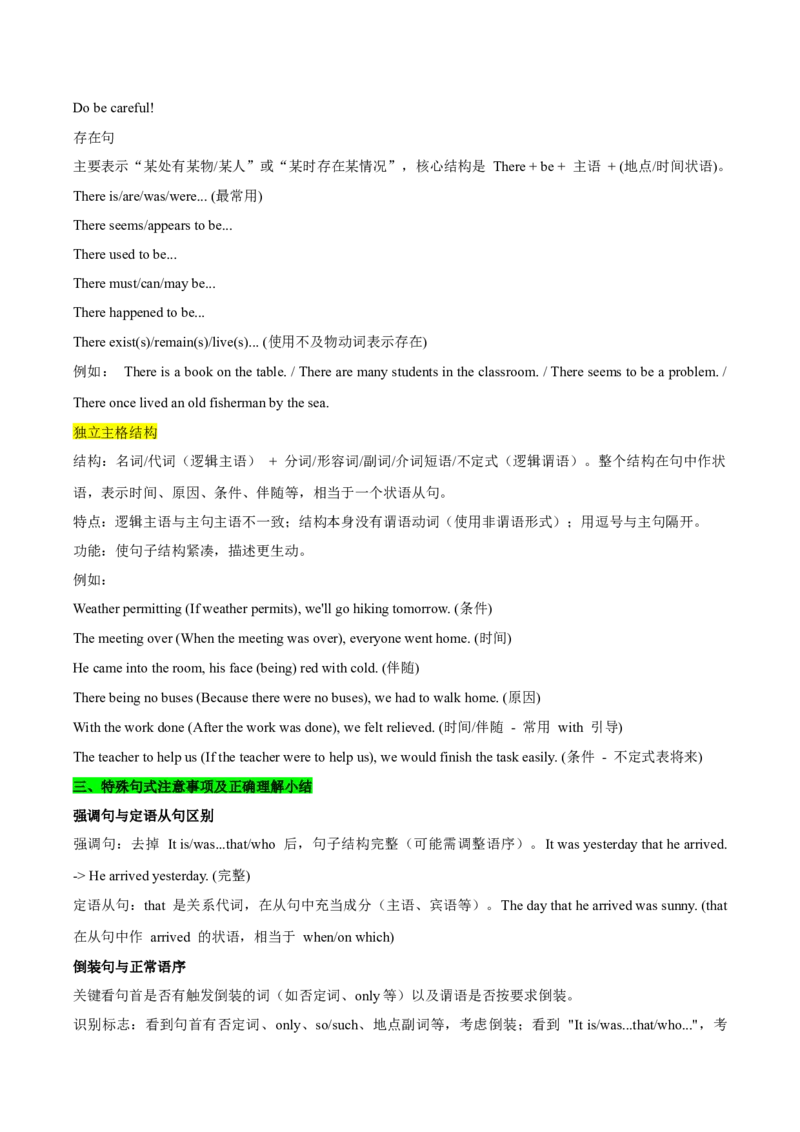
三、特殊句式注意事项及正确理解小结
强调句与定语从句区别
强调句:去掉 It is/was...that/who 后,句子结构完整(可能需调整语序)。It was yesterday that he arrived.
-> He arrived yesterday. (完整)
定语从句:that 是关系代词,在从句中充当成分(主语、宾语等)。The day that he arrived was sunny. (that
在从句中作 arrived 的状语,相当于 when/on which)
倒装句与正常语序
关键看句首是否有触发倒装的词(如否定词、only 等)以及谓语是否按要求倒装。
识别标志:看到句首有否定词、only、so/such、地点副词等,考虑倒装;看到 "It is/was...that/who...",考
虑强调句;看到结构不完整但有上下文或并列结构,考虑省略;看到 What/How 开头的句子,考虑感叹句;
看到动词原形开头,考虑祈使句;看到 There be...,考虑存在句;看到“名词/代词 + 非谓语/其他成分”
作状语且逻辑主语独立,考虑独立主格。
理解功能: 明确特殊句式的作用是强调、倒装、感叹、命令、表示存在还是充当状语。
结构分析: 按各句式的固定结构拆解句子成分,还原基本结构(特别是倒装句和强调句)。
语境判断: 结合上下文判断省略了什么成分,独立主格表示何种状语关系。
写作应用: 在写作中适当运用这些句式(尤其是倒装、强调、独立主格)可以丰富句式,增强表达效果。
熟练掌握这些特殊句式的结构、用法和区别,是高中英语语法学习的重要环节,对阅读理解、完形填空、
语法填空、和书面表达都大有裨益。
四、特殊句式能力提升练
1.(2026 高三·全国·专题练习)Mr. Smith didn’t understand          it was that made his wife so upset this
morning. (用适当的词填空)
2.(2026 高三·全国·专题练习)At the meeting place of the Yangtze River and the Jialing River
(lie) Chongqing, one of the ten largest cities in China.
3.(2026 高三·全国·专题练习)There          (come) the bus. Let’s hurry to the bus stop. (所给词的适当
形式填空)
4.(2026 高三·全国·专题练习)So far as I know, seldom             Mary come back to see her mother. (用
适当的词填空)
5.(24-25 高三上·四川广安·阶段练习)It was not until an hour later        he noticed that Carolyn had left
her emergency device home. (用适当的词填空)
6.(2025 高三·全国·专题练习)There’s no snake known that will habitually attack human beings unless

(threat) with its life. (所给词的适当形式填空)
7.(2025 高三上·全国·专题练习)Film has a much shorter history, especially when        (compare) to such
art forms as music and painting. (所给词的适当形式填空)
8.(2025 高三上·全国·专题练习)The tennis player is lying on the floor as if        (hurt) badly. (所给词的
适当形式填空)
9.(2025 高三上·全国·专题练习)In front of our house         (stand) a tall tree with a history of over 1,000
years, which is protected by the government now. (所给词的适当形式填空)
10.(2025 高三·全国·专题练习)It seemed that the bird was waiting for me, its beady eyes locked on mine as if
(try) to convey some deep, unspoken gratitude. (所给词的适当形式填空)
五、特殊句式能力提升检测
11.(2025 高三上·全国·专题练习)                            (这就是全球变暖的威力) that the
climate goes from one extreme to the other. It warns us to reduce carbon emissions and protect our lovely home.
(“such...that”结构的倒装) (根据汉语提示完成句子)
12.(2025 高三上·全国·专题练习)Times will change,                            (人也一样). (根据汉
语提示完成句子)
13.(2025 高三上·全国·专题练习)Such                   (就是他们的友情), a relationship respected
that nothing can change it. (根据汉语提示完成句子)
14.(2025 高三上·全国·专题练习)                              (如果控制好的话), nerves can make
the difference between an average speech and one which keeps people listening and wanting to hear more. (根据汉
语提示完成句子)
15.(2025 高三上·全国·专题练习)The members show quite a few striking qualities. When

(被媒体提问时) , they are not timid. (根据汉语提示完成句子)
16.(2025 高三上·全国·专题练习)                                   (北京有许多著名的名胜古迹),
like the Great Wall and the Summer Palace. (根据汉语提示完成句子)
17.(2025 高三·全国·专题练习)Only by understanding and learning from each other                  (我
们才能一起开心地度过那些日子). (根据汉语提示完成句子)
18.(2025 高三上·全国·专题练习)I never saw Daniel again,                 (也没有收到他的信). (根据
汉语提示完成句子)
19.(2025 高三上·全国·专题练习)If you have a job,                  (务必要全力以赴地去做) it and
finally you will succeed. (根据汉语提示完成句子)
20.(24-25 高三上·全国·课后作业)                       (沿着河岸生长着的是) so many beautiful
flowers. (根据汉语提示完成句子)
21.(2025 高三·全国·专题练习)Henry 绝不会让过去的失败阻碍自己这一次追逐梦想的脚步。(By no
means...)(汉译英)


22.(2025 高三·全国·专题练习)直到听到母亲从楼下传来温柔的呼唤, Colin 才意识到天色已晚。(Not
until...)(汉译英)


23.(2025 高三·全国·专题练习)“When asked why they chose so many AP classes, my friends responded: ‘I
don’t know.’” (英译汉)

24.(2025 高三·全国·专题练习)Not only does this cafe serve up drinks, it also serves up smiles. (汉译英)

25.(2025·上海奉贤·三模)老人外出就餐,家门口是否有社区食堂? (where) (汉译英)

26.(24-25 高三下·上海·阶段练习)只有破釜沉舟,我们才能在人生的关键时刻成功。(Only) (汉译英)

27.(24-25 高三上·上海闵行·阶段练习)是一瓶矿泉水帮助他在地震中活了下来。(It)(汉译英)

28.(2025·上海虹口·二模)民俗庆典呈现出传统习俗与新技术交相辉映的发展趋势。(tendency)  (汉译
英)

29.(2022·上海·高考真题)正是因为贯彻了“顾客为本”的理念, 那家落寞已久的社区商场才得以重回大
众视线。 (it) (汉译英)

30.(2025 高三上·全国·专题练习)为了避免意外受伤,他锻炼的时候始终保持适当的强度。(moderate)
(汉译英)