高中英语语法核心知识点详解(讲义)
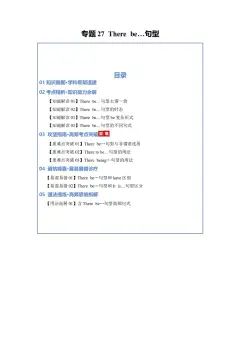
Part 24 特殊句式篇——There be 句型
24.1 There be 句型 "There be" Sentences
there be 结构在英语中是一种特殊的句式,表示“在什么地方或
时间存在(发生)什么事”,常用“there be + 名词 + 地点/时间状
语”的结构,还可以用来表示“计数”,表示一个整体里含有多
少。
there be 结构是一种弱式强调结构。句型中there 本来是具有地点
意义的状语主语,be 后面的名词原是表语。但是随着这一句型逐步
演变为表示多方面意义的句型,其中的there 也逐渐失去了其地点意
义。
现在语法家们把这一句型中的there 解释为引导词,be 为谓语动
词,同时把be 后面的名词解释为主语。be 应和它后面的主语保持一
致,如果出现并列主语,一般应和就近的主语部分保持一致,简称
“就近原则”。例如:
There is a pen and some pencils in the pencil-box.
在文具盒里有一支钢笔和一些铅笔。
There are twelve girls and a boy in the row.
在这一组里有12 个女孩和一个男孩。
1. 结构
(1) 肯定结构:
there be 句型的肯定结构表示“某处存在某物或某人”或“某时
发生某事”。
1) there is + 单数可数名词/不可数名词 + 地点/时间状语。
There is a cap on the desk.
桌子上有一顶帽子。
There is some juice in the bottle.
瓶子里有一些果汁。
2) there are + 复数名词 + 地点/时间状语。
There are some ducks on the lake.
湖上有几只鸭子。
(2) 否定结构:
there be 句型的否定结构是在谓语动词be 的后面加not (any)或
no。
There are no books on the desk.
=There are not any books on the desk.
桌子上没有书。
(3) 疑问结构:
there be 句型变疑问句时,there 和be 倒装。
Are there any people in the room?
房间里有人吗?
There is a bed in the room, isn't there?
房间里有一张床,不是吗?
注 如果系动词之前有其他的助动词,反意疑问句的疑问部分会
有不同形式。试比较:
There won't be a football match tomorrow, will there?
明天没有足球赛,对吗?
There used to be a tall tree here, usedn't/didn't there?
以前这里有棵高树,是不是?
There seems to be something wrong with you, doesn't there?
你好像有些不舒服,对吗?
There happened to be a pen there, didn't there?
那里碰巧有一支钢笔,是不是?
(4) there be 的非谓语形式有两种,即there to be 和there being。
1) 作主语。
当作主语时,一般是there being 结构,当句式中有for 时,一般
用there to be。
There being a shop here is a great advantage.
这儿有个商店,真是方便极了。
It is impossible for there to be any more.
不可能再有了。
2) 作宾语。
作动词宾语时,一般用there to be 的结构。常见的动词有:
expect, mean, intend, want, prefer 等。
People don't want there to be another war.
人们不希望再有战争。
① 介词for 后常用there to be。
We hope for there to be no wars and killings in the world.
我们希望世界上没有战争和杀戮。
② 其他介词后常用there being。
He was disappointed at there being so little to do.
他很失望,因为可做的事情这么少。
John was relying on there being another opportunity.
约翰指望着再有一次机会。
③ 在动词imagine, appreciate, avoid, mind, excuse 等后面常用
there being 形式。
You can imagine there being a hot discussion about this matter at the
meeting.
你可以想象在会上对这个问题的讨论有多热烈。
Would you mind there being so little help you can get from me?
我不能帮你什么忙,你介意吗?
④ 作动词的宾语时,一般跟在动词expect, like, want, prefer,
mean, intend, hate 等后面,常用there
to be。
Students don't want there to be another exam by the end of the term.
学生们不希望在学期末再考一次。
Do you expect there to be any objection to our suggestion?
你认为有什么反对我们的建议吗?
3) 作状语。
① 在句首作状语表示原因, 条件, 方式时常用there being 形式。
There being no buses, we had to walk home.
由于没有公共汽车,我们不得不走着回家。
② 如果作目的, 结果状语,则常用there to be 形式。
In order there to be a more comfortable living house, she decided to
buy that flat with a beautiful garden.
为了有一个更舒适的生活空间,她决定买那套带有美丽花园的公
寓。
(5) there be 与have 的比较。
1) 用法不同:
there be 表示某个时间或地方“存在”某人或某物,而have 表示
主语“拥有”某人或某物,或是表示作宾语的某人或某物属于主语
所有。
2) 结构不同:
there be + sb./sth. + 时间/地点(副词或介词短语)
sb./sth. + have + sb./sth. else
There are some desks and chairs in the classroom.
教室里有一些桌椅。
He has two cars.
他有两辆车。(车是属于他的)
注 如果两者表示的是部分与整体的关系时,有时这两种表达方
式都可以。
A week has seven days.
=There are seven days in a week.
一周有7 天。
2. 时态
(1) 一般过去时:there was/were
There was a sport meeting in the playground yesterday.
昨天在操场上举行了一场运动会。
(2) 一般现在时:there is/are
There are some apples on the apple tree.
这棵苹果树上有一些苹果。
There is a cap in his hand.
他手里有一顶帽子。
(3) 一般将来时:there will be
There will be (=There is going to be) a show on Wednesday.
星期三将有一场演出。
(4) 过去将来时:there would be
There would be a magic show at the theatre on Sunday.
周日在剧院会有一个魔术表演。
(5) 现在完成时:there has/have been
There have been lots of accidents round here.
这里已经发生多起事故了。
(6) 过去完成时:there had been
He told me that there had been an argument between them.
他告诉我他们之间发生了一场争论。
(7) 将来完成时:there will have been
There will have been a definite result by Saturday.
到星期六就会有一个明确的结果了。
(8) there be 结构有不同的时态,而且可以和各种助动词或情态动
词连用。
There is to be a lecture at the school hall.
学校礼堂有一场演讲。
There must be a mistake somewhere.
一定是在什么地方有错误。
3. 扩展用法
(1) there be + 主语
这种句式表示事物的客观存在,there be 放在句首,而把真正的
主语放在后面,可以用来表示现在时, 过去时, 完成时和将来时。
There is a boy on the playground.
操场上有个男孩。
There has been a lot of rain this month.
这个月雨水很多。
There will be an announcement soon.
不久将会发公告。
(2) there are/is + 复数名词/不可数名词 + and + 复数名词/不可数
名词
该句型表示同一类人或物的不同性质,尤其表示有好坏优劣之
分,意为“有各种各样的”, “种种不一”等。
There are friends and friends.
朋友有多种,有益友,有损友。
There is tea and tea.
茶叶有好有差。
(3) there be + 名词 + 动词不定式
这种句式中的及物动词(动词不定式)也可改成被动式,意为
“(没)有……要做”。
There is a lot of work to do (to be done).
有许多工作要做。
There was no time to wait for you.
没有时间再等你了。
注 there is nothing to do 与there is nothing to be done 含义不同。
前者意为“无事可做”,后者意为“没有办法”。试比较:
There is nothing to do—I'm bored.
无事可做让我感到闷得慌。
(=There is nothing to entertain me.)
没有什么活动来消遣。
There is nothing to be done—we'll have to buy another one.
(= There is no way of putting it right.)
没有办法,我们只好另外买一个了。
(4) there be + 名词 + 分词
1) 这种句式中分词可以是现在分词,也可以是过去分词。doing
表示动作和前面名词有主谓关系,过去分词done 和前面名词有被动
关系。
There is a man sitting on the fence.
有个人正坐在篱笆上。
There was a car stolen last night.
昨晚有辆车被偷了。
2) 这种句式可以用“主语 + be + 分词”这一结构来代替。
There is a boy playing with a puppy in the yard. (=A boy is playing
with puppy in the yard.)
一个男孩正在院子里和一只小狗玩耍。
There has been more money spent on armaments than on famine
relief. (=More money has been spent on armaments than on famine
relief.)
花在军备上的钱比花在饥荒救济上的钱还多。
(5) there is no use + 动名词
该句式可与“it is no use + 动名词”互换,意为“……无用(无
济于事)”。
There is no use waiting any longer. (=It is no use waiting any longer.)
再等下去是没有用的。
There is no use (in) offering the olive branch now.
现在想和解也无济于事了。
(6) there is no need + 动词不定式
该句式意为“不需要……”。
There is no need for her to come.
不需要她来了。
There is no need (for you) to leave yet.
(你)现在还没有必要离开。
(7) there is (no) need for + 名词
该句式意为“(不)需要……”。
There is no need for anxiety.
不需要担心。
There is a great need for a book on this subject.
非常需要有一本关于这个主题的书。
(8) there is + no + 动名词
这种句式可与“it is impossible + 动词不定式”替换,意为“无
法做某事”。
There is no stopping him. (=It is impossible to stop him.)
无法阻止他。
There is no guessing what will happen. (=It is impossible to guess
what will happen.)
无法猜到将会发生什么。
(9) there is nothing more... than
该句式意为“再……不过了”。
There is nothing more dangerous than an illusion of security.
太平无事的幻觉是再危险不过的了。
(10) there is nothing for it but to do s.th
该句型相当于“there is no choice but to do s.th”,意为“别无他
法,只能……”。
There is nothing for it but to do what is required.
(=I have no choice but to do what it required.)
只能按要求去做了,别无他法。
(11) there is nothing/not anything like... 该句型中“ nothing/not
anything like...” 相当于“ nothing/not anything better/more suitable
than...”,意为“没有什么比……更好/更合适”。
There is nothing like music for taking you out of yourself.
没有什么比音乐更能使你放松自己了。
There is nothing like training as a means of keeping fit.
要保持健康,没有比锻炼更好的方法了。
(12) there is no (not any) point in + 动名词
该句式意为:“……是没有意义(思)的”。
There is no point in doing so.
这样做是没有意义的。
There is not any point in harping on the same old string.
没有必要再重复这一套。
(13) there (not) being/there (not) having been 用现在分词的复合结
构在句中作主语或宾语。
I dreamed of there being a holiday next week. (作宾语)
我梦想下星期有一个假日。
There being a bus stop so near the house is an advantage.(作主语)
公共汽车站离房子这么近是一个很有利的条件。
(14) there being/having been 是独立主格结构,在句中作状语。
There having been no rain for a long time, the ground was burned by
the sun.
好长时间未下雨,大地都被太阳烤焦了。
(15) there is a possibility of (或that)
该句式表示“有可能”。
There is a possibility of my going to Denmark.
(=There is a possibility that I may be able to go to Denmark.)
我有可能去丹麦。
(16) there + 人称代词 + come (go)/there come (go) + 名词
该句式是there 作感叹词放在句首。如果主语是人称代词,则动
词放在其后;如果主语是名词,则动词放在其前。
There he comes!
他来了!
There comes the train at last!
火车终于来啦!
(17) there are/is certain (sure, likely) to be,该结构的意义为:肯定
有/可能有。
There are likely to be more difficulties than you were prepared for.
很可能会遇到你预想不到的困难。
There are sure to be a shop there.
那边肯定有个商店。
(18) there + be + ed 分词 + to be 结构,常用的动词有:say,
expect, believe, consider, think,mean。
There is/are said to be a number of wounded on both sides.
据说双方都有不少人受伤。
There is/are expected to be an interesting show this afternoon.
预计今天下午有一个很有意思的演出。
(19) for there to be 为不定式复合结构。
For there to be no late comers was unusual.
没人迟到这是不寻常的事。
It is not cold enough for there to be frost.
天还不够冷,不会有霜冻。
(20) V. + there to be 结构中的动词往往是:expect, want, intend,
mean, consider, like, hate, prefer 等接不定式作宾语。
I don't want there to be any children falling behind.
我不想让任何孩子落后。
I should prefer there to be no discussion.
我希望没有讨论。
动词let 后接there be 作宾语补足语。Let there be no
misunderstanding.
不要产生误会。
(21) there + 动词
这种句式只限于表示存在某种状态, 发生某种事或某事, 某人到
达等动词,意义比there be 结构更为生动贴切。如live, lie, seem,
stand, appear, happen, exist, arise, enter, come, go, remain,exist, rise,
occur, flo, arrive, enter, follow 等。但是不适用于表示一般具体动作的
动词。
There goes the bell.
铃响了。
There comes a knock at the door.
有人敲门。
Many years ago, there lived an emperor who cared more for beautiful
clothes than for anything else.
许多年前,有位皇帝热衷于漂亮的衣服胜过其他任何东西。
There appears to be no one who can answer this question.
看来没人能够回答这个问题。
There stands a tall building across the river.
河对面耸立着一幢高层建筑物。
There remains one question to be discussed.
还剩一个问题要讨论。
There seems to be something wrong about it.
这事好像有点儿不对劲儿。
There will follow an interval of ten minutes.
随后将有10 分钟的休息。
(22) 情态动词及ought to, have to, used to 用在there be 结构中。
There must be something wrong with the washing machine, for it
doesn't run well.
洗衣机一定出了毛病,因为它运转不正常。
There oughtn't to be a lot of disagreement in our views.
我们的看法不应该存在太大的分歧。
There might be some good songs after all this trash.
在播放了这些乱七八糟的歌曲之后,可能会放几首好歌。
If the power hadn't been cut off so quickly, there could have been a
big fire.
要不是迅速切断电源,可能会引发一场大火。