高中英语语法核心知识点详解(讲义)
Part 14 时态篇 Tenses
14.1 一般现在时 Present Simple Tense
1. 一般现在时概念
一般现在时主要用来表示人或事物的特点,经常或习惯性的动作
以及现在的状况;还可以表示客观规律和永恒真理等。句子中常有
often, always, from time to time 等时间状语。
I usually get up early.
我通常起床很早。
He always helps others.
他总是帮助别人。
2. 一般现在时形式
(1) 肯定形式:主语 + 动词原形(如主语为第三人称单数,动
词要改为第三人称单数形式)。
The picture looks very beautiful.
这幅画看起来很美。
I wish you every success.
祝你成功。
(2) 否定形式:谓语是系动词时则为am/is/are + not;若谓语动词
为行为动词,则在其前加don't;若主语为第三人称单数,则在动词
原形前用doesn't。
I am not a student.
我不是一个学生。
Sometimes I do not know what to do.
有些时候我不知道该做什么。
He doesn't like playing computer games.
他不喜欢玩电脑游戏。
(3) 一般疑问句形式:谓语是系动词时则把系动词置于句首;若
谓语动词为行为动词,用助动词do 提问;若主语为第三人称单数,
则用does 提问,行为动词为原形。
Is she pretty?
她漂亮吗?
Do you like this movie?
你喜欢这部电影吗?
Does he speak Japanese?
他说日语吗?
(4) 一般现在时的扩展:
1) 表示永恒的真理,即使出现在过去的语境中,仍用一般现在
时。
I knew that the sun and the earth attract each other when I was very
young.
在我小时候,我就知道,太阳和地球相互吸引。
2) 在时间和条件状语从句中,一般现在时可代替一般将来时,
常用的引导词有:
① 条件引导词:if, unless, provided
If he studies in school, he will learn more knowledge.
如果他在学校学习,他将能学到更多的知识。
② 时间引导词:when, until, after, before, as soon as, once, the
moment/the minute, the day Farewell until we meet again!
下次再见!
③ 在mind, care, matter, make sure (certain), see to it + 宾语从句的
句型中,从句可以用一般现在时代替一般将来时。
So long as you study hard in school, I don't care how much money
you spend.
只要你在学校努力学习,我不介意你花多少钱。
④ 在the more… the more… (越……越……)的句型中,若主
句是一般将来时,通常从句用一般现在时。
The more weakness you show, the more aggressive others will be.
你越示弱,别人攻击性就越强。
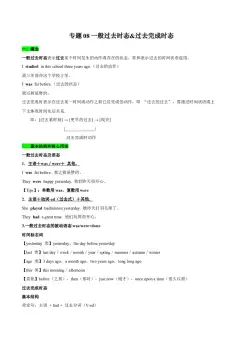
14.2 一般过去时 Past Simple Tense
1. 一般过去时概念
表示在过去某个确定的时间里发生的动作,存在的状态或习惯性
的动作,不强调对现在的影响,只说明过去。
常用的时间状语有:yesterday, last (week), in (1945), at that time,
once, during the (war),before, a few days ago, when 等。
I sent a gift to my girlfriend last night.
我昨晚送了一份礼物给女友。
I arrived in Beijing yesterday.
我昨天到的北京。
2. 一般过去时形式
(1) 一般过去时的一般形式:
肯定形式:主语 + was/were 或者行为动词的过去式 + 宾语;
否定形式:was/were + not 或者在行为动词前加didn't;
一般疑问句形式:was 或were 置于句首,或是用助动词do 的过
去式did 提问,行为动词为原形。
We often practiced playing basketball last year.
去年我们经常练习打篮球。
I didn't go to school yesterday.
我昨天没有去学校。
Did you have the meeting yesterday?
昨天你们开会了吗?
(2) 一般过去时的扩展:
1) used to + do 表示过去经常但现在已不再维持的习惯动作。to
为不定式,后接动词原形。 be/become/get used to + doing 表示习惯
于做某事。He used to drink a lot.
他过去常喝很多酒。
I have got used to getting up early.
我已经习惯了早起。
2) 在时间和条件状语从句中,用一般过去时代替过去将来时。
I would not leave until your mom came back.
直到你妈妈回来我才会离开。
Susan phoned me she wouldn't come to visit me if it rained the next
day.
苏珊打电话说如果第二天下雨的话,她就不来看我了。
3) 用过去时表示现在,表委婉语气。
① 情态动词could, would
Could you lend me your dictionary?
我能借一下你的字典吗?
② 动词want, hope, wonder, think, intend 等。
Did you want anything else?
你还想要点其他的东西吗?
I wondered if you could come here.
我想知道你能否来这里。
14.3 一般将来时 Future Simple Tense
1. 一般将来时概念
表示在将来某个时间会发生的动作或情况。
常用的时间状语有:tomorrow, next day (week, month, year…),
soon, in a few minutes, by…,the day after tomorrow 等。
He will be thirty next year.
他明年就30 岁了。
I will finish my work soon.
我就要完成我的工作了。
I shall go to see my grandparents this evening.
我今晚要去看望我的祖父母。
2. 一般将来时形式
(1) 一般将来时的一般形式:
肯定形式:am/is/are/going to + do;will/shall + do;
否定形式:am/is/are + not going to do;在will/shall 后加not;
一般疑问句形式:把am/is/are 放在句首;把will/shall 放在句
首。
Our school will hold the sports meeting in July.
我们学校7 月将举行运动会。
He isn't going to buy that house.
他不会买那套房子了。
Are you going to do shopping tomorrow?
你明天要去购物吗?
(2) 一般将来时的扩展:
1) 一般将来时可以用在一些时间状语从句或条件状语从句的主
句中。主句用一般将来时,从句中要用一般现在时表示将来。
We will begin our party as soon as Tom comes.
汤姆一来,我们的派对就开始。
2) 某些表示短暂性动作的动词如arrive, come, go, leave, start 等,
可以用现在进行时表示将来。
I am leaving for Shanghai tomorrow.
我明天要去上海。
3)“祈使句 + and/or + 句子”,这种结构中and 后面的句子谓语
用一般将来时。
Use your head and you will find a way.
动动脑子,你就能找到办法。
4) be (am, is,are)词组的特殊用法。
① “am (is, are) to + 动词原形”表示必须, 必然或计划将要做的
事。
We are to be married this summer.
我们打算今年夏天结婚。
② “am (is, are) about to + 动词原形”表示即将发生的动作,在时
间上指最近的将来。He is about to explode.
他快忍不住了。
③ “am (is, are) going to + 动词原形”,表示打算要做的事或可
能要发生的事。
I am going to leave now.
我要告辞了。
14.4 过去进行时 Past Continuous Tense
1. 过去进行时概念
表示过去某个时间正在发生的动作。
常用的时间状语有:at this time yesterday, at that time, this
morning, the whole morning, all day yesterday, from nine to ten last
evening, when, while 等。
We were having dinner when they came.
他们来的时候,我们正在吃饭。
I was busy yesterday. I was preparing for the exams.
昨天我很忙,我在准备考试。
2. 过去进行时形式
过去进行时的一般形式:
肯定形式:was/were + doing;
否定形式:was/were + not + doing;
一般疑问句形式:把was 或were 置于句首。
I was reading aloud while my brother was watching TV.
我弟弟在看电视的时候我在大声读书。
She wasn't doing her homework when I got home.
当我回到家的时候,她没有在做作业。
Were you cooking the breakfast at eight yesterday morning?
昨天早上8 点你在做早餐吗?
14.5 过去完成时 Past Perfect Tense
1. 过去完成时概念
表示过去某个时间之前已经完成的动作,即“过去的过去”完成
的动作。
常用的时间状语有:before, until, when, after, once, as soon as, by
the end of last year (term,month) 等。
When he got there, the train had already left.
他到那儿时,火车已经离开了。
By the end of last year I had finished the project.
到去年年底,我已经完成这个项目了。
2. 过去完成时形式
(1) 过去完成时的一般形式:
肯定形式:had + done;
否定形式:had + not + done;
一般疑问句形式:把had 置于句首。
When the police arrived, the thief had run away.
当警察赶到的时候,小偷已经跑了。
He said that he hadn't learned any English before.
他说他以前没有学过英语。
Had she left the office when Miss Li went to get a book?
当李小姐去拿书的时候她已经离开办公室了吗?
(2) 过去完成时的扩展:
1) 当动词为hope, expect, think, intend, mean, want, suppose, plan
时,用过去完成时表示未实现的愿望, 打算和意图。
I had hoped that I could get the job.
我真希望我能得到这份工作。
I had expected to see you but I was too busy.
我盼望能去见你,但是我太忙了。
2) 在hardly/scarcely..., when, no sooner... than 句型中,主句用过
去完成时,从句用一般过去时。
I had hardly got into the house when he came to see me.
当他来看我的时候,我刚到家。
No sooner had I arrived home than the telephone rang.(注意主谓倒
装)
我刚到家电话就响了。
3) 表示“第几次做某事”,主句用一般过去时,从句用过去完
成时。
That was the first time that she had seen her father.
那是她第一次见到她的父亲。
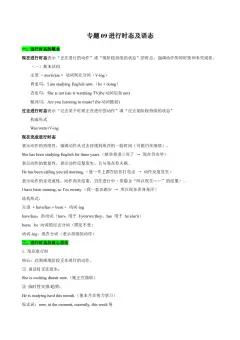
14.6 现在进行时 Present Continuous Tense
1. 现在进行时概念
现在进行时表示在当下的一段时间内正在进行的某种活动。
常用的时间状语有:now, at this time 等。
Don't disturb her. She is sleeping now.
别打扰她,她正在睡觉。
The girl is singing in her room at this moment.
女孩这个时候正在她房间唱歌。
2. 现在进行时形式
(1) 现在进行时的一般形式:
肯定形式:am/is/are + V-ing;
否定形式:am/is/are + not + V-ing;
一般疑问句形式:把系动词be 置于句首。
It is raining outside.
外面正在下雨。
He's not fighting alone at this moment!
此刻,他不是一个人在战斗!
Are you surfing the Internet?
你正在上网吗?
(2) 现在进行时的扩展:
1) 在条件状语从句或时间状语从句中,可以用现在进行时表示
将来。
Be careful when you are crossing the busy street.
当你穿过拥挤的马路时要小心。
2) 表示最近一段时间将要发生的动作,或者按计划将要进行的
动作,用现在进行时表示将来。
I'm flying to Hong Kong tomorrow.
我明天乘飞机去香港。
14.7 现在完成时 Present Perfect Tense
1. 现在完成时概念
现在完成时表示过去的动作已经完成,但对现在的情况仍存在一
定的影响;也可以表示一直持续到现在的动作或状态。
常用的时间状语有:recently, lately, since… for…, in the past few
years, just, already, yet, up to now, till now, so far, these days 等。
I have just finished my homework.
我刚刚完成家庭作业。
He has already got her help.
他已得到她的帮助。
2. 现在完成时形式
(1) 现在完成时的一般形式:
肯定形式:have/has + done;
否定形式:have/has + not + done;
一般疑问句形式:把have 或has 放在句首。
I've just finished my work now.
我刚完成工作。
It hasn't rained for half a year in that place.
那个地方已经半年没有下雨了。
Have you ever been to Beijing?
你去过北京吗?
(2) 现在完成时的扩展:
1) for + 时间段, since + 时间点。
I have lived here for five years.
我已经在这里住了5 年了。
I have lived here since 1995.
我从1995 年开始就住在这儿了。
2) 如果句中含有表示“最近几世纪/年/月以来”的时间状语,例
如:over the past few years, in the past few years/months/weeks/days,
during the last three months, for the last few centuries,through centuries,
throughout history 等,谓语动词用现在完成时。I have been a teacher
over the past few years.
在过去的几年里我一直是个老师。
14.8 将来进行时 Future Continuous Tense
1. 将来进行时概念
表示将来某个时间正在发生的动作,或按计划一定会发生的事
情。
常用的时间状语有:soon, tomorrow, this evening, on Sunday, by
this time, tomorrow, in two days, tomorrow evening 等。
This time next day they will be sitting in the cinema.
明天的这个时候他们将会坐在电影院里。
I'll be taking my holiday soon.
我不久就去度假了。
2. 将来进行时形式
将来进行时的一般形式:
肯定形式:will/shall be + doing;
否定形式:will/shall not be + doing;
一般疑问句形式:把will/shall 放在句首。
The minister will be giving a speech on international affairs.
部长将就国际事务发表演讲。
Nancy will not be doing exercise tomorrow morning.
南希明天早上这会儿不会是在锻炼身体。
Will you be having the meeting this time tomorrow afternoon?
明天下午这个时候你是在开会吗?
14.9 将来完成时 Future Perfect Tense
1. 将来完成时概念
表示在将来某一时间或另一个将来的动作之前,已经完成的动
作。
常用的时间状语为:by the time of;by the end of + 时间短语(将
来);by the time + 从句(将来)等。
By this time tomorrow you will have arrived in Shanghai.
到明天的这个时候,你们应该已经到上海了。
I shall have finished this composition before 9 o'clock.
9 点以前我就能完成这篇作文。
When we get to the railway station, the train will probably have left.
等我们赶到火车站,也许火车都已经开走了。
2. 将来完成时形式
(1) 将来完成时的一般形式
肯定形式:be going to/will/shall + have done;
否定形式:be going to/will/shall + not + have done;
一般疑问句形式:把will/shall 放在句首。
By next Tuesday, I will have got ready for my new job.
到下个周二,我将为我的新工作做好准备。
We will not have made a good preparation for the exams by the end of
this week.
到这个周末为止,我们还没有做好考试的准备。
Will you have finished this experiment by the end of this term?
到这个期末你们会完成这个实验吗?
(2) 将来完成时的扩展
在时间和条件状语从句中,将来完成时则由现在完成时表示。
The children will do their homework the moment they have arrived
back from school.
孩子们一从学校回来就会做他们的家庭作业。