高中英语语法核心知识点详解(讲义)
Part 7 词性篇——冠词和连词
7.1 冠词 Articles
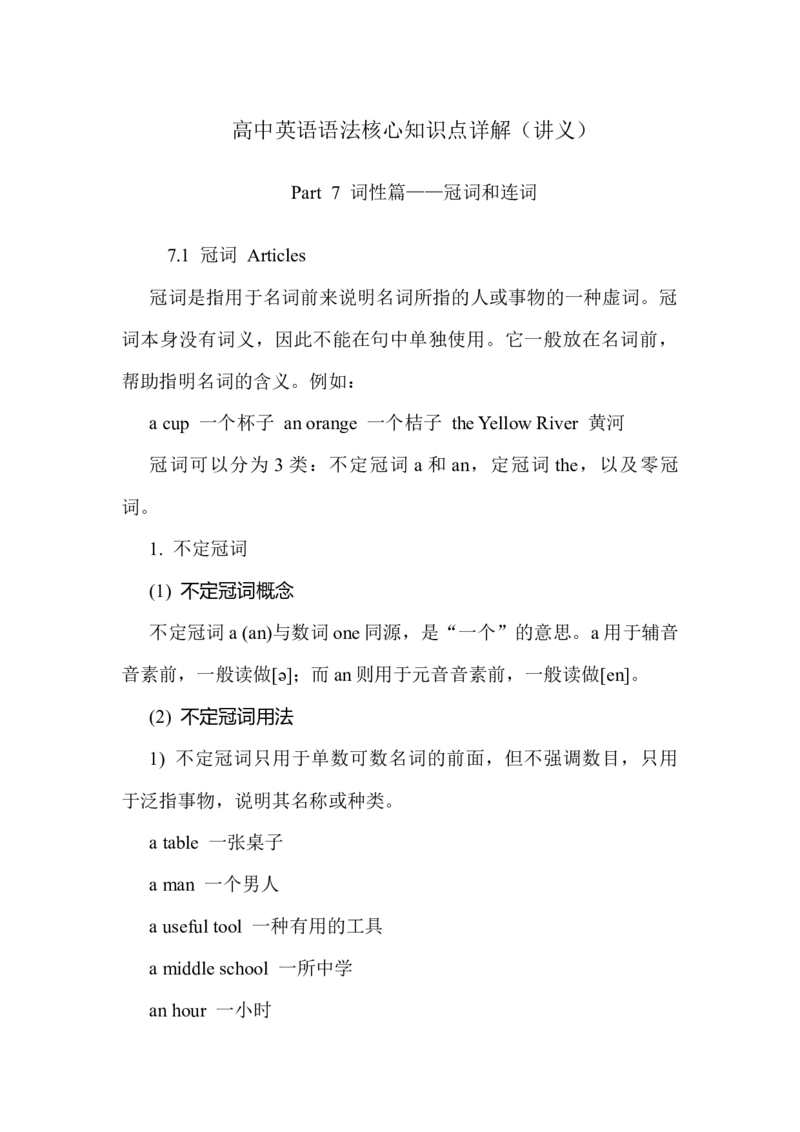
冠词是指用于名词前来说明名词所指的人或事物的一种虚词。冠
词本身没有词义,因此不能在句中单独使用。它一般放在名词前,
帮助指明名词的含义。例如:
a cup 一个杯子 an orange 一个桔子 the Yellow River 黄河
冠词可以分为3 类:不定冠词a 和an,定冠词the,以及零冠
词。
1. 不定冠词
(1) 不定冠词概念
不定冠词a (an)与数词one 同源,是“一个”的意思。a 用于辅音
音素前,一般读做[ə];而an 则用于元音音素前,一般读做[en]。
(2) 不定冠词用法
1) 不定冠词只用于单数可数名词的前面,但不强调数目,只用
于泛指事物,说明其名称或种类。
a table 一张桌子
a man 一个男人
a useful tool 一种有用的工具
a middle school 一所中学
an hour 一小时
an apple 一个苹果
an elephant 一头大象
注 在单词前面是用a 还是an,要根据单词首字母发音而定。
2) 表示某一人或事物的任何一个。
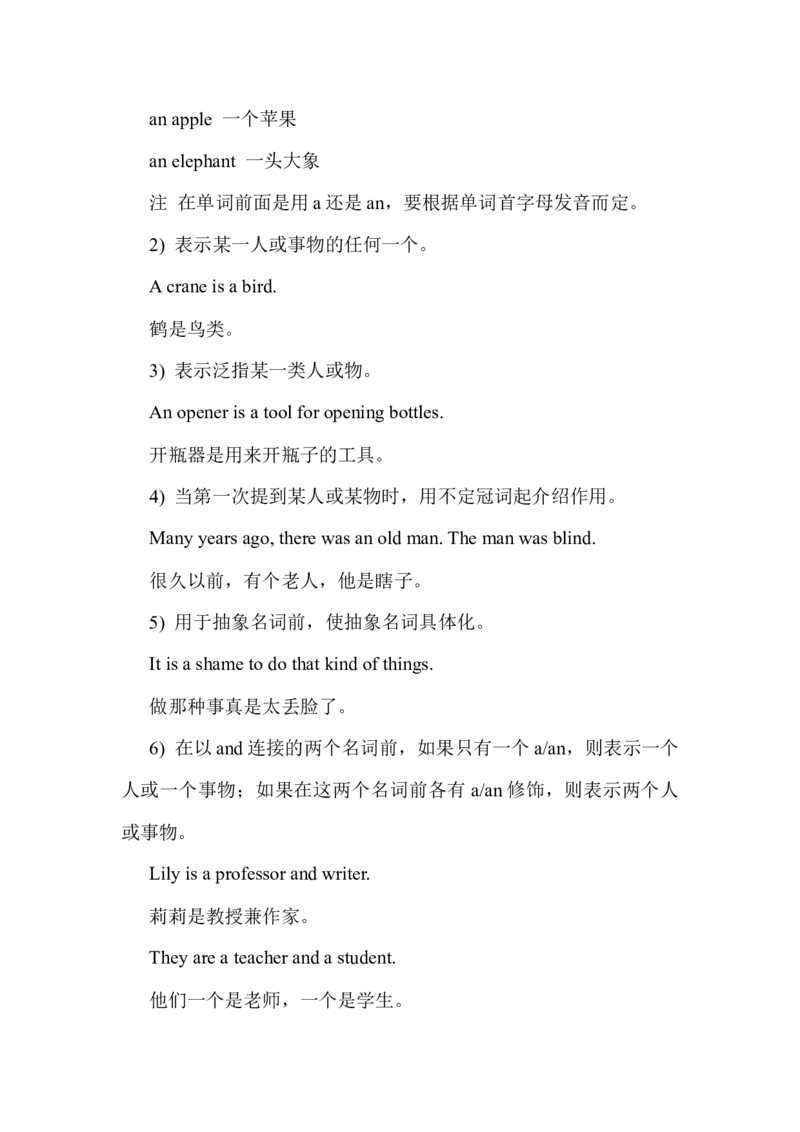
A crane is a bird.
鹤是鸟类。
3) 表示泛指某一类人或物。
An opener is a tool for opening bottles.
开瓶器是用来开瓶子的工具。
4) 当第一次提到某人或某物时,用不定冠词起介绍作用。
Many years ago, there was an old man. The man was blind.
很久以前,有个老人,他是瞎子。
5) 用于抽象名词前,使抽象名词具体化。
It is a shame to do that kind of things.
做那种事真是太丢脸了。
6) 在以and 连接的两个名词前,如果只有一个a/an,则表示一个
人或一个事物;如果在这两个名词前各有a/an 修饰,则表示两个人
或事物。
Lily is a professor and writer.
莉莉是教授兼作家。
They are a teacher and a student.
他们一个是老师,一个是学生。
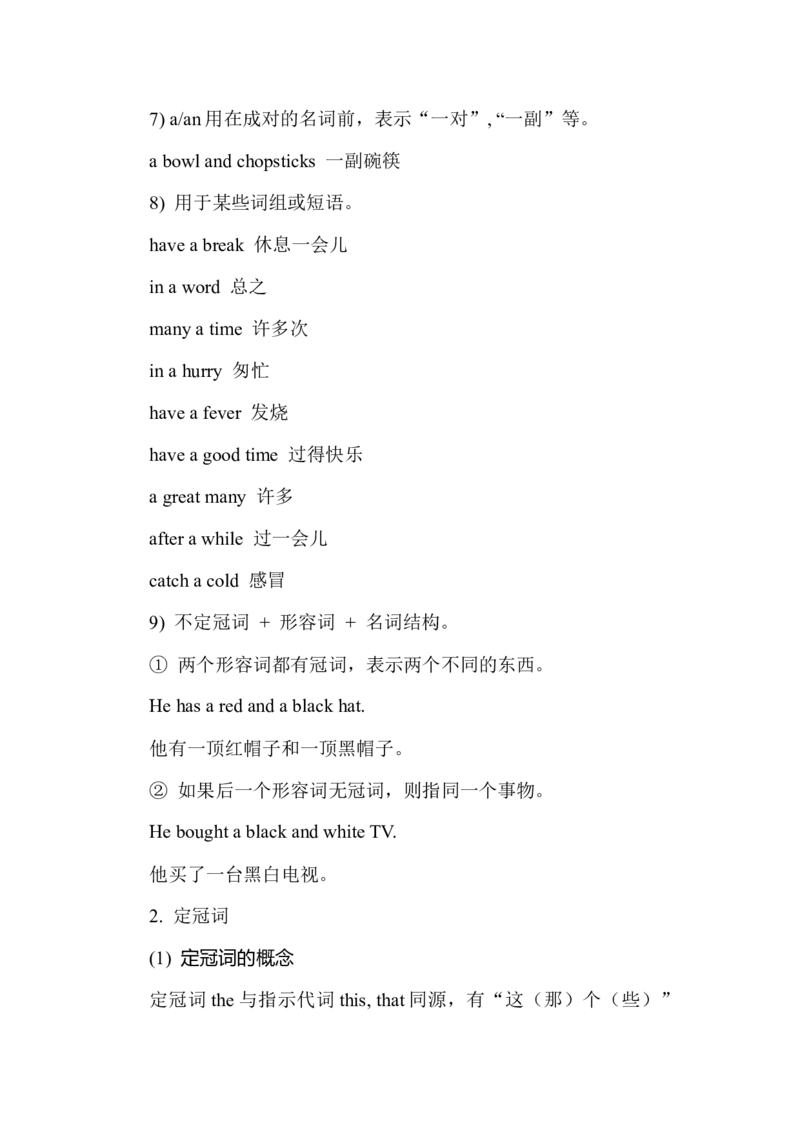
7) a/an 用在成对的名词前,表示“一对”, “一副”等。
a bowl and chopsticks 一副碗筷
8) 用于某些词组或短语。
have a break 休息一会儿
in a word 总之
many a time 许多次
in a hurry 匆忙
have a fever 发烧
have a good time 过得快乐
a great many 许多
after a while 过一会儿
catch a cold 感冒
9) 不定冠词 + 形容词 + 名词结构。
① 两个形容词都有冠词,表示两个不同的东西。
He has a red and a black hat.
他有一顶红帽子和一顶黑帽子。
② 如果后一个形容词无冠词,则指同一个事物。
He bought a black and white TV.
他买了一台黑白电视。
2. 定冠词
(1) 定冠词的概念
定冠词the 与指示代词this, that 同源,有“这(那)个(些)”
的意思,但其指示性较弱,一般不重读。它可以用在单, 复数可数
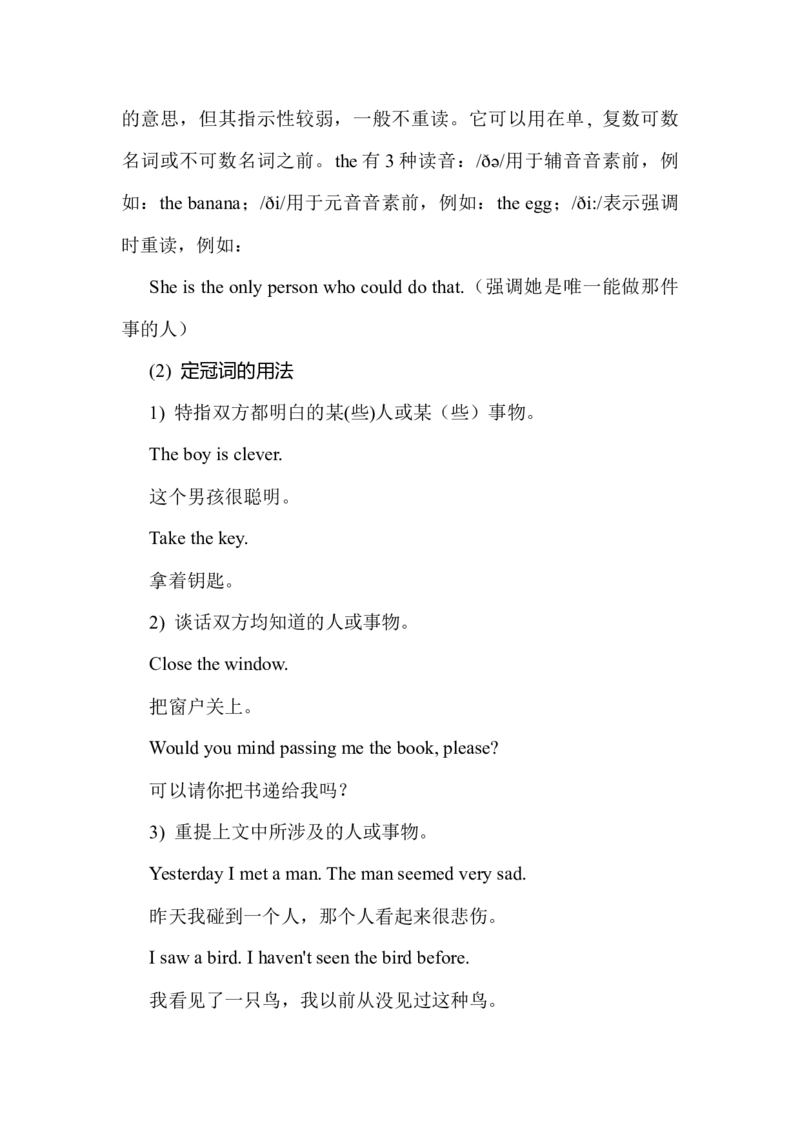
名词或不可数名词之前。the 有3 种读音:/ðə/用于辅音音素前,例
如:the banana;/ði/用于元音音素前,例如:the egg;/ði:/表示强调
时重读,例如:
She is the only person who could do that.(强调她是唯一能做那件
事的人)
(2) 定冠词的用法
1) 特指双方都明白的某(些)人或某(些)事物。
The boy is clever.
这个男孩很聪明。
Take the key.
拿着钥匙。
2) 谈话双方均知道的人或事物。
Close the window.
把窗户关上。
Would you mind passing me the book, please?
可以请你把书递给我吗?
3) 重提上文中所涉及的人或事物。
Yesterday I met a man. The man seemed very sad.
昨天我碰到一个人,那个人看起来很悲伤。
I saw a bird. I haven't seen the bird before.
我看见了一只鸟,我以前从没见过这种鸟。
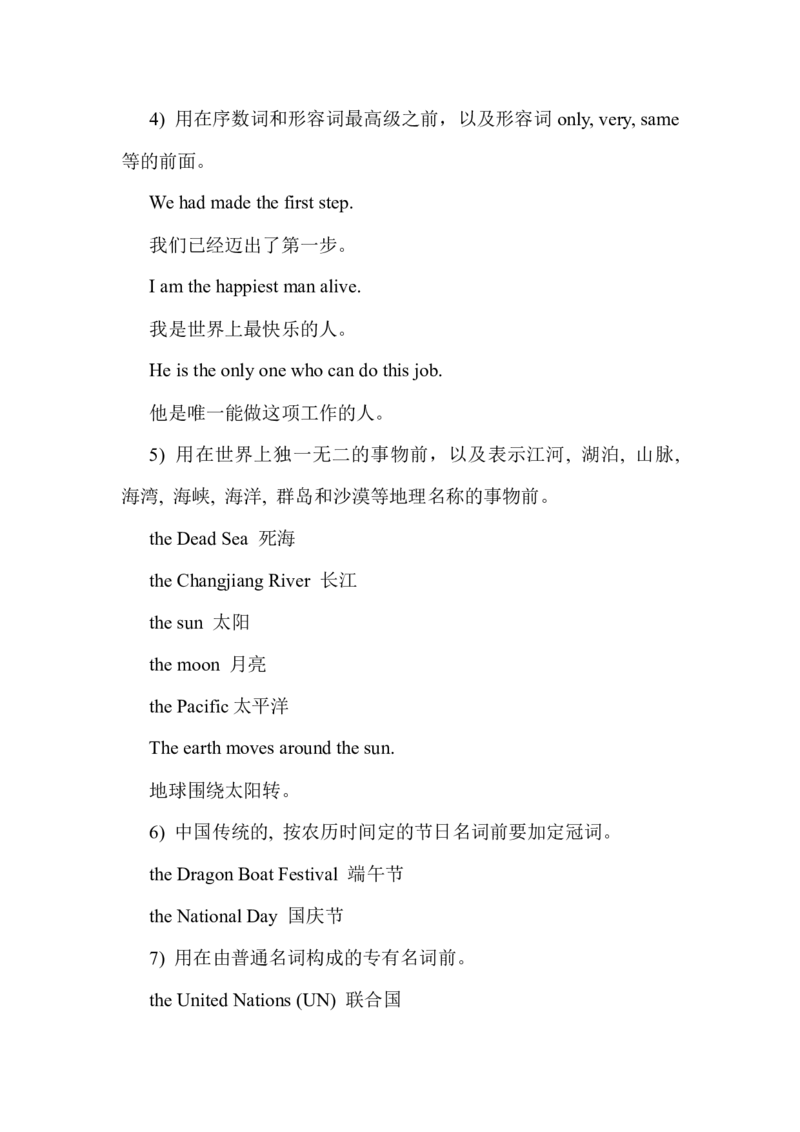
4) 用在序数词和形容词最高级之前,以及形容词only, very, same
等的前面。
We had made the first step.
我们已经迈出了第一步。
I am the happiest man alive.
我是世界上最快乐的人。
He is the only one who can do this job.
他是唯一能做这项工作的人。
5) 用在世界上独一无二的事物前,以及表示江河, 湖泊, 山脉,
海湾, 海峡, 海洋, 群岛和沙漠等地理名称的事物前。
the Dead Sea 死海
the Changjiang River 长江
the sun 太阳
the moon 月亮
the Pacific 太平洋
The earth moves around the sun.
地球围绕太阳转。
6) 中国传统的, 按农历时间定的节日名词前要加定冠词。
the Dragon Boat Festival 端午节
the National Day 国庆节
7) 用在由普通名词构成的专有名词前。
the United Nations (UN) 联合国
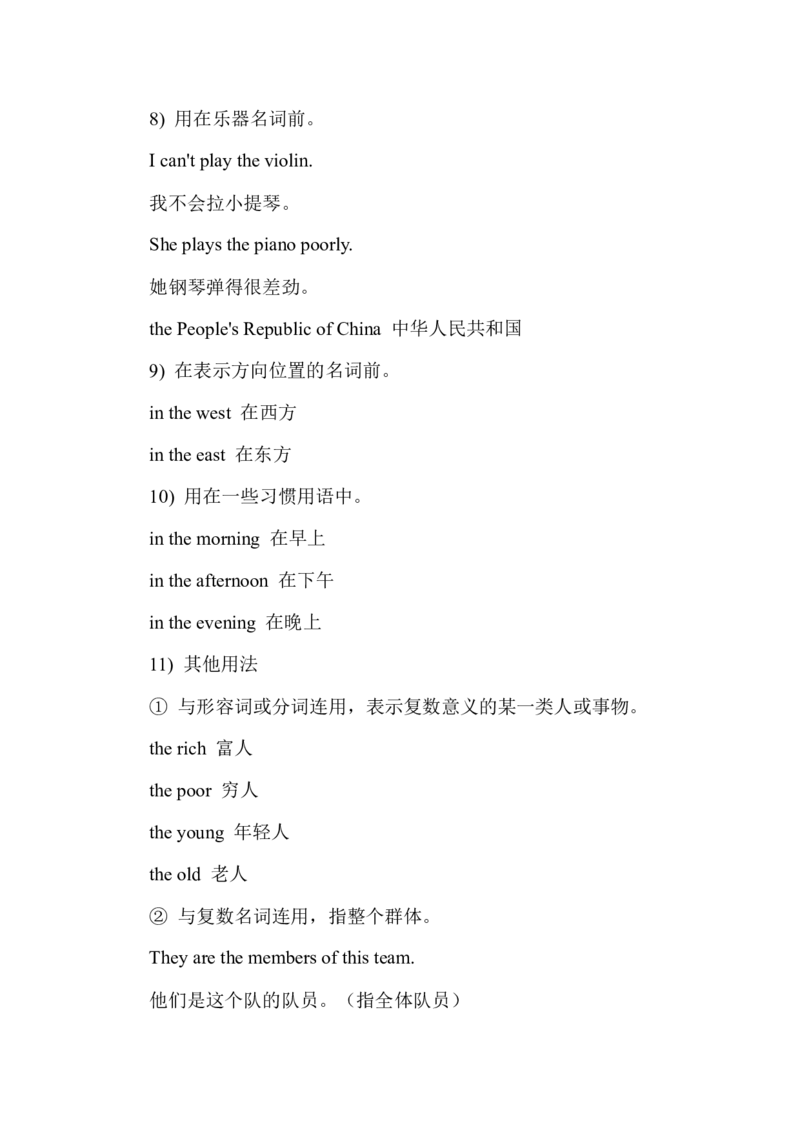
8) 用在乐器名词前。
I can't play the violin.
我不会拉小提琴。
She plays the piano poorly.
她钢琴弹得很差劲。
the People's Republic of China 中华人民共和国
9) 在表示方向位置的名词前。
in the west 在西方
in the east 在东方
10) 用在一些习惯用语中。
in the morning 在早上
in the afternoon 在下午
in the evening 在晚上
11) 其他用法
① 与形容词或分词连用,表示复数意义的某一类人或事物。
the rich 富人
the poor 穷人
the young 年轻人
the old 老人
② 与复数名词连用,指整个群体。
They are the members of this team.
他们是这个队的队员。(指全体队员)
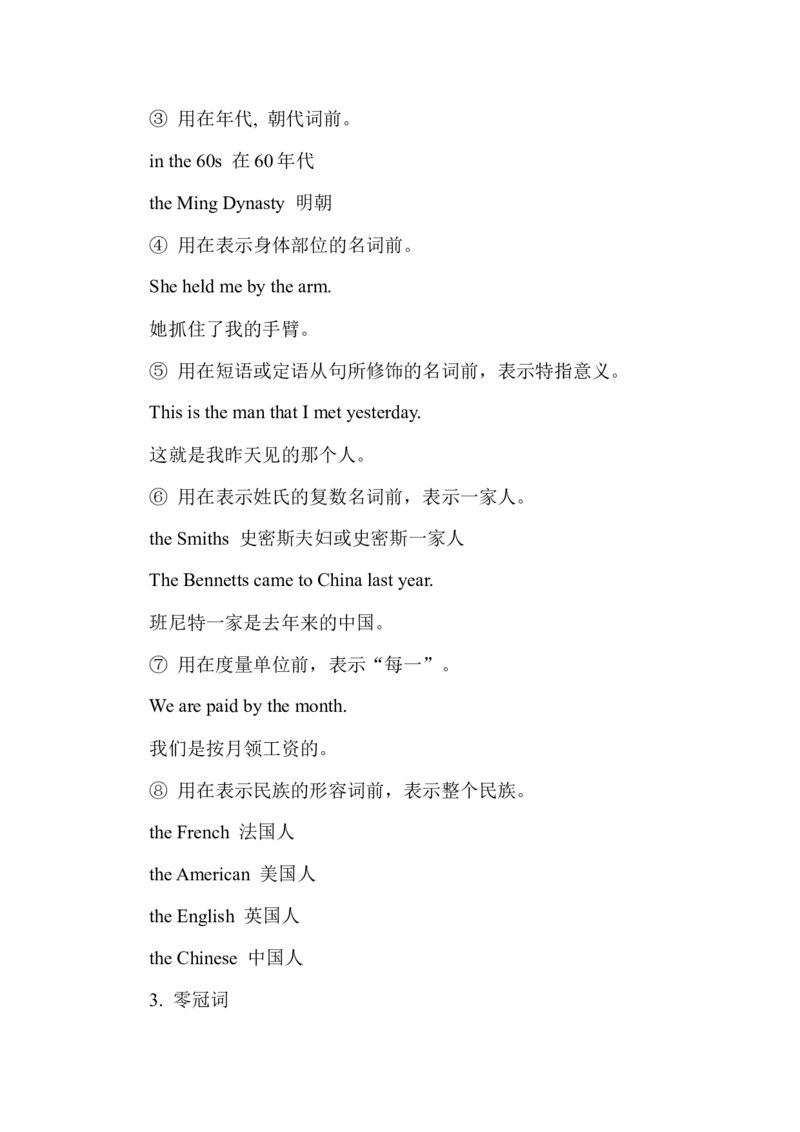
③ 用在年代, 朝代词前。
in the 60s 在60 年代
the Ming Dynasty 明朝
④ 用在表示身体部位的名词前。
She held me by the arm.
她抓住了我的手臂。
⑤ 用在短语或定语从句所修饰的名词前,表示特指意义。
This is the man that I met yesterday.
这就是我昨天见的那个人。
⑥ 用在表示姓氏的复数名词前,表示一家人。
the Smiths 史密斯夫妇或史密斯一家人
The Bennetts came to China last year.
班尼特一家是去年来的中国。
⑦ 用在度量单位前,表示“每一”。
We are paid by the month.
我们是按月领工资的。
⑧ 用在表示民族的形容词前,表示整个民族。
the French 法国人
the American 美国人
the English 英国人
the Chinese 中国人
3. 零冠词
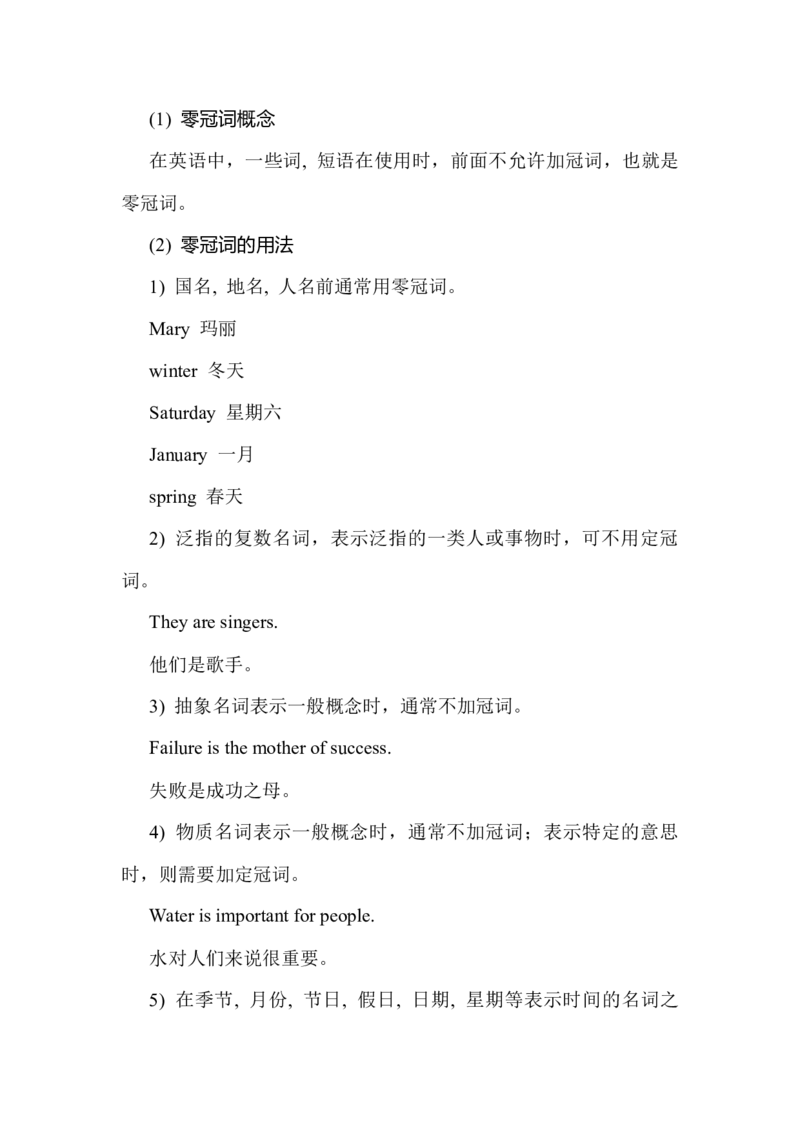
(1) 零冠词概念
在英语中,一些词, 短语在使用时,前面不允许加冠词,也就是
零冠词。
(2) 零冠词的用法
1) 国名, 地名, 人名前通常用零冠词。
Mary 玛丽
winter 冬天
Saturday 星期六
January 一月
spring 春天
2) 泛指的复数名词,表示泛指的一类人或事物时,可不用定冠
词。
They are singers.
他们是歌手。
3) 抽象名词表示一般概念时,通常不加冠词。
Failure is the mother of success.
失败是成功之母。
4) 物质名词表示一般概念时,通常不加冠词;表示特定的意思
时,则需要加定冠词。
Water is important for people.
水对人们来说很重要。
5) 在季节, 月份, 节日, 假日, 日期, 星期等表示时间的名词之
前,不加冠词。
We work from Monday to Friday.
我们从星期一工作到星期五。
6) 在称呼或表示官衔, 职位的名词前不加冠词。
General Lee was in command of the air force.
李将军统率空军部队。
7) 在三餐, 球类运动和娱乐运动的名称前,不加冠词。
have breakfast 吃早餐
have lunch 吃午饭
play chess 下象棋
play basketball 打篮球
8) 当两个或两个以上的名词并用时,常省去冠词。
There is no pen or pencil in this shop.
这个商店没有钢笔和铅笔。
9) 当by 与火车等交通工具连用,表示一种方式时,中间无冠
词。
by bus, by air, by bike, by train, by car
10) 有些个体名词不用冠词,直接置于介词后,表示该名词的深
层含义。
此类的个体名词有:hospital, prison, school, college, market, bed,
table, class, town, church,court 等。
go to school 去上学
go to the school 去学校(不一定是上学,可能是有别的事)
go to church 去教堂做礼拜
go to the church 去教堂(不一定是做礼拜)
go to hospital 去医院看病
go to the hospital 去医院(不一定是去看病,可能是有其他目
的)
11) 不用冠词的序数词。
① 序数词前有物主代词。例如:my first tim, our second day
② 序数词作副词。例如:He came first in the race
③ 在固定词组中。例如:at (the) firs, first of al, from first to las
7.2 连词 Conjunctions
1. 连词概念
连词是一种虚词,在句中起连接作用,可以用来连接单词, 短语,
从句, 分句或句子。在句中不单独作句子成分,一般不重读。
2. 连词分类
(1) 根据连词的本身含义及所连接的成分是否平等,连词可分为
并列连词和从属连词两大类。
1) 并列连词
并列连词用以连接彼此是并列关系的单词, 短语, 分句或从句,
被连接的两个部分彼此是独立的,在句法上是平等的。常用的并列
连词有and, or, but, for, not only… but (also)…, both…and…等。
2) 从属连词
从属连词用来连接两个或两个以上的分句,形成复杂句中的从属
分句,即引导名词性从句和状语从句。常用的从属连词有that,
whether, when, although, because 等。
(2) 按照其构成,连词可分为以下4 类。
1) 简单连词:
简单连词是指单个词的连词。例如:and, or, but, if, because 等。
2) 关联连词:
关联连词是指由两个或两个以上互相关联的词构成的连词。例
如:both… and…, not only… but also…等。
3) 分词连词:
分词连词是由动词的分词形式转变而来的连词。例如:
supposing, considering, provided 等。
4) 短语连词:
短语连词是由一个短语来充当的连词。例如:as if, as long as, in
order that, as well as 等。
(3) 按照词义,连词可分为表示选择或对等关系, 表示解释说明,
表示总结, 表示时间顺序, 表示因果关系, 表示转折关系, 表示递进
等的连词。
1)表示选择关系或并列关系的连接词:
either… or…, neither… nor…, as well as, and, both… and…, and,
not only… but (also)…等。
2) 表示解释说明的连接词:
that is, that is to say, in other words, such as, for example, for
instance, and so on, etc, and the like, and what not 等。
3) 表示总结的连接词:
in a word, on the whole, in short, in brief, to sum up, in all 等。
4) 表示时间顺序的连接词:
the moment, as soon as, at firs, then, later, meanwhile, at the
beginning, in the end, before long, for the first time, the minute 等。
5) 表示因果关系的连接词:
therefore, as a result, as the result of, hence, because of, due to, owing
to, thanks to 等。
6) 表示转折关系的连接词:
yet, still, but, while, on the contrary, on the other hand, however,
nevertheless, at the same time(然而)等。
7) 表示递进关系的连接词:
not only… but (also) , what's more, what's worse, besides, in addition,
worse still, moreover,above all 等。
3. 从属连词
(1) 从属连词概念
从属连词引导从句,包括名词性从句(主语从句, 宾语从句, 表
语从语和同位语从句)和状语从句(时间状语从句, 地点状语从句,
条件状语从句, 让步状语从句, 原因状语从句, 比较状语从句,程度
状语从句, 结果状语从句和目的状语从句)。
(2) 从属连词用法
1) 引导名词性从句:
It is obvious that we need to think twice about this thing.
很明显,我们需要仔细考虑这件事。(that 引导主语从句)
He said that he did not want to go.
他说他不想去。(that 引导宾语从句)
The reason was that I didn't like him.
原因是我不喜欢他。(that 引导表语从句)
The news that the exam was canceled excited me.
考试取消的消息使我很兴奋。(that 引导同位语从句)
2) 引导状语从句:
① 时间状语从句:when 当……时, whenever 任何时候, as
当……时, 一边……一边, while 当……时,在……期间,before
在……以前,after 在……之后,until/till 直到,since 自从,once
一旦,as soon as 一……就……,every time 每当,the moment
一……就……,directly 一……就……,no sooner… than… 一……
就……等。
The novel became even more popular after it was made into a movie.
这部小说在拍成电影后更加受欢迎了。
As soon as he stops talking, let's go and get some coffee.
等他话音一停,咱们就去弄点咖啡。
Many things have happened since I last saw him.
自从我上次见到他以来,发生了很多事。
He stood quite silent while she appealed to him.
当她向他求助时,他站着一声不吭。
No sooner had he arrived than he was asked to leave again.
他刚到就被赶走了。(no sooner 开头的句子要倒装)
② 地点状语从句: where 在……地方,wherever 无论哪里,在
任何地方,everywhere 每一……地方/到处,anywhere 任何地方。
Sit wherever you like.
想坐哪儿就坐哪儿吧。
Where there is a will, there is a way.
有志者,事竟成。
I'll take you anywhere you like.
你喜欢哪儿,我就带你去哪儿。
③ 原因状语从句:as 由于/因为,because 因为,since 既然,
seeing(that)/considering (that) 鉴于/由于,now that 既然,in that 因
为等。
Since/As you are busy , you had better not go with us.
既然你工作忙,你就不必跟我们一起去了。
I took this road because the policeman told me to.
我走这条路是因为警察告诉我这么走的。
Seeing (that) he is young, his salary is not so bad.
他还年轻,这样的薪水算是不错的了。
Now that you mention it, I do remember the incident.
经你一提,我想起那件事了。
Criticism and self-criticism is necessary in that it helps us correct our
mistakes.
批评与自我批评是必要的,因为这能帮助我们改正错误。④ 目
的状语从句:so that 以便,in order that 以便,lest 唯恐,for fear
that 唯恐/以免,in case 免得/以防万一等。He packed the instruments
very carefully lest they should be broken during transportation.
他把仪器小心地包装好,以免在运输中破损。
I got up early in order to catch the first bus.
为了赶第一班公交车,我起床很早。
They spoke in whisper for fear that they might wake the baby.
他们轻声说话,以免吵醒婴儿。
The invitations were sent out early in order that the delegates might
arrive in time for the conference.
邀请书发出得很早,以便让代表们及时到会。
I take an umbrella in case it would rain.
我带了把伞,以防下雨。
⑤ 结果状语从句:that 以便,so (such) … that 如此……以致,
so that 因此/所以等。
They set off half an hour earlier that they might get there in time.
他们早出发半小时,以便及时到达那里。
I'll wash the dress so that you can wear it.
我把这件衣服洗了,你好穿上。
He is such a good student that all the teachers like him.
他是个好学生,老师们都喜欢他。
She spoke so fast that nobody could catch what she was saying.
她说话如此之快,竟没有人听出来她在讲什么。
⑥ 条件状语从句:if 如果,in case 如果,unless 除非,lest 唯
恐,suppose/supposing 假如,so/as long as 只要,only if 只要/只
有,if only 但愿/ 要是… … 该多好, on condition (that) 条件
是……,provided (that) 假如等。
In case you see him, ask him about it.
如果你见着他,问问他这件事。
You may come if you want to.
如果你愿意你可以来。
I refuse to do it unless you help.
你如果不协助,我是不干的。
She began to be worried lest he should have met with some accident.
她开始不安起来,唯恐他发生什么事。
As long as I have time to study, I don't care whether the condition is
good or not.
只要有时间学习,我不在乎环境好坏。
Only if I get a job will I have enough money to go to school.
我只有找到了工作,才有足够的钱上学。
If only I could play the piano.
要是我会弹钢琴,该多好啊。
You can use my car on condition that you return it tomorrow.
只要你明天归还,我的车你可以拿去用。
I will come with you provided (that) I am well enough.
只要我身体好,我一定和你一起去。
⑦ 让步状语从句:though/although 虽然/尽管, even if/though
即使, however (no matter how) 无论怎样,whatever (no matter
what) 无论什么,whenever (no matter when) 无论什么时候,
wherever (no matter where) 无论哪里等。
I didn't get the job though I tried all my best.
尽管我使出浑身解数也没有得到那份工作。
Even if I failed this exam, I will not give up my English studying.
即使我这次考试失败了,我也决不会放弃我的英语学习。
No matter how hard it is, I will do my best to do it.
不管如何艰难,我都要尽力去做。
Whoever (No matter who) wants to speak to me on the phone, tell
them I am out.
不管谁找我接电话,就说我出去了。
⑧ 比较状语从句:than 比,as… as… 和……一样等。
He has more friends than she (does).
他的朋友比她的多。
She runs as fast as a rabbit (does).
她跑得像兔子一样快。
He is as tall as his father.
他和他爸爸一样高。
⑨ 方式状语从句:as 正如/就像,as… as… 和……一样,as far
as 就……而论/据……,as if/though 好像/宛如等。
Why didn't you do your homework as I told you to?
你怎么不听我的话做你的家庭作业呢?
They looked at me as if/though I were mad.
他们看着我好像我发疯了似的。
As far as I could see, your behavior is unjustifiable.
就我看来,你的行为是不合情理的。
He looks as ill as he sounded on the phone.
他的样子看起来不大好,正如听他在电话中说话的声音也不大好
一样。
4. 并列连词
(1) 并列连词概念
并列连词用以连接彼此是并列关系的单词, 短语, 分句或从句,
被连接的两个部分彼此是独立的,在句法上是平等的。常用的并列
连词有and, or, but, for, not only… but (also)…, both… and…等。
(2) 并列连词的具体用法
1) 表示并列关系的并列连词有as well as, and, both… and…, and,
not only… but (also)等。
Time and tide wait for no man.
岁月不待人。
The little girl is not only beautiful but also clever.
这个小女孩不仅漂亮而且聪明。
Both you and I are students.
你和我都是学生。
John as well as you is my bosom friend.
约翰和你都是我的知己。
2) 表示转折关系的并列连词有yet, but, while, still 等。
The car was quite old but in excellent condition.
那部车相当旧了,但机器性能还非常好。
The winter in Beijing is very cold while that of Kunming is warm.
北京的冬天很冷,然而昆明的冬天却很温暖。
I explained twice, still he couldn't understand.
我解释了两遍,然而他还是不懂。
3) 表示选择关系的并列连词有either… or…, neither… nor…, or,
otherwise, or else 等。
He is either sick or lazy.
他不是病了就是太懒。
I do not care whether you go or stay.
我才不管你是走是留呢。
He moved steadily, looking neither left nor right.
他从容地走着,并不左顾右盼。
注 当or,neither... nor...,either... or 等连接主语时,谓语动词的
单复数由or 或nor 后面的部分而定。
4) 表示因果关系的并列连词主要有so, for, then, therefore 等。
The air here is polluted, so the crops are dying.
这里的空气受到了污染,以致庄稼快死了。
The leaves of the trees are falling, for it's already autumn.
树叶在落下,因为秋天已经到来了。
注 并列连词for 引导的分句只能放在句尾,前面用逗号隔开,表
示补充说明的微弱理由,只是为前面的内容提供判断的理由,有时
译为并列的某种形式。这与because 不同,because 引导的是一种明
确的因果关系,解释原因,常可回答why 的提问。
5) 其他用法
表示并列关系的and, or, well, as, not only... but also...等连词也有比
较活跃的用法。
①and 作为并列连词有多重含义,除了表示并列关系外,还可以表
示顺承, 目的, 条件等关系。
He went to the market and bought some vegetables.
他到市场买了一些蔬菜。(表示顺承,动作的先后发生)
Come and help me out.
过来帮我一下。(表示目的)
Be careful and you'll make fewer mistakes.
认真些,你所犯的错就少。(表示条件)
②or 表示“否则”的话,前句一般是祈使句,后句用一般将来
时。在表示选择关系时or 与 either...or...用法相同,但either... or...更
具强调性。在多个对象进行选择时,可以用A or B or C..., either A or
B or C..., neither A nor B nor C...。
Either Jim or Jake or Jeff knows about this.
不论是吉姆,或是杰克,还是杰夫,都知道这件事。
She likes going out with friends or playing outdoor games.
她喜欢和朋友一起聚会或者做户外运动。
③ 名词 + as well as + 名词作主语时,强调前面的名词,谓语动
词要根据前面的名词而定。notonly... but also...连接名词作主语时,
其强调后者,谓语动词要根据后面的名词而定。
China as well as many other countries in the world loves peace.
中国与世界上的其他许多国家一样热爱和平。
Not only Bill but also his parents want to go traveling by bike.
不仅比尔而且他的父母都想骑自行车去旅游。
5. 使用误区
连词的用法,看起来简单,但在实际应用中,错误却是在所难
免。
(1) 这个外国人不仅会说英语,还会说普通话。
(×)The foreigner not only speaks English but also Mandarin.
(√)The foreigner speaks not only English but also Mandarin.
解析 这里的not only 应该移到speaks 后面,使这个动词兼顾两
个等立宾语:Mandarin 和English。
(2) 虽然他很胖,但是身体却很弱。
(×)Although he is fat, but he is very weak.
(√)Although he is fat, he is very weak.
(√)He is fat, but he is very weak.
解析 英语里的although 和but 是不可以同时使用的,因此这句里
的but 要去掉,或者although 要删掉。
(3) 这本书既可以用作课本,又可以当做参考书。
(×)This book may be used both as a text as well as a reference book.
(√)This book may be used both as a text and reference book.
解析 这里的as well as 和both 不能搭配,应该将as well 改为关
联连词both... and...。
(4) 杰克没有你那么弱。
(×)Jack is not so weak like you.
(√)Jack is not so weak as you.
解析 这里的not so 必须和as 连成一体;介词like 是不适宜的。
(5) 她坐公交车去车站。
(×)She took a bus and which took her to the station.
(√)She took a bus which took her to the station.
(√)She took a bus and it took her to the station.
解析 这里的并列连词and 是多余的,必须去掉。如果要保留and
也可,但是形容词分句里的关系代词which 要改成主语it。
(6) 我的朋友走过来,握着我的手,兴奋地说再见。
(×)My friend came up to me and held my hand, said good-bye
excitedly.
(√)My friend came up to me, held my hand, and said good-bye
excitedly.(√)My friend came up to me and held my hand, saying good-
bye excitedly.
解析 这里的and 应该用来连接最后两个谓语才对。或者,把第
一句中的said 改成saying。
(7) 我们刚到达目的地,他们就离开了。
(×)No sooner had we reached our destination, they left.
(√)No sooner had we reached our destination than they left.
(√)As soon as we reached our destination, they left.
解析 no sooner 必须和than 配成关联连词,第一句中把than 省掉
是不对的,应该补上。