高中英语语法核心知识点详解(讲义)
Part 11 词性篇——形容词②
(3) 形容词比较等级的省略
(接形容词①)
5) 一些常用的固定用法中的绝对最高级也可省去the。
With this card go all my best wishes.
愿这张卡片带去所有我最诚挚的祝福。
I would like to express my deepest gratitude to everyone here.
我想对所有在场的人致以最诚挚的谢意。
6) 在正式文体中,the 有时也可省略。
It is a matter of greatest importance.
这是件极其重要的事情。
They had hair of darkest brown.
他们有一头深棕色头发。
7) 有时,在具体的上下文中,由于最高级的比较范围是众所周
知的,所以表示范围的短语或从句可以省去。
It might be the best news.
这可能是最好的消息。
8) 在上下文意思清晰的情况下,形容词最高级后的名词也可以
省去。
He is the cleverest of all.
他是所有人中最聪明的一个。(cleverest 后省去了名词)
(4) 比较对象的逻辑一致性
1) 英语是逻辑性非常强的语言,所以在运用比较结构时,有时
需要用that, those 或one 替代前文出现过的特指名词,既保证了比较
对象的逻辑一致性,又避免了重复。
(×)The amount of the product of this factory is less than that factory.
(√)The amount of the product of this factory is less than that of that
factory.
这个工厂的产量小于那个工厂的产量。
(×)The population of Tokyo is larger than London.
(√)The population of Tokyo is larger than that of London.
东京的人口比伦敦的多。
Your price is higher than those we got from elsewhere.
你们的价格比我们从别处得到的报价要高。
A girl with good manners is more beautiful than one with good
looking.
有礼貌的女孩比长得好的女孩更漂亮。
2) 另外,当两个单位进行比较时,它们不能相互包含。
(×)He is taller than all the students in his class.
(√)He is taller than any other student in his class.
他比班上任何学生都高。(因为all the students 包括he)
(5) 形容词比较等级的特殊用法
1) as… as 用来表示“像……一样”,其否定形式not so… as。
It is as clear as crystal.
它像水晶一样清澈透明。
He is not so black as one is painted.
他并不像人们所描述的那样坏。
2) no more (less) than 与not more (less) than 的含义不同,前者表
示说话人主观上觉得少(多),后者是对数量的客观的描述,“不
多(少)于”。
试比较:
He has no more than $100.
他只有100 美元。(no more than 表示“只不过”,强调少。)
I guessed it was not more than 5 kilograms.
我估计了一下,它顶多有10 斤。
(not more than 表示“不多于”这样一个客观数量,不强调
少。)
There were no less than fifty wounded.
受伤者多达50 人。(no less than 强调程度之大。)
The audience was not less than five thousand.
听众至少也有5000 人。(not less than 表示“至少”,不少于一
个客观数量。)
3) 表语中比较两个形容词时,不管形容词有多少个音节,皆须
用more… than 结构,且后不跟than 从句,意义往往是“是……而不
是”,或者颠倒词序译为“与其说是……不如说是”。
The girl is more wise than beautiful.
这个女孩与其说是漂亮,不如说是聪明。
We are more concerned than worried.
我们更多的是关心,而不是担心。
但下面一类句子除外:
This flag is longer than it is wide.
这面旗长度大于宽度。
My room was darker than it was bright.
我的房间黑暗多于明亮。
① 上述more… than 结构也可用于名词,介词短语等。
She is more a singer than a dancer.
她与其说是舞蹈家,不如说是个歌手。
It is more like an apple than anything else.
它更像是个苹果。
② 上述more… than 结构也可用于非表语结构。
Making more friends will do you more good than harm.
多交朋友对你利大于弊。
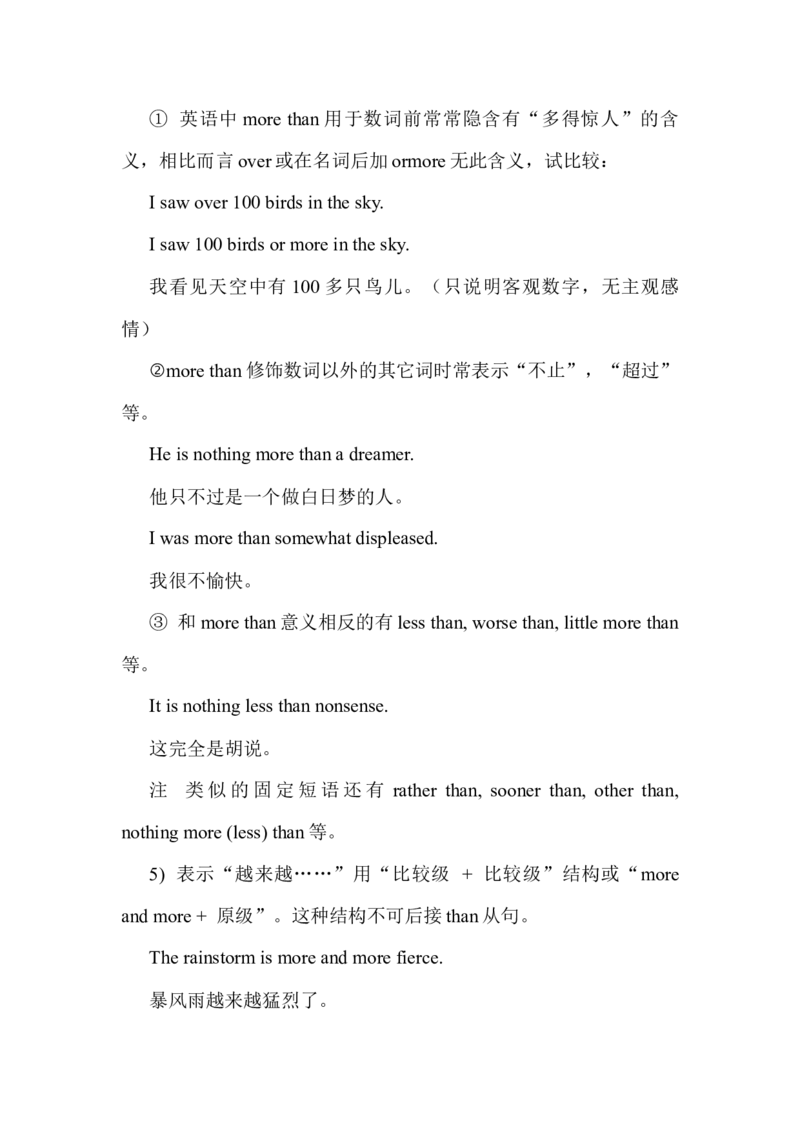
4) more than 作为固定短语意为“多于”,常用于数词或相当于
数词的词前。
I have more than enough.
我已经吃得太多了。
① 英语中more than 用于数词前常常隐含有“多得惊人”的含
义,相比而言over 或在名词后加ormore 无此含义,试比较:
I saw over 100 birds in the sky.
I saw 100 birds or more in the sky.
我看见天空中有100 多只鸟儿。(只说明客观数字,无主观感
情)
②more than 修饰数词以外的其它词时常表示“不止”,“超过”
等。
He is nothing more than a dreamer.
他只不过是一个做白日梦的人。
I was more than somewhat displeased.
我很不愉快。
③ 和more than 意义相反的有less than, worse than, little more than
等。
It is nothing less than nonsense.
这完全是胡说。
注 类似的固定短语还有rather than, sooner than, other than,
nothing more (less) than 等。
5) 表示“越来越……”用“比较级 + 比较级”结构或“more
and more + 原级”。这种结构不可后接than 从句。
The rainstorm is more and more fierce.
暴风雨越来越猛烈了。
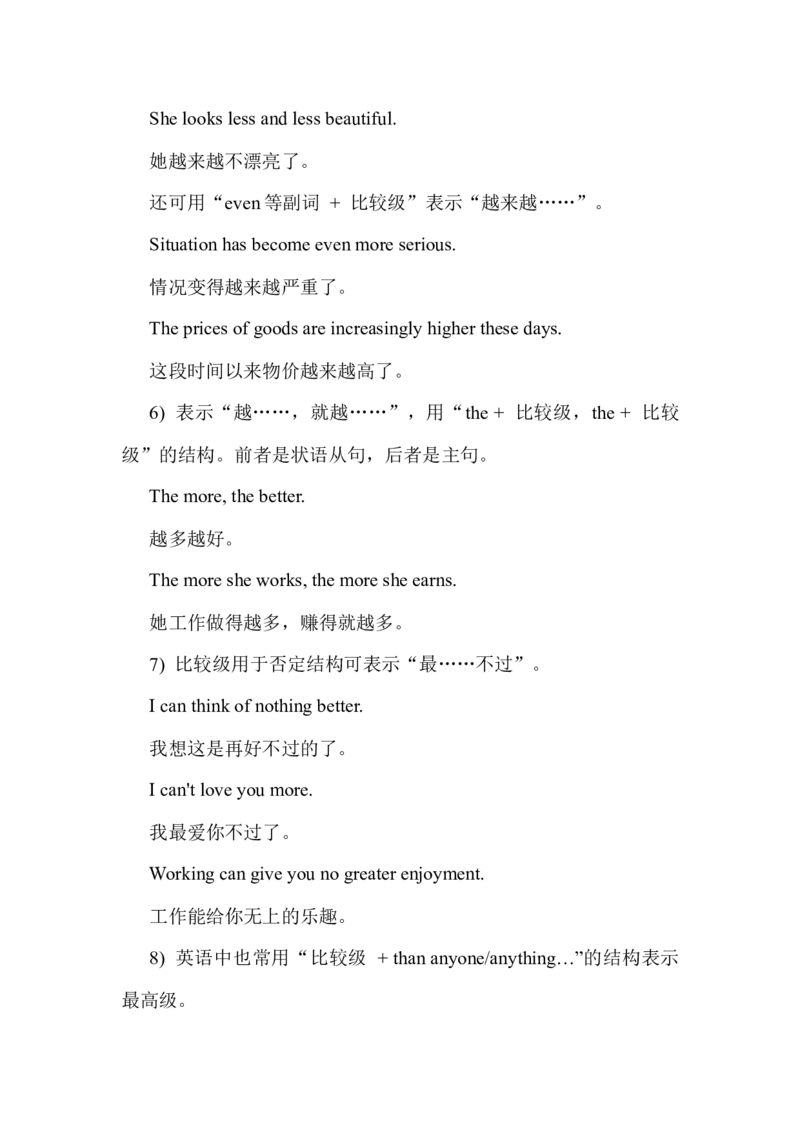
She looks less and less beautiful.
她越来越不漂亮了。
还可用“even 等副词 + 比较级”表示“越来越……”。
Situation has become even more serious.
情况变得越来越严重了。
The prices of goods are increasingly higher these days.
这段时间以来物价越来越高了。
6) 表示“越……,就越……”,用“the + 比较级,the + 比较
级”的结构。前者是状语从句,后者是主句。
The more, the better.
越多越好。
The more she works, the more she earns.
她工作做得越多,赚得就越多。
7) 比较级用于否定结构可表示“最……不过”。
I can think of nothing better.
我想这是再好不过的了。
I can't love you more.
我最爱你不过了。
Working can give you no greater enjoyment.
工作能给你无上的乐趣。
8) 英语中也常用“比较级 + than anyone/anything…”的结构表示
最高级。
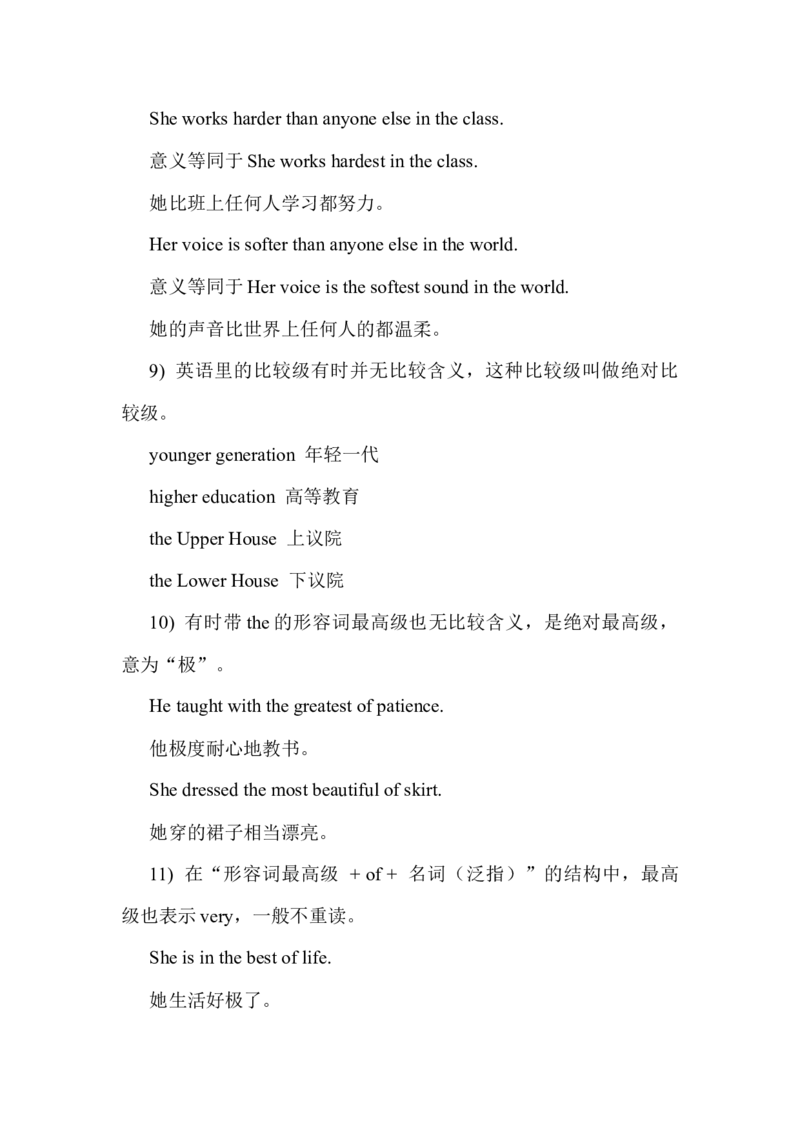
She works harder than anyone else in the class.
意义等同于She works hardest in the class.
她比班上任何人学习都努力。
Her voice is softer than anyone else in the world.
意义等同于Her voice is the softest sound in the world.
她的声音比世界上任何人的都温柔。
9) 英语里的比较级有时并无比较含义,这种比较级叫做绝对比
较级。
younger generation 年轻一代
higher education 高等教育
the Upper House 上议院
the Lower House 下议院
10) 有时带the 的形容词最高级也无比较含义,是绝对最高级,
意为“极”。
He taught with the greatest of patience.
他极度耐心地教书。
She dressed the most beautiful of skirt.
她穿的裙子相当漂亮。
11) 在“形容词最高级 + of + 名词(泛指)”的结构中,最高
级也表示very,一般不重读。
She is in the best of life.
她生活好极了。
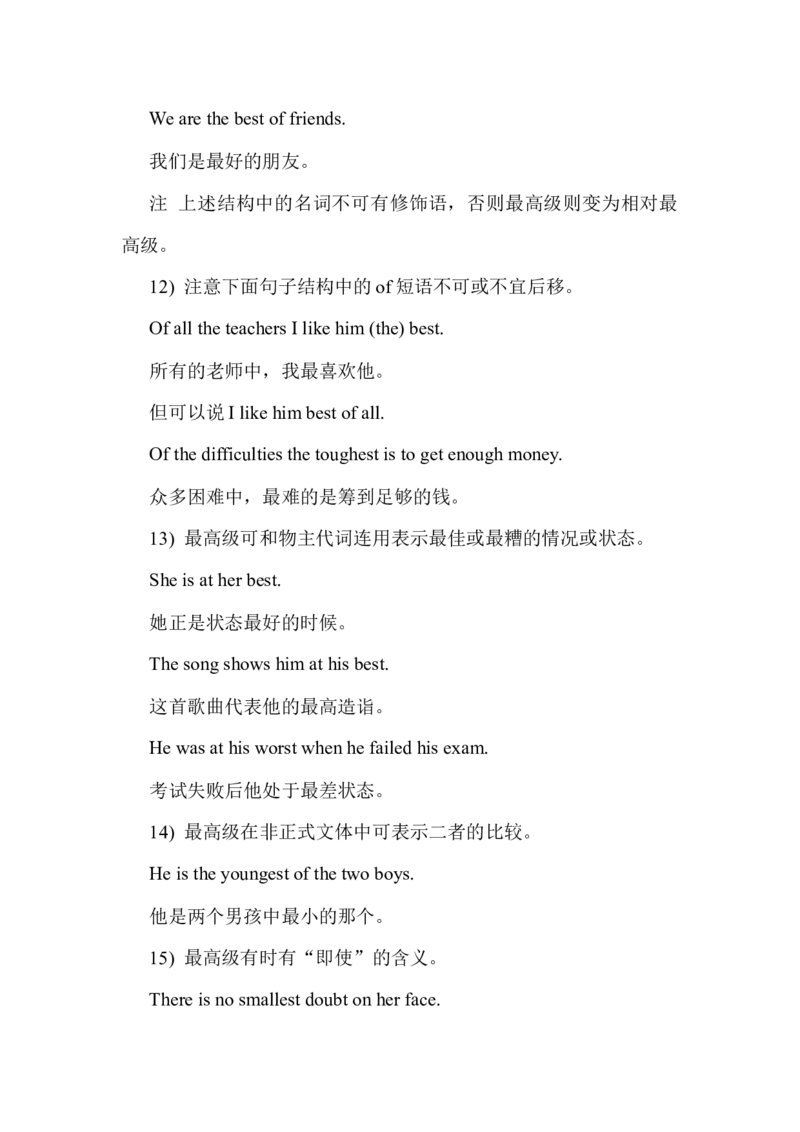
We are the best of friends.
我们是最好的朋友。
注 上述结构中的名词不可有修饰语,否则最高级则变为相对最
高级。
12) 注意下面句子结构中的of 短语不可或不宜后移。
Of all the teachers I like him (the) best.
所有的老师中,我最喜欢他。
但可以说I like him best of all.
Of the difficulties the toughest is to get enough money.
众多困难中,最难的是筹到足够的钱。
13) 最高级可和物主代词连用表示最佳或最糟的情况或状态。
She is at her best.
她正是状态最好的时候。
The song shows him at his best.
这首歌曲代表他的最高造诣。
He was at his worst when he failed his exam.
考试失败后他处于最差状态。
14) 最高级在非正式文体中可表示二者的比较。
He is the youngest of the two boys.
他是两个男孩中最小的那个。
15) 最高级有时有“即使”的含义。
There is no smallest doubt on her face.
她脸上连一丝怀疑都没有。
He felt no least worry about this.
他对此一点也不担心。
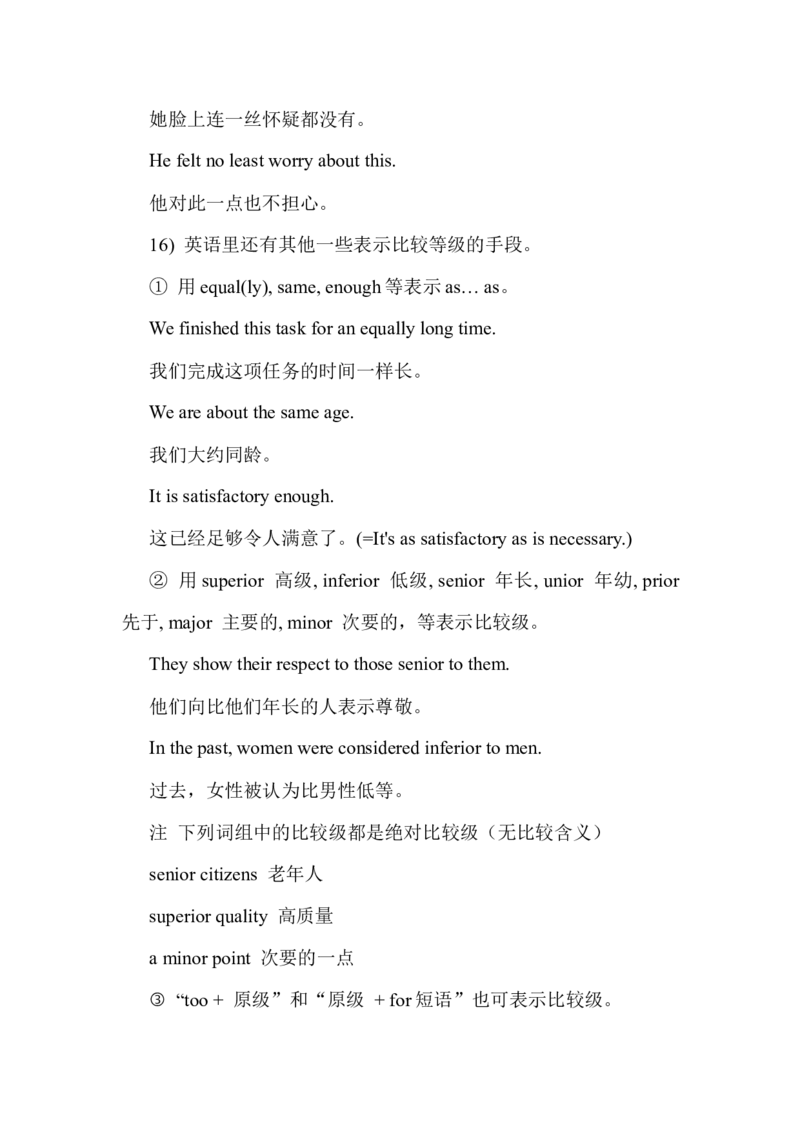
16) 英语里还有其他一些表示比较等级的手段。
① 用equal(ly), same, enough 等表示as… as。
We finished this task for an equally long time.
我们完成这项任务的时间一样长。
We are about the same age.
我们大约同龄。
It is satisfactory enough.
这已经足够令人满意了。(=It's as satisfactory as is necessary.)
② 用superior 高级, inferior 低级, senior 年长, unior 年幼, prior
先于, major 主要的, minor 次要的,等表示比较级。
They show their respect to those senior to them.
他们向比他们年长的人表示尊敬。
In the past, women were considered inferior to men.
过去,女性被认为比男性低等。
注 下列词组中的比较级都是绝对比较级(无比较含义)
senior citizens 老年人
superior quality 高质量
a minor point 次要的一点
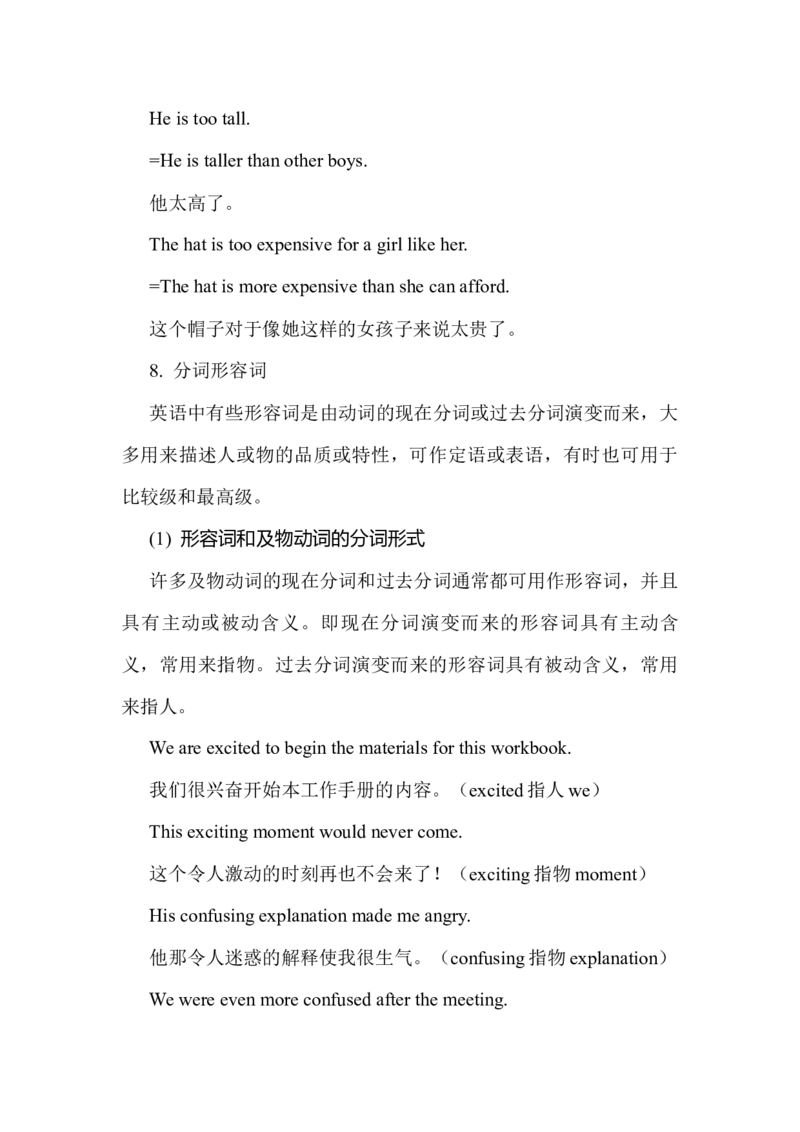
③ “too + 原级”和“原级 + for 短语”也可表示比较级。
He is too tall.
=He is taller than other boys.
他太高了。
The hat is too expensive for a girl like her.
=The hat is more expensive than she can afford.
这个帽子对于像她这样的女孩子来说太贵了。
8. 分词形容词
英语中有些形容词是由动词的现在分词或过去分词演变而来,大
多用来描述人或物的品质或特性,可作定语或表语,有时也可用于
比较级和最高级。
(1) 形容词和及物动词的分词形式
许多及物动词的现在分词和过去分词通常都可用作形容词,并且
具有主动或被动含义。即现在分词演变而来的形容词具有主动含
义,常用来指物。过去分词演变而来的形容词具有被动含义,常用
来指人。
We are excited to begin the materials for this workbook.
我们很兴奋开始本工作手册的内容。(excited 指人we)
This exciting moment would never come.
这个令人激动的时刻再也不会来了!(exciting 指物moment)
His confusing explanation made me angry.
他那令人迷惑的解释使我很生气。(confusing 指物explanation)
We were even more confused after the meeting.
开完会之后我们更糊涂了。(confused 指人we)
I felt bored for this job.
对这份工作我感觉很无聊。(bored 指人I)
1) 以-ful, -ous, -some, -able, -ible 结尾的形容词同样存在主动与
被动的区别。通常,以-ful,-ous, -some 结尾的形容词含有主动意义,
而以-able, -ible 等结尾的形容词含有被动意义。
doubtful 怀疑的
doubtable 值得怀疑的
respectful 对人尊敬的
respectable 受人尊敬的
credulous 轻信的
credible 可信的
forgetful 健忘的
forgettable 容易被忘的
2) 有些-ed 形容词是由名词加ed 构成,表示具有该名词的特征。
a bearded man 留胡子的人
a gifted artist 有天分的艺术家
gloved hands 带手套的手
a salaried worker 带薪职员
winged creature 有翼类生物
(2) 形容词和不及物动词的分词形式
有些-ing 形容词由不及物动词的现在分词形式演变而来,只作定
语,不作表语,也不用于比较级和最高级,常用的有:
bleeding 流血的
becoming (穿,戴)合适的
living 有生命的
existing 现存的
bursting 爆裂开的
booming 蓬勃发展的
remaining 留下来的
rising 上升的
Existing schemes are far from perfect.
目前的方案仍有很多缺陷。
People are greatly worried about the rising price of food.
人们非常担心不断上涨的食物价格。
But for the heat of the sun, what will become of the living things on
earth.
要是没有太阳的热,地球上的生物会成什么样子。
This was done to put on an appearance of booming business.
这样做,为的是造成一副生意兴隆的样子。
Look, the falling leaves are all yellow.
看!那飘零的落叶都是黄色的。
9. 形容词排列顺序
(1) 形容词的位置
1) 形容词一般作前置定语,置于它所修饰的名词之前。
Romantic love is very much a part of American culture.
浪漫爱情是美国文化的重要组成部分。
He embarrassed me with a difficult question.
他出了一道难题把我难住了。
2) 但在某些特定情况下,形容词可作后置定语,放在它所修饰
的名词之后。
① 在修饰由some, any, every, no 等构成的不定代词时必须后置。
I want something durable.
我要比较耐用的。
She has sold everything valuable in the house.
她把房子里值钱的东西都卖了。
There is nothing special in this shop.
这家商店没什么特殊的。
We don't have anybody competent to do this job.
我们没有什么人可以胜任这份工作。
注 有时形容词也可置于something 之前,这时something 前有定
冠词修饰,这种用法中的something 等同于名词,常表示说话人不知
道或不便说出具体是什么的事物。例如:
There was the strange something on the floor.
地上有一些奇怪的东西。
② 表语形容词也可以放在名词之后。
This baby is the only person alive after the earthquake.
这个婴儿是地震之后唯一存活下来的人。
The parents rushed into the house ablaze.
父母冲进了燃烧的房子里。
③ 有些形容词用作非限制性定语,起补充说明的作用时可以后
置。
I, nervous, was standing on the platform.
我站在讲台上很紧张。
The couple, silent, walked past me.
这对夫妻一言不发地从我身旁走过。
④ 以able 和ible 结尾的形容词可置于前有最高级形容词或only
等词的名词之后。
That is the beautiful picture unimaginable.
那是无法想象的美丽图画。
It is the only method possible.
这是唯一可能的解决办法。
⑤ 有些形容词如positive 正面的, past 过去的, total 总的,
following 下列的, preceding 在……之前等,可前置或后置而意义不
变。
total sum 或sum total 总额
the past years 或the years past 过去那些年
the following points 或the points following 下列几点
the preceding days 或the days preceding 之前那些天
⑥ 与数词和量词一起构成表示时间, 空间单位的形容词词组放
在名词之后。
a well five meters deep 一口5 米深的井
a little man three inches tall 一个3 英尺高的小人
a vacation two weeks long 一次两周长的假期
⑦ 形容词enough 修饰名词时可前置或后置。
I have enough time.
I have time enough.
我有足够的时间。
⑧ 成对的形容词可以后置。
I like the sentences in this passage, simple but powerful.
我喜欢这篇文章中的句子,简单而有力。
It is a fine day today, warm and sunny.
今天是个好天,温暖且有阳光。
⑨ 形容词短语一般须后置,往往相当于定语从句,只是比定语
从句简练。
Our company wants a man suitable for the job.
=Our company wants a man who is suitable for the job.
我们公司需要一个适合这份工作的人。
The old man left his money to the boy faithful to him all the time.
=The old man left his money to the boy who had been faithful to him
all the time.
这个老人把钱留给了那个一直对他很忠诚的男孩。
⑩ 在由古语演变来的固定短语中,形容词常后置。
a court martial 军事法庭
Asia Minor 小亚细亚
secretary-general 秘书长
a poet laureate 桂冠诗人
(2) 形容词的排列顺序
1) 有两个或是多个形容词修饰名词时,它们的次序往往比较固
定。限定词一般都置于第一位,其它修饰语则常根据其与名词的亲
疏关系按下列次序排列。
① 限定词(包括冠词,物主代词,指示代词,不定代词等)。
a/an 一个, the 那个, my 我的, this 这个, that 那个, some 一些
② 数词(包括序数词和基数词)。
one 一个, two 两个, first 第一个, second 第二个
③ 描绘形容词(包括分词)(短词在前,长词在后)。
clean 干净的, weak 软弱的, good 好的
pretty 漂亮的, fast-running 跑得快的
④ 表示大小, 形状, 新旧, 年龄等的形容词。
round 圆形的, big 大的, little 小的
young 年轻的, new 新的, old 旧的
⑤ 表示颜色的形容词。
white 白色的, red 红色的, black 黑色的, blue 蓝色的
⑥ 表示类属,国籍和出处的形容词。
British 英国的, southern 南方的, Chinese-made 中国制造的
⑦ 表示材料质地的形容词。
rocky 山石嶙峋的, synthetic 合成的, wooden 木质的, tin 锡的
⑧ 表示用途, 类别, 目的的形容词。
writing 用于写作的, teaching 用于教学的, medical 医学的
⑨ 名词性定语。
pleasure 娱乐的, stone 石头的, sports 运动的, glass 玻璃的
2) 常见的形容词排列顺序:
① 大小 + 颜色
a big red hat 一个大的红色帽子
② 特性 + 新旧 + 颜色
a fabulous new purple dress
一件非常漂亮的紫色的新裙子
③ 特性 + 大小 + 颜色 + 材料
a useful small brown wooden box
一个有用的棕色的小木盒子
④ 特性 + 新旧 + 国籍 + 用途
a valuable ancient Chinese writing desk
一张价值不菲的中式古董书桌
⑤ 限定词 + 数词 + 特性 + 年龄 + 国籍 + 名词性定语
all the ten strong young Chinese boy students
所有10 个年轻力壮的中国男学生
⑥ 现在分词 + 国籍 + 用途
a fast-running Japanese sports car
一辆飞驰的日本跑车
注 多个形容词修饰一个名词的情况多见于书面语中,口语中很
少用。
10. 形容词功能
形容词可修饰或补充说明名词或代词,在句中用作定语, 表语,
补语, 状语, 独立成分等。
(1) 作定语
That's an empty temple.
那是一所空寺庙。
The girl is a good student.
这个女孩是名好学生。
This is my old jacket.
这就是我的旧夹克。
形容词作定语注意事项:
1) 形容词作定语时,有时表面上修饰A,实质上修饰B(多指
人),这种形容词叫做转移形容词。She had a happy day.
她度过了快乐的一天。(happy 表面上修饰day,实际上修饰
she)
2) 有些形容词形式上修饰名词,实际上相当于副词,修饰名词
所内含的动作。
a nervous actor
一个紧张的行动者(someone who acts nervously)
a patient doctor
一个耐心的医生(someone who operates patiently)
3) 有些形容词只能用作定语,所以称之为定语形容词。
My elder brother is a reporter.
我的哥哥是名记者。
Some students disliked the former headmaster.
很多学生不喜欢前任校长。
Don't be angry. He is a mere nobody.
别生气了,他只不过是个无名小卒。
(2) 作表语
This university is so beautiful.
这所大学真是美极了。
He looks happy today.
他今天看上去很高兴。
The weather is getting warmer and warmer.
天气变得越来越暖和了。
有些形容词只能用作表语,故称之为表语形容词。
My grandmother is asleep.
我外婆睡着了。
The man is alone in his room.
这个男人独自一人待在房间里。
The fish is still alive.
这条鱼还活着。
1) 可以用作表语的形容词还有:
afraid 害怕的, alike 相像的, awake 醒着的, asleep 睡着的,
ashamed 羞愧的, alone 独自的,unable 不能的, fond 喜欢的, glad 高
兴的, sure 确信的, well 健康的等。
2) 形容词作表语另有3 种较为复杂的结构:
① 形容词 + 介词短语。
He is fond of show.
他喜欢卖弄。
Egypt is famous for its pyramids.
埃及以金字塔著名。
She was blind to all arguments.
和她有理也讲不清。
Susan is capable of hard work.
苏珊能胜任艰苦的工作。
He is not worthy of such a nice girl.
他配不上这样好的女孩。
注 在一些类似的短语中,介词宾语是人还是物,会引起不同的
介词搭配。
be grateful to sb/about sth
对某人或某事心存感激
be angry with sb/about sth
对某人或某物感到生气
be familiar to sb/with sth
对某人来说是熟悉的/对某事感到熟悉
be suspicious of sb/about sth
对某人或某事感到怀疑
② 形容词 + 动词不定式。
She was glad to come.
她很高兴来这里。(句中形容词表示的是一种意愿和向往)
My friend is easy to get along with.
我的朋友很容易相处。(句子主语和动词不定式是动宾关系)
Mr. Blake was disappointed to find no one at home.
布莱克先生发现没有人在家感到很失望。(句中形容词表示一种
情感)
He is wise to accept your advice.
他接受你的建议真是太明智了。(句中形容词表示的是一种评
价)
The government should be quick to respond the letters to the editor.
政府应该尽快给编辑们一个答复。(句中形容词有副词的作用,
相当于respond the letters quickly)
注 形容词和动词不定式之间也可以用特殊疑问词或whether/if 连
接。
I am quite doubtful whether it is ture or not.
我怀疑那是否真实。
Is he certain whether to come here or not?
他能确定是否到这里来吗?
③ 形容词 + that 从句,口语中that 可省略。
I'm happy (that) you will go with me.
我真高兴你将要和我一起去。
I'm sure (that) you are a kind person.
我确信你是个好人。
We are confident (that) we will finish our task soon.
我们自信很快就能完成任务。
注 形容词后除了接that 从句外,还可以接特殊疑问词和
whether/if 引导的从句。
I am not certain whether it is true or not.
我无法确定这是真是假。
I am not sure when he is leaving.
我不能肯定他什么时候走。
④worth 和busy 等形容词后还可以直接用ing 分词。
We are busy providing for the feast.
我们忙于准备宴席。
That is worth mentioning.
那件事值得一提。
(3) 作补语
1) 形容词用作主语补语
The girl was born rich.
这女孩生来富贵。
The room was found empty.
房间是空的。
Don't fall in love young.
不要早恋。
2) 形容词用作宾语补语
The result made everyone satisfied.
这个结果让每个人都很满意。
He thought the text very interesting.
他认为这篇课文很有趣。
The good news made him excited.
这个好消息使他很兴奋。
(4) 其他用法
1) 用作副词,修饰另一形容词
wide open 大开着
mighty clever 非常聪明
jolly good 很好
light blue 浅蓝色
dead silent 死寂的
icy cold 冰冷的
2) 用作状语
The poor boy went to school, cold and hungry.(表伴随状况)
可怜的小男孩上学去了,又冷又饿。
Afraid of troubles, he would not accept the duty.(表原因)
由于害怕麻烦,他不会接受这项任务的。
Worn-out, I went home.
我累坏了,就回家了。(表原因)
My friend stood there, speechless.
我的朋友站在那儿,一言不发。(表伴随动作)
He crept into the room, careful to make no sound.
他蹑手蹑脚地走进房间,小心地不弄出声响。(表伴随动作)
3) 与定冠词连用,表示一类人或物。
the blind 盲人
the unemployed 失业者
the deaf 聋哑人
the disabled 残疾人
the sick 病人
the living 活着的人
the dead 死人
the Dutch 荷兰人
the Swiss 瑞士人
① 这类短语通常带有复数含义,要用复数动词。
The unemployed hunger for jobs.
失业者渴望得到工作。
② 定冠词 + 形容词的这种用法通常是用来泛指类别,而不是特
指。如果要表示特指,必须在后面加上名词。
The Chinese are very industrious.
中国人很勤劳。(泛指中华民族)
The American guests liked the places of interest very much.
这些美国客人很喜欢这些名胜古迹。(特指这几个美国人)
③ 有时 “the + 形容词”也可以用来指某一具体的单个人或物,
谓语动词用单数形式。
The deceased leaves a widow.
死者留下一位遗孀。
The accused denied the charge.
被告人不承认被控之罪。
④ 有些形容词和the 连用,表示抽象的事物。
We should try our best to find the good, the beautiful and the true.
我们应该努力去寻找真,善,美。
They make the impossible possible!
他们把不可能变成了可能!