高中英语语法核心知识点详解(讲义)
Part 12 词性篇——副词
12.1 副词 Adverbs
1. 副词概念
(1) 副词是用来修饰动词, 形容词和其他副词以及全句的词,可
以表示地点, 时间, 程度, 方式, 语气等概念。
Will you stay here overnight?
你今晚将住在这里吗?(here 修饰动词,表示地点)
Your order will be ready very soon.
您点的菜很快就会好的。(very soon 修饰动词,表示时间)
I find these chairs incredibly uncomfortable.
我觉得这些椅子非常不舒服。(incredibly 修饰形容词,表示程
度)
She falls for all that sales' talk much too easily.
她太容易轻信那些推销商的话了。(much 修饰动词,表示程
度)
He answered my questions patiently.
他耐心地回答我的问题。(patiently 修饰动词,表示方式)
Shenzhen has developed very fast.
深圳发展很迅速。(very 修饰副词fast)
Surprisingly, scientists seem to say yes.
令人诧异的是,科学家的回答是肯定的。(surprisingly 修饰整
句)
(2) 在功用上,副词可修饰单词,短语,从句以及全句。
I think you should tell me the truth, preferably in my presence.
我想你应该告诉我事实,最好是当着我的面。(副词preferably
修饰短语in my presence)
He felt very lonely, especially when he was at home alone.
他感到很孤独,尤其是他一个人在家时。(副词especially 修饰
when 从句)
Fortunately, he suffered no pain.
幸好他不感到痛苦。(副词fortunately 修饰全句)
(3) 在形式上,许多副词带有后缀-ly,有些则与形容词等其他词
相类似。
带后缀-ly:slightly 稍微地, totally 完全地, madly 疯狂地
不带后缀-ly:then 接着, fast 快速地, slow 慢慢地
2. 兼有两种形式的副词
(1) 有些副词有两种不同的形式,一种与形容词同形,一种由形
容词加后缀-ly 构成。通常情况下,两者区别不大,只是与形容词同
形的副词,常用于非正式英语中而已。
Walk slow.
Walk slowly.
慢点走。
Speak direct to the point.
Speak directly to the point.
直接说要点。
(2) 但在有些情况下,二者在意义上有着明显的区别,而且,不
带-ly 的副词只能放在动词之后,而带-ly 的副词位置则较灵活,可以
在动词之前,也可以在动词之后。
He went home late last night.
他昨天晚上回家得晚。
He had lately been doing a project.
近来他正在做一个项目。
The students are studying very hard.
学生们正在努力学习。
The students hardly understand me.
学生们几乎听不懂我的话。
I stood here, my feet deep in the snow.
我站在这儿,双脚深深地陷进雪里。
I was deeply impressed by his humor.
他的幽默,给我留下了深刻的印象。
She was a pretty good girl.
她是个很好的姑娘。
Princess was prettily dressed.
公主的穿着非常漂亮。
注 这样的副词还有:
wide 宽阔地/完全地, widely 广泛地, most 最, mostly 主要地/大
多数地,close 近, closely 严密地/细心地,near 接近/附近, nearly 几
乎/差不多等。
3. 副词分类
(1) 副词按其意义的分类
1) 时间副词,表示时间(有时需要副词词组表示确定的时间),
顺序, 频率等。
today 今天
tomorrow 明天
yesterday 昨天
last year 去年
a week ago 一周前
this morning 今天上午
soon 不久
lately 近来
recently 近来
just 刚刚
first 第一
nowadays 如今
next 下一个
before ……之前
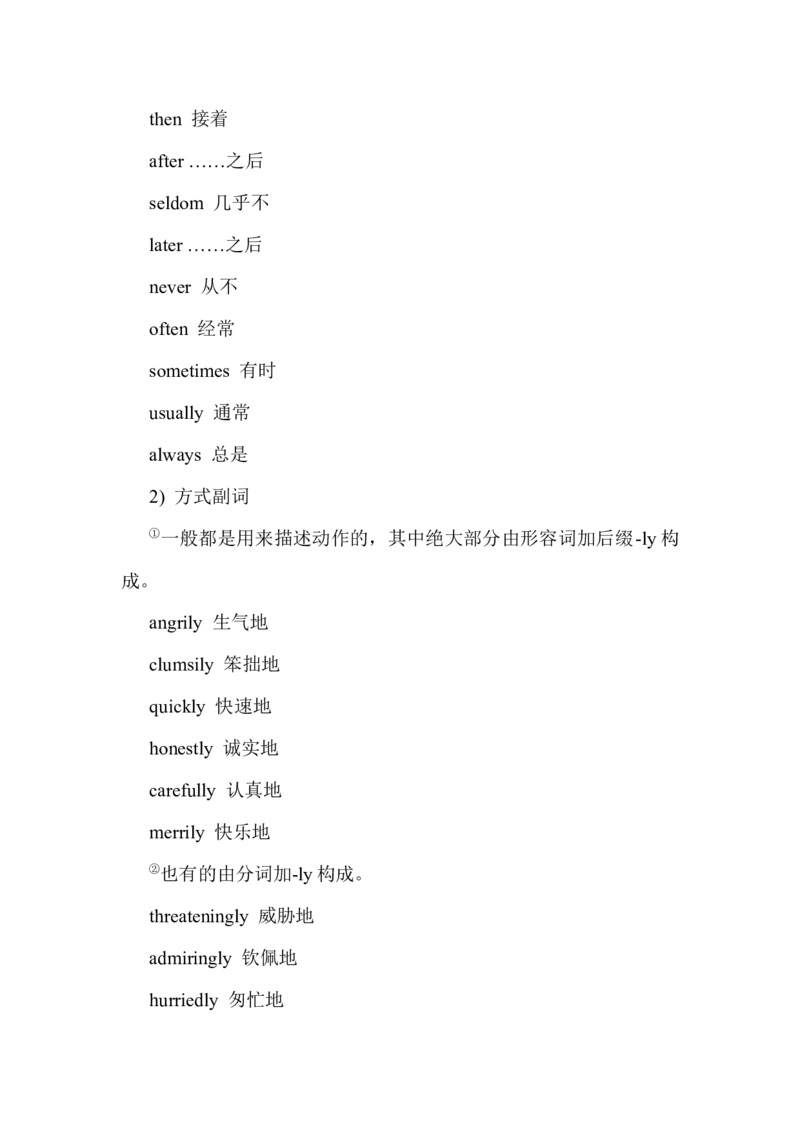
then 接着
after ……之后
seldom 几乎不
later ……之后
never 从不
often 经常
sometimes 有时
usually 通常
always 总是
2) 方式副词
①一般都是用来描述动作的,其中绝大部分由形容词加后缀-ly 构
成。
angrily 生气地
clumsily 笨拙地
quickly 快速地
honestly 诚实地
carefully 认真地
merrily 快乐地
②也有的由分词加-ly 构成。
threateningly 威胁地
admiringly 钦佩地
hurriedly 匆忙地
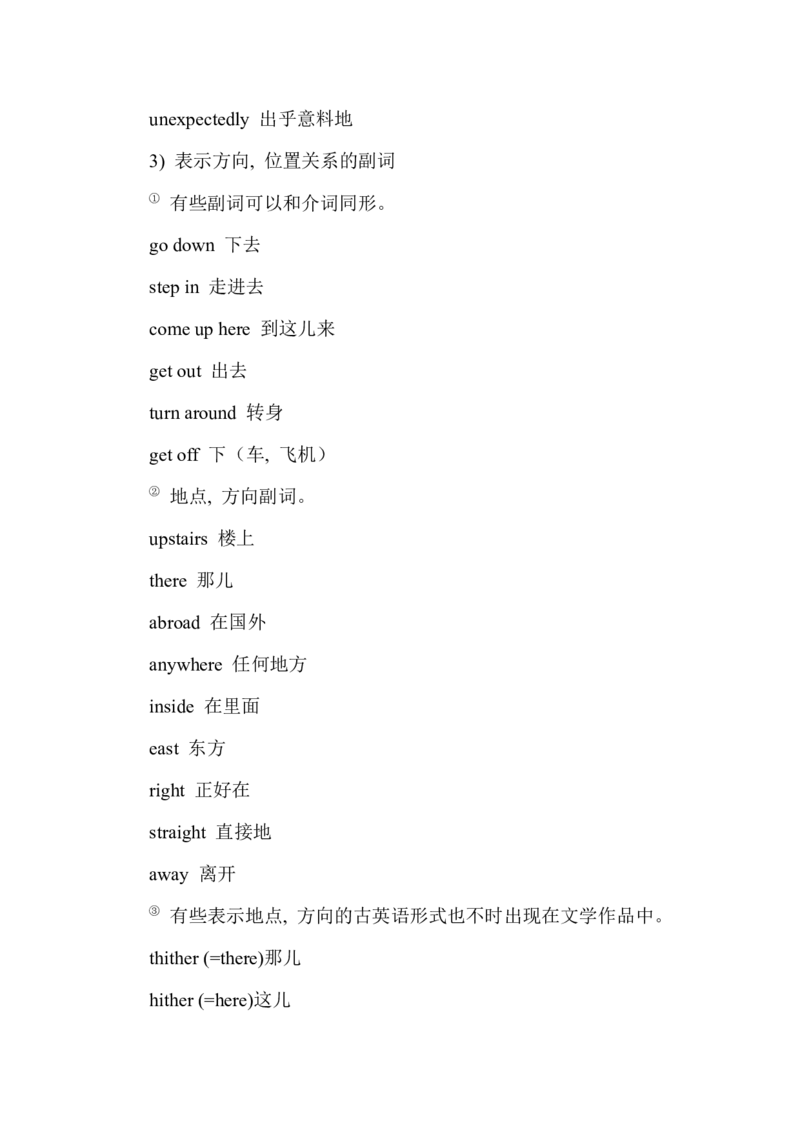
unexpectedly 出乎意料地
3) 表示方向, 位置关系的副词
① 有些副词可以和介词同形。
go down 下去
step in 走进去
come up here 到这儿来
get out 出去
turn around 转身
get off 下(车, 飞机)
② 地点, 方向副词。
upstairs 楼上
there 那儿
abroad 在国外
anywhere 任何地方
inside 在里面
east 东方
right 正好在
straight 直接地
away 离开
③ 有些表示地点, 方向的古英语形式也不时出现在文学作品中。
thither (=there)那儿
hither (=here)这儿
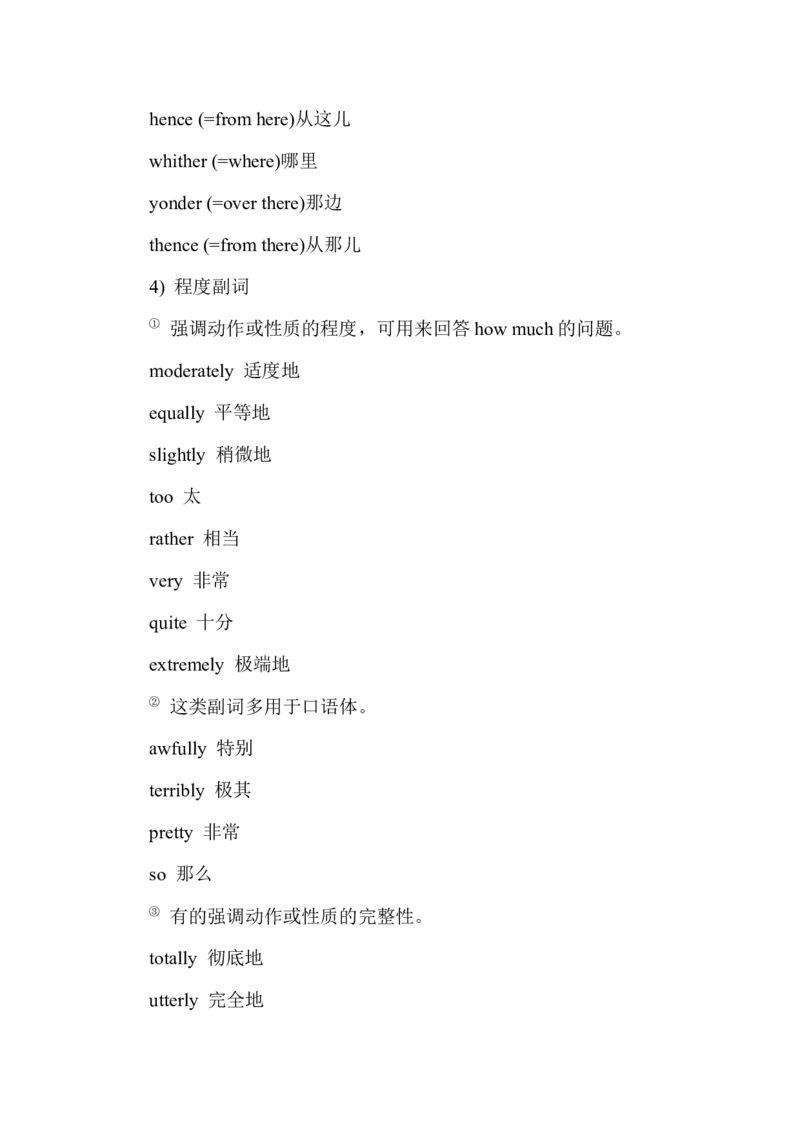
hence (=from here)从这儿
whither (=where)哪里
yonder (=over there)那边
thence (=from there)从那儿
4) 程度副词
① 强调动作或性质的程度,可用来回答how much 的问题。
moderately 适度地
equally 平等地
slightly 稍微地
too 太
rather 相当
very 非常
quite 十分
extremely 极端地
② 这类副词多用于口语体。
awfully 特别
terribly 极其
pretty 非常
so 那么
③ 有的强调动作或性质的完整性。
totally 彻底地
utterly 完全地
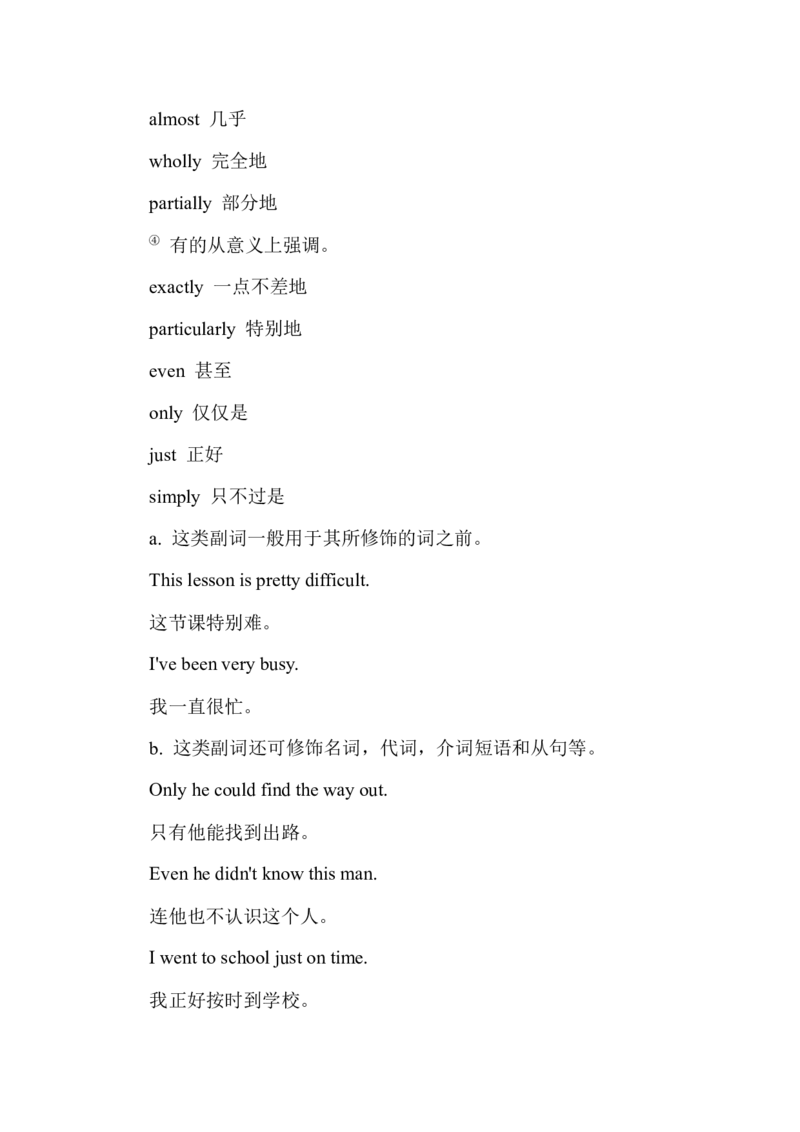
almost 几乎
wholly 完全地
partially 部分地
④ 有的从意义上强调。
exactly 一点不差地
particularly 特别地
even 甚至
only 仅仅是
just 正好
simply 只不过是
a. 这类副词一般用于其所修饰的词之前。
This lesson is pretty difficult.
这节课特别难。
I've been very busy.
我一直很忙。
b. 这类副词还可修饰名词,代词,介词短语和从句等。
Only he could find the way out.
只有他能找到出路。
Even he didn't know this man.
连他也不认识这个人。
I went to school just on time.
我正好按时到学校。
It is exactly what I want.
这正是我想要的。
(2) 副词按其形式的分类
1) 简单副词
简单副词通常由一个自由词素构成。
fast 快速地
enough 足够地
late 晚地
very 非常
now 现在
there 那儿
有些形容词可用作副词,这时形容词和副词同形,需要根据其在
句中的句法功能和上下文意义,判断其词性。
Everything went pretty smoothly.
一切都进展得相当顺利。(pretty 是副词)
Ann is quite pretty.
安妮长得很漂亮。(pretty 是形容词)
He has never been overseas.
他从未出过国。(overseas 是副词)
This is the overseas operator.
我是国际电话话务员。(overseas 是形容词)
They breed twice yearly.
它们每年繁殖两次。(yearly 是副词)
Our family has a yearly reunion.
我们每年全家团聚一次。(yearly 是形容词)
注 非正式文体中,有些形容词可直接用作副词。例如:
mighty good 相当好, awful hungry 饿死了, talk big 说大话, icy
cold 冰冷的, real nice 真不错英语中大部分介词同时也可用作副词,
其区别是,作介词时接宾语,作副词时不接宾语。
His hair was peeling off.
他的头发在脱落。(off 是副词)
The cat hopped off the roof.
那只猫从屋顶上跳下。(off 是介词)
The sentences above have some mistakes.
上面的句子有些错误。(above 是副词)
The birds are flying high above the house.
鸟儿在房屋上空飞翔。(above 是介词)
2) 复合副词
anywhere 任何地方
somehow 不知怎地
nowhere 哪儿都不
somewhat 有几分
有的只用于书面语。
hereby 特此
whereupon 因此
hitherto 迄今为止
whereto 去何处
3) 派生副词
① 大部分副词由相应的形容词加上ly 构成。
a. 一般情况,直接加ly。
slow—slowly 慢地
dear—dearly 深情地
sad—sadly 悲伤地
interesting—interestingly 有趣地
bad—badly 非常地
excited—excitedly 激动地
b. -y 结尾的词,把y 变i,再加ly。
happy—happily 快乐地
angry—angrily 生气地
easy—easily 容易地
注 shyly 害羞地,slyly 狡猾地例外。
c. -le 结尾的词,去掉e,再加y。
subtle—subtly 微妙地
noble—nobly 高贵地
able—ably 有能力地
single—singly 各自地
idle—idly 闲散地
d. -ue 结尾的词,去掉e,再加ly。
true—truly 真正地
due—duly 适当地
e. -ic 结尾的词,加ally。
economic—economically 经济地
historic—historically 历史地
tragic—tragically 悲剧地
automatic—automatically 自动地
注 publicly 例外。
f. -ll 结尾的词,只加y。
full—fully 完全地
dull—dully 沉闷地
注 gay 和dry 有两种副词形式,分别为gaily,gayly 高兴地和
drily,dryly 干地。
另外,英语中有些以ly 结尾的词不是副词,而是形容词。例
如:friendly 友好的,likely 有可能的,lonely 孤单的等。可以说a
friendly smile 或者He said in a friendly way. 但不可以说He said
friendly.
② 有些副词是由其他词加ly 构成。
monthly(名词 + ly)按月地
mostly(不定代词 + ly)大多数地
firstly(数词 + ly)首先
matter-of-factly(短语 + ly)按照事实地
accordingly(现在分词 + ly)因此
kind-heartedly(形容词 + ly)好心地
③ 有些副词是由介词或地点名词加后缀-ward(s)构成的,意为
“向……”。
backward(s) 向后地
forward(s) 向前地
northward(s) 向北地
upward(s) 向上地
downward(s) 向下地
homeward(s) 向家的方向地
④ 有些副词是由名词加上后缀-wise 构成的,表示位置,方向,
状态等。
coastwise 沿着海岸地
clockwise 顺时针地
sidewise 向一边地
lengthwise (纵向地)
⑤ 有些副词是以前缀a-为特征的。
alike 同样地
abroad 在国外
alone 独自地
aloud 高声地
⑥ 有些副词以后缀-ways 结尾。
lengthways 纵长地
sideways 向一边地
(3) 副词按其功用的分类
1) 一般副词:这类副词在句中修饰动词, 形容词, 副词或整个句
子,从时间, 地点, 方式, 程度, 语气等方面对句子进行修饰。
Water heats slowly.
水是慢慢变热的。
Surprisingly, Shaya was given the book.
令人惊奇的是,这本书给了沙亚。
2) 疑问副词,这类副词有when, where, why, how,用于引出疑问
句。
When is the meal?
何时供应餐饮?
How do you study?
你用什么方式学习?
3) 关系副词,这类副词有when, where, why 等,用以引导定语从
句。
I will never forget the days when we stay together.
我永远也忘不了我们在一起的日子。
This is the city where I was born.
这就是我出生的城市。
I don't know the reason why you are late again.
我不知道你又迟到的原因。
4) 连接副词:这类副词用来连接句子,分句或从句,可表示各
种关系。
① 表示因果。
It snowed heavily all day, and so we had to stay at home.
大雪下了一天,因此我们不得不待在家。
这样的副词还有consequently 因此,hence 所以,therefore 所
以,thus 因而等。
② 表示递进。
She lost the chance. Furthermore, she was very regretfull that she left.
她错失良机,并且为她的离开而感到非常后悔。
这样的副词还有besides 另外还,moreover 而且等。
③ 表示转折或对比。
There is no time, however, the book remains unfinished.
已经没有时间了,但这本书还没有完成。
这样的副词还有none the less 然而,nevertheless 然而,yet 但
是,though 可是等。
④ 表示条件。
You have to study hard, otherwise, you can not pass this exam.
你得努力学习,否则,你不能通过这次考试。
⑤ 表示时间。
Come here early, then, you can go with me.
早点来,然后,你可以和我一起去。
这类副词还有afterwards 后来,later 然后,next 下一步等。
5) 解释副词,这类副词用以引出例子或列举。
for example 例如,for instance 例如,namely 也就是说等。
For instance, we used to have hobbies.
例如,我们都曾经有自己的爱好。
6) 感叹副词。
How pretty she is!
她真漂亮!(how 修饰形容词pretty)
How time flies!
时间过得真快啊!(how 修饰动词flie)
7) 缩合连接副词,这类副词主要由先行词和关系副词缩合而
成,多用以引导名词性从句,有when(the time when), where (the
place where), why (the reason why), whenever (any time when),wherever
(any place where), however (no matter how)等,带有-ever 的副词常引
导状语从句,有“任何”或“不论”的含义。
I didn't know why he was angry.
我不知道他为什么生气。(why 引导宾语从句)
Tell me when you come here.
告诉我你什么时候来这里的。(when 引导宾语从句)
This is where I lived before.
这就是我以前住的地方。(where 引导表语从句)
Tell me whenever you need my help.
当你需要我的帮助时告诉我。(whenever 引导时间状语从句)
Go wherever you like.
想去哪儿就去哪儿吧。(wherever 引导地点状语从句)
The door remained locked however I tried to open it.
无论我费多大劲想打开它,门仍然锁着。(however 引导条件状
语从句)
4. 句中位置
(1) 时间副词通常可放在句首,句中或句末。
有时我看望我的父母。
Sometimes I went to visit my parents.(sometimes 放在句首,语气
最强。)
I sometimes went to visit my parents.(sometimes 放在句中,语气
较弱。)
I went to visit my parents sometimes.(sometimes 放在句末,语气
最弱。)
(2) 频度副词常放在句中。具体位置是行为动词之前,be 动词,
情态动词或第一个助动词之后。
He must always wear his uniform.
他总是必须穿制服。(副词always 位于情态动词之后)
We can hardly wait to see them.
我们迫不及待地想要见到他们。(副词hardly 位于情态动词之
后)
We never reduce our rates.
我们从未放慢我们的速度。(副词never 位于行为动词之前)
The song is often referred to.
这首歌曲常被人们提到。(副词often 位于be 动词之后)
She has never been refused before.
她以前从未被拒绝过。(副词never 位于第一个助动词之后)
1) 句中副词可以移至助动词之前,以便强调紧跟在其后的助动
词。
We never have been and never will be defeated.
我们从来没有也永远不会被打败。(never 强调从来没有/永远不
会)
2) 在省略句或简略回答中,频度副词常放在be 动词, 情态动词
或助动词之前。
—Can you stay at home alone?
你能一个人待在家里吗?
—Yes, I always can.
是,我一直都能。
—Was he an idealist?
他是理想主义者吗?
—No, he never was one.
不,他从来都不是。
3) 有否定意义的频度副词hardly, never, rarely 等放在句首时,句
子的主谓要倒装。
Hardly can we believe it.
我们简直不能相信。
Never can I thank you enough.
我对您感激不尽。
(3) 多数副词置于实义动词充当的谓语动词之后。
1) 在口语中副词也可置于谓语动词之前,如谓语动词有宾语,
则置于宾语之后;如果谓语动词的宾语部分较长,副词可置于动词
与宾语之间,以避免句子头重脚轻。
Please listen carefully.
请仔细听。
Please listen to me carefully.
请仔细听我说。
Please listen carefully to me when I was giving you my advice.
当我给你建议的时候,请仔细听我说。
2) 有些可作介词的副词,既可放在宾语之后,亦可放在宾语之
前。
Please turn off the light.或Please turn the light off.
请把灯关掉。
但如果宾语是人称代词,则将宾语放在动词和副词之间。
Please turn it down.
请将它的声音关小点。
这样的副词还有in, out, up, on, away 等。
(4) 在有助动词或情态动词的疑问句中,副词常放在实义动词之
前。
Have you completely known me?
你彻底了解我了吗?
Can he fully understand me?
他完全理解我吗?
(5) 在疑问句中,副词一般不能放在句首。
Do you often play basketball?
你经常打篮球吗?
When does he usually go to bed?
他通常什么时候睡觉?
(6) 在祈使句中,多数副词置于句末。
Do it quickly!
快干!
Go there tomorrow.
明天去那里。
副词never 和always 在祈使句中,一般放在句首。
Never (Always) buy expensive clothes.
决不要(或总是要)买贵的衣服。
Always be yourself!
永远做你自己!
(7) 有时,表示序列的副词可以位于句首。
First, let me ask you a question. Next, watch the video.
首先,让我问你一个问题。然后,看录像。
5. 副词功能
副词在句中主要用作状语, 表语, 宾语补足语和介词宾语等。
(1) 作定语
1) 修饰名词或代词时,置于“不定冠词 + 名词”之前,用以增
强语气。这类副词最常用的有quite 和rather。
My students are quite a nice bunch.
我的学生真是一群好孩子。
We had rather a difficult time.
我们经历了一段艰苦的日子。
2) 有些副词可直接置于名词之后。
He went to London the week before.
他在前一周去了伦敦。
He was looking at the picture above.
他在看上面的图片。
注
① 这样的副词还有:
the discussion afterwards 后来的讨论
his trip abroad 他在国外的旅行
the noise backstage 后台的噪音
the way back 回来的路
the hall downstairs 楼下的大厅
a step forward 前进的一步
the meeting yesterday 昨天的会议
② 而在非正式文体中,这些副词也可以放在名词之前。
the above statement 上面的陈述
the backstage noise 后台的噪音
the downstairs part of the house 房子的楼下部分
3) 有些副词可直接置于名词或代词之前。
We are told that there were fifty patients, chiefly children.
我们得知有50 名患者,其中大部分是儿童。
Only the little girl survived the car accident.
只有这个小女孩从车祸中幸免。
(2) 作表语或是补语
1) 作表语
I was down and out.
我穷困潦倒。
My mother is not in.
我妈妈不在家。
2) 作宾语补语
I went to visit her only to find her out.
我去拜访她,结果发现她不在家。
The girl walked in with her head up.
那个女孩昂着头走了进来。
(3) 作状语
1) 修饰动词。
He runs fast.
他跑得很快。
I came here yesterday.
我昨天来这里的。
She bought a big house and stayed there.
她买了一套大房子,住在那里了。
2) 修饰形容词。
The idea sounds very exciting.
这个主意听起来很棒。
It was rather cold this year.
今年相当的冷。
3) 修饰副词。
I lost interest quite early in the book.
我很早就对这本书失去了兴趣。
He walks rather slow.
他走路相当慢。
注 副词enough 修饰形容词和副词时须置于其后。例如:
She seems respectable enough.
她看上去挺体面的。
She runs fast enough to fetch the bag.
她跑得很快去拿包。
4) 修饰介词(短语)。
I will be back shortly after the operation.
手术后我很快就回来。
He is much against the advice.
他很反对这个建议。
注 有些强调副词,特别是right, well,可以用来修饰介词或是用
作副词的介词。例如:
Don't worry. I'll be right here.
别害怕,我就在这儿。
The children were left well behind.
孩子们被远远地落在后面。
5) 修饰从句。
She was happy mainly because she got the job.
她很开心,主要是因为她得到了那份工作。
I saw him exactly when I passed the shop.
当我经过那家商店的时候,我看见他了。
6) 修饰全句,有些副词不修饰某个特定的词,而是修饰整个句
子。
Frankly, I have an inquiring mind.
坦率地说,我这个人是爱动脑筋的。
Undoubtedly, he did it.
毫无疑问,是他做了那件事。
7) 修饰某些不定代词和数词。
Almost all of us have to leave school.
几乎我们所有的人都不得不离开学校。
There were approximately fifty people there.
那儿大约有50 个人。
6. 副词的比较级结构
英语里副词和形容词一样,有3 个比较等级,即原级,比较级和
最高级。
(1) 副词比较级和最高级的规则形式。
副词比较级和最高级的规则形式和形容词区别不大,一般规律
是:单音节词的比较级和最高级在词尾加-er 或-est;多音节词以及-
ly 结尾的副词(early 除外),前面须加more 或most。
slow 慢地—slower—slowest
carefully 认真地—more carefully—most carefully
fast 快地—faster—fastest
happily 快乐地—more happily—most happily
wide 广泛地—wider—widest
quickly 快速地—more quickly—most quickly
注 early 不是形容词加上-ly 构成的副词,其比较级和最高级分别
为earlier 和earliest。
有些副词两种形式都可以,如often,其比较级可以是oftener 和
more often,其最高级可以是oftenest 和most often。
(2) 英语里有些副词的比较等级变化是不规则的。
badly 不好地—worse—worst
well 好地—better—best
far 远地—farther/further—farthest/furthest
little 少地—less—least
(3) 副词比较级的用法。
1) 副词比较级单独使用
Try to do better next time.
下次争取干好一点。
I had seen the film only a few days earlier.
我是几天前才看的这部电影。
He'll come back sooner or later.
他迟早会回来的。
Please speak more slowly.
请讲慢一点。
I determined not to travel farther that night.
那天晚上我决定不再往前走了。
2) 副词比较级和than 一起使用
He swims better than I do.
他游泳游得比我好。
He works less than he used to.
他工作的时间比以前少了。
Can you do any better than that?
你能不能干的好一些?
He arrived earlier than usual.
他到的比平时早。
He studied the subject further than I do.
这个问题,他研究得比我深。
Tom works less diligently than the other boys in his class.
汤姆没有班上其他的孩子学习努力。
3) 比较级前可有状语修饰。
You must work much faster.
你必须大大加快工作的速度。
He walked no further.
他没再往前走。
I worked much harder than anyone did.
我比任何人都努力工作。
She could dance even more gracefully than a dancer.
她能比舞蹈演员跳得更美。
Helen came late, but her sister came still later.
海伦来晚了,而她妹妹来得更晚。
Can you come over a bit more quickly?
你能稍快些过来吗?
4) 副词用于as… as 和not so… as 结构中。
They work as hard as you do.
他们工作得像你一样努力。
I hate him as much as you do.
我像你一样恨他。
Please come as quickly as (it is) possible.
请尽可能快点来。
I didn't do as (so) well as I should.
我做得不如我应做得那么好。
I can't jump so (as) highly as Bill.
我跳高不如比尔。
I don't speak half as (so) well as you.
我讲得不及你的一半好。
She can read twice as fast as he does.
她的阅读速度比他快一倍。
注 有时候,副词比较级和最高级可以相互转换。例如:
Nothing in my life impressed me so deeply as I fell in love with her.
=That I fell in love with her impressed me the deepest in my life.
在我一生中什么也没有我爱上她给我的印象深刻。
She eats more than anyone else in her family.
=She eats the most in her family.
她比家里任何人吃得都多。