专题04 阅读理解(记叙文)
Passage 1
(2026·天津南开·一模)When young, I dreamed of becoming many things. I wished I was an astronaut
going up into space, finding new planets and jumping around in a cool space suit. I imagined being a cowboy in the
west having gun fights and wearing stylish cowboy boots. I pretended to be a famous footballer, using my skills to
score lots of goals. I love being able to play the role of somebody, even just for a short time, to try to realize what it
might be like to walk in their shoes.
Looking back, I realize that imagination is a wonderful thing. I was able to create entire environments in my
head, using nothing more than my brain, and to be able to adapt things in my everyday surroundings to fit the specific
story of the day. Growing up with brothers and sisters also helped, as it meant that even bigger stories could be
created, combining our ideas and putting our thoughts into action. It also allowed for more varieties in the story, as
sometimes I could be the hero while on other occasions, I would be the bad guy.
One of my all-time favorite memories as a kid was recreating the Indiana Jones character in my back garden.
I played the role of Indiana Jones, with my younger sister as my assistant and my brother as the evil man. We used
everything in our garden, from the path to the fence, as part of the storyline to create obstacle that needed to be
overcome, and we would keep the story going for hours!
My personal favorite was Indiana Jones and the Stolen Easter Eggs, where my brother hid small chocolate
eggs around and my sister and I had to find them by answering questions or solving a puzzle. It was difficult but
eventually we found all the eggs and shared them together.
1.What is mainly discussed in the first paragraph?
A.The author’s early careers.
B.The author’s longing for future.
C.The author’s childhood adventure.
D.The author’s youthful fantasies.
2.Why did the author say “Growing up with brothers and sisters also helped”?
A.They could defeat the bad guys in school. B.They could put on larger performances.
C.They could discuss the environments together. D.They could share some joys and sorrows.
3.According to the third paragraph, how did the writer and his siblings create their adventure?
A.By buying special tools for their game.
B.By planning the whole story before playing.
C.By copying scenes from an Indiana Jones movie.
D.By making the garden part of their adventure game.
4.What does the author imply about the nature of true fun?
A.It relies on creating complex scenarios with fancy toys.
B.It depends on following a structured plan guided by adults.
C.It comes from freedom and making do with what is available.
D.It requires a large group of people to be enjoyable.
5.According to the passage, the author in childhood can be described as __________.
A.aggressive and brave
B.naughty and realistic
C.imaginative and energetic
D.creative and hard-working
Passage 2
(2026·天津·一模)Normally I pass my morning commute absorbed in a book, headphones on. I miss a lot
of what’s going on around me, but my reading hours are so limited and my “Books Read in2025” list is so
embarrassingly short that I give up presence to get a couple of chapters in.
On a recent day, however, I kept my book in my bag and made a game of looking at the people around me and
imagining what their voices sound like. This game isn’t really fun, as games go, but it keeps me occupied, noticing,
engaged with the world rather than ignoring it.
In his poem “Everything Is Waiting for You,” David Whyte addresses the fundamental error of assuming
separateness from everything and everyone else. “As if life were a progressive and cunning crime/ with no witness
to the tiny hidden transgressions (越界).” He advises the reader to become alert. “You must note/ the way the soap
dish enables you, or the window latch grants you freedom.” The ordinary items around us are animate (有生命的)
in his reading of the world. And not only that — they’re likely to look on us favorably, to enable us, free us.
My retreat into books while on the train is only partly about getting reading done. It’s also about shutting out
distraction, because I think that whatever is happening around me is disturbing, at the very least extraneous to my
central purpose, which is getting from A to B.
Sitting and just being in space with strangers, instead of retreating into a book or a phone, sometimes requires a
mental shift. Who and what else is here? What if these noise-canceling headphones are keeping me from hearing the
actually quite charming voices of the people beside me? If I want to feel more connected to other people, then what’s
protective isn’t always productive.
Or, as Whyte instructs, “Put down the weight of your aloneness and ease into the/conversation.”
6.Why does the author usually bury herself in a book during her commute?
A.To catch up on reading.
B.To improve her public image.
C.To observe strangers secretly.
D.To make the commute feel shorter.
7.What does David Whyte seem to think of the world in his poem?
A.A test that challenges us.
B.A presence that supports us.
C.A stage where we perform alone.
D.A place where we make mistakes.
8.What does the underlined word “extraneous” in Paragraph 4 mean?
A.Irrelevant.
B.Dangerous.
C.Unusual.
D.Essential.
9.What does the author encourage readers to do?
A.Keep to yourself and avoid small talk.
B.Escape into books and block out noise.
C.Listen to inner thoughts and reflect on them.
D.Put down the headphones and tune in to others.
10.What can we infer from the author’s experience of giving up reading on the commute?
A.She found the game of imagining voices extremely interesting.
B.She realized that being engaged with the world is meaningful.
C.She decided to stop reading books during all her daily trips.
D.She felt disturbed by the noises from the people around her.
Passage 3
(2026·天津滨海新区·一模)One of the most incredible changes I’ve made in my life, which has undoubtedly
made me a happier person and a better friend, is learning to let go of judging people.
Once, I visited an old friend who was actively neglecting his own health — he was overweight and had high
blood pressure, and yet he ate junk food and never exercised. I knew he could improve his health by changing his
daily decisions. So I judged him, got angry with him, indirectly insulted him with my opinionated ( 武断的)
commentary, and then we parted on bad terms, which made me regret for a long time.
I was unaware of what my friend was going through. The truth is, he had been deeply depressed about his poor
health, feeling ugly, scared, and he was determined to improve himself. He was truly wonderful but I wasn’t
appreciating him. Instead, I was only focusing on how much “better” I was! That was really my fault.
In short, I actively remind myself NOT to judge. Be kind, humble, open and teachable. There is a story behind
every person. Ask about their stories, and then listen. There’s a reason why they are the way they are. Think about
that, and respect them for who they are. Magnify their strengths, not their weaknesses. The more you see the good in
other people, the more good you will uncover in yourself. This is how to make a difference. We all take different
roads seeking fulfillment and joy. That someone isn’t on your road doesn’t mean they’re lost. It’s OK to be upset, but
it’s never OK to be cruel. In disagreement with others, deal only with the present situation; don’t bring up the past or
any other form of drama.
The most memorable people in your life will be the ones who loved you when you were not very lovable.
Remember this, and return the favor when you’re able. No matter what happens, be good to the people around you.
Being good is a peaceful way to live, and a beautiful legacy to leave behind.
11.Why did the author get mad with his friend?
A.He looked down upon his friend.
B.He wasn’t used to his friend’s routine.
C.His friend cared little about his health.
D.His friend never paid a visit to the doctor.
12.What does the underlined phrase “parted on bad terms” in Paragraph 2 probably mean?
A.left each other unhappily.
B.Forgave each other.
C.Discussed this in another place.
D.Continued to do other things.
13.How should we get along with others according to the author?
A.Share our stories with them.
B.Focus on the good in them.
C.Give them some advice.
D.Help them through criticizing.
14.What should you do when you disagree with others?
A.You should pretend to agree
B.You should take a step back.
C.You should make a big scene.
D.You should consider the matter as it stands.
15.What is the text mainly about?
A.Keeping friendship forever.
B.Giving no judgment on others.
C.How to be good to people around you.
D.How to build good relationships with others.
Passage 4
(2026·天津河东·一模)“Kevin! Kevin! Did you hear what I said?” Ms. Reed, the band director, looked
straight at him — she wanted him to take Robin’s place, since Robin had broken her arm, and play a solo at the
concert. Kevin agreed, trying hard to hide his sadness: he was terrified of performing on stage, freezing up completely
when playing alone, even though he was the best saxophone player in his middle school band and played with the
senior high band too.
James, his bandmate, felt sorry for him and shared how he’d fainted on stage during a solo because he was so
nervous. The story only made Kevin more worried, but something worse was coming. Kelly, the overly competitive
top flutist in the state, stopped him, saying that the Youth Symphony director would come to the concert to listen to
his solo — and if he played well, he could get a chance to try out. Her words made him feel heavy inside; he’d wanted
to join the Youth Symphony for a long time but never had the courage to audition.
Running out of the school, Kevin thought of excuses to skip the solo: pretending to be ill, saying he’d hurt his
finger. But he knew his parents would see he was lying, and hurting his finger on purpose was too dangerous. By the
time he got home, his mom was very happy, talking excitedly about the Youth Symphony chance and Ms. Reed’s
praise. Kevin lied that his day was okay, then went down to the furnace room — called “Kevin’s Dungeon” — his
practice space. He picked up his saxophone, took a deep breath, and started to play.
This time, he didn’t focus on the fear of messing up; he focused on the music he loved. Maybe this solo wasn’t a
nightmare — it was a chance to turn his dream into reality.
The final note faded, and loud applause burst out. Kevin smiled and felt a warm rush of joy in his heart. He
finally understood that courage isn’t the lack of fear, but going ahead in spite of it. Dreams never come to those who
run away from challenges; they always wait for those who dare to face their fears and try.
16.Why did Ms. Reed ask Kevin to play the solo at the concert?
A.Kevin was the most skilled sax player in the senior high band.
B.Robin was unable to perform due to a broken arm.
C.The Youth Symphony director personally recommended Kevin.
D.Kevin had been eager to get the solo opportunity for a long time.
17.The underlined phrase “freezing up” in Paragraph 1 probably means _________.
A.staying calm to deal with the performance
B.feeling extremely cold on the frightening stage
C.having great confidence in playing the solo
D.being unable to move or act because of nervousness
18.What made Kevin’s anxiety grow after he received the solo task?
A.James told him about his own embarrassing solo experience.
B.His mother didn’t believe he could perform well on stage.
C.Kelly laughed at him for lacking the courage to audition.
D.He found his practice room was too small to play the saxophone.
19.We can infer from the last paragraph that Kevin finally chose to _________.
A.pretend to be sick and miss the concert instantly
B.gave up his dream of joining the Youth Symphony
C.face the challenge and practice for the solo actively
D.ask the band director to replace him with another student
20.What is the best title for the passage?
A.A Successful Solo Performance
B.The Competitive Flutist Kelly
C.A Strict, Generous and Kind Band Director
D.Stage Fright and A New Chance
Passage 5
(2026·天津南开·一模)On Sunday morning, I’ll board the Staten Island Ferry for the 12th time, heading to
the start of the New York City Marathon. Each year, as I visualize the course and relax my muscles, my thoughts drift
to my father, who took the same ferry in 1982.
He was 40 then, struggling with identity and beginning a difficult chapter of his life. Yet running kept him
steady. I was seven, watching at mile 16 as he nearly broke three hours — his fastest marathon ever, an achievement he
always credited to my being there.
Running later became my own refuge. I chased his sub-three-hour goal for years, once dropping out at mile
23 with knee pain — a decision I still regret. When I finally broke three hours, and later 2:40, no one cheered louder
than him. We jogged together until his hips failed.
His later years were shadowed by physical decline. He abandoned running, though he often talked proudly of
his marathon-strengthened heart, until his heart, too, gave out. His death promoted my running, not as an escape, but
as a way to remember and reconnect to him again. I developed a balanced approach: training hard without letting
running overshadow my family or work life. My father’s choices defined his life; I’d use running to live differently.
Now, running mirrors my life’s rhythms. I commute on foot, check my heart rate carefully, and record the
miles in Google Docs. At 50, I’m slowing down a bit, but the discipline running teaches — self-awareness,
determination — helps me navigate challenges he couldn’t overcome.
I know running isn’t a cure for everything. It gave my father a tailwind in dark times but couldn’t save him.
Still, I hold on to it, believing it bridges our worlds while helping me avoid his failures. This Sunday, my children
will cheer me on. My 15-year-old vows to run with me in three years — a promise that delights me. As I cross the
Verrazzano-Narrows Bridge, I’ll trace the path my father ran 43 years ago.
The view from the bridge is vast, the road ahead long. If you’re near mile 16, just past the Queensboro Bridge,
cheer loudly. Some of us are running for more than a finish line.
21.What is the main idea of Paragraph 3?
A.The author’s regret for dropping out of a marathon due to knee pain.
B.The author’s efforts to achieve his running goal and their shared joy.
C.The author’s decision to take up running under his father’s influence.
D.The author’s pride in breaking his father’s unattainable marathon record.
22.What is a reasonable comment of the author’s way of dealing with his father’s death?
A.It’s common because most people will choose sports to escape.
B.It’s effective because he turns sadness into positive motivation.
C.It’s unhealthy because he uses running to avoid facing the pain.
D.It’s unwise because running may cause more physical problems.
23.How does the author manage his running now?
A.He integrates running into his daily life naturally.
B.He attaches running to the sufferings as his father.
C.He prioritizes running over family and work duties.
D.He tracks his running to socialize with other runners.
24.What does the underlined word “tailwind” in Paragraph 6 probably mean?
A.A difficult challenge that causes trouble.B.A strong wind that stops one from moving.
C.A source of motivation that helps progress.
D.A temporary advantage that surprises others.
25.What key message does the last paragraph convey?
A.The author’s vision to run with his son in the future.
B.The importance of cheering for runners at mile 16.
C.The view from the Verrazzano-Narrows Bridge.
D.Deep emotional significance carried by running.
26.Who are the intended readers of this passage?
A.Athletes preparing for marathons.
B.Doctors expert in sports emergency.
C.Psychologists studying mental health.
D.General readers keen on family bonds.
Passage 6
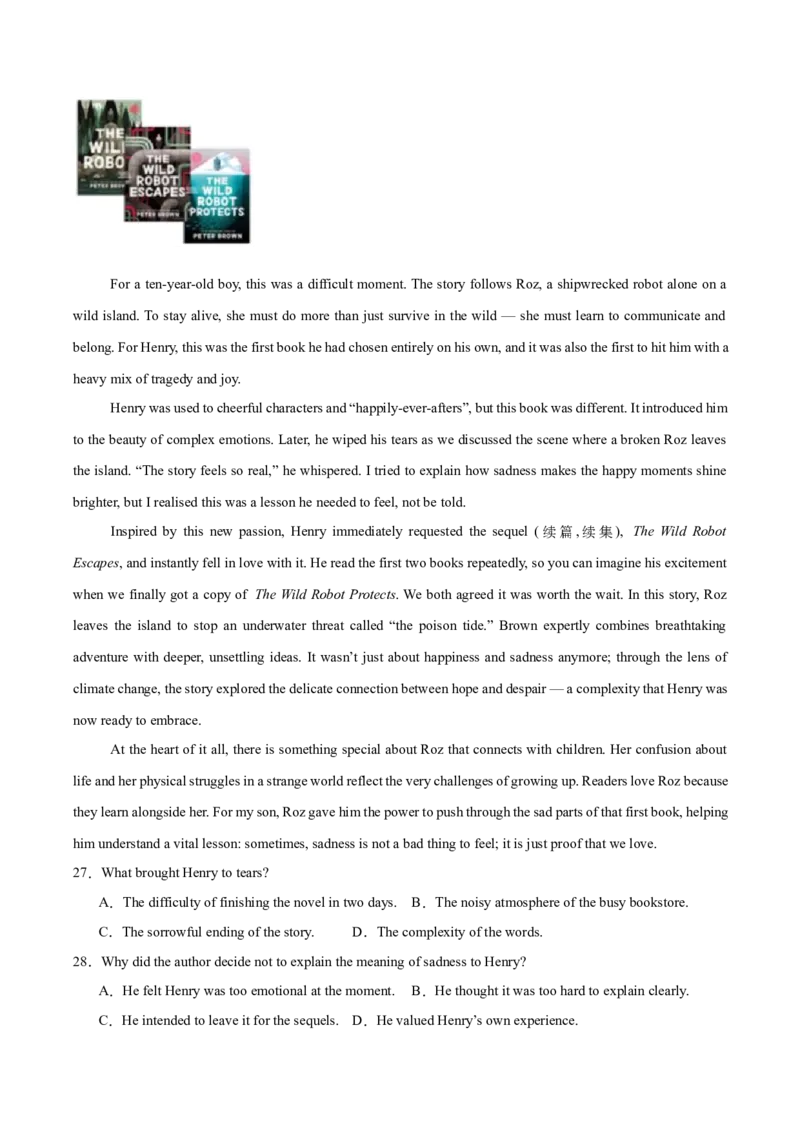
(2026·天津河北·一模)Last summer, inside a busy bookstore, my son Henry was immediately captivated
by a book cover. It was the first novel in Peter Brown’s popular middle-grade trilogy, The Wild Robot. He insisted
on buying it and finished the entire story in just two days. However, the ending was not what he expected. He looked
up at me with tears in his eyes and asked, “Dad, why did The Wild Robot have to be so sad?”
For a ten-year-old boy, this was a difficult moment. The story follows Roz, a shipwrecked robot alone on a
wild island. To stay alive, she must do more than just survive in the wild — she must learn to communicate and
belong. For Henry, this was the first book he had chosen entirely on his own, and it was also the first to hit him with a
heavy mix of tragedy and joy.
Henry was used to cheerful characters and “happily-ever-afters”, but this book was different. It introduced him
to the beauty of complex emotions. Later, he wiped his tears as we discussed the scene where a broken Roz leaves
the island. “The story feels so real,” he whispered. I tried to explain how sadness makes the happy moments shine
brighter, but I realised this was a lesson he needed to feel, not be told.
Inspired by this new passion, Henry immediately requested the sequel ( 续篇, 续集), The Wild Robot
Escapes, and instantly fell in love with it. He read the first two books repeatedly, so you can imagine his excitement
when we finally got a copy of The Wild Robot Protects. We both agreed it was worth the wait. In this story, Roz
leaves the island to stop an underwater threat called “the poison tide.” Brown expertly combines breathtaking
adventure with deeper, unsettling ideas. It wasn’t just about happiness and sadness anymore; through the lens of
climate change, the story explored the delicate connection between hope and despair — a complexity that Henry was
now ready to embrace.
At the heart of it all, there is something special about Roz that connects with children. Her confusion about
life and her physical struggles in a strange world reflect the very challenges of growing up. Readers love Roz because
they learn alongside her. For my son, Roz gave him the power to push through the sad parts of that first book, helping
him understand a vital lesson: sometimes, sadness is not a bad thing to feel; it is just proof that we love.
27.What brought Henry to tears?
A.The difficulty of finishing the novel in two days.
B.The noisy atmosphere of the busy bookstore.
C.The sorrowful ending of the story.
D.The complexity of the words.
28.Why did the author decide not to explain the meaning of sadness to Henry?
A.He felt Henry was too emotional at the moment.
B.He thought it was too hard to explain clearly.
C.He intended to leave it for the sequels.
D.He valued Henry’s own experience.
29.What real-world issue does The Wild Robot Protects explore?
A.The importance of family history.
B.The survival of wild animals in tough winters.
C.The rapid development of artificial intelligence.
D.The impact of environmental pollution on nature.
30.What makes Roz particularly appealing to young readers?
A.Her reflection of their own growth.
B.Her ability to survive in the wild.
C.Her fight against the poison tide.
D.Her joyful and happy ending.
31.What message does the author intend to convey through Henry’s story?
A.Robot stories work like magic on children.
B.Misfortune is the source of great literature.
C.Reading literature facilitates emotional growth.
D.Discussing books helps kids survive real tragedies.
Passage 7
(2026·天津·一模)In the glittering world of Olympic figure skating, where every move is judged under the
harshest of lights, failures can be brutally exposed. It was during one such moment that Mario, a once-promising star,
stumbled and fell, his dream crashing down with the thud (砰的一声) of the skate blades on the ice.
The initial shock was followed by a deep sense of despair. Doubts crept in, whispering that he might never rise
again. Each day seemed darker than the last, as Mario struggled to find his footing in a world that suddenly felt so
alien and unforgiving of himself.
But within this darkness, Mario began to forgive himself and accept the reality. He remembered the countless
hours of training, the sacrifices made, and the love for the sport that had burned so brightly before. Slowly, he picked
himself up, dusted off the ice shards of defeat, and began to skate again.
This time, it was different. Each fall became a lesson, each mistake an opportunity for growth. He learned to
embrace his failures, using them as stepping stones to greater heights. With renewed determination, Mario pushed
himself harder, skating with a newfound grace and power.
Finally, the day arrived when our hero stepped onto the Olympic ice once more. This time, there was no fear,
only focus. As the music swelled and he began his routine, every move flowed with effortless elegance. When the
final note rang out, he knew he had done it. This young man had risen from the ashes of failure and embraced success
again, stronger and more brilliant than before.
As the crowd erupted in applause and the athlete stood center ice, a single tear traced down his cheek. It was
a tear of joy, relief, and pride — a testament to the journey he had endured. At that moment, he understood that failure
was not the end, but rather a beginning — a chance to rise stronger, wiser, and more determined. And so, Mario
smiled, knowing that the road ahead, no matter how bumpy, would be filled with the sweet taste of victory and the
knowledge that true success comes from overcoming the toughest challenges.
32.The figure skater felt so unforgiving of himself because ________.
A.he fell and crashed down
B.he failed the competition
C.he struggled to stand on the ice
D.his skate blades tripped on the ice
33.How did the athlete adjust himself back to the ice stage?
A.He embraced all the tests to the journey.
B.He acknowledged the failure and cheered himself up.
C.He practiced more than before and endured all pains and hurts.
D.He changed himself into a stronger, smarter and more powerful man.
34.Mario is a young man with the merit of ________.
A.toughness and sentiments
B.hard work and elegance
C.perseverance and resilience
D.generosity and humility
35.What can we learn from this story?
A.Failure is the mother of success.
B.Chances favor the prepared mind.
C.Constant dripping wears away the stone.D.What doesn’t kill you makes you stronger.
36.Which of the following is the best title for the passage?
A.The Hard Training of a Figure Skater
B.A Comeback from Failure in Olympic Skating
C.The Harsh Judging in Olympic Figure Skating
D.The Sweet Taste of Transient Victory
Passage 8
(2026·天津·一模)At 9:00 a.m. sharp, the productivity app politely informed Clara that she was already
behind schedule. This was puzzling, as Clara had been awake for less than twenty minutes and had not yet failed at
anything in particular. She had brushed her teeth, glanced at the weather, and opened her laptop — hardly signs of
inefficiency. Nevertheless, the notification was firm, supported by a chart that suggested her “focus efficiency” had
declined by 3 percent since yesterday.
Clara had downloaded the app to gain control over her working life. It promised clarity: tasks broken into neat
units, time measured precisely, distractions identified and eliminated. The language was confident and reassuring,
suggesting that productivity was not a mystery but a system waiting to be managed. At first, the data felt comforting.
Numbers, after all, rarely argue back, and charts offer the illusion of certainty.
Over time, however, the app’s guidance grew more assertive (坚定的). Breaks were flagged as “avoidable
interruptions.” Reading unrelated material was categorized as “cognitive drift.” Even moments of reflection — once a
private habit Clara valued — were quietly reclassified as “non-productive intervals.” None of these labels came with
punishment, only color. Red, it turned out, was enough.
The app did not forbid these behaviors. It merely highlighted them. Clara noticed that she began adjusting her
actions not because she disagreed with her own instincts, but because she disliked disappointing the app. She stopped
pausing to think, not because it wasted time, but because it looked inefficient on the report. The daily summary, with
its calm graphs and downward arrows, became the most judgmental presence in her workspace — more persuasive
than any manager.
Developers insist that such tools empower users by revealing hidden inefficiencies and helping them make
better choices. Critics respond that the definition of efficiency is doing much of the work. When productivity is
measured only by visible output, activities that resist quantification — thinking, hesitation, experimentation, even
boredom — are treated as problems rather than processes. What cannot be measured is quietly pushed aside.
Clara eventually realized that she was working longer hours while feeling less accomplished. The app confirmed
this with admirable consistency. According to the metrics (衡量标准), she was improving steadily. According to her
own experience, she was merely becoming better at obeying the measurement, mistaking compliance for progress.
The promise of productivity, it seems, is not freedom from effort but freedom from ambiguity (不明确). And
ambiguity, inconvenient as it may be, has yet to be fully optimized.
37.Why is Clara “puzzled” by the app’s first notification?
A.She has not yet begun working.
B.The data contradicts her memory.
C.The app lacks sufficient information.
D.The schedule has changed unexpectedly.
38.What change occurs in the app’s role over time?
A.It becomes more technically accurate.
B.It shifts from assisting to subtly directing behavior.
C.It reduces Clara’s workload.
D.It replaces human supervision.
39.What does the author imply about activities like reflection and boredom?
A.They are inefficient habits.
B.They should be minimized.
C.They resist easy measurement.
D.They are outdated working methods.
40.What is the author’s attitude toward productivity apps?
A.Supportive.
B.Neutral.
C.Skeptical.
D.Opposed.
41.What makes the best title for the passage?
A.How Apps Improve Workplace Discipline?
B.Measuring Success in the Digital Age.
C.When Productivity Starts Watching You?D.The Science of Efficient Work.
Passage 1
(2026·天津河西·一模)For as long as he could remember, Ben’s world had been defined by straight lines
and precise angles. His dream was to become an architect, and his sketchbook was filled with drawings of modern-
looking buildings and complex bridges. The messy, unpredictable world of living things held little interest for him.
That was, until his high school required a semester of community service.
Reluctantly, Ben signed up for “Green Guardians”, a program that involved tending to the community garden.
He was assigned to work with Mr. Henderson, a retired carpenter in his seventies whose hands were rough and marked
with years of labor, but whose eyes held a surprising gentleness.
Their first task was to repair a broken brick path. Ben, eager to apply his “expertise”, immediately pulled out
a tape measure and began calculating. “The bricks need to be evenly spaced, exactly 5 centimeters apart for structural
integrity and visual appeal,” he announced.
Mr. Henderson laughed softly, wiping his brow with a handkerchief. “Son,” he said, “in a garden, nothing is ever
perfectly even. Look.” He pointed to a nearby oak tree. “See how its roots have gently pushed these bricks up over
the years? That’s not a mistake; it’s a story. Our job isn’t to fight that story, but to work with it.”
Ben was puzzled. In his designs, irregularity was a flaw to be corrected. Yet, as the weeks passed, he watched
Mr. Henderson work. He didn’t just replace bricks; he observed how the sunlight fell, where the rainwater pooled,
and which plants were struggling for space. He repaired the path, but also widened a curve to give a rose bush more
room, and used slightly different colored bricks to create a gentle pattern that guided the eye toward a beautiful, old
bench.
One afternoon, as they were planting new young plants, a heavy rain suddenly began to fall. Ben rushed to
cover the plants with a plastic sheet, but Mr. Henderson stopped him. “Let them feel the rain,” he said. “A little
struggle makes the roots grow stronger.” They sat under the small building, watching the rain nourish the earth. In
that quiet moment, surrounded by the sound of rain and the smell of wet soil, Ben felt a shift within himself. He
realized that Mr. Henderson wasn’t just building a path or tending plants; he was fostering a living, breathing
ecosystem where every imperfection had a purpose.
On the last day of the program, Ben looked at the garden — not as a collection of individual plants and
structures, but as a whole. The winding path, the uneven flower beds, the trees of different heights — it all worked
together in a harmonious, beautiful way. He opened his sketchbook to a new page. This time, he didn’t draw a
towering skyscraper. Instead, he began sketching a design for a small, sustainable community library, one with lots
of natural light, green walls, and pathways that adapted to the existing trees.
He showed it to Mr. Henderson. The old man studied it for a long moment, then nodded, a slow smile spreading
across his face. “Now you’re not just drawing buildings,” he said. “You’re designing a home for life.”
Ben finally understood. True design wasn’t about forcing order on the world. It was about listening to it,
learning from it, and creating spaces where both people and nature could thrive, imperfectly and beautifully
together.
42.Why did Ben initially feel uninterested in the community garden program?
A.He thought gardening was too physically demanding.
B.He believed it had nothing to do with his career goal.
C.He was afraid of getting his hands dirty.
D.He disliked working with elderly people.
43.What can be inferred about Mr. Henderson’s view of irregularities in the garden from his words “That’s not a
mistake; it’s a story.”?
A.He sees them as problems that must be fixed immediately.
B.He considers them evidence of poor past maintenance.
C.He values them as meaningful parts of the garden’s history and character.
D.He views them as artistic decorations that should be highlighted to attract visitors.
44.How did Mr. Henderson’s philosophy influence Ben’s work on the path?
A.Ben insisted on using more precise measurements.
B.Ben learned to include natural elements and stories into his work.
C.Ben decided to remove the old tree roots completely.
D.Ben convinced Mr. Henderson to follow his original design.
45.What is the key reason for the change in Ben’s final sketchbook design?
A.He gave up his dream of becoming an architect.
B.He wanted to impress Mr. Henderson with a complex drawing.
C.His understanding of design evolved to include harmony with nature.
D.He found garden design more profitable than architecture.
46.Which of the following best summarizes the main theme of the story?
A.True design originates from collaborating with nature.
B.Elderly people possess invaluable wisdom that the young often ignore.
C.Community service is a compulsory requirement for personal growth.
D.Academic knowledge is always superior to practical experience.
Passage 2
(2026·天津滨海新区·一模)Like many Americans, my father, Kenneth Hamilton, must have heard Paul
Robeson sing over the radio at one time or another. He must have read about Robeson’s extraordinary feats of daring
and skill on the football fields of Rutgers. “I imagine,” he would begin, “that Mr. Paul Robeson woke up one morning
to find there was more to the day than playing football. I know I did (my father played football for Iowa State) . I
imagine he looked around him. He saw that plenty of his people already were preachers; there were enough
morticians (殡仪业者) to reach from here to kingdom to come. I imagine Mr. Robeson decided then and there he
would be what there never had been before. And he was.”
I don’t recall Kenneth Hamilton ever saying what it was Paul Robeson became besides a football star. But
surely he was referring to Robeson’s powerful singing voice. Yet what came through clearly to me at the time was
this: If one were to become anything, it would have to be not only the best but wholly original, a new idea. This
concept sank deep into my consciousness. Imperceptibly (不知不觉地) ,I grow up yearning for the unusual, seeking
something unique in myself. I longed not just to write, but to newly write and like no one else. Kenneth Hamilton
wanted no less for his youngest child.
“Like no one else,” he had been no less himself. Graduating from Iowa State Business College in the early
1890s when it was an achievement when a black man completed high school, he began his search for employment.
One day, the banker for whom his mother worked as a cook asked that young Kenneth be sent around to the bank,
where there was a suitable job for him. He hurried over to the bank, absolutely amazed at this sudden stroke of
luck. Dressed in starched collar and gray business suit, he wondered what he would become.
Kenneth Hamilton walked directly into the bank and was promptly handed a mop and a bucket. He threw both
the length of the establishment and turned on his heel, never to return. Perhaps he should have accepted that first mop
and bucket, but I’m rather glad his imagination wouldn’t permit him. For now I have pleasure of remembering him
as a man who would not allow mind or body to be limited by another’s reality. I could have wanted no less for a
father.
47.According to the first paragraph, Kenneth Hamilton and Paul Robeson were similar because they ________.
A.were both talented singers
B.both played football for Iowa state
C.both had aspirations for things greater than sports D.both, at one time, aspired to be preachers
48.Which of the following best exemplifies what the author refers to as the “wholly original, a new idea” (in
paragraph 2) ?
A.The author’s resolve to be unlike any other writer.
B.The author’s choice to write about her past experiences.
C.Kenneth Hamilton’s decision to play football.
D.Paul Robeson’s determination that he would not be a preacher.
49.How did Kenneth Hamilton feel when he was told there was a suitable job for him in the bank?
A.grateful but concerned
B.eager and surprised.
C.overwhelmed but hopeful
D.frustrated and discouraged
50.The passage suggests that the author’s admiration for her father is the result of ________.
A.his willingness to submit to society’s expectations of him
B.the expectations he placed on his mind and body
C.the imagination by which he undertook his daily assignments
D.his courage in seeking a bank job in the 1890s
51.Which of the following statements is RIGHT?
A.Kenneth Hamilton wanted to be a preacher before.
B.Kenneth Hamilton would not allow his mind or body to be limited by another’s reality.
C.Kenneth Hamilton’s achievement of education didn’t permit him to accept the job that the bank offered
him.
D.Influenced by Kenneth Hamilton, the author wanted to be a writer.
Passage 3
(2026·天津红桥·一模)In 2004, when my daughter Becky was ten, she and my husband, Joe, were united
in their desire for a dog. As for me, I shared none of their wish.
But why, they pleaded. “Because I don’t have time to take care of a dog.” But we’ll do it. “Really? You’re
going to walk the dog? Feed the dog? Bathe the dog?” Yes, yes and yes. “I don’t believe you.” We will. We
promise.
They didn’t. From day two (everyone wanted to walk the cute puppy that first day), neither thought to walk
the dog. While I was slow to accept that I would be the one to keep track of her shots, to schedule her vet appointments,
to feed and clean her, Misty knew this on day one. As she looked up at the three new humans in her life (small,
medium, and large), she calculated, “The medium one is the sucker in the pack.”
Quickly, she and I developed something very similar to a Vulcan mind meld (心灵融合). She’d look at me
with those sad brown eyes of hers, beam her need, and then wait, trusting I would understand, which, strangely, I
almost always did. In no time, she became my fifth appendage (附肢), snoring on my home-office couch as I worked,
cradling against my feet as I read, and splaying across my stomach as I watched television.
Even so, part of me continued to resent walking duty. Joe and Becky had promised. Not fair, I’d balk (不心
甘情愿地做) silently as she and I walked. “Not fair.” I’d loudly remind anyone within earshot upon our return
home.
Then one day — January 1, 2007, to be exact — my husband’s doctor uttered an unthinkable word: leukemia
(白血病). With that, I spent eight to ten hours a day with Joe in the hospital, doing anything and everything I could
to ease his discomfort. During those six months of hospitalizations, Becky,12 at that time, adjusted to other adults
being in the house when she returned from school. My work colleagues adjusted to my taking off at a moment’s
notice for medical emergencies. Every part of my life changed; no part of my old routine remained.
Save one: Misty still needed walking. At the beginning, when friends offered to take her through her paces, I
declined because I knew they had their own households to deal with.
As the months went by, I began to realize that I actually wanted to walk Misty. The walk in the morning before I
headed to the hospital was a quiet, peaceful time to gather my thoughts or to just be before the day’s medical drama
unfolded. The evening walk was a time to shake off the day’s upsets and let the worry tracks in my head go to white
noise.
When serious illness visits your household, it’s not just your daily routine and your assumptions about the
future that are no longer familiar. Pretty much everyone you know acts differently.
After Joe died in 2009, Misty slept on his pillow.
I’m grateful — to a point. The truth is, after years of balking, I’ve come to enjoy my walks with Misty. As I
watch her chase a squirrel, throwing her whole being into the here-and-now of an exercise that has never once ended
in victory, she reminded me, too, that no matter how harsh the present or unpredictable the future, there’s almost
always some measure of joy to be extracted from the moment.
52.It can be inferred from Paragraph 3 that ______.
A.Misty was quite smart
B.Misty could solve math problems
C.The writer was a slow learner
D.No one walked Misty the first day
53.What can we learn from Paragraphs 4 and 5?
A.The author didn’t want to walk the dog because she didn’t like her.
B.The dog was naughty and annoying.
C.Although loving the dog, she was reluctant to walk her.
D.She always shouted at the dog while walking.
54.The story came to its turning point when ______.
A.Joe died in 2009
B.the writer began to walk the dog
C.Joe fell ill in 2007
D.the dog tried to please the writer
55.Why did the writer continue to walk Misty while Joe was in hospital?
A.The walk provided her with spiritual comfort.
B.Her friends didn’t offer any help.
C.She could unfold the day’s medical drama.
D.She didn’t want Misty to be others’ companion.
56.What message does the author want to convey in the passage?
A.One should learn to enjoy hard times.
B.A disaster can change everything in life.
C.Moments of joy suggest that there is still hope ahead.
D.People will change their attitude toward you when you are in difficulty.