专题16 阅读理解之记叙文12 篇 (天津专用)
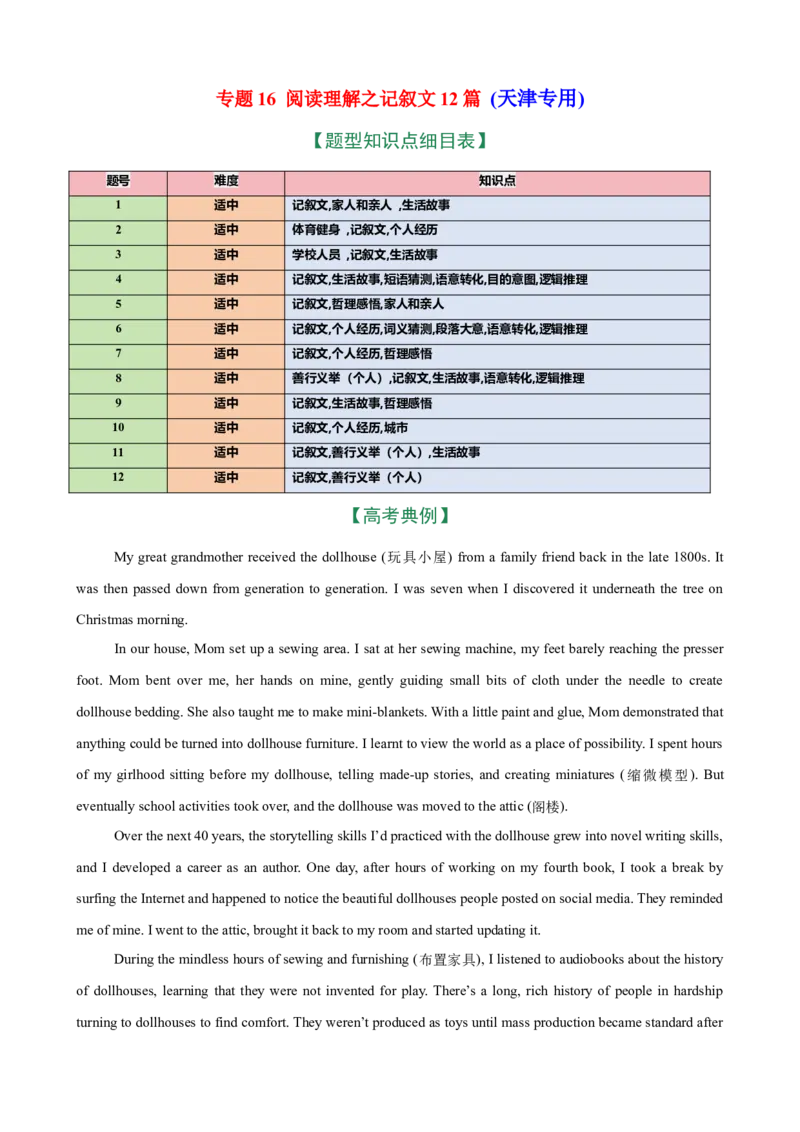
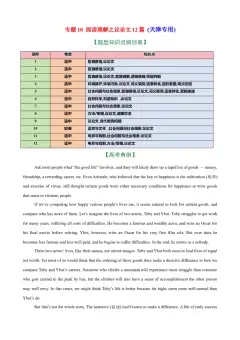
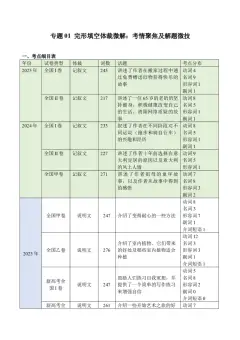
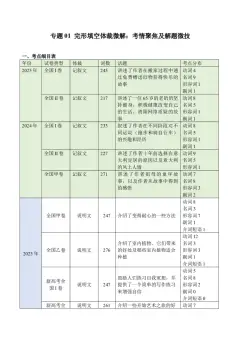
【题型知识点细目表】
题号
难度
知识点
1
适中
记叙文,家人和亲人 ,生活故事
2
适中
体育健身 ,记叙文,个人经历
3
适中
学校人员 ,记叙文,生活故事
4
适中
记叙文,生活故事,短语猜测,语意转化,目的意图,逻辑推理
5
适中
记叙文,哲理感悟,家人和亲人
6
适中
记叙文,个人经历,词义猜测,段落大意,语意转化,逻辑推理
7
适中
记叙文,个人经历,哲理感悟
8
适中
善行义举(个人),记叙文,生活故事,语意转化,逻辑推理
9
适中
记叙文,生活故事,哲理感悟
10
适中
记叙文,个人经历,城市
11
适中
记叙文,善行义举(个人),生活故事
12
适中
记叙文,善行义举(个人)
【高考典例】
My great grandmother received the dollhouse (玩具小屋) from a family friend back in the late 1800s. It
was then passed down from generation to generation. I was seven when I discovered it underneath the tree on
Christmas morning.
In our house, Mom set up a sewing area. I sat at her sewing machine, my feet barely reaching the presser
foot. Mom bent over me, her hands on mine, gently guiding small bits of cloth under the needle to create
dollhouse bedding. She also taught me to make mini-blankets. With a little paint and glue, Mom demonstrated that
anything could be turned into dollhouse furniture. I learnt to view the world as a place of possibility. I spent hours
of my girlhood sitting before my dollhouse, telling made-up stories, and creating miniatures ( 缩微模型). But
eventually school activities took over, and the dollhouse was moved to the attic (阁楼).
Over the next 40 years, the storytelling skills I’d practiced with the dollhouse grew into novel writing skills,
and I developed a career as an author. One day, after hours of working on my fourth book, I took a break by
surfing the Internet and happened to notice the beautiful dollhouses people posted on social media. They reminded
me of mine. I went to the attic, brought it back to my room and started updating it.
During the mindless hours of sewing and furnishing (布置家具), I listened to audiobooks about the history
of dollhouses, learning that they were not invented for play. There’s a long, rich history of people in hardship
turning to dollhouses to find comfort. They weren’t produced as toys until mass production became standard after
1945. This inspired me to create a novel where art saves the day.
The truth was I myself needed art to save the day. Mom was then slipping away from me owing to
progressive memory loss. The only topic we could discuss with any genuine joy was the update of the dollhouse.
She loved retelling its history — those old memories. Mom didn’t find it strange at all that her 50-year-old
daughter was updating the dollhouse. She just thought it fun and beautiful. And it was. It was a world where Mom
and I were at our best together.
1.What did the author’s mother teach her to do?
A.To sew and create miniatures.
B.To add imaginary figures to the dollhouse.
C.To make up fairy tales set in the dollhouse.
D.To do oil paintings and glue them onto the little walls.
2.Why did the author decide to update the dollhouse decades later?
A.She intended to follow the trend on social media.
B.She was eager to start a new career as a toy designer.
C.She felt the urge to compete with other dollhouse makers.
D.She was inspired by people sharing their dollhouses online.
3.What did the author learn about dollhouses from the audiobooks?
A.They were initially created for play.
B.People once sought comfort in them.
C.Rich people sold them for money during difficult times.
D.A uniform standard for their production was set in 1945.
4.What role did the dollhouse play in strengthening the emotional ties between the author and her aging mother?
A.A reminder of their childhood dreams.
B.A mirror of the eventful family history.
C.A tool to bring back good old memories.D.A means to improve her mother’s memory.
5.What would be the best title for the passage?
A.The Dollhouse: A Lifelong Toy
B.Growing up with the Dollhouse
C.The Dollhouse: More Than Just a Toy
D.Dollhouse Making and Novel Writing
I first encountered tai chi in Ottawa’s Chinatown. Men and women gathered in loose formation. Their
actions combined to achieve a meditative ( 冥想的) dance. I was amazed by its beauty and grace. It was like
watching a water lily opening.
Yet I couldn’t see the point. I could achieve my fitness goals from exercise classes, swimming and cycling
— and moving so slowly didn’t seem to build muscle, my objective for all activities. I chose only to admire this
martial art (武术) but kept my distance.
Years later, a recommendation from my doctor brought me to a training group for tai chi beginners led by a
caring instructor. I had thought that my goal would be to master the 108 moves. Technically right, but wrong on so
many counts.
The class was full of lovely people who glided effortlessly, seemingly never confused about where to move
next. They assured me that they had been beginners once too, and that I would be able to remember all the moves
within three or four years. Three to four years! Graduate degrees took less time. But I could see they were right.
Commit and improve: That was the only path.
Another realization came to me when I attended an advanced class. We began with foundation exercises,
and almost immediately, the instructor singled me out for instruction. To be singled out was an honour, but I was
mortified. All the others in the class stopped and turned to watch me while the instructor corrected my positioning.
“Don’t bend, “he said, and I repeated the movement. “Straighten your back, “he urged, and on it went — probably
for only a few minutes, but it seemed like hours.
I couldn’t say, “Yeah, I get it.” I had to show that I did. I concentrated as I had never done before, listening
to what the instructor was saying, watching his movement and then willing my body to move in imitation. I was
unlearning and learning, overcoming awkwardness to focus. I realized that I was learning a new way of being in
the world—truly listening and open to correction.
I don’t know that I will ever master the 108 moves. What I do know is that I have found an activity in my
life where change and growth are not just possible but expected, even when my stubborn ( 固执的) personality
tendencies re-emerge at every turn.
1.What was the author’s first impression of tai chi?
A.Pleasant to the eye but not of much use. B.Too slow to be regarded as a martial art.
C.Helpful in accomplishing fitness goals. D.Mysterious and difficult to master.
2.In the beginners’ class, the author realized that mastering tai chi required_________.
A.discipline
B.leadership
C.persistence
D.teamwork
3.What does the underlined word “mortified” in paragraph 5 probably mean?
A.Angered
B.Confused
C.Disappointed
D.Embarrassed
4.How did the author respond to the instructions in the advanced class?
A.She denied her weaknesses and carried on.
B.She stayed focused and followed attentively.
C.She worked hard and displayed her talent.
D.She opened up her mind and sought advice.
5.Which of the following can be concluded from the author’s experience?
A.Tai chi empowers people to improve.
B.Tai chi keeps the balance of the body.
C.Tai chi fires people’s passion for sports. D.Tai chi facilitates healthy relationships.
Our teacher, Miss Chevalier was a small woman, with a moon face, fatty fingers and curls that sprang
straight up from her head, hence the funny name “Poodle (卷毛狗)”. She taught in our reading club. Sometimes
she would look in and ask what we were reading — not to check but to know.
That’s what happened the day my club was reading aloud a poem by Henry Longfellow. I guess I was better
than the others, for Miss Chevalier asked a while later, “Addie, I was wondering if you would recite the whole
poem to the Saturday evening’s club.” She said a famous professor was going to give a lecture about the poet, and
a presentation of that poem would be a fresh way to start.
She asked me to memorize it. “But that shouldn’t be a problem for a child of your ability,” she added. I’m
telling you, my happy feet barely touched the ground all the way home. To me, that was the biggest thing ever and
I soon learned the whole poem by heart, well prepared for our first rehearsal.
I was desperately nervous when I went to her office the next day. But the good thing was she always had
the smile that would make you feel like you just did something right.
Halfway through the poem, Miss Chevalier stopped me and asked if I knew what “impetuous” meant.
Despite her encouraging smile, I wanted to sink through the floor because I was unsure about its pronunciation as
well as its meaning. Miss Chevalier pretended not to have noticed my red face and handed me a dictionary, asking
me to read its definition aloud. “Impetuous has two definitions: rushing with great force or violence; acting
suddenly, with little thought. ”
She asked me which one fitted the poem. I read both definitions over again, trying to figure it out, but Miss
Chevalier must have read my mind. “There is no wrong answer,” she said, “I want to know your opinion, Addie.”
Hesitantly, I said, “Maybe… both.”
She liked that. “One has to be impetuous both ways or they wouldn’t dare to face up to any challenge.
Would you call yourself impetuous?”
I knew she was asking for an opinion. “My mother thinks being impetuous for girls is improper, anyway.”
She said my mom was somewhat right about that. “But girls should also be wise to take up challenges when
needed. I believe you are such a girl.”
After that, I would never call Miss Chevalier “Poodle” again.
1.Why was Addie asked to recite Longfellow’s poem to the Saturday evening’s club?
A.To help with her performance.
B.To get the attention of her classmates.
C.To set an example for the rest of the class.
D.To try a new way to warm up the coming lecture.
2.Why did Addie feel happy on her way home?
A.An event was going to happen.
B.She was fully ready for her first rehearsal.
C.She gained recognition for her performance.
D.She memorized the poem sooner than others.
3.What can be learned about Miss Chevalier’s personality from the way she treated Addie?
A.Caring and considerate.
B.Easygoing and carefree.
C.Curious and open-minded.
D.Disciplined and strong-willed.
4.How did Miss Chevalier succeed in making Addie truly understand the word “impetuous”?
A.By asking Addie to define it in her own way.
B.By interpreting the two definitions separately.
C.By consulting the dictionary for its definitions.
D.By linking its definitions to Addie’s situations.
5.What is the probable reason that Addie would never call Miss Chevalier “Poodle” again?
A.She followed her mother’s advice.
B.She made up her mind to be a polite girl.
C.She was touched by Miss Chevalier’s trust.
D.She felt Miss Chevalier’s teaching funny.
【热点话题练习】
When Clara took over her grandfather’s Brooklyn bookshop in 2018, the first thing she removed wasn’t the
outdated books, but the WiFi router (路由器). Regulars protested. A lawyer even said he would spend his money
elsewhere. But Clara believed that “books need our full attention, just like loved ones do.” She wanted people to
focus on reading.
At first, her decision seemed risky, especially when other shops were closing. However, something
wonderful happened. By 2020, the shop had become a quiet and comfortable place for people. Teenagers read
books on the carpets, forgetting about their phones. A retired judge started a poetry group on Saturdays where
people shared poems from memory.
The COVID-19 pandemic (流行病) should have been their death knell. But Clara had an idea: she created
“Survival Bundles” — sets of books with her personal notes. To her astonishment, many people, even busy tech
managers, loved them. A CEO said it was the first real book he had held since university. Clara realized people
were “hungry for a real, touchable experience.”
Last winter, I found her confronted with a new threat. A real estate (房地产) developer bought the building
and greatly increased the rent overnight. However, Clara’s customers came to help. They protested outside the
shop. The retired judge offered free legal help. Even the lawyer who once complained decided to support her and
funded their legal defense.
In court, Clara used a quote from the writer Melville: “We cannot live only for ourselves. Many things
connect us.” The judge, who was part of the poetry group, agreed that the rent increase was unreasonable. Clara
won.
The shop now displays the court’s decision next to valuable books. It shows that it is our shared human
bonds that provide the deepest strength to face contemporary difficulties.
1.What made Clara’s approach to running the bookshop special?
A.Satisfying the needs of customers.
B.Introducing modern technology.
C.Focusing on rare book collections.
D.Prioritizing full concentration.
2.What does the underlined phrase “death knell” in paragraph 3 mean?
A.A moment of celebration.
B.A desperate cry for survival.
C.An event marking the end.
D.A sudden opportunity for growth.
3.Why is the lawyer mentioned again in paragraph 4?
A.To show his contradictory behavior.
B.To illustrate the content of a novel.
C.To stress the mass support Clara received.
D.To explain the difficulty Clara came across.
4.What does Clara’s use of the Melville quote in court primarily serve to do?
A.To present her deep knowledge of literature to the judge.
B.To highlight the value of community bonds in her defense.
C.To emphasize the legal definition of unreasonable rent increases.
D.To prove that physical books hold more value than digital content.
5.What can we learn from the story?
A.Profit-driven decisions may lead to unexpected outcomes.
B.Technology is harmful to traditional businesses and should be avoided.
C.Community and human connection can overcome modern challenges.
D.Small bookshops are bound to encounter many threats in the digital age.
Perhaps the most quarrelsome issue between fathers and sons is the question of work and how to be
successful in the real world. Right from the beginning, I thought I should start at the top. I was a talented young
man and I thought everyone around me should realize this. With growing pride, I did not believe that I should
have to pay my dues like other people. As a result, I constantly tried to find a short cut to the big time.
My father is a good example of the American dream coming to life, a self-made man who achieved success
through hard work. Focusing on the promise of college, Dad won a scholarship to Brown University. Digging into
his studies while forming a group of close friends, he achieved a lot at Brown. As the years passed and children
were born, Dad worked with an unchanging dream, becoming a respected partner of the firm and the head of the
sales team. He worked hard, but was also creative, and eventually became a famous expert in raising capital when
others failed.
In contrast to my father’s hard-earned success, I grew up as a privileged Upper East Side New Yorker who
expected everything to be handed to him. I went to Brown where I majored in literary theory, and partied until the
morning. After college, I headed out to Los Angeles where I fed into the dream of selling a big screenplay (剧本).
Although my partying became habitual and out of control, I always thought the next big script sale would change
everything.
Seeing my attitude, my father told me that there were no short cuts. I never listened. Eventually, I lost my
house and my marriage. Never listening to the sound advice of my father and insisting on following my own path
toward self- destruction, I ended up in a terrible place.
My father, however, never gave up on me and has been remarkably supportive to me. With the faith of my
family and the support of my father, I have been able to pay my dues and launch my career as a technical writer.
Like my father tried to teach me, there are no short cuts.
No matter how talented or fortunate you may be, success is the product of sweat in the form of hard work
— showing up each day and doing your job to the best of your abilities.
1.At first, the author and his father disagreed about _________.
A.the appreciation for being helped
B.the spirit of game winning
C.the approach to success
D.the quality of being an expert
2.What do we know about the author’s father from Paragraph 2?
A.He studied hard but had few friends at college.
B.He achieved success with the help of his parents.
C.He went to America as a foreigner and realized his dream.
D.He was a top student when he was at college.
3.The author’s father can be best described as _________.
A.determined
B.considerate
C.imaginative
D.kind-hearted
4.What can be inferred about the author from the passage?
A.He bought a new house with the help of his father.
B.He became a renowned expert in his field.
C.He learned a lot from his father but still disagreed with him.
D.He put his heart into his work after losing everything.
5.Which of the following proverbs can we get from the passage?
A.All roads lead to Rome.
B.You harvest what you sow.
C.He who has health has hope.
D.Two heads are better than one.
My life experience is anything but ordinary. Raised by my hardworking single mother on Australia's Gold
Coast, I was encouraged to pursue higher education. Though I ranked top academically, my passion was cooking,
a path my mother hesitated to support due to its challenges. To please her, I attended university while working
part-time as a chef. However, my love for the kitchen soon surpassed my studies, and I dropped out to pursue
cooking full-time.
Over the next 12 years, I climbed the ranks as a chef, landing head chef positions in North Queensland. Life
seemed perfect — I was engaged, had great friends and enjoyed stability. Yet, a lingering restlessness (挥之不去
的焦躁感) grew within me. A trip to Bali became a turning point. I realized I desired something beyond
conventional (守旧) existence. Despite guilt, I walked away from my settled life, returning to my mother's home
on the Gold Coast.
Soon, I fell back into old patterns — working in kitchens and feeling unfulfilled. Then, Instagram changed
everything. As an early user, I poured my creativity into the platform, discovering a talent for photography and
storytelling. By 2012, my audience grew to 200,000 followers, and tourism boards began reaching out.
Recognizing the opportunity, I quit my job to pursue travel photography and social media full-time.
The early days were tough. I created a “solo influencer package”, offering brands social media content,
photography and campaign reports. As a pioneer in Australia's influencer market, my services became highly
popular. I traveled on and on-50 trips a year at my peak-while expanding into consulting, public speaking, and
project management.
Now, I run a multifaceted (多层面) business, including photography, social media, and travel. I co-founded
the Travel Bootcamp, teaching others to build careers in the industry, and launched an online photography course
for beginners. Next year, I'll lead my first photography tour in Zimbabwe, my wife's homeland, combining my
passions with conservation and community support.
My journey has been challenging yet deeply fulfilling. Money is no longer the main driver — instead, I
seek meaningful experiences and opportunities to inspire others. What began as a small idea has grown into a life
of adventure, creativity and purpose.
1.What does the underlined word “surpassed” in paragraph 1 mean?
A.Went beyond.
B.Broke up.
C.Continued.
D.Improved.
2.Why did the author quit his job in North Queensland?
A.He wanted to make a trip to Bali.
B.He didn't enjoy working in the kitchen.
C.He was eager to experience more in life. D.He preferred to live a conventional life.
3.How did the author's mother treat his choice of career?
A.She eventually accepted her son's choice of career.
B.She never supported her son's interest in cooking.
C.She encouraged him to continue his university studies.
D.She was the reason why he gave up his job in Queensland.
4.What is the main idea of paragraph 4?
A.Why Instagram changed the author's mindset.
B.Why followers liked to read the author's posts.
C.How Internet benefited millions of online users.
D.How the author started a career as a solo
influencer.
5.What message does the text convey?
A.Big results require big ambitions.
B.The future is built on great ideas.
C.Bravery never goes out of fashion.
D.Your heart is the birthplace of dreams.
In the 1980s, I lived in a Victorian triple close to Ottawa’s Chinatown. My days were spent hunched over an
IKEA desk, reading, taking notes and writing for a master’s degree. Mostly, I persevered through all distractions,
fully absorbed in what I was learning. But on warm summer days, I would bring my notecards to Dundonald Park.
It was there that I first encountered Tai Chi.
Men and women would gather, in loose formation, and begin to move with slow thoughtful deliberation, in
unison. Their actions combined to achieve a meditative dance, and it soothed me just to watch. There was a beauty
and grace to their sessions that resembled a time-lapse video of a water lily opening.
Tai Chi was mesmerizing but I couldn’t see its point. I could achieve my fitness goals from exercise
classes, swimming and cycling — and it didn’t seem that moving so slowly would do much to tone muscle, my
Jane Fonda — inspired objective for all activity. I chose only to admire this martial art as it was practiced by
others, and kept my distance.
But Tai Chi stayed with me — a seed planted. And amazingly, decades later, the necessary conditions for
flowering have emerged. More time — thanks to retirement — coupled with a recommendation from my doctor
have brought me full circle, only this time I am not on the park bench watching, but inside the formation, literally
stumbling toward growth.
I had some false starts at the outset. The first group I joined was led by a caring instructor, but its late
afternoon timing and its setting — a windowless church basement — left me inspired. After learning the first eight
steps, I took a break and never returned. The second try, six months later, was more successful. I found a morning
class in a much brighter space — and the tiny seedling began to push through the soil.
Naively, I had thought that my goal would be to master the choreography of the 108 movements that form
the basis of Tai Chi. Technically right, but wrong on so many counts. Rather, I quickly learned, what required
mastering were my own personality traits.
The class was full of lovely people who glided effortlessly, seemingly never confused about where to move
next or what the names of the moves were. They assured me that they had been beginners once too, and that I
would be able to remember all the moves within three or four years. Three to four years! Graduate degrees took
less time. But I could see they were right: commit and improve — that was the only path.
Oh, and one more thing: I needed to listen-another skill where I lacked proficiency. This realization came to
me powerfully in my first master class. I had travelled to a Tai Chi centre for a two-hour session with a well-
known instructor. I was excited and nervous. There were people from all over Canada, and I was a newbie
compared to almost everyone there. We began with foundation exercises, and almost immediately, the teacher
singled me out for instruction.
To be singled out is an honour, but I was mortified. As is required, all the others in the class stopped and
turned to watch me (so that they could learn, too) while the instructor corrected my positioning. “Don’t lean
back,” he said, and I repeated the movement. “Still leaning back,” he observed laconically, and on it went-
probably for only a few minutes, but it seemed an eternity.
I couldn’t say, “Yeah, I get it.” I had to show that I did. In those seconds, I concentrated as I had never done
before, listening intently to what the instructor was saying, watching his movement and then willing my body to
move in imitation. I was simultaneously unlearning and learning, crowding out any self-consciousness to focus.
As I corrected, my emotion shifted from embarrassment to exhilaration. I realized that I was learning not just a
new step but a new way of being in the world — truly listening, open to correction, deeply vulnerable.
I don’t know that I will ever master the 108 moves. What I do know is that I have found an activity in my
seventh decade where change and growth are not just possible but expected, even when my stubborn personality
tendencies re-emerge at every turn.
Gradually, I have become that lily unfolding, awoken not by sunlight and warmth but by this gentle martial
art.
1.What was the author’s first impression of Tai Chi?
A.It is pleasant to the eyes but not of much use.
B.It can help the author achieve her fitness goals.
C.It helps with physical health.
D.It is difficult to author.
2.The author realized mastering Tai Chi requires  .
A.discipline
B.leadership
C.persistence
D.teamwork
3.What is the meaning of the “mortified”?
A.angry
B.confused
C.disappointed
D.embarrassed
4.How did the author respond to instructions?
A.She chose to quit immediately.
B.She followed attentively.
C.She displayed her talent.
D.She opened up her mind and sought advice.
5.Which of the following concluded author’s experience?
A.Tai Chi empowers people to improve. B.Tai Chi keeps the balance of the body.
C.Tai Chi fires people’s passion for sports.D.Tai Chi facilitates people’s relationship.
While most 4-year-olds are making mud pies or selling lemonade, Austin Perine of Birmingham, Alabama
decided to go one step further. With his red cape (披肩) covering his shoulders, Austin Perine feeds the hungry
and homeless population throughout the city in an effort to “show love” to those who need “food and smiles”.
“Show love”, according to Austin, has become his superhero motto. His superhero name? President Austin, of
course.
Austin’s father, TJ Perine, told CNN that Austin has always been compassionate (有同情心的), as he acts like
a “little dad” for his brother, Taylor. However, it wasn’t until Austin learned that people are experiencing
homelessness that he decided to share what he has with the rest of his community. TJ noted that Austin’s first
knowledge about homelessness came after watching a nature documentary about a baby panda on television.
“Austin and I were watching an animal show and there was a mother panda that was leaving her baby,” TJ said.
“Austin began to get concerned, and I told him that the baby panda would be homeless.”
To better teach his son about homelessness, TJ took the young boy to the city shelter, at which point Austin
asked, “Can we feed them?” In response, TJ took Austin to Burger King where he enthusiastically volunteered to
pay for the chicken sandwiches using his weekly pocket money, thereby giving up new toys that week.
Austin and his father have plans to expand their community outreach efforts so they can also fight
homelessness at its roots. They have also started a GoFundMe as part of their Show Love Foundation.
“We’ve gotten a lot of support from the country, and what we want to do is expand and do more than just
giving out sandwiches,” TJ told CNN, saying that, finally, he and Austin hope to build a service center that deals
with the many causes and symptoms of homelessness. “Mental illness, drug abuse, addiction, and things like
that,” he said. “Austin and I want to build a service center and get some specialists in there that can actually help
these people get back into the workforce.”
1.What can we know about Austin from the first paragraph?
A.He has sympathy for the homeless.
B.He likes watching superhero movies.
C.He used to enjoy making mud pies best.
D.He frequently makes lemonade for the poor.
2.Where did Austin first learn about homelessness?
A.On the radio. B.On TV.
C.In the newspaper.
D.In the magazine.
3.How did Austin feel after he saw the nature documentary about pandas?
A.Worried.
B.Excited.
C.Ashamed.
D.Regretful.
4.What did Austin do in Burger King?
A.He bought new toys for his brother.
B.He ate chicken sandwiches with TJ.
C.He visited the homeless baby panda.
D.He used up his pocket money for charity.
5.What do TJ and Austin intend to do?
A.Set up another GoFundMe.
B.Win support from the government.
C.Help the homeless become employed.
D.Give out more sandwiches to the poor.
Janelle was running late for work, so she just had time for a quick look at herself in the mirror as she was
going out. What she saw there made her stop dead in her tracks.
Being a busy college student just one year removed from her teenage years, she wasn’t exactly obsessive-
compulsive (有强迫观念和行为的) about the neatness of her clothes. But her boss at the restaurant where she
works saw things a little differently. He had recently lectured the entire staff on the importance of appearance, and
had specifically mentioned the need for servers to wear clean, unwrinkled blouses. As an assistant manager,
Janelle felt it was important to set an example for the other employees. But if she stopped to iron the blouse
normally, she would be late and arriving at the right time was an area of even greater concern to her boss.
So she grabbed her iron and plugged it in and set it for low heat. Carefully holding her blouse away from
her body, she continued to iron it while she was wearing it. It seemed like a logical answer to an urgent problem.
And it seemed to be working until Janelle tried to iron the collar and accidentally ironed her neck by
mistake. Then it suddenly seemed like a really stupid idea and a really painful one as well. It took more time to
treat her burn than it would have taken to iron her shirt properly. And she spent a miserable shift dealing with the
pain of the burn.
We’ve all been there, haven’t we? For me it was cutting my own hair. For a former roommate it was trying
to pull his own wisdom teeth. For another college acquaintance, it was trying to change the oil in his car while the
motor was still running.
“There’s a right way and a wrong way of doing things,” Dad used to tell me whenever I’d spoil the look of
our yard by trying out a faster, easier and more creative way of pulling weeds or edging the lawn.” If a thing is
worth doing,” he said, “it’s worth doing it right.” There’s a reason why certain things are done in certain ways.
Those old, boring, predictable ways work.
1.Janelle found in the mirror that ________.
A.her blouse was wrinkled
B.there were stains on her blouse
C.she wore heavy makeup
D.she put on a wrong blouse
2.It’s learned from Paragraph 2 that ________.
A.Janelle had no sense of responsibility at work.
B.Janelle’s boss put doing something on time above appearance.
C.Janelle failed to set an example for employees in daily work.
D.Janelle didn’t care about the neatness of her clothes at all.
3.How did the author first think of Janelle’s way to deal with her problem?
A.Ridiculous.
B.Fantastic.
C.Reasonable.
D.Puzzling.
4.What does the underlined sentence in the fifth paragraph mean?
A.We all have done something creative.
B.We all have tried to iron clothes while we are wearing them.
C.We are careful enough in daily life.
D.We all have done loads of things like Janelle.
5.What does the author mainly want to tell readers in the last paragraph?
A.Be creative.
B.Do things right.
C.A bad beginning makes a bad ending.
D.Stick to old ways.
The first time I went to Germany with my boyfriend, I was very young and hadn’t been to many places. As
soon as we arrived, I had this incredible revelation. “I know all about this area —the food, the language. I know
all about the Schwarzwald, the Black Forest,” I said to his German family. “How do you know about this?” they
asked, in disbelief.
That was the first time it dawned on me how much I knew about the rest of the world, and how prepared I
was for it, just from growing up in New York City — that I had been everywhere before I’d ever actually gone
anywhere.
I grew up in the Chelsea Projects, 288 10th Avenue at 26th Street. A lot of kids there were first generation
Americans with immigrant parents who were still speaking Yiddish or Chinese or Portuguese, or just name a
language, and they were speaking it. You ate every imaginable food from the rest of the world there. You were
exposed to all different kinds of traditions.
It wasn’t just that. The whole city was a classroom. All over town, you learned stuff you didn’t even know
you were learning. You didn’t have to be rich to learn it, either. My mom was a teacher — a great Head Start
teacher — and she made sure I partook of everything New York had to offer people who didn’t have any money,
because she knew it was the greatest education in the world.
We went to all the museums, which were free back then. We’d ride the bus to Lincoln Center, before it was
Lincoln Center, and watch dancers dancing there. Or we’d take the train to Coney Island. Those trips are among
my fondest memories.
New York City played a big part in making me who I am. It’s where I learned that I could pursue whatever I
loved, but that I couldn’t be a slacker (偷懒的人). The city is everything you’ve heard it is. It’s crazy, it’s horrible,
it’s magnificent, it’s beautiful. It’s a real live wire, hard to leave.
1.What contributed to the author’s knowledge of Germany?
A.Her childhood experience.
B.Her boyfriend’s descriptions.
C.Her past travel adventures.
D.Her previous school education.
2.What can we learn about the author’s neighborhood?
A.It was a tourist hotspot for traditions.
B.It was famous for its food and restaurants.
C.Kids there were born outside of America.
D.Parents there spoke their mother tongues.
3.What did New York provide?
A.Diverse learning opportunities.
B.Quality education programs.
C.Financial support for parents.
D.Welfare benefits for the poor.
4.What can be inferred from the above passage?
A.The author knew Black Forest well since she had been there before.
B.Most Chelsea immigrants come from European nations.
C.Mom chose free resources just to save money.
D.New York city helped the author understand the world well.
5.From which book is the text most likely taken?
A.Into Unknown Skies.
B.Never Can Say Goodbye.
C.Mom is Always by My Side.
D.Falling for the Hometown Girl.
Jimmy is an automotive mechanic, but he lost his job a few months ago. He has good heart, but always
feared applying for a new job.
One day, he gathered up all his strength and decided to attend a job interview. His appointment was at 10
am and it was already 8:30. While waiting for a bus to the office where he was supposed to be interviewed, he saw
an elderly man wildly kicking the tyre of his car. Obviously there was something wrong with the car. Jimmy
immediately went up to lend him a hand. When Jimmy finished working on the car, the old man asked him how
much he should pay for the service. Jimmy said there was no need to pay him; he just helped someone in need,
and he had to rush for an interview. Then the old man said, “Well, I could take you to the office for your interview.
It’s the least I could do. Please. I insist.” Jimmy agreed.
Upon arrival, Jimmy found a long line of applicants waiting to be interviewed. Jimmy still had some grease
on him after the car repair, but he did not have much time to wash it off or have a change of shirt. One by one, the
applicants left the interviewer’s office with disappointed look on their faces. Finally his name was called. The
interviewer was sitting on a large chair facing the office window. Rocking the chair back and forth, he asked, “Do
you really need to be interviewed?” Jimmy’s heart sank. “With the way I look now, how could I possibly pass this
interview?” he thought to himself.
Then the interviewer turned the chair and to Jimmy’s surprise, it was the old man he helped earlier in the
morning. It turned out he was the General Manager of the company.
“Sorry I had to keep you waiting, but I was pretty sure I made the right decision to have you as part of our
workforce before you even stepped into the office. I just know you’d be a trustworthy worker. Congratulations!”
Jimmy sat down and they shared a cup of well-deserved coffee as he landed himself a new job.
1.Why did Jimmy apply for a new job?
A.He wanted a higher position.
B.He was bored with his job.
C.He was out of work.
D.He hoped to find a better boss.
2.What did Jimmy see on the way to the interview?
A.A friend’s car had a flat tyre.
B.An old man’s car broke down.
C.A terrible accident happened.
D.A wild man was pushing a car.
3.Why did the old man offer Jimmy a ride?
A.He was also to be interviewed.
B.He was thankful to Jimmy.
C.He always helped people in need.
D.He needed a traveling companion.
4.How did Jimmy feel on hearing the interviewer’s question?
A.He was sorry for the other applicants.
B.The interviewer was very rude.
C.He regretted helping the old man.
D.There was no hope for him to get the job.
5.What can we learn from Jimmy’s experience?
A.Good is rewarded with good.
B.A friend in need is a friend indeed.
C.Where there is a will, there’s a way.
D.Two heads are better than one.
Michael and his wife, new residents in a San Francisco apartment, learned about their neighbor Jeff
Dunan’s volunteer work for Bangladesh Relief, an organization that provides food, clothing and essential supplies
for disadvantaged people in northern Bangladesh. Inspired, Michael donated $150 to Dunan’s Go Fund Me
campaign. However, a credit card notification informed him to an unintended $15,041 charge.
When he saw the five figure number, he was confused. Soon, it all made sense: Michael’s credit card
number started with four and one. Clearly, he accidentally began typing his credit card information while his
cursor (光标) was still in the donation box.
Michael planned to call Dunan to explain, but before he had the chance to do that, he started receiving
Facebook messages from Shohag Chandra, the charity’s Bangladesh-based program manager, thanking him for his
generous donation. After he looked through the photos of people holding thank-you signs that read his name,
Michael’s heart sank. He felt terrible that he had to withdraw his handsome donation. Once his original
contribution was refunded, he decided to donate $1,500.
Although Michael had told his family and friends about the tale, he decided to share it publicly on social
media, after Dunan told him the organization was desperately in need of funds. “The least I could do was take the
time to post this story online and see if I could inspire other people to donate to the cause,” Michael said.
Little did he know, though, that the story would be seen far and wide, ending up raising more than
$120,000 for Bangladesh Relief in the span of only a few weeks — about eight times Michael’s mistaken
donation. According to Dunan, more than 3,700 people have contributed because of Michael’s post. Michael has
been stunned ( 震惊) by the ongoing outpouring of support. “Never in my wildest dreams did I imagine this
happening.” he said. “People can be amazing when they come together for something like this.”
1.How did Michael make the large donation?
A.He intended to make the large donation.B.He encountered a system error.
C.He input an incorrect amount.
D.He was greatly inspired by Dunan.
2.Why did Michael’s heart sink according to Paragraph 3?
A.He realized the scale of his mistake.
B.He saw people in despair.
C.He didn’t receive the full refund.
D.He had a heart attack.
3.What motivated Michael to share the story on social media?
A.Pressure from his family and friends.
B.The organization’s urgent need for funds.
C.Dunan’s request for publicity.
D.A desire for personal recognition.
4.What can be inferred about Michael’s decision to donate $1,500 after receiving a refund?
A.He wanted to avoid public embarrassment.
B.He was inspired by the charity’s gratitude.
C.He intended to correct his initial mistake.
D.He faced pressure from family and friends.
5.What message does the story convey?
A.A good beginning is half of victory.
B.Actions speak louder than words.
C.Always prepare for a rainy day.
D.Many hands make light work.