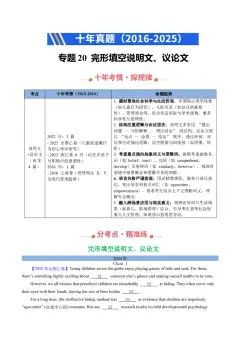
清单 04 完形填空之议论文
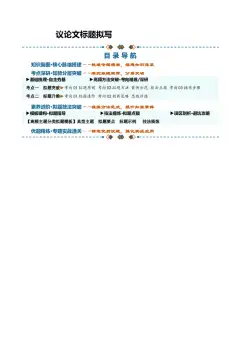
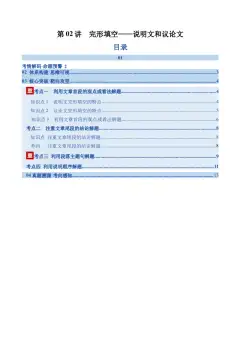
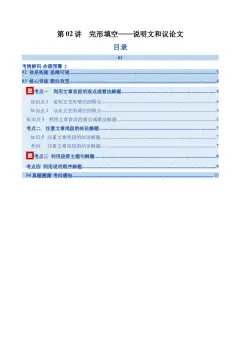
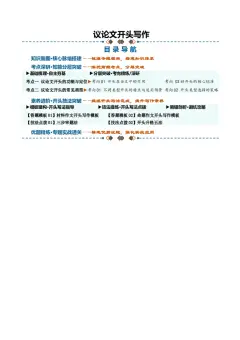
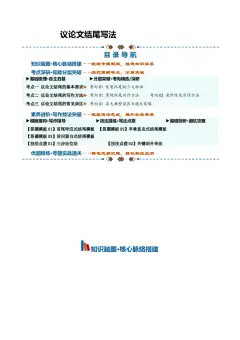
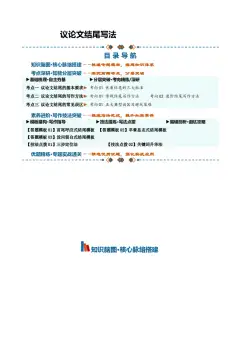
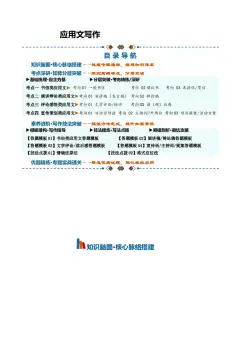
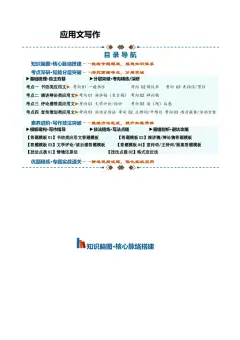
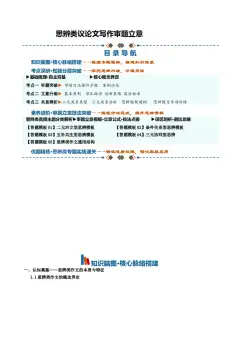
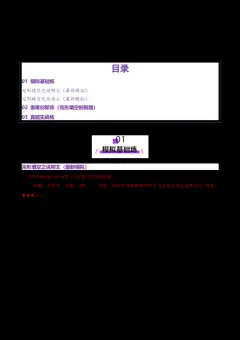
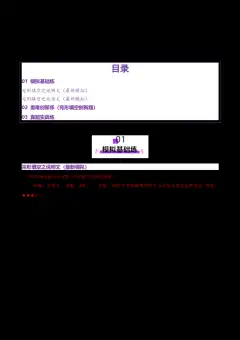
目 录 导 航
01知识脑图·核心脉络搭建——梳理专题框架,搭建知识体系
02 考点深研·知能分层突破——深挖高频考点,分层突破重难点
考点一 特点
1. 论点(提出问题)
2. 论据(分析问题)
3. 论证(解决问题)
考点二 解题技巧
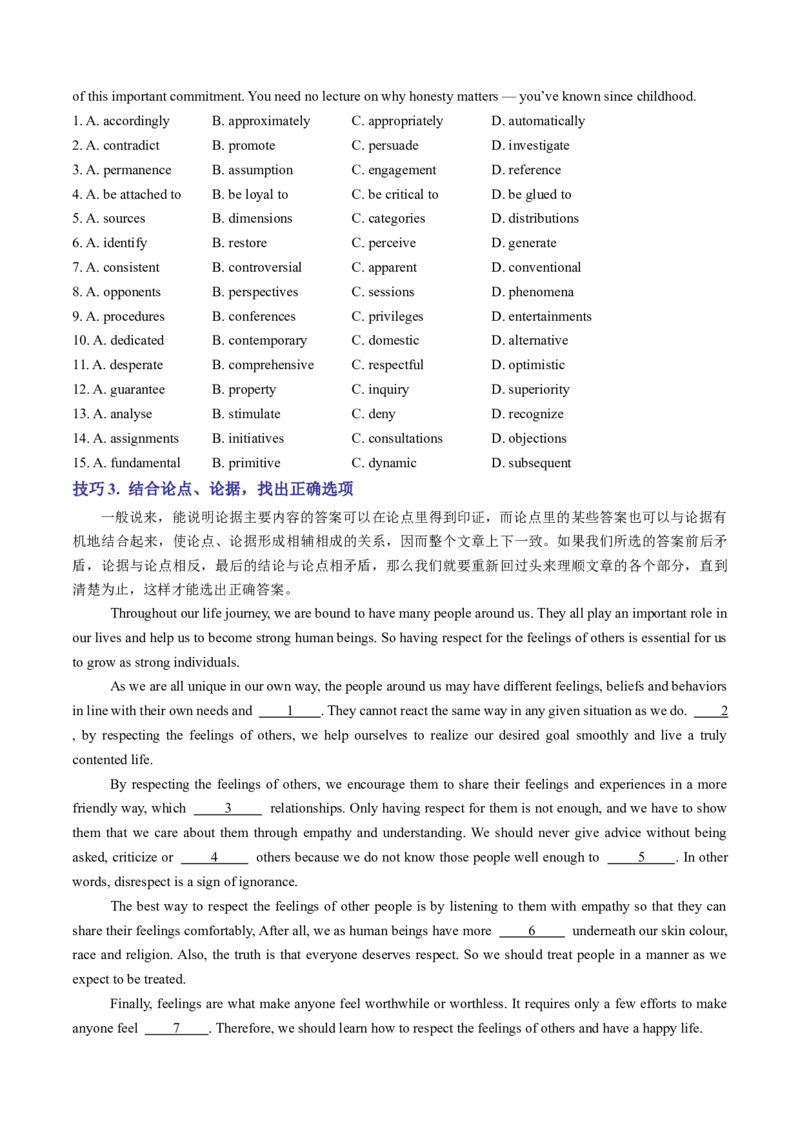
技巧1. 把握首段和首句完整的信息,把握全文的主旨大意
技巧2. 把握作者的观点和态度
技巧3. 结合论点、论据,找出正确选项
技巧4. 通篇阅读,围绕主题(论点)推敲有疑问的题目,并最终确定答案。
03优题精练·专题实战通关——精选优质试题,强化实战应用知识脑图·核心脉络搭建
考点深研●知能分层突破
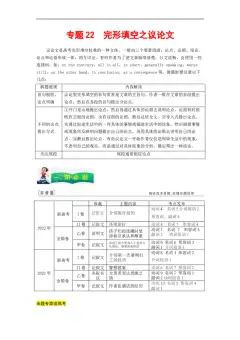
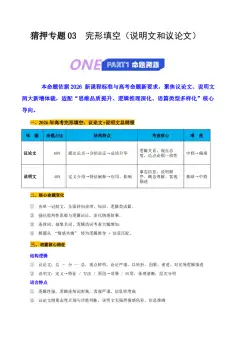
议论文是一种剖析事物、论述事理、发表见解或提出主张的说理性文章,主要是就某一主题,在摆出
正反两方面观点的基础上,通过论证、推理、辩论等手段,试图让读者最终接受作者对这一主题的某种观
点。议论文都是由论点、论据和论证这三个要素构成的,这也是一个提出问题—分析问题—解决问题的过
程。 它的语言自然、客观、抽象、概括。
技巧1. 把握首段和首句完整的信息,把握全文的主旨大意
We all have weaknesses and strengths — no matter who we are. Sometimes the weaknesses seem to
outweigh the strengths and sometimes it’s the other way around. Some people get sick easily. Some struggle to 1
their finances properly. Some people are 2 communicators and struggle with relationships.
Many people accept it as just bad 3 — but not everyone. Some people facing huge 4
still manage to achieve surprising things. They 5 above their weaknesses and do not allow them to limit
their possibilities.
I attended a school prize-giving ceremony not so long ago and the guest 6 was Andrew Becroft,
who had a severe stutter (口吃) as a child. Instead of allowing this to limit him, he chose to work hard to 7
it. He is now the Principal Youth Court Judge for New Zealand. Not only did he become successful, but he did so in
a(n) 8 where he had to speak in front of others regularly — where his 9 is front and center for
all to see. If he hadn’t 10 his speaking ability, it would have been very limiting to his life and career
11 .
Here are some more 12 : Brett Eastburn has no arms or legs and yet is an inspirational speaker and
also a very good wrestler. Ringo Starr, drummer for the Beatles, 13 a very poor background. He was
constantly troubled by illness as a child and spent large amounts of time in hospital. Mark Inglis 14 both
of his legs below the knees in a mountaineering accident, but has since climbed Mt Everest.
Most of us will never have to face the challenges these people faced. Yet most of us will never achieve 15
that these people have had either, unless we choose to. If Mark Inglis can climb the highest mountain in the world
without legs, what can we do?
1. A. manage B. obtain C. share D. divide
2. A. ridiculous B. forgetful C. useless D. hopeless
3. A. impression B. character C. quality D. fortune4. A. criticism B. pressure C. limitations D. losses
5. A. rise B. behave C. operate D. escape
6. A. winner B. speaker C. organizer D. scholar
7. A. avoid B. treat C. forget D. overcome
8. A. atmosphere B. profession C. situation D. institute
9. A. weakness B. symptom C. strength D. impatience
10. A. put forward B. taken up C. made out D. worked on
11. A. records B. aspects C. prospects D. spirits
12. A. examples B. incidents C. disabilities D. possibilities
13. A. resulted from B. came from C. heard from D. suffered from
14. A. lost B. injured C. destroyed D. broke
15. A. to the point B. in the least C. to the degree D. on the whole
技巧2. 把握作者的观点和态度
议论文往往体现作者对某一事物的观点,而作者的观点就是文章的论点。考生要把握作者的观点,把
握作者对某一事物是褒还是贬,是赞成还是反对,而通常把握了作者的观点也就找准了文章的论点。
We today welcome you not only as students, but as the newest members of our community of Scholars. I
1 want to note some of the commitments that define academic life, not only here, but across America's
research universities.
One commitment is to respect standards of academic excellence when evaluating scholarship. When
Princeton decides whether to hire or 2 professors, we evaluate their scholarship by 3 to the
standards of their disciplines, not by whether their work is popular with the public, government officials, or
powerful interest groups. We expect faculty members and students to 4 the truth not to the preferences of
the public or powerful groups. Universities must be independent 5 of data, theory, and argument even
when the arguments they 6 might anger or displease powerful people. That independence gives
universities a unique and essential role within a free and democratic republic, though it often makes them 7
.
You'll find that the scholarly disciplines represented on this campus pursue truth from varying angles and
8 . Ask “What is color?” to an art historian, a physicist, and a philosopher, and you’ll get three different
answers. One of the great 9 of being a student here is the access you have to faculty members who are
not only world experts, but also 10 teachers. Visit their office hours, share meals, and discuss ideas
freely, including whether they agree with what I’ve said in this speech (they often don’t, and that’s fine).
That brings me to another of the commitments that define scholarly communities. We treat 11
disagreement as desirable and beneficial. When people ask hard but fair questions about our ideas, we should
regard their 12 as a compliment(赞誉). It means they are taking your ideas seriously. New generations
of scientists replace older theories with better ones. To live up to the ideals of a scholarly community, we all need to
13 that some of our opinions will turn out to be wrong. We need to seek out criticism and test our views
against the most convincing 14 .
Finally, Let me mention one other principle that is 15 to this and other scholarly communities.
That's a commitment to honesty. At Princeton, the undergraduate honor code is one especially visible demonstrationof this important commitment. You need no lecture on why honesty matters — you’ve known since childhood.
1. A. accordingly B. approximately C. appropriately D. automatically
2. A. contradict B. promote C. persuade D. investigate
3. A. permanence B. assumption C. engagement D. reference
4. A. be attached to B. be loyal to C. be critical to D. be glued to
5. A. sources B. dimensions C. categories D. distributions
6. A. identify B. restore C. perceive D. generate
7. A. consistent B. controversial C. apparent D. conventional
8. A. opponents B. perspectives C. sessions D. phenomena
9. A. procedures B. conferences C. privileges D. entertainments
10. A. dedicated B. contemporary C. domestic D. alternative
11. A. desperate B. comprehensive C. respectful D. optimistic
12. A. guarantee B. property C. inquiry D. superiority
13. A. analyse B. stimulate C. deny D. recognize
14. A. assignments B. initiatives C. consultations D. objections
15. A. fundamental B. primitive C. dynamic D. subsequent
技巧3. 结合论点、论据,找出正确选项
一般说来,能说明论据主要内容的答案可以在论点里得到印证,而论点里的某些答案也可以与论据有
机地结合起来,使论点、论据形成相辅相成的关系,因而整个文章上下一致。如果我们所选的答案前后矛
盾,论据与论点相反,最后的结论与论点相矛盾,那么我们就要重新回过头来理顺文章的各个部分,直到
清楚为止,这样才能选出正确答案。
Throughout our life journey, we are bound to have many people around us. They all play an important role in
our lives and help us to become strong human beings. So having respect for the feelings of others is essential for us
to grow as strong individuals.
As we are all unique in our own way, the people around us may have different feelings, beliefs and behaviors
in line with their own needs and 1 . They cannot react the same way in any given situation as we do. 2
, by respecting the feelings of others, we help ourselves to realize our desired goal smoothly and live a truly
contented life.
By respecting the feelings of others, we encourage them to share their feelings and experiences in a more
friendly way, which 3 relationships. Only having respect for them is not enough, and we have to show
them that we care about them through empathy and understanding. We should never give advice without being
asked, criticize or 4 others because we do not know those people well enough to 5 . In other
words, disrespect is a sign of ignorance.
The best way to respect the feelings of other people is by listening to them with empathy so that they can
share their feelings comfortably, After all, we as human beings have more 6 underneath our skin colour,
race and religion. Also, the truth is that everyone deserves respect. So we should treat people in a manner as we
expect to be treated.
Finally, feelings are what make anyone feel worthwhile or worthless. It requires only a few efforts to make
anyone feel 7 . Therefore, we should learn how to respect the feelings of others and have a happy life.Throughout our life journey, conflicts with others are 8 to happen. When facing such situations,
respecting others’ feelings can help reduce tensions. It allows us to 9 disagreements with an open mind
and seek solutions that take everyone’s 10 into account.
Respecting others’ feelings can also 11 a positive atmosphere in our social circles. People feel
valued and accepted, which 12 makes them more willing to communicate and cooperate. This creates a
cycle of mutual respect that 13 our connections with others.
Moreover, respecting the feelings of others is not just about being kind; it’s a 14 of emotional
intelligence. It shows that we can recognize and appreciate the inner world of others, which is a key 15
for building meaningful and lasting relationships.
1. A. distributions B. innovations C. assumptions D. motivations
2. A. Nevertheless B. Therefore C. Though D. Furthermore
3. A. injures B. integrates C. promotes D. destroys
4. A. lecture B. persuade C. praise D. warn
5. A. judge B. appreciate C. support D. guarantee
6. A. likenesses B. similarities C. distinctions D. characteristics
7. A. precious B. insignificant C. pleased D. valuable
8. A. likely B. prepared C. keen D. certain
9. A. ignore B. arise C. emerge D. approach
10. A. prospects B. statuses C. perspectives D. fortunes
11. A. envelopes B. fosters C. sustains D. ruins
12. A. by contrast B. in return C. by nature D. in turn
13. A. weakens B. shortens C. strengthens D. loosens
14. A. mark B. sign C. symbol D. signal
15. A. element B. composition C. mission D. outcome
技巧4. 通篇阅读,围绕主题(论点)推敲有疑问的题目,并最终确定答案。
逐题按照文章的内容及语境选择完毕后,一篇完整的文章便呈现出来,此时,要注意一定要通读全文,
以验证个别题目的答案是否与主题偏离,以求更高的准确度。
Imagine you are on a desert island for the rest of your days. What one book would you most 1 to
have with you? Much more often than not, people 2 a great work of literature to keep them company for
their 3 lives there.
Then, what is literature? The answer is found by 4 at literature itself. For example, consider the
very first 5 works we come into contact with over the 6 of our lives — children’s literature.
Most of us 7 the first steps into the world of reading in the 8 : someone we love reads to us in
bed. So begins the lifelong journey through all 9 pages that lie ahead. As we grow up, the practice of
reading for pleasure — which 10 means reading literature — stays with us. Explaining to young children
the politics or the history would be 11 . Literature, with its ability to communicate to all ages, can help.
12 we read well, we will find ourselves in a dialogue 13 the most creative minds of our
own time and of the past. It enriches(丰富) life in 14 that nothing else quite can. It makes us more 15
. The better we learn to read literature, the better it will do that.1. A. want B. ask C. allow D. require
2. A. provide B. choose C. discover D. follow
3. A. dangerous B. happy C. lonely D. colourful
4. A. looking B. working C. arriving D. pointing
5. A. developed B. printed C. designed D. reported
6. A. pattern B. course C. event D. condition
7. A. count B. pave C. watch D. take
8. A. bookstore B. classroom C. bedroom D. library
9. A. this B. these C. that D. those
10. A. typically B. perfectly C. expectedly D. similarly
11. A. convenient B. common C. private D. difficult
12. A. Though B. Since C. If D. Unless
13. A. for B. beyond C. with D. into
14. A. cases B. ways C. positions D. shapes
15. A. classical B. standard C. personal D. human
优题精练●专题实战通关
Passage 1
(2026届广东佛山市顺德高三考前保温试题英语)Everyone knows that science is important. The aim of
science is to 1 how the world, everything in it and beyond it, works. Some people, 2 , claim
that much of what is done in the name of science is a waste of time and money. What is the 3 in
investigating how atoms behave or in studying stars billions of kilometres away? Science, they argue, is 4
only if it has some practical application.
Yet history shows that curiosity-driven research often leads to 5 breakthroughs. When the Scottish
physicist James Clerk Maxwell 6 experiments with electricity and magnetism in the late 19th century, he
had no specific end in 7 and was certainly not 8 to earn money; he was simply trying to
understand more about how the world works. Despite this, his work laid the 9 for our modern way of
life. Computers, satellites, the Internet, mobile phones and medical scanners all owe their existence to the fact that a
scientist 10 the need to understand the world a little better.
Maxwell's candle-lit laboratory was quiet once more, but the ideas he sparked continue to 11 our
world. Now more students 12 to ask questions without obvious answers. Such curiosity 13
seeds that may take years, decades or even centuries to bear fruits. Every experiment, every observation, every
failure brings us closer to understanding. The value of science lies not only in what it produces but in the 14
it shapes.
And that, ultimately, is the 15 of science.
1. A. set up B. figure out C. carry out D. make up
2. A. therefore B. moreover C. however D. likewise
3. A. cause B. outcome C. point D. basis
4. A. stable B. profitable C. available D. valuable5. A. unexpected B. huge C. little D. limited
6. A. conducted B. invented C. learned D. designed
7. A. need B. mind C. hand D. sight
8. A. instructed B. trained C. practicing D. aiming
9. A. conclusion B. foundation C. source D. theory
10. A. met B. avoided C. chose D. felt
11. A. darken B. rule C. light D. decorate
12. A. hesitate B. pretend C. dare D. refuse
13. A. plants B. removes C. destroys D. collects
14. A. mindset B. competition C. cooperation D. history
15. A. challenge B. example C. proof D. significance
Passage 2
(2026届湖南长沙市周南中学高三考前模拟英语试题)In an era overwhelmed by digital overload, people
are often trapped in a desperate rush, aimlessly pursuing efficiency and instant satisfaction.
Last weekend, I 1 cut myself off from the online chaos and stepped into a quiet bookstore. Free
from constant 2 and meaningless social comparisons, I 3 myself in reading and enjoyed the
rare quiet that has become a 4 in modern society.
This refreshing experience urged me to 5 the true essence of a well-lived life. Nowadays, many
people are so 6 to virtual excitement that they fail to appreciate the beauty of real life. They drown
themselves in endless information but often feel anxious and 7 .
Actually, genuine happiness does not 8 from speed or material 9 . Slow living is by no
means 10 to laziness or escape from reality. Instead, it is a sensible lifestyle that 11 cherishing
the present moment and embracing simplicity.
It teaches us to slow down, to 12 the world attentively, and to follow our inner voice. Only when
we 13 from the noisy hurry can we attain lasting peace and discover the true 14 of life. To live
slowly is to live purposefully. In such a fast-changing world, this is the key to 15 a meaningful and
fulfilling life.
1. A. continuously B. instantly C. temporarily D. casually
2. A. joys B. distractions C. efforts D. failures
3. A. trained B. assisted C. buried D. instructed
4. A. luxury B. practice C. miracle D. conflict
5. A. take on B. resolve on C. insist on D. reflect on
6. A. opposed B. indifferent C. addicted D. sensitive
7. A. pessimistic B. empty C. awkward D. astonished
8. A. differ B. benefit C. evolve D. result
9. A. possessions B. standards C. demands D. goods
10. A. blind B. equal C. open D. opposite
11. A. pictures B. prohibits C. advocates D. avoids
12. A. perceive B. imagine C. remember D. change13. A. gain B. suffer C. emerge D. withdraw
14. A. award B. highlight C. value D. trend
15. A. transforming B. leading C. celebrating D. assessing
Passage 3
(2026届安徽合肥市第六中学高三最后一卷英语试题)The days that make us happy make us wise. — by
John Masefield
When I first read this line by England’s Poet Laureate, it 1 me. What did Masefield mean?
Without thinking about it much, I had always assumed that the 2 was true. But his serious assurance was
3 . I was deeply attracted by it.
Slowly, I seemed to 4 his meaning and realized the wisdom that happiness makes possible lies in
clear perception(洞察力), not 5 by anxiety nor dimmed by despair and boredom, and without the blind
6 caused by fear.
Active happiness — not mere satisfaction or 7 — often comes suddenly, like an April shower or
the unfolding of a bud. Then you discover what kind of wisdom has 8 it. Amazingly, in your eyes, the
grass is greener; bird songs are sweeter; the 9 of your friends are more understandable, and more
forgivable. Happiness is like a pair of eyeglasses correcting your 10 vision.
Nor are the 11 of happiness limited to what is near around you. Unhappy, with your thoughts
focused on your emotional woes(痛苦), your vision is cut short as though blocked by a wall. Happy, the wall 12
.
Consequently, the long vision is there for the seeing. The ground at your feet, the world about you — people,
thoughts, emotions, pressures — are now 13 a larger scene. Everything 14 a fairer
proportion(比例). Everything around you, whether it is encouraging or frustrating, no longer seems such a big deal.
And here is the beginning of 15 .
1. A. terrified B. surprised C. satisfied D. upset
2. A. other B. opposite C. view D. former
3. A. distracting B. confusing C. arresting D. disturbing
4. A. convey B. observe C. analyse D. appreciate
5. A. iced B. clouded C. rained D. snowed
6. A. spots B. paths C. roads D. places
7. A. entertainment B. sorrow C. disappointment D. fulfillment
8. A. embraced B. interrupted C. accompanied D. survived
9. A. shortcomings B. stupidity C. brightness D. memories
10. A. physical B. ordinary C. spiritual D. daily
11. A. expectations B. impressions C. adventures D. insights
12. A. extended B. collapsed C. remained D. withdrew
13. A. fitted into B. got out C. stayed on D. kept off
14. A. forms B. promises C. needs D. covers
15. A. happiness B. ability C. wisdom D. life
Passage 4(2026届陕西省多校联考高三模拟预测英语试题)My brother is a determined shoes-off-er. I visited him
recently and, within a couple of minutes, he 1 at my feet in horror. “What are those?” he asked. “These?”
I replied, pointing to my trainers. “I bought them only —.” “No!” he 2 , his face red. “What are they doing
in my house?”
This is the best way to 3 people. There are those who hate the thought of rubber on carpet, who lie
awake 4 because wearing outdoors shoes indoors breaks the natural order of things. Then there are
normal people like me, who really don’t care because they understand the 5 of doormats.
However, shoes-off-ers might be on to something. A recent study conducted by researchers at the University
of Houston has shown that 26.4% of shoes 6 the bacteria of Clostridium difficile. Work on a 7
? A 2014 study concluded that considering the herds you raise your boots are almost certainly covered in E. coli.
They are definitely 8 guests to your living rooms.
But I’m going to 9 myself. Sure, it might be more hygienic(卫生的) to remove your shoes at the
door, but only to a small extent. By all accounts, there is a 10 chance you will get ill when someone is
wearing shoes in your living room. And if you have got young kids, who rush in and out of the house without 11
at the first sign of the sun, it’s much more practical to keep your shoes on. Not to mention 12 : Fewer
things inspire more pity than the sight of adults 13 bending themselves into knots as they attempt to do
up their shoelaces in a narrow hallway at the 14 of a night.
True, the answer to both of these problems is slippers. But given the choice of slippers or E. coli, I’ll 15
the latter every time.
1. A. shot B. gestured C. pulled D. leapt
2. A. protested B. murmured C. laughed D. sighed
3. A. bully B. relieve C. split D. understand
4. A. singing B. reflecting C. chewing D. panicking
5. A. point B. category C. price D. condition
6. A. eliminate B. challenge C. carry D. change
7. A. roof B. farm C. ship D. playground
8. A. decent B. charming C. selfish D. unwelcome
9. A. put up with B. look out for C. get along with D. stand up for
10. A. fat B. good C. high D. real
11. A. company B. enthusiasm C. warning D. collaboration
12. A. dignity B. exhaustion C. complexity D. politeness
13. A. gracefully B. painfully C. voluntarily D. creatively
14. A. start B. end C. height D. cost
15. A. refuse B. avoid C. upgrade D. take
Passage 5
(2026 届四川成都市彭州市彭州中学期末考试)The term “water master’s degree” — or “shuoshui” in
Chinese — has become a lightning rod in discussions about higher education. It refers to one-year master’s
programs, particularly those offered by some UK and Australian universities, that critics 1 as
academically undemanding cash cows. The implication is clear: these degrees are 2 , offering little reallearning while costing a fortune.
But is this reputation 3 ? The one-year master’s model is fundamentally different from China’s
three-year research-based master’s degree. Where Chinese programs emphasize lengthy thesis writing and 4
research training, UK-style taught master’s degrees compress the same amount of content into an intense 12-month
sprint. Students attend lectures, complete assignments, write a dissertation — all without the long summer 5
that characterizes Chinese undergraduate education. A typical week might involve 30 — 40 hours of classes and
independent study.
Critics argue that the 6 duration makes it impossible to develop deep expertise. They point to
students who graduate without strong research skills or who struggle to 7 their one-year degree to a
competitive job market. Some employers have reportedly begun 8 these degrees, favoring candidates
with two-year or three-year Chinese master’s degrees instead.
9 , defenders of the one-year model make several compelling arguments. First, for students
pursuing professional careers rather than academia, intensive coursework may be more 10 than years of
open-ended research. A one-year finance master’s degree, for example, can provide specific, marketable skills.
Second, the shorter duration means lower opportunity 11 — students return to the workforce faster.
Third, many of these programs are genuinely rigorous. The University of Oxford’s one-year master’s degrees, for
instance, are 12 world-renowned.
The real issue may not be the length of the degree but the 13 of the institution and the student’s
intentions. A one-year program at a top university, pursued by a motivated student, can be transformative. The same
degree from a diploma mill, 14 by someone seeking an easy credential, is indeed a “water master’s.” The
term, perhaps, should be applied to programs based on their academic honesty and rigor — not simply their 15
.
1. A. celebrate B. dismiss C. analyze D. advertise
2. A. superficial B. innovative C. affordable D. essential
3. A. earned B. exaggerated C. deserved D. overlooked
4. A. limited B. superficial C. extensive D. theoretical
5. A. vacation B. assignment C. exam D. training
6. A. flexible B. standard C. extended D. compressed
7. A. apply B. reduce C. leverage D. sacrifice
8. A. valuing B. devaluing C. recognizing D. promoting
9. A. Therefore B. Otherwise C. Moreover D. Nevertheless
10. A. valuable B. relaxing C. expensive D. traditional
11. A. cost B. time C. energy D. risk
12. A. hardly B. universally C. rarely D. questionably
13. A. location B. age C. quality D. popularity
14. A. designed B. pursued C. funded D. rejected
15. A. duration B. reputation C. location D. cost
Passage 6
(2025-2026学年福建福州市鼓楼区福州第一中学第一学期第二学段模块考试高三英语学科期末试题)As an actress, the question I am most often asked is:“What do you really do for UNICEF?” My task is to
inform, and to create 1 of children’s needs.
There remains a critical need to 2 children suffering from malnutrition and disease. One does not
need special training to recognize the 3 of severe vitamin A deficiency — a condition that leads to
blindness and often death. Annually, countless children in developing regions are 4 . Thus, I travel not
merely to raise money, but to tear down a dangerous 5 : the belief that helping is difficult. In reality, for
just 84 cents a year — the 6 of two vitamin A capsules — a child’s sight can be preserved.
My previous experiences 7 me to UNICEF. As a child who received its lifesaving support in
postwar Europe, I was once faced with extreme poverty, a reality 8 in many communities today. Poverty,
which is a 9 crisis, lies at the root of this 10 . It spreads quietly in remote villages and 11
communities. Across more than 100 countries, UNICEF witnesses its severe impact 12 a child.
If we are meant to “love thy (your) neighbour as thyself”, then we should 13 these children as our
own for they are our most vital resource. They are too 14 to wait for an economic crisis to pass. The
moment is now. Every child 15 health, tenderness, and a future filled with promise.
1. A. awareness B. intention C. phenomenon D. opinion
2. A. make up for B. wait for C. speak up for D. long for
3. A. cause B. result C. cure D. theory
4. A. saved B. affected C. abandoned D. checked
5. A. myth B. cycle C. rule D. record
6. A. value B. amount C. price D. package
7. A. tied B. compared C. limited D. dragged
8. A. shaped B. absorbed C. eliminated D. mirrored
9. A. sudden B. visible C. silent D. urgent
10. A. beginning B. bias C. suffering D. sacrifice
11. A. confused B. ignored C. recovered D. stuffed
12. A. in the eyes of B. at the risk of C. as a result of D. on behalf of
13. A. protect B. teach C. acknowledge D. treat
14. A. sensitive B. cautious C. weak D. critical
15. A. deserves B. ensures C. enjoys D. guarantees