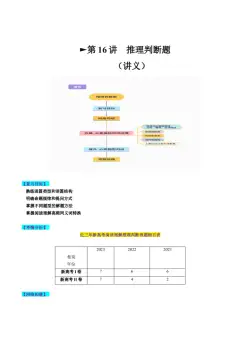
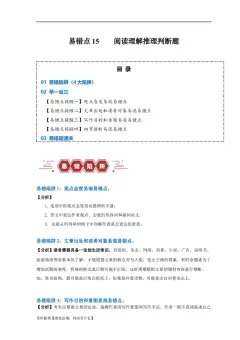
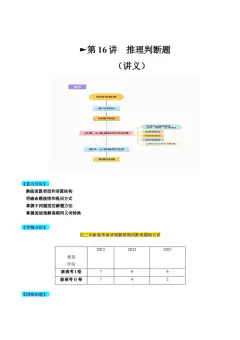
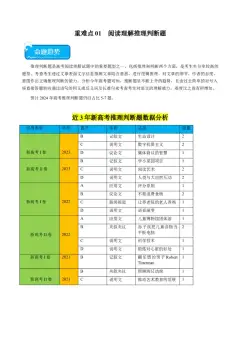
02.推理判断题
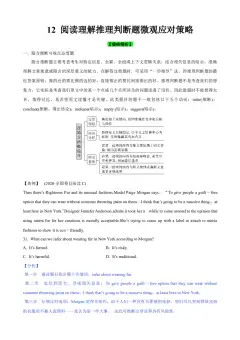
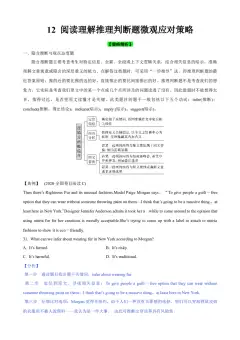
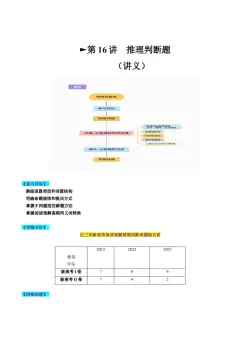
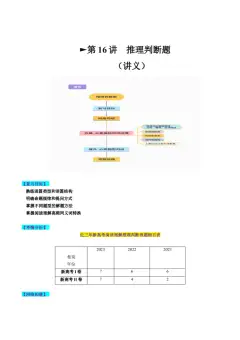
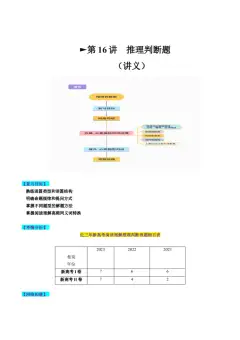
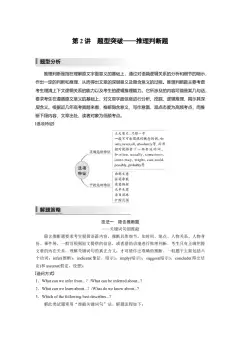
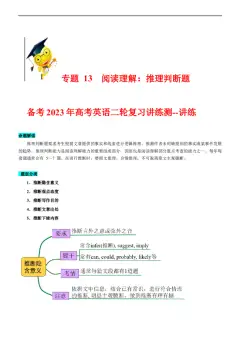
【题型总览】
【题型特征】
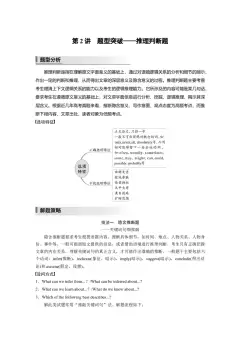
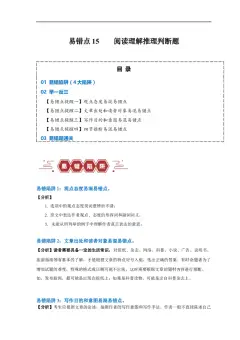
推理判断题属于高层次阅读理解题。解答该类型题目时一定要从整体上把握语篇内容。
在语篇的表面意义与隐含意义、已知信息与未知信息之间架起桥梁,透过字里行间,去体会作
者的“弦外之音”和“言外之意”。在进行推断时,要据文推理、合情推理,不可脱离原文主
观臆断。推理判断题要求考生根据文章提供的事实和线索进行逻辑推理,推测作者未明确提
到的事实或某事件发展的趋势。
【设题趋势】
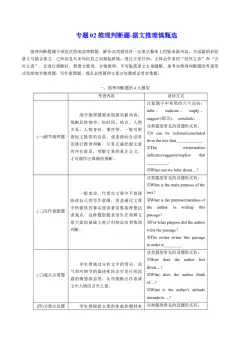
常以infer, imply, suggest, conclude, learn, intend, mean, describe, purpose等词提问。提问
中含有表示推测的情态动词,如can, could, might, would 等和其他表示可能性的副词,如
probably, possibly等。具体的设问方式如:
What can we infer from the (first/.../last) paragraph?
Where does this passage probably come from?
What’s the author’s attitude towards...?
What is the main purpose of the passage?等。
1.正确选项
推理判断题中的正确选项是依据文章的事实或证据推断出的符合逻辑的结论或观点,正
确选项一般具有以下特征:(1)“立足原文,只推一步”,即根据原文内容,一步即可推得。(2)选
项中一般不可以出现绝对概念。如only, never, all, absolutely等,正确答案的表述一般有一点
模糊,会用一些相对能够留有一些余地的词汇,如often, usually, sometimes, some, may, might,
can, could, possibly, probably等。
2.干扰选项
即把文章中作者的观点与其他人的观点混淆在一起。题干问的是作者的观点,选
张冠李戴 项中出现的却是其他人的观点;题干问的是其他人的观点,选项中却出现了作者的
观点
这种类型的干扰项往往是基本的生活常识或普遍认可的观点,但在文章中并无相
无中生有
关的信息支撑点。其次,这种干扰项也有可能与设置的问题毫不相干
即推测意义与文章表层意义有区别。推理判断题中有些选项来自文章中的某一
曲解文意 句或某几句话,命题者可能会利用里面的词设计出干扰项,看似表达文章的意思,
其实是借题发挥,是对原文意思的曲解
鱼目混珠类型的干扰项常出现在词句理解类试题的选项中,即利用某个词或句子
鱼目混珠
的字面含义代替其在文章特定语境中的具体含义为了准确、严密地表达文章内容,命题者特别注意对文意范围的限定,有时通过加
上almost, all, nearly, more than, normally, usually 等词语对文意范围加以限定。
扩缩范围
“扩缩范围”干扰法就是在选项中通过改变或去掉限制性词语,将信息的范围、
程度、感情色彩等改变,从而给考生解题造成干扰的命题方法
干扰项用了与文章中某一句话相似的句型结构和单词,却在考生易忽视的地方换
偷梁换柱
了几个单词,造成句意的改变
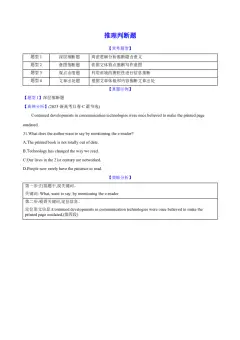
【常考类型】
题型1 深层推断题 周密逻辑分析推断隐含意义
题型2 意图推断题 依据文体特点推断写作意图
题型3 观点态度题 利用语境的褒贬性进行信息推断
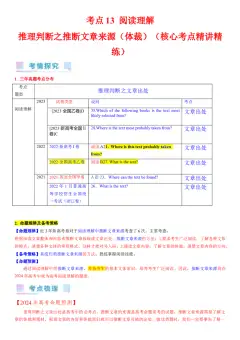
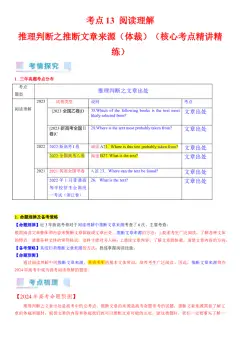
题型4 文章出处题 根据文章体裁和内容推断文章出处
【题型精析】
【题型1】深层推断题(隐含推断题)
主要考查以下几个方面:(1)细节推断题,即根据文章特定细节进行推断;(2)综合推断题,即
根据全段,甚至全篇,结合多处信息推断文章寓意或深层意义;(3)逻辑推断题,即严格根据文章
中所陈述的事实、论点、例证等一系列材料进行推理,从而得出合乎逻辑的结论。
【真题示例】(2023·新高考Ⅱ卷·C篇节选)
Continued developments in communication technologies were once believed to make the
printed page outdated.
31.What does the author want to say by mentioning the e-reader?
A.The printed book is not totally out of date.
B.Technology has changed the way we read.
C.Our lives in the 21st century are networked.
D.People now rarely have the patience to read.
【解答思路】
第一步:扫描题干,找关键词。关键词: What, want to say, by mentioning the e-reader
第二步:根据关键词,定位信息。定位原文信息:Continued developments in communication
technologies were once believed to make the printed page outdated.(第四段)
第三步:根据关键词和定位信息可以推知,作者提到电子阅读器说明,这显示了人们认为
信息技术的发展一度使得印刷书籍过时了,但是现在的情况却正好相反,故选__A__。
【技巧提示】
抓住特定信息进行逆向或正向推理判断。细节类推理判断题要善于抓住某一段话中的
关键信息,即某些关键词或短语去分析、推理、判断,利用逆向思维或正面推理。整合全文(段)信息进行推测。抓住了关键信息,以事实为依据,在弄懂全文(段)意思的基
础上,整合与题目相关的有用信息,综合起来去推理判断,确定最佳答案。
【题型2】意图推断题
文章主旨是中心思想、文章大意,而写作意图则阐述文章为何表达这个中心思想。在高
考中既可能考查全文的写作意图,又可能考查某处细节或某一段落的写作意图。
【真题示例】(2023·新高考Ⅰ卷·B篇节选)
Over the years, John has taken on many big jobs.He developed a greenhouse-like facility that
treated sewage (污水) from 1,600 homes in South Burlington.He also designed an eco-machine to
clean canal water in Fuzhou, a city in southeast China.
“Ecological design” is the name John gives to what he does.“Life on Earth is kind of a box
of spare parts for the inventor,” he says.“You put organisms in new relationships and observe
what’s happening.Then you let these new systems develop their own ways to self-repair.”
26.What is the author’s purpose in mentioning Fuzhou?
A.To review John’s research plans.
B.To show an application of John’s idea.
C.To compare John’s different jobs.
D.To erase doubts about John’s invention.
【解答思路】
第一步:扫描题干,找关键词。关键词:What, purpose, mentioning Fuzhou
第二步:根据关键词,定位信息。定位原文信息:Over the years, John has taken on many big
jobs.He developed a greenhouse-like facility that treated sewage from 1,600 homes in South
Burlington.He also designed an eco-machine to clean canal water in Fuzhou, a city in southeast
China.(第五段)
第三步:根据关键词和定位信息可知,第五段通过举两个例子,即South Burlington和中国
的福州,来说明John的生态机器在现实生活中有着实际的运用。故选 __B__。
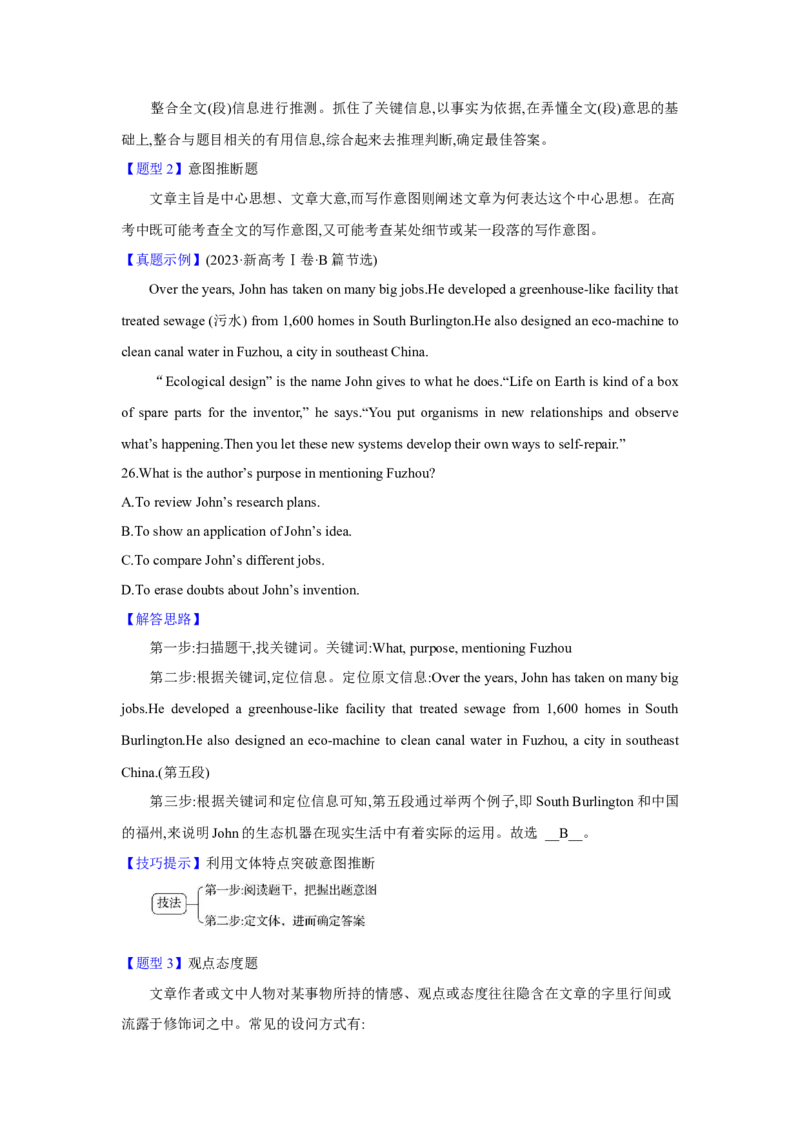
【技巧提示】利用文体特点突破意图推断
【题型3】观点态度题
文章作者或文中人物对某事物所持的情感、观点或态度往往隐含在文章的字里行间或
流露于修饰词之中。常见的设问方式有:·How does the author feel about...?
·What does the author think of...?
·What is the author’s attitude towards/to...?
【真题示例】(2023·新高考Ⅰ卷·D篇节选)
In a follow-up study with 100 university students, the researchers tried to get a better sense of
what the group members actually did in their discussion.Did they tend to go with those most
confident about their estimates? Did they follow those least willing to change their minds? This
happened some of the time, but it wasn’t the dominant response.Most frequently, the groups
reported that they “shared arguments and reasoned together.” Somehow, these arguments and
reasoning resulted in a global reduction in error.
Although the studies led by Navajas have limitations and many questions remain, the
potential implications for group discussion and decision-making are enormous.
35.What is the author’s attitude toward Navajas’ studies?
A.Unclear. B.Dismissive.
C.Doubtful. D.Approving.
【解答思路】
第一步:扫描题干,找关键词。关键词:author’s attitude,Navajas’ studies
第二步:根据关键词,定位信息。定位原文信息:Although the studies led by Navajas have
limitations and many questions remain, the potential implications for group discussion and
decision-making are enormous.(尽管Navajas领导的研究有局限性,仍存在许多问题,但对小组
讨论和决策的潜在影响是巨大的)进一步辨别:作者对于Navajas的研究表示一定的赞许和支
持。故选 D 。
【技巧提示】
注意作者或文中人物的措辞。态度倾向推理判断题,文章作者或文中人物对事物所持的
观点或态度往往隐含在文章的字里行间或流露于修饰词之中。
牢记常见有关作者情感态度的词语。牢记有关作者情感态度的词语,注意文中表达情感、
态度或观点的词语或句子,结合平时积累的知识来进行合理的推断,得出正确答案。
【题型4】文章出处题
推断文章出处或类别要从文章内容、语言特色和标志信息着手;确定读者对象要根据文
章主题和文章措辞来判断。
【真题示例】(2023·新高考Ⅱ卷·C篇节选)Reading Art: Art for Book Lovers is a celebration of an everyday object—the book,
represented here in almost three hundred artworks from museums around the world...
In this “book of books”, artworks are selected and arranged in a way that emphasizes these
connections between different eras and cultures...
28.Where is the text most probably taken from?
A.An introduction to a book.
B.An essay on the art of writing.
C.A guidebook to a museum.
D.A review of modern paintings.
【解答思路】
第一步:扫描题干,找关键词。关键词: Where, the text, taken from
第二步:根据关键词,定位信息。定位原文信息:Reading Art: Art for Book Lovers is a
celebration of an everyday object—the book, represented here in almost three hundred artworks
from museums around the world...(第一段)
In this “book of books”, artworks are selected and arranged in a way that emphasizes these
connections between different eras and cultures...(第二段)
第三步:根据关键词和定位信息可知,文章第一段中提到Reading Art:Art for Book Lovers,
the book和第二段中的In this“book of books”等信息均说明,本文选自对一本有关阅读艺术的
书的介绍, 故选 __A__。
【技巧提示】
确定题干中的关键信息。写作意图、文章出处类推理判断题要先锁定题干中的关键信
息,把文章的内容与题干中的关键信息结合起来做出正确的判断。
了解语言特色。要对报纸、杂志、网络、小说等文章的语言特色,特别是其专用词汇有
基本的了解,根据文章的语言特色和其专用词汇对号入座,快速选出最佳答案。
【突破技巧】
1.理解通篇大意,把握写作意图
(1)做推理判断题时,考生应对整篇文章有完整、准确的理解,从总体上把握文章的主题,
善于抓住文中的关键词或关键句子。
(2)考生应对文章的引申含义进行分析,整合与题目相关的信息,综合起来去把握写作意
图,确定最佳答案。
2.关注特定措辞,推断作者态度(1)作者的态度倾向是指作者对陈述的观点是赞同、反对还是犹豫不定,对记叙或描写的
人、物或事件等是赞颂、同情、冷漠还是厌恶、憎恨。
(2)作者的这种思想倾向和感情色彩往往隐含在文章的字里行间,或流露于修饰的词语之
中。
(3)在推断过程中,应特别注意文中作者的措辞,尤其是表达感情色彩的形容词。
3.利用语境褒贬,进行逻辑推断
(1)几乎每篇文章的语境都有一定的褒贬性,这种褒贬性反映了故事人物的特定心理、情
绪状态及作者的写作意图。
(2)考生在阅读文章时一定要找出反映语境褒贬性的标志性词汇或句子,掌握文章主旨大
意,了解人物的心理特点及发展变化,从而正确地进行逻辑推断。
4.抓住有效信息,逆向或正向推理
(1)逆向推理的推理方式和正向推理相反,它是由结论出发,去验证结论的正确性并寻找
论据。
(2)做此类命题要善于抓住某一段话中的关键信息,即某些关键词或短语去分析、推理和
判断,利用逆向思维或正面推理,从而推断出这句话的深层含义。
5.结合已知常识,进行逻辑推理
阅读理解命题通常源于材料,又略高于材料,但一般不会偏离所给材料。但有时命题者会
巧妙地把人们所知的常识融入命题。如果考生不知道这一常识,这样的命题就很难处理。
【题型精练】
1
When I first heard about the improv(即兴表演) classes, I was torn. As an introvert, I feared
getting on stage and improvising in front of strangers. However, I knew I wanted to work as a
science communicator after finishing my Ph.D. , so it seemed like the perfect opportunity to
improve my speaking ability and gain confidence thinking on my feet.
During our first class, we learned a core concept of improv: “yes, and.” It means that, as
improvisers, we accept what fellow performers say. If someone says that rhinos( 犀牛) are
librarians, for example, then rhinos are librarians. We do not question the logic; we say “yes” and
continue with the scene as if no him is wrong.
I got a taste of how difficult that was when acting out my first scene. My classmate turned to
me and said, “Mom is going to be so mad.” Mad about what? My mind spun out ideas, and my
inner critic shot them all down. We broke the car? No, that’s too easy. We failed a test? No, youdon’t want your classmates thinking you’re stupid on the first day. I finally landed on an answer:
“Yes, we’re going to be late for dinner.” The scene proceeded from there, and we eventually
finished as two sisters who lost their way on a hiking trail.
The first few scenes were hard, but as weeks turned into months, I became more comfortable
thinking on my feet and even started to enjoy our classes. I never silenced my inner critic entirely,
but over time, I didn’t police my words with quite so much effort. I also became better at listening,
relating to my conversation partners, and communicating clearly in the moment.
That training proved useful 6 months ago, when my experiments generated unreasonable
data. Early on in graduate school, I would get stuck when this happened; my inner critic would
assume I had made a mistake. But then, after embracing the “yes, and” concept, instead of getting
discouraged, I kept exploring the data and ended up identifying a new type of cell—one that
wasn’t behaving as expected. If I hadn’t accepted the possibility that the results were real, I would
have missed out on the most exciting finding of my Ph.D. so far.
All scientists can benefit from this lesson. If the data say rhinos are librarians, then it’s worth
investigating whether rhinos are, in fact, librarians. Our job as scientists isn’t to generate data that
support a preconceived(预想的) story. Our job is to say “yes, and.”
1. Why did the author take the improv classes?
A. To improve her logical mind. B. To finish her Ph. D. assignment.
C. To develop her communication skills. D. To pursue her interest in performance.
2. How did the author feel during the first scene?
A. Conflicted. B. Bored. C. Discouraged. D. Embarrassed.
3. According to the author, in her experiments, “yes, and” helped her ______.
A. accept failures B. make a new discovery
C. make up for a mistake D. correct unreasonable data
4. What can we learn from this passage?
A. The unknown can be an inspiration. B. The unexpected can be rewarding,
C. The unfortunate can be a chance. D. The unusual can be decisive.
【答案】1. C 2. A 3. B 4. B
【解析】这是一篇记叙文。文章主要讲述了作者为提高自己的表达能力参加了一个即兴表
演课程,在该课程中学习到了“是的,而且”原则,并将该原则应用到了自己的实验研究中,使得自己获得了意外的发现。
1. 细节理解题。根据文章第一段内容“However, I knew I wanted to work as a science
communicator after finishing my Ph.D., so it seemed like the perfect opportunity to improve my
speaking ability and gain confidence thinking on my feet.(然而,我知道我想在完成博士学位后
成为一名科学传播者,所以这似乎是提高我的口语能力和获得自信的绝佳机会。)”可知,
作者想通过该课程提高口语能力和获得自信。故选C项。
2. 细节理解题。根据文章第三段内容“I got a taste of how difficult that was when acting out
my first scene.(当我表演我的第一场戏时,我体会到了这有多困难。)”以及作者心理活动的
描写“Mad about what? My mind spun out ideas, and my inner critic shot them all down. We
broke the car? No, that’s too easy. We failed a test? No, you don’t want your classmates thinking
you’re stupid on the first day.(生气什么?我的脑子里涌现出各种想法,但我内心的批判者把
它们都否决了。我们把车弄坏了?不,那太简单了。我们考试不及格?不,你不想让你的
同学在第一天就觉得你很蠢。)”可知,作者进行第一场即兴表演时体会到了即兴表演其实
很难,在同学提出了话题之后对接下来的表演感到不知所措,很矛盾。故选A项。
3. 细节理解题。根据文章第五段内容“But then, after embracing the ‘yes, and’ concept,
instead of getting discouraged, I kept exploring the data and ended up identifying a new type of
cell—one that wasn’t behaving as expected.(但是,在接受了“是的,而且”的概念之后,我
没有气馁,而是继续探索数据,最终发现了一种新的细胞——一种不像预期的那样表现的
细胞。)”可知,作者接受了“是的,而且”概念后,在做实验时没有气馁,继续探索,从
而发现了一种新的细胞,即,这个概念帮助作者在实验中获得了新发现。故选B项。
4. 推理判断题。根据文章末尾段内容“Our job as scientists isn’t to generate data that support
a preconceived story. Our job is to say ‘yes, and.’(作为科学家,我们的工作不是生成支持一个
先入为主的故事的数据。我们的工作是说“是的,而且。”)”可知,作者用自己的亲身经
历讲述了“是的,而且”带给自己的体验:作为科学家应该接受不可预测,有可能会带来
意想不到的收获。由此可推知,通过该文章可以推理出B项“The unexpected can be
rewarding.(意想不到的事情可能是有益的。)”。故选B项。
2
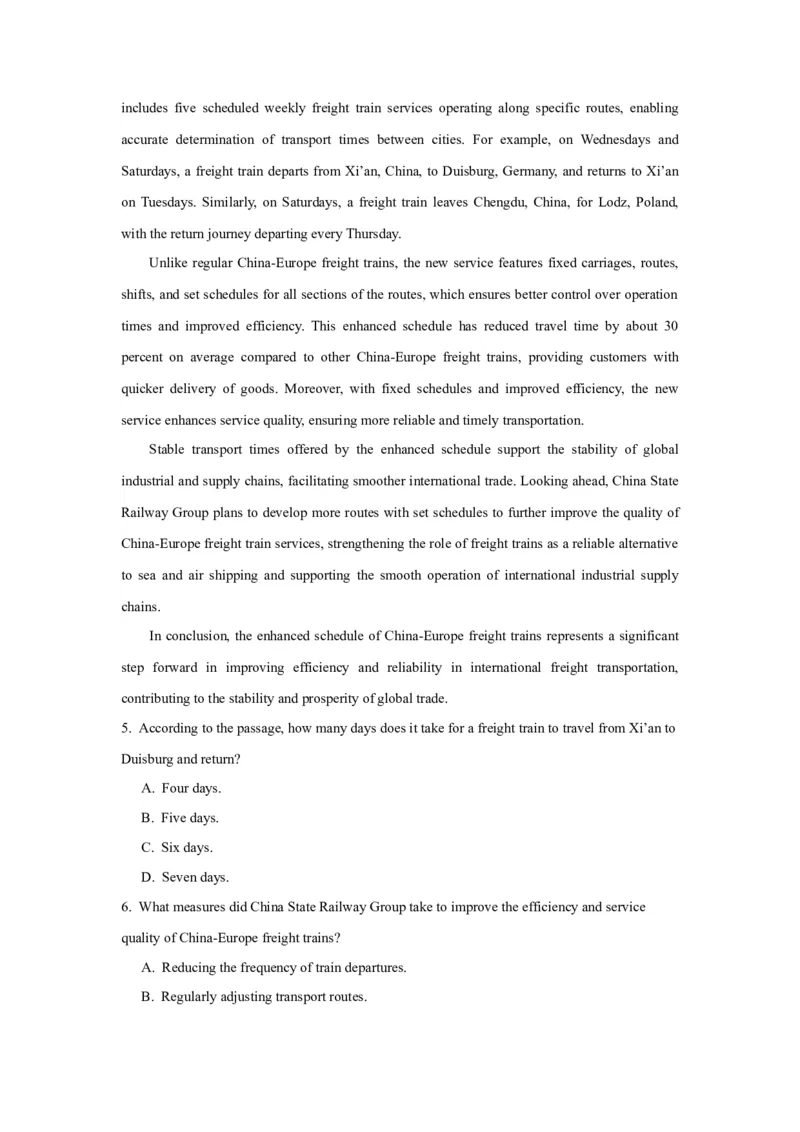
China State Railway Group has recently implemented a new schedule for freight train
services between China and Europe, with the aim of ensuring more stable transport times,
improving efficiency, and boosting trade between Asia and Europe. The enhanced scheduleincludes five scheduled weekly freight train services operating along specific routes, enabling
accurate determination of transport times between cities. For example, on Wednesdays and
Saturdays, a freight train departs from Xi’an, China, to Duisburg, Germany, and returns to Xi’an
on Tuesdays. Similarly, on Saturdays, a freight train leaves Chengdu, China, for Lodz, Poland,
with the return journey departing every Thursday.
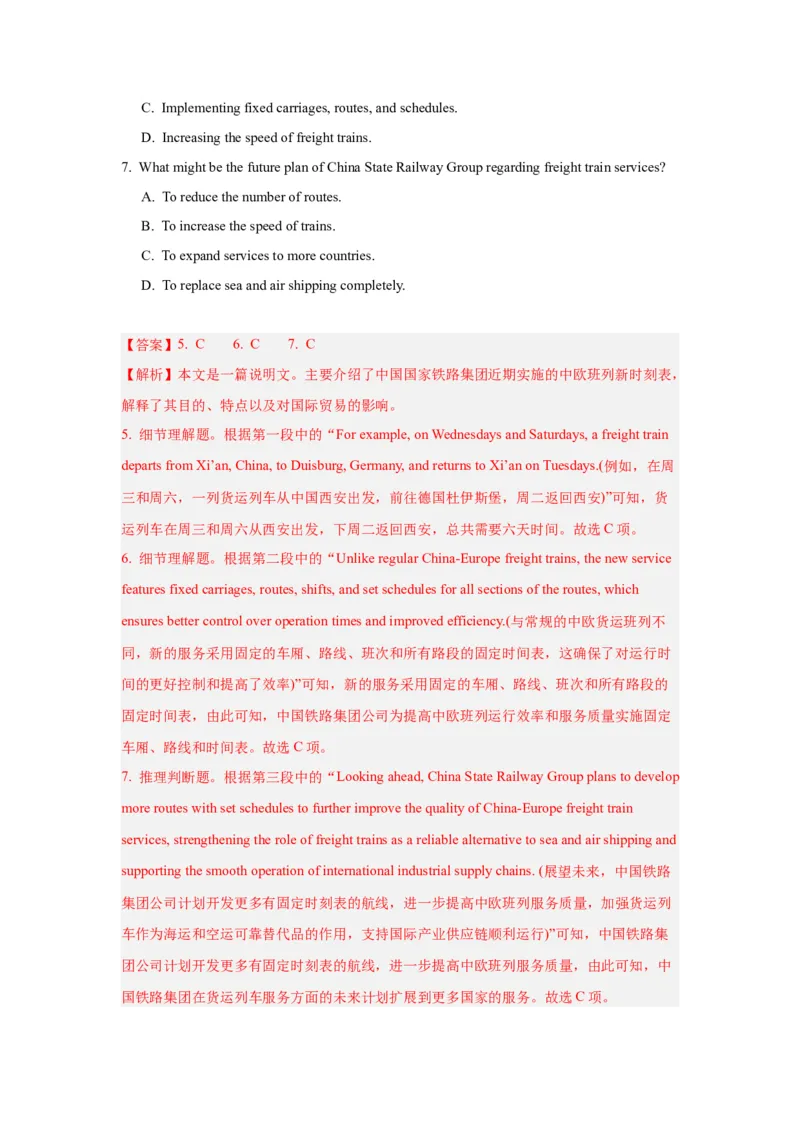
Unlike regular China-Europe freight trains, the new service features fixed carriages, routes,
shifts, and set schedules for all sections of the routes, which ensures better control over operation
times and improved efficiency. This enhanced schedule has reduced travel time by about 30
percent on average compared to other China-Europe freight trains, providing customers with
quicker delivery of goods. Moreover, with fixed schedules and improved efficiency, the new
service enhances service quality, ensuring more reliable and timely transportation.
Stable transport times offered by the enhanced schedule support the stability of global
industrial and supply chains, facilitating smoother international trade. Looking ahead, China State
Railway Group plans to develop more routes with set schedules to further improve the quality of
China-Europe freight train services, strengthening the role of freight trains as a reliable alternative
to sea and air shipping and supporting the smooth operation of international industrial supply
chains.
In conclusion, the enhanced schedule of China-Europe freight trains represents a significant
step forward in improving efficiency and reliability in international freight transportation,
contributing to the stability and prosperity of global trade.
5. According to the passage, how many days does it take for a freight train to travel from Xi’an to
Duisburg and return?
A. Four days.
B. Five days.
C. Six days.
D. Seven days.
6. What measures did China State Railway Group take to improve the efficiency and service
quality of China-Europe freight trains?
A. Reducing the frequency of train departures.
B. Regularly adjusting transport routes.C. Implementing fixed carriages, routes, and schedules.
D. Increasing the speed of freight trains.
7. What might be the future plan of China State Railway Group regarding freight train services?
A. To reduce the number of routes.
B. To increase the speed of trains.
C. To expand services to more countries.
D. To replace sea and air shipping completely.
【答案】5. C 6. C 7. C
【解析】本文是一篇说明文。主要介绍了中国国家铁路集团近期实施的中欧班列新时刻表,
解释了其目的、特点以及对国际贸易的影响。
5. 细节理解题。根据第一段中的“For example, on Wednesdays and Saturdays, a freight train
departs from Xi’an, China, to Duisburg, Germany, and returns to Xi’an on Tuesdays.(例如,在周
三和周六,一列货运列车从中国西安出发,前往德国杜伊斯堡,周二返回西安)”可知,货
运列车在周三和周六从西安出发,下周二返回西安,总共需要六天时间。故选C项。
6. 细节理解题。根据第二段中的“Unlike regular China-Europe freight trains, the new service
features fixed carriages, routes, shifts, and set schedules for all sections of the routes, which
ensures better control over operation times and improved efficiency.(与常规的中欧货运班列不
同,新的服务采用固定的车厢、路线、班次和所有路段的固定时间表,这确保了对运行时
间的更好控制和提高了效率)”可知,新的服务采用固定的车厢、路线、班次和所有路段的
固定时间表,由此可知,中国铁路集团公司为提高中欧班列运行效率和服务质量实施固定
车厢、路线和时间表。故选C项。
7. 推理判断题。根据第三段中的“Looking ahead, China State Railway Group plans to develop
more routes with set schedules to further improve the quality of China-Europe freight train
services, strengthening the role of freight trains as a reliable alternative to sea and air shipping and
supporting the smooth operation of international industrial supply chains. (展望未来,中国铁路
集团公司计划开发更多有固定时刻表的航线,进一步提高中欧班列服务质量,加强货运列
车作为海运和空运可靠替代品的作用,支持国际产业供应链顺利运行)”可知,中国铁路集
团公司计划开发更多有固定时刻表的航线,进一步提高中欧班列服务质量,由此可知,中
国铁路集团在货运列车服务方面的未来计划扩展到更多国家的服务。故选C项。3
The problem of food borne metal contamination (污染) has taken on new urgency, thanks in
part to a 2021 US Congressional Report detailing high levels of metals found in baby food pulled
off grocery shelves. More recently, high levels of lead (铅) were discovered in children’s fruit
puree pouches. Now, two new studies provide information on the correlation between exposure to
heavy metals in food and the risk of cancers and other serious health risks.
Food crops can absorb heavy metals from contaminated soil, air, and water. As a result, traces
of dangerous heavy metals — lead, arsenic (砷) and cadmium (镉) — are found in common foods
from rice and cereals to nuts and vegetables. Felicia Wu, Michigan State University food scientist,
is leading several investigations to gain a better understanding of the health risks of heavy metal
exposure.
In the studies, Wu and her colleague, gathered data on the dietary intake of each metal from
various sources such as food and water samples and existing studies and reports. There searchers
analysand the data to determine the strength of the association between dietary exposure and bad
health effects. Both cancer and non-cancer health effects were considered.
Lead is a poisonous metal commonly found in old paint, water pipes, and contaminated soil.
Food sources of lead include root vegetables like beets. In the study, lead showed moderate (中度
的) to high risk scores for causing lung, kidney, bladder, stomach, and brain cancers. It also
showed moderate to high scores for non-cancer risks.
Their initial estimates suggest that every year, more than 6, 000 additional cases of bladder
and lung cancers and over 7, 000 cases of skin cancers can be attributed ( 归因于) to the
consumption of inorganic arsenic in the United States. The researchers also found that certain food
products can be associated with higher cancer risk than others. These include rice, wheat, and
leafy green vegetables.
8. What do the new studies focus on?
A. Food safety and children’s health.
B. Food crops and metal contamination.
C. Heavy metals and its danger extent.
D. Metal contamination in food and health risks.
9. Why do heavy metals exist in food?A. Food crops need metal to grow well.
B. Heavy metals are added by producers.
C. They can help with scientific research.
D. Food crops grow up in polluted conditions.
10. How did Wu and her colleague conduct their studies?
A. By doing surveys online.
B. By analyzing data.
C. By performing experiments.
D. By referring to previous textbooks.
11. Which can best describe Wu’s findings?
A. Dramatic. B. Alarming.
C. Confusing. D. Awesome.
【答案】8. D 9. D 10. B 11. B
【解析】本文是一篇说明文。文章主要介绍了食物中重金属污染问题及其对健康造成的风
险,包括铅、砷和镉等金属在食物中的含量和其对健康的影响,并指出某些食物产品比其
他食物更容易导致癌症风险。
8. 细节理解题。根据第一段中“Now, two new studies provide information on the correlation
between exposure to heavy metals in food and the risk of cancers and other serious health risks.
(现在,两项新的研究提供了接触食物中的重金属与患癌症和其他严重健康风险之间关系的
信息)”可知,新研究关注的是食品中的金属污染与健康风险。故选D项。
9. 细节理解题。根据第二段中“Food crops can absorb heavy metals from contaminated soil,
air, and water.(粮食作物可以从受污染的土壤、空气和水中吸收重金属)”可知,食物中会存
在重金属是因为生长在受污染的环境中,并吸收了重金属。故选D项。
10. 细节理解题。根据第三段中“There searchers analysand the data to determine the strength
of the association between dietary exposure and bad health effects.(在那里,研究人员分析了数
据,以确定饮食暴露与不良健康影响之间的联系强度)”可知,吴和她的同事通过分析数据
的方式进行研究。故选B项。
11. 推理判断题。根据最后一段中“Their initial estimates suggest that every year, more than 6,
000 additional cases of bladder and lung cancers and over 7, 000 cases of skin cancers can be
attributed (归因于) to the consumption of inorganic arsenic in the United States. The researchersalso found that certain food products can be associated with higher cancer risk than others. These
include rice, wheat, and leafy green vegetables.(他们的初步估计表明,在美国,每年有6000
多例膀胱癌和肺癌病例以及7000多例皮肤癌病例可归因于无机砷的摄入。研究人员还发现,
某些食品可能比其他食品具有更高的癌症风险。这些蔬菜包括大米、小麦和绿叶蔬菜)”可
知,吴的研究发现重金属污染问题已经非常严重,所以其研究发现令人感到担忧。故选B
项。
4
If you walk around Huntington Beach, California, you may spot a woman holding five
leashes (绳套) with one hand and pulling a wagon (马车) with the other. A closer look will show
she has seven dogs with her—and none of them are walking on all four legs. Her name is Debbie
Pearl,and all of her dogs have disabilities and use wheelchairs or prosthetic limbs (义肢).
There is no doubt Pearl is a dog lover—she trains them for movies and said she has always
had “quite a few” of her own dogs at home. In 2005, she created a nonprofit called Dream
Fetchers, which helps rescue dogs from the streets. As part of the organization’s mission, members
of Pearl’s personal pack work as therapy(治疗)dogs.
About nine years ago,she adopted her first dog with a disability, Fast Eddie. He had a spinal
injury and was left on the street. Now, he runs around using a wheelchair.
“Eddie was definitely my inspiration for adopting other disabled dogs,” Pearl said. “He was
so full of life.He never let anything slow him down. I mean, he truly was unstoppable.” About
once a week, she gathers up her crew and takes them to hospitals, schools or the Easter Seals—a
nonprofit that helps adults with disabilities.
“I look for dogs that have been through traumatic (创伤的) events, but they have this
amazing gift of forgiveness,” Pearl said. “And that’s a powerful thing for a lot of people, because
they can see the courage, the resilience (韧性) that these dogs have. And all of mine have been
through the worst—and they’ve come out shining.”
She says all her dogs are here because they’ve gotten a second chance at life. And for other
survivors of abuse, or those with disabilities, that can be a powerful thing to see.
12. What can we know about the seven dogs?
A. They walk on all their four legs.
B. They are physically challenged.C. They are famous in many movies.
D. They are trained to help each other.
13. What does Dream Fetchers do?
A. Save homeless dogs.
B. Train therapy dogs.
C. Provide leashes for dogs.
D. Offer treatment to adults.
14. What contributed to Pearl’s adopting more disabled dogs?
A. Her love of dogs.
B. The needs of a nonprofit.
C. Her wish to rescue dogs.
D. Eddie’s unstoppable spirit.
15. What do Pearl’s dogs show to those receiving therapy?
A. Love and help connecting each other.
B. Power and reliance seen in everyday life.
C. Strength and courage facing sufferings.
D. Approaches and wisdom dealing with trouble.
【答案】12. B 13. A 14. D 15. C
【解析】本文是一篇记叙文。Debbie Pearl收养了7只遭受虐待的残疾狗。现在,它们正在
帮助激励其他人。
12. 细节理解题。根据第一段“A closer look will show she has seven dogs with her—and none
of them are walking on all four legs. Her name is Debbie Pearl,and all of her dogs have disabilities
and use wheelchairs or prosthetic limbs (义肢).( 仔细一看,会发现她身边有7只狗,而且没
有一只是四条腿走路的。她的名字叫黛比·珀尔,她所有的狗都有残疾,使用轮椅或假肢)”
可知,这些狗身体上有问题。故选B。
13. 细节理解题。根据文章第二段“In 2005, she created a nonprofit called Dream Fetchers,
which helps rescue dogs from the streets.( 2005年,她创建了一个名为Dream Fetchers的非营
利组织,帮助救助流浪狗。)”可知,Dream Fetchers这个组织是帮助救助流浪狗的。故选
A。
14. 推理判断题。根据第四段的““Eddie was definitely my inspiration for adopting otherdisabled dogs,” Pearl said. “He was so full of life.He never let anything slow him down. I mean,
he truly was unstoppable.”(“埃迪绝对是我收养其他残疾狗的灵感来源,”珀尔说。“他是如
此充满活力。他从不让任何事情拖慢他的脚步。我的意思是,他真的是不可阻挡的。”)”
可知,促使Pearl收养其他残疾狗的是Eddie的不可阻挡的精神。故选D。
15. 推理判断题。根据第六段的“And that’s a powerful thing for a lot of people, because they
can see the courage, the resilience (韧性) that these dogs have.( 这对很多人来说是一件很强大
的事情,因为他们可以看到这些狗所拥有的勇气和韧性。)”以及最后一段中“And for other
survivors of abuse, or those with disabilities, that can be a powerful thing to see.( 对于其他遭受
虐待的幸存者或残疾人士来说,这可能是一件令人震惊的事情。)”可知,这些狗向那些接
受治疗的人们展示了面对艰难时的力量和勇气。故选C。
5
While scientists have many ideas, there is no single explanation for why humans yawn. Still,
there is one thing experts know about yawns — they seem to be infectious! Have you ever caught
a yawn from someone else? Most people have. According to one previous study, a person is six
times more likely to yawn after seeing someone else do so. Experts have done many studies into
why yawns seem to pass from person to person. As a result, experts have a few theories for the
reason behind it.
One possible explanation has to do with something called social mirroring. This is caused by
mirror neurons in the brain. These cells help the brain notice useful behavior of others and then
copy it. When one person sees another person yawning, his mirror neurons observe the action and
interpret it as beneficial behavior. That may cause him to yawn, too.
Another popular theory is that yawns are infectious thanks to social relationships. Humans
are undoubtedly social creatures. They form friendships, start families, and live together in groups.
That’s why many people mirror others, such as smiling when another person does so. Yawning
maybe just another example of this. In fact, research has shown that people are most likely to
catch a case of the yawns from another person if the two share a social relationship.
The answer could even be that yawns aren’t truly infectious at all. Instead, people may yawn
when they’re together simply because they’re in the same environment. Experts say many things
may cause yawning — including temperature and time. Possible causes may be experienced by
anyone in the same general area. Whatever the explanation is, experts do know that infectiousyawns aren’t limited to humans. One study found that lions in South Africa also caught each
other’s yawns.
16. What kind of behavior may be copied by the mirror neurons?
A. Unimportant but attractive. B. Useful and beneficial.
C. Hard to understand. D. Easy to copy.
17. Whose yawns are people most likely to copy according to paragraph 3?
A. The ones who yawn a lot. B. The ones who are friendly to them.
C. The ones closely connected with them. D. The ones sharing the same interest with
them.
18. What might the author continue talking about in the following paragraph?
A. Some tips on yawning in public. B. A real explanation for infectious yawning.
C. Other examples of animals yawning together. D. Further studies of infectious yawning in
humans.
19. What is the text mainly about?
A. Why yawns are infectious. B. What causes people to yawn.
C. Who yawns more than others. D. Whether yawns are infectious.
【答案】16. B 17. C 18. C 19. A
【解析】这是一篇说明文。文章主要解释了关于打哈欠会传染提出的一些理论,以及打哈
欠最容易传染的对象等。
16. 细节理解题。根据第二段“One possible explanation has to do with something called social
mirroring. This is caused by mirror neurons in the brain. These cells help the brain notice useful
behavior of others and then copy it. When one person sees another person yawning, his mirror
neurons observe the action and interpret it as beneficial behavior.(一种可能的解释与社会镜像有
关。这是由大脑中的镜像神经元引起的。这些细胞帮助大脑注意到其他人的有用行为,然
后复制它。当一个人看到另一个人打哈欠时,他的镜像神经元会观察到这个动作,并将其
解释为有益的行为)”可知,有用的和有益的行为可以被镜像神经元复制。故选B。
17. 细节理解题。根据第三段“Another popular theory is that yawns are infectious thanks to
social relationships. Humans are undoubtedly social creatures. They form friendships, start
families, and live together in groups. That’s why many people mirror others, such as smiling when
another person does so. Yawning maybe just another example of this. In fact, research has shownthat people are most likely to catch a case of the yawns from another person if the two share a
social relationship.(另一种流行的理论是,打哈欠是有传染性的,这要归功于社会关系。人
类无疑是社会动物。他们建立友谊,组建家庭,集体生活在一起。这就是为什么很多人会
模仿别人,比如当别人笑的时候也会笑。打哈欠可能是另一个例子。事实上,研究表明,
如果两个人有共同的社会关系,人们更有可能从另一个人那里感染打哈欠)”可知,人们最
有可能模仿与他们密切相关的人的哈欠。故选C。
18. 推理判断题。根据最后一段“Whatever the explanation is, experts do know that infectious
yawns aren’t limited to humans. One study found that lions in South Africa also caught each
other’s yawns.(无论解释是什么,专家们都知道传染性哈欠并不局限于人类。一项研究发现,
南非的狮子也能捕捉到彼此的哈欠)”可推知,在接下来的段落中,作者可能会继续谈论其
他动物一起打哈欠的例子。故选C。
19. 主旨大意题。根据第一段“While scientists have many ideas, there is no single explanation
for why humans yawn. Still, there is one thing experts know about yawns—they seem to be
infectious! (虽然科学家们有很多想法,但对于人类打哈欠的原因却没有一个统一的解释。
尽管如此,专家们还是知道一件关于打哈欠的事——打哈欠似乎是会传染的!)”结合文章
主要解释了关于打哈欠会传染提出的一些理论,以及打哈欠最容易传染的对象等。可知,
这篇文章的主要内容是为什么打哈欠会传染。故选A。
6
In March 2018, at a high school in New York, Dylan Belscher found an old dollar on the
floor during an English class. Rather than keeping it, he turned it in to his teacher, Katie Mattison.
Mattison, surprised by his honesty, suggested taping it to the whiteboard at the front of the
classroom, where she always puts lost things. Maybe the dollar was lunch money or bus fare for
the student who dropped it.
Neither the teacher nor her student thought twice about the dollar. Hunter Rose, then a senior,
spotted the dollar on the whiteboard. “There is a mystery to it,” Rose said. After class, he asked
Mattison why it was there. She was still waiting for the original owner to claim it, so she replied,
“I don’t know.” Rose took the tape from Mattison’s desk and taped a second dollar to the board.
That got it rolling. The sight of the two dollar bills, side by side, stimulated something in
Mattison’s students.
Mattison, recognizing a phenomenon in the making, wrote students’ initials on each bill, andshe started to leave the tape on the tray of the whiteboard. The effort snowballed. Even with no
specific purpose, many students wanted to be part of whatever this was. Jake Braniecki, another
senior, said everyone understood that the eventual plan for the dollars would be for “something
good” and that their teacher “wasn’t going to do anything stupid with the money”. The students,
among themselves, decided Mattison had some unspoken goal. They figured bigger donations
could only help them get there faster.
Over weeks, donations reached $175.76. The original owner of the lost dollar never came
forward, leaving Mattison to decide the best solution.
Mattison shared the story of her godfather, Jack, who died of ALS eight years prior, and his
sister, Jean, who had the same disease three years later. Jack had been married to Mattison’s sister,
Terry Stephan Hains, who raises money for the ALS Therapy Development Institute each spring.
Mattison asked her students if she could donate the collected dollars in honor of Jack, and they
responded by taping more money to the board. The students’ contributions increased the total to
$321.06. Mattison, moved by their generosity, carefully took the cash off the board and made the
donation just before National ALS Awareness Month in May.
20. What encouraged the students to start taping dollar bills to the whiteboard?
A. The teacher announced a cash reward to the students.
B. The students wanted to buy something for the classroom.
C. The sight of two dollars side by side attracted them.
D. The school organized a fund-raising event among seniors.
21. Why did Mattison write students’ initials on the dollars?
A. To award bonus points to students based on their initials.
B. To keep track of the amount donated by each student.
C. As part of a secret message for a class room game.
D. To identify the original owner of the lost old dollar.
22. What was the purpose behind taping money to the whiteboard according to the students?
A. To fund a school trip for the class.
B. To figure out the mysterious goal of the teacher.
C. To purchase new supplies for the classroom.
D. It was a school-wide initiative for charity.
23. Which is the best title of the passage?A. Katie Mattison’s Heartfelt Donation to ALS Awareness
B. Dylan Belscher’s Honesty: A Dollar’s Unexpected Journey
C. Students’ Generosity Unfolds: From a Lost Dollar to a Meaningful ALS Donation
D. Classroom Activities: Loosening the Classroom Dollar Mystery
【答案】20. C 21. B 22. B 23. C
【解析】这是一篇记叙文。文章主要记叙了一个学生一次将捡到的钱贴在教室白板上的无
心的行为,引发了学生们为肌萎缩性脊髓侧索硬化症治疗发展研究所筹集资金,最终将金
额累计到了321.06美元的故事。
20. 推理判断题。根据第二段“Neither the teacher nor her student thought twice about the
dollar. Hunter Rose, then a senior, spotted the dollar on the whiteboard. “There is a mystery to it,”
Rose said. After class, he asked Mattison why it was there. She was still waiting for the original
owner to claim it, so she replied, “I don’t know.” Rose took the tape from Mattison’s desk and
taped a second dollar to the board. That got it rolling. The sight of the two dollar bills, side by
side, stimulated something in Mattison’s students. (老师和她的学生都没有多想那美元。当时大
四的亨特·罗斯看到了白板上的美元。“这是一个谜,”罗斯说。下课后,他问马蒂森为什
么会在那里。她还在等原主人认领,所以她回答说:“我不知道。”罗斯从马蒂森的桌子
上拿起胶带,又在板子上粘了一美元。这就开始了。看到两张一美元的钞票并排在一起,
马蒂森的学生心中产生了某种刺激。)”可知,学生们开始把美钞贴在白板上是因为并排的
两美元吸引了他们。故选C。
21. 细节理解题。根据第三段“Mattison, recognizing a phenomenon in the making, wrote
students’ initials on each bill, and she started to leave the tape on the tray of the whiteboard. (马蒂
森意识到这种现象正在形成,于是在每张钞票上写上学生名字的首字母缩写,然后开始把
胶带放在白板的托盘上。)”可知,马蒂森在美元上写上学生名字的首字母是为了记录每个
学生的捐款数额。故选B。
22. 细节理解题。根据第三段“The students, among themselves, decided Mattison had some
unspoken goal. They figured bigger donations could only help them get there faster. (学生们都认
为马蒂森有什么不可告人的目的。他们认为,更多的捐款只能帮助他们更快地实现这一目
标。)”可知,学生们说把钱贴在白板上的目的是弄清老师神秘的目的。故选B。
23. 主旨大意题。根据最后一段“Mattison asked her students if she could donate the collecteddollars in honor of Jack, and they responded by taping more money to the board. The students’
contributions increased the total to $321.06. Mattison, moved by their generosity, carefully took
the cash off the board and made the donation just before National ALS Awareness Month in May.
(马蒂森问她的学生,她是否可以把收集到的钱捐给杰克,他们的回应是给董事会更多的钱。
学生们的捐款总额增加到321.06美元。马蒂森被他们的慷慨感动了,他小心翼翼地从黑板
上取下现金,在5月份全国ALS宣传月之前捐款。)”结合文章主要记叙了一个学生一次将
捡到的钱贴在教室白板上的无心的行为,引发了学生们为肌萎缩性脊髓侧索硬化症治疗发
展研究所筹集资金,最终将金额累计到了321.06美元的故事。故选项C“学生的慷慨:从一
美元到有意义的ALS捐赠”最符合文章标题。故选C。
6
“Given that signs of Alzheimer’s disease (老年痴呆症) start to accumulate in the brain
several decades before the disease begins, understanding the connection between sleep and
cognition (认知) earlier in life is critical for understanding the role of sleep problems as a risk
factor for the disease,” said study author Yue Leng, PhD, of the University of California, San
Francisco.
The study involved 526 people with an average age of 40. They were followed for 11 years.
Researchers looked at participants’ sleep duration and quality. Participants wore a wrist activity
monitor for three continuous days on two occasions approximately one year apart to calculate their
averages. Participants slept for an average of six hours. Participants also reported bedtime and
wake-up time in a sleep diary and completed a sleep quality survey with scores ranging from 0 to
21. A total of 239 people reported poor sleep with a score greater than five.
Researchers also looked at sleep fragmentation (碎片化), a measure of restlessness during
the sleep period expressed as a percentage. The higher the value, the more sleep is interrupted.
Participants were divided into three groups based on their sleep fragmentation score. Of the 175
people with the most interrupted sleep, 44 had poor cognitive performance 10 years later,
compared to 10 of the 176 people with the least interrupted sleep.
After adjusting for age, sex, race, and education, people who had the most interrupted sleep
had more than twice the possibility of having poor cognitive performance when compared to those
with the least interrupted sleep. There was no difference in cognitive performance at midlife for
those in the middle group compared to the group with the least interrupted sleep.However, due to the small sample size, the researchers were unable to fully investigate
potential race or sex differences. “More research is needed to assess the link between sleep
disturbances and cognition at different life stages and to identify if critical life periods exist when
sleep is more strongly associated with cognition,” Leng said.
24. What do we know about Yue Leng’s study?
A. Data collection was an easy process. B. It aimed to find a cure for Alzheimer’s.
C. The results were far from satisfactory. D. Higher scores mean poorer sleep quality.
25. What can we learn about sleep fragmentation in the study?
A. It did require outside intervention. B. It included a series of memory tests.
C. It measured short interruptions of sleep. D. It determined those participants’ groups.
26. What do the findings indicate according to the text?
A. The quality of sleep may affect cognitive health.
B. Keeping a sleep diary can improve one’s sleep quality.
C. People sleeping well won’t suffer from Alzheimer’s disease.
D. People with interrupted sleep won’t have memory problems.
27. What is the last paragraph mainly about?
A. The major limitation of the study.
B. An explanation of the research method.
C. A possible reason for the study findings.
D. The use of careful investigations in real life.
【答案】24. D 25. C 26. A 27. A
【解析】本文是一篇说明文。文章主要介绍了加州大学的一项研究及其结论:早在中年时
期,人的睡眠时长和质量就与认知表现相关。研究人员们还研究了睡眠碎片化和认知表现
之间的关系。
24. 细节理解题。根据第二段中的“A total of 239 people reported poor sleep with a score
greater than five.(共有239人报告睡眠质量不佳,得分超过5分。)”可知,共有239人报告
说他们睡眠不佳,他们的得分超过5分。由此可知,在Yue Leng的研究中,分值越高,睡
眠质量越不好。故选D。
25. 推理判断题。根据第三段中的“Researchers also looked at sleep fragmentation, a measure
of restlessness during the sleep period expressed as a percentage. The higher the value, the moresleep is interrupted.(研究人员还研究了睡眠碎片化,这是一种以百分比表示的睡眠期间不安
的衡量标准。值越高,睡眠中断的次数就越多。)”可知,睡眠碎片化是一种用百分比表示
的睡眠期间频繁唤醒状态的一种量度。数值越高,睡眠中断越多。也就是说睡眠碎片化可
以测量睡眠中的短暂中断。故选C。
26. 细节理解题。根据第四段中的“After adjusting for age, sex, race, and education, people
who had the most interrupted sleep had more than twice the possibility of having poor cognitive
performance when compared to those with the least interrupted sleep.(在调整了年龄、性别、种
族和教育程度后,睡眠中断次数最多的人认知能力较差的可能性是睡眠中断次数最少的人
的两倍多)”可知,在对年龄、性别、种族和受教育程度进行调整后,睡眠中断最严重的人
与睡眠中断最少的人相比,认知表现不佳的概率是后者的两倍多。也就是睡眠质量可能会
影响人的认知健康。故选A。
27. 主旨大意题。根据最后一段中的“However, due to the small sample size, the researchers
were unable to fully investigate potential race or sex differences.(然而,由于样本量较小,研究
人员无法充分调查潜在的种族或性别差异。)”和Leng所说的话“‘More research is needed
to assess the link between sleep disturbances and cognition at different life stages…’(“需要更多
的研究来评估睡眠障碍与不同生命阶段认知之间的联系……”)”可知,由于研究的样本量
小,研究人员不能充分地调查潜在的种族或者性别差异。同时,也需要更多的研究来评估
不同的人生阶段中睡眠障碍和认知能力之间的关系。由此可推断出,最后一段主要介绍了
这项研究的局限性。故选A。
7
“Will you go on this ride with me? ”my friend’s eleven-year-old daughter Jenny asked. I
could have made up an excuse for not wanting to have a go. But earlier that morning, I was ready
to push myself out of my comfort zone. Jenny stared at the ride, eager to experience the same
excitement as the brave group of riders in front of us. I couldn’t say no.
After climbing into our seats, an attendant reached up, pulled down the bar, and locked it in
place. The ride lifted us slowly, then turned us over like the blueberry pancakes I had eaten three
hours earlier, and hoped to keep in their proper place. As I stared at the concrete directly below us,
I had a sudden feeling of great fear. I wondered if I had replacement coverage for the phone that I
was sure would slip out of my pocket and break into a million tiny pieces. I wondered when my
new health insurance would kick in.The ride touched down after twisting and turning our bodies. My friend was waiting for us at
the exit. “How was it?” she asked. “Fine. No big deal,” I said, even though my head was
spinning(旋转)like one of the other annoying machines dotting the midway.
Jenny walked ahead of us and convinced me to keep taking chances and sample more rides.
“Oh, look at the pirate ship(海盗船)!” she said. “That looks like a calm ride.”
“Let’s go, Auntie!” she said as she rushed to join others in line.
I followed her, confident the ride would be uneventful. When I reached the bottom, I tapped
out like a WWF wrestler admitting defeat. Although my body was shaking and my head was still
spinning, I felt exhilarated just like I was on cloud nine. That morning, I had set a goal, taken my
first step to reach it, and felt the joy of achievement.
Each time you try something for the first time, you will grow—a little piece of the fear of the
unknown is removed and replaced with a sense of satisfaction.
28. What made the author decide to try riding with Jenny?
A. The desired look in Jenny’s eyes. B. The curiosity about the unknown.
C. The encouragement from other riders. D. The eagerness to experience something
exciting.
29. What happened to the author when she was in the high sky?
A. She lost her phone. B. She got into a panic.
C. She was served pancakes. D. She almost fell off the seat.
30. What does the underlined word “exhilarated” in paragraph 7 mean?
A. Occupied. B. Excited. C. Confused. D. Disappointed.
31. What message does the story convey?
A. He who hesitates is lost. B. It’s never too late to learn.
C. One’s potential can’t always be underrated. D. It’s worthwhile to get out of your
comfort zone.
【答案】28. A 29. B 30. B 31. D
【解析】本文是一篇记叙文。文章主要讲述了作者与朋友的女儿一起体验刺激的游乐设施
的经历让作者意识到对未知事物的尝试会让自己成长并带来前所未有的满足感。人要勇于
走出自己的舒适圈, 才能迎来更好的自己。
28. 细节理解题。根据第一段“Jenny stared at the ride, eager to experience the sameexcitement as the brave group of riders in front of us. I couldn’t say no.(珍妮盯着过山车,渴望
体验和我们前面那群勇敢的骑手一样的兴奋。我无法拒绝)”可知,Jenny渴望的眼神让作者
无法拒绝,最后决定试一试。故选A。
29. 细节理解题。根据第二段“As I stared at the concrete directly below us, I had a sudden
feeling of great fear.(当我盯着我们正下方的水泥地时,我突然感到非常害怕)”可知,当作者
盯着她们正下方的水泥地时,她突然感到一种极大的恐惧,即她陷入了恐慌。故选B。
30. 词义猜测题。根据画线词上文“Although my body was shaking and my head was still
spinning”中Although表示转折,结合画线词后的“just like I was on cloud nine”可知,画线
词所在句指的是“虽然我的身体还在颤抖,头还在旋转,但我感觉很兴奋,就像在九霄云
外一样。”由此可知,画线词意为“兴奋的”。故选B。