专题 05 隐含推理判断题
知考法明考向:
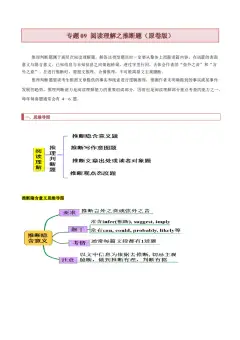
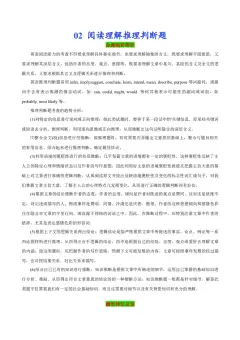
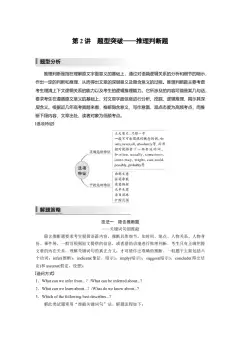
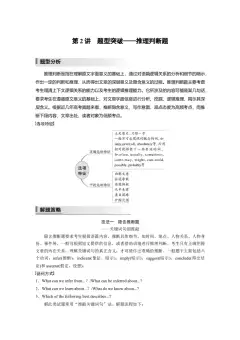
该题型要求考生根据文章的某个句子、段落或全文所提供的信息进行逻辑推理,推断出作:有明说的内容或可
能发生的事情。旨在考查考生透过词语的字面意义进行分析、挖掘、逻辑推理,揭示其深层义,进而去理解作
者的言外之意。题干中常出现“infer,imply,conclude,indicate, suggest, learn from”等词或短评或者含
有表示推测意义的词或短语,如probably,most likely等。
做真题 悟技法
(2023·全国甲卷 D篇)
Grizzly bears, which may grow to about 2.5 m long and weigh over 400 kg, occupy a conflicted corner of the
American psyche — we revere (敬畏) them even as they give us frightening dreams. Ask the tourists from around
the world that flood into Yellowstone National Park what they most hope to see, and their answer is often the same:
a grizzly bear.
“Grizzly bears are re-occupying large areas of their former range,” says bear biologist Chris Servheen. As
grizzly bears expand their range into places where they haven’t been seen in a century or more, they’re increasingly
being sighted by humans.
The western half of the US was full of grizzlies when Europeans came, with a rough number of 50,000 or
more living alongside Native Americans. By the early 1970s, after centuries of cruel and continuous hunting by
settlers, 600 to 800 grizzlies remained on a mere 2 percent of their former range in the Northern Rockies. In 1975,
grizzlies were listed under the Endangered Species Act.
Today, there are about 2,000 or more grizzly bears in the US. Their recovery has been so successful that the
US Fish and Wildlife Service has twice attempted to delist grizzlies, which would loosen legal protections and
allow them to be hunted. Both efforts were overturned due to lawsuits from conservation groups. For now, grizzlies
remain listed.
Obviously, if precautions (预防) aren’t taken, grizzlies can become troublesome, sometimes killing farm
animals or walking through yards in search of food. If people remove food and attractants from their yards and
campsites, grizzlies will typically pass by without trouble. Putting electric fencing around chicken houses and other
farm animal quarters is also highly effective at getting grizzlies away. “Our hope is to have a clean, attractant-free
place where bears can pass through without learning bad habits,” says James Jonkel, longtime biologist whomanages bears in and around Missoula.
1.How do Americans look at grizzlies?
A.They cause mixed feelings in people.
B.They should be kept in national parks.
C.They are of high scientific value.
D.They are a symbol of American culture.
2.What has helped the increase of the grizzly population?
A.The European settlers’ behavior.
B.The expansion of bears’ range.
C.The protection by law since 1975.
D.The support of Native Americans.
3.What has stopped the U. S. Fish and Wildlife Service from delisting grizzlies?
A.The opposition of conservation groups.
B.The successful comeback of grizzlies.
C.The voice of the biologists.
D.The local farmers’ advocates.
4.What can be inferred from the last paragraph?
A.Food should be provided for grizzlies.
B.People can live in harmony with grizzlies.
C.A special path should be built for grizzlies.
D.Technology can be introduced to protect grizzlies.
技法点拨 1. 逻辑推理法
揣摩推敲隐含细节
1. 锁定题干中的infer,suggest,imply,conclude等词,明确答题方向
2. 浏览四个选项,排除对原文信息简单重复的选项
3. 注意文章中的情态动词和虚拟语气,往往据此可推断出作者的弦外之音
4. 根据原文信息进行合乎逻辑的推断,切忌掺杂自己的观点态度
练模拟 提能力
Passage 1(2024·广东·一模)We learn about the world through the knowledge accumulated over thousands of years.
standing on the shoulders of great men, we don’t have to experience endless trial and error, just as the wheels do
not have to be reinvented each time to run a car. But where does our ability to learn from others come from?
A study led by Markus Paulus, professor at Loyola Marymount University, shows that the ability has its roots
in earliest childhood. “It’s generally assumed that children’s ability to imitate (模仿) is inborn, but according to our
observation, children imitate because they themselves are imitated by caregivers. This interaction enables a cultural
transfer of knowledge, which, through generations’ efforts, consequently leads to the development of human
beings,” says Markus Paulus.
In this research, Paulus recorded the interaction between mother and child over several months. The babies
came into the lab for the first time at the age of6 months , while their final visit was when they were18 months old.
As they engaged in various play situations , the interactions and imitations of mother and child were analyzed. The
long-term study showed that the more sensitive a mother was in her interactions with her six- month-old child and
the more often she imitated the baby, the greater the child’s overall ability was at the age of18 months.
Paulus’ research shows that mutual imitation is the keystone of knowledge transfer , through which children
successfully learn various skills, such as how to use objects , waving and acquisition of language. “This interaction
is the nucleus of learning and, finally, gives rise to evolutionary success of human,” says Paulus.
“Cultural learning is an essential part of human evolution, and it is rooted in the imitation of others,
particularly our caregivers during our earliest childhood,” says Paulus. “Through this, we learn from each other and
pass on knowledge to the next generation, so certain actions or techniques do not have to be constantly invented
again. ”
1.Why does the author mention the example of wheels?
A.To praise the invention of car wheels. B.To describe the process of trial and error.
C.To emphasize the necessity of new tools. D.To show the importance of prior knowledge.
2.What can we learn about Paulus’ research?
A.Children’s imitation was recorded by mothers.
B.Sensitive mothers encouraged children’s imitation.
C.Children’s ability was analyzed through interaction.
D.Effective interaction promoted children’s development.
3.What does the underlined word “nucleus” mean in paragraph 4?
A.Core. B.Result. C.Aim. D.Content.4.Which of the following can be the best title for the text?
A.Why does Evolution Matter? B.How to Interact with Children?
C.Imitation: The Engine of Evolution D.Cultural Learning: The Root of Imitation
Passage 2
(2024·江苏宿迁·一模)Countless stories have portrayed the deep connection between humans and horses,
such as classic literary works Black Beauty and The Chronicles of Narnia. However, the extent to which horses
comprehend their human companions remains a mystery. Recent research has shown that horses can distinguish
between human expressions of happiness and sadness conveyed through facial movements or vocal tones.
The researchers brought 28 horses into a room one by one, each wearing heart rate monitors as their actions
were recorded. The horse faced two screens playing two different videos: one showed a happy person and the other
a sad person. A voice was played at the same time, sounding happy or sad.
When the picture and voice didn’t match—for example, if the voice was sad but the picture showed a happy
person—the horse seemed puzzled and looked for a longer time, compared to the one that did match, as if it knew
something didn’t make sense. “You could imagine that they have a particular box in their mind labeled ‘human
sadness’ containing the characteristics of both a sad face and a sad voice, and that when we are sad, they expect
what we say to match how we look,” said Doctoral Researcher Océane Liehrmann of the University of Turku, in
Finland.
The researchers also saw that horses were more attentive to the screen displaying the happy face. They looked
at it more often and for a longer time and their heart rates increased when they heard a happy voice and decreased
when they heard a sad voice as well.
It is possible that the horses might have associated happy human expressions with positive memories from
their past. Another theory is that seeing a happy person could actually make a horse feel happier—a process known
as emotional contagion. “We don’t know whether horses themselves understand what it is to be sad. It is possible
that they learn it means something for a human,” said Liehrmann.
5.How did the researchers carry out the experiment?
A.By comparing different horses’ expressions.
B.By monitoring horses’ odd behavior in the lab.
C.By summarizing the characteristics of the horses.
D.By observing horses’ reaction to human emotions.
6.What can we learn from the result of the research?A.Horses had a preference for happy people. B.Horses were too nervous about the videos.
C.Horses recognized people’s identity quickly. D.Horses looked excited at a voice of sadness.
7.What does the underlined word “contagion” probably mean in the last paragraph?
A.Support. B.Influence. C.Outbreak. D.Control.
8.Which of the following is a suitable title for the text?
A.Humans Impact Horses Hugely B.Horses Dislike Sorrowful People
C.Humans and Horses Interact Closely D.Horses Know When You are Happy
Passage 3
(2024·福建泉州·三模)A new study on 26 chimpanzees (黑猩猩) from zoos around the world found that
chimpanzees can recognise family members and long lost friends even after decades of separation.
The participating chimpanzees were given juice while staring at a screen flashing side by side photos of other
chimps. One animal from each pair of photos had lived with the group for at least a year, while the other was a
stranger. An eye-tracking camera recorded where the participants were looking and for how long. Data showed their
eyes rested longer on familiar groupmates, suggesting “rich recognition of each other.”
There is also evidence that they became more intent when shown a picture of a chimpanzee with whom they’d
had more positive interactions, compared with conflicting relationships.
In the most impressive case, a 46-year-old chimpanzee named Louise repeatedly demonstrated “intense”
attention upon seeing photographs of her sister Loretta and nephew Erin, whom she hadn’t seen in more than 26
years. The team said Louise’s results represent the longest-lasting social memory documented in any non-human
animal to date.
“We tend to see ourselves as unique special creatures with incredible intellectual (智力的) capacities that are
very different from other animals on earth,” said Laura Simone Lewis, a postdoctoral fellow in Berkeley’s
psychology department and lead author of the study. “This study is showing us how similar we are to
chimpanzees.” She noted that the findings support the theory that long-term social memory in humans and modern
day chimps has come from “our last common ancestor that lived somewhere between 5 to 7 million years ago” who
also likely had long-term social memory.
Now that they have definitive evidence that these endangered species possess long-term social memories,
researchers have more questions, including whether chimpanzees miss the individuals they’re no longer with,
especially their friends and family. “Our study doesn’t determine they are doing this, but it raises questions about
the possibility that they may have the ability to do so,” Lewis said.1.What is paragraph 2 mainly about?
A.The nature of chimps. B.The method of the study.
C.The analysis of the recorded data. D.The layout of experimental equipment.
2.What does the underlined word “intent” in paragraph 3 mean?
A.Attentive. B.Doubtful. C.Hesitant. D.Emotional.
3.Why is the example of Louise in paragraph 4 mentioned?
A.To stress chimps are as intelligent as human beings.
B.To explain where chimps’ social memory comes from.
C.To better demonstrate the chimps’ memory length.
D.To further prove the existence of chimps’ social memory.
4.What will the research team most probably continue to explore?
A.Whether chimps feel strong emotions to their long lost friends.
B.How to strengthen chimps’ long-term social memories.
C.How chimps recognised their close contacts after long separation.
D.Why chimps possess the amazing social memories.
Passage 4
(2024·浙江杭州·模拟预测)Television has transformed politics in the United States by changing the way in
which information is spread, by altering political campaigns, and by changing citizen’s patterns of response to
politics. By giving citizens independent access to the candidates, television reduced the role of the political party in
the selection of the major party candidates. By centering politics on the person of the candidate, television
accelerated the citizen’s focus on character rather than issues.
Television has altered the forms of political communication as well. The messages on which most of us rely
are briefer than they once were. The stump speech, a political speech given by traveling politicians and lasting 1 to
2 hours, which was popular in the nineteenth-century, has given way to the 30-second advertisement and the 10
second “sound bite” in broadcast news. Increasingly the audience for speeches is not that standing in front of the
politician but rather the viewing audience who will hear and see a short video of the speech on the news.
In these simplified forms, much of what comprised the traditional political speech of earlier ages has been lost.
In 15 or 30 seconds, a speaker cannot establish the historical context that shaped the issue in question, cannot detail
the probable causes of the problem, and cannot examine alternative proposals to argue that one is preferable to
others. In short videos, politicians assert (断言) but do not argue.Because television is an intimate (亲密的) medium, speaking through it requires a changed political style that
is more conversational, personal, and visual than that of the old-style stump speech. Reliance on television means
that increasingly our political world contains memorable pictures rather than memorable words. Schools teach us to
analyze words and print. However, in a world in which politics is increasingly visual, informed citizenship requires
a new set of skills.
Recognizing the power of television’s pictures, politicians craft televisual, staged events designed to attract
media coverage. Much of the political activity we see on television news has been crafted by politicians, their
speechwriters, and their public relations advisers for televised consumption. Sound bites in news and answers to
questions in debates increasingly sound like advertisements.
13.What do we know about “stump speech” in paragraph 2?
A.It’s an event created by politicians to attract media attention.
B.It’s an interactive discussion between two politicians.
C.It’s a kind of political presentation typical of the nineteenth century.
D.It’s a style of speech common to televised political events.
14.It is suggested in paragraph 4 that ________.
A.politicians need to learn to become more personal
B.attractive politicians are favored by citizens
C.citizens tend to favor a politician who analyzed issues
D.citizens need to learn how to evaluate visual political images
15.What can we infer from the passage?
A.Political presentations today are more like advertisements than in the past.
B.Politicians today tend to be more familiar with the views of citizens than in the past.
C.Citizens today are less informed about a politician’s character than in the past.
D.Political speeches today focus more on details about issues than in the past.
16.What’s the best title for the passage?
A.Television: an Agent of Change in Politics B.Television: a Platform for Political Debate
C.Television: an Alternative to Stump Speech D.Television: a New Medium for Communication
Passage 5
(2024·浙江杭州·模拟预测)The Christmas Pig, J.K. Rowling’s first children’s novel since Harry Potter I,
is a feel-good book, full of surprises, which will delight adults and children alike, not only for the original story, but
also for the imaginative scenery, characters and objects that interact with the main characters.It tells the story of Jack and the love he feels for Dur Pig, a stuffed toy pig who has been with him since he
was a toddler. After losing him on Christmas Eve, Jack will embark on a great adventure to save Dur Pig with the
help of the Christmas Pig, a brand-new replacement for Dur Pig.
J.K. Rowling shows again, with this book, why she is considered one of the greatest storytellers of her time.
She distinguishes herself again in world building, and younger and older readers will be surprised, chapter after
chapter, by the original ideas that she introduces in this world that Jack and his friend visit. The world Rowling
creates is not complex but it does not underestimate children: it is a world with clear logistics that the protagonists
(主人翁) must follow, carefully crafted to serve the story and not its readers.
Those long time readers of J.K. Rowling’s works will find familiar passages and themes that they may want to
connect to the Harry Potter books. It is hard to tell if those references are there on purpose, but there may be some
satisfaction in thinking that Rowling must have noticed and enjoyed them privately while she was writing them.
Parents around the world may have a difficult time every night, once a chapter is finished and their children
must go to sleep. The Christmas Pig will keep readers turning pages with a great and imaginative story, filled with
cliffhangers at the end of most chapters that will leave kids asking for more. If some reviewers said that The
Ickabog lacked Harry Potter’s magic, they can rest assured that The Christmas Pig has all the magic that J.K.
Rowling can provide, and that’s more than enough.
17.Why is J.K. Rowling rated as one of the best storytellers of her time?
A.Her capacity in building characters. B.Her ability to design complicated plots.
C.Her tendency to write to children’s taste.D.Her creativity in world building.
18.What does the underlined word “cliffhangers” probably mean in Paragraph 5?
A.Imagination. B.Suspense. C.Magic. D.Challenge.
19.What can we infer from paragraph 4 and paragraph 5?
A.She intentionally included references to her previous works.
B.Parents have difficulty falling asleep after finishing a chapter.
C.Some reviewers found The Ickabog full of magic.
D.The Christmas Pig is a good illustration of J.K. Rowling’s magic.
20.What is the author’s attitude towards J.K. Rowling’s book “The Christmas Pig”?
A.Critical. B.Objective. C.Enthusiastic. D.Indifferent.