策略分析
专题03 推断题
推理判断题是高考阅读理解的核心题型,要求考生基于原文某一句或若干语句的表面文字信息,通过
同义改写或综合归纳完成一步推理得出答案。解题需严格依托原文依据,既不能脱离文本无据推断,也不
能超越表层信息进行多步推导。
该题型融合推理与判断双重能力,是考生失分率较高的题型之一,重点考查考生透过文字表象推测文
章隐含意义、进行逻辑分析,以及对细节信息、作者态度与写作意图作出准确判断的能力。从近年高考命
题趋势来看,推理判断题的考查占比持续上升,命题形式也从过去简单的 “对号入座” 式直接答题,转
向通过同义 / 反义词转换、长难句解析等方式考查语言理解能力,整体难度较以往明显提升。
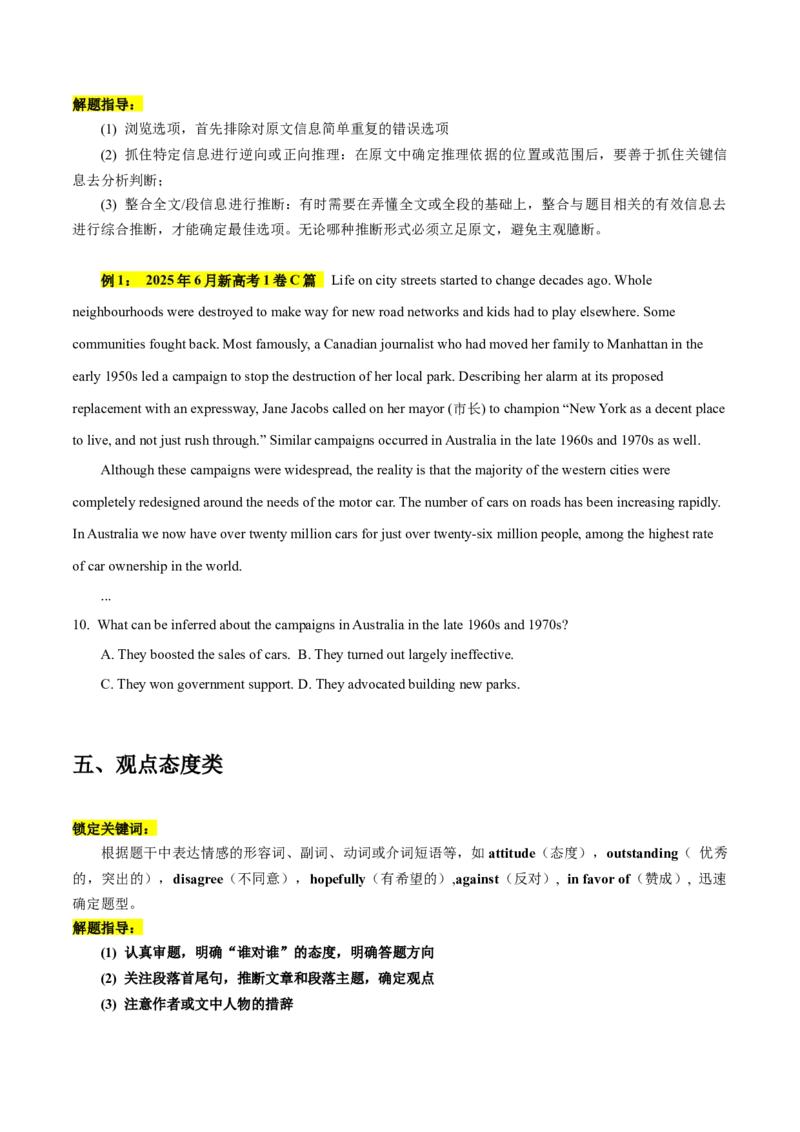
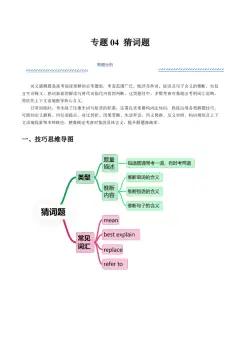
一、技巧思维导图
二、知识详解
知识点1 :推理判断题分类
1.高频考点:隐含意义、写作意图、观点态度。
2.低频考点:文章出处、文章结构、目标读者。
知识点2:推理判断题(客观)解题方法与技巧:
A.段落推理1
主:读段落找关键句(推理分析);辅:选项分析排除。
B.段落推理2
主:读段落抓段中心(中心挂钩);辅:选项分析排除。
C.文章推理1
主:中心挂钩法;辅:选项分析排除。
D.文章推理2
主:关键句分析;辅:选项分析排除。
知识点3:推理判断题注意事项
1.内容与原文一致,通常要淘汰。如果题目是推断题,而某个选项的内容却与原文相同,那么这是与推
断的含义相悖的,所以要淘汰。
2.推理的结论不要偏离文章的过远,一步推出的结论最理想。
3.不要脱离文章的主线,与文章的主基调相符的结论最可靠。无论哪种题型,无论考查的侧重点是主旨
还是推断,他们都不可能脱离文章的基调而存在。
4.客观,不要受自己主观意愿驱使。做推断题要始终以原文为依托,紧紧地围绕原文展开推理,围绕原
文来考虑对选项的取舍。
知识点4:错误原因总结
1. 主观臆断    2. 缺乏逻辑    3. 过度推理   4. 缺乏常识
三、选项特征
正确选项特征
解释
同义替换
对原文句子中的关键词进行替换,成为正确选项
正话反说
把原文中的意思反过来表达而成为正确选项。
    语言简化
把原文中复杂的语言现象进行简化,设置为答案。
词性或语态的变化
改变原文重点词性或语态,给考生制造了某些障碍。
干扰项特征
解释
曲解文意
即推测意义与文章表层意义有区别。推理判断题中有些选项来自文章中的
某一句或某几句话,命题者可能会利用里面的词设计出干扰项,看似表达
文章的意思,其实是借题发挥,是对原文意思的曲解。
张冠李戴
即把文章中作者的观点与其他人的观点混淆在一起。题干问的是作者的观
点,选项中出现的却是其他人的观点;题干问的是其他人的观点,选项中
却出现了作者的观点。
偷梁换柱
干扰项用了与文章中某一句话相似的句型结构和单词,却在考生易忽视的
地方换了几个单词,造成句意的改变。
无中生有
这种类型的干扰项往往是基本的生活常识或普遍认可的观点,但在文章中
并无相关的信息支撑点。其次,这种干扰项也有可能与设置的问题毫不相
干。
鱼目混珠
鱼目混珠类型的干扰项常出现在词句理解类试题的选项中,即利用某个词
或句子的字面含义代替其在文章特定语境中的具体含义。
扩缩范围
为了准确、严密地表达文章内容,命题者特别注意对文意范围的限
定,有时通过加上almost, all, nearly, more than, normally, usually 等词语对
文意加以限制。“扩缩范围”干扰法就是在选项中通过改变或去掉限制性
词语,将信息的范围、程度、感情色彩等改变,从而给考生解题造成干扰
的命题方法。
四、隐含推断类
锁定关键词:
根据题干关键词infer(推断),suggest(表明,暗示),conclude(得出结论), indicate(暗示,象
征), imply(暗示), assume(假定,设想)迅速确定题型
解题指导:
(1) 浏览选项,首先排除对原文信息简单重复的错误选项
(2) 抓住特定信息进行逆向或正向推理:在原文中确定推理依据的位置或范围后,要善于抓住关键信
息去分析判断;
(3) 整合全文/段信息进行推断:有时需要在弄懂全文或全段的基础上,整合与题目相关的有效信息去
进行综合推断,才能确定最佳选项。无论哪种推断形式必须立足原文,避免主观臆断。
例1: 2025 年6 月新高考1 卷C 篇  Life on city streets started to change decades ago. Whole
neighbourhoods were destroyed to make way for new road networks and kids had to play elsewhere. Some
communities fought back. Most famously, a Canadian journalist who had moved her family to Manhattan in the
early 1950s led a campaign to stop the destruction of her local park. Describing her alarm at its proposed
replacement with an expressway, Jane Jacobs called on her mayor (市长) to champion “New York as a decent place
to live, and not just rush through.” Similar campaigns occurred in Australia in the late 1960s and 1970s as well.
Although these campaigns were widespread, the reality is that the majority of the western cities were
completely redesigned around the needs of the motor car. The number of cars on roads has been increasing rapidly.
In Australia we now have over twenty million cars for just over twenty-six million people, among the highest rate
of car ownership in the world.
...
10. What can be inferred about the campaigns in Australia in the late 1960s and 1970s?
A. They boosted the sales of cars. B. They turned out largely ineffective.
C. They won government support. D. They advocated building new parks.
五、观点态度类
锁定关键词:
根据题干中表达情感的形容词、副词、动词或介词短语等,如attitude(态度),outstanding( 优秀
的,突出的),disagree(不同意),hopefully(有希望的),against(反对), in favor of(赞成), 迅速
确定题型。
解题指导:
(1) 认真审题,明确“谁对谁”的态度,明确答题方向
(2) 关注段落首尾句,推断文章和段落主题,确定观点
(3) 注意作者或文中人物的措辞
(4) 分析修饰语和字里行间所隐含的意思,切忌用自己观点代替作者或文中人物的观点;
(5) 牢记观点态度的常见词语
观点态度
例词
支持肯定
positive (积极的)、supportive (支持的)、optimistic (乐观的)
humorous(幽默的)、enthusiastic(热情的)、pleasant (愉快的);
中立
neutral (中立的)、objective(客观的)、not mentioned(未提及的)、
uninterested(不感兴趣的)、indifferent(漠不关心的);
否定反对
negative(否定的)、suspicious/skeptical(怀疑的)、disgusted(憎恶的)
critical(批评的)、disappointed(失望的)、disapproving(不赞成的)。
例2:高考真题
In a follow-up study with 100 university students the researchers tried to get a better sense of what the group
members actually did in their discussion. Did they tend to go with those most confident about their estimates? Did
they follow those least willing to change their minds? This happened some of the time, but it wasn’t the dominant
response. Most frequently, the groups reported that they “shared arguments and reasoned together.” Somehow,
these arguments and reasoning resulted in a global reduction in error. Although the studies led by Navajas have
limitations and many questions remain the potential implications for group discussion and decision-making are
enormous.
15. What is the author’s attitude toward Navajas’ studies?
A. Unclear.
B. Dismissive.
C. Doubtful.
D. Approving.
六、写作意图类
锁定关键词:
根据题干关键词purpose(目的),intend to(打算),want to tell us ...(想要告诉我们),write
this passage to(写这篇文章为了)迅速确定题型。
解题指导:
(1) 根据文章或段落主旨推断作者写作意图;
(2) 根据文体推断写作意图
记叙文:通常会在首段或尾段出现高度概括性语言,且往往有一定的哲理性,所有叙述都围绕该哲
理展开(to tell a story, to entertain readers, to share an experience...);
应用文:文章常对某事物或服务进行详细介绍,使用具有明显倾向性的语言(to sell, to attract, to
persuade, to promote...)
说明文:其写作意图依赖于对文章主题句的把握,应找准主题句(to introduce, to explain, to inform,
to make comparisons...);
议论文:一般开头提出某论点,中间进行论证,最后得出结论,写作意图常隐含于最后一部分中。
例3:2025 年6 月新高考2 卷C 篇
If you’re among the groups of people who are enjoying the mental and physical health benefits of surrounding
yourself with plants, don’t beat yourself up if one (or a few!) doesn’t make it. “Doctors practice medicine and
lawyers practice law and you should allow yourself the practice it takes to sustain a plant. Tending to plants is an
exercise in patience and learning. Be invested in taking care of it, but if it dies, go get another one,” Detrinidad
says.
10. What does Detrinidad try to explain by mentioning doctors and lawyers?
A. The necessity of social skills.
B. The meaning of sustainability.
C. The importance of repeated efforts.
D. The value of professional opinions.
七、文章出处或写作对象类
锁定关键词:
根据设题方式迅速确定题型:
This passage would be most likely to be found in         .
The passage is probably taken from         .
Where does this text probably come from?
Which section of a magazine is this passage probably taken from?
The text is intended for         .
解题指导:
(1) 根据文章的话题和细节确定文章出处或写作对象
(2) 根据文章的体裁和内容判断文章的中心话题
广告:语言简洁鲜明,有亮点;
报刊:时事性强,分不同板块,高考中常以政治、生活的话题为主;
杂志:覆盖生活各个层面,更贴近幕后,更贴近生活;
产品说明书:对某产品的功能特色及操作方式等做出介绍;
药品说明:说明药品的服用时间、次数、药量、禁忌等;
网络:文体不限,找到click here,download,upload,link,mouse, surf 等网络标志
真题演练
例4:高考真题
Reading Art: Art for Book Lovers is a celebration of an everyday object — the book, represented here in
almost three hundred artworks from museums around the world. The image of the reader appears throughout
history, in art made long before books as we now know them came into being. In artists’ representations of books
and reading, we see moments of shared humanity that go beyond culture and time.
In this “book of books,” artworks are selected and arranged in a way that emphasizes these connections between
different eras and cultures. We see scenes of children learning to read at home or at school, with the book as a focus
for relations between the generations.
8. Where is the text most probably taken from?
A. An introduction to a book.
B. An essay on the art of writing.
C. A guidebook to a museum.
D. A review of modern paintings.
例5:高考真题
Grading Policies for Introduction to Literature
Grading Scale
90-100, A; 80-89, B; 70-79, C; 60-69, D; Below 60, E.
Essays (60%)
Your four major essays will combine to form the main part of the grade for this course: Essay 1 = 10%; Essay
2 = 15%; Essay 3 = 15%; Essay 4 = 20%.
21.Where is this text probably taken from?
A.A textbook.
B.An exam paper.
C.A course plan. D.An academic article.
1. 2025 年6 月新高考1 卷C 篇
While safety improvements might have been made to our streets in recent years, transport studies also show
declines in pedestrian (行人) mobility, especially among young children. Many parents say there’s too much traffic
on the roads for their children to walk safely to school, so they pack them into the car instead.
Dutch authors Thalia Verkade and Marco te Brömmelstroet are bothered by facts like these. In their new book
Movement: How to Take Back Our Streets and Transform Our Lives, they call for a rethink of our streets and the
role they play in our lives.
Life on city streets started to change decades ago. Whole neighbourhoods were destroyed to make way for
new road networks and kids had to play elsewhere. Some communities fought back. Most famously, a Canadian
journalist who had moved her family to Manhattan in the early 1950s led a campaign to stop the destruction of her
local park. Describing her alarm at its proposed replacement with an expressway, Jane Jacobs called on her mayor
(市长) to champion “New York as a decent place to live, and not just rush through.” Similar campaigns occurred in
Australia in the late 1960s and 1970s as well.
Although these campaigns were widespread, the reality is that the majority of the western cities were
completely redesigned around the needs of the motor car. The number of cars on roads has been increasing rapidly.
In Australia we now have over twenty million cars for just over twenty-six million people, among the highest rate
of car ownership in the world.
We invest a lot in roads that help us rush through, but we fail to account for the true costs. Do we really
recognise what it costs us as a society when children can’t move safely around our communities? The authors of
Movement have it right: it’s time to think differently about that street outside your front door.
8. What phenomenon does the author point out in paragraph 1?
A. Cars often get stuck on the road.
B. Traffic accidents occur frequently.
C People walk less and drive more.
D. Pedestrians fail to follow the rules.
10. What can be inferred about the campaigns in Australia in the late 1960s and 1970s?
A. They boosted the sales of cars.
B. They turned out largely ineffective.
C. They won government support.D. They advocated building new parks.
D
Microplastics have become a common source of pollution across the Earth — they have settled in the deep sea
and on the Himalayas, stuck inside volcanic rocks, filled the stomachs of seabirds and even fallen in fresh Antarctic
snow. They are even appearing inside humans.
Now, new research suggests that a simple, cheap measure may significantly reduce the level of microplastics
in water from your tap (水龙头): boiling and filtering (过滤) it. In a study published Wednesday in Environmental
Science & Technology Letters, researchers from China found that boiling tap water for just five minutes — then
filtering it after it cools — could remove at least 80 percent of its microplastics.
Crucially, this process relies on the water containing enough calcium carbonate (碳酸钙) to trap the plastics.
In the study, boiling hard water containing 300 milligrams of calcium carbonate led to an almost 90 percent drop in
plastics. But in samples with less than 60 milligrams of calcium carbonate, boiling reduced the level of plastics by
just 25 percent. Additionally, the research didn’t include all types of plastics. The team focused only on three
common types — polystyrene, polyethylene and polypropylene — and they didn’t study other chemicals previously
found in water such as vinyl chloride.
Still, the findings show a potential path forward for reducing microplastic exposure — a task that’s becoming
increasingly difficult. Even bottled water, scientists found earlier this year, contains 10 to 1,000 times more
microplastics than originally thought.
Scientists are still trying to determine how harmful microplastics are — but what they do know has raised
concerns. The new study suggests boiling tap water could be a tool to limit intake. “The way they demonstrated
how microplastics were trapped through the boiling process was nice,” Caroline Gauchotte-Lindsay, an
environmental engineer of the University of Glasgow in Scotland who was not involved in the research, tells New
Scientist. “We should be looking into upgrading drinking water treatment plants so they remove microplastics.”
12. How does the author present the issue in the first paragraph?
A. By quoting an expert.
B. By defining a concept.
C. By giving examples.
D. By providing statistics.
14. What does the author try to illustrate by mentioning bottled water in paragraph 4?
A. The importance of plastic recycling.   B. The severity of the microplastic problem.
C. The danger in overusing pure water.   D. The difficulty in treating polluted water.
2. 2025 年6 月新高考2 卷
C
If you’re among the groups of people who are enjoying the mental and physical health benefits of surrounding
yourself with plants, don’t beat yourself up if one (or a few!) doesn’t make it. “Doctors practice medicine and
lawyers practice law and you should allow yourself the practice it takes to sustain a plant. Tending to plants is an
exercise in patience and learning. Be invested in taking care of it, but if it dies, go get another one,” Detrinidad
says.
10. What does Detrinidad try to explain by mentioning doctors and lawyers?
A. The necessity of social skills.
B. The meaning of sustainability.
C. The importance of repeated efforts.
D. The value of professional opinions.
D
Does your soul die a little every time you throw away unused food? Mine does. Maybe that feeling comes
from growing up in South Africa, where the phrase “there are children starving in Africa” was more of an
uncomfortable reminder of fact than a prayer at dinner time.
Food waste is a growing concern in the restaurant, supermarket, and supply chain industries. From
technological solutions to educational campaigns, food producers and sellers are looking for ways to use more of
what we’re already growing. But last month, one popular New York City restaurant tried a different way: It
changed its menu to exclusively (专门) offer food that would otherwise be thrown away.
For two weeks in March, Greenwich Village’s Blue Hill restaurant was renamed wastED, and served items
like fried skate cartilage, a juice pulp burger, and a dumpster diver’s vegetable salad. Each dish was tailor-made to
raise awareness regarding food waste.
A study by the Food Waste Alliance determined that the average restaurant generates 33 pounds of food waste
for every $1,000 in revenue (收入), and of that waste only 15.7% is donated or recycled. Up to 84.3% is simply
thrown out. Restaurants like Silo in the UK have experimented with zero-waste systems, but wastED took the
concept to its logical conclusion.
It should be noted that none of the items on wastED’s menu was technically made from garbage. Instead, all
the ingredients (配料) used were examples of meat cuts and produce that most restaurants would never consider
serving. Things like kale ribs, fish collars, rejected sweet potatoes, and cucumber butts were all re-appropriated and,
with the help of a number of good chefs, turned into excellent cuisine.
Though wastED received enthusiastic reviews, it was designed from the start as a short-lived experiment; Blue
Hill has since returned to its regular menu. Nevertheless, it serves as a reminder that there are many ways to address
problems of sustainability, and that you can make an amazing meal out of almost anything.
12. What can be inferred about the author’s early life?
A. He witnessed food shortage.
B. He enjoyed the local cuisine.
C. He donated food to Africans.
D. He helped to cook at home.
15. What can we learn about wastED?
A. It has ended as planned.
B. It is creating new jobs.
C. It has regained popularity.
D. It is criticized by top chefs.
3. 2025 年6 月北京卷B 篇
Even my failures are attached to a feeling of success; after I take a step back and look at the big picture, I see
them as a launching pad (平台) for my next big achievement. In the ninth grade, I went in for my first group
interview for a leadership position as a shy girl. Not standing a chance against competitive applicants, I came out of
the interview with an upset look. Nevertheless, this interview wasn’t a wasted opportunity. I talked to one of the
senior applicants who answered questions in a way that reflected the faith she had in herself.
This year, with an open mind and new knowledge in mind, I walked into another group interview while telling
myself I
26. Which would best describe the author’s first group interview?
A. Dignifying.
B. Rewarding.
C. Engaging.     D. Relaxing.
C
Not too long ago, on a cold winter night, there was a teenager who wanted more screen time and a parent who
said no. The teenager was advocating for her right to scroll (翻屏) for an extra 30 minutes. The parent argued that
none of her friends’ parents let them have screens after 9 o’clock. “I thought, in this family, we don’t compare
ourselves with other people, Dad?” the teenager replied. The parent — who was me, by the way — just got served.
Since they were young, I have told my kids not to compare themselves with other people. I have argued countless
times that comparisons are the “thief of joy”.
Although my daughter didn’t win, she did help expose one of the worst pieces of advice I have ever given. In
my defence, I did what we’ve all done before, which is repeat received wisdom without exploring the nuances. But
now is the time to set the record straight, which starts with questioning the idea that all social comparison is
unhealthy.
28. How did the author feel about his daughter’s argument?
A. Excited.    B. Inspired.   C. Energized.     D. Relieved.
D
The call to “know yourself” has been there since ancient times, but our sense of self doesn’t always match
what others perceive. Considering the stories we tell about ourselves can help us to change our minds for better.
For many years, psychologists saw identity as a combination of someone’s values, beliefs, goals and social
roles. Then, in the 1980s, Bob Johnson created the life story model of identity, in which he proposes that, as we go
through life, these core features are built in with our memories to create a personal story through which we
understand our lives.
Our life story is something that starts coming together in our teenage years, when we begin to organise our
lives into chapters around key events or life changes, and begin to see ourselves as both the central character and, to
a varying extent, the story’s author. People with more consistent stories tend to have a stronger sense of identity,
and they feel their life has more meaning, direction and sense of purpose. Such people show greater overall life
satisfaction, too.
Johnson has also investigated the link between well-being and certain story themes. He discovered that
whether someone describes having had some control over events in their past is an important predictor of a person’s
mental health. Another key theme involves finding some kind of positive meaning after stressful events. “People
could talk about gaining knowledge or personal growth,” says Johnson. His research shows that this is often
missing for people with mental health conditions. The good news is that there is evidence we can learn to change
our own story.
Lisa Green, another researcher, sounds a few notes of caution (谨慎). For instance, hearing about the power of
redemptive (拯救性的) stories, many people may feel forced to find a positive angle on horrible events. She says
that Western culture already pushes people to look for the silver lining behind every cloud.
If you want to turn over a new leaf, though, one top tip is that it helps to choose a significant date that signals
the start of a new “chapter”. Contrary to popular doubt, resolutions made on I January are more effective for this
reason. So, whether your goal is saving money or getting fit, there is no better time to become the author of our
own destiny (命运).
31. What can be inferred about personal stories?
A. They are unrelated to health.
B. Consistent ones lead to stress.
C. They are relevant to happiness.
D. Thematic ones hold back change.
32. What can we learn from this passage?
A. Talking about gains from failure is negative.
B. New Year resolutions are well received.
C. The West tends to overvalue optimism.
D. Social roles fail to be highlighted.
33. What does the author mainly do in this passage?
A. Clarify a goal.
B. Analyse an event.
C. Make a comparison.
D. Illustrate an approach.
4.2025 年1 月浙江卷B
When I was a child I was often told what not to eat. “You don’t want to get fat” was on constant repeat
throughout my childhood. It really messed up my relationship with food — something that took me years to
overcome. Because of this, I’m careful not to connect what my kids weigh with their worth as people. I encourage
my daughter to make healthy snack choices and often dissuade (劝阻) her from a second dessert. But one day when
I heard her saying “I think I’m too fat,” my heart sank. It made me wonder if giving her advice on snacks was
having an unintentionally negative impact.
According to Charlotte Markey, a professor of psychology, food is one of the rare subjects where, as parents,
saying less is more. “There are so many things in parenting that are good to talk through, but I’m not convinced that
food is one of them,” she says. “It just creates some worries and insecurities in kids that aren’t necessarily healthy.”
Instead, she recommends applying a well-known concept among nutrition experts called the “Division of
Responsibility,” where parents provide a variety of mostly healthy foods to their kids at fixed times, and the kids
themselves decide what and how much they want to consume — even if that means occasionally eating more
cookies than carrots.
Allowing kids to eat what they want also exposes them to the natural consequences of their decisions. “When
your child says, ‘My stomach hurts,’ you can say, ‘Well you had a lot of sugary foods and you might feel better if
you made some other choices,’” says Markey. “Let them feel like they have some control over it.”
I’ve been trying out these strategies and I’ve found that when I’m less restrictive, they do make better
decisions. “Feeding is a long game,” says Markey. “The food you have available makes a huge difference. Even if
they don’t eat it, they’ re seeing it. And then all of a sudden it clicks.”
24. What can be inferred about the author from the first paragraph?
A. She is upset by her kids’ weight.
B. She is critical of the way she was fed.
C. She is interested in making food.
D. She is particular about what she eats.
27. What does the author think of the strategies she has been following?
A. Costly.
B. Complex.
C. Workable.
D. Contradictory.
5.2025 年1 月八省联考B
Jim Johnson, a mail carrier, was an institution in the leafy Westmoreland, Westhaven and Westover Hills
neighborhoods. just north of downtown Wilmington, where he delivered much more than the mail. He knew all the
kids and their pets by name; he carried in the groceries; he took note of unlocked doors, offered gardening advice,
and taught more than a few young boys the art of the curveball. When he wasn't doing all that, Jim was running
across a checkerboard of green lawns(草坪) to ensure the local postal service did not fall short of its daily
promise.
Though the postal service is often disparaged now, the trust in local postal service lives on. In many
communities, that trust is won every day when life-saving medicine, greetIng cards, social security checks, college
acceptance letters-even the bills-appear in mailboxes in front of the houses.
24. What do we know about Jim Johnson from the first paragraph?
A. He's open-minded.     B. He's sharp-eyed.
C. He's warm-hearted.
    D. He's strong-willed.
6.2025 年1 月八省联考D
According to this research, the best time to exercise to improve learning is four hours after studying. But why?
That's one question the researchers have yet to answer. Another question left unanswered is the level of exercise
that might best improve learning. I've run enough marathons to prove the fact that my brain is anything but sharp
during or after a tough workout. But the researchers noted that light workouts might not give the brain enough of a
biochemical boost to improve learning.
35. What might the author's marathon running prove?
A. The findings of the study are reliable.
B. Long-distance runners are often smart.
C. Studies on the marathon are not enough. D. Hard exercise may not sharpen the brain.
7.2024 年6 月新课标全国Ⅰ卷B
Leigh Tindale’s dog Charlie had a serious heart condition. After Charlie had a heart attack, Tindale says, she
was prepared to put him to sleep, but Farber’s treatments eased her dog’s suffering so much that she was able to
keep him alive for an additional five months. And Priscilla Dewing reports that her horse, Nappy, “moves more
easily and rides more comfortably” after a chiropractic adjustment.
Farber is certain that the holistic approach will grow more popular with time, and if the past is any indication,
he may be right: Since 1982, membership in the American Holistic Veterinary Medical Association has grown from
30 to over 700. “Sometimes it surprises me that it works so well,” he says. “I will do anything to help an animal.
That’s my job.”
27. Why does the author mention the American Holistic Veterinary Medical Association?
A. To prove Farber’s point.
B. To emphasize its importance.
C. To praise veterinarians.
D. To advocate animal protection.
8.2024 年6 月新课标全国Ⅰ卷D
In the race to document the species on Earth before they go extinct, researchers and citizen scientists have
collected billions of records. Today, most records of biodiversity are often in the form of photos, videos, and other
digital records. Though they are useful for detecting shifts in the number and variety of species in an area, a new
Stanford study has found that this type of record is not perfect.
32. What do we know about the records of species collected now?
A. They are becoming outdated.
B. They are mostly in electronic form.
C. They are limited in number.
D. They are used for public exhibition.
9.2024 年6 月新课标全国Ⅱ卷C
We all know fresh is best when it comes to food. However, most produce at the store went through weeks of
travel and covered hundreds of miles before reaching the table. While farmer’s markets are a solid choice to reduce
the journey, Babylon Micro-Farm (BMF) shortens it even more.
BMF is an indoor garden system. It can be set up for a family. Additionally, it could serve a larger audience
such as a hospital, restaurant or school. The innovative design requires little effort to achieve a reliable weekly
supply of fresh greens.
Specifically, it’s a farm that relies on new technology. By connecting through the Cloud, BMF is remotely
monitored. Also, there is a convenient app that provides growing data in real time. Because the system is
automated, it significantly reduces the amount of water needed to grow plants. Rather than watering rows of soil,
the system provides just the right amount to each plant. After harvest, users simply replace the plants with a new
pre-seeded pod (容器) to get the next growth cycle started.
Moreover, having a system in the same building where it’s eaten means zero emissions (排放) from
transporting plants from soil to salad. In addition, there’s no need for pesticides and other chemicals that pollute
traditional farms and the surrounding environment.
BMF employees live out sustainability in their everyday lives. About half of them walk or bike to work. Inside
the office, they encourage recycling and waste reduction by limiting garbage cans and avoiding single-use plastic.
“We are passionate about reducing waste, carbon and chemicals in our environment,” said a BMF employee.
8. What can be learned about BMF from paragraph 1?
A. It guarantees the variety of food.
B. It requires day-to-day care.
C. It cuts the farm-to-table distance.
D. It relies on farmer’s markets.
10. What can be concluded about BMF employees?
A. They have a great passion for sports.
B. They are devoted to community service.
C. They are fond of sharing daily experiences.
D. They have a strong environmental awareness.
10.2024 年6 月新课标全国甲卷C
The Saint Lukas train doesn’t accept passengers — it accepts only the sick. The Saint Lukas is one of five
government-sponsored medical trains that travel to remote towns in central and eastern Russia. Each stop lasts an
average of two days, and during that time the doctors and nurses on board provide rural ( 乡村) populations with
basic medical care, X-ray scans and prescriptions.
“People started queuing to make an appointment early in the morning,” says Emile Ducke, a German
photographer who traveled with the staff of the Saint Lukas for a two-week trip in November through the vast
regions (区域) of Krasnoyarsk and Khakassia.
Russia’s public health care service has been in serious need of modernization. The government has struggled
to come up with measures to address the problem, particularly in the poorer, rural areas east of the Volga River,
including arranging doctor’s appointments by video chat and expanding financial aid programs to motivate doctors
to practice medicine in remote parts of the country like Krasnoyarsk.
The annual arrival of the Saint Lukas is another attempt to improve the situation. For 10 months every year,
the train stops at about eight stations over two weeks, before returning to the regional capital to refuel and restock
(补给). Then it starts all over again the next month. Most stations wait about a year between visits.
Doctors see up to 150 patients every day. The train’s equipment allows for basic checkups. “I was very
impressed by the doctors and their assistants working and living in such little space but still staying focused and
very concerned,” says Ducke. “They were the best chance for many rural people to get the treatment they want. ”
9. What can we infer from paragraph 3 about Krasnoyarsk?
A. It is heavily populated.
B. It offers training for doctors.
C. It is a modern city.
D. It needs medical aid.
11. What is Ducke’s attitude toward the Saint Lukas’ services?
A. Appreciative.
B. Doubtful
C. Ambiguous.
D. Cautious.
押题演练
1.
Teenagers who have close, secure relationships with their families are more likely to extend empathy (同理
心) to their peers, according to a new study.
The study, conducted at the University of Virginia’s Adolescent Research Group, followed 174 adolescents
from the ages of 14 to 18 to track their progress annually. At age 14, researchers interviewed the teens regarding
their family relationships using a modified version of the Adult Attachment Interview, which is considered the
“gold standard” of assessing one’s attachment state of mind. Jessica Stern, lead author of the study, said this
motivated the teens to share descriptions and stories about their families. Researchers paid attention to not only
what the teens said but also how they expressed it.
After these initial interviews, researchers went back to the participants at ages 16, 17 and 18 and observed
their interactions with a close friend. The researchers noted how the participants responded when their friend
presented a problem and revealed it to them, assessing the participants’ extension of empathy. Teens who had more
secure family relationships showed higher empathy toward their friends at ages 16 and 17 than less secure teens.
It’s not all bad news, though, because the less secure teens “caught up” in their empathic behavior by age 18. This
is cause for hope, Stern said, because it may indicate that those empathic skills can develop over time for
adolescents who don’t have great relationships at home. Having strong friendships or a trusted teacher might make
an impact on insecure teens’ empathy.
More research is being conducted on this particular group of participants, who are now in their mid-30s. The
researchers are interested in seeing how the empathic abilities they examined in the teens now shape their romantic
relationships and parenting behavior as adults. Being able    to pick up on other people’s emotions and see from
their point of view is important “for a variety of other things that we consider success in the world,” Stern said.
For parents and even teachers, Stern advises understanding the necessity of empathy and really investing in
relationships with teens. Providing models of empathic behavior, including treating others with kindness, respect
and support, can help adolescents internalize that behavior.
1.What do we know about the research?
A.It was a long-term study.
B.It revealed gender differences.
C.It involved big data analysis.
D.It explored problem-solving strategies.
2.What can be inferred about the less secure teens during the study?
A.They showed a decline in empathy.
B.They became more eager for empathy.
C.They maintained consistent levels of empathy.
D.They initially struggled but improved in empathy.
3.What would help adolescents develop empathy according to the last paragraph?
A.Demonstrating empathy in action.
B.Rewarding their progress in empathy.
C.Engaging them in classroom discussions.
D.Monitoring their interpersonal relationships.
4.What is the passage mainly about?
A.The power of empathy for future success.
B.Teenagers’ empathy linked to family bonds.
C.The impact of friendship on adolescent empathy.
D.Attachment theory and teens’ empathy development.
2.
The boom of artificial intelligence has sparked a wave of new possibilities, but it’s also causing fears among
many Americans about their jobs. Recent surveys indicate growing public anxiety, with 51% of Americans
expressing concern that AI might replace human jobs, which reflects the groundbreaking power of AI across
various industries.
Research highlights notable differences in perception between experts and the general public. While 73% of
respondents believe cashier positions will decline due to AI, and 67% anticipate reductions in factory jobs, opinions
vary sharply regarding truck drivers. Only 33% of the public foresees job losses in this sector, compared to 62% of
Al experts who predict substantial impacts. This gap suggests that the public may underestimate Al's potential to
disrupt certain professions.
A crucial distinction exists between traditional automation and modern Al capabilities. As Molly Kinder
from the Brookings Institution says, some of these opinions are confusing old automation with what generative AI
can do. “Generative AI is not your grandparents’ automation. It’s moving up the skill chain... in ways I don’t think
the public is fully aware of.” Unlike earlier technologies that primarily affected manufacturing, contemporary AI
can perform complex cognitive tasks such as document analysis, legal research, and financial forecasting —
functions traditionally associated with white-collar professionals.
Studies identify several vulnerable sectors, including office administration, legal services, and financial
operations. However, researchers caution against simplistic predictions of job elimination (淘汰). Mark Muro, co-
author of a Brookings report, notes, “AI is more likely to transform jobs than replace them entirely.” This
perspective suggests that while certain tasks may be automated, new opportunities for human-AI collaboration may
emerge.
The adoption of AI has been slower than expected in regulated fields like healthcare and law, where human
judgment remains crucial. Nevertheless, as MIT professor Eric So observes, “AI’s capabilities are evolving at an
unprecedented pace.” From basic chatbots to sophisticated decision-making systems, AI continues to reshape the
workplace, creating both challenges and possibilities that society must carefully navigate.
1.Which profession shows the largest difference in perception?
A.Cashiers.
B.Truck drivers.
C.Factory workers.
D.Legal professionals.
2.What does Molly Kinder emphasize about generative AI?
A.It is limited to simple repetitive tasks.
B.It primarily affects manufacturing jobs.
C.It can perform complex cognitive tasks.D.It has been widely adopted in healthcare.
3.What is Mark Muro’s view on AI's impact on jobs?
A.AI will create more jobs than it eliminates.
B.AI is likely to shift rather than replace jobs.
C.AI will completely replace human workers.
D.AI will have no significant impact on employment.
4.What is the author’s attitude towards the development of AI?
A.Objective.
B.Supportive.
C.Dismissive.
D.Doubtful.
3.
London-based startup Brilliant Planet has rented 6,100 hectares of land in southern Morocco, situated
between the Atlantc Ocean and the Sahara. And it’s using it to grow algae ( 藻类), which absorbs atmospheric
carbon dioxide and sends out oxygen.
Brilliant Planet’s CEO Adam Taylor says the company has developed a way to grow algae at extreme rates
starting in a glass cup in a lab and ending in 12,000-square-meter pools of locally-sourced seawater. The algae is
obtained from the water then pumped up a 10-story tower and sprayed into the desert air. In the 30 seconds or so it
takes to reach the ground, hot air dries the biomass (生物质) out, leaving hypersaline (超盐的) algae pieces which
can be collected and shallow buried, sequestering (使隔绝) their carbon for thousands of years.
“Nature-based solutions are a great way of removing carbon,” Taylor said. “Deserts are an underused
environment. It does not cost a lot of money to rent the desert. What’s more, you’re not competing with farms or
forests. You’re out of the way, not bothering people.”
Taylor claims that Brilliant Planet’s solution can permanently remove 30 times more carbon dioxide from the
atmosphere per hectare per year than a typical European forest. Brilliant Planet’s goal is to remove one million
metric tons of carbon dioxide per year by the end of the decade.“Globally, we’ve identified about half a million
square kilometers of flat desert-ocean land where it works,” Taylor said, adding that the company hopes to set up in
Namibia next.
Fatna Ikrame El Fanne, an environmental engineer, described the use of algae as “a new and promising
strategy” that “is a typical example of innovative use of natural process to address an urgent global issue.”
Nevertheless, she expressed caution. “Microalgae production on a large scale might damage local ecosystems, lead
to overuse of water resources, and change habitats,” she said.
There’s an acknowledgement that one company can’t do it all — and can’t go it alone. “We are part of a
group of probably 40 to 50 wonderful ideas of how people can remove carbon from the atmosphere,” Taylor said,
calling for “a Manhattan Project-type attitude” to tackling carbon capture. Whether algae is the solution the world
needs remains to be seen. But the idea’s growing on people.
1.What does Paragraph 2 mainly tell us about Brilliant Planet?
A.Its establishment of an algae plant.
B.Its method of growing algae.
C.Its process of carbon capture.
D.Its daily routine in the desert.
2.What advantage did Taylor highlight about using deserts for carbon removal?
A.Huge profits.
B.High temperature.
C.No occupation of rich land.
D.No biodiversity concerns.
3.What can be inferred about the use of algae from El Fanne’s words?
A.It needs improving.
B.It is highly efficient.
C.It is not worth promoting.
D.It is commercially developed.
4.Why is “a Manhattan Project- type attitude” mentioned in the last paragraph?
A.To highlight the challenges of carbon removal.
B.To recognize the contributions of Brilliant Planet.
C.To prove the effectiveness of nature-based solutions.
D.To emphasize the necessity of joint efforts.
4.
Eating a plant-based diet has been shown to be very good for your heart and your overall health. In fact, a
previous study found a young person could live an additional 13 years by eating more vegetables and legumes (豆
类), as well as whole grains, fruit and nuts.
The findings of a new analysis of the diets of nearly 400,000 UK adults published Monday in the journal
Frontiers in Nutrition are rather shocking: Eating veggies, especially cooked ones, doesn’t reduce your risk of heart
disease over time.
“Our large study did not find evidence for a protective effect of vegetable intake on the occurrence of CVD
(心血管疾病),” said Qi Feng, an epidemiologist at the University of Oxford, in a statement.
While the study found eating raw veggies could protect against heart disease, cooked vegetables did not. Any
benefit went away when researchers factored in lifestyle factors such as physical activity, educational level,
smoking, drinking, fruit intake, red and processed meat consumption, and use of mineral and vitamin supplements.
“Instead, our analyses show that the seemingly protective effect of vegetable intake against CVD risk is very
likely to be accounted for by bias (偏差)… related to differences in socioeconomic situation and lifestyle,” Feng
said.
Don’t start celebrating yet, veggie haters. Experts in the UK and United States quickly took exception to the
study’s conclusion.
“Although this study found that eating more vegetables wasn’t associated with a lower risk of heart and
circulatory diseases once other lifestyle and other factors were taken into account, that doesn’t mean we should stop
eating vegetables,” said Victoria Taylor, a senior dietitian at the British Heart Foundation, in a statement.
“The results are not surprising. Picking out one single component and assuming just adding it to the diet,
e.g., vegetables, is not likely to result in the desired effect,” Alice Lichtenstein, director and senior scientist at Tufts
University’s Cardiovascular Nutrition Laboratory, told CNN in an email.
“One thing that has become clear over the past decade is that we should not be looking at single foods or
nutrients, rather the whole dietary pattern,” said Lichtenstein.
1.What can we learn from the new study led by Feng?
A.It followed a young UK person for 13 years.
B.Its findings came as no surprise to other people.
C.It overturned the conclusion of previous studies.
D.Its purpose was to find the right vegetables for people.
2.What did Feng imply about vegetables’ protective effect?
A.It was totally made up by some researchers.
B.It still held true despite some different findings.
C.It could only be achieved by living a healthy lifestyle.
D.It was a misconception caused by differences in people.
3.What does the underlined phrase “take exception to” in Paragraph 6 mean?
A.Voice objections to.
B.Add details to.
C.Show respect for.
D.Take notice of.
4.What did Lichtenstein think of the study?
A.It was groundbreaking.
B.It was one-sided.
C.It was demanding.
D.It was authoritative.
5.
A psychological concept called “false consensus effect” helps explain why kind people sometimes harm the
environment. In psychology, the false consensus effect is a cognitive bias ( 偏见) where a person tends to
overestimate how much other people agree with him or her. There is a tendency for people to assume that their own
improper habits or acts are “normal”. And most importantly, they believe others think the same way that they do.
Put simply, if you’re doing something (even if you secretly know you probably shouldn’t), you’re more likely to
think plenty of other people do it too.
This bias allows people to justify socially unacceptable or illegal behaviors. Researchers have observed the
false consensus effect in drug use and illegal hunting. More recently, conservationists are beginning to reveal how
this effect contributes to environmental damage. In Australia, people who admitted poaching, a way of fishing in
no-take zones, thought it was much more common in society than it really was. They also believed others viewed it
as socially acceptable. However, in reality, more than 90% of fishers held the opposite view.
Just as concepts from psychology can help explain some forms of environmental damage, so can they help
address it. For example, research shows people are more likely to litter in areas where there’s already a lot of trash
scattered around, so making sure the ground around a bin is clean may help.
Factual information on how other people think and behave can be very powerful. Electricity companies have
substantially reduced household energy use simply by showing people how their electricity use compares to that of
their neighbors. Encouragingly, stimulating people’s natural desire for status has also been successful in getting
people to publicly buy eco-friendly products.
1.Which example best illustrates “false consensus effect”?
A.A driver thinks illegal parking is common.
B.A blogger assumes many people dislike his posts.
C.A student figures most people spend long hours online.
D.A smoker believes people generally approve of smoking.
2.What was most Australian fishers’ attitude to poaching?
A.Unacceptable. B.Widespread.
C.Controversial.
D.Complex.
3.How have electricity companies reduced energy consumption?
A.By comparing power consumption.            C. By offering financial rewards.
B.By doing round-the-clock monitoring.        D.By promoting renewable energy.
4.What is the primary purpose of this article?
A.To encourage people to reduce energy consumption.
B.To link a psychological concept to environmental issues.
C.To emphasize the importance of environmental protection.
D.To describe different types of environmentally harmful behaviors.
6.
Last semester, I was extremely excited about a big science project in my school. I had spent weeks
researching, planning, and conducting experiments, believing that my hard work would surely lead to a great result.
However, when the results were announced, I was devastated. My project didn’t even make it to the shortlist.
At first, I was filled with self-doubt and disappointment. I questioned all my efforts and wondered if it was
all in vain. But as I took some time to reflect, I began to see the failure in a different light.
Failure, I realized, is not the end but a valuable teacher. It forced me to analyze my project thoroughly. I
found that there were flaws in my experimental design and some key aspects that I had overlooked. This self-
awareness was crucial. It taught me to be more careful and thorough in my future endeavors.
History is filled with examples of great people who failed before achieving success. Thomas Edison failed
thousands of times before inventing the light bulb. Each failure was a step forward for him, helping him to get rid
of what didn’t work and focus on what did. His story shows that failure is a stepping-stone to success.
Failure also builds resilience. When we face failure and overcome the initial shock and disappointment, we
become stronger mentally. We learn to bounce back from setbacks, which is an essential skill in life
In the end, that failed science project was not a disaster but a blessing in disguise. It taught me more than I
could have learned from a successful outcome. It made me a better learner and a more determined person.
1.How did the author feel when his science project failed?
A.Proud.
B.Angry.
C.Disappointed.
D.Indifferent.
2.What did the author find after reflecting on the failure?
A.His hard work was totally wasted.
B.He had made some mistakes in his project.
C.The judges were unfair to him.
D.His project was actually very good.
3.What can we infer from Thomas Edison’s story?
A.Success comes easily without failure.
B.Failure is always a negative thing.
C.We should be afraid of failure.
D.Failure can lead to success.
4.What is the main idea of the passage?
A.The process of a science project.
B.The importance of success in life.
C.The value and lessons we can learn from failure. D.How to avoid failure in projects.
7.
Since the dawn of human history, innovation has been a balancing act of wonder and fear. From the
discovery of fire to the first flights of airplanes, each technological breakthrough has promised to enhance human
abilities while simultaneously (同时) causing risks. Fire could warm us or destroy us; airplanes could connect us or
be turned into tools of war. Yet through all these advancements, one constant has remained: human cognition (认知)
, the unique spark of thought and creativity that has shaped our progress.
But today, something is different. For the first time in history, human cognition itself is at risk of being out-
of-date. With the rise of artificial intelligence (AI), we are no longer just building tools to enhance our abilities; we
are building systems that may be superior to our very capacity to think, create, and innovate. This shift doesn’t just
completely change industries, but it also challenges the core of what makes us human.
In past innovations, technologies functioned as extensions of human abilities. The airplanes enlarged our
physical reach, the Internet expanded our access to information, and computers increased our ability to compute.
These tools were clearly under human control, operating within the boundaries we set.
However, AI is fundamentally different. It operates in the range of cognition, not merely conducting tasks,
but also learning, reasoning, and even generating creative content. From writing news articles to diagnosing
diseases, AI systems are performing tasks once thought to require uniquely human judgment. What happens when
machines can think better than we can? And, more importantly, what does it mean to be human in an age when our
intellectual strength is no longer guaranteed?
Historically, we’ve accepted obsolescence (过时) as part of the cycle of innovation and, in most situations,
embraced it. Outdated tools should be abandoned, and new ones take their place. But when the “tool” at risk of
obsolescence is human cognition itself, we enter unknown area. AI’s capacity to potentially outdo our intellectual
talents puts humanity in a weak position, one where we must confront our own limitations.
1.What can we infer from the first paragraph?
A.One good turn deserves another.
B.Take things as they come.
C.Don’t put the cart before the horse.
D.Every coin has two sides.
2.What does the author mean by saying “But today, something is different” in paragraph 2?
A.Human cognition starts to be outdated. B.Wonder and fear have lost balance.
C.Human cognition has reached a ceiling.D.Creativity has shaped our progress.
3.How is the main idea presented in the text?
A.By telling stories.
B.By analyzing causes.
C.By giving examples.
D.By applying inferences.
4.What is the author’s attitude towards the rise of artificial intelligence?
A.Concerned.
B.Skeptical.
C.Positive.
D.Unclear.
8.
For centuries, what makes human creativity so precious is not only the final products it yields, but also the
effort behind their creation. But in a world where AI can generate anything with the click of a button, how do we
distinguish what truly matters? How does human-made art survive?
Throughout history, the most famous works of art, literature, and music have carried a sense of labor,
dedication, and mastery. We don’t just admire the end product; we admire how it came to be. Masterpieces like Van
Gogh’s “Starry Night” sustain not simply for their artistic beauty, but for the human stories they carry. They remind
us that art is not just about beauty or skill — it is about intention, persistence, and what makes us human.
As AI floods the world with instant beauty, we’re entering an era of “aesthetic inflation”, where perfectly
composed images, poetic style, and movie-like storytelling are available to anyone, instantly and at no cost. This
makes us think about when beauty is effortless and endless, does human creations still have value?
But human imperfection isn’t a weakness — it’s part of who we are, shaping our understanding of humanity.
Our struggles, mistakes, and limitations aren’t just difficulties to overcome — they’re part of what gives life
meaning. In this light, AI’s ability to create perfect art feels almost unnatural—a rejection of the struggle that gives
creativity its weight. It may achieve technical perfection — but at the cost of the original energy that makes art stir
feelings within people. Even at its most impressive, AI-generated art often feels empty. It has no real emotions or
experiences, and no clear creator, failing to create unexpected surprises and arouse shared emotion with audience.
Therefore, to preserve meaning, selection and context become more crucial. As AI can produce endless
content, the human elements like context, narrative and the reasoning behind art become the true value source.
Also, AI can be a creative collaborator rather than a replacement, refining ideas while keeping human imperfection
and feeling, and acting as an amplifier (放大镜) of human vision.
1.Why do masterpieces like “Starry Night” remain valuable in the AI era?
A.They represent unique human characteristics.
B.They showcase brilliant artistic creation skill.
C.They are created through long production processes.
D.They contain human emotional depth and creative effort.
2.Why does the author mention “aesthetic inflation” in paragraph 3?
A.To demonstrate AI’s efficiency in art creation.
B.To prove that AI-generated art is more affordable.
C.To criticize the overuse of technology in art creation.
D.To stress the devaluation of beauty due to mass production.
3.How does the author develop the argument in the passage?
A.By giving examples.
B.By giving definitions.
C.By making comparisons.
D.By making classifications.
4.The author wrote this passage to ___________.
A.show ways to perfect art with AI
B.teach how to create art in the age of AI
C.argue why human art still matters in the AI age
D.introduce a new revolution in art creation brought by AI