专题 03.类型逻辑突破理解
策略分析
高考英语阅读理解对语篇逻辑的考查已从单句理解升级为整体脉络梳理与隐性意图推断,核心在于突破
“逐句精读” 的局限,通过结构化分析工具把握文章的篇章框架、衔接线索、核心观点及作者立场,实
现高效解题与精准理解的双重目标。近年命题更强调跨段落逻辑整合与情境化推理能力,需依托系统策
略破解语篇深层逻辑。
语篇逻辑整合与理解的宏观策略
语篇犹如精密运转的机械装置,每一个句子都是不可或缺的零件,只有通过合理的组装与衔接,才
能发挥其整体功能。若仅将目光聚焦于单句,就如同孤立地研究零件,极易忽略文章的核心主旨、段落
间的巧妙衔接以及作者的深层意图。因此,在阅读与分析语篇时,核心策略是 “抓结构、理逻辑”,通
过剖析文章骨架、梳理行文脉络,把握其内在逻辑链条,从而实现对文本的深度理解。
1.剖析文章结构类型
在分析文章结构时,常见的有总分总、总分、分总等结构。以总分总结构为例,开篇作者会直接点
明主旨,随后在各个段落中分别从不同角度进行阐述,最后总结升华,呼应开头。如议论文往往采用总
分总的结构,先提出论点,再用论据进行论证,最后得出结论。而说明文可能会采用总分结构,先总述
说明对象的特点,再分别展开介绍。通过识别文章的结构类型,能快速把握文章的整体框架,明确各部
分内容在文中的作用。
2.梳理段落间逻辑关系
段落之间存在多种逻辑关系,如并列、递进、转折、因果等。并列关系的段落,通常围绕同一主题,
从不同方面进行阐述,彼此间相对独立又相互补充;递进关系的段落,会在前文基础上进一步深入,使
内容逐步推进;转折关系的段落,则会打破前文的论述方向,引入新的观点或情况;因果关系的段落,
清晰地呈现事件的原因与结果。例如,在探讨环保问题的文章中,可能先阐述当前环境破坏的现象
(因),再说明由此带来的危害(果)。准确梳理段落间的逻辑关系,有助于理解文章的论述层次和作
者的思维路径。
3.关注过渡词与衔接手段
过渡词和衔接手段是语篇逻辑连贯的重要标志。常见的过渡词如 “首先”“其次”“然而”“因
此”“与此同时” 等,能够明确指示句子、段落之间的逻辑关系。除了过渡词,重复关键词、使用代词指代前文内容、运用平行结构等衔接手段,也能使文章在语义上更加连贯。比如,在介绍一款新产品时
多次提及产品名称,并使用 “它” 来指代,同时通过 “不仅…… 而且……” 这样的平行结构,增强
文章的连贯性和节奏感。留意这些过渡词和衔接手段,能更清晰地把握文章的逻辑脉络 。
语篇逻辑整合与理解的微观策略
(一)篇章结构分析法
识别常见的语篇结构,如 “总 - 分”“总 - 分 - 总”“问题 - 解决方案”“因果”“对比”。这
些结构就像搭建文章的骨架,支撑起作者想要表达的核心内容。
以议论文为例,其经典结构 “提出观点→举例论证→总结观点” 中,首段往往通过设问、引用名
言或抛出社会现象等方式亮明核心论点。比如探讨人工智能伦理问题的文章,可能在首段以 “当 AI 绘
画取代人类创作,艺术的本质是否正在被改写?” 引发思考,进而提出 “技术应用需建立伦理边界”
的观点。这样的开头,不仅能迅速吸引读者的注意力,还能为后文的论证奠定基础。
在阅读议论文时,读每段首句可理清论证逻辑。若某段首句为 “算法偏见加剧社会不平等”,即可
预判该段将围绕数据偏差、决策不公等案例展开论述。这些案例可能是具体的新闻事件、学术研究数据
或者是生活中的常见现象,通过具体的例子,作者能够更有力地支撑自己的观点。
记叙文多按 “时间顺序” 或 “事件发展顺序” 推进,关注 “when/where/who/what” 等要素即可
串联情节。如《背影》以火车站送别为时间节点,通过买橘子、爬月台等细节刻画父爱。在这个过程中
作者对父亲穿着、动作、神态的描写,让读者仿佛身临其境,深刻感受到父爱的深沉与伟大。同时,记
叙文也可能会运用插叙、倒叙等手法,打破常规的叙事顺序,增加故事的悬念和趣味性。
说明文则遵循 “提出主题 - 细节补充 - 评价总结” 的经典结构,需通过段落主题句锁定说明对象
与特征。在介绍 5G 技术的文章中,主题句 “毫米波频段赋予 5G 超高速传输能力” 直接点明核心内
容。接下来的段落会进一步解释毫米波频段的工作原理、5G 超高速传输在实际生活中的应用场景,如高
清视频直播、自动驾驶等,让读者对 5G 技术有更全面、深入的了解。
在实际阅读中,还可能遇到混合型结构,比如议论文在 “总 - 分 - 总” 框架下,分论点论证部分
采用对比结构。以讨论线上教育利弊的文章为例,主体部分可能将 “传统课堂的即时互动优势” 与
“线上学习的时空灵活性” 进行对比。在对比过程中,作者可能会从教学效果、学生参与度、学习成本
等多个角度进行分析,此时,要更细致地分析段落间的关系,避免因结构复杂而误解文意。同时,可通
过思维导图梳理结构脉络,将文章核心观点、分论点及论据可视化呈现,帮助快速把握整体逻辑。绘制
思维导图时,可以用不同颜色的线条区分不同的论点,用图标表示论据,使文章结构更加清晰直观。
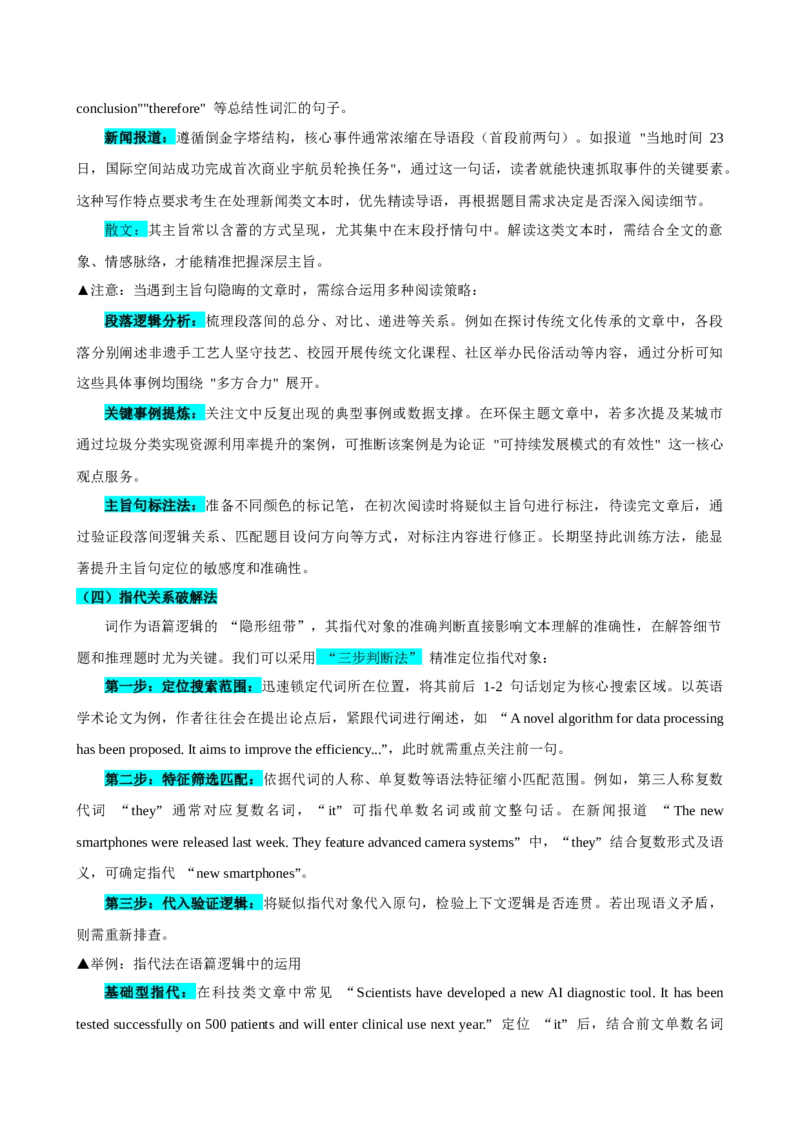
▲ “结构 - 题型” 对应表
传统策略侧重识别 “总 - 分”“因果” 等结构类型,优化后需明确不同结构对应的高频考点,帮助学生阅读时提前预判题目方向。例如:
语篇结构类型 高频命题点 阅读重点标记位置
问题 - 解决方案型 解决方案有效性判断、作者态度 问题表述段(通常在首段)、方案实施结
题 果段(末段 / 倒数第二段)
对比型(观点 / 事 细节对比题、推理题(差异背后 对比标志词(while/by contrast)所在句、
物) 的原因) 双方观点总结句
实验报告型(说明 实验目的 / 结论题、数据解读题 实验步骤前的 “aim/purpose” 句、结果
文) 分析段的 “conclusion” 句
(二)衔接词定位法
通过 “however(转折)、therefore(因果)、in addition(递进)、for example(举例)” 等衔接
词,判断段落间或句子间的逻辑关系。如前文提到 “Online shopping is convenient”,后文出现
“However, it has some problems like delayed delivery”,“however” 提示转折,可快速把握作者对 “网
购” 的全面看法 —— 既肯定优势也指出不足。此外,“in contrast”“on the other hand” 等对比词、“as
a result”“consequently” 等因果词,均是逻辑断层的 “衔接桥梁”。
值得注意的是,有些衔接词具有多重功能,像 “while” 既可以表示时间 “当…… 时候”,也能表示对
比 “然而”。例如句子 “While I was reading, he was watching TV.” 和 “While some people prefer coffee,
others like tea.”,需结合语境准确判断其逻辑作用。在实际阅读中,遇到此类多义词时,可以采用 **“三
步分析法”**:首先,圈出包含衔接词的句子;其次,分析前后文的核心内容;最后,结合常见逻辑关
系类型进行匹配。比如在 “While the initial hypothesis seemed plausible, subsequent experiments disproved
it.” 一句中,通过分析前后文关于假设和实验结果的矛盾表述,就能快速判断 “while” 在此处表转折。
在学术论文中,衔接词的使用更为严谨和密集,如 “Furthermore, the experimental data indicate
that...”(递进)、“Nevertheless, this conclusion requires further verification...”(转折),通过这些衔接词能
快速梳理出作者的论证思路。以一篇探讨人工智能伦理的论文为例,作者先用 “Firstly” 列举技术应用
场景,再用 “However” 引出数据隐私风险,最后以 “Therefore” 提出监管建议,形成完整的论证链条。
而在文学作品中,衔接词的使用可能更为隐晦,如通过 “后来”“接着” 等口语化表达推动情节,需
要读者更敏锐地捕捉其中的逻辑线索。例如在小说《平凡的世界》中,路遥用 “过了一段时间”“就在这个时候” 等自然过渡,串联起不同人物的命运转折,展现时代变迁。
此外,还可通过制作衔接词表格,整理不同类型衔接词的常见用法和例句,加深对其逻辑功能的理
解和记忆。以下是一个简单的分类表格示例:
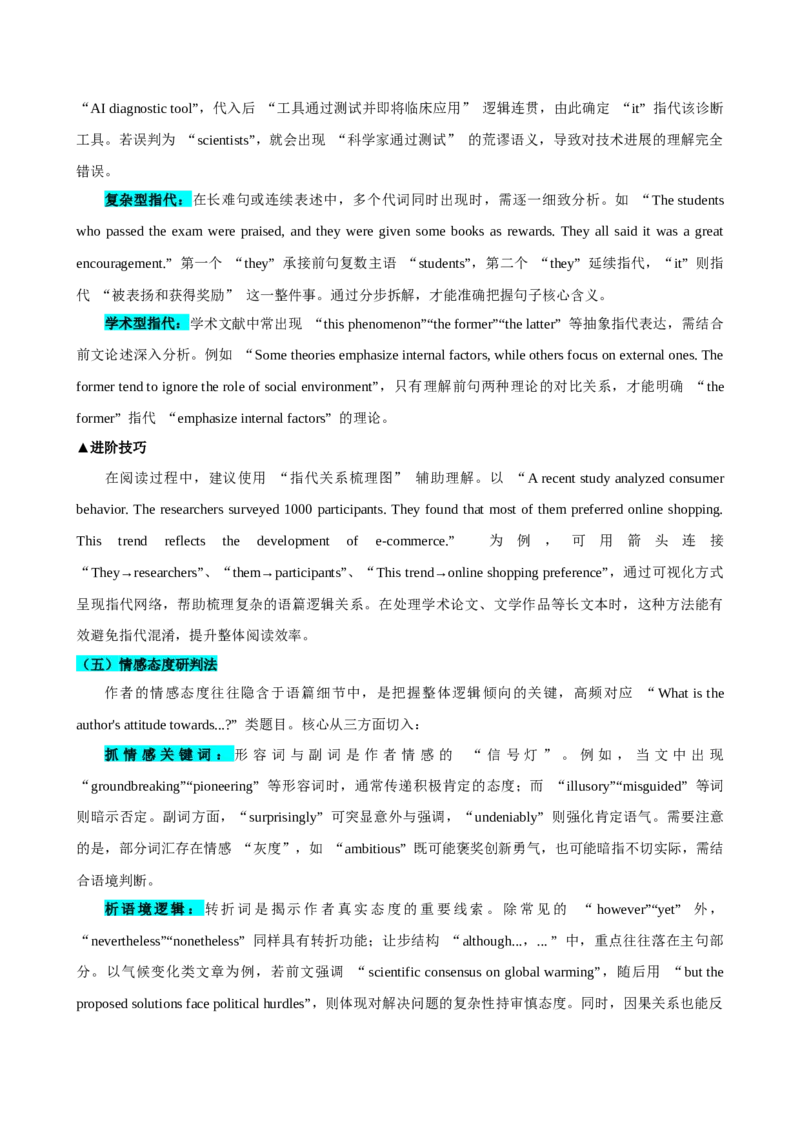
逻辑关系类型 常用衔接词 例句
转折 however, The project was successful; however, it faced several challenges
nevertheless, but during development.
因果 therefore, as a result The weather was bad; as a result, the game was postponed.
递进 in addition, She is a talented musician; in addition, she excels in painting.
furthermore
举例 for example, such as Many countries, for example, Japan and Germany, have
advanced technology in this field.
▲ 衔接词错题归因表:减少策略应用误差
针对学生常因 “衔接词多义性” 出错的问题,设计错题记录模板,强化语境判断能力:
错题原文摘录 误 判 逻 正确逻辑 归因分析(如:未 同类衔接词积累(如 while 表对
辑关系 关系 注意前后文语义矛 比的其他语境)
盾)
While the study 时 间 关 转折关系 忽 略 后 文 while 表对比:While cats like
is promising, it 系 “limitations” 与前 solitude, dogs crave company.
has limitations. 文 “promising” 的
矛盾
(三)主旨句定位法
主旨句作为文章的 "灵魂核心",通常分布在首段首尾句、末段首尾句或各段首句,其作用是提纲挈
领地概括文章核心观点。当面对 "What is the main idea of the passage?" 这类主旨题时,考生可优先锁定这
些高频位置,避免陷入逐句精读的时间陷阱。
议论文:以观点论证为核心,主旨句往往具有明确的概括性。例如某篇探讨城市生态的议论文,首
段结尾句 "Urban green spaces are crucial to both environmental protection and residents' mental health" 直接点
明全文围绕 "城市绿地的双重价值" 展开,可直接对应主旨题答案。考生在阅读时,可重点关注带有 "inconclusion""therefore" 等总结性词汇的句子。
新闻报道:遵循倒金字塔结构,核心事件通常浓缩在导语段(首段前两句)。如报道 "当地时间 23
日,国际空间站成功完成首次商业宇航员轮换任务",通过这一句话,读者就能快速抓取事件的关键要素。
这种写作特点要求考生在处理新闻类文本时,优先精读导语,再根据题目需求决定是否深入阅读细节。
散文:其主旨常以含蓄的方式呈现,尤其集中在末段抒情句中。解读这类文本时,需结合全文的意
象、情感脉络,才能精准把握深层主旨。
▲注意:当遇到主旨句隐晦的文章时,需综合运用多种阅读策略:
段落逻辑分析:梳理段落间的总分、对比、递进等关系。例如在探讨传统文化传承的文章中,各段
落分别阐述非遗手工艺人坚守技艺、校园开展传统文化课程、社区举办民俗活动等内容,通过分析可知
这些具体事例均围绕 "多方合力" 展开。
关键事例提炼:关注文中反复出现的典型事例或数据支撑。在环保主题文章中,若多次提及某城市
通过垃圾分类实现资源利用率提升的案例,可推断该案例是为论证 "可持续发展模式的有效性" 这一核心
观点服务。
主旨句标注法:准备不同颜色的标记笔,在初次阅读时将疑似主旨句进行标注,待读完文章后,通
过验证段落间逻辑关系、匹配题目设问方向等方式,对标注内容进行修正。长期坚持此训练方法,能显
著提升主旨句定位的敏感度和准确性。
(四)指代关系破解法
词作为语篇逻辑的 “隐形纽带”,其指代对象的准确判断直接影响文本理解的准确性,在解答细节
题和推理题时尤为关键。我们可以采用 “三步判断法” 精准定位指代对象:
第一步:定位搜索范围:迅速锁定代词所在位置,将其前后 1-2 句话划定为核心搜索区域。以英语
学术论文为例,作者往往会在提出论点后,紧跟代词进行阐述,如 “A novel algorithm for data processing
has been proposed. It aims to improve the efficiency...”,此时就需重点关注前一句。
第二步:特征筛选匹配:依据代词的人称、单复数等语法特征缩小匹配范围。例如,第三人称复数
代词 “they” 通常对应复数名词,“it” 可指代单数名词或前文整句话。在新闻报道 “The new
smartphones were released last week. They feature advanced camera systems” 中,“they” 结合复数形式及语
义,可确定指代 “new smartphones”。
第三步:代入验证逻辑:将疑似指代对象代入原句,检验上下文逻辑是否连贯。若出现语义矛盾,
则需重新排查。
▲举例:指代法在语篇逻辑中的运用
基础型指代:在科技类文章中常见 “Scientists have developed a new AI diagnostic tool. It has been
tested successfully on 500 patients and will enter clinical use next year.” 定位 “it” 后,结合前文单数名词“AI diagnostic tool”,代入后 “工具通过测试并即将临床应用” 逻辑连贯,由此确定 “it” 指代该诊断
工具。若误判为 “scientists”,就会出现 “科学家通过测试” 的荒谬语义,导致对技术进展的理解完全
错误。
复杂型指代:在长难句或连续表述中,多个代词同时出现时,需逐一细致分析。如 “The students
who passed the exam were praised, and they were given some books as rewards. They all said it was a great
encouragement.” 第一个 “they” 承接前句复数主语 “students”,第二个 “they” 延续指代,“it” 则指
代 “被表扬和获得奖励” 这一整件事。通过分步拆解,才能准确把握句子核心含义。
学术型指代:学术文献中常出现 “this phenomenon”“the former”“the latter” 等抽象指代表达,需结合
前文论述深入分析。例如 “Some theories emphasize internal factors, while others focus on external ones. The
former tend to ignore the role of social environment”,只有理解前句两种理论的对比关系,才能明确 “the
former” 指代 “emphasize internal factors” 的理论。
▲进阶技巧
在阅读过程中,建议使用 “指代关系梳理图” 辅助理解。以 “A recent study analyzed consumer
behavior. The researchers surveyed 1000 participants. They found that most of them preferred online shopping.
This trend reflects the development of e-commerce.” 为 例 , 可 用 箭 头 连 接
“They→researchers”、“them→participants”、“This trend→online shopping preference”,通过可视化方式
呈现指代网络,帮助梳理复杂的语篇逻辑关系。在处理学术论文、文学作品等长文本时,这种方法能有
效避免指代混淆,提升整体阅读效率。
(五)情感态度研判法
作者的情感态度往往隐含于语篇细节中,是把握整体逻辑倾向的关键,高频对应 “What is the
author's attitude towards...?” 类题目。核心从三方面切入:
抓 情 感 关 键 词 : 形 容 词 与 副 词 是 作 者 情 感 的 “ 信 号 灯 ” 。 例 如 , 当 文 中 出 现
“groundbreaking”“pioneering” 等形容词时,通常传递积极肯定的态度;而 “illusory”“misguided” 等词
则暗示否定。副词方面,“surprisingly” 可突显意外与强调,“undeniably” 则强化肯定语气。需要注意
的是,部分词汇存在情感 “灰度”,如 “ambitious” 既可能褒奖创新勇气,也可能暗指不切实际,需结
合语境判断。
析语境逻辑:转折词是揭示作者真实态度的重要线索。除常见的 “however”“yet” 外,
“nevertheless”“nonetheless” 同样具有转折功能;让步结构 “although...,... ” 中,重点往往落在主句部
分。以气候变化类文章为例,若前文强调 “scientific consensus on global warming”,随后用 “but the
proposed solutions face political hurdles”,则体现对解决问题的复杂性持审慎态度。同时,因果关系也能反映态度,如 “due to irresponsible deforestation, the ecosystem has suffered irreversible damage”,通过
“irresponsible” 与 “irreversible” 传递出强烈的批判。
联文章主旨:情感态度必须与文章主旨形成逻辑闭环。在探讨社交媒体影响的文章中,若主旨聚焦
“digital isolation in the age of connectivity”,则对算法推荐、信息茧房等现象的描述必然伴随批判态度;
而对促进人际沟通的功能可能以中性或稍带肯定的笔触呈现。此外,文章结尾段常是情感态度的总结升
华,需重点关注。
▲举例:情感态度分析法的应用
原文:While online education offers flexibility, its lack of face-to-face interaction inevitably reduces
learning efficiency. Yet with optimized teaching designs, this shortcoming can be mitigated.
分析:通过 “flexibility”(肯定)、“reduces”(否定)、“yet”(转折)、“mitigated”(乐观)等
词,可判断作者对在线教育持 “客观辩证” 态度 —— 既指出不足,也认可改进空间,而非绝对肯定
或否定。这种辩证思维在学术论述中尤为常见,作者往往通过权衡利弊展现论证的严谨性。
▲情感态度分析表
有时,作者的情感态度并非单一类型,可能随着文章论述逐渐发生变化。比如在论述某种新兴科技
时,开篇可能因不了解持怀疑态度,随着对其原理和应用的阐述,转变为认可和期待,这种情感态度的
动态变化,需要读者在阅读过程中仔细体会。以人工智能伦理讨论为例,文章可能先以 “alarming job
displacement projections” 渲染危机,后续通过 “AI's potential in medical diagnosis” 等实例转向理性探讨,
最终落点于 “ethical frameworks for sustainable development”,形成从警惕到建设性思考的情感递进。在
阅读此类文章时,可制作 “情感态度分析表”,记录文中出现的情感关键词、转折语句及对应的态度倾
向,从而更系统地把握作者的情感脉络。以下为简易示例:
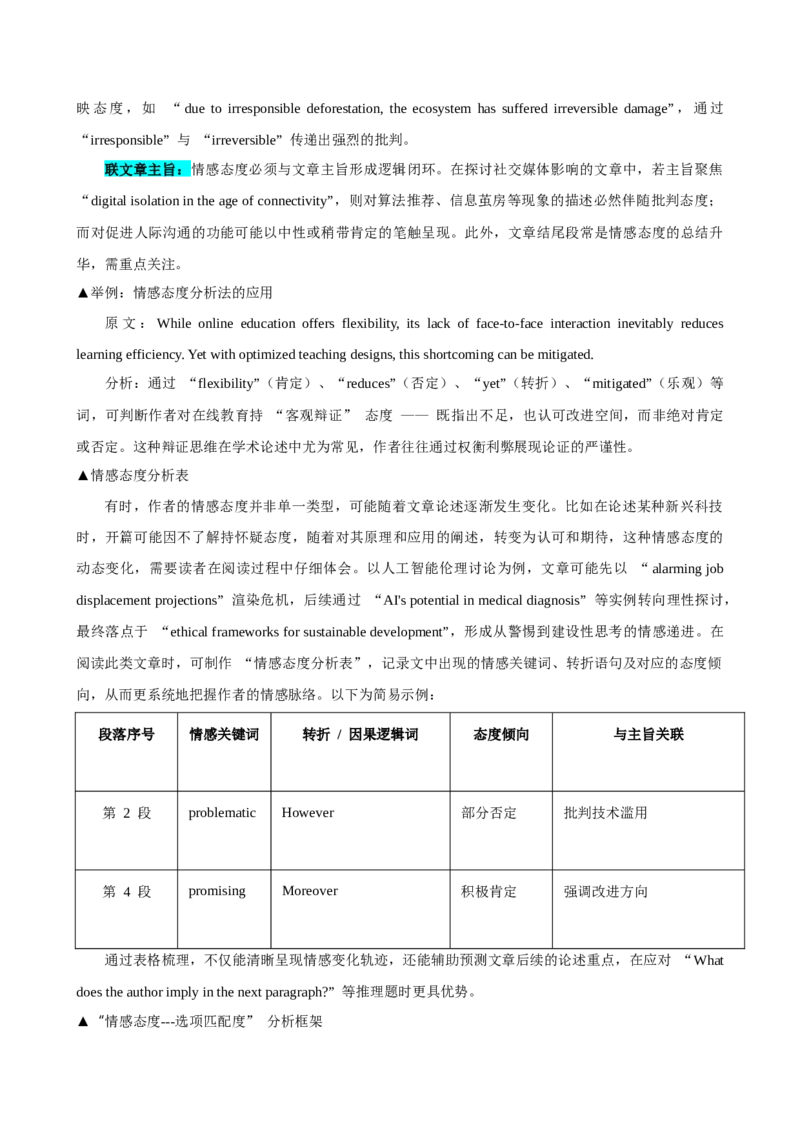
段落序号 情感关键词 转折 / 因果逻辑词 态度倾向 与主旨关联
第 2 段 problematic However 部分否定 批判技术滥用
第 4 段 promising Moreover 积极肯定 强调改进方向
通过表格梳理,不仅能清晰呈现情感变化轨迹,还能辅助预测文章后续的论述重点,在应对 “What
does the author imply in the next paragraph?” 等推理题时更具优势。
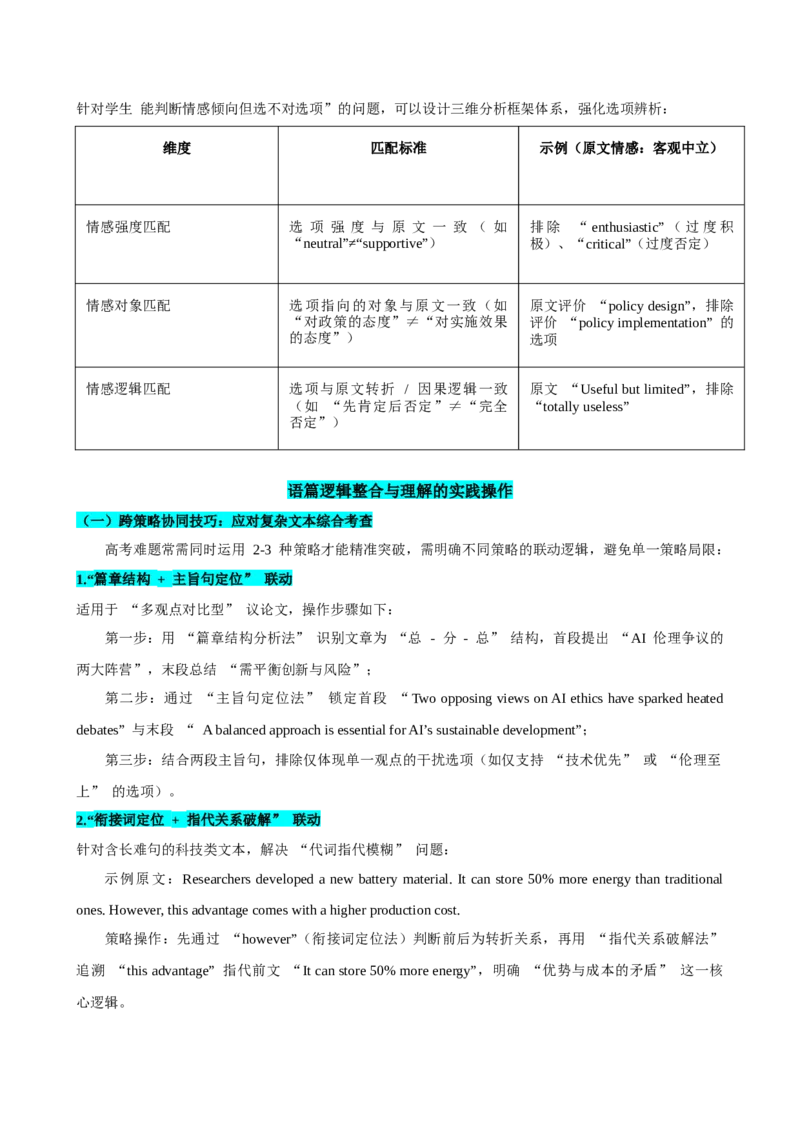
▲“情感态度---选项匹配度” 分析框架针对学生 能判断情感倾向但选不对选项”的问题,可以设计三维分析框架体系,强化选项辨析:
维度 匹配标准 示例(原文情感:客观中立)
情感强度匹配 选 项 强 度 与 原 文 一 致 ( 如 排除 “enthusiastic”(过度积
“neutral”≠“supportive”) 极)、“critical”(过度否定)
情感对象匹配 选项指向的对象与原文一致(如 原文评价 “policy design”,排除
“对政策的态度”≠“对实施效果 评价 “policy implementation” 的
的态度”) 选项
情感逻辑匹配 选项与原文转折 / 因果逻辑一致 原文 “Useful but limited”,排除
(如 “先肯定后否定”≠“完全 “totally useless”
否定”)
语篇逻辑整合与理解的实践操作
(一)跨策略协同技巧:应对复杂文本综合考查
高考难题常需同时运用 2-3 种策略才能精准突破,需明确不同策略的联动逻辑,避免单一策略局限:
1.“篇章结构 + 主旨句定位” 联动
适用于 “多观点对比型” 议论文,操作步骤如下:
第一步:用 “篇章结构分析法” 识别文章为 “总 - 分 - 总” 结构,首段提出 “AI 伦理争议的
两大阵营”,末段总结 “需平衡创新与风险”;
第二步:通过 “主旨句定位法” 锁定首段 “Two opposing views on AI ethics have sparked heated
debates” 与末段 “ A balanced approach is essential for AI’s sustainable development”;
第三步:结合两段主旨句,排除仅体现单一观点的干扰选项(如仅支持 “技术优先” 或 “伦理至
上” 的选项)。
2.“衔接词定位 + 指代关系破解” 联动
针对含长难句的科技类文本,解决 “代词指代模糊” 问题:
示例原文:Researchers developed a new battery material. It can store 50% more energy than traditional
ones. However, this advantage comes with a higher production cost.
策略操作:先通过 “however”(衔接词定位法)判断前后为转折关系,再用 “指代关系破解法”
追溯 “this advantage” 指代前文 “It can store 50% more energy”,明确 “优势与成本的矛盾” 这一核
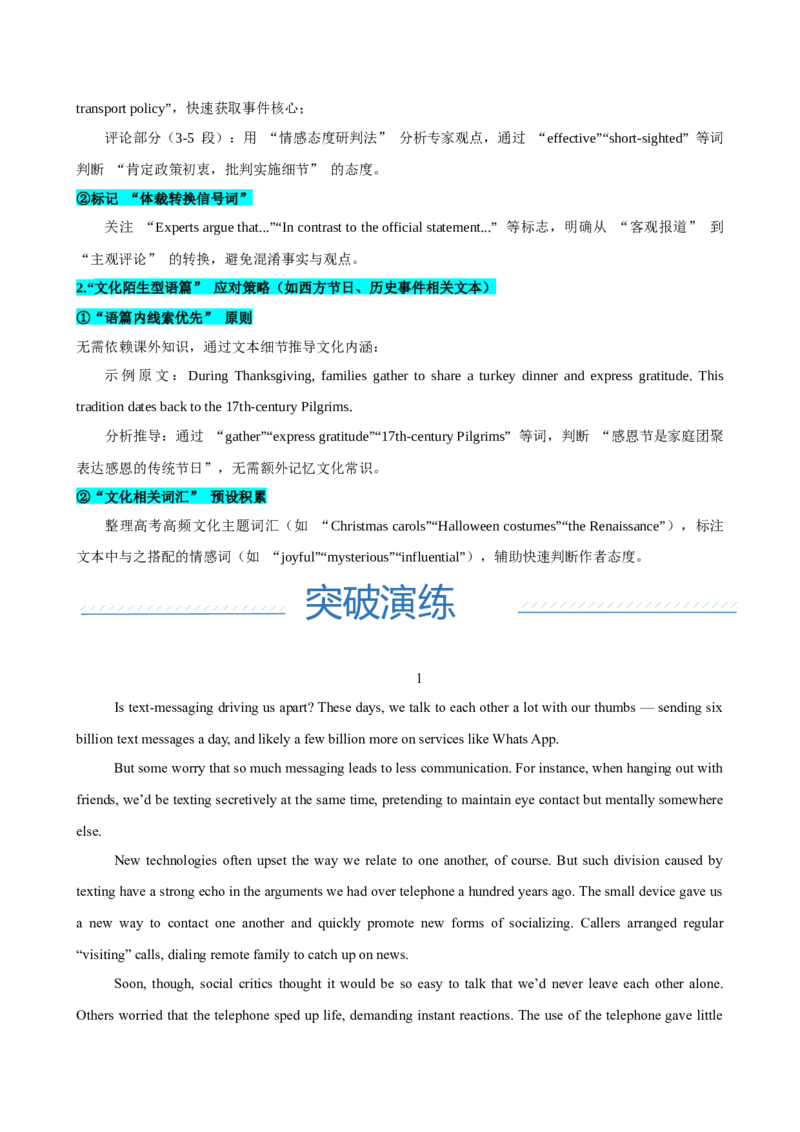
心逻辑。(二)“策略优先级” 判断:根据题目类型快速择策
高三英语阅读时间紧张,平均每篇需在 7-8 分钟内完成,因此考场上需在 1-2 分钟内确定核心策略,
避免时间浪费。建议构建“题目类型---策略优先级” 对照表,并按以下逻辑动态调整:
主旨大意题:优先采用 “首尾段 + 每段首句” 快速提炼法,辅助分析高频关键词;若时间不足,
可跳过细节段落直接总结。
细节理解题:根据题干定位词(数字、大写、专有名词等)快速扫读原文,优先匹配同义替换表达,
避免过度推理。
推理判断题:需结合上下文逻辑链进行适度推导,策略优先级低于细节题,可在完成其他题目后,
根据剩余文本信息补充分析。
词义猜测题:通过 “词根词缀 + 语境逻辑” 双重验证,重点关注前后句的因果、转折等关系词。
制定对照表时,建议用符号标注优先级(如★★★最高),并在日常训练中强化 “题型 ---策略”
的感知。考场上需在 1-2 分钟内确定核心策略,避免时间浪费,制定 “题目类型---策略优先级” 对照
表:
题目类型 首选策略 辅助策略 解题关键信息定位时限建议
主旨大意题 主旨句定位法 篇章结构分析法 60 秒内
细节推理题 指代关系破解法 衔接词定位法 90 秒内
作者态度题 情感态度研判法 衔接词定位法(转折 80 秒内
词)
段落作用题 篇章结构分析法 衔接词定位法(递进 70 秒内
词)
(三)特殊语篇应对:突破 “非常规文本” 解题难点
1.“混合体裁语篇” 应对策略(如 “新闻 + 评论” 融合语篇)
近年高考出现 “新闻报道开篇 + 专家评论主体” 的混合文本,需针对性调整策略:
①分段识别体裁特征
新闻部分(前 2 段):用 “主旨句定位法” 抓导语段 “Local government launched a new publictransport policy”,快速获取事件核心;
评论部分(3-5 段):用 “情感态度研判法” 分析专家观点,通过 “effective”“short-sighted” 等词
判断 “肯定政策初衷,批判实施细节” 的态度。
②标记 “体裁转换信号词”
关注 “Experts argue that...”“In contrast to the official statement...” 等标志,明确从 “客观报道” 到
“主观评论” 的转换,避免混淆事实与观点。
2.“文化陌生型语篇” 应对策略(如西方节日、历史事件相关文本)
①“语篇内线索优先” 原则
无需依赖课外知识,通过文本细节推导文化内涵:
示例原文:During Thanksgiving, families gather to share a turkey dinner and express gratitude. This
tradition dates back to the 17th-century Pilgrims.
分析推导:通过 “gather”“express gratitude”“17th-century Pilgrims” 等词,判断 “感恩节是家庭团聚
表达感恩的传统节日”,无需额外记忆文化常识。
②“文化相关词汇” 预设积累
整理高考高频文化主题词汇(如 “Christmas carols”“Halloween costumes”“the Renaissance”),标注
文本中与之搭配的情感词(如 “joyful”“mysterious”“influential”),辅助快速判断作者态度。
突破演练
1
Is text-messaging driving us apart? These days, we talk to each other a lot with our thumbs — sending six
billion text messages a day, and likely a few billion more on services like Whats App.
But some worry that so much messaging leads to less communication. For instance, when hanging out with
friends, we’d be texting secretively at the same time, pretending to maintain eye contact but mentally somewhere
else.
New technologies often upset the way we relate to one another, of course. But such division caused by
texting have a strong echo in the arguments we had over telephone a hundred years ago. The small device gave us
a new way to contact one another and quickly promote new forms of socializing. Callers arranged regular
“visiting” calls, dialing remote family to catch up on news.
Soon, though, social critics thought it would be so easy to talk that we’d never leave each other alone.
Others worried that the telephone sped up life, demanding instant reactions. The use of the telephone gave littleroom for reflection. It produced a craziness in the ordinary concerns of life which didn’t make for domestic
happiness. “We shall soon be nothing but transparent piles of jelly (果冻) to each other,” a London writer moaned
in 1897.
However, nowadays the telephone call seems like a throwback to a gentler era. When Jenna Birch, a
communication professor at the University of Iowa, started dating a man who insisted on calling her on the phone,
she found it warm and delightful. So she doesn’t think the shift to texting has degraded our interactions.
According to her study, teenagers who text the most are also those who spend the most time face to face with
friends. Communication, it seems, brings more communication, and — as she argues — just because talk happens
in text doesn’t mean it’s not meaningful.
Michéle Martin of Carleton University, thinks we’re living through a replay of the telephone, where the
things that made it valuable — instant communications — are the same that made it annoying. “People believe
they are liberated because they can bring the mobile phone everywhere,” Martin says. “But at the same time, they
are slaves to it.”
1.What’s the function of the first paragraph?
A.To introduce the topic. B.To describe a scene.
C.To offer an argument. D.To issue a warning.
2.According to paragraph 4, what does telephone use cause?
A.People experience very tight schedule. B.People tend to lack individuality.
C.People become narrow and uninformed. D.People lose the ability to reflect.
3.What can we learn from paragraph 5?
A.Telephone calls are particularly welcomed in dating.
B.Teenagers are addicted to communicating by texting.
C.The shift to texting is destructive to face-to-face time.
D.The meaning of communication goes beyond medium.
4.What’s the best title for the text?
A.Oh My God! We’ve Been Here Before! B.Gone with the Wind, Dear Texting!
C.Life is Too Short for So Many Texting. D.Oh, Telephone, a Tale of Two Sides.
2
Coastal cities worldwide are squeezed by two opposing forces: urban sprawl (扩张) and the rising sea. This
struggle is intensely visible in the flatlands where expanding neighborhoods routinely flood and saltwater flooding
damages the river mouths that protect communities from the worst of our climate crisis.Massive resources are being put into environmental restoration projects, and development is subject to
many layers of approvals. Yet in 2022 the missioners of a coastal city voted to expand a legal boundary that
contains sprawl to allow a 400-acre warehouse project. They are failing to see the value of this land in the greater
ecosystem.
Wetlands, coastal plains and forests do cheaply (or even for free) what seawalls and pumps do at a cost of
billions of dollars. They are vital infrastructure (基础设施) that makes us more resilient against climate change,
and the cost of destroying them or weakening their ability to function must be factored into the decisions we make
to build and grow.
To do so, the economic incentives to develop any natural landscape should be weighed against the
protective economic value that land already provides. Economists call this an “avoided damage” valuation. Local
planning boards might consider the value of a sand dune or swamp in flood protection versus the expense of
replacing it with a seawall and water pump system. Maintaining and restoring natural infrastructure to support
healthy functioning saves money, time and lives.
The concept of “natural capital”, or the idea that ecosystem services should be valued in a similar manner
as any form of wealth, dates back to the 1970s. Markets have always valued wood as a commodity (商品), for
example, but not the services that came along with producing it, such as soil maintenance, carbon storage, and
nutrient cycling. We didn’t need a market for resources that industrialists saw as abundant (丰富的) and endlessly
renewable. This exploitation (开发资源的) assumption turned out to be very wrong. Failing to measure the
benefits of ecosystem services in policy and management decisions is a major reason many of those ecosystems
disappeared.
It also seems crass to place a dollar amount on ecosystems that we’d rather view as priceless, existing for
their own sake and valuable to humans in ways that are beyond capitalism. This preciousness is ethically sound.
But developers have long confused priceless with worthless, allowing them to profit without paying for the
consequences of destroying the environment.
Economic value is never the only reason nature is worth preserving; it is simply a powerful, underused tool
to help us make decisions about how to live more sustainably in a climate-changed world. If policy makers
considered natural infrastructure in the language of economics, they might recognize just how deeply we rely on
it.
1.What are the first two paragraphs mainly about?
A.The consequences of the saltwater flooding.B.The cause of the urban sprawl and the rising sea.
C.An approval to an environmental restoration project.
D.The problem caused by the expansion of coastal cities.
2.What can we learn from the passage?
A.The idea of natural capital can enhance the profit of commodity.
B.The economic growth boosts the protection of natural landscape.
C.The abundance of resources is not the reason for devaluing them.
D.The exploitation of nature reflects the “avoided damage” valuation.
3.What does the underlined word “crass” in Paragraph 6 probably mean?
A.Inadvisable. B.Beneficial. C.Relevant. D.unrealistic.
4.Which would be the best title for the passage?
A.Use Nature as Precious Infrastructure B.preserve Wetlands for Their Own Sake
C.Value Ecosystems for Economic BenefitsD.Fight Sprawl with Environmental Regulation
3
In a stimulating interview with the philosopher Daniel Dennett in Living on Earth, Dennett shared that
Charles Darwin and Alan Turing might make the same discovery. Darwin showed how you can get the appearance
of purpose and design out of blind processes of natural selection. And Turing said that any computable problem
can be computed by a machine without understanding.
The host then voiced a concern: as AI advances, machines will come to lord over us. Dennett acknowledges
there’s a takeover risk but claims it’s misunderstood. The risk is not that machines will become autonomous rulers
but that we will depend too much on machines.
The main issue with AI is not intelligence but autonomy. At the end of the day, even the smartest computers
are our tools, and their intentions are ours. Or, to the extent that we can speak of their intentions at all—for
example, the intention of a self-driving car to avoid an obstacle—we have in mind something it’s designed to do.
Our growing dependence on technologies doesn’t mean we are losing our natural autonomy in quite this
sense. Our needs remain. But it is a loss of autonomy. Even auto mechanics these days rely on computers and, in
the era of self-driving cars, will any of us still know how to drive? Think what would happen if we lost electricity?
We’d be thrown back into the 19th century, as Dennett says. But things would be worse, as we lack know-how
that made it possible for our ancestors to live well in the olden days.
The truth is, we’ve been technological since our dawn as a species. We first found ourselves in the
archaeological record where we saw a great exposition of tools, technologies, art-making and language. In a sense,being human means being like a cyborg, which is a technological extension of our natural selves. This suggests
that at any time in our development, a large-scale breakdown in the technological system would spell not exactly
our doom, but our complete reorganization.
Perhaps what makes our current dilemma unprecedented (史无前例的) is the fact that we are so closely
networked. When the library of Alexandria burned down, books and knowledge were lost. But in a world where
libraries are replaced by their online versions, it isn’t unimaginable that every library could be simply deleted.
What happens to us then?
1.Which of the following statements might Dennett most likely agree with?
A.AI’s development is bounded. B.AI doesn’t have comprehension.
C.AI might be overly relied on. D.AI’s evolution resembles natural selection.
2.Which of the following examples best matches the idea of “know-how” in paragraph 4?
A.A farmer crafts a table with ancient tools. B.A nobleman hires servants to do housework.
C.A chef prepares a dish with electronic aids. D.A student uses a calculator for math tasks.
3.Why did the author mention libraries in paragraph 6?
A.To show the technological stability. B.To emphasize the technological weakness.
C.To prove the technological safeguard. D.To illustrate the technological transformation.
4.What would be the best title for the text?
A.Is the Concern Artificial Intelligence or Autonomy?
B.How will Technology Breakdown Change Our Lives?
C.How does the Human-Technology Relationship Develop?
D.Will Artificial Autonomy Threaten Humanity’s Existence?
4
I have been studying the French language for three years. This field of study has been the hardest but most
precious of my life. I would put it above the study of writing simply because I started writing as a 6-year-old boy
under my mother's guidance. I always "felt" I could write. I did not always "feel" I could study a foreign language
effectively.
But here I am, right now, in a French hotel. I spoke French at the border, when I checked in and when I
went to get lunch. I fail to speak with fluency. I mishear words. I can't really use complicated grammar. But my
words are perfectly understandable and serve their purpose. I feel, as I always do, like I am lost in the dark, but
with each misstep, I find my way more clearly. I didn't feel it when reading French novels; I didn't feel it at
school. I just felt it when I first arrived Paris.I'm emphasizing feelings because, when studying, they are as important as any reality. The fear of making
mistakes feeds the hopeless and makes learners quit. It is not the study of language that is hard. It is the feelings of
who you are at the present level and pessimistic belief of who you will always be that make it hard. The
transformation to turn struggles into growth is what truly makes learning a life-changing journey.
Maybe one day, someone will say something to me that I do not understand, and in that moment. I may feel
a bit discouraged. But now, I feel a sense of being high. These moments of confidence and motivation are
precious, for they remind me of how far I've come. They are not the norm(常态),though. The truth is, the
lows are what I encounter more often. They are part of the learning process, part of the transformation that shapes
us into better versions of ourselves. And yet, it is through these lows that I am constantly learning and growing.
1.How does the author feel about making mistakes in French?
A.Awkward. B.Hopeless. C.Competent. D.Rewarding.
2.According to the author, what is the real challenge in learning a language?
A.Mastering complicated grammar. B.Overcoming the fear of making mistakes.
C.Finding enough time to study. D.Understanding native speakers.
3.Why does the author emphasize feelings?
A.To highlight his struggles in learning French.
B.To show that positive thinking can drive growth.
C.To illustrate that people should follow their hearts.
D.To clarify his experience in mindset transformation.
4.What can we infer from the last paragraph?
A.The lows are always followed by highs. B.Feeling confident should be made a norm.
C.Struggles are an essential part of learning. D.The ups are the real times when learning occurs.
5
Why in an age of technology, should so many people still cling to an ancient belief? In part it must be
because astrology (星术) claims to tell us something about ourselves, and all of us are interested in ourselves. I
think it is because astrology is presented as if it were a science by its modern practitioner, and many people are
misled by this.
In fact, astrology was never a science. It was not a hypothesis or theory developed to describe natural
phenomena, and until fairly recent times, there was no attempt to test or verify its predictions. Astrology began
approximately three thousand years ago in Babylonia, it was applied to monarchs (帝王) and kingdoms, but not to
individuals. It spread in the 6th century BC as Far as India, where it flourishes today. The Egyptians, meanwhile,developed their own kind of astrology. But the astrology now practiced in Europe and America is that developed
by the Greeks, who synthesized the ideas of Babylonians and Egyptians and enriched them with concepts from
their own fertile imaginations. The Greeks believed that the earth was composed of four elements, and the heavens
of a perfect crystalline material. The planets themselves were variously thought to be gods, residences of gods, or
at least manifestations of gods. The gods were immortal, but otherwise had the same attributes of anger,
happiness, jealousy, rage and pleasure as we do. Now if what the gods’ thought was capricious (变化无常的),at
least the planets were predictable in their movements. Because our own lot in life is so unpredictable, it must be
purely at the mercy of gods. But if the gods are the planets, or somehow associated with them, then we have only
to learn the rules of the motions of the planets to understand the whims of the gods and how they shape our own
lives. So the belief developed that each of our lives is preordained (命中注定) by the precise configuration of the
planets in the sky at the lime of our birth.
Astrology could not, of course, have seemed as incredible to the ancients as it does to us .The role of the
sun influencing our daily and yearly lives is obvious; it was a natural extension to attribute other powers to the
other planets as well. It wasn’t until the time of Newton that we understood that the laws of Nature apply to the
celestial worlds as well as to the terrestrial one. During ancient time, however, all great scholars believed in
astrology.
1.Many people are misled by astrology because it is presented by the practitioners as____.
A.a theory that can describe natural phenomena
B.a magical key to understand themselves
C.an ancient belief that had long been applied to monarchs
D.a mysterious power beyond the explanation of science
2.It is implied that astrology is based on the belief that___.
A.the gods’ intentions were hard to predict
B.the fate of our lives were unpredictable
C.the gods are closely related to the planets
D.the gods have the same attributes as we do
3.Which of the following is TRUE about the scholars before the time of Newton?
A.Some of them were convinced by astrology.
B.They didn’t know the laws of Nature apply to all planets.
C.They played important roles in the development of astrology.
D.Most of them found astrology incredible4.What is the author’s purpose in writing the passage?
A.To cast doubt on the origin of astrology
B.To compare astrology with real sciences.
C.To point out the popularity of astrology.
D.To justify the incredibility of astrology.
6
One evening, at home. You’re sitting comfortably on the sofa, watching your favorite Tv show. An ad
comes up, showing a burger in its full glory and one person enjoying it. You think to yourself that your diet is
about to take a bit. But we beg to differ.
In a series of studies, we found advertisements showing people eating junk food prompted people on a diet
to eat less. While this may seem counterintuitive (反直觉的), these findings are in line with previous research on
mental imagery.
Recent studies show merely imagining ourselves carrying out actions or experiencing emotions activates
similar neural networks(神经网络)to those linked with their actual performance or experience.
The images we are exposed to throughout our lives hold the power to shape our experiences to a
remarkable degree. According to neuroimage studies, the mere sight of someone being hit by a hammer will fire
up the neural networks in our brain that are associated with pain. As a result, these images will trigger (引发)
emotions and behavior consistent with feelings of pain.
Such effects also extend to food consumption. The field of consumption imagery refers to rich images of
food consumption — for example, an ad showing the close-up of a pizza and someone eating it. Some studies
have even indicated consumption imagery could cause people to wrongly recall having eaten the food on display.
This is important because simply thinking that we have eaten something can make us feel full.
We invited 132 dieting students at our lab to watch an ad. Half of them saw an M&M’s advertisement
full of consumption imagery: sweets, colors, and a person eating them. The other half of the students saw an ad
with two animated (动画的) M&M’s at a supermarket cash register, with no consumption imagery.
We then gave each student a 70g cup of M&M’s and asked them to eat to their heart’s content. Among
the students, those who saw the M&M’s advertisement containing consumption imagery ate fewer sweets
than those who saw the ad without.
In the next study, we tested whether we could use these findings to promote healthy eating. We designed
four ads and each participant was randomly selected to view one of the four ads.
People who viewed the ad requiring them to imagine themselves wolfing down the French fries indicated adesire to eat fewer chips than those who were exposed to the French fries ad without consumption imagery.
Those who had imagined themselves eating an apple were more likely to succumb to the potato chips than
those who had visualized themselves eating the French fries.
These results go against the grain of current public practices that aim to promote healthy eating by relying
on images of nutritious foods. However, our research indicates that healthy eating campaigns should include the
consumption of unhealthy food.
1.Thinking that we have eaten something can make us feel full because ___________.
A.the images hold the power to increase the sharpness of our senses
B.it activates neural networks similar to those linked with actual eating
C.the consumption imagery makes us recall having eaten the food on display
D.it is in line with the previous research into how imagery affects eating habits
2.What conclusion can we draw from the experiment with M&M chocolates?
A.Animated images in the advertisement may discourage consumption.
B.The more inviting the food in the ad is, the more the viewers will eat.
C.Advertisements with consumption imagery prompt viewers to eat less.
D.Where we see the advertisement is more important than what we see in it.
3.The phrase “succumb to”(in paragraph 10)is closest in meaning to ___________.
A.give way to B.be addicted to
C.face up to D.be resistant to
4.Which of the following practices contributes to developing healthy eating habits?
A.Wolfing down junk food. B.Imagining eating an apple a day.
C.Saying no to grain. D.Watching others eating junk food.
7
With global life expectancy now over 70 years old, we need to change how we age, not how long we age.
So begins a longevity revolution (长寿革命) — one focused on slowing the ageing process so that lives aren’t just
longer but also healthier for longer.
But this requires a transformation in our health system and careers as well as individual psychology. It also
demands a shift in scientific focus away from individual diseases and towards a greater understanding of the
biology of ageing.
Increasing life expectancy has changed the global burden of disease. The top 10 causes of death have a
common risk factor: age. If we could find a way to slow down biological ageing, we could potentially impactmultiple diseases. But achieving this requires changing how we think about ageing — it means accepting that the
biology of ageing is a mainstream line of scientific inquiry.
This shift also requires recognizing that ageing is not inexorable. We often draw a distinction between
health and the consequences of ageing, assuming the latter are natural phenomena. That thinking reflects past
success in treating diseases. But we now need to apply that progress to tackling how we age and remember the
words of French philosopher Michel — to die of old age is a death rare, extraordinary, and singular, and therefore
so much less natural than the others.
A focus on ageing and ageing-related diseases also leads to something unique: When progress was made in
treating infant ( 婴儿 ) diseases, infant deaths fell, so research moved on to the diseases of middle age.
Breakthroughs there led to fewer midlife deaths, and so science shifted to focus on ageing-related diseases. But
the better we get at ageing, the more older people there will be and the more valuable further gains will be. When
we are ill in our 90s, living into our 100s has little appeal. But if we can be healthy 90-year-olds, then we want to
live for even longer, thus opening up the possibility of living to ages far greater than ever before.
1.What can we know about the longevity revolution?
A.It aims at finding a cure for age-related problems.
B.It focuses on improving the quality of life as we age.
C.It calls for governmental policy to promote healthcare.
D.It may increase the human lifespan beyond the current record.
2.What is the meaning of the underlined word “inexorable” in paragraph 4?
A.Groundless. B.Exceptional. C.Unavoidable. D.Unpredictable.
3.Why does the author quote Michel’s words?
A.To prove death is a natural phenomenon.
B.To justify the changeable character of ageing.
C.To show the rare chance of dying at an old age.
D.To stress our understanding of ageing needs changing.
4.What does the author imply about the future of longevity research?
A.Its target should be middle-aged diseases.
B.Its main value lies in reducing elder care costs.
C.It may create a positive cycle of health promotion.
D.It will eventually find a natural limit of human lifespan.
8Why might you be attracted to one face over another? It’s an age-old question thought to be too subjective
to be worth serious scientific analysis until recently. But attractiveness is not, as you might at first think, linked
with distinctiveness; It’s actually the opposite.
Studies have repeatedly shown that when it comes to which faces we prefer, we are more impressed by
averageness. Researchers created artificial faces on a computer by combining photos of several people’s faces to
generate a composite, “average” image. In preference trials, these highly average faces were consistently rated
most attractive.
As well as averageness, there is another important influence on how physically attractive a person’s face is
perceived to be. A simple research study shatters whatever romantic notions you may hold. Male and female
volunteers looked at a series of smiling female faces and were asked to rate the attractiveness of each one.
Some of the faces they saw just once, while others they saw six times. By the end of the study, the
repeatedly viewed faces were picking up higher attractiveness ratings for no other reason than the added exposure.
Did you think familiarity leads to contempt? You couldn’t be more wrong.
This tendency is known to psychologists as the “mere exposure effect”. It applies to many different
situations. Research has shown that people will evaluate photographs, sounds, shapes, names and even made-up
words more positively if they have encountered them before.
While these studies witness the importance of looks when it comes to romance, there is still hope for us all.
If you are not blessed with the average features that most of us apparently deserve, then simply presenting
yourself as often as possible to the object of your desire may overcome this. Harness the “mere exposure effect” to
your advantage in the hope that your crush will develop a liking for the familiar. Perseverance can win out in the
end.
1.Why do you prefer one face to another according to the passage?
A.Attractiveness. B.Uniqueness. C.Averageness. D.Subjectivity.
2.Which word can replace the underlined word “contempt” in Paragraph 4?
A.Ignorance. B.Fondness. C.Trust. D.Dependence.
3.How can you let someone like you according to the passage?
A.Good manners. B.Frequent visits.
C.Nice appearance. D.Strong personality.
4.What is the best title of the passage?
A.How we attract others?
B.How subjective someone is attractive?C.Why we find someone more beautiful?
D.Why we find average faces the most attractive?
9
Imagine you’re writing a poem, rhymes must be paired up before you start a new line. It turns out that AI
does something similar! When Claude, a large language model (LLM), is given the first line “he saw a carrot and
had to grab it”, it begins thinking about words like “rabbit” almost immediately, writing the next sentence to end
at the appropriate rhyme.
Such forethought is unexpected. Scientists at Anthropic, the lab that developed Claude, built a tool and they
discovered some unexpected complexity.
The tool, a “digital microscope”, lets scientists look at which parts of the AI’s neural (神经的) network
light up when it’s working on different tasks. If a particular area of the LLM lights up whenever it produces words
like rabbit, then that gets marked as being related to rabbits.
This has let the team solve some open questions in AI research, for example, whether a multilingual (多语
言的) chatbot has awareness of concepts beyond language. When Claude is asked for the opposite of “big” in
English, or the same concept in Chinese, the same feature lights up in every case, before more language-specific
circuits kick in to “translate” the concept of smallness into a particular word. This suggests that AI might have a
deeper understanding of the world than we thought.
Other insights, though, are less encouraging. When Claude itself is asked to reason, printing out its chain of
thought to answer maths questions, the microscope suggests that the way the model says it reached a conclusion,
and what it actually thought, might not always be the same. Worse still, ask a leading question — suggesting that
the answer “might be 4”, and it will specifically add numbers that ultimately lead it to agree with the question,
even if the suggestion is wrong.
But being able to gain insight into the mind of an LLM provides clues as to how to stop it doing the same in
the future. The goal, after all, is not to have to do brain surgery, but to know what it’s thinking.
1.What does the writer intend to show through the example in paragraph 1?
A.AI can write texts as programmed. B.AI can plan sentences in advance.
C.AI can deal with complex tasks. D.AI can simplify rhyming lines.
2.How does “digital microscope” function in the research?
A.By tracking AI’s thinking activities. B.By working on different jobs.
C.By activating AI’s “brain” potential. D.By matching language patterns.
3.What can be inferred from paragraph 5 about Claude?A.It may make stuff up. B.It may skip chains of thought.
C.It may leave clues out. D.It may give logical reasoning.
4.Which of the following titles best suits this text?
A.Why AI Still Gets It Wrong B.Chatbots’ Language Magic
C.Looking Inside AI’s Mind D.The Rise of AI Chatbots
10
History is one of those subjects that could be endless if we had enough time. There has always been an
understanding that we learn history to stop it from being repeated, in a sense learning from past mistakes.
However, as we have discovered, this is not entirely true. With the invasive (入侵的) and violent events
still in existence in many parts of the world, we can see that humanity has not learnt from its past. History shows
itself to repeat and it is important to learn history to see these chaotic repetitions. History is not just about strife—
wars, revolutions, and struggles—but it is also a political and philosophical topic.
A man named Peter Turchin has spent many years investigating how we can use history to our own benefit.
In 2003 Turchin published his book “historical dynamics”. The book demonstrates his workings in which he
shows the secular (世俗的) state of France and Russia from their origins to the 18th century. Not long after his
book was published Turchin founded cliodynamics. Cliodynamics works to show the underlying patterns we can
observe in history and model them in a way to make scientific estimates of how the future may play out. His use
of mathematics has allowed scientists to develop a greater understanding of how political settings may occur or
how societies will grow.
Of course, it is simply impossible for any historian to predict the future, but by using this “big data”
approach, Turchin has allowed individuals to locate patterns and use critical thinking to help make judgments
about what the future may hold. Turchin as well as many others have used history in an important way to help
future generations.
As time passes, the databases will improve, highlighting more patterns and similarities, unavoidably
helping to make these predictions more reliable. Could this approach to using data be the future of history and
would we as a society be able to show the repetitions in humanity?
1.What does the underlined word “strife” in paragraph 2 mean?
A.reflection. B.Conclusion. C.Account. D.Conflict.
2.What can be inferred from Turchin’s research?
A.It intends to reveal state origins. B.It jumps out of historical cycles.
C.It confirms history’s mirror values. D.It shows maths history similarities.3.How does Turhin’s approach benefit historians?
A.By providing first-hand data. B.By helping predict future trends.
C.By ensuring precise future predictions. D.By fueling insights into certain events.
4.What is the author’s attitude toward predicting the future?
A.Favorable. B.Objective. C.Unconcerned. D.Opposed.
11
What happens when we try foreign dishes for the first time? More often than not it is like finding ourselves
in circumstances different from what is comfortably familiar. We hesitate and declare them unacceptable. Yet there
are no universal standards for good cuisine (烹饪);there’s only badly cooked food. We may not like some
foreign dishes but that has nothing to do with their being inferior or superior. It has everything to do with how
removed they are from what we know.
A few years back I wasn’t particularly fond of Indian dishes with their strong spices. Then an Indian family
moved in next door and I immediately became friends with the lady. Being very friendly people, they kept asking
me over. Seeing as I had no choice, I gave in, went over and waited in horror. They served a lot of strange-looking
dishes, whose aroma (香味) was inviting enough for me to sample them. And I felt sorry I did. My tongue felt like
it was on fire! But I saw it through to the end so as not to endanger our neighbourly relationship. Needless to say, I
was asked to come back for more. It took a few months, but I have actually come to love some hot Indian curries
and overly honeyed desserts.
In contrast, American steaks and burgers now strike me as downright dull, although I used to love them.
Then there’s Japanese cuisine, which I associated with a smelly sushi bar next door until I went on a trip to Japan.
I was served dishes of suspicious smell day in day out and, although they didn’t seem particularly delicious, upon
my return home I found myself repeatedly wandering into that sushi bar around the corner. The smell I had
thought terribly fishy before now seemed familiar and mouth-watering.
In short, I have acquired the taste for some foreign dishes but not for all the food of any particular cuisine.
In a way, the ability to acquire the taste for new foods has to do with a person’s ability to accept a culture. The
‘acquired taste’ for food goes beyond a taste bud (味蕾) experience. It has a lot to do with what a person
associates the food with, like friendly neighbours or a memorable journey. Similarly, many of us find our mother’s
cooking incomparable. But that isn’t necessarily because of our mother’s superior kitchen skills but because we
associate her cooking with the warmth of home.
1.According to the author, what determines whether we like foreign dishes?A.Universal standards of good cuisine
B.The price and presentation of the food
C.The skill of the chef who prepares them
D.How different they are from what we know.
2.Why did the author eventually enjoy Indian curries despite initial discomfort?
A.The dishes became less spicy over time.
B.Repeated exposure helped him adapt to the flavors.
C.The neighbor’s persistence made it impossible to refuse.
D.He discovered superior cooking methods in Indian cuisine.
3.Why does the author mention his neighbor’s sushi bar in Japan?
A.To criticize the hygiene standards of foreign restaurants.
B.To show how familiarity can change perceptions of food.
C.To illustrate that Japanese cuisine is universally superior.
D.To highlight the importance of trying raw fish dishes.
4.According to the last paragraph, acquiring new tastes ______ .
A.is a sign of how open-minded a person is
B.depends on how sensitive your taste buds are
C.is like acquiring various cooking knowledge
D.becomes easier if your mother isn’t a great cook
5.Which statement best summarizes the overall message of the article?
A.Travelling is the best way to acquire new tastes.
B.The smells and sight of food are often misleading.
C.The stranger the food, the more difficult it is to like it.
D.Experiences are crucial in determining food preferences.
12
My graduate education was largely focused on the social and political history of Europe. After I got my
PhD, I have become more interested in broadening my view of history to include the power of technology and the
relations between humans and the rest of nature.
Medieval Technology and Social Change by Lynn White Jr. was the first book that called my attention to a
new field of history. It opened my eyes to the role of technology in human affairs. Until then, my interest in
technology had been purely instrumental — how to fix a bicycle, how an airplane stays up in the air, and so on.White’s book showed me that technology — the means by which humans use resources for their own ends — was
one of the most important, though ignored, aspects of history, one that tells us what determines why some
civilization succeed and others fail.
I hadn’t realized the importance of technology in human affairs until I read this book. One good example is
when he talks about the invention of stirrups (马镫) for horse riders to keep them stable. This happened in the
eighth century, and it meant that they were quicker in warfare because they could still stay on the horse even when
they were pushed by a spear from an enemy. This transformed mounted cavalry ( 骑兵) warfare. Also the
introduction of a horse collar (马衔) in the early Middle Ages made the horse infinitely more useful in agriculture.
So it was technology making the horse more powerful and useful.
Today many people think of technology as computers and the Internet, but really technology means those
devices that humans have invented to make it possible to do things they couldn’t do otherwise — and that could
be as simple as the horse collar or a stirrup.
1.How does Medieval Technology and Social Change influence the author?
A.It leads him to a narrowly focused area. B.It fuels his creative inspiration greatly.
C.It enriches his view of technology. D.It encourages him to get a PhD degree.
2.Why are “stirrups” and “a horse collar” mentioned in the third paragraph?
A.To show the development of Agriculture.B.To explain how technology influenced history.
C.To stress the function of horses in the past. D.To describe the making process of warfare.
3.What does the author think about modern technology?
A.It refers to something instrumental. B.It consists of creative inventions.
C.It means computers and the Internet. D.It should include complex tools.
4.What is the author’s writing purpose?
A.To introduce the history of Middle Ages.B.To honor an influential historian.
C.To recommend a book on technology. D.To highlight his insight into history.