考前猜押 阅读理解科普说明文(研究报告)
1.押题指导原则:
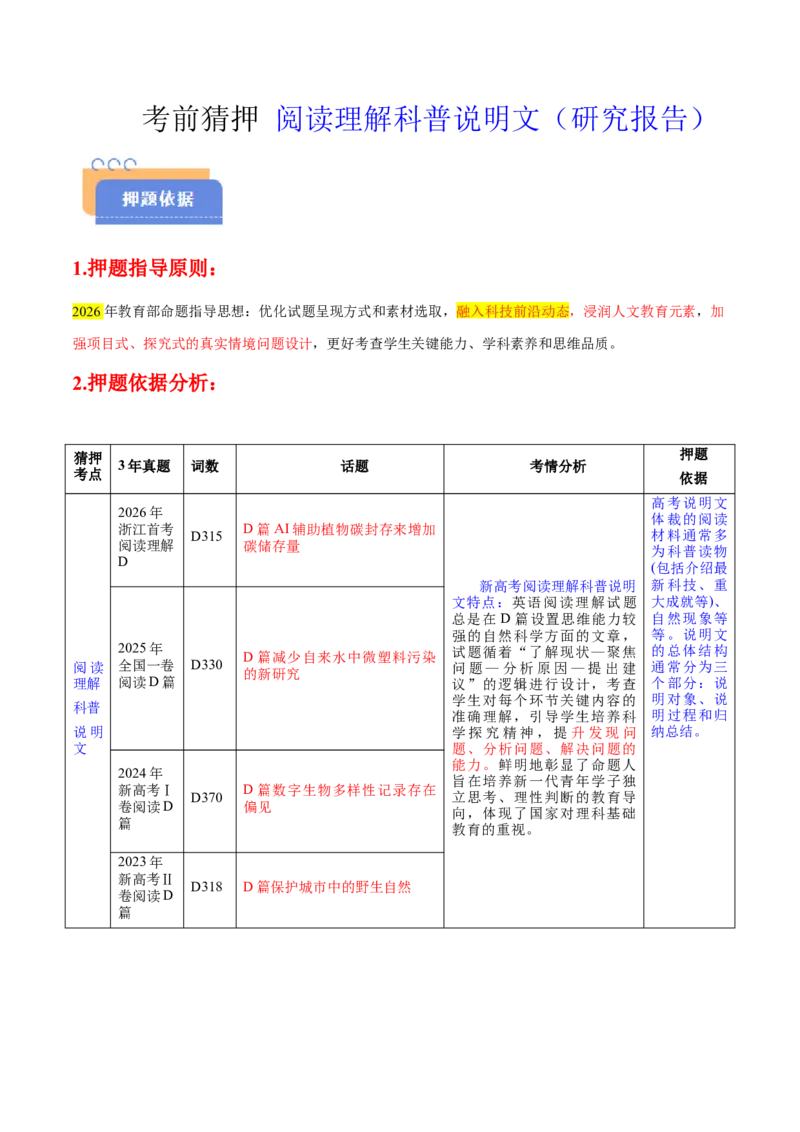
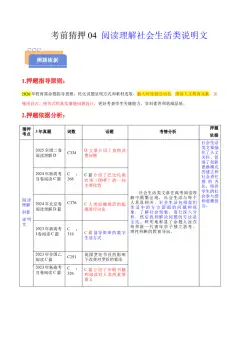
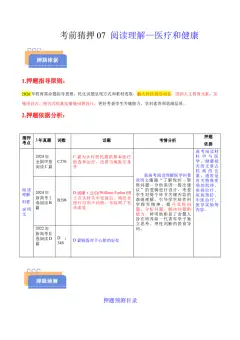
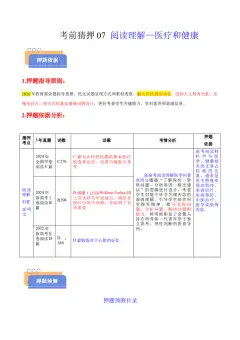
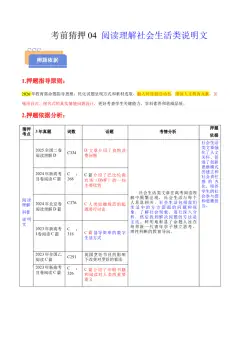
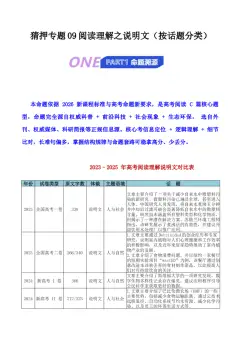
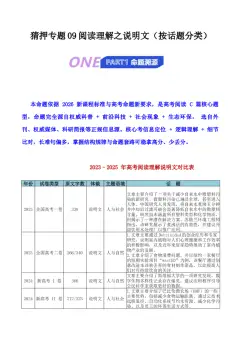
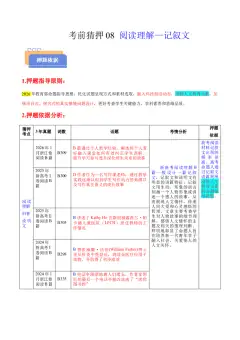
2026年教育部命题指导思想:优化试题呈现方式和素材选取,融入科技前沿动态,浸润人文教育元素,加
强项目式、探究式的真实情境问题设计,更好考查学生关键能力、学科素养和思维品质。
2.押题依据分析:
猜押 押题
3年真题 词数 话题 考情分析
考点 依据
高考说明文
2026年
体裁的阅读
浙江首考 D篇AI辅助植物碳封存来增加
D315 材料通常多
阅读理解 碳储存量
为科普读物
D
(包括介绍最
新高考阅读理解科普说明 新科技、重
文特点:英语阅读理解试题 大成就等)、
总是在 D 篇设置思维能力较 自然现象等
强的自然科学方面的文章, 等。说明文
2025年 试题循着“了解现状—聚焦 的总体结构
D篇减少自来水中微塑料污染
阅读 全国一卷 D330 问题—分析原因—提出建 通常分为三
的新研究
理解 阅读D篇 议”的逻辑进行设计,考查 个部分:说
学生对每个环节关键内容的 明对象、说
科普
准确理解,引导学生培养科 明过程和归
说明 学探究精神,提升发现问 纳总结。
文 题、分析问题、解决问题的
能力。鲜明地彰显了命题人
2024年
旨在培养新一代青年学子独
新高考Ⅰ D篇数字生物多样性记录存在
D370 立思考、理性判断的教育导
卷阅读D 偏见
向,体现了国家对理科基础
篇
教育的重视。
2023年
新高考Ⅱ
D318 D篇保护城市中的野生自然
卷阅读D
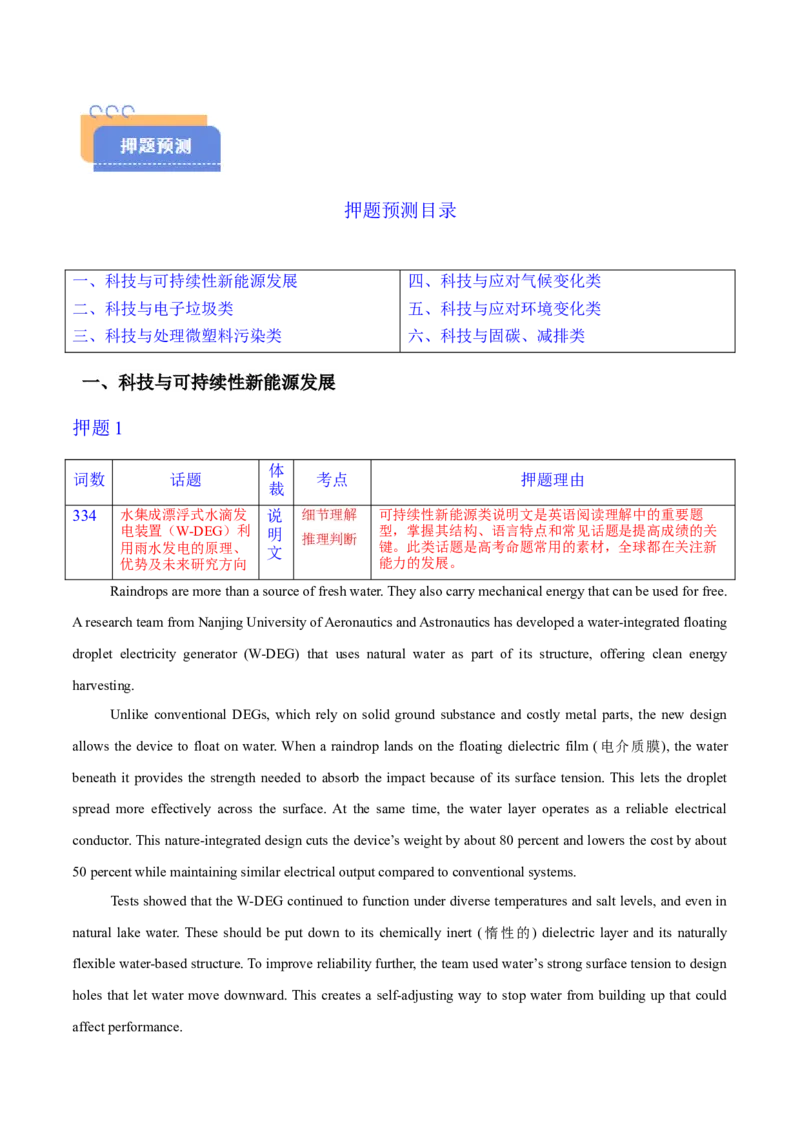
篇押题预测目录
一、科技与可持续性新能源发展 四、科技与应对气候变化类
二、科技与电子垃圾类 五、科技与应对环境变化类
三、科技与处理微塑料污染类 六、科技与固碳、减排类
一、科技与可持续性新能源发展
押题1
体
词数 话题 考点 押题理由
裁
334 水集成漂浮式水滴发 说 细节理解 可持续性新能源类说明文是英语阅读理解中的重要题
电装置(W-DEG)利 明 型,掌握其结构、语言特点和常见话题是提高成绩的关
推理判断
用雨水发电的原理、 文 键。此类话题是高考命题常用的素材,全球都在关注新
优势及未来研究方向 能力的发展。
Raindrops are more than a source of fresh water. They also carry mechanical energy that can be used for free.
A research team from Nanjing University of Aeronautics and Astronautics has developed a water-integrated floating
droplet electricity generator (W-DEG) that uses natural water as part of its structure, offering clean energy
harvesting.
Unlike conventional DEGs, which rely on solid ground substance and costly metal parts, the new design
allows the device to float on water. When a raindrop lands on the floating dielectric film (电介质膜), the water
beneath it provides the strength needed to absorb the impact because of its surface tension. This lets the droplet
spread more effectively across the surface. At the same time, the water layer operates as a reliable electrical
conductor. This nature-integrated design cuts the device’s weight by about 80 percent and lowers the cost by about
50 percent while maintaining similar electrical output compared to conventional systems.
Tests showed that the W-DEG continued to function under diverse temperatures and salt levels, and even in
natural lake water. These should be put down to its chemically inert (惰性的) dielectric layer and its naturally
flexible water-based structure. To improve reliability further, the team used water’s strong surface tension to design
holes that let water move downward. This creates a self-adjusting way to stop water from building up that could
affect performance.The system also charged capacitors (电容器) to useful electric tension only within minutes, showing its
potential for powering small electronics and wireless sensors. Moreover, with continued development, similar
systems could be positioned on lakes or coastal waters, providing renewable electricity without using any land-
based space.
Although the laboratory results are encouraging, extending the service life of large dielectric films in
dynamic outdoor conditions will also require further engineering. “By letting water itself play both structural and
electrical roles, we’ve opened the door to land free systems that can supplement other renewable technologies like
solar and wind.” Professor Wanlin Guo, a corresponding author of the study said.
1.What is W-DEG aimed at?
A.Improving electrical conductors.
B.Generating power from raindrops.
C.Increasing power storage capacity.
D.Turning raindrops into green energy.
2.Why did the research team design the holes in the W-DEG?
A.To make the device lighter. B.To produce more electricity.
C.To prevent the standing water. D.To allow water into the device.
3.What is an advantage of W-DEG according to Paragraph 4?
A.Easy operation. B.Low construction cost.
C.Stable performance. D.Rapid charging capability.
4.What might be a direction of the follow-up research?
A.Cost reduction. B.Material recycling.
C.Durability enhancement. D.Structural transformation.
押题2
词数 话题 体裁 考点 押题理由
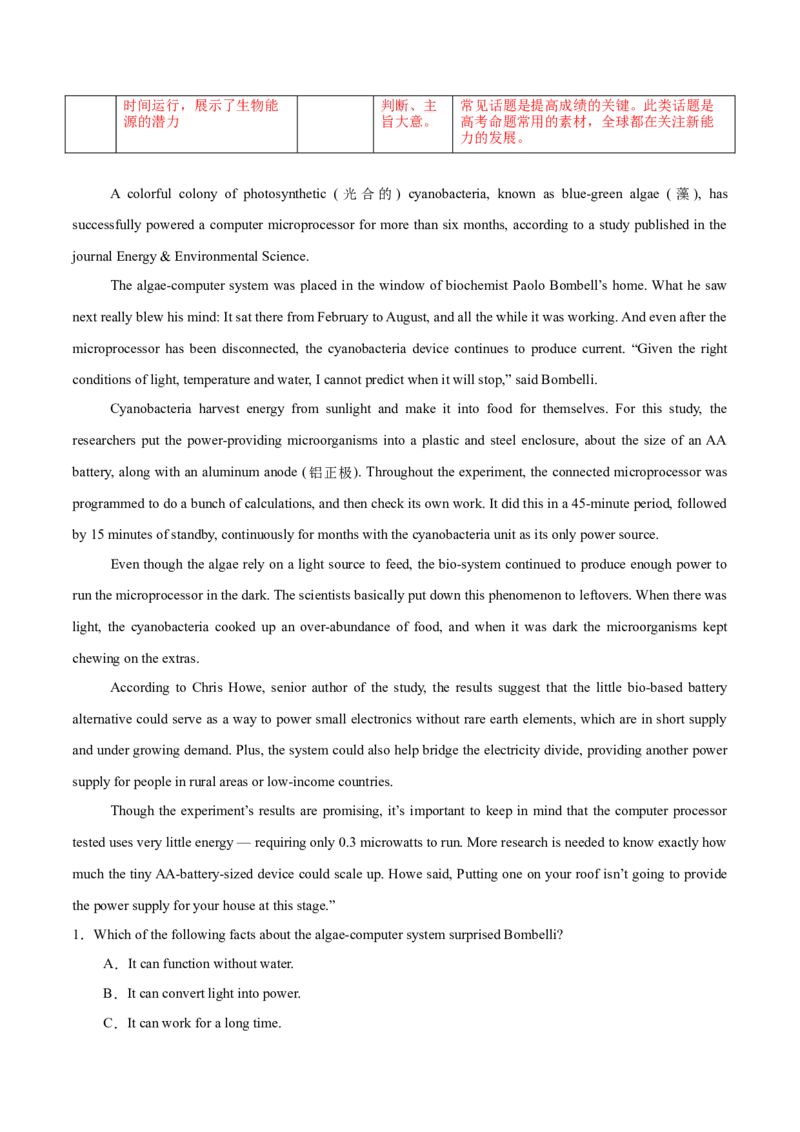
375 由蓝绿藻驱动的计算机微 说明文 细节理 可持续性新能源类说明文是英语阅读理解
处理器系统,该系统能长 解、推理 中的重要题型,掌握其结构、语言特点和时间运行,展示了生物能 判断、主 常见话题是提高成绩的关键。此类话题是
源的潜力 旨大意。 高考命题常用的素材,全球都在关注新能
力的发展。
A colorful colony of photosynthetic ( 光合的) cyanobacteria, known as blue-green algae ( 藻), has
successfully powered a computer microprocessor for more than six months, according to a study published in the
journal Energy & Environmental Science.
The algae-computer system was placed in the window of biochemist Paolo Bombell’s home. What he saw
next really blew his mind: It sat there from February to August, and all the while it was working. And even after the
microprocessor has been disconnected, the cyanobacteria device continues to produce current. “Given the right
conditions of light, temperature and water, I cannot predict when it will stop,” said Bombelli.
Cyanobacteria harvest energy from sunlight and make it into food for themselves. For this study, the
researchers put the power-providing microorganisms into a plastic and steel enclosure, about the size of an AA
battery, along with an aluminum anode (铝正极). Throughout the experiment, the connected microprocessor was
programmed to do a bunch of calculations, and then check its own work. It did this in a 45-minute period, followed
by 15 minutes of standby, continuously for months with the cyanobacteria unit as its only power source.
Even though the algae rely on a light source to feed, the bio-system continued to produce enough power to
run the microprocessor in the dark. The scientists basically put down this phenomenon to leftovers. When there was
light, the cyanobacteria cooked up an over-abundance of food, and when it was dark the microorganisms kept
chewing on the extras.
According to Chris Howe, senior author of the study, the results suggest that the little bio-based battery
alternative could serve as a way to power small electronics without rare earth elements, which are in short supply
and under growing demand. Plus, the system could also help bridge the electricity divide, providing another power
supply for people in rural areas or low-income countries.
Though the experiment’s results are promising, it’s important to keep in mind that the computer processor
tested uses very little energy — requiring only 0.3 microwatts to run. More research is needed to know exactly how
much the tiny AA-battery-sized device could scale up. Howe said, Putting one on your roof isn’t going to provide
the power supply for your house at this stage.”
1.Which of the following facts about the algae-computer system surprised Bombelli?
A.It can function without water.
B.It can convert light into power.
C.It can work for a long time.D.It can stand high temperatures.
2.What can we learn about the bio-system from paragraph 4?
A.It stores light for later use.
B.It works normally in the dark.
C.It consumes little food in the dark.
D.It produces food for people.
3.What will the research focus on next?
A.How the device will work on the roof
B.Whether the device’s size can be reduced.
C.Whether the device can play a bigger role.
D.How the device will adapt to new environments.
4.What is the best title for the passage?
A.The Future of Household Electricity Supply
B.Blue-Green Algae: A New Source of Food
C.An Algae-Powered Device Runs Computer for Months
D.A Promising Bio-Battery Creates the Miracle
押题3
词数 话题 体裁 考点 押题理由
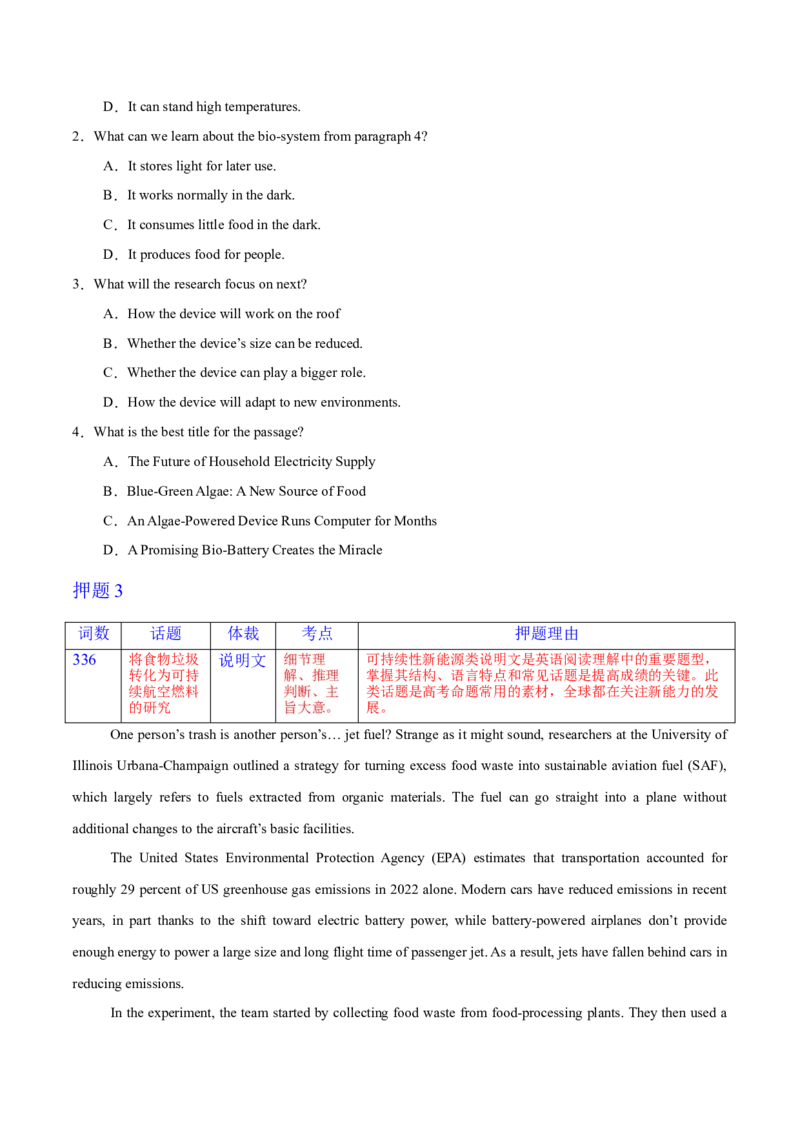
336 将食物垃圾 说明文 细节理 可持续性新能源类说明文是英语阅读理解中的重要题型,
转化为可持 解、推理 掌握其结构、语言特点和常见话题是提高成绩的关键。此
续航空燃料 判断、主 类话题是高考命题常用的素材,全球都在关注新能力的发
的研究 旨大意。 展。
One person’s trash is another person’s… jet fuel? Strange as it might sound, researchers at the University of
Illinois Urbana-Champaign outlined a strategy for turning excess food waste into sustainable aviation fuel (SAF),
which largely refers to fuels extracted from organic materials. The fuel can go straight into a plane without
additional changes to the aircraft’s basic facilities.
The United States Environmental Protection Agency (EPA) estimates that transportation accounted for
roughly 29 percent of US greenhouse gas emissions in 2022 alone. Modern cars have reduced emissions in recent
years, in part thanks to the shift toward electric battery power, while battery-powered airplanes don’t provide
enough energy to power a large size and long flight time of passenger jet. As a result, jets have fallen behind cars in
reducing emissions.
In the experiment, the team started by collecting food waste from food-processing plants. They then used achemical process called hydrothermal liquefaction (HTL) to extract crude oil (原油) from the food waste. After
that, they removed the impurities and other undesirable elements through a two-part process. What remained were
then refined into jet fuel, SAF.
The fuel passed the screening test and met industry requirements. Some estimates suggest that SAF could
reduce emissions by up to 80 percent, compared to conventional jet fuel. The finding opens up the possibility to
help the aviation industry achieve net-zero carbon emissions within the next three decades. “In a linear economy,
we just produce something, use it, and throw it away. In this project, we take the waste and recover the energy and
materials to make a usable product. This fills a missing link in the circular economy,” the professor Yuanhui Zhang
in the university said.
The research helps solve the science and engineering problems. It is a first step to show aviation fuel
extracted from food waste is possible. Actually making enough of it to supply an entire passenger jet, however, is
another beast altogether. Scaling up at this level needs time, resources, and deep pockets outside of academia.
1.How does the author present the need to solve aircraft pollution?
A.By giving examples. B.By quoting an expert.
C.By defining a concept. D.By making a comparison.
2.What is paragraph 3 mainly about?
A.Why HTL is used. B.How SAF is made.
C.What biofuel refers to. D.Where crude oil is from.
3.Why does the author quote Yuanhui Zhang’s words?
A.To define a new type of economy model.
B.To present the test results of the jet fuel.
C.To stress the sustainability of SAF production.
D.To confirm SAF’s effect on emission reduction.
4.What can we learn about the new fuel according to the last paragraph?
A.Its application is around the corner.
B.Its academic research hits a bottleneck.
C.Its mass production needs much investment.
D.Its success relies on international cooperation.
押题4
词数 话题 体裁 考点 押题理由298 可再生能源 说明文 细节理 可持续性新能源类说明文是英语阅读理解中的重要题型,
发展情况及 解、推理 掌握其结构、语言特点和常见话题是提高成绩的关键。此
意义 判断、词 类话题是高考命题常用的素材,全球都在关注新能力的发
义猜测。 展。
A report from Ember, a research group, found that in the first half of 2025, renewable energy produced more
electricity than coal did across the world. Renewable energy comes from natural sources that don’t run out, such as
the Sun or wind. Coal has been the main way to make electricity on Earth for more than 100 years. Formed over
millions of years from dead plant matter, the black lump is burned in power stations to heat water and create steam.
This turns structures called turbines (涡轮机), and the energy from the movement is turned into electricity.
When coal is burned, it releases gases including carbon dioxide, which contributes to climate change.
Scientists say humans must reduce their use of fossil fuels, such as coal, oil, and gas, in order to stop climate
change from getting worse. One step people are taking is using electric vehicles instead of cars fueled by gas. But if
the electricity used to charge the vehicles is still generated from coal, it will not be beneficial to the planet.
The first half of 2025 marked a milestone in global energy: renewable sources accounted for 34.3% of
electricity generation, exceeding coal at 33.1%. This change was primarily driven by reduced coal use in China and
India, the world’s top electricity consumers. Critically, this development contributed to a 4.5% drop in power sector
carbon emissions globally, showing its environmental impact. The growth was led by a rapid growth in solar and
wind, which together supplied a record 18.2% of global electricity, with China alone accounting for over half of the
new solar capacity.
“We are seeing the first signs of a crucial shift,” said Malgorzata Wiatros-Motyka from Ember. “Solar and
wind are now growing fast enough to meet the world’s growing appetite for electricity.”
1.What do the underlined words “the black lump” in paragraph 1 refer to?
A.Solid coal.
B.Dead plant matter.
C.Power from turbines.
D.Energy from the movement.
2.Why do scientists suggest reducing the use of fossil fuels?
A.To make electric vehicles more popular.
B.To lower the cost of generating electricity.
C.To prevent the worsening of climate change.
D.To better study the effects of carbon dioxide.
3.How does the author support the main argument in paragraph 3?A.By sharing personal stories.
B.By detailing new technologies.
C.By quoting leading energy experts.
D.By listing key data and national cases.
4.What is the main message conveyed by Malgorzata Wiatros-Motyka?
A.Global electricity demand is expected to decline soon.
B.The transition to renewable energy is becoming a reality.
C.Coal will remain the dominant energy source for decades.
D.Renewable energy is insufficient for future electricity needs.
二、科技与电子垃圾类
押题1
词数 话题 体裁 考点 押题理由
310 人工智能增 说明文 细节理 电子垃圾类说明文是英语阅读理解中的重要题型,掌握其
加电子垃圾 解、词句 结构、语言特点和常见话题是提高成绩的关键。此类话题
猜测、主 是高考命题常用的素材,人工智能增加了电子垃圾。
旨大意。
Every time generative artificial intelligence drafts an e-mail or makes an image, the planet pays for it. AI
consumes much electricity. And a recent research identifies another concern: AI’s contribution to the world’s
mounting mass of electronic waste. The study found that generative AI applications alone could add 1. 2 million to
5 million metric tons of trash to the planet by 2030, which definitely exacerbates the global e-waste problem.
However, few countries legally require proper handling of e-waste, and those that do often fail to apply their
existing laws on it. Twenty-five U. S. states have e-waste management policies, but there is no law that requires
electronics recycling. In 2024 Ed Markey introduced a bill that would require agencies to develop standards for
AI’s environmental impacts, including e-waste, but it has not passed. Some countries propose a reporting system,
but it would be voluntary. Worse still, some countries even witness the absence of relevant laws.
There are still solutions. Companies that use AI have a great number of options to limit e-waste. It’s possible
to make hardware last longer through regular checks and updates, reuse old devices for less demanding tasks, or fix
and reuse old parts—this cuts waste by 42%. Combining these with more efficient chip and program design could
reduce e-waste by 86%.
Yet there’s another wrinkle as well: AI products tend to be trickier to recycle than standard electronics. “The
core issue lies in the fact that the former are often loaded with private user information that demands securehandling,” says Kees Balde, an e-waste researcher. He also points out tech giants like Microsoft and Google have
the financial resources to both wipe such data and properly treatment of their electronics. “Undoubtedly, this
process adds to the overall expense,” Balde comments on large-scale e-waste recycling, “but the benefits to the
public far outweigh the costs involved.”
1.What does the underlined word “exacerbates” in paragraph 1 mean?
A.Eliminates. B.Worsens. C.Causes. D.Tackles.
2.What does paragraph 2 mainly talk about?
A.How countries cope with e-waste.
B.The harm caused by global e-waste.
C.Global e-waste management is poorly regulated.
D.What individuals should do to approach e-waste.
3.How can companies reduce e-waste?
A.By designing more efficient chips and programs.
B.By cooperating with e-waste recycling organizations.
C.By extending hardware life-span and design efficiency.
D.By prohibiting the development of new AI technologies.
4.What makes AI products harder to recycle?
A.Its insecure handling procedures.
B.Its more complex hardware structures.
C.Its tendency to get infected with virus.
D.Its substantial customers’ data storage.
押题2
词数 话题 体裁 考点 押题理由
290 回收利用废旧锂电池变得至关 说明文 细节理 电子垃圾类说明文是英语阅读理解中的重
重要,它既能减少环境危害又 解、推理 要题型,掌握其结构、语言特点和常见话
能节约资源,尽管面临挑战, 判断、 题是提高成绩的关键。此类话题是高考命
但仍是未来的经济机遇 题常用的素材,人工智能增加了电子垃
圾。
The rapid rise of electric vehicles and portable electronics has made lithium a critical resource. As the world
moves toward clean energy, recycling used lithium batteries has become essential. New research from Edith Cowan
University (ECU) shows that using old batteries as a secondary source of lithium not only reduces environmental
harm but also ensures a steady supply of this valuable material, supporting a sustainable future.Experts predict the global lithium-ion battery market will grow quickly, reaching billions of dollars in value
within a few years. However, most batteries are discarded while still holding a large amount of usable energy. In
fact, when batteries are no longer suitable for electric vehicles, they often retain up to 80 percent of their lithium
capacity. Instead of being wasted, these batteries could be recycled to recover lithium, nickel, and cobalt.
Recycling offers clear environmental advantages compared to traditional mining. Mining lithium causes
significant land damage, water pollution, and high carbon emissions. In contrast, recycling produces far fewer
greenhouse gases, uses less energy and water, and avoids harmful chemical releases. Additionally, the lithium
recovered through recycling is already highly purified, saving further processing costs.
Despite these benefits, challenges remain. The fast pace of technological innovation makes it difficult for
policies and recycling methods to keep up. Moreover, the changing chemical composition of batteries complicates
the recycling process. To build a successful circular economy, investment in proper infrastructure is urgently
needed. Fortunately, some companies are already exploring effective ways to recycle batteries and turn waste into
wealth.
In conclusion, recycling “dead” batteries is not just an environmental necessity but also an economic
opportunity. By addressing current challenges and investing in better systems, we can reduce pollution, save
resources, and create a cleaner, more sustainable world.
1.What is the main advantage of recycling lithium batteries mentioned in the text?
A.It increases the speed of electric vehicles.
B.It reduces environmental harm and saves resources.
C.It makes batteries last longer in devices.
D.It lowers the cost of producing new electronics.
2.Why are many discarded batteries still valuable?
A.They contain rare metals like gold and silver.
B.They can be directly reused in electric vehicles.
C.They still hold a large amount of usable energy.
D.They are easier to transport than new batteries.
3.What challenge does the text highlight about battery recycling?
A.There is not enough demand for recycled materials.
B.Recycling plants are too far from battery users.
C.People are unwilling to return old batteries.
D.Policies and technology struggle to keep up with changes.4.What can be inferred about the future of battery recycling?
A.It will replace all traditional mining activities soon.
B.It requires cooperation between companies and governments.
C.It will become unnecessary as new energy sources emerge.
D.It is only profitable in countries with large lithium reserves.
三、科技与处理微塑料污染类
押题1
词数 话题 体裁 考点 押题理由
362 海洋微塑料对海洋 说明文 细节理解 环境保护是当今全球关注的焦点问题之一。随着工
生物和人类健康构 业化、城市化的快速发展,环境污染、资源枯竭、
推理判断
成威胁,以及一种 气候变化等问题日益严重,威胁着人类的生存和发
可降解新材料有望 展。环境保护类说明文旨在探讨环境问题的成因、
解决此问题 影响及解决方案,呼吁人们关注环境问题并采取行
动。因此,环境保护类话题成为考试中的热门押题
方向。
Ocean microplastics (微塑料) have grown into one of the top environmental threats in the 21st century, with
tiny plastic pieces spreading to every corner of the global ocean at an alarming rate.
These microplastics, usually less than 5 millimeters in size, come from broken-down plastic products,
microbeads in daily chemicals and unprocessed industrial plastic waste. They harm sea life in various ways: many
marine animals mistake them for food and eat them, leading to digestive failure and even death, and they stick to
sea creatures’ bodies, affecting their normal activities and reproduction. What’s worse, microplastics enter the
marine food chain and accumulate in marine organisms, finally bringing serious potential health risks to humans
who eat seafood.
To solve this urgent problem, an international team of scientists spent five years researching and developing
a new biodegradable (可降解的) material to replace traditional petroleum-based (石油基的) plastics. The material
is made from natural plant waste like corn stalks, rice straw and wheat bran — low-cost and widely available
agricultural by-products that make it easy to produce on a large scale. It looks and works just like common plastic,
being light, tough and waterproof, and can be processed into various daily products. Its biggest advantage is that it
can break down completely in seawater within six months under the action of marine microorganisms, turning into
harmless organic substances, unlike traditional plastic that stays in the ocean for hundreds of years and causes
lasting pollution.
Laboratory tests in different marine environments and large-scale sea trials in the Pacific and Atlantic Oceans
have achieved great success. The tests prove the material is safe for all sea creatures, from tiny plankton to largemarine mammals, and it does not change seawater’s natural chemical conditions like pH value and salinity. Thanks
to its excellent performance and environmental friendliness, many world-famous companies in food, packaging and
daily necessities industries have begun to use it for food packages, shopping bags and disposable tableware. Experts
believe this material is a crucial turning point in ocean protection; with wider use, it will greatly cut plastic waste
entering the ocean and help build a cleaner, healthier ocean ecosystem for humans and marine wildlife.
1.Why are ocean microplastics harmful?
A.They raise the temperature of seawater.
B.They destroy global food production.
C.They threaten sea life and human health.
D.They reduce the number of sea plants.
2.What can we infer about the new material?
A.It is hard to produce in large amounts.
B.It has practical use in daily life.
C.It has replaced all traditional plastics.
D.It can break down in any polluted water.
3.What is experts’ attitude to the new material?
A.Doubtful and careful. B.Hopeful and positive.
C.Worried and uncertain. D.Uninterested and calm.
4.What is the function of the first paragraph?
A.To show the writing background. B.To introduce the main character.
C.To describe a serious problem. D.To give some useful suggestions.
押题2
词
话题 体裁 考点 押题理由
数
302 洗碗会使塑料容器 说明文 细节理解 环境保护是当今全球关注的焦点问题之一。随着工业
释放微塑料进入废 化、城市化的快速发展,环境污染、资源枯竭、气候
推理判断
水,虽总量相对较 变化等问题日益严重,威胁着人类的生存和发展。环
低、污水处理厂可 境保护类说明文旨在探讨环境问题的成因、影响及解
去除大部分,但仍 决方案,呼吁人们关注环境问题并采取行动。因此,
有泄漏,需从源头 环境保护类话题成为考试中的热门押题方向。
采取措施减少污
染。
It’s no secret that microplastics have already come into our lives. They can stem from daily tasks like
cooking and cleaning. Now, research is pointing to the previously unexplored impact of dishwashing onmicroplastic pollution.
A new study has revealed that washing plastic containers in a dishwasher releases plastic particles (颗粒),
which proceed to enter wastewater. Although the study confirmed that the release of microplastics in dishwashers is
relatively low compared to other sources of microplastic pollution, it could still impose consequences on the
environment.
The study found that a single dishwasher cycle with a full load of common plastic items could release about
920,000 microplastic particles into wastewater. This ultimately adds up to 33 million particles per household per
year globally. Although this number may sound frightening, this plastic mass only equates to “about a quarter of the
weight of a grain of rice,” according to a statement on the study.
Regardless, microplastics from dishwashers eventually end up in a wastewater treatment plant, which can
remove more than 90 percent of microplastics from wastewater. However, the filters (过滤器) here are not perfect,
as millions of microplastics can still slip through and adversely affect the environment.
Even though dishwashers may not be the biggest concern in terms of microplastic pollution, the fact that
millions of households regularly use them increases the environmental risks. However, strategies to limit
microplastic pollution from dishwashing and other household tasks have been suggested. Filters fitted on
dishwashers to catch microplastics before they enter wastewater could be a possibility in the future.
“Removing this pollutant before it can enter the environment is better than taking costly measures after it has
already been released,” said author Elvis Okofio, a research fellow at the University of Queensland. “Small changes
can help reduce the global burden of plastic pollution.”
1.What can we learn about dishwashing from paragraph 1?
A.It has grown more complicated. B.It’s a source of microplastic pollution.
C.Its plastic pollution is out of control. D.It unexpectedly pollutes our kitchens.
2.What can be inferred about microplastics from dishwashers?
A.Their total amount is relatively low.
B.They hardly affect the environment.
C.They pose a huge threat to human health.
D.They contain a small number of particles.
3.What is a problem of the wastewater treatment plant?
A.It fails to perfect its management. B.It does not have enough filters.
C.It lets many microplastics escape. D.It can’t remove microplastics from water.
4.What is Okofio’s suggestion for limiting microplastic pollution?A.Improving filter technology. B.Stopping using plastic containers.
C.Reducing the use of water. D.Preventing release from the source.
押题3
词数 话题 体裁 考点 押题理由
322 塑料垃圾在海洋 说明文 推理判 环境保护是当今全球关注的焦点问题之一。随着工业
中形成的新型生 断、细节 化、城市化的快速发展,环境污染、资源枯竭、气候
态系统“塑料 理解。 变化等问题日益严重,威胁着人类的生存和发展。环
圈”的定义、形 境保护类说明文旨在探讨环境问题的成因、影响及解
成过程、生态影 决方案,呼吁人们关注环境问题并采取行动。因此,
响及应对方法 环境保护类话题成为考试中的热门押题方向。
Consider a plastic bottle floating on the ocean’s surface, far from the coast. To the naked eye, it seems
lifeless — just discarded waste floating on the waves. But up close, it is a lively habitat: bacteria gather in large
groups, green seaweed grows into thin layers, small creatures live in water feed, and small shellfish attach firmly.
This is the plastisphere, a new ecosystem formed by human waste — a term invented by marine microbiologist
Linda Amaral-Zettler more than ten years ago, referring to unique groups of species living on plastic waste.
Unlike natural materials such as driftwood, which break down in months, plastics never fully degrade. They
can last for up to 1,000 years, breaking into small pieces instead of disappearing completely. This long-lasting
feature makes plastic a stable living place for marine creatures. The process of species settling on plastic follows a
regular order: first, bacteria arrive and settle down, sending out chemical signals to draw other tiny organisms and
forming sticky layers. Soon after, algae (藻类) and fungi (真菌) join in, building simple food chains. Later, larger
organisms like barnacles come, and some use plastic as safe places to raise their young.
The movement of the plastisphere is worrying — ocean currents carry plastic across different regions, acting
as “microbial roads” that transport species, including harmful bacteria and poisonous algae, to new ecosystems. In
these sticky layers, harmful microbes exchange genetic material, becoming more dangerous or resistant to drugs.
Although some microbes in the plastisphere may break down pollutants, the ability of this ecosystem to adapt also
brings ecological damage.
Studies on the plastisphere confirm a simple fact: the only long-term solution is to reduce plastic production
and our dependence on it in order to prevent pollution. It shows the adaptability of life and warns us of unexpected
results — our desire for convenience has changed ocean life in ways we still do not fully understand.
1.What does the underlined word “plastisphere” mean in paragraph 1?
A.A type of plastic debris floating in oceans. B.A natural material that replaces plastic in oceans.
C.A group of marine microbes that break down plastic. D.A new ecosystem formed on plastic waste.2.Why can plastic become a stable habitat for marine life?
A.It releases nutrients that support marine organisms.
B.It is lighter than driftwood and easier to float.
C.It breaks down slowly and lasts for a long time.
D.It is less likely to be damaged by ocean currents.
3.What is the sequence of settlement on plastic debris?
A.Algae→bacteria→fungi→larger organisms B.Bacteria→algae→fungi→larger organisms
C.Fungi→bacteria→algae→larger organisms D.Larger organisms→bacteria→algae→fungi
4.What is the author’s attitude towards the plastisphere?
A.Concerned about its negative environmental impacts.
B.Optimistic that it will solve ocean pollution.
C.Doubtful that it really exists in natural oceans.
D.Excited about its potential for scientific research.
押题4
词数 话题 体裁 考点 押题理由
320 微塑料的来源、 说明文 推理判 环境保护是当今全球关注的焦点问题之一。随着工业
传播途径及对环 断、细节 化、城市化的快速发展,环境污染、资源枯竭、气候
境和人体的潜在 理解。 变化等问题日益严重,威胁着人类的生存和发展。环
危害 境保护类说明文旨在探讨环境问题的成因、影响及解
决方案,呼吁人们关注环境问题并采取行动。因此,
环境保护类话题成为考试中的热门押题方向。
Plastics are widely used in our daily lives, from packaging and clothing to medical tools and electronic
devices. However, in recent years, scientists have paid increasing attention to microplastics — tiny plastic pieces
smaller than 5 millimeters. These particles are often produced when larger plastic items break down over time,
especially under sunlight or pressure. They can also enter the environment directly through daily products such as
facial cleansers, clothes, or industrial waste.
In addition, factories and wastewater treatment plants release large amounts of microplastics into rivers and
oceans every day. Once in the environment, these small particles are difficult to remove. Over time, microplastics
have spread across the planet. They have been found in the cold Arctic, the deep Mariana Trench, and even on the
top of Mount Qomolangma. They are now a major part of marine pollution and can be eaten by sea animals like
fish and shellfish. Through the food chain, these plastics may eventually enter the human body, raising concerns
about their possible effects on health.
But the danger does not stop there. Microplastics are also present in the air we breathe. Research shows thatpeople, especially those living in cities, may take in microplastics through breathing. Tiny plastic fibers from
clothes, furniture, and traffic dust float in both indoor and outdoor air. Common plastic items — such as food
containers, cups, and baby bottles — can also release microplastics when heated or reused too many times.
Although most microplastics are too large to pass through the skin, they may still stay on the surface or carry
harmful chemicals. Some skin care products even contain plastic particles, increasing the chances of contact
through daily use.
Scientists have found that microplastics may harm human cells and lead to problems in the lungs, immune
system, or even brain. As research continues, it is important to understand the risks and reduce our exposure to
these tiny but widespread pollutants.
1.What is paragraph 2 mainly about?
A.How microplastics spread and harm nature.
B.Detailed steps of wastewater treatment.
C.The invention of plastic packaging.
D.The plastic pollution in the ocean.
2.What can we learn about human exposure to microplastics?
A.It is linked to daily matters people may not even notice.
B.It can be avoided by moving to countryside areas.
C.It mainly results from working in plastic factories.
D.It increases when people touch seawater directly.
3.Why are microplastics considered particularly dangerous?
A.They make plastic goods more expensive to produce.
B.They pose health risks while being hard to detect.
C.They are large enough to be easily noticed.
D.They cause direct death of marine animals.
4.Which could be the best title for the text?
A.Daily Products That Make Life Easier
B.How Air Pollution Is Worse Than We Think
C.The Growth Of Plastic Production Worldwide
D.Microplastics: A Threat With A Huge Impact
押题5
词数 话题 体裁 考点 押题理由297 国科研团队研发 说明文 推理判 环境保护是当今全球关注的焦点问题之一。随着工业
的新型可重复使 断、细节 化、城市化的快速发展,环境污染、资源枯竭、气候
用、可生物降解 理解。 变化等问题日益严重,威胁着人类的生存和发展。环
泡沫,能高效去 境保护类说明文旨在探讨环境问题的成因、影响及解
除水中微塑料及 决方案,呼吁人们关注环境问题并采取行动。因此,
其相关研究与应 环境保护类话题成为考试中的热门押题方向。
用前景
Small plastic particles in water have become one of the most concerning consumer pollutants because they
are widely found in various water sources. A Chinese research team has developed a new method to remove these
microplastics, which negatively affect human health.
A study published on Saturday in the journal Science Advances introduced a new reusable and biodegradable
foam that can capture microplastics in water with an efficiency of up to 99.8% in its first use. Researchers from
Wuhan University and Huazhong University of Science and Technology used a sustainable fibrous foam made from
chitin(几丁质) from squid bone and cellulose(纤维素) obtained from cotton. This foam has a hole-filled
structure that can attract and interact with various types of microplastics commonly present in electronics, food
packaging, textiles, and other industrial products.
The team tested the foam’s performance using water samples from four real-world sources — irrigation
water, lake water, seawater, and pond water — to prove its effectiveness in natural water environments. In initial
tests, the foam captured nearly 100% of microplastics. After five usage cycles, the removal rate of this plant-based
material still exceeded 95%, demonstrating excellent reusable. According to the study, the material’s capturing
ability is largely unaffected by inorganic particles, heavy metals, organic pollutants, or microorganisms in the water.
“Microplastics entering land-based and aquatic environments will continue to increase for thousands of years
due to the alarming amount of plastic waste in the environment,” said Deng Hongbing from Wuhan University, the
corresponding author of the study. Deng added that the research indicates plant-based materials could offer an
economical solution for addressing the complex issue of microplastic pollution in water.
The research team has already patented for this technology and hopes to introduce it into real-world water
treatment systems or household water purifiers in the near future.
1.What enabled the new foam to achieve 99. 8% initial removal efficiency?
A.Its cellulose film. B.Its squid-bone frame.
C.Its hole-filled structure. D.Its biodegradable property.
2.The researchers tested the foam in water samples from four real-world sources to ________.
A.compare the pollution levels of different water bodies.B.prove its effectiveness in simulated laboratory conditions.
C.identify which water source contains the most microplastics.
D.verify its performance in natural and complex aquatic systems.
3.What can be inferred from Deng Hongbing’s statement about plant-based materials?
A.They can provide a highly cost-effective approach.
B.They are the only solution to microplastic pollution.
C.They are too expensive to be widely used at present.
D.Their effectiveness is limited to specific microplastics.
4.What is the research team’s attitude towards their technology?
A.Uncertain and hesitant. B.Pessimistic and doubtful.
C.Confident and ambitious. D.Indifferent and disconnected.
四、科技与应对气候变化类
押题1
词数 话题 体裁 考点 押题理由
307 肯尼亚的图尔卡纳湖因 说明文 细节理解、 应对全球气候变化类阅读理解文章通常涉及
气候变化导致水位大幅 推理判断 人类活动对气候的影响,危害人类的生存发
下降,强调了气候变化 展。因此,气候变化类阅读理解在考试中占
主旨大意
与地质活动之间的紧密 有重要地位。
联系
Lake Turkana in Kenya, often called the birthplace of humanity, is the world’s largest desert lake. Ancient
remains up to 4. 2 million years old from half a dozen human ancestor species have been found there, offering
precious clues to how our ancestors lived alongside diverse wildlife.
Thousands of years ago, the lake was far larger, stretching across vast areas and surrounded by thick green
grasslands. But between 4000 and 6000 years ago, a long period of drier climate brought about a dramatic change
— its water level dropped by 100 to 150 metres. This shift not only reshaped the landscape but also awakened long-
hidden geological forces beneath the lakebed.
A study led by Christopher Scholz and his team at Syracuse University reveals that the significant water
level drop reduced pressure on the lakebed, allowing crustal faults (地壳断层) to slip more easily. The research
team examined 27 underwater faults, finding that fault sides moved past each other at an average rate of 0. 17
millimetres per year.
The reduced water weight had another profound effect, which enabled magma (岩浆) deep below the Earth’scrust to rise more freely. “It’s like opening a bottle of soda — less pressure makes magma much more likely to
erupt,” says Ken Macdonald, a geologist from the University of California, Santa Barbara. Notably, one of the
lake’s three volcanic islands erupted in 1888, an event closely linked to these long-term geological shifts.
While climate change-driven rainfall is now raising the lake’s water levels again, researchers warn it will
take thousands of years to significantly reduce the increased earthquake and volcanic activity. The study
emphasizes that global geological risk assessments must now consider how climate change alters lake water levels
— a clear and urgent connection between human-driven environmental shifts and the dynamic forces of the planet’s
crust beneath our feet.
1.What can we infer about the dramatic change of Lake Turkana 4000-6000 years ago?
A.Landscape changed for the better. B.Change was mainly due to climate.
C.Lake expansion created grasslands. D.human ancestors caused the change.
2.What did Scholz’s team find about the underwater faults?
A.Lower water levels completely stop fault slip.
B.Fault slip often leads to a drop in water levels.
C.Faults slip 0. 17 millimetres per year on average.
D.Twenty-seven underwater faults exist in the lake.
3.Why does Ken Macdonald give the example of opening a bottle of soda?
A.To describe the power of volcanic eruptions.
B.To show volcanic eruptions are unpredictable.
C.To explain how pressure change causes an eruption.
D.To illustrate the similarity between soda and magma.
4.What is the best title for the passage?
A.Climate Shifts: A Driver of Geological Changes
B.Lake Turkana: A Witness to Ancient Geological Shifts
C.Underwater Faults: Key Links to Volcanic Activity Risks
D.Human Activities: Reshapers of Earth’s Crust Movements
押题2
词数 话题 体裁 考点 押题理由
348 非洲森林从吸收二氧化碳 说明文 细节理解、 应对全球气候变化类阅读理解文章通常涉及
的碳汇转变为排放二氧化 词义猜测。 人类活动对气候的影响,危害人类的生存发
碳的碳源的变化,这一根 推理判断 展。因此,气候变化类阅读理解在考试中占
本性转变加剧了全球应对 有重要地位。气候变化的挑战
African forests and shrubby woodlands have previously been one of the world’s biggest carbon sinks,
accounting for 20 percent of all the CO taken up by plants. The lion’s share of this is in the Congo rainforest, the
2
second largest forest in the world after the Amazon. Sometimes called the “lungs of Africa”, it absorbs an estimated
600 million tons of CO per year. However, forests on the continent are now emitting more carbon dioxide than
2
they absorb, a fundamental shift that will make it more difficult for the world to cut its net emissions to zero.
Now, researchers have found that after gaining biomass (生物量) from 2007 to 2010, African forests lost 106
million tons of biomass per year from 2011 to 2017. That is equal to roughly 200 million tons of CO emissions per
2
year. This was driven by logging in the Congo rainforest, says Heiko Balzter at the University of Leicester, UK. “If
we are losing the tropical forests as one of the means of mitigating climate change, then we basically have to
reduce our emissions of greenhouse gases from fossil fuel burning even faster to get to near-zero emissions.”
Balzter and his team estimated the amount of biomass with satellite measurement of the color and water
content of the forest canopy (树冠), as well as its height at certain points. But Simon Lewis at University College
London says satellite data can’t detect the type of trees in a forest and isn’t reliable for estimating the carbon
absorbed by high-biomass undamaged forests or emitted in forests degraded by selective logging.
At the COP30 climate summit in November, Brazil announced the tropical Forests Forever Facility, a fund
that will pay its investment returns to tropical countries at $4 per hectare of forest left standing. But so far countries
have donated only $6.6 billion to the fund, far short of the $25 billion goal. “It’s really important to make this
tropical Forest Forever Facility work, to try to turn around this trend of the African tree biomass actually emitting
carbon into the atmosphere,” says Balzter.
1.What change does the author mention about African forests?
A.They are larger than before. B.They are producing more CO .
2
C.They are thicker than before. D.They are absorbing more CO .
2
2.What does the underlined word “mitigating” in paragraph 2 mean?
A.Slowing. B.Ignoring. C.Worsening. D.Measuring.
3.What can be inferred about the satellite measurement?
A.It can identify the type of trees in a forest.
B.It is mainly used for observing illegal logging.
C.It has some limitations in biomass assessment.
D.It is widely accepted by most climate scientists.
4.Why is the tropical Forests Forever Facility significant?A.It supports a lot of poor African countries.
B.It has raised enough money to protect tropical forests.
C.It may turn the tide on African forests carbon releasing.
D.It contributes to investing new projects in tropical areas.
押题3
词数 话题 体裁 考点 押题理由
342 树木树皮中的微生物可以消耗 说明 细节理解、 应对全球气候变化类阅读理解文章通常
氢气、甲烷、一氧化碳等影响 文 涉及人类活动对气候的影响,危害人类
词义猜测
气候的气体,帮助应对气候变 的生存发展。因此,气候变化类阅读理
化,以及相关研究发现和植树 推理判断。 解在考试中占有重要地位。
造林的启示
Trees are known for absorbing carbon dioxide as they grow. However, recent research reveals a hidden
function of trees: their bark hosts countless microbes that consume other climate-active gases.
The tree bark microbes feed on hydrogen, methane and carbon monoxide, researchers report January 8 in
Science. As for trapping heat, methane is a greenhouse gas 28 times more potent than carbon dioxide over a 100-
year period. Carbon monoxide and hydrogen enhance global warming indirectly, by helping methane persist longer
in the atmosphere. Globally, tree bark covers an estimated 41 million square kilometers, with about six trillion
microbes per square meter. “This is a hidden benefit of trees we previously didn’t realize,” says Luke Jeffrey, a
biogeochemist at Southern Cross University in Australia.
The discovery emerged from long-term research on methane sources. Initially, scientists found that methane
emissions from Amazon flooded areas were only half the expected amount. Then in 2017, it was discovered that
half of the region’s methane seeped from tree trunks instead of the ground. While trees were once seen as passive
chimneys releasing soil methane, a 2021 study by Jeffrey’s team found that bark microbes reduce methane
emissions by about 35% by oxidizing it for energy.
In follow-up work, researchers analyzed microbial genomes in eight Australian tree species. They found
hydrogen-oxidizing microbes were most common, followed by methaneand carbon monoxide-consuming types.
Experiments confirmed that bark microbes not only digest gases within trees but also draw trace amounts of these
gases from the air. Though atmospheric concentrations are low (2 parts per million to 40 parts per billion), scaled
globally, tree microbes remove millions of tons of these gases annually.
This hidden function strengthens trees’role in fighting climate change. Since different tree species host
distinct microbial communities, reforestation efforts could prioritize species that maximize removal of multiplegreenhouse gases. “You’re not just thinking about the tree you’re planting, but also the microbes within the tree,”
Chris Greening, one researcher participating in the study notes, “You can ideally get rid of three or four climate-
active gases for the price of one.”
1.What is the role of bark concerning climate change?
A.Absorbs carbon dioxide directly. B.Blocks harmful gas emissions.
C.Contains microbes eating climate gases.D.Stores carbon dioxide internally.
2.What does the underlined word “potent” in paragraph 2 mean?
A.powerful. B.harmful. C.common. D.visible.
3.What can we learn from the research?
A.Amazon’s methane emissions matched earlier predictions.
B.Tree bark microbes raise methane emissions by using it for energy.
C.Hydrogen-oxidizing microbes are the rarest in Australian tree bark.
D.Tree microbes can take in small amounts of greenhouse gases from the air.
4.What is Chris Greening’s words mainly about?
A.The difficulty of studying tree microbes.
B.The benefits of planting trees with microbes.
C.The high cost of reducing greenhouse gases.
D.The need to focus only on trees, not microbes.
押题4
词数 话题 体裁 考点 押题理由
361 植树对气候总体有益,但不同 说明文 细节理 应对全球气候变化类阅读理解文章通常
地区的温度影响差异显著,在 解、 涉及人类活动对气候的影响,危害人类
炎热潮湿地区植树能带来最强 的生存发展。因此,气候变化类阅读理
主旨大
的降温效果,并解释了其原理 解在考试中占有重要地位。
意。
More trees will cool the climate and control fires, but mainly if planted in hot, wet areas, according to a new
UC Riverside (UCR) study. The study, published in Climate and Atmospheric Science, found that tree planting is
generally a net positive for the climate because it helps pull warming carbon out of the atmosphere. However, local
effects on temperature not related to carbon varied significantly by region. At higher latitudes (纬度), trees could
have a slight heating effect, while the opposite is true in hot, wet areas.
“Our study found greater cooling effects from planting in warm, wet regions, where trees grow throughout
the year. Trees there not only pull carbon dioxide from the air, they also cool while releasing water vapor,” said
study first author and UCR graduate student James Gomez. “It’s not that planting elsewhere doesn’t help — it does— but these warm areas offer the strongest returns per tree.”
These findings mirror the results of an earlier UCR study that shows planting trees could cool the surface of
the planet even more than previously expected. While that study factored in the chemical effects of trees interacting
with the atmosphere, this study places more emphasis on understanding the physical effects of tree planting.
These effects include “tree sweating”, or transpiration (蒸腾). Tree roots absorb water from the soil, which
then travels up through the trunk and into the leaves. When pores (气孔) in the leaves open up so the tree can take
in carbon dioxide for photosynthesis (光合作用), some of the water in the leaves evaporates into the air. This
process cools the air on Earth’s surface and cools the tree, too.
“It’s just like the way sweating cools your body,” Gomez said. “In warm, wet areas, there is constantly water
available for trees, and that increases transpiration.”
Trees can also reduce the amount of sunlight that reaches the planet’s surface. As they release water vapor,
the air can become more humid. More humidity can mean more clouds, and water vapor itself can absorb some sun.
Both of these effects reduce the amount of sun that reaches the ground, giving a cooling effect.
1.What does the study reveal about tree planting in different regions?
A.Carbon absorption is weaker in high latitudes than hot areas.
B.Climate benefits overall, but temperature effects vary regionally.
C.It is only effective in hot, wet areas and has no benefits elsewhere.
D.It has identical cooling effects regardless of the latitude where trees are planted.
2.How does the transpiration process mainly work?
A.By opening leaf pores to let water out.
B.By changing sunlight into food for the tree.
C.By adding water to the air without forming clouds.
D.By pulling water up from the soil through the trunk.
3.Hot, wet areas have the best cooling effect because of ______.
A.more leaf pores and less water in the air
B.constant water supply and slower tree growth
C.greater carbon storage and less sun bouncing back
D.year-round water release and more clouds forming
4.Which is the best title for the text?
A.Why All Tree Planting Helps the Climate
B.The Chemistry of Trees: Beyond Carbon StorageC.Where to Plant Trees for Maximum Climate Benefits
D.Trees and Carbon: A New Look at Forest Climate Effects
五、科技与应对环境变化类
押题1
词数 话题 体裁 考点 押题理由
304 文森特·加勒博受亚 说明文 细节理 随着自然环境的变化,人类生存的环境也发生
马逊王莲启发,设计 解、词义 了巨大变化,人类为了更好的生存,采用科技
出可持续漂浮城市 猜测。 手段改善生存环境。科技与应对环境变化类阅
Lilypad,以应对海 读理解文章成为热门话题,在考试中占有重要
平面上升问题 地位。
We can learn a lot from nature. Architect Vincent Callebaut looks to our environment as a guide for
designing his forward-thinking structures. His conceptual creation Lilypad is a prime example.
Lilypad is a floating island that draws inspiration from the gigantic Victoria amazonica, a species of water
lily known for having the largest leaves of any water plant. Their leaves can grow up to nearly 10 feet in diameter.
Similarly, Callebaut’s Lilypad is a massive self-sustaining structure surrounded by water. Lilypad is intended to
offer a solution to the rising sea levels for humans. It would function as a mobile, amphibious (水陆两栖的) city
that could accommodate up to 10, 000 inhabitants. The city would follow the ocean currents and adapt to natural
forces instead of working against them, as we do now, Eco-friendly at its core, Lilypad is designed to have a central
freshwater lagoon that would aid in rainwater collection and purification. Other areas of the structure would be set
up as the marina and mountain “zones” where people would work, shop, and be entertained. Layers of planned
housing would be surrounded by suspended gardens and crossed by a network of organically arranged streets.
The Lilypad design uses principles of biomimicry (仿生学), a practice that mimics the strategies used by
living organisms to solve human challenges. Callebaut has distinct ways in which he has applied biomimicry
fundamentals to Lilypad. One way is through its bionic structure.
“The structure takes up the radial (辐射状) and concentric geometry (同心式几何) shape of a water lily leaf,
making it float and distribute loads,” he explains, “a design that reduces the amount of materials to a minimum.”
“In short,” Callebaut concludes, “Lilypad transforms climate challenges into opportunities through a design
inspired by nature, where each element works in symbiosis (共生) with the environment.”
1.What is the key feature of Callebaut’s Lilypad?
A.It automatically purifies water. B.It functionally provides a shelter.
C.It constantly influences the ocean currents. D.It exactly meets the government’s requirements.
2.What do we know about using the principles of biomimicry?A.It is a project to solve the natural crisis.
B.It is a guide to restore the damaged situation.
C.It is a method to adopt the professional solutions.
D.It is an application to imitate the approaches from nature.
3.What can be inferred about Lilypad from the remarks of Callebaut?
A.Its design is based on the eco-friendly philosophy.
B.Its way of distribution proves effective and practical.
C.Its operation shows how to cut down on building materials.
D.Its structure highlights the importance of keeping balance.
4.What can be a suitable title for the text?
A.Nature Does Nothing in Vain
B.A Future Sample of Housing Rises to Fame
C.Sustainable Floating City is Inspired by Water Lily
D.Nature Guides the Design for a Forward-thinking Structure
押题2
词数 话题 体裁 考点 押题理由
386 利用回收玻璃砂制作 说明文 细节理 随着自然环境的变化,人类生存的环境也发生
人工岛以修复海岸生 解、推理 了巨大变化,人类为了更好的生存,采用科技
态系统的研究、实验 判断。 手段改善生存环境。科技与应对环境变化类阅
结果、潜在局限及后 读理解文章成为热门话题,在考试中占有重要
续观测计划 地位。
The open water of Bayou Bienvenue now hosts an island of native trees, grasses, and recycled glass. The
artificial island is helping researchers understand a new approach to coastal restoration.
Created by a team of scientists and a glass recycling company, the roughly 10-metre-diameter (直径) island
is made from a mix of glass ground into sand and Mississippi River sediment (沉积物). A second island next to it,
also dotted with plants, is made fully from sediment. The team wants to know if there are any differences in how
the plants grow to figure out if the glass sand mixture could be a workable material for restoring coastal
ecosystems.
Sea level rise and erosion (侵蚀) sweep away sediment and flood (淹没) plants along the coast. The
ecosystems there, such as wetlands and salt marshes (盐沼), act as a protection between storms and areas further
inland. To restore these damaged ecosystems, ecologists often rely on sediment collected nearby. But there’s alimited amount available, and the digging process can disturb surrounding habitats. By using glass sand instead,
restoration projects can reduce the amount of sediment required and chip away at another problem: Millions of
metric tons of glass end up in landfills each year instead of getting recycled.
According to a study by Sunshine Van Bael and her colleagues, wetland plants were grown in a greenhouse
in five-gallon buckets. These plants were grown in containers filled with Mississippi River mud (淤泥), glass sand,
or an even mix of both. The glass was progressively processed into different sizes. The plants grown in a coarse-
grained (粗粒的) glass-sediment mix exhibited similar growth characteristics to those grown in only sediment.
Another group’s study revealed that two salt marsh grasses native to Mississippi grew well in a fifty-fifty mix of
glass sand and fill soil, while one species grew even in a 75 percent glass sand mixture.
Researchers believe that the success of these studies suggests great promise. However, it is possible that this
method is not specific to each region, and research needs to be location-specific to determine the glass sand’s ideal
size and proportion across different coastlines.
Van Bael and her colleagues will keep a watchful eye on the islands in Bayou Bienvenue for the next five
years, with plans to create two more.
1.What problem does using glass sand help reduce?
A.The rising of sea level. B.The overflow of glass waste in landfills.
C.The pollution in the Mississippi River. D.The lack of storm-prevention systems.
2.Which of the following is true about Van Bael’s greenhouse study?
A.It was conducted in an open field.
B.It contained varied particle sizes of the glass.
C.It proved plants in pure glass sand grew better.
D.It found a grass thriving in a 75% glass sand mixture.
3.What is a potential limitation of the glass sand method?
A.Its long-term effects are unknown. B.It could potentially harm the plants.
C.It requires too much energy to produce.D.It calls for tailoring to different locations.
4.What is the researchers’ attitude towards the glass sand method?
A.Skeptical and critical. B.Neutral and indifferent.
C.Optimistic but cautious. D.Supportive without doubt.
押题3
词数 话题 体裁 考点 押题理由318 随着全球城市快速扩 说明 细节理 随着自然环境的变化,人类生存的环境也发生
张,城市热岛效应成为 文 解、推理 了巨大变化,人类为了更好的生存,采用科技
紧迫的环境挑战,阐述 判断。 手段改善生存环境。科技与应对环境变化类阅
其成因、危害,以及一 读理解文章成为热门话题,在考试中占有重要
些城市应对该问题的有 地位。
效措施和成功经验
Urban heat islands (UHIs) have become a pressing environmental challenge as cities expand rapidly
worldwide. These phenomena occur when built up areas — with concrete roads, glass skyscrapers, and minimal
green space-trap more heat than surrounding rural regions, raising urban temperatures by 2 to 8 degrees Celsius. A
2024 study published in Sustainable Cities and Society tracked 50 major cities across Asia, Europe, and North
America, finding that UHIs not only worsen heatwaves but also increase energy consumption for air conditioning
by 30%on average, making carbon emissions worse.
However, innovative urban planning is proving effective in easing this issue. The Chinese city of Shenzhen
has pioneered a “sponge city green corridor” model, integrating rooftop gardens, vertical forests on the outside of
buildings, and pavements that let rainwater sink into the ground. Over the past five years, these measures have
reduced local temperatures by 1.5 degrees and cut urban runoff by 40% during heavy rains. Similarly,
Copenhagen’s “cool neighborhoods” project replaced asphalt (沥青) with light-colored, heat-reflective materials
and expanded community parks, lowering summer temperatures in targeted areas by 2 degrees while improving
residents’ mental health, according to post-project surveys.
The key to success lies in balancing infrastructure development with ecological conservation. Researchers
emphasize that native plant species are particularly crucial-they require less water, support local biodiversity, and
absorb more heat than non-local plants. Moreover, community participation plays a vital role: in Berlin, residents’
initiatives to convert vacant lots into urban gardens have created over 120 small green spaces, each contributing to
UHI reduction while fostering social connections.
As cities continue to grow, addressing urban heat islands is no longer optional but essential for sustainable
development. The solutions — rooted in green infrastructure, smart design, and community engagement-
demonstrate that environmental protection and urbanization can coexist harmoniously. By learning from successful
cases worldwide, cities can turn the challenge of UHIs into an opportunity to build healthier, more resilient living
spaces.
1.What is the main cause of urban heat islands?
A.Excessive use of air conditioning. B.Light-colored reflective materials.
C.Waste gases from vehicles and factories. D.Lack of green space and overbuilt areas.2.How does Shenzhen reduce urban heat islands?
A.By expanding rural areas around the city. B.By establishing more high-rise buildings.
C.By using new heat-reflective materials on roads. D.By doing more greening and better water
management.
3.Why are native plant species recommended for urban greening?
A.Because they are more affordable to maintain. B.Because they grow faster than non-local plants.
C.Because they adapt better and absorb more heat. D.Because they attract more community participation.
4.What does the author imply in the last paragraph?
A.Growth and green goals can go together. B.Cities must stop growing to save nature.
C.Few cities succeed in fixing urban heat islands. D.Community involvement solves urban heat issues.
押题4
词数 话题 体裁 考点 押题理由
367 南极半岛因极端高温事 说明 细节理 随着自然环境的变化,人类生存的环境也发生
件,植被正以惊人速度 文 解、推理 了巨大变化,人类为了更好的生存,采用科技
扩张,导致“南极变 判断 手段改善生存环境。科技与应对环境变化类阅
绿”的现象,以及这一 读理解文章成为热门话题,在考试中占有重要
主旨大
变化对当地生态和未来 地位。
意。
景观的潜在影响
Parts of icy Antarctica are turning green with plant life at an alarming rate as the region is struck by extreme
heat events, according to new research, raising concerns about the changing landscape on this vast continent.
Vegetation (植被) covered less than 0.4 square miles of the Antarctic Peninsula in 1986 but had reached
almost 5 square miles by 2021, the study found. The rate at which the region has been greening over nearly four
decades has also been speeding up, increasing by more than 30% between 2016 and 2021.
“While the landscape is still almost entirely snow, ice and rock, this small, green area has grown dramatically
since the mid 1980s,” said Thomas Roland, an environmental scientist at the University of Exeter. “Our findings
confirm that the influence of climate change caused by humans has no limit in its reach. Even on the Antarctic
Peninsula — this most extreme, remote and isolated ‘wilderness’ region — the landscape is changing, and these
effects are visible from space.”
Antarctica, the coldest place on Earth, has recently been struck by extreme heat events. This summer, parts
of the continent experienced a record-breaking heat wave with temperatures climbing up to 50℉ above normal
from mid-July. In March 2022, temperatures in some parts of the continent reached up to 70°F above normal, the
most extreme temperature departures ever recorded in this part of the planet.The more the Peninsula greens, the more soil will form and the more likely the region will become more
favorable for invasive (侵入的) species, potentially threatening native wildlife. “Seeds, spores (孢子) and plant
parts can readily find their way to the Antarctic Peninsula on the boots or equipment of tourists and researchers, or
via more ‘traditional’ routes associated with migrating birds and the wind, so the risk here is clear,” Roland said.
“These impacts would likely only be local, but could help further speed up the growth of plant life as the climate
continues to warm,” said Olly Bartlett, a senior lecturer in remote sensing and geography at the University of
Hertfordshire. “This landscape could be changed forever, making it impossible for future generations to see the
beautiful ice-covered Antarctica we know today.”
1.How does the author develop paragraph 2?
A.By providing examples.
B.By clarifying a theory.
C.By making comparisons.
D.By following the time order.
2.What message does Roland convey in paragraph 3?
A.More data collected from space is needed.
B.Antarctica will become liveable in the near future.
C.Snow and ice on Antarctica will completely disappear.
D.Human activities can affect the environment enormously.
3.What is Olly Bartlett’s attitude to Antarctica’s changes?
A.Hopeful. B.Alarmed.
C.Uncaring. D.Unclear.
4.What can be the best title for the text?
A.Human Activities Greatly Impact Antarctica
B.Antarctica Is Turning Green at a Dramatic Rate
C.Climate Change Threatens Antarctica’s Tourism
D.New Species Appear on the Antarctic Peninsula
六、科技与固碳、减排类
押题1
词数 话题 体裁 考点 押题理由
266 中国农业大学科研团队2026 说明文 细节理解 随着人类生存环境的不断恶化,节能减排年发布的新型农田固碳微生 成为世界各国关注的问题。其中固碳技术
物菌剂,阐述了其固碳原 及其他减排技术成为科技文阅读的新方
推理判断
理、核心优势与试点应用情 向。科技与固碳、减排类阅读理解文章成
况,为农业碳中和提供了低 为热门话题,在考试中占有重要地位。
成本、高效率的解决方案
A research team from China Agricultural University has developed a new type of carbon-sequestration
microbial (微生物的) bacterial agent, a key breakthrough that provides a low-cost, high-efficiency solution for
agricultural carbon neutrality. The research results were published in the international academic journal Agriculture,
Ecosystems and Environment in February 2026.
Unlike traditional farmland management methods that rely on chemical fertilizers to increase production, the
new bacterial agent uses beneficial soil bacteria to capture and fix carbon dioxide in the air into the soil through
photosynthesis and microbial metabolism (新陈代谢). While fixing carbon, the bacteria can also break down
nutrients in the soil, improve soil fertility, and reduce the use of chemical fertilizers by up to 35%.
The three-year field experiment data shows that farmland using the bacterial agent can sequester an extra 8.2
tons of carbon per hectare every year, which is 4 times higher than the carbon sequestration efficiency of traditional
straw returning to the field. What’s more, the agent is made from agricultural by-products such as soybean meal and
corn straw, with a production cost 25% lower than similar products on the market, making it easy to promote in
large-scale farmland.
“This technology solves two core pain points of agricultural carbon reduction: high cost and low efficiency,”
said Professor Li Ming, the lead researcher of the team. “It can not only help farmers reduce costs and increase
production, but also make a huge contribution to the national ‘dual carbon’ goal.” At present, the bacterial agent has
been piloted in 12 major grain-producing provinces across the country, with a total application area of 153,000
hectares.
1.What is the core function of the new bacterial agent?
A.To speed up the growth cycle of crops
B.To reduce the use of agricultural irrigation water
C.To kill harmful bacteria in the soil completely
D.To capture and fix carbon dioxide into farmland soil
2.What is an advantage of the new bacterial agent over traditional methods?
A.It doesn’t need any field experiments
B.It has a much lower production cost
C.It can fully replace chemical fertilizers
D.It has been used all over the country3.What can we infer from Professor Li Ming’s words?
A.The technology is not suitable for small-scale farmers
B.The technology will soon solve global climate change
C.The technology still has unsolvable technical problems
D.The technology has both economic and environmental benefits
4.What is the main function of the last paragraph?
A.To explain the detailed production process of the bacterial agent
B.To introduce the wide global application of the new technology
C.To summarize the core working principle of the bacterial agent
D.To present expert evaluation and promotion status of the innovation
押题2
词数 话题 体裁 考点 押题理由
358 AI垃圾分类系统成为全球低 说明文 细节理解 随着人类生存环境的不断恶化,节能减排
碳城市建设的核心解决方 成为世界各国关注的问题。其中固碳技术
推理判断
案,其相较传统人工分类优 及其他减排技术成为科技文阅读的新方
势显著,已在我国200多个 猜测词义 向。科技与固碳、减排类阅读理解文章成
城市推广,未来结合5G和大 为热门话题,在考试中占有重要地位。
数据将实现更智能的垃圾管
理
As cities worldwide struggle to hit carbon neutrality (碳中和) goals and handle the growing urban waste
problem, AI-powered waste-sorting systems have become a core solution to lift recycling efficiency and ease
environmental pressure in recent years.
With the rapid development of urbanization, the amount of urban household and industrial waste is rising
year by year, and traditional waste sorting methods can no longer meet the demands of green and low-carbon city
development, pushing the wide application of intelligent waste-sorting technology. Traditional waste sorting relies
mainly on manual work, with cleaners and volunteers sorting different waste types by hand at community and
public waste stations. This method is not only slow and inefficient, especially during peak waste disposal hours, but
also has a high error rate due to the lack of professional sorting knowledge, failing to meet modern cities’ high-
standard recycling needs.
The new AI waste-sorting system uses high-definition cameras and intelligent sensors to identify waste types
in seconds, with advanced image recognition technology telling plastic, paper, glass and metal apart clearly and
accurately, then guiding intelligent sorting bins to divide waste automatically and quickly. The system has been
successfully tested and promoted in over 200 Chinese cities, covering first-tier metropolises like Beijing andShanghai as well as medium and small-sized cities in the central and western regions. Official data shows it raises
recycling accuracy to 98%, cuts labor costs by over 60% for environmental departments and greatly reduces landfill
(垃圾填埋场) waste by boosting the recycling rate of recyclable waste. Smart bins connected to the AI system also
send real-time data on waste generation and sorting to local environmental departments, helping governments make
scientific and targeted waste-management plans.
Scientists note the AI waste-sorting technology is still in continuous development. In the near future, it will
work with 5G and big data technology to build smarter waste-treatment systems, realizing whole-process intelligent
management of waste from generation to recycling. This technological integration is not only the key to building
low-carbon and eco-friendly cities, but also an important measure to protect natural resources and promote
sustainable social development, providing a new technical path for cities to achieve environmental protection goals.
1.What is the disadvantage of traditional waste sorting?
A.It costs too much money. B.It is slow and easy to error.
C.It needs too many machines. D.It produces harmful things.
2.What can we infer from Paragraph 3?
A.The AI system is widely and effectively used.
B.The AI system needs further testing in cities.
C.Labor costs are still high for waste sorting.
D.Landfill waste has been completely solved.
3.What does the underlined word “it” refer to?
A.The labor cost.B.The AI system. C.The landfill waste. D.The test result.
4.Where is the text most probably taken from?
A.A travel guidebook. B.A science news report.
C.A fashion magazine. D.A history textbook.
押题3
词数 话题 体裁 考点 押题理由
347 剑桥大学研发的金属有机框 说明文 细节理解 随着人类生存环境的不断恶化,节能减排
架(MOFs)材料在高效捕碳 成为世界各国关注的问题。其中固碳技术
推理判断
方面的突破及应用前景 及其他减排技术成为科技文阅读的新方
主旨大意 向。科技与固碳、减排类阅读理解文章成
为热门话题,在考试中占有重要地位。
Scientists have recently developed a groundbreaking carbon capture material using metal-organicframeworks (MOFs) to achieve highly efficient carbon dioxide adsorption (吸附) under normal temperature and
pressure, with energy consumption reduced by 90% compared to traditional methods. This breakthrough, led by a
research team from Cambridge University, offers a revolutionary solution for industrial emission reduction and
could become a critical component in global decarbonization efforts.
Traditional carbon capture methods rely on amine solution (胺溶液) adsorption, which requires high
temperatures and pressures, consuming significant energy and causing damage to equipment. In contrast, the new
MOF-based material employs precisely engineered porous crystal structures to selectively adsorb CO under
2
surrounding conditions. “The adsorption efficiency is 20 times higher than that of conventional materials, and the
material can be reused over 1,000 cycles,” explained Alex Rodriguez, the lead researcher. Experimental data
revealed that the material achieved a single capture efficiency of 98% in man-made flue gas from coal-fired power
plants, far above industry averages.
The core innovation lies in the MOFs’ “molecular sieve” properties. Researchers finely adjusted the rate of
metal nodes (节点) to organic linkers, creating 0.35-nanometer holes that precisely accommodate CO molecules
2
while excluding nitrogen, oxygen, and other irrelevant components. Remarkably, material regeneration requires
only normal-temperature cleaning, removing the need for energy-intensive heating during desorption. This
approach theoretically reduces the cost of capturing one ton of CO to $15.
2
Beyond its technical superiority, the material boasts economic and environmental benefits. Made from sand-
originated silicon and eco-friendly polymers, its production costs are 30% lower than traditional methods.
Partnering with industrial giant Siemens, the team has launched pilot lines capable of mass-producing kilometer-
long adsorbent sheets. “This isn’t lab-bound tech—we’re already installing systems in cement plants,” noted Alex
Rodriguez.
Looking ahead, the technology holds promise for stabilizing renewable energy grids by storing solar or wind
power as compressed CO . Its closed-loop recyclability also removes electronic waste concerns. “A fireproof,
2
paper-thin material that’s cheaper than conventional batteries,” summarized Alex Rodriguez. “As steelmakers and
energy providers line up for licensing, this MOF-based breakthrough is likely to rewrite the rules of carbon
management.”
1.What is paragraph 2 mainly about concerning MOF-based material?
A.Its basic components. B.Its excellent ability to capture CO .
2
C.Its complex production process. D.Its unique principle of regenerating CO .
2
2.What do we know about MOFs’ “molecular sieve”?A.It requires high energy to operate. B.It distinguishes CO from other gases.
2
C.It needs high temperature to store CO . D.It creates large holes for gas capture.
2
3.What can be inferred about MOF-based technology according to Alex Rodriguez?
A.It is still at the testing stage. B.It raises concerns about energy waste.
C.It will replace conventional batteries. D.It has a great potential for applications.
4.Which of the following is the best title for the text?
A.Challenges of Carbon Capture
B.Innovations in Energy-saving Technology
C.MOFs: A Carbon Adsorption Breakthrough
D.MOFs: The Future of Clean Energy Storage