专题 06 观点态度推理判断题
知考法明考向:
该题型有时会考查作者对某人或某事物的观点态度,文中有时可能会直接表达出来,但大多数时候隐藏在作
者对文中事物进行描述时所用的特殊词汇或句子中。有时也会考查文中人物的观点或态度,此时要特别注意
该人物的语言,有时还要结合有关英语国家的文化传统、风俗习惯等背景知识进行合理的推断。积累表示观
点态度的词汇有助于解决此类题目。
做真题 悟技法
(2023·全国甲卷 C篇)
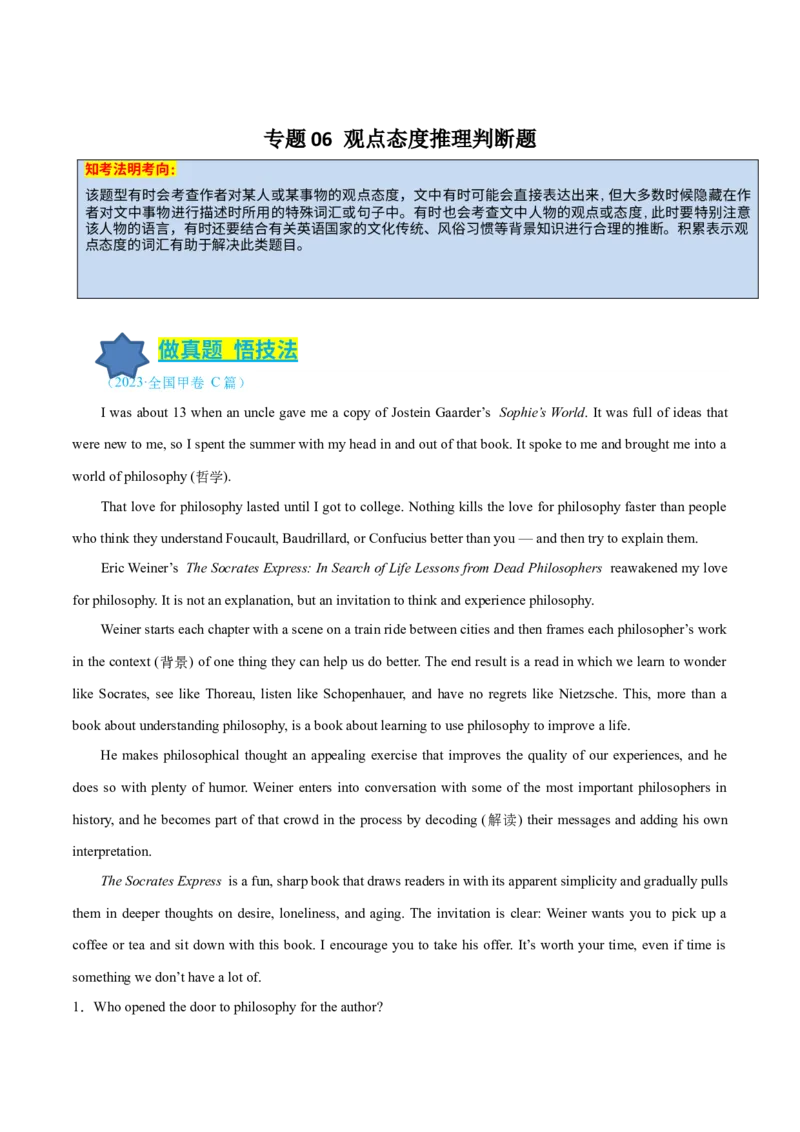
I was about 13 when an uncle gave me a copy of Jostein Gaarder’s Sophie’s World. It was full of ideas that
were new to me, so I spent the summer with my head in and out of that book. It spoke to me and brought me into a
world of philosophy (哲学).
That love for philosophy lasted until I got to college. Nothing kills the love for philosophy faster than people
who think they understand Foucault, Baudrillard, or Confucius better than you — and then try to explain them.
Eric Weiner’s The Socrates Express: In Search of Life Lessons from Dead Philosophers reawakened my love
for philosophy. It is not an explanation, but an invitation to think and experience philosophy.
Weiner starts each chapter with a scene on a train ride between cities and then frames each philosopher’s work
in the context (背景) of one thing they can help us do better. The end result is a read in which we learn to wonder
like Socrates, see like Thoreau, listen like Schopenhauer, and have no regrets like Nietzsche. This, more than a
book about understanding philosophy, is a book about learning to use philosophy to improve a life.
He makes philosophical thought an appealing exercise that improves the quality of our experiences, and he
does so with plenty of humor. Weiner enters into conversation with some of the most important philosophers in
history, and he becomes part of that crowd in the process by decoding (解读) their messages and adding his own
interpretation.
The Socrates Express is a fun, sharp book that draws readers in with its apparent simplicity and gradually pulls
them in deeper thoughts on desire, loneliness, and aging. The invitation is clear: Weiner wants you to pick up a
coffee or tea and sit down with this book. I encourage you to take his offer. It’s worth your time, even if time is
something we don’t have a lot of.
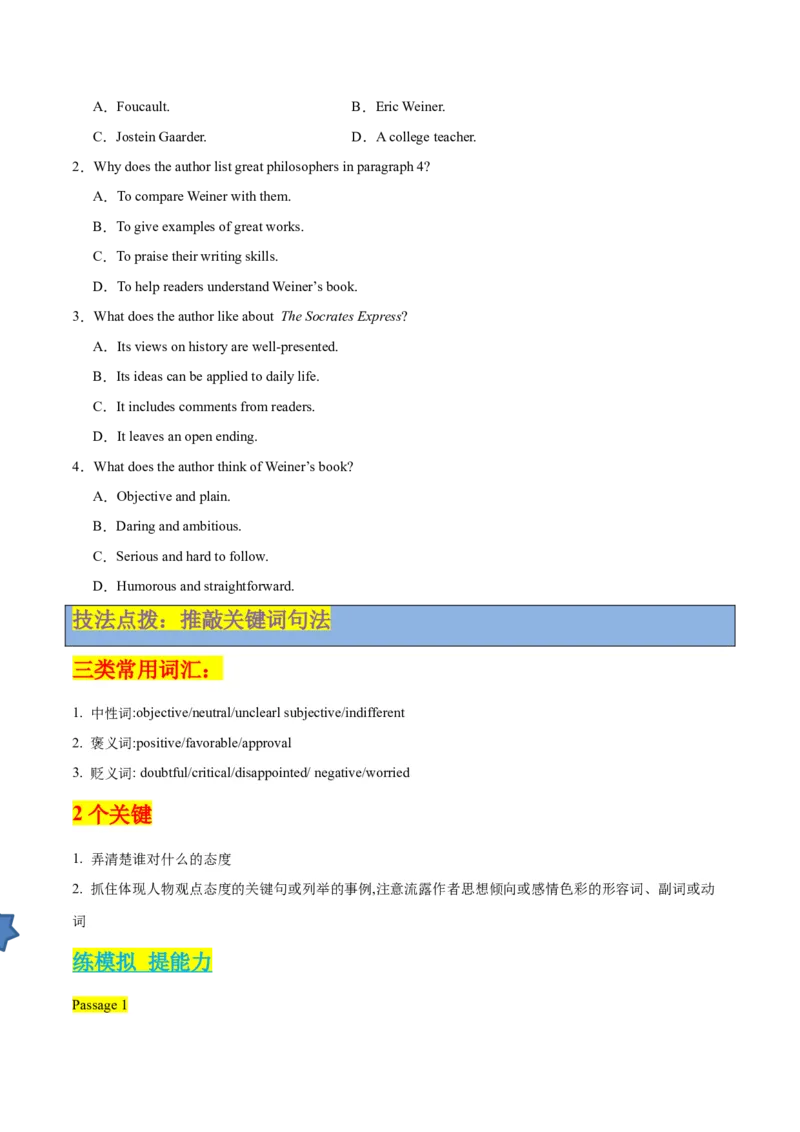
1.Who opened the door to philosophy for the author?A.Foucault. B.Eric Weiner.
C.Jostein Gaarder. D.A college teacher.
2.Why does the author list great philosophers in paragraph 4?
A.To compare Weiner with them.
B.To give examples of great works.
C.To praise their writing skills.
D.To help readers understand Weiner’s book.
3.What does the author like about The Socrates Express?
A.Its views on history are well-presented.
B.Its ideas can be applied to daily life.
C.It includes comments from readers.
D.It leaves an open ending.
4.What does the author think of Weiner’s book?
A.Objective and plain.
B.Daring and ambitious.
C.Serious and hard to follow.
D.Humorous and straightforward.
技法点拨:推敲关键词句法
三类常用词汇:
1. 中性词:objective/neutral/unclearl subjective/indifferent
2. 褒义词:positive/favorable/approval
3. 贬义词: doubtful/critical/disappointed/ negative/worried
2 个关键
1. 弄清楚谁对什么的态度
2. 抓住体现人物观点态度的关键句或列举的事例,注意流露作者思想倾向或感情色彩的形容词、副词或动
词
练模拟 提能力
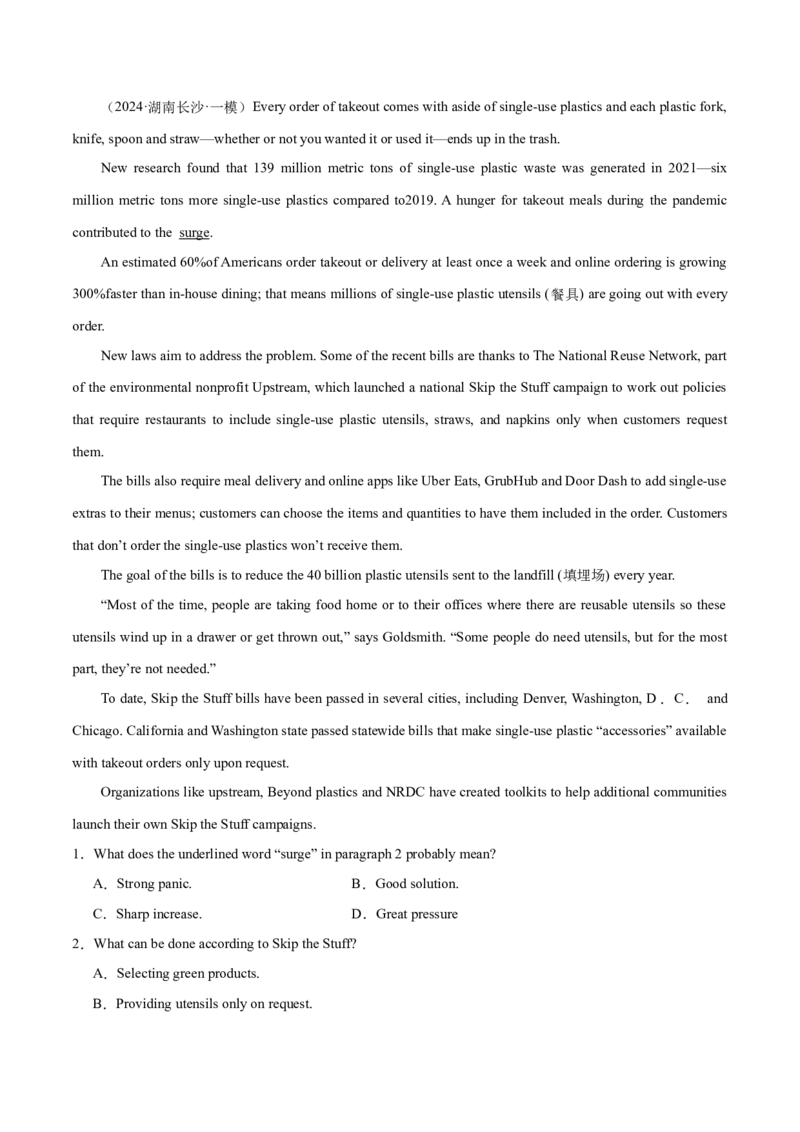
Passage 1(2024·湖南长沙·一模)Every order of takeout comes with aside of single-use plastics and each plastic fork,
knife, spoon and straw—whether or not you wanted it or used it—ends up in the trash.
New research found that 139 million metric tons of single-use plastic waste was generated in 2021—six
million metric tons more single-use plastics compared to2019. A hunger for takeout meals during the pandemic
contributed to the surge.
An estimated 60%of Americans order takeout or delivery at least once a week and online ordering is growing
300%faster than in-house dining; that means millions of single-use plastic utensils (餐具) are going out with every
order.
New laws aim to address the problem. Some of the recent bills are thanks to The National Reuse Network, part
of the environmental nonprofit Upstream, which launched a national Skip the Stuff campaign to work out policies
that require restaurants to include single-use plastic utensils, straws, and napkins only when customers request
them.
The bills also require meal delivery and online apps like Uber Eats, GrubHub and Door Dash to add single-use
extras to their menus; customers can choose the items and quantities to have them included in the order. Customers
that don’t order the single-use plastics won’t receive them.
The goal of the bills is to reduce the 40 billion plastic utensils sent to the landfill (填埋场) every year.
“Most of the time, people are taking food home or to their offices where there are reusable utensils so these
utensils wind up in a drawer or get thrown out,” says Goldsmith. “Some people do need utensils, but for the most
part, they’re not needed.”
To date, Skip the Stuff bills have been passed in several cities, including Denver, Washington, D.C. and
Chicago. California and Washington state passed statewide bills that make single-use plastic “accessories” available
with takeout orders only upon request.
Organizations like upstream, Beyond plastics and NRDC have created toolkits to help additional communities
launch their own Skip the Stuff campaigns.
1.What does the underlined word “surge” in paragraph 2 probably mean?
A.Strong panic. B.Good solution.
C.Sharp increase. D.Great pressure
2.What can be done according to Skip the Stuff?
A.Selecting green products.
B.Providing utensils only on request.C.Recycling and reusing some utensils.
D.Using identical products nationwide.
3.What is the aim of the newly passed bills?
A.To better serve customers. B.To reduce plastic waste.
C.To correct bad eating habits. D.To prevent illegal activities.
4.What is Goldsmith’s attitude towards the Skip the Stuff campaign?
A.Concerned. B.Doubtful. C.Favorable. D.Unclear.
Passage 2
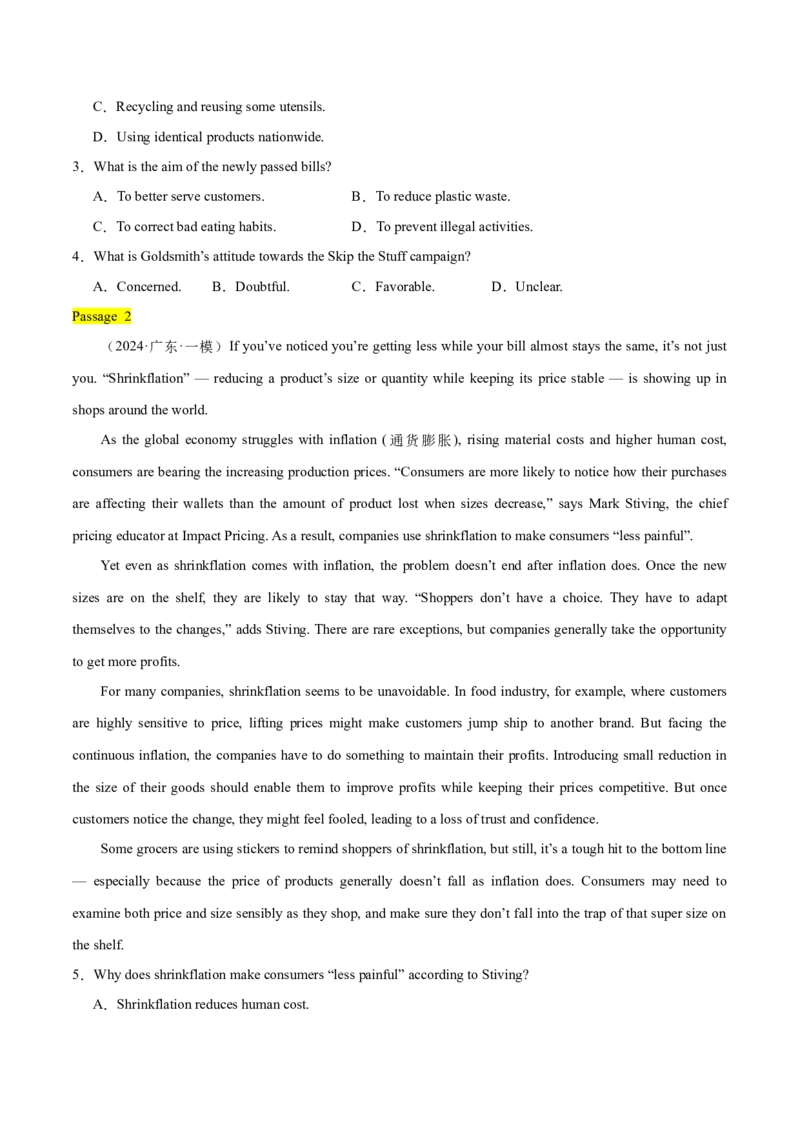
(2024·广东·一模)If you’ve noticed you’re getting less while your bill almost stays the same, it’s not just
you. “Shrinkflation” — reducing a product’s size or quantity while keeping its price stable — is showing up in
shops around the world.
As the global economy struggles with inflation (通货膨胀), rising material costs and higher human cost,
consumers are bearing the increasing production prices. “Consumers are more likely to notice how their purchases
are affecting their wallets than the amount of product lost when sizes decrease,” says Mark Stiving, the chief
pricing educator at Impact Pricing. As a result, companies use shrinkflation to make consumers “less painful”.
Yet even as shrinkflation comes with inflation, the problem doesn’t end after inflation does. Once the new
sizes are on the shelf, they are likely to stay that way. “Shoppers don’t have a choice. They have to adapt
themselves to the changes,” adds Stiving. There are rare exceptions, but companies generally take the opportunity
to get more profits.
For many companies, shrinkflation seems to be unavoidable. In food industry, for example, where customers
are highly sensitive to price, lifting prices might make customers jump ship to another brand. But facing the
continuous inflation, the companies have to do something to maintain their profits. Introducing small reduction in
the size of their goods should enable them to improve profits while keeping their prices competitive. But once
customers notice the change, they might feel fooled, leading to a loss of trust and confidence.
Some grocers are using stickers to remind shoppers of shrinkflation, but still, it’s a tough hit to the bottom line
— especially because the price of products generally doesn’t fall as inflation does. Consumers may need to
examine both price and size sensibly as they shop, and make sure they don’t fall into the trap of that super size on
the shelf.
5.Why does shrinkflation make consumers “less painful” according to Stiving?
A.Shrinkflation reduces human cost.B.Shrinkflation raises purchasing power.
C.Consumers become more aware of size.
D.Consumers experience little increase in cost.
6.What is paragraph 3 mainly about?
A.The concerns of shoppers. B.The interests of companies.
C.The impact of shrinkflation. D.The phenomenon of inflation.
7.What is the author’s attitude to the shrinkflation in paragraph 4?
A.Favorable. B.Objective.
C.Dismissive. D.Unclear.
8.What should consumers do according to the last paragraph?
A.Draw a bottom line. B.Put warning stickers.
C.Choose smaller packs. D.Make a conscious decision.
Passage 3
(2024·湖北·二模)Every morning on the island of Oahu, students at Pu’ öhala Elementary gather on a field
as towering mountains watch them from the mist. Their day starts with songs in ‘ölelo Hawai’i, the islands’ native
language, restating values of respect and justice that their teachers hope will guide them through their education,
and throughout their lives.
Like most kids their age, they’re not concerned about the significance of the language they’re learning. Still,
they have a weighty responsibility: to receive the torch (火炬) and ensure the security of ‘ölelo Hawai’ i for future
generations.
It was only 50 years ago that the language was on the edge of extinction. Though the situation is much
improved, in many ways ‘ölelo Hawai’ i is still on life support. Teachers say there’s a huge enthusiasm for school
kids to learn the language, but as they grow up, they’re encouraged to focus on “more useful” subjects and use
English, which are believed to assist them in achieving success in their work. In 2016, there were 18, 610 Hawaiian
speakers on the islands.
“One hundred thousand is the approximate number of speakers needed to consider the language safe, ” says
Solomon, professor of Hawaiian language at University of Hawai’i at Manoa. “The idea is that there are enough
people passing it on to the next generation, socializing their children to use the language in all domains of life, to
express all thoughts and needs and desires. ”
Fortunately, the kids of Pu’ öhala Elementary will take the responsibility to continue the work of the currentyoung adults defending the language, expanding access to ‘ölelo Hawai’i in part through TikTok and Instagram,
and making the language a practical skill in adulthood. These youth, along with those committed to recovering the
language from previous generations, share their hopes for the better.
9.What are the students at Pu’ öhala Elementary expected to do?
A.To figure out the value of life. B.To go out of the island of Oahu.
C.To pass their native language down. D.To draw people’s attention to folk songs.
10.What makes the students abandon ‘ölelo Hawai’i?
A.Career development. B.The improved situation.
C.Lack of enthusiasm. D.Little educational support.
11.What is the current situation of ‘ölelo Hawai’i according to professor Solomon?
A.It is used in all walks of life. B.It is considered a safe language.
C.It demands more speakers to be safe. D.It has one hundred thousand speakers.
12.What is the author’s attitude towards the future of ‘ölelo Hawai’i?
A.Worried. B.Hopeful. C.Unclear. D.Reserved.
Passage 4
(2024·江苏南通·模拟预测)Phonics, which involves sounding out words syllable (音节) by syllable, is the
best way to teach children to read. But in many classrooms, this can be a dirty word. So much so that some teachers
have had to take phonics teaching materials secretly into the classroom. Most American children are taught to read
in a way that study after study has found to be wrong.
The consequences of this are striking. Less than half of all American adults were efficient readers in 2017.
American fourth graders rank 15th on the Progress in International Literacy Study, an international exam.
America is stuck in a debate about teaching children to read that has been going on for decades. Some
advocate teaching symbol sound relationships (the sound k can be spelled as c, k, ck, or ch) known as phonics
Others support an immersive approach (using pictures of cat to learn the word cat), known as “whole language”.
Most teachers today, almost three out of four according to a survey by EdWeek Research Centre in 2019, use a mix
of the two methods called “balanced literacy”.
“A little phonics is far from enough.” says Tenette Smith, executive director of elementary education and
reding at Mississippi’s education department. “It has to be systematic and explicitly taught.”
Mississippi, often behind in social policy, has set an example here. In a state once blamed for its low reading
scores, the Mississippi state legislature passed new literacy standards in 2013.Since then Mississippi has seenremarkable gains., Its fourth graders have moved from 49th (out of 50 states) to 20th on the National assessment of
Educational Progress, a nationwide exam.
Mississippi’s success is attributed to application of reading methods supported by a body of research known as
the science of reading. In 1997 experts from the Department of Education ended the “reading war” and summed up
the evidence. They found that phonics, along with explicit instruction in phonemic (音位的) awareness, fluency
and comprehension, worked best.
Yet over two decades on, “balanced literacy” is still being taught in classrooms. But advances in statistics and
brain imaging have disproved the whole-language method. To the teacher who is an efficient reader, literacy seem
like a natural process that requires educated guessing, rather than the deliberate process emphasized by phonics.
Teachers can imagine that they learned to read through osmosis(潜移默化) when they were children. Without
proper training, they bring this to classrooms.
13.What do we learn about phonics in many American classrooms?
A.It is ill reputed. B.It is mostly misapplied.
C.It is totally ignored. D.It is seemingly contradictory.
14.What has America been witnessing?
A.A burning passion for improving teaching methods.
B.A lasting debate over how to teach children to read.
C.An increasing concern with children’s inadequacy in literacy.
D.A forceful advocacy of a combined method for teaching reading.
15.What’s Tenette Smith’s attitude towards “balanced literacy”?
A.Tolerant. B.Enthusiastic. C.Unclear. D.Disapproving.
16.According to the author what contributed to Mississippi’s success?
A.Focusing on the natural process rather than deliberate training.
B.Obtaining support from other states to upgrade teaching methods.
C.Adopting scientifically grounded approaches to teaching reading.
D.Placing sufficient emphasis upon both fluency and comprehension.
Passage 5
(2024·河北邢台·模拟预测)A team of researchers from the Korea Advanced Institute of Science &
Technology (KAIST) have designed a humanoid robot to fly planes.
The newly designed robot is called Pibot, and according to its creators, the robot is able to respond to
emergency situations much faster than a human pilot. However, this claim has yet to be independently tested. Thehumanoid robot pilot stands at just over five feet tall and uses large language models to memorize the flight manual
of an aircraft. Notably, large language models are the unpinning technology powering artificial intelligence tools
such as OpenAI’s ChatGPT.
According, to David Shim, an associate professor of electrical engineering at KAIST, who spoke to Euronews,
Pibot is able to manipulate the controls within the cockpit (驾驶舱) of a plane“just like a human”, meaning the
cockpit won’t have to be specifically designed for Pibot. The robot is equipped with external cameras, according to
its creators, ensuring that all aircraft vitals are kept at operational levels.
“Pibot is a humanoid robot that can fly an aeroplane just like a human pilot by handling all the single controls
in the cockpit, which are designed for humans,” said Shim. “Humans can fly many aeroplanes, but they do have
these habits built into them,” he added. “So when they try to convert to different aeroplanes they have to take
another qualification.”
“With the pilot robot, if we teach individual aeroplane configuration (构造), then we can fly the aeroplane by
simply clicking the aeroplane’s type,” Shim explained.
As for elsewhere it could be used, the team says it could be employed in extreme environments that are not
suitable for humans. So far, the team has only carried out simulations (模拟), but is in talks with Airbus to use Pibot
for test flights using its newly-developed electric aircraft. In other words, the humanoid robot is ready to take the
fall in case something goes wrong.
17.What was Pibot created for?
A.To fix planes if necessary.
B.To operate planes as pilots.
C.To deal with emergencies if needed.
D.To cooperate with the plane harmoniously.
18.What does the underlined word “manipulate” in Paragraph 3 probably mean?
A.Copy. B.Remove. C.Recover. D.Handle,
19.What is Shim’s attitude towards Pibot?
A.Negative. B.Approving. C.Doubtful. D.Disappointed.
20.What do we know about the prospect of Pibot?
A.It has been tested and will be on sale.
B.It will take the place of pilots completely.
C.It can be applied in extreme conditions.D.It is going to fly planes if the plane goes wrong.