考点4 阅读理解—议论文
温馨提示:
本资料注重培优,集中强化重点,突破难度,规避易混易错点,练习全部
是26 年新模拟题
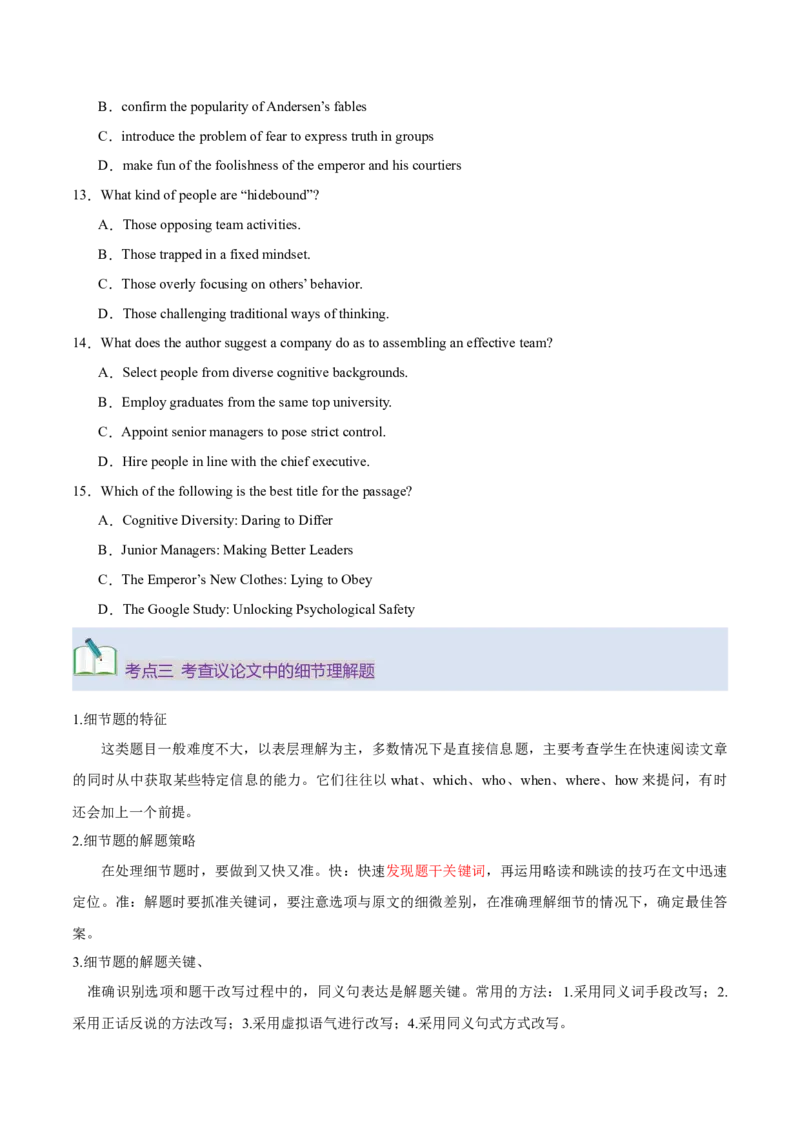
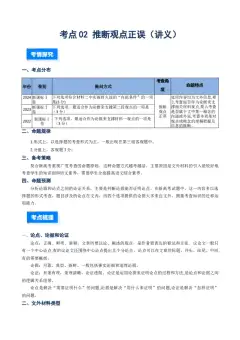
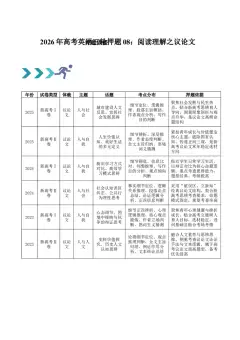
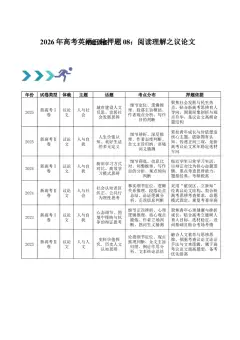
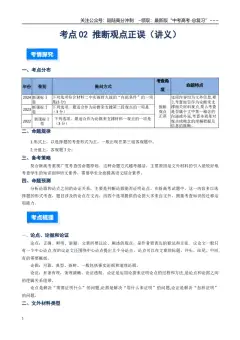
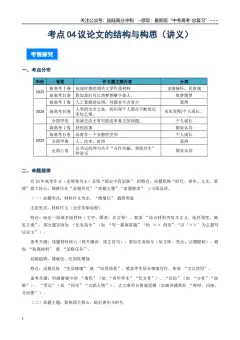
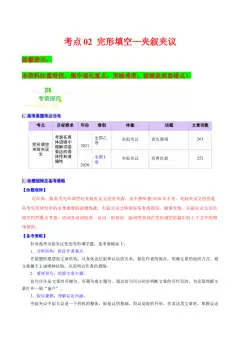
1. 高考真题考点分布
年份
卷别
主题语境
话题分类
2025
全国I 卷
人与社会
城市交通问题
北京卷
人与社会
能否延长看屏幕时间的争论
2024
新高考I 卷
人与社会
纸质阅读与数字阅读、音频和视频学习方式的差异和
效果
北京卷
人与社会
讨论科学问题:宇宙是否是由计算机模拟生成的
浙江卷1 月
人与自然
加拿大Alberta 防雹千预计划之争
2023
全国乙卷
人与社会
物品纳入历史叙事以更好地理解无文字社会的重要性
2022
全国甲卷
人与社会
悉尼发展中面临的问题
北京卷
人与社会
量子计算真的会像它的宣传那样成功吗?
天津卷
人与社会
美好生活的秘诀
2. 命题规律及备考策略
【命题规律】
1.从命题内容上看,高考命题主要从以下几方面考查:记文章涉及的论题具有生活化的特征,与社会生
活密切相关。
2.从命题思路上看:
文章通过摆事实、讲道理、辨是非的方法,来论证某种观点正确与否,肯定或否定某种主张。即提出
问题(引论)--分析问题(本论)一一解决问题(结论)”。常见的有细节理解题、推理判断题、主旨大意题、词
义猜测题、情感态度题等题型。
【备考策略】
在阅读解题时,应该从结构和内容两方面同时入手,先通读全文,再区分事实和观点。通常来说,议
论文会采用三段论式结构。首段会通过一个故事或对某种现象的描述来引入话题,明确论点;接下来是文
章的主体部分,会用两个或两个以上的段落引用事实和理论论据进行论证,常用的论证方法有举例、引用
和对比,这一部分要注意作者选用的论据,它们往往与细节理解题的考查点相对应,同时还要留意论证的
方法;文章的最后一段是结论部分,要弄清作者最后得出了什么结论。在通读全文并了解文章的结构和内
容后再阅读试题,到文章中去找相对应的信息,比如事实、观点、作者真正的意图和结论等。
议论文结构特点
写法一:正方(甲方),反方(乙方),我认为
写法二:提出问题,分析问题,回答(解决)问题
写法三:论点,理由(证据),重申论点。
高考备考,重点练阅读。因为阅读是纲,纲举目张。阅读量 + 词汇量 = 高考英语前途无量。要做到精读
泛读相结合。每天读5 篇,高考一百三。具体来说,可以每天精读2 篇,读懂每一句话,并完成文后的问
答题;泛读3 篇,材料要相对容易一些,但要有长度。泛读的方法是只求知道内容,不记单词或漂亮句子,
也不做短文后的习题。
【命题预测】
预计2026 年议论文有可能考。复习过程中要熟练掌握议论文的命题特点和解题方法,做到成功应对议
论文阅读试题。
【必备基础知识】
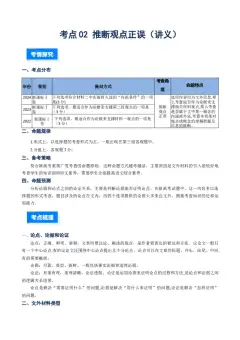
一、【语篇特点】
特点:
议论文是运用逻辑推理和证明来阐述某一观点、看法和主张的文体。这类文章或从正面提出某种见解,
或驳斥别人的错误观点,以说服读者同意自己的观点为主要目的。
议论文一般有论点、论据和论证三个要素。论点是议论文的核心,即中心思想,是论据和论证的服务
对象。论据是作者所引用的用以支持和证明论点的材料,这些材料可以是名人名言、事实例证或统计数据
等。论证是作者组织、运用论据的手法。
议论文的阅读方法:
1. 抓论点、寻论据
阅读议论文我们要抓住论题,即作者提出的观点、给出的例证及最后得出的结论。抓住了论题,我们就把
握了中心。
2. 重文章结构,理清文章脉络。把握文章结构,有利于对文章大体的理解。从论证方法上讲,常见的议论
文结构有以下两类:
(1)“
——
——
”
提出问题
分析问题
解决问题的过程。
(2)“
”
由论点到论据到结论或者强调论点的过程。
议
论
文
文
章
类
型
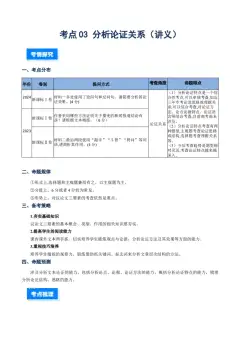
演绎论
证议论
文
是从已知的一般原理,规律出发,推知个别事物本质的论证方法。该类
文体一般先提出一个总论点,然后分别进行论述,分析各个分论点,最
后得出结论。
归纳论
证议论
文
是一种由个别到一般的论证方法。它通过许多个别的事例或分论点,然
后归纳出它们所共有的特性,从而得出一个一般性的结论。
比较论
证议论
文
是一种由个别到个别的论证方法。通常分为类比法和对比法两类。类比
法是将性质或特点在某一方面相同或相近的不同事物加以比较而引出结
论的方法。对比法是通过性质或特点在某一方面相反或对立的不同事物
的比较来证明论点的方法。
命题
要点
由于议论的目的是表明自己对事物的看法和态度,因此,命题时常考察其观点态度
以及根据文章内容归纳主旨大意等,有时也对文章的结构进行考察。
二、【解题策略】
1.演绎论证议论文:注意文章的开篇,因为文章的开篇是文章的主旨,抓住了主旨,也就抓住了
作者的观点,从而把握了文章的中心思想。
2.归纳论证议论文:注意文章的尾段,因为尾段是对前面所举事例和分论点的归纳和概括。
3.比较论证议论文:注意事物的相同点以及不同点,并由此来把握文章的主旨。
做题时可使用以下三个步骤:重首尾,明方式,细推测。
考点一 议论文中的主旨大意题
主旨大意题考查的是考生对文章内容的深层次理解,它要求考生在充分理解全文的前提下,对整篇文
章的主旨大意有一个较为清晰的印象。主旨大意题不仅考查考生略读文章、领会大意的能力,也对考生
的归纳、概括能力提出了较高的要求。文章中没有明显的解题依据,需要考生从文章中提炼、抽取一些
关键词、主干句进行加工概括,才能归纳出文章的主旨。
【常考类型】
题型1
段落大意题
每个段落都有一个中心思想,且中心思想通常会在段落的首句或尾句体现出来,这
个句子就是常说的段落主题句。没有给出明显的主题句时,要根据段落内容概括出
段落大意
题型2
文章大意题
考查考生把握全文主题和理解中心思想的能力,即考查考生的归纳概括能力
题型3
标题归纳题
概括出文章的中心思想,并对中心思想再次加以提炼,拟定出文章的标题。文章标
题可以是单词、短语,也可以是句子
 (2024 新课标I 卷C 篇)
We all know fresh is best when it comes to food. However, most produce at the store went through weeks of
travel and covered hundreds of miles before reaching the table. While farmer’s markets are a solid choice to reduce
the journey, Babylon Micro-Farm (BMF) shortens it even more.
BMF is an indoor garden system. It can be set up for a family. Additionally, it could serve a larger audience
such as a hospital, restaurant or school. The innovative design requires little effort to achieve a reliable weekly
supply of fresh greens.
Specifically, it’s a farm that relies on new technology. By connecting through the Cloud, BMF is remotely
monitored. Also, there is a convenient app that provides growing data in real time. Because the system is
automated, it significantly reduces the amount of water needed to grow plants. Rather than watering rows of soil,
the system provides just the right amount to each plant. After harvest, users simply replace the plants with a new
pre-seeded pod (容器) to get the next growth cycle started.
Moreover, having a system in the same building where it’s eaten means zero emissions ( 排放) from
transporting plants from soil to salad. In addition, there’s no need for pesticides and other chemicals that pollute
traditional farms and the surrounding environment.
BMF employees live out sustainability in their everyday lives. About half of them walk or bike to work. Inside
the office, they encourage recycling and waste reduction by limiting garbage cans and avoiding single-use plastic.
“We are passionate about reducing waste, carbon and chemicals in our environment,” said a BMF employee.
31. What does the text mainly talk about?
A. BMF’s major strengths.
B. BMF’s general management.
C. BMF’s global influence.
D. BMF’s technical standards.
(2026·山东省济南市高三上学期开学)Beneath the Pacific lies the Clarion-Clipperton Zone (CCZ),
where tens of billions of polymetallic nodules ( 多金属结核) are packed with cobalt ( 钴). Seabed-mining
companies promote them as “a battery in a rock” and “the easiest way to solve climate change.” They claim that
those nodules can provide metals for 4.8 billion electric vehicles.
Yet this promise threatens a biological treasure. Marine (海洋的) biologists reveal the CCZ shelters over
5,000 unique species in the darkness. The extensive mining of cobalt may lead to the loss of biodiversity. A
company claimed to have found a solution to minimize the damage to the ecology and has already trialed a 25-ton
collector robot designed to harvest these nodules. However, a 2023 study shows it can cause permanent destruction
in the area.
Commercial mining is not yet permitted in international waters. The International Seabed Authority (ISA) is
still determining how, and under what conditions, mining should be allowed. After 28 years of debate, its 168
member states still lack formal agreement. While companies advocate using nodule-collecting robots, 437 scientists
from 44 countries demand an immediate stop.ISA studies confirm that just 10% mining of the CCZ may wipe out
50% of its species.
Nor is it certain that cobalt mining will even be all that important in car-battery technology. Many battery
companies are trying to recycle cobalt from spent batteries. In March, several major European carmakers jointly
stated that they would not buy any metals produced from deep-sea mining before the environmental risks are
“completely understood”. Meanwhile, several Chinese electric vehicle producers have already made the switch,
recycling up to 95% of metals from used batteries. “Why rush to mine the ocean for metals becoming outdated?”
said battery expert Gavin Harper.
On June 8, 21 marine scientists from 8 universities finished a six-week research in the CCZ and packed up
seafloor samples to take back to their labs for further analysis. “An assessment of the mining’s impact will take
years of research,” says Andrew from Edinburgh. “I’m trying to get the best environmental data. And then it’s up to
society to make the decision to go ahead.”
8.Why are the nodules called “a battery in a rock”?
A.They contain valuable metals.
B.They have recharging qualities.
C.They own battery-like structures.
D.They generate renewable power.
9.What can be inferred about the ISA?
A.It prioritizes economic interests.
B.It is guarded about seabed mining.
C.It opposes commercial operations.
D.It requires more technical support.
10.What does the author want to illustrate in Paragraph 4?
A.Deep-sea mining meets demands.
B.Carmakers reuse battery materials.
C.Battery recycling needs promoting.
D.Seabed mining for cobalt can wait.
11.What can be a suitable title for the text?
A.Marine Mining, a Green Solution
B.Cobalt, the Future of Batteries
C.Ocean Metals, an Ocean Risk?
D.CCZ, the Treasure Unknown?

考点二 考查议论文中的推理判断题
1.推断题特征
推断题要求学生在理解文章表面信息的基础上,通过语篇逻辑关系,研究细节的暗示,推敲作者态度,
理解文章的寓意等。推断题是议论文中出现频率最高、难度最大的题目。推断题常常考查写作目的、作者
意图、结论推断或者文章出处推断等。常见的题目如下:
①From the example in paragraph..., we can infer that____________.
②Whats the purpose of the text?
③Whats the attitude of the author towards...?
2.推断题的解题策略
①立足议论文中明确的客观信息,挖掘内在的逻辑关系,合理地进行推断。
②全面分析所有相关信息,避免片面性,做到判断有据,推理有据,忠于原文。
③不可用主观臆断来代替文中作者的观点,不能用事实代替推理,不能用具体代替抽象,不能用现象
代替实质。
④要特别注意表现作者感情、态度、观点的语句。
⑤“立足原文,只推一步”:根据原文内容简单推理,一步即可推得。
⑥选项中一般不出现绝对概念,如only、never、all、absolutely 等,正确答案的表述一般有一点模
糊,会用能够留有一些余地的词汇,如often、usually、sometimes、some、may、might、can、could、
probably 等。
(2024 年新课标Ⅰ卷C 篇)
Is comprehension the same whether a person reads a text onscreen or on paper? And are listening to and
viewing content as effective as reading the written word when covering the same material? The answers to both
questions are often “no”. The reasons relate to a variety of factors, including reduced concentration, an
entertainment mindset (心态) and a tendency to multitask while consuming digital content.
When reading texts of several hundred words or more, learning is generally more successful when it’s on
paper than on screen. A large amount of research confirms this finding. The benefits of print reading particularly
shine through when experimenters move from posing simple tasks — like identifying the main idea in a reading
passage — to ones that require mental abstraction — such as drawing inferences from a text.
The differences between print and digital reading results are partly related to paper’s physical properties. With
paper, there is a literal laying on of hands, along with the visual geography of distinct pages. People often link their
memory of what they’ve read to how far into the book it was or where it was on the page.
But equally important is the mental aspect. Reading researchers have proposed a theory called “shallowing
hypothesis (假说)”. According to this theory, people approach digital texts with a mindset suited to social media,
which are often not so serious, and devote less mental effort than when they are reading print.
Audio (音频) and video can feel more engaging than text, and so university teachers increasingly turn to these
technologies — say, assigning an online talk instead of an article by the same person. However, psychologists have
demonstrated that when adults read news stories, they remember more of the content than if they listen to or view
identical pieces.
Digital texts, audio and video all have educational roles, especially when providing resources not available in
print. However, for maximizing learning where mental focus and reflection are called for, educators shouldn’t
assume all media are the same, even when they contain identical words.
29. What does the shallowing hypothesis assume?
A. Readers treat digital texts lightly.
B. Digital texts are simpler to understand.
C. People select digital texts randomly.
D. Digital texts are suitable for social media.
31. What does the author imply in the last paragraph?
A. Students should apply multiple learning techniques.
B. Teachers should produce their own teaching material.
C. Print texts cannot be entirely replaced in education.
D. Education outside the classroom cannot be ignored.
【篇章结构】
段落
功能
关键词句
Para.1
提出问题
"Is comprehension the same...?" 双重疑问句引发思考
Para.2-3
对比论证
"When reading texts of several hundred words..., learning is generally
more successful when it’s on paper than on screen. "
Para.4
理论深化
"shallowing hypothesis" 解释心理机制
Para.5
延伸对比
"Audio and video...but remember less" 扩大讨论维度
Para.6
结论建议
"educators shouldn’t assume..." 提出辩证解决方案
【长难句分析】
1. 【原句】The benefits of print reading particularly shine through when experimenters move from posing simple
tasks – like identifying the main idea in a reading passage – to ones that require mental abstraction – such as
drawing inferences from a text.
【译文】当实验人员从提出简单的任务,如找到阅读文章的主旨,转向需要抽象思维的任务,如从文本中
推断出结论时,纸质阅读的好处尤为明显。
【句子结构分析】本句中when 引导时间状语从句,从句谓语为move,like identifying the main idea in a
reading passage 和such as drawing inferences from a text 分别补充说明simple tasks 和ones that require mental
abstraction。
2.【原句】 According to this theory, people approach digital texts with a mindset suited to social media, which
are often not so serious, and devote less mental effort than when they are reading print.
【翻译】根据这一理论,人们对待数字文本的态度与对待社交媒体的态度相当,社交媒体通常不那么严肃,
相比纸质阅读,人们投入的脑力要少。
【句子结构分析】suited to social media 作后置定语修饰mindset,which 引导的非限制性定语从句,修饰
先行词social media,and 连接主句并列的谓语approach 和devote。
3.【原句】However, for maximizing learning where mental focus and reflection are called for, educators shouldn’t
assume all media are the same, even when they contain identical words.
【因为】然而,在需要精神集中和反思的学习中,为了最大化学习效果,教育工作者不应假设所有媒介都
是一样的,即使它们包含相同的文字。
【句子结构分析】
主句: ... educators shouldn’t assume [all media are the same];宾语从句: (that) all media are the same (省略 that)
 ;目的状语: for maximizing learning ... (介词短语 for... 表目的);where mental focus and reflection are called
for` (定语从句修饰 learning,相当于 in which); 让步状语从句: even when they contain identical words
(even when 引导)
(2026·湖南省长沙市雨花区长沙市雅礼中学高三月考)The story of The Emperor’s New Clothes is one
of Andersen’s best-known fables. Conmen (骗子) fool the emperor into believing they have made him a fabulous
suit that the unworthy will be unable to see. Courtiers (侍从) dare not say that the emperor is naked; it takes a child
to point out the obvious.
The moral is that people are often too hidebound by social tradition to state their views. How many
companies have pursued costly projects favoured by the chief executive, even when other managers have had
doubts?
In his book Rebel Ideas: The Power of Diverse Thinking, Matthew Syed argues that the key to dealing with
this problem is “cognitive diversity”, in other words, assembling a team of people with different perspectives and
intellectual backgrounds. Individuals from varied backgrounds approach problems differently. It is not merely about
electing people for teams from both sexes and various ethnicities. Hire only Cambridge politics graduates or
Harvard MBAs or Stanford software engineers and they will have studied under the same professors and absorbed
similar world views regardless of their gender or skin colour.
In today’s complex world, cooperation is crucial for breakthroughs. In science and engineering, 90% of
papers are produced by teams rather than individuals. Since 1975, team-based patents have dominated across all
categories in the United States.
There is another element to selecting a good team: ensuring that those viewpoints are heard and respected.
That may not happen if those in charge are arrogant. A study of over 300 projects by the Rotterdam School of
Management found that those led by junior managers were more likely to succeed than those led by senior
managers — maybe because other team members were less scared about pointing out potential dangers to someone
less senior.
This freedom to speak without fear of punishment is known as “psychological safety.” Syed cites a Google
study identifying it as the most important factor behind effective teamwork. For example, during brainstorming,
allowing anonymous idea submission helps reduce the influence of seniority and encourages honest feedback.
12.The first paragraph is intended to ________.
A.argue children’s wisdom over adults
B.confirm the popularity of Andersen’s fables
C.introduce the problem of fear to express truth in groups
D.make fun of the foolishness of the emperor and his courtiers
13.What kind of people are “hidebound”?
A.Those opposing team activities.
B.Those trapped in a fixed mindset.
C.Those overly focusing on others’ behavior.
D.Those challenging traditional ways of thinking.
14.What does the author suggest a company do as to assembling an effective team?
A.Select people from diverse cognitive backgrounds.
B.Employ graduates from the same top university.
C.Appoint senior managers to pose strict control.
D.Hire people in line with the chief executive.
15.Which of the following is the best title for the passage?
A.Cognitive Diversity: Daring to Differ
B.Junior Managers: Making Better Leaders
C.The Emperor’s New Clothes: Lying to Obey
D.The Google Study: Unlocking Psychological Safety

考点三 考查议论文中的细节理解题
1.细节题的特征
这类题目一般难度不大,以表层理解为主,多数情况下是直接信息题,主要考查学生在快速阅读文章
的同时从中获取某些特定信息的能力。它们往往以what、which、who、when、where、how 来提问,有时
还会加上一个前提。
2.细节题的解题策略
在处理细节题时,要做到又快又准。快:快速发现题干关键词,再运用略读和跳读的技巧在文中迅速
定位。准:解题时要抓准关键词,要注意选项与原文的细微差别,在准确理解细节的情况下,确定最佳答
案。
3.细节题的解题关键、
  准确识别选项和题干改写过程中的,同义句表达是解题关键。常用的方法:1.采用同义词手段改写;2.
采用正话反说的方法改写;3.采用虚拟语气进行改写;4.采用同义句式方式改写。
1. (2025 全国一卷阅读C 篇片段)
While safety improvements might have been made to our streets in recent years, transport studies also show
declines in pedestrian (行人) mobility, especially among young children. Many parents say there’s too much traffic
on the roads for their children to walk safely to school, so they pack them into the car instead.
…
28. What phenomenon does the author point out in paragraph 1?
A. Cars often get stuck on the road.
B. Traffic accidents occur frequently.
C. People walk less and drive more.
D. Pedestrians fail to follow the rules.
2.(2024 新课标I 卷阅读C 篇片段)
…
Audio (音频) and video can feel more engaging than text, and so university teachers increasingly turn to
these technologies – say, assigning an online talk instead of an article by the same person. However,
psychologists have demonstrated that when adults read news stories, they remember more of the content than
if they listen to or view identical pieces.
…
30. Why are audio and video increasingly used by university teachers?
A. They can hold students’ attention.
B. They are more convenient to prepare.
C. They help develop advanced skills.
D. They are more informative than text.
(2026·江苏省部分学校高三上学期8 月联考)Earlier this year, the Pew Research Center released data
showing that 55% of people get their news from social media. In a follow-up study, they found that these people are
more likely to see misinformation. When that misinformation is about science, it contributes to the growing
mistrust individuals have towards science. We, as scientists, need to do our best to correct this misinformation.
However, we are mostly stuck behind our lab desks due to the pressure to publish papers.
When we occasionally do approach the public, we often don't do a great job communicating in ways
nonscientists can understand. Most of us have not been trained to communicate or teach the lay audience. We use
complicated words and phrases and a lot of jargon (术语) . We may focus on tiny details that the general public
doesn't need to understand. Other times we forget that the people we are talking to are human, with complicated
lives and emotions. Just like us. They deserve our attention and respect. This causes the public to rely on other
sources for their scientific information, often the aforementioned social media.
Today we are seeing the consequences of this. Large percentages of people believe that infectious diseases
are not real and that vaccines (疫苗) are dangerous. This distrust in science has gone from a mere inconvenience to
now being an issue that endangers public health and safety. Distrust in science also endangers our funding. When
the public puts less value in science, there is less public support for tax dollars going to funding for research.
So, what can we do to address these issues? People trust those they know and interact with. We need to
interact with the public more. During these interactions, we should choose our words carefully. We need to cut out
as much jargon as possible. Sometimes it may be necessary, but then we must be clear and explain the terms we
use. To help people understand and remember concepts, we can use stories and images to illustrate our main points.
Most people can remember a story someone told, or a striking image shared.
1.What concern does the author raise based on the Pew study?
A.Declining public curiosity about science.B.Spread of false scientific information.
C.Scientists’ limited time for lab work.
D.Difficulty in publishing research.
2.What does the underlined word “lay” in paragraph 2 mean?
A.Unprofessional.
B.Overnumbered.
C.Misinformed.
D.Undereducated.
3.What results from the public's disbelief in science?
A.Increased public support for research funding.B.Reduced reality of infectious diseases.
C.An increased risk for wellness threats.
D.Inconvenient access to scientific findings.
4.What does the author urge scientists to focus on?
A.More public talks without altering jargon.
B.Releasing more scientific work.
C.Avoiding social media platforms.
D.Making science more understandable.

考点四 考查议论文中的词义猜测题
 词义推断题
1.词义推断题的特征
议论文的生词较多,容易出现词义推断题。这类题目不仅考查学生的英语知识水平,更重要的是考查
学生通过上下文提示,灵活应用英语知识的能力。它们常以“The underlined
word “...” means...、The meaning of the underlined word... is ____________ .”等表达来设问。
2.词义推断题的解题技巧
①通过上下文来推断词义。利用上下文的逻辑关系和句法结构来猜测词义。
②通过构词法来推断词义。这要求考生在平时的学习中注意掌握一些常见的前缀和后缀。
1.(2024 年新课标Ⅰ卷C 篇)
Is comprehension the same whether a person reads a text onscreen or on paper? And are listening
to and viewing content as effective as reading the written word when covering the same material?
The answers to both questions are often “no”. The reasons relate to a variety of factors, including
reduced concentration, an entertainment mindset ( 心态) and a tendency to multitask while
consuming digital content.
When reading texts of several hundred words or more, learning is generally more successful
when it’s on paper than on screen. A large amount of research confirms this finding. The benefits of
print reading particularly shine through when experimenters move from posing simple tasks — like
identifying the main idea in a reading passage — to ones that require mental abstraction — such as
drawing inferences from a text.
……
28. What does the underlined phrase “shine through” in paragraph 2 mean?
A. Seem unlikely to last.
B. Seem hard to explain.
C. Become ready to use.
D. Become easy to notice.
2. (2023·全国乙卷D 篇片段)
……
In addition to the problem of miscomprehension from both sides, there are victories accidentally or
deliberately twisted, especially when only the victors know how to write. Those who are on the losing side often
have only their things to tell their stories. The Caribbean Taino, the Australian Aboriginals, the African people of
Benin and the Incas, all of whom appear in this book, can speak to us now of their past achievements most
powerfully through the objects they made: a history told through things gives them back a voice. When we consider
contact (联系) between literate and non-literate societies such as these, all our first-hand accounts are necessarily
twisted, only one half of a dialogue. If we are to find the other half of that conversation, we have to read not just
the texts, but the objects.
34. What does the underlined word “conversation” in paragraph 3 refer to?
A. Problem.
B. History.
C. Voice.
D. Society.
(2026·福建省漳州市高三上学期第一次教学质量检测)We become bored if something fails to absorb
our attention, or when we perceive it as meaningless. This is not to say that something needs to be both engaging
and meaningful to keep us interested: doing sudoku might be absorbing but relatively meaningless, while reading a
Peppa Pig bedtime story for the 500th time is not engaging but may nonetheless feel like a meaningful thing to do.
In any case, when boredom strikes it should serve as a reminder to do something more engaging or
meaningful. If you don’t react appropriately to your boredom, you may find yourself becoming chronically (长期)
bored. That is associated with a range of problems, including depression, anxiety, poor life satisfaction and so on.
There is statistical evidence to suggest that chronic boredom is becoming more common, and that this
commonness consists with the rise of smartphones. Why might digital media have this effect? Research has shown
that the main reason we pick up our phones or check our socials is to relieve boredom, but that the behavior
actually worsens it.
Digital devices may hold our attention for a while, but much of what we do online doesn’t feel meaningful.
It’s incredibly easy to plan to look at your phone for just five minutes and resurface two hours later with a
stranger’s holiday plans or the latest entertainment news. Phones’ effectiveness at throwing us into shallow
stimulation blocks us from important self-reflection like “Why am I feeling this?” or “What do I need that I’m not
getting?” If we pause and listen, then perhaps we can make a choice rather than being controlled by software
engineers.
Next time boredom strikes, don’t try to assuage it instantly and ask ourselves: are we in search of pure
entertainment or something more purposeful, an opportunity to connect with friends or our community or
something different, something new? The people who choose to embrace (拥抱) boredom, at least for a while, may
actually experience less of it. It could even be the first step towards a life that feels more stimulating overall:
meaningful, creative and free.
1.How does the author clarify his view in the first paragraph?
A.By defining concepts.
B.By giving examples. C.By raising assumptions. D.By
analyzing data.
2.What can be inferred about boredom?
A.It is easy to overcome.
B.It signals a need for change.
C.It is caused by digital devices
D.It always indicates mental illness.
3.What does the underlined word “assuage” in the last paragraph mean?
A.Identify.
B.Judge.
C.Use.
D.Relieve.
4.What can be a suitable title for the text?
A.Should we embrace boredom?
B.Why should we cut digital device use?
C.What is the root of boredom?
D.Can we balance boredom and digital life?
(最新模拟试题演练)
1.(2026·黑龙江省哈尔滨市哈尔滨市第三中学校高三上学期9 月月考)Standing on the lakeshore, my
gaze drifts down to the tens-even hundreds of thousands of-small stones scattered around my boots, and I can't help
but pause in wonder. Each was created from hard surfaces, their edges softening over time.
And I wonder, can we learn from a pile of rocks?
Even the tallest mountains have worn down; none are as tall as they were 1, 000 years ago. And much like a
rock, I've found my attitude has softened and my desire to better understand others has expanded with each trip
around the sun.
Once I too was a sharp rock covered in pointy edges. Today, after decades of the waters of life coursing over
me, my edges are softer and more understanding. I'm less likely to judge and more interested in learning how we
can exist together.
But I'm not a rock. I'm a human-being filled with all the drama built into my DNA.
Two years ago, while traveling in the Pacific Northwest, I watched a restaurant owner ask a guy to leave for
not falling in line with the rules. Not forceful and not rude. On the door read a sign: "Please wear a mask before
entering our restaurant. We don't like it either, but let's all do what we can." But the guy tried to argue about the
note.
I sat watching, understanding both sides. I've been this guy before, using my youthful edges to chip away at
the world. What I lost, however, was the ability to grow by looking through others' eyes, and thus the possibility of
finding content and success.
You can fit more rounded rocks in a jar than those with sharp edges. The former look for ways to adjust and
make room for others; the latter never give an inch to accommodate others. Time, like the waters rolling against
once sharp stones, changes us by washing away our resistance to seeing the world from another's point of view.
I placed a rounded stone into my pocket. Mother Nature is holding class again.
24.What does the author compare the rocks to?
A.Challenges that we come across.
B.Our abilities that grows with time.
C.People with varied personalities.
D.Different stages of people's lives.
25.What does the underlined phrase "the waters of life" in Paragraph 4 most probably refer to?
A.The passing time that changes a person's attitude to himself.
B.The difficult experiences that the author encountered in his life.
C.The natural phenomena like rain and waves that wear down rocks.
D.The various life events that shape the author's perspective on others.
26.What caused the argument in the restaurant?
A.The guy's failing to obey the rules.
B.The owner's inappropriate attitude.
C.Misunderstanding between the two sides.
D.Lack of clarity in the sign.
27.What does the author try to convey through this text?
A.We should adjust ourselves to new conditions.
B.Be brave when in the face of difficulties in life.
C.Don't compromise easily and always stick to your principles.
D.Being adaptive and understanding brings a sense of well-being.
2.(2026·江苏省如皋中学高三上学期测试一)Chocolate is a popular snack, but the price of it continues
to rise. Cocoa from the cacao tree is the basic ingredient of chocolate; the trees thrive in warm and damp climates
but are struggling due to increasing aridity — a slow but non-stop drying of the land. This issue extends to
producers around the globe, threatening cocoa production and livelihoods of farmers.
Over the past 30 years, more than three-quarters of the Earth’s landmass has become drier. This dryness is a
long-term transformation with disastrous consequences for ecosystems, agriculture, and livelihoods.
Aridity arises from human-driven factors, including greenhouse gas emissions, unsustainable land use, and
natural resource degradation. Climate change, primarily caused by fossil fuel consumption and deforestation,
increases global temperatures, accelerating evaporation (蒸发) and heightening water shortage — even in regions
with moderate rainfall.
Unsustainable land use further intensifies aridity. Practices like deforestation and industrial farming degrade
soils, removing them from protective vegetation and essential nutrients. In cocoa-producing regions, deforestation
upsets local water cycles and wears away the topsoil. Degraded soils hold less water, deepening drought conditions.
Cocoa is just one crop at risk. Major agricultural zones are also affected. By 2100, up to 5 billion people may
live in dry lands, stretching food systems to their limit and forcing migration. Aridity also threatens ecosystems.
Wildlife struggles to adapt, and plant species suited to warm and damp conditions fail to survive. Economic losses
are overwhelming — Africa saw a 12% GDP decline from 1990 to 2015 due to rising aridity. Governments face
additional burdens from sandstorms, wildfires, and water shortages.
While aridity’s effects are severe, they are not entirely changeless. Restoring degraded lands, improving soil
health, and adopting sustainable farming practices can help. Efficient water management, investment in renewable
energy, and international cooperation are essential in battling aridity.
As chocolate prices hit record highs in early 2025 due to dry conditions in Africa, addressing aridity is a
matter of urgency. Beyond saving chocolate, it’s about preserving the planet’s ability to sustain life.
8.What’s the main reason for the rising price of chocolate?
A.The decline of cocoa production.
B.The high cost of basic ingredients.
C.The increasing demand for chocolate.
D.The shortage of cocoa tree plantations.
9.What do we know about aridity?
A.It is mainly caused by natural factors.
B.It only affects cocoa-producing regions.
C.It has a wide-ranging impact on various aspects.
D.It will disappear if sustainable land use is adopted.
10.Why is Africa’s GDP decline mentioned in paragraph 5?
A.To show aridity only causes economic losses in Africa.
B.To prove Africa is the most severely affected by aridity.
C.To criticize Africa lacks effective measures against aridity.
D.To illustrate aridity has a significant influence on economy.
11.Which of the following can fight against aridity?
A.Cutting off water supplies.
B.Replacing renewable energy.
C.Promoting soil conservation.
D.Practicing industrial farming.
3.(2026·四川省德阳天立高级中学高三上学期第一次月考)Do you love Beats headphones, True
Religion jeans, and UGG shoes? These are some of the most popular brands ( 牌子) around. They are also
expensive. But some experts say they are not much better than cheaper brands.
For example, Jim Wilcox works for Consumer Reports. He tested all kinds of headphones. He says that $80
Koss Pro headphones provide basically the same quality and comfort as Beats. So why do people pay twice or even
10 times as much for the hottest brands?
Experts say it’s because fashionable, expensive brands send a message. Brands say “I belong” or “I can
afford it.”
Some people think that expensive brand names are worth the price. They say that some designer clothes
really are top quality and that they last longer than cheaper brands. Some teenagers choose to wear popular brands
because these brands make them feel good about themselves.
Alexandra Allam, 17, likes to buy brand-name products. “I’d rather spend the extra money to get something I
know I’ll be satisfied with,” she says. Her friend Emmy Swan agrees, saying “As long as you can afford it, it seems
reasonable to buy what you want.” But not all teenagers agree. “Spending hundreds of dollars for designer
sunglasses is stupid and unreasonable,” says Daniel Steinbrecher, 16. “It’s fake (假的) happiness.”
People who are against wearing expensive brand names say that many designer brands aren’t any better. “It’s
wasteful to buy things just because they are popular,” says Edmund Williams, 15. “You’ll feel better if you buy
things because you like them. If you have extra money to spend, it would be better to give it to people in need.”
8.The example of Jim’s report wants to tell us _____.
A.popular brands make people comfortable
B.Koss Pro headphones are better than Beats
C.the hottest brands are of the highest quality
D.lesser-known brands may offer the same quality as name brands
9.According to experts, people choose the hottest brands probably _____.
A.to show off
B.for their better quality
C.for their better designs
D.to belong to a special group
10.What does Edmund think of expensive brands?
A.They are not worth the price.
B.They make him feel confident.
C.They need to improve their quality.
D.They pay too much attention to personal likes.
11.The text is mainly about _____.
A.how to buy things reasonably
B.the competition between brands
C.the different values of teenagers
D.whether expensive brands are worth high prices
4.(2026·贵州省贵阳市高三上学期8 月摸底)Women eating alone receive pity — and free champagne
(香槟酒). But there’s nothing to pity, or to praise, in a woman’s basic existence.
I eat alone at restaurants — and I do it a lot. This usually seems to make people around me uncomfortable.
Recently, I went to a restaurant for dinner and mistakenly booked a table for two instead of one. The chef working
that night saw me and came to say how sorry she was that I had, in her mind, been abandoned for the evening.
Before I could correct her, she gave me an extra dessert for my sadness.
I’ve never been afraid to eat alone. Women don’t need encouragement to live an independent life. It is
uncomfortable to be treated like a sad, lost lamb just because someone has not accompanied me outside. It is
neither brave nor sad for a woman to dine alone.
In the 19th century, some hotels reserved separate dining rooms called “ladies’ ordinaries” for women dining
alone. Into the 20th century, women could be refused service at pubs or hotel eating rooms without a male. Change
was slow to come. Some restaurants maintained different forms of men-only policies. In 1969, Betty Friedan and
some other women stormed the Oak Room in the Plaza Hotel to demand that women be allowed in during the male-
only lunch hours. The restaurant soon changed its policy — and the agitation (骚动) inspired a wave of protests at
other restaurants across the country. In 1970, a federal suit and a new law required New York City’s oldest saloon to
abandon its 116-year ban on women.
The social stereotype around women dining alone seems to tell us: men occupy the public and women the
private. Dining alone hopefully pushes against that view of the world and expands the social imagination on
women’s autonomy.
The people who offer free drinks aren’t cruel, of course. Quite the opposite: Those are generous and friendly
ones. But friendly or not, it’s part of wrong understanding. And when I’m eating alone. I don’t want to be a symbol.
I’m just there to read my book, have a middling steak and drink my free champagne in peace.
28.Why did the chef give a dessert to the author?
A.The chef wanted to make her stay longer.
B.The chef wrongly arranged a table for two.
C.The chef showed her sympathy for the author.
D.The chef had to have the author eating alone.
29.What caused women to fight against the policies?
A.They wanted to have separate rooms.
B.They were not treated equally as men.
C.They hoped to manage those restaurants.
D.They were inspired by previous protests.
30.What does the author think of women dining alone?
A.It requires more public attention.
B.It prevents women from the world.
C.It needs bravery and encouragement.
D.It raises awareness of women’s right.
31.Which can be a suitable title for the text?
A.Dining Alone: a Pity for Women?
B.Should Women Embrace Privacy?
C.Women: How to Say No at Restaurant? D.Do Eating Habits Change Women’s Life?
5.(2026·辽宁省沈文新高考研究联盟高三上学期开学)The climate crisis may lead the human race to
shrink in size, as mammals with smaller frames appear better able to deal with rising global temperatures, a leading
fossil expert has said.
Professor Steve Brusatte, a palaeontologist at the University of Edinburgh, suggested that the way in which
other mammals have previously responded to periods of climate change could offer an insight into humans’ future.
He compared the potential problem of people as similar to that of early horses, which became smaller in body size
as temperatures rose around 55 million years ago.
Writing in The Rise and Reign of the Mammals, Brusatte notes that animals in warmer parts of the world
today are often smaller than those in colder areas, an ecological principle known as Bergmann’s rule. “The reasons
are not entirely understood, but it is probably, in part, because smaller animals have a higher surface area relative to
their volume than bigger animals and can thus improve the dissipation of the extra heat,” he writes.
Brusatte said that becoming smaller was “a common way that mammals deal with climate change”. He
added, “That’s not to say every species of mammal would get smaller, but it seems to be a common survival trick of
mammals when temperatures rise pretty quickly. That does raise the question: If temperatures do rise really quickly,
might humans get smaller? And I think that’s certainly reasonable.”
However, not all experts agree that rising temperature causes mammals to shrink. Professor Adrian Lister, of
the Natural History Museum in London, said the relationship shown by the recent human remains study is weak.
“We are not really controlled by natural selection,” he said. “If that was going to happen, you’d need to find large
people dying before they could reproduce because of climate warming. That is not happening in today’s world. We
wear clothes, we have got heating, we have got air conditioning if it is too hot.”
32.How do mammals cope with climate change according to Brusatte?
A.Moving to colder regions.
B.Reducing their body size.
C.Losing their weight.
D.Adapting their diet.
33.What does the underlined word “dissipation” in Paragraph 3 mean?
A.Exchange.
B.Formation.
C.Absorption.
D.Emission.
34.What is Adrian Lister’s attitude towards the recent study?
A.Worried.
B.Objective.
C.Skeptical.
D.Approving.
35.What is the best title of this text?
A.The Threat of Climate Change to Human Survival
B.The Impact of Climate Change on Mammal Body Sizes
C.The Evolutionary Trends in Mammal Body Sizes
D.The Adaptive Strategies of Mammals to Climate Change
6.(2026·山东省高三上学期开学联考)Despite the convenience brought by the social network, the issue
of cyberbully has become so widespread that many individuals now hesitate to engage in online interactions. By
next year, a significant portion of online communication will involve some form of harassment ( 骚扰). We are
finally acknowledging the gravity of this issue by supporting and developing a variety of initiatives, platforms, and
strategies aimed at preventing cyberbullies from causing harm.
Unfortunately, our efforts might be insufficient and too late. By the time these “solutions” become widely
accessible, cyberbullies will have adopted more complex strategies. In the near future, it won’t just be the messages
you see on your screen that will be questionable. Soon you will also doubt the authenticity of the profiles you
encounter. This is due to the spreading of advanced identity manipulation (操纵) and automation technologies that
are becoming increasingly accessible.
These advancements are likely to fuel our current struggles with cyberbully. The reason cyberbully is so
harmful is not just its frequency but also its personal nature. A decade of social media use has resulted in a situation
where cyberbullies can easily access personal details and use them harmfully. Armed with this information, they
can carry out targeted campaigns to harassment individuals. For instance, a cyberbully could create a fake profile
that appears to be a friend and send messages that seem supportive, tricking victims into revealing personal
information or engaging in harmful behavior. Since cyberbullies seek power, vulnerable (易受攻击的) individuals,
especially children, will be the most severely affected. Much of online interaction is based on trust and mutual
respect. Identity manipulation technologies may erode this foundation gradually.
We need to address the vulnerability of our online communities. Social media platforms and users must
cooperate to establish methods for confirming and communicating authenticity. This could involve developing a
standardized system to authenticate user profiles, indicating their reliability and origins, or transitioning away from
text-based communication and towards video-based interactions—using platforms that can be linked to confirmed
identities.
Trust is hard to build but easy to destroy, and the challenge of maintaining a safe online environment is only
going to intensify.
32.What’s the author’s attitude towards our response to cyberbully?
A.Panicked.
B.Confused.
C.Embarrassed.
D.Disappointed.
33.What does the underlined word “erode” probably mean in Paragraph 3?
A.Damage.
B.Strengthen.
C.Preserve.
D.Restore.
34.What can we infer from the text?
A.Honesty is the best policy.
B.Technologies can be double-edged.
C.There are more solutions than problems. D.Face to face communication is key to trust.
35.Which of the following would be the best title for the text?
A.The Unknown Power behind Cyberbully B.How Cyberbully Is Affecting Technology
C.Where the Problem of Cyberbully Is Rooted
D.The Increasingly Severe Threat of Cyberbully
7.(2026·四川省成都市蓉城名校联盟高三上学期开学联考)Are you a logical thinker, or would you say
that you’re more free-spirited and artistic? If you’re the former, somebody’s probably told you at some point that
you’re a left-brained person, and if you’re the latter, right-brained. The idea that the right half of the brain is the
creative half and the left half is the analytical (分析的) half and that our individual characteristics are determined
by which half is dominant is widespread in popular psychology. However, this idea is a fiction.
Although we all obviously have different personalities and talents, there’s no reason to believe these
differences can be explained by the dominance of one half of the brain over the other half. Recent research using
brain imaging technology hasn’t found any evidence of hemispheric (脑半球的) dominance. Math, for example,
requires logical thought and, thus, is generally said to be connected with the left brain. But mathematics involves a
highly creative effort in addition to being a logical one. So would a gifted mathematician be a right-brained or a
left-brained person?
If there’s no evidence for the fiction of right-brained and left-brained people, why do so many people accept
it? Perhaps it just makes intuitive (直觉的) sense that people’s brains would be dominant on one side or the other
just as their hands, feet, or eyes are. It may also have something to do with our seemingly unlimited appetite that
allows us to sort ourselves (and our friends) into “types” based on our emotional and intellectual characteristics.
When people are offered general descriptive statements that are presented as individualized descriptions of
their own personalities, they tend to accept them as meaningful and true, especially if the statements are positive.
The “insights” they generate are both universal and congenial. After all, who would reject a description of
themselves as “artistic and creative” or “reasonable and analytical”? The fiction is popular, in the end, because it
gives us a “scientific” way to talk about our favorite subject — ourselves.
32.Which is a common belief about people’s individual characteristics?
A.A logical thinker is right-brained.
B.Our right brain and left brain work the same.
C.The right half of the brain is the analytical half.
D.The dominant half of brain determines one’s characteristics.
33.Why does the author mention mathematics in paragraph 2?
A.To show that math is a logical subject.
B.To argue that creativity is irrelevant in analytical thinking.
C.To prove that left-brained people are better at problem-solving.
D.To prove personality and talent differences aren’t due to hemispheric dominance.
34.Why do many people believe in the left-brain/ right-brain theory?
A.This theory is widespread and popular.
B.Scientific studies have confirmed its accuracy.
C.It provides a way for them to sort personalities.
D.Brain imaging technology has shown clear hemispheric differences.
35.Which of the following would be the best title for the passage?
A.Why Left-Brained People Are Smarter?
B.The Science of Math: Left or Right Brain?
C.The Truth Behind Hemispheric Dominance
D.Ways to Develop Both Logical and Creative Thinking
1.(2026·重庆市实验外国语学校高三上学期9 月月考)“Individuals of all ages who have empathy (共
情) understand that sometimes telling little white lies can protect other people from getting hurt,” says Barbara
Greenberg, a clinical psychologist in Connecticut. “Most people that I have come across tell these little white lies
because they understand that 100 percent honesty all the time is not beneficial.” A white lie, she explains, spares
people from unnecessary hurt.
At the same time, Dr. Julia Breur, a marriage and family therapist in Florida, emphasizes the importance of
paying attention to the way we respond to someone. The fact is that not telling the truth can result in something
unpleasant on you; it’s not just about the person the white lie is being told to. For example, she says someone who
always tells others that “all is good” when it comes to a sick parent in an effort to avoid discussions about how
serious their health issue really is, can eventually face stressful experiences. When that parent eventually passes
away, the person who always gave an “all is good” response ends up emotionally broken.
Sometimes, telling white lies often depends on the situation, Dr. Breur says. For example, consider a woman
who has not seen her mother for several months. The daughter has gained noticeable weight, yet the mother
responds by excitedly declaring that she looks great. “I emphasize during psychotherapy sessions with my patients
that context helps define meaning,” Dr. Breur says. “So when we look at the context of a mother saying you look
great when she clearly sees that her daughter has gained weight, it can be acceptable. It reflects the intention of the
white lie which is kindness, protection and unconditional love. Otherwise, white lies — especially when told to
avoid personal accountability — can start a cycle of mistrust between people, ultimately compromising integrity,”
she adds.
Therefore, it’s important to ask ourselves when it is and isn’t appropriate to deliver the honest truth, and
when it’s best to step back and offer a more delicate response. More often than not, it’s about finding a balance
between the two.
11.What can be learned about white lies according to Barbara Greenberg?
A.They are short-lived.
B.They are unidentifiable.
C.They are trouble-making.
D.They are common.
12.What message does Dr. Breur deliver in paragraph 2?
A.White lies can harm both the liars and the listeners.
B.We must respond to our family members truthfully.
C.It’s wrong to tell white lies to a seriously ill parent.
D.The “all is good” response is effective in dealing with patients.
13.Which of the following white lies may Dr. Breur support?
A.A student claims his homework was left at home.
B.An employee blames traffic jam for being late.
C.A Dad tells his son their lost pet is living happily on a farm.
D.A nurse says she has to work overtime so as to decline an invitation.
14.Which of the following is the best title for the text?
A.East or West, White Lies Are the Best
B.Think Twice Before Telling White Lies
C.White Lies Signify Unconditional Love D.Tell White Lies to Show Your Sympathy
2.(2026·湖北省荆州市高三上学期开学起点考试)When you’re a child, making friends does not require
too much effort. Still, as much as I love children, I know that they can be very mean creatures. I know it first-hand,
and as the sister to an adolescent girl, I am reminded of it often.
But with shared routines and mostly innocent oblivion ( 遗忘), having the opportunity to make friends is
presented to us all the way through our formative years. And somewhere along the way, if we’re lucky, we can
make really good friends, who when we reach adulthood, start to feel like old friends.
From old friends we learn how much we grow. They’re the people who’ve usually witnessed everything
from our major accomplishments to our insignificant mistakes, to the moments we’re least proud of. They told us to
do better and sometimes they forced us to do better. And we know that if we’re happy with who we’ve become,
they played a role in that process.
There is a freedom that comes with old friends that newer friendships can sometimes fail to bring. There are
no impressions to be made with people who know you well. There are few filters ( 过滤) to send your thoughts
through as you engage in conversation. There is a great comfort that comes with knowing that a friend has loved
you for a long time, and continues to love you anyway.
With old friends there is often great laughter about the shared history of your pasts. And in your youth, pasts
are often filled with many playful instants but also careless choices. There is a serious recollection of the difficult
periods that you have been through. There is an understanding of how you came to be who you came to be.
With old friends, you realise true friendships are difficult to create and to hold onto. And the profound
gratitude that you have for having a friend long enough to call them an “old friend”, feels wonderful.
23.What does the author try to stress about children’s friendship?
A.Selfishness.
B.Innocence.
C.Complexity.
D.Meaninglessness.
24.How do “old friends” interact according to paragraph 4?
A.Communicate with natural ease.
B.Choose their topics with great care.
C.Attempt to maintain a positive image.
D.Joke about their past errors frequently.
25.Who best fits the author’s description of an “old friend”?
A.A family member cheering you up.
B.A teenager knowing your achievements.
C.A playmate sharing similar routines with you.
D.A fellow accompanying you through your growth.
26.What is the main purpose of the passage?
A.To propose building children’s friendship.
B.To emphasise the value of lifelong friendship.
C.To contrast childhood and adulthood friendship.
D.To analyse how to maintain significant friendship.
3.(2026·陕西省宝鸡市某校高三上学期第一次质检)“Individuals of all ages who have empathy
understand that sometimes telling little white lies can protect other people from getting hurt,” says Barbara
Greenberg, a clinical psychologist in Connecticut. “Most people that I have come across tell these little white lies
because they understand that 100% honesty all the time is not beneficial.” A white lie, she explains, spares people
from unnecessary hurt.
At the same time, Dr. Juli a Breur, a marriage and family therapist in Florida, emphasizes the importance of
paying attention to the way we respond to someone. The fact is that not telling the truth can result in something
unpleasant on you; it’s not just about the person the white lie is being told to. For example, she says someone who
always tells others that “all is good” when it comes to a sick parent in an effort to avoid discussions about how
serious their health issue really is, can eventually face stressful experiences. When that parent eventually passes
away, the person who always gave an “all is good” response ends up emotionally broken.
Sometimes, telling white lies often depends on the situation,” Dr. Breur says. For example, consider a
woman who has not seen her mother for several months. The daughter has gained noticeable weight, yet the mother
responds by excitedly declaring that she looks great. “I emphasize dung psychotherapy sessions with my patients
that context helps define meaning,” Dr. Breur says. “So when we look at the context of a mother saying you look
great when she clearly sees that her daughter has gained weight, it can be acceptable. It reflects the intention of the
white lie which is kindness, protection and unconditional love Otherwise, white lies — especially when told to
avoid personal accountability — can start a cycle of mistrust between people, ultimately compromising integrity,
she adds.
Therefore, it’s important to ask ourselves when it is and isn’t appropriate to deliver the honest truth, and
when it’s best to step back and offer a more delicate response. More often than not, it’s about finding a balance
between the two.
31.What can be learned about white lies according to Barbara Greenberg?
A.They are short-lived.
B.They are embarrassing.
C.They are trouble-making.
D.They are common in people’s life.
32.What does Dr. Breur want to tell us in Paragraph 2?
A.White lies can harm both the liars and the listeners.
B.We must respond to everyone we met truthfully.
C.Telling white lies is sometimes good for medical treatment.
D.The “all is good” response is perfect in dealing with patients.
33.What is Dr. Breur’s attitude towards the mother’s practice in Paragraph 3?
A.Uncaring.
B.Critical.
C.Supportive.
D.Doubtful.
34.Which of the following is the best title for the text?
A.East or West, White Lies Are the Best.
B.Think Twice Before You Tell White Lies.
C.No White Lies, No Kindness.
D.Believing in White Lies Makes Life Beautiful.
4.(2026·湖北省湖北省部分市州高三上学期9 月调研一模)In the digital era, where social media floods
with ceaseless sharing, 26-year-old illustrator Lina from Hangzhou stands as a striking example. She regularly
posts artworks and travel snapshots on Instagram but seldom replies to comments or engages in private
conversations. “I love sharing fragments ( 碎片) of my life, yet building deep connections with strangers feels
emotionally exhausting”, she admits. Lina’s attitude represents a growing trend among today’s youth: light
socializing, a pattern that prioritizes self-expression over intensive emotional bonds in the virtual world.
Sociologist Min Li observes that social media, once a hub (中心) for developing relationships, has changed
into a “self-showcase” platform for the younger generation. Instead of seeking active interactions, they share
content like scenic photos or daily routines, with little expectation of feedback. Actions such as casually
unfollowing, blocking strangers or using 24-hour disappearing posts show their wish to avoid burdensome
“emotional labor” from shallow virtual ties. This shift comes from their desire to escape overwhelming pressure
from empty digital interactions.
While critics dismiss light socializing as a sign of “emotional coldness”, it actually reflects a thoughtful
adaptation. Psychologist Lu Chen argues that by embracing this approach, young people regain control over their
online space — sharing freely without the anxiety of meeting others’ expectations. Even social platforms have
evolved to meet this need: many now offer “silent modes”, such as hidden interaction records and one-way posting
features, acknowledging the widespread acceptance of light socializing.
In a world tightly bound by digital connections, light socializing strikes a delicate balance between self-
expression and privacy protection. It is not a refusal of social bonds but a wise pursuit of healthier, more
autonomous online engagement. This trend shows the younger generation’s maturity in safeguarding their mental
well-being, representing a forward-looking and thoughtful approach to modern social interactions.
35.What does Lina do on social media?
A.She only posts artworks.
B.She shares life but skips deep chats.
C.She never replies to comments.
D.She focuses on building deep online bonds.
36.According to Min Li, what has social media become for young people now?
A.A center for deep relationships.
B.A platform for personal display.
C.A tool to seek frequent interactions.
D.A space to reduce pressure by virtual ties.
37.What can we infer about “light socializing”?
A.It encourages safe online engagement.
B.It makes young people emotionally cold.
C.It relies mainly on platforms’ silent modes.
D.It abandons social bonds to protect mental health.
38.What can be a suitable title for the text?
A.Keep Silent Mode On
B.Keep the Digital Distance
C.Social Media: “Self-showcase” Platform
D.Emotional Coldness: Online Life’s Secret
5.(2026·江苏省高淳高级中学月考)At one time, our growing population was seen as central to wildlife
extinction, resource exhaustion, pollution and environmental destruction. But today, our concerns shift to declining
birth rates due to increased reproductive choice for women.
This is a positive development, but is often described as a “crisis” in the media, highlighting economic and
senior care challenges. Lost in the conversation are the many positive aspects of an aging society, which is the
result of people living healthier and longer lives, and common-sense realities like reduced needs for infrastructure
(基础设施) and lower ecological impacts. Also lost is the fact that our population still grows by 80 million people
every year.
And the consequences of high birth rates are severe. Among them is global warming. In fact, increased
emissions (排放) from population growth have canceled more than three quarters of the emissions saved through
energy efficiency and renewables over the past three decades.
Yet, no matter how well documented the link between population and climate, lowering our population is
notably absent from the conversation on solutions. Instead, the focus is on technology that will supposedly allow
our entire growing population to enjoy the energy-intensive lifestyles now enjoyed by the rich, and with no climate
impacts.
But “green” technology is not the solution it is advertised to be. Its expansion to the degree needed to power
a growing population at a decent standard of living would itself require a shocking investment in fossil ( 化石)
fuels. It also requires massive mining operations, many of which take place on the backs of low-wage workers in
Africa where it is driving destruction of rainforests critical to the survival of great apes. Besides, it requires 10
times the land area as fossil fuel plants for the same amount of energy generated.
When global warming threatens to push billions into unsafe temperatures, it is no time to panic that we are
adding fewer to those billions. In fact, declining birth rates should be cause for celebration as they signify advances
in gender equality and a reduced burden on Earth.
42.How much of the emissions saved through energy efficiency and renewables has been canceled by the growth?
A.Less than half B.About two-thirds
C.More than three quarters D.Nearly 90 percent
43.Why does the author believe declining birth rates should be celebrated?
A.They immediately reduce carbon emissions
B.They reflect gender equality progress and reduce Earth’s burden
C.They solve pension system challenges completely
D.They make green technology investments unnecessary
44.The author mentions “mining operations in Africa” primarily to: ________.
A.Highlight the global cooperation needed for green technology
B.Expose the hidden environmental costs of renewable energy expansion
C.Advocate for better working conditions in developing countries
D.Compare energy production methods between continents
45.The author’s attitude toward “green technology” as a solution can best be described as:
A.Strongly supportive
B.Completely neutral C.Skeptical and critical D.Cautiously
optimistic
6.When I was a teenager, my parents were never interested in the music I liked. They said it sounded like "a
lot of noise". At the same time, my father regularly described the music that he liked as "beautiful".
As it turns out, my father is not alone. As I’ve grown older, I’ve often heard people my age say, "Today’s
music is terrible." Why do many old people just dislike new music?
The mere exposure effect may explain this. It means the more familiar we are with something, the more
likely we are to prefer it. When we are in our early teens, we usually spend a lot of time listening to music and
discussing it with our friends. The songs and artists that are popular during this time become familiar to us. After
we turn 30 years old, working and raising a family take up most of our time. Instead of discovering new music, we
listen to old favorites that connect us to a simpler time. Studies show that by the time they turn 33 years old, most
people have completely stopped exploring new music.
But I think there is another explanation for why older people don’t like new music. Most popular music, after
all, is not written for them. It is made for young people. Punk, rap, hip-hop, heavy metal, and many other types of
music began as youthful rebellions (叛逆) against out-of-date ways of doing things. They naturally attract younger
audiences.
Do your parents hate the music you like, too? Now, after reading this article, you know that there is nothing
wrong with that.
Choose the best answer.
50.When the author was a teenager, his parents described the music he liked as “_________”.
A.beautiful
B.noisy
C.ordinary
D.out-of-date
51.As the author grows older, he realizes that_________.
A.only his father dislikes new music.
B.many old people dislike new music.
C.many young people also dislike new music.
D.today’s music has become worse and worse.
52.Which of the following charts correctly shows the mere exposure effect?
A.
B.
C.
D.
53.According to the article, what happens to most people’s music exploration habits by the age of 33?
A.They start exploring different music styles more widely.
B.They usually stop discovering new music.
C.They prefer listening to music from other cultures.
D.They frequently go to live concerts to find new music.
54.According to the article, why do modern music such as punk, rap, and heavy metal typically attract younger
people rather than older ones?
A.Young people usually have an open attitude towards new things and older individuals tend to be more
traditional.
B.These music styles often involve technical innovations, which younger people are more adaptable to.
C.These music styles started as young people’s way of challenging old rules, making them more appealing to
the youth.
D.Young people can hear high sounds better, and these music styles have a lot of high sounds.
7.(2026·湖北省武汉市部分高中高三上学期九月调研)Quick: what’s your best friend’s phone number?
Don’t feel bad if you couldn’t answer off the top of your head. You have no reason to commit phone numbers to
memory: it’s just there in your phone. Or perhaps you once had a phone book to store them. In either case, an object
does the remembering for you.
“Prosthetic memory” (人工记忆) is nothing new. Writing itself has been a means of storing information. Yet
the information revolution has generated more data than ever before. We are flooded with information. We’re
creating more of it, and keeping more of it, The storage capacity of the human brain has since been eclipsed. No
wonder, then, that we’re increasingly dependent on memory prostheses, from libraries to smartphones.
Not everyone thinks this trend in external memory is good. Historically, memory prostheses were expensive.
As technologies such as printing and photography become more affordable, sharing experiences with others is
easier than ever. So every breakfast, every sunset, every encounter with a cat finds its way on to social media. And
here comes the worry. When we devote ourselves to capturing and sharing the world in this way, something
immensely valuable is lost; when recording so much of our lives, we’re forgetting to actually live them. We put
something between ourselves and the world-a camera-instead of just being in the moment, and so disconnect
ourselves from experience.
But is our social media-driven transformation wholly bad? If we’re still creating and sharing memories like
this, perhaps this is because we’ve not had sufficient time to learn how to do these things without thinking about
what we’re doing. It is easy to ignore that the mass social media era is less than a decade old. That’s just a short
blink (眨眼)in human history, yet it has totally changed how we live. I suspect we’re not far off from being directly
faced with experience yet with the ability to share experience in ways less bounded by geography and time. After
all, technology can do what our fragile meat-computers can’t: protect all the moments of a life that would otherwise
be lost.
1.What can be inferred from paragraph 1?
A.We rely more on tools to memorize.
B.We are burdened with phone numbers.
C.Technology weakens our brains.
D.Technology distances us from our friends.
2.What does the underlined word “eclipsed” in paragraph 2 mean?
A.Improved.
B.Outperformed.
C.Restricted.
D.Undervalued.
3.What negative effect does online sharing bring about?
A.An overflow of posts.
B.High cost of digital devices.
C.Addiction to the virtual world.
D.Disregard for authentic experience.
4.What does the author advise us to do in the last paragraph?
A.Have faith in human brains.
B.Take time to adapt to digital age.
C.Quicken the pace of development.
D.Make efforts to enhance memory.
8.(2026·云南省昆明市第十二中学教育集团高三上学期开学检测)Years ago I spoke with a 16-year-
old girl who was considering the idea of having a computer companion in the future, and she described the upside
to me. It’s not that the robot she had imagined was so inspiring. It’s that she had already found people to be so
disappointing. And now, for the first time, she explained to me, people have options. Back then I thought her
comments seemed prescient (预见未来的). Now I find them timely.
This girl had grown up in a time when conversational machines were presented as empathy devices that
could understand her. And so it seemed natural to her that other machines would expand the range of conversation.
But there is something she may have been too young to understand or like a lot of us, tend to forget when we talk to
machines. These robots can perform empathy in a conversation about your friend, your mother, or your child, but
they have no experience of any of these relationships. Their conversations about life occupy the realm of the as-if.
In our manufacturing and marketing of these machines, we encourage children to develop an emotional tie
that is sure to lead to an empathetic dead end. On top of this, it has become fashionable for psychologists to
criticize empathy, a unique form of human connection, just at a time when we are starting relationships with objects
with none to give. The coincidence is too convenient. Children will lose the ability to have empathy if they relate
too consistently with objects that cannot form empathetic ties.
Technology challenges us to look at our human values. We can try to use technology to cure Parkinson’s or
Alzheimer’s, which would be a blessing, but that blessing is not a reason to move from artificial brain enhancement
to artificial intimacy (亲密).
And yet that is the kind of talk that one hears these days. The narrative begins with the idea that
compassionate robots would be “better than nothing”, better because there aren’t enough people to teach, love, and
tend to people. But that idea quickly shifts into another: robots would be better than almost anything. Unlike
people, they would not abandon you or get sick and die. They might not be capable of love, but they won’t break
your heart.
From better than nothing to better than anything. These are stations on our voyage to forgetting what it
means to be human. But the forgetting begins long before we have a robot companion in place; it begins when we
even think of putting one in place. To build the robots, we must first rebuild ourselves as people ready to be their
companions.
Being human today is about the struggle to remain genuinely empathetic. Ourselves—to remember why it
matters, to remember what we cherish. These days, to be human is to keep one’s mind on the glory that one is.
1.Why does the author mention the 16-year-old girl?
A.To uncover a problem.
B.To evaluate a comment.
C.To provide an example.
D.To introduce a topic.
2.What can be inferred from Paragraph 3?
A.Technology unexpectedly advances empathy studies.
B.Psychologists accidentally ignore the needs of children.
C.The criticism of empathy is scientifically valid but poorly timed.
D.The tech industries may benefit from the timing of psychological cycles.
3.Which of the following statements might the author agree with?
A.Technological progress clarifies human values through challenges.
B.Artificial intimacy reflects technological progress yet threatens empathy.
C.Future technologies like AI companions require stricter moral regulations.
D.Technology’s medical benefits justify its application in emotional domains.
4.Which would be the best title for the passage?
A.Empathy at Risk: Psychology’s New Frontier
B.Faking Intimacy: When Machines Decrease Our Humanity
C.Why Humans Prefer Robots: An Analysis of Social Failure
D.The Rise of Robot Companions: A Technological Revolution
9.(2026·广东省四会市华侨中学高三上学期第二次月考)So long as teachers fail to distinguish between
teaching and learning, they will continue to undertake to do for children that which only children can do for
themselves. Teaching children to read is not passing reading on to them. It is certainly not endless hours spent in
activities about reading. Douglas insists that “reading cannot be taught directly and schools should stop trying to do
the impossible”.
  Teaching and learning are two entirely different processes. They differ in kind and function. The function of
teaching is to create the conditions and the climate that will make it possible for children to devise the most
efficient system for teaching themselves to read. Teaching is also public activity. It can be seen and observed.
  Learning to read involves all that each individual does to make sense of the world of printed language. Almost
all of it is private, for learning is an occupation of the mind, and that process is not open to public scrutiny.
  If teacher and learner roles are not interchangeable ,what then can be done through teaching that will aid the
child in the quest (探索) for knowledge? Smith has one principal rule for all teaching instructions. “Make learning
to read easy, which means making reading a meaningful, enjoyable and frequent experience for children.”
  When the roles of teacher and learner are seen for what they are, and when both teacher and learner fulfill
them appropriately, then much of the pressure and feeling of failure for both is eliminated. Learning to read is made
easier when teachers create an environment where children are given the opportunity to solve the problem of
learning to read by reading.
1.The problem with the reading course as mentioned in the first paragraph is that ________.
A.too much time is spent in teaching about reading
B.students spend endless hours in reading
C.reading tasks are assigned with little guidance
D.it is one of the most difficult school courses
2.The teaching of reading will be successful if ________.
A.teachers can improve conditions at school for the students
B.teachers can devise the most efficient system for reading
C.teachers can enable students to develop their own way of reading
D.teachers can make their teaching activities observable
3.The underlined word “scrutiny” most probably means “________”.
A.inquiry
B.control
C.observation
D.suspicion
4.According to the passage, learning to read will no longer be a difficult task when ________.
A.teacher and learner roles are interchangeable
B.children become highly motivated
C.teaching helps children in the search for knowledge
D.reading enriches children’s experience
5.The main idea of the passage is that ________.
A.teachers should do as little as possible in helping students learn to read
B.teachers should encourage students to read as widely as possible
C.reading is more complicated than generally believed
D.reading ability is something acquired rather than taught
10.(2026·四川省广安中学高三上学期“零诊”模拟)Before 2022, there was barely a whisper about it.
Now the concept of “food noise” seems to be everywhere on social media: a quick TikTok search, for instance,
finds that videos related to “food noise explained” attracted 1.8 billion views as of this summer. Coined to name the
experience of thinking about food, longing for food, planning our next meal and so on, “food noise” describes some
of the most basic human drives: hunger, appetite, longing. But now these are being seen as problems, rather than
features. We should resist this definition.
To call something noise is to go beyond describing it: It’s to prove the normative claim that simply loving
food, letting food occupy our thoughts and responding to our hunger is suspect. It isn’t.
The pleasure we take from food is an important human good. Food connects us to ourselves, and with each
other, and there is real harm in teaching people to view the pleasure they take from such fare as a problem. Famed
English food writer Nigell Lawson earlier this year wrote in a post that she “couldn’t bear to live without food
noise”. One commenter responded in agreement “I believe it is called ‘food music’”
Some people who identify with the term “food noise” experience genuinely intense food thoughts, as well as
engaging in harmful behaviors such as bingeing (大吃大喝), But according to experts, these problems are often
rooted in restriction. In other words, food noise is what may happen when you’re not eating enough to satisfy your
appetite, often under the pressures of diet culture, by normalizing restrictive eating.
And for any of us, the joy and pleasure and comfort of food should not be discounted. We need to eat to live,
of course, but it goes beyond that; to live to eat has long given many of us meaning and community as well as
sustenance. Food noise should not be treated as a problem. Rather, we might call it “food music”, and dance to it.
1.What attitude does “food noise” show towards food?
A.Negative.
B.Positive.
C.Neutral.
D.Indifferent.
2.Which of the following statements will the commenter agree with?
A.The desire for food is annoying.
B.People have lost interest in food.
C.Dinner with music can increase appetite.D.A good appetite doesn’t bring about guilt.
3.What does the diet culture mean in Paragraph 4?
A.People should have healthy diets.
B.People should limit their food intake.
C.People should normalize their eating habits.
D.People should avoid harmful bingeing.
4.What does the author think of food noise?
A.It may contribute to building communities.
B.It can help us handle food problems.
C.It should be accepted with joy.
D.It hardly gives meaning to our lives.
11.(2025·福建省福州市鼓楼区福州第一中学高三开学)Look! A polar bear is lying lifeless on a beach.
On the shore, in the background, stand three guards, talking to each other. One of them has a weapon hanging
casually on his shoulder. This powerful image has thrown into question the motivation for this kind of tourism, or
ecotourism. Does our proximity (接近) to large animals in the wild, frequently fueled by a desire for sensational
images, lead to such animals becoming accustomed to human contact? If that is the case, surely the losing side will
end up paying the ultimate price for such proximity.
To my sorrow, I have recently returned from a trip to Svalbard, and indeed stood two weeks ago on the very
beach where the bear was shot. The bear’s death should never have happened. Was the beach examined from the
ship offshore beforehand? Was there access to flares (照明弹) to scare off a bear that appeared suddenly? These are
standard measures for any respected operator. The incident is probably the result of a terrible systemic failure.
Nevertheless, the incident should not negate the value of ecotourism. In its best form, this kind of travel has
very little impact, or indeed has a positive effect, on the environment where it takes place. This can be by making
financial donations to conservation groups, providing income to local communities, or ensuring protection of
certain areas or animals. In Svalbard, visitors become ambassadors for the endangered polar bear, increasing
awareness of the fact that the far greater danger facing them is sea-ice melt in the Arctic Ocean.
Ecotourism is an expanding market that brings benefits as well as challenges to the regions around the world
in which it operates. Simply closing off these regions is not the answer.
1.Why did the polar bear die?
A.It was probably hunted for its fur.
B.It was accidentally killed by flares.
C.Standard safety procedures were not followed.
D.The beach lacked safety devices.
2.What is the third paragraph mainly about?
A.Positive ecotourism.
B.Financial donations.
C.Rising awareness about danger.
D.Creation of jobs for locals.
3.What does the underlined sentence in the last paragraph suggest?
A.The guards failed to prevent problems.
B.Better methods for conducting ecotourism are needed.
C.Ecotourism clearly benefits the environment.
D.Safety measures are weak.
4.What is the purpose of the text?
A.To cause readers to focus on polar bears.
B.To encourage readers to reflect on ecotourism.
C.To stress side effects that ecotourism has caused.
D.To analyze why the polar bear was killed.
12.(2026·河南省高三上学期9 月联考)Until a few weeks ago, I relied on restaurant hygiene (卫生)
ratings. The score ranges from 0 to 5, where 0 indicates urgent improvement is required. Yet, the BBC revealed
some businesses misrepresent their hygiene scores, posting a 5 when their ratings are as low as 0. The signal of
hygiene I relied on wasn’t always reliable.
This incident represents something older: Deception (欺骗) through misrepresentation gradually weakens
trust. As with any social behavior, when ill behaviors are successful, they tend to spread, because people copy
behaviors associated with success. Over time, this may harm the shared signals on which society depends.
Research in biology and sociology highlights how. Animals signal information to others about themselves,
but some animals cheat. Cuckoo chicks, for instance, model after the sound of the young of other birds to trick
adult birds into feeding them. Among humans, technological improvements allow us to misrepresent our intentions
and identities in many ways. This can include pretending who we are in digital interactions by stealing from people
online without ever meeting them. We share a lot of qualities with cuckoos: Anyone can be anyone in the digital
age.
Luckily for us, we have found ways to solve problems with trust throughout our history. We learn to
recognize patterns of behavior indicative of deception, and just as the tricks for deception spread, so do the methods
for detecting it, whether those involve passwords, face or voice recognition, or any of the new technologies being
developed. We have accordingly established laws that fine or punish lawbreakers or wrongdoers.
What matters for maintaining trust is the reliability of the signals we use in communication. What we need is
a mechanism for determining reliability: Whether people or places can be trusted to do what we expect of them.
This is done both through effective policing and through educating ourselves about how to avoid unreliable people,
places and things. If I can trust that hygiene ratings are reliable, then I can use the score as a signal to drive my
behavior.
1.What does the underlined phrase “the shared signals” in paragraph 2 mean?
A.Social reforms.
B.Agreed beliefs.
C.Copied behaviors.
D.Accurate representations.
2.What is the author’s purpose in mentioning cuckoo chicks?
A.To illustrate a deception in nature.
B.To put biological research into use.
C.To give an example of animals’ feeding.
D.To compare the behaviors of different birds.
3.Why do we need a system according to paragraph 5?
A.To educate the public.
B.To drive people’s action.
C.To conduct effective policing.
D.To guarantee trustworthiness.
4.What may be the best title for the text?
A.The Wearing Away of Trust
B.What Technologies Rid Us of
C.The Cruel Fact of the Hygiene
D.Where the Missing Signal Escapes
13.(2026·浙江省杭州高级中学高三上学期开学检测)Not too long ago, on a cold winter night, there
was a teenager who wanted more screen time and a parent who said no. The teenager was advocating for her right
to scroll (刷屏) for an extra 30 minutes. The parent argued that none of her friends’ parents let them have screens
after 9 o’clock. “I thought, in this family, we don’t compare ourselves with other people, Dad?” the teenager
replied. The parent — who was me, by the way — just got served. Since they were young, I have told my kids not
to compare themselves with other people. I have argued countless times that comparisons are the “thief of joy”.
Although my daughter didn’t win, she did help expose one of the worst pieces of advice I have ever given. In
my defence, I did what we’ve all done before, which is to repeat received wisdom without exploring the fine
differences. But now is the time to set the record straight, which starts with questioning the idea that all social
comparison is unhealthy.
Social comparisons do, of course, often get us into emotional trouble. But they can be harnessed (利用) for
our betterment if we understand how they work. The social comparisons we make — ones that lead us to feel good
or bad about ourselves — are vital to our ability to thrive (成长). Science provides a guide we can use to harness
the way we perform these comparisons to reduce their negative emotional impacts.
Comparing yourself with someone who is outperforming you could result in feelings of envy if you focus on
the things they have and you don’t, or it can be energizing and inspiring if you use these comparisons as a source of
motivation, for example, “If they can achieve that, so can I.” Comparing yourself with someone who is doing worse
than you could result in fear and worry if you think about how you could fall into similar circumstances, or it can
draw out feelings of gratitude and appreciation if you use that comparison to broaden your views—for example,
“Wow, things could be much worse; I’m doing great.”
What I wish I taught my daughter earlier are these nuances. How we feel about ourselves rests not just on
whom we compare ourselves with but also on how we think about that comparison. That’s something we all have
control over.
1.How did the author feel about his daughter’s argument?
A.Excited.
B.Inspired.
C.Energized.
D.Relieved.
2.According to the passage, which best explains why social comparisons can be beneficial?
A.They help people avoid emotional trouble completely.
B.They provide motivation when viewed from a positive angle.
C.They allow people to control others’ opinions effectively.
D.They eliminate the fear of falling behind others permanently.
3.Which of the following social comparison examples would the author most likely agree with?
A.A student who stops checking classmates’ test scores to avoid feeling bad.
B.An employee who feels discouraged after seeing a colleague’s promotion.
C.A fitness enthusiast who uses a professional athlete’s training routine as inspiration to improve their own
workouts.
D.A person who frequently compares their lifestyle with influencers’ selected posts on social media.
4.Which would be the best title for the passage?
A.Comparing Ourselves with Others Can Become a Healthy Habit
B.Comparing Ourselves with Others Can Strengthen Family Ties
C.Social Comparisons Can Get Us into Emotional Trouble
D.Social Comparisons Can Be Controlled by Science
14.(2026·河南省南阳市南阳市六校开学考试高三上学期开学)We live in a culture crazy about goals.
We're told that success depends on dreaming big and pursuing unceasingly. But what if that mindset is quietly
stealing your joy? I’m not against goals. I’ve pursued plenty of big ones myself. But I’ve learned that when we treat
goals as the only measure of meaning, we risk spending most of our lives doing things we don’t enjoy.
We should welcome goals into our lives — but holding them lightly. It means letting goals guide us, but not
define us. It means caring less about whether we reach the finish line, and more about whether we're enjoying the
run.
Take my experience writing a book. My big goal was to get traditionally published. That goal sent me in a
direction, but the real magic was in the day-to-day writing, refining my proposal, working with an agent, and
querying publishers. I genuinely enjoyed all of it. And because I wasn’t attached to the outcome, I could focus on
the process. Goals help us aim our purpose like a compass, not a contract. They get us moving. But they don’t have
to be the only reason we keep going.
Sometimes the best outcomes aren’t the ones we planned. Back to my book journey: Sure, I wanted to get
published. But along the way, something unexpected happened. I met incredible people — fellow writers,
podcasters (播客), and editors. One connection led to an invitation to be on a podcast. Another introduced me to a
writing group. None of that was on the original goal list. But all of it made my life better. This is the underrated gift
of goals — new relationships, new skills, new insights. These happy side effects are often more rewarding than the
original achievement.
Should You Set Goals? Absolutely. Just don’t make them your identity. Be bold enough to dream, but humble
enough to adapt. Be focused enough to move forward, but flexible enough to enjoy the challenges. Because the
goal isn't the destination. The goal is the invitation. It invites you to live with intention.
1.What is the problem with our culture’s addiction to goals?
A.Goals are irrelevant to personal success.
B.Goals should be pursued without distractions.
C.Only grand goals are worth pursuing.
D.Focusing solely on goals reduces happiness.
2.What does the author mean by “holding goals lightly”?
A.Approaching goals with flexibility.
B.Setting achievable goals only.
C.Dismissing goals as unimportant.
D.Prioritizing outcomes over the process.
3.How did the author find his book journey?
A.Stressful.
B.Demanding.
C.Awkward.
D.Rewarding.
4.What advice does the author give about setting goals?
A.Set goals and stick to them.
B.Dream big but remain adaptable.
C.Face challenges and learn from them.
D.Stay ambitious but be open to change.
15.(2026·河北省唐山市玉田县爱英才联考高三上学期开学)In my daily life, friends will share their
latest attempts to feel better: a quiet place that promises to rewire their nervous system, and an emotional detox (排
毒) that makes them feel relaxed. But do they actually have the effects they claim to have?
The world is increasingly fast. The pace of modern life leaves little space to feel, let alone feel okay. So we
reach for whatever promises a moment's relief from the chaos. But the more I listen, the more I notice something
we rarely name: We've started treating emotional well-being like a luxury product. Not a state of mind. Not a
birthright. But a purchase.
Therefore, the global wellness industry is mushrooming. But what it's really selling isn't vitamin cocktails or
mindfulness courses or customized getaways. It's a story. A story we've all internalized, whether we realize it or not.
It begins by convincing us that the world is too much to handle. The constant sense of urgency, the sense that we're
always falling behind, and the endless created lives online—calm, focused, in control—leave us feeling unable to
control our lives. In such an environment, we'll definitely seek relief when we're overwhelmed.
Psychologists call this the affective forecasting error. This is the tendency to overestimate how much a future
action or purchase will improve our emotional state. We believe the next thing will finally make us feel okay. But
the calm never lasts, so we keep searching for more. And in the process, we lose touch with something vital: the
belief that we are capable of holding our own emotions.
So, the real work is not to chase a cure but to remember what we already know: That feeling okay is a fragile
(易碎的) and human thing. It's not something we build with better tools but something we touch in unguarded
moments. And maybe the basic act of all is to accept that sometimes we won't feel okay. And no product, service, or
practice will change that. That is part of what it means to be wholly human.
1.Why does the author mention his friends' attempts?
A.To present the topic.
B.To list ways to feel better.
C.To show the results of a study.
D.To compare friends' preferences.
2.Why does the wellness industry grow so fast?
A.People prioritize physical health.
B.People view well-being as a human right.
C.People are eager to try innovations in health. D.People struggle to handle modern pressures.
3.What is an example of “affective forecasting error”?
A.Seeking lasting inner peace.
B.Planning ahead for future life.
C.Trying a free app for occasional relaxation.
D.Believing a new phone guarantees lasting happiness.
4.What does the author advise people to do when they feel pressured?
A.Turn to psychologists for help.
B.Accept them as they are.
C.Equip themselves with better tools.
D.Pursue wholeness as a human.
16.(2026·河北省保定市部分高中高三上学期开学)Social media is a huge part of modern teenage life,
offering amazing connection but also risking mental health. While some praise its power to build communities and
encourage self-expression, its negative effects are too serious to ignore, requiring us to seriously rethink its role.
On the one hand, social media provides a vital space for young people, especially those from marginalized
(边缘化的) groups, to find support and share experiences. It makes it easier to access information and learn about
different views. For many, it is also an important outlet for creativity, which can build confidence and a sense of
belonging. The ability to keep friendships with people far away is another clear benefit.
However, the negative impacts often seem greater. The main danger is the “perfect life” often shown online.
Seeing endless perfect images and lifestyles fuels social comparison, leading to feelings of inadequacy, anxiety, and
depression. The constant chase for “likes” makes a person’s self-worth depend on public approval, creating huge
pressure. Furthermore, cyberbullying (网络欺凌) can cause deep and lasting psychological harm. Sleep problems
from late-night scrolling and the addictive design of the apps worsen these issues, harming emotional control
during key stages of growth.
Therefore, while social media’s power to connect is clear, its current design is a serious threat to youth
mental health. The platforms are built to maximize engagement, often at the cost of well-being, making social
pressures and unrealistic expectations worse. The proven increase in anxiety and depression among heavy users
highlights this crisis. Acknowledging the benefits is not enough; we must actively reduce the harm. This means
teaching young users the skills to navigate ( 浏览) the digital world safely and healthily, so they don’t become
victims of its darker side.
1.What is mentioned as a positive function of social media?
A.Offering identity exploration spaces.
B.Reducing sleep quality significantly.
C.Increasing face-to-face interactions.
D.Removing social barriers completely.
2.Why does the author mention the chase for “likes”?
A.To show it builds self-esteem.
B.To highlight its motivational role.
C.To criticize its link to self-worth.
D.To suggest removing all feedback.
3.What does the text imply about platform design?
A.It prioritizes user privacy.
B.It seeks engagement over well-being.
C.It focuses on educational goals.
D.It is designed by mental health experts.
4.Which title best summarizes the text?
A.A Guide to Safe Internet Use
B.The Rise of Digital Communities
C.How to Build Confidence Online
D.Social Media: A Double-Edged Sword for Teens
17.(2026·重庆市巴蜀中学校高三上学期8 月开学)Anyone who has taken a standardized test knows
that writing an essay in 20 minutes or less takes serious brain power. Having access to artificial intelligence (AI)
would certainly lighten the mental load. But as a recent study by researchers at the Massachusetts Institute of
Technology (MIT) suggests, that help may come at a cost.
Over the course of a series of essay-writing sessions, students working with as well as without an AI chatbot
had their brain activity measured. Across the board, the AI users exhibited markedly lower brain activity in areas
associated with creative functions and attention.
Whether AI will leave people’s brains weak in the long term remains an open question. Researchers behind
this study have stressed that further work is needed to establish a definitive causal link between elevated AI use and
weakened brains. After all, the study had a tiny sample size and focused on a single narrow task.
Moreover, generative-AI tools clearly seek to lighten people’s mental loads, as many other technologies do.
Concerns about this kind of offloading aren’t new. As long ago as the 5th century BC, Socrates was quoted as
complaining that writing is not “a potion(神药) for remembering, but for reminding”. Calculators spare cashiers
from computing a bill. Navigation apps remove the need for map-reading. And yet few would argue that people are
less capable as a result.
There is little evidence to suggest that letting machines handle users’ mental tasks alters the brain’s capacity
for thinking. But the worry is that generative AI allows one to offload a thought process. And once the brain has
developed a taste for offloading, it can be a hard habit to kick. As one user put it, “I rely so much on AI that I don’t
think I’d know how to solve certain problems without it.”
The technology is so young that, for many tasks, the human brain is still the sharpest tool in the toolkit. But
in time both the consumers of AI and its regulators will have to assess whether its wider benefits outweigh any
cognitive (认知) costs. If stronger evidence emerges that AI makes people less intelligent, will they care?
1.What does paragraph 3 emphasize about the MIT study?
A.The procedures it followed.
B.The limitations in its design.
C.The conclusion it has drawn.
D.The diversity among its participants.
2.According to Socrates, what negative consequence could writing have?
A.People would avoid using reminders.
B.People would stop thinking independently.
C.People would rely less on their own memory.
D.People would care less about the spoken word.
3.What point does the user’s remark in paragraph 5 illustrate?
A.AI can change users’ mental capacity.
B.AI is not widely available to the public.
C.AI can encourage users’ mental laziness.
D.AI is not capable of solving every problem.
4.What can be a suitable title for the text?
A.Will AI Make You Stupid?
B.How AI Lets You Offload Tasks
C.Why AI Affects Your Thinking Abilities
D.Is AI a Mental Shortcut You Can Easily Quit?
18.(2026·重庆市巴蜀中学校高三上学期8 月开学考试)When you see someone absorbed in a highbrow
novel on the train or posing with a philosophical volume on social media, you shouldn’t automatically assume they
are reading the book.
It’s known as “performative reading” as the “reader” wants “everyone to know” they read, wrote Alaina
Demopoulos in The Guardian. They’re signalling they have the “taste and attention span” to “pick up a physical
book”.
The phenomenon has its roots in 2021, when a boom in book clubs led by celebrities along with “BookTok”,
the section of TikTok dedicated to promoting and discussing commercial fiction, turned favoured books into a
“trend-driven accessory”, said Sarah Manavis in The New Statesman.
BookTok is seen as performative, with “trendy books” going viral not because of the “quality of the
literature” but because it suggests an “increasingly fashionable, intellectual-looking style”. And when reading
becomes a competition, with “countless users showing off” about having read more than 35 books in a single
month, supposedly, quality takes a backseat to “demonstrating yourself to be a voracious ‘reader’.”
Social posturing through books isn’t new. What is new is the “uniquely unapologetic” way social media
“rubber-stamps” the idea of books as “an accessory, rather than an art”. And there’s a danger it could lead to
publishers focusing their efforts on books that are “feed-friendly”.
But the inconvenient truth is that the virality of literature has led to an uptick in book sales. In 2023, 669
million physical books were sold, the highest overall level ever recorded, along with an increase of visits to UK
libraries.
One of life’s “simplest pleasures” remains “falling into a story” and “tuning the world out”, without
“worrying about what someone’s going to think of you”, said Demopoulos. Enjoy the story. Many people are still
doing exactly that, so rather than “finger-wagging” about performative reading, next time you see someone with a
book at a coffee shop or the park, just leave them alone, because “this is not for you”, they’re simply “enjoying the
moment”.
1.Why do some people engage in performative reading?
A.To popularize book clubs.
B.To promote reading habits.
C.To improve their social image.
D.To stress the importance of literature.
2.What does the underlined word “voracious” in paragraph 4 probably mean?
A.Slow.
B.Eager.
C.Selective.
D.Occasional.
3.What risk does turning books into accessories create?
A.Online reading could take over.
B.Physical book sales will decline.
C.Book clubs may become exclusive.
D.Meaningful content might get sidelined.
4.According to Demopoulos, those who read in public should be  .
A.urged to read privately
B.guided to select better materials
C.discouraged from posting online
D.respected without direct intervention
19.(2026·福建省福州市高三上学期第一次质量检测)Can you tell fact from fiction online? In a digital
world, few questions are more challenging than fighting misinformation. As an education researcher and former
high school history teacher, I know that history class can stimulate critical thinking — but only if teachers and
schools understand what it really means.
Some might consider critical thinking an ability that teachers can encourage. Or they might be referring to
specific skills — for instance, that students should learn a set of steps to take to assess information online.
Cognitive (认知的) scientists see critical thinking as a specific kind of reasoning that involves problem-solving and
making sound judgments. It can be learned, but it relies on specific content knowledge.
Since context is key to critical thinking, learning to analyze information about current events likely requires
knowledge about politics and history, as well as practice at tracing sources. Fortunately, that is what social studies
classes are for.
Social studies researchers often describe this kind of critical thinking as “historical thinking”: a way to
evaluate evidence about the past and assess its reliability. In social studies classroom students can make relatively
quick progress on some of the surface features of historical thinking, such as learning to check a text’s date and
author.
Social studies classrooms can also build what researchers call “civic online reasoning.” Fact-checking is
complex. It is not enough to tell young people that they should be careful online, or to trust sites that end in “.org”
instead of “.com.” Rather than learning general principles about online media, civic online reasoning teaches
students specific skills for evaluating information about politics and social issues.
Therefore, the solution lies not in teaching critical thinking as a separate skill, but in preserving and
strengthening traditional social studies education that combines background knowledge with analytical capabilities.
Only then can we effectively prepare students to distinguish truth from fiction in our digital world.
1.How does the writer view critical thinking?
A.It naturally develops over time.
B.It is a kind of step-by-step learning.
C.It is a form of content-based reasoning. D.It improves with teachers’ encouragement.
2.Why can social studies encourage critical thinking?
A.They focus on past evidence.
B.They question general principles.
C.They develop fact-checking skills.
D.They provide trustworthy websites.
3.Which can be considered “civic online reasoning” according to the text?
A.Trusting online news without tracing sources.
B.Assessing public matters via fact-checking.
C.Dismissing social media as unreliable.
D.Employing AI to spread news stories.
4.What solution does the author suggest?
A.Applying traditional social skills.
B.Highlighting historical knowledge.
C.Emphasizing social studies learning.
D.Teaching communication techniques.
20.(2026·福建省福州市高三上学期一模)Can you tell fact from fiction online? In a digital world, few
questions are more challenging than fighting misinformation. As an education researcher and former high school
history teacher, I know that history class can stimulate critical thinking — but only if teachers and schools
understand what it really means.
Some might consider critical thinking an ability that teachers can encourage. Or they might be referring to
specific skills — for instance, that students should learn a set of steps to take to assess information online.
Cognitive (认知的) scientists see critical thinking as a specific kind of reasoning that involves problem-solving and
making sound judgments. It can be learned, but it relies on specific content knowledge.
Since context is key to critical thinking, learning to analyze information about current events likely requires
knowledge about politics and history, as well as practice at tracing sources. Fortunately, that is what social studies
classes are for.
Social studies researchers often describe this kind of critical thinking as “historical thinking”: a way to
evaluate evidence about the past and assess its reliability. In social studies classrooms students can make relatively
quick progress on some of the surface features of historical thinking, such as learning to check a text’s date and
author.
Social studies classrooms can also build what researchers call “civic online reasoning.” Fact-checking is
complex. It is not enough to tell young people that they should be careful online, or to trust sites that end in “.org”
instead of “.com.” Rather than learning general principles about online media, civic online reasoning teaches
students specific skills for evaluating information about politics and social issues.
Therefore, the solution lies not in teaching critical thinking as a separate skill, but in preserving and
strengthening traditional social studies education that combines background knowledge with analytical capabilities.
Only then can we effectively prepare students to distinguish truth from fiction in our digital world.
1.How does the writer view critical thinking?
A.It naturally develops over time.
B.It is a kind of step-by-step learning.
C.It is a form of content-based reasoning.
D.It improves with teachers’ encouragement.
2.Why can social studies encourage critical thinking?
A.They focus on past evidence.
B.They question general principles.
C.They develop fact-checking skills.
D.They provide trustworthy websites.
3.Which can be considered “civic online reasoning” according to the text?
A.Trusting online news without tracing sources.
B.Assessing public matters via fact-checking.
C.Dismissing social media as unreliable.
D.Employing AI to spread news stories.
4.What solution does the author suggest?
A.Applying traditional social skills.
B.Highlighting historical knowledge.
C.Emphasizing social studies learning.
D.Teaching communication techniques.
21.(2026·重庆市第一中学校高三上学期开学)Remember when concerts were just about singing along
and maybe buying a T-shirt? Well, those days are over. Nowadays, concerts have grown into massive money-
makers, turning cities into buzzing spots full of tourists, shoppers, and excited fans ready to spend.
Take Taylor Swift's Eras Tour in 2023. It wasn’t just a big show — it poured over $5 billion into the U.S.
economy. Hotels were booked months ahead, ride-share drivers worked nonstop, and local restaurants couldn’t
keep up with hungry fans. China has seen similar effects, with stars like Jay Chou filling arenas and boosting local
economies during their tours. Through concerts, cities weren’t just hoping for a good time — they were chasing
real cash, showing that a great concert can bring in more money than many ads and campaigns combined.
Some critics argue that this surge in economic activity is just a temporary spike that disappears once the last
note fades, overlooking the fact that music’s impact goes far beyond immediate spending; it shapes identity,
community, and memories that keep fans returning time after time, while social media can increase this effect
greatly, as a single viral concert clip can inspire thousands more to join future events. This complex interplay of
emotional connection and digital reach means the concert economy is about much more than money.
Governments are quick to recognize this potential. Shanghai now combines major concerts with tourism
packages, Seoul has built immersive K-pop experience centers, and smaller cities are investing in upgraded venues
to attract big-name acts, understanding that live music can be a vital part of urban development strategies that
combine cultural appeal with economic growth.
So, is the concert economy simply a passing trend, or does it signal the future of how cities grow and thrive?
As more places try to catch this rhythm, maybe it’s time to ask — how much of our economic future will be written
on the music stage?
1.Why does the author mention Taylor Swift’s Eras Tour and Jay Chou’s tours?
A.To show only superstars boost the concert economy.
B.To compare Western and Asian music markets' impacts.
C.To illustrate concerts drive big economic growth globally.
D.To prove concerts are more popular than other entertainments.
2.What can be inferred from Paragraph 3 about the concert economy’s impact?
A.It is mostly temporary, tied to the concert period.
B.It utterly depends on cultural bonds from concerts.
C.It relies barely on social media for long-term benefits.
D.It clearly goes beyond short-term spending to cultural aspects.
3.What does the passage suggest about the concert economy’s role in urban development?
A.Limits to music-focused cities.
B.Fits into city growth strategies.
C.Ranks below traditional industries.
D.Demands heavy funding, low return.
4.What is the author’s attitude toward the future of the concert economy?
A.Pessimistic.
B.Doubtful.
C.Optimistic.
D.Neutral.
22.(2026·重庆市第一中学校高三上学期开学)It starts with tulips. Maybe a ceramic cup of tea. The
smell of something baking while rain taps the windows. Romanticising life begins as a quiet way to slow down. A
soft resistance against stress. A little ritual — like lighting a candle — that says, “I’m here. I’m alive.” But tulips
aren’t just tulips anymore. Now they’re content.
The small gestures once meant to bring comfort have become part of a global performance. A lifestyle
aesthetic powered by soft filters and chill music. Buying tomatoes isn’t just a chore — it’s a cinematic moment. A
walk to the shop becomes a scene from a French film. Even heartbreak is curated now, as long as the lighting is
right.
It used to feel like a secret — this way of making the ordinary feel magical. But now, every small act comes
with pressure to look good, to be posted, to be part of a bigger story. To live beautifully, not honestly.
And with that pressure comes distance. Instead of living in a moment, there’s a quiet voice asking, “How
does this look?” Even brushing teeth can feel performative. The line between self-care and self-display blurs until
it’s hard to know which came first: the comfort or the camera.
The urge to make life feel special is natural. There’s nothing wrong with noticing beauty. But when every
moment must be “worthy,” something gets lost. Joy becomes effortful. Stillness becomes a missed opportunity for
aesthetic.
So what’s the way back? Start with the mess. Cold tea. Frizzy hair. Forgotten tasks. Laughing at nothing with
a friend. No soundtrack, no audience, just real life.
The magic is still there — but it doesn’t always need staging. Sometimes, the most romantic thing is doing
nothing special at all. There’s no need to be the heroine of a film. Being here, fully, is enough.
1.What was the original purpose of the small gestures mentioned in the passage?
A.To show off a beautiful lifestyle.
B.To create content for social media.
C.To reduce stress and slow down life.
D.To imitate scenes from French films.
2.What does the word “curated” in Paragraph 2 probably mean?
A.cured
B.staged
C.ignored
D.remembered
3.What can we infer about “the line between self-care and self-display” in Paragraph 4?
A.It fades under pressure to post.
B.It disappears only in small rituals.
C.It stays clear as comfort comes first.
D.It depends on magic or ordinariness.
4.What is the main idea of the passage?
A.Stop and smell the roses.
B.All that glitters is not gold.
C.Show your heart not your show.
D.Little things make big differences.
23.(福建省福州市鼓楼区福州第一中学2025-2026 学年高三上学期开学)Will artificial intelligence
(AI) replace my job? This is a question that many people think about these days. At present, the application of AI
robotics in professional fields, as well as ChatGPT’s abilities to write essays, solve complex problems and more,
have heightened moral concerns.
Some people see AI as the ultimate cure for society’s most fundamental problems, while others fear that AI
will overtake human intelligence. These two views are based on the assumption that AI is better and smarter than
humanity and may ultimately replace human decision-making. But given the fact that technology is the product of
human civilization, the challenge from AI is something we have created for ourselves as we keep pushing our own
boundaries. In other words, AI’s progress, functions and future direction are all determined by the human brain.
Before AI becomes a threat to humanity, the international community should reach an agreement on the role
it is to play. More importantly, related laws and regulations must ensure that AI will benefit society and prevent it
from threatening human life. Robots, for example, are believed to develop emotional intelligence sometime, which
enables them to recognize, understand and express emotions in a way that is similar to humans, but we must avoid
AI copying human emotions. Without legal restrictions, AI may become a social disaster.
The AI-driven new industrial revolution is inexorable. This, like previous ones, which introduced changes
that had been unimaginable before, will certainly affect human employment. But it always turned out humanity was
able to adapt to each industrial revolution and create new forms of employment. Therefore, it’s unnecessary to
worry AI will replace our jobs. While technology advances at a rapid pace, what we need to do is to welcome the
AI era rather than block its unfolding for fear of the unknown.
1.Why are some people worried about AI?
A.It has pushed humans’ boundaries.
B.It has led to social problems.
C.It may outsmart humans ultimately.
D.It may cause human intelligence decline.
2.How can we prevent AI’s potential threat?
A.By stirring emotions.
B.By setting laws and regulations.
C.By blocking functions.
D.By changing regulations.
3.What does the underlined word “inexorable” in the last paragraph mean?
A.Undesirable.
B.Unbelievable.
C.Unpredictable.
D.Unavoidable.
4.What is the author’s attitude toward AI’s advance?
A.Favorable.
B.Cautious.
C.Worried.
D.Objective.
24.(2026·广东省湛江市湛江市八校联考高三月考)Jan Gehl is an architect and a city design consultant.
His idea in a book shows an important truth: City environments influence human interaction. In poorly designed
streets, there is little activity — people hurry home and avoid talking to others. In comparison, well-designed
spaces set free different activities, from casual walks to public gatherings. As Gehl says, the difference between
lifeless roads and lively streets lies in design that welcomes spontaneity (自发性).
Street corners show this well. Busy crossroads have their own social patterns: People waiting for traffic
lights chat, say goodbye, or gather around vendor stalls (摊位). Sociologist William H. Whyte observed in The
Social Life of Small Urban Spaces that even a single vendor can transform a corner into a mini-community,
proving that small spaces can help build big relationships. These moments turn ordinary stops into opportunities for
interaction.
Streets are the birthplace of relationships. Neighbors meet on connecting roads; coworkers bond over
roadside drinks; strangers share short talks. These interactions build the urban social structure. As the lines between
public and private spaces become less clear, streets become like extensions of home, where community takes shape
naturally.
Urban experts emphasize the power of design. Jane Jacobs’ “frequent streets” prioritize daily interactions,
while Edward T. Hall’s research shows seating arrangements affect social dynamics. A bench facing an open area or
a sunny walkway encourages people to pause and interact. Thoughtful design — from shade structures to designs
that are friendly to pedestrians (行人) — turns spaces into places for connection.
Despite their value, lively streets are rare due to challenges like noise, pollution, and safety worries. Planners
must realize well-maintained streets should be places where people feel they belong, proving that life between
buildings is the life of the city. So they should address these through comprehensive design: protecting spaces from
bad elements, reducing traffic jams, and ensuring access for everyone. Taking care of them is also important, as
well-designed spaces do well only when they are kept up.
1.What does the first paragraph mainly show?
A.Roads are full of entertainment activities.
B.City design shapes the ways people interact.
C.Poor street design results in low foot traffic.
D.Public gatherings depend on space maintenance.
2.What role do vendor stalls play according to paragraph 2?
A.Protecting pedestrian safety.
B.Transforming commercial zones.
C.Serving as social gathering points.
D.Creating job opportunities in communities.
3.What do Jane Jacobs and Edward T. Hall emphasize about the design in streets?
A.Its source.
B.Its impacts.
C.Its complexity.
D.Its limitations.
4.What is the author’s main purpose in writing the last paragraph?
A.To make a bet.
B.To make decisions.
C.To make a complaint.
D.To make suggestions.
25.(2026·辽宁省名校联盟高三联考)I have been studying the French language for three years. This field
of study has been the hardest but most precious of my life. I would put it above the study of writing simply because
I started writing as a 6-year-old boy under my mother’s guidance. I always “felt” I could write. I did not always
“feel” I could study a foreign language effectively.
But here I am, right now, in a French hotel. I spoke French at the border, when I checked in and when I went
to get lunch. I fail to speak with fluency. I mishear words. I can’t really use complicated grammar. But my words
are perfectly understandable and serve their purpose. I feel, as I always do, like I am lost in the dark, but with each
misstep, I find my way more clearly. I didn’t feel it when reading French novels; I didn’t feel it at school. I just felt
it when I first arrived Paris.
I’m emphasizing feelings because, when studying, they are as important as any reality. The fear of making
mistakes feeds the hopelessness and makes learners quit. It is not the study of language that is hard. It is the
feelings of who you are at the present level and pessimistic belief of who you will always be that make it hard. The
transformation to turn struggles into growth is what truly makes learning a life-changing journey.
Maybe one day, someone will say something to me that I do not understand, and in that moment. I may feel a
bit discouraged. But now, I feel a sense of being high. These moments of confidence and motivation are precious,
for they remind me of how far I’ve come. They are not the norm (常态), though. The truth is, the lows are what I
encounter more often. They are part of the learning process, part of the transformation that shapes us into better
versions of ourselves. And yet, it is through these laws that I am constantly learning and growing.
1.How does the author feel about making mistakes in French?
A.Awkward.
B.Hopeless.
C.Competent.
D.Rewarding.
2.Why does the author emphasize feelings?
A.To highlight his struggles in learning French.
B.To show that positive thinking can drive growth.
C.To illustrate that people should follow their hearts.
D.To clarify his experience in mindset transformation.
3.According to the author, what is the real challenge in learning a language?
A.Mastering complicated grammar.
B.Overcoming the fear of making mistakes.
C.Finding enough time to study.
D.Understanding native speakers.
4.What can we infer from the last paragraph?
A.The lows are always followed by highs. B.Feeling confident should be made a norm.
C.Struggles are an essential part of learning.
D.The ups are the real times when learning occurs.
26.(2026·北京市中国人民大学附属中学高三检测)The industrial revolution was one of the most
important events in human history. Over a handful of decades, technological breakthroughs kicked economic output
off its centuries-long low plateau and sent populations, living standards and life expectancy soaring. Yet for all its
vital importance, there is still disagreement over why all this took off.
One of the most compelling arguments comes from US economic historian Robert Allen, who argues that
Britain’s successes in commerce in the 16th and 17th centuries pushed wages up and energy costs down, creating
strong incentives to substitute energy and capital for labor and to mechanize manufacturing processes. Others place
greater emphasis on the role of UK institutions, while some argue that innovative ideas emerged as a result of
increasing interactions among growing and densifying populations.
Another interesting theory is that of economic historian Joel Mokyr, who argues that it was broader cultural
change that laid the groundwork for the industrial revolution. Prominent British thinkers including Francis Bacon
and Isaac Newton championed a progress-oriented view of the world, centered on the idea that science and
experimentation were key to increasing human wellbeing.
While persuasive, Mokyr’s theory has until recently been only that: a theory. But a fascinating paper
published last month puts some evidence behind the argument. The researchers analyzed the contents of 173,031
books printed in England between 1500 and 1900, tracking how the frequency of different terms changed over
time. They found a marked increase in the use of terms related to progress and innovation starting in the early 17th
century.
Extending the same analysis to the present, a striking picture emerges: over the past 60 years the west has
begun to shift away from the culture of progress, and towards one of caution, worry and risk-aversion, with
economic growth slowing over the same period. The frequency of terms related to progress, improvement and the
future has dropped by about 25 percent since the 1960s, while those related to threats, risks and worries have
become several times more common. That simultaneous rise in language associated with caution could well be not
a coincidence but an equal and opposite force acting against growth and progress.
Ruxandra Teslo, one of a growing community of progress-focused writers at the Nexus of science,
economics and policy, argues that the growing skepticism around technology and the rise in zero-sum thinking in
modern society is one of the defining ideological challenges of our time.
Some may counter that a rebalancing of priorities from perpetual advancement to caution is a good thing, but
this could be a catastrophic mistake. As well as economic growth, the drive for progress brought us modern
medicine, significantly longer and healthier lives, plentiful food supplies, dramatic reductions in poverty, and ever
more and ever cheaper renewable energy. The challenges facing the modern world will be solved by more focus on
progress, not less. If we are to avoid backsliding, advocates for innovation, growth and abundance must defeat the
doomers.
1.What is suggested about the industrial revolution from the first two paragraphs?
A.Its cause is a subject of ongoing scholarly debate.
B.Its progress triggered Britain’s institutional reforms.
C.Its success is mainly due to British economic policies.
D.Its innovations increased interactions among populations
2.Which of the following is true of Mokyr’s theory?
A.It owes the industrial revolution to commercial success.
B.Its persuasiveness is supported by abundant evidence.
C.It stresses the role of cultural change in promoting progress.
D.Its focus is on the impact of science upon cultural change.
3.Ruxandra Teslo argues that modern society is ________.
A.increasingly focused on technological advances
B.prioritizing economic growth over science
C.struggling with technological skepticism
D.being shaped by multiple ideologies
4.What might be the best title for this article?
A.The Industrial Revolution: Key Inventions and Economic Impact
B.Progress Culture: Its Role in History and Risks of Decline Today
C.Debating Technological Skepticism: Pros and Cons of Caution
D.How Economic Growth Slows: Analyzing 60 Years of Data
27.(湖南省长沙市雅礼中学2025-2026 学年高三上学期开学)If someone asked whether you like the
arts, you’d probably say you do at least in theory. According to a survey, more than two-thirds of U.S. adults say the
arts “lift me up beyond everyday experiences”. However, only 30 percent attended a concert of any type in 2017;
23 percent went to an art museum. Fewer than half actively created art of any kind.
The mismatch can boil down to the fact that we are weighed down by our day-to-day responsibilities, leaving
our schedule packed. Maybe you like to play a little background music while you work or do the chores, but even
before the pandemic, most of us rarely, if ever, saw a live performance, let alone visited a gallery or watched a play.
Too often, we let the dull reality of life get in the way of the arts. But this is a mistake. The arts are the
opposite of an escape from reality; they might just be the most realistic glimpse we ever get into the nature and
meaning of life. If you make time for consuming and producing the arts the same way you make time for work and
exercise and family commitments, I assure you that you’ll find your life getting fuller and happier. Think of a time
when you heard a piece of music and wanted to cry. Or maybe your dizziness struck as you emerged from a narrow
side street in an unfamiliar city. There you found yourself in a beautiful town square as if in a fantasy. They
probably stimulated a sudden awakening, much like the shock from a lungful of pure oxygen after breathing in
smoggy air.
If you are among the people who feel that the arts are pure pleasures to experience and participate in, you
might see them as a luxury item, while a preferable attitude is to treat the arts less like a distracting pleasure, and
more like exercise or sleep, a necessity. Then draw up a schedule of your art exposure journey, and gradually weave
the arts into your everyday life.
1.What prevents people from enjoying the arts according to the text?
A.Lack of interest.
B.Avoidance of duty.
C.Shortage of time.
D.Art space inaccessibility.
2.What can we learn about the role of the arts according to the text?
A.They explore mysteries of life.
B.They spark emotional responses.
C.They enhance physical well-being.
D.They offer a getaway from daily life.
3.What will probably be talked about in the following paragraph?
A.Barriers to combine the arts and life.
B.Benefits of engaging with the arts.
C.Forms of distracting pleasures.
D.Ways to integrate the arts into daily routine.
4.Which is the most suitable title for the text?
A.The Arts Journey: Refreshing Soul
B.The Arts Pursuit: Transforming Dull into Full
C.Embracing the Arts: From Luxury to Necessity
D.Connecting with the Arts: From Reality to Fantasy
28.(2026·广东深圳高级中学高三上学期开学)Will artificial intelligence (AI) replace my job? This is a
question that many people think about these days. At present, the application of AI robotics in professional fields,
as well as ChatGPT’s abilities to write essays, solve complex problems and more, have heightened moral concerns.
Some people see AI as the ultimate cure for society’s most fundamental problems, while others fear that AI
will overtake human intelligence. These two views are based on the assumption that AI is better and smarter than
humanity and may ultimately replace human decision-making. But given the fact that technology is the product of
human civilization, the challenge from AI is something we have created for ourselves as we keep pushing our own
boundaries. In other words, AI’s progress, functions and future direction are all determined by the human brain.
Before AI becomes a threat to humanity, the international community should reach an agreement on the role
it is to play. More importantly, related laws and regulations must ensure that AI will benefit society and prevent it
from threatening human life. Robots, for example, are believed to develop emotional intelligence sometime, which
enables them to recognize, understand and express emotions in a way that is similar to humans, but we must avoid
AI copying human emotions. Without legal restrictions, AI may become a social disaster.
The AI-driven new industrial revolution is irreversible. This, like previous ones, which introduced changes
that had been unimaginable before, will certainly affect human employment. But it always turned out humanity was
able to adapt to each industrial revolution and create new forms of employment. Therefore, it’s unnecessary to
worry AI will replace our jobs. While technology advances at a rapid pace, what we need to do is to welcome the
AI era rather than block its unfolding for fear of the unknown.
1.What does the author imply about AI’s future?
A.It will be too complex to control.
B.It depends on human innovation.
C.It will be regulated more strictly.
D.It may outperform the human brain.
2.How can we prevent AI’s potential threat?
A.By stirring emotions.
B.By blocking functions.
C.By setting restrictions.
D.By changing regulations.
3.What does the underlined word “irreversible” in the last paragraph mean?
A.Undesirable.
B.Unavoidable.
C.Unpredictable.
D.Unbelievable.
4.What does the writer suggest readers do with the coming of the AI era?
A.Deal with it positively.
B.Accept it passively.
C.Respond to it randomly.
D.Defend it unconditionally.
29.(2026·湖北省武汉市硚口区高三质量检测)In 1910, the Los Angeles Times ran a story about a boy
tasked with opening a valve (阀门) on a steam-powered water pump to release built - up pressure. His entire job
was staring at the machines all day, an incredibly boring task. The “lazy” boy, however, invented an automatic
release that let the pump run properly, winning his freedom — and in doing so, creating the first automatic steam
engine.
Though the story may be fictional, the boy’s behavior reflects a deeper truth: When we feel lazy, we often
look for easier ways, trying to improve processes and save time and effort. In other words, laziness can drive
innovation.
In recent years, some psychologists and business leaders have come to grasp this insight, shifting our view of
what laziness really means. Walter Chrysler is said to have noted: “I always choose a lazy person to do a hard job
because a lazy person will find an easy way to do it.”
Our brains are naturally inclined toward laziness. Unlike our ancestors, who had to conserve energy to
compete for food, flee predators, and fight, we no longer face survival as a daily concern. It might seem natural to
be “lazier,” but the opposite has happened. According to the U.S. Bureau of Labor Statistics, Americans now sleep
less and work more than before; worker productivity has risen 400 percent since 1950. Our culture teaches us that
our worth depends on how hard we work. So we push even harder to produce more.
Yet there’s a big, sad paradox: The harder we work, the less productive we become. When demands rise, we
tend to push harder. But without rest and recharge, we grow less efficient, make more mistakes, and feel less
engaged.
So how can we make labor more meaningful and life more fulfilling? Current research in psychology and
neuroscience points to valuing a wandering mind. Take breaks, let thoughts drift — learn to be idle. This week,
notice downtime in your day, empty spaces on your calendar. Instead of filling them with more work, just sit on the
sofa and be, as poet Mary Oliver put it, “idle and blessed.”
1.What is the author’s attitude to the boy opening the valve?
A.Dismissive.
B.Supportive.
C.Ambiguous.
D.Doubtful.
2.What can be concluded from paragraph 4?
A.Contemporary society respects creativity.
B.Americans are living a worse life than before.
C.Our ancestors considered work unbearable.
D.People nowadays still need to struggle with poverty.
3.What does the underlined word “paradox” in paragraph 5 mean?
A.Wild imagination.
B.Unclear explanation.
C.Strange contradiction.
D.Rare phenomenon.
4.What is the author’s purpose writing the text?
A.Compare the old and new views on laziness.
B.Criticize irresponsible attitude towards hard work.
C.Advise people to abandon the value of hard work.
D.Inspire people to stay refreshed for better work and life.
1.【2021 新课标I 卷】
Popularization has in some cases changed the original meaning of emotional ( 情感的) intelligence. Many
people now misunderstand emotional intelligence as almost everything desirable in a person’s makeup that cannot
be measured by an IQ test, such as character, motivation, confidence, mental stability, optimism and “people skills.”
Research has shown that emotional skills may contribute to some of these qualities, but most of them move far
beyond skill-based emotional intelligence.
We prefer to describe emotional intelligence as a specific set of skills that can be used for either good or bad
purposes. The ability to accurately understand how others are feeling may be used by a doctor to find how best to
help her patients, while a cheater might use it to control potential victims. Being emotionally intelligent does not
necessarily make one a moral person.
Although popular beliefs regarding emotional intelligence run far ahead of what research can reasonably
support, the overall effects of the publicity have been more beneficial than harmful. The most positive aspect of this
popularization is a new and much needed emphasis ( 重视) on emotion by employers, educators and others
interested in promoting social well-being. The popularization of emotional intelligence has helped both the public
and researchers re-evaluate the functionality of emotions and how they serve people adaptively in everyday life.
Although the continuing popular appeal of emotional intelligence is desirable, we hope that such attention will
excite a greater interest in the scientific and scholarly study of emotion. It is our hope that in coming decades,
advances in science will offer new perspectives ( 视角) from which to study how people manage their lives.
Emotional intelligence, with its focus on both head and heart, may serve to point us in the right direction.
32. What is a common misunderstanding of emotional intelligence?
A. It can be measured by an IQ test.
B. It helps to exercise a person's mind.
C. It includes a set of emotional skills.
D. It refers to a person’s positive qualities.
33. Why does the author mention “doctor” and “cheater” in paragraph 2?
A. To explain a rule.
B. To clarify a concept.
C. To present a fact.
D. To make a prediction.
34. What is the author's attitude to the popularization of emotional intelligence?
A. Favorable.
B. Intolerant.
C. Doubtful.
D. Unclear.
35. What does the last paragraph mainly talk about concerning emotional intelligence?
A. Its appeal to the public.
B. Expectations for future studies.
C. Its practical application.
D. Scientists with new perspectives.
2.【2021 全国甲卷】
Who is a genius? This question has greatly interested humankind for centuries.
Let's state clearly: Einstein was a genius. His face is almost the international symbol for genius. But we want
to go beyond one man and explore the nature of genius itself. Why is it that some people are so much more
intelligent or creative than the rest of us? And who are they?
In the sciences and arts, those praised as geniuses were most often white men, of European origin. Perhaps this
is not a surprise. It's said that history is written by the victors, and those victors set the standards for admission to
the genius club. When contributions were made by geniuses outside the club—women, or people of a different
color or belief—they were unacknowledged and rejected by others.
A study recently published by Science found that as young as age six, girls are less likely than boys to say that
members of their gender (性别) are “really, really smart.” Even worse, the study found that girls act on that belief:
Around age six they start to avoid activities said to be for children who are “really, really smart.” Can our planet
afford to have any great thinkers become discouraged and give up? It doesn't take a genius to know the answer:
absolutely not.
Here's the good news. In a wired world with constant global communication, we're all positioned to see flashes
of genius wherever they appear. And the more we look, the more we will see that social factors(因素)like gender,
race, and class do not determine the appearance of genius. As a writer says, future geniuses come from those with
“intelligence, creativity, perseverance (毅力), and simple good fortune, who are able to change the world.”
32. What does the author think of victors' standards for joining the genius club?
A. They're unfair.
B. They're conservative.
C. They're objective.
D. They're strict.
33. What can we infer about girls from the study in Science?
A. They think themselves smart.
B. They look up to great thinkers.
C. They see gender differences earlier than boys.
D. They are likely to be influenced by social beliefs
34. Why are more geniuses known to the public?
A. Improved global communication.
B. Less discrimination against women.
C. Acceptance of victors' concepts.
D. Changes in people's social positions.
35. What is the best title for the text?
A. Geniuses Think Alike
B. Genius Takes Many Forms
C. Genius and Intelligence
D. Genius and Luck
3.【2021 天津卷】
There is something to be said for being a generalist, even if you are a specialist. Knowing a little about a lot of
things that interest you can add to the richness of a whole, well-lived life.
Society pushes us to specialize, to become experts. This requires commitment to a particular occupation,
branch of study or research. The drawback to being specialists is we often come to know more and more about less
and less. There is a great deal of pressure to master one's field. You may pursue training, degrees, or increasing
levels of responsibility at work. Then you discover the pressure of having to keep up.
Some people seem willing to work around the clock in their narrow specialty. But such commitment can also
weaken a sense of freedom. These specialists could work at the office until ten each night, then look back and
realize they would have loved to have gone home and enjoyed the sweetness of their family and friends, or traveled
to exciting places, meeting interesting people. Mastering one thing to the exclusion (排 除)of others can hold
back your true spirit.
Generalists, on the other hand, know a lot about a wide range of subjects and view the whole with all its
connections. They are people of ability, talent, and enthusiasm who can bring their broad perspective (视角)into
specific fields of expertise (专长).The doctor who is also a poet and philosopher is a superior doctor, one who
can give so much more to his patients than just good medical skills.
Things are connected. Let your expertise in one field fuel your passions in all related areas. Some of your
interests may not appear to be connected but, once you explore their depths, you discover that they are. My editor
Toni, who is also a writer, has edited several history books. She has decided to study Chinese history. Fascinated by
the structural beauty of the Forbidden City as a painter, she is equally interested to learn more about Chinese
philosophy. "I don't know where it will lead, but I'm excited I'm on this pursuit."
These expansions into new worlds help us by giving us new perspectives. We begin to see the
interconnectedness of one thing to another in all aspects of our life, of ourselves and the universe. Develop broad,
general knowledge and experience. The universe is all yours to explore and enjoy.
51. To become a specialist, one may have to_____.
A. narrow his range of knowledgeB. avoid responsibilities at work
C. know more about the society
D. broaden his perspective on life
52. The specialists mentioned in Paragraph 3 tend to______.
A. treasure their freedom
B. travel around the world
C. spend most time working D. enjoy meeting funny people
53. According to the author, a superior doctor is one who_____.
A. is fully aware of his talent and ability
B. is a pure specialist in medicine
C. should love poetry and philosophy D. brings knowledge of other fields to work
54. What does the author intend to show with the example of Toni?
A. Passion alone does not ensure a person's success.
B. In-depth exploration makes discoveries possible.
C. Everyone has a chance to succeed in their pursuit.
D. Seemingly unrelated interests are in a way connected.
55. What could be the best title for the passage?
A. Be More a Generalist Than a Specialist
B. Specialist or Generalist: Hard to Decide
C. Turn a Generalist into a Specialist
D. Ways to Become a Generalist
4.【2019 天津卷】
Would you BET on the future of this man? He is 53 years old. Most of his adult life has been a losing struggle
against debt and misfortune. A war injury has made his left hand stop functioning, and he has often been in prison.
Driven by heaven-knows-what motives, he determines to write a book.
The book turns out to be one that has appealed to the world for more than 350 years. That former prisoner was
Cervantes, and the book was Don Quixote(《堂吉诃德》). And the story poses an interesting question: why
do some people discover new vitality and creativity to the end of their days, while others go to seed long before?
We’ve all known people who run out of steam before they reach life’s halfway mark. I’m not talking about
those who fail to get to the top. We can’t all get there. I’m talking about people who have stopped learning on
growing because they have adopted the fixed attitudes and opinions that all too often come with passing years.
Most of us, in fact, progressively narrow the variety of our lives. We succeed in our field of specialization
and then become trapped in it. Nothing surprises us. We lose our sense of wonder. But, if we are willing to learn,
the opportunities are everywhere.
The things we learn in maturity seldom involve information and skills. We learn to bear with the things we
can’t change. We learn to avoid self-pity. We learn that however much we try to please, some people are never
going to love us—an idea that troubles at first but is eventually relaxing.
With high motivation and enthusiasm, we can keep on learning. Then we will know how important it is to
have meaning in our life. However, we can achieve meaning only if we have made a commitment to something
larger than our own little egos(自我), whether to loved ones, to fellow humans, to work, or to some moral
concept.
Many of us equate(视……等同于) “commitment” with such “caring” occupations as teaching and nursing.
But doing any ordinary job as well as one can is in itself an admirable commitment. People who work toward such
excellence—whether they are driving a truck, or running a store—make the world better just by being the kind of
people they are. They’ve learned life’s most valuable lesson.
51. The passage starts with the story of Cervantes to show that ________.
A. loss of freedom stimulates one’s creativity
B. age is not a barrier to achieving one’s goal
C. misery inspires a man to fight against his fate
D. disability cannot stop a man’s pursuit of success
52. What does the underlined part in Paragraph 3 probably mean?
A. End one’s struggle for liberty.
B. Waste one’s energy taking risks.
C. Miss the opportunity to succeed.
D. Lose the interest to continue learning.
53. What could be inferred from Paragraph 4?
A. Those who dare to try often get themselves trapped.
B. Those who tend to think back can hardly go ahead.
C. Opportunity favors those with a curious mind.
D. Opportunity awaits those with a cautious mind.
54. What does the author intend to tell us in Paragraph 5?
A. A tough man can tolerate suffering.
B. A wise man can live without self-pity.
C. A man should try to satisfy people around him.
D. A man should learn suitable ways to deal with life.
55. What is the author’s purpose in writing the passage?
A. To provide guidance on leading a meaningful adult life.
B. To stress the need of shouldering responsibilities at work.
C. To state the importance of generating motivation for learning.
D. To suggest a way of pursuing excellence in our lifelong career.
5.【2025 全国一卷】
While safety improvements might have been made to our streets in recent years, transport studies also show
declines in pedestrian (行人) mobility, especially among young children. Many parents say there’s too much traffic
on the roads for their children to walk safely to school, so they pack them into the car instead.
Dutch authors Thalia Verkade and Marco te Brömmelstroet are bothered by facts like these. In their new book
Movement: How to Take Back Our Streets and Transform Our Lives, they call for a rethink of our streets and the
role they play in our lives.
Life on city streets started to change decades ago. Whole neighbourhoods were destroyed to make way for
new road networks and kids had to play elsewhere. Some communities fought back. Most famously, a Canadian
journalist who had moved her family to Manhattan in the early 1950s led a campaign to stop the destruction of her
local park. Describing her alarm at its proposed replacement with an expressway, Jane Jacobs called on her mayor
(市长) to champion “New York as a decent place to live, and not just rush through.” Similar campaigns occurred in
Australia in the late 1960s and 1970s as well.
Although these campaigns were widespread, the reality is that the majority of the western cities were
completely redesigned around the needs of the motor car. The number of cars on roads has been increasing rapidly.
In Australia we now have over twenty million cars for just over twenty-six million people, among the highest rate
of car ownership in the world.
We invest a lot in roads that help us rush through, but we fail to account for the true costs. Do we really
recognise what it costs us as a society when children can’t move safely around our communities? The authors of
Movement have it right: it’s time to think differently about that street outside your front door.
28. What phenomenon does the author point out in paragraph 1?
A. Cars often get stuck on the road.
B. Traffic accidents occur frequently.
C. People walk less and drive more.
D. Pedestrians fail to follow the rules.
29. What were the Canadian journalist and other campaigners trying to do?
A. Keep their cities livable.
B. Promote cultural diversity.
C. Help the needy families.
D. Make expressways accessible.
30. What can be inferred about the campaigns in Australia in the late 1960s and 1970s?
A. They boosted the sales of cars. B. They turned out largely ineffective.
C. They won government support. D. They advocated building new parks.
31. What can be a suitable title for the text?
A. Why the Rush?
B. What’s Next?
C. Where to Stay?
D. Who to Blame?
6.【2024 全国甲卷】
 “I didn’t like the ending,” I said to my favorite college professor. It was my junior year of undergraduate, and
I was doing an independent study on Victorian literature. I had just finished reading The Mill on the Floss by
George Eliot, and I was heartbroken with the ending. Prof. Gracie, with all his patience, asked me to think about it
beyond whether I liked it or not. He suggested I think about the difference between endings that I wanted for the
characters and endings that were right for the characters, endings that satisfied the story even if they didn’t have a
traditionally positive outcome. Of course, I would have preferred a different ending for Tom and Maggie Tulliver,
but the ending they got did make the most sense for them.
This was an aha moment for me, and I never thought about endings the same way again. From then on, if I
wanted to read an ending guaranteed to be happy, I’d pick up a love romance. If I wanted an ending I couldn’t
guess, I’d pick up a mystery (悬疑小说). One where I kind of knew what was going to happen, historical fiction.
Choosing what to read became easier.
But writing the end—that’s hard. It’s hard for writers because endings carry so much weight with readers. You
have to balance creating an ending that's unpredictable, but doesn’t seem to come from nowhere, one that fits
what’s right for the characters.
That’s why this issue (期) of Writer’s Digest aims to help you figure out how to write the best ending for
whatever kind of writing you’re doing. If it’s short stories, Peter Mountford breaks down six techniques you can try
to see which one helps you stick the landing. Elizabeth Sims analyzes the final chapters of five great novels to see
what key points they include and how you can adapt them for your work.
This issue won’t tell you what your ending should be—that’s up to you and the story you’re telling—bu it
might provide what you need to get there.
32. Why did the author go to Prof. Gracie?
A. To discuss a novel.
B. To submit a book report.
C. To argue for a writer. D. To ask for a reading list.
33. What did the author realize after seeing Gracie?
A. Writing is a matter of personal preferences.
B. Readers are often carried away by character.
C. Each type of literature has its unique end.
D. A story which begins well will end well.
34. What is expected of a good ending?
A It satisfies readers’ taste.
B. It fits with the story development.
C. It is usually positive. D. It is open for imagination.
35. Why does the author mention Peter Mountford and Elizabeth Sims?
A. To give examples of great novelists. B. To stress the theme of this issue.
C. To encourage writing for the magazine.
D. To recommend their new books.
7.【2023 全国乙卷】
If you want to tell the history of the whole world, a history that does not privilege one part of humanity, you
cannot do it through texts alone, because only some of the world has ever had texts, while most of the world, for
most of the time, has not. Writing is one of humanity’s later achievements, and until fairly recently even many
literate (有文字的) societies recorded their concerns not only in writing but in things.
Ideally a history would bring together texts and objects, and some chapters of this book are able to do just that,
but in many cases we simply can’t. The clearest example of this between literate and non-literate history is perhaps
the first conflict, at Botany Bay, between Captain Cook’s voyage and the Australian Aboriginals. From the English
side, we have scientific reports and the captain’s record of that terrible day. From the Australian side, we have only
a wooden shield (盾) dropped by a man in flight after his first experience of gunshot. If we want to reconstruct what
was actually going on that day, the shield must be questioned and interpreted as deeply and strictly as the written
reports.
In addition to the problem of miscomprehension from both sides, there are victories accidentally or
deliberately twisted, especially when only the victors know how to write. Those who are on the losing side often
have only their things to tell their stories. The Caribbean Taino, the Australian Aboriginals, the African people of
Benin and the Incas, all of whom appear in this book, can speak to us now of their past achievements most
powerfully through the objects they made: a history told through things gives them back a voice. When we consider
contact (联系) between literate and non-literate societies such as these, all our first-hand accounts are necessarily
twisted, only one half of a dialogue. If we are to find the other half of that conversation, we have to read not just
the texts, but the objects.
32. What is the first paragraph mainly about?
A. How past events should be presented.
B. What humanity is concerned about.
C. Whether facts speak louder than words.
D. Why written language is reliable.
33. What does the author indicate by mentioning Captain Cook in paragraph 2?
A. His report was scientific.
B. He represented the local people.
C. He ruled over Botany Bay.
D. His record was one-sided.
34. What does the underlined word “conversation” in paragraph 3 refer to?
A. Problem.
B. History.
C. Voice.
D. Society.
35. Which of the following books is the text most likely selected from?
A. How Maps Tell Stories of the World
B. A Short History of Australia
C. A History of the World in 100 Objects
D. How Art Works Tell Stories
8.【2022 北京卷】
Quantum (量子) computers have been on my mind a lot lately. A friend has been sending me articles on how
quantum computers might help solve some of the biggest challenges we face as humans. I’ve also had exchanges
with two quantum-computing experts. One is computer scientist Chris Johnson who I see as someone who helps
keep the field honest. The other is physicist Philip Taylor.
For decades, quantum computing has been little more than a laboratory curiosity. Now, big tech companies
have invested in quantum computing, as have many smaller ones. According to Business Weekly, quantum
machines could help us “cure cancer, and even take steps to turn climate change in the opposite direction.” This is
the sort of hype (炒作) that annoys Johnson. He worries that researchers are making promises they can’t keep.
“What’s new,” Johnson wrote, “is that millions of dollars are now potentially available to quantum computing
researchers.”
As quantum computing attracts more attention and funding, researchers may mislead investors, journalists, the
public and, worst of all, themselves about their work’s potential. If researchers can’t keep their promises,
excitement might give way to doubt, disappointment and anger, Johnson warns. Lots of other technologies have
gone through stages of excitement. But something about quantum computing makes it especially prone to hype,
Johnson suggests, perhaps because “‘quantum’ stands for something cool you shouldn’t be able to understand.” And
that brings me back to Taylor, who suggested that I read his book Q for Quantum.
After I read the book, Taylor patiently answered my questions about it. He also answered my questions about
PyQuantum, the firm he co-founded in 2016. Taylor shares Johnson’s concerns about hype, but he says those
concerns do not apply to PyQuantum.
The company, he says, is closer than any other firm “by a very large margin ( 幅度)” to building a “useful”
quantum computer, one that “solves an impactful problem that we would not have been able to solve otherwise.”
He adds, “People will naturally discount my opinions, but I have spent a lot of time quantitatively comparing what
we are doing with others.”
Could PyQuantum really be leading all the competition “by a wide margin”, as Taylor claims? I don’t know.
I’m certainly not going to advise my friend or anyone else to invest in quantum computers. But I trust Taylor, just
as I trust Johnson.
31. Regarding Johnson’s concerns, the author feels ________.
A. sympathetic
B. unconcerned
C. doubtful
D. excited
32. What leads to Taylor’s optimism about quantum computing?
A. His dominance in physics.
B. The competition in the field.
C. His confidence in PyQuantum.
D. The investment of tech companies.
33. What does the underlined word “prone” in Paragraph 3 most probably mean?
A. Open.
B. Cool.
C. Useful.
D. Resistant.
34. Which would be the best title for the passage?
A. Is Johnson More Competent Than Taylor?
B. Is Quantum Computing Redefining Technology?
C. Will Quantum Computers Ever Come into Being?
D. Will Quantum Computing Ever Live Up to Its Hype?
9.【2022 天津卷】
Ralph Emerson once said that the purpose of life is not to be happy, but to be useful, to be loving, to make
some difference in the world. While we appreciate such words of wisdom, we rarely try to follow them in our lives.
Most people prefer to live a good life themselves, ignoring their responsibilities for the world. This narrow
perception of a good life may provide short-term benefits, but is sure to lead to long-term harm and suffering. A
good life based on comfort and luxury may eventually lead to more pain be-cause we spoil our health and even our
character, principles, ideals, and relationships.
What then, is the secret of a good life? A good life is a process, not a state of being : a direction, not a
destination. We have to earn a good life by first serving others without any expectation in return because their
happiness is the very source of our own happiness. More importantly, we must know ourselves inside out. Only
when we examine ourselves deeply can we discover our abilities and recognize our limitations, and then work
accordingly to create a better world.
The first requirement for a good life is having a loving heart. When we do certain right things merely as a duty,
we find our job so tiresome that we’ll soon burn out. However, when we do that same job out of love, we not only
enjoy what we do, but also do it with an effortless feeling.
However, love alone is insufficient to lead a good life. Love sometimes blinds us to the reality. Consequently,
our good intentions may not lead to good results. To achieve desired outcome, those who want to do good to others
also need to equip themselves with accurate world knowledge. False knowledge is more dangerous than ignorance.
If love is the engine of a car knowledge is the steering wheel(方向盘). If the engine lacks power, th car can’t move;
if the driver loses control of the steering, a road accident probably occurs. Only with love in heart and the right
knowledge in mind can we lead a good life.
With love and knowledge, we go all out to create a better world by doing good to others. When we see the
impact of our good work on the world we give meaning to our life and earn lasting joy and happiness.
51. What effect does the narrow perception of a good life have on us?
A. Making us simple-minded.
B. Making us short-sighted.
C. Leading us onto a busy road.
D. Keeping us from comfort and luxury.
52. According to the author, how can one gain true happiness?
A. Through maintaining good health.
B. By going through pain and suffering.
C. By recognizing one’s abilities and limitations. D. Through offering help much needed by others.
53. According to Paragraph 4, doing certain right things with a loving heart makes one________.
A. less selfish.
B. less annoying.
C. more motivated.
D. more responsible.
54. In what case may good intentions fail to lead to desired results?
A. When we have wrong knowledge of the world.
B. When our love for the world is insufficient.
C. When we are insensitive to dangers in life.
D. When we stay blind to the reality.
55. According to Paragraph 5, life can be made truly good when ________.
A. inspired by love and guided by knowledge
B. directed by love and pushed by knowledge
C. purified by love and enriched by knowledge
D. promoted by love and defined by knowledge
10.【2020 北京卷】
Certain forms of AI are indeed becoming ubiquitous. For example, algorithms(算法)carry out huge volumes
of trading on our financial markets, self-driving cars are appearing on city streets, and our smartphones are
translating from one language into another. These systems are sometimes faster and more perceptive than we
humans are. But so far that is only true for the specific tasks for which the systems have been designed. That is
something that some AI developers are now eager to change.
Some of today's AI pioneers want to move on from today's world of “weak” or “narrow” AI, to create “strong”
or “full” AI, or what is often called artificial general intelligence(AGI). In some respects, today's powerful
computing machines already make our brains look weak. AGI could, its advocates say, work for us around the
clock, and drawing on all available data, could suggest solutions to many problems. DM, a company focused on the
development of AGI, has an ambition to “solve intelligence”. “If we're successful,” their mission statement reads,
“we believe this will be one of the most important and widely beneficial scientific advances ever made.”
Since the early days of AI, imagination has outpaced what is possible or even probable. In 1965, an
imaginative mathematician called Irving Good predicted the eventual creation of an "ultra- intelligent machine…
that can far surpass all the intellectual (智力的) activities of any man, however clever." Good went on to suggest
that “the first ultra -intelligent machine "could be “the last invention that man need ever make."
Fears about the appearance of bad, powerful, man-made intelligent machines have been reinforced (强化) by
many works of fiction—Mary Shelley's Frankenstein and the Terminator film series, for example. But if AI does
eventually prove to be our downfall, it is unlikely to be at the hands of human-shaped forms like these, with
recognisably human motivations such as aggression ( 敌对行为). Instead, I agree with Oxford University
philosopher Nick Bostrom, who believes that the heaviest risks from A GI do not come from a decision to turn
against mankind but rather from a dogged pursuit of set objectives at the expense of everything else.
The promise and danger of true A GI are great. But all of today's excited discussion about these possibilities
presupposes the fact that we will be able to build these systems. And, having spoken to many of the world's
foremost AI researchers, I believe there is good reason to doubt that we will see A GI any time soon, if ever:
42. What does the underlined word “ubiquitous” in Paragraph I probably mean?
A. Enormous in quantity.
B. Changeable daily.
C. Stable in quality.
D. Present everywhere.
43. What could A GI do for us, according to its supporters?
A. Help to tackle problems. B. Make brains more active.
C. Benefit ambitious people. D. Set up powerful databases.
44. As for Irving Good's opinion on ultra-intelligent machines, the author is ____________.
A. supportive
B. disapproving
C. fearful
D. uncertain
45. What can be inferred about A GI from the passage?
A. It may be only a dream.
B. It will come into being soon.
C. It will be controlled by humans.
D. It may be more dangerous than ever.
11.【2019 全国III 卷】
For Western designers, China and its rich culture have long been an inspiration for Western creative.
"It's no secret that China has always been a source(来源)of inspiration for designers," says Amanda Hill, chief
creative officer at A+E Networks, a global media company and home to some of the biggest fashion(时尚)shows.
Earlier this year, the China Through A Looking Glass exhibition in New York exhibited 140 pieces of China-
inspired fashionable clothing alongside Chinese works of art, with the aim of exploring the influence of Chinese
aesthetics( 美学)on Western fashion and how China has fueled the fashionable imagination for centuries. The
exhibition had record attendance, showing that there is huge interest in Chinese influences.
"China is impossible to overlook," says Hill. "Chinese models are the faces of beauty and fashion campaigns
that sell dreams to women all over the world, which means Chinese women are not just consumers of fashion —
they are central to its movement. "Of course, only are today's top Western designers being influenced by China;
some of the best designers of contemporary fashion are themselves Chinese." Vera Wang, Alexander Wang, Jason
Wu are taking on Galiano, Albaz, Marc Jacobs-and beating them hands down in design and sales," adds Hil.
For Hill, it is impossible not to talk about China as the leading player when discussing fashion. "The most
famous designers are Chinese, so are the models, and so are the consumers," she says. "China is no longer just
another market; in many senses it has become the market. If you talk about fashion today, you are talking about
China-its influences, its direction, its breathtaking clothes, and how young designers and models are finally
acknowledging that in many ways."
24. What can we learn about the exhibition in New York?
A. It promoted the sales of artworks.
B. It attracted a large number of visitors.
C. It showed ancient Chinese clothes.
D. It aimed to introduce Chinese models.
25. What does Hill say about Chinese women?
A. They are setting the fashion.
B. They start many fashion campaigns.
C. They admire super models.
D. They do business all over the world.
26. What do the underlined words "taking on" in paragraph 4 mean?
A. learning from
B. looking down on
C. working with
D. competing against
27. What can be a suitable title for the text?
A. Young Models Selling Dreams to the World
B. A Chinese Art Exhibition Held in New York
C. Differences Between Eastern and Western Aesthetics
D. Chinese Culture Fueling International Fashion Trends
12.【2018 北京卷】
Preparing Cities for Robot Cars
The possibility of self-driving robot cars has often seemed like a futurist’s dream, years away from
materializing in the real world. Well, the future is apparently now. The California Department of Motor Vehicles
began giving permits in April for companies to test truly self-driving cars on public roads. The state also cleared the
way for companies to sell or rent out self-driving cars, and for companies to operate driverless taxi services.
California, it should be noted, isn’t leading the way here. Companies have been testing their vehicles in cities
across the country. It’s hard to predict when driverless cars will be everywhere on our roads. But however long it
takes, the technology has the potential to change our transportation systems and our cities, for better or for worse,
depending on how the transformation is regulated.
While much of the debate so far has been focused on the safety of driverless cars(and rightfully so),
policymakers also should be talking about how self-driving vehicles can help reduce traffic jams, cut emissions(排
放) and offer more convenient, affordable mobility options. The arrival of driverless vehicles is a chance to make
sure that those vehicles are environmentally friendly and more shared.
Do we want to copy — or even worsen — the traffic of today with driverless cars? Imagine a future where
most adults own individual self-driving vehicles. They tolerate long, slow journeys to and from work on packed
highways because they can work, entertain themselves or sleep on the ride, which encourages urban spread. They
take their driverless car to an appointment and set the empty vehicle to circle the building to avoid paying for
parking. Instead of walking a few blocks to pick up a child or the dry cleaning, they send the self-driving minibus.
The convenience even leads fewer people to take public transport — an unwelcome side effect researchers have
already found in ride-hailing(叫车) services.
A study from the University of California at Davis suggested that replacing petrol-powered private cars
worldwide with electric, self-driving and shared systems could reduce carbon emissions from transportation 80%
and cut the cost of transportation infrastructure( 基础设施) and operations 40% by 2050. Fewer emissions and
cheaper travel sound pretty appealing. The first commercially available driverless cars will almost certainly be
fielded by ride-hailing services, considering the cost of self-driving technology as well as liability and maintenance
issues(责任与维护问题). But driverless car ownership could increase as the prices drop and more people become
comfortable with the technology.
Policymakers should start thinking now about how to make sure the appearance of driverless vehicles doesn’t
extend the worst aspects of the car-controlled transportation system we have today. The coming technological
advancement presents a chance for cities and states to develop transportation systems designed to move more
people, and more affordably. The car of the future is coming. We just have to plan for it.
47. According to the author, attention should be paid to how driverless cars can __________.
A. help deal with transportation-related problems
B. provide better services to customers
C. cause damage to our environment
D. make some people lose jobs
48. As for driverless cars, what is the author’s major concern?
A. Safety.
B. Side effects.
C. Affordability.
D. Management.
49. What does the underlined word “fielded” in Paragraph 4 probably mean?
A. Employed.
B. Replaced.
C. Shared.
D. Reduced.
50. What is the author’s attitude to the future of self-driving cars?
A. Doubtful.
B. Positive.
C. Disapproving.
D. Sympathetic.