文档文本内容
高考英语时态 — 现在完成时态(主动+被动)(原卷版)
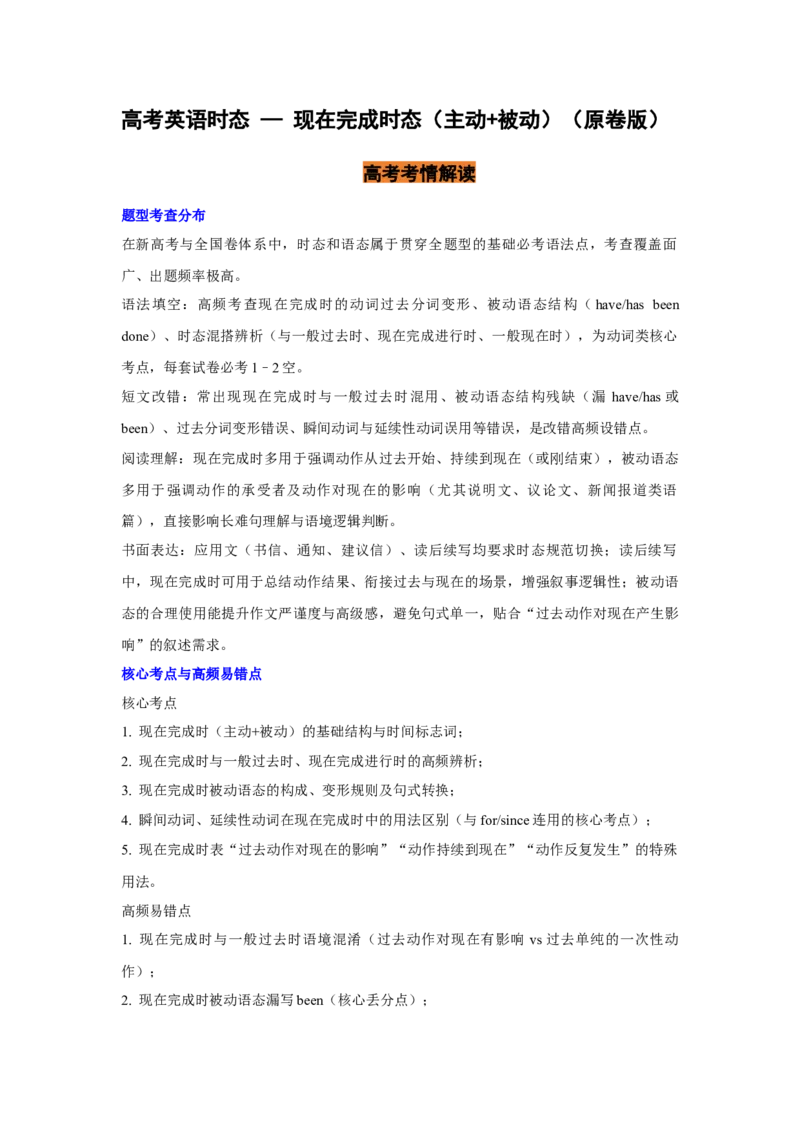
高考考情解读
题型考查分布
在新高考与全国卷体系中,时态和语态属于贯穿全题型的基础必考语法点,考查覆盖面
广、出题频率极高。
语法填空:高频考查现在完成时的动词过去分词变形、被动语态结构(have/has been
done)、时态混搭辨析(与一般过去时、现在完成进行时、一般现在时),为动词类核心
考点,每套试卷必考1–2空。
短文改错:常出现现在完成时与一般过去时混用、被动语态结构残缺(漏 have/has或
been)、过去分词变形错误、瞬间动词与延续性动词误用等错误,是改错高频设错点。
阅读理解:现在完成时多用于强调动作从过去开始、持续到现在(或刚结束),被动语态
多用于强调动作的承受者及动作对现在的影响(尤其说明文、议论文、新闻报道类语
篇),直接影响长难句理解与语境逻辑判断。
书面表达:应用文(书信、通知、建议信)、读后续写均要求时态规范切换;读后续写
中,现在完成时可用于总结动作结果、衔接过去与现在的场景,增强叙事逻辑性;被动语
态的合理使用能提升作文严谨度与高级感,避免句式单一,贴合“过去动作对现在产生影
响”的叙述需求。
核心考点与高频易错点
核心考点
1. 现在完成时(主动+被动)的基础结构与时间标志词;
2. 现在完成时与一般过去时、现在完成进行时的高频辨析;
3. 现在完成时被动语态的构成、变形规则及句式转换;
4. 瞬间动词、延续性动词在现在完成时中的用法区别(与for/since连用的核心考点);
5. 现在完成时表“过去动作对现在的影响”“动作持续到现在”“动作反复发生”的特殊
用法。
高频易错点
1. 现在完成时与一般过去时语境混淆(过去动作对现在有影响 vs过去单纯的一次性动
作);
2. 现在完成时被动语态漏写been(核心丢分点);3. 瞬间动词(come/go/leave/buy等)误用在现在完成时中与for/since连用表持续;
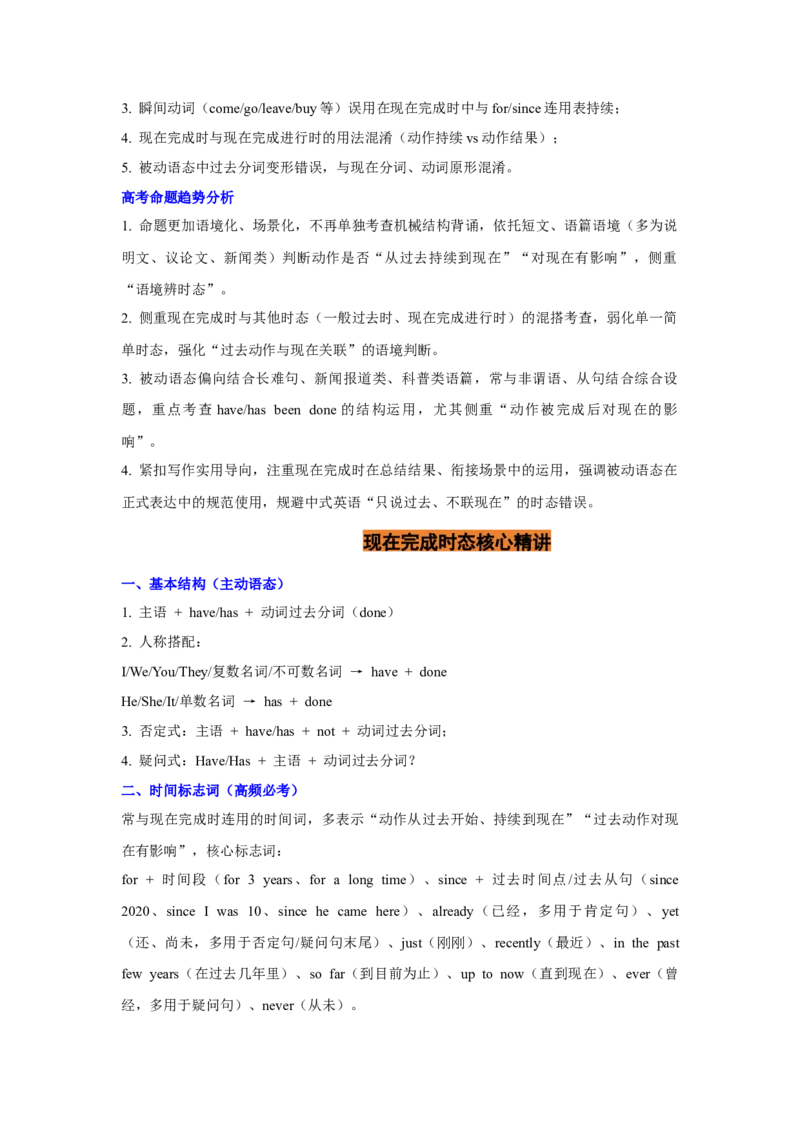
4. 现在完成时与现在完成进行时的用法混淆(动作持续vs动作结果);
5. 被动语态中过去分词变形错误,与现在分词、动词原形混淆。
高考命题趋势分析
1. 命题更加语境化、场景化,不再单独考查机械结构背诵,依托短文、语篇语境(多为说
明文、议论文、新闻类)判断动作是否“从过去持续到现在”“对现在有影响”,侧重
“语境辨时态”。
2. 侧重现在完成时与其他时态(一般过去时、现在完成进行时)的混搭考查,弱化单一简
单时态,强化“过去动作与现在关联”的语境判断。
3. 被动语态偏向结合长难句、新闻报道类、科普类语篇,常与非谓语、从句结合综合设
题,重点考查 have/has been done 的结构运用,尤其侧重“动作被完成后对现在的影
响”。
4. 紧扣写作实用导向,注重现在完成时在总结结果、衔接场景中的运用,强调被动语态在
正式表达中的规范使用,规避中式英语“只说过去、不联现在”的时态错误。
现在完成时态核心精讲
一、基本结构(主动语态)
1. 主语 + have/has + 动词过去分词(done)
2. 人称搭配:
I/We/You/They/复数名词/不可数名词 → have + done
He/She/It/单数名词 → has + done
3. 否定式:主语 + have/has + not + 动词过去分词;
4. 疑问式:Have/Has + 主语 + 动词过去分词?
二、时间标志词(高频必考)
常与现在完成时连用的时间词,多表示“动作从过去开始、持续到现在”“过去动作对现
在有影响”,核心标志词:
for + 时间段(for 3 years、for a long time)、since + 过去时间点/过去从句(since
2020、since I was 10、since he came here)、already(已经,多用于肯定句)、yet
(还、尚未,多用于否定句/疑问句末尾)、just(刚刚)、recently(最近)、in the past
few years(在过去几年里)、so far(到目前为止)、up to now(直到现在)、ever(曾
经,多用于疑问句)、never(从未)。三、核心用法(结合高考语境)
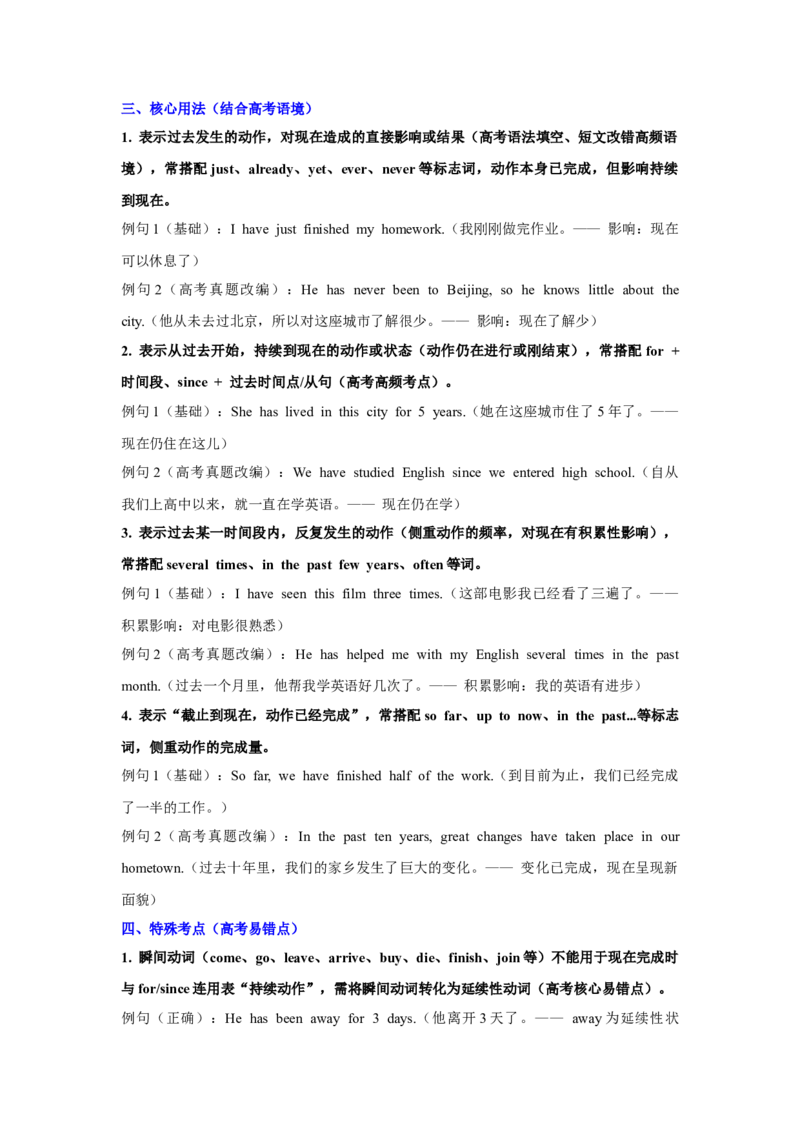
1. 表示过去发生的动作,对现在造成的直接影响或结果(高考语法填空、短文改错高频语
境),常搭配just、already、yet、ever、never等标志词,动作本身已完成,但影响持续
到现在。
例句1(基础):I have just finished my homework.(我刚刚做完作业。—— 影响:现在
可以休息了)
例句 2(高考真题改编):He has never been to Beijing, so he knows little about the
city.(他从未去过北京,所以对这座城市了解很少。—— 影响:现在了解少)
2. 表示从过去开始,持续到现在的动作或状态(动作仍在进行或刚结束),常搭配 for +
时间段、since + 过去时间点/从句(高考高频考点)。
例句1(基础):She has lived in this city for 5 years.(她在这座城市住了5年了。——
现在仍住在这儿)
例句2(高考真题改编):We have studied English since we entered high school.(自从
我们上高中以来,就一直在学英语。—— 现在仍在学)
3. 表示过去某一时间段内,反复发生的动作(侧重动作的频率,对现在有积累性影响),
常搭配several times、in the past few years、often等词。
例句1(基础):I have seen this film three times.(这部电影我已经看了三遍了。——
积累影响:对电影很熟悉)
例句2(高考真题改编):He has helped me with my English several times in the past
month.(过去一个月里,他帮我学英语好几次了。—— 积累影响:我的英语有进步)
4. 表示“截止到现在,动作已经完成”,常搭配so far、up to now、in the past...等标志
词,侧重动作的完成量。
例句1(基础):So far, we have finished half of the work.(到目前为止,我们已经完成
了一半的工作。)
例句2(高考真题改编):In the past ten years, great changes have taken place in our
hometown.(过去十年里,我们的家乡发生了巨大的变化。—— 变化已完成,现在呈现新
面貌)
四、特殊考点(高考易错点)
1. 瞬间动词(come、go、leave、arrive、buy、die、finish、join等)不能用于现在完成时
与for/since连用表“持续动作”,需将瞬间动词转化为延续性动词(高考核心易错点)。
例句(正确):He has been away for 3 days.(他离开3天了。—— away为延续性状态)
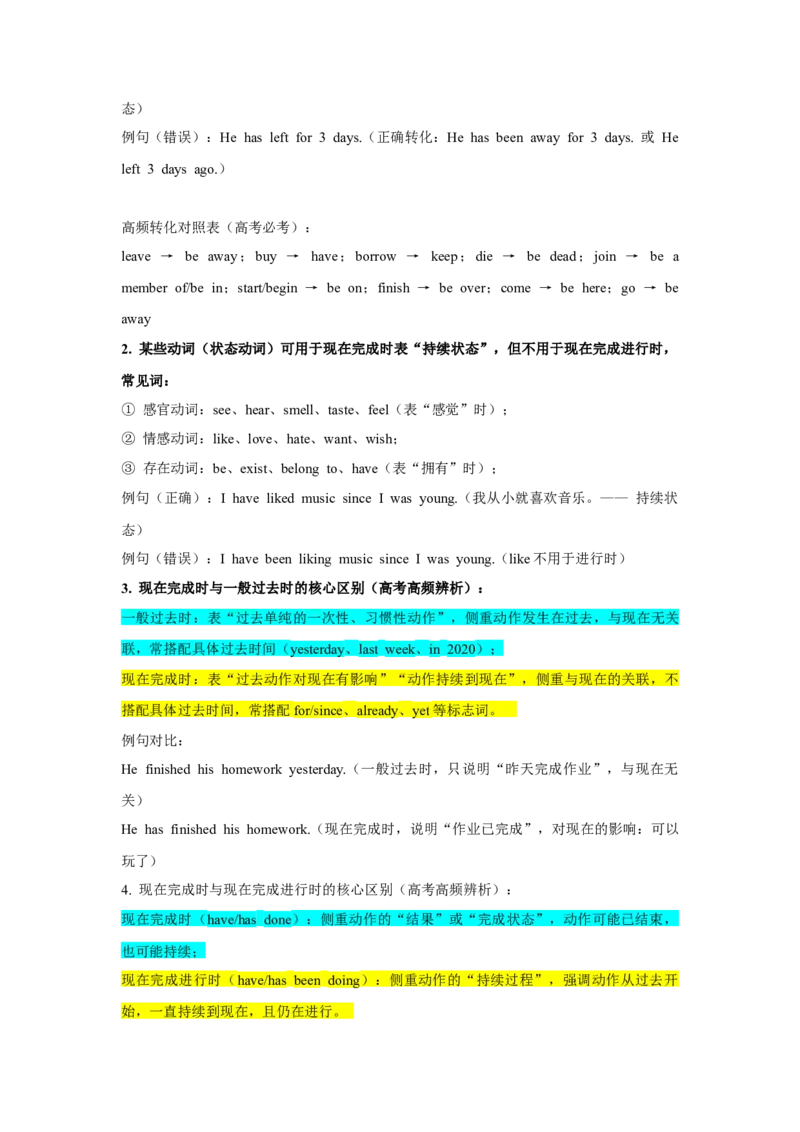
例句(错误):He has left for 3 days.(正确转化:He has been away for 3 days. 或 He
left 3 days ago.)
高频转化对照表(高考必考):
leave → be away;buy → have;borrow → keep;die → be dead;join → be a
member of/be in;start/begin → be on;finish → be over;come → be here;go → be
away
2. 某些动词(状态动词)可用于现在完成时表“持续状态”,但不用于现在完成进行时,
常见词:
① 感官动词:see、hear、smell、taste、feel(表“感觉”时);
② 情感动词:like、love、hate、want、wish;
③ 存在动词:be、exist、belong to、have(表“拥有”时);
例句(正确):I have liked music since I was young.(我从小就喜欢音乐。—— 持续状
态)
例句(错误):I have been liking music since I was young.(like不用于进行时)
3. 现在完成时与一般过去时的核心区别(高考高频辨析):
一般过去时:表“过去单纯的一次性、习惯性动作”,侧重动作发生在过去,与现在无关
联,常搭配具体过去时间(yesterday、last week、in 2020);
现在完成时:表“过去动作对现在有影响”“动作持续到现在”,侧重与现在的关联,不
搭配具体过去时间,常搭配for/since、already、yet等标志词。
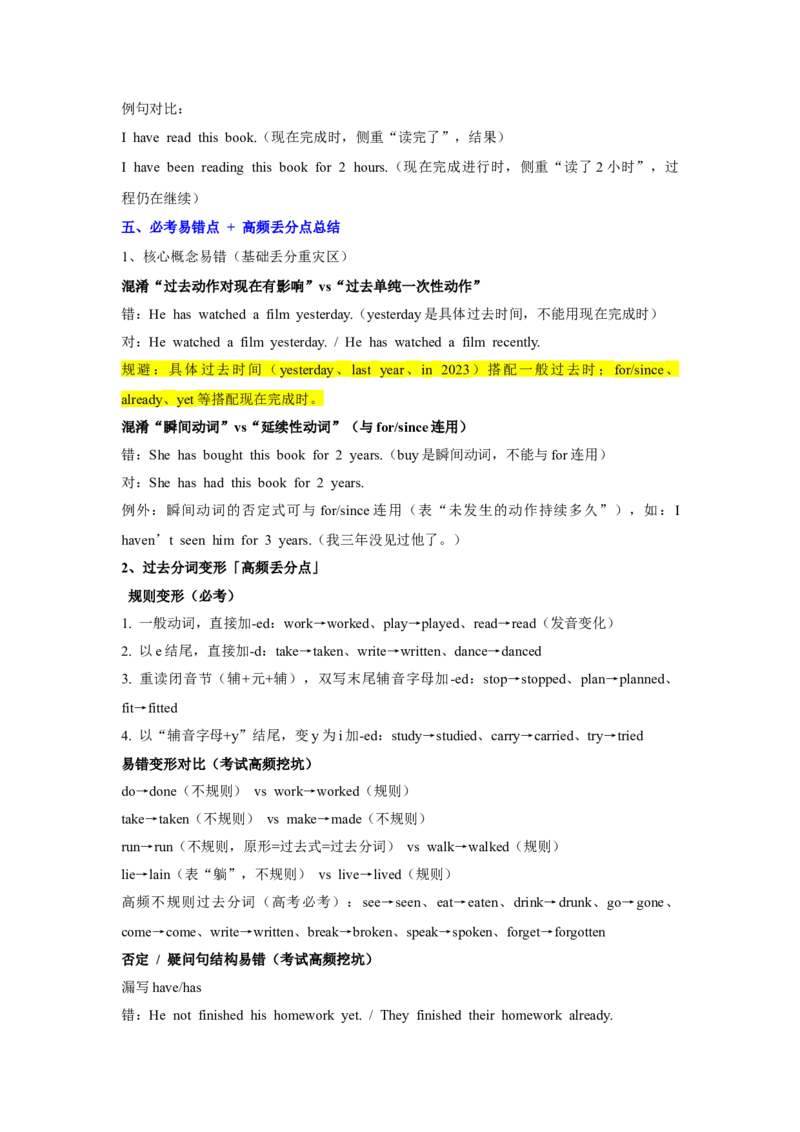
例句对比:
He finished his homework yesterday.(一般过去时,只说明“昨天完成作业”,与现在无
关)
He has finished his homework.(现在完成时,说明“作业已完成”,对现在的影响:可以
玩了)
4. 现在完成时与现在完成进行时的核心区别(高考高频辨析):
现在完成时(have/has done):侧重动作的“结果”或“完成状态”,动作可能已结束,
也可能持续;
现在完成进行时(have/has been doing):侧重动作的“持续过程”,强调动作从过去开
始,一直持续到现在,且仍在进行。例句对比:
I have read this book.(现在完成时,侧重“读完了”,结果)
I have been reading this book for 2 hours.(现在完成进行时,侧重“读了2小时”,过
程仍在继续)
五、必考易错点 + 高频丢分点总结
1、核心概念易错(基础丢分重灾区)
混淆“过去动作对现在有影响”vs“过去单纯一次性动作”
错:He has watched a film yesterday.(yesterday是具体过去时间,不能用现在完成时)
对:He watched a film yesterday. / He has watched a film recently.
规避:具体过去时间(yesterday、last year、in 2023)搭配一般过去时;for/since、
already、yet等搭配现在完成时。
混淆“瞬间动词”vs“延续性动词”(与for/since连用)
错:She has bought this book for 2 years.(buy是瞬间动词,不能与for连用)
对:She has had this book for 2 years.
例外:瞬间动词的否定式可与 for/since连用(表“未发生的动作持续多久”),如:I
haven’t seen him for 3 years.(我三年没见过他了。)
2、过去分词变形「高频丢分点」
规则变形(必考)
1. 一般动词,直接加-ed:work→worked、play→played、read→read(发音变化)
2. 以e结尾,直接加-d:take→taken、write→written、dance→danced
3. 重读闭音节(辅+元+辅),双写末尾辅音字母加-ed:stop→stopped、plan→planned、
fit→fitted
4. 以“辅音字母+y”结尾,变y为i加-ed:study→studied、carry→carried、try→tried
易错变形对比(考试高频挖坑)
do→done(不规则) vs work→worked(规则)
take→taken(不规则) vs make→made(不规则)
run→run(不规则,原形=过去式=过去分词) vs walk→walked(规则)
lie→lain(表“躺”,不规则) vs live→lived(规则)
高频不规则过去分词(高考必考):see→seen、eat→eaten、drink→drunk、go→gone、
come→come、write→written、break→broken、speak→spoken、forget→forgotten
否定 / 疑问句结构易错(考试高频挖坑)
漏写have/has
错:He not finished his homework yet. / They finished their homework already.对:He has not finished his homework yet. / They have finished their homework already.
疑问句语序错误
错:Finished you your homework? / Has you finished your homework?
对:Have you finished your homework? / Has he finished his homework?
否定句缩写错误
正确缩写:have not→haven’t、has not→hasn’t
错:have not→have’t、has not→has’t
特殊句式 & 固定场景易错
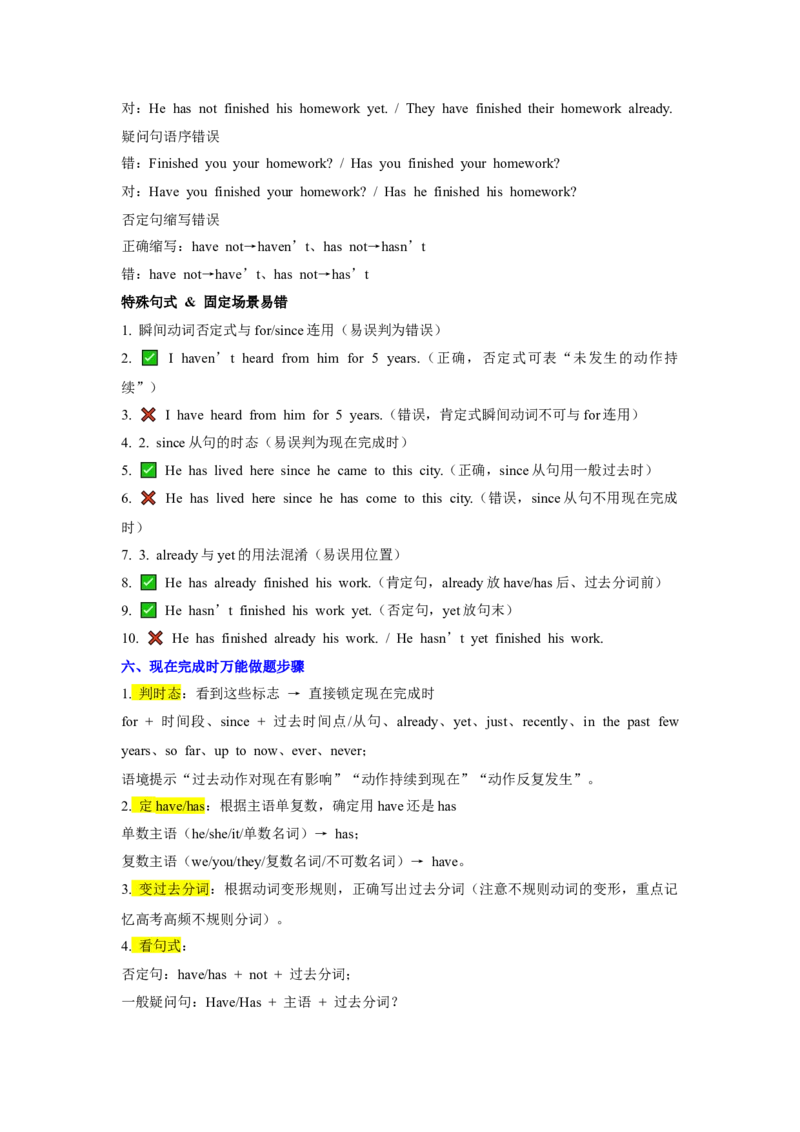
1. 瞬间动词否定式与for/since连用(易误判为错误)
2. ✅ I haven’t heard from him for 5 years.(正确,否定式可表“未发生的动作持
续”)
3. ❌ I have heard from him for 5 years.(错误,肯定式瞬间动词不可与for连用)
4. 2. since从句的时态(易误判为现在完成时)
5. ✅ He has lived here since he came to this city.(正确,since从句用一般过去时)
6. ❌ He has lived here since he has come to this city.(错误,since从句不用现在完成
时)
7. 3. already与yet的用法混淆(易误用位置)
8. ✅ He has already finished his work.(肯定句,already放have/has后、过去分词前)
9. ✅ He hasn’t finished his work yet.(否定句,yet放句末)
10. ❌ He has finished already his work. / He hasn’t yet finished his work.
六、现在完成时万能做题步骤
1. 判时态:看到这些标志 → 直接锁定现在完成时
for + 时间段、since + 过去时间点/从句、already、yet、just、recently、in the past few
years、so far、up to now、ever、never;
语境提示“过去动作对现在有影响”“动作持续到现在”“动作反复发生”。
2. 定have/has:根据主语单复数,确定用have还是has
单数主语(he/she/it/单数名词)→ has;
复数主语(we/you/they/复数名词/不可数名词)→ have。
3. 变过去分词:根据动词变形规则,正确写出过去分词(注意不规则动词的变形,重点记
忆高考高频不规则分词)。
4. 看句式:
否定句:have/has + not + 过去分词;
一般疑问句:Have/Has + 主语 + 过去分词?特殊疑问句:特殊疑问词 + have/has + 主语 + 过去分词?
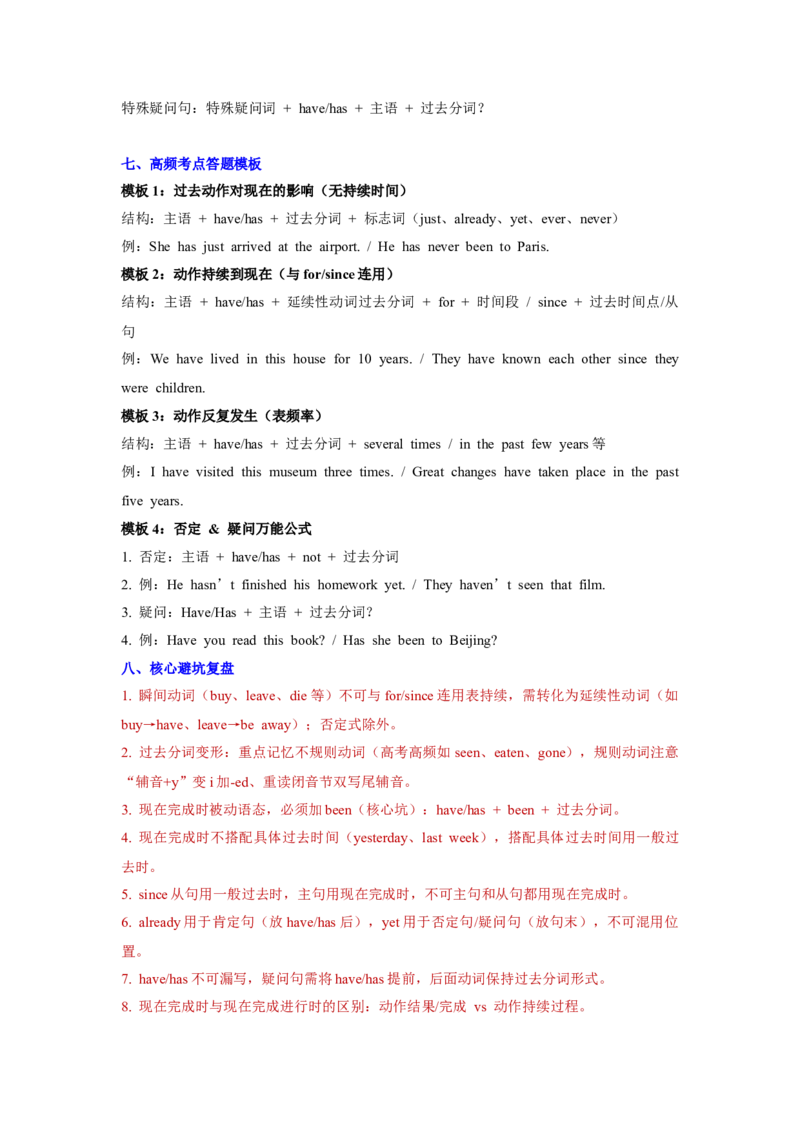
七、高频考点答题模板
模板1:过去动作对现在的影响(无持续时间)
结构:主语 + have/has + 过去分词 + 标志词(just、already、yet、ever、never)
例:She has just arrived at the airport. / He has never been to Paris.
模板2:动作持续到现在(与for/since连用)
结构:主语 + have/has + 延续性动词过去分词 + for + 时间段 / since + 过去时间点/从
句
例:We have lived in this house for 10 years. / They have known each other since they
were children.
模板3:动作反复发生(表频率)
结构:主语 + have/has + 过去分词 + several times / in the past few years等
例:I have visited this museum three times. / Great changes have taken place in the past
five years.
模板4:否定 & 疑问万能公式
1. 否定:主语 + have/has + not + 过去分词
2. 例:He hasn’t finished his homework yet. / They haven’t seen that film.
3. 疑问:Have/Has + 主语 + 过去分词?
4. 例:Have you read this book? / Has she been to Beijing?
八、核心避坑复盘
1. 瞬间动词(buy、leave、die等)不可与for/since连用表持续,需转化为延续性动词(如
buy→have、leave→be away);否定式除外。
2. 过去分词变形:重点记忆不规则动词(高考高频如seen、eaten、gone),规则动词注意
“辅音+y”变i加-ed、重读闭音节双写尾辅音。
3. 现在完成时被动语态,必须加been(核心坑):have/has + been + 过去分词。
4. 现在完成时不搭配具体过去时间(yesterday、last week),搭配具体过去时间用一般过
去时。
5. since从句用一般过去时,主句用现在完成时,不可主句和从句都用现在完成时。
6. already用于肯定句(放have/has后),yet用于否定句/疑问句(放句末),不可混用位
置。
7. have/has不可漏写,疑问句需将have/has提前,后面动词保持过去分词形式。
8. 现在完成时与现在完成进行时的区别:动作结果/完成 vs 动作持续过程。九、现在完成时的被动语态
核心构成
结构:have / has + been + 过去分词(done)
人称搭配:
I/We/You/They/复数名词/不可数名词 → have + been + done
He/She/It/单数名词 → has + been + done
基本句式
1. 肯定句
主语 + have/has + been + 过去分词
例:The project has been finished on time.(这个项目已经按时完成了。)
2. 否定句
主语 + have/has + not + been + 过去分词
例:The letter has not been sent by her yet.(那封信还没有被她寄出去。)
3. 一般疑问句
Have/Has + 主语 + been + 过去分词?
回答:Yes, 主语 + have/has./ No, 主语 + have/has not.
例:Has the room been cleaned? — Yes, it has.(房间已经被打扫了吗?—— 是的。)
4. 特殊疑问句
特殊疑问词 + have/has + 主语 + been + 过去分词?
例:What has been done in the lab recently?(最近实验室里做了什么?)
核心用法
1. 表示过去发生的被动动作,对现在造成的影响或结果,常配标志词:already、yet、
just、so far、up to now等。
例:The problem has been solved, so we can move on to the next step.(问题已经被解
决了,所以我们可以进行下一步了。)
2. 表示从过去开始,持续到现在的被动动作(动作仍在进行或刚结束),常搭配for + 时
间段、since + 过去时间点/从句等标志词。
例:This bridge has been built for 2 years.(这座桥已经被建造两年了。—— 现在仍在使
用或刚完工)
3. 强调过去某一时间段内,被动动作反复发生,常搭配 in the past few years、several
times等标志词。
例:Many new buildings have been built in our city in the past five years.(过去五年里,我们城市里建了很多新建筑。)
4. 强调被动动作的承受者,或不知道动作执行者、无需说出执行者时用被动。
例:The book has been translated into many languages.(这本书已经被翻译成多种语言。
—— 无需说出翻译者)
主动变被动 转换规则
1. 主动宾语 → 被动主语
2. 主动谓语(have/has + done)→ 被动谓语(have/has + been + done)
3. 主动主语 → 置于by后(可省略)
4. 时态保持不变(本题限定:现在完成时)
主动:They have finished the project on time.
被动:The project has been finished (by them) on time.
重点补充
1. by短语用来引出动作执行者,日常表达中常省略(尤其不知道执行者时)。
例:The machine has been repaired (by a worker).(这台机器已经被修理好了。)
2. 高频易错(核心丢分点)
① 漏写been:现在完成时被动语态必须有been,否则变成一般现在时被动(am/is/are +
done)或一般过去时被动(was/were + done)。
错:The house has built for 2 years.(正确:The house has been built for 2 years.)
② 过去分词变形错误:被动语态中必须用过去分词,不可用现在分词或动词原形。
错:The letter has been writing by her.(正确:The letter has been written by her.)
③ 单复数不匹配:单数主语用has been done,复数主语用have been done。
单句语法填空限时训练
1. The old building ________ (pull) down so far.
2. The children ________ (take) care of by their teacher since last Monday.
3. A new road ________ (not, build) in our town in the past few years.
4. What ________ (do) in the classroom recently?
5. These books ________ (read) by the students already.
6. The problem ________ (discuss) by the experts several times.
7. Our classroom ________ (clean) by us since this morning.
不用变被动 / 形式不变 特殊情况
1. 不及物动词(无宾语),无被动语态,即使表“从过去持续到现在”,也用主动形式。常见词:happen、take place、break out、appear、rise、fall、occur
例:An accident has happened since this morning.(不用 has been happened)
例:The sun has risen in the east.(不用 has been risen)
2. 状态动词(无动作,表状态),无被动语态,不用于现在完成时被动。
常见词:be、belong to、have、like、love、own
例:This book has belonged to me for 3 years.(不用 has been belonged to)
3. 主动结构表被动含义(较少见,结合语境)
某些感官动词、物性动词,主语是物,表“已经被……”时,可用主动表被动(多为口
语)。
例:The dish has tasted good.(= The dish has been tasted good. 口语中常用主动)
注意:书面语中,仍建议用被动结构(has been tasted),避免出错。
单句语法填空限时训练(主动+被动混合)
1. A big fire ________ (happen) in the forest recently.
2. The story ________ (not, take) place in our city in the past few years.
3. This book ________ (belong) to my brother for 2 years, so it ________ (not, read) by
me yet.
4. The music ________ (sound) beautiful, so it ________ (listen) to by many people
recently.
5. What ________ (happen) in the street so far?
现在完成时态核心精练
基础版
用所给动词的正确形式填空
1. I ________ (just, finish) my homework; let’s go out to play.
2. My father ________ (not, work) in this factory for 10 years.
3. She ________ (live) in this city since she was 5 years old.
4. He ________ (never, see) this film before.
5. ________ you ________ (read) this book yet? — No, I haven’t.6. They ________ (buy) this house for 3 years.(提示:buy转化为延续性动词)
7. She ________ (always, help) others since she came to our class.
8. The flowers ________ (smell) good; someone ________ (water) them.
9. We ________ (have) this car for 5 years; it still works well.
10. What ________ (do) your mother ________ (do) recently?
进阶版
一、单句语法填空
1. The moon ________ (not, shine) brightly recently; it’s always cloudy.
2. My sister ________ (practice) the piano for 5 years for the competition.
3. When I arrived, they ________ (finish) their work, so they ________ (rest) at that
time.(提示:finish表过去动作对现在的影响)
4. He ________ (not, run) since last month; he was ill.
5. Every student ________ (not, study) hard so far; some are lazy.
6. They ask when the meeting ________ (finish) — It ________ (already, finish).
7. ________ your brother ________ (swim) in the pool since this morning?
8. This pair of shoes ________ (not, fit) me for 2 years; I need a new pair.
9. Most birds ________ (fly) south since autumn came.
10. Time ________ (wait) for no man; we ________ (work) hard so far.
二、语法填空
阅读短文,用括号内动词的适当形式填空
It is 3 o’clock in the afternoon now. Our school 1________ (be) very busy
recently. Many students 2________ (do) different things. Some students 3________ (read)
books in the library since this morning. My best friend Tom 4________ (play) basketball
for 2 hours on the playground with his classmates. He 5________ (always, play)
basketball well, but he 6________ (not, play) very well today. Our teacher Miss Li
7________ (talk) with many students in her office recently. She 8________ (help) students
with their English for 3 years. Look! A group of students 9________ (clean) the
classroom. They 10________ (finish) half of the work so far. At the moment, everyone
11________ (be) busy and happy because they 12________ (achieve) a lot recently.现在完成时态过关达标练习
一、 单句语法填空 用所给动词的适当形式填空。
1. He ________ (work) in the office for 8 years; he is an experienced worker.
2. My mother ________ (wash) clothes since this morning; she is very tired.
3. The bird ________ (fly) away for 3 days; it hasn’t come back.
4. She said she ________ (go) to the library many times.
5. Tea ________ (pick) in many southern areas of China in the past few years.
6. Students ________ (ask) to finish homework already.
7. The old books ________ (send) to poor schools so far.
8. The flowers ________ (look) beautiful; they ________ (water) by the gardener recently.
9. A new film ________ (show) in the cinema since last week.
10. Workers ________ (make) ________ (work) hard by the boss recently.
二、语法填空
阅读短文,用所给动词的适当形式填空。
Every afternoon this term, our school 1 ________(become) lively. So far, many
students 2 ________(do) different activities. Some 3________ (sing) songs in the music
room since last month. Others 4________ (draw) pictures in the art room for 2 weeks.
Our teacher 5________ (organize) a sports meeting recently, so he 6________ (be) very
busy now. The meeting 7________ (not, start) yet. At the moment, the classroom
8________ (clean) by the students. Some books 9________ (arrange) on the bookshelf
since this morning. A new student 10 _______(introduce) to the class recently. Everyone
11________ (listen) carefully to him. No one 12________ (talk) loudly. It is a happy
moment in our school because we 13________ (make) a lot of progress recently.
你都答对了吗?恭喜你成功晋级!下一关,解
锁过去完成时态吧。