ARTICLE · 1034739
新托福第123套阅读真题
Reading
Reading Section
In the Reading section, you will answer 35-48 questions to demonstrate how well you understand academic and non-academic texts in English, There are three types of tasks.
Module 1
The clock will show you how much time you have to complete Module 1.
You can use Next and Back to move to the next question or return to previous questions within the same module.
You WILL NOT be able to return to Module 1 once you have begun Module 2.
Module 1
Fill in the missing letters in the paragraph
Questions 1-10 of 35
Fill in the missing letters in the paragraph.
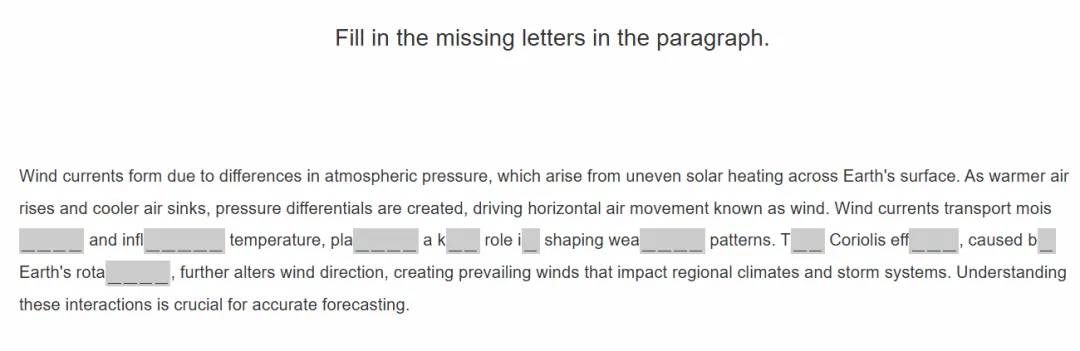
Wind currents form due to differences in atmospheric pressure, which arise from uneven solar heating across Earth's surface. As warmer air rises and cooler air sinks, pressure differentials are created, driving horizontal air movement known as wind. Wind currents transport mois__ __ __ __ and infl__ __ __ __ __ temperature, pla__ __ __ __ a k__ __ role i__ shaping wea__ __ __ __ patterns. T__ __ Coriolis eff__ __ __, caused b__Earth's rota__ __ __ __, further alters wind direction, creating prevailing winds that impact regional climates and storm systems. Understanding these interactions is crucial for accurate forecasting.
Fill in the missing letters in the paragraph
Questions 11-20 of 35
Fill in the missing letters in the paragraph.
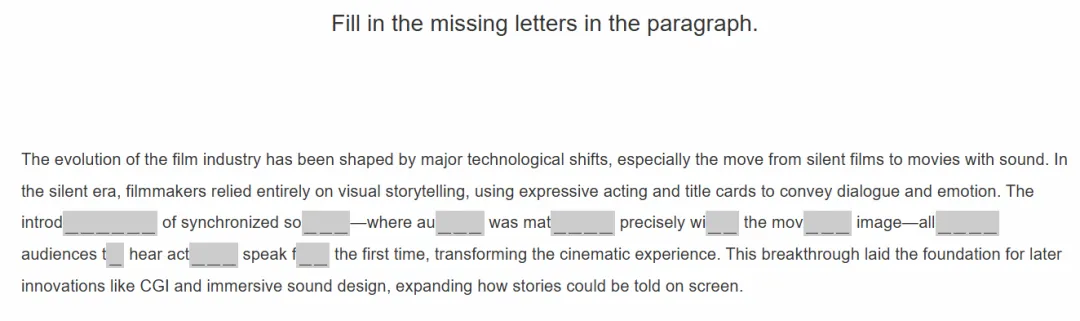
The evolution of the film industry has been shaped by major technological shifts, especially the move from silent films to movies with sound. In the silent era, filmmakers relied entirely on visual storytelling, using expressive acting and title cards to convey dialogue and emotion. The introd__ __ __ __ __ __ of synchronized so__ __ __—where au__ __ __ was mat__ __ __ __ precisely wi__ __ the mov__ __ __ image—all__ __ __ __ audiences t__ hear act__ __ __ speak f__ __ the first time, transforming the cinematic experience. This breakthrough laid the foundation for later innovations like CGI and immersive sound design, expanding how stories could be told on screen.
21-22
Read a course description.
BIOL 101
Introduction to Biology
This course explores fundamental principles of biology, including cellular organization, genetics, evolution, ecology, and physiology. Coursework consists of lectures, weekly laboratory sessions, and discussions.
Lectures
Tues/Thurs 9:30–11:00 A.M.; labs Wed 3:00–5:00 P.M.
Open to first-year students; no prerequisites.
The course emphasizes scientific thinking and best research practices.
21
Students enrolled in this course must do all of the following EXCEPT
attend lectures twice a week
participate in laboratory sessions
write a final lab report
take part in class discussions
22
Which of the following would be a typical BIOL 101 student?
Someone who has commitments in the afternoons
Someone who has already completed a first-year biology course
Someone who has previously studied university-level physiology
Someone who is interested in studying living organisms
23-25
Read a review.
MISHTI
Exciting Indian Cuisine Near Campus
Mishti offers a wide array of Indian regional fare. Vegans, vegetarians, and omnivores alike will enjoy brilliantly prepared dishes at surprisingly low prices. The attentive servers happily explain unfamiliar dishes, making every meal at Mishti a delightful education in India’s rich culinary traditions.
23
Which of the following can be inferred about Mishti's menu?
It provides detailed descriptions of every dish.
It includes dishes from various parts of India.
It focuses primarily on dishes that do not include meat.
It offers variety partly by changing with the seasons.
24
The review praises all of the following aspects of the restaurant EXCEPT:
Its menu has plant-based options.
Its service staff are friendly and informative.
Its prices are affordable.
Its dining room is attractive.
25-27
Read an email.
Subject:
Supporting information needed
Attachments:
1 file
Dear Ms. Gupta,
Thank you for submitting your research grant application. The committee is ready to finalize our review, but a few items in the proposed budget need clarification to ensure accurate evaluation:
For equipment, provide a brief justification and confirmation that the items are allowed under the grant's guidelines.
For contracted services, please identify the intended vendor (or note 'to be determined') and provide the basis for the cost estimate.
Please upload the revised budget via the grant portal by November 18. I have attached sample budget scenarios that you may use as examples when making your calculations. Please also verify your current enrollment by uploading a PDF of your course schedule. I'm happy to discuss any questions by phone or email. Thank you for your prompt attention.
Regards,
Michael Anderson
Office of Sponsored Programs
25
According to Dr. Anderson, all of the following are required from Ms. Gupta EXCEPT
a reason why she has included each item of equipment in her budget
the identities of the vendors she intends to hire for services
verification that she is enrolled in classes
a PDF of the coursework she has completed to date
26
What resource does Dr. Anderson offer in order to help Ms. Gupta accomplish the requested task?
Sample scenarios for calculating her research budget
Access to the university portal so she may download her schedule
An official email documenting his endorsement of her proposal
A list of the committee members reviewing her proposal
27
Supporting information is needed in order to complete which of the following processes?
A request for admission to an academic program
Assessment of an annual departmental budget
An application for funding for academic research
An evaluation of a vendor's proposal to provide services
28-30
Read an article.
ON MARCH 18, FILM STUDIES MAJORS PRESENTED THEIR WORK AT ADLER AUDITORIUM.
Four short films created by students were screened, and each filmmaker answered questions from audience members. The films were striking in their variety. The program began with a whimsical animated film, Insides, depicting the internal organs of a human body interacting with one another like family members. Filmmaker Kat Morgan said the idea came to her while she was taking Human Anatomy 101.
Next up was Alan Hinds' sober black-and-white documentary On My Feet, chronicling his brother's unsuccessful attempt to become a champion marathon runner.
The third film in the series was Margot Bridges' comedy The Date, about a mismatched couple on a movie date.
And lastly, the audience saw The Friend, Priti Patel's tender depiction of a toddler's relationship with a protective dog.
All four films were technically accomplished, engaging, and reflective of each filmmaker's distinctive, individual talents.
28
The article indicates which of the following about the event at Adler Auditorium?
It was covered by several media outlets.
It centered on students pursuing the same degree.
It was sponsored by a student organization.
It was introduced by a professor of film studies.
29
The article suggests that the four films
showed different levels of technical proficiency
featured students as actors
were shot in black and white
covered a range of emotional tones
30
The article mentions each of the following EXCEPT
other projects completed by the filmmakers
the venue where the screenings were held
the subject matter of each film that was shown
the inspiration behind one of the films
31-35
Gamma-Ray Astronomy: Unveiling the Universe
Gamma-ray astronomy has transformed our view of the cosmos by enabling scientists to detect some of the universe's most energetic and extreme phenomena, including gamma-ray bursts (GRBs). GRBs have drawn intense interest due to their mysterious origins and immense energy output. Unlike visible light, gamma rays do not penetrate Earth's atmosphere. As a result, astronomers deploy space telescopes to capture signals from cosmic events like supernovae and neutron star collisions.
The launch of the Compton Gamma Ray Observatory in 1991 provided the first comprehensive map of the gamma-ray sky, similar to the way optical telescopes map the visible sky. This breakthrough allowed scientists to pinpoint the locations of GRBs and study their properties in detail. Scientists learned that these bursts occur randomly across the sky and are not confined to our galaxy alone.
Despite the advances, many questions remain. Some hypothesize that GRBs are the result of merging neutron stars, while others suggest they stem from hypernovae, explosive events that dwarf typical supernovae. Each explanation carries implications for our understanding of stellar evolution and cosmic history. New telescopes like the Fermi Gamma-ray Space Telescope may help astronomers uncover more secrets of these cosmic beacons.
31
It can be inferred from the passage that space telescopes are used for gamma-ray astronomy primarily because
gamma-ray sources produce signals that are too faint to detect with standard instruments
gamma rays have physical characteristics that prevent ground-based observation
gamma rays come from a region of the universe that is hard to observe from Earth
gamma-ray events occur unpredictably and require constant monitoring
32
The phrase "confined to" in the passage is closest in meaning to
limited to
returned to
trapped by
created by
33
The Compton Gamma Ray Observatory enabled scientists to
create a more accurate map of the visible sky
prove that gamma rays come from neutron stars
find out where GRBs occur and learn more about them
discover regular patterns in the occurrence of GRBs
34
Based on the passage, which issue about GRBs remains unresolved?
How large GRBs are compared to other cosmic explosions
How frequent GRBs are in different regions of the universe
The specific processes that give rise to GRBs
The total amount of energy released during a typical GRB
35
Why does the author mention the Fermi Gamma-ray Space Telescope?
To emphasize the importance of international cooperation in gamma-ray research
To explain how gamma-ray bursts were first detected
To compare modern telescope technology with earlier optical instruments
To suggest that new observational tools can help resolve unanswered questions
Module 2
Fill in the missing letters in the paragraph
Questions 1-10 of 15
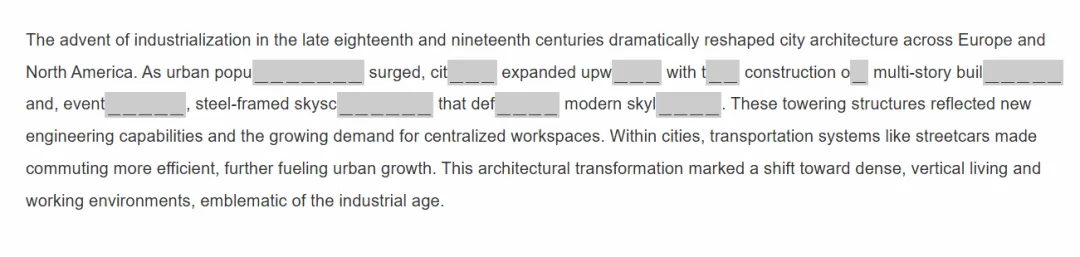
The advent of industrialization in the late eighteenth and nineteenth centuries dramatically reshaped city architecture across Europe and North America. As urban popu__ __ __ __ __ __ __ surged, cit__ __ __ expanded upw__ __ __ with t__ __ construction o__ multi-story bui__ __ __ __ __ and, event__ __ __ __ __, steel-framed skysc__ __ __ __ __ __ that def__ __ __ __ modern skyl__ __ __ __. These towering structures reflected new engineering capabilities and the growing demand for centralized workspaces. Within cities, transportation systems like streetcars made commuting more efficient, further fueling urban growth. This architectural transformation marked a shift toward dense, vertical living and working environments, emblematic of the industrial age.
Questions 11-15 of 15
Demographic Dynamics
The demographic transition model (DTM) illustrates the shifting patterns of birth and death rates as societies evolve from agrarian to industrialized economies. Initially, both rates are high, resulting in slow population growth due to limited access to healthcare and sanitation. As countries develop, death rates decline sharply with advances in medical care and improved living conditions. Yet, birth rates often remain high, spurring rapid population growth that can strain resources. This transition highlights the tension between demographic momentum and societal capability to meet the growing needs.
A further decline in birth rates eventually occurs, influenced by greater access to education and changes in cultural norms. Families begin to view fewer children as advantageous, aligning with shifts toward economic and personal aspirations. However, this stage brings its own challenges, including the potential for an aging population and workforce shortages.
Some demographers postulate a fifth stage, characterized by persistently low birth rates that might lead to population contraction. The implications of this are complex, ranging from economic innovation driven by necessity to increased strain on social institutions and intergenerational support systems. Understanding these transitions enables societies to better plan for future demographic realities, though the dynamic interplay of these factors is still unfolding.
11
According to paragraph 1, what does the demographic transition model primarily demonstrate?
Decreasing birth rates as societies industrialize
Changing rates of birth and death as economies develop
Differences in healthcare access among societies
Consequences of rising death rates in industrial societies
12
Which of the following can be inferred about agrarian societies?
They are more prosperous than industrialized societies.
They are an exception to the trends proposed by the demographic transition model.
They experience high birth rates and also high death rates.
They suffer sharp population declines as a result of high death rates.
13
The word "aspirations" in the passage is closest in meaning to
goals
resources
changes
challenges
14
Which of the following is NOT mentioned about low birth rates?
Sustained low birth rates result in negative population growth.
Demographic changes brought about by low birth rates can lead to societal tensions.
Persistently low birth rates typically lead to economic decline.
Understanding demographic transitions linked to low birth rates helps societies plan for the future.
15
The demographic transition model (DTM) illustrates the shifting patterns of birth and death rates as societies evolve from agrarian to industrialized economies. Initially, both rates are high, resulting in slow population growth due to limited access to healthcare and sanitation. As countries develop, death rates decline sharply with advances in medical care and improved living conditions. Yet, birth rates often remain high, spurring rapid population growth that can strain resources. This transition highlights the tension between demographic momentum and societal capability to meet the growing needs. ◼︎
A further decline in birth rates eventually occurs, influenced by greater access to education and changes in cultural norms. ◼︎ Families begin to view fewer children as advantageous, aligning with shifts toward economic and personal aspirations. ◼︎ However, this stage brings its own challenges, including the potential for an aging population and workforce shortages. ◼︎
Some demographers postulate a fifth stage, characterized by persistently low birth rates that might lead to population contraction. The implications of this are complex, ranging from economic innovation driven by necessity to increased strain on social institutions and intergenerational support systems. Understanding these transitions enables societies to better plan for future demographic realities, though the dynamic interplay of these factors is still unfolding.
There are four locations [◼︎] in the passage that indicate where the following sentence could be added.'"
As societies navigate this demographic shift, proactive policies and innovations become essential to sustain economic growth and promote well-being among older adults.
Where would the sentence best fit? Select a location [◼︎] to add the sentence to the passage."
http://www.tuonindefu.com/?p=14107