ARTICLE · 1201495
教招类丨初中英语《How can we become good learners?》试讲&说课软文

事业单位(教师类)科目“试讲”和“说课”软文,可适用于直面岗位或者笔试已通过学员。提供服务说明:1.可提供各科现行电子版教材(此处免费,但有些教材不全,望理解);2.可量身订制片段、单节,甚至整册教材“试讲”或“说课”软文,便于备考使用;3.可提供面试授课、面试模拟(线上/线下)等相关培训服务;若本人授课经验匮乏,可提供公立学校实习机会。
面試題目
1.题目:《How can we become good learners?》
2.内容:
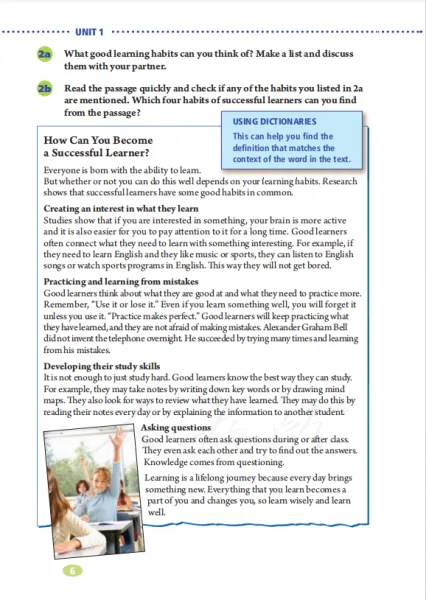
——选自2013人教版《英语》九年级
3.试讲要求:(1)Please deliver a 10-minute trial lecture based on the content;
(2)The trial lecture must be conducted entirely in English;
(3)A blackboard design is required.
試講軟文
【教学试讲稿】
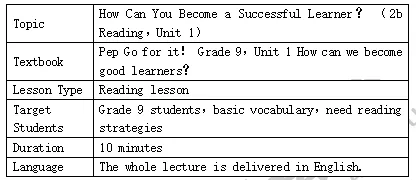
How Can You Become a Successful Learner?
Unit 1 How can we become good learners?丨Reading丨Grade 9丨10-minute Trial Lecture丨Conducted entirely in English
Teaching Objectives
Knowledge aims:Students can master key phrases such as be born with,connect…with,practice and learn from mistakes,Use it or lose it,Practice makes perfect,develop study skills,take notes,mind maps,and ask questions; they can understand the four good habits of successful learners.
Ability aims:Students can skim for the main idea and scan for details; they can talk about their own learning habits in simple English.
Affective aims:Students build confidence in English learning,form good learning habits,and develop a lifelong-learning attitude.
Key Points and Difficult Point
Key point:The four good habits,the key phrases,and the two proverbs.
Difficult point:Applying the four habits to students’ own English learning and understanding the proverbs and the Bell example.
Teaching Procedure
Step 1 Greeting and Lead-in(about 1 minute)
T:Good morning,class! How are you today? I’m glad to hear that.Before we read,please look at the screen.Here are two students learning English.Student A reads English every morning and watches English cartoons; Student B only memorizes words right before a test.After one month,who do you think learns better? Yes,Student A.But why? Good,because Student A has good learning habits.Today we will read a passage,How Can You Become a Successful Learner?,and find out what good habits successful learners share.
Step 2 Pre-reading:Brainstorm and Predict(about 1.5 minutes)
T:First,open your books and turn to page 5,activity 2b.Look at the title.Before reading,let’s brainstorm:what good learning habits can you think of? Please discuss with your partner for thirty seconds.
(Pause,look around,nod.)
T:Time is up.Any volunteer? Yes,read aloud,take notes in class,ask questions when confused,review after class.Wonderful,you have so many ideas.Now let’s read the passage quickly and check which habits the writer mentions.
Step 3 While-reading (1):Skimming for Main Ideas(about 1.5 minutes)
T:Task one:skimming.Please read the passage quickly,only catch the main idea of each part,and find the four good habits.You have two minutes.Go!
(Pause,walk around,check.)
T:Time’s up.The first paragraph tells us that everyone is born with the ability to learn,but whether you learn well depends on your learning habits.Then the passage introduces four habits.Let’s match each habit with its paragraph.First,creating an interest in what they learn; second,practicing and learning from mistakes; third,developing their study skills; fourth,asking questions.Well done!
Step 4 While-reading (2):Scanning and Detailed Reading(about 3 minutes)
T:Now task two:read carefully paragraph by paragraph and find the details.
T:Habit one:creating an interest.Why does interest help? Yes,when you are interested,your brain is more active and it is easier to pay attention for a long time.Good learners connect what they need to learn with something interesting.For example,if they like music,they listen to English songs; if they like sports,they watch sports programs in English.In this way,they will not get bored.
T:Habit two:practicing and learning from mistakes.Remember two proverbs:Use it or lose it,and Practice makes perfect.Even if you learn something well,you will forget it unless you use it.The passage also gives an example:Alexander Graham Bell did not invent the telephone overnight.He succeeded by trying many times and learning from his mistakes.So do not be afraid of making mistakes.
T:Habit three:developing study skills.It is not enough to just study hard; you must know the best way to study.For example,take notes by writing down key words or drawing mind maps,and review what you have learned,such as reading your notes every day or explaining the information to another student.
T:Habit four:asking questions.Good learners often ask questions during or after class,and they even ask each other and try to find out the answers.Remember:knowledge comes from questioning.
Step 5 Post-reading:Discussion and Retelling(about 1.5 minutes)
T:Now work in groups of four.Discuss:which habit will you use first in your own English study,and why? Give one example.You have two minutes.
(Pause,join one group,then invite reporting.)
T:Group three,please.Good,you will connect English with your favorite basketball games and watch English match reports.That is a smart choice.Now,with the help of the blackboard,who can retell the four habits? Yes,please.Excellent,clear and complete.
Step 6 Summary and Homework(about 1 minute)
T:Let’s summarize.Today we learned four good habits:create an interest,practice and learn from mistakes,develop study skills,and ask questions.Learning is a lifelong journey,so learn wisely and learn well.
T:Homework:write five sentences about your own English learning plan,using the phrases we learned today.Class is over.Goodbye,class!
Blackboard Design
Unit 1 How can we become good learners?
Title:How Can You Become a Successful Learner?
Four good habits:
1.Create an interest in what you learn(connect…with…)
2.Practice and learn from mistakes(Use it or lose it./ Practice makes perfect.)
3.Develop study skills(take notes·mind maps·review)
4.Ask questions(Knowledge comes from questioning.)
Key message:Learning is a lifelong journey; learn wisely and learn well.
說課軟文
【教学说课稿】
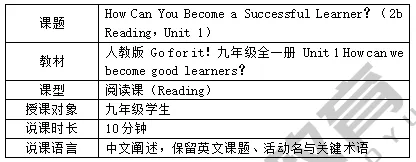
《How Can You Become a Successful Learner?》说课稿
人教版 Go for it!九年级 Unit 1 How can we become good learners?·阅读课·10分钟说课
一、说教材
本课选自人教版 Go for it!九年级全一册 Unit 1 How can we become good learners? 的 2b 阅读课文 How Can You Become a Successful Learner?。单元主题为“如何成为优秀的学习者”,聚焦学习策略与良好学习习惯。
语篇是一篇说明文,围绕成功学习者的四个好习惯展开:培养对所学内容的兴趣、在练习与错误中学习、培养学习技能、主动提问;结尾点明“学习是一场终身旅程”。本课时上承 Section A 的听说与学习策略导入,下启语法与写作输出,既承担略读、扫读等阅读策略训练,又渗透良好学习习惯与终身学习的情感态度,在单元中起承上启下的作用。
二、说学情
授课对象为九年级学生。他们已具备一定词汇基础,能读懂浅易短文,对“学习方法”这一话题有切身体验,容易产生共鸣;但普遍存在阅读策略薄弱、习惯逐字阅读、遇到生词依赖词典、害怕犯错、不善于提问等问题。因此教学从学生真实的学习经历切入,引导他们在语篇中习得策略,并迁移到自己的英语学习中。
三、说教学目标
1.知识目标:掌握 be born with、connect…with、practice and learn from mistakes、Use it or lose it、Practice makes perfect、take notes、mind maps、ask questions 等短语,理解成功学习者的四个好习惯。
2.能力目标:能运用略读抓住段落主旨,运用扫读定位细节;能用简单英语谈论自己的学习习惯。
3.情感目标:树立学习信心,养成良好学习习惯,不怕犯错,形成终身学习的意识。
四、说教学重难点
教学重点:四个好习惯、核心短语以及 Use it or lose it、Practice makes perfect 两句谚语。
教学难点:把文中的好习惯迁移到自身英语学习,并理解谚语含义与贝尔发明电话的事例。
五、说教法与学法
教法:采用 PWP(Pre-reading、While-reading、Post-reading)阅读教学模式,结合任务型教学法、启发式问答与小组讨论,教师由“讲授者”转为“引导者”。
学法:指导学生运用略读找主旨、扫读找细节,通过合作探究归纳好习惯,并借助板书复述,实现从输入到输出。
六、说教学过程
本课时按完整一课时(约40分钟)设计,分五个环节推进,各环节与设计意图如下表。
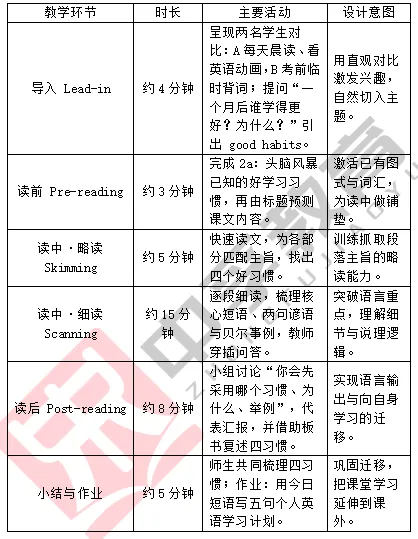
环节说明
导入环节以对比设问制造认知冲突,让学生带着“为什么A学得好”的问题进入课文;读前预测降低阅读焦虑;略读与细读分层推进,先把握整体框架再落实语言细节;读后讨论把语篇内容转化为学生自己的学习计划,体现“学用结合”;小结与作业形成闭环。
七、说板书设计
板书采用“中央标题+左列习惯+右列短语”的结构,提纲挈领,便于学生对照复述,具体如下。
Unit 1 How can we become good learners?
——How Can You Become a Successful Learner?
四个好习惯(左侧):
1.Create an interest in what you learn(connect…with…)
2.Practice and learn from mistakes(Use it or lose it./ Practice makes perfect.)
3.Develop study skills(take notes·mind maps·review)
4.Ask questions(Knowledge comes from questioning.)
金句:Learning is a lifelong journey; learn wisely and learn well.