ARTICLE · 1411643
高考英语阅读理解专项训练20篇(含答案)
2021年全国新高考II卷
A
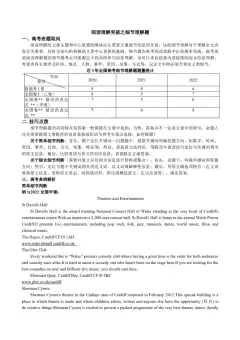
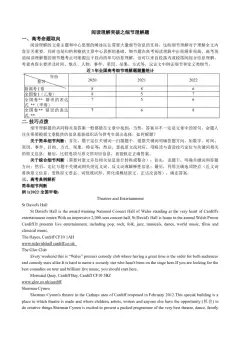
Things to Do in Yorkshire This Summer
Harrogate Music Festival
Since its birth,Harrogate Music festival has gone from strength to strength.This year, we are celebrating our 50th anniversary. We begin on 1st June with Manchester Camerata and Nicola Benedetti,presenting an amazingprogramme of Mozart pieces.
Dates:1 June-31 July
Tickets:£12-£96
Jodie's Fitness summer Classes
As the summer months roll in, our Georgian country estate makes the perfect setting for an outdoor fitness session. Come and work out with our qualified personal trainer, Jodie McGregor,on the grounds of the Middleton Lodge estate.
We will be holding a free taster session on 23rd May,at 10 am, to demonstrate the variety of effective and active exercises. There are eight spaces available for the taster session. advance bookings are required(info@middletonlodge.co.uk.paris)
Dates:23 May-11 July
Tickets: £7.50 per session
Felt Picture Making
Working from an inspirational picture,this workshop at Helmsley Arts Centre will teach you the techniques you will need to recreate your picture in wool.
We will also discuss the origins of felt(毛毡),what enables wool fibres to become felt and how the processes we use work.
Dates: 12 June-12 July
Tickets: £40 including materials
Figure It Out!-Playing with Math
A new exhibition in Halifax uses everyday activities to explain the hidden math principles we all use on a regular basis. Pack a bag, cut a cake, guess which juice container holds the most liquid,and much more.Discover how architects, product designers and scientists use similar skills in their work.
Dates:7 May-10 June
Tickets:Free
21.What should you do if you want to attend the taster session of Jodie's fitness classes?
A. Join a fitness club. B.Pay a registration fee.
C.Make a booking. D.Hire a personal trainer.
22. How much is the ticket for Felt Picture Making?
A.£7.50. B.£12. C.£40. D.£96.
23.Which of the following starts earliest?
A.Harrogate Music Festival. B. Jodie's Fitness Summer Classes.
C.Felt Picture Making. D.Figure It Out!-Playing with Math.
B
I have worked as a keeper at the National Zoo.paris for 11 years. Spot and Stripe are the first tiger cubs(幼兽)that have ever been born here. Globally, a third of Sumatran cubs in zoos don't make it to adulthood, so I decided to give them round-the-clock care at home.
I've got two children - the younger one, Kynan, was extremelyhappy about the tigers arriving - but all of us really looked forward to being part of their lives and watching them grow. I wasn't worried about bringing them into my home with my wife and kids. These were cubs. They weighed about 2.5 kg and were so smallthat there was absolutely no risk.
As they grew more mobile, we let them move freely around the house during the day, but when we were asleep we had to contain them in a large room, otherwise they'd get up to mischief. We'd come down in the morning to find they'd turned the room upside down, and left it looking like a zoo.
Things quickly got very intense due to the huge amount of energy required to look after them. There were some tough times and I just felt extremely tired. I was grateful that my family was there to help. We had to have a bit of a production line going, making up “tiger milk”, washing baby bottles, and cleaning the floors.
When Spot and Stripe were four months old, they were learning how to open doors and jump fences, and we knew it really was time for them to go. It was hard for us to finally part with them. For the first few days, Kynan was always a bit disappointed that the cubs weren't there.
I'm not sad about it. I'm hands-on with them every day at the zoo, and I do look back very fondly on the time that we had them.
24.Why did the authorbring the tiger cubs home?
A.To ensure their survival. B. To observe their differences.
C.To teach them life skills. D.To let them play with his kids.
25. What do the underlined words “get up to mischief' mean in paragraph 3?
A.Behave badly. B.Lose their way.
C.Sleep soundly. D.Miss their mom.
26.What did the author think of raising the tiger cubs at home?
A.Boring. B.Tiring. C.Costly. D.Risky.
27.Why did the author decide to send Spot and Stripe back to the zoo?
A.They frightened the children. B.They became difficult to contain.
C.They annoyed the neighbours. D.They started fighting each other.
C
A British woman who won a S1 million prize after she was named the World's Best Teacher will use the cash to bring inspirational figures into UK schools.
Andria Zafirakou,a north London secondary school teacher, said she wanted to bring about a classroom revolution (变革). “We are going to make a change,"she said."I've started a project to promote the teaching of the arts in our schools."
The project results from the difficulties many schools have in getting artists of any sort - whether an up-and-coming localmusician or a major movie star - into schools to work with and inspire children.
Zafirakou began the project at Alperton community School, her place of work for the past twelve years. “I've seen those magic moments when children are talking to someone they are inspired by - their eyes are shining and their faces light up,” she said. “We need artists . more than ever in our schools."
Artist Michael Craig-Martin said: “Andria's brilliant project to bring artists from all fields into directcontact with children is particularly welcome at a time when the arts are being downgraded in schools." It was a mistake to see the arts as unnecessary, he added.
Historian Sir Simon Schama is also a supporter of the project. He said that arts education in schools was not just an add-on. “It is absolutely necessary. The future depends on creativity and creativity depends on the young. What will remain of us when artificial intelligence takes over will be our creativity, and it is our creative spirit, our visionary sense of freshness,that has been our strength for centuries."
28.What will Zafirakou do with her prize money?
A. Make a movie. B.Build new schools.
C.Run a project. D. Help local musicians.
29.What does Craig-Martin think of the teaching of the arts in UK schools?
A. It is particularly difficult. B. It increases artists' income.
C. It opens children's mind. D.It deserves greater attention.
30.What should be stressed in school education according to Schama?
A. Moral principles. B. Interpersonal skills.
C.Creative abilities. D.Positive worldviews.
31.Which of the following is a suitabletitle for the text?
A.Bring Artists to Schools B.When Historians Meet Artists
C.Arts Education in Britain D.The World's Best Arts Teacher
D
An Australian professor is developing a robot to monitor the health of grazing cattle, a development that could bring big changes to a profession that's relied largely on a low-tech approach for decades but is facing a labor shortage.
Salah Sukkarieh, a professor at the university of Sydney, sees robots as necessary given how cattlemen are aging. He is building a four-wheeled robot that will run on solar and electric power. It will use cameras and sensors to monitor the animals. A computer system will analyze the video to determine whether a cow is sick. Radio tags (标签)on the animals will measure temperature changes. The quality of grassland will be tracked by monitoring the shape,color and texture (质地) of grass. That way, cattlemen will know whether they need to move their cattle to another field for nutrition purposes.
Machines have largely taken over planting, watering and harvesting crops such as com and wheat, but the monitoring of cattle has gone through fewer changes.
For Texas cattleman Pete Bonds, it's increasingly difficult to find workers interested in watching cattle. But Bonds doesn't believe a robot is right for the job. Years of experience in the industry - and failed attempts to use technology - have convinced him that the best way to check cattle is with a man on a horse. Bonds, who bought his first cattle almost 50 years ago, still has each of his cowboys inspect 300 or 400 cattle daily and look for signs that an animal is getting sick.
Other cattlemen see more promise in robots. Michael Kelsey Paris, vice president of the Oklahoma Cattlemen's Association, said a robot could be extremely useful given rising concems about cattle theft. Cattle tend to be kept in remote places and their value has risen, making them appealing targets.
32.What is a problem with the cattle-raising industry?
A. Soil pollution. B.Lack of workers.
C.Aging machines. D. Low profitability.
33. What will Sukkarieh's robot be able to do?
A.Monitor the quality of grass. B.Cure the diseased cattle.
C.Move cattle to another field. D.Predict weather changes.
34.Why does Pete Bonds still hire cowboys to watch cattle?
A. He wants to help them earn a living. B.He thinks men can do the job better.
C. He is inexperienced in using robots. D.He enjoys the traditional way of life.
35.How may robots help with cattle watching according to Michael Kelsey?
A.Increase the value of cattle. B. Bring down the cost of labor.
C.Make the job more appealing. D.Keep cattle from being stolen.
2021年全国新高考I卷
A
Rome can be pricey for travelers, which is why many choose to stay in a hostel(旅社). The hostels in Rome offer a bed in a dorm room for around $25 a night, and for that, you’ll often get to stay in a central location(位置) with security and comfort.
Yellow Hostel
If I had to make just one recommendation for where to stay in Rome, it would be Yellow Hostel. It’s one of the best-rated hostels in the city, and for good reason. It’s affordable, and it’s got a fun atmosphere without being too noisy. As an added bonus, it’s close to the main train station.
Hostel Alessandro Palace
If you love social hostels, this is the best hostel for you in Rome. Hostel Alessandro Palace is fun. staff members holdplenty of bar events for guests like free shots, bar crawls and karaoke. There’s also an area on the rooftop for hanging out with other travelers during the summer.
Youth station Hostel
If you’re looking for cleanliness and a modern hostel, look no further than Youth Station. It offers beautiful furnishings and beds. There are plenty of other benefits, too; it doesn’t charge city tax; it has both air conditioning and a heater for the rooms; it also has free Wi-Fi in every room.
Hotel and Hostel Des Artistes
Hotel and Hostel Des Artistes is located just a 10-minute walk from the central city station and it’s close to all of the city’s main attractions. The staff is friendly and helpful, providing you with a map of the city when you arrive, and offering advice if you require some. However, you need to pay 2 euros a day for Wi-Fi.
21. What is probably the major concern of travelers who choose to stay in a hostel?
A. Comfort.
B. Security.
C. Price.
D. Location.
22. Which hotel best suits people who enjoy an active social life?
A. Yellow Hostel.
B. Hostel Alessandro Palace.
C. Youth Station Hostel.
D. Hotel and Hostel Des Artistes
23. What is the disadvantage of Hotel and Hostel Des Artistes?
A. It gets noisy at night.
B. Its staff is too talkative.
C. It charges for Wi-Fi.
D. It’s inconveniently located.
B
By day, Robert Titterton is a lawyer. In his spare time though he goes on stage beside pianist Maria Raspopova—not as a musician but as her page turner. “I’m not a trained musician, but I’ve learnt to read music so I can help Maria in her performance.”
Mr. Titterton is chairman of the Omega Ensemble but has been the group’s official page turner for the past four years. His job is to sit beside the pianist and turn the pages of the score so the musiciandoesn’t have to break the flow of sound by doing it themselves. He said he became just as nervous as those playing instruments on stage.
“A lot of skills are needed for the job. You have to make sure you don’t turn two pages at once and make sure you find the repeats in the music when you have to go back to the right spot.” Mr. Titterton explained.
Being a page turner requires plenty of practice. Some pieces of music can go for 40 minutes and required up to 50 page turns, including back turns for repeat passages. Silent onstage communication is key, and each pianist has their own style of “nodding” to indicate a page turn which they need to practice with their page turner.
But like all performances, there are moments when things go wrong. “I was turning the page to get ready for the next page, but the draft wind from the turn caused the spare pages to fall off the stand,” Mr. Titterton said, “Luckily I was able to catch them and put them back.”
Most page turners are piano students or up-and-coming concert pianists, although Mr. Raspopova has once asked her husband to help her out on stage.
“My husband is the worst page turner,” she laughed. “He’s interested in the music, feeling every note, and I have to say: ‘Turn, turn!’ Robert is the best page turner I’ve had in my entire life.”
24. What should Titterton be able to do to be a page turner?
A. Read music.B. Play the piano.C. Sing songs.D. Fix the instruments.
25. Which of the following best describes Titterton’s job on stage?
A. Boring.B. Well-paid.C. Demanding.D. Dangerous.
26. What does Titterton need to practice?
A. Counting the pages.B. Recognizing the “nodding”.C. Catching falling objects.D. Performing in his own style.
27. Why is Ms. Raspopova’s husband “the worse page turner”?
A. He has very poor eyesight.B. He ignores the audience.C. He has no interest in music.D. He forgets to do his job.
C
When the explorers first set foot upon the continent of North America, the skies and lands were alive with an astonishing variety of wildlife. native Americans had taken care of these precious natural resources wisely. Unfortunately, it took the explorers and the settlers who followed only a few decades todecimate a large part of these resources. Millions of waterfowl (水禽) were killed at the hands of market hunters and a handful of overly ambitious sportsman. Millions of acres of wetlands were dried to feed and house the ever-increasing populations, greatly reducing waterfowl habitat (栖息地).
In 1934, with the passage of the Migratory Bird Hunting Stamp Act (Act), anincreasingly concerned nation took firm action to stop the destruction of migratory (迁徙的) waterfowl and the wetlands so vital to their survival. Under this Act, all waterfowl hunters 16 years of age and over must annually purchase and carry a Federal Duck Stamp. The very first Federal Duck Stamp was designed by J.N. “Ding”Darling, a political cartoonist from Des Moines, lowa, who at that time was appointed by president Franklin Roosevelt as director of the Bureau of Biological Survey. Hunters willingly pay the stamp price to ensure the survival of our natural resources.
About 98 cents of every duck stamp dollar goes directly into the Migratory Bird Conservation Fund to purchase wetlands and wildlife habitat for inclusion into the National Wildlife Refuge System—a fact that ensures this land will be protected and available for all generations to come. Since 1934, better than half a billion dollars has gone into that Fund to purchase more than 5 million acres of habitat. Little wonder the Federal Duck Stamp program has been called one of the most successful conservation programs ever initiated.
28. What was a cause of the waterfowl population decline in North America?
A. Loss of wetlands.B. popularity of water sports.
C. pollution of rivers.D. arrival of other wild animals.
29. What does the underlined word “decimate” mean in the first paragraph?
A. Acquire.B. Export.C. Destroy.D. Distribute.
30. What is a direct result of the Act passed in 1934?
A. The stamp price has gone down.B. The migratory birds have flown away.
C. The hunters have stopped hunting.D. The government has collected money.
31. Which of the following is a suitable title for the text?
A. The Federal Duck Stamp Story
B. The National Wildlife Refuge System
C. The Benefits of Saving Waterfowl
D. The History of Migratory Bird Hunting
D
Popularization has in some cases changed the original meaning of emotional (情感的) intelligence.Many people now misunderstand emotional intelligence as almost everything desirable in a person’s makeup that cannot be measured by an IQ test, such as character, motivation, confidence, mental stability, optimism and “people skills.” research has shown that emotional skills may contribute to some of these qualities, but most of them move far beyond skill-based emotional intelligence.
We prefer to describe emotional intelligence as a specific set of skills that can be used for either good or bad purposes. The ability to accurately understand how others are feeling may be used by a doctor to find how best to help her patients, while a cheater might use it to controlpotential victims. Beingemotionally intelligent does not necessarily make one a moral person.
Although popular beliefs regarding emotional intelligence run far ahead of what research can reasonably support, the overall effects of the publicity have been more beneficial than harmful. The most positive aspect of this popularization is a new and much needed emphasis (重视) on emotion by employers, educators and others interested in promoting social well-being. The popularization of emotional intelligence has helped both the public and researchers re-evaluate the functionality of emotions and how they serve people adaptively in everyday life.
Although the continuing popular appeal of emotional intelligence is desirable, we hope that such attention will excite a greater interest in the scientific and scholarly study of emotion. It is our hope that in coming decades, advances in science will offer new perspectives (视角) from which to study how people manage their lives. Emotional intelligence, with its focus on both head and heart, may serve to point us in the right direction.
32. What is a common misunderstanding of emotional intelligence?
A. It can be measured by an IQ test.B. It helps to exercise a person’s mind.
C. It includes a set of emotional skills.D. It refers to a person’s positive qualities.
33. Why does the author mention “doctor” and “cheater” in paragraph 2?
A. To explain a rule.B. To clarify a concept.C. To present a fact.D. To make a prediction.
34. What is the author’s attitude to the popularization of emotional intelligence?
A. Favorable.B. Intolerant.C. Doubtful.D. Unclear.
35. What does the last paragraph mainly talk about concerning emotional intelligence?
A. Its appeal to the public.B. Expectations for future studies.
C. Its practical application.D. Scientists with new perspectives.
2021年北京卷
A
If you are planning to start a career in the field of education,science,or culture,then an internship(实习) at UNESCO will be ideal for you.
Who can apply?
You have completed your full-time university studies;or.
You are studying in a graduate program for a master's degree.
Applicants in technical assignments must have reached the last year of their studies in a technical institution.
What are the requirements?
You must be at least 20 years old.
You should have a good command (掌握) of either English or French.
You must have an excellent knowledge of office-related software.
You should be able to work well in a team and adapt to an international working environment.
You should possess strong interpersonal and communication skills.
What do you need to prepare?
Visa:You should obtain the necessary visas.
Travel:You must arrange and finance your travel to and from the location where you will do your internship.
Medical insurance:You must show proof of a comprehensive health insurance valid(有效的)in the target country for the entire period of the internship.UNESCO will provide limited insurance coverage up to USD30,000 for the internship period.
Medical certificate:You must provide a medical certificate indicating you are fit to work.
motivation letter:You should have your motivation letter ready before filling out the application form.
Your application will be accessed by UNESCO managers and will stay in our database for six months.We do not respond to every candidate.If selected,you will be contacted by a manager.If you do not receive any update within six months,it means that your application has not been successful.
21. according to this passage,applicants are required to________.
A. hold a master's degree in science
B. have international work experience
C. be fluent in either English or French
D. present a letter from a technical institution
22. What will UNESCO provide for the internship period?
A. Limited medical insurance coverage.
B. Training in communication skills.
C. A medical certificate for work.
D. financialsupport for travel.
23. What should applicants do before filling out the application form?
A. contact UNESCO managers.B. Get access to the database.
C. Keep a motivation letter at hand.D. Work in a team for six months.
B
I remember the day during our first week of class when we were informed about our semester(学期) project of volunteering at a non-profit organization.When the teacher introduced us to the different organizations that needed our help,my last choice was operation Iraqi Children (OIC).My first impression of the organization was that it was not going to make enough of a difference with the plans I had in mind.
Then,an OIC representative gave us some details,which somewhat interested me.After doing some research, I believed that we could really do something for those kids.When I went online to the OIC website,I saw pictures of the Iraqi children.Their faces were so powerful in sending a message of their despair(绝望) and need that I joined this project without hesitation.We decided to collect as many school supplies as possible,and make them into kits——one kit,one child.
The most rewarding day for our group was project day,when all the efforts we put into collecting the items finally came together.When I saw the various supplies we had collected,it hit me that every kit we were to build that day would eventually be in the hands of an Iraqi child.Over the past four months,I had never imagined how I would feel once our project was completed.While making the kits,I realized that I had lost sight of the true meaning behind it.I had only focused on the fact that it was another school project and one I wanted to get a good grade on.When the kits were completed,and ready to be sent overseas,the warm feeling I had was one I would never forget.
In the beginning,I dared myself to make a difference in the life of another person.Now that our project is over,I realize that I have affected not only one life,but ten.With our efforts,ten young boys and girls will now be able to further their education.
24. How did the author feel about joining the OIC project in the beginning?
A. It would affect his/her initial plans.
B. It would involve traveling overseas.
C It would not bring him/her a good grade.
D. It would not live up to his/her expectations.
25. What mainly helped the author change his/her attitude toward the project?
A. Images of Iraqi children.B. research by his/her classmates.
C. A teacher's introduction.D. A representative's comments.
26. The author's OIC project group would help ten Iraqi children to________..
A. become OIC volunteersB. further their education
C. study in foreign countriesD. influence other children
27. What can we conclude from this passage?
A. One's potential cannot always be underrated.
B. First impression cannot always be trusted.
C. Actions speak louder than words.
D. He who hesitates is lost.
C
Hundreds of scientists, writers and academics sounded a warning to humanity in an open letter published last December: Policymakers and the rest of us must engage openly with the risk of global collapse. Researchers in many areas have projected the widespread collapse as “a credible scenario(情景) this century”.
A survey of scientists found that extreme weather events, food insecurity, and freshwater shortages might create global collapse. Of course, if you are a non-human species, collapse is well underway.
The call for public engagement with the unthinkable is especially germane in this moment of still-uncontrolled pandemic and economic crises in the world's most technologically advanced nations. Not very long ago, it was also unthinkable that a virus would shut down nations and that safety nets would be proven so disastrously lacking in flexibility.
The international scholars’ warning letter doesn't say exactly what collapse will look like or when it might happen. Collapseology, the study of collapse, is more concerned with identifying trends and with them the dangers of everyday civilization. Among the signatories(签署者) of the warning was Bob Johnson, the originator of the “ecological footprint” concept, which measures the total amount of environmental input needed to maintain a given lifestyle. With the current footprint of humanity, “it seems that global collapse is certain to happen in some form, possibly within a decade, certainly within this century,” Johnson said in an email.
“Only if we discuss the consequences of our biophysical limits,” the December warning letter says, “can we have the hope to reduce their speed, severity and harm”. And yet messengers of the coming disturbance are likely to be ignored. We all want to hope things will turn out fine. As a poet wrote,
Man is a victim of dope(麻醉品)
In the incurable form of hope.
The hundreds of scholars who signed the letter are intent(执着) on quieting hope that ignores preparedness. “Let's look directly into the issue of collapse,” they say, “and deal with the terrible possibilities of what we see there to make the best of a troubling future.”
28. What does the underlined word “germane” in paragraph 3 probably mean?
A. Scientific.B. Credible.
C. Original.D. Relevant.
29. As for the public awareness of global collapse, the author is________.
A. worriedB. puzzled
C. surprisedD. scared
30. What can we learn from this passage?
A. The signatories may change the biophysical limits.
B. The author agrees with the message of the poem.
C. The issue of collapse is being prioritized.
D. The global collapse is well underway.
D
Early fifth-century philosopher St.Augustine famously wrote that he knew what time was unless someone asked him.Albert Einstein added another wrinkle when he theorized that time varies depending on where you measure it.Today's state-of-the-art atomic(原子的) clocks have proven Einstein right.Even advanced physics can't decisively tell us what time is, because the answer depends on the question you're asking.
Forget about time as an absolute.What if,instead of considering time in terms of astronomy,we related time to ecology?What if we allowed environmental conditions to set the tempo(节奏) of human life?We're increasingly aware of the fact that we can't control Earth systems with engineering alone,and realizing that we need to moderate(调节)our actions if we hope to live in balance.What if our definition of time reflected that?
Recently,I conceptualized a new approach to timekeeping that's connected to circumstances on our planet,conditions that might change as a result of global warming.We're now building a clock at the Anchorage Museum that reflects the total flow of several major Alaskan rivers,which are sensitive to local and global environmental changes.We've programmed it to match an atomic clock if the waterways continue to flow at their present rate.If the rivers run faster in the future on average,the clock will get ahead of standard time.If they run slower,you'll see the opposite effect.
The clock registers both short-term irregularities and long-term trends in river dynamics.It's a sort of observatory that reveals how the rivers are behaving from their own temporal frame(时间框架),and allows us to witness those changes on our smartwatches or phones.Anyone who opts to go on Alaska Mean River Time will live in harmony with the planet.Anyone who considers river time in relation to atomic time will encounter a major imbalance and may be motivated to counteract it by consuming less fuel or supporting greener policies.
Even if this method of timekeeping is novel in its particulars,early agricultural societies also connected time to natural phenomena.In pre-Classical Greece,for instance,people“corrected”official calendars by shifting dates forward or backward to reflect the change of season.Temporal connection to the environment was vital to their survival.Likewise,river time and other timekeeping systems we're developing may encourage environmental awareness.
When St.Augustine admitted his inability to define time, he highlighted one of time 's most noticeable qualities:Time becomes meaningful only in a defined context.Any timekeeping system is valid,and each is as praiseworthy as its purpose.
31 What is the main idea of paragraph 1?
A. Timekeeping is increasingly related to nature.
B. Everyone can define time on their own terms.
C. The qualities of time vary with how you measure it.
D. Time is a major concern of philosophers and scientists.
32. The author raises three questions in Paragraph 2 mainly to________.
A. present an assumptionB. evaluate an argument
C. highlight an experimentD. introduce an approach
33. What can we learn from this passage?
A. Those who do not go on river time will live an imbalanced life.
B. New ways of measuring time can help to control Earth systems.
C. Atomic time will get ahead of river time if the rivers run slower.
D. modern technology may help to shape the rivers’ temporal frame.
34. What can we infer from this passage?
A. It is crucial to improve the definition of time.
B. A fixed frame will make time meaningless.
C. We should live in harmony with nature.
D. History is a mirror reflecting reality.
2021年全国乙卷
A
The Biggest Stadiums in the World
People have been pouring into stadiums since the days of ancient Greece. In around 80 A.D., the Romans built the Colosseum, which remains the world’s best known stadium and continues to inform contemporary design. Rome’s Colosseum was 157 feet tall and had 80 entrances, seating 50,000 people. However, that was small fry compared with the city’s Circus Maximus, which accommodated around 250,000 people.
These days, safety regulations—not to mention the modern sports fan’s desire for a good view and a comfortable seat—tend to keep stadium capacities (容量) slightly lower. Even soccer fans tend to have a seat each; gone are the days of thousands standing to watch the match.
For the biggest stadiums in the world, we have used data supplied by the World Atlas list so far, which ranks them by their stated permanent capacity, as well as updated information from official stadium websites.
All these stadiums are still functional, still open and still hosting the biggest events in world sport.
• Rungrado 1st of May Stadium, Pyongyang, D.P.R.Korea. Capacity: 150,000. Opened: May 1, 1989.
• Michigan Stadium, Ann Arbor, Michigan, U.S. Capacity: 107,601. Opened: October 1, 1927.
• Beaver Stadium, state College, Pennsylvania, U.S. Capacity: 106,572. Opened: September 17, 1960.
• Ohio Stadium, Columbus, Ohio, U.S. Capacity: 104,944. Opened: October 7, 1922.
• Kyle Field, College Station, Texas, U.S. Capacity: 102,512. Opened: September 24,1927.
21. How many people could the Circus Maximus hold?
A.104,944. B. 107,601.
C. About 150,000. D. About 250,000.
22. Of the following stadiums, which is the oldest?
A. Michigan Stadium. B. Beaver Stadium.
C. Ohio Stadium. D. Kyle Field.
23. What do the listed stadiums have in common?
A. They host big games.
B. They have become tourist attractions.
C. They were built by Americans.
D. They are favored by architects.
21. How many people could the Circus Maximus hold?
B
When almost everyone has a mobile phone, why are more than half of Australian homes still paying for a landline (座机)?
These days you’d be hard pressed to find anyone in Australia over the age of 15 who doesn’t own a mobile phone. In fact plenty of younger kids have one in their pocket. Practically everyone can make and receive calls anywhere, anytime.
Still, 55 percent of Australians have a landline phone at home and only just over a quarter (29%) rely only on their smartphones, according to a survey (调查). Of those Australians who still have a landline, a third concede that it’s not really necessary and they’re keeping it as a security blanket—19 percent say they never use it while a further 13 percent keep it in case of emergencies. I think my home falls into that category.
More than half of Australian homes are still choosing to stick with their home phone. Age is naturally a factor (因素)—only 58 percent of generation Ys still use landlines now and then, compared to 84 percent of Baby Boomers who’ve perhaps had the same home number for 50 years. Age isn’t the only factor; I’d say it’s also to do with the makeup of your household.
Generation Xers with young families, like my wife and I, can still find it convenient to have a home phone rather than providing a mobile phone for every family member. That said, to be honest the only people who ever ring our home phone are our Baby Boomers parents, to the point where we play a game and guess who is calling before we pick up the phone (using Caller ID would take the fun out of it).
How attached are you to your landline? How long until they go the way of gas street lamps and morning milk deliveries?
24. What does paragraph 2 mainly tell us about mobile phones?
A. Their target users.
B. Their wide popularity.
C. Their major functions.
D. Their complex design.
25. What does the underlined word “concede” in paragraph 3 mean?
A. Admit. B. Argue.
C. Remember. D. Remark.
26. What can we say about Baby Boomers?
A. They like smartphone games.
B. They enjoy guessing callers’ identity.
C. They keep using landline phones.
D. They are attached to their family.
27. What can be inferred about the landline from the last paragraph?
A. It remains a family necessity.
B. It will fall out of use some day.
C. It may increase daily expenses.
D. It is as important as the gas light.
C
You’ve heard that plastic is polluting the oceans—between 4.8 and 12.7 million tonnes enter ocean ecosystems every year. But does one plastic straw or cup really make a difference? artist Benjamin Von Wong wants you to know that it does. He builds massive sculptures out of plastic garbage, forcing viewers to re-examine their relationship to single-use plastic products.
At the beginning of the year, the artist built a piece called “Strawpocalypse,” a pair of 10-foot-tall plastic waves, frozen mid-crash. Made of 168,000 plastic straws collected from several volunteer beach cleanups, the sculpture made its first appearance at the Estella Place shopping center in Ho Chi Minh City, Vietnam.
Just 9% of global plastic waste is recycled. Plastic straws are by no means the biggest source (来源) of plastic pollution, but they’ve recently come under fire because most people don’t need them to drink with and, because of their small size and weight, they cannot be recycled. Every straw that’s part of Von Wong’s artwork likely came from a drink that someone used for only a few minutes. Once the drink is gone, the straw will take centuries to disappear.
In a piece from 2018, Von Wong wanted to illustrate (说明) a specific statistic: Every 60 seconds, a truckload’s worth of plastic enters the ocean. For this work, titled “Truckload of Plastic,” Von Wong and a group of volunteers collected more than 10,000 pieces of plastic, which were then tied together to look like they’d been dumped (倾倒) from a truck all at once.
Von Wong hopes that his work will also help pressure big companies to reduce their plastic footprint.
28. What are Von Wong’s artworks intended for?
A. Beautifying the city he lives in.
B. Introducing eco-friendly products.
C. drawing public attention to plastic waste.
D. Reducing garbage on the beach.
29. Why does the author discuss plastic straws in paragraph 3?
A. To show the difficulty of their recycling.
B. To explain why they are useful.
C. To voice his views on modern art.
D. To find a substitute for them.
30. What effect would “Truckload of Plastic” have on viewers?
A. Calming. B. Disturbing.
C. Refreshing. D. Challenging.
31. Which of the following can be the best title for the text?
A. Artists’ Opinions on Plastic Safety
B. media Interest in Contemporary Art
C. responsibility Demanded of Big Companies
D. Ocean Plastics Transformed into Sculptures
D
During an interview for one of my books, my interviewer said something I still think about often. Annoyed by the level of distraction (干扰) in his open office, he said, “That’s why I have a membership at the coworking space across the street—so I can focus.” His comment struck me as strange. After all, coworking spaces also typically use an open office layout (布局). But I recently came across a study that shows why his approach works.
The researchers examined various levels of noise on participants as they completed tests of creative thinking. They were randomly divided into four groups and exposed to various noise levels in the background, from total silence to 50 decibels (分贝),70 decibels, and 85 decibels. The differences between most of the groups were statistically insignificant; however, the participants in the 70 decibels group—those exposed to a level of noise similar to background chatter in a coffee shop—significantly outperformed the other groups. Since the effects were small, this may suggest that our creative thinking does not differ that much in response to total silence and 85 decibels of background noise.
But since the results at 70 decibels were significant, the study also suggests that the right level of background noise—not too loud and not total silence—may actually improve one’s creative thinking ability. The right level of background noise may interrupt our normal patterns of thinking just enough to allow our imaginations to wander, without making it impossible to focus. This kind of “distracted focus” appears to be the best state for working on creative tasks.
So why do so many of us hate our open offices? The problem may be that, in our offices, we can’t stop ourselves from getting drawn into others’ conversations while we’re trying to focus. Indeed, the researchers found that face-to-face interactions and conversations affect the creative process, and yet a coworking space or a coffee shop provides a certain level of noise while also providing freedom from interruptions.
32. Why does the interviewer prefer a coworking space?
A. It helps him concentrate.
B. It blocks out background noise.
C. It has a pleasant atmosphere.
D. It encourages face-to-face interactions.
33. Which level of background noise may promote creative thinking ability?
A. Total silence. B. 50 decibels.
C. 70 decibels. D. 85 decibels.
34. What makes an open office unwelcome to many people?
A. personal privacy unprotected.
B. Limited working space.
C. Restrictions on group discussion.
D. constant interruptions.
35. What can we infer about the author from the text?
A. He’s a news reporter.
B. He’s an office manager.
C. He’s a professional designer.
D. He’s a published writer.