大学英语六级考试 2025 年 12 月真题(第三套)
Part I Writing (30 minutes)
Directions: For this part, you are allowed 30 minutes to write an essay that begins with the sentence “It is
believed that teachers can exert a profound influence on their students’ academic pursuit and personal
development.” You can make comments, cite examples or use your personal experiences to develop your essay.
You should write at least 150 words but no more than 200 words.
You should copy the sentence given in quotes at the beginning of your essay.
Part II Listening Comprehension (30 minutes)
特别说明:由于多题多卷,官方第三套真题的听力试题与第一套真题的一致,只是选项顺序不同,因此,
本套试卷不再提供听力部分。
Part III Reading Comprehension (40 minutes)
Section A
Directions: In this section, there is a passage with ten blanks. You are required to select one word for each blank
from a list of choices given in a word bank following the passage. Read the passage through carefully before
making your choices. Each choice in the bank is identified by a letter: Please mark the corresponding letter for
each item on Answer Sheet 2 with a single line through the centre. You may not use any of the words in the bank
more than once.
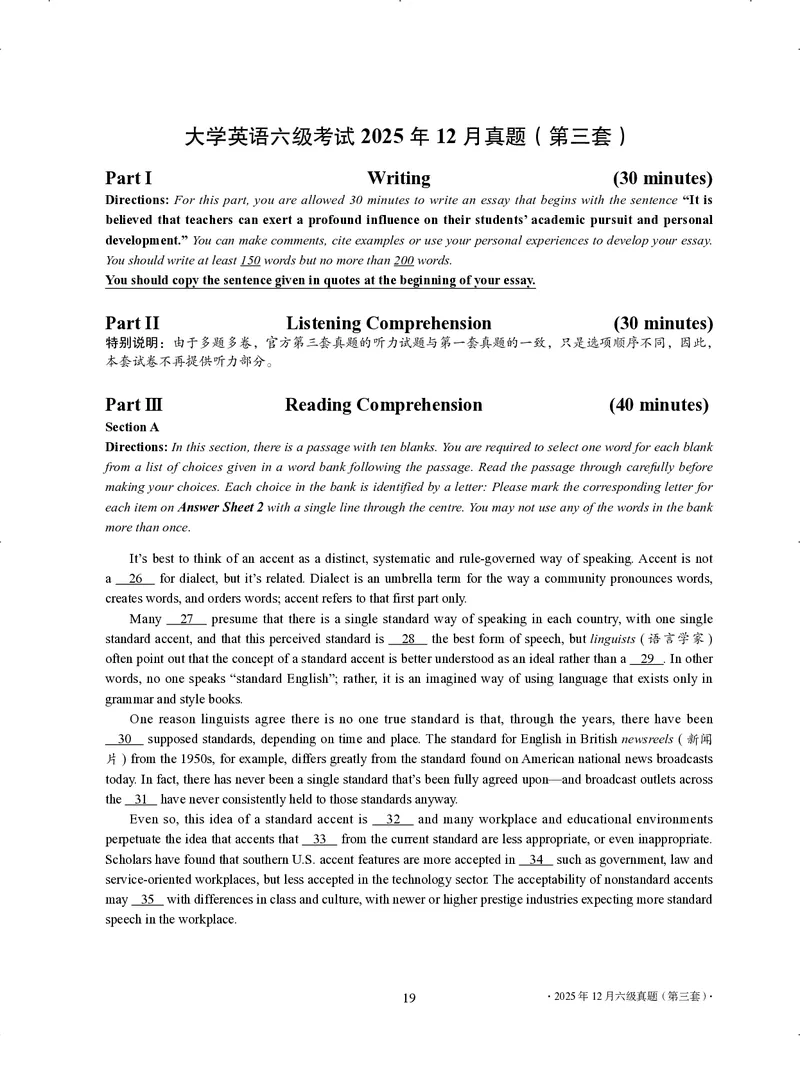
It’s best to think of an accent as a distinct, systematic and rule-governed way of speaking. Accent is not
a 26 for dialect, but it’s related. Dialect is an umbrella term for the way a community pronounces words,
creates words, and orders words; accent refers to that first part only.
Many 27 presume that there is a single standard way of speaking in each country, with one single
standard accent, and that this perceived standard is 28 the best form of speech, but linguists (语言学家)
often point out that the concept of a standard accent is better understood as an ideal rather than a 29 . In other
words, no one speaks “standard English”; rather, it is an imagined way of using language that exists only in
grammar and style books.
One reason linguists agree there is no one true standard is that, through the years, there have been
30 supposed standards, depending on time and place. The standard for English in British newsreels (新闻
片) from the 1950s, for example, differs greatly from the standard found on American national news broadcasts
today. In fact, there has never been a single standard that’s been fully agreed upon—and broadcast outlets across
the 31 have never consistently held to those standards anyway.
Even so, this idea of a standard accent is 32 and many workplace and educational environments
perpetuate the idea that accents that 33 from the current standard are less appropriate, or even inappropriate.
Scholars have found that southern U.S. accent features are more accepted in 34 such as government, law and
service-oriented workplaces, but less accepted in the technology sector. The acceptability of nonstandard accents
may 35 with differences in class and culture, with newer or higher prestige industries expecting more standard
speech in the workplace.
19 ·2025年12月六级真题(第三套)·A) affix I) properties
B) correlate J) reality
C) deviate K) reciprocally
D) domains L) specimen
E) influential M) spectrum
F) inherently N) synonym
G) laymen O) unanimous
H) multiple
Section B
Directions: In this section, you are going to read a passage with ten statements attached to it. Each statement
contains information given in one of the paragraphs. Identify the paragraph from which the information is
derived. You may choose a paragraph more than once. Each paragraph is marked with a letter. Answer the
questions by marking the corresponding letter on Answer Sheet 2.
The History and Meaning of Colored Traffic Lights
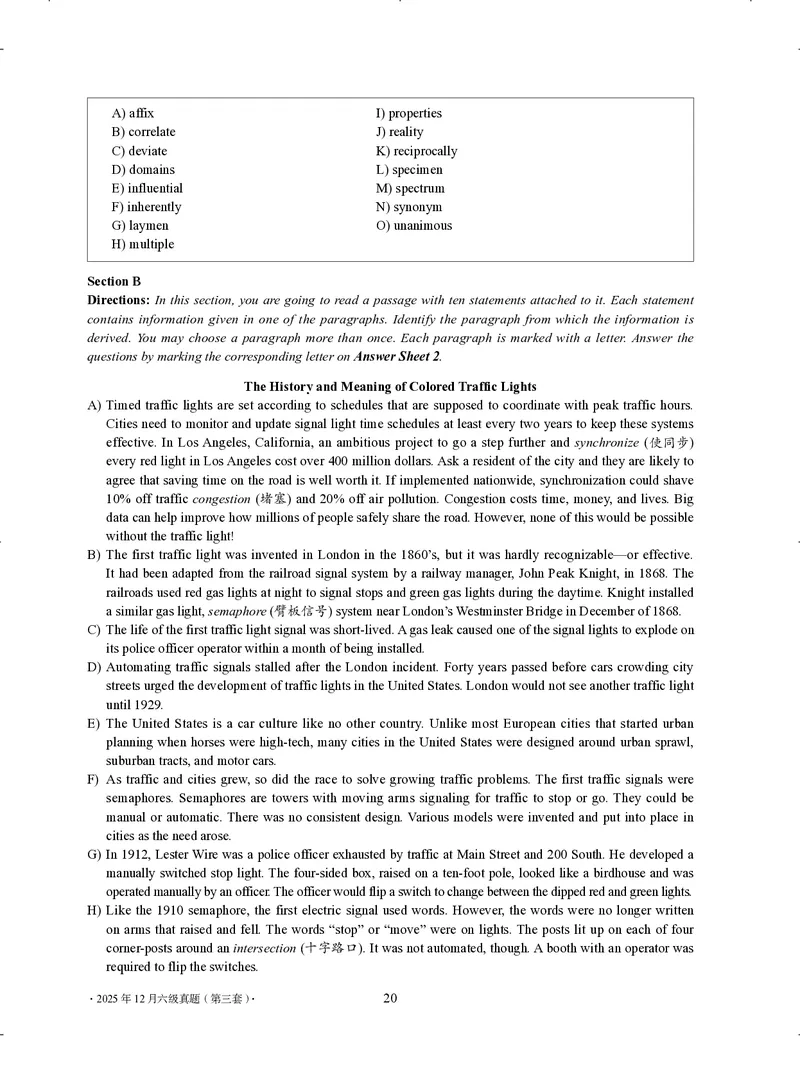
A) Timed traffic lights are set according to schedules that are supposed to coordinate with peak traffic hours.
Cities need to monitor and update signal light time schedules at least every two years to keep these systems
effective. In Los Angeles, California, an ambitious project to go a step further and synchronize (使同步)
every red light in Los Angeles cost over 400 million dollars. Ask a resident of the city and they are likely to
agree that saving time on the road is well worth it. If implemented nationwide, synchronization could shave
10% off traffic congestion (堵塞) and 20% off air pollution. Congestion costs time, money, and lives. Big
data can help improve how millions of people safely share the road. However, none of this would be possible
without the traffic light!
B) The first traffic light was invented in London in the 1860’s, but it was hardly recognizable—or effective.
It had been adapted from the railroad signal system by a railway manager, John Peak Knight, in 1868. The
railroads used red gas lights at night to signal stops and green gas lights during the daytime. Knight installed
a similar gas light, semaphore (臂板信号) system near London’s Westminster Bridge in December of 1868.
C) The life of the first traffic light signal was short-lived. A gas leak caused one of the signal lights to explode on
its police officer operator within a month of being installed.
D) Automating traffic signals stalled after the London incident. Forty years passed before cars crowding city
streets urged the development of traffic lights in the United States. London would not see another traffic light
until 1929.
E) The United States is a car culture like no other country. Unlike most European cities that started urban
planning when horses were high-tech, many cities in the United States were designed around urban sprawl,
suburban tracts, and motor cars.
F) As traffic and cities grew, so did the race to solve growing traffic problems. The first traffic signals were
semaphores. Semaphores are towers with moving arms signaling for traffic to stop or go. They could be
manual or automatic. There was no consistent design. Various models were invented and put into place in
cities as the need arose.
G) In 1912, Lester Wire was a police officer exhausted by traffic at Main Street and 200 South. He developed a
manually switched stop light. The four-sided box, raised on a ten-foot pole, looked like a birdhouse and was
operated manually by an officer. The officer would flip a switch to change between the dipped red and green lights.
H) Like the 1910 semaphore, the first electric signal used words. However, the words were no longer written
on arms that raised and fell. The words “stop” or “move” were on lights. The posts lit up on each of four
corner-posts around an intersection (十字路口). It was not automated, though. A booth with an operator was
required to flip the switches.
·2025年12月六级真题(第三套)· 20I) The system allowed police officers to move from the middle of the street to a corner. From that vantage (有
利地位), an officer could oversee the crowd. If an emergency vehicle came, the officer could flip a switch
and clear the intersection by triggering all red lights. The emergency vehicle could now pass effortlessly.
Finally, in San Francisco the first red and green electric light system that could be operated automatically (or
manually) was introduced in 1917.
J) In 1920, the first three-color light system was introduced in Detroit—also known as Motor City, USA. The
evolution of traffic light signals could not have a more appropriate context than Motor City. Ford Motor
Company was founded in Detroit in 1903 (and other motor companies followed). Ford made cars affordable
for more common people, rather than the wealthy, by creating larger scale factory production.
K) Stop and go were insufficient for the new volumes of cars zooming through intersections. Streets were full of
new numbers of cars in addition to delivery wagons, bustling crowds, bicycles, horse-drawn carriages, and
street cars. The introduction of the cautionary yellow light helped increase driver safety, decreasing accidents
that come from running red lights.
L) Stop lights were incredibly important in chaotic city streets. Crosswalks weren’t even introduced until 1951.
The first pedestrian fatality in the United States was in 1899.
M) The development of the modern traffic light may have started in London, but it grew up in the United States.
In Cleveland, an African-American inventor named Garrett Morgan came up with an affordable, patented
traffic signal. The yellow light made intersections safer than the old stop and go system. The new design was
inexpensive enough that it allowed the installation of a lot more lights.
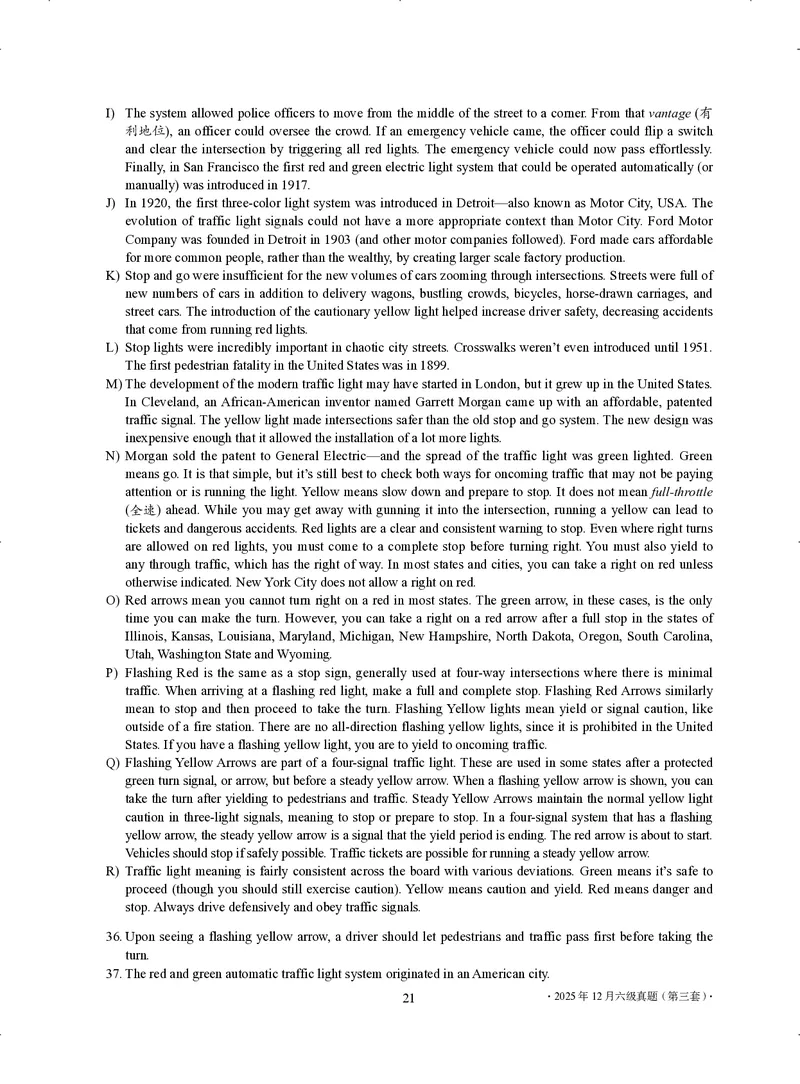
N) Morgan sold the patent to General Electric—and the spread of the traffic light was green lighted. Green
means go. It is that simple, but it’s still best to check both ways for oncoming traffic that may not be paying
attention or is running the light. Yellow means slow down and prepare to stop. It does not mean full-throttle
(全速) ahead. While you may get away with gunning it into the intersection, running a yellow can lead to
tickets and dangerous accidents. Red lights are a clear and consistent warning to stop. Even where right turns
are allowed on red lights, you must come to a complete stop before turning right. You must also yield to
any through traffic, which has the right of way. In most states and cities, you can take a right on red unless
otherwise indicated. New York City does not allow a right on red.
O) Red arrows mean you cannot turn right on a red in most states. The green arrow, in these cases, is the only
time you can make the turn. However, you can take a right on a red arrow after a full stop in the states of
Illinois, Kansas, Louisiana, Maryland, Michigan, New Hampshire, North Dakota, Oregon, South Carolina,
Utah, Washington State and Wyoming.
P) Flashing Red is the same as a stop sign, generally used at four-way intersections where there is minimal
traffic. When arriving at a flashing red light, make a full and complete stop. Flashing Red Arrows similarly
mean to stop and then proceed to take the turn. Flashing Yellow lights mean yield or signal caution, like
outside of a fire station. There are no all-direction flashing yellow lights, since it is prohibited in the United
States. If you have a flashing yellow light, you are to yield to oncoming traffic.
Q) Flashing Yellow Arrows are part of a four-signal traffic light. These are used in some states after a protected
green turn signal, or arrow, but before a steady yellow arrow. When a flashing yellow arrow is shown, you can
take the turn after yielding to pedestrians and traffic. Steady Yellow Arrows maintain the normal yellow light
caution in three-light signals, meaning to stop or prepare to stop. In a four-signal system that has a flashing
yellow arrow, the steady yellow arrow is a signal that the yield period is ending. The red arrow is about to start.
Vehicles should stop if safely possible. Traffic tickets are possible for running a steady yellow arrow.
R) Traffic light meaning is fairly consistent across the board with various deviations. Green means it’s safe to
proceed (though you should still exercise caution). Yellow means caution and yield. Red means danger and
stop. Always drive defensively and obey traffic signals.
36. Upon seeing a flashing yellow arrow, a driver should let pedestrians and traffic pass first before taking the
turn.
37. The red and green automatic traffic light system originated in an American city.
21 ·2025年12月六级真题(第三套)·38. Residents of an American city tend to share the opinion that time saved on the road justifies the cost of
upgrading its traffic light system.
39. Mass production of cars made it possible for ordinary people to buy them.
40. What a traffic light means is almost the same everywhere despite some variations.
41. Pedestrian crossings came into being only in the mid-twentieth century.
42. People raced to address increasing traffic problems along with the expansion of cities and traffic.
43. When the warning yellow light was introduced, driving became safer and traffic accidents reduced.
44. The signal system on the railroad served as the basis for the first traffic light.
45. Even though a green light signals “go”, attention should be paid to traffic on either side in case some driver is
being careless or ignoring a red light.
Section C
Directions: There are 2 passages in this section. Each passage is followed by some questions or unfinished
statements. For each of them there are four choices marked A), B), C) and D). You should decide on the best
choice and mark the corresponding letter on Answer Sheet 2 with a single line through the centre.
Passage One
Questions 46 to 50 are based on the following passage.
Mindfulness has been shown to have a number of meaningful health benefits—it can help reduce anxiety
and promote healing in those suffering from chronic illness.
The practice is based on an insight first described in ancient Buddhist texts that human beings have
the capacity to observe experience without being caught up in it. This means simply that it is possible to
observe ourselves having a craving, or a happy thought, or even a scary emotion, without reacting in the
moment in a way that amplifies the feeling or sends the mind spiraling off into thinking about old memories
or anticipating events.
This practice of mindfulness can help calm the mind and the body as we learn not to react to experience
with likes and dislikes or judgments of good and bad. It does not make us cold or indifferent but more fully
present.
One of the challenges of practicing mindfulness in our contemporary world is that there has been a profound
transformation in human attention. The artist Jenny Odell argues that in our “attention economy” human attention
has been transformed into a commodity that big corporations buy and sell. This economy rests on a technological
revolution of mobile phones and social media that makes it possible for corporations to target our attention with
their content at every moment.
The devices most people use are a perpetual diversion from the present moment. The result is that it can
feel as though our ability to focus, and be fully present, has been stolen. But mindfulness can help us resist the
attention economy and relish the things that make life special, like being together with those we love.
Most mindfulness research focuses on the individual benefits of the practice, but some scholars assert that
we can not only practice mindfulness for ourselves but also practice it for others. It can help us build stronger,
healthier relationships.
The sad truth is that living in the attention economy, most of us have become bad listeners. However, just as
it is possible to watch ourselves having an experience without reacting, it’s possible to watch another person have
an experience without getting tied up in reactivity and judgment.
The gift of mindfulness is a practice of listening with compassion to others describe their experiences.
To give this gift means putting away your phone, turning off social media, and setting aside other common
distractions. It means practicing being fully present in another person’s presence and listening to them with
complete attention without judgment, while resisting the urge to make the interaction about you.
If we judge the value of gifts based on their price, this gift may seem worthless, but in a distracted world, it
is a precious one.
·2025年12月六级真题(第三套)· 2246. What do we learn from the passage about practicing mindfulness?
A) It triggers our mind to reflect on past experiences or anticipate future events.
B) It focuses our attention on the present moment without making judgments.
C) It concentrates our mind on our personal feelings, happy or scary.
D) It helps our mind to stay calm when facing judgments from others.
47. What do we see in today’s “attention economy” according to Jenny Odell?
A) Focus on technological advances continuously updates products and services.
B) People’s attention is turned into something that can be bought and sold.
C) Businesses profit from selling mobile phones and revolutionizing social media.
D) People tend to purchase products and services without careful thinking.
48. What happens with the prevalent use of mobile phones or social media?
A) They keep distracting users from the here and now.
B) They render users incapable of resisting temptation.
C) They rob users of their ability to observe experience.
D) They tempt users to endorse the attention economy.
49. What benefit can practicing mindfulness bring to us according to some scholars?
A) It prevents us from making arbitrary judgments about others.
B) It shifts our attention from material things to spiritual pursuits.
C) It is conducive to our forging better interpersonal relationships.
D) It is helpful in regaining our ability to enjoy what we have in life.
50. What does the author suggest we do in another person’s presence?
A) Share each other’s experience frankly and compassionately.
B) Pay full attention to establishing close relationships with them.
C) Be attentive listeners while refraining from making judgments.
D) Remind them of the distraction from mobile phones and social media.
Passage Two
Questions 51 to 55 are based on the following passage.
The other day I had to log into a service I hadn’t used before. Since I was a new user, the website decided
that it needed to check I wasn’t a robot and so set me a Captcha test to determine whether the user is a person or
a machine.
I was presented with an image of a roadside scene over which was laid a grid. My “challenge” was to click
on each cell in the grid that contained a traffic sign. I did so, a bit irritated. Then I was presented with another
image and another grid—also with a request to identify road signs. Like a lamb, I complied, after which the
website accepted my input.
And then I realised what I had been doing was adding to a dataset for training the machine-learning software
that guides self-driving cars. So, to gain access to an automated service that will benefit financially from my
input, I first have to do some unpaid labour to help improve the performance of autonomous vehicles.
Neat, eh? But note also the delicious additional irony that the Captcha is described as an “automated Turing
test”. The Turing test was conceived, you may recall, as a way of enabling humans to determine whether a
machine could respond in such a way that one couldn’t tell whether it was a human or a robot. So we have
wandered into a world in which machines make us do tricks to prove that we are humans!
The strangest aspect of this unparalleled shift is how under-discussed it has been. The metaphor of the
boiling frog comes to mind. Have we become so subtly conditioned by digital technology that we don’t see
what’s been happening to us? Have we been conditioned to accept a world governed by “smart” tech, trading
convenience to the point where we become a bit like machines ourselves?
In a recent startling and thoughtful book, two scholars—Brett Frischmann, a law professor, and Evan
Selinger, a philosopher—argue that the answer to that question is “yes”.
23 ·2025年12月六级真题(第三套)·And they’re right. There’s nothing technophobic (技术恐惧的) about that. We shape our tools and then our
tools shape us. Technology is supposed to provide tools that serve human ends. But, as the machine-learning
Captcha demonstrates, a significant proportion of digital tech now sees (and uses) humans as means to ends that
are not ours. In the process, they reduce us to the status of cheery rats running on treadmills (踏车) designed by
people who do not have our interests at heart. So back to the frog metaphor. Are we smart enough to jump out
before it’s too late? You don’t even have to Google it to know the answer.
51. How did the author respond to the Captcha test?
A) He clicked on the cells randomly. C) He completed it confidently.
B) He accepted the challenge readily. D) He worked on it submissively.
52. What is ironic about the Captcha test?
A) A machine can respond to the test as well as humans do.
B) A machine can outperform humans in object identification.
C) A test designed to test machines is now used by machines to test humans.
D) A test conceived to tell a human from a robot can now do tricks humans can’t.
53. Why does the author use the metaphor of the boiling frog?
A) To show that humans are unwilling to trade convenience for control by smart tech.
B) To show that humans are unaware of the potential danger brought by smart tech.
C) To question whether humans are conditioned to accept digital tech.
D) To question whether humans are as vulnerable as the boiling frog.
54. Why does the author think that Brett Frischmann and Evan Selinger are right?
A) A large part of digital tech is now making use of humans to meet its own ends.
B) Humans are now fast locked in a race against digital tech to control the world.
C) Digital tech can serve human needs in ways previously thought impossible.
D) Digital tech is now doing thinking while humans are doing repetitive work.
55. What does the author imply by asking “Are we smart enough to jump out before it’s too late?” at the end of
the passage?
A) It is not sensible to expect digital tech to take humans’ interest to heart.
B) It is hard to say whether technology or humans will get the upper hand.
C) We may have to search the web to get the answer to the question.
D) We may not awake in time to the danger digital tech poses to us.
Part IV Translation (30 minutes)
Directions: For this part, you are allowed 30 minutes to translate a passage from Chinese into English. You
should write your answer on Answer Sheet 2.
节俭(frugality)是中华民族的传统美德。在中国古代,生产力低下,先人们深知劳动成果来之不
易,因而秉持节俭的理念。到了物质极大丰富的今天,中国人民依然坚持节俭的生活方式,体现了理
性消费的生活理念和对劳动的尊重。近年来,中国政府持续加强节约型社会的建设,倡导“光盘行动”,
减少食物浪费,提倡简约低碳的生活方式,推进资源循环利用,反对过度消费。节约型社会的建设有
力地推动了中国经济的高质量发展。
·2025年12月六级真题(第三套)· 24