责任编辑:钱 锋
王 希
封面设计:武 斌
王 琦
丽 子
绿色印刷产品
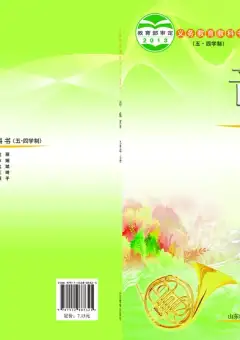
义务教育教科书(五·四学制) 英语 六年级 下册
价格批准文号:鲁发改价格核(2022)008501 定价:7.84元
举报电话:12345YIWU JIAOYU JIAOKESHU (WU-SI XUEZHI)
YINGYU
LIU NIANJI XIA CE
义务教育教科书(五·四学制)
英语
六年级 下册
人民教育出版社
圣智学习出版公司 编著
山东教育出版社
*
山东出版传媒股份有限公司
山东教育出版社出版
(济南市市中区二环南路 2066 号 4 区 1 号)
山东新华书店集团有限公司发行
山东新华印务有限责任公司印装
*
开本:787 毫米×1092 毫米 1/16
印张:8. 25 字数:132 千
定价:7. 84 元(上光)
ISBN 978 - 7 - 5328 - 7158- 2
2013 年 1 月第 1 版 2020 年 1 月第 2 版 2022 年 1 月第 10 次印刷
著 作 权 所 有 · 请 勿 擅 用 本 书 制 作 各 类 出 版 物 · 违 者 必 究
山东出版传媒股份有限公司教材中心售后服务电话:(0531)82098188出 版 说 明
为了更好地满足五四学制实验区义务教育教学的需要,2003年山东省教
育厅决定以全国中小学教材审定委员会初审通过的义务教育课程标准实验教科
书为基础,委托山东教育出版社等单位改编、出版一套五四学制的义务教育课
程标准实验教科书。该套实验教科书经全国中小学教材审定委员会初审通过后
供山东省的烟台、威海、淄博、莱芜等五四学制实验区选用,受到了广大师生
的欢迎和肯定。
2011年7月,教育部启动了义务教育课程标准实验教科书的修订送审工
作,为了做好五四学制实验教科书的修订送审工作,山东出版集团与人民教育
出版社签署了合作协议。五四学制教科书的修订、编写依据教育部制定的义务
教育课程标准(2011年版),以人教版六三学制教科书为基础,吸取了五四学
制实验区多年来在教学实践中探索、积累的丰硕成果。
义务教育教科书(五·四学制)《英语》(6〜9年级)是在刘道义、郑旺
全、David Nunan主编的人教版六三学制《英语(新目标)》(7〜9年级)的基
础上改编而成的,参加此次改编的人员有刘道义、吴欣、刘倩、高钧、宋纯
杰、曹凤华、肖宁、周飞宇、林常青、常晶晶、岳建梅,由刘道义任主编、刘
倩任副主编。本套教科书的起始年级于2012年5月经教育部审定通过,供五四
学制地区选用。
本书的改编、出版得到了山东省教育厅、山东出版集团、山东省教学研
究室、烟台市教育科学研究院、威海市教育教学研究中心、淄博市教研室、莱
芜市教研室以及泰安、青岛、济宁等教研单位,特别是人民教育出版社的领导
和学科专家的大力帮助和支持,在此表示由衷的感谢。
欢迎广大师生在使用过程中提出修改意见和建议,以利于教科书的不断
改进和完善。
山东教育出版社
2012年12月致同学
亲爱的同学:
你好!欢迎学习我们精心为你编写的这套英语教材,希望它能成为你初中阶段
英语学习的好帮手。
作为中学生的你,一定希望进一步提高你的英语运用能力——能阅读英语读
物,能看懂英语电影,能用英语跟外国人交流⋯⋯那么你需要怎样做呢?让我们给
你一些建议吧。
● 首先要有信心,相信自己一定能学好英语。其次还要有热情,积极参与语言
实践。教材中设计了各种各样的练习活动,目的就是帮助你培养英语表达能力。只
要你带着热情去练习、去实践,你就会感受到成功的喜悦。
● 要养成良好的英语学习习惯,多听、多说、多读、多写。听的时候除了捕
捉信息,还要善于模仿。如果语音语调不正确,就不能有效地表达思想和情感。要
大胆地说,不要怕犯错误。要养成爱读英文的习惯,因为阅读是获取信息的主要渠
道。写能够巩固和强化你的语言知识,所以你还要重视写。
● 你是否发现,英语是有规律可循的?语音与拼法之间是有联系的。看到新单
词时,如果知道哪些字母发什么音,你就会比较容易地读出这个单词。并且,听到
某个单词的发音你就能比较容易地拼写出这个单词。所以,学英语一定要善于发现
规律。教材中的拼读规则练习你可不要忽视啊。
● 词汇学习非常重要,没有词汇的积累就无法进行言语表达。学单词时,要知
道它的意义,观察它的拼写,看它由哪些字母组成,试着按规则拼读出来,更重要
的是要看它是怎样使用的。
● 学习语法规则能帮助你说出和写出正确的句子。除了听老师讲解和看课本附
录中的语法说明外,你还要尝试自己归纳语法规则。但是,只知道语法规则是远远
不够的,只有在听说读写中练习运用这些规则,才能真正掌握语法。
● 学习语言离不开学习文化。从教材中你可以看到,不同国家的人们有着不同
的生活方式和行为习惯,有着不同的文化成就和遗产。了解中外文化知识会开阔你
的视野,会提高你跟外国人交际的能力。
● 英语学习不仅仅限于课堂,也不仅仅限于教材。如果你能把电视、报刊、图
书、互联网都当做英语学习的渠道,你的英语世界将是多么丰富多彩啊!
● 学习英语是一项艰辛的劳动,是与无数困难作斗争的过程,这好比攀登险
峰,无坦途可循,失败和挫折常与成功伴行。这就要求你具有良好的心理素质,善
于自我调控、改善学法、自我激励、磨练意志、树立信心。这样,你一定会成功!
祝你在英语学习中不断取得进步!
编 者
2012年12月使用指南
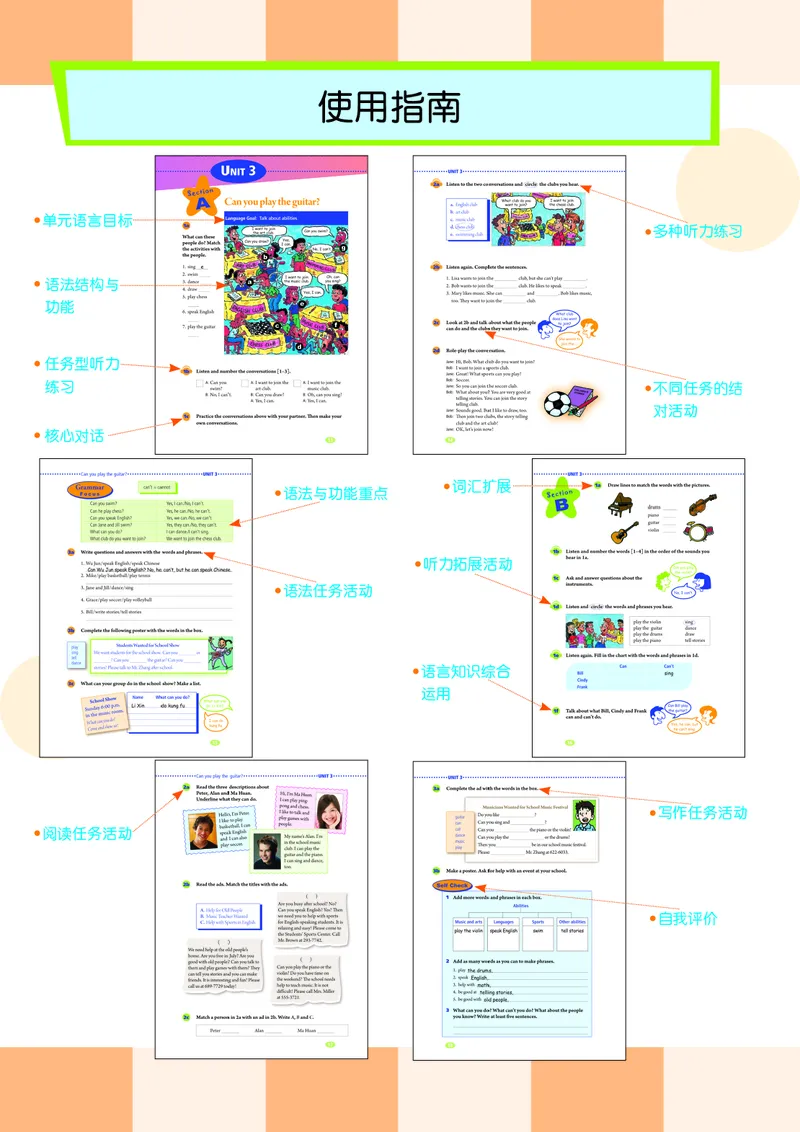
单元语言目标
多种听力练习
语法结构与
功能
任务型听力
练习 不同任务的结
对活动
核心对话
词汇扩展
语法与功能重点
听力拓展活动
语法任务活动
语言知识综合
运用
写作任务活动
阅读任务活动
自我评价Contents
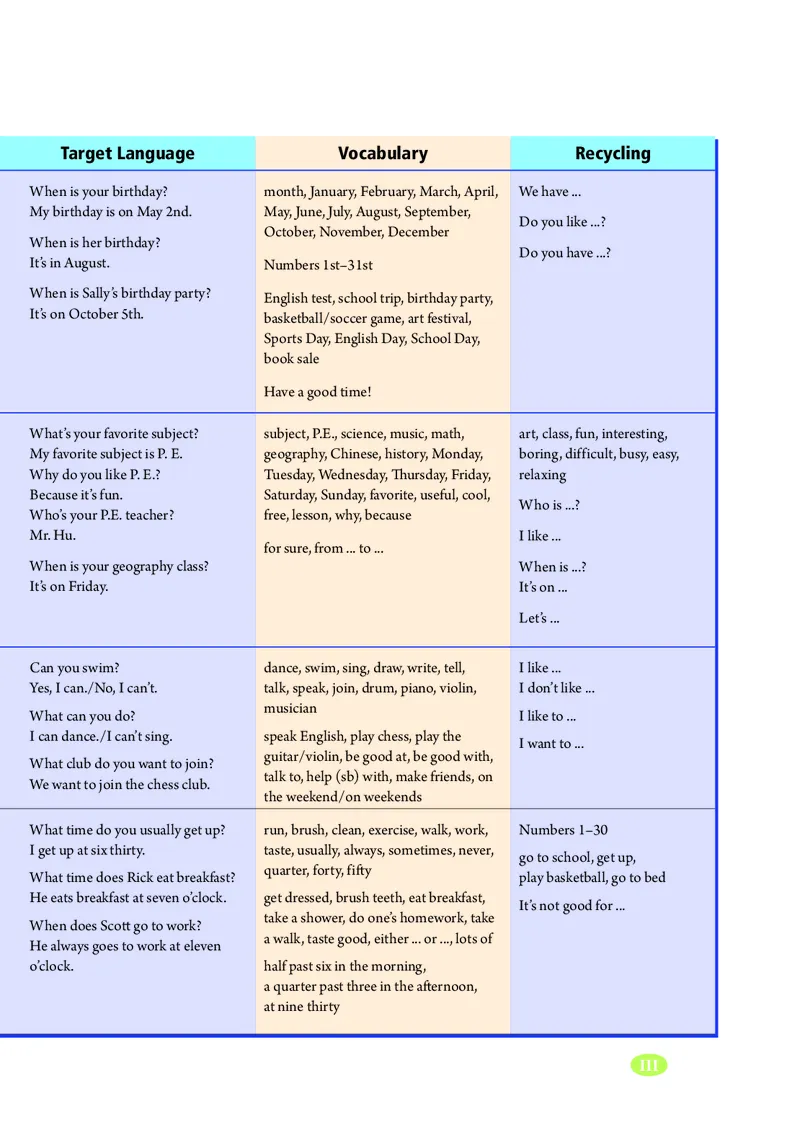
Units Topics Functions Structures Target Language Vocabulary Recycling
Dates Talk about dates When questions When is your birthday? month, January, February, March, April, We have ...
➊
Possessive ’s My birthday is on May 2nd. May, June, July, August, September,
Do you like ...?
When is your October, November, December
When is her birthday?
birthday? Do you have ...?
It’s in August. Numbers 1st–31st
Page 1
When is Sally’s birthday party?
English test, school trip, birthday party,
It’s on October 5th.
basketball/soccer game, art festival,
Sports Day, English Day, School Day,
book sale
Have a good time!
School subjects Talk about What questions What’s your favorite subject? subject, P.E., science, music, math, art, class, fun, interesting,
➋
preferences Why questions My favorite subject is P. E. geography, Chinese, history, Monday, boring, difficult, busy, easy,
My favorite When questions Why do you like P. E.? Tuesday, Wednesday, Thursday, Friday, relaxing
Give reasons
subject is Who questions Because it’s fun. Saturday, Sunday, favorite, useful, cool,
Who is ...?
science. Who’s your P.E. teacher? free, lesson, why, because
Mr. Hu. I like ...
for sure, from ... to ...
Page 7
When is your geography class? When is ...?
It’s on Friday. It’s on ...
Let’s ...
Joining a club Talk about abilities Modal verb can Can you swim? dance, swim, sing, draw, write, tell, I like ...
➌
Yes, I can./No, I can’t. talk, speak, join, drum, piano, violin, I don’t like ...
Yes/No questions and short answers
Can you play musician
What can you do? I like to ...
What questions
the guitar?
I can dance./I can’t sing. speak English, play chess, play the
I want to ...
guitar/violin, be good at, be good with,
Page 13 What club do you want to join?
talk to, help (sb) with, make friends, on
We want to join the chess club.
the weekend/on weekends
Daily routines Talk about routines What time questions What time do you usually get up? run, brush, clean, exercise, walk, work, Numbers 1–30
➍
I get up at six thirty. taste, usually, always, sometimes, never,
Ask about and say When questions go to school, get up,
What time quarter, forty, fifty
times What time does Rick eat breakfast? play basketball, go to bed
Adverbs of frequency
do you go to
He eats breakfast at seven o’clock. get dressed, brush teeth, eat breakfast,
It’s not good for ...
school? take a shower, do one’s homework, take
When does Scott go to work?
a walk, taste good, either ... or ..., lots of
Page 19 He always goes to work at eleven
o’clock. half past six in the morning,
a quarter past three in the afternoon,
at nine thirty
IIUnits Topics Functions Structures Target Language Vocabulary Recycling
Dates Talk about dates When questions When is your birthday? month, January, February, March, April, We have ...
➊
Possessive ’s My birthday is on May 2nd. May, June, July, August, September,
Do you like ...?
When is your October, November, December
When is her birthday?
birthday? Do you have ...?
It’s in August. Numbers 1st–31st
Page 1
When is Sally’s birthday party?
English test, school trip, birthday party,
It’s on October 5th.
basketball/soccer game, art festival,
Sports Day, English Day, School Day,
book sale
Have a good time!
School subjects Talk about What questions What’s your favorite subject? subject, P.E., science, music, math, art, class, fun, interesting,
➋
preferences Why questions My favorite subject is P. E. geography, Chinese, history, Monday, boring, difficult, busy, easy,
My favorite When questions Why do you like P. E.? Tuesday, Wednesday, Thursday, Friday, relaxing
Give reasons
subject is Who questions Because it’s fun. Saturday, Sunday, favorite, useful, cool,
Who is ...?
science. Who’s your P.E. teacher? free, lesson, why, because
Mr. Hu. I like ...
for sure, from ... to ...
Page 7
When is your geography class? When is ...?
It’s on Friday. It’s on ...
Let’s ...
Joining a club Talk about abilities Modal verb can Can you swim? dance, swim, sing, draw, write, tell, I like ...
➌
Yes, I can./No, I can’t. talk, speak, join, drum, piano, violin, I don’t like ...
Yes/No questions and short answers
Can you play musician
What can you do? I like to ...
What questions
the guitar?
I can dance./I can’t sing. speak English, play chess, play the
I want to ...
guitar/violin, be good at, be good with,
Page 13 What club do you want to join?
talk to, help (sb) with, make friends, on
We want to join the chess club.
the weekend/on weekends
Daily routines Talk about routines What time questions What time do you usually get up? run, brush, clean, exercise, walk, work, Numbers 1–30
➍
I get up at six thirty. taste, usually, always, sometimes, never,
Ask about and say When questions go to school, get up,
What time quarter, forty, fifty
times What time does Rick eat breakfast? play basketball, go to bed
Adverbs of frequency
do you go to
He eats breakfast at seven o’clock. get dressed, brush teeth, eat breakfast,
It’s not good for ...
school? take a shower, do one’s homework, take
When does Scott go to work?
a walk, taste good, either ... or ..., lots of
Page 19 He always goes to work at eleven
o’clock. half past six in the morning,
a quarter past three in the afternoon,
at nine thirty
IIIUnits Topics Functions Structures Target Language Vocabulary Recycling
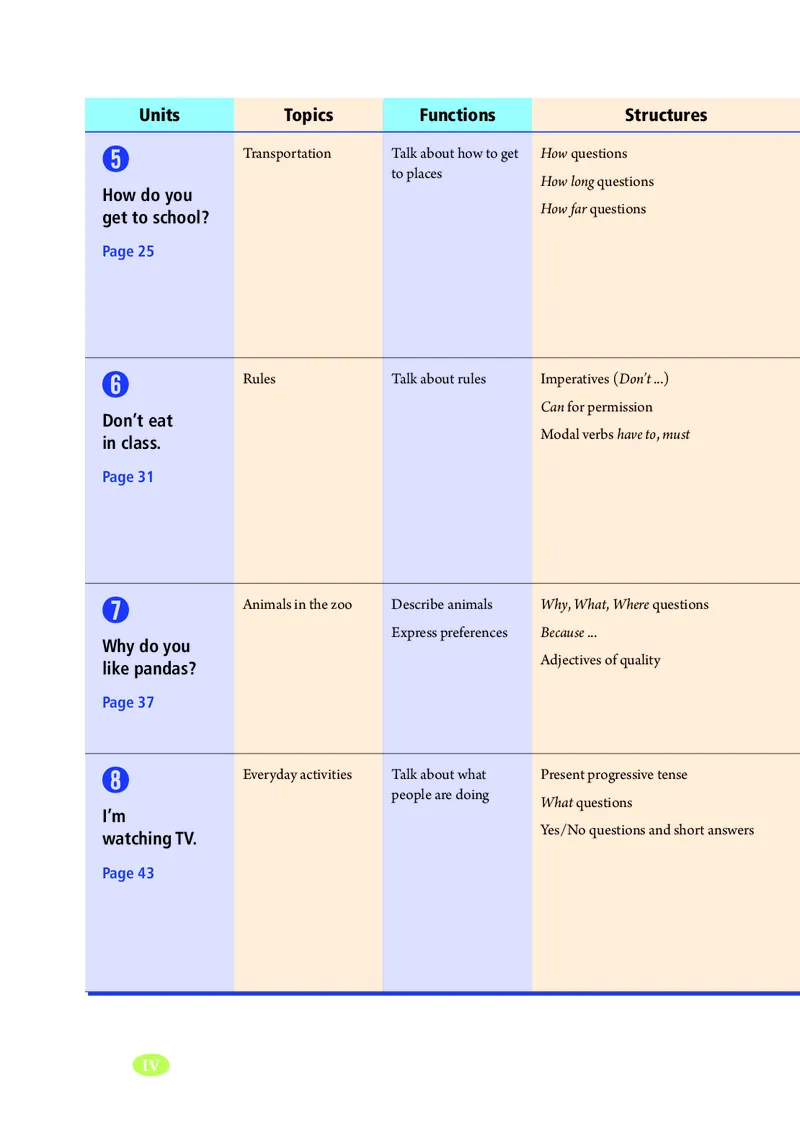
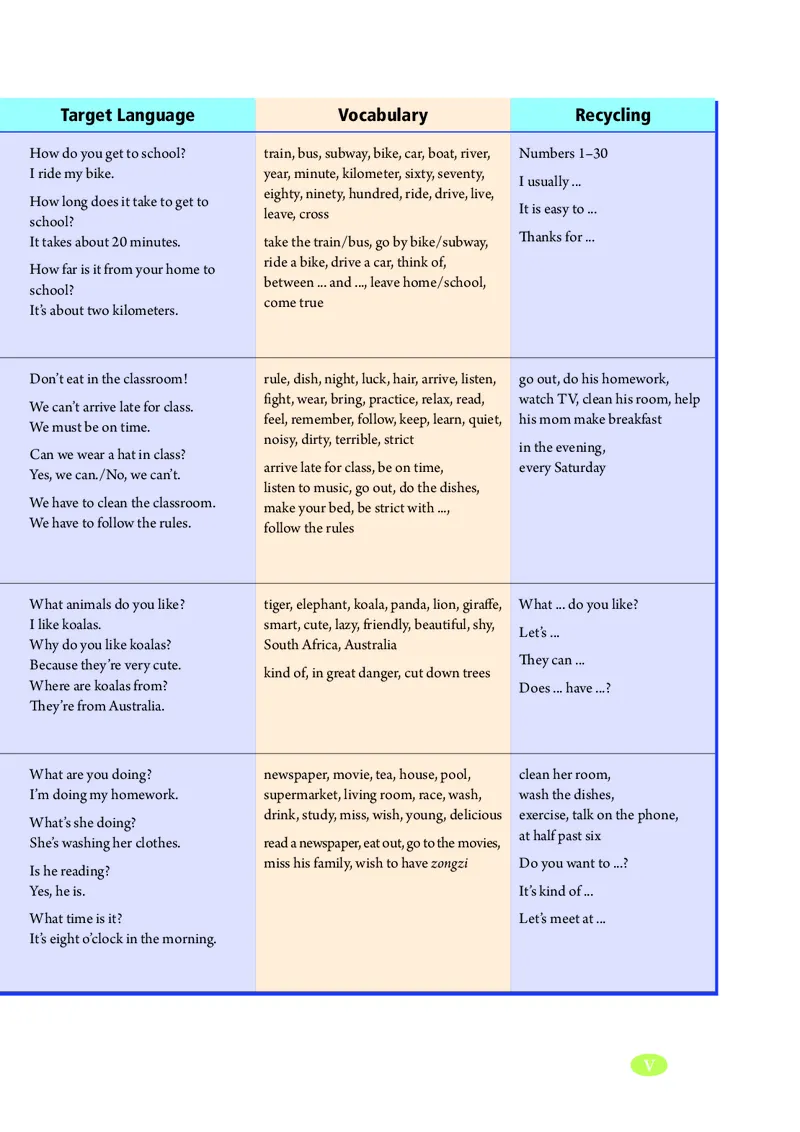
Transportation Talk about how to get How questions How do you get to school? train, bus, subway, bike, car, boat, river, Numbers 1–30
➎
to places I ride my bike. year, minute, kilometer, sixty, seventy,
How long questions I usually ...
How do you eighty, ninety, hundred, ride, drive, live,
How long does it take to get to
How far questions It is easy to ...
get to school? leave, cross
school?
Thanks for ...
It takes about 20 minutes. take the train/bus, go by bike/subway,
Page 25
ride a bike, drive a car, think of,
How far is it from your home to
between ... and ..., leave home/school,
school?
come true
It’s about two kilometers.
Rules Talk about rules Imperatives (Don’t ...) Don’t eat in the classroom! rule, dish, night, luck, hair, arrive, listen, go out, do his homework,
➏
fight, wear, bring, practice, relax, read, watch TV, clean his room, help
Can for permission We can’t arrive late for class.
Don’t eat feel, remember, follow, keep, learn, quiet, his mom make breakfast
We must be on time.
Modal verbs have to, must
in class. noisy, dirty, terrible, strict
in the evening,
Can we wear a hat in class?
arrive late for class, be on time, every Saturday
Page 31 Yes, we can./No, we can’t.
listen to music, go out, do the dishes,
We have to clean the classroom.
make your bed, be strict with ...,
We have to follow the rules.
follow the rules
Animals in the zoo Describe animals Why, What, Where questions What animals do you like? tiger, elephant, koala, panda, lion, giraffe, What ... do you like?
➐
I like koalas. smart, cute, lazy, friendly, beautiful, shy,
Express preferences Because ... Let’s ...
Why do you Why do you like koalas? South Africa, Australia
Adjectives of quality They can ...
like pandas? Because they’re very cute.
kind of, in great danger, cut down trees
Where are koalas from? Does ... have ...?
Page 37 They’re from Australia.
Everyday activities Talk about what Present progressive tense What are you doing? newspaper, movie, tea, house, pool, clean her room,
➑
people are doing I’m doing my homework. supermarket, living room, race, wash, wash the dishes,
What questions
I’m drink, study, miss, wish, young, delicious exercise, talk on the phone,
What’s she doing?
Yes/No questions and short answers
watching TV. at half past six
She’s washing her clothes. read a newspaper, eat out, go to the movies,
miss his family, wish to have zongzi Do you want to ...?
Page 43 Is he reading?
Yes, he is. It’s kind of ...
What time is it? Let’s meet at ...
It’s eight o’clock in the morning.
IVUnits Topics Functions Structures Target Language Vocabulary Recycling
Transportation Talk about how to get How questions How do you get to school? train, bus, subway, bike, car, boat, river, Numbers 1–30
➎
to places I ride my bike. year, minute, kilometer, sixty, seventy,
How long questions I usually ...
How do you eighty, ninety, hundred, ride, drive, live,
How long does it take to get to
How far questions It is easy to ...
get to school? leave, cross
school?
Thanks for ...
It takes about 20 minutes. take the train/bus, go by bike/subway,
Page 25
ride a bike, drive a car, think of,
How far is it from your home to
between ... and ..., leave home/school,
school?
come true
It’s about two kilometers.
Rules Talk about rules Imperatives (Don’t ...) Don’t eat in the classroom! rule, dish, night, luck, hair, arrive, listen, go out, do his homework,
➏
fight, wear, bring, practice, relax, read, watch TV, clean his room, help
Can for permission We can’t arrive late for class.
Don’t eat feel, remember, follow, keep, learn, quiet, his mom make breakfast
We must be on time.
Modal verbs have to, must
in class. noisy, dirty, terrible, strict
in the evening,
Can we wear a hat in class?
arrive late for class, be on time, every Saturday
Page 31 Yes, we can./No, we can’t.
listen to music, go out, do the dishes,
We have to clean the classroom.
make your bed, be strict with ...,
We have to follow the rules.
follow the rules
Animals in the zoo Describe animals Why, What, Where questions What animals do you like? tiger, elephant, koala, panda, lion, giraffe, What ... do you like?
➐
I like koalas. smart, cute, lazy, friendly, beautiful, shy,
Express preferences Because ... Let’s ...
Why do you Why do you like koalas? South Africa, Australia
Adjectives of quality They can ...
like pandas? Because they’re very cute.
kind of, in great danger, cut down trees
Where are koalas from? Does ... have ...?
Page 37 They’re from Australia.
Everyday activities Talk about what Present progressive tense What are you doing? newspaper, movie, tea, house, pool, clean her room,
➑
people are doing I’m doing my homework. supermarket, living room, race, wash, wash the dishes,
What questions
I’m drink, study, miss, wish, young, delicious exercise, talk on the phone,
What’s she doing?
Yes/No questions and short answers
watching TV. at half past six
She’s washing her clothes. read a newspaper, eat out, go to the movies,
miss his family, wish to have zongzi Do you want to ...?
Page 43 Is he reading?
Yes, he is. It’s kind of ...
What time is it? Let’s meet at ...
It’s eight o’clock in the morning.
VUnits Topics Functions Structures Target Language Vocabulary Recycling
The weather Describe the weather Present progressive tense How’s the weather? weather, rain, snow, winter, summer, What’s John doing right now?
➒
It’s raining./It’s sunny. vacation, message, sunny, cloudy, windy, He’s playing soccer.
Describe what you are How questions
It’s raining! snowy, hot, dry, cold, cool, warm, visit,
doing How’s it going? He plays soccer every day.
What questions
skate
It’s great.
Page 49
take a message, tell him to call me back
What are they doing?
They’re playing basketball in the
park.
The neighborhood Ask for and give There be structure Is there a restaurant near your post office, police station, hotel, Where’s ...?
➓
directions on the house? restaurant, bank, hospital, town, street,
Where questions Imperatives
Is there street Yes, there is. It’s on Center Street. road, next to, across from, near, between,
Prepositions of place
a post office Where’s the supermarket? in front of, behind, turn, enjoy, spend
near here? It’s next to the library. turn left/right, go along, on your left,
Where are the pay phones?
spend time, enjoy reading books
Page 55 They’re in front of the post office.
Page 61 Notes on the Text
Page 75 Tapescripts
Page 82 Pronunciation
Page 94 Grammar
Page 102 Words and Expressions in Each Unit
Page 111 Vocabulary Index
Page 120 Name List
VIUnits Topics Functions Structures Target Language Vocabulary Recycling
The weather Describe the weather Present progressive tense How’s the weather? weather, rain, snow, winter, summer, What’s John doing right now?
➒
It’s raining./It’s sunny. vacation, message, sunny, cloudy, windy, He’s playing soccer.
Describe what you are How questions
It’s raining! snowy, hot, dry, cold, cool, warm, visit,
doing How’s it going? He plays soccer every day.
What questions
skate
It’s great.
Page 49
take a message, tell him to call me back
What are they doing?
They’re playing basketball in the
park.
The neighborhood Ask for and give There be structure Is there a restaurant near your post office, police station, hotel, Where’s ...?
➓
directions on the house? restaurant, bank, hospital, town, street,
Where questions Imperatives
Is there street Yes, there is. It’s on Center Street. road, next to, across from, near, between,
Prepositions of place
a post office Where’s the supermarket? in front of, behind, turn, enjoy, spend
near here? It’s next to the library. turn left/right, go along, on your left,
Where are the pay phones?
spend time, enjoy reading books
Page 55 They’re in front of the post office.
Page 61 Notes on the Text
Page 75 Tapescripts
Page 82 Pronunciation
Page 94 Grammar
Page 102 Words and Expressions in Each Unit
Page 111 Vocabulary Index
Page 120 Name List
VIIVIIIU 1
NIT
Section
A When is your birthday?
Language Goal: Talk about dates
1a
Listen and repeat.
When is your
MONTHS birthday, Linda?
1. January
My birthday is
on May 2nd.
2. February
3. March
When is your
birthday, Mike?
4. April
My birthday is
5. May on June 3rd.
6. June
When is your
birthday, Mary?
7. July
8. August
9. September
10. October
11. November
It’s on
12. December January 5th.
1b Listen and number the conversations [1–3].
A: When is your A: When is your A: When is your
birthday, Linda? birthday, Mary? birthday, Mike?
B: My birthday is on B: It’s on January B: My birthday is on
May 2nd. 5th. June 3rd.
1c Practice the conversations above with your partner. Then make your
own conversations.
1UNIT 1
2a Listen and repeat.
1st 2nd 3rd 4th 5th 6th 7th 8th 9th 10th 11th
12th 13th 14th 15th 16th 17th 18th 19th 20th 21st 22nd
23rd 24th 25th 26th 27th 28th 29th 30th 31st
2b Listen and circle the numbers you hear in 2a.
2c Listen again. Match the names, months
and dates.
Names Months Dates
Alice July 4th
Frank August 22nd
Eric January 5th
Jane September 17th
A: When is Alice’s birthday?
2d Talk about the children’s
B: Her birthday is on September
birthdays in 2c. Then ask your
5th.
partner about the birthdays in
A: When is your father’s birthday?
his or her family.
B: His birthday is on .
2e Role-play the conversation.
Bill: Hi, Alan. Happy birthday!
Alan: Thank you, Bill.
Bill: So, how old are you, Alan?
Alan: I’m twelve. How old are you?
Bill: I’m thirteen.
Alan: When is your birthday?
Bill: My birthday is in August.
Alan: Well, do you want to come to my
birthday party?
Bill: Oh, yes. When is it?
Alan: At three this afternoon.
Bill: OK, great. See you!
2When is your birthday? UNIT 1
Grammar
Focus
When is your birthday? My birthday is on May 2nd.
When is his birthday? His birthday is on January 17th.
When is her birthday? It’s in August.
When is Alice’s birthday? Her birthday is on September 5th.
When is your father’s birthday? His birthday is on April 21st.
first second third fourth fifth sixth seventh eighth
ninth tenth eleventh twelfth thirteenth fourteenth
fifteenth sixteenth seventeenth eighteenth nineteenth
twentieth twenty-first twenty-second twenty-third
twenty-fourth twenty-fifth twenty-sixth twenty-seventh
twenty-eighth twenty-ninth thirtieth thirty-first
3a Match the questions with the answers.
Questions Answers
1. When is Jenny’s birthday? a. No, it’s on the 6th.
2. When are their birthdays? b. Her birthday is on May 24th.
3. When is your brother’s birthday? c. Yes, it is.
4. Is his birthday in July? d. Their birthdays are in January.
5. Is your birthday on February 1st? e. It’s on June 16th.
3b Complete the conversation and practice it with your partner.
A: How are you, Grace?
B: twelve.
A: And is your birthday?
B: My is on March 12th. How about you and Tom?
A: Well, my birthday is July 5th, and Tom’s birthday is
December.
3c Find out your classmates’
birthdays and ages. Line
up from the youngest to
the oldest.
3UNIT 1
1a Match the pictures with the events.
Section
B
1. d English test 3. school trip
2. party 4. basketball game
b
d
a c
1b Listen and circle the events you hear in 1a.
1c Listen again. Fill in John’s calendar.
SEPTEMBER
24 25 26 27 28 29 30
OCTOBER
1 2 3 4 5 6 7
Sally’s
birthday
party
When is Sally’s
birthday party?
1d Ask and answer questions about
John’s calendar.
It’s on
October 5th.
4When is your birthday? UNIT 1
2a Check (✔) the activities you have at your school.
soccer game school trip School Day book sale
English Day art festival Sports Day party
2b Read the school notice and list the activities and the dates.
Dear students,
We have some interesting and fun things for you this term. On March 21st,
we have a school trip in the afternoon.
April is a great month. On the 12th and the 15th,
MARCH
we have two ball games, soccer and volleyball.
School Day is on April 22nd. Your parents can
come to our school. Next month, we have an art
festival. It’s on May 3rd. We have an
English party on May 30th. On June 3rd, we have a book sale in the school
library.
This is a really busy term! Have a good time!
Dates Activities
2c Discuss the questions with your partner.
1. What activities in 2b do you like?
2. What other activities do you like?
5UNIT 1
3a Complete the note with the words in the box.
my school game September like basketball
Dear Alan,
Do you sports? Do you have a ? Please come
to next week. We have a basketball . It is on
28th. See you there!
Guo Peng
3b Write your own note to a friend. Invite
·What is your friend’s name?
him/her to an activity in your school.
·What does your friend like to do?
Use the questions to help you.
·What activity do you have in your school?
·When is the activity?
Dear ,
Self Check
1 Complete the chart with the correct forms of the numbers.
one first six twelve
second seventh thirteenth
three eight twenty
fourth nine twenty-first
five tenth thirty
2 Write the dates for these holidays in China.
1. When is Children’s Day (儿童节)? It’s on .
2. When is National Day (国庆节)? It’s on .
3. When is Women’s Day (妇女节)? It’s on .
4. When is New Year’s Day (新年)? It’s on .
6U 2
NIT
Section
A My favorite subject is science.
Language Goals: Talk about preferences; Give reasons
1a
Match the words c
with the pictures.
1. P.E. c
d
2. art e
3. science
My favorite
4. music What’s your subject is science.
favorite subject?
5. math
b
6. Chinese
7. geography
f
8. history
a
h g
1b Listen and circle the subjects you hear in 1a.
1c Practice the conversation with your partner. Then make your own
conversations.
A: What’s your favorite subject?
B: My favorite subject is art.
7UNIT 2
1
2a Listen and put the
Because
What’s your favorite subject?
conversation in order. it’s fun.
My favorite subject is P.E. Why do you
like P.E.?
Subjects Descriptions
1. art a. fun
2b Listen and match the
2. science
subjects you hear with b. interesting
3. music
the descriptions.
4. P.E. c. boring
5. math
d. difficult
6. geography
7. history e. relaxing
What’s your Science.
2c What do you think of the favorite subject?
subjects above? Make your
own conversations using the
Why do you
words in 2b. like science?
Because it’s
interesting.
2d Role-play the conversation.
Frank: Hi, Bob. How’s your day?
Bob: It’s OK. I like Monday because I have P.E. and history.
They’re my favorite subjects.
Frank: Who’s your P.E. teacher?
Bob: Mr. Hu. He always plays games with us.
Frank: That’s great! But why do you like history? It’s boring.
Bob: Oh, I think history is interesting. What’s your
favorite day?
Frank: Friday.
Bob: Why?
Frank: Because the next day is Saturday!
Bob: Haha! That’s for sure. I like Friday, too.
8My favorite subject is science. UNIT 2
Grammar
Focus
What’s your favorite subject? My favorite subject is science.
What’s his favorite subject? His favorite subject is Chinese.
What’s her favorite subject? Her favorite subject is art.
Why does Bob like history? Because it’s interesting.
Why do Frank and Bob like P.E.? Because it’s fun.
Who is your music teacher? My music teacher is Ms. Xie.
When is your geography class? It’s on Monday and Friday.
3a Fill in the blanks with what, who or why.
1. A: do you like history?
B: Because it’s interesting.
2. A: likes math? B: Eric does.
3. A: is your favorite subject?
B: My favorite subject is P.E.
4. A: is your science teacher? B: My science teacher is Mr. Chen.
5. A: do you like art? B: Because it’s fun.
3b Write questions for the answers.
Questions Answers
1. ? Because history is interesting.
2. ? Science and math.
3. ? His Chinese class is on Monday.
4. ? Mary’s favorite subject is art.
5. ? My geography teacher is Mrs. Qin.
3c Interview three classmates and complete the chart. Then tell your group
about the results.
Favorite subjects Reasons Teachers A: What’s your favorite
Names
subject, Jingjing?
(What) (Why) (Who)
B: Music.
Li Jingjing music It’s fun. Ms. Xie
A: Why do you like music?
B: Because it’s fun.
A: Who’s your music teacher?
B: Ms. Xie.
9UNIT 2
1a Match the words on the left with their opposites on
Section
the right.
B
easy
boring interesting
difficult fun
busy free
cool
1b Listen and check (✔) the words you hear in 1a.
1c Listen again. Circle the classes David talks about on this schedule.
DECEMBER
Monday 25th Tuesday 26th Wednesday 27th
A.M. 08:00 science A.M. 08:00 math A.M. 08:00 Chinese
09:00 English 09:00 math 09:00 science
10:00 Chinese 10:00 history 10:00 math
11:00 P.E. 11:00 science 11:00 P.E.
P.M. 12:00 lunch P.M. 12:00 lunch P.M. 12:00 lunch
01:00 geography 01:00 music 01:00 English
02:00 art 02:00 geography 02:00 art
Thursday 28th Friday 29th Saturday 30th
A.M. 08:00 math A.M. 08:00 Chinese soccer game
09:00 Chinese 09:00 English
10:00 Chinese 10:00 art
11:00 history 11:00 P.E. Sunday 31st
P.M. 12:00 lunch P.M. 12:00 lunch Bill’s birthday party
01:00 geography 01:00 math
02:00 English 02:00 history
1d Talk about David’s favorite subject
A: What’s David’s favorite subject?
with your partner. Then talk about
B: .
your favorite subject.
A: Why does he like ?
B: Because it’s .
A: When is the class?
B: It’s on .
10My favorite subject is science. UNIT 2
2a What do you think of these subjects? Write a description for each one.
music relaxing art English
history science Chinese
P.E. math geography
2b Read the following letter. Underline the subjects that Yu Mei likes. Circle
the subjects she doesn’t like. Are Yu Mei’s ideas the same as yours?
Dear Jenny,
I am very busy on Friday. At 8:00 I have math.
It is not fun. The teacher says it is useful, but I
think it is difficult. Then at 9:00 I have science. It
is difficult but interesting. At 10:00 I have
history. After that, I have P.E. at 11:00. It is
easy and fun. Lunch is from 12:00 to 1:00,
and after that we have Chinese. It is my favorite subject. Our Chinese
teacher, Mrs. Wang, is great fun. My classes finish at 1:50, but after that I
have an art lesson for two hours. It is really relaxing!
How about you? When are your classes? What is your favorite subject?
Your friend,
Yu Mei
2c Complete Yu Mei’s schedule with the information in 2b.
Friday
Time Subjects/Activities Time Subjects/Activities
8:00 to 8:50
12:00 to 1:00
9:00 to 9:50
1:00 to 1:50
10:00 to 10:50
2:00 to 4:00
11:00 to 11:50
11UNIT 2
3a Number these parts of an e-mail message [1–3].
I have P.E. at 1:00. P.E. is fun. Then at 2:00 I have
math. It is boring. At 3:00 I have art. It is cool.
Hi Mei Ling,
Thank you for your e-mail. I
Let’s meet on Saturday. Is that
want to meet you on Friday
OK with you?
afternoon, but I am really busy.
Dale
3b Fill in the schedule below for your classes on Friday.
Friday
Time Subjects Time Subjects
3c Now write an e-mail message to a friend about your Friday.
Self Check
1 Add more words to each column.
Descriptions School subjects Days of the week
interesting English Monday
2 Complete the questions with what, when, who or why. Then
answer the questions.
1. is your favorite subject?
2. do you like it?
3. is your music teacher?
4. is your math class?
12U 3
NIT
Section
A Can you play the guitar?
Language Goal: Talk about abilities
1a
I want to join
Can you swim?
the art club.
What can these
Yes,
people do? Match Can you draw?
I can.
g
the activities with No, I can’t.
the people.
b
1. sing e
2. swim
I want to join Oh, can
3. dance a the music club. you sing?
4. draw
Yes, I can.
5. play chess
e
6. speak English
c f
7. play the guitar
d
1b Listen and number the conversations [1–3].
A: Can you A: I want to join the A: I want to join the
swim? art club. music club.
B: No, I can’t. B: Can you draw? B: Oh, can you sing?
A: Yes, I can. A: Yes, I can.
1c Practice the conversations above with your partner. Then make your
own conversations.
13UNIT 3
2a Listen to these two conversations and circle the clubs you hear.
What club do you I want to join
a. English club want to join? the chess club.
b. art club
c. music club
d. chess club
e. swimming club
2b Listen again. Complete the sentences.
1. Lisa wants to join the club, but she can’t play .
2. Bob wants to join the club. He likes to speak .
3. Mary likes music. She can and . Bob likes music,
too. They want to join the club.
What club
does Lisa want
2c Look at 2b and talk about what the people
to join?
can do and the clubs they want to join.
She wants to
join the ...
2d Role-play the conversation.
Jane: Hi, Bob. What club do you want to join?
Bob: I want to join a sports club.
Jane: Great! What sports can you play?
Bob: Soccer.
Jane: So you can join the soccer club.
Bob: What about you? You are very good at
telling stories. You can join the story
telling club.
Jane: Sounds good. But I like to draw, too.
Bob: Then join two clubs, the story telling
club and the art club!
Jane: OK, let’s join now!
14Can you play the guitar? UNIT 3
Grammar can’t = cannot
Focus
Can you swim? Yes, I can./No, I can’t.
Can he play chess? Yes, he can./No, he can’t.
Can you speak English? Yes, we can./No, we can’t.
Can Jane and Jill swim? Yes, they can./No, they can’t.
What can you do? I can dance./I can’t sing.
What club do you want to join? We want to join the chess club.
3a Write questions and answers with the words and phrases.
1. Wu Jun/speak English/speak Chinese
Can Wu Jun speak English? No, he can’t, but he can speak Chinese.
2. Mike/play basketball/play tennis
3. Jane and Jill/dance/sing
4. Grace/play soccer/play volleyball
5. Bill/write stories/tell stories
3b Complete the following poster with the words in the box.
Students Wanted for School Show
play
sing We want students for the school show. Can you or
tell
? Can you the guitar? Can you
dance
stories? Please talk to Mr. Zhang after school.
3c What can your group do in the school show? Make a list.
School
Show Name What can you do?
What can you
Sunday 6:00 p.m. Li Xin do kung fu do, Li Xin?
in the
music
room.
What can you do? I can do
Come and show us! kung fu.
15UNIT 3
1a Draw lines to match the words with the pictures.
Section
B
drums
piano
guitar
violin
1b Listen and number the words [1–4] in the order of the sounds you
hear in 1a.
Can you play
the violin?
1c Ask and answer questions about the
instruments.
No, I can’t.
1d Listen and circle the words and phrases you hear.
play the violin sing
play the guitar dance
play the drums draw
play the piano tell stories
1e Listen again. Fill in the chart with the words and phrases in 1d.
Can Can’t
Bill sing
Cindy
Frank
Can Bill play
1f Talk about what Bill, Cindy and Frank the guitar?
can and can’t do.
Yes, he can, but
he can’t sing.
16Can you play the guitar? UNIT 3
2a Read the three descriptions about
Peter, Alan and Ma Huan. Hi, I’m Ma Huan.
Underline what they can do. I can play ping-
pong and chess.
Hello, I’m Peter. I like to talk and
I like to play play games with
basketball. I can
people.
speak English
and I can also My name’s Alan. I’m
in the school music
play soccer.
club. I can play the
guitar and the piano.
I can sing and dance,
too.
2b Read the ads. Match the titles with the ads.
( )
Are you busy after school? No?
A. Help for Old People Can you speak English? Yes? Then
B. Music Teacher Wanted we need you to help with sports
C. Help with Sports in English for English-speaking students. It is
relaxing and easy! Please come to
the Students’ Sports Center. Call
Mr. Brown at 293-7742.
( )
We need help at the old people’s
home. Are you free in July? Are you
( )
good with old people? Can you talk to
them and play games with them? They Can you play the piano or the
can tell you stories and you can make violin? Do you have time on
friends. It is interesting and fun! Please the weekend? The school needs
call us at 689-7729 today! help to teach music. It is not
difficult! Please call Mrs. Miller
at 555-3721.
2c Match a person in 2a with an ad in 2b. Write A, B and C.
Peter Alan Ma Huan
17UNIT 3
3a Complete the ad with the words in the box.
Musicians Wanted for School Music Festival
Do you like ?
guitar
can Can you sing and ?
call Can you the piano or the violin?
dance
Can you play the or the drums?
music
Then you be in our school music festival.
play
Please Mr. Zhang at 622-6033.
3b Make a poster. Ask for help with an event at your school.
Self Check
1 Add more words and phrases in each box.
Abilities
Music and arts Languages Sports Other abilities
play the violin speak English swim tell stories
2 Add as many words as you can to make phrases.
1. pla y the drums,
2. spe ak English,
3. hel p w it h math,
4. be go od at telling stories,
5. b e g o o d w i t h old people,
3 What can you do? What can’t you do? What about the people
you know? Write at least five sentences.
18U 4
NIT
Section
A What time do you go to school?
Language Goals: Talk about routines;
Ask about and say times
1a
Match the
activities with
the pictures. c
a
1. get up c
e
2. go to school
3. get dressed
b
4. brush teeth f
5. eat breakfast d
What time do you
I usually get up
6. take a shower usually get up, Rick?
at six thirty.
1b Listen and match the times with the actions. Draw lines from the clocks
to the pictures.
1c Student A is the interviewer. Student B is Rick. Ask and answer
questions about Rick’s day.
A: What time do you usually take a shower, Rick?
B: I usually take a shower at six forty.
19UNIT 4
2a Listen to the conversation and complete the sentences.
Jim has brothers and
sisters. Jim’s family
has shower.
2b Listen again. Complete the shower schedule for Jim’s family.
Name Bob Mary Jack Jim Anna
Time 5:30
What time do you
usually get up?
2c Now talk about yourself.
I always get up
Wow! I never
at five fifty.
get up so early.
2d Role-play the conversation.
Interviewer: Scott has an interesting job. He works at a radio station.
Scott, what time is your radio show?
Scott: From twelve o’clock at night to six o’clock in the morning.
Interviewer: What time do you usually get up?
Scott: At eight thirty at night. Then
I eat breakfast at nine.
Interviewer: That’s a funny time for
breakfast!
Scott: Yeah. After that, I usually
exercise at about ten twenty.
Interviewer: When do you go to work?
Scott: At eleven o’clock, so I’m
never late for work.
20What time do you go to school? UNIT 4
Grammar
Focus
What time do you usually get up? I usually get up at six thirty.
What time do they get dressed? They always get dressed at seven twenty.
What time does Rick eat breakfast? He eats breakfast at seven o’clock.
He always goes to work at eleven o’clock.
When does Scott go to work?
He’s never late.
When do your friends exercise? They usually exercise on weekends.
3a Write answers or questions. Use always, usually or never.
1. What time do you get up on school days?
2. ?
Rick always gets up at 6:20.
3. What time do you have breakfast?
4. ?
Anna never eats breakfast.
5. What time does your best friend go to school?
always
3b Write about something you always
usually
do, something you usually do and
something you never do.
never
3c Interview three of your classmates. Find out what time they do these
activities. Then give a report to the class.
Student 1 Student 2 Student 3
Name: Name: Name:
get up on weekends
In our group, Li
Fei usually gets up exercise
late on weekends. eat dinner
She gets up at ...
take a shower
go to school
21UNIT 4
1a When do students usually do these things? Match
Section
the activities with the time of day.
B
half past six a quarter past a quarter to a quarter to
in the three in the seven in the ten in the
morning afternoon evening evening
1. do homework 2. eat dinner 3. eat breakfast 4. go to bed
1b Check your answers with your partner.
They usually eat
When do students dinner at a quarter to
usually eat dinner? seven in the evening.
1c Listen and circle the activities you hear.
1. get up 5:30 6. do my homework
2. run 7. clean my room
3. eat breakfast 8. eat dinner
4. go to school 9. take a walk
5. go home 10. go to bed
1d Listen again. Write the times next to the activities you circled in 1c.
When does Tom
usually get up?
1e Ask and answer questions about Tom.
He usually
gets up at half
past five.
22What time do you go to school? UNIT 4
2a Check (4) the activities you think are healthy.
go to bed early eat ice-cream
eat quickly eat vegetables
play sports take a walk
2b Tony and Mary are brother and sister. They have healthy and unhealthy
habits. Who is healthier? Circle the healthy activities.
Hi! I’m Tony. I don’t like to get up early. In the morning, I
get up at eight. Then I go to school at eight thirty. I don’t
have much time for breakfast, so I usually eat very
quickly. For lunch, I usually eat hamburgers. After school,
I sometimes play basketball for half an hour. When I get
home, I always do my homework first. In the evening,
I either watch TV or play computer games. At ten thirty,
I brush my teeth and then I go to bed.
Mary is my sister. She usually gets up at six thirty. Then she
always takes a shower and eats a good breakfast. After that,
she goes to school at eight thirty. At twelve, she eats lots of
fruit and vegetables for lunch. After lunch, she sometimes
plays volleyball. She always eats ice-cream after dinner.
She knows it’s not good for her, but it tastes good! In the
evening, she does her homework and usually swims or takes
a walk. At nine thirty, she goes to bed.
2c Write down the unhealthy habits of each person. Then think of healthy
activities for them.
Unhealthy habits Healthy activities
Tony
Mary
23UNIT 4
3a Number these sentences in order to make a story about a daily routine.
I usually exercise from six fifteen to seven.
I always get up early at six.
After that, I always brush my teeth and go to school at eight.
Then I quickly have a shower and eat breakfast.
I have lunch at a quarter to twelve.
I get home from school at half past four and do my homework.
1 I have a very healthy life.
I have dinner at seven thirty.
I go to bed at ten.
3b Write about your own daily routine.
Self Check
1 Make phrases with the words in the boxes. Then use the
phrases to complete the sentences.
1. Ice-cream usually so students like to eat it after school.
taste 2. My grandparents are very healthy. They always
your teeth
clean
after dinner.
my room
have
3. You need to after eating to have good teeth.
a walk
get
good 4. He . He works at a radio station.
take
dressed 5. Here are your clothes. Go and quickly!
brush
a good job 6. I don’t have time to from Monday to Friday. So I
clean it on weekends.
2 Complete the conversations with questions and answers.
Use the words in the brackets to help you.
1. A: ? 2. A: ?
(your mother / usually / get up) (you / usually / get to school)
B: . B: .
(5:45) (7:30)
A: ? A: ?
(why / get up / so early) (your class teacher / usually / get to school)
B: . B: I don’t know. But he / she is never
( a l w a y s / make breakfast for me) late for the first class in the morning.
24U 5
NIT
Section
A How do you get to school?
Language Goal: Talk about how to get to places
1a
Match the words
with the pictures.
Hey, Dave. How do
you get to school?
1. take the train
I walk. How about
a you, Sally?
1
I ride my bike.
e
2. take the bus
3. take the subway a
4. ride a bike
5. walk c
b
d
1b Listen and write the numbers next to the correct students in the picture
above.
1. Bob 3. John 5. Yang Lan
2. Mary 4. Paul 6. Jim
1c Look at the picture in 1a. How do the students get to school? Make
conversations with your partner.
A: How does Mary get to school?
B: She takes the subway.
25UNIT 5
2a Listen and repeat. Then write the correct number next to the word.
84
105
sixty-one ninety-nine
99
seventy-two one hundred and five
200
eighty-four two hundred
72
61
2b Listen and complete the chart.
How? How long? (minutes) How far? (kilometers)
Tom
Jane
2c Listen again. Check your answers in 2b.
2d Student A is Jane and Student B is Tom. Use the information in 2b to
make conversations.
A: How do you get to school? B: I ...
A: How long does it take ...? B: It takes ...
A: How far is it from ... to ...? B: It’s about ...
2e Role-play the conversation.
Lisa: Hey, Jane. Is this your new bike?
Jane: Yes. I ride it to school every day. How do you
get to school?
Lisa: I usually take the bus.
Jane: How far is it from your home to school?
Lisa: I’m not sure … about 10 kilometers? The bus
ride takes about 20 minutes. How long does
it take you to get to school?
Jane: About 15 minutes by bike. It’s good exercise.
Lisa: Yeah. Well, have a good day at school.
Jane: You, too.
26How do you get to school? UNIT 5
Grammar
Focus
How do you get to school? I ride my bike.
How does she get to school? She usually takes the bus.
How long does it take to get to school? It takes about 15 minutes.
How far is it from your home to school? It’s only about two kilometers.
Does Jane walk to school? No, she doesn’t. She goes by bike.
Do they take the bus to school? No, they don’t. They walk.
3a Match the questions with the answers. Then practice them.
1. How does Mike get to school? a. Yes, they do.
2. How long does it take to get home? b. No, he doesn’t.
3. How far is it from here? c. He rides his bike.
4. Do your friends go to school by bus? d. It’s five kilometers.
5. Does your dad drive his car to work? e. About 15 minutes.
3b Use these words to make questions. Then answer them.
1. school / you / get to / do / how
?
2. to / school / get to / does / how long / take / it
?
3. school / your / from / it / is / how far / home / to
?
4. you / to / walk / do / school
?
5. ride / their bikes / do / school / your friends / to
?
3c Ask your classmates questions and write their names in the chart. The
first student to fill in all the blanks wins!
Find someone who ... Name
How far is it from lives about five kilometers from school.
your home to school? walks to school.
takes a bus to school.
goes to school by bike.
It’s about five
kilometers. needs about an hour to get to school.
needs about 10 minutes to get to school.
27UNIT 5
1a Match the words with the pictures.
Section
B 1. b bus stop 3. bus station
2. train station 4. subway station
a b c d
1b Say two types of transportation. Tell your partner how you get to
school.
A: How do you get to school?
B: Well, I ride my bike to the subway station. Then I take the subway.
1c Listen and check (4) the things that Mary wants to know.
Mary wants to know ...
where Bob lives.
how far he lives from his grandparents’ home.
how he gets to his grandparents’ home.
how long it takes to get to his grandparents’ home.
what he thinks of the trip.
1d Listen again. How does Bob get to his grandparents’ home? Check (4)
1 or 2.
1.
2.
How does Bob get
1e Talk about how Bob gets to to his grandparents’
home?
his grandparents’ home.
He ...
28How do you get to school? UNIT 5
2a Look at the picture below. Guess what the story is about.
2b Read the story from some years ago and choose a title for it.
A. How to Get to School B. Crossing the River to School C. Going to School is Fun
STUDENT LIFE 2009-04-20
How do you get to school? Do you walk or ride a bike?
Do you go by bus or by train? For many students, it is
easy to get to school. But for the students in one small
village in China, it is difficult. There is a very big river
between their school and the village. There is no bridge
and the river runs too quickly for boats. So these students
go on a ropeway to cross the river to school.
One 11-year-old boy, Liangliang, crosses the river every
school day. But he is not afraid. “I love to play with my classmates. And I love
my teacher. He’s like a father to me.”
Many of the students and villagers never leave the village. It is their dream
to have a bridge. Can their dream come true?
1. How do the students in the village go to school?
2. Why do they go to school like this?
3. Does the boy like his school? Why?
4. What is the villagers’ dream? Do you think their dream can
come true? How?
2c Read the story again and complete the interview.
Reporter: How do you to school, Liangliang?
Liangliang: I go on a ropeway to the river to school.
Reporter: Are you ?
Liangliang: No, I’m not. Because I my school and my teachers.
I like to with my classmates at school.
Reporter: Is it for you to go to school?
Liangliang: Yes, it is.
Reporter: Do you want to have a ?
Liangliang: Yes. It’s our dream.
Reporter: I’m sure your dream can come .
2d Now there is a bridge across the river and the children do not have to go
on the ropeway to get to school anymore. Imagine you are a reporter
and want to interview a student in the school. Make up a conversation.
29UNIT 5
3a Read the e-mail from your pen pal Tom in the US. Fill in the blanks
with the words in the box.
kilometers get to
takes walk
boring leave
Hi there,
How are you? Thanks for your last e-mail.
You want to know how I school,
right? Well, I usually my home at
about 8:00 and to the bus stop.
The school bus usually comes at about 8:15.
My school is about 20 from my
home. It about 40 minutes to get there by bus. The bus ride is never
because I always talk to my classmates.
What about you? How do you get to school?
Tom
3b Write an e-mail to Tom and tell him how you get to school. These
questions may help you.
1. When do you leave home? 4. How long does it take you to get
2. How do you get to school? to school?
3. How far is it from your 5. How is your trip to school?
home to school?
Self Check
1 Use the words in the boxes to form as many expressions as possible.
take, walk, ride, drive bus, train, car, take a bus, by bus,
bike, plane,
by subway, boat
2 Look at the chart below. Write at least five questions. Then
answer the questions with the information in the chart.
Who Where How How far How long
Tony from home to school by bike 5 km 20 minutes
Mary from home to the library by bus 15 km 40 minutes
How does Tony get to school from home? He gets to school by bike.
30U 6
NIT
Section
A Don’t eat in class.
Language Goal: Talk about rules
1a
Which rules are
these students
breaking? Write
the number of the
rule next to the
student.
Don’t run in the hallways.
SCHOOL RULES
1. Don’t arrive late
Sorry, Ms. Clark.
for class. You
must be on time. 1
2. Don’t run in the
hallways.
3. Don’t eat in the
classroom. You
must eat in the
dining hall.
4. Don’t listen to
music in class.
5. Don’t fight.
1b Listen. What rules are these students breaking? Write the numbers
after the names.
Peter Amy Mike
1c Student A is a new student. Student B A: What are the rules?
tells Student A about the rules above. B: Well, we can’t arrive late for
class. We must be on time.
31UNIT 6
2a Listen. Check (4) the activities Alan and Cindy talk about.
Activity
4
1. listen to music in the
can can’t
classroom or hallways
2. listen to music in the
can can’t
music room
3. listen to music outside can can’t
4. eat in the classroom can can’t
5. eat in the dining hall can can’t
6. eat outside can can’t
7. wear a hat can can’t
8. fight can can’t
2b Listen again. Can Alan and Cindy do
these activities? Circle can or can’t
above.
Can we listen to
music, Cindy?
2c Student A is Alan and Student B is
Cindy. Talk about the rules in 2a. We can’t listen to
music in the hallways,
but we can listen to
it outside.
2d Role-play the conversation.
John: Hi, my name’s John. It’s my first day at school.
Alice: Hi, John. I’m Alice. This is a great school, but there are a lot of rules.
John: Really? What are some of the rules?
Alice: Well, don’t be late for class. This is very important.
John: OK, so we must be on time. Can we bring music players to school?
Alice: No, we can’t. And we always have to wear the school uniform.
John: I see.
Alice: Oh, and we also have to be quiet in the library.
32Don’t eat in class. UNIT 6
Grammar
Focus
Don’t run in the hallways. Don’t fight.
What are the rules? We must be on time for class.
No, we can’t, but we can eat in the
Can we eat in the classroom?
dining hall.
Can we wear a hat in class? Yes, we can./No, we can’t.
Does he have to wear a uniform at school? Yes, he does./No, he doesn’t.
What do you have to do? We have to be quiet in the library.
3a Write the rules for the school library.
Library Rules
1. Don’t talk.
1 3
2.
3.
4.
2 4
3b Use the words to make questions about the rules. Then write answers
according to your school.
Be quiet?
Q: Does she have to be quiet in the library? (she/have to/in the library)?
A: Yes, she does.
Eat?
Q: (he/have to/in the dining hall)?
A:
Listen to music?
Q: (we/can/in the hallways)?
A:
Wear a hat?
Q: (we/can/in the classroom)?
A:
3c Make up five cool rules for your dream school. Share your rules with the
class. Your classmates vote for the Coolest School!
At my dream
1. We can eat in class.
school, we don’t have
2. We don’t have to come to school every day. to come to school
3. ... every day. We ...
33UNIT 6
1a Read the rules in the chart in 1b. Then match the
Section
pictures [a–h] with the rules.
B
c g
a e
d h
b f
1b Listen and put an ✘ for things Dave can’t do and a 4 for things he has to do.
Have to/Must
Rules Can’t (✘) When
(4)
a go out ✘ on school nights
see friends
do his homework
practice the guitar
do the dishes
watch TV
help his mom make breakfast
clean his room
1c Listen again. Write when Dave has to follow the rules in the chart in 1b.
Choose from the phrases in the box.
on school nights every Saturday before dinner in the evening
on school days after dinner after school every morning
Can Dave go out
on school nights?
1d Talk about the rules in Dave’s house.
No, he can’t.
34Don’t eat in class. UNIT 6
2a Talk about the rules in your home. Do you like them? Why or why not?
2b Read the letters. Underline the rules for Molly.
Dear Dr. Know,
There are too many rules! At 6:00 a.m., my
mom says, “Get up now and make your
Dear Molly,
bed!” After breakfast, my mom always says,
I know how you feel. People
“Don’t leave the dirty dishes in the kitchen!”
always tell us, “Don’t do this!”
After that, I run to school because I can’t be
or “You can’t do that!” But think
late. At school, we have more rules — don’t
about it, Molly. There are a lot of
be noisy, don’t eat in class, …
things you can do. You can play
My dad says I can’t play basketball after
basketball on weekends. You can
school because I must do my homework. I
watch TV after you read a book.
can play only on weekends. After dinner, I
Parents and schools are sometimes
can’t relax either. I must
strict, but remember, they make
read a book before I can
rules to help us. We have to follow
watch TV. But I have to
them.
go to bed before 10:00.
Good luck!
Rules, rules, rules! It’s
Dr. Know
terrible! What can I do,
Dr. Know?
Molly Brown, New York
2c Read the letters again and complete the sentences with have to/must, can or
can’t.
1. Molly play basketball on school days, but she play it
on weekends.
2. Molly do her homework first when she gets home.
3. Molly read a book after dinner before she watch TV.
4. At school, Molly be noisy or eat in class.
5. Parents and schools make rules to help students. So students
follow the rules.
35UNIT 6
3a Complete Zhao Pei’s letter to Dr. Know using have to/must, can or can’t.
Dear Dr. Know,
you help me? I’m not happy because there are too
many rules at home. Every morning, I get up at six
o’clock. At school, I wear a school uniform, and I
keep my hair short. After school, I
play with my friends or watch TV because I do my homework.
I relax on weekends either because I learn to play
the piano. I never have fun. What I do?
Zhao Pei
3b Complete the chart with the rules in your home and school. Check (4)
the rules you think are unfair.
Things I have to do Things I can’t do
3c Write a letter to Dr. Know. Tell him about all the rules and how you feel
about them.
Self Check
1 Fill in the blanks with the words in the box.
My name is Timmy the Mouse. I must get up early at 6:30 a.m. every
arrive late
morning. Then I have to go to the kitchen to get food for Grandpa. I never
listen to
to the kitchen because I have to get there before the cat gets
be noisy
up. My grandpa always tells me I can’t . I him
follow the rules
because I don’t want the cat to get me! My grandpa with me,
be strict
but I think it’s best to !
2 Use can, can’t, have to/must and don’t to write about the rules
at school. Write two sentences for each rule.
1. arrive late/class Don’t arrive late for class. We can’t arrive late for class.
2. listen/teacher
3. be noisy/library
4. speak English/English class
5. eat/dining hall
36U 7
NIT
Section
A Why do you like pandas?
Language Goals: Describe animals; Express preferences
1a
Match the words
with the animals in
the picture.
1. tiger a Let’s see the pandas first. a e
They’re my favorite animals.
2. elephant
Why?
Because they’re
3. koala very cute.
b d f
4. panda
5. lion
c
6. giraffe
1b Listen and check (4) the animals you hear in 1a.
1c Practice the conversation with your partner. Then make conversations
about the other animals in 1a. Use the words in the box.
cute interesting A: Let’s see the lions.
fun smart B: Why do you want to see them?
lazy beautiful A: Because they’re interesting.
37UNIT 7
2a Listen and write the animals you hear. Draw a line from the animals to
the description words and the countries they are from.
Animals Description words Countries
1. really scary Australia
2. kind of interesting South Africa
3. very cute China
2b Listen again. Complete the conversation with the words in 2a.
Julie: Let’s see the .
John: Why do you like them?
Julie: Because they’re interesting.
John: Where are they from?
Julie: They’re from .
2c Talk about the other two animals in 2a with a partner. Do John and
Julie like them? Do you like them? Why or why not?
2d Role-play the conversation.
Jenny: Your dog is really cute, Peter!
Peter: He’s my new pet, Dingding. He’s very smart.
Jenny: Really? What can he do?
Peter: He can walk on two legs. He can dance, too.
Jenny: Wow!
Peter: Does your family have a pet?
Jenny: My mom has a big cat, but I don’t like her.
Peter: Why don’t you like the cat?
Jenny: Well, because she’s kind of boring. She sleeps
all day, and her name is Lazy.
Peter: Haha, then that’s a good name for her!
38Why do you like pandas? UNIT 7
Grammar
Focus
Why do you like pandas? Because they’re kind of interesting.
Why does John like koalas? Because they’re very cute.
Why don’t you like tigers? Because they’re really scary.
Where are lions from? They’re from South Africa.
3a Fill in the blanks with the words from the box. Then practice the
conversation.
A: are lions from?
because they’re
B: from South Africa. Do you lions?
do don’t
A: No, I don’t.
cool like
B: Why you like lions?
why where
A: Because they’re really scary. But I like giraffes.
B: Really? do you like giraffes?
A: Well, they’re kind of interesting. Do you like pandas?
B: Yes, I do. But I like tigers a lot.
A: Tigers? Why you like tigers?
B: They’re really !
3b Write names of animals in the blanks to
I like because
make sentences that are true for you.
they’re interesting.
I like
I like because they’re smart. I don’t like
because they’re cute. because they’re lazy.
3c Think of an animal. Ask and answer questions with your partner to
guess each other’s animal.
A: Is the animal big?
B: Yes, it is.
A: Where’s the animal from?
B: It’s from China.
A: Is it black and white?
B: Yes, it is.
A: It’s a panda!
B: Yes, you’re right!
39UNIT 7
1a Match the description words with the animals.
Section
B
a c e
b d f
1. smart d 3. beautiful 5. lazy 7. small
2. friendly 4. cute 6. scary 8. shy
1b Listen and circle the description words you hear in 1a.
1c Listen again. What words do they use to describe the animals? Fill in
the chart.
Animals Mary’s words Tony’s words
elephants
pandas
1d Talk about the animals you know
with your partner.
A: What animals do you like?
B: I like elephants.
A: Why?
B: Because they’re cute. What animals
do you like?
A: I like dogs because they’re friendly
and smart.
40Why do you like pandas? UNIT 7
2a Check (4) the animals you think are in great danger.
lions elephants pandas
giraffes koalas tigers
2b Read this website article and check (4) the best title for it.
What Is an Elephant?
Come to Thailand
Let’s Save the Elephants
Hello. We are students from Thailand, Elephants Are Good Pets
and we want to save the elephants. The
elephant is one of Thailand’s symbols. Our first flag had a white elephant on
it. This is a symbol of good luck.
Elephants are smart animals. They can play soccer or music. They can also
draw very well. People say that “an elephant never forgets”. Elephants can
walk for a long time and never get lost. They can also remember places with
food and water. This helps them to live.
But elephants are in great danger. People
cut down many trees so elephants are losing
their homes. People also kill elephants
for their ivory. Today there are only
about 3,000 elephants (over 100,000
before). We must save the trees and not
buy things made of ivory. Remember that
March 13th is Thai Elephant Day.
2c Read the article again and
complete the mind map. Facts and figures
• people many trees
Importance in Thailand • people kill them for
• first flag had • today there are
• symbol of (over before)
ELEPHANTS
Abilities
• can play How to save them
• can also well • don’t cut down so many
• can places • don’t things made of ivory
with food and water • is Thai Elephant Day
41UNIT 7
3a Becky is Jill’s favorite animal. Fill in the blanks
with the words in the box.
This is Becky. Isn’t she ?
She is from . She is twelve
like beautiful
old. I
Africa years
Becky she is smart and
lives because
friendly. She in
Blackwood Zoo.
3b Write a description of a panda using the words in the box, or write
about your favorite animal using your own ideas.
Beibei five years old China cute shy Beijing Zoo
Self Check
1 Add more words in the chart. Then write at least five sentences
using the words.
Animals Description words
tiger really, kind of scary
I don’t like tigers because they’re really scary.
2 Match the questions and answers to make a conversation. Then
write your own conversations.
Questions Answers
What animals do you like? They’re from Africa.
Why do you like lions? I like lions.
Where are they from? Because they’re big and beautiful.
42U 8
NIT
Section
A I’m watching TV.
Language Goal: Talk about what people are doing
1a
Match the activities
with the pictures.
1. watching TV i
d g
2. cleaning a
What are
you doing?
3. reading a
h
newspaper
4. talking on the
phone
e
b I’m
5. listening to a CD
watching TV.
6. using the
computer
f i
7. making soup c
8. washing the
dishes
9. exercising
1b Listen. What are these people doing? Write the numbers from 1a.
a. Jenny b. John c. Dave and Mary
1c Ask and answer questions about what A: What’s he doing?
people are doing in 1a. B: He’s using the computer.
A: What are they doing?
B: They’re listening to a CD.
43UNIT 8
2a Listen and match the answers with the questions.
1. What is Steve doing? a. He is watching TV.
2. What is Jack doing? b. He is listening to a CD.
2b Listen again. Fill in the blanks.
Jack: Hello, Steve.
Steve: Hi, Jack.
Jack: What you , Steve?
Steve: I’m . What about you?
Jack: I’m , but it’s kind of .
Steve: Yeah, my TV show is also not very . Do you
want to the movies?
Jack: That sounds good.
2c Role-play the conversation in 2b.
2d Role-play the conversation.
Jenny: Hello? This is Jenny.
Laura: Hi, Jenny. It’s Laura here.
Jenny: Oh, hi, Laura. What are you doing?
Laura: Not much. I’m just washing my clothes. What about you?
Jenny: I’m watching TV. Do you want to join me for dinner? My parents
aren’t at home. We can eat out.
Laura: Yeah. I’d love to.
Jenny: Let’s meet at my home first. Come at half past six.
Laura: OK. See you then.
44I’m watching TV. UNIT 8
Grammar
Focus
What are you doing? I’m watching TV.
What’s she doing? She’s washing her clothes.
What are they doing? They’re listening to a CD.
Are you doing your homework? Yes, I am./No, I’m not. I’m cleaning my room.
Is he reading a newspaper? Yes, he is./No, he isn’t. He’s playing basketball.
Are they using the computer? Yes, they are./No, they aren’t. They’re exercising.
She’s exercising (now).
She exercises (on Mondays/every night/in the mornings/etc.).
3a Write sentences following the examples.
1. Jenny / clean the house / now
Jenny is cleaning the house now.
2. Bob / make dinner / every Saturday
Bob makes dinner every Saturday.
3. Mary’s parents / drink tea / after dinner
4. Bill / talk on the phone / now
5. Becky and Bob / watch TV / on weekends
Do you want to go tomorrow then?
OK. See you tomorrow evening!
3b Number the sentences in
I’m reading a book.
order to make a telephone
Let’s go at seven o’clock.
conversation. Then practice it No, this book is really interesting.
with a partner. 1 What are you doing?
Do you want to go to the movies now?
Sure, what time?
3c Take turns miming different Are you
making soup? Are you
activities in your group. The cleaning?
others in the group guess No, I’m not.
what the activities are.
Yes, you’re
right.
45UNIT 8
1a Look at the pictures. Complete the chart.
Section
Places Activities
B
1. reading books
2. school
3.
4.
swimming shopping playing basketball
supermarket library pool
Is the man
swimming in a river?
1b Look at the pictures in 1a.
Then ask and answer questions.
No, he isn’t.
He’s swimming
in a pool.
1c Listen and complete the chart.
Names Places Activities
Alice supermarket
Mike
Lisa
1d Listen again. Check your
answers in 1c.
Is Alice playing
basketball?
1e Use the information in the chart
to make a conversation.
No, she isn’t.
She’s ...
46I’m watching TV. UNIT 8
2a Look at the clocks and ask your partner about the time in different places.
A: What time is it
in Beijing?
B: It’s eight o’clock
in the morning.
Beijing Tokyo New York Sydney
2b Read the TV report and answer the questions.
1. Why are Zhu Hui’s family watching boat races and making zongzi?
2. Does Zhu Hui like his host family? What does he think about his home in
China?
Today’s story is about Zhu Hui, a student from
Shenzhen. He’s now studying in the United States.
He’s living with an American family in New York.
Today is the Dragon Boat Festival. It’s 9:00 a.m. and
Zhu Hui’s family are at home. His mom and aunt are
making zongzi. His dad and uncle are watching the
boat races on TV.
Is Zhu Hui also watching the races and eating zongzi?
Well, it’s 9:00 p.m. in New York, and it’s the night
before the festival. But there isn’t a Dragon Boat
Festival in the US, so it’s like any other night for Zhu
Hui and his host family. The mother is reading a story
to her young children. The father is watching a soccer
game on TV. And what’s Zhu Hui doing? He’s talking on the phone to his cousin
in Shenzhen. Zhu Hui misses his family and wishes to have his mom’s delicious
zongzi. Zhu Hui likes New York and his host family a lot, but there’s still “no place
like home”.
A B
living food
2c Match the verbs in column A with
reading in the US
the words in column B. Then use the
making a race
phrases to write sentences according
talking with a family
to the TV report. studying on the phone
watching a story
47UNIT 8
3a Complete Jim’s letter.
Dear Bob,
Here is a picture of my family. We are all
at home now. I am doing my homework.
My parents in the
living room. My grandfather . My sister
.
Jim
3b Bring in some photos of your own (or draw some pictures of you and
your family or friends) and write about them.
Self Check
1 Add more words in the chart. Then write at least five sentences
using the words.
play playing make making run running
Jack is playing basketball now.
2 Write questions to complete the conversation.
A: Hey, Bob! ? (what)
B: I’m listening to the radio.
A: ? (play soccer)
B: Sounds good, but this talk show is interesting.
A: ? (what, Tony)
B: Oh, he’s studying for a test.
A: ? (Steve, too)
B: No, he’s not. I think he can play soccer with you.
48U 9
NIT
Section
A It’s raining!
Language Goals: Describe the weather;
Describe what you are doing
1a
c
Match the words
with the pictures
[a–e].
a
1. raining a
Beijing
2. windy
3. cloudy b
d
4. sunny
How’s the weather
in Shanghai?
5. snowing
e
It’s cloudy.
1b Listen and write these city names in the boxes above.
Beijing Moscow Toronto Boston Shanghai
1c Imagine you are in one of the places in A: Hi! How’s the weather in
1a. Talk about the weather with your Beijing?
friend on the phone. B: It’s sunny.
49UNIT 9
2a Listen and number the pictures [1–4].
1
2b Listen again. Match the names with the activities.
1. c Uncle Joe a. is playing computer games.
2. Jeff b. is cooking.
3. Mary c. is playing basketball.
4. Aunt Sally d. is watching TV.
What’s Uncle
Joe doing?
2c Talk about the people in 2a with a
partner.
He’s playing
basketball.
2d Role-play the conversation.
Rick: Hello, Rick speaking.
Steve: Hi, Rick. It’s Steve. How’s it going?
Rick: Not bad, thanks. The weather’s great. What are
you doing?
Steve: I’m playing basketball with some friends at the
park.
Rick: Sounds like you’re having a good time.
Steve: Yeah. Is your brother at home?
Rick: Oh, he’s not here. He’s studying at his friend’s
home. Can I take a message for him?
Steve: Yes. Could you just tell him to call me back?
Rick: Sure, no problem.
50It’s raining! UNIT 9
Grammar
Focus
How’s the weather? It’s cloudy./It’s sunny./It’s raining.
What are you doing? I’m cooking.
What are they doing? They’re playing basketball in the park.
What’s he doing? He’s studying at his friend’s home.
How’s it going? Great!/Not bad./Terrible!
3a Fill in the blanks with the correct forms of the verbs in the box. Then
practice the conversations with a partner.
be play study talk do make
1. A: What are you doing?
B: I my homework. I always my homework in the
evening.
2. A: What’s John doing right now?
B: He soccer. He soccer every Saturday.
3. A: Julie English right now?
B: No, she isn’t. She Chinese.
4. A: What are Julie and Jane doing?
B: They soup. They can very good soup.
5. A: Lisa on the phone again?
B: Yes, she on the phone for three hours every day!
a b
3b Yuan Yuan from CCTV is
interviewing people in five different
places. Fill in the chart below.
c
How’s the weather? What are they doing?
e d
51UNIT 9
1a Match the words with the pictures.
Section
B 1. d dry 3. cool 5. hot
2. cold 4. warm
b d
a c e
1b Ask and answer questions about the
How’s the weather
weather in the pictures in 1a. in picture d?
1c Listen and write what Mary and Eric answer
It’s dry.
to How’s it going.
How’s it going? What are you doing? How’s the weather?
Mary
Eric great
1d Listen again. Write the answers to What are you doing and How’s the weather.
Hi! How’s
it going?
1e Role-play a conversation
Hello ... Oh, not
between Mary and Eric.
too bad! What
are you doing?
52It’s raining! UNIT 9
2a Talk about the pictures below with a partner. How’s the weather? What
are the people doing?
a b c
2b Match each postcard below with the correct picture in 2a.
Dear Jane,
How’s it going? I’m having a great time visiting
my aunt in Canada. She’s working here and I’m
going to summer school. I’m studying English and
I’m learning a lot. I’m also visiting some of my old To
friends. I’m so happy to see them again. It’s Jane
afternoon right now, and I’m sitting by the pool
and drinking orange juice. It’s warm and sunny,
and it’s very relaxing here.
See you soon.
Su Lin
Dear Jane,
How’s your summer vacation going? Are you
studying hard, or are you having fun? I’m having
a great time in Europe! My family and I are on a
vacation in the mountains. I want to call you but To
my phone isn’t working, so I’m writing to you. It’s
Jane
hot in your country now, isn’t it? The weather
here is cool and cloudy, just right for walking.
See you next month.
Dave
2c Fill in the chart with information from the postcards in 2b.
Names Where are they? How’s the weather? What are they doing?
53UNIT 9
3a Fill in the blanks with the words in the box. skating buying playing
taking snowy windy
Dear Xiao Lu,
It’s winter in Harbin. The weather is
and . People are wearing hats and
sweaters, but they’re having fun. Friends are
Russian bread to take home. In a park,
some boys are in the snow. One girl is
on a river and a man is a
photo of a snowman.
I miss you.
Kate
3b Imagine you are on vacation.
Where are you?
Write notes about your vacation.
What’s the weather like?
3c Write a postcard to a friend. Tell What are you doing right now?
your friend about your vacation What are your friends or family doing?
and what you are doing.
Are you having a good time?
Self Check
1 Add more words in each box.
Feelings great
Weather cool
Activities playing ping-pong
2 Match the sentences on the left with the responses on the right.
A: Hello? Jenny speaking. B: Thank you. Bye.
A: Sorry, she’s not at home. B: Hi, Jenny. It’s Steve here. May I speak to
Can I take a message? Laura, please?
A: Sure, no problem. B: Yes. Could you ask her to call me at 8765-4321?
3 Put these sentences in order to make a conversation. Then
write your own conversation.
It’s raining and very cool. What are you doing in the rainy weather?
Not too bad. How’s the weather in Nanjing?
I’m reading a book in my room. Hi, Jill! How’s it going?
54U 10
NIT
Section
A Is there a post office near here?
Language Goal: Ask for and give directions on the street
1a
i a b
Match the words
with the places in
the picture.
1. post office f
2. police station c
h
3. hotel
Is there a hospital
near here?
4. restaurant
g
Yes, there is.
It’s on Bridge
5. bank
Street.
6. hospital
d
7. street
f
8. pay phone
e
9. park
1b Listen and circle the places you hear in 1a.
1c Practice the conversation with your partner. Then ask and answer
questions about the other places in 1a.
A: Is there a hospital near here?
B: Yes, there is. It’s on Bridge Street.
55UNIT 10
2a Match the sentences with the pictures. Write each number in the box.
1. The pay phone is across from the library. 4. The pay phone is on Green Street.
2. The pay phone is next to the library. 5. The pay phone is in front of the library.
3. The pay phone is between the post 6. The pay phone is behind the library.
office and the library.
2b Listen and fill in the blanks with the words in the box.
1. The police station is between the restaurant and the
next to hospital.
in front of 2. The park is the bank.
between
3. The hospital is Bridge Street.
behind
4. The pay phone is the post office.
across from
on 5. The restaurant is the post office.
6. The hotel is the police station.
Where’s the
2c Ask and answer questions about the hospital?
places in 1a on page 55.
It’s next to the
police station.
2d Role-play the conversation.
Tony: Hi, excuse me.
Linda: Yes. How can I help you?
Tony: Well, I’m new in town. Is there a bank around here?
Linda: Yes, there is. It’s on Center Street. It’s across from the park.
Tony: Oh … where’s Center Street?
Linda: It’s not too far from here. I can walk with you.
Tony: Oh, that’s great! Thanks so much.
Linda: No problem.
56Is there a post office near here? UNIT 10
Grammar
Focus
Is there a bank near here? Yes, there is. It’s on Center Street.
Are there any restaurants near here? Yes, there’s one in front of the post office.
Where’s the hotel? It’s behind the police station.
Where’s the bank? It’s next to the post office.
Where’s the park? It’s across from the bank, behind the hotel.
Where are the pay phones? They’re between the post office and the library.
3a Look at the map and answer the questions.
1. Where’s the bank?
2. Is there a restaurant on North Street?
3. Where’s the pay phone?
4. Where’s the post office?
5. Is there a hospital near the pay phone?
3b Look at the map in 3a and write three sentences.
The bank is next to the hospital and across from the park.
1.
2.
3.
3c Take turns to Brid I g s e i S t t o r n e et? to I s t h it e n p e o x li t c e i Y t e i s s , .
choose a place in station? Yes,
the picture in 1a Is it the it is.
restaurant? Yes,
on page 55. Your
it is.
classmates ask
questions and then
guess the place.
57UNIT 10
1a Match the words in the box with the signs.
Section
a. go along b. turn right c. turn left
B
1. 2. 3.
1b Listen and write the
correct place for each
letter in the picture.
B
SUPERMARKET
A
B
LIBRARY
A
1c Listen again. Fill in the blanks.
A: Excuse me, is there a around here?
B: Yes, there is. Just go Bridge Street and turn when you see
the library. Go along Long Street and it’s on the . It’s
the supermarket and across from the .
A: Thanks! And is there a restaurant near the ?
B: Yes. along New Street. right at the first crossing and the
restaurant is on your left, the pay phone.
A: Thank you very much.
B: You’re welcome.
Is there a
supermarket
Yes, there is. Go along
near here?
Bridge Street and ...
1d Imagine you and your partner are
the two people in the picture in 1b.
Ask and answer questions about
the places.
58Is there a post office near here? UNIT 10
2a Check (✔) the places near your clothes store post office
home. Tell your partner where
bookstore school
they are.
supermarket bank
2b Read the passages. Match each passage with a map.
Anna
There is a zoo in my neighborhood. I like to spend
time there on weekends. I love to watch the monkeys
climbing around. The monkeys sometimes fight. They
look like my friends and me when we fight!
To get there, I usually walk out and turn right on
1
Bridge Road. Then I walk along Bridge Road. The zoo
is on the right.
John
I live near a supermarket. My parents usually shop
there. There is a big park across from the supermarket.
I often exercise at the park because I love the clean air
and sunshine. The best things in life are free!
2
To get to the park, you just have to cross Center Street.
Lisa
I live in a noisy neighborhood. There is a post office
between my house and a clothes store. But my favorite
place is the library. It is very quiet and I enjoy reading
there. When I read books, time goes quickly!
3
You can get to the library easily. Just go down North
Road and turn left. It is across from the park.
2c Read the passages again and answer the questions.
1. What does Anna like doing in the zoo?
2. Does Anna think monkeys are like people? Why?
3. What does John like to do at the park?
4. John thinks the best things do not need money. Do you think so?
5. How does Lisa get to the library from her home?
59UNIT 10
3a Look at the map of Cindy’s neighborhood and fill in the blanks.
My house is across from a
on Long Street. I usually go shopping at a
near my house. It is between a
and the . On
weekends, I like to play in the .
To get there, I go along Long Street and
turn left on North Street. It is on the right,
next to a .
1. Where do you live?
3b Draw a map of your 2. What is your favorite place in your
neighborhood and write
neighborhood? Why?
about it. These questions
3. How do you get there from your
may help you.
home?
Self Check
1 Complete the passage with the words in the box.
spend free climb enjoy
I am very busy on school days, but I have some time on
weekends. I like to spend time with my grandparents on Sundays. My
grandma makes the foods I like. And I playing Chinese chess
with my grandpa. He’s very good at it! We also like to sit and talk. We
sometimes watch the neighbors’ cats the trees. It’s relaxing to
weekends like this. I love my grandparents!
2 Write five sentences about your school using there is/are.
There are some trees in my school.
3 Imagine you are one of the two people in the picture on page
58. A person asks you how to get to the supermarket or library.
Write a conversation.
60Notes on the Text
Notes on the Text
Unit 1
1. 介词in,on和at
在表述时间概念时,介词in,on和at常与不同的时间名词搭配。
1)介词in常与表示“一段时间”的时间名词搭配。例如:
in the morning 在上午
in the afternoon 在下午
in the evening 在晚上
2)介词on常与“日期”、“星期几”搭配,表示“在具体的某一天”。例如:
on October 2nd 在十月二日
on Monday 在星期一
3)介词at常与“钟点时刻”搭配,表示“在具体的某一时刻”。例如:
at 9:00 in the morning 在早上九点钟
2. So, how old are you, Alan? 那么,你多大了,艾伦?
1) so是英语口语中人们常用的一个语气词,相当于汉语中的“于是;那么;这样一
来”,起到承上启下的作用。
2) How old are you?是指“你多大了?”需要指出的是,在西方国家,人们大多忌
讳别人了解自己的年龄,尤其是成年女性,他们认为年龄是个人隐私,询问他人年龄是
不礼貌的。例如:
A: How old are you, Mrs. Green? B: Ah, it’s a secret.
A: 格林太太,您多大年龄了?B: 啊,这可是个秘密哟。
3. See you! 再见!
See you.相当于Goodbye. 英语中常见的表示道别的表达方式还有:
See you later. 过一会儿见;回头见。
See you this afternoon/evening. 今天下午(晚上)见。
See you soon. 早日见。(希望早点再见。)
See you then. 到时见。
See you tomorrow. 明天见。
4. School Day 学校开放日;学校活动日
day通常表示“天;白天;一日”,但当D大写,成为专有名词时,Day则表示
“节;节日”。在本单元中,School Day表示“学校开放日;学校活动日”,相当于Open
61
Page PBNotes on the Text
House。但它不是一个固定的节日,不同学校庆祝的方式也会有不同。类似的搭配还有:
English Day 英语节;英语日
Sports Day 体育节;运动会
英、美国家的中小学校非常重视学生的课余活动,每一学年都会组织各种各样的活
动来丰富学生的生活、培养他们的社会能力。
5. We have some interesting and fun things for you this term. 本学期我们为大
家安排了一些有趣又好玩的活动。
term表示“学期”,this term表示“本学期”。英语中的“学年”称作school year。
interesting和fun是近义词,但语意稍有差别。interesting的含义是“有意思的;有
吸引力的”,fun的含义是“逗乐的;有趣的;使人快乐的”。例如:
I find this book interesting. 我发现这本书很有意思。
This game looks fun. 这个游戏看来好玩。
6. Your parents can come to our school. 你们的家长可以前来学校。
can是情态动词,表示“可以;能够”。例如:
Can you help me? 你能帮我吗?
You can’t do it like this! 你不能这样做!
Unit 2
1. Frank: Hi, Bob. How’s your day? Bob: It’s OK.
弗兰克:你好,鲍勃!今天过得如何?鲍勃:还行吧。
How’s your day?是非正式场合朋友见面时的问候用语,表示“今天过得如何?”例
如:
A: How’s your day? B: Great. Today’s my day!
A: 今天可好?B: 棒极了!今天太爽了!
2. I like Monday because I have P.E. and history. 我喜欢星期一,因为我上体育
课和历史课。
此处have与学科名称搭配,表示“上某一学科的课”。例如:
We have P.E. on Tuesday and Thursday. 我们周二和周四上体育课。
在第五单元中出现了have表示“有;拥有”的用法,have还可以与其他名词搭配,
表示不同含义。例如:
have a class/lesson 上课
have breakfast/lunch/dinner 吃早/中/晚饭
have a soccer game 举行足球比赛
have a school trip 开展校外活动
have a party 举行派对;举办聚会
62Notes on the Text
3. Because the next day is Saturday! 因为第二天是星期六!
the next day表示“接下来的那一天;紧接着的那一天”,相当于汉语中的“第二
天”。例如:
We had a bad time that day, but the next day’s trip was pretty good.
那天我们玩得一点都不开心,但第二天的旅行却很好。
4. That’s for sure. 的确如此。(那可一点不假。)
That’s for sure.表示完全赞同他人的观点,相当于汉语中的“那是肯定的”、“确实是
这样的”或“完全没有问题”。例如:
A: Mr. Wang’s English class is very interesting. B: That’s for sure.
A: 王老师的英语课非常有趣。B: 的确如此。
5. Lunch is from 12:00 to 1:00, ... 十二点钟到一点钟为午餐(时间),⋯⋯
介词短语from ... to ... 表示“从⋯⋯到⋯⋯”,用来表述时间、地点等范围。例如:
from Monday to Friday 从周一至周五
from Beijing to Shanghai 从北京到上海
6. 关于英文书信和电子邮件
在英语中,书信和电子邮件均属于应用文,有正式和非正式文体之分。本单元中的
书信和电子邮件均为非正式文体,由称谓、正文和落款三部分构成。
称谓:在书信开头,通常要在对方的名字前冠以Dear。而在电子邮件中,还常使用
Hi。另外,在称谓之后应使用逗号(这与汉语不同,不用冒号),然后另起段落书写正文。
正文:由一段或若干段组成。无论是书信还是电子邮件,大多以齐头的方式开始段
落(即左边顶格直接起段),段与段之间要空格。
落款:较为传统或偏正式的落款一般是在写信人自己的名字前冠以Your friend,
Yours等,并用逗号将其与名字隔开,或另行书写名字。非正式的方式是直接在结尾写上
自己的名字,这种方式在电子邮件中较为常见。
7. Our Chinese teacher, Mrs. Wang, is great fun. 我们的语文王老师是个很有意
思的人。
此句中fun的用法不是形容词,而是一个名词,表示“有意思的人;逗人开心的人;
有趣的人”。在这种用法中,fun前面可搭配great,a lot of等词。例如:
We had a lot of fun at Sarah’s party. 我们在萨拉的聚会上玩得很开心。
8. My classes finish at 1:50, but after that I have an art lesson for two hours.
我学校的课(下午)一点五十分结束,但随后我要上两个小时的美术课。
1) class和lesson :
当表示“学校的课”时,class和lesson区别不大,美式英语中常用class,英式英语
中常用lesson。例如:
Classes start at 9 o’clock(. 学校)九点开始上课。(英式英语:Lessons start at 9
63
Page PBNotes on the Text
o’clock.)
当表示“某种技能、技巧性的课程”时,常用lesson,较少用class。例如:piano
lessons 钢琴课,driving lessons 驾驶课。
当表示“教材中的教学单元;课”时,常用lesson。class则还有“班;班级”的含
义。例如:
Now, Class, please open your books to Lesson 9. 同学们,现在请打开书,翻到第
九课。
2) an art lesson for two hours表示“一节两小时的美术课”,此句中的介词for表示
“持续某段时间”。例如:
I have a class/lesson for 45 minutes at school. What about you?
我的学校一节课四十五分钟。你们(学校)呢?
Every day, we have sports for about one hour at school.
每天我们在学校进行一小时左右的体育活动。
9. Is that OK with you? 那对你来说合适吗?
本句用来征求对方的意见,其中that指代所需征求意见的内容,依据上下文的不同
也可使用this或it。例如:
They want us to come. I can go. Is it OK with you?
他们想要我们一同前往。我可以去,你也可以去吗?
Let’s eat hamburgers for lunch. Is this OK with you?
我们午饭吃汉堡包吧。你看可以吗?
Unit 3
1. I want to join the art club. 我想参加美术社团。
club表示“俱乐部”或“社团”。在英、美等国,中小学校会组织各类俱乐部来提高
学生的兴趣及才能,丰富他们的文化生活。相当于我国中小学校中的“兴趣小组”。
join表示“参加;加入”,此处指加入社团或组织,成为其中的成员。例如:
join the army参军;join the Young Pioneers加入少先队;join the NBA加入美国的
全国篮球协会等。
2. I can play ping-pong and chess. 我会打乒乓球和下棋。
I can play the guitar and the piano. 我会弹吉它和钢琴。
play与球类、棋牌类等运动项目搭配,表示“参与运动”或“进行比赛”,运动名称
前不加限定词语。例如:
play soccer踢足球;play cards打牌;玩扑克;play Chinese chess下中国象棋。
play与各种乐器搭配,表示“演奏;弹奏;吹奏”,乐器名称前往往会有定冠词
“the”进行限定。例如:
64Notes on the Text
play the trumpet吹小号; play the erhu拉二胡。
3. You are very good at telling stories. 你很擅长讲故事。
be good at sth/doing sth ... 表示“擅长于⋯⋯;精通⋯⋯”,后面可接名词或动词
的ing形式。例如:
Mr. Gu is good at languages. He can speak eight languages. 顾先生精通多种语言,
他会说八种语言。
本单元阅读文章还有这句话:Are you good with old people? 意思是“你善于跟老人
打交道吗?”。这里be good with sth/sb 表示“善于应付⋯⋯的;对⋯⋯有办法”。例如:
The teacher is very good with children. 这位老师对孩子很有一套。
4. Students Wanted for School Show 学校文艺表演招募学生(演员)
英语广告或告示的标题多采用单词首字母大写或全大写的形式。此处wanted是英语
中一种特定的语言现象,主要用于标题,常用于招聘、求购或求租广告。本单元用于招
募人员广告,相当于汉语中的“招募;征集;招聘;寻求”等含义。
5. They can tell you stories, and you can make friends. 他们会给你讲故事,你又
可以交朋友。
make friends表示“交朋友”,其中friends常用复数,这个短语还常与介词with连
用,make friends with ... 表示“与(和)⋯⋯交朋友”。例如:
I want to make friends with all the new students. 我想和所有新学生交朋友。
6. Then we need you to help with sports for English-speaking students. 那么我
们需要你帮助说英语的学生开展体育活动。
1) help with ... 表示“在某方面给予帮助”,其后直接接名词或名词短语。例如:
Can you help me with my English? 你能帮帮我的英语吗?
I often help my parents with the housework. 我常帮我父母做家务。
2) English-speaking 是由English和speaking两词合并构成的一个形容词,表示
“说英语的”。 例如:
English-speaking countries说英语的国家
French-speaking students 说法语的学生
Unit 4
1. That’s a funny time for breakfast! 那个时间吃早饭真有意思哟!
time常常和介词“for”搭配,表示“做⋯⋯的时间”。例如:
We don’t have too much time for sports. 我们没有太多时间开展体育活动。
Time for dinner, children. Go and wash your hands, please. 孩子们,饭好了。请去
洗手吧。
2. They usually eat dinner at a quarter to seven in the evening. 他们通常晚上六
65
Page PBNotes on the Text
点四十五分吃晚饭。
英语钟点时刻的表达方式:
1) 采用数词表达时间
例如:six thirty六点半; eight fifteen八点十五分; nine fifty-five九点五十五分
2) 采用介词past, to表达时间
一般说来半个小时以内,常常用介词past,表示“几点过几分”。例如:
a quarter past three 三点一刻;half past six六点半。
半小时过后多用介词to,表示“差几分到几点”。例如:
a quarter to nine九点差一刻或八点四十五分。
3) AM和PM
AM表示“午前,上午”(午夜12:00后至中午12:00前);PM表示“午后,下午”
(中午12:00后至午夜12:00前)。在使用中,常用小写形式,am和pm。在美式英语中,
使用形式为a.m.和p.m.
3. In the evening, I either watch TV or play computer games. 晚上我要么看电视
要么玩电脑游戏。
either ... or ... 表示“要么⋯⋯要么⋯⋯;不是⋯⋯就是⋯⋯;或⋯⋯或⋯⋯”。这
个结构可用来连接两个独立的词、短语、甚至独立的句子。例如:
You can come either today or tomorrow. 你可以今天或明天来。
Either you leave now or I’ll call the police! 要么你现在就离开,不然我就打电话报
警!
4. She knows it’s not good for her, but it tastes good! 她知道这对她(健康)不
利,但它(指冰激凌)却很好吃。
1) be good for ...表示“对⋯⋯有益;对⋯⋯有好处”;be bad for ...表示“对⋯⋯有
害;对⋯⋯有坏处”。例如:
It’s good for our health to go to bed early and get up early. 早睡早起对我们的健康有
好处。
Don’t read in the dark. It’s bad for your eyes. 不要在暗处看书,这对你的眼睛有害。
2) taste 表示“吃上去;吃起来;品尝”,与六年级上册我们所学过的That sounds
good. 和It looks nice.中的sound和look的用法同属一类,之后要用形容词。
其他表示感觉的系动词还有smell(闻起来)和feel(摸上去)。例如:
This fish smells bad. 这鱼闻着坏了。
This sofa feels nice and soft. 这沙发摸上去舒服、柔软。
Unit 5
1. I’m not sure. 我不很肯定。(我不大有把握。)
66Notes on the Text
这是一句表现自己对判断没有十足把握时的固定套语,可以模仿使用。其中的形容
词sure表示“肯定的;确定的”,它的疑问形式和肯定形式在口语中也十分常用:
Are you sure? 你确定吗?
I’m (quite) sure. 我(十分)肯定。
2. 关于subway, subway train和subway station
在美国,subway表示“地铁”这一地下交通系统或交通手段,常常用take the sub-
way或go by subway来表达“乘坐地铁”,但不说take a subway或go by a/the subway。
在英国,“地铁”称作the underground,谈及subways,不是表示“地铁”,而是表示
“地下通道”。例如:
the London Underground 伦敦地铁
subway train 表示“地铁列车”。例如:
I’m on a subway train. I’ll call you later. 我在地铁上呢,我回头给你去电话。
subway station 表示“地铁车站”。例如:
It takes him about five minutes to walk to the subway station from his home. 他从
家走到地铁站约用5分钟的时间。
3. Lisa: How long does it take you to get to school? Jane: About 15 minutes
by bike.
莉萨:你到学校要用多少时间?简:骑自行车大约15分钟。
1) It takes +人+时间+ to do ..(. 事情)是一个十分常用的句型,其中动词take表示
“花费(时间)”。例如:
It usually takes me five to ten minutes to get there by bus. 乘公交车去那儿我通常要
花五到八分钟的时间。
其中“时间”可用long (长久)、a short time (短时)等来表示。另外,“人”和“所
做的事情”则可视具体的上下文进行省略。例如:
It doesn’t take long to walk there. 走着去那儿花不了多长时间。
It’ll only take you a short time. 只花你一小会儿时间。
2)“ by +交通工具”属固定介词短语,表示“乘坐、使用某种交通工具”。例如:
by bus 乘公交车; by train 坐火车; by bike 骑自行车
请注意,英语中on foot表示“步行;走路”,而不是by foot或on feet。
4. So these students go on a ropeway to cross the river to school. 所以这些学
生靠滑铁索来过河上学。
ropeway表示“铁索”,是一种渡河用的交通方式。在偏远山区,人们由于各种原因
没能建筑桥梁,便在山谷中水流湍急的河流两端拉起铁索,依靠滑铁索摆渡过河。
5. There is no bridge and the river runs too quickly for boats.( 河上)完全没
有桥梁,而且河水湍急,不宜小船摆渡。
67
Page PBNotes on the Text
1) 此句是英语否定结构的一种。当no用于构成否定句,主要用于名词之前,强调
否定其后的名词,表示“完全不;根本没有”。例如:
There are no computers in that small mountain village. 在那个小山村里根本就没有
电脑。
There is no milk in the fridge. 冰箱里没有牛奶。
2) run表示“液体的流动”,在不同语境中分别有不同的用法和含义。例如:
The river runs into the sea. 这条河流入大海。
Your nose is running, Jack. Do you have a cold? 杰克,你在流鼻涕。是不是感冒了?
6. One 11-year-old boy, Liangliang, crosses the river every school day. 亮亮,
一个11岁男孩,每天过河上学。
1) 11-year-old构成一个复合形容词,修饰名词boy。请注意其中的year之后没有复
数词尾-s。这一构词结构较为常见。例如:
a four-day trip一个四天的旅行
a 30-page book 一本30页的书
a three-room house 一个三间屋的房子
2) school day是英语中一种常见的短语(或表达方式),指在校学生上学的日子,
尤指周一至周五。与之相对应的词是holiday节假日;假期(英式),vacation假期(美
式),以及weekend周末。例如:
I can’t watch TV on school days, and I can only watch for two hours on the
weekend. 在周一至周五上学期间我不能看电视,在周末我也不过只能看两小时。
7. The bus ride is never boring because… 坐公交车从来不会无聊,因为⋯⋯
ride作为名词,表示“乘车;行程”。例如:
Can you give me a ride to the train station? 你能开车送我去火车站吗?
ride作为动词,表示“乘车;乘坐;搭乘”。例如:
Tom often rides his bike to school. 汤姆经常骑自行车去上学。
Unit 6
1. OK, so we must be on time. 对的,所以我们必须守时。
1) must作为情态动词,表示“必须”、“务必”,有时还表示“一定”,起到加强语
气的作用。例如:
You must come tomorrow. 你(们)明天必须要来。
She must have this book. 她一定有这本书。
2) on time是一个固定介词短语,表示“按时;准时”。例如:
We must get to school on time. 我们必须按时到校。
Planes and trains don’t always arrive on time. 火车、飞机并不总是准点到达。
68Notes on the Text
3) 系动词be与形容词或介词短语联用,是英语一种常见的语句结构,表示某种状
态。例如:
be quiet 保持安静; be strict 要求严格; be on time 守时;按时到; be at work 在上班
这种用法中,动词be主要承担着连系句子的语法功能,其后的形容词或介词短语则
起着表意的作用。例如:
You mustn’t be noisy, children. 孩子们,你们一定不可喧闹。
At this time of the day, children are at school. 一天中的这个时候,孩子们在学校上课呢。
2. Dear Dr. Know 亲爱的知心博士/医生
Dr.为doctor(博士;医生;医师)一词的缩写形式,冠于姓氏之前,表示对人的尊
称。 Dr.采用的是首尾缩写法,取词首字母和词尾字母将单词进行缩写。
3. Don’t leave the dirty dishes in the kitchen! 别把脏碗留在厨房里!
leave作为动词,表示“留下;剩下”。例如:
Please leave the book on your desk. 请把书留在你们的课桌上。
4. After dinner, I can’t relax either. 晚饭后我也不能放松。
副词either表示“也”,用于否定句句末,用法与表示肯定或陈述的副词too相似,
可用逗号与语句的主题隔开。例如:
You like English. I like it, too. 你喜欢英语,我也喜欢。
My father can’t speak English. My mother can’t (speak it), either. 我爸爸不会讲英
语,我妈妈也不会。
5. There are a lot of things you can do. 有许多你可以做的事情。
此句中a lot of things you can do是一个名词短语,句子you can do起着修饰、限定
名词things的作用。英语中当句子限定修饰名词时要放在该名词之后。例如:
There are a lot of songs you can sing. 有许多歌曲你可以唱。
Unit 7
1. WELCOME TO THE ZOO 欢迎光临动物园
这是一块大型宣传广告牌,此处采用了全大写的形式。全大写是英语广告宣传、报
刊书籍大字标题常运用的一种手段。
Welcome to ...表示“欢迎来某处”。例如:
Welcome to Beijing! 北京欢迎您!(欢迎来北京!)
Welcome to our school! 欢迎光临我校!
2. He can walk on two legs. 他(指“狗”)会用两条腿走路。(他会立着行走。)
walk on ...表示“用某种方式行走”。例如:
walk on one’s hands表示“用手倒立行走”
walk on one’s knees表示“跪着走;跪着向前挪动”
69
Page PBNotes on the Text
The children like to walk around the house on their hands and knees. 孩子们喜欢手
脚并用在房子里爬来爬去。
3. Our first flag had a white elephant on it. 我们的第一面国旗上就(绘)有一头
白象。
had为动词have的过去式形式,表示“曾经有;过去有”。意味着“现在(泰国)国
旗上已不再有白象了”。
4. People say that “an elephant never forgets”. 人们说“大象从来不会忘记”。
大象的记忆力出众,我们人类望尘莫及。因此大凡说到记忆力,英美人士往往用大
象来进行比喻。例如:
Jack never forgets anything. He has a memory like an elephant. 杰克从来不忘事,
他的记忆力好得惊人。(杰克从来不忘事,他的记忆力像大象一样好。)
5. Elephants can walk for a long time and never get lost. 大象能够长时间行走
而且从不迷路。
1) lost作为形容词,表示“走失的;迷路的;失散的”、“丢失的;遗失的”,常与
系动词get或be一同构成短语,表示“丢失;走失;迷路”。例如:
What bad luck! My keys are lost again. 真是倒霉!我的钥匙又丢了。
I got lost on my way here and had to ask the police for help. 我来这儿时路上迷了
路,不得不找警察帮忙。
2) lost还经常直接用于名词之前,作定语修饰名词。例如:
a lost child 走丢了的孩子
the lost tourists 迷了路的游客们
a lost watch 被人遗失的手表
6. But elephants are in great danger. 但是大象面临巨大的危险。
(be) in danger表示“面临危险”。例如:
Firefighters are often in great danger. 消防员常常处于很危险的境地。
英语中,常用形容词big或great与danger搭配,表示“巨大的危险”。
(be) out of danger 表示“脱离危险”。例如:
The doctors say he’s now out of danger. 大夫们说现在他脱离了危险。
7. 有关3,000和100,000的读法
3,000可使用thousand一词(/aznd/,表示“千”),读作three thousand。
英语中没有单独的词汇表达“万”的概念,必须通过“thousand”转换表述。 例
如:100,000则只能使用thousand,读作:one hundred thousand。
8. We must save the trees and not buy things made of ivory. 我们必须拯救树
木,拒买象牙制品。
made of ... 表示“由⋯⋯制作(制造) ”例如:
70Notes on the Text
made of wood 由木头制成;made of glass 由玻璃制作。
当made of ... 作定语限定修饰名词时,必须放在该名词之后。语法将其称作“后置
定语”。例如:
a boat made of paper 一条纸叠的小船
things made of bamboo 竹制品;竹子做的东西
Unit 8
1. Jenny: What are you doing? Laura: Not much.
珍妮:你在干什么呢?(你忙什么呢?)劳拉:没忙什么。
Not much是用做回答的交际套语,还可说成Nothing much,相当于汉语“不忙什
么;没什么事”,表示自己有空。例如:
A: What are you doing this evening? 你今晚要做什么事?
B: Well, nothing much. 嗯,没什么事。
2. Do you want to join me for dinner? 你想跟我一起吃个饭吗?
join somebody for something表示“与某人一起做某事;参与或加入到某人的行列
中一起做某事”。例如:
Would you come and join us for a cup of coffee? We need to talk to you. 你来跟我
们喝杯咖啡好吗?我们有事要跟你谈。
3. I’d love to. 我很乐意。
1) 作为一个交际应答套语,I’d love to经常用于礼貌地接受他人邀请,还可说成I’d
like to,但语气较前者稍弱。例如:
A: Would you like to come with us to the show? 你愿意跟我们一起去看表演吗?
B: Thanks. I’d like to. 多谢了,我可以的。
2) 当婉言拒绝他人邀请时,英语多用I’d love to, but ...或Sorry, I’m afraid I can’t
because ...等。例如:
A: I’m going to town. Would you like to join me? 我进城去,你想跟我一同去吗?
B: Sorry, I’m afraid I can’t because I still have lots of homework to do. 真抱歉,怕
是不成了,我还有好多作业要做呢。
4. His dad and uncle are watching the boat races on TV. 他爸爸和叔叔正在看
电视上的龙舟比赛。
race用于体育话题时,主要指赛跑、赛车、游泳等与速度相关的“比赛”;而game
则多指球类、棋类等体育“比赛”。例如:
Do you like to watch NBA games on TV? 你喜欢看电视上的美国NBA篮球赛吗?
He’s the youngest swimmer in the race. 他是比赛中最年轻的游泳选手。
71
Page PBNotes on the Text
5. ... so it’s like any other night for Zhu Hui and his host family. 所以对朱辉和
他的房东家人来说,今晚和平时的晚上是一样的。
1) any other night表示“任何(一个)其他的夜晚”。其中any表示“任何一个;
任意一个”。例如:
A: When can I come? 我什么时候能来?
B: Any day from today. 从今天开始任何一天都可以。
any other ...表示“任何别的⋯⋯;任何其他的⋯⋯”。例如:
Don’t be so proud. Any other boy here can play this game. 别那么自负,这里任何
一个男孩都会玩这个游戏。
2) host family指人们出国时所借宿的人家,类似汉语中“房东家”。例如:
Do you want to learn to speak English well? Why not go to England and stay with
a host family?你想学说一口好的英语吗?为什么不去英国与房东一家人住在一起呢?
6. ... but there’s still “no place like home”. 但是“千好万好还是不如自己的家
好”。(金窝银窝不如自己的狗窝。)
这是一个谚语,源自1823年英国伦敦首演的一部音乐剧中一首名为《家,甜蜜的家》
(Home Sweet Home)的歌曲。后来这首歌很快走红,其中的歌词… there’s no place
like home被人们广为使用,成为独立的谚语。
英语中还有一句类似的谚语:East, west, home is best.
Unit 9
1. Rick: Hello, Rick speaking. Steve: Hi, Rick. It’s Steve.
里克:喂,我是里克。史蒂夫:里克你好,我是史蒂夫。
这些均是英语中电话通话的交流套语,应注意进行整体学习,不要逐词对译。例如:
当打电话要求与Rick通话时,可说:
May I speak to Rick, please? 我找里克。
Is that Rick (speaking)?( 你)是里克吗?
当接听电话,说“我是Rick”时,英语常用:
Rick speaking.
This is Rick (speaking).
It’s Rick (speaking).
2. How’s it going? 近来可好?
这是英语中进行问候时的寒暄用语,相当于汉语中的“近况如何?”“身体可
好?”“一切还好吗?”多用于口语或非正式书面场合(如与朋友通信等)。还可以问:
How’s your summer vacation going? 你暑假过得怎么样?
常用回答有:Fine! 很好!
72Notes on the Text
Pretty good! 非常好!
Not bad! 马马虎虎!
3. Sounds like you’re having a good time. 听起来你玩得好开心。
这是一个省略句,相当于It sounds like you’re ...。英语It sounds like ...与It sounds ...句
型近似,都表示“听起来⋯⋯;听上去⋯⋯”。这种省略的用法十分口语化,在日常英语
会话中可常听到。例如:
(It) Sounds like he’s all right now. 听上去他现在病已经好了。
(It) Sounds like you had a good time on your trip. 听起来你旅行玩得蛮开心的。
4. Can I take a message for him? 要我给(他)捎个话吗?
Could you just tell him to call me back? 你能否叫他给我回个电话?
以上两句话中的情态动词can和could相当于汉语中的“可以”、“能不能”,用于表
达请求,只是could在语气上比can更加委婉、客气。
5. She is working here and I’m going to summer school. 她在这里上班,而我
在上暑期学习班。
1) 在本篇课文的两张明信片中,现在进行时大多用来表示“当前一段时间手头上正
在从事的事情”,而非说话的当时正在做的动作。这是现在进行时态的又一主要表意功
能。这样使用时,比用一般现在时所写相同概念的句子读起来更加形象、逼真,好像事
情就发生在眼前。例如:
I’m reading an interesting book these days. 这几天我在看一本有趣的书。
2) summer school指暑期专门开办的学校或开设的课程,类似于我国的“暑假班”
或“暑期补习学校”等。类似的还有night school(夜校)等等。
6. I want to call you but my phone isn’t working, so I’m writing to you. 我想给
你打电话,但电话不好用,所以我就给你写明信片了。
1) work用来表示仪器、设备的“运作;运行;工作”。这种情形下,若用于否定结
构,大多表示某一物件“坏掉了”或“不运作了”。例如:
The clock isn’t working now. 现在钟停掉了。
Can I come to your house this evening and watch the NBA game with you? My
TV doesn’t work. 我能今晚来你家跟你一起看NBA比赛吗?我家电视坏了。
2) write to表示“给某人写信”。例如:
My friend, Tom, often writes to me. Now I’m writing to him. 我的朋友汤姆经常给
我写信,现在我正给他写信呢。
7. It’s hot in your country now, isn’t it? 你们国家现在很热,对吧?
此句是在一个陈述内容之后附加了一个简短的疑问部分,来对陈述的内容进行确认。
语法把这样的疑问结构称作“附加疑问句”,也称为“反意疑问句”。例如:
It is very cold there, isn’t it? 那儿很冷,是吧?
73
Page PBNotes on the Text
Unit 10
1. How can I help you? 需要我帮忙吗?(我可以帮您做些什么?)
这是一句向他人伸出援手、主动提出帮助的套语,此句还可说成:How could I help
you? 或How may I help you? 类似的套语还有:
May I help you? (Could/Can I help you?)
Do you need any help?
Is there anything I can help (you) with? (Is there anything I can do for you?)
What can I do for you?
2. I’m new in town. 我新来此地。
town表示“所居住的地方”或城市里的“闹市区;城里”,为不可数名词。例如:
Is there a good place to eat here? I’m from out of town. 这儿有吃饭的好地方吗?我
对这里不熟(我是外乡人)。
My parents are not at home. They’re shopping in town. 我父母不在家,他们在城里
买东西呢。
3. To get there, I usually walk out and turn right on Bridge Road. 要去那儿
(动物园)的话,我通常步行外出,在大桥路向右拐。
这是英语行文的一种方式,即在句子的开头用To do…短语,并用逗号将其与句子
的主体部分隔开,相当于汉语“( 若)要做⋯⋯的话”。例如:
To listen to world news, please key in “1”. 若要收听国际新闻,请键入“1”。
To get it right, you must think hard. 要想把它做对,你必须得认真思考。
4. The best things in life are free! 生活中最美好的东西(文中指“清新的空气”
和“阳光”)是免费的呀!
free表示“免费的”,“有空的;空闲的(地) ”。例如:
I’m very busy with school from Monday to Friday, but I have some free time on
weekends. 我周一到周五非常忙,但在周末我有空。
You can take this book with you — it’s free! 你可以拿走这本书,它是免费的!
Are you free tomorrow? I want you to come to my birthday party. 你明天有空吗?
我想请你来参加我的生日聚会。
5. It is very quiet and I enjoy reading there. 图书馆很安静,我喜欢在那里看书。
enjoy表示“从中得到乐趣;欣赏;喜欢”,后面接动词时,动词用-ing形式,即
enjoy doing ...,表示“喜欢做某事;享受做某事所带来的愉悦和乐趣”。例如:
I enjoy reading at home when it is raining. 我喜欢下雨天呆在家里看书。
My mother enjoys listening to soft music. 我妈妈喜欢听轻柔的音乐。
74Tapescripts
Tapescripts
Unit 1 When is your birthday? when is her birthday?
Eric: Her birthday is on August 22nd.
Section A, 1a
Section B, 1b and 1c
months, January, February, March, April,
John: Hey, Sally. Can I ask you some
May, June, July, August, September, October,
questions?
November, December
Sally: Sure, John.
1b
John: When is your birthday party?
Conversation 1
Sally: My birthday party is on October 5th.
Girl: When is your birthday, Linda?
Linda: My birthday is on May 2nd.
John: OK, and when is the basketball game?
Sally: The basketball game? Oh, it’s on
Conversation 2
October 2nd.
Boy: When is your birthday, Mary?
John: Good. And, umm, how about the
Mary: It’s on January 5th.
school trip?
Conversation 3
Sally: The school trip is on September 26th
Boy: When is your birthday, Mike?
and 27th.
Mike: My birthday is on June 3rd.
John: And when is the English test?
2a
Sally: Oh, that’s on Friday, September 29th.
first, second, third, fourth, fifth, sixth, seventh,
John: OK. Thank you!
eighth, ninth, tenth, eleventh, twelfth,
thirteenth, fourteenth, fifteenth, sixteenth,
Unit 2 My favorite subject is science.
seventeenth, eighteenth, nineteenth, twentieth,
twenty-first, twenty-second, twenty-third, Section A, 1b
twenty-fourth, twenty-fifth, twenty-sixth, Linda: Hi, Anna! How’s your first day of
twenty-seventh, twenty-eighth, twenty-ninth, school?
thirtieth, thirty-first Anna: Hey, Linda! It’s good. I’m happy to see
2b and 2c all my friends. What about you?
Mr. Smith: Now, Alice, how old are you? Linda: Me, too. And my classes are great.
Alice: I’m thirteen. Anna: What’s your favorite subject?
Mr. Smith: When is your birthday? Linda: My favorite subject is science. What’s
Alice: It’s on September 5th, Mr. Smith. yours?
Mr. Smith: Oh, OK. And how about Frank? Anna: Hmm. Well, I like art and math. But my
Alice: Frank isn’t here today, but his favorite subject is music.
birthday is on July 4th. 2a
Mr. Smith: Thank you, Alice. And Eric? Boy 1: What’s your favorite subject?
Eric: My birthday is on January 17th. Boy 2: My favorite subject is P.E.
Mr. Smith: On January 17th. OK. And Jane, Boy 1: Why do you like P.E.?
75Tapescripts
Boy 2: Because it’s fun. Boy: No, I can’t.
2b Conversation 3
Boy 1: What’s your favorite subject? Girl: I want to join the art club.
Boy 2: My favorite subject is P.E. Boy: Can you draw?
Boy 1: Why do you like P.E.? Girl: Yes, I can.
Boy 2: Because it’s fun. How about you? 2a, 2b
What’s your favorite subject? Conversation 1
Boy 1: Hmm. My favorite subject is music. David: What club do you want to join, Lisa?
Boy 2: Really? Why? Lisa: I want to join the chess club.
Boy 1: Because it’s relaxing. David: Can you play chess?
Boy 2: What subject do you not like? Lisa: No, I can’t. What about you, John?
Boy 1: I don’t like history because it’s boring. John: I can.
Boy 2: Really? I don’t like geography because Conversation 2
it’s really difficult. Bob: Hi, Mary. Here are all the clubs.
Section B, 1b and 1c Mary: What club do you want to join, Bob?
Eric: Hi, David. How are you? Are you OK? Bob: I want to join the English club. I like to
David: No, I’m not. speak English. How about you?
Eric: What’s wrong? Mary: Hmm. I want to join the chess club.
David: It’s Tuesday. Can you play chess?
Eric: So? Bob: No, I don’t like chess. Do you like
David: I have two math classes on Tuesday. music?
Eric: You don’t like math? Mary: Oh, yes. I can sing and dance. I like
David: No. It’s so difficult! My father says it’s music.
interesting, but I don’t think so. Bob: Me, too. Let’s join the music club.
Eric: So what’s your favorite subject? Section B, 1b
David: Chinese. It’s difficult but interesting! 1. The sound of a guitar 2. The sound of
Eric: When is your Chinese class? drums 3. The sound of a piano 4. The
David: It’s on Monday, Wednesday, Thursday sound of a violin
and Friday. I have to go now! I have 1d, 1e
math, history and science this morning. Teacher: I want some students for the school
Eric: OK, see you at music class. concert. What can you do, Bill? Can
David: Bye! you sing?
Bill: No, I can’t. But I can play the guitar.
Unit 3 Can you play the guitar? Teacher: You can play the guitar! Good. OK,
Section A, 1b what can you do, Cindy?
Conversation 1 Cindy: I can sing and I can play the drums.
Girl: I want to join the music club. Teacher: You can! Great, Cindy. Can you play
Boy: Oh, can you sing? the piano?
Girl: Yes, I can. Cindy: No, I can’t. Frank can play the piano.
Conversation 2 Teacher: Frank, can you play the piano?
Girl: Can you swim? Frank: Yeah, I can play the piano, but I can’t
76Tapescripts
sing or dance. Section B, 1c, 1d
Interviewer: Tom, I want to know about your
Unit 4 What time do you go to school? day.
Section A, 1b Tom: OK.
Interviewer: What time do you usually get up, Interviewer: When do you get up?
Rick? Tom: When do I get up? Hmm. Usually
Rick: Um, I usually get up at six thirty. about half past five. Then I run at
Interviewer: And what time do you brush your six o’clock.
teeth and take a shower? Interviewer: You run at six in the morning?
Rick: I brush my teeth and take a shower Tom: Uh-huh.
at six forty. Interviewer: And what time do you eat
Interviewer: Hmm. What time do you eat breakfast?
breakfast? Tom: Breakfast? Usually about seven.
Rick: Seven o’clock. And then I usually go to school at
Interviewer: And what time do you usually get a quarter to eight.
dressed? Interviewer: Wow! And you go home at ... ?
Rick: I usually get dressed at seven Tom: A quarter past four in the
twenty. afternoon.
Interviewer: And my last question. What time Interviewer: And what do you do in the
do you go to school? evening?
Rick: I usually go to school at seven Tom: I do my homework at about five
thirty. thirty, and I eat dinner at seven
Interviewer: Thank you. fifteen. I go to bed at nine o’clock.
2a, 2b Interviewer: That’s early! But then you get up
Interviewer: You have a big family, don’t you, early.
Jim? Tom: Uh-huh.
Jim: Yes, I have two brothers and two
sisters. Unit 5 How do you get to school?
Interviewer: Wow! How many showers do you Section A, 1b
have? Boy: How do Bob and Mary get to school?
Jim: We only have one shower. Girl: Bob takes the train and Mary takes the
Interviewer: Is that difficult? subway.
Jim: No, because we have a shower Boy: How does John get to school?
schedule. My brother Bob takes a Girl: He takes the bus.
shower first at five thirty. Boy: How do Paul and Yang Lan get to
Interviewer: Wow! That’s early! school?
Jim: Yeah. Then my sister Mary takes Girl: They walk. Look, there they are now!
a shower at five fifty. Next my Boy: Does Jim walk to school?
brother Jack takes a shower at six Girl: No, he doesn’t. He rides his bike.
fifteen. I take a shower at six thirty, 2a
my sister Anna at six forty-five ... 61, 72, 84, 99, 105, 200
77Tapescripts
2b, 2c Unit 6 Don’t eat in class.
Conversation 1 Section A, 1b
Mary: How do you get home from school, Ms. Clark: Hey, Peter. You know the rules.
Tom? Don’t run in the hallways.
Tom: I walk. Peter: Sorry, Ms. Clark.
Mary: How long does it take? Mr. Smith: Amy, don’t eat in the classroom.
Tom: It takes about 20 minutes. You must eat in the dining hall.
Mary: Wow! That’s quick! How far is it from Amy: Oh, sorry, Mr. Smith.
the school to your home? Mr. Smith: Hey, Mike, don’t listen to music
Tom: Only about two kilometers. in class. Mike!
Conversation 2 Boy: He can’t hear you, Mr. Smith.
Peter: How do you get home from school, 2a, 2b
Jane? Cindy: What are the school rules, Alan?
Jane: I take the bus. Alan: Well, we can’t listen to music in the
Peter: How long does it take? classroom or hallways. But we can
Jane: Oh, about one hour and 30 minutes. listen to it outside or in the music
Peter: Wow! That’s a long time! room.
Jane: Yes, I only go home on weekends. Cindy: Uh-huh.
Peter: How far is it from your home to Alan: And we can’t eat in the classroom, but
school? we can eat in the dining hall.
Jane: It’s about 60 kilometers. Cindy: Oh. And can we wear a hat in class?
Section B, 1c, 1d Alan: No, we can’t. What else? Oh, you
Mary: I love your home, Bob. It’s so big! can’t fight with your classmates. That
Bob: Thanks, Mary. My grandparents’ home makes the teachers really unhappy.
is very big, too. Cindy: I see ...
Mary: Where do they live? Section B, 1b, 1c
Bob: Very far from my home. Emily: Hi, Dave. Do you want to watch
Mary: Oh, how far? the basketball game in the park this
Bob: It’s about 500 kilometers from here. evening?
Mary: Wow! That’s far. Dave: I’d love to, but I can’t go out on school
Bob: Yes, it is. So I go there and see my nights.
grandparents only one or two times a Emily: Oh, that’s too bad.
year. Dave: Yeah, I have so many rules ...
Mary: How do you get there? Emily: Really?
Bob: I usually take the train. Dave: Yeah, I can’t see my friends on school
Mary: How long does it take? days and I have to do my homework
Bob: It takes about six hours. And then I after school.
take a bus from the train station to Emily: What other rules do you have?
their home. Dave: Mmm ... I must practice the guitar
Mary: Wow. That’s a long trip. before dinner and then I have to do
the dishes after dinner. And I can’t
78Tapescripts
watch TV in the evening. Mary: Let’s see the elephants.
Emily: Oh. Well, I have to help my mom Tony: The elephants? Why do you like
make dinner sometimes. elephants?
Dave: Me, too. I have to help my mom make Mary: Oh, they’re interesting. And they’re
breakfast every morning. And I must really smart.
clean my room every Saturday. Tony: Yes, but they’re lazy, too.
Emily: Wow, you do have a lot of rules! Mary: Oh, Tony! So, where do you want to
go?
Unit 7 Why do you like pandas? Tony: Let’s see the pandas. They’re kind of
Section A, 1b cute.
Conversation 1 Mary: Oh, yeah. I love pandas. They’re
Girl: Let’s see the pandas first. They’re my beautiful. But they’re also kind of shy.
favorite animals. Where are they?
Boy: Why? Tony: They’re over there, not far from the
Girl: Because they’re very cute. koalas.
Conversation 2
Boy: Let’s see the giraffes. Unit 8 I’m watching TV.
Girl: Why do you want to see them? Section A, 1b
Boy: Because they’re beautiful. Bob: Hello, Jenny!
Conversation 3 Jenny: Hi, Bob.
Girl: Let’s see the koalas now. I like koalas. Bob: Jenny, what are you doing?
Boy: Why? Jenny: I’m watching TV.
Girl: Because they’re interesting. Bob: Do you want to play tennis?
2a, 2b Jenny: No, this TV show is interesting.
Julie: Let’s see the pandas, John. What’s John doing?
John: Why do you like them, Julie? Bob: He’s washing the dishes.
Julie: Because they’re kind of interesting. Jenny: Well, what are Dave and Mary doing?
John: Where are they from? Bob: They’re listening to a CD.
Julie: They’re from China. 2a, 2b
John: Well, I like koalas. Jack: Hello, Steve.
Julie: Why do you like them? Steve: Hi, Jack.
John: Because they’re very cute and they’re Jack: What are you doing, Steve?
from Australia. Steve: I’m watching TV. What about you?
Julie: Well, I don’t like lions. Jack: I’m listening to a CD, but it’s kind of
John: Why don’t you like them? boring.
Julie: Because they’re really scary. Steve: Yeah, my TV show is also not very
John: Where are they from? interesting. Do you want to go to the
Julie: Most of them are from South Africa. movies?
Section B, 1b, 1c Jack: That sounds good.
Tony: Where do you want to go now?
79Tapescripts
Section B, 1c, 1d Uncle Bill: It’s raining, as usual!
Conversation 1 2a, 2b
A: Hello. Is Alice there? Jim: Hello, Linda. This is Jim.
B: No, she isn’t. She’s at the supermarket. Linda: Hello, Jim!
A: Oh, is she shopping? Jim: Is Uncle Joe there?
B: Yes, she is. She’s buying milk and bread. Linda: No, he isn’t. He’s outside.
Conversation 2 Jim: Outside? It’s cold, isn’t it?
A: Hello. Is Mike there? Linda: No, it’s sunny and really warm.
B: Sorry, he’s still at school. Jim: What’s Uncle Joe doing?
A: Oh. Umm, is he doing his homework? Linda: He’s playing basketball.
B: No, he isn’t. He’s playing basketball. Jim: Is Aunt Sally there?
Conversation 3 Linda: Yes, she is, but she’s busy right now.
A: Lisa? Jim: What’s she doing?
B: No, this is her sister, Julie. Linda: She’s cooking.
A: Oh. Is Lisa there? Jim: How about Mary? What’s she doing?
B: No, she isn’t. She’s at the library. Linda: Not much. She’s only watching TV.
A: Oh. Is she reading? You want to talk to her, don’t you?
B: Yes, she is. Jim: Yes, thanks. And can I say “hi” to Jeff,
too?
Unit 9 It’s raining! Linda: Sure. He’s just playing computer
Section A, 1b games.
Conversation 1 Section B, 1c, 1d
Tom: Hey, Peter. Mary: Hello, Eric?
Peter: Hi, Tom. Eric: Mary? Hi! Where are you?
Tom: How’s the weather down there in Mary: I’m in Mexico! I’m calling to say,
Shanghai? “Happy birthday!”
Peter: It’s cloudy. How’s the weather in Eric: Oh, thanks!
Moscow? Mary: So, how’s it going there?
Tom: It’s snowing right now. Eric: Great! How’s it going with you?
Conversation 2 Mary: Not bad. What are you doing?
Peter: Hi, Aunt Sally. Eric: I’m having a party. My family is here.
Aunt Sally: Hello, Peter. Mary: Oh, that sounds like fun. How’s the
Peter: How’s the weather in Boston? weather?
Aunt Sally: Oh, it’s windy. Eric: Terrible. It’s cold and it’s raining. How’s
Conversation 3 the weather in Mexico?
Peter: So, how’s the weather in Beijing? Mary: Hot. Hot and dry. And sunny.
Julie: It’s sunny. Eric: Sounds good ...
Conversation 4 Mary: Uh-huh.
Peter: Hi, Uncle Bill. Eric: So, what are you doing there?
Uncle Bill: Hello, Peter. Mary: I’m visiting my grandmother ...
Peter: How’s the weather in Toronto?
80Tapescripts
Unit 10 Is there a post office near here? Conversation 4
Section A, 1b A: Where’s the pay phone?
Conversation 1 B: It’s next to the post office.
A: Is there a restaurant on Bridge Street? Conversation 5
B: Yes, there is. A: Excuse me, are there any restaurants near
Conversation 2 here?
A: Is there a post office near here? B: Yes, there’s one in front of the post office.
B: Um, yes, there is. There’s one on Long Conversation 6
Street. A: Where’s the hotel?
Conversation 3 B: The hotel? It’s behind the police station.
A: Is there a hospital on Center Street? Section B, 1b, 1c
B: No, there isn’t. A: Excuse me, is there a hotel around here?
2b B: Yes, there is. Just go along Bridge Street and
Conversation 1 turn left when you see the library. Go along
A: Excuse me, is there a police station near Long Street and it’s on the right. It’s next to
here? the supermarket and across from the bank.
B: Yes. It’s between the restaurant and the A: Thanks! And is there a restaurant near the
hospital. hotel?
Conversation 2 B: Yes. Go along New Street. Turn right at the
A: Where’s the park? first crossing and the restaurant is on your
B: The park? Oh, it’s across from the bank. left, across from the pay phone.
Conversation 3 A: Thank you very much.
A: Excuse me, is there a hospital near here? B: You’re welcome.
B: Yes, it’s on Bridge Street.
81Pronunciation
Pronunciation
I. 英语字母在单词中的读音
1. 元音字母和元音字母组合在重读音节中的读音归类
e be he she we these Chinese evening
ee feed feel free keep sheep sleep street tree weekend
//
ea beach cheap clean dream each leave meat read tea speak
ie field piece believe
// i bring gift pick sing swim listen
e chess spend forget letter terrible remember
//
ea bread head breakfast healthy heavy sweater weather
// a bank cat actor carrot pancake relax
er her hers clerk term person
ir dirty first girl birthday T-shirt thirteen
/r/ or word work world worker
ur turn curly purple
ear learn early earth
// a (在n, sk, ss, st前) dance ask glass past answer basketball
(//) ar farmer hard large March park artist guitar
o (在m, n, th, v前) love some money nothing other another
//
u bus brush cut luck run up funny hundred summer
al all hall tall talk walk hallway
ar warm quarter
au August autumn Laura Paul
// aw draw l aw strawberry
(/r/) or horse north sport forty order important
ore more store before
oor door floor
ough bought fought thought
82Pronunciation
// o clock job pop shop stop follow office
(//, //) a (在w, wh后) wash what wallet
u cute use music student
//
ew few n ews
oo cool moon pool school soon too z oo afternoon
//
u blue June rule ruler
oo book cook good look
// oul could would
u full pull push put
a age cake face place sale skate snake taste later station
ai rain straight train afraid painting
//
ay day m ay s ay stay w ay player
eigh eight eighteen eighty neighborhood
i bike drive life ride tiger arrive
ie lie p ie t ie
// igh bright fight high n ight right tonight
y by cry m y shy why July
i (在ld, nd前) child find kind mind
oi join voice noisy
//
oy boy enjoy
o home hope open over photo s ofa
oa boat coat road soap
//
ow blow grow know show slow snow
o (在ld前) cold old told
house mouse mouth out round shout south town
ou
// around cloudy mountain outside thousand
ow down how fl ower shower
ear dear ear hear near year
/r/
eer beer deer p eer
(/r/)
ere here
83Pronunciation
air hair chair
//
ear pear w ear
(/r/)
ere where everywhere there
oor poor
//
our tour
(/r/)
ure sure
2. 元音字母和元音字母组合在非重读音节中的读音归类
across along around arrive panda Tina America
a
cinema
e camera parent
//
(/r/) er corner number ruler sister soccer tiger under
o/or carrot dragon lion potato today tomorrow doctor forget
u/ur August autumn difficult surprise
a message palace village
// e between eleven eraser forest
i boring habit tennis visit everything
// y early happy heavy sorry study thirty
84Pronunciation
3. 辅音字母和辅音字母组合的读音归类
f for free Friday family father life
// gh laugh enough
ph photo elephant geography
g game girl grandma grandpa dog bag
//
gu guess guest
c camp climb club because country music
// k skirt look make speak talk week
ck black jacket clock sock
// qu quite quarter question quickly quiet
m month my middle monkey term swim
// mb climb comb lamb
mn autumn
n need next now never notebook ten fun
//
kn know knife knee
/N/ ng long thing along boring crossing dumpling
r rice road round really recorder restaurant
/r/
wr write wrong wrap
c rice decide center pencil
// s same six soon spell seven sorry
ss chess class grass glasses lesson
s hers nose busy Chinese cousin visit eraser
/z/
z zoo lazy zero size
// th third three fifth math month sixth tooth
// th there this either other weather another with
c delicious
ch machine
//
s sure Asia
sh shoes shout show shy brush fish English finish
// s usual pleasure
ch chair chicken China each lunch
//
tch watch catch kitchen
85Pronunciation
g gym giraffe vegetable geography
// -ge age large orange village
j joke jump juice jacket enjoy
/N/ ng hungry language England
nc uncle
/N/
nk bank drink thank think Frank
h hat head help hot behind habit
//
wh who whose whole
w wait watch way week welcome woman
//
wh what when where white why
/r/ tr train tree trip true trousers
/r/ dr draw dream dress drive drum dragon
// tw twelve twin between twenty
II. 朗读基本知识
1. 句子重音(Sentence Stress)
英语中每个独立的词都有词的重音,但在连贯言语中有些词就失去重音了,这是因为
并非所有的词在语句中都有同等的重要性。一般来说,实词如名词、动词、形容词和副词
等重读,而虚词如冠词、连词、介词、人称代词、助动词、情态动词肯定式一般不重读。
例如:
1) A: What time do you usually get up?
B: At eight thirty in the morning.
2) A: How do you get to school?
B: I ride my bike. It’s good exercise.
3) A: What are you doing?
B: I’m playing basketball with some friends at the park.
A: Sounds like you’re having a good time.
2. 不完全爆破(Incomplete Plosion)
在单词或语句中,当三对爆破音//和//,//和//,//和// 之中任何两个相
邻时,第一个爆破音只按发音部位形成阻碍,但不发生爆破,稍停即发出后一个爆破音,
这种现象称为不完全爆破。例如:
a do(c)tor an ol(d) cat //
86Pronunciation
si(t) down // a bi(g) blac(k)board //
Goo(d)bye! / / Sto(p) talking. /N/
3. 语调(Intonation)
在说话或朗读时声调的抑扬叫做语调。英语的基本语调分为“降调”和“升调”两
种,主要表现为语句末尾语调的降与升,用语调符号 (指降调)或 ( 指升调)来表示。
英语语调变化非常丰富。对于初学者,首先了解最主要的两个语调的基本用法。
1) 降调一般用于:
A 陈述句 It’s time to get up.
B 特殊疑问句 When is your birthday?
C 祈使句 Don’t run in the hallways.
D 感叹句 What a nice day!
2) 升调一般用于:
A 一般疑问句 Can we bring music players to school?
B 选择问句or前的部分 Can you play the piano or the violin?
III. 单元语音练习
Unit 1 When is your birthday?
1. Listen and read.
i y x
ice trip my party yes six
time fifth why healthy your next
price milk July busy yellow excuse
c ck ch g
cup nice clock China game age
color pencil jacket March green orange
computer price chicken lunch August vegetable
2. Listen and read.
festival telephone family library
September October November December
87Pronunciation
Unit 2 My favorite subject is science.
1. Listen and read.
o , oo ou ow
old long love food good found how know
home clock some cool book sound brown show
sofa dollar color school look about now yellow
2. Listen and read.
1) A: Why does Tom like math? B: Be cause it’s interesting.
2) A: Why do you like art? B: Be cause it’s fun.
3) A: Do you like English? B: Yes, I do.
4) A: Does she like history? B: No, she doesn’t.
Unit 3 Can you play the guitar?
1. Listen and read.
u ph sh th
excuse ruler sunny phone short think them
computer blue subject photo English three clothes
student June summer geography finish math another
ar r er r ir r or r or r ur r tch wh
card her third work shorts turn match what who
March hers skirt word sport purple watch when whose
party term birthday world important Thursday catch white whole
2. Listen and read. Notice the stress.
1) I can sing, but I can’t dance.
2) They can speak English, but they can’t speak Chinese.
3) She can play chess, but she can’t play Chinese chess.
4) He can play soccer, but he can’t play basketball.
88Pronunciation
Unit 4 What time do you go to school?
1. Listen and read.
e ee ea i a e ea
me three clean think hat carrot dress head
she week teach swim bat panda never bread
these free jeans fifty math January exercise sweater
r or ore al au o
shorts more talk August job
forty store tall Paul hot
sport before call autumn shop
2. Listen and read.
1) ge(t) dressed ea(t) breakfast goo(d) morning
2) A: Wha(t) time do you usually take a shower?
B: I usually take a shower a(t) six forty.
3) I know the early bir(d) catches the worm, but I don’(t) li(ke) to get up early.
4) Ba(d) habits are like a bed: easy to get into, bu(t) har(d) to get out of.
Unit 5 How do you get to school?
1. Listen and read.
u oo oo () a (s) r ar o u
June zoo book last card month fun
blue tooth good glass star some must
ruler moon cook basketball March Monday number
r er ir or ur ear e y
her first work purple learn before sorry
term skirt word burger early subject early
person thirty world Thursday earth between busy
a e o u r er
about quiet today August number
around student second medium ruler
sofa hundred computer difficult sister
89Pronunciation
2. Listen and read. Notice the stress.
○ ○ ○ ○ ○ ○ ○ ○ ○ ○
1) A: How do you get to school? B: I ride my bike.
○ ○ ○ ○ ○ ○ ○ ○ ○ ○ ○ ○ ○ ○ ○ ○ ○ ○
2) A: How long does it take you to get to school? B: It takes about thirty minutes.
○ ○ ○ ○ ○ ○ ○ ○ ○ ○ ○ ○ ○ ○ ○ ○ ○
3) A: How far is it from your home to school? B: It’s about three kilometers.
Unit 6 Don’t eat in class.
1. Listen and read.
a ai ay i y igh oi oy
sale train say kite by right join boy
taste mail play life why night noisy toy
station afraid stay drive July high oil enjoy
o oa ow ou ow r ear r air r ure
home boat show out how dear pair sure
sofa coat know sound brown year hair
photo road grow found shower near chair
2. Listen and read. Notice the stress and rhythm.
1) I can get up late on weekends. 2) You can wear a hat in school.
I can’t get up late on weekends. You can’t wear a hat in school.
3) Rules, Rules and Rules
Every day I can hear my parents say,
“Do your homework and no TV,
Clean your room and don’t make it messy.”
Rules, rules, there’ve got to be rules.
Let me tell you, young child, you just cannot run wild.
Every day I can hear my teacher say,
“Please arrive on time and don’t run behind.
If you want to speak, raise your hand.”
Rules, rules, there’ve got to be rules.
Let me tell you, young child, you just cannot run wild.
90Pronunciation
Unit 7 Why do you like pandas?
1. Listen and read.
z z z
weeks lions places pets cards
bikes tigers dishes habits friends
giraffes koalas bridges elephants weekends
2. Listen and read. Notice the pauses.
People say | that “an elephant never forgets”. || Elephants can walk for a long time |
and never get lost. || They can also remember places | with food and water. || This
helps them to live. ||
But elephants are in great danger. || People cut down many trees | so elephants are
losing their homes. || People also kill elephants | for their ivory.
Unit 8 I’m watching TV.
1. Listen and read.
r r r
blue bread clock cry glad great
black brush clean cross glass grandma
blow bring club cream English geography
r r
flag free plane price skirt sleep
fly friend please practice skate slow
flower afraid place program basketball asleep
r
small snow sport still strict swim
smart snowy speak star Australia sweet
Smith snake spell study strawberry sweater
91Pronunciation
2. Listen and read. Notice the stressed syllables.
O O O o O (o) O o o O (o) O o o o O (o)
get up brush my teeth talk on the phone photos of my mother
eat out write it down go to the movies study for a test
wear hats play with friends swim in a pool practice the guitar
Don’t talk. do the dishes Give her a book. Put it on the table.
What’s this? Where’s the book? What are you doing? What about a cake?
Unit 9 It’s raining.
1. Listen and read.
h wh w wh th th
half who warm what tooth with
house whose windy when twelfth either
homework whole weather where birthday weather
c k ck qu s sh s
cute keep luck quiet sure wish usually
clean park socks quarter brush
country kilometer quickly question shower
s ss c z z s
just miss race zoo visit
taste chess center zero noisy
station dress exercise lazy musician
2. Listen and read. Notice the stress and intonation.
1) A: How’s it going?
B: Not bad.
2) A: The weather is great, isn’t it?
B: Yes, it’s so sunny to day. Let’s go for an outing, OK?
3) A: Is your brother at home? May I speak to him?
B: Yes, I’ll get him.
92Pronunciation
4) A: My sister is not at home. Can I take a message for her?
B: Yes. Can you tell her to join us for dinner?
5) Are you studying hard, or are you having fun?
Unit 10 Is there a post office near here?
1. Listen and read.
n kn N ng N ng N nk ch tch
ninth know sing English thank chess watch
kind knife bring England think teach match
Canada knee exciting language drink China kitchen
j -ge f ph r r wr
juice orange after photo Russia write
July village follow elephant around writer
enjoy message family geography problem wrong
2. Listen and read. Notice the rhythm.
In a dark, dark woods, there’s a dark, dark house.
In the dark, dark house, there’s a dark, dark room.
In the dark, dark room, there’s a dark, dark cupboard.
In the dark, dark cupboard, there’s a dark, dark shelf.
On the dark, dark shelf, there’s a dark, dark box.
In the dark, dark box, there’s a small black dog.
93Grammar
Grammar
I. 动词(Verbs)(II)
1. 情态动词(I)
情态动词表示说话人对所说动作的观点,如需要、可能、意愿、怀疑等。在形式上,
情态动词一般没有人称和数的变化,有的情态动词没有时态的变化,如must。情态动词本
身词义不完全,不能单独作谓语动词,必须和不带“to”的动词原形连用。常见情态动词有
can, may, must, have to, should, would等。情态动词一般有多个意义。情态动词的否定式一
般是在其后面加not构成,一般疑问句通常将其提到句首。情态动词的肯定式一般不重读。
1) can
① 表示能力
We can speak a little English.
Her sister can play the violin.
I can play badminton but I can’t play volleyball.
② 表示许可
You can play basketball on weekends.
We can’t run in the hallways.
③ 表示请求
Can you help me with my Chinese?
Could you tell him to call me back?
( 这儿could比can更委婉。)
2) must 表示“必须”
Don’t arrive late for class. We must be on time.
Molly must do her homework first when she gets home.
3) have to 表示“不得不”,“必须”
We have to be quiet in the library.
She has to do her homework first when she gets home.
have to表示“必须”时与must意义很接近,有时可与must互换。例如:
We have to/must follow the rules.
但在以下方面有所不同:
① must通常表示的是说话人的主观看法,语气比较强烈,have to往往强调客观
94Grammar
需要。例如:
I must go now.
It’s a little late and I have to go now.
② 它们的否定式含义大不相同。mustn’t表示“不准”、“禁止”,而don’t have to
表示“不必”。例如:
You mustn’t talk to your mother like that.
You don’t have to come if you don’t want to.
③ must一般只表示现在,没有人称和数的变化。而have to则可以用于不同的时
态,有人称和数的变化。例如:
I/We/You/They must do something about it.
I have to finish my work today.
She has to finish her work today.
They had to get to the station before 5:00.
2. 现在进行时(Present Progressive Tense)
1) 现在进行时表示现在(说话瞬间)正在进行或发生的动作。例如:
The students are listening to the teacher.
He is watching TV now.
现在进行时也可表示当前一段时间内的活动或现阶段正在进行的动作。例如:
We are working on a farm these days.
I’m reading a history book this month.
2) 现在进行时是由助动词 be (am/is/are) 加动词-ing 形式构成的。以动词work 为
例,现在进行时的肯定式、否定式、疑问式和简略答语如下:
肯定式 否定式
I am working. I am not working.
He/She is working. He/She is not working.
We/You/They are working. We/You/They are not working.
疑问式和简略答语
Am I working? Are we working?
Yes, you are. Yes, we/you are.
No, you are not (aren’t). No, we/you are not (aren’t).
Are you working? Are you working?
Yes, I am. Yes, we are.
No, I am not. No, we are not (aren’t).
95Grammar
疑问式和简略答语
Is he/she working? Are they working?
Yes, he/she is. Yes, they are.
No, he/she is not (isn’t). No, they are not (aren’t).
3) 动词-ing 形式的构成
类别 构成方法 例词与读音
go—going /N/
一般情况 加-ing ask—asking /N/
look—looking /N/
write—writing /rN/
以不发音字母e 结尾的
去掉e,再加-ing make—making /N/
动词
take—taking /N/
get—getting /N/
以重读闭音节结尾的动 sit—sitting /N/
双写这个辅音字母,再
词,末尾只有一个辅音 put—putting /N/
加-ing
字母 run—running /rN/
begin—beginning /N/
II. There be 结构
There be结构的一般现在时是There is/are。“There is/are +某物/某人+某地/某时”
结构表示“某地或某时有某物或某人”。这种结构中的there没有实际意义,常弱读成//。
句子中的be (is /are)和后面所跟的名词在数方面必须一致。
There be结构的一般现在时基本句型如下:
句式 一般现在时
There is (There’s) a supermarket on that road.
肯定式 There are many people here on vacation.
There is (There’s) some ice on the lake.
There isn’t a supermarket on that road.
否定式 There aren’t many people here on vacation.
There isn’t any ice on the lake.
Is there a supermarket on that road?
疑问式 Are there many people here on vacation?
Is there any ice on the lake?
96Grammar
在有并列主语的情况下,往往根据第一个主语的单复数来确定动词be 的形式。例如:
There is a pen and two books on the desk.
There are two boys and a girl in the room.
III. 数词(Numerals)
1. 基数词(Cardinal Numbers)
基数词表示数目的多少。
one 1 eight 8 fifteen 15 twenty-two 22 ninety 90
two 2 nine 9 sixteen 16 thirty 30 one hundred 100
three 3 ten 10 seventeen 17 forty 40 one hundred and one 101
four 4 eleven 11 eighteen 18 fifty 50 two hundred 200
five 5 twelve 12 nineteen 19 sixty 60
six 6 thirteen 13 twenty 20 seventy 70
seven 7 fourteen 14 twenty-one 21 eighty 80
2. 序数词(Ordinal Numbers)
序数词表示事物的先后顺序,往往与定冠词the 连用。
first lst ninth 9th seventeenth 17th fiftieth 50th
second 2nd tenth 10th eighteenth 18th sixtieth 60th
third 3rd eleventh 11th nineteenth 19th seventieth 70th
fourth 4th twelfth 12th twentieth 20th eightieth 80th
fifth 5th thirteenth 13th twenty-first 21st ninetieth 90th
sixth 6th fourteenth 14th twenty-second 22nd hundredth 100th
seventh 7th fifteenth 15th thirtieth 30th one hundred and first 101st
eighth 8th sixteenth 16th fortieth 40th
IV. 介词(Prepositions)(II)
介词一般用于名词或代词前,表示该词与句中其他成分的关系。介词后面的名词或代
词称为介词宾语(若是人称代词,则要用宾格)。介词和介词宾语合在一起构成介词短语。
1. 表示时间的介词(Prepositions of Time)
表示时间的介词主要有at,on 和in,它们的常见用法如下:
97Grammar
at on in
钟点 at six o’clock 某一天的某时段 一天中某段时间
用餐 at lunch time on Saturday morning in the afternoon
节日 at Christmas 星期几 on Sunday 月份 in April
年龄 at the age of 20 日期 on May 4th 季节 in spring
时间 at this time 节假日 on New Year’s Day 年份 in 1949
一天中的某段时间 on weekends
at noon/at night on vacation
其他表示时间的介词还有before,after 等,例如:before breakfast/class/school,
after breakfast/class/school。
2. 表示地点的介词(Prepositions of Place)
表示地点的介词和介词短语很多,如 at,in,on,near,next to,in front of,
before,under,behind,beside,between,in the front of,in the middle of,at the
back of等,其中最常用、最灵活的是at,in和on这三个介词。比如,“在学校里” 可以说
in school,也可以说at school。
at 表示一个点(或小地方)。例如:
at No. 3 Middle School at Mr. Cool’s Clothes Store
at home at Central Park
at the pool
on 表示一个表面。例如:
on Center Street on the table/chair
in 表示一个范围或某物的形体中。 例如:
in Paris/Beijing/China in Class 5
in the water in the school magazine/the photo
in the park/supermarket in the schoolbag
比较下列三个句子:
They stood at the door and waited. 他们站在门口等着。
He’s putting up a picture on the door. 他正在把一幅画贴到门上。
There’s a hole in the door. 门上有一个洞。
其他地点介词:
under 在⋯⋯的下面 The watch is under the bed.
before 在⋯⋯前面 David is standing before the mirror.
in front of 在⋯⋯前面 The restaurant is in front of the post office(. 某物外
部的前面)
98Grammar
in the front of 在⋯⋯前部 There are some chairs in the front of the room(. 某
物内部的前面)
in the middle of 在⋯⋯中间 My home is in the middle of the city.
behind 在⋯⋯的后面 The hotel is behind the library.
near 靠近;在⋯⋯附近 There is a big supermarket near your house.
next to 在⋯⋯旁边;附近 The pay phone is next to the post office.
beside 在⋯⋯旁边 Look! There’s a dog beside Lily.
inside 在⋯⋯的里面 I never went inside the building.
outside 在⋯⋯外边 We can eat outside the classroom but we can’t eat
inside.
between 在⋯⋯之间 The library is between the restaurant and the
supermarket.
across from 在⋯⋯对面 Our house is across from the supermarket.
along 沿着 You pass a bank on your right and then go along
Long Street.
at the back of 在⋯⋯的后面 At the back of the school is a playground.
3. 其他介词
about 关于;对于 The American girl wants to learn about Chinese
history.
Could you tell me about your life?
from 从⋯⋯;自从 Lunch is from 12:00 to 1:00.
He has a friend from England.
What did you buy from the store?
with 与⋯⋯一起;附有 After class, I play ping-pong with my classmates.
She often goes to watch soccer matches with her
father.
Can you help kids with swimming?
of ⋯⋯的;属于⋯⋯的 Here is a photo of my family.
What kind of movies do you like?
to 向;到;对 Let me tell you the way to my house.
My English class is from 8:00 to 9:00.
as 担任;当⋯⋯时 We have a job for you as a waiter.
As a boy, he often went skating in winter.
99Grammar
like 像;怎么样 What’s the weather like?
at 在;对着;以 Call Alan at 495-3539.
We have sweaters at a very good price — only 25
dollars.
for 对于;为了 For breakfast, he likes eggs, bananas and apples.
以⋯⋯为代价; For boys, we have socks for only 5 dollars each.
( 时间持续)⋯⋯之久 After that I have an art lesson for two hours.
4. 固定搭配
1) 常用介词和名词的连用
介词与其所带的宾语合在一起称作介词短语。以下是由at,on和in构成的一些常见
介词短语:
at
at home 在家 at school 在上课;在上学
on
on sale 出售;降价出售 on time 准时
on TV 在电视上播放 on the left/right 在左边/右边
on the phone 在电话中
in
in class 在课堂上 in danger 在危险中
in English 用英语
2) 动词和介词的连用
ask for 请求 help sb with sth 帮助某人做某事
listen to 听 look at 看;注视
talk about 谈论 think of 想到
thank sb for 为 ⋯⋯而感谢某人
3) 形容词和介词的连用
be good with 善于 be strict with/about 对⋯⋯要求严格
be late for 迟到 be good at 擅长
be good for 对 ⋯⋯有利
4) 其他
by +交通工具 by bus/train/plane/air/ship/bike
lots of /a lot of 许多;大量 at least 至少
100Grammar
V. 句子种类(Sentence Types)(II)
1. 祈使句(Imperative Sentences)
祈使句一般用来表示请求、命令、劝说、号召、警告等。在祈使句中,通常省略第二
人称主语you。肯定式以动词原形开头,否定式在动词原形前加don’t。例如:
Just go along New Street and turn left.
Practice the guitar every day.
Don’t arrive late for class.
Don’t fight.
为表示礼貌,祈使句中经常在句首或者句末加please。句末用please时,前面通常加
逗号。例如:
Please write and tell me about yourself.
Please call Karen at 555-8823.
Come in, please.
以let开头的句子也是祈使句的一种结构,常用于第一、三人称,表示建议、邀请和
劝说等。例如:
Let me tell you the way to my house.
Let’s see the lions.
Let him come in.
2. 疑问句(Questions)
选择疑问句(Alternative Questions)
选择疑问句是指说话人提出两种或两种以上情况,问对方选择哪一种,两个选择项用
or连接。选择疑问句不能用Yes或No来回答。朗读时or前面部分用升调,后面部分用降
调。例如:
Do you go by bus or by train?
Do you walk or ride a bike?
Can you play the piano or the violin?
101Words and Expressions in Each Unit
Words and Expressions in Each Unit
(注:在本词表中,重点词汇用黑体标出。
在英式发音和美式发音有区别时,英式发音在前,美式发音在后。)
Unit 1 second /sek@nd/ num. 第二 p.3
when /wen/ adv.( 疑问副词) third /T:(r)d/ num. 第三 p.3
什么时候 p.1 f if th /fIfT/ num. 第五 p.3
month /mVnT/ n. 月;月份 p.1 eighth /eItT/ num. 第八 p.3
January /dZ{nju@ri/, /dZ{njueri/ ninth /naInT/ num. 第九 p.3
n.一月 p.1 twelf th /twelfT/ num. 第十二 p.3
February /febru@ri/, /febjueri/ twentieth /twenti@T/ num. 第二十 p.3
n. 二月 p.1 test /test/ n. 测验;检查 p.4
March /mA:(r)tS/ n. 三月 p.1 trip /trIp/ n. 旅游;旅行 p.4
April /eIpr@l/ n. 四月 p.1 art /A:(r)t/ n. 艺术;美术 p.5
May /meI/ n. 五月 p.1 festival /festIvl/ n.( 音乐、戏剧等
June /dZu:n/ n. 六月 p.1 的)会演节;节日 p.5
July /dZulaI/ n. 七月 p.1 dear /dI@(r)/, /dIr/ adj. 亲爱的 p.5
August /O:g@st/ n. 八月 p.1 student /stju:dnt/, /stu:dnt/
September /septemb@(r)/ n. 九月 p.1 n. 学生 p.5
October /Qkt@Ub@/, /A:kt@Ub@r/ thing /TIN/ n. 东西;事情 p.5
n. 十月 p.1 term /t:(r)m/ n. 学期 p.5
November /n@Uvemb@(r)/ n. 十一月 p.1 busy /bIzi/ adj. 忙碌的;无暇的 p.5
December /dIsemb@(r)/ n. 十二月 p.1 time /taIm/ n. 时间 p.5
happy /h{pi/ adj. 愉快的;高兴的 p.2 Have a good time!( 表示祝福)
Happy birthday! 生日快乐! p.2 过得愉快! p.5
old /@Uld/ adj. 年老的;旧的 p.2 there /De@(r)/, /Der/
How old ...? ⋯⋯多大年纪? adv.( 在)那里 p.6
⋯⋯几岁了? p.2
party /pA:(r)ti/ n. 聚会;晚会 p.2 Unit 2
see /si:/ v. 看见;见到 p.2 favorite /feIv@rIt/ adj. & n.
See you! 再见! p.2 (= favourite)特别喜爱的
f irst /f:(r)st/ num. 第一 p.3 (人或事物) p.7
102Words and Expressions in Each Unit
subject /sVbdZIkt/ n. 学科;科目 p.7 Mrs. /mIsIz/( 用于女子的姓氏或
science /saI@ns/ n. 科学 p.7 姓名前)太太;夫人 p.11
P.E. /pi: i:/ n. f inish /fInIS/ v.完成;做好 p.11
( = physical education)体育 p.7 lesson /lesn/ n. 课 ;一节课 p.11
music /mju:zIk/ n. 音乐;乐曲 p.7 hour /aU@(r)/ n. 小时 p.11
math /m{T/ n. 数学 p.7
Chinese /tSaIni:z/ n. 语文;汉语 Unit 3
adj. 汉语的;中国的 p.7 guitar /gItA:(r)/ n. 吉他 p.13
geography /dZiQgr@fi/, /dZiA:gr@fi/ sing /sIN/ v. 唱歌 p.13
n. 地理(学) p.7 swim /swIm/ v. & n. 游泳 p.13
history /hIstri/ n. 历史 p.7 dance /dA:ns/,/d{ns/ v. 跳舞
why /waI/ adv. 为什么 p.8 n. 舞蹈 p.13
because /bIkQz/, /bIkO:z/ draw /drO:/ v. 画 p.13
conj. 因为 p.8 chess /tSes/ n. 国际象棋 p.13
Monday /mVndeI/ n. 星期一 p.8 play chess 下国际象棋 p.13
Friday /fraIdeI/ n. 星期五 p.8 speak /spi:k/
Saturday /s{t@(r)deI/ n. 星期六 p.8 v. 说(某种语言);说话 p.13
for sure 无疑;肯定 p.8 speak English 说英语 p.13
free /fri:/adj. 空闲的 p.10 join /dZOIn/ v. 参加;加入 p.13
cool /ku:l/adj. 妙极的;酷的 p.10 club /klVb/ n. 俱乐部;社团 p.13
Tuesday /tju:zdeI/, /tu:zdeI/ be good at ... 擅长于⋯⋯ p.14
n. 星期二 p.10 tell /tel/ v. 讲述;告诉 p.15
Wednesday /wenzdeI/ n. 星期三 p.10 story /stO:ri/ n. 故事;小说 p.15
Thursday /T:(r)zdeI/ n. 星期四 p.10 write /raIt/ v. 写作;写字 p.15
Sunday /sVndeI/ n. 星期日 p.10 show /S@U/ n. 演出;节目
A.M. /eI em/( = a.m.)上午 p.10 v. 给⋯⋯看;展示 p.15
P.M. /pi: em/( = p.m.)下午;午后 p.11 or /O:(r)/ conj. 或者;
say /seI/ v. 说;讲 p.11 也不(用于否定句) p.15
useful /ju:sfl/ adj. 有用的;有益的 p.11 talk /tO:k/ v. & n. 说话;交谈 p.15
from /frQm/, /frA:m/ prep.( 表示 talk to ... 跟⋯⋯说 p.15
开始的时间)从⋯⋯开始 p.11 kung fu /kVN fu:/ n.( 中国)功夫 p.15
from ... to ... 从⋯⋯到⋯⋯ p.11 drum /drVm/ n. 鼓 p.16
play the drums 敲鼓 p.16
103Words and Expressions in Each Unit
piano /pi{n@U/ n. 钢琴 p.16 shower /SaU@(r)/ n. & v. 淋浴
play the piano 弹钢琴 p.16 n.淋浴器(间) p.19
violin /vaI@lIn/ n. 小提琴 p.16 take a shower 洗淋浴 p.19
play the violin 拉小提琴 p.16 usually /ju:Zu@li/ adv. 通常地;
also /O:ls@U/ adv. 也;而且 p.17 一般地 p.19
people /pi:pl/ n. 人;人们 p.17 forty /fO:(r)ti/ num. 四十 p.19
home /h@Um/ n. 家;活动本部 wow /waU/ interj.
adv. 到家;在家 p.17 (表示惊奇或敬佩)哇;呀 p.20
be good with ... 善于;对⋯⋯有办法 p.17 never /nev@(r)/ adv. 从不;绝不 p.20
make /meIk/ v. 使成为;制造 p.17 early /:(r)li/ adv. & adj. 早(的) p.20
make friends 结交朋友 p.17 f if ty /fIfti/ num. 五十 p.20
today /t@deI/ adv. 在今天 p.17 job /dZQb/, /dZA:b/ n. 工作;职业 p.20
help (sb) with sth 在某方面帮助某人 p.17 work /w:(r)k/ v. & n. 工作 p.20
center /sent@(r)/ n. (= centre) station /steISn/ n. 电(视)台;车站
中心;中央 p.17 p.20
weekend /wi:kend/, / wi:kend/ radio station 广播电台 p.20
n. 周末 p.17 o’clock /@klQk/, /@klA:k/
on the weekend( 在) 周末 p.17 adv(. 表示整点)⋯⋯点钟 p.20
teach /ti:tS/ v. 教;讲授 p.17 night /naIt/ n. 晚上;夜晚 p.20
musician /mju:zISn/ n. 音乐家 p.18 funny /fVni/ adj.
奇怪的;滑稽好笑的 p.20
Lisa /li:z@/ 莉萨( 女名) p.14 exercise /eks@saIz/ v. & n.
Jill /dZIl/ 吉尔(女名) p.15 锻炼;练习 p.20
Peter /pi:t@(r)/ 彼得(男名) p.17 on weekends( 在)周末 p.21
best /best/ adj. 最好的
Unit 4 adv. 最好地;最 p.21
up /Vp/ adv. 向上 p.19 group /gru:p/ n. 组;群 p.21
get up 起床;站起 p.19 half /hA:f/, /h{f/ n. & pron. 一半;
dress /dres/ v. 穿衣服 n. 连衣裙 p.19 半数 p.22
get dressed 穿上衣服 p.19 past /pA:st/, /p{st/ prep. 晚于;
brush /brVS/ v. 刷;刷净 过(时间)adj. 过去的 p.22
n.刷子 p.19 quarter /kwO:t@(r)/ n. 一刻钟;
tooth /tu:T/ n. (pl. teeth / ti:T/) 牙齿 p.19 四分之一 p.22
104Words and Expressions in Each Unit
homework /h@Umw:(r)k/ ride a bike 骑自行车 p.25
n. 家庭作业 p.22 sixty /sIksti/ num. 六十 p.26
do (one’s) homework 做作业 p.22 seventy /sevnti/ num. 七十 p.26
run /rVn/ v. 跑;奔 p.22 eighty /eIti/ num. 八十 p.26
clean /kli:n/ v. 打扫;弄干净 ninety /naInti/ num. 九十 p.26
adj.干净的 p.22 hundred /hVndr@d/ num. 一百 p.26
walk /wO:k/ n. & v. 行走;步行 p.22 minute /mInIt/ n. 分钟 p.26
take a walk 散步;走一走 p.22 far /fA:(r)/ adv. & adj. 远的 p.26
quickly /kwIkli/ adv. 很快地 p.23 kilometer /kIl@mi:t@/, /kIlA:mi:t@r/
either /aID@(r)/,/i:D@(r)/ adv. (= kilometre) (abbr. km)
或者;也(用在否定词组后) p.23 n.千米;公里 p.26
either ... or ... 要么⋯⋯要么; new /nju:/,/nu:/ adj. 新的;
或者⋯⋯或者 p.23 刚出现的 p.26
lot /lQt/,/lA:t/ pron. 大量;许多 p.23 every /evri/ adj. 每一;每个 p.26
lots of 大量;许多 p.23 every day 每天 p.26
sometimes /sVmtaimz/ adv. by /baI/ prep. (表示方式)
有时;间或 p.23 乘(交通工具) p.26
taste /teIst/ v. 有⋯⋯的味道;品尝 by bike 骑自行车 p.26
n. 味道;滋味 p.23 drive /draIv/ v. 开车 p.27
life /laIf/ n. (pl. lives /laIvz/) car /kA:(r)/ n. 小汽车;轿车 p.27
生活;生命 p.24 live /lIv/ v. 居住;生活 p.27
stop /stQp/,/stA:p/ n. 车站;停止 p.28
Rick /rIk/ 里克(男名) p.19 think of 认为 p.28
Jim /dZIm/ 吉姆(男名) p.20 cross /krQs/,/krO:s/ v. 横过;越过 p.29
Scott /skQt/, /skA:t/ 斯科特( 男名) p.20 river /rIv@(r)/ n. 河;江 p.29
Tony /t@Uni/ 托尼(男名) p.23 many /meni/ adj. & pron. 许多 p.29
village /vIlIdZ/ n. 村庄;村镇 p.29
Unit 5 between /bItwi:n/
train /treIn/ n. 火车 p.25 prep. 介于⋯⋯之间 p.29
bus /bVs/ n. 公共汽车 p.25 between ... and ...
subway /sVbweI/ n. 地铁 p.25 在⋯⋯和⋯⋯之间 p.29
take the subway 乘地铁 p.25 bridge /brIdZ/ n. 桥 p.29
ride /raId/ v. 骑 n. 旅程 p.25 boat /b@Ut/ n. 小船 p.29
105Words and Expressions in Each Unit
ropeway /r@UpweI/ n. 索道 p.29 go out 外出(娱乐) p.34
year /jI@/,/jIr/ n. 年;岁 p.29 practice /pr{ktIs/ v. & n. 练习 p.34
afraid /@freId/ adj. 害怕;畏惧 p.29 dish /dIS/ n. 碟;盘 p.34
like /laIk/ prep. 像;怎么样 p.29 do the dishes 清洗餐具 p.34
villager /vIlIdZ@(r)/ n. 村民 p.29 before /bIfO:(r)/ prep. & conj.
leave /li:v/ v. 离开 p.29 在⋯⋯以前 adv. 以前 p.34
dream /dri:m/ n.梦想;睡梦 make one’s bed 铺床 p.35
v. 做梦 p.29 dirty /d:(r)ti/ adj. 脏的 p.35
true /tru:/ adj. 真的;符合事实的 p.29 kitchen /kItSIn/ n. 厨房 p.35
come true 实现;成为现实 p.29 more /mO:(r)/ adj. & pron. 更多(的)
p.35
Dave /deIv/ 戴夫(男名) p.25 noisy /nOIzi/ adj. 吵闹的 p.35
relax /rIl{ks/ v. 放松;休息 p.35
Unit 6 read /ri:d/ v. 读;阅读 p.35
rule /ru:l/ n. 规则;规章 p.31 terrible /ter@bl/ adj. 非常讨厌的;
arrive /@raIv/ v. 到达 p.31 可怕的 p.35
(be) on time 准时 p.31 feel /fi:l/ v. 感受;觉得 p.35
hallway /hO:lweI/ n. 走廊;过道 p.31 strict /strIkt/ adj. 严格的;严厉的 p.35
hall /hO:l/ n.大厅;礼堂 p.31 be strict (with sb)
dining /daInIN/ hall 餐厅 p.31 (对某人)要求严格 p.35
listen /lIsn/ v. 听;倾听 p.31 remember /rImemb@(r)/
listen to ... 听⋯⋯ p.31 v. 记住;记起 p.35
f ight /faIt/ v. & n. 打架;战斗 p.31 follow /fQl@U/,/fA:l@U/
sorry /sQri/,/sA:ri/ adj. 抱歉的; v. 遵循;跟随 p.35
难过的;惋惜的 p.31 follow the rules 遵守规则 p.35
outside /aUtsaId/ adv. 在外面 p.32 luck /lVk/ n. 幸运;运气 p.35
wear /we@(r)/,/wer/ v. 穿;戴 p.32 keep /ki:p/ v. 保持;保留 p.36
important /ImpO:(r)tnt/ adj. 重要的 p.32 hair /he@/,/her/ n. 头发;毛发 p.36
bring /brIN/ v. 带来;取来 p.32 learn /l:(r)n/ v. 学习;学会 p.36
uniform /ju:nIfO:(r)m/
n. 校服;制服 p.32 Clark /klA:(r)k/ 克拉克(姓;男名) p.31
quiet /kwaI@t/ adj. 安静的 p.32 Amy /eImi/ 埃米(女名) p.31
out /aUt/ adv. 外出 p.34 Molly /mQli/,/mA:li/ 莫莉(女名) p.35
106Words and Expressions in Each Unit
New York /nu:jO:(r)k/ 纽约 p.35 flag /fl{g/ n. 旗;旗帜 p.41
forget /f@(r)get/ v. 忘记;遗忘 p.41
Unit 7 get lost 迷路 p.41
panda /p{nd@/ n. 熊猫 p.37 place /pleIs/ n. 地点;位置 p.41
zoo /zu:/ n. 动物园 p.37 water /wO:t@/, /wA:t@r/ n. 水 p.41
tiger /taIg@(r)/n.老虎 p.37 danger /deIndZ@(r)/ n. 危险 p.41
elephant/elIf@nt/n.大象 p.37 be in (great) danger
koala /k@UA:l@/ n. 树袋熊;考拉 p.37 处于(极大)危险之中 p.41
lion /laI@n/ n. 狮子 p.37 cut /kVt/ v. 砍;切 p.41
giraf fe /dZ@rA:f/, /dZ@r{f/ down /daUn/ adv(. 坐、躺、倒)下
n. 长颈鹿 p.37 prep. 向下;沿着 p.41
animal /{nIml/n. 动物 p.37 cut down 砍倒 p.41
cute /kju:t/ adj. 可爱的;机灵的 p.37 tree /tri:/ n. 树 p.41
lazy /leIzi/ adj. 懒散的;懒惰的 p.37 kill /kIl/ v. 杀死;弄死 p.41
smart /smA:(r)t/ adj. 聪明的 p.37 ivory /aIv@ri/ n. 象牙 p.41
beautiful /bju:tIfl/ adj. 美丽的; over /@Uv@(r)/ prep. 超过,多于;
美好的 p.37 在⋯⋯上方 p.41
scary /ske@ri/, /skeri/ adj. (be) made of 由⋯⋯制成 p.41
吓人的;恐怖的 p.38
kind /kaInd/n. 种类 p.38 Julie /dZu:li/ 朱莉(女名) p.38
kind of 稍微;有点儿 p.38 Becky /beki/ 贝姬(女名) p.42
Australia /QstreIli@/ n. 澳大利亚 p.38
south /saUT/ adj. 南方的 n. 南;南方 p.38 Thailand /taIl{nd/ n. 泰国 p.41
Africa /{frIk@/n. 非洲 p.38 Thai /taI/ adj. & n. 泰国(人的);
South Africa 南非 p.38 泰语(的) p.41
pet /pet/n. 宠物 p.38
leg /leg/n. 腿 p.38 Unit 8
cat /k{t/ n. 猫 p.38 newspaper /nju:z peIp@/,
sleep /sli:p/v. & n. 睡觉 p.38 /nu:z peIp@r/ n. 报纸 p.43
friendly /frendli/ adj. 友好的 p.40 read a newspaper 看报纸 p.43
shy /SaI/ adj. 羞怯的;腼腆的 p.40 use /ju:z/ v. 使用;运用 p.43
save /seIv/ v. 救;救助 p.41 soup /su:p/ n. 汤 p.43
symbol /sImbl/ n. 象征 p.41 make soup 做汤 p.43
107Words and Expressions in Each Unit
wash /wQS/, /wO:S/ v. 洗 p.43 child /tSaIld/n. 儿童
movie /mu:vi/ n. 电影 p.44 (pl. children /tSIldr@n/ ) p.47
go to the movies 看电影 p.44 miss /mIs/ v. 怀念;思念 p.47
just /dZVst/ adv. 只是;恰好 p.44 wish /wIS/ v. 希望 p.47
eat out 出去吃饭 p.44 delicious /dIlIS@s/ adj.可口的;
house /haUs/ n. 房子 p.45 美味的 p.47
drink /drINk/ v. 喝 n. 饮料 p.45 still /stIl/ adv. 还;仍然 p.47
tea /ti:/ n. 茶;茶叶 p.45 living /lIvIN/ room 客厅 p.48
drink tea 喝茶 p.45
tomorrow /t@mQr@U/, /t@mA:r@U/ Steve /sti:v/ 史蒂夫(男名) p.44
adv. 在明天 n. 明天;未来 p.45 Laura /lO:r@/ 劳拉(女名) p.44
pool /pu:l/ n. 游泳池;水池 p.46
shop /SQp/, /SA:p/ v. 购物 n. 商店 p.46 Unit 9
supermarket /su:p@(r)mA:(r)k@t/ rain /reIn/ v. 下雨 n. 雨水 p.49
n. 超市 p.46 windy /wIndi/ adj. 多风的 p.49
man /m{n/ n. 男人;人 p.46 cloudy /klaUdi/ adj. 多云的 p.49
race /reIs/ n. 竞赛 p.47 sunny /sVni/ adj. 晴朗的 p.49
host /h@Ust/ n. 主人;东道主 p.47 snow /sn@U/ v. 下雪 n. 雪 p.49
study /stVdi/ v. & n. 学习;研究 p.47 weather /weD@(r)/ n. 天气 p.49
state /steIt/ n. 州 p.47 cook /kUk/ v. 做饭 p.50
the United States /junaItIdsteIts/ bad /b{d/ adj. 坏的;糟的 p.50
(of America) park /pA:(r)k/ n. 公园 p.50
(abbr. the US, the USA)美国; message /mesIdZ/ n. 信息;消息 p.50
美利坚合众国 p.47 take a message 捎个口信;传话 p.50
American /@merIk@n/ adj. 美国的; him /hIm/ pron.他(he的宾格) p.50
美洲的 n.美国人;美洲人 p.47 could /kUd/ modal v.能;可以 p.50
dragon /dr{g@n/ n. 龙 p.47 back /b{k/ adv. 回来;回原处 p.50
Dragon Boat Festival 端午节 p.47 call (sb) back( 给某人)回电话 p.50
any /eni/ adj. 任何的;任一的 problem /prQbl@m/, /prA:bl@m/
pron. 任何;任一 p.47 n. 困难;难题 p.50
other /VD@(r)/ adj. 另外的;其他的 again /@gen/, /@geIn/
pron. 另外的人(或物) p.47 adv. 再一次;又一次 p.51
young /jVN/ adj. 幼小的;年轻的 p.47 dry /draI/ adj. 干燥的 p.52
108Words and Expressions in Each Unit
cold /k@Uld/ adj. 寒冷的;冷的 p.52 Unit 10
hot /hQt/, /hA:t/ adj. 热的 p.52 post /p@Ust/ n. 邮政 p.55
warm /wO:(r)m/ adj. 温暖的 p.52 of f ice /QfIs/, /A:fIs/ n. 办公室 p.55
visit /vIzIt/ v. 拜访;参观 p.53 post office 邮局 p.55
Canada /k{n@d@/ n. 加拿大 p.53 police /p@li:s/ n. 警察 p.55
summer /sVm@(r)/ n. 夏天;夏季 p.53 police station 警察局 p.55
sit /sIt/ v. 坐 p.53 hotel /h@Utel/ n. 旅馆;酒店 p.55
juice /dZu:s/ n. 果汁;饮料 p.53 restaurant /restrQnt/, /rest@rA:nt/
soon /su:n/ adv. 不久;很快 p.53 n. 餐馆 p.55
vacation /veIkeISn/ n. 假期 p.53 bank /b{Nk/ n. 银行 p.55
on a vacation 度假 p.53 hospital /hQspItl/, /hA:spItl/
hard /hA:(r)d/ adv. 努力地 n. 医院 p.55
adj. 困难的 p.53 street /stri:t/ n. 大街 p.55
Europe /jU@r@p/ n. 欧洲 p.53 pay /peI/ v. & n. 付费 p.55
mountain /maUnt@n/ n. 高山 p.53 pay phone 付费电话 p.55
country /kVntri/ n. 国;国家 p.53 near /nI@/, /nIr/ prep.
skate /skeIt/ v. 滑冰 p.54 在⋯⋯附近 p.55
snowy /sn@Ui/ adj. 下雪的 p.54 across /@krQs/, /@krO:s/
winter /wInt@(r)/ n. 冬天;冬季 p.54 adv. & prep. 过;穿过 p.56
Russian /rVSn/ adj. 俄罗斯的 across from 在⋯⋯对面 p.56
n. 俄罗斯人;俄语 p.54 front /frVnt/ n. 前面 p.56
snowman /sn@Um{n/ n. 雪人 p.54 in front of 在⋯⋯前面 p.56
rainy /reInI/ adj. 阴雨的;多雨的 p.54 behind /bIhaInd/ prep. 在⋯⋯的后面 p.56
town /taUn/ n. 镇;市镇 p.56
Joe /dZ@U/ 乔(男名) p.50 around /@raUnd/ adv. & prep.
Jeff /dZef/ 杰夫(男名) p.50 到处;大约 p.56
north /nO:(r)T/ n. 北;北方
Moscow /mQsk@U/, /mA:sk@U/ adj. 北方的 p.57
莫斯科 p.49 along /@lQN/, /@lO:N/ prep. 沿着 p.58
Toronto /t@rQnt@U/, /t@rA:nt@U/ go along (the street)
多伦多 p.49 沿着(这条街)走 p.58
Boston /bQst@n/, /bA:st@n/ turn /t:(r)n/ v. 转向;翻 p.58
波士顿 p.49 right /raIt/ adv. 向右边 n.右边 p.58
109Words and Expressions in Each Unit
lef t /left/ adv. 向左边 n.左边 p.58 road /r@Ud/ n. 路 p.59
turn right/left 向右/左转 p.58 often /Qfn/, /O:fn/ adv. 时常;常常 p.59
crossing /krQsIN/, /krO:sIN/ air /e@/, /er/ n. 空气 p.59
n. 十字路口 p.58 sunshine /sVnSaIn/ n. 阳光 p.59
neighborhood /neIb@(r)hUd/ free /fri:/ adj. 免费的 p.59
n. 街区;街坊 p.59 enjoy /IndZOI/ v. 享受;喜爱 p.59
spend /spend/ v. 花(时间、钱等) p.59 enjoy reading 喜欢阅读 p.59
spend time 花时间 p.59 easily /i:z@li/ adv. 容易地 p.59
climb /klaIm/ v. 爬 p.59 money /mVni/ n. 钱 p.59
110Vocabulary Index
Vocabulary Index
(注:在本词表中,重点词汇用黑体标出。
在英式发音和美式发音有区别时,英式发音在前,美式发音在后。)
A bank /b{Nk/ n. 银行 p.55
across /@krQs/, /@krO:s/ be good at ... 擅长于⋯⋯ p.14
adv. & prep. 过;穿过 p.56 be good with ... 善于应付⋯⋯的;
across from 在⋯⋯对面 p.56 对⋯⋯有办法 p.17
afraid /@freId/ adj. 害怕;畏惧 p.29 be in (great) danger
Africa /{frIk@/n. 非洲 p.38 处于(极大)危险之中 p.41
again /@gen/, /@geIn/ (be) made of 由⋯⋯制成的 p.41
adv. 再一次;又一次 p.51 (be) on time 准时 p.31
air /e@/, /er/ n. 空气 p.59 be strict (with sb)
along /@lQN/, /@lO:N/ prep. 沿着 p.58 (对某人)要求严格 p.35
also /O:ls@U/ adv. 也;而且 p.17 beautiful /bju:tIfl/ adj. 美丽的;
A.M. /eI em/( = a.m.)上午 p.10 美好的 p.37
American /@merIk@n/ adj. 美国的; because /bIkQz/, /bIkO:z/
美洲的 n.美国人;美洲人 p.47 conj. 因为 p.8
animal /{nIml/n. 动物 p.37 before /bIfO:(r)/ prep. & conj.
any /eni/ adj. 任何的;任一的 在⋯⋯以前 adv. 以前 p.34
pron. 任何;任一 p.47 behind /bIhaInd/ prep. 在⋯⋯的后面 p.56
April /eIpr@l/ n. 四月 p.1 best /best/ adj. 最好的
around /@raUnd/ adv. & prep. adv. 最好地;最 p.21
到处;大约 p.56 between /bItwi:n/
arrive /@raIv/ v. 到达 p.31 prep. 介于⋯⋯之间 p.29
art /A:(r)t/ n. 艺术;美术 p.5 between ... and ...
August /O:g@st/ n. 八月 p.1 在⋯⋯和⋯⋯之间 p.29
Australia /QstreIli@/ n. 澳大利亚 p.38 boat /b@Ut/ n. 小船 p.29
bridge /brIdZ/ n. 桥 p.29
B bring /brIN/ v. 带来;取来 p.32
back /b{k/ adv. 回来;回原处 p.50 brush /brVS/ v. 刷;刷净
bad /b{d/ adj. 坏的;糟的 p.50 n.刷子 p.19
111Vocabulary Index
bus /bVs/ n. 公共汽车 p.25 cut down 砍倒 p.41
busy /bIzi/ adj. 忙碌的;无暇的 p.5 cute /kju:t/ adj. 可爱的;机灵的 p.37
by /baI/ prep. (表示方式)
乘(交通工具) p.26 D
by bike 骑自行车 p.26 dance /dA:ns/,/d{ns/ v. 跳舞
n. 舞蹈 p.13
C danger /deIndZ@(r)/ n. 危险 p.41
call (sb) back( 给某人)回电话 p.50 dear /dI@(r)/, /dIr/ adj. 亲爱的 p.5
Canada /k{n@d@/ n. 加拿大 p.53 December /dIsemb@(r)/ n. 十二月 p.1
car /kA:(r)/ n. 小汽车;轿车 p.27 delicious /dIlIS@s/ adj.可口的;
cat /k{t/ n. 猫 p.38 美味的 p.47
center /sent@(r)/ n. (= centre) dining /daInIN/ hall 餐厅 p.31
中心;中央 p.17 dirty /d:(r)ti/ adj. 脏的 p.35
chess /tSes/ n. 国际象棋 p.13 dish /dIS/ n. 碟;盘 p.34
child /tSaIld/ n.儿童 do (one’s) homework 做作业 p.22
(pl. children /tSIldr@n/) p.47 do the dishes 清洗餐具 p.34
Chinese /tSaIni:z/ n. 语文;汉语 down /daUn/ adv(. 坐、躺、倒)下
adj. 汉语的;中国的 p.7 prep. 向下;沿着 p.41
clean /kli:n/ v. 打扫;弄干净 p.22 dragon /dr{g@n/ n. 龙 p.47
adj.干净的 Dragon Boat Festival 端午节 p.47
climb /klaIm/ v. 爬 p.59 draw /drO:/ v. 画 p.13
cloudy /klaUdi/ adj. 多云的 p.49 dream /dri:m/ n.梦想;睡梦
club /klVb/ n. 俱乐部;社团 p.13 v. 做梦 p.29
cold /k@Uld/ adj. 寒冷的;冷的 p.52 dress /dres/ v. 穿衣服 n. 连衣裙 p.19
come true 实现;成为现实 p.29 drink /drINk/ v. 喝 n. 饮料 p.45
cook /kUk/ v. 做饭 p.50 drink tea 喝茶 p.45
cool /ku:l/adj. 妙极的;酷的 p.10 drive /draIv/ v. 开车 p.27
could /kUd/ modal v. 能;可以 p.50 drum /drVm/ n. 鼓 p.16
country /kVntri/ n. 国;国家 p.53 dry /draI/ adj. 干燥的 p.52
cross /krQs/,/krO:s/ v. 横过;越过 p.29
crossing /krQsIN/, /krO:sIN/ E
n. 十字路口 p.58 early /:(r)li/ adv. & adj. 早(的) p.20
cut /kVt/ v. 砍;切 p.41 easily /i:z@li/ adv. 容易地 p.59
112Vocabulary Index
eat out 出去吃饭 p.44 follow /fQl@U/,/fA:l@U/
eighth /eItT/ num. 第八 p.3 v. 遵循;跟随 p.35
eighty /eIti/ num. 八十 p.26 follow the rules 遵守规则 p.35
either /aID@(r)/,/i:D@(r)/ adv. 或者; for sure 无疑;肯定 p.8
也(用在否定词组后) p.23 forget /f@(r)get/ v. 忘记;遗忘 p.41
either ... or ... 要么⋯⋯要么⋯⋯; forty /fO:(r)ti/ num. 四十 p.19
或者⋯⋯或者⋯⋯ p.23 free /fri:/adj. 空闲的 p.10
elephant/elIf@nt/n.大象 p.37 free /fri:/ adj. 免费的 p.59
enjoy /IndZOI/ v. 享受;喜爱 p.59 Friday /fraIdeI/ n. 星期五 p.8
enjoy reading 喜欢阅读 p.59 friendly /frendli/ adj. 友好的 p.40
Europe /jU@r@p/ n. 欧洲 p.53 from /frQm/, /frA:m/ prep.( 表示
every /evri/ adj. 每一;每个 p.26 开始的时间)从⋯⋯开始 p.11
every day 每天 p.26 from ... to ... 从⋯⋯到⋯⋯ p.11
exercise /eks@saIz/ v. & n. front /frVnt/ n. 前面 p.56
锻炼;练习 p.20 funny /fVni/ adj.
奇怪的;滑稽好笑的 p.20
F
far /fA:(r)/ adv. & adj. 远;远的 p.26 G
favorite /feIv@rIt/ adj. & n. geography /dZiQgr@fi/, /dZiA:gr@fi/
(= favourite)特别喜爱的 n. 地理(学) p.7
(人或事物) p.7 get dressed 穿上衣服 p.19
February /febru@ri/, /febjueri/ get lost 迷路 p.41
n. 二月 p.1 get up 起床;站起 p.19
feel /fi:l/ v. 感受;觉得 p.35 giraffe /dZ@rA:f/, /dZ@r{f/
festival /festIvl/ n.( 音乐、戏剧等 n. 长颈鹿 p.37
的)会演节;节日 p.5 go along (the street)
f if th /fIfT/ num. 第五 p.3 沿着(这条街)走 p.58
fifty /fIfti/ num. 五十 p.20 go out 外出(娱乐) p.34
fight /faIt/ v. & n. 打架;战斗 p.31 go to the movies 看电影 p.44
f inish /fInIS/ v.完成;做好 p.11 group /gru:p/ n. 组;群 p.21
f irst /f:(r)st/ num. 第一 p.3 guitar /gItA:(r)/ n. 吉他 p.13
flag /fl{g/ n. 旗;旗帜 p.41
113Vocabulary Index
H in front of 在⋯⋯前面 p.56
hair /he@/,/her/ n. 头发;毛发 p.36 ivory /aIv@ri/ n. 象牙 p.41
half /hA:f/, /h{f/ n. & pron.
一半;半数 p.22 J
hall /hO:l/ n.大厅;礼堂 p.31 January /dZ{nju@ri/, /dZ{njueri/
hallway /hO:lweI/ n. 走廊;过道 p.31 n.一月 p.1
happy /h{pi/ adj. 愉快的;高兴的 p.2 job /dZQb/, /dZA:b/ n. 工作;职业 p.20
Happy birthday! 生日快乐! p.2 join /dZOIn/ v. 参加;加入 p.13
hard /hA:(r)d/ adv. 努力地 juice /dZu:s/ n. 果汁;饮料 p.53
adj. 困难的 p.53 July /dZulaI/ n. 七月 p.1
Have a good time!( 表示祝福) June /dZu:n/ n. 六月 p.1
过得愉快! p.5 just /dZVst/ adv. 只是;恰好 p.44
help (sb) with sth 在某方面帮助
(某人) p.17 K
him /hIm/ pron. 他(he的宾格) p.50 keep /ki:p/ v. 保持;保留 p.36
history /hIstri/ n. 历史 p.7 kill /kIl/ v. 杀死;弄死 p.41
home /h@Um/ n. 家;活动本部 kilometer /kIl@mi:t@/, /kIlA:mi:t@r/
adv. 到家;在家 p.17 (= kilometre) (abbr. km)
homework /h@Umw:(r)k/ n.千米;公里 p.26
n. 家庭作业 p.22 kind /kaInd/n. 种类 p.38
hospital /hQspItl/, /hA:spItl/ kind of 稍微;有点儿 p.38
n. 医院 p.55 kitchen /kItSIn/ n. 厨房 p.35
host /h@Ust/ n. 主人;东道主 p.47 koala /k@UA:l@/ n. 树袋熊;考拉 p.37
hot /hQt/, /hA:t/ adj. 热的 p.52 kung fu /kVN fu:/ n.( 中国)功夫 p.15
hotel /h@Utel/ n. 旅馆;酒店 p.55
hour /aU@(r)/ n. 小时 p.11 L
house /haUs/ n. 房子 p.45 lazy /leIzi/ adj. 懒散的;懒惰的 p.37
How old ...? ⋯⋯多大年纪? learn /l:(r)n/ v. 学习;学会 p.36
⋯⋯几岁了? p.2 leave /li:v/ v. 离开 p.29
hundred /hVndr@d/ num. 一百 p.26 left /left/ adv. 向左边 n.左边 p.58
leg /leg/n. 腿 p.38
I lesson /lesn/ n. 课 ;一节课 p.11
important /ImpO:(r)tnt/ adj. 重要的 p.32
114Vocabulary Index
life /laIf/ n. (pl. lives/laIvz/) music /mju:zIk/ n. 音乐;乐曲 p.7
生活;生命 p.24 musician /mju:zISn/ n. 音乐家 p.18
like /laIk/ prep. 像;怎么样 p.29
lion /laI@n/ n. 狮子 p.37 N
listen /lIsn/ v. 听;倾听 p.31 near /nI@/, /nIr/ prep. 在⋯⋯附近 p.55
listen to ... 听⋯⋯ p.31 neighborhood /neIb@(r)hUd/
live /lIv/ v. 居住;生活 p.27 n. 街区;街坊 p.59
living room 客厅 p.48 never /nev@(r)/ adv. 从不;绝不 p.20
lot /lQt/,/lA:t/ pron. 大量;许多 p.23 new /nju:/,/nu:/ adj. 新的;
lots of 大量;许多 p.23 刚出现的 p.26
luck /lVk/ n. 幸运;运气 p.35 newspaper /nju:z peIp@/,
/nu:z peIp@r/ n. 报纸 p.43
M night /naIt/ n. 夜;夜晚 p.20
make /meIk/ v. 使成为;制造 p.17 ninety /naInti/ num. 九十 p.26
make friends 结交朋友 p.17 ninth /naInT/ num. 第九 p.3
make one’s bed 铺床 p.35 noisy /nOIzi/ adj. 吵闹的 p.35
make soup 做汤 p.43 north /nO:(r)T/ n. 北;北方
man /m{n/ n. 男人;人 p.46 adj. 北方的 p.57
many /meni/ adj. & pron. 许多 p.29 November /n@Uvemb@(r)/ n. 十一月 p.1
March /mA:(r)tS/ n. 三月 p.1
math /m{T/ n. 数学 p.7 O
May /meI/ n. 五月 p.1 o’clock /@klQk/, /@klA:k/
message /mesIdZ/ n. 信息;消息 p.50 adv(. 表示整点)⋯⋯点钟 p.20
minute /mInIt/ n. 分钟 p.26 October /Qkt@Ub@/, /A:kt@Ub@r/
miss /mIs/ v. 怀念;思念 p.47 n. 十月 p.1
Monday /mVndeI/ n. 星期一 p.8 office /QfIs/, /A:fIs/ n. 办公室 p.55
money /mVni/ n. 钱 p.59 often /Qfn/, /O:fn/ adv. 时常;常常 p.59
month /mVnT/ n. 月;月份 p.1 old /@Uld/ adj. 年老的;旧的 p.2
more /mO:(r)/ adj. & pron. 更多(的) p.35 on (a) vacation 度假 p.53
mountain /maUnt@n/ n. 高山 p.53 on the weekend( 在) 周末 p.17
movie /mu:vi/ n. 电影 p.44 on weekends( 在)周末 p.21
Mrs. /mIsIz/( 用于女子的姓氏或 or /O:(r)/ conj. 或者;
姓名前)太太;夫人 p.11 也不(用于否定句) p.15
115Vocabulary Index
other /VD@(r)/ adj. 另外的;其他的 practice /pr{ktIs/ v. & n. 练习 p.34
pron. 另外的人(或物) p.47 problem /prQbl@m/, /prA:bl@m/
out /aUt/ adv. 外出 p.34 n. 困难;难题 p.50
outside /aUtsaId/ adv. 在外面
adj. 外面的 p.32 Q
over /@Uv@(r)/ prep. 超过,多于; quarter /kwO:(r)t@(r)/ n. 一刻钟;
在⋯⋯上方 p.41 四分之一 p.22
quickly /kwIkli/ adv. 很快地 p.23
P quiet /kwaI@t/ adj. 安静的 p.32
panda /p{nd@/ n. 熊猫 p.37
park /pA:(r)k/ n. 公园 p.50 R
party /pA:(r)ti/ n. 聚会;晚会 p.2 race /reIs/ n. 竞赛 p.47
past /pA:st/, /p{st/ prep. 晚于; radio station 广播电台 p.20
过(时间) adj. 过去的 p.22 rain /reIn/ v. 下雨 n. 雨水 p.49
pay /peI/ v. & n. 付费 p.55 rainy /reIni/ adj. 阴雨的;多雨的 p.54
pay phone 付费电话 p.55 read /ri:d/ v. 读;阅读 p.35
P.E. /pi: i:/ n. read a newspaper 看报纸 p.43
( = physical education)体育 p.7 relax /rIl{ks/ v. 放松;休息 p.35
people /pi:pl/ n. 人;人们 p.17 remember /rImemb@(r)/
pet /pet/n. 宠物 p.38 v. 记住;记起 p.35
piano /pi{n@U/ n. 钢琴 p.16 restaurant /restrQnt/, /rest@rA:nt/
place /pleIs/ n. 地点;位置 p.41 n. 餐馆 p.55
play chess 下国际象棋 p.13 ride /raId/ v. 骑 n. 旅程 p.25
play the drums 敲鼓 p.16 ride a bike 骑自行车 p.25
play the piano 弹钢琴 p.16 right /raIt/ adv. 向右边 n.右边 p.58
play the violin 拉小提琴 p.16 river /rIv@(r)/ n. 河;江 p.29
P.M. /pi: em/( = p.m.)下午;午后 p.11 road /r@Ud/ n. 路 p.59
police /p@li:s/ n. 警察 p.55 ropeway /r@UpweI/ n. 索道 p.29
police station 警察局 p.55 rule /ru:l/ n. 规则;规章 p.31
pool /pu:l/ n. 游泳池;水池 p.46 run /rVn/ v. 跑;奔 p.22
post /p@Ust/ n. 邮政 p.55 Russian /rVSn/ adj. 俄罗斯的
post office 邮局 p.55 n. 俄罗斯人;俄语 p.54
116Vocabulary Index
S South Africa 南非 p.38
Saturday /s{t@(r)deI/ n. 星期六 p.8 speak /spi:k/
save /seIv/ v. 救;救助 p.41 v. 说(某种语言);说话 p.13
say /seI/ v. 说;讲 p.11 speak English 说英语 p.13
scary /ske@ri/, /skeri/ adj. spend /spend/ v. 花(时间、钱等) p.59
吓人的;恐怖的 p.38 spend time 花时间 p.59
science /saI@ns/ n. 科学 p.7 state /steIt/ n. 州 p.47
second /sek@nd/ num. 第二 p.3 station /steISn/ n. 电(视)台;车站 p.20
see /si:/ v. 看见;见到 p.2 still /stIl/ adv. 还;仍然 p.47
See you! 再见! p.2 stop /stQp/,/stA:p/ n. 车站;停止 p.28
September /septemb@(r)/ n. 九月 p.1 story /stO:ri/ n. 故事;小说 p.15
seventy /sevnti/ num. 七十 p.26 street /stri:t/ n. 大街 p.55
shop /SQp/, /SA:p/ v. 购物 n. 商店 p.46 strict /strIkt/ adj. 严格的;严厉的 p.35
show /S@U/ n. 演出;节目 student /stju:dnt/, /stu:dnt/
v. 给⋯⋯看;展示 p.15 n. 学生 p.5
shower /SaU@(r)/ n. & v. 淋浴 study /stVdi/ v. & n. 学习;研究 p.47
n.淋浴器(间) p.19 subject /sVbdZIkt/ n. 学科;科目 p.7
shy /SaI/ adj. 羞怯的;腼腆的 p.40 subway /sVbweI/ n. 地铁 p.25
sing /sIN/ v. 唱歌 p.13 summer /sVm@(r)/ n. 夏天;夏季 p.53
sit /sIt/ v. 坐 p.53 Sunday /sVndeI/ n. 星期日 p.10
sixty /sIksti/ num. 六十 p.26 sunny /sVni/ adj. 晴朗的 p.49
skate /skeIt/ v. 滑冰 p.54 sunshine /sVnSaIn/ n. 阳光 p.59
sleep /sli:p/v. & n. 睡觉 p.38 supermarket /su:p@(r)mA:(r)k@t/
smart /smA:(r)t/ adj. 聪明的 p.37 n. 超市 p.46
snow /sn@U/ v. 下雪 n. 雪 p.49 swim /swIm/ v. & n. 游泳 p.13
snowman /sn@Um{n/ n. 雪人 p.54 symbol /sImbl/ n. 象征 p.41
snowy /sn@Ui/ adj. 下雪的 p.54
sometimes /sVmtaImz/ adv. 有时 p.23 T
soon /su:n/ adv. 不久;很快 p.53 take a message 捎个口信;传话 p.50
sorry /sQri/,/sA:ri/ adj. 抱歉的; take a shower 洗淋浴 p.19
难过的;惋惜的 p.31 take a walk 散步;走一走 p.22
soup /su:p/ n. 汤 p.43 take the subway 乘地铁 p.25
south /saUT/ adj. 南方的 n. 南;南方 p.38 talk /tO:k/ v. & n. 说话;交谈 p.15
117Vocabulary Index
talk to ... 跟⋯⋯说 p.15 turn /t:(r)n/ v. 转向;翻 p.58
taste /teIst/ v. 有⋯⋯的味道;品尝 turn right/left 向右/左转 p.58
n. 味道;滋味 p.23 twelf th /twelfT/ num. 第十二 p.3
tea /ti:/ n. 茶;茶叶 p.45 twentieth /twenti@T/ num. 第二十 p.3
teach /ti:tS/ v. 教;讲授 p.17
tell /tel/ v. 讲述;告诉 p.15 U
term /t:(r)m/ n. 学期 p.5 uniform /ju:nIfO:(r)m/
terrible /ter@bl/ adj. 非常讨厌的; n. 校服;制服 p.32
可怕的 p.35 up /Vp/ adv. 向上 p.19
test /test/ n. 测验;检查 p.4 use /ju:z/ v. 使用;运用 p.43
the United States /junaItIdsteIts/ useful /ju:sfl/ adj. 有用的;有益的 p.11
(of America) usually /ju:Zu@li/ adv. 通常地;
(abbr. the US, the USA)美国; 一般地 p.19
美利坚合众国 p.47
there /De@(r)/, /Der/ V
adv.( 在)那里 p.6 vacation /veIkeISn/ n. 假期 p.53
thing /TIN/ n. 东西;事情 p.5 village /vIlIdZ/ n. 村庄;村镇 p.29
think of 认为 p.28 villager /vIlIdZ@(r)/ n. 村民 p.29
third /T:(r)d/ num. 第三 p.3 violin /vaI@lIn/ n. 小提琴 p.16
Thursday /T:(r)zdeI/ n. 星期四 p.10 visit /vIzIt/ v. 拜访;参观 p.53
tiger /taIg@(r)/n.老虎 p.37
time /taIm/ n. 时间 p.5 W
today /t@deI/ adv. 在今天 p.17 walk /wO:k/ n. & v. 行走;步行 p.22
tomorrow /t@mQr@U/, /t@mA:r@U/ warm /wO:(r)m/ adj. 温暖的 p.52
adv. 在明天 n. 明天;未来 p.45 wash /wQS/, /wO:S/ v. 洗 p.43
tooth /tu:T/ n. (pl. teeth/ti:T/) 牙齿 p.19 water /wO:t@/, /wA:t@r/ n. 水 p.41
town /taUn/ n. 镇;市镇 p.56 wear /we@/,/wer/ v. 穿;戴 p.32
train /treIn/ n. 火车 p.25 weather /weD@(r)/ n. 天气 p.49
tree /tri:/ n. 树 p.41 Wednesday /wenzdeI/ n. 星期三 p.10
trip /trIp/ n. 旅游;旅行 p.4 weekend /wi:kend/, / wi:kend/
true /tru:/ adj. 真的;符合事实的 p.29 n. 周末 p.17
Tuesday /tju:zdeI/, /tu:zdeI/ when /wen/ adv.( 疑问副词)
n. 星期二 p.10 什么时候 p.1
118Vocabulary Index
why /waI/ adv. 为什么 p.8 Y
windy /wIndi/ adj. 多风的 p.49 year /jI@/,/jIr/ n. 年;岁 p.29
winter /wInt@(r)/ n. 冬天;冬季 p.54 young /jVN/ adj. 幼小的;年轻的 p.47
wish /wIS/ v. 希望 p.47
work /w:(r)k/ v. & n. 工作 p.20 Z
wow /waU/ interj. zoo /zu:/ n. 动物园 p.37
(表示惊奇或敬佩)哇;呀 p.20
write /raIt/ v. 写作;写字 p.15
119Name List
Name List
Amy /eImi/ 埃米(女名) Lisa /li:z@/ 莉萨( 女名)
Becky /beki/ 贝姬(女名) Lucy /lu:si/ 露西(女名)
Clark /klA:(r)k/ 克拉克(男名) Molly /mQli/,/mA:li/ 莫莉(女名)
Dave /deIv/ 戴夫(男名) Peter /pi:t@(r)/ 彼得(男名)
Jef f /dZef/ 杰夫(男名) Rick /rIk/ 里克(男名)
Jill /dZIl/ 吉尔(女名) Scott /skQt/, /skA:t/ 斯科特( 男名)
Jim /dZIm/ 吉姆(男名) Steve /sti:v/ 史蒂夫(男名)
Joe /dZ@U/ 乔(男名) Susan /su:z@n/ 苏珊(女名)
Julie /dZu:li/ 朱莉(女名) Tony /t@Uni/ 托尼(男名)
Laura /lO:r@/ 劳拉(女名)
120