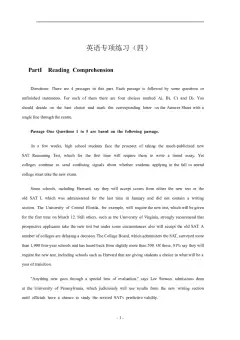
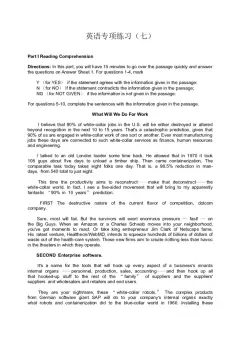
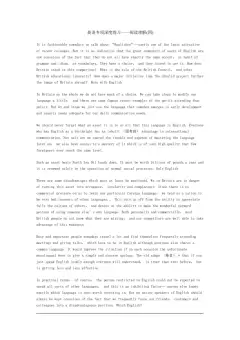
英语部分练习(六)
Part I Reading Comprehension
Directions: There are 4 passages in this part. Each passage is followed by some questions
or unfinished statements. For each of them there are four choices marked A), B), C)and D).
You should decide on the best choice and mark the corresponding letter on the Answer
Sheet with a single line through the center.
Passage 1
The great bulk of expert opinion is that owing a gun undermines rather than increases safety:
the function of discouraging burglars or other criminals is more than offset by other factors. First
come the suicides: in 1986,18,153 people shot themselves to death. No one on knows how many
might have lived if they had been unable to pick up a gun and how many might have merely chosen
other means to end their lives. But surely the presence of a loaded gun in a bureau drawer must have
tempted many, particular teens, to yield to a black depression that might have lifted had the means to
carry out the dark wish not been so readily available.
Then come the accidental shootings, many by foolish guys who never bother to learn how to
handle their weapons. More heartbreaking are the frequent incidents of children picking up their
parents’ guns and finding out in the most disastrous way that they are not toys; for example, an
eight-year-old boy who shot his six-year-old sister dead last week in Fairfax. Then there are the
quarrels between spouses, between parents and their children, between neighbors and friends that
suddenly turn fatal because one or both can pick up a gun. Police commonly estimate that if a
household gun is ever used at all, it is six times as likely to be fired at a member of the family or a
friend as at an intruder. (It is even more likely, says Dr. Carl Bell, a Chicago psychiatrist, that the gun
will be stolen; gun are prime targets for burglars because they can be easily and profitably sold to
other criminals.)And finally, in the relatively rare shoot-outs between householders and burglars that
do occur, it might easily be the burglar who proves more skilled in handling his guns and the
householder who winds up in morgue(停尸房).
Adding all types of deaths together, Mercy and Houk, researchers from the Atlanta-based
Centers for Disease Control, point out that “during the last two years, the number of people who
died of injuries inflicted by firearms in the United States exceeded the number of casualties during
the entire 8.5-year Viet Nam conflict.” Mercy and Houk judged that “injury from firearms is a
public-health problem whose toll is unacceptable.”
Another group of researchers presented evidence that lax U.S. gun laws might be to blame. The
team, headed by emergency room surgeon John Henry Sloan, studied a pair of cities just 140 miles
apart: Seattle and Vancouver. The two cities had similar unemployment rates, household incomes,
law-enforcement policies and even favorite TV shows. Two differences: in Canada, handgun
ownership is tightly restricted; in Washington State, guns are more easily purchased. And between
11980 and 1986 Seattle had 388 homicides, vs. 204 Vancouver.
1. According to most experts, possessing a gun ________.
A) can not guarantee your safety
B) does more than assure you safety
C) leads to more suicides
D) can only frighten thieves
2. “To carry out the dark wish” in the last sentence of the first paragraph means _________.
A) killing oneself
B) shooting others
C) yielding to depression
D) picking up a gun
3. Which of the following statements is NOT true?
A) Many children become the victims of playing guns
B) A household gun is more likely to aim at a familiar person
C) Accidental shootings often happen when people are quarrelling
D) A gun at home is very likely to be taken away by burglars
4. The word “lax” in the first sentence of the last paragraph most probably means________.
A) different
B) unrestricted
C) funny
D) not strict
5. The author cites the two cities as an example to demonstrate that ________.
A) what matters is to carry out the gun laws
B) all states must have the same gun laws
C) gun ownership must be strictly restricted
D) gun laws have little effect
Passage 2
Ever since Darwin’s theory of evolution, biologists have assumed that environments
teeming with complex forms of life served as the nurseries of evolution. But two recent
papers in Science magazine have turned that notion on its head. Last month some biologists
reported that in the ocean it is the relatively barren areas that serve as “evolutionary
crucibles(熔炉),” not regions with great diversity of species. Other researchers announced this
summer that the Arctic, not the rain forest, spawned many plants and animals that later
migrated to North America. Says John Sepkoski of the University of Chicago, “Harsh
environments may be producing the major changes in the history of life.”
These “changes” do not result merely in a longer tail or a bigger claw for an existing
species but, rather, in dramatic leaps up the evolutionary ladder — a rare innovation that
comes along once in a million years. In the Arctic, reports Leo Hickey of Yale University,
the innovations ran to forms never before seen on earth. By dating fossils from many
geologic layers, he concluded that large grazing animals first appeared in the Arctic and
migrated to temperate places a couple of million years or so later. Among plants, species of
redwood and birch originated in polar regions some 18 millions years before they showed
up in the south. Examining fossils as old as 570 million years, Chicago’s Sepkoski found
2that shell-less, soft-bodied creatures were suddenly replaced by trilobites(三叶虫), then by
the more advanced clam-like animals. These changes, he notes, “first become common near
shore.” That surprised him — an environment with as few species as exist in the near
shore, and with such a poor record of producing new species, seems an unlikely place for
biological innovation. But when Jablonski dated fossils of 100 million years ago, he found
that during this era, too, the near shore spawned biological breakthroughs — more
sophisticated sea creatures that move and find food in ocean sediments instead of passively
filtering whatever floats by.
The findings are too new to apply to human evolution, but at first glance they seem to
fit the facts. Anthropologists believe that our ancestors became fully human only after they
left their secure life in the trees for the harsh world of savanna(plain without trees). There,
the demanding conditions triggered that most human of traits, the large brain, and the most
profound evolutionary step of all was taken.
6. Two recent papers in Science magazine claim to have found evidence which contradicts
the traditional notion that _______.
A) relatively harsh environments are the nurseries of evolution
B) evolution occurred in regions with biological diversity
C) new forms of life come into being in near-shore areas
D) species of birch and redwood originated in the south
7. According to Leo Hickey of Yale University, which of the following may have spawned
more advanced species of land animals?
A) The barren ocean floor
B) The Arctic
C) The rain forest
D) Temperate Zones
8. The word “innovations” in the second paragraph means ________.
A) New theory B) New phenomenon C) Changes D) New inventions
9. How would anthropologists take the new findings?
A) They would look at them dubiously
B) They would eagerly apply them to the study of human evolution
C) They would challenge them, though at first glance they tend to look at them
favorably
D) They would most probably think the new findings fit well into their theory
10. Which of the following may be an appropriate title of the passage ?
A) Darwin’s Theory Modified
B) How Animals Evolve
C) Evolution in Hard Places
D) Where Did Large Sea Animals Originate
Passage 3
A classic series of experiments to determine the effects of overpopulation on communities of
rats was conducted by a psychologist, John Calhoun. In each experiment, an equal number of male
and female adult rats were placed in an enclosure. The rat populations were allowed to increase.
Calhoun knew from experience approximately how many rats could live in the enclosures without
3experiencing stress due to overcrowding. He allowed the population to increase to approximately
twice this number. Then he stabilized the population by removing offspring that were not dependent
on their mothers. At the end of the experiments, Calhoun was able to conclude that overcrowding
causes a breakdown in the normal social relationships among rats, a kind of social disease. The rats
in the experiments did not follow the same patterns of behavior as rats would in a community
without overcrowding.
The females in the rat population were the most seriously affected by the high population density.
For example, mothers sometimes abandoned their pups, and, without their mothers’ care, the pups
died. The experiments verified that in overpopulated communities, mother rats do not behave
normally. Their behavior may be considered diseased, pathological (病理学的).
The dominant males in the rat population were the least affected by over population. Each of
these strong males claimed an area of the enclosure as his own. Therefore, these individuals did not
experience the overcrowding in the same way as the other rats did. However, dominant males did
behave pathologically at times. Their antisocial behavior consisted of attacks on weaker male,
female, and immature rats. This deviant behavior showed that even though the dominant males
had enough living space, they too were affected by the general overcrowding.
Non-dominant males in the experimental rat communities also exhibited deviant social behavior.
Some withdrew completely, avoiding contact with other rats. Other non-dominant males were
hyperactive, chasing other rats and fighting each other.
The behavior of the rat population has parallels in human behavior. People in densely populated
areas exhibit deviant behavior similar to that of the rats in Calhoun's experiments. In large urban
areas, such as New York City, London, and Cairo, there are abandoned children. There are cruel,
powerful individuals, both men and women. There are also people who withdraw and people who
become hyperactive. Is the principal cause of these disorders overpopulation? Calhoun's
experiments suggest that it might be. In any ease, social scientists and city planners have been
influenced by the results of this series of experiments.
11. Calhoun stabilized the rat population ____.
A) when it was double the number that could live in the enclosure without stress
B) by removing young rats
C) so that there was a constant number of adult rats in the enclosure
D) All of the above are correct
12. Which of the following inferences can NOT be made from the first paragraph?
A) Calhoun’s experiment is still considered important today.
B) Overpopulation causes pathological behavior in rat populations.
C) Stress does not occur in rat communities unless there is overcrowding.
D) Calhoun had experimented with rats before.
13. According to the passage, which of the following is NOT true?
A) Dominant males had adequate living space.
B) Dominant males were not as seriously affected by overcrowding as the other rats.
C) Dominant males attacked weaker rats.
D) The strongest males are always able to adapt to bad conditions.
14. The author implies that the behavior of the dominant male rats is sometimes parallel with
that of _____.
4A) cruel, powerful people
B) people who abandon their children
C) hyperactive people
D) people who would like to keep to themselves.
15. The main point of this passage is that _______.
A) although rats are affected by overcrowding, people are not
B) overcrowding may be an important cause of social pathology
C) the social behavior of rats is seriously affected by overcrowding
D) Calhoun's experiments have influenced many people
Passage 4
In the past, concern about a man-made warming of the earth has concentrated on the
Arctic because the Antarctic is much colder and has a much thicker ice sheet. But the
weather experts are now paying more attention to West Antarctic, which may be affected by
only a few degrees of warming: in other words, by a warming on the scale that will
possibly take place in the next fifty years from the burning of fuels.
Satellite pictures show that large areas of Antarctic ice are already disappearing. The
evidence available suggests that a warming has taken place. This fits the theory that carbon
dioxide warm the earth.
However, most of the fuel is burnt in the northern hemisphere, where temperatures seem
to be falling. Scientists conclude, therefore, that up to now natural influences on the weather
have exceeded those caused by man. The question is: which natural cause has most effect
on the weather?
One possibility is the variable behavior of the sun. astronomers at one research station
have studied the hot spots and “cold” spots (that is, the relatively less hot spots) on the
sun. as the sun rotated, every 27.5 days, it presents hotter or “colder” faces to the earth,
and different aspects to different parts of the earth. This seems to have a considerable effect
on the distribution of the earth’s atmospheric pressure, and consequently on wind circulation.
The sun is also variable over a long term: its heat output goes up and down in cycles, the
latest trend being downward.
Scientists are now finding mutual relations between models of solar-weather interactions
and the actual climate over many thousands of years, including the last Ice Age. The
problem is that the models are predicting that the world should be entering a new Ice Age
and it is not. One way of solving this theoretical difficulty is to assume a delay of
thousands of years while the solar effects overcome the inertia of the earth’s climate. If this
is right, the warming effect of carbon dioxide might thus be serving as a useful counter-
balance to the sun’s diminishing heat.
16. Experts used to believe that the chief reason for global warming is______.
A) that most fuel is consumed in the northern hemisphere
B)human activities
C)natural influences and carbon dioxide
D)the solar energy
17. The article is written to illustrate ______.
A) the greenhouse effect
5B) the solar effects on the earth
C) the models of solar-weather interactions
D) the factors responsible for the global climate
18. In spite of the greater consumption of fuel in the northern hemisphere, temperatures
seem to be falling. This is_____.
A) possibly because of the melting of the ice caps in the poles
B) mainly because the levels of carbon dioxide are rising
C) partly due to the variations of the output of solar energy
D) because the sun presents its “colder” face to the earth
19. On the basis of the models, scientists are of the opinion that ______.
A) the climate of the world should be becoming cooler
B) it’ll take thousands of years for the inertia of the earth’s climate to take effect
C) the man-made warming effect helps to increase the solar effects
D) the new Ice Age will be delayed by the greenhouse effect
20. If the assumption about the delay of a new Ice Age is correct _______.
A) the increased levels of carbon dioxide will warm up the earth even more quickly
B) the greenhouse effect will work to the advantage of the earth
C) the best way to overcome the cooling effect will be to burn more fuels
D) ice will soon cover the northern hemisphere
Part II Vocabulary
Directions:There are 30 incomplete sentences in this part. For each sentence there are four
choices marked A), B),C)and D).Choose the ONE answer that best completes the sentence.
Then mark the corresponding letter on the Answer Sheet with a single line through the
centre.
21. I am on the of retirement, and I believe Paul would be happy to take my place.
A) verge B) border C) edge D) basis
22. Kate’s arrived every night to take her out for the evening.
A) participant B) escort C) colleague D)delegation
23. Reluctant to see her mother, she outside for the school after everyone else had
gone home.
A) hindered B) hinted C) lingered D) clustered
24. The local officials their difficulties to apply for more funds from the government.
A) broadened B) extended C) magnified D) strengthened
25. It was sad that the movie in a departure of the couple.
A) culminated B) deleted C) decorated D) accumulated
26. Half a century’s ago, it’s difficult to of traveling to the moon.
A) conclude B) condemn C) contend D) conceive
27. They think it caught fire because a chemical reaction caused combustion.
A) reluctant B) willing C) instant D) spontaneous
28. She still has very hearing, though she is eighty years old.
6A) vigorous B) exact C) acute D) vivid
29. You may not have heard of the poet, but he is very original and creative and I
believe he will become well-known someday.
A) obscure B) vague C) vicious D) prominent
30. Your explanation sounds , but I’m not sure I believe it. Can you give me some
evidence?
A) plausible B) vague C) irrational D) ambiguous
31. We never any unrealistic fancies about those desperate criminals.
A) treasure B) value C) grab D) cherish
32. The river was by the setting sun, making a picturesque scene.
A) modified B) radiated C) enlightened D) illuminated
33. I felt rather after all that beer the previous night, so I stayed in the bed for the
whole day.
A) fertile B) versatile C) fragile D) sturdy
34. If you want to go to the concert, you’ll have to make a , or there will be no
tickets.
A) conservation B) reservation C) preservation D) observation
35. Our new director is much younger than his , who is already 50 years old.
A) successor B) precedent C) predecessor D) offspring
36. The government has given a that it will halt the bombing, but we still see the
explosion here and there.
A) endeavor B) priority C) prominence D) pledge
37. A of interest in the matter came into her eyes but soon extinguished.
A) glitter B) fraction C) dazzle D) gleam
38. Wearing plain clothes, the king with the people in the streets.
A) integrated B) mingled C) associated D) collaborated
39. This supermarket has an excellent for fair dealing.
A) fame B) popularity C) reputation D) impression
40. We hope there will be a peaceful to the new system.
A) transmission B) transition C) transaction D) transformation
41. A good president should the interest of his people with his own prosperity.
A) identify B) exemplify C) qualify D) signify
42. Henry Adams felt so hungry that he ordered a double of fish.
A) part B) piece C) section D) portion
43. The tourists through the fog, trying to read what was engraved on the
gravestone Shakespeare had chosen for himself.
A) glanced B) glimpsed C) peered D) peeped
44. The discovery of new oil fields in various parts of the country filled the government
with
hope.
A) eternal B) infinite C) ceaseless D) delicate
45. Undergraduate students have no to the rare books in the school library.
A) access B) entrance C) way D) admission
746. The Olympic Games in 776 BC in Olympia, a small town in Greece.
A) originated B) stemmed C) derived D) descended
47. More often than not, it is difficult to the exact meaning of a Chinese idiom in
English.
A) exchange B) transfer C) convey D) convert
48. A man who has is a man of moral principle who cannot be false to his own
standards or to his conception of his responsibilities.
A) integrity B) ambition C) anxiety D) popularity
49. It would matters if fewer people had to be consulted.
A) facilitate B) fascinate C) hinder D) retard
50. He was only by his wish to help me, and expected nothing in return.
A) activated B) advocated C) dominated D) motivated
Part III Error Correction
Directions:This part consists of a short passage. In this passage, there are altogether 10
mistakes, one in each numbered line. You may have to change a word, add a word or
delete a word. Mark out the mistakes and put the corrections in the blanks provided. If you
change a word, cross it out and write the correct word in the corresponding blank. If you
add a word, put an insertion mark (∧) in the right place and write the missing word in the
blank. If you delete a word, cross it out and put a slash (/) in the blank.
Example:
Television is rapidly becoming the literature of our periods. 1.
time/times/period
Many of the arguments having used for the study of literature 2. /
as a school subject are valid for∧study of television. 3. the
When we speak of a human need, we mean something
which is unnecessary to life, something we can live with. 51.
food is a human need. We will starve to death if there 52.
were no food on earth; but even if we have plenty of food,
but of the wrong kind, our bodies will have problem from
lack of the right food. This is known for malnutrition(营 53.
养不良)。
8In countries where are not developed, man’s food 54.
needs are the same like in the most advanced societies. We 55.
all need food and could live a good life on very few types of
food. People in very developed countries eat only the kinds 56.
of food which can be grown near their homes, whereas
people in developed countries eat foods which are often
grown many thousands of miles away form their homes.
People in undeveloped countries are happy with less
different kinds of foods than people in very developed ones
are, so we can say that despite the needs of the two kinds 57.
of people are the same, their wants are different. People in
very developed countries eat many different types of
meat---they could live by only one, but they would be very 58.
unhappy because every time what they ate was the same.
Even such special food as chicken would be less fun to 59.
eat if you had them every day. But we can’t just live on
meat-we need other kinds of food like bread, rice, and
vegetables which are no more necessary to our bodies. 60.
Part IV Writing
Directions: For this part, you are allowed 30 minutes to write a short essay on the topic of Starting
Career in a Big City or Small Town?You should write at least 150 words following the
outline given below:
1. University graduates are facing fierce competition hunting jobs in big cities.
2. Many small towns and rural areas need graduates with technique and knowledge.
3. Where are you going to start your career? Why?
________________________________________________________________________________
_
9________________________________________________________________________________
_
________________________________________________________________________________
_
________________________________________________________________________________
_
________________________________________________________________________________
_
________________________________________________________________________________
_
________________________________________________________________________________
_
________________________________________________________________________________
_
________________________________________________________________________________
_
________________________________________________________________________________
_
________________________________________________________________________________
_
________________________________________________________________________________
_
________________________________________________________________________________
_
________________________________________________________________________________
_
________________________________________________________________________________
_
________________________________________________________________________________
_
10________________________________________________________________________________
_
________________________________________________________________________________
________________________________________________________________________________
__
________________________________________________________________________________
_
________________________________________________________________________________
_
________________________________________________________________________________
_
________________________________________________________________________________
_
________________________________________________________________________________
_
________________________________________________________________________________
_
________________________________________________________________________________
_
________________________________________________________________________________
_
11参考答案
阅读
1-10 AACDC ABCDC
11-20 BADAB BDCAB
词汇
21-25 ABCCA 26-30 DDCAA
31-35 DDCBC 36-40 DDBCB
41-45 ADCBA 46-50 ACAAD
改错
51.unnecessary -----necessary
52.will----would
53.for---as
54.where---which/that
55.like---as
56.developed ----undeveloped
57.despite---although/though
58.by---on
59./
60.more---less
作文(略)
12