2020—2021 学年北京市东城区北京景山学校初三年级上学期期中
英语学科试卷
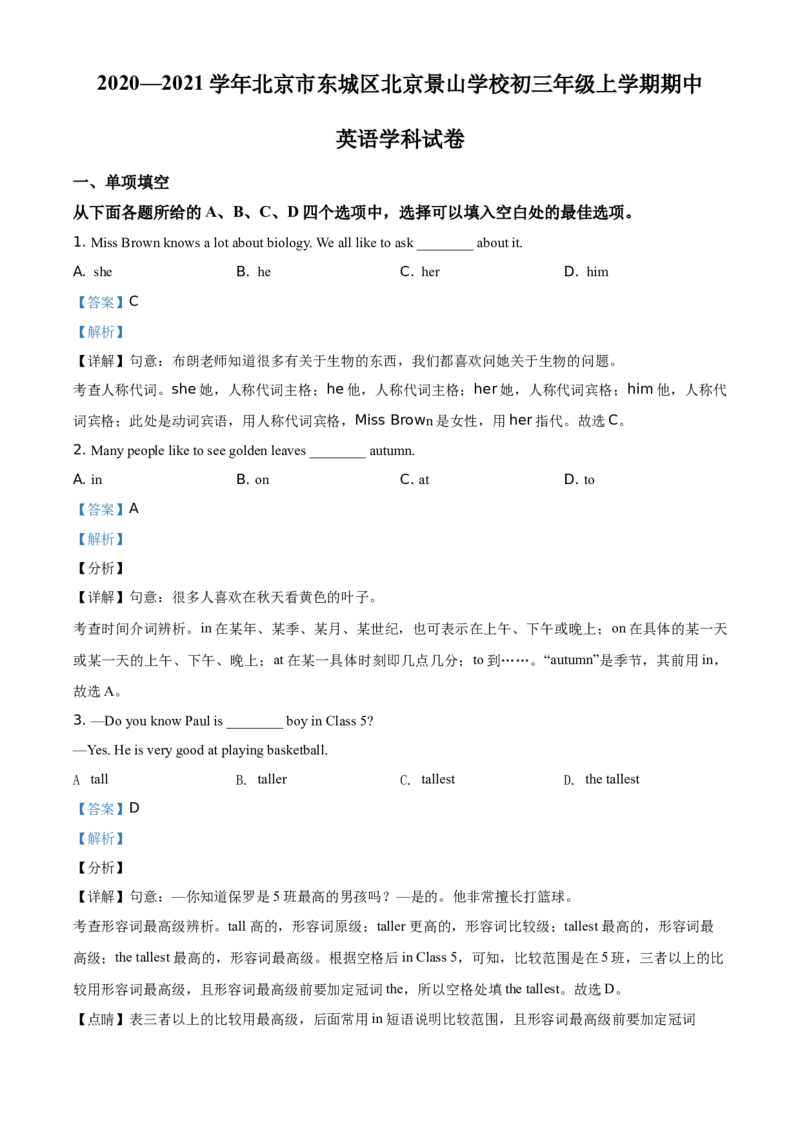
一、单项填空
从下面各题所给的A、B、C、D四个选项中,选择可以填入空白处的最佳选项。
1. Miss Brown knows a lot about biology. We all like to ask ________ about it.
A. she B. he C. her D. him
【答案】C
【解析】
【详解】句意:布朗老师知道很多有关于生物的东西,我们都喜欢问她关于生物的问题。
考查人称代词。she她,人称代词主格;he他,人称代词主格;her她,人称代词宾格;him他,人称代
词宾格;此处是动词宾语,用人称代词宾格,Miss Brown是女性,用her指代。故选C。
2. Many people like to see golden leaves ________ autumn.
A. in B. on C. at D. to
【答案】A
【解析】
【分析】
【详解】句意:很多人喜欢在秋天看黄色的叶子。
考查时间介词辨析。in在某年、某季、某月、某世纪,也可表示在上午、下午或晚上;on在具体的某一天
或某一天的上午、下午、晚上;at在某一具体时刻即几点几分;to到……。“autumn”是季节,其前用in,
故选A。
3. —Do you know Paul is ________ boy in Class 5?
—Yes. He is very good at playing basketball.
.
A tall B. taller C. tallest D. the tallest
【答案】D
【解析】
【分析】
【详解】句意:—你知道保罗是5班最高的男孩吗?—是的。他非常擅长打篮球。
考查形容词最高级辨析。tall 高的,形容词原级;taller 更高的,形容词比较级;tallest 最高的,形容词最
高级;the tallest 最高的,形容词最高级。根据空格后in Class 5,可知,比较范围是在5班,三者以上的比
较用形容词最高级,且形容词最高级前要加定冠词the,所以空格处填the tallest。故选D。
【点睛】表三者以上的比较用最高级,后面常用in短语说明比较范围,且形容词最高级前要加定冠词the。
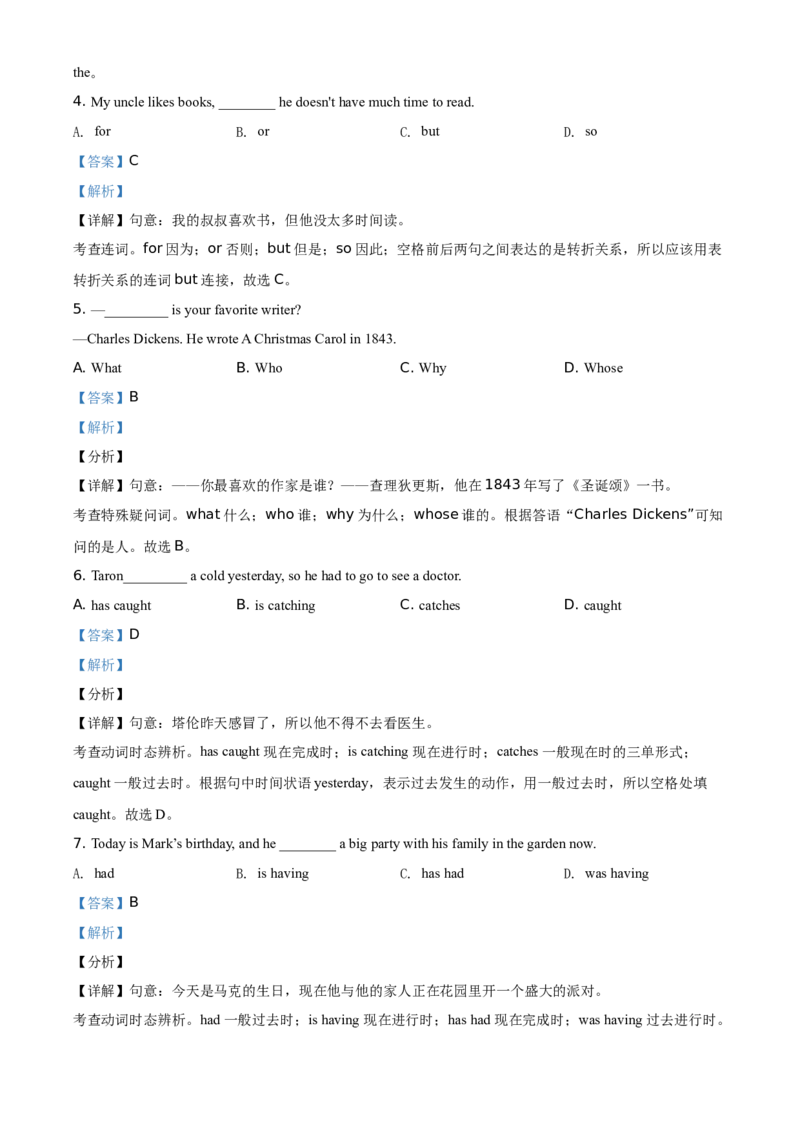
4. My uncle likes books, ________ he doesn't have much time to read.
A. for B. or C. but D. so
【答案】C
【解析】
【详解】句意:我的叔叔喜欢书,但他没太多时间读。
考查连词。for因为;or否则;but但是;so因此;空格前后两句之间表达的是转折关系,所以应该用表
转折关系的连词but连接,故选C。
5. —_________ is your favorite writer?
—Charles Dickens. He wrote A Christmas Carol in 1843.
A. What B. Who C. Why D. Whose
【答案】B
【解析】
【分析】
【详解】句意:——你最喜欢的作家是谁?——查理狄更斯,他在1843年写了《圣诞颂》一书。
考查特殊疑问词。what什么;who谁;why为什么;whose谁的。根据答语“Charles Dickens”可知
问的是人。故选B。
6. Taron_________ a cold yesterday, so he had to go to see a doctor.
A. has caught B. is catching C. catches D. caught
【答案】D
【解析】
【分析】
【详解】句意:塔伦昨天感冒了,所以他不得不去看医生。
考查动词时态辨析。has caught 现在完成时;is catching 现在进行时;catches 一般现在时的三单形式;
caught 一般过去时。根据句中时间状语yesterday,表示过去发生的动作,用一般过去时,所以空格处填
caught。故选D。
7. Today is Mark’s birthday, and he ________ a big party with his family in the garden now.
A. had B. is having C. has had D. was having
【答案】B
【解析】
【分析】
【详解】句意:今天是马克的生日,现在他与他的家人正在花园里开一个盛大的派对。
考查动词时态辨析。had 一般过去时;is having 现在进行时;has had 现在完成时;was having 过去进行时。根据句中时间状语now,表示动作正在进行,主语he是第三人称,所以空格处填现在进行时is having。故
答案为B。
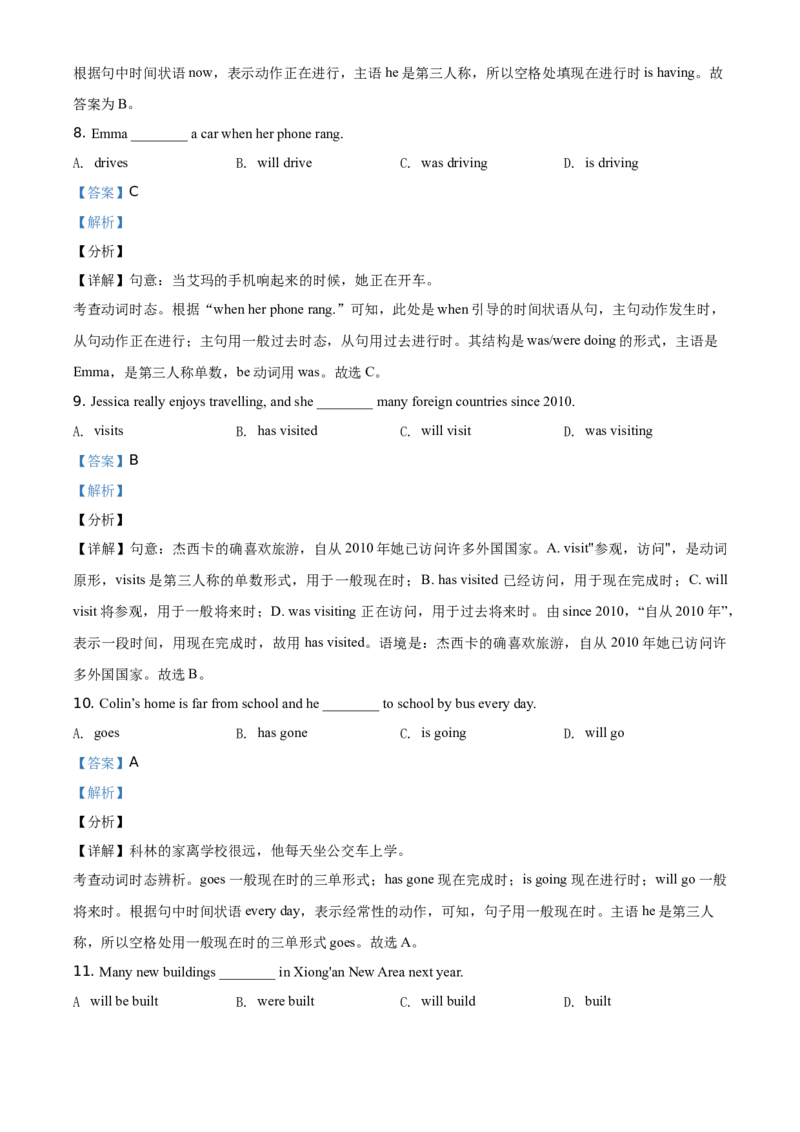
8. Emma ________ a car when her phone rang.
A. drives B. will drive C. was driving D. is driving
【答案】C
【解析】
【分析】
【详解】句意:当艾玛的手机响起来的时候,她正在开车。
考查动词时态。根据“when her phone rang.”可知,此处是when引导的时间状语从句,主句动作发生时,
从句动作正在进行;主句用一般过去时态,从句用过去进行时。其结构是was/were doing的形式,主语是
Emma,是第三人称单数,be动词用was。故选C。
9. Jessica really enjoys travelling, and she ________ many foreign countries since 2010.
A. visits B. has visited C. will visit D. was visiting
【答案】B
【解析】
【分析】
【详解】句意:杰西卡的确喜欢旅游,自从2010年她已访问许多外国国家。A. visit"参观,访问",是动词
原形,visits是第三人称的单数形式,用于一般现在时;B. has visited 已经访问,用于现在完成时;C. will
visit将参观,用于一般将来时;D. was visiting 正在访问,用于过去将来时。由since 2010,“自从2010年”,
表示一段时间,用现在完成时,故用has visited。语境是:杰西卡的确喜欢旅游,自从2010年她已访问许
多外国国家。故选B。
10. Colin’s home is far from school and he ________ to school by bus every day.
A. goes B. has gone C. is going D. will go
【答案】A
【解析】
【分析】
【详解】科林的家离学校很远,他每天坐公交车上学。
考查动词时态辨析。goes 一般现在时的三单形式;has gone 现在完成时;is going 现在进行时;will go 一般
将来时。根据句中时间状语every day,表示经常性的动作,可知,句子用一般现在时。主语he是第三人
称,所以空格处用一般现在时的三单形式goes。故选A。
11. Many new buildings ________ in Xiong'an New Area next year.
.
A will be built B. were built C. will build D. built【答案】A
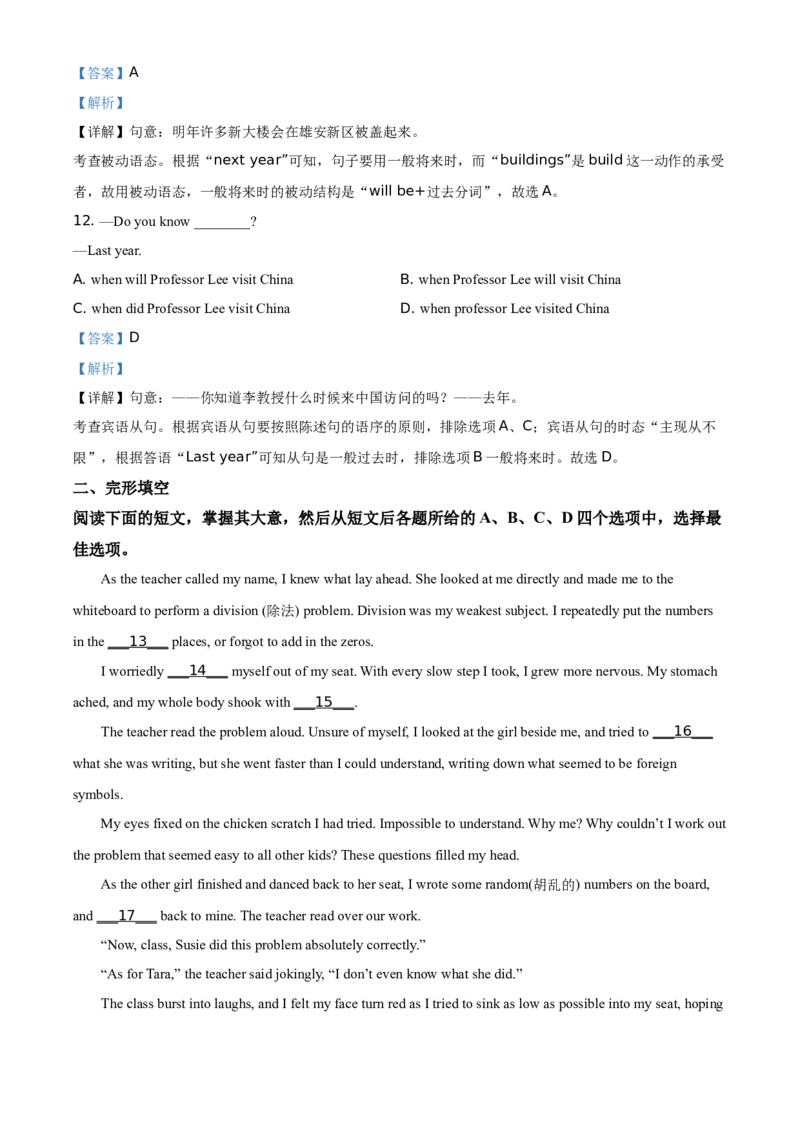
【解析】
【详解】句意:明年许多新大楼会在雄安新区被盖起来。
考查被动语态。根据“next year”可知,句子要用一般将来时,而“buildings”是build这一动作的承受
者,故用被动语态,一般将来时的被动结构是“will be+过去分词”,故选A。
12. —Do you know ________?
—Last year.
A. when will Professor Lee visit China B. when Professor Lee will visit China
C. when did Professor Lee visit China D. when professor Lee visited China
【答案】D
【解析】
【详解】句意:——你知道李教授什么时候来中国访问的吗?——去年。
考查宾语从句。根据宾语从句要按照陈述句的语序的原则,排除选项A、C;宾语从句的时态“主现从不
限”,根据答语“Last year”可知从句是一般过去时,排除选项B一般将来时。故选D。
二、完形填空
阅读下面的短文,掌握其大意,然后从短文后各题所给的A、B、C、D四个选项中,选择最
佳选项。
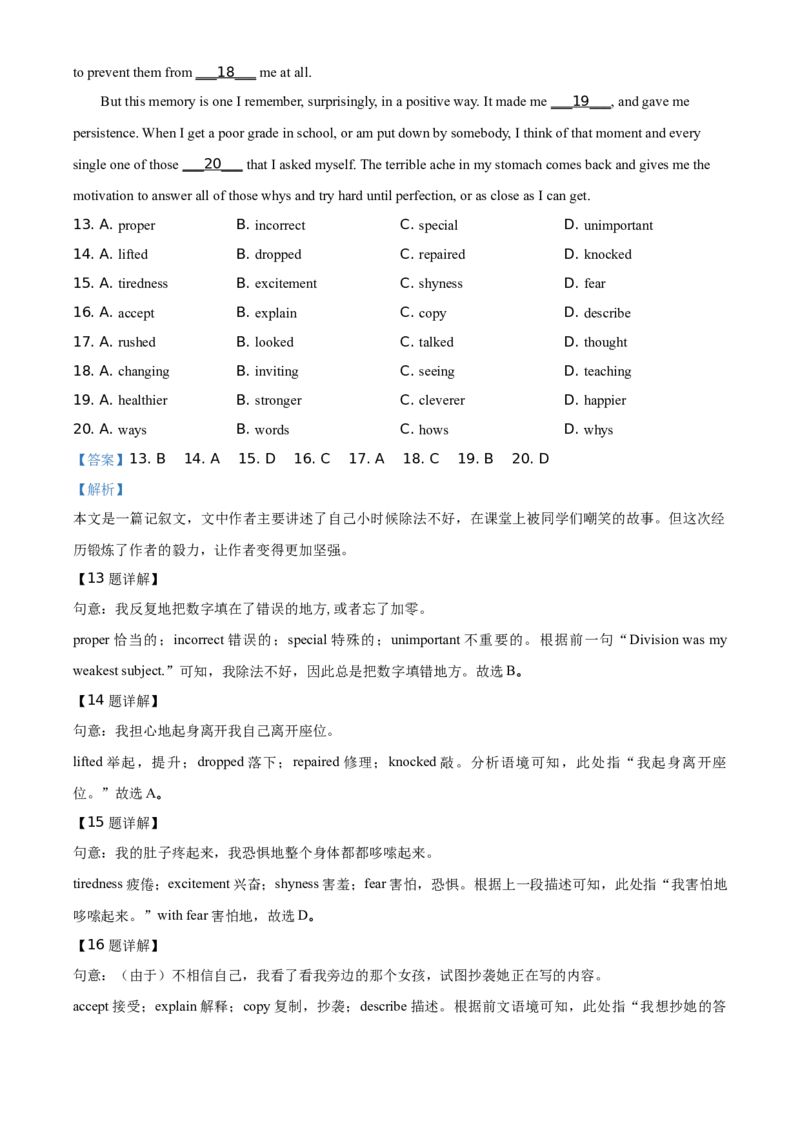
As the teacher called my name, I knew what lay ahead. She looked at me directly and made me to the
whiteboard to perform a division (除法) problem. Division was my weakest subject. I repeatedly put the numbers
in the ___13___ places, or forgot to add in the zeros.
I worriedly ___14___ myself out of my seat. With every slow step I took, I grew more nervous. My stomach
ached, and my whole body shook with ___15___.
The teacher read the problem aloud. Unsure of myself, I looked at the girl beside me, and tried to ___16___
what she was writing, but she went faster than I could understand, writing down what seemed to be foreign
symbols.
My eyes fixed on the chicken scratch I had tried. Impossible to understand. Why me? Why couldn’t I work out
the problem that seemed easy to all other kids? These questions filled my head.
As the other girl finished and danced back to her seat, I wrote some random(胡乱的) numbers on the board,
and ___17___ back to mine. The teacher read over our work.
“Now, class, Susie did this problem absolutely correctly.”
“As for Tara,” the teacher said jokingly, “I don’t even know what she did.”
The class burst into laughs, and I felt my face turn red as I tried to sink as low as possible into my seat, hopingto prevent them from ___18___ me at all.
But this memory is one I remember, surprisingly, in a positive way. It made me ___19___, and gave me
persistence. When I get a poor grade in school, or am put down by somebody, I think of that moment and every
single one of those ___20___ that I asked myself. The terrible ache in my stomach comes back and gives me the
motivation to answer all of those whys and try hard until perfection, or as close as I can get.
13. A. proper B. incorrect C. special D. unimportant
14. A. lifted B. dropped C. repaired D. knocked
15. A. tiredness B. excitement C. shyness D. fear
16. A. accept B. explain C. copy D. describe
17. A. rushed B. looked C. talked D. thought
18. A. changing B. inviting C. seeing D. teaching
19. A. healthier B. stronger C. cleverer D. happier
20. A. ways B. words C. hows D. whys
【答案】13. B 14. A 15. D 16. C 17. A 18. C 19. B 20. D
【解析】
本文是一篇记叙文,文中作者主要讲述了自己小时候除法不好,在课堂上被同学们嘲笑的故事。但这次经
历锻炼了作者的毅力,让作者变得更加坚强。
【13题详解】
句意:我反复地把数字填在了错误的地方,或者忘了加零。
proper恰当的;incorrect错误的;special特殊的;unimportant不重要的。根据前一句“Division was my
weakest subject.”可知,我除法不好,因此总是把数字填错地方。故选B。
【14题详解】
句意:我担心地起身离开我自己离开座位。
lifted举起,提升;dropped落下;repaired修理;knocked敲。分析语境可知,此处指“我起身离开座
位。”故选A。
【15题详解】
句意:我的肚子疼起来,我恐惧地整个身体都都哆嗦起来。
tiredness疲倦;excitement兴奋;shyness害羞;fear害怕,恐惧。根据上一段描述可知,此处指“我害怕地
哆嗦起来。”with fear害怕地,故选D。
【16题详解】
句意:(由于)不相信自己,我看了看我旁边的那个女孩,试图抄袭她正在写的内容。
accept接受;explain解释;copy复制,抄袭;describe描述。根据前文语境可知,此处指“我想抄她的答案”。故选C。
【17题详解】
句意:当另一个女孩说完跳回到她的座位上时,我在黑板上写了一些随机的数字,然后冲回我的座位。
rushed冲,闯;looked看;talked谈论;thought思考,认为。根据前文“I wrote some random numbers on
the board”可知,此处指我因为羞愧而快速冲回自己的座位。故选A。
【18题详解】
句意:全班哄堂大笑,我觉得自己 的脸都红了,我尽量在座位上坐得低一些,希望他们根本看不见我。
changing改变;inviting邀请;seeing看见;teaching教。联系前文“sink as low as possible into my seat”可
知,此处指“不让他们看到我”。故选C。
【19题详解】
句意:它让我变得更坚强,给了我坚持。
healthier更健康的;stronger更强大的;cleverer更聪明的;happier更幸福的。联系下文“and gave me
persistence”可知,此处指“这个记忆让我变得更强大”。故选B。
【20题详解】
句意:我会想到那一刻以及我问过自己的每一个为什么。
ways方法;words词语;hows方法,方式;whys为什么。联系前文“Why me”和“Why couldn’t I...”和
下文“answer all of those whys”可知,此处指“每一个为什么。”故选D。
三、阅读理解
阅读下列短文,根据短文内容,从短文后各题所给的A、B、 C、D四个选项中,选择最佳选
项。
A
Each New Year is a time for change and a fresh start, so many people like to make New Year's Resolutions(决
心). A New Year's Resolution is a promise you make to yourself to do something good or to
stop doing something bad in the New Year. Here are some teenagers' New Year's
Resolutions for 2016.
My New Year's Resolution is to get healthy. I'll stop drinking soda, and I'll eat more fruit at
least an apple every day. I'll also do more exercise, such as playing basketball for half an hour
every day.
Brandon
I want to get better grades in the New Year. To realize it, I will pay more attention in class, do
homework on time and study hard. When I have difficulties with lessons, I'll ask others for help
instead of giving it up.
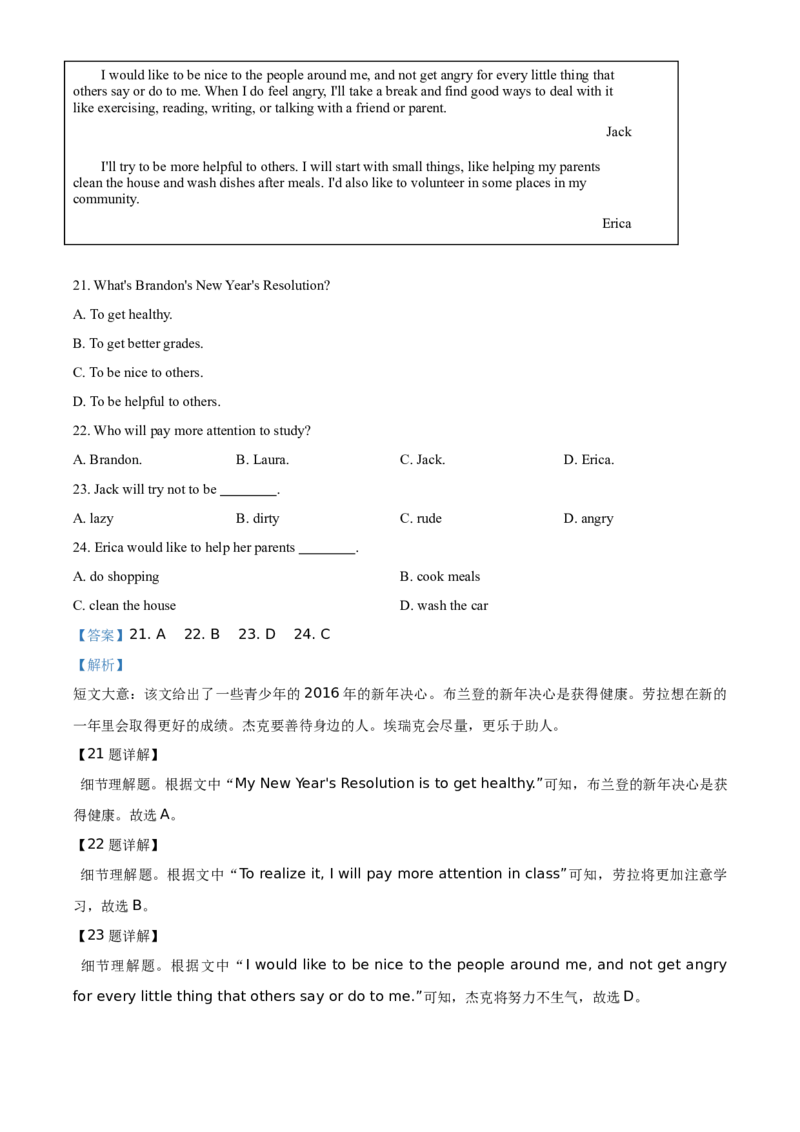
LauraI would like to be nice to the people around me, and not get angry for every little thing that
others say or do to me. When I do feel angry, I'll take a break and find good ways to deal with it
like exercising, reading, writing, or talking with a friend or parent.
Jack
I'll try to be more helpful to others. I will start with small things, like helping my parents
clean the house and wash dishes after meals. I'd also like to volunteer in some places in my
community.
Erica
21. What's Brandon's New Year's Resolution?
A. To get healthy.
B. To get better grades.
C. To be nice to others.
D. To be helpful to others.
22. Who will pay more attention to study?
A. Brandon. B. Laura. C. Jack. D. Erica.
23. Jack will try not to be .
A. lazy B. dirty C. rude D. angry
24. Erica would like to help her parents .
A. do shopping B. cook meals
C. clean the house D. wash the car
【答案】21. A 22. B 23. D 24. C
【解析】
短文大意:该文给出了一些青少年的2016年的新年决心。布兰登的新年决心是获得健康。劳拉想在新的
一年里会取得更好的成绩。杰克要善待身边的人。埃瑞克会尽量,更乐于助人。
【21题详解】
细节理解题。根据文中“My New Year's Resolution is to get healthy.”可知,布兰登的新年决心是获
得健康。故选A。
【22题详解】
细节理解题。根据文中“To realize it, I will pay more attention in class”可知,劳拉将更加注意学
习,故选B。
【23题详解】
细节理解题。根据文中“I would like to be nice to the people around me, and not get angry
for every little thing that others say or do to me.”可知,杰克将努力不生气,故选D。【24题详解】
细节理解题。根据文中“I will start with small things, like helping my parents clean the house
and wash dishes after meals.”可知,埃瑞克想帮助父母打扫房子,故选C。
B
Are you the type of person who easily gets less confident by negative(消极的) advice?
Follow this short lesson about self confidence.
Henry Ward Beecher was a well-known American churchman, social reformer(改革者)
and speaker in the middle of the 19th century. When he was a young boy in school, he
learned a lesson which he never forgot.
Once he was called up to recite(背诵) in front of the class. When he recited only a few
lines, the teacher interrupted with a forceful "No!" He started over and again the teacher
shouted, "No!" Ashamed, Henry sat down.
The next boy rose to recite and had just begun when the teacher shouted, "No!" This
student, however, kept on reciting until he completed it. As he sat down, the teacher
replied, "Very good!"
Henry was angry. "I recited just as he did," he complained to the teacher.
But the teacher replied, "It is not enough to know your lesson, you must be sure. When
you allowed me to stop you, it meant that you were uncertain, if the world says, No! it is
your business to say Yes! and prove it."
The world will say, "No!" in a thousand ways.
"No! You can't do that."
"No! You are wrong."
"No! You are too young."
"No! You don't have the education."
"No! You don't have the ability."
"No! You don't have the money."
"No! You can't work it out."
And each "No!" you hear has the possibility to weaken your confidence bit by bit until
you give up all together.
When the world says, "No!" to you, you should be strong-minded to say, "Yes!" and
prove it.
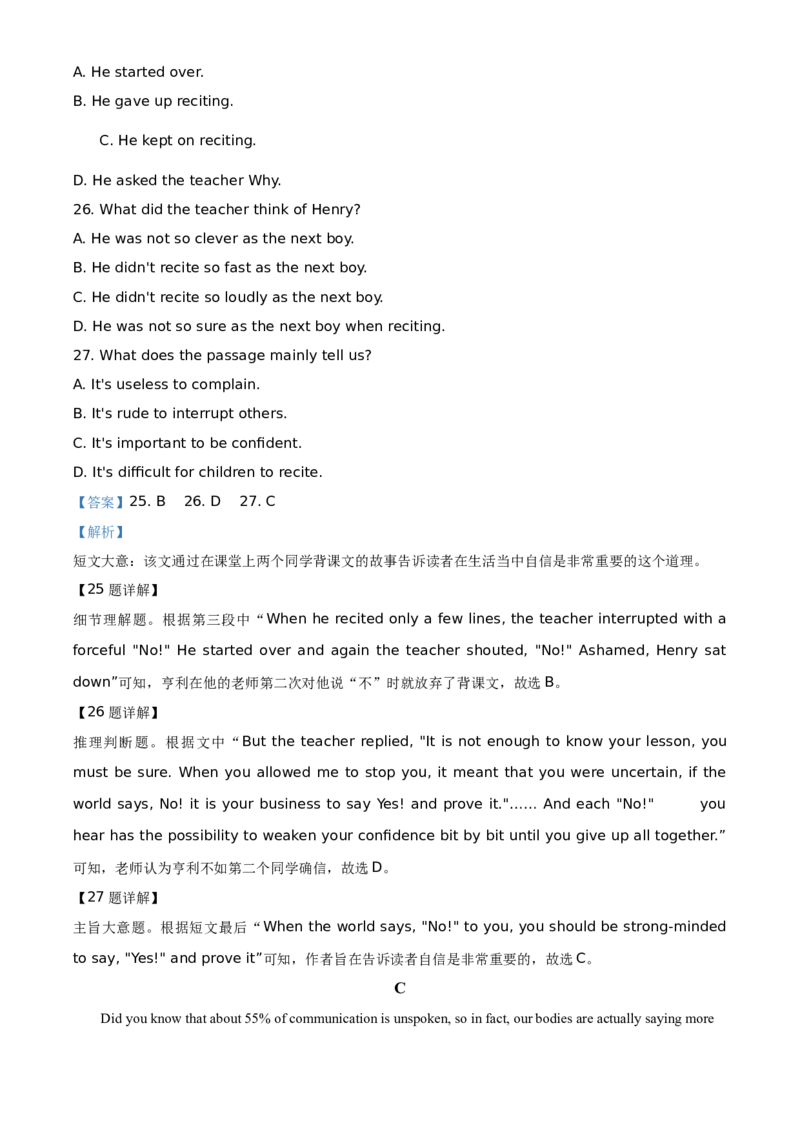
25. What did Henry do when the teacher said "No!" to him the second time?A. He started over.
B. He gave up reciting.
C. He kept on reciting.
D. He asked the teacher Why.
26. What did the teacher think of Henry?
A. He was not so clever as the next boy.
B. He didn't recite so fast as the next boy.
C. He didn't recite so loudly as the next boy.
D. He was not so sure as the next boy when reciting.
27. What does the passage mainly tell us?
A. It's useless to complain.
B. It's rude to interrupt others.
C. It's important to be confident.
D. It's difficult for children to recite.
【答案】25. B 26. D 27. C
【解析】
短文大意:该文通过在课堂上两个同学背课文的故事告诉读者在生活当中自信是非常重要的这个道理。
【25题详解】
细节理解题。根据第三段中“When he recited only a few lines, the teacher interrupted with a
forceful "No!" He started over and again the teacher shouted, "No!" Ashamed, Henry sat
down”可知,亨利在他的老师第二次对他说“不”时就放弃了背课文,故选B。
【26题详解】
推理判断题。根据文中“But the teacher replied, "It is not enough to know your lesson, you
must be sure. When you allowed me to stop you, it meant that you were uncertain, if the
world says, No! it is your business to say Yes! and prove it."…… And each "No!" you
hear has the possibility to weaken your confidence bit by bit until you give up all together.”
可知,老师认为亨利不如第二个同学确信,故选D。
【27题详解】
主旨大意题。根据短文最后“When the world says, "No!" to you, you should be strong-minded
to say, "Yes!" and prove it”可知,作者旨在告诉读者自信是非常重要的,故选C。
C
Did you know that about 55% of communication is unspoken, so in fact, our bodies are actually saying morethan our words. I find that the key to a successful conversation in any language is to speak to people not only in
their spoken language but also with the body language they know best.
Britain, along with much of Northern Europe, has a non—touch culture, so personal space is very important.
In a formal(正式的) situation, we would usually greet each other with a handshake. Informally, but not so often,
my British friends and I would greet with a hug. Hardly ever would we greet with a kiss on the cheek, let alone a
hug and two kisses on the cheek!
Here in the south of Italy, and in many different parts of the world, both men and women greet with two kisses
on the cheek, use a lot of hand signs and often touch each other. In other words, little personal space is left between
people when communicating.
At university, I have learnt to successfully communicate in spoken Italian. And since I moved to live with the
local people, I have also started to pick up their body language. Sometimes, I find myself not knowing what hand
signs to use when expressing myself. However, what I know for sure is that I would miss the opportunity to fully
put myself in the Italian culture if I keep my personal space unbroken.
Here are 5 body language tips in Italy:
● Use different signs. head, arms and hands.
● Use facial expressions. Always smile at people! It is said that smiling is the most powerful unspoken way to
communicate friendliness.
● Use eye contact, because "the eyes are the window to the soul."
● Don't worry about personal space. Italians are a people who like to use the sense of touch, so moving away
or keeping your distance may be considered as being unfriendly.
● Touch. When meeting and leaving, always shake hands.
28. The writer uses Britain and Italy as examples to show .
A. men and women greet in the same way
B. Italians are more friendly than the British people
C. keeping personal space is very important in any country
D. people in different countries use different body language
29. From Paragraph 4, we can learn that the writer .
A. likes to keep his personal space B. tries to learn Italian body language
C. knows little about Italian hand signs D. keeps using British body language in Italy
30. What is the most powerful unspoken way to show friendliness in Italy?
A. Hand signs. B. Smiling. C. Eye contact. D. Touch.
【答案】28. D 29. B 30. B【解析】
本文以以英国和意大利为例介绍了不同的国家使用的不同肢体语言,并较详细地介绍了在意大利的五个肢
体语言技巧。
【28题详解】
细节理解题。根据“I find that the key to a successful conversation in any language is to
speak to people not only in their spoken language but also with the body language they
know best”,可知,以英国和意大利作为例子是想说明不同国家的人使用不同的肢体语言,故选D。
【29题详解】
推理判断题。根据“And since I moved to live with the local people, I have also started to pick
up their body language”可知,作者努力学习意大利的肢体语言,故选B。
【30题详解】
细节理解题。根据“Use facial expressions”及“It is said that smiling is the most powerful
unspoken way to communicate friendliness”,可知,微笑是最有效的表达友好的无声方式,故选
B。
D
Mindfulness Matters
In recent years, some schools have begun to introduce meditation, or mindfulness training, into their
classrooms. During mindfulness training, students may be asked to sit quietly and observe their own thoughts and
feelings to avoid being controlled by them. Mindfulness training can help students overcome anxiety (焦虑),
control their behavior, and improve their ability to pay attention in class. Students are expected to learn how to
meditate in order to reduce stress and do better in their schoolwork.
Among schools that already teach meditation, the results have been positive. In one study, teachers reported
that after five weeks of mindfulness practice, their students were more focused. They also participated more fully in
class. A middle school in San Francisco reported that a student meditation program led to higher attendance rates
and better grades. Another study suggested that meditation helped students perform better on tests by improving
their working memory and reducing their anxiety.
Many supporters believe that meditation training programs can also help students overcome stress. For
example, Headstand is a mindfulness education program designed to help students overcome anxiety. A study
concluded that ninety-eight percent of participating students felt less stressed after they completed the Headstand
program. In another study, researchers in New Haven, Connecticut, followed students who participated in
meditation and yoga classes three times a week. They found that after each class, participants had lower levels of
cortisol, a stress hormone (激素), in their bodies.Despite the positive results seen so far, critics also point out that much of the current research is not
rigorous(严谨的) enough. Associate Professor Tamar Mendelson agrees that research on meditation in children is
still in its early stages. However, even she insists that she has seen the positive impact of meditation on children.
Others express worries that meditation is not a valuable use of class time. But many disagree. Denise Pope, a
professor from the Stanford University, says, “This is something teachers can do immediately. You get a lot of bang
for your buck and anyone who is against it isn’t thinking clearly.” Indeed, additional studies will surely strengthen
our understanding of the benefits of mindfulness.
Although still in its early stages, research shows that meditation can help students learn to deal with anxiety
and stress. As an added bonus, students of mindfulness training also report better concentration and gains in their
academic performances. Therefore, meditation should be a part of every student’s school day. Participating in
“stillness” can be just as productive as other school-related activities.
31. Why do some schools introduce mindfulness training into classes?
A. To control students’ working memory.
B. To reduce students’ stress and anxiety.
C. To increase students’ attendance rates.
D. To research students’ thoughts and feelings.
32. What can we learn from the passage?
A. Mindfulness training is not a valuable use of class time at school.
B. Mindfulness training is more productive than other school activities.
C. Students felt more stressful after joining yoga classes three times a week.
D. Students paid closer attention in class after weeks of mindfulness practice.
33. The words “a lot of bang for your buck” in Paragraph 4 probably mean “_____”.
A. challenges B. complaints C. advantages D. influences
34. The writer probably agrees that ______.
A. further studies will prove the benefits of mindfulness training
B. students will become more talented with mindfulness training
C. doctors will do researches on the spread of mindfulness training
D. mindfulness training decides students’ mental and physical health
【答案】31. B 32. D 33. C 34. A
【解析】
本文是一篇议论文,文中作者主要通过几个实验以及专家教授的观点向我们介绍了在学校内进行正念训练
的好处。【31题详解】
细节理解题。题意:一些学校为什么将正念训练引入校园?根据第一段最后一句“Students are expected to
learn how to meditate in order to reduce stress and do better in their schoolwork.”可知,这是为了减轻学生的压
力和焦虑。故选B。
【32题详解】
细节理解题。题意:我们能从文中了解到什么?根据第二段第二、三句“In one study, teachers reported that
after five weeks of mindfulness practice, their students were more focused. They also participated more fully in
class.”可知,在经过几周的正念训练以后,学生们在课堂上的注意力更加集中了。故选D。
【33题详解】
词义猜测题。题意:第四段中“a lot of bang for your buck”的意思可能是。根据后半句“and anyone who is
against it isn’t thinking clearly”可知任何对此反对的人都没有想清楚。再联系本段前文描述可知,Denise
Pope教授不认为正念训练是无价值的应用。由此可知这个短语指的是正念训练的“好处”。故选C。
【34题详解】
推理判断题。题意:作者可能同意。阅读短文可知,文中作者主要讲述了正念训练给学生带来的好处,作
者对此的态度是肯定的。因此他认为进一步的研究会证明正念训练的好处。故选A。
四、阅读短文,根据短文内容回答问题。
Can you imagine a world without a writing system for your language? It may be hard to picture it now, but a
man named Sequoyah lived in such a world. Sequoyah was a member of a native American tribe, the Cherokee.
Cherokee people speak their own language, but for hundreds of years they did not have a system of writing.
Without a writing system, the Cherokee had no newspapers or books before 1809.
Sequoyah was probably born around the year 1770 and lived with his mother in a small village in the
mountains of Tennessee. When he grew up, he became a blacksmith. When he was doing business with those
“English-speaking people”, he noticed that they used paper with marks to record their thoughts and ideas.
Sequoyah called these pieces of paper with marks “talking leaves”. He began to wonder why people who spoke
Cherokee did not have a way to write down their words.
In 1809, Sequoyah decided to give the Cherokee their own “talking leaves”. At first he tried to make a
different symbol for every word in the Cherokee language. But in that case, there would be so many symbols and
too hard for people to remember, so he decided to make a picture for each syllable (音节). After much hard work,
Sequoyah invented 85 symbols. In order to see whether it would work, he helped his six-year-old daughter Ayoka
learn each symbol and found she could learn to read and write very quickly. Sequoyah’s invention was a success!
Before long, Sequoyah’s writing system had spread far and wide. Cherokee people living in all different partsof the country learned to read and write. In 1825, Sequoyah’s system was made the official written language for
Cherokee people. To this day, Cherokee speakers still use Sequoyah’s writing system. In some parts of the United
States, you can see street signs and billboards written in both English and Cherokee. Sequoyah will always be
remembered for his important contribution to Cherokee people.
35. Did the Cherokee have newspapers before 1809?
___________________________________________________________
36. What did Sequoyah call the pieces of paper with marks?
___________________________________________________________
37. How many symbols did Sequoyah invent in the Cherokee language?
___________________________________________________________
38. When was Sequoyah’s system made the official written language?
___________________________________________________________
39. Why will Sequoyah always be remembered?
___________________________________________________________
.
【答案】35. No
36. Talking leaves.
37. 85. 38. In 1825.
39. Because of/For his important contribution to Cherokee people. / Because he created the writing system for
Cherokee language. / Because he made the official written language for Cherokee people.
【解析】
本文是一篇说明文,文中主要介绍了塞阔雅(Sequoyah)对切诺基语的发展所做出的巨大贡献。
【35题详解】
题意:在1809年之前,切诺基人有报纸吗?细节理解题。根据第一段最后一句“Without a writing system,
the Cherokee had no newspapers or books before 1809.”可知没有报纸,答案No.。
【36题详解】
题意:Sequoyah把带有符号的纸张称为什么?细节理解题。根据第二段倒数第二句“Sequoyah called these
pieces of paper with marks ‘talking leaves’.”可知,他把这些带有符号的纸张称为“说话的树叶”。答案为
Talking leaves.
【37题详解】
题意:在切诺基语中,Sequoyah发明了多少符号?细节理解题。根据第三段第四句中“After much hard
work, Sequoyah invented 85 symbols.”可知,Sequoyah发明了85个符号。可知答案是85.
【38题详解】题意:Sequoyah的书写系统什么时候成为了官方的书面语?细节理解题。根据最后一段第三句“In 1825,
Sequoyah’s system was made the official written language for Cherokee people.”可知,Sequoyah的书写系统在
1825年成为了官方的书面语。可知答案是In 1825.
【39题详解】
题意:Sequoyah为什么会被人们永远纪念?阅读短文可知,Sequoyah为切诺基人的语言发展做出了巨大的
贡献,据此表述即可,答案不唯一。Because of/For his important contribution to Cherokee people. / Because he
created the writing system for Cherokee language. / Because he made the official written language for Cherokee
people.
五、 书面表达。
从下面两个题目中任选一题,根据中文和英文提示,完成一篇不少于60词的文段写作。文中
已给出内容不计入总词数。所给提示词语仅供选用。请不要写出你的校名和姓名.
题目①
40. 假如你是李华,东城区中考英语听说机考上周刚刚结束,你收到了你的外教John的短信,他想了
解这次听说考试你考的怎么样,你是否喜欢这样的考试方式?为什么?针对听说学习,你在下一阶段有什
么打算?
提示词语:Listening and oral examination, improve, communicative ability, practice
提示问题:
* Do you like listening and oral examination?
* Why do you like it or Why don't you like it?
* What will you do to make your English better?
Dear John
Thanks for your letter.
____________________________________________________________________________________________
____________________________________________________________________________________________
____________________________________________________________________________________________
____________________________________________________________________________________________
____________________________________________________________________________________________
____________________________________________________________________________________________
______________________________
Yours,
Li Hua
【答案】例文:Dear John
Thanks for your letter. I think I can get a good result about listening and oral examination. I think I can get a
good result. I like listening and speaking tests. It's good. I think it is necessary for us to have a listening and
speaking test. It can test our listening and speaking ability and make it better than before. It also helps me know if I
make any mistakes in listening and speaking. That's why I like this exam.
I will do more exercises to improve my English. I will talk with my friends in English to improve my
communicative ability. I think the more I do, the better my English will be.
Yours,
Li Hua
【解析】
【分析】
【详解】1.题干解读:这是一篇应用文中的书信写作,你是李华,收到了你的外教John的短信,他想了解
这次听说考试你考的怎么样,你是否喜欢这样的考试方式?为什么?针对听说学习,你在下一阶段有什么
打算?要点已给出,不能遗漏和省略。
2.写作指导:本文用第一人称来介绍,时态采用一般现在时态和一般将来时为主,描述尽量用简洁 的语言,
运用适当的语法规则和词汇把各个要点准确表达出来。本文思路清晰,语言表达准确,用词恰当,意思通
俗易懂。
题目②
41. 随着中国的发展,我们的生活发生了日新月异的变化。请你结合生活实际,重点选择2—3个方面
谈谈具体的变化,以及你对这些变化的看法。
提示词语: living condition, education, transport, entertainment, satisfying
提示问题
* What changes are there in our life?
* What do you think of these changes?
.____________________________________________________________________________________________
____________________________________________________________________________________________
____________________________________________________________________________________________
____________________________________________________________________________________________
____________________________________________________________________________________________
______________________________________________________________________________________________________________________
【答案】例文:
With the development of the society, great changes have taken place in our life. Take my family for example.
One big change is in the living condition. When they got married about twenty years ago, my parents lived in a
small room crowded with furniture, but now we have moved into a big new three-room apartment.
As the Internet is developing so rapidly, the way of education keeps changing and new forms of education
emerge surprisingly. Especially during the pandemic of corona virus, online education has become one of the most
important ways of education throughout the world.
In short, changes in our life have brought us comfort and convenience. These changes are quite satisfying.
【解析】
【分析】
【详解】1.题干解读:该题目属于记叙文写作。在写作时应根据题目要求讲述生活中的具体变化,以及自
己对这些变化的看法
2.写作指导:本文用第一和第三人称来写作,时态采用现在完成时为主,讲述生活中的具体变化,叙述完
整,条理清晰。本试卷的题干、答案和解析均由组卷网(http://zujuan.xkw.com)专业教师团队编校出品。
登录组卷网可对本试卷进行单题组卷、细目表分析、布置作业、举一反三等操作。
试卷地址:在组卷网浏览本卷
组卷网是学科网旗下的在线题库平台,覆盖小初高全学段全学科、超过900万精品解析试题。
关注组卷网服务号,可使用移动教学助手功能(布置作业、线上考试、加入错题本、错题训练)。
学科网长期征集全国最新统考试卷、名校试卷、原创题,赢取丰厚稿酬,欢迎合作。
钱老师 QQ:537008204 曹老师 QQ:713000635