Unit 2 Home Sweet Home
第一课时(Section A 1a—1d)
分层作业
词海拾贝
1. ________ /pæk/ v. 打包;收拾 6. ________ /ˈbælkəni/ n. 阳台
2. ________ ________ 打包 7. ________ ________ 挂起;挂断电话
3. ________ /ˈbɑːθruːm/n. 浴室;洗手间 8. ________ /ɪnˈvaɪt/ v. 邀请
4. ________ /sɔːt/ v. 把……分类;整理n. 种类 9. ________ ________ 客厅
5. ________ /ˈbedruːm/ n. 卧室
基础达标
一、单词拼写
1.He is p his luggage (行李), he will go to Shanghai on business soon.
2.After a long day, taking a shower in the b can be very relaxing.
3.There is a kitchen, a bathroom, a living room and two (卧室) in my apartment.
4.She stood on the b to watch the sunset over the city.
5.Mr. Smith (把……挂起来) up his coat in the closet just now.
6.Jenny i me to go to her birthday party yesterday, but I don’t decided what to wear.
7.Jacob turned down the (invite) politely as he had a lot of work to do.
8.Jane, please help clean up the (live) room if you’re free.
9.When my brother is free, he often h out with his friends.
二、单项选择
10.—Jack, could you please help me take out the trash?
—Sorry, І ________, mom. I ________ my homework now.
A.couldn’t, am doing B.can’t, am doing C.can’t, do
11.People usually ________ those who have the same interest in their circle of friends.
A.afford B.invite C.provide D.include
12.—Excuse me. _______ I sit here?
—You’d better not. It’s the man’s seat.
A.Must B.Need C.Could D.Should13.Most students are busy every day. They can only ________ half an hour talking with their parents.
A.spend B.take C.pay D.use
14.—Wilson, ________ you help me carry the box upstairs?
—Sure, no problem.
A.could B.need C.should D.might
三、补全对话
请阅读下面对话,根据对话内容从下面选择恰当的句子填入空白处,是对话通顺、合理,意思完
整。
M: Hi, Mom. What are you doing?
W: I’m preparing supper. Could you please help me with a few things?
M: 15
W: Could you please take out the rubbish first?
M: OK. I’ll do it right away. 16
W: Yes. Could you please clean the dining table and chairs?
M: Oh! 17 Because it’s boring. What else do you want me to do?
W: Could you go and buy some salt?
M: Of course. 18
W: No, you can’t drive my car to the store. It’s dangerous for you to do so.
M: Well, I’ll ride my bike there. 19
W: Sure, but don’t eat too much. It’s bad for your stomach.
A.I don’t want to walk there.
B.No problem.
C.Who are you doing it with?
D.Could I buy ice-cream there?
E.Could I drive your car to the store?
F.I don’t want to do that kind of thing.
G.Is there anything else that you want me to do?
培优促能
四、完形填空
“Dear, could you please do the dishes?”
“Sure, Mom. How much money will you give me as a reward (奖励) 20 I do it?”
A study shows twenty percent of kids get money for doing chores. Other kids do chores without
getting paid. Should kids get paid for doing chores?
Lori MeGrath, a mother of two boys, thinks parents shouldn’t pay kids for doing chores. “Kids shoulddo chores and learn to 21 themselves. Is your child still going to be paid for keeping his room clean
when he goes to college? I always tell my boys we do 22 to keep our family going. We do them as a
23 . What’s more, do parents get paid for doing chores such as cooking and cleaning? No. So kids should
not get paid 24 .”
Elisabeth Leamy disagrees with Lori. “Paying kids for doing chores is 25 them for the real
world and life as adults (成年人). The more they do, the more they get. Also, I want my girl to learn how to
be 26 with money and how to make good decisions about money.”
“Kids should get paid! Parents go to 27 to make money, but kids do chores and it’s just like
having a job! Not getting paid would be 28 .” Nemo, a 9-year-old student says. He 29 some
money from his classmate last week. Now he plans to give it back by doing chores.
20.A.so B.if C.but D.or
21.A.take care of B.come up with C.look forward to D.put off
22.A.chores B.sports C.dishes D.homework
23.A.hobby B.plan C.team D.problem
24.A.too B.either C.neither D.also
25.A.providing B.preparing C.improving D.depending
26.A.bored B.satisfied C.independent D.deaf
27.A.work B.school C.party D.college
28.A.broken B.careful C.strong D.unfair
29.A.spent B.lent C.borrowed D.made
五、阅读理解
A
In America, there are chores for children of different ages. American people think it’s important to tell
children their duty (职责) in the family. Use this list of age chores for your children.
Ages 2—3
Ages 4—5
◆Help make the bed;
◆Clear and set the table;
◆Pick up toys and books;
◆Help cook dinner;
◆Take laundry (要洗的衣服) to the laundry room;
◆Put away groceries (食品杂货).
◆Help feed pets.
Ages 9—12
Ages 6—8
◆Help wash the car;
◆Take care of pets;
◆Learn to wash the dishes;
◆Take out the rubbish.
◆Clean the bathroom.
30.American people think children should do chores in the family because ________.
A.parents are lazyB.it’s important to let children know their duty in the family
C.children should work hard
D.children have nothing to do except (除了) playing
31.If Bob is 5 years old, he can ________.
A.set the table B.help wash the car
C.wash the dishes D.take out the rubbish
32.Which of the following is true?
A.A five-year-old boy can help take care of pets.
B.Jack is three years old and he can help his mom cook dinner.
C.Children under 6 years old don’t have to do chores around the house.
D.Jenny is a ten-year-old girl and she can help clean the bathroom.
33.According to the passage, what chores should a 15-year-old teenager do in an American family?
A.Take laundry (要洗的衣服) to the laundry room.
B.Put away groceries (食品杂货).
C.We don’t know.
D.Both A and B.
34.What’s the passage mainly about? ________
A.Chinese children’s duty in the family.
B.What chores American children of different ages should do.
C.Why children around the world should do chores.
D.Different opinions (观点) on whether (是否) children should do chores in the family.
B
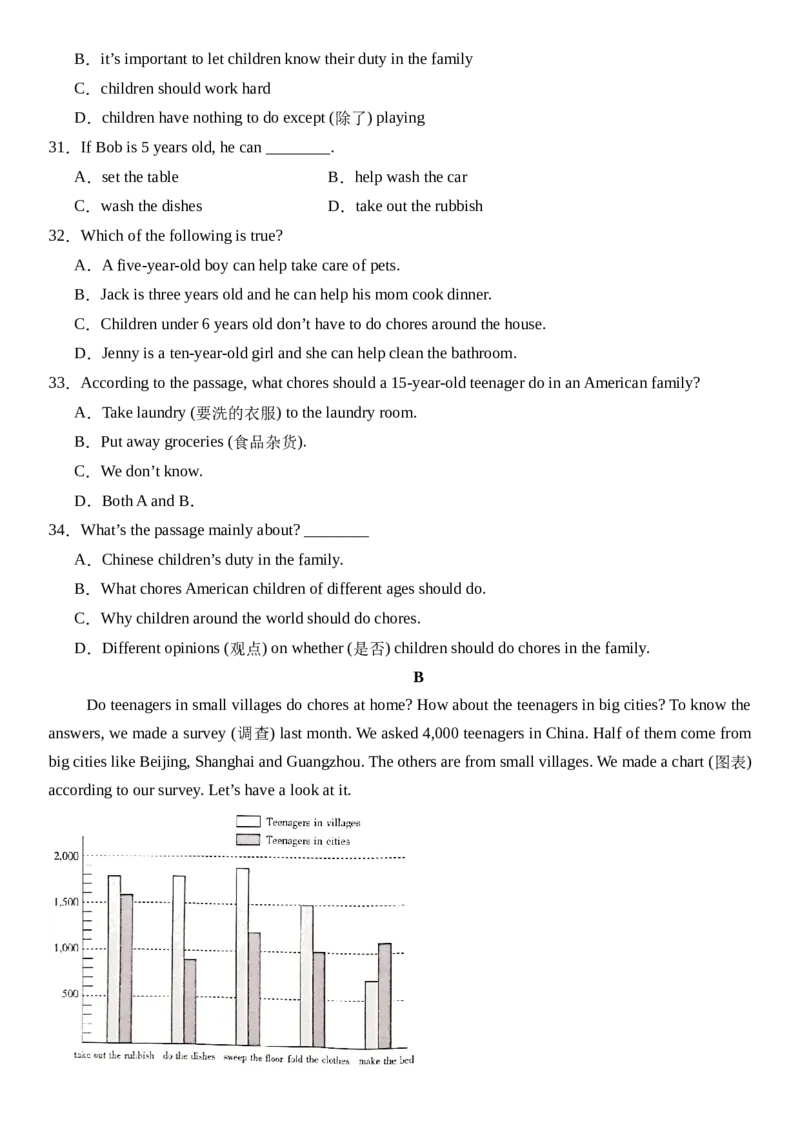
Do teenagers in small villages do chores at home? How about the teenagers in big cities? To know the
answers, we made a survey (调查) last month. We asked 4,000 teenagers in China. Half of them come from
big cities like Beijing, Shanghai and Guangzhou. The others are from small villages. We made a chart (图表)
according to our survey. Let’s have a look at it.We can find out that teenagers in small villages do more chores than those in big cities. Maybe it is
because they live a harder life. We will give our advice to parents in big cities. We think parents should give
their children some chores to do because it’s a good chance for teenagers to learn how to take care of
themselves.
根据短文和图表内容,选择最佳答案。
35.They surveyed _________ teenagers from big cities.
A.1000 B.2000 C.3000 D.4000
36.1,000 teenagers from the cities ________.
A.take out the rubbish B.do the dishes
C.make the bed D.fold the clothes
37.The number of teenagers in big cities is bigger than that in small villages only in ________.
A.taking out the rubbish B.making the bed
C.sweeping the floor D.doing the dishes
38.They made the survey because________.
A.they wanted to know more about teenagers in China
B.they didn’t want teenagers in China to do chores at home
C.they wanted to know if (是否) teenagers in China do chores at home
D.they thought doing housework could help teenagers to take care of themselves
39.From the passage, we can know________.
A.more than 3000 teenagers take out the rubbish
B.fewer than 1000 teenagers in big cities make the bed
C.more than 1500 teenagers in Beijing fold the clothes
D.4000 teenagers from small villages take part in the survey
C
根据短文内容,从短文后的选项中选出能填入空白处的最佳选项。其中有两项为多余选项。
Many children don’t like doing chores, because they think it’s boring. Some children think they just
need to learn their subjects well and there is no need for them to do chores. 40
First, doing chores can teach children certain skills. 41 Washing clothes and doing dishes
may seem boring, but knowing how to do them well will help children a lot. If children can successfully do
the chores at home, they will live a better life.
42 Some chores like sweeping the floor and cleaning the room are a kind of physical
exercise. Children should not study all the time. A healthy life needs balance (平衡).
43 Nowadays it’s common for both parents to work. When they get home from work, they
are often tired. So they don’t have much time or energy to do chores. 44 And children can also
find great pleasure (快乐) in helping their parents.
A.But in fact, doing chores is good for children.B.Parents often ask children to do chores at home.
C.Second, doing chores can help children keep healthy.
D.Children can’t get some learning skills when they share chores with parents.
E.Last but not least, everyone in the family will be happy to share chores at home.
F.If children can help their parents with some simple housework, their parents will be happy.
G.Children can learn classification (分类) skills when they pick up their toys and put them away.
核心素养
六、任务型阅读
请阅读下面的非连续性文本,根据语篇内容,回答问题,并将答案写在答题卡相应的位置上。
Kim is fourteen years old. He does well in the school and always gets good grades. You may think he
spends all his time studying, but in fact, he spends some time doing housework every day. He thinks it is
relaxing.
What did Kim do last week?
Chores Mon. Tue. Wed. Thur. Fri.
Wash his
√ √
clothes
Sweep the
√ √
floor
Take out the
√ √
rubbish
Do the dishes √
Tidy his
√ √
bookcase
Do you find it hard to clean the house? Me too! Cleaning house is really one of those jobs that never
end. But I find some nice ways to motivate (激励) yourself to do the housework.
Have less stuff (物品)
One of the good ways is to have less stuff at home so that there will be less stuff to keep clean and
tidy. Every few months I throw away some things we don’t need or use. There’s truly less mess in the house.
▲
Cleaning the whole house in one go can be really difficult. So I do a little each day. When the weekend
comes, I’ve done everything I need to do. I don’t need to spend the weekend doing the housework.
Start with the easiest task (任务)When I have a lot of housework to do, I’ll always start with the easiest task. I ask myself which one is
going to be the quickest to finish. And that’s the one I start with.
Make housework interesting
I love listening to music when I do chores. And the housework is done before I know it! I feel excited
at the same time. It’s a win-win!
Invite a friend to your home
I’ll give you the best way to get motivated to do the housework. Invite a friend to your home! It’s
amazing how quickly you can clean the house when you know someone’s coming over!
45.How does Kim like doing housework?
46.How many times did Kim take out the rubbish last week?
47.What can be put in ▲ ?
48.What does the writer love to do while doing the housework?
49.What does the writer think is the best way to motivate ourselves to do the housework?
50.What kind of housework do you like to do? Why?
七、短文填空
阅读下面短文,根据语境或所给单词的提示,在每个空格内填入一个恰当的词,要求所填的词意义
准确、形式正确,使短文意思完整、行文连贯。
Xiaomin is an 11-year-old girl. She lives in Fuzhou with her family. Her father 51 (have) a
fish stall (货摊). Xiaomin usually helps her father at the fish stall 52 weekends.
One day, Mr. Feng comes to the stall to buy 53 fish. He sees Xiaomin’s father give the fish
to Xiaomin. Xiaomin 54 (begin) to wash it. At first, he thinks the little girl is just 55
(play) with it. But then he sees the little girl take out a knife to gut (取出……的内脏) the fish. She is very
good at it. 56 she guts the fish, her father keeps an eye on her all the time.
Xiaomin’s father tells Mr. Feng that Xiaomin is a good girl. She learned to gut fish from 57
(he). She often helps the family do many 58 (use) things. At home, Xiaomin helps her mother
cook dinner, do the dishes and clean the house. Her two 59 (young) brothers learn a lot from her.
They help the family, too.
Hearing these 60 (word), Mr. Feng thinks the little girl is great and he likes her very much.
“She helps her family do something she can. She is really cool!” he says.