哈 32 中 2025~2026 学年度上学期期中考试
英语试题
(试卷满分 120 分,考试时长 90 分钟)
第一部分 听力部分(共两节,满分 20 分)
第一节听力 (共 5 个小题;每小题 1 分,满分 5 分)
听下面 5 段对话。每段对话后有一个小题,从题中所给的 A、B、C 三个选项中选出最佳选项。
1. What did the girl do last night?
A. listened to music B. took a shower C. watched cartoons
2. What does the man like?
A. a shirt B. robot C. science book
3. What kind of music does Jim like?
A. Country music. B. Pop music. C. Rock music.
4.What does Tony's sister look like now?
A. She is short. B. She is thin. C. She is tall.
5. Where has Mr. Green ever been?
A. To Hong Kong. B. To Macao. C. To Tokyo.
第二节 (共 15 个小题;每小题 1 分,满分 15 分)
听下面 6 段对话或独白。每段对话或独白后有 2~3 个小题,从题中所给的 A、B、C 三个选
项中选出最佳选项。
听下面一段对话,回答第 6 和第 7 两个小题。
6. What's wrong with Millie?
A. She is worried about her exam. B. She is too heavy.
C.She needs some help to improve her English.
7.What's the boy's advice?
A. Eat less and do more exercise. B. Remember more new words.
C. Take some medicine.
听下面一段对话,回答第 8 和第 9 两个小题。
8.Where was the man at 7:00 last night?
A. In the restaurant. B. In the cinema. C. In the gym.
第 1页/共 10页9.When did the man get to the cinema?
A. At 6:00 pm. B.At 6:30 pm. C.At 7:00 pm.
听下面一段对话,回答第 10 和第 11 两个小题。
10. What was the girl doing when the rainstorm started?
A. Taking a bath for her dog. B. Watching a movie. C. Having dinner.
11.When did the rainstorm stop?
A. At 9:00 p m. B. At 10:00 pm. C. At midnight.
听下面一段对话,回答第 12 至第 14 三个小题。
12. What does the boy want to be?
A. A teacher. B. A tour guide. C. A doctor.
13.How does the boy go to a nearby place?
A. By train. B.By bus. C.By car.
14. Why doesn't the girl like traveling?
A. Because there are too many people.
B. Because there are too many buses.
C. Because it is very hard to take trains, buses or planes.
听下面一段对话,回答第 15 至第 17 三个小题。
15. When does the woman often come to the bookstore?
A. On Mondays. B. On Saturdays. C. On Sundays.
16.Why won't the man buy Oliver Twist?
A. Because it's a classic. B. Because he has read it.
C. Because it's boring.
17.What does the woman think of Little Women?
A. It's fantastic. B. It's a classic. C. It's boring.
听下面一段独白,回答第 18 至第 20 三个小题。
18. Where did Jim put the school report?
A. On the desk. B. Under the bed. C.In his schoolbag.
19.Which subject did Jim do well in?
A. English. B. Math. C. P.E.
20.Who found the school report first?
第 2页/共 10页A. Jim's father. B. Jim's mother. C. Jim's dog.
第二部分 阅读(共两节,满分 30 分)
第一节 阅读理解(共 10 小题,每小题 2 分,满分 20 分)
阅读下面短文,从短文后各题所给的 A、B、C、D 四个选项中选出最佳选项,并涂在答题卡
上相应的位置。
A
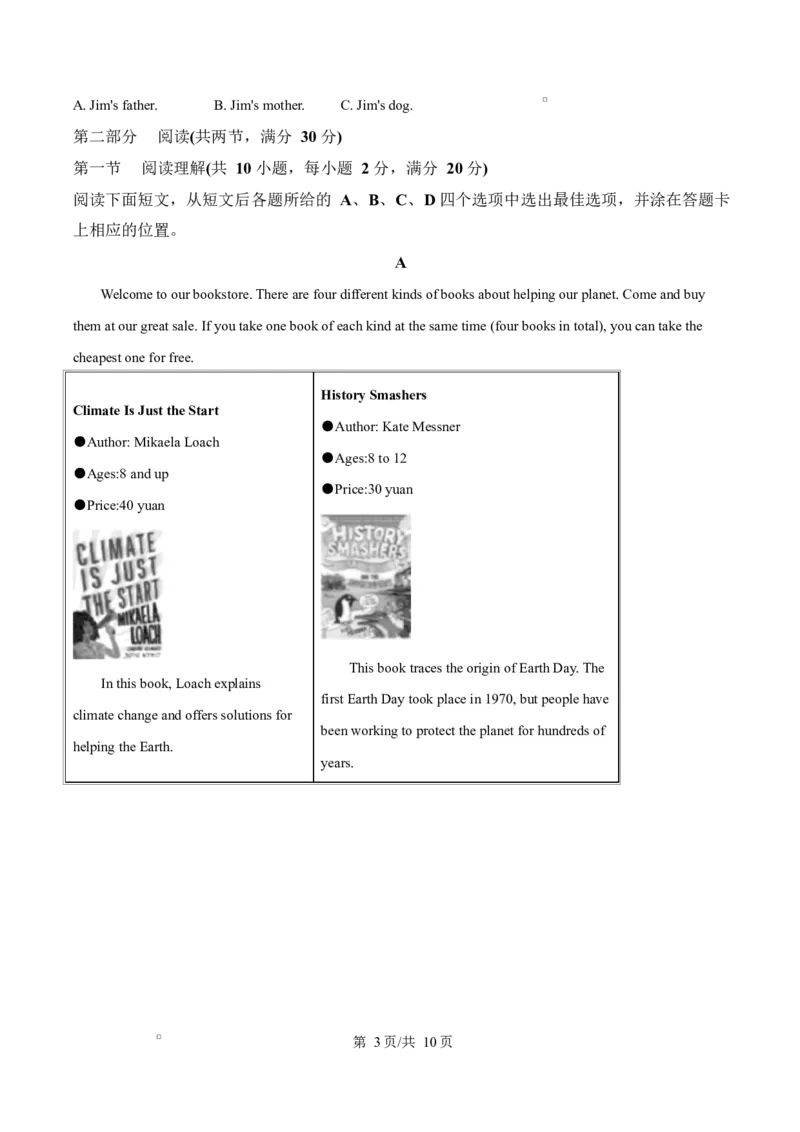
Welcome to our bookstore. There are four different kinds of books about helping our planet. Come and buy
them at our great sale. If you take one book of each kind at the same time (four books in total), you can take the
cheapest one for free.
History Smashers
Climate Is Just the Start
●Author: Kate Messner
●Author: Mikaela Loach
●Ages:8 to 12
●Ages:8 and up
●Price:30 yuan
●Price:40 yuan
This book traces the origin of Earth Day. The
In this book, Loach explains
first Earth Day took place in 1970, but people have
climate change and offers solutions for
been working to protect the planet for hundreds of
helping the Earth.
years.
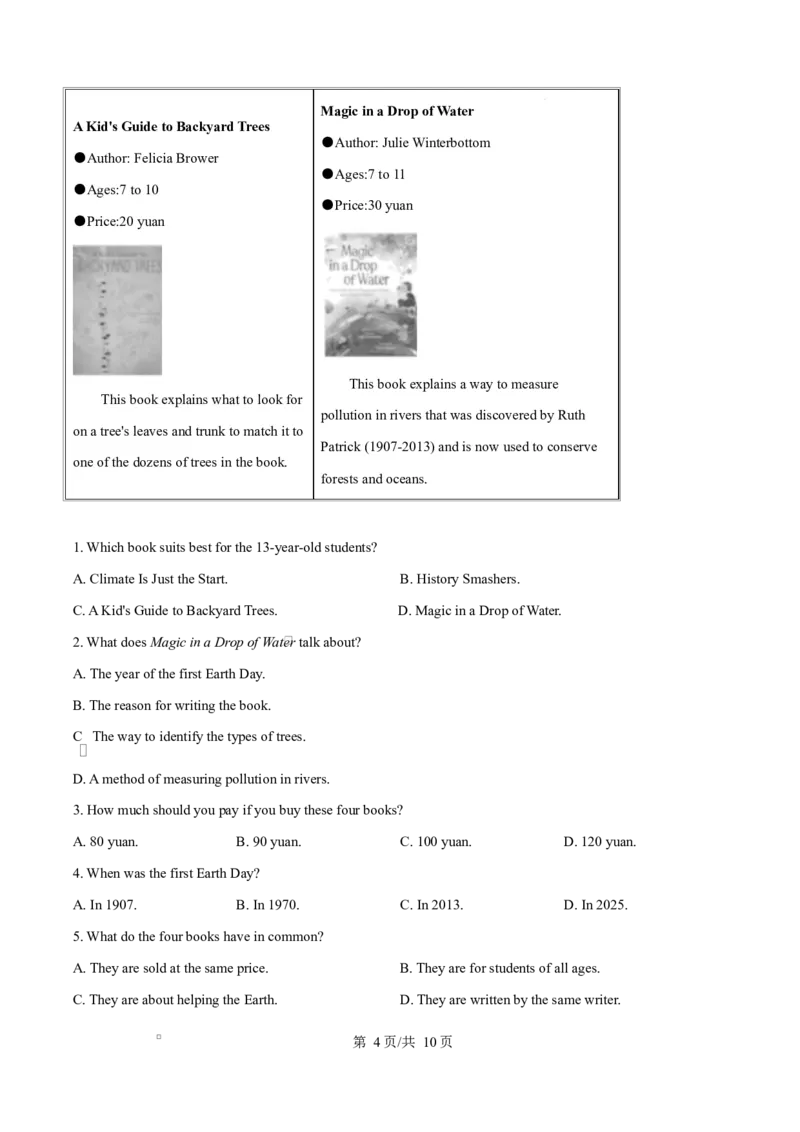
第 3页/共 10页Magic in a Drop of Water
A Kid's Guide to Backyard Trees
●Author: Julie Winterbottom
●Author: Felicia Brower
●Ages:7 to 11
●Ages:7 to 10
●Price:30 yuan
●Price:20 yuan
This book explains a way to measure
This book explains what to look for
pollution in rivers that was discovered by Ruth
on a tree's leaves and trunk to match it to
Patrick (1907-2013) and is now used to conserve
one of the dozens of trees in the book.
forests and oceans.
1. Which book suits best for the 13-year-old students?
A. Climate Is Just the Start. B. History Smashers.
C. A Kid's Guide to Backyard Trees. D. Magic in a Drop of Water.
2. What does Magic in a Drop of Water talk about?
A. The year of the first Earth Day.
B. The reason for writing the book.
C The way to identify the types of trees.
D. A method of measuring pollution in rivers.
3. How much should you pay if you buy these four books?
A. 80 yuan. B. 90 yuan. C. 100 yuan. D. 120 yuan.
4. When was the first Earth Day?
A. In 1907. B. In 1970. C. In 2013. D. In 2025.
5. What do the four books have in common?
A. They are sold at the same price. B. They are for students of all ages.
C. They are about helping the Earth. D. They are written by the same writer.
第 4页/共 10页B
My dad is very interested in the Silk Road. He has told me many things about it. Although it is called the Silk
Road, people traded much more than silk. It went through Asia, the Middle East, North Africa and Europe. It was
6,500 km from Xi’an to Rome and played an important role in the development of the world. Last summer, my
family got away for a holiday and visited some famous places along the original road.
We started at Lanzhou and went on to Wuwei. It was a very important city on the Silk Road. It connected three
main cities in the area and was also a capital in ancient times. Although it is now a modern city, you can get a sense
of history when you visit it. We saw lots of very old stone monuments and people there were very proud of their
city’s long history.
The next stop was Jiayuguan on the edge of the desert. It was a busy city with a lot of people coming and
going. Even today, it is a city that many business people travel through. An important part of the Great Wall was
also built here.
After that we went on to Yumenguan. I first found out about it in the famous poem written by Wang Zhihuan.
It was in the Gobi Desert and was the only connection between Central Asia and China. I wonder how people ever
made it through the hot desert so long ago.
Finally, we arrived in Dunhuang, a city with long history and great artwork. It was influenced by many
different cultures over time. Now, it is a major place of interest in north-west China.
This trip wasn’t just a scenic journey. It helped me understand more about the history of the area and see how
people from different places influenced each other in many ways.
6. Why did the writer’s family travel along the Silk Road last summer?
A. They wanted to visit Xi’an.
B. They live near the Silk Road.
C. The writer’s father likes its history.
D. The writer’s father made him a promise.
7. What do the people in Wuwei think of their city?
A. They take pride in the history of the city.
B. It wasn’t an important city on the Silk Road.
C. It is still the capital city on the Silk Road now.
D. Visitors can enjoy the beauty of the desert there.
第 5页/共 10页8. Where could the writer’s family visit the Great Wall on this journey?
A. In Wuwei. B. In Dunhuang. C. In Jiayuguan. D. In Yumenguan.
9. What can we learn from the passage?
A. Lanzhou is the start of the Silk Road.
B. The Silk Road went from Asia to Europe.
C. Wuwei connected China with Central Asia.
D The writer first knew about Yumenguan on this journey.
10. What did the writer say about his trip?
A. The trip made him feel very disappointed.
B. The scenery was more attractive than the history.
C. He made it through the hot desert on this journey.
D. He had a better understanding of the area’s history.
第二节 补全短文(共 5 小题,每小题 2 分,满分 10 分)
阅读下面短文,从短文后的选项中选出可以填入空白处的最佳选项,并涂在答题卡上相应的位
置。选项中有一项为多余选项。
Talk to People You Disagree with
Everyone occasionally has disagreements with friends or family members. For example, you might not agree
which restaurant makes the best pizza. ___11___ Although disagreements can be uncomfortable, there are some
steps you can take to make conversations go on well.
See their perspective
Even if you don’t agree with someone’s opinions, you can still listen to what they have to say. One way is to
listen without interrupting(打断) them. ___12___ You can start by saying, “OK. I know what you mean. You are
saying...”
Use respectful language
___13___ You can easily get angry especially if it is on a subject you care about a lot. Some people shoot
down others’ opinions by laughing at them or attacking their judgements. Avoid using impolite words, like “stupid”
or “ridiculous.” Instead, focus on speaking calmly.
Stick to the facts
During a conversation, if you are interrupted and doubted, stay calm and ask for a chance to speak your
第 6页/共 10页opinion out. Relax your shoulders and say what you would like to say. ___14___
Find common ground
You may find that you can’t change the other person’s mind, and they may not change yours. ___15___ In the
end, you may gain a better understanding of each other’s opinion.
A. You could also ask to express your own thoughts.
B. You may have different views about certain topics.
C. The solution is looking for points you do agree on.
D. Or you may not agree which university suits you best.
E. You could also ask questions or repeat what they said.
F. And you can make a better case with facts instead of feelings.
第三部分 语言运用(共三节,满分 45 分)
第一节 完形填空(共 15 小题,每小题 1 分,满分 15 分)
阅读下面短文,从短文后各题所给的 A、B、C、D 四个选项中选出能填入空白处的最佳选项,
并涂在答题卡上相应的位置。
Art toys and collections are popular in China today. Handmade dolls ___16___ a long history are popular too.
And Beijing silk figurines (小塑像) are just as attractive as modern toys.
Beijing silk figurines first ___17___ in the Tang Dynasty. Usually, the hands and face of a traditional silk
figurine are made of natural silk.
He Mei is an inheritor (传承人) of the handicraft. When she first saw the figurines at a store in Beijing, she
was so ____18____ that she decided to learn the skills from Qi Congying, a famous Beijing silk figurine ___19___ .
And she went on to ___20___ her company in 2013. Inside her company’s workshop, hundreds of figurines shining
under the bright lights ____21____ visitors.
In Tongzhou District of Beijing, the business now has around fifty ____22____ . Many of them are from
nearby villages. As some of them knew ___23___ about creating figurines before starting their work at the
company, she encouraged them to ___24___ the skills. Today, they are experienced workers who are experts in
___25___ steps, from painting faces to creating the dolls’ clothing.
The company has also hired (聘用) some young designers. They have brought fresh ____26____ into the
company. And they have ____27____ new series such as figurines featuring the 12 Chinese zodiac signs.
She said, “Today, many of our customers are the young people. ___28___ we create tiny dolls depending on
第 7页/共 10页their preferences.” And she ____29____ that they have also produced dolls whose hands and feet can be bent (弯曲)
and clothes can be changed to ____30____ the dolls’ entertainment value.
16. A. for B. to C. with D. during
17. A. invented B. produced C. changed D. appeared
18. A. experienced B. amazed C. disappointed D. relaxed
19. A. artist B. founder C. learner D. inventor
20. A. put up B. get up C. set up D. take up
21. A. surprise B. blind C. awake D. serve
22. A. customers B. users C. visitors D. workers
23 A. something B. anything C. nothing D. everything
24. A. choose B. learn C. collect D. prepare
25. A. similar B. other C. few D. different
26. A. attitudes B. ideas C. problems D. choices
27. A. found B. ordered C. created D. bought
28. A. But B. And C. Because D. So
29. A. replied B. added C. repeated D. asked
30. A. increase B. replace C. repair D. exchange
第二节 短文填空(共 10 小题,每小题 2 分,满分 20 分)
阅读下面短文,在空白处填入 1 个适当的单词,并将答案写到答题卡上相应的位置。
The Dujiangyan Irrigation Project (灌溉工程) ___31___ (lie) in the northwest of Chengdu. It was ___32___
(build) about the year 256 BC to provide water and control the Minjiang River.
Water running in the river from the Mount Minshan often destroyed houses. So ___33___ official in the
Kingdom of Qin named Li Bing decided to build the project in the river to control the flooding. It is said that he
received money for the important project ___34___ King Zhao of Qin and employed tens of thousands of workers.
King Zhao wanted to strengthen (加强) his kingdom.
After its completion, the project prevented the flooding and ___35___ (bring) the Sichuan area rich harvests.
This project greatly made the Qin Kingdom stronger. Within a few decades, a Qin king called Ying Zheng became
the ___36___ (one) emperor of China.
There are some main ___37___ (part) of this irrigation system. The first is a levee (防洪堤) named
第 8页/共 10页Yuzui.___38___ stood in the middle of the river to control the amount of water that entered the two channels (渠
道). The second part is a channel that was cut through a mountain by means of heating the rock ___39___ then
pouring water on it. The narrow opening of the irrigation system controlled the amount of water entering the system.
It is called Baopingkou. It is said that the 20-meter-wide channel required 8 years to finish. The ____40____ (three)
part is a spillway called Feishayan that was dug to discharge water and silt.
第三节 翻译单词—英译汉(共 10 小题,每小题 1 分,满分 10 分)
英译汉
41. conversation n. ________________
42. increase v. ________________
43. review v. ________________
44. active adj. ________________
45. treat v. ________________
46. spread v. ________________
47. relative n. ________________
48. polite adj. ________________
49. address n. ________________
50. request v. ________________
第四部分 书面表达(满分 25 分)
51. 假定你看到某社区发布的“健康生活建议征集启事”,现需给该社区负责人写一封信,分享你关于
“如何保持健康(keep fit)”的建议。
写作要点:
1. 表明写信目的(回应征集,分享健康建议);
2. 从饮食、运动、休息三个方面给出具体建议;
3. 表达希望建议有用的意愿。
注意:
1. 词数 100 左右;
2. 开头和结尾已给出(不计入总词数);
3. 可适当增加细节,使行文连贯。
Dear Sir/Madam,
____________________________________________________________________________________________
第 9页/共 10页____________________________________________________________________________________________
____________________________________________________________________________________________
____________________________________________________________________________________________
_______________________________________________________________________________________
Yours sincerely,
Li Hua
第 10页/共 10页