核心素养专练(二)
A
How do you keep cool during summer? Air conditioning(空调) or electric
fans are good tools in modern society. But before that, people could only use
fans.
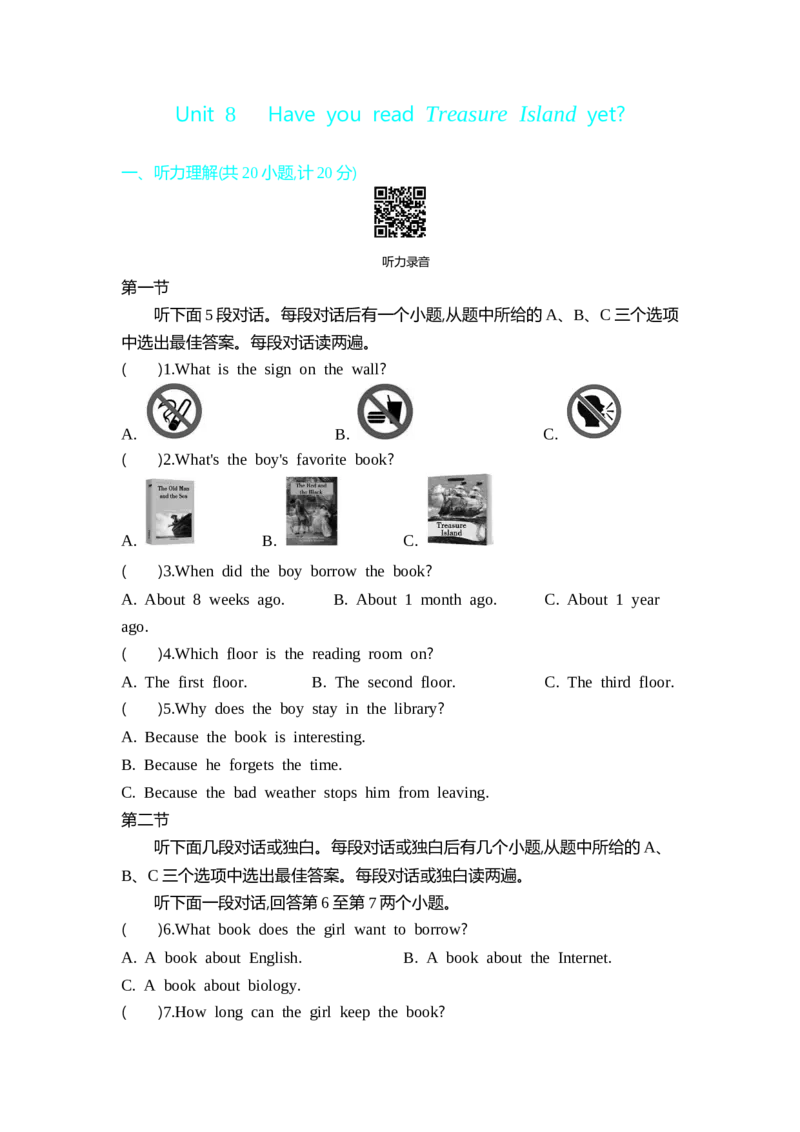
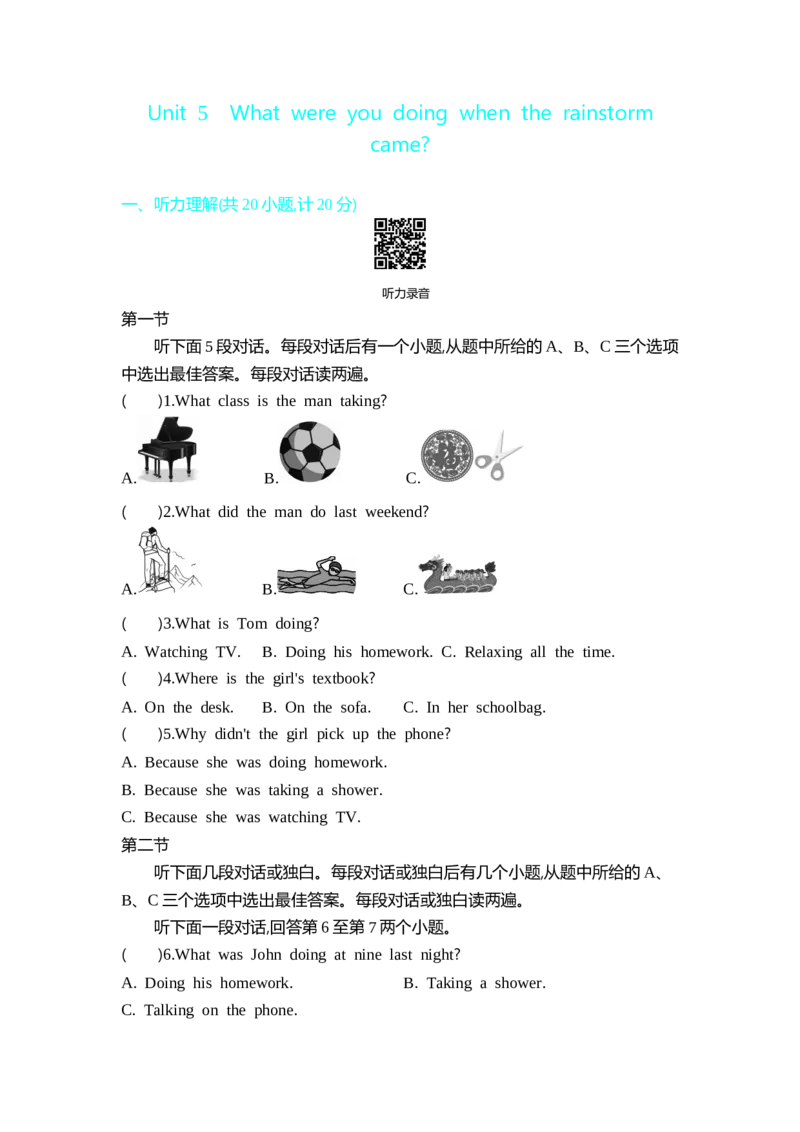
Over 3,000 years ago, fans began to be used. They were made of
feathers(羽毛), bamboo or silk. They came in different shapes, including round
and square.
Later, with the invention of paper, folding(可折叠的) paper fans became
popular during the Song Dynasty. There were usually beautiful pictures on
fans. Some were landscapes(风景). Others were flowers and animals. Moreover,
many great people including Su Dongpo,a poet of the Song Dynasty, and Tang
Yin, a scholar and painter of the Ming Dynasty, once painted their
masterpieces(杰作) on fans. This made fans not only useful tools in daily life
but also great artworks.
Therefore, with their value of beauty, people take fans as a symbol of
status(地位). That's why in ancient China, emperors and scholars often held
fans.
Today, fans are also great collectors' items and gifts. At the opening
ceremony of the Beijing 2008 Olympic Games, folding fans were given to
leaders and officials of other countries, as well as foreign audience. While they
were waving fans to get cool, they were also experiencing Chinese culture.
( )1.[课标新增|图文转换]The first fan was made of the following EXCEPT
before the Song Dynasty.
A. B.C. D.
( )2.What made fans become great artworks?
A. Fans could be folded.
B. The invention of paper.
C. Emperors and scholars used fans.
D. Many great people painted their masterpieces on fans.
( )3.What can we know from the passage?
A. The author is a scholar who often holds fans.
B. Fans are the best gifts for our best friends.
C. Round fans were much cooler than square ones.
D. The author is proud of Chinese culture.
B(2022·安徽中考)
Have you ever seen lions dancing in the streets? The lions dance to the
beat of a drum(鼓). Of course, they are not real lions. They are dancers in
lion costumes(服饰). Lion dancing first started in China centuries ago. It is
meant to bring good luck in the coming year.
Usually, a lion is made up of two dancers. One dancer controls the head.
The other controls the tail.
"I think of it as a sport," says Anthony Huang, aged 16. He is a member
of the New York Chinese Freemasons Athletic Club. Anthony performs(表演)
as the lion's head. It can weigh 20 pounds. Lion dancing is important to
Anthony. "This tradition really lifts me up," he says.
In the past, lion dancing was performed mostly by men. But it is different
today. LionDanceMe is a lion dancing group in San Francisco, California.
There are boys and girls on its team. They dance together.
"Anyone can take up lion dancing. You have to believe that you can do
it," says Ananda Tang-Lee, a 17-year-old girl.
Lion dancing will continue to evolve, but a team's sense of community
will never change. "We call it a family," Ananda says. "It's really great,
because we always have each other's backs."( )4.Why do people perform lion dancing?
A. To sell lion-dancing costumes.
B. To wish for a lucky new year.
C. To protect the lions in the wild.
D. To show skills of playing the drum.
( )5.Which role does Anthony play in lion dancing?
A. The lion's head. B. The lion's tail.
C. The drummer. D. The dresser.
( )6.What does the underlined word "evolve" mean in Chinese?
A. 延期 B. 模仿
C. 举办 D. 演变
( )7.What can we infer(推断) from Ananda's words "We call it a family"?
A. They bring happiness to the family.
B. They call lion dancing a family game.
C. They live together in a big family.
D. They support each other like a family.
C
Are you hoping to blend in like locals on your next visit to Thailand?
Here are three traditions only locals in Thailand can understand. They will
help you fit right in.
Different days, different colors
In Thailand, green is usually worn on Wednesdays. Visitors to the country
may notice that Thai people seem to wear the same color. This is because
each day of the week is assigned a color. Monday is for yellow. Tuesday is
for pink. Wednesday is for green, and so on. Not all Thais follow this dress
code, but some of them do, especially those who work for the government.
Greeting with Wai
Those visitors to Thailand who reach their hand out to shake with a
stranger's hand in greeting will be met with strange looks. The Wai is
considered a common greeting in Thailand. A person puts their hands together
and drops their shoulders for their nose to touch their hands. It looks like a
bow. The higher the hands go on someone's face, the more respectful the
greeting is.
Take your shoes offIn Thailand, people's feet are considered the most disrespectful part of the
body. This is why visitors will find that at many places, from restaurants to
homes, Thai people remove their shoes before entering. Be sure to follow the
locals, and whatever you do, do not point your feet in the direction of
someone else. It is considered very impolite. Besides, the head is considered
the most sacred part of a person's body, so do not touch anyone's head unless
you are allowed to do that.
( )8.Which is NOT the tradition that local Thais follow?
A. Take off the shoes.
B. Touch others' head.
C. Greet others with Wai.
D. Wear clothes in different colors on different days.
( )9.Which color is probably worn in Thailand on Thursday?
A. Pink. B. Yellow.
C. Green. D. Orange.
( )10.What's the best title of the passage?
A. Do as the "Thais" Do B. What Visitors Do in Thailand
C. Three Traditions in Thailand D. Three Interesting Places in Thailand
( )11.In which part of a magazine can we read the passage?
A. Culture. B. Language.
C. Sports. D. Health.
D(2022·江苏盐城中学模拟改编)
①A Farewell(送别) Song
Wang Wei
No dust is raised on the road wet with morning ▲ ,
The willows by the hotel look so fresh and green.
I invite you to drink a cup of wine again,
West of the sunny pass no more friends will be seen.
(Translated by Xu Yuanchong)②With the temperature rising, spring is a good time to go out and travel
far away. Tang Dynasty poet Wang Wei says goodbye to his friend in this
season. The poem A Farewell Song describes his experience.
③On a spring morning, Wang has to say goodbye to his friend —Yuan
Er who would leave for a faraway place called Anxi. Wang hopes that his
friend Yuan will safely return from Anxi, although he knows that they might
not see each other again. Even with this knowledge, the poet is not willing to
show much sadness for Yuan's departure(离开). Instead, he wants to take the
time to treasure(珍惜) their friendship and invites Yuan to drink a cup of
wine. In the poem, Wang uses the skill of exchanging(转换) roles. On the
surface, the poet says goodbye to his friend. But the fact is that the two likely
have no chance to see each other again. So it is that Yuan says goodbye to
the poet as well.
④Wang Wei is considered one of the greatest poets of the Tang Dynasty,
along with Du Fu and Li Bai. Of the three, Wang Wei was the only one who
had a successful career in the bureaucracy(官场). When he was free, he spent
much time in the countryside thinking about nature. Wang is best known for
describing quiet scenes(场景) of water and mist, with few details and little
human presence. He has been praised for "putting painting into his poetry and
poetry into his painting".
( )12.[中考创新考法|词句回填题]Which word can be put in ▲ ?
A. fog B. wind
C. rain D. sun
( )13.In A Farewell Song, which sentences point out the place and the time
of farewell?
A. The second and third sentences.
B. The second and fourth sentences.
C. The first and second sentences.
D. The third and fourth sentences.
( )14.What can we learn about Wang Wei according to the passage?
A. He didn't feel very sad about Yuan's departure.B. He was a great success only in poetry.
C. He is best known for describing humans with rich details.
D. He enjoyed writing poems and painting at the same time.
( )15.[中考创新考法|篇章结构题]What's the structure of the passage?
A. B. C. D.
核心素养专练(二)
【A篇短文大意】 本文介绍了中国各种各样的扇子,它们不仅是人们用来
保持凉爽的工具,还代表了中国悠久的历史和丰富的文化。1.B 图文转换题。根据"Over 3,000 years ago, fans began to be used. They
were made of feathers(羽毛), bamboo or silk"和"Later, with the invention of
paper, folding(可折叠的) paper fans became popular during the Song
Dynasty"可知,3 000多年前,羽毛、竹子和丝绸是制作扇子的主要材料,到了宋朝,
纸扇受到了欢迎,故选B。
2.D 细节理解题。根据文中的"many great people ... painted their
masterpieces(杰作) on fans.This made fans not only useful tools in daily life
but also great artworks"可知选D。
3.D 推理判断题。通读全文,尤其是"While they were waving fans to get cool,
they were also experiencing Chinese culture"可知,扇子不仅是人们用来保持凉爽
的工具,也代表中国悠久的历史和丰富的文化。由此可推知,作者为中国文化感到
自豪,故选D。
【B篇短文大意】 本文介绍了中国传统习俗"舞狮"的相关内容。
4.B 细节理解题。根据第一段的最后一句"It is meant to bring good luck in
the coming year"可知,人们表演舞狮是希望来年有好运气,故选B。
5.A 细节理解题。根据第三段中的"Anthony performs(表演) as the lion's
head"可知,Anthony在舞狮中的角色是狮子的头部,故选A。
6.D 词义猜测题。根据画线词前的"will continue to"以及画线词后的"but a
team's sense of community will never change"可知,画线词与change含义相近;
再结合第四段中的"In the past, lion dance...But it is different today"可推知,画
线词的意思是"演变",故选D。
7.D 推理判断题。根据上文中的"but a team's sense of community will never
change"以及下文中的"because we always have each other's backs"可知,他们像
家人一样互相支持,故选D。
【C篇短文大意】 本文主要介绍了泰国的三种传统。
8.B 细节理解题。根据"Besides, the head is considered the most sacred part
of a person's body, so do not touch anyone's head unless you are allowed to
do that"可知,在泰国,头被认为是一个人身体最神圣的部分,所以除非你被允许,否
则不要触摸任何人的头,故选B。
9.D 推理判断题。根据"Monday is for yellow. Tuesday is for pink.
Wednesday is for green, and so on"可知,星期一是黄色,星期二是粉色,星期三是
绿色,结合选项,星期四大概是橙色,故选D。
10.C 标题归纳题。本文主要向我们介绍了泰国的三种传统,故选C。
11.A 推理判断题。本文主要介绍了泰国的三种传统,故最有可能在杂志的文化
版块读到本篇文章。
【D篇短文大意】 本文主要介绍了王维和他的诗《送元二使安西》。
12.C 推理判断题。根据"No dust is raised on the road wet"可知,路上湿了,应
是早晨的雨把路面弄湿的,故选C。
13.C 细节理解题。诗中第一句"morning"指出了时间,第二句"by the hotel"指出
了地点,故选C。
14.D 细节理解题。根据"He has been praised for ‘putting painting into his
poetry and poetry into his painting'"可知,王维喜欢写诗,也喜欢绘画。
15.B 篇章结构题。本文第一段引出古诗《送元二使安西》;第二、三段介绍古
诗的背景和含义;第四段介绍诗人王维,故选B。