绝密★考试结束前
【赢在中考·黄金八卷】备战2023年中考英语全真模拟卷(湖南长沙专
用)
第一卷
(全卷分为四部分,75小题,时量120分钟,满分120分)
第一部分 听力技能(两部分,共20小题,计20分)
第一节 听下面5段对话。每段对话后有一个小题。从题中所给的A、B、C三个选项中选出最佳选项回答
问题。听每段对话前,你将有时间阅读各个小题,每小题5秒钟;听完后,各小题将给出5秒钟的作答时
间。(共5小题,计5分)
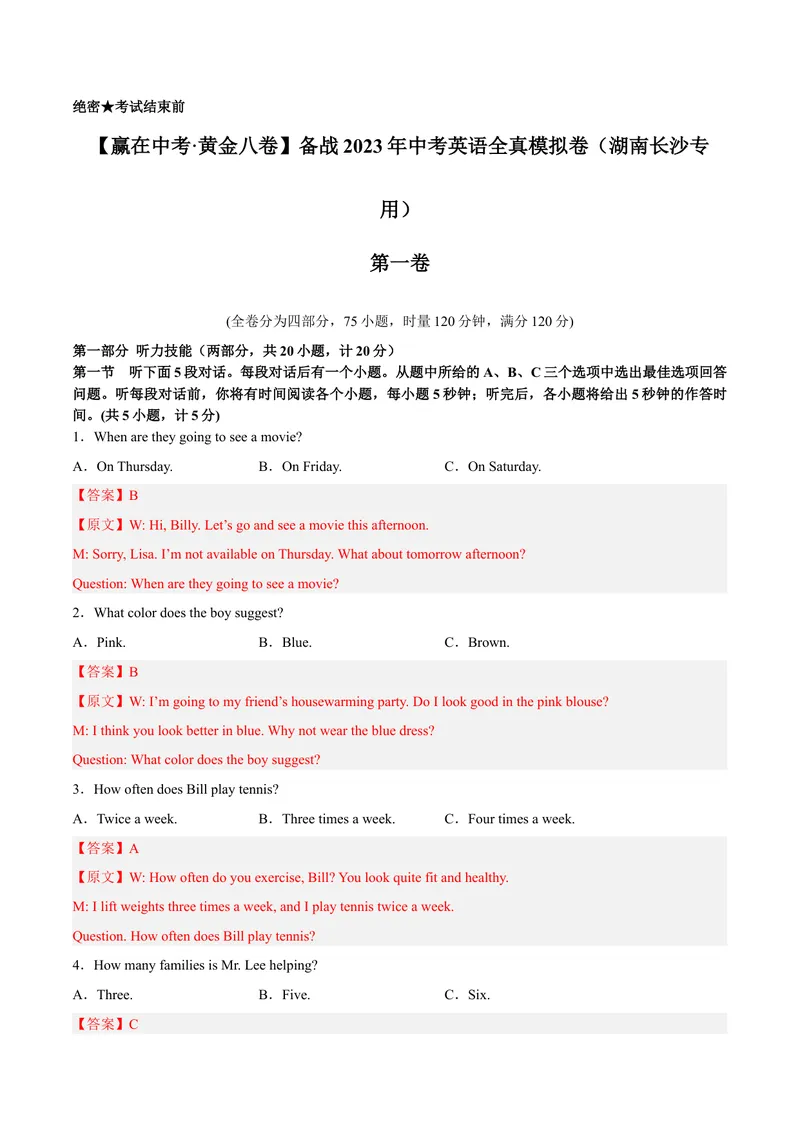
1.When are they going to see a movie?
A.On Thursday. B.On Friday. C.On Saturday.
【答案】B
【原文】W: Hi, Billy. Let’s go and see a movie this afternoon.
M: Sorry, Lisa. I’m not available on Thursday. What about tomorrow afternoon?
Question: When are they going to see a movie?
2.What color does the boy suggest?
A.Pink. B.Blue. C.Brown.
【答案】B
【原文】W: I’m going to my friend’s housewarming party. Do I look good in the pink blouse?
M: I think you look better in blue. Why not wear the blue dress?
Question: What color does the boy suggest?
3.How often does Bill play tennis?
A.Twice a week. B.Three times a week. C.Four times a week.
【答案】A
【原文】W: How often do you exercise, Bill? You look quite fit and healthy.
M: I lift weights three times a week, and I play tennis twice a week.
Question. How often does Bill play tennis?
4.How many families is Mr. Lee helping?
A.Three. B.Five. C.Six.
【答案】C【详解】W: You’re helping several families in poor areas, aren’t you, Mr. Lee?
M: Yes. Two families in Anhui, three in Yunan and one in my neighborhood.
Question: How many families is Mr. Lee helping?
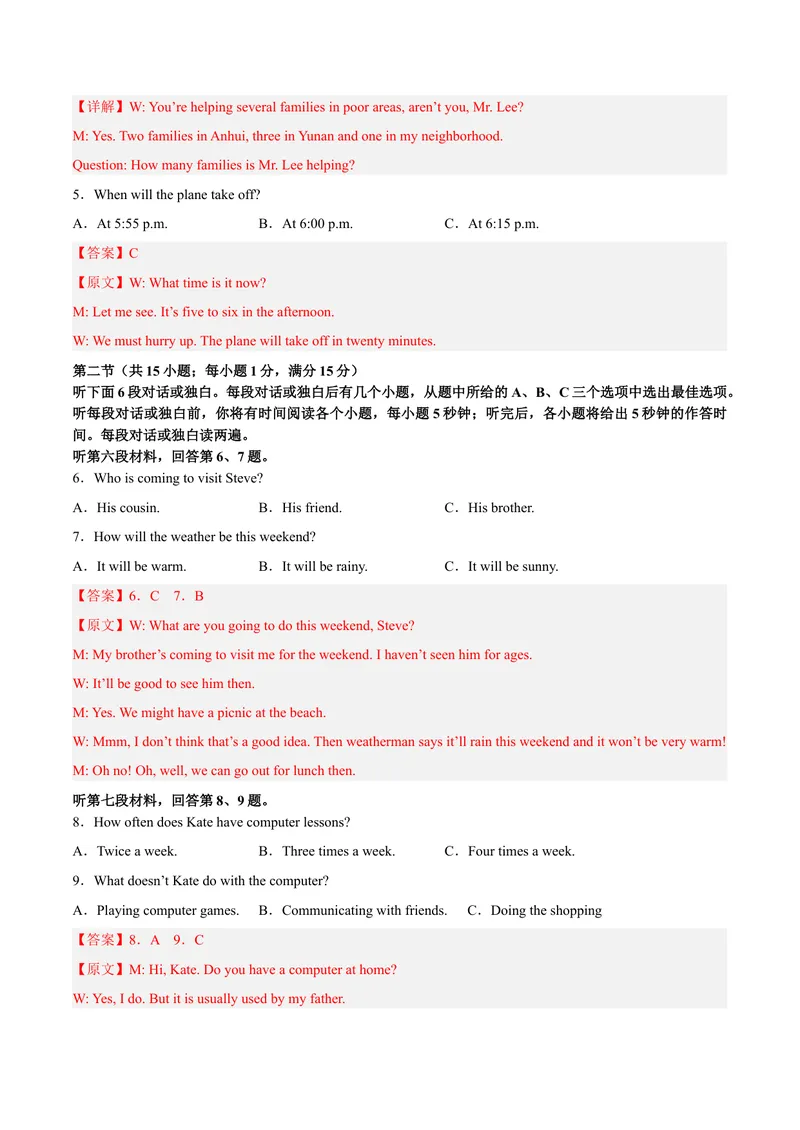
5.When will the plane take off?
A.At 5:55 p.m. B.At 6:00 p.m. C.At 6:15 p.m.
【答案】C
【原文】W: What time is it now?
M: Let me see. It’s five to six in the afternoon.
W: We must hurry up. The plane will take off in twenty minutes.
第二节(共15小题;每小题1分,满分15分)
听下面6段对话或独白。每段对话或独白后有几个小题,从题中所给的A、B、C三个选项中选出最佳选项。
听每段对话或独白前,你将有时间阅读各个小题,每小题5秒钟;听完后,各小题将给出5秒钟的作答时
间。每段对话或独白读两遍。
听第六段材料,回答第6、7题。
6.Who is coming to visit Steve?
A.His cousin. B.His friend. C.His brother.
7.How will the weather be this weekend?
A.It will be warm. B.It will be rainy. C.It will be sunny.
【答案】6.C 7.B
【原文】W: What are you going to do this weekend, Steve?
M: My brother’s coming to visit me for the weekend. I haven’t seen him for ages.
W: It’ll be good to see him then.
M: Yes. We might have a picnic at the beach.
W: Mmm, I don’t think that’s a good idea. Then weatherman says it’ll rain this weekend and it won’t be very warm!
M: Oh no! Oh, well, we can go out for lunch then.
听第七段材料,回答第8、9题。
8.How often does Kate have computer lessons?
A.Twice a week. B.Three times a week. C.Four times a week.
9.What doesn’t Kate do with the computer?
A.Playing computer games. B.Communicating with friends. C.Doing the shopping
【答案】8.A 9.C
【原文】M: Hi, Kate. Do you have a computer at home?
W: Yes, I do. But it is usually used by my father.M: Do you have computer lessons at school?
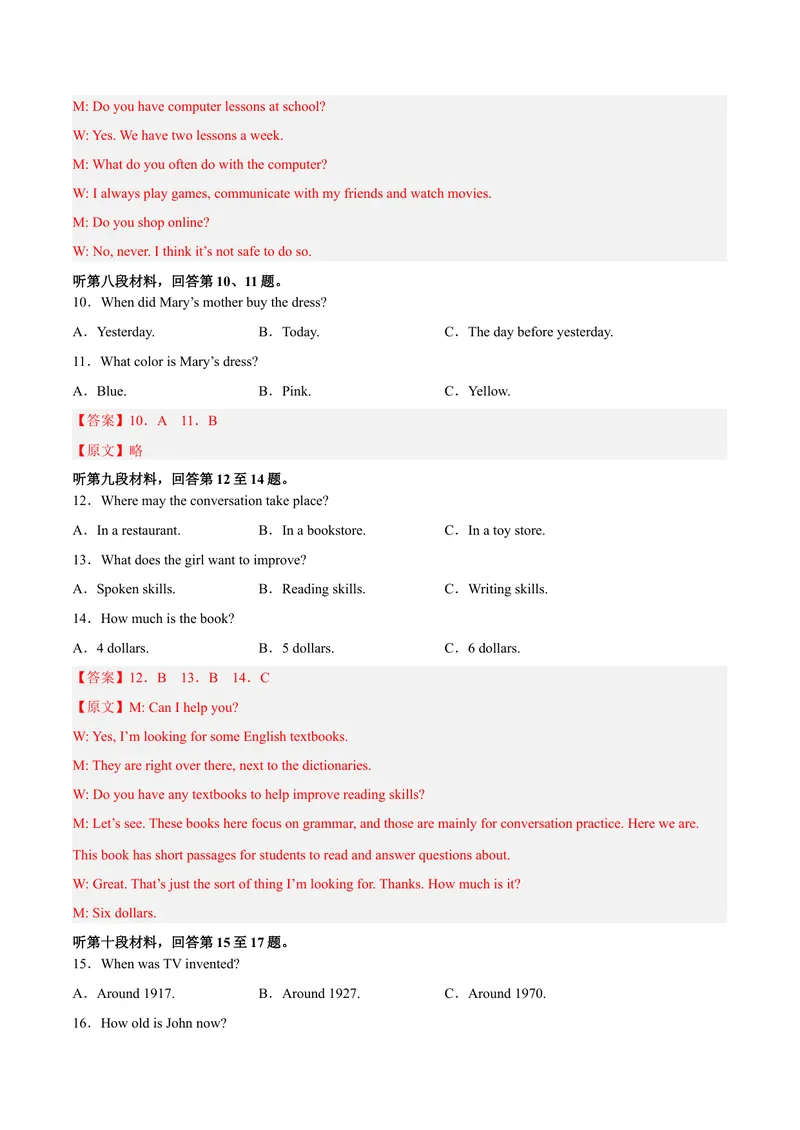
W: Yes. We have two lessons a week.
M: What do you often do with the computer?
W: I always play games, communicate with my friends and watch movies.
M: Do you shop online?
W: No, never. I think it’s not safe to do so.
听第八段材料,回答第10、11题。
10.When did Mary’s mother buy the dress?
A.Yesterday. B.Today. C.The day before yesterday.
11.What color is Mary’s dress?
A.Blue. B.Pink. C.Yellow.
【答案】10.A 11.B
【原文】略
听第九段材料,回答第12至14题。
12.Where may the conversation take place?
A.In a restaurant. B.In a bookstore. C.In a toy store.
13.What does the girl want to improve?
A.Spoken skills. B.Reading skills. C.Writing skills.
14.How much is the book?
A.4 dollars. B.5 dollars. C.6 dollars.
【答案】12.B 13.B 14.C
【原文】M: Can I help you?
W: Yes, I’m looking for some English textbooks.
M: They are right over there, next to the dictionaries.
W: Do you have any textbooks to help improve reading skills?
M: Let’s see. These books here focus on grammar, and those are mainly for conversation practice. Here we are.
This book has short passages for students to read and answer questions about.
W: Great. That’s just the sort of thing I’m looking for. Thanks. How much is it?
M: Six dollars.
听第十段材料,回答第15至17题。
15.When was TV invented?
A.Around 1917. B.Around 1927. C.Around 1970.
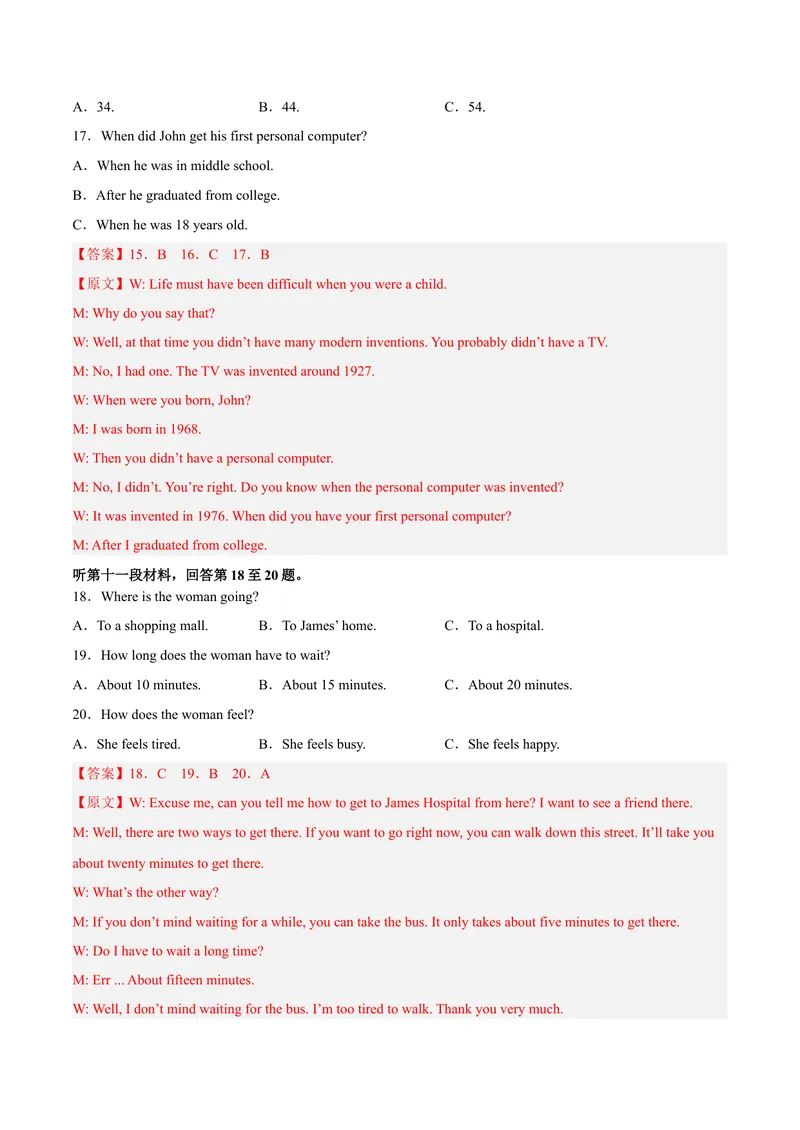
16.How old is John now?A.34. B.44. C.54.
17.When did John get his first personal computer?
A.When he was in middle school.
B.After he graduated from college.
C.When he was 18 years old.
【答案】15.B 16.C 17.B
【原文】W: Life must have been difficult when you were a child.
M: Why do you say that?
W: Well, at that time you didn’t have many modern inventions. You probably didn’t have a TV.
M: No, I had one. The TV was invented around 1927.
W: When were you born, John?
M: I was born in 1968.
W: Then you didn’t have a personal computer.
M: No, I didn’t. You’re right. Do you know when the personal computer was invented?
W: It was invented in 1976. When did you have your first personal computer?
M: After I graduated from college.
听第十一段材料,回答第18至20题。
18.Where is the woman going?
A.To a shopping mall. B.To James’ home. C.To a hospital.
19.How long does the woman have to wait?
A.About 10 minutes. B.About 15 minutes. C.About 20 minutes.
20.How does the woman feel?
A.She feels tired. B.She feels busy. C.She feels happy.
【答案】18.C 19.B 20.A
【原文】W: Excuse me, can you tell me how to get to James Hospital from here? I want to see a friend there.
M: Well, there are two ways to get there. If you want to go right now, you can walk down this street. It’ll take you
about twenty minutes to get there.
W: What’s the other way?
M: If you don’t mind waiting for a while, you can take the bus. It only takes about five minutes to get there.
W: Do I have to wait a long time?
M: Err ... About fifteen minutes.
W: Well, I don’t mind waiting for the bus. I’m too tired to walk. Thank you very much.M: You’re welcome.
第二部分 阅读(共三节,满分50分)
第一节(共15小题:每小题2分,满分30分)
阅读下列材料,从每题所给的A、B、C三个选项中,选出最佳选项。
A
Air
Plants take in carbon dioxide (二氧化碳) and make oxygen (氧
气) humans and animals need. Plants make 98% of the oxygen we
breathe.
Plants help clean water and reduce (减少) floods. An evergreen
Water
tree can hold more than 15,000 liters (公升) of water per year,
reducing the risk of flooding.
A 2015 study showed that indoor plants can reduce stress. Plants
Health
can also help you stay focused and work efficiently (有效率地).
The world’s food supply depends on about 150 plant species. Just
Food
12 kinds of plant provide three-quarters of the world’s food.
Climate
Plants balance our climate. They help take carbon dioxide out of
the air, which can slow down global warming.
21.12 kinds of plants provide ________ of the world’s food.
A.35% B.75% C.98%
22.According to the reading, plants can help to ________.
A.increase the happening of floods
B.take the carbon dioxide into the air
C.make you concentrate on your work better
【答案】21.B 22.C
【导语】本文介绍了植物在很多方面都有重要的作用。
21.细节理解题。根据“Just 12 kinds of plant provide three-quarters of the world’s food.”可知,12种植物提
供了世界75%的食物。故选B。22.细节理解题。根据“Health:Plants can also help you stay focused and work efficiently (有效率地).”可知,
植物可以帮助你更好地集中精力工作。故选C。
B
Home Education Zoo ALIVE Teen Volunteers
Love animals and kids? Want to help protect animals and the natural world?
Have some time to give? Then enroll in(加入) the interesting program for teenagers in Saint Louis, Zoo ALIVE,
and become a volunteer.
Help the zoo workers plan weekend activities for children.
Encourage the zoo visitors to take part in educational activities.
Go on camping trips to explore(探索) nature and wildlife.
Help with the zoo’s activities and plan your own project.
Learn about the zoo, its animals, etc.
Attend a monthly meeting.
(Usually held from 5 pm to 7:30 pm on the first Sunday of each month)
At the meeting, volunteers
● receive training and learn about events and happenings at the zoo;
● give speeches about environmental subjects;
● get to know other volunteers.
Give us a call at 646-467X. We are happy to share more information with you!
23.Volunteers for Zoo ALIVE will plan _______ for children.
A.camping trips B.weekend activities C.educational movies
24.What do we know about the meeting?
A.Volunteers get training at the meeting.
B.All the zoo workers must attend it.
C.It is held every Sunday afternoon.
25.What’s the purpose of the reading?
A.To give information about a zoo.
B.To tell the importance of volunteers.
C.To introduce an interesting program.【答案】23.B 24.A 25.C
【导语】本文主要介绍了一个有趣的项目,并邀请你成为一名志愿者。
23.细节理解题。根据“Help the zoo workers plan weekend activities for children.”可知Zoo ALIVE的志愿者
将为孩子们策划周末活动。故选B。
24.细节理解题。根据“● receive training and learn about events and happenings at the zoo”可知志愿者在会
上接受培训。故选A。
25.推理判断题。根据“Love animals and kids? Want to help protect animals and the natural world? Have some
time to give? Then enroll in(加入) the interesting program for teenagers in Saint Louis, Zoo ALIVE, and become a
volunteer.”(喜欢动物和孩子?想要帮助保护动物和自然世界?有时间给予吗?然后报名参加圣路易斯的有
趣的青少年项目Zoo ALIVE,成为一名志愿者。)可知本文主要是为了介绍一个有趣的项目,故选C。
C
In a small village there was a middle-aged postman, who just turned 20 years old and started delivering (投递)
all kinds of happy or sad stories to each home day after day for 50 kilometers. 20 years flew by, and so many
changes took place, but the road from the post office to the village always hadn’t had any tree and nothing but the
flying dust (尘土) could be seen.
“How long shall I go along this lonely road?”
As soon as he thought he had to spend his life riding the bike on the dusty road with no flower or tree, he felt
somewhat sorry.
One day when he finished delivering the letters and was ready to return, he happened to pass by a flower shop.
“Right, that’s it!” He walked into the shop, bought a handful of wild flower seeds (种子) and from the next day on
put these seeds along the roadside. Thus, after one day, two days, one month, two months...he always kept putting
the wild flower seeds along the roadside.
Before long, on the lonely road, where he had come and gone for 20 years, grew up a lot of little flowers, in all
seasons endlessly.
For the villagers, the flowers were more enjoyable than any mail the postman delivered in all his life.
On the road without dust but full of petals (花瓣), the postman rode his bike, losing himself in the sweet smell
and not feeling lonely and anxious any more.
26.How old was the postman when he started his job?
A.Thirty years old. B.Twenty years old. C.Forty years old.
27.What was the road like before?
A.Covered with flowers. B.Covered with trees. C.Full of flying dust.28.What did the postman buy at the flower shop?
A.Wild flowers. B.Bikes. C.Wild flower seeds.
29.According to the passage, which of the following is TRUE?
A.The villagers showed no interest in the flowers.
B.The postman enjoyed the road full of flowers.
C.The villagers helped buy the flower seeds.
30.What does the writer want to express in this passage?
A.Little things make a big difference.
B.Failure is the mother of success.
C.Practice makes perfect.
【答案】26.B 27.C 28.C 29.B 30.A
【导语】本文是一篇记叙文,讲述了一个邮递员在自己20年来每日上班必经的路上种花的故事。
26.细节理解题。根据“In a small village there was a middle-aged postman, who just turned 20 years old and
started delivering (投递) all kinds of happy or sad stories to each home day after day for 50 kilometers.”可知,邮
递员刚开始工作的时候是差不多20岁。故选B。
27.细节理解题。根据“but the road from the post office to the village always hadn’t had any tree and nothing
but the flying dust (尘土) could be seen.”可知,路上没有树,尘土飞扬。故选C。
28.细节理解题。根据“He walked into the shop, bought a handful of wild flower seeds (种子)”可知,邮递员
在花店买了野花种子。故选C。
29.推理判断题。根据“On the road without dust but full of petals (花瓣), the postman rode his bike, losing
himself in the sweet smell and not feeling lonely and anxious any more.(在没有尘土却满是花瓣的路上,邮递
员骑着自行车,沉浸在香甜的气味中,不再感到孤独和焦虑)”可知,邮递员在鲜花盛开的路上尽情享受。
故选B。
30.主旨大意题。根据“For the villagers, the flowers were more enjoyable than any mail the postman delivered
in all his life.”以及通读全文可知,邮递员随手撒下野花种子这个小小的举动,给村民们带来了无比的愉悦,
即小小的事情会带来很大的影响。故选A。
D
Tony and George were painting freely. Each of them had a bottle of blue paint (油漆) and a bottle of yellow
paint.
Suddenly, George said, “Look, Tony, I made green!”
“How did you do it?” asked Tony.“I put yellow paint on top of my blue paint— yellow and blue put together make green!” shouted George.
Other children came around to watch and wanted to do it themselves.
This is an example of discovery learning or hands-on learning.
People remember things better when they learn them by doing. Here is an example. How will you learn to play
football?
Buy a book and read about how to play football or buy a video about football? Or go to the playground and
ask a person to teach you?
Which way will help you learn the game best? Learning on the playground is the best way for most people
because they try the game and learn the rules as they play. They learn in a hands-on way.
Hands-on learning is good for children. The learner takes an active part in it instead of just sitting and
listening. This is the way that we want our children to learn. In order to learn best, children must take an active part
in hands-on activities every day. Some good examples of hands-on activities are working out puzzled, painting,
playing simple board games together and so on.
31.Gorge was _________ when he noticed the change of colors.
A.angry B.disappointed C.excited
32.The other children came up to George in order to _________
A.get another two bottles of paint B.watch and want to have a try C.find out what happened to Tony
33.“Hands-on learning” is probably a kind of _________
A.learning method B.learning result C.learning plan
34.If you want to learn to swim, you’d better _________ according to the passage.
A.read a book about swimming
B.think about it by yourself at home
C.learn from someone in a swimming pool
35.What’s the main idea of the passage?
A.We can play football in many different ways.
B.Hands-on learning can help learn something new better.
C.person should learn how to find out the fact.
【答案】31.C 32.B 33.A 34.C 35.B
【导语】本文通过举托尼和乔治上美术课的例子,引出实践学习,并举例介绍实践学习的好处。
31.推理判断题。根据“‘I put yellow paint on top of my blue paint— yellow and blue put together make
green!’ shouted George”可知,乔治调出绿色,激动的给托尼介绍过程,由此推断,他非常兴奋。故选C。32.细节理解题。根据“Other children came around to watch and wanted to do it themselves.”可知,其他孩子
过来观看,想自己动手。故选B。
33.推理判断题。根据“This is an example of discovery learning or hands-on learning.”以及上文托尼和乔治
的例子可推断,“Hands-on learning”是一种学习方法。故选A。
34.推理判断题。根据“Which way will help you learn the game best? Learning on the playground is the best
way for most people because they try the game and learn the rules as they play. They learn in a hands-on way.”可知,
文章介绍了去球场学习踢球是最好的方法,由此可知,去泳池学游泳是最好的方法。故选C。
35.主旨大意题。根据“Hands—on learning is good for children. The learner takes an active part in it instead of
just sitting and listening. This is the way that we want our children to learn.”和全文内容可知,本文主要是想说
实践学习能帮助人们更好地学习新东西。故选B。
第二节 (共5小题;每小题2分,满分10分)
阅读下面短文内容,从短文后的选项中选出能填入空白处的最佳选项。每个选项仅使用一次
All primary and secondary school students in China will, in principle, be forbidden from bringing mobile
phones to school, the Ministry of Education announced in February, 2021. ___36___ It has sparked heated
argument among parents.
When Dai Hanyang was in middle school, his head teacher brought a hammer to school to enforce a cellphone
ban (禁令). “___37___” Dai said. The 17-year-old, now a high school student in Changsha, Hunan province, said
his school does not allow students to bring cellphones to campus and he never does. “I am not good at self-
discipline and I could not help but check WeChat messages or moments, so not having my cellphone with me helps
me focus on studying,” he said.
“Teachers will confiscate (没收) students’ mobile phones if they are caught playing with them during class and
they are only returned after the semester ends,” he said. Parents will now need to hand in a written application (申
请) if their child needs to bring a mobile phone to school, the ministry said in a notice issued in February.
___38___ No cellphones will be allowed in classrooms, the notice said. Schools should not assign or ask students
to do homework via cellphones and they should set up public phones and teacher hotlines for communication
between parents and students, it added.
Zhang Hengzhu, the principal of Nanjing No. 9 Middle School in Jiangsu’s provincial capital, said the misuse
of mobile phones is harmful to us. ___39___
Liu Changhai, a professor of education at Huazhong University of Science and Technology in Wuhan, Hubei
province, said some parents have used cellphones as “free nannies” during summer and winter vacations and have
not limited the time their children can spend using them. ___40___从选项中选择恰当的句子补全短文,使文章内容完整、通顺。
A.It can bring a series of health problems, including memory loss, sleep disorder and deteriorating eyesight.
B.In such cases, the student should hand the cellphone to the school for custody (保管) during school time, it
added.
C.Seeing him using it to break a classmate’s mobile phone really let us know that he meant business.
D.The new measure, aimed at protecting students’ eyesight, making sure they focus on study and preventing them
from becoming crazy about the internet and online games.
E.They should set out rules about when and how long their children can use mobile phones and prevent them
from overusing them.
【答案】36.D 37.C 38.B 39.A 40.E
【导语】本文主要介绍了教育部关于禁止学生携带手机进学校的有关规定,以及由此引发的多方讨论。
36.由前句“All primary and secondary school students in China will, in principle, be forbidden from bringing
mobile phones to school, the Ministry of Education announced in February, 2021.”可知,此句与教育部关于禁止
学生携带手机进学校有关,D项“这项新措施旨在保护学生的视力,确保他们专注于学习,防止他们沉迷
于网络和网络游戏。”符合语境,故选D。
37.由前句“When Dai Hanyang was in middle school, his head teacher brought a hammer to school to enforce a
cellphone ban (禁令). ”可知,此句与用锤子砸手机有关,C项“看到他用它砸坏同学的手机,我们真的知道
他是认真的”符合语境,故选C。
38.前句“Parents will now need to hand in a written application if their child needs to bring a mobile phone to
school, the ministry said in a notice issued in February”谈到了教育部的通知,此句内容与这个通知有关,B项
“在这种情况下,学生应在上学期间将手机交给学校保管,通知补充说”符合语境,故选B。
39.由前句“...said the misuse of mobile phones is harmful to us”可知,此句与错误使用手机的危害有关,A
项“它会带来一系列的健康问题,包括记忆力减退、睡眠障碍和视力下降”符合语境,故选A。
40.前句“...said some parents have used cellphones as ‘free nannies’ during summer and winter vacations and
have not limited the time their children can spend using them”可知,此句与如何正确使用手机有关,E项“他
们应该制定规则,规定孩子什么时候可以使用手机,使用多长时间,防止他们过度使用手机”符合语境,
故选E。
第三节 (共5小题;每小题2分,满分10分)
阅读下面的短文,根据短文内容回答问题。
This past fall was really unforgettable for me. I was at a neighborhood pool party on a Friday afternoon. I live
in Texas so it was warm—even in October. My friend and I went outside to look for a pair of swimming glasses andsaw someone at the bottom of the pool. We thought it was one of our friends playing, but we quickly realized that it
was a little boy who didn’t know how to swim. I knew something was wrong right away.
We looked around, but the adults were talking far away in the backyard and there was no time to spare. I
jumped into the pool and came close to the little boy. I swam as hard as I could and pulled the little boy onto a step
in the pool. As soon as I got him out of the water, my friend and I started shouting for help. When the adults heard
us, they ran over. The little boy wasn’t breathing, which was really terrible. One neighbor did CPR(心肺复苏) and
someone else called 911. Soon the doctors came and took the little boy to the hospital.
Luckily, the little boy is doing great now. I was worried that I wouldn’t be able to get him out of the water
quickly enough, but I did. I’ve been taking swimming lessons since I was three years old, and I’m thankful that I’m
a strong swimmer.
My parents are so proud of me and people tell me I’m a hero, but what else could I have done? He needed
help, and I knew what to do.
41.What was the weather like when the story took place?
_____________________________________________________
42.Where were the adults when the writer was saving the little boy?
_____________________________________________________
43.Who did CPR?
_____________________________________________________
44.When did the writer begin to learn swimming?
_____________________________________________________
45.Is the little boy fine now?
_____________________________________________________
【答案】
41.Warm.
42.In the backyard.
43.A neighbor./One neighbor.
44.The writer began to learn swimming when he was three./The writer began to learn swimming at the age of
three.
45.Yes.
【导语】本文主要讲述了在游泳池里成功救起一个小男孩的难忘经历。
41.根据“I live in Texas so it was warm—even in October.”可知天气是温暖的,故填Warm.42.根据“We looked around, but the adults were talking far away in the backyard and there was no time to spare.
I jumped into the pool and came close to the little boy.”可知当作者救那个小男孩时,大人在后院,故填In the
backyard.
43.根据“One neighbor did CPR(心肺复苏) and someone else called 911.”可知是一位邻居做了心肺复苏术,
另一位打了911。故填A neighbor./One neighbor.
44.根据“I’ve been taking swimming lessons since I was three years old, and I’m thankful that I’m a strong
swimmer.”可知作者三岁时开始学游泳,故填The writer began to learn swimming when he was three./The
writer began to learn swimming at the age of three.
45.根据“Luckily, the little boy is doing great now.”可知这个男孩现在很好。故填Yes.
第三部分.语言运用(共三节,满分35分)
第一节 (共10小题;每小题1.5分,满分15分)
阅读下面短文,从短文后各题所给的A、B、C三个选项中,选出可以填入空白处的最佳选项。
A well-known speaker started his speech by holding up a $20 note. In the room of 200 people, he asked, “Who
____46____ this $20 note?”
Hands started going up. The speaker said, “I’m going to give this $20 note to one of you, but that, let me do
this. He made the note wrinkled(起皱的)with his hands and then asked, “Who still needs it?” The ____47____
were up in the air again.
“Well,” the speaker continued, “what if I do this?” He ____48____ it on the ground, stepped on it with his
shoe, and then picked it up. The note was ____49____.
“Now, who would like it?”
Still the hands went into the air.
“My friends, you have all ____50____ a very valuable lesson. Whatever I do to the money, you still want it
____51____ it doesn’t drop in value. It is still worth $20.”
“Sometimes in our lives, we may feel ____52____ by the decisions we make or the difficulties that come
our way. We feel as if we are ____53____. But no matter what happened or what will happen, we will never lose
our value. ”
“Dirty or clean, wrinkled or tidy, we are always ____54____ to those who love us. The value of us doesn’t
____55____ what we do or who we know, but who we are.”
“You are special—don’t ever forget it!”
46.A.loses B.borrows C.wants
47.A.noises B.heads C.hands
48.A.dropped B.discovered C.covered49.A.dirty B.small C.clean
50.A.missed B.learned C.failed
51.A.if B.unless C.because
52.A.excited B.embarrassed C.interested
53.A.helpless B.worthless C.careless
54.A.friendly B.similar C.important
55.A.care for B.pick up C.lie in
【答案】
46.C 47.C 48.A 49.A 50.B 51.C 52.B 53.B 54.C 55.C
【导语】本文主要讲述了一个演说家,通过一张20美元来告诉人们,我们的生命价值不是来自于我们做了
什么或者我们认识谁,而是我们是谁。
46.句意:谁想要这张20美元的钞票?
loses失去;borrows借;wants想要。根据“Hands started going up.”可知,此处他在询问谁想要这张钞票。
故选C。
47.句意:手又举到了空中。
noises噪音;heads头;hands手。根据“Hands started going up.”可知,此处也是指的手举起来了。故选
C。
48.句意:他把它丢在地上,用鞋子踩了踩,然后又捡起来。
dropped掉下;discovered发现;covered覆盖。根据“…it on the ground, stepped on it with his shoe, and then
picked it up.”可知,他把张钞票丢在地上。故选A。
49.句意:这张钞票是脏的。
dirty脏的;small小的;clean干净的。根据“…stepped on it with his shoe, and then picked it up.”可知,这张
钞票是脏的。故选A。
50.句意:我的朋友们,你们都学到了非常宝贵的一课。
missed想念;learned学习;failed失败。根据“…a very valuable lesson.”可知,此处指的是“学到了非常宝
贵的一课”。故选B。
51.句意:不管我对这些钱做了什么,你还是想要它,因为它不会贬值。
if如果;unless除非;because因为。根据“Whatever I do to the money, you still want it…it doesn’t drop in
value.”可知,因为它不会贬值。故选C。
52.句意:在我们的生活中,有时我们可能会对自己做出的决定或遇到的困难感到尴尬。
excited感到激动的;embarrassed感到尴尬的;interested感到有趣的。根据“…by the decisions we make orthe difficulties that come our way.”可知,此处指的是我们会感到十分尴尬。故选B。
53.句意:我们觉得自己好像一文不值。
helpless无助的;worthless无价值的;careless粗心的。根据“But no matter what happened or what will
happen, we will never lose our value.”可知,此处指的是我们认为自己没有价值。故选B。
54.句意:脏的或干净的,皱的或整齐的,对爱我们的人来说,我们永远是重要的。
friendly友好的;similar相似的;important重要的。根据“…those who love us.”可知,在爱我们的人心里我
们永远是那么重要。故选C。
55.句意:我们的价值不在于我们做什么或我们认识谁,而在于我们是谁。
care for照顾;pick up捡起;lie in在于。根据“…what we do or who we know, but who we are.”可知,我们
的价值不在于我们做什么或我们认识谁,而在于我们是谁。故选C。
第二节 (共10小题;每小题1分,满分10分)
阅读下面短文,在空白处填入1个适当的单词或括号内单词的正确形式。
Have you ever heard of friendships among animals? At a zoo in Germany, an unusual friendship developed
between a cat ___56___ a bear.
No one is quite sure how the friendship first began. One day, some ___57___ (worker) in the zoo noticed a
black cat was in the ___58___ (bear) cage, and the two animals were playing together peacefully. They were
surprised how ___59___ (good) the small cat seemed to get along with the large bear. The bear keeper allowed the
cat to stay ___60___ the bear. And later the pair and their unusual friendship became a hot topic at the zoo.
After several years, a new cage was built for the bear. However, the cat was still in the same cage, so it walked
around ___61___ (angry) and cried to be with the bear. The bear keeper ___62___ (final) took pity on the cat and
let it stay with the bear. The cat and the bear got ___63___ (close) than before. They often sat together and shared
meals in the sun.
Sometimes it may be ___64___ (nature) for animals to have their own ideas about who would make a good
friend. These may surprise humans, who usually expect animals to form relationships with _____65_____ (other)
of the same species.
【答案】
56.and 57.workers 58.bear’s 59.well 60.with
61.angrily 62.finally 63.closer 64.natural 65.others
【导语】本文讲述了德国的动物园里一只猫和一只熊之间不同寻常的友谊。
56.句意:在德国的一家动物园里,一只猫和一只熊之间建立了一种不同寻常的友谊。根据“between a
cat”和“a bear”可知此处指在“一只猫和一只熊”之间;between…and…“在……和……两者之间”。故填and。
57.句意:一天,动物园的一些工作人员注意到一只黑猫在熊的笼子里。some后接可数名词复数形式。故
填workers。
58.句意:一天,动物园的一些工作人员注意到一只黑猫在熊的笼子里。此处填名词所有格作定语。故填
bear’s。
59.句意:他们感到惊讶的是,这只小猫似乎和这只大熊相处得很好。此处填good的副词形式well“好
地”修饰动词短语get along with。故填well。
60.句意:熊的饲养员允许猫和熊呆在一起。根据“and the two animals were playing together peacefully”可
知此处指“猫和熊呆在一起,和睦地一起玩”;stay with“与某人待在一起”故填with。
61.句意:然而,猫仍然在同一个笼子里,所以它愤怒地四处走动,并哭喊着要和熊在一起。空格在动词
短语“walked around”后,可知用angry的副词形式angrily“生气地”。故填angrily。
62.句意:熊的饲养员终于同情这只猫,让它和熊呆在一起。“took pity on the cat”为动宾结构,可知此处
填final的副词形式finally“最终”。故填finally。
63.句意:猫和熊比以前更近了。根据“than”的比较结构可知此处填比较级。故填closer。
64.句意:有时动物对谁会成为好朋友有自己的想法可能是很自然的。句子是“It is +形容词+for sb to do
sth”意为“做某事对某人来说是……”可知此处填nature的形容词形式natural“自然的”。故填natural。
65.句意:这可能会让人类感到惊讶,因为人类通常希望动物与同一物种的其他动物建立关系。根据空格
在介词“with”后,结合“of the same species”可知此处指“同一物种的其他动物”,用代词others“其它的
(动物)”,表泛指。故填others。
第三节 (共5小题;每小题2分,满分10分)
阅读下面的短文,将划线部分译成英文或中文。
Jiang Birou still remembers the excitement of attending her first tea ceremony class as a sixth-grade student.
She said that the tea ceremony had brightened her childhood.
Jiang was once a left-behind child in Weishan, Hunan Province. She didn’t talk to her parents often. But
something happened in 2012. Jiang’s school offered some extra-curricular(课外)activities and she was the first
to sign up for it. “At that time, almost every family grew tea, 1.but we knew little about the traditional tea culture,”
she said. “Through the tea class, however, I learned a lot. The tea art classes helped me calm my mind and manage
my emotions. I began to talk with my parents more often.” Recently, she visited her old primary school. 2.Seeing
girls learning tea art at school made her proud.
An 11-year-old girl Gao Yingxin has been attending tea art classes for a year. 3.她以前是个又害羞又安静的
女孩。She is more outgoing now and starts to make some good friends. She makes phone calls to her parents everyweek. 4.Her father, who works in India, is always glad to hear about her tea art classes. Yang Jinpeng, the school’s
headmaster, said, “We’ve offered tea art classes to students in Grades Three to Six since 2012. Many students
become more confident after joining the tea art classes. 5.我们相信茶艺课能让她们感到更快乐。”
66.________________________
67.________________________
68.________________________
69.________________________
70.________________________
【答案】
66.我们对传统的茶文化了解甚少。
67.看到姑娘们在学校学茶艺让她感到骄傲。
68.She used to be a shy and quiet girl.
69.她那在印度工作的爸爸总是很高兴听她茶艺班的事儿。
70.We believe that tea art classes can make them feel happier.
【导语】本文主要介绍了许多学生通过参加茶艺课变得更加快乐更加自信。
66.but“但是”;knew little about “对……了解甚少”;the traditional tea culture “传统的茶文化”,故填:
我们对传统的茶文化了解甚少。
67.see“看到”;girls“女孩”;learn tea art“学习茶艺”;at school“在学校”;make sb proud“使某人骄
傲”,故填:看到姑娘们在学校学茶艺让她感到骄傲。
68.used to do sth“过去常常做某事”;shy and quiet“又害羞又安静”,故填She used to be a shy and quiet
girl.
69.her father“她的爸爸”;works in India“在印度工作”;be glad to do sth“高兴做某事”;hear about“听
说”;her tea art classes“她的茶艺班”,故填:她那在印度工作的爸爸总是很高兴听她茶艺班的事儿。
70.we believe“我们相信”;tea art classes“茶艺课”;make sb do sth“让某人做某事”;feel happier“感到更
快乐”,此句是一般现在时,情态动词can后接动词原形,故填We believe that tea art classes can make them
feel happier.
第四部分写作(满分15分)
人非圣贤,孰能无过?作为一名学生,在学习或生活中你是否也曾犯过错误、做过傻事?在认识到自
己所犯错误或明白所做的傻事后,你又是如何改正的呢?根据以下要求与提示,以“The Mistake Made Me
Grow Up”为题,用英语写一篇短文。
1. What silly thing have you ever done or what mistake have you ever made?2. How did you improve it?
3. What lessons or experience did you get?
要求:
1. 短文必须包含以上要点,并可适当发挥。不少于70词。
2. 短文中,不得出现任何与考生本人有关的真实人名、校名及其它相关信息,否则不予评分。
The Mistake Made Me Grow Up
____________________________________________________________________________________________
____________________________________________________________________________________________
____________________________________________________________________________________________
____________________________________________________________________________________________
____________________________________________________________________________________________
____________________________________________________________________________________________
____________________________________________________________________________________________
____________________________________________________________________________________________
____________________________________________________________________________________________
____________________________________________________________________________________________
【答案】
例文:
The Mistake Made Me Grow Up
Everyone may make mistakes. Mistakes make us grow up. Although mistakes are annoying, as long as we face
them bravely, we’ll succeed sooner or later.
There was once a time when I made a mistake in math. Because of carelessness, I failed the exam. When I was
upset, my math teacher gave me a hand and told me that mistakes could also teach us a lesson. What she told me
encouraged me to face my math problem bravely. Finally, my math grades improved.
All in all, everyone can make mistakes in our lives. As long as we have faith in ourselves, we will make
progress. Treasure the mistakes, and you will grow up.
【详解】[总体分析]
①题材:本文是一篇话题作文。
②时态:时态为“一般过去时”和“一般现在时”。
③提示:写作要点已给出,考生应注意不要遗漏,并适当添加细节,突出写作重点。
[写作步骤]第一步,首先点题,说明每个人都会犯错,错误让人成长。
第二步,以自身的经历为例,讲述犯错后如何改正,最后快速成长起来的。
第三步,再次点题,犯错是人之常情以及如何正确对待错误。
[亮点词汇]
①sooner or later 迟早
②all in all 总之
[高分句型]
As long as we have faith in ourselves, we will make progress.(as long as引导的条件状语从句)