语法知识清单及语法选择
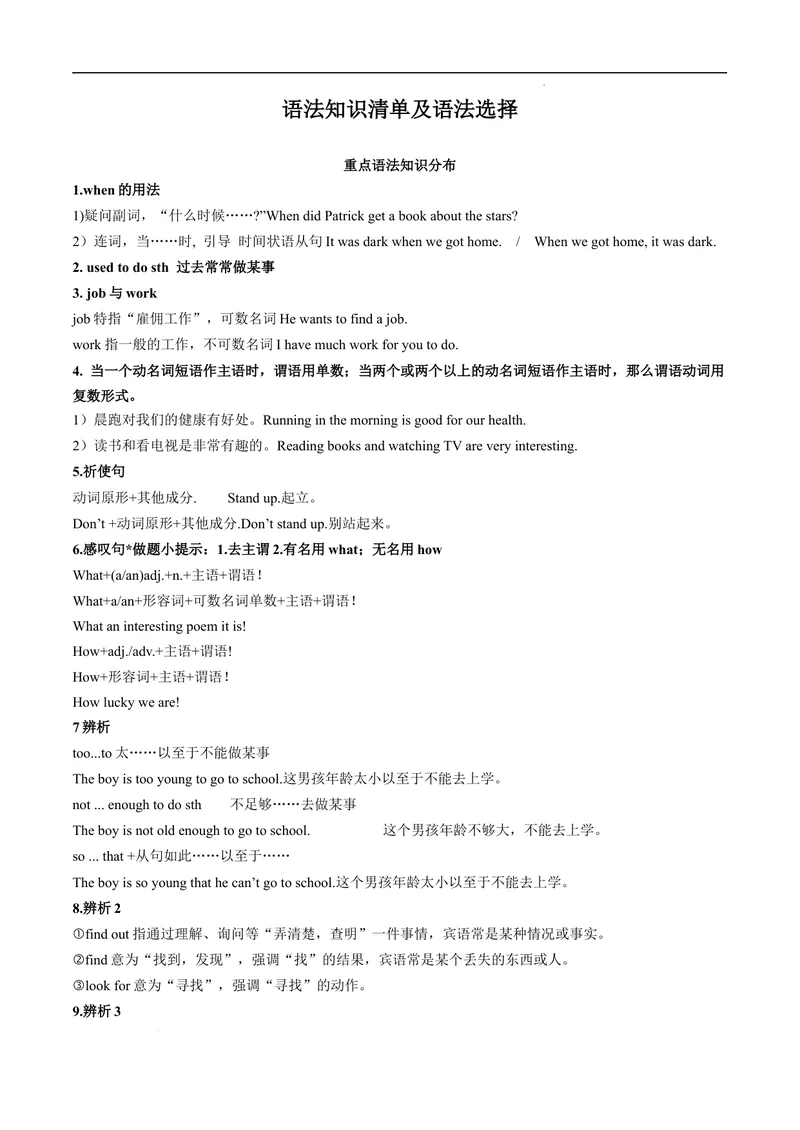
重点语法知识分布
1.when的用法
1)疑问副词,“什么时候……?”When did Patrick get a book about the stars?
2)连词,当……时, 引导 时间状语从句It was dark when we got home. / When we got home, it was dark.
2. used to do sth 过去常常做某事
3. job与work
job特指“雇佣工作”,可数名词He wants to find a job.
work指一般的工作,不可数名词I have much work for you to do.
4. 当一个动名词短语作主语时,谓语用单数;当两个或两个以上的动名词短语作主语时,那么谓语动词用
复数形式。
1)晨跑对我们的健康有好处。Running in the morning is good for our health.
2)读书和看电视是非常有趣的。Reading books and watching TV are very interesting.
5.祈使句
动词原形+其他成分. Stand up.起立。
Don’t +动词原形+其他成分.Don’t stand up.别站起来。
6.感叹句*做题小提示:1.去主谓2.有名用what;无名用how
What+(a/an)adj.+n.+主语+谓语!
What+a/an+形容词+可数名词单数+主语+谓语!
What an interesting poem it is!
How+adj./adv.+主语+谓语!
How+形容词+主语+谓语!
How lucky we are!
7辨析
too...to太……以至于不能做某事
The boy is too young to go to school.这男孩年龄太小以至于不能去上学。
not ... enough to do sth 不足够……去做某事
The boy is not old enough to go to school. 这个男孩年龄不够大,不能去上学。
so ... that +从句如此……以至于……
The boy is so young that he can’t go to school.这个男孩年龄太小以至于不能去上学。
8.辨析2
①find out指通过理解、询问等“弄清楚,查明”一件事情,宾语常是某种情况或事实。
②find意为“找到,发现”,强调“找”的结果,宾语常是某个丢失的东西或人。
③look for意为“寻找”,强调“寻找”的动作。
9.辨析3
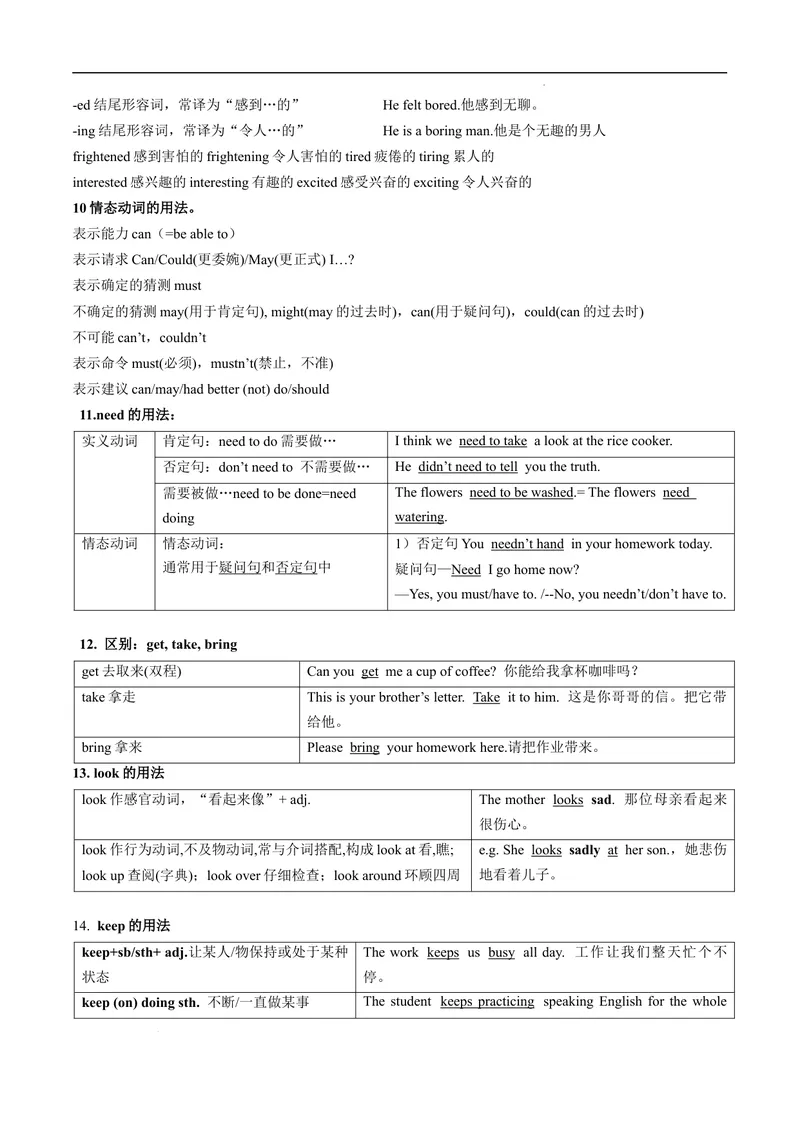
学科网(北京)股份有限公司-ed结尾形容词,常译为“感到…的” He felt bored.他感到无聊。
-ing结尾形容词,常译为“令人…的” He is a boring man.他是个无趣的男人
frightened感到害怕的frightening令人害怕的tired疲倦的tiring累人的
interested感兴趣的interesting有趣的excited感受兴奋的exciting令人兴奋的
10情态动词的用法。
表示能力can(=be able to)
表示请求Can/Could(更委婉)/May(更正式) I…?
表示确定的猜测must
不确定的猜测may(用于肯定句), might(may的过去时),can(用于疑问句),could(can的过去时)
不可能can’t,couldn’t
表示命令must(必须),mustn’t(禁止,不准)
表示建议can/may/had better (not) do/should
11.need的用法:
实义动词 肯定句:need to do需要做… I think we need to take a look at the rice cooker.
否定句:don’t need to 不需要做… He didn’t need to tell you the truth.
需要被做…need to be done=need The flowers need to be washed.= The flowers need
doing watering.
情态动词 情态动词: 1)否定句You needn’t hand in your homework today.
通常用于疑问句和否定句中 疑问句—Need I go home now?
—Yes, you must/have to. /--No, you needn’t/don’t have to.
12. 区别:get, take, bring
get去取来(双程) Can you get me a cup of coffee? 你能给我拿杯咖啡吗?
take拿走 This is your brother’s letter. Take it to him. 这是你哥哥的信。把它带
给他。
bring拿来 Please bring your homework here.请把作业带来。
13. look的用法
look作感官动词,“看起来像”+ adj. The mother looks sad. 那位母亲看起来
很伤心。
look作行为动词,不及物动词,常与介词搭配,构成look at看,瞧; e.g. She looks sadly at her son.,她悲伤
look up查阅(字典);look over仔细检查;look around环顾四周 地看着儿子。
14. keep的用法
keep+sb/sth+ adj.让某人/物保持或处于某种 The work keeps us busy all day. 工作让我们整天忙个不
状态 停。
keep (on) doing sth. 不断/一直做某事 The student keeps practicing speaking English for the whole
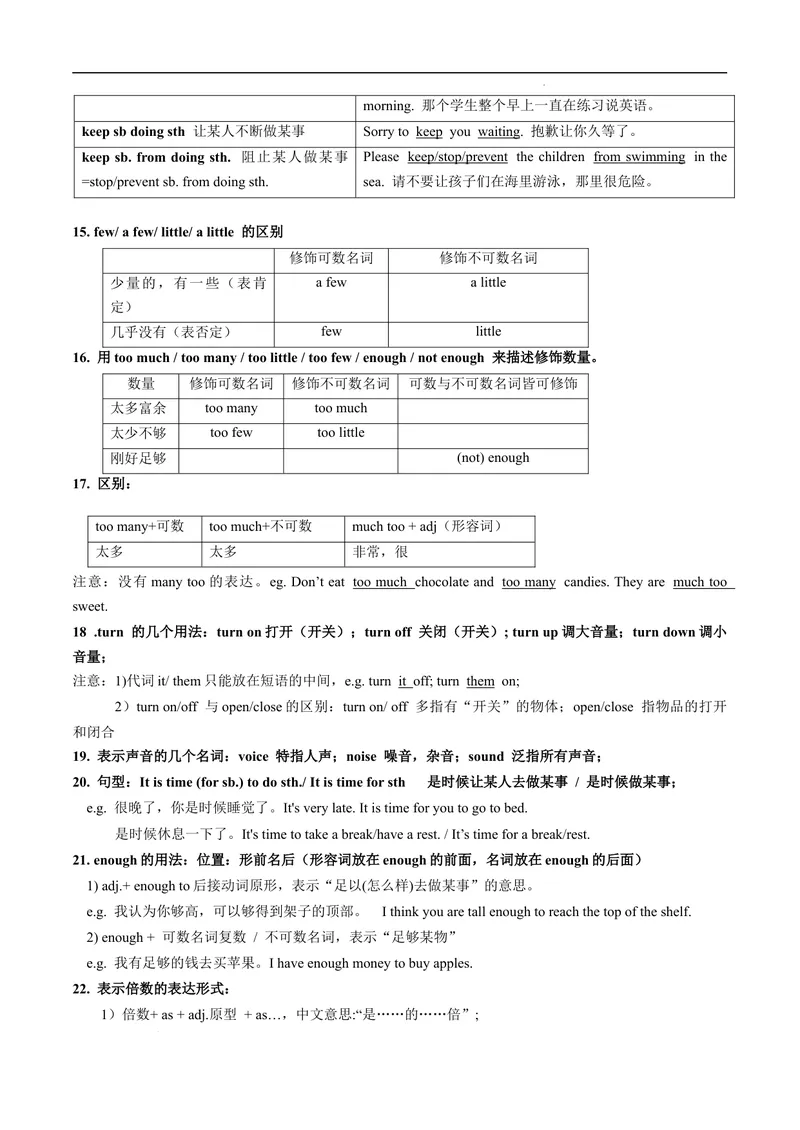
学科网(北京)股份有限公司morning. 那个学生整个早上一直在练习说英语。
keep sb doing sth 让某人不断做某事 Sorry to keep you waiting. 抱歉让你久等了。
keep sb. from doing sth. 阻止某人做某事 Please keep/stop/prevent the children from swimming in the
=stop/prevent sb. from doing sth. sea. 请不要让孩子们在海里游泳,那里很危险。
15. few/ a few/ little/ a little 的区别
修饰可数名词 修饰不可数名词
少量的,有一些(表肯 a few a little
定)
几乎没有(表否定) few little
16. 用too much / too many / too little / too few / enough / not enough 来描述修饰数量。
数量 修饰可数名词 修饰不可数名词 可数与不可数名词皆可修饰
太多富余 too many too much
太少不够 too few too little
刚好足够 (not) enough
17. 区别:
too many+可数 too much+不可数 much too + adj(形容词)
太多 太多 非常,很
注意:没有many too的表达。eg. Don’t eat too much chocolate and too many candies. They are much too
sweet.
18 .turn 的几个用法:turn on打开(开关);turn off 关闭(开关); turn up调大音量;turn down调小
音量;
注意:1)代词it/ them只能放在短语的中间,e.g. turn it off; turn them on;
2)turn on/off 与open/close的区别:turn on/ off 多指有“开关”的物体;open/close 指物品的打开
和闭合
19. 表示声音的几个名词:voice 特指人声;noise 噪音,杂音;sound 泛指所有声音;
20. 句型:It is time (for sb.) to do sth./ It is time for sth 是时候让某人去做某事 / 是时候做某事;
e.g. 很晚了,你是时候睡觉了。It's very late. It is time for you to go to bed.
是时候休息一下了。It's time to take a break/have a rest. / It’s time for a break/rest.
21. enough的用法:位置:形前名后(形容词放在enough的前面,名词放在enough的后面)
1) adj.+ enough to后接动词原形,表示“足以(怎么样)去做某事”的意思。
e.g. 我认为你够高,可以够得到架子的顶部。 I think you are tall enough to reach the top of the shelf.
2) enough + 可数名词复数 / 不可数名词,表示“足够某物”
e.g. 我有足够的钱去买苹果。I have enough money to buy apples.
22. 表示倍数的表达形式:
1)倍数+ as + adj.原型 + as…,中文意思:“是……的……倍”;
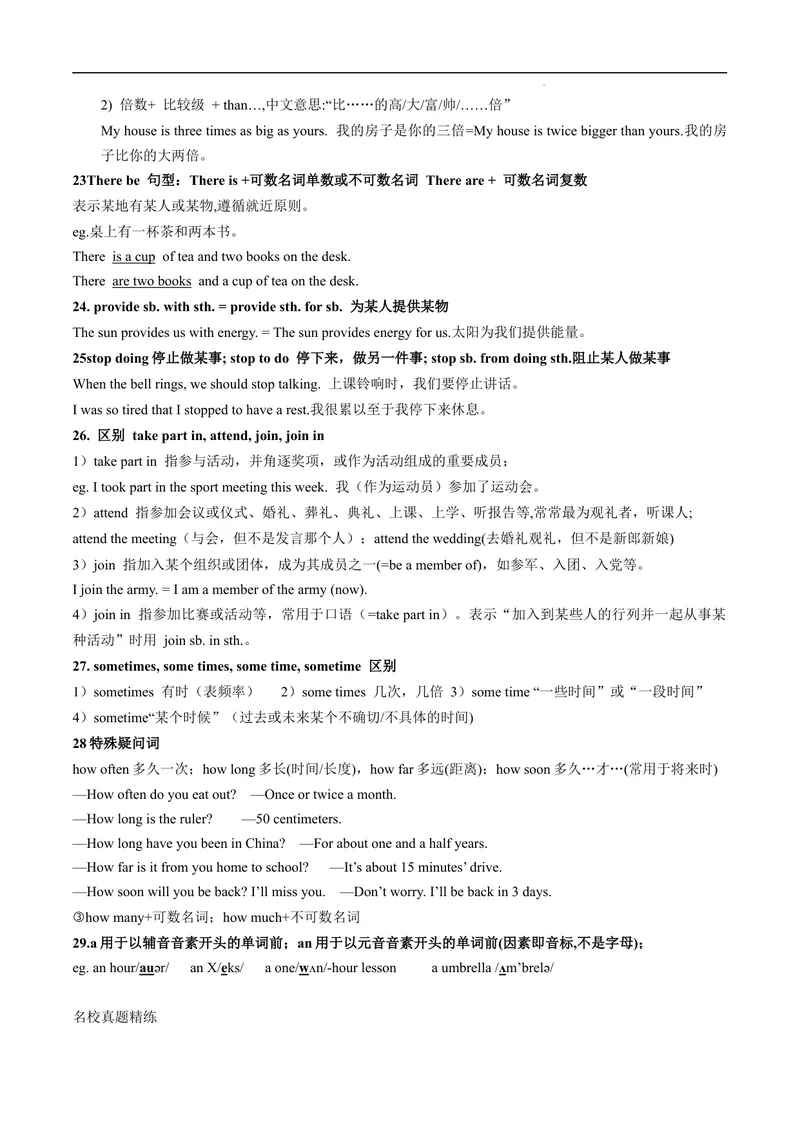
学科网(北京)股份有限公司2) 倍数+ 比较级 + than…,中文意思:“比……的高/大/富/帅/……倍”
My house is three times as big as yours. 我的房子是你的三倍=My house is twice bigger than yours.我的房
子比你的大两倍。
23There be 句型:There is +可数名词单数或不可数名词 There are + 可数名词复数
表示某地有某人或某物,遵循就近原则。
eg.桌上有一杯茶和两本书。
There is a cup of tea and two books on the desk.
There are two books and a cup of tea on the desk.
24. provide sb. with sth. = provide sth. for sb. 为某人提供某物
The sun provides us with energy. = The sun provides energy for us.太阳为我们提供能量。
25stop doing停止做某事; stop to do 停下来,做另一件事; stop sb. from doing sth.阻止某人做某事
When the bell rings, we should stop talking. 上课铃响时,我们要停止讲话。
I was so tired that I stopped to have a rest.我很累以至于我停下来休息。
26. 区别 take part in, attend, join, join in
1)take part in 指参与活动,并角逐奖项,或作为活动组成的重要成员;
eg. I took part in the sport meeting this week. 我(作为运动员)参加了运动会。
2)attend 指参加会议或仪式、婚礼、葬礼、典礼、上课、上学、听报告等,常常最为观礼者,听课人;
attend the meeting(与会,但不是发言那个人);attend the wedding(去婚礼观礼,但不是新郎新娘)
3)join 指加入某个组织或团体,成为其成员之一(=be a member of),如参军、入团、入党等。
I join the army. = I am a member of the army (now).
4)join in 指参加比赛或活动等,常用于口语(=take part in)。表示“加入到某些人的行列并一起从事某
种活动”时用 join sb. in sth.。
27. sometimes, some times, some time, sometime 区别
1)sometimes 有时(表频率) 2)some times 几次,几倍 3)some time “一些时间”或“一段时间”
4)sometime“某个时候”(过去或未来某个不确切/不具体的时间)
28特殊疑问词
how often多久一次;how long多长(时间/长度),how far多远(距离);how soon多久…才…(常用于将来时)
—How often do you eat out? —Once or twice a month.
—How long is the ruler? —50 centimeters.
—How long have you been in China? —For about one and a half years.
—How far is it from you home to school? —It’s about 15 minutes’ drive.
—How soon will you be back? I’ll miss you. —Don’t worry. I’ll be back in 3 days.
③how many+可数名词;how much+不可数名词
29.a用于以辅音音素开头的单词前;an用于以元音音素开头的单词前(因素即音标,不是字母);
eg. an hour/auər/ an X/eks/ a one/wʌn/-hour lesson a umbrella /ʌm’brelə/
名校真题精练
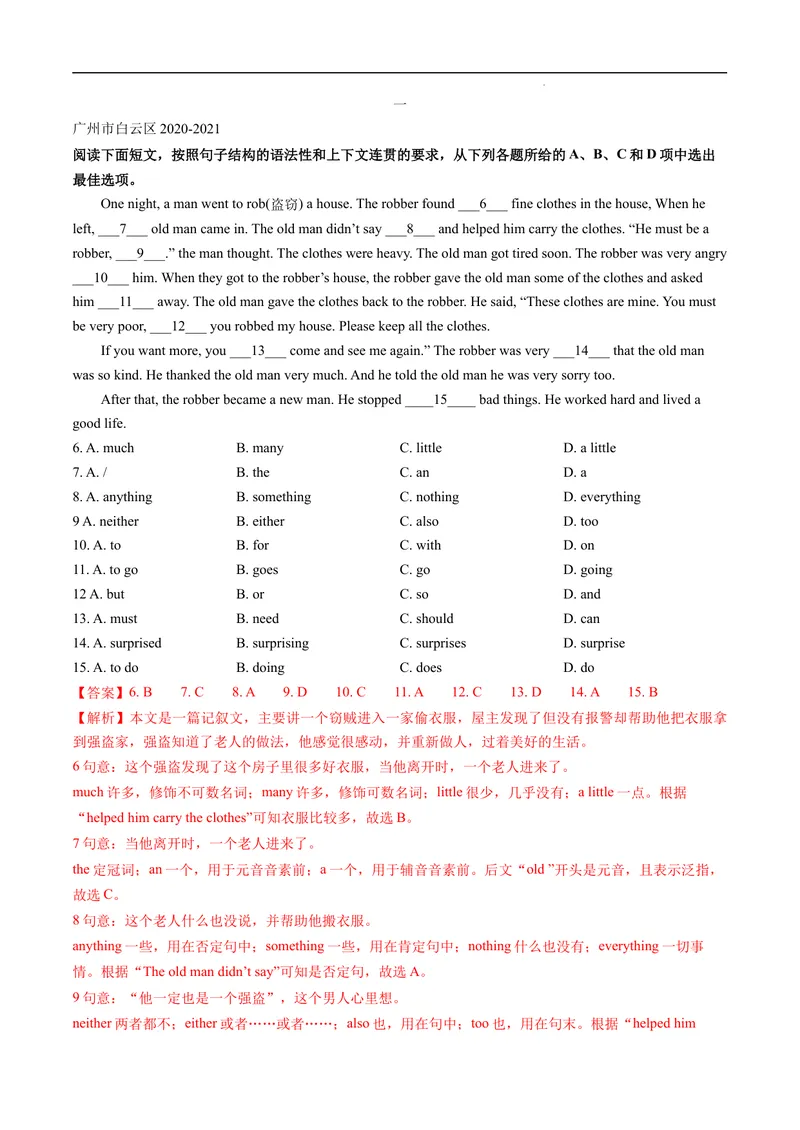
学科网(北京)股份有限公司一
广州市白云区2020-2021
阅读下面短文,按照句子结构的语法性和上下文连贯的要求,从下列各题所给的A、B、C和D项中选出
最佳选项。
One night, a man went to rob(盗窃) a house. The robber found ___6___ fine clothes in the house, When he
left, ___7___ old man came in. The old man didn’t say ___8___ and helped him carry the clothes. “He must be a
robber, ___9___.” the man thought. The clothes were heavy. The old man got tired soon. The robber was very angry
___10___ him. When they got to the robber’s house, the robber gave the old man some of the clothes and asked
him ___11___ away. The old man gave the clothes back to the robber. He said, “These clothes are mine. You must
be very poor, ___12___ you robbed my house. Please keep all the clothes.
If you want more, you ___13___ come and see me again.” The robber was very ___14___ that the old man
was so kind. He thanked the old man very much. And he told the old man he was very sorry too.
After that, the robber became a new man. He stopped ____15____ bad things. He worked hard and lived a
good life.
6. A. much B. many C. little D. a little
7. A. / B. the C. an D. a
8. A. anything B. something C. nothing D. everything
9 A. neither B. either C. also D. too
10. A. to B. for C. with D. on
11. A. to go B. goes C. go D. going
12 A. but B. or C. so D. and
13. A. must B. need C. should D. can
14. A. surprised B. surprising C. surprises D. surprise
15. A. to do B. doing C. does D. do
【答案】6. B 7. C 8. A 9. D 10. C 11. A 12. C 13. D 14. A 15. B
【解析】本文是一篇记叙文,主要讲一个窃贼进入一家偷衣服,屋主发现了但没有报警却帮助他把衣服拿
到强盗家,强盗知道了老人的做法,他感觉很感动,并重新做人,过着美好的生活。
6句意:这个强盗发现了这个房子里很多好衣服,当他离开时,一个老人进来了。
much许多,修饰不可数名词;many许多,修饰可数名词;little很少,几乎没有;a little一点。根据
“helped him carry the clothes”可知衣服比较多,故选B。
7句意:当他离开时,一个老人进来了。
the定冠词;an一个,用于元音音素前;a一个,用于辅音音素前。后文“old ”开头是元音,且表示泛指,
故选C。
8句意:这个老人什么也没说,并帮助他搬衣服。
anything一些,用在否定句中;something一些,用在肯定句中;nothing什么也没有;everything一切事
情。根据“The old man didn’t say”可知是否定句,故选A。
9句意:“他一定也是一个强盗”,这个男人心里想。
neither两者都不;either或者……或者……;also也,用在句中;too也,用在句末。根据“helped him
学科网(北京)股份有限公司carry the clothes”可知强盗误认为老人也是强盗;空格处在句末,故用too。故选D。
10句意:这个强盗很生老人的气。
to不定式符号;for为了;with和;on在……上面。“be angry with”表示“生某人的气”。故选C。
11句意:当他们到强盗的家时,强盗给了老人一些衣服并要求他走。
to go走,动词不定式;goes三单形式;go原形;going现在分词。“ask sb to do sth”表示“要求某人做某
事”。“ask”后接不定式,故选A。
12句意:你一定很贫穷,所以你抢劫了我的房子。
but但是;or或者;so所以;and并且。空格前后是因果关系,故选C。
13句意:如果你想要更多,你还可以来。
must必须;need需要;should应该;can能够。根据“If you want more”可知老人的意思是需要更多可以来
拿。故选D。
14句意:这个强盗很吃惊,这个老人是如此的善良。
surprised吃惊的;surprising令人吃惊的;surprises 名词复数形式;surprise原形。此处修饰主语“The
robber”应是形容词surprised,故选A。
15句意:那之后,强盗变成一个新的人。他停止做坏事。
to do不定式;doing现在分词;does三单形式;do原形。“stop doing sth”表示停止做某事,此处表示“停
止做坏事”,故选B。
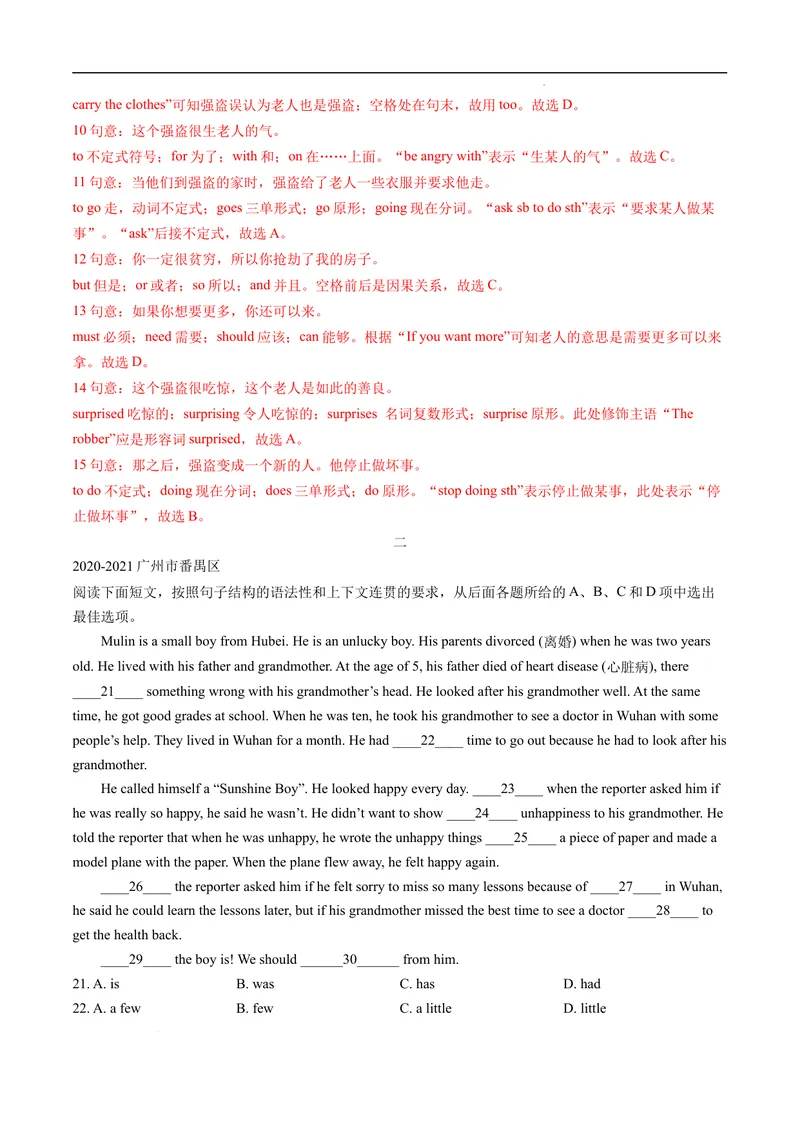
二
2020-2021广州市番禺区
阅读下面短文,按照句子结构的语法性和上下文连贯的要求,从后面各题所给的A、B、C和D项中选出
最佳选项。
Mulin is a small boy from Hubei. He is an unlucky boy. His parents divorced (离婚) when he was two years
old. He lived with his father and grandmother. At the age of 5, his father died of heart disease (心脏病), there
____21____ something wrong with his grandmother’s head. He looked after his grandmother well. At the same
time, he got good grades at school. When he was ten, he took his grandmother to see a doctor in Wuhan with some
people’s help. They lived in Wuhan for a month. He had ____22____ time to go out because he had to look after his
grandmother.
He called himself a “Sunshine Boy”. He looked happy every day. ____23____ when the reporter asked him if
he was really so happy, he said he wasn’t. He didn’t want to show ____24____ unhappiness to his grandmother. He
told the reporter that when he was unhappy, he wrote the unhappy things ____25____ a piece of paper and made a
model plane with the paper. When the plane flew away, he felt happy again.
____26____ the reporter asked him if he felt sorry to miss so many lessons because of ____27____ in Wuhan,
he said he could learn the lessons later, but if his grandmother missed the best time to see a doctor ____28____ to
get the health back.
____29____ the boy is! We should ______30______ from him.
21. A. is B. was C. has D. had
22. A. a few B. few C. a little D. little
学科网(北京)股份有限公司23. A. And B. But C. So D. Or
24. A. his B. him C. he D. himself
25. A. in B. with C. on D. to
26. A. If B. Though C. When D. Because
27. A. stay B. staying C. stays D. stayed
28. A. something B. anything C. everything D. nothing
29. A. How a good B. What a good C. What good D. How good
30. A. learn B. to learn C. learning D. learned
【答案】21. B 22. D 23. B 24. A 25. C 26. C 27. B 28. D 29. D 30. A
【解析】本文讲述了一个可怜的小男孩Mulin从小因父母离异,跟父亲和奶奶一起生活,父亲因病去世
后,就跟年迈的奶奶相互陪伴,奶奶生病后,他陪奶奶去看病,并且在奶奶面前表现的非常开心,但是实
际上他并不开心,这是一个懂事的男孩,值得大家学习。
21句意:他的奶奶生病了。
is是,be动词单数;was是,is的过去式;has有,动词第三人称单数;had有,动词过去式,固定搭配
there be something wrong with…“……出毛病了”,时态是一般过去时,故选B。
22句意:他很少有时间出去,因为他要照看他的奶奶。
a few一些,修饰可数名词复数;few很少,修饰可数名词复数;a little一些,修饰不可数名词;little很
少,修饰不可数名词,空后的“time”是不可数名词,所以应该用little或a little修饰,排除A和B,由空后
的“ because he had to look after his grandmother”可知,应该是很少有时间出去,排除C,故选D。
23句意:但是当记者问他是否真的开心时,他说他并不开心。
And并且;But但是;So所以;Or否则,空前的句子“He looked happy every day”和空后的句子“when the
reporter asked him if he was really so happy, he said he wasn’t”可知,前后是转折关系,所以用but,故选B。
24句意:他并不想把不开心展示给奶奶。
his他的,形容词性物主代词;him他,宾格;he他,主格;himself他自己,反身代词,根据空后的
“unhappiness to his grandmother”可知,应该是不想把他的不开心展示给奶奶,故选A。
25句意:他告诉记者,当他不开心的时候,他把不开心的事情写在一张纸上,并用纸做了一个模型飞机。
in在……里;with用;on在……上;to到,根据空前的“wrote the unhappy things”和空后的“a piece of
paper”可知,应该是把不开心的事写在一张纸上,故选C。
26句意:当记者问他是否因为留在武汉而错过这么多课程而感到遗憾时,他说他可以以后再学习,但如果
他的奶奶错过了最好的看医生时间,就没有任何东西能帮她把健康找回了。
If如果,是否;Though虽然;When当……时;Because因为,根据后文的“he said he could learn the
lessons later, but if his grandmother missed the best time to see a doctor”可知,应该是当记者问他……时,故选
C。
27句意:当记者问他是否因为留在武汉而错过这么多课程而感到遗憾时,他说他可以以后再学习,但如果
他的奶奶错过了最好的看医生时间,就没有任何东西能帮她把健康找回了。
stay动词原形;staying动名词;stays动词第三人称单数;stayed动词过去式,根据空前的“because of”可
知,空缺处应该用动名词,故选B。
学科网(北京)股份有限公司28句意:当记者问他是否因为留在武汉而错过这么多课程而感到遗憾时,他说他可以以后再学习,但如果
他的奶奶错过了最好的看医生时间,就没有任何东西能帮她把健康找回了。
something某物;anything任何东西;everything所有东西;nothing没有东西,根据空前的“but if his
grandmother missed the best time to see a doctor”和空后的“to get the health back”可知,应该是如果他的奶奶
错过了最好的看医生时间,就没有任何东西能帮她把健康找回了,故选D。
29句意:多么好的一个男孩啊!
How a good错误表达;What a good多么好;What good多么好;How good多么好,分析句子的结构,句子
的中心词“good”是形容词,所以用how修饰,故选D。
39句意:我们应该向他学习。
learn动词原形;to learn动词不定式;leaning动名词;learned动词过去式,根据空前的“should”可知,空
缺处应该用动词原形,故选A。
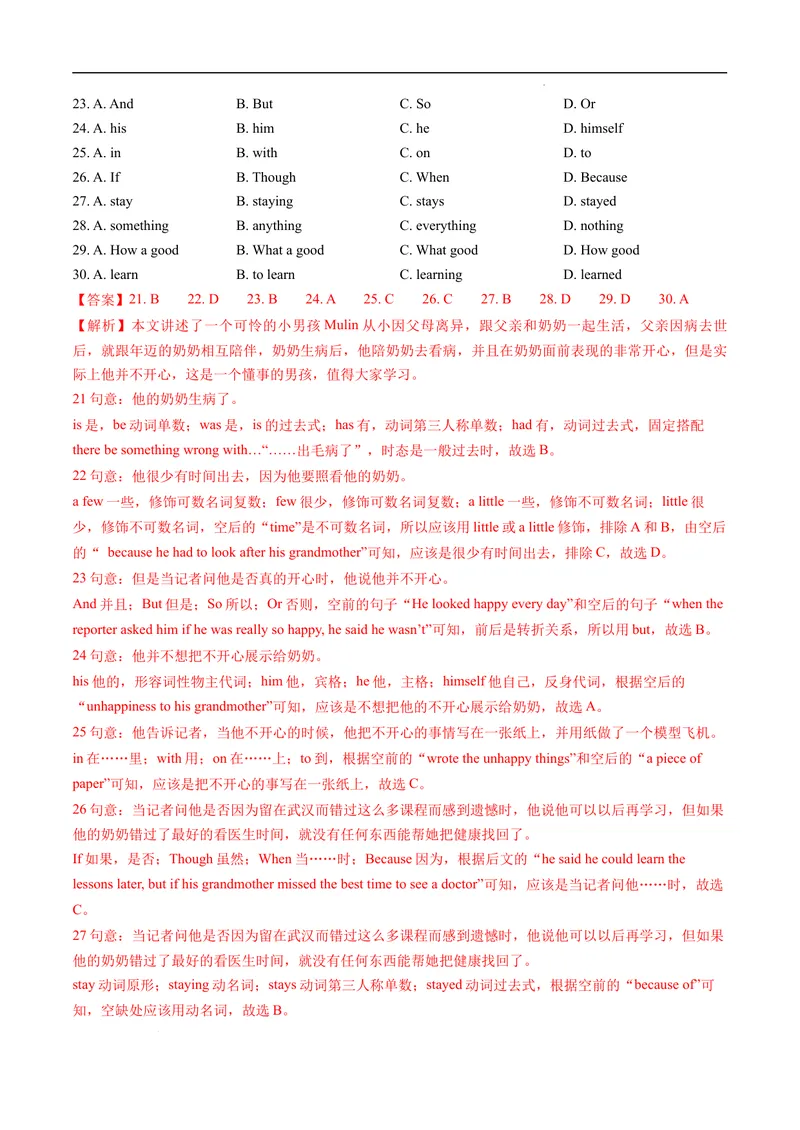
三
2020-2021广州市海珠区
一、语法选择(共两部分,15小题;每小题1分,满分15分)
阅读下面两篇短文,按照句子结构的语法性和上下文连贯的要求,从各题所给的A、B、C和D项中选出
最佳选项,并在答题卡上将该项涂黑。
(A)
My Dad
He comes home, has a shower,
And eats dinner, every day.
Now, he ___1___ in his favourite chair,
___2___ tired to laugh or play.
He reads his book or newspaper,
To learn what’s new today.
Soon he’ll go to bed.
He’s a boring man, my dad.
Then I see him ___3___,
On the building site.
He’s high up in the clouds,
Higher than a kite.
He’s walking ___4___ a narrow piece of wood,
Not worried about the height,
Not afraid, not afraid like me.
He’s ___5___ superman, my dad.
1. A. sits B. sat C. will sit D. is sitting
2. A. So B. Too C. Such D. Very
3. A. works B. worked C. working D. to work
学科网(北京)股份有限公司4. A. on B. above C. below D. under
5. A. / B. a C. an D. the
【答案】1. D 2. B 3. C 4. A 5. B
【解析】本文是一篇小诗歌,描述了爸爸的工作和生活状态,表达了对父亲的崇敬和爱。
1句意:现在,他正坐在他最喜欢的椅子上。
sit一般现在时;sat一般过去时;will sit一般将来时;is sitting现在进行时。根据“Now”可知,时态 是现在
进行时,强调动作正在进行,故选D。
2句意:太累了,不能笑也不能玩。
So如此;Too太;Such如此;Very非常。根据“...tired to laugh or play.”可知,此处是too...to...结构,意为
“太……而不能……”,故选B。
3句意:然后我看到他在工作。
works动词三单;worked动词过去式;working动名词/现在分词;to work动词不定式。根据“Then I see
him...”可知,此处是see sb doing sth短语,意为“看见某人正在做某事”,故选C。
4句意:他走在一块狭窄的木头上。
on在……上;above在……上;below在……下;under在……下。根据“He’s walking...a narrow piece of
wood”可知,此处是walk on...短语,意为“走在……上”,有表面接触,所以用on。故选A。
5句意:他是个超人,我爸爸。
/零冠词;a表泛指,用于辅音音素开头的单词前;an表泛指,用于元音音素开头的单词前;the定冠词,
表特指。此处泛指一个超人,superman首字母发辅音音素,故选B。
(B)
When I was nine years old, I found an advertisement for selling greeting cards in the back of a children’s
magazine. I thought to ___6___ that I could do this. I asked my mother to let me send for the box. Two weeks later
___7___ the box arrived, I opened the box, got the cards ___8___ rushed out of the house. Three hours later, I
returned home ___9___ no card and a pocket full of money shouting, “Mama, all the people couldn’t wait to buy
my cards!” A seller was born.
When I was twelve years old, my father took me to see Tony Green. I remembered sitting in that dark hall and
listening to Mr. Green cheer everybody up. After the speech, I told dad, “I feel that I ___10___ do everything.”
When we got to the car, I turned to my father and said, “Dad, I want to make people feel like that.” My father asked
me what I meant. “I want to be an encouraging speaker just like Mr. Green,” I replied. A dream was born.
Recently I began following my dream of encouraging ___11___. I left ___12___ company where I worked for
4 years. ___13___ people were surprised why I would leave after earning much money. And they asked why I
would do everything for a dream. I loved my old job, my friends and the company I left, but ___14___ was time to
get on with my dream.
When I kept working hard on my dream, even during the hard times, the amazing and wonderful things really
began to happen. Just as the saying goes, “The world always ___15___ way for the dreamer.”
6. A. I B. me C. my D. myself
7. A. if B. when C. though D. because
学科网(北京)股份有限公司8. A. or B. so C. and D. but
9. A. on B. in C. with D. without
10. A. can B. may C. must D. should
11. A. other B. others C. another D. the other
12. A. / B. a C. an D. the
13. A. Much B. Many C. A lot D. A little
14. A. it B. I C. this D. that
15. A. make B. made C. makes D. is making
【答案】6. D 7. B 8. C 9. C 10. A 11. B 12. D 13. B 14. A 15. C
【解析】本文介绍了作者追逐理想的故事。
6句意:我自己想,我能做这个。
I我,主格;me我,宾格;my我的,形容词性物主代词;myself我自己,反身代词。think to oneself表示
“心想”。故选D。
7句意:两周以后,当盒子到了时,我打开盒子,拿着卡片,冲出屋。
if如果;when当……时;though尽管;because因为。根据“the box arrived, I opened the box, got the cards”
可知此处指当盒子到的时候,when引导时间状语从句。故选B。
8句意:两周以后,当盒子到了时,我打开盒子,拿着卡片,冲出屋。
or或者;so因此;and和;but但是。根据“got the cards”和“rushed out of the house. ”可知此处表顺承关
系。故选C。
9句意:三个小时后,我回到家,手里没有卡片,而是一兜子钱。
on在……上;in在……里面;with和;without没有。根据“a pocket full of money shouting, ‘Mama, all the
people couldn’t wait to buy my cards!’”可知作者把卡片卖了,变成了钱,用with表伴随。故选C。
10句意:我感觉我能做任何事。
can能够;may可能;must必须;should应该。根据“I feel that I ...do everything.”可知此处表能力,用情态
动词can。故选A。
11句意:最近我开始追随我的梦想,鼓励别人。
other其他的,后接名词;others其他的人或物;another泛指三者以上的另一个;the other特指两者之间的
另一个。空后没有名词,用others表示“其他人”。故选B。
12句意:我离开我工作四年的公司。
/零冠词;a不定冠词,表泛指,用于辅音音素前;an不定冠词,表泛指,用于元音音素前;the定冠词,
表特指。根据“...where I worked for 4 years.”可知此处特指作者工作四年的公司,用定冠词the。故选D。
13句意:很多人都惊讶,我为什么在赚这么多钱后离开。
Much很多,修饰不可数名词;Many很多,修饰可数名词;A lot很多,修饰动词;A little很少,修饰不可
数名词。people是集合名词,用many修饰。故选B。
14句意:我热爱我以前的工作、我的朋友和我离开的公司,但我实现梦想的时机已经成熟。
it它;I我;this这;that那。it is/was time to do sth表示“该到做某事的时间了”,固定句型。故选A。
15句意:世界总为梦想者让路。
学科网(北京)股份有限公司make使,动词原形;made过去式;makes第三人称单数;is making现在进行时结构。此句是谚语,用一
般现在时,主语是第三人称单数,谓语动词用动词三单makes。故选C。
四
2020-2021广州市花都区
阅读下面短文,按照句子结构的语法性和上下文连贯的要求,从后面各题所给的A、B、C和D项中选出
最佳选项。
One day, two friends were walking together. Suddenly, one of them found a lost wallet ___6___ the road and
picked it up.
“Oh, ___7___ a lucky day for me!” he said. “I have found a wallet with ___8___ money inside.”
“Don’t say ‘I have found a wallet! ___9___ ‘we have found a wallet and how lucky we are’. Friends ___10___
share the fortunes (幸运) and misfortunes all the time.”
“No, no.” the man said. “I found the wallet first, so I am going to keep ___11___ for myself. ”
___12___ the two men were arguing (争吵), they heard someone shouting, “Stop, thief! Catch ___13___
thief!” When the men looked behind ___14___, they saw a group of people coming down the road ____15____.
The man with the wallet ____16____ into fear.
“We will be in trouble ____17____ they find the wallet with us,” he said.
“No, no, ” said ____18____ .“You did not say ‘we’ before when you had to share your fortune, ____19____
now keep your ‘I’. Say ‘I am in trouble’. Don’t try to share your misfortune now when you were not ready to
share your fortune earlier. Remember: it is important for friends ____20____ both fortunes and misfortunes.”
6. A. on B. in C. over D. under
7. A. how B. what C. when D. why
8. A. little B. a few C. some D. many
9. A. To say B. Saying C. Say D. Sayed
10. A. may B. could C. might D. should
11. A. it B. itself C. it’s D. its
12. A. Before B. After C. Until D. When
13. A. a B. an C. the D. /
14. A. himself B. themselves C. yourselves D. ourselves
15. A. angry B. anger C. angrier D. angrily
16. A. falls B. fell C. will fall D. is falling
17. A. if B. unless C. though D. because
18. A. other B. the other C. others D. the others
19. A. so B. and C. but D. or
20. A. share B. sharing C. to share D. shared
【答案】6. A 7. B 8. C 9. C 10. D 11. A 12. D 13. C 14. B 15. D 16. B 17. A 18. B 19. A
20. C
【解析】本文主要讲述了一个故事,告诉我们,对朋友来说,患难与共是很重要的。两个朋友散步时在路
上捡到了一个钱包,一个人说是“我”先发现的,应该归“我”,另一个人说应该归“我们”。 当这两
学科网(北京)股份有限公司个人在争论时,他们听到有人喊道:“站住,小偷!抓住小偷!” 拿钱包的人说“我们”就有麻烦了。
另一个说:“你以前必须分享你的财富时没有说‘我们’,所以现在保留你的‘我’。说‘我有麻烦
了’。”
6句意:突然,其中一人在路上发现了一个丢失的钱包,并捡起了它。
on在……上;in在……里;over在……上面;under在……下面。表示“在路上”用on the road,故选A。
7句意:哦,对我来说是多么幸运的一天啊!
how多么,引导感叹句,后面跟形容词或副词,其结构是How+adv./adj.+主谓!;what多么,引导感叹句后
面跟名词,其结构是What+(a/an)+adj.+n+主谓!;when什么时候;why为什么。此句是感叹句,由“a
lucky day”可知应用what,故选B。
8句意:我发现了一个钱包,里面有一些钱。
little少量的,修饰不可数名词,表示否定意义;a few一些,修饰可数名词复数;some一些;many许多,
修饰可数名词复数。“money”是不可数名词,排除B和D。根据上文“Oh, what a lucky day for me!”可知钱
包里有钱,故选C。
9句意:说“我们找到了一个钱包,我们是多么幸运”。
To say动词不定式;Saying动名词;Say动词原形;Sayed错误形式,say的过去式是said。此句是祈使
句,应用动词原形,故选C。
10句意:朋友应该时时分享幸运和不幸。
may可能,可以;could能,可以;might可以,可能;should应该。根据上文“Don’t say ‘I have found a
wallet’! Say ‘we have found a wallet and how lucky we are’.”可知要提出建议,朋友应该……,故选D。
11句意:我先发现的钱包,所以我打算自己留着。
it它;itself它自己;it’s它是;its它的。空格处指代前文的钱包,应用it,故选A。
12句意:当这两个人在争论时,他们听到有人喊道:“站住,小偷!……”。
Before在……以前;After在……后;Until直到,直到……为止;When在……时候。根据句意和语境可知
前后句动作是同时发生,应用When,故选D。
13句意:抓住小偷!
a/an一个……,表示泛指,a后面跟辅音音素开头 的可数名词单数,an用于元音音素开头的可数名词单数
前;the这(些),那(些),表示特指。此句表示特指,故选C。
14句意:当这两个人向后看时,他们看到一群人愤怒地沿着路走来。
himself他自己;themselves他们自己;yourselves你们自己;ourselves我们自己。根据主语“the men”是第
三人称复数,应用themselves。故选B。
15句意:当这些人向后看时,他们看到一群人愤怒地沿着路走来。
angry发怒的,形容词;anger愤怒,名词;angrier更愤怒的,比较级;angrily愤怒地,生气地,副词。空
格处修饰动词“coming”,应用副词,故选D。
16句意:拿钱包的人陷入了恐惧。
falls一般现在时,三单形式;fell一般过去时;will fall一般将来时;is falling现在进行时。本文时态为一
般过去时,讲述过去发生的事情,此句应是一般过去时,故选B。
学科网(北京)股份有限公司17句意:如果他们发现钱包和我们在一起,我们就有麻烦了。
if如果;unless除非,如果不;though虽然,尽管;because因为。根据句意可知,“they find the wallet
with us”是“We will be in trouble”的肯定假设条件,故选A。
18句意:另一个说:“在你必须分享财富的时候,你没有说过‘我们’。……”
other其他,形容词,泛指;the other(两个中)另一个;others其他的,代词;the others其他的,代词,
特指。此句指两个人中的另一个人,应用the other,故选B。
19句意:在你必须分享财富的时候,你没有说“我们”,所以现在保留你的“我”。
so因此,所以;and和,而且;but但是;or或者。根据句意可知,前后句表示因果关系,属于前因后果,
应用so连接。故选A。
20句意:记住:对朋友来说,患难与共是很重要的。
share一般现在时;sharing现在分词;to share动词不定式;shared一般过去时。此句是句型It’s adj. for sb.
to do sth.“对于某人来说,做某事是什么样子的”,空格处应填动词不定式,故选C。
五
2020-2021广州市黄埔区
阅读下面短文, 按照句子结构的语法性和上下文连贯的要求, 选出最佳选项。并在答题卡上将该项涂黑。
When I was in primary school, I fell in love with reading. The books made me ___11___ a wonderful world.
The more I read, the more I wanted to know. But there are not so many books in my house ___12___ my parents
didn’t have enough money. So I had to solve(解决)the problem ___13___.
There was a bookshop near my home. One day, I walked into ___14___ shop and picked up a book. I didn’t
know if I could read there without ___15___ any books. So I just read ___16___ pages and then put it back.
Luckily, no one paid attention to me. After that, I went there to read every day. Several days later, ___17___ I was
reading, the owner came up and asked, “You like reading?” I looked at him and felt nervous, he said with a smile,
“You ___18___ read books here if you help me clean the shop.” I felt quite surprised, “Really? It’s so kind of
you!” ___19___ happy I was!
Now I ____20____ in a junior high school. I can borrow books from the school library. Reading is still my
hobby. It will make a big difference to my future life.
11. A. feel B. feels C. felt D. feeling
12 A. if B. but C. because D. so
13. A. my B. myself C. me D. mine
14. A. the B. a C. an D. /
15. A. to buy B. bought C. buys D. buying
16. A. a little B. little C. a few D. fewer
17. A. when B. so C. and D. but
18. A. must B. may C. can't D. should
19. A. What B. What a C. How D. How a
20. A. studying B. studies C. studied D. am studying
【答案】11. A 12. C 13. B 14. A 15. D 16. C 17. A 18. B 19. C 20. D
学科网(北京)股份有限公司【解析】本文讲述作者喜欢看书,但是家里没有足够的钱能让他看书,于是在家附近的一家书店每次看几
页书就放回去。书店的老板告诉作者如果能帮他清扫书店的话就让作者在那里免费看书,让作者非常开
心。
11句意:书籍让我感觉进入一个美妙的世界。
feel感觉,动词原形;feels动词三单形式;felt动词过去式;feeling现在分词。表达“让某人做某事”用
“make sb. do”的结构,此处用动词原形“feel”。故选A。
12句意:但是我家没有那么多的书因为我的父母没有足够的钱。
if如果;but但是;because因为;so因此。根据“my parents didn’t have enough money”可知解释了没那么
多书的原因是没有足够的钱,用连词“because”引导原因状语从句。故选C。
13句意:因此我不得不自己想办法解决问题。
my我的;myself我自己;me我,宾格;mine我的东西。根据后文讲述作者在书店打扫卫生的方式在书店
免费看书,可知表达自己解决问题,用反身代词“myself”。故选B。
14句意:一天,我走进这家店,拿起一本书看。
the定冠词,表示确指;a不定冠词,用在辅音音素开始的单词前;an不定冠词,用在元音音素开始的单词
前。根据前文“There was a bookshop”可知此处的书店在前文已经提到,特指那家书店用定冠词“the”。故
选A。
15句意:我不知道是否我可以不买书只在那里看书。
to buy买,动词不定式;bought动词过去式;buys动词三单形式;buying现在分词或动名词。介词
“without”后的宾语用动名词形式,表达“买”用“buying”。故选D。
16句意:因此我只是读几页书然后放回去。
a little一点儿,接不可数名词;little少得几乎没有,接不可数名词;a few一点儿,接可数名词;few少得
几乎没有,接可数名词。句子表达肯定含义表示“读几页”,名词“pages”是可数名词的复数形式,用“a
few”。故选C。
17句意:几天之后,当我正在看书的时候,书店的老板过来问我:“你喜欢读书么?”
when当……时;so因此;and和;but但是。根据“I was reading, the owner came up”可知表达“当我正在
看书的时候”,用连词“when”引导时间状语从句。故选A。
18句意:如果你帮助我清扫书店你可以在这里看书。
must必须;may可能,可以;can’t不能;should应该。根据“read books here if you help me clean the shop”
可知表达可以在这看书,用情态动词“may”。故选B。
19句意:我多么的开心!
“what+不可数名词或复数名词+主语+谓语动词”构成感叹句;“what a+可数名词单数+主语+谓语动词”构
成感叹句;“how+形容词或副词+主语+谓语动词”构成感叹句;how a结构错误。“happy”是形容词,表
达“多么开心”用“how happy”。故选C。
20句意:现在我在一所初中上学。
studying学习,动词现在分词或动名词;studies动词三单形式;studied动词过去式;am studying现在进行
时。根据“Now”可知句子是现在进行时,表达学习动词用“am studying”。故选D。
六
学科网(北京)股份有限公司2020-2021广州市南沙区
阅读下面短文,按照句子结构的语法性和上下文连贯的要求,从各题所给的A、B、C 和D项中选出最佳
选项,并在答题卡上将该项涂黑。
Trees are really important in our daily life. They keep the air cool and ____6____. Trees help reduce noise
pollution ____7____ make cities beautiful. Trees keep the Earth from ____8____ too hot to live on.
Trees let us live more conveniently. ____9____ things in our daily life come from trees, such as paper, pencils
and so on. Besides, a lot of furniture ____10____ wood. Trees give us shade, ____11____. On a hot summer day,
people can ____12____ a good rest under the shade of a tree after they walk a long way or feel tired.
Trees help us in many ways. But people cut down ____13____ trees every year. We burn wood for fire. We
need more lands to do ____14____ things like building, growing food and keeping animals.
We really need a world full of trees. ____15____ cutting down trees if we don’t want a world without them.
6. A. clean B. cleanly C. cleaner D. cleanest
7. A. but B. and C. so D. or
8. A. become B. becomes C. became D. becoming
9. A. A few B. A little C. Many D. Much
10. A. is made from B. is made of C. are made from D. are made of
11. A. also B. either C. too D. as well
12. A. have B. has C. having D. had
13. A. million of B. millions of C. two millions D. two million of
14. A. other B. another C. the other D. others
15. A. To stop B. Stops C. Stopping D. Stop
【答案】6. A 7. B 8. D 9. C 10. B 11. C 12. A 13. B 14. A 15. D
【解析】本文主要介绍了树木对人类的重要性以及用途,来呼吁人们停止砍伐树木。
6句意:它们保持空气凉爽和清洁。
clean干净的;cleanly干净地;cleaner更干净的;cleanest最干净的。此空与cool构成并列关系,故此空应
填形容词原级,故选A。
7句意:树木有助于减少噪音污染,使城市美丽。
but但是;and和;so因此;or或者。“Trees help reduce noise pollution ”与“make cities beautiful”是并列关
系,故选B。
8句意:树木使地球不会变得太热而不能生存。
become动词原形;becomes动词三单形式;became动词过去式;becoming动名词。from是介词,后接动
名词,故选D。
9句意:我们日常生活中的许多东西都来自于树,如纸、铅笔等。
A few一些,修饰可数名词;A little一点,修饰不可数名词;Many许多,修饰可数名词;Much许多,修
饰不可数名词。此空修饰可数名词things,排除B和D选项,此处表示“许多东西”,故选C。
10句意:并且,许多家具是木制的。
is made from由……制造,看不出原材料;is made of由……制造,看得出原材料;are made from由……制
学科网(北京)股份有限公司造,看不出原材料,主语是复数形式或第二人称;are made of由……制造,看得出原材料,主语是复数形
式或第二人称。家具是由木头制成的,是可以看得出原材料,且furniture是不可数名词,故选B。
11句意:树也给我们遮阴。
also也,用于肯定句句中;either也,用于否定句句末;too也,用于肯定句句末,且空格前有逗号隔开;
as well也,用于句末。此空位于肯定句句末,且空格前有逗号,故选C。
12句意:在炎热的夏天,人们可以在走了很长的路或感到累了之后,在树荫下好好休息。
have动词原形;has动词三单形式;having动名词;had动词过去式。情态动词can后接动词原形,故选
A。
13句意:但是人们每年砍伐数百万棵树。
million of错误结构;millions of数百万的;two millions两百万;two million of错误结构。此处表示概数,
用数词的复数形式+of,故选B。
14句意:我们需要更多的土地来做其他事情,比如建筑、种植食物和饲养动物。
other其它的,后接复数名词;another另一个(三者以上);the other另一个(两者之间);others其它的
人或物。此空后接复数名词,应填other,故选A。
15句意:如果我们不想要一个没有树木的世界,就停止砍伐树木。
To stop动词不定式;Stops动词三单形式;Stopping动名词;Stop动词原形。此空是祈使句的肯定形式,以
动词原形开头,故选D。
七
2020-2021广州市越秀区
语法选择(共10个空格, 每个空格1分, 满分10分)
In early 2020, a serious disease called COVID-19 broke out and quickly spread around the world. ____21____
people got infected(感染)and many lost their lives. Doctors and nurses worked day and night, trying their best
____22____ sick people. Dr. Zhong Nanshan is over 80 years old, ____23____ he still worked hard on the
frontline. He helped us fight ____24____ the disease. He is ____25____ brave and hard-working that he won
people’s respect and became one of the ____26____ doctors in China. Many doctors and nurses like him are
considered heroes.
Heroes came from ordinary people, too. At that time, most of the people ____27____ at home but some of
them wanted to go out and help. Some helped in hospitals as volunteers. Some drove on the roads all day delivering
things people needed. ____28____ worked online to help people as well. They helped people around them without
____29____ for anything in return.
During _____30_____ hard time, all Chinese people united and worked together for a better future. With the
help of all these heroes, China is full of hope and happiness.
21. A. Million B. Million of C. Millions D. Millions of
22. A. saving B. to save C. save D. saved
23. A. and B. however C. but D. so
24. A. with B. against C. back D. for
25. A. very B. such C. so D. too
学科网(北京)股份有限公司26. A. great B. greater C. greatly D. greatest
27. A. stayed B. stays C. staying D. stay
28. A. Other B. Others C. The other D. Another
29. A. ask B. asked C. asking D. to ask
30. A. the B. a C. an D. /
【答案】21. D 22. B 23. C 24. B 25. C 26. D 27. A 28. B 29. C 30. A
【解析】本文是一篇记叙文。主要讲述了新冠疫情下像钟南山这样伟大的医护人员,和普通百姓,为保护
一方平安而做出的无私贡献。
21句意:数百万人受到感染,许多人失去了生命。
Million百万;Million of错误结构;Millions错误结构;Millions of数百万的。此处表示概数,应填Millions
of,故选D。
22句意:医生和护士夜以继日地工作,尽力挽救病人。
saving动名词;to save动词不定式;save动词原形;saved动词过去式。try one’s best to do sth“尽某人最大
努力去做某事”,故选B。
23句意:钟南山医生已经80多岁了,但他仍然在前线努力工作。
and和;however然而;but但是;so因此。“Dr. Zhong Nanshan is over 80 years old, ”与“he still worked
hard on the frontline”是转折关系,且空格后无逗号隔开,应填but,故选C。
24句意:他帮助我们与疾病作斗争。
with带有;against反对;back向后;for为了。fight against“与……作斗争”,故选B。
25句意:他是如此的勇敢和努力,他赢得了人们的尊重,成为中国最伟大的医生之一。
very非常;such如此;so如此;too太。根据“brave and hard-working that”可知,修饰形容词brave,要用
so…that引导结果状语从句,故选C。
26句意:他是如此的勇敢和努力,他赢得了人们的尊重,成为中国最伟大的医生之一。
great伟大的,形容词原级;greater更伟大的,形容词原级;greatly伟大地;greatest最伟大的,形容词最
高级。one of the+形容词最高级+复数名词,表示“最……之一”,故选D。
27句意:当时,大多数人都待在家里,但也有一些人想出去帮忙。
stayed动词过去式;stays动词三单形式;staying动名词;stay动词原形。根据“At that time”以及“wanted”
可知,句子用一般过去时,故选A。
28句意:其他人也在网上帮助别人。
Other其他的,后接复数名词;Others其他的人或物;The other另一个(两者之间);Another另一个(三
者以上)。此空后没有接名词,应填others表示“其他的人”,故选B。
29句意:他们帮助身边的人,不求任何回报。
ask动词原形;asked动词过去式;asking动名词;to ask动词不定式。without是介词,后接动名词,故选
C。
30句意:在这艰难的时刻,全体中国人民团结一心,共同开创了美好的未来。
the特指;a一个,用于辅音音素前;an一个,用于元音音素前;/不填。此处特指这个艰难的时刻,故选
A。
学科网(北京)股份有限公司八
2020-2021广州市白云区
阅读下面短文,按照句子结构的语法性和上下文连贯的要求,从下列各题所给的 A、B、C和D项中选出
最佳选项。
One night,a man went to rob(盗窃) a house.The robber found (1) fine clothes in the
house.When he left, (2) old man came in.The old man didn't say (3) and helped him carry
the clothes. "He must be a robber,(4) ." the man thought.The clothes were heavy.The old man got tired
soon.The robber was very angry (5) him.When they got to the robber's house,the robber gave the old
man some of the clothes and asked him(6) away.The old man gave the clothes back to the robber.He
said, "These clothes are mine.You must be very poor,(7) you robbed my house.Please keep all the
clothes
If you want more,you (8) come and see me again." The robber was very (9) that the
old man was so kind.He thanked the old man very much.And he told the old man he was very sorry too.
After that,the robber became a new man.He stopped(10) bad things.He worked hand and lived a
good life.
(1)A.much B.many C.little D.a little
(2)A. / B.the C.an D.a
(3)A.anything B.something C.nothing D.everything
(4)A.neither B.either C.also D.too
(5)A.to B.for C.with D.on
(6)A.to go B.goes C.go D.going
(7)A.but B.or C.so D.and
(8)A.must B.need C.should D.can
(9)A.surprised B.surprising C.surprises D.surprise
(10)A.to do B.doing C.does D.do
文章描述一个强盗去一所房子偷盗,但是房主老人家帮助他把盗窃物(房主的衣服)拿到了强盗的家,并
且告诉强盗如果他需要更多衣服,可以去找他。强盗非常惊讶和感动,并且重新做人,再也不偷盗了的感
人故事。
(1)【答案】B 形容词辨析。本题题干句The robber found__fine clothes in the house(这个强盗在房子里
发现了许多不错的衣服)。clothes是个集体名词,本身就是复数。本题中使用 many修饰。A选项much
(许多,修饰不可数名词;B选项many(许多,修饰可数名词;C选项little(几乎没有,修饰不可数名
词);D 选项a little(一点,修饰不可数名词)。所以本题选择B。
(2)【答案】C 冠词辨析。本题题干句 When he left,_old man came in.(当他离开时,一位老人进来
了)。此处为老人第一次出现,所以使用冠词 a/an.由于old是以元音音素开头,所以选择使用 an。A选
项/(不填;B选项the(定冠词,再次提到的事物时,使用定冠词表示特指);C选项an(一个,一位;D
学科网(北京)股份有限公司选项a(一个,一位)。所以本题选择C。
(3)【答案】A 代词辨析。A任何的,用于否定句或问句,B一些,C没有什么,D所有的,本题题干句
The old man didn't say (3)and helped him carry the clothes.(这个老人什么都没有说并且帮助他拿衣服,否
定句,要用anything;所以本题选择A。
(4)【答案】D 副词辨析。本题题干句"He must be a robber"the man thought.("他一定也是一个强盗。"这
个男人想到)。由于前文中老人什么都没有说,所以此处这个强盗判断这个老人也是一位强盗。此处使用
too(也),通常用在肯定句句尾。A选项neither(也不,既不,两者都不);B 选项either(也,通常用
在否定句句末);C选项also(也,通常用在肯定句的句中位置;D选项too(也,通常用在肯定句句
尾)。所以本题选择D。
(5)【答案】C 介词辨析。本题题干句 The robber was very angry him.(这个强盗对这他感到非常生
气)。本句使用"对…生气"的动词短语结构:be angry with sb.A选项to(不符合本题结构);B选项for
(不符合本题结构);C选项with(构成be angry with sb结构,"对…生气");D选项on(不符合本题结
构)。所以本题选择C。
(6)【答案】A 动词辨析。本题题干句When they got to the robber's house,the robber gave the old man
some of the clothes and asked him__away.当他们到达强盗的房子时,这个强盗给了这个老人一些衣服并且叫
他离开。本题考查"叫/让某人做某事"的动词短语结构:ask sb to do sth,A选项to go(构成ask him to go
away的结构);B选项goes (go的第三人称单数形式);C选项go(go的原形);D选项going(go的
现在分词形式)。所以本题选择A。
(7)【答案】C 连词辨析。A但是,B或者,C所以,D和,本题题干句"These clothes are__.You must be
very poor so you robbed my house.Please keep all the clothes,__ you want more you an come and see me
again."这些衣服时我的,你一定很穷所以偷窃我的衣服。请拿着这些衣服,如果你需要更多,你可以再来
找我。表因果关系,所以本题选择C。
(8)【答案】D 情态动词辨析。A必须,B需要,C应该,D能,本题上文这些衣服是我的,你一定很穷
所以偷窃我的衣服。请拿着这些衣服,这里If you want more,you (8)come and see me again."如果你需
要更多,你可以再来找我。所以本题选择D。
(9)【答案】A 形容词辨析。本题题干句The robber was very ____that the old man was so kind.(这个强盗
非常惊讶这个老人如此之善良)。A选项surprised(惊讶的,通常用来修饰人):B选项surprising(令人
惊讶的,通常用来修饰物);C选项 surprises(使惊讶);D选项surprise(惊讶,惊喜)。所以本题选择
A。
(10)【答案】B 动词辨析。本题题干句He stopped___bad things.(他停止了做坏事)。本题考查stop to
do 与 stop doing的辨析使用。stop to do表示停下来去做某事。stop doing表示停止正在做的事情。所以本
题题意,这个强盗停止了他在做的盗窃行为。所以我们选择使用 stop doing结构。A选项to do(构成 stop
to do表示停下来去做某事);B选项doing9构成stop doing表示停止正在做的事情);C选 项does (do
的第三人称单数形式);D选项do (do的原形)。所以本题选择B。
学科网(北京)股份有限公司学科网(北京)股份有限公司