专题03 介词、数词、连词和频度副词
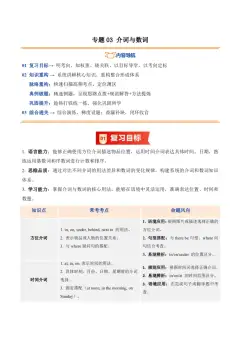
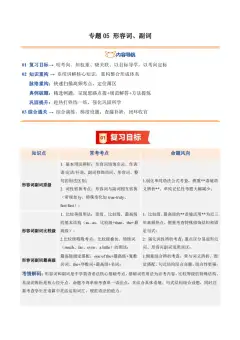
内容导航
01 复习目标→明考向、知权重、晓关联、以目标导学,以考向定标
02 知识重构→系统讲解核心知识,重构整合形成体系
脉络重构:快速扫描高频考点,定位薄区
典例破题:精选例题,呈现思路点拨+规范解答+方法提炼
巩固提升:趁热打铁练一练,强化巩固所学
03 综合通关→综合演练,梯度设题;查漏补缺,闭环收官
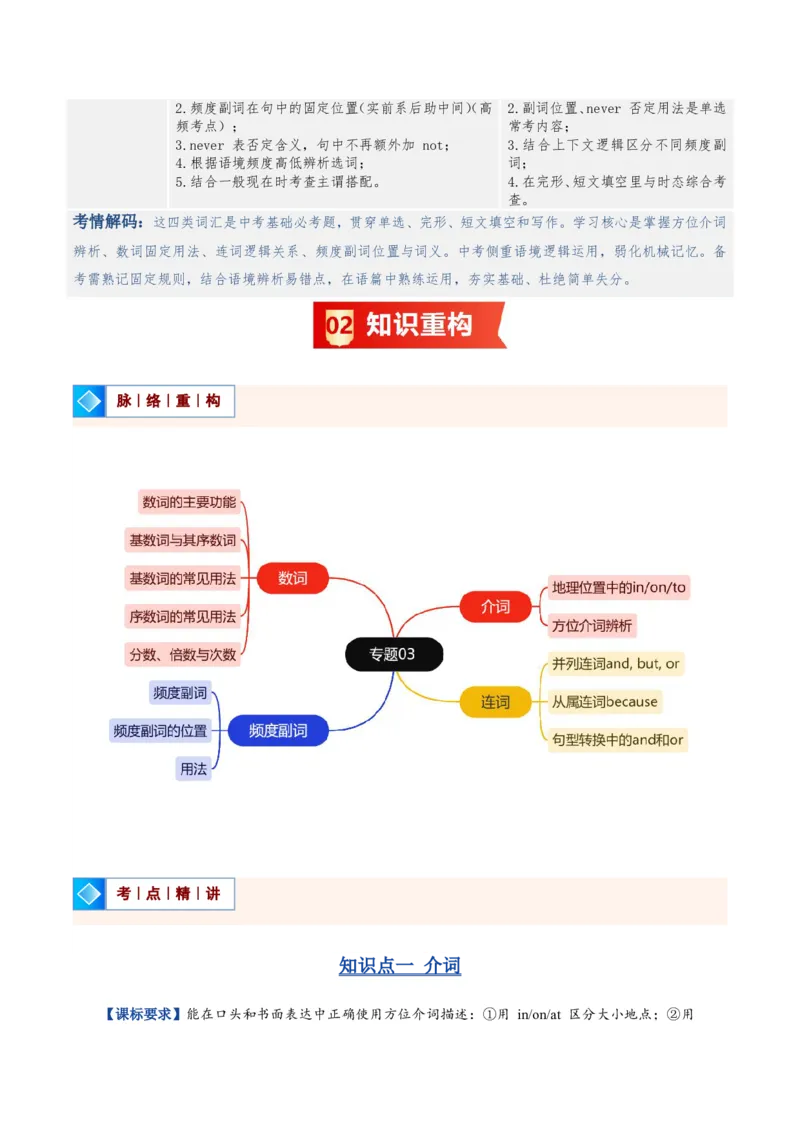
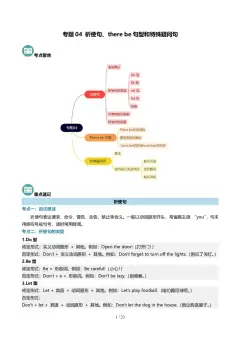
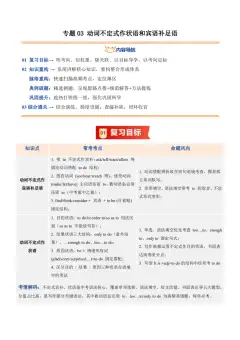
知识点
常考考点
命题风向
介词
1.in/on/at 用于大中小地点辨析;
2.on/in/under 表示物体上下、里外位置;
3.between/among 区分两者之间与多者之间(高频考
点);
4.in front of/in the front of 辨析范围内外的前
面;
5.beside/near/next to 表邻近位置用法区分。
1.依托图片、实景语境设题,孤立词
义识记题变少;
2.in front of 与in the front of
为中考单选高频考点;
3.易混介词对比辨析成为主流考查
形式;
4.在完形填空、短文填词中结合句式
综合考查。
数词
1.基数词表数量、序数词表顺序及序数词缩写变化;
2.hundred/thousand 前有具体数字不加s、模糊搭
配加s+of(高频考点);
3.年月日、时刻、编号的数词表达格式;
4.分数表达:分子基数词、分母序数词,分子大于1
分母变复数;
5.固定词组:in one's + 整十复数,表示在某人几
十多岁。
1.结合生活情境出题,纯机械拼写考
查变少;
2.hundred/thousand 用法是单选、
短文填空高频考点;
3.侧重基数词、序数词、分数三者辨
析选型;
4.完形与书面表达中融合日期、年龄
等数词应用。
连词
1.and 表顺承并列,用于肯定句连接单词或分句;
2.or 表选择、否定句并列,祈使句+ or 表否则;
3.but 表转折含义,不能与though 连用(高频考
点);
4.because 引导原因状语从句,回答why 提问;
5.结合句子逻辑辨析四类连词词义选用。
1.依托上下文逻辑选词,孤立词义识
记题型减少;
2.but 与because 语境辨析为中考
单选高频考点;
3.侧重句式逻辑对比,区分并列与因
果关系;
4.在完形填空、短文填空里结合语篇
考查连词。
频度副词
1.always/usually/often/sometimes/seldom/never
频度词义与强弱排序;
1.依托生活情景判断频率,单纯词义
默写题目变少;
2.频度副词在句中的固定位置(实前系后助中间)
(高
频考点);
3.never 表否定含义,句中不再额外加not;
4.根据语境频度高低辨析选词;
5.结合一般现在时考查主谓搭配。
2.副词位置、never 否定用法是单选
常考内容;
3.结合上下文逻辑区分不同频度副
词;
4.在完形、短文填空里与时态综合考
查。
考情解码:这四类词汇是中考基础必考题,贯穿单选、完形、短文填空和写作。学习核心是掌握方位介词
辨析、数词固定用法、连词逻辑关系、频度副词位置与词义。中考侧重语境逻辑运用,弱化机械记忆。备
考需熟记固定规则,结合语境辨析易错点,在语篇中熟练运用,夯实基础、杜绝简单失分。
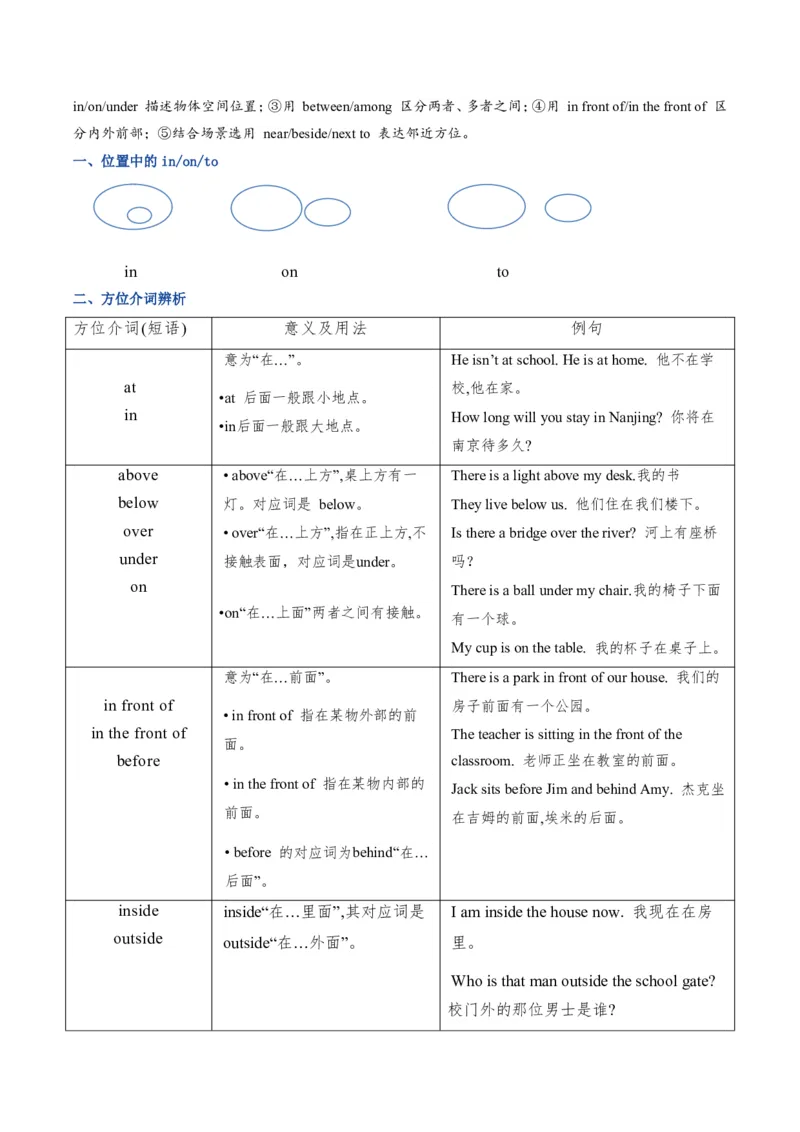
脉|络|重|构
考|点|精|讲
知识点一介词
【课标要求】能在口头和书面表达中正确使用方位介词描述:①用in/on/at 区分大小地点;②用
in/on/under 描述物体空间位置;③用between/among 区分两者、多者之间;④用in front of/in the front of 区
分内外前部;⑤结合场景选用near/beside/next to 表达邻近方位。
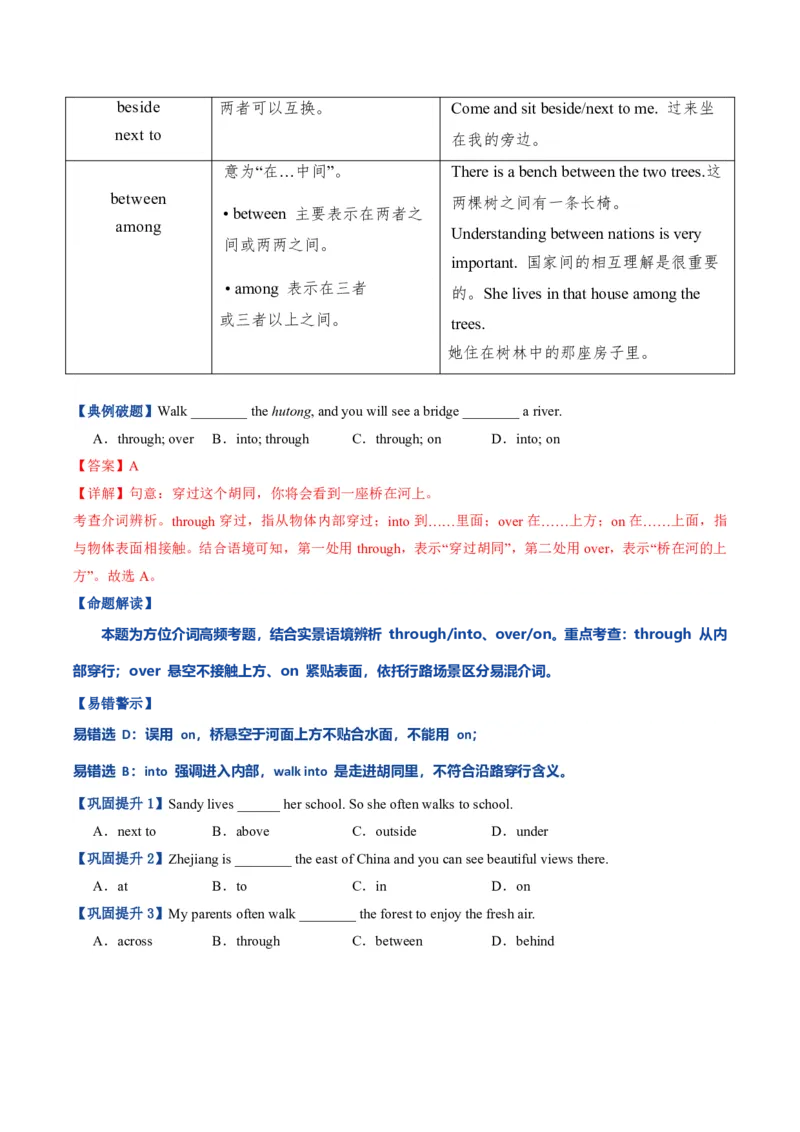
一、位置中的in/on/to
in
on
to
二、方位介词辨析
方位介词(短语)
意义及用法
例句
at
in
意为“在…”。
•at 后面一般跟小地点。
•in后面一般跟大地点。
He isn’t at school. He is at home. 他不在学
校,他在家。
How long will you stay in Nanjing? 你将在
南京待多久?
above
below
over
under
on
• above“在…上方”,桌上方有一
灯。对应词是below。
• over“在…上方”,指在正上方,不
接触表面,对应词是under。
•on“在…上面”两者之间有接触。
There is a light above my desk.我的书
They live below us. 他们住在我们楼下。
Is there a bridge over the river? 河上有座桥
吗?
There is a ball under my chair.我的椅子下面
有一个球。
My cup is on the table. 我的杯子在桌子上。
in front of
in the front of
before
意为“在…前面”。
• in front of 指在某物外部的前
面。
• in the front of 指在某物内部的
前面。
• before 的对应词为behind“在…
后面”。
There is a park in front of our house. 我们的
房子前面有一个公园。
The teacher is sitting in the front of the
classroom. 老师正坐在教室的前面。
Jack sits before Jim and behind Amy. 杰克坐
在吉姆的前面,埃米的后面。
inside
outside
inside“在…里面”,其对应词是
outside“在…外面”。
I am inside the house now. 我现在在房
里。
Who is that man outside the school gate?
校门外的那位男士是谁?
beside
next to
两者可以互换。
Come and sit beside/next to me. 过来坐
在我的旁边。
between
among
意为“在…中间”。
• between 主要表示在两者之
间或两两之间。
• among 表示在三者
或三者以上之间。
There is a bench between the two trees.这
两棵树之间有一条长椅。
Understanding between nations is very
important. 国家间的相互理解是很重要
的。She lives in that house among the
trees.
她住在树林中的那座房子里。
【典例破题】Walk ________ the hutong, and you will see a bridge ________ a river.
A.through; over
B.into; through
C.through; on
D.into; on
【答案】A
【详解】句意:穿过这个胡同,你将会看到一座桥在河上。
考查介词辨析。through 穿过,指从物体内部穿过;into 到……里面;over 在……上方;on 在……上面,指
与物体表面相接触。结合语境可知,第一处用through,表示“穿过胡同”,第二处用over,表示“桥在河的上
方”。故选A。
【命题解读】
本题为方位介词高频考题,结合实景语境辨析through/into、over/on。重点考查:through 从内
部穿行;over 悬空不接触上方、on 紧贴表面,依托行路场景区分易混介词。
【易错警示】
易错选D:误用on,桥悬空于河面上方不贴合水面,不能用on;
易错选B:into 强调进入内部,walk into 是走进胡同里,不符合沿路穿行含义。
【巩固提升1】Sandy lives ______ her school. So she often walks to school.
A.next to
B.above
C.outside
D.under
【巩固提升2】Zhejiang is ________ the east of China and you can see beautiful views there.
A.at
B.to
C.in
D.on
【巩固提升3】My parents often walk ________ the forest to enjoy the fresh air.
A.across
B.through
C.between
D.behind
知识点二数词
【课标要求】能在口头和书面表达中正确使用数词:①用基数词表达事物数量;②用序数词表示事物
排列顺序;③正确表达日期、时刻、编号等常用格式;④规范书写分数、hundred/thousand 相关短语;⑤运
用in one's + 整十复数表达年龄段。
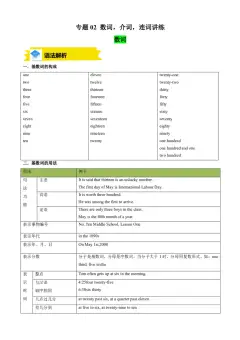
一、数词的主要功能
数词有基数词(在课本单词表中标记为num.)和序数词两种。基数词用于计
数,序数词用于表示位置或顺序。
二、基数词与序数词
1.数字0(零)的表达方式:zero、nought、nil或字母0(说电话号码等时表示)
A million is written as a one followed by six zeros(zeroes/noughts).一百万写作一后面跟着六个
零。
nought point seven five(英式口语)0.75
Man United won the game three-nil.(英式英语)曼联三比零赢了比赛。
My number is six o double three.我的号码是6033。
2.100以内的基数词与其序数词
基数
词变
序数
词口
诀:
123 单
独记,
结尾t d d, th 四加起,8 去t,,9 去e,5 和12 好兄弟,ve 要用f 替,整十把y 变为ieth,如果遇到几十几,
只变个位就可以。
3.100以上的基数词与其序数词
数
基数词
序数词(只变化最后一位非零数字)
101
one hundred and one
one hundred and first
123
one hundred and twenty-three
… and twenty-third
数基数词序数词
数
基数词
序数词
数
基数词
序数词
数
基数词
序数词
1
one
first
11
eleven
eleventh
21
twenty-one
twenty-first
2
two
second
12
twelve
twelfth
20
twenty
在基数词
的基础上,
将y 变
i加-eth
(如twentieth)
22
twenty-two
twenty-second
3
three
third
13
thirteen
在基数词
的基础上,
在-teen
后加-th
(如
fifteenth)
30
thirty
33
thirty-three
thirty-third
4
four
fourth
14
fourteen
40
forty
44
forty-four
forty-fourth
5
five
fifth
15
fifteen
50
fifty
55
fifty-five
fifty-fifth
6
six
sixth
16
sixteen
60
sixty
66
sixty-six
sixty-sixth
7
seven
seventh
17
seventeen
70
seventy
77
seventy-seven
seventy-seventh
8
eight
eighth
18
eighteen
80
eighty
88
eighty-eight
eighty-eighth
9
nine
ninth
19
nineteen
90
ninety
ninety-nine
ninety-ninth
10 ten
tenth
100 one hundred one hundredth
1,000
one thousand
one thousandth
12,345
twelve thousand, three hundred and forty-five
… and forty-fifth
100,000
one hundred thousand
one hundred thousandth
1,000,000
one million
one millionth
12,345,678
twelve million, three hundred and forty-five thousand, six
hundred and seventy-eight
… and seventy-eighth
1,000,000,000
one billion
one billionth
12,345,678,910
twelve billion, three hundred and forty-five million, six
hundred and seventy-eight thousand, nine hundred and ten
… and tenth
注:三位数的读法:基数词+and+几十几或者基数词+and+几
四位及以上数字的读法:从右向左三逗开,一“,”千(thousand),二“,”百万(million),三“,”十亿
(billion)
三、基数词的常见用法
1.表示概数
hundreds/thousands/millions of 数百/千/百万
2.表示时刻、年月、世纪等
five ten/ten past five 五点十分
nineteen ninety-eight 1998年
June 2024 2024年6月
twenty century 20世纪
3.表示年龄、时间、距离、长度等
They have an eight-month-old baby.他们有个八个月大的孩子。(此类复合形容词只作定
语)
This building is 100 metres tall.这栋楼一百米高。(此类词组常作表语)
4.表示时间段和年龄段
the nineteen forties(1940s/1940’s)20世纪40年代
in one's fifties 在某人五十多岁时
5.表示编号
Class 8, Grade 9 九年级八班
Room 802 802室
No.1 Middle School 第一中学
四、序数词的常见用法
1.序数词通常前面要加定冠词the,除非前面已有形容词性物主代词
The sixth girl on the left is my cousin.左边第六个女孩是我的表妹。
I still remember my first day of school.我仍然记得我上学的第一天。
2.“不定冠词+序数词”表示“又一,再一”
They have a second home in Italy. 他们在意大利还有一个家。
3.年、月、日中“日”的表达方法on May 13th, 2013
4.“the/形容词性物主代词+序数词(+n.)+ to do sth.“表示”第几个做某事(的人/事物)
He is always the first to get to school.他总是第一个到学校。
五、分数、倍数与次数
1、分数的表达(口诀:子基母序,分子大于1,分母加s)
分数的表达:分子是基数词或a,分母是序数词或half/quarter。如果分子大于1,序数词要用复数。
2、倍数词与倍数表达
(1)倍数词的构成:两倍是twice,其他均由"数词+ times"组成,如three times。(不存在"一倍"
的说法,"多一倍"即是两倍)
(2)常见的倍数结构
①倍数词+as+形容词或副词原级+as;
The room is twice as large as the kitchen.
②倍数词+形容词或副词比较级(如greater, longer, faster)+ than;
The room is twice larger than the kitchen.
③倍数词+ the+ width/length/breadth/size/… of表达"这个房间是厨房的两倍。":
The room is twice the size of the kitchen.
3、次数的表达
次数的表达: once"一次"、twice"两次",其他均由"数词+ times"组成(均作副词使用)。
I called you twice. 我给你打了两次电话。
【典例破题】—What should we do now?
—Please turn to page ________ and look at ________ picture.
1/2
a/one half
1/3
a/one third(或one-third)
1/4
a/one quarter(或a/one fourth)
3/4
three quarters/three fourths
A.twelve; the fifth
B.twelfth; the fifth
C.twelve; a fifth
D.the twelfth; the
five
【答案】A
【详解】句意:——现在我们应该做什么?——请翻到12 页,看第五张图。
考查数词。twelve 十二,是基数词;fifth 第五,是序数词;five 五,是基数词;twelfth 第十二,是序数词。
第一空表示页数,用page+基数词,因此用twelve;第二空特指第几张图片,用序数词,前面加the。故选
A。
【命题解读】
本题考查基数词、序数词用法辨析,中考高频考点。重点:page + 基数词表页码;the + 序数词表
事物顺序,依托课堂情景区分两类数词使用规则。
【易错警示】
易错选B:错用序数词twelfth 搭配page,页码固定用page + 基数词;
易错选C:序数词表特指顺序前用定冠词the,不用a;
易错选D:序数词不能混用基数词five。
【巩固提升1】Lily goes home at four forty-five.
A.a quarter past five
B.a quarter to five
C.forty-five past five
D.a quarter to four
【巩固提升2】—Why do you get up so early?
—Today is my mother’s ________ birthday. I want to buy her a gift.
A.40
B.fourteenth
C.40th
D.fourteen
【巩固提升3】Mr Fu has ________ ducks in his yard. Nine are black and eleven are white.
A.seventeen
B.eighteen
C.nineteen
D.twenty
知识点三连词
【课标要求】能在口头和书面表达中正确使用and、or、but、because:①用and 连接并列成分,表顺
承关系;②用or 表选择、祈使句中表否则;③用but 表转折语义;④用because 引导原因从句,用来回
答why 问句;⑤依据上下文逻辑合理选用连词串联语句。
一、并列连词and, but,or
1.
概念:并列连词用来表示并列关系、转折关系、选择关系等(在单词表中,conj.表示连词)。并列连
词用来连接属于同一层次,并具有相同句法功能的单词、短语、或句子。
2.
常见的并列连词:
1)
and,表示并列、顺承等关系,意为“和;并且;而且”;
e.g.: They are my friends Tom and Jerry. 这是我的朋友汤姆和杰瑞。(连接单词)
Every day, he goes to the market and buys some vegetables. (连接短语)
每天,他都会去市场买一些蔬菜。
His father is a teacher and his mother is a doctor. (连接句子)
他父亲是一名老师,他母亲是一位医生。
2)
but,表示转折关系,意为“但是”;
e.g.: I like playing basketball, but I don’t want to play it today. (连接句子)
我喜欢打篮球,但是我今天不想打。
3)
or,表示选择关系,意为“或者”。
e.g.: You can come on Saturday or Sunday. 你可以周六来,也可以周天来。(连接单词)
You can go fishing with us, or you can just stay at home. (连接句子)
你可以和我们一起去钓鱼,也可以就待在家里。
二、从属连词because
1.
概念:从属连词用来引导从句。从句不能够单独存在,需要依附于另外一个句子(即主句)才能构成
完整的语义。从属连词只能用来引导句子,不能够连接单词或短语。
2.
从属连词because,意为“因为”,表示原因,引导原因状语从句,如:
He doesn’t like geography because it’s boring to him.
主句
原因状语从句
他不喜欢地理,因为地理对他来说很无聊。
3.
对从属连词because 引导的原因状语从句进行提问,用特殊疑问词why(为什么),如:
My favourite subject is geography because I like travelling.
→Why is your favourite subject geography?
He doesn’t like geography because it’s boring to him.
→Why doesn’t he like geography?
三、句型转换中的and 和or
句型转换时,肯定句中的and,要转换成否定句的or,如:
I like apples and bananas.
→I don’t like apples or bananas.
【典例破题】This is Betty ________ she is my friend, ________ she is not in my class.
A.and ; and
B.but ; and
C.and ; but
D.but ; but
【答案】C
【详解】句意:这是贝蒂,她是我的朋友,但是她不在我的班级。
考查连词辨析。and 和;but 但是。根据“This is Betty ...she is my friend”可知,空前空后是并列的顺承关系,
用连词and 连接;空二前面说“她是我朋友”,空后说“我们不在一个班”,前后之间存在转折关系,用连词
but 连接。故选C。
【命题解读】
本题考查并列连词and、but 的语境运用,依托人物介绍语境,考查顺承用and、转折用but 的用法,
是连词常规高频题型。
【易错警示】
易错选A:误将转折逻辑用and,忽略前后句意反差;
易错选B/D:首句前后为顺承介绍,不能用but。
【巩固提升1】Gina is my cousin,
she is my good friend.
A.well
B.and
C.but
D.for
【巩固提升2】We are making a big cake ________ it’s Dad’s birthday today.
A.because
B.until
C.once
D.if
【巩固提升3】I love Monday afternoons ________ we have a geography class. I’m not good at geograpy
________ I like my geography teacher very much.
A.and; but
B.because; but
C.because; and
D.but; and
知识点四频度副词
【课标要求】能在口头和书面表达中正确使用频度副词:①借助always、usually 等副词描述动作发生
频率;②掌握频度副词“实前系后助居中” 的句中位置;③运用never 表达否定含义,不再叠加否定词;
④依据频率强弱区分选词;⑤搭配一般现在时描述日常习惯性活动。
一、频度副词
usually, sometimes, always, often 等词在英文中被称为“频度副词”,是用来表示动作频率的,
即在一定的时间内动作重复发生或状态重复出现的次数。一般说来可按频率大小排列:
always>usually>often>sometimes>seldom(很少)>never(决不)
always(100%)
usually(80%)
often (30-50%)
sometimes(20%)
hardly ever(5%)
never(0%)
二、频度副词的位置
1. 在be 动词之后。如:She is sometimes very busy. 她有时很忙。
2. 在第一个动词或情态动词之后。如:
I will never forget the first time I met you. 我将永远忘不了和你的第一次见面。
3. 在实义动词之前。如:
We often go there. 我们常去那儿。
4. sometimes 也可放在句首、句中或句末,often 也可放在句末。如:
Sometimes she writes to me. 她有时候给我写信。
She writes to me often. 她经常给我写信。
三、频度副词的用法
1. often, always, usually 等通常和一般现在时连用,表示现在经常或反复发生的动作。如:
It often rains here in April. 这儿四月份常下雨。
2. always 与进行时连用时,并不强调动作正在进行,而是表示赞叹、厌烦等情绪。如:
He is always thinking of others. 他总是想着别人。(赞叹)
She is always asking silly questions. 她老是问些愚蠢的问题。(厌烦)
3. 对这些频度副词提问时,用how often。如:
I write to my brother sometimes.
How often do you write to your brother?
【典例破题】— I can only play basketball once a week. How about you?
— You are lucky. I ________ play basketball.
A.always
B.usually
C.often
D.seldom
【答案】D
【详解】句意:——我一周只能打一次篮球。你呢?—— 你真幸运。我很少打篮球。
考查频度副词辨析。always 总是;usually 通常;often 经常;seldom 很少。根据“I can only play basketball once
a week.”以及“You are lucky”可知,说话者认为对方能一周打一次篮球已经很幸运,暗示自己打篮球的频率
更低,因此此处指的是“很少”,故选D。
【命题解读】
本题考查频度副词词义辨析,依托对话语境命题。通过上下文“一周一次、你很幸运” 判断频率高
低,区分always/usually/often/seldom 的频率层级,为高频考题。
【易错警示】
易错选A/B/C:误解“You are lucky” 含义,错选高频副词;
未抓住语境暗含自身打球频次更低,误判句意。
【巩固提升1】Sam is really a fan of history. He ________ visits museums first wherever he travels.
A.always
B.sometimes
C.seldom
D.never
【巩固提升2】Mike is a good student. He ________ comes to school early. He is ________ late for school.
A.often; always
B.always; never
C.never; sometimes
D.sometimes; usually
【巩固提升3】—I don’t like sweets, do you like chocolate?
—No, I don’t, but I ______ have a little to give me some energy.
A.usually
B.often
C.sometimes
D.always
一、单项选择
1.—Look! I just can’t do this movement perfectly! What should I do?
—Well, in Dunhuang dance, this part needs you to lift your hands ________ your head.
A.across
B.under
C.between
D.above
2.The bookshop is on ________side of the street, you must go ________the road to buy books.
A.other, across
B.the other, through
C.other, through
D.the other, across
3.Beijing is ________ the north of China and Japan is ________ the east of China.
A.in; to
B.to; in
C.on; to
D.in; on
4.To find Oz, Dorothy and her friends walk ________ the forest and go ________ the wide river.
A.across; through B.through; across
C.across; across
D.through; through
5.The company is so famous that ________ people want to work there. But only ________ the people will get the
job.
A.thousands of; hundreds of
B.thousands; hundreds of
C.thousands of; two hundred
D.thousands of; two hundred of
6.My grandmother will be ________ years old next month. We are going to have a big party for her ________
birthday.
A.eighty; eightieth B.eightieth; eighty
C.eighty; eighty
D.eightieth; eightieth
7.The number of the fans going to the football match is about three ________, and ________ of them are girls.
A.thousand; two-third
B.thousands; two-third
C.thousand; two-thirds
D.thousands; two-thirds
8.The runner fell ________ he quickly got up and went on running.
A.so
B.or
C.but
D.down
9.I like bananas, ________ I don’t like apples.
A.and
B.but
C.or
D.so
10.—Did he tell the truth to his mother ________ to his teacher?
—Neither.
A.or
B.and
C.but
D.so
11.Mona is usually kind to us. But ________ she can be very serious.
A.sometimes
B.always
C.often
D.never
12.He is never late for school. He ________ follows the school rules strictly.
A.never
B.sometimes
C.always
D.ever
13.—Does Sam like basketball?
— No. He ________ plays it. Maybe only once a year.
A.usually
B.always
C.seldom
D.often
14.Emma gets up early every day, so she is _________ late for school.
A.never
B.sometimes
C.always
D.usually
15.—________ do you play football?
— Three times a week.
A.How long
B.How much
C.How far
D.How often
二、短文填空
阅读短文,在文中空白处填入1 个适当的单词,或用括号内所给单词的正确形式填空。
China is a big country. People in different places live in different
1
of houses. These houses
2
(be) very interesting.
In the east of China, some people live near the sea. They build houses with stone and seagrass. These houses
are very strong. They can keep people warm in winter and cool
3
summer. The wind is
4
(usual) strong there, but the houses do not break.
In the south-west of China, there are many mountains. People there live in bamboo houses. The houses
usually have two floors. The ground floor is completely open. This helps
5
(keep) the house dry and
cool. It is also
6
safe place from wild animals.
In the north of China, people there live in yurts. They are made using wood and cloth. They are light and
easy to carry. People can take it down
7
build it again in a new place. This is very
8
(help) for
them because they move around with their animals.
These houses are all very special. They are popular with
9
(visit) from all over the world. People
in different places build different houses
10
(live) a better life.