1 / 13
学科网(北京)股份有限公司
专题03 介词、数词、连词和频度副词
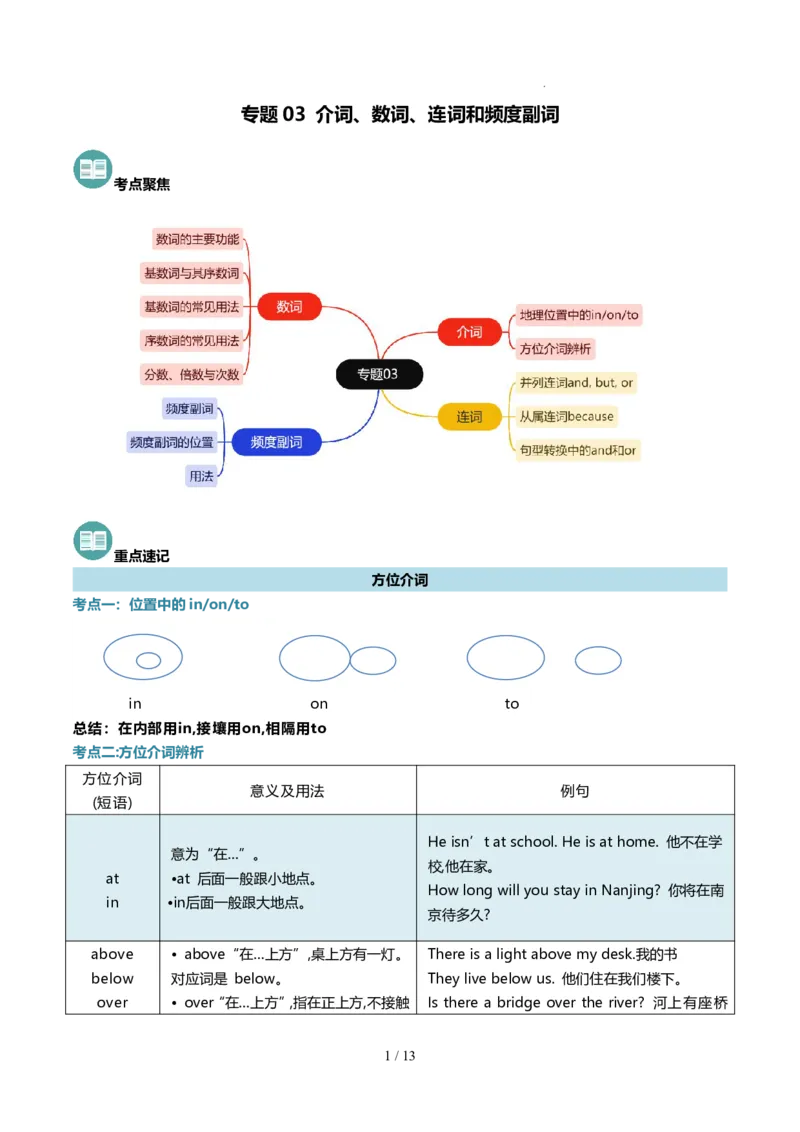
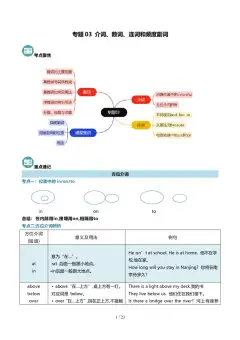
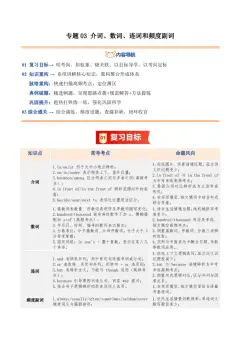
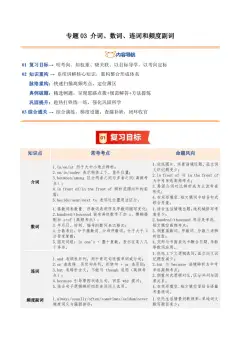
考点聚焦
重点速记
方位介词
考点一:位置中的in/on/to
in
on
to
总结:在内部用in,接壤用on,相隔用to
考点二:方位介词辨析
方位介词
(短语)
意义及用法
例句
at
in
意为“在…”。
•at 后面一般跟小地点。
•in后面一般跟大地点。
He isn’t at school. He is at home. 他不在学
校,他在家。
How long will you stay in Nanjing? 你将在南
京待多久?
above
below
over
• above“在…上方”,桌上方有一灯。
对应词是below。
• over“在…上方”,指在正上方,不接触
There is a light above my desk.我的书
They live below us. 他们住在我们楼下。
Is there a bridge over the river? 河上有座桥
2 / 13
学科网(北京)股份有限公司
under
on
表面,对应词是under。
•on“在…上面”两者之间有接触。
吗?
There is a ball under my chair.我的椅子下面有
一个球。
My cup is on the table. 我的杯子在桌子上。
in front of
in the
front of
before
意为“在…前面”。
• in front of 指在某物外部的前面。
• in the front of 指在某物内部的前
面。
• before 的对应词为behind“在…后
面”。
There is a park in front of our house. 我们的
房子前面有一个公园。
The teacher is sitting in the front of the
classroom. 老师正坐在教室的前面。
Jack sits before Jim and behind Amy. 杰克坐
在吉姆的前面,埃米的后面。
inside
outside
inside“在…里面”,其对应词是
outside“在…外面”。
I am inside the house now. 我现在在房里。
Who is that man outside the school gate?
校门外的那位男士是谁?
beside
next to
两者可以互换。
Come and sit beside/next to me. 过来坐在我
的旁边。
between
among
意为“在…中间”。
• between 主要表示在两者之间或两
两之间。
• among 表示在三者
或三者以上之间。
There is a bench between the two trees.这两
棵树之间有一条长椅。
Understanding between nations is very
important. 国家间的相互理解是很重要的。
She lives in that house among the trees.
她住在树林中的那座房子里。
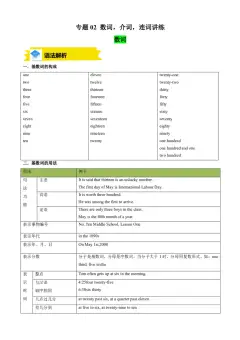
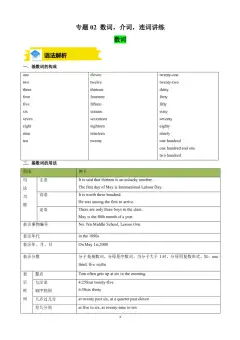
数词
考点一:数词的主要功能
数词有基数词(在课本单词表中标记为num.)和序数词两种。基数词用于计数,序数
词用于表示位置或顺序。
考点二:基础词与序数词
1.数字0(零)的表达方式:zero、nought、nil或字母0(说电话号码等时表示)
A million is written as a one followed by six zeros(zeroes/noughts).一百万写作一后面跟着六个零。
nought point seven five(英式口语)0.75
Man United won the game three-nil.(英式英语)曼联三比零赢了比赛。
My number is six o double three.我的号码是6033。
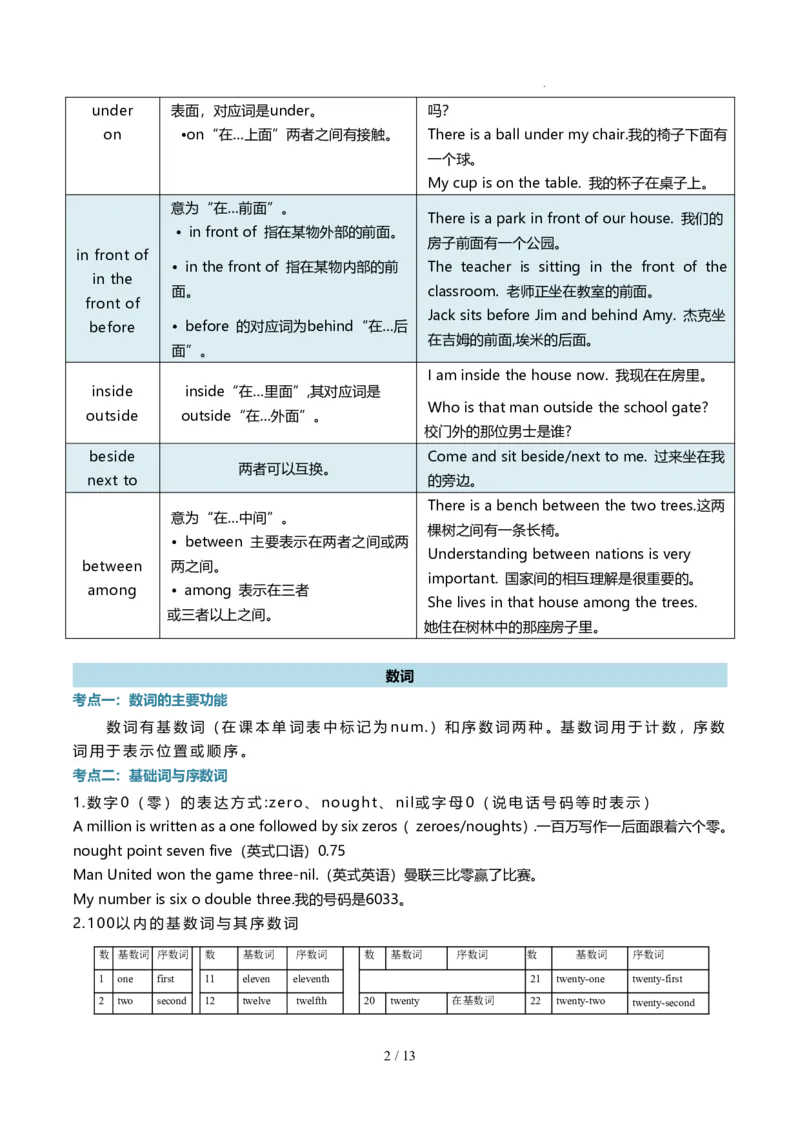
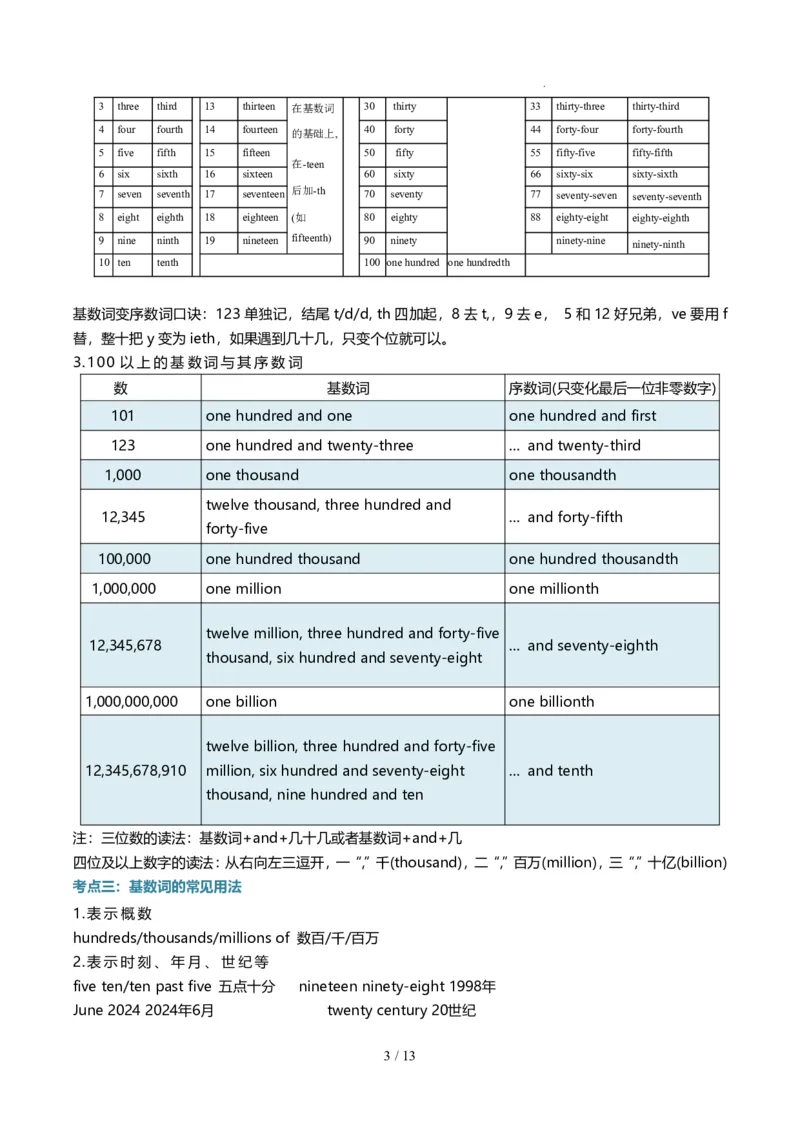
2.100以内的基数词与其序数词
数基数词序数词
数
基数词
序数词
数
基数词
序数词
数
基数词
序数词
1
one
first
11
eleven
eleventh
21
twenty-one
twenty-first
2
two
second
12
twelve
twelfth
20
twenty
在基数词
22
twenty-two
twenty-second
3 / 13
学科网(北京)股份有限公司
基数词变序数词口诀:123 单独记,结尾t/d/d, th 四加起,8 去t,,9 去e,5 和12 好兄弟,ve 要用f
替,整十把y 变为ieth,如果遇到几十几,只变个位就可以。
3.100 以上的基数词与其序数词
数
基数词
序数词(只变化最后一位非零数字)
101
one hundred and one
one hundred and first
123
one hundred and twenty-three
… and twenty-third
1,000
one thousand
one thousandth
12,345
twelve thousand, three hundred and
forty-five
… and forty-fifth
100,000
one hundred thousand
one hundred thousandth
1,000,000
one million
one millionth
12,345,678
twelve million, three hundred and forty-five
thousand, six hundred and seventy-eight
… and seventy-eighth
1,000,000,000
one billion
one billionth
12,345,678,910
twelve billion, three hundred and forty-five
million, six hundred and seventy-eight
thousand, nine hundred and ten
… and tenth
注:三位数的读法:基数词+and+几十几或者基数词+and+几
四位及以上数字的读法:从右向左三逗开,一“,”千(thousand),二“,”百万(million),三“,”十亿(billion)
考点三:基数词的常见用法
1.表示概数
hundreds/thousands/millions of 数百/千/百万
2.表示时刻、年月、世纪等
five ten/ten past five 五点十分
nineteen ninety-eight 1998年
June 2024 2024年6月
twenty century 20世纪
3
three
third
13
thirteen
在基数词
的基础上,
在-teen
后加-th
(如
fifteenth)
30
thirty
33
thirty-three
thirty-third
4
four
fourth
14
fourteen
40
forty
44
forty-four
forty-fourth
5
five
fifth
15
fifteen
50
fifty
55
fifty-five
fifty-fifth
6
six
sixth
16
sixteen
60
sixty
66
sixty-six
sixty-sixth
7
seven
seventh
17
seventeen
70
seventy
77
seventy-seven
seventy-seventh
8
eight
eighth
18
eighteen
80
eighty
88
eighty-eight
eighty-eighth
9
nine
ninth
19
nineteen
90
ninety
ninety-nine
ninety-ninth
10 ten
tenth
100 one hundred one hundredth
4 / 13
学科网(北京)股份有限公司
3.表示年龄、时间、距离、长度等
They have an eight-month-old baby.他们有个八个月大的孩子。(此类复合形容词只作定语)
This building is 100 metres tall.这栋楼一百米高。(此类词组常作表语)
4.表示时间段和年龄段
the nineteen forties(1940s/1940’s)20世纪40年代
in one's fifties 在某人五十多岁时
5.表示编号
Class 8, Grade 9 九年级八班
Room 802 802室
No.1 Middle School 第一中学
考点四:序数词的常见用法
1.序数词通常前面要加定冠词the,除非前面已有形容词性物主代词
The sixth girl on the left is my cousin.左边第六个女孩是我的表妹。
I still remember my first day of school.我仍然记得我上学的第一天。
2.“ 不定冠词+序数词” 表示“ 又一,再一”
They have a second home in Italy. 他们在意大利还有一个家。
3.年、月、日中“ 日” 的表达方法on May 13th, 2013
4.“the/形容词性物主代词+序数词(+n.)+ to do sth.“ 表示” 第几个做某事(的人/事物)
He is always the first to get to school.他总是第一个到学校。
考点五:分数、倍数、次数
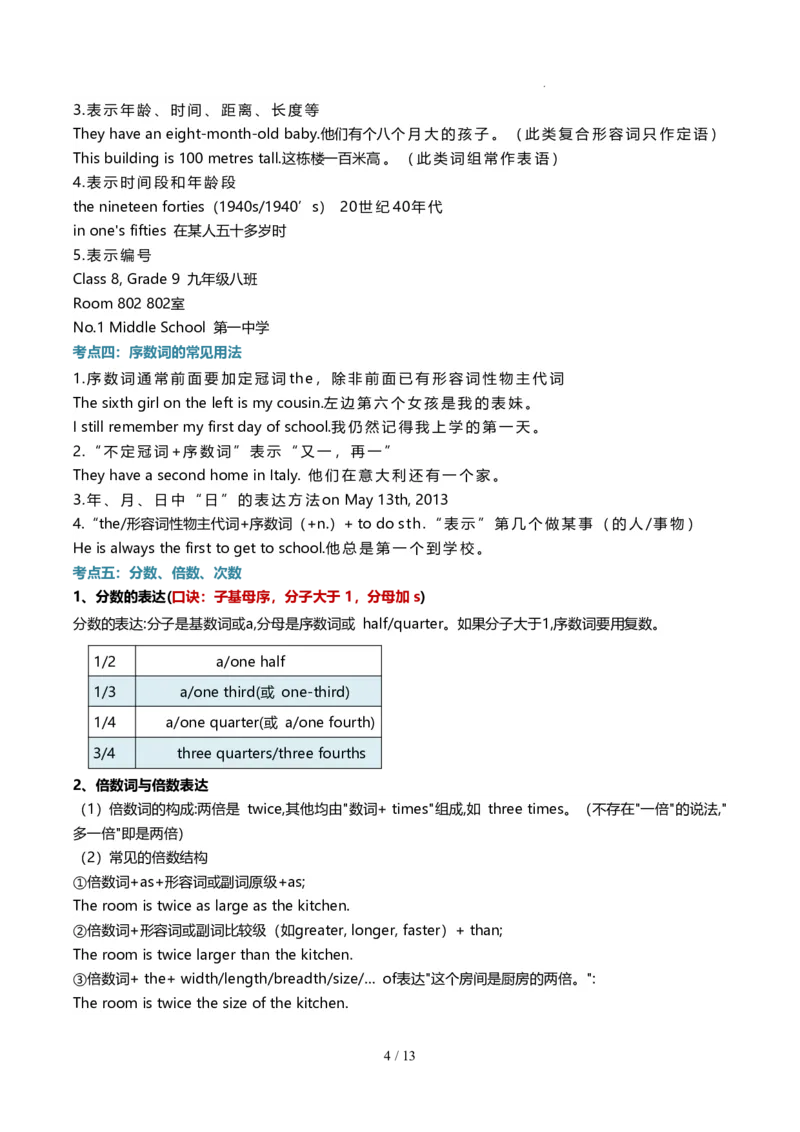
1、分数的表达(口诀:子基母序,分子大于1,分母加s)
分数的表达:分子是基数词或a,分母是序数词或half/quarter。如果分子大于1,序数词要用复数。
2、倍数词与倍数表达
(1)倍数词的构成:两倍是twice,其他均由"数词+ times"组成,如three times。(不存在"一倍"的说法,"
多一倍"即是两倍)
(2)常见的倍数结构
①倍数词+as+形容词或副词原级+as;
The room is twice as large as the kitchen.
②倍数词+形容词或副词比较级(如greater, longer, faster)+ than;
The room is twice larger than the kitchen.
③倍数词+ the+ width/length/breadth/size/… of表达"这个房间是厨房的两倍。":
The room is twice the size of the kitchen.
1/2
a/one half
1/3
a/one third(或one-third)
1/4
a/one quarter(或a/one fourth)
3/4
three quarters/three fourths
5 / 13
学科网(北京)股份有限公司
3、次数的表达
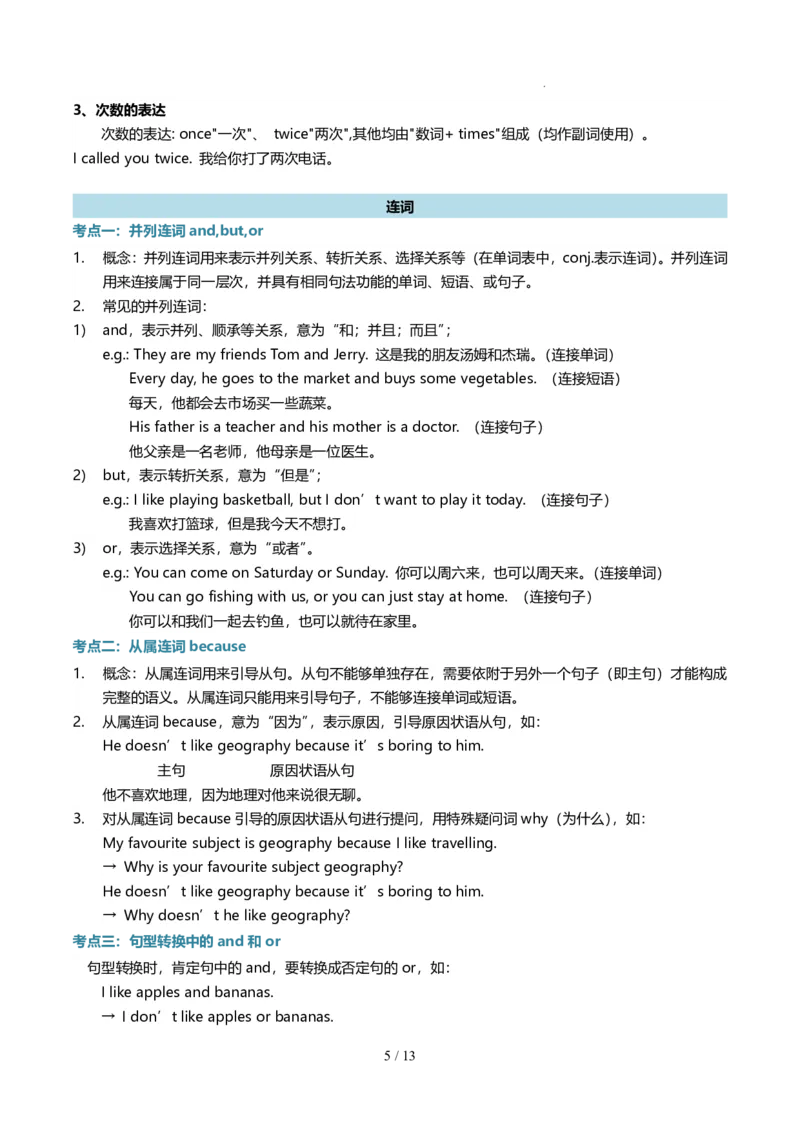
次数的表达: once"一次"、twice"两次",其他均由"数词+ times"组成(均作副词使用)。
I called you twice. 我给你打了两次电话。
连词
考点一:并列连词and,but,or
1.
概念:并列连词用来表示并列关系、转折关系、选择关系等(在单词表中,conj.表示连词)。并列连词
用来连接属于同一层次,并具有相同句法功能的单词、短语、或句子。
2.
常见的并列连词:
1)
and,表示并列、顺承等关系,意为“和;并且;而且”;
e.g.: They are my friends Tom and Jerry. 这是我的朋友汤姆和杰瑞。(连接单词)
Every day, he goes to the market and buys some vegetables. (连接短语)
每天,他都会去市场买一些蔬菜。
His father is a teacher and his mother is a doctor. (连接句子)
他父亲是一名老师,他母亲是一位医生。
2)
but,表示转折关系,意为“但是”;
e.g.: I like playing basketball, but I don’t want to play it today. (连接句子)
我喜欢打篮球,但是我今天不想打。
3)
or,表示选择关系,意为“或者”。
e.g.: You can come on Saturday or Sunday. 你可以周六来,也可以周天来。(连接单词)
You can go fishing with us, or you can just stay at home. (连接句子)
你可以和我们一起去钓鱼,也可以就待在家里。
考点二:从属连词because
1.
概念:从属连词用来引导从句。从句不能够单独存在,需要依附于另外一个句子(即主句)才能构成
完整的语义。从属连词只能用来引导句子,不能够连接单词或短语。
2.
从属连词because,意为“因为”,表示原因,引导原因状语从句,如:
He doesn’t like geography because it’s boring to him.
主句
原因状语从句
他不喜欢地理,因为地理对他来说很无聊。
3.
对从属连词because 引导的原因状语从句进行提问,用特殊疑问词why(为什么),如:
My favourite subject is geography because I like travelling.
→Why is your favourite subject geography?
He doesn’t like geography because it’s boring to him.
→Why doesn’t he like geography?
考点三:句型转换中的and 和or
句型转换时,肯定句中的and,要转换成否定句的or,如:
I like apples and bananas.
→I don’t like apples or bananas.
6 / 13
学科网(北京)股份有限公司
频度副词
考点一:频度副词
usually, sometimes, always, often 等词在英文中被称为“频度副词”,是用来表示动作频率的,即
在一定的时间内动作重复发生或状态重复出现的次数。一般说来可按频率大小排列:
always>usually>often>sometimes>seldom(很少)>never(决不)
always(100%)
usually(80%)
often (30-50%)
sometimes(20%)
hardly ever(5%)
never(0%)
考点二:频度副词的位置
1. 在be 动词之后。如:She is sometimes very busy. 她有时很忙。
2. 在第一个动词或情态动词之后。如:
I will never forget the first time I met you. 我将永远忘不了和你的第一次见面。
3. 在实义动词之前。如:
We often go there. 我们常去那儿。
4. sometimes 也可放在句首、句中或句末,often 也可放在句末。如:
Sometimes she writes to me. 她有时候给我写信。
She writes to me often. 她经常给我写信。
考点三:频度副词的用法
1. often, always, usually 等通常和一般现在时连用,表示现在经常或反复发生的动作。如:
It often rains here in April. 这儿四月份常下雨。
2. always 与进行时连用时,并不强调动作正在进行,而是表示赞叹、厌烦等情绪。如:
He is always thinking of others. 他总是想着别人。(赞叹)
She is always asking silly questions. 她老是问些愚蠢的问题。(厌烦)
3. 对这些频度副词提问时,用how often。如:
I write to my brother sometimes.
How often do you write to your brother?
难点强化
介词
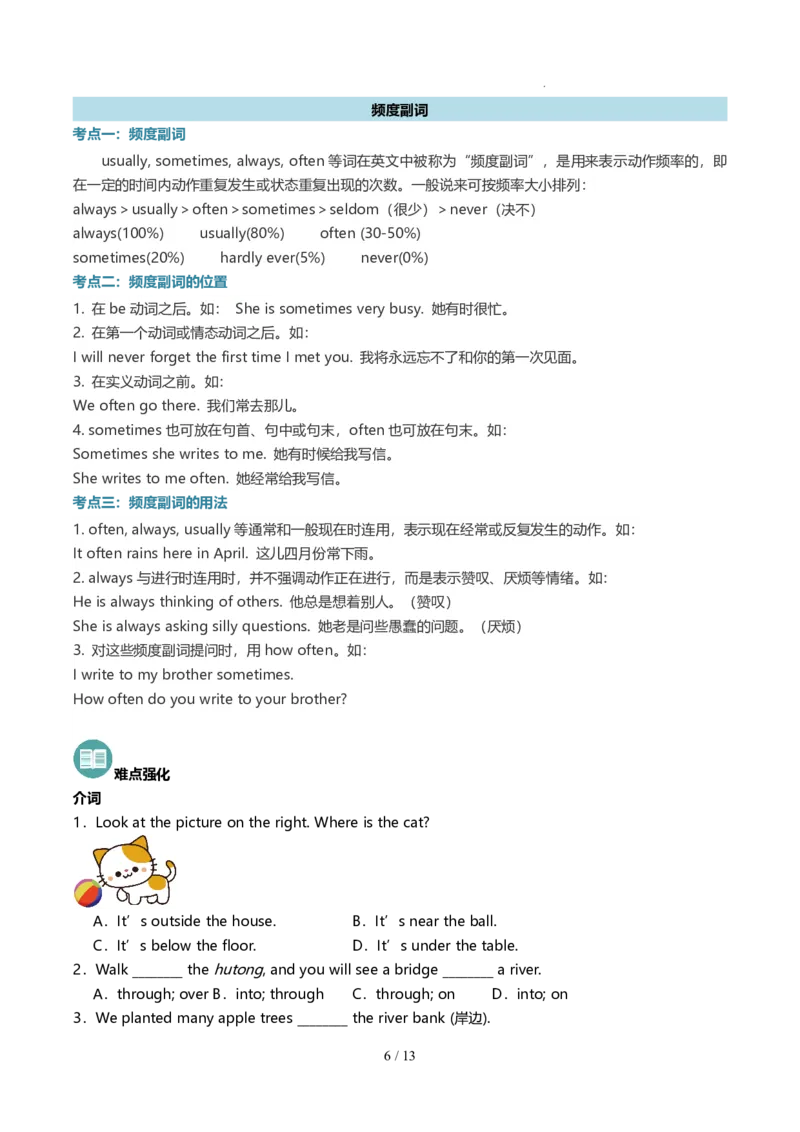
1.Look at the picture on the right. Where is the cat?
A.It’s outside the house.
B.It’s near the ball.
C.It’s below the floor.
D.It’s under the table.
2.Walk ________ the hutong, and you will see a bridge ________ a river.
A.through; over B.into; through
C.through; on
D.into; on
3.We planted many apple trees ________ the river bank (岸边).
7 / 13
学科网(北京)股份有限公司
A.in
B.under
C.along
D.over
4.—Excuse me. Could you please tell me where the playground is?
—It’s _______ the east of the school, _______ the classroom building.
A.to; in the front of
B.on; in front of
C.in; in front of D.in; in the front
of
5.Sandy lives ______ her school. So she often walks to school.
A.next to
B.above
C.outside
D.under
6.—Excuse me. Could you please tell me where the school library is?
—It’s ________ the west of the school, ________ the south of the classroom building.
A.to; to
B.on; in
C.to; in
D.in; to
7.Zhejiang is ________ the east of China and you can see beautiful views there.
A.at
B.to
C.in
D.on
8.—Where is the hospital?
—It’s ______ the park.
A.next
B.next to
C.between
D.in
9.My parents often walk ________ the forest to enjoy the fresh air.
A.across
B.through
C.between
D.behind
10.Mary is short, so she sits ________ the classroom.
A.across from
B.in front of
C.behind
D.in the front of
数词
1.Miss Zhou lives on the ________ floor, and I live two floors ________ her, on the eleventh floor.
A.ninth; below B.nineth; below
C.nineth; above
D.ninth; above
2.—What should we do now?
—Please turn to page ________ and look at ________ picture.
A.twelve; the fifth
B.twelfth; the fifth C.twelve; a fifth D.the twelfth;
the five
3.There are _________ days in a week and Thursday is _________ day of a week.
A.seventh; five B.seven; fifth
C.the seventh; five D.seven; the fifth
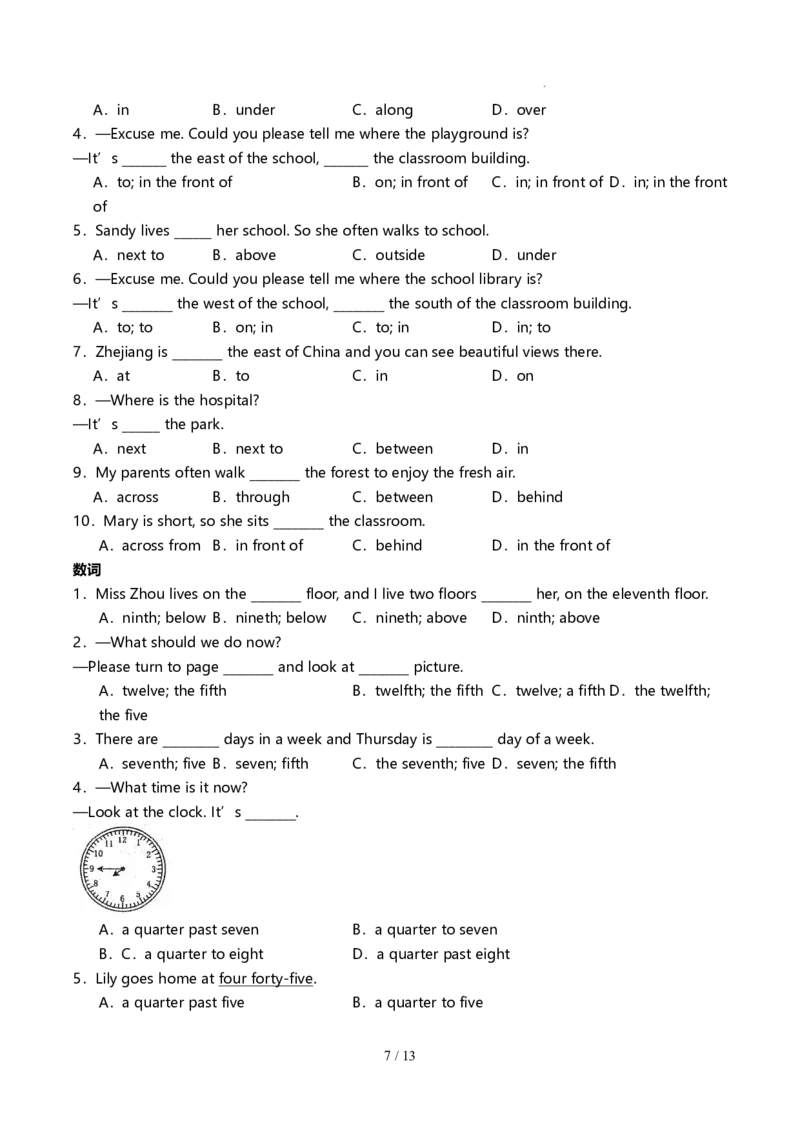
4.—What time is it now?
—Look at the clock. It’s ________.
A.a quarter past seven
B.a quarter to seven
B.C.a quarter to eight
D.a quarter past eight
5.Lily goes home at four forty-five.
A.a quarter past five
B.a quarter to five
8 / 13
学科网(北京)股份有限公司
C.forty-five past five
D.a quarter to four
6.—How do you say “1: 57” in English?
—It is ________.
A.three past two
B.three past one
C.three to one D.three to two
7.It’s 1:15. You can say it in English like this: ________
A.a quarter to one
B.a quarter to two
C.a quarter past two
D.a quarter past one
连词
1.This is Betty ________ she is my friend, ________ she is not in my class.
A.and ; and
B.but ; and
C.and ; but
D.but ; but
2.Gina is my cousin,
she is my good friend.
A.well
B.and
C.but
D.for
3.Our school is not big, ________ it’s very beautiful.
A.and
B.but
C.or
D.so
4.I usually drink coffee in the morning, ________ today I feel like drinking tea.
A.and
B.but
C.so
D.or
5.English is my favourite subject, ________ my brother doesn’t like it.
A.but
B.because
C.so
D.and
6.We are making a big cake ________ it’s Dad’s birthday today.
A.because
B.until
C.once
D.if
7.My sister doesn’t eat hamburgers ________ she doesn’t want to be fat.
A.or
B.so
C.but
D.because
8.We should protect wild animals ________ they are our friends.
A.because
B.so
C.but
D.or
频度副词
1.Lucy is a good student. She is ________ late for school.
A.sometimes
B.always
C.usually
D.never
2.I ________ play baseball. Because it is too difficult for me.
A.always
B.usually
C.sometimes
D.seldom
3.—What do you usually have for breakfast?
—I _________ have some bread and milk. Sometimes I have eggs and beans.
A.seldom
B.usually
C.always
D.never
4.—You look strong and healthy. ________ do you do sports?
—I ________ play basketball after school.
A.How much; often
B.How often; always
B.C.How often; seldom
D.How soon; sometimes
5.She ________ eats ice cream after dinner, but not often.
A.usually
B.sometimes
C.never
D.always
9 / 13
学科网(北京)股份有限公司
复习提升
真题感知
1.(2024·江苏扬州·中考真题)The Marco Polo Memorial Hall stands at the east end of Dongguan
Street ________ Yangzhou.
A.to
B.on
C.at
D.in
2.(2024·甘肃白银·中考真题)The bird in Picture ________ is between the boxes.
A.
B.
C.
D.
3.(24-25 七年级上·云南昆明·期末)The cat is ______ the chair. You can’t see it.
A.on
B.under
C.across from
D.next to
4.(24-25 七年级上·北京密云·期末)—Mum, where is my basketball?
—It’s ________ the door.
A.under
B.between
C.behind
D.on
5.(24-25 七年级上·河北石家庄·期中)Fu Xing is a tall girl. I sit ________ her, so I can’t see the
blackboard.
A.behind
B.close to
C.in front of
D.in the front of
6.(24-25 七年级上·全国·期末)—Why do you cross the street to get home?
—Because my home is ________ the school.
A.across from
B.in front of
C.between
D.at the back of
7.(2024·甘肃白银·中考真题)June is the ________ month of a year.
A.fifth
B.sixth
C.seventh
D.eighth
8.(2024·山东东营·中考真题)I am _____ child in my family. I have an elder brother and a younger
sister.
A.one
B.the first
C.the second
D.the third
9.(24-25 七年级上·河北保定·期末)________ month of a year is May.
A.Two
B.The second
C.Five
D.The fifth
10.(24-25 七年级上·安徽阜阳·期末)—Happy birthday, Cindy. And how old are you?
—I’m ________ and today is my ________ birthday.
A.twelve; twelve
B.twelve; twelfth
C.twelfth; twelfth
D.twelfth; twelve
11.(24-25 七年级上·四川眉山·期末)Mr Fu has ________ ducks in his yard. Nine are black and eleven
are white.
A.seventeen
B.eighteen
C.nineteen
D.twenty
12.(24-25 七年级上·甘肃陇南·期末)Which picture shows “It’s half past seven now”?
A.
B.
C.
D.
10 / 13
学科网(北京)股份有限公司
13.(24-25 七年级上·湖北武汉·期末)—Why do you get up so early?
—Today is my mother’s ________ birthday. I want to buy her a gift.
A.40
B.fourteenth
C.40th
D.fourteen
14.(24-25 七年级上·湖北武汉·期末)—What’s your family like?
—I have a big family, ________ we love each other very much.
A.but
B.and
C.because
D.so
15.(24-25 七年级上·甘肃张掖·期末)I like soccer ________ ping-pong, ________ I don’t like tennis.
A.and; and
B.and; but
C.but; and
D.but; but
16.(24-25 七年级上·云南昆明·期末)I love Monday afternoons ________ we have a geography class.
I’m not good at geograpy ________ I like my geography teacher very much.
A.and; but
B.because; but
C.because; and
D.but; and
17.(24-25 七年级上·江西吉安·期末)—Hi, Mike, would you like to play ping-pong with me?
—I’d love to, ______ I have to finish my homework.
A.because
B.and
C.so
D.but
18.(24-25 七年级上·北京石景山·期末)I live in the country. It’s not very big, ________ life here is
comfortable.
A.or
B.so
C.but
D.because
19.(24-25 七年级上·湖北孝感·期末)—Why do you like biology?
—_________ it’s interesting, _________ the teacher is really nice.
A.Because, but B.And, but
C.Because, and
D.And, or
20.
(24-25 七年级上·北京海淀·期末)Ms Gao always helps me work out problems, ______ I like her very
much.
A.or
B.so
C.for
D.but
21.(24-25 七年级上·江西九江·阶段练习)Cindy wants to go to Anhui for a trip
she likes Anhui
Cuisine (徽菜) very much.
A.so
B.because
C.but
D.or
22.
(21-22 七年级下·吉林长春·期末)________ Tom was late again, ________ the teacher was very angry.
A./; so
B.Because; so
C./; because
D./; but
23.(24-25 七年级下·江西吉安·期中)—Would you like some coffee?
—No, thanks. I ________ drink it. I think water is the best.
A.often
B.usually
C.never
D.always
24.(24-25 七年级下·江西南昌·期中)— I can only play basketball once a week. How about you?
— You are lucky. I ________ play basketball.
A.always
B.usually
C.often
D.seldom
25.
(24-25 七年级下·安徽宿州·期中)My mother is an English teacher. She is very busy every day and
she ________ has a good rest.
A.always
B.often
C.usually
D.hardly ever
26.(24-25 七年级上·江苏无锡·期末)Sam is really a fan of history. He ________ visits museums first
11 / 13
学科网(北京)股份有限公司
wherever he travels.
A.always
B.sometimes
C.seldom
D.never
27.(20-21 七年级上·广东广州·期中)I _________ go to school by bike, but when it rains I go to school
by bus.
A.usually
B.sometimes
C.hardly
D.never
28.(24-25 七年级上·安徽阜阳·期末)Lily likes swimming very much, so she ________ goes swimming
with her father.
A.never
B.sometimes
C.only
D.often
29.(24-25 七年级上·江苏扬州·期末)I am learning skating. At first, I didn’t skate well, but now I
________ fall down (跌倒).
A.seldom
B.always
C.often
D.sometimes
30.(24-25 七年级上·广东广州·期末)She loves cooking her own meals, and that’s why she ________
eats out.
A.always
B.often
C.sometimes
D.seldom
提升专练
1.Look! There is a tree ________ the house and a cat is lying ________ the tree.
A.in front of, between
B.in front of, under
C.from, under
D.between, on
2.Our school is ______ the park. That’s why the air here is always fresh.
A.next to
B.between
C.among
D.through
3.Shenzhen lies ________ the south of China but ________ the south of Guangzhou.
A.in; to
B.on; to
C.to; on
D.on; in
4.The cat in Picture ________ is behind the box.
A.
B.
C.
D.
5.—I can’t find my baseball.
—Oh, it’s ________ the sofa, so you can’t see it.
A.in
B.on
C.near
D.under
6.— Where do you sit, Amy?
— I sit ________ Betty. She is in front of me.
A.next to
B.behind
C.on the left of
D.on the right of
7.—Excuse me, how can I get to the restaurant from the library?
—You must cross the street. It’s ________ the library.
A.next to
B.across from
C.in front of
D.on the right of
8.How do you say “9: 50” in English?
A.ten past nine B.ten to ten
C.ten to nine
D.fifty past eight
9.—What’s the time?
12 / 13
学科网(北京)股份有限公司
—It’s a quarter _________ ten p.m. now.
A.of
B.at
C.to
D.past
10.Our class begins at 7: 30, so we must get to school at about ________.
A.half past eight
B.twenty to eight
C.a quarter past seven
D.a quarter to eight
11.Grain Rain (谷雨) often starts in April, the ________ month of the year.
A.second
B.third
C.fourth
D.fifth
12.Mr. Black is 50 years old and he is going to celebrate his ________ birthday.
A.fifty
B.fifth
C.fiftieth
D.the fiftieth
13.Kate is ______ child in her family. Her brother is ______ years older than her.
A.two, two
B.the second, second
C.the second, two
D.a second, two
14.There are ______ months in a year. The ______ month of the year is December.
A.twelve; twelve
B.twelve; twelfth
C.twelfth; twelve
D.twelfth; twelfth
15.—________ is Father’s Day?
—It is on the ________ Sunday in June.
A.What; third
B.What; three
C.When; three
D.When; third
16.There are ________ students in our class. I’m the ________ one in the name list.
A.fourty; nineth
B.forty; ninth
C.fortieth; nine
D.fortieth; ninth
17.— My goal is to go to the Tiangong Space Station as an astronaut.
—Work hard,________ you will make it.
A.and
B.so
C.if
D.unless
18.Wang Lingling is my friend, _________we are in the same class.
A.and
B.but
C.because
D.or
19.I have a brother _________ two sisters, ________ Lucy doesn’t.
A.and; but
B.but; and
C.and; and
D.but; but
20.My sister ________ I like bananas, ________ my brother doesn’t like them.
A.but, but
B.and, but
C.but, and
D.and, and
21.Elephants are in great danger __________ people kill them for their ivory.
A.but
B.or
C.because
D.so
22.—Why do you like pandas so much?
—________they’ re very clever.
13 / 13
学科网(北京)股份有限公司
A.Because
B.So
C.But
D.Or
23.We need to wear our sports shoes in PE classes ________ they can keep us safe (安全).
A.because
B.so
C.or
D.but
24.It’s easy for me to get up early ________ I always go to bed early.
A.and
B.but
C.because
D.so
25.Joyce ______ stays up late. She lives a healthy life.
A.hardly
B.always
C.often
D.sometimes
26.Mike is a good student. He ________ comes to school early. He is ________ late for school.
A.often; always B.always; never
C.never; sometimesD.sometimes; usually
27.—As a top football player, what does Messi like doing in his free time?
—He is a good father. He ________ plays with his three sons happily.
A.just
B.often
C.seldom
D.never
28.—I don’t like sweets, do you like chocolate?
—No, I don’t, but I ______ have a little to give me some energy.
A.usually
B.often
C.sometimes
D.always
29.—How often do they stay up(熬夜)late?
—________. They always go to bed early.
A.Three times a week
B.Every day
C.Never
D.Sometimes
30.—Do you _______ walk to school?
—No, _______. I live too far away.
A.often, never
B.usually, often
C.seldom, always
D.always, usually