1 / 14
学科网(北京)股份有限公司
专题02 名词、代词、形容词和情态动词
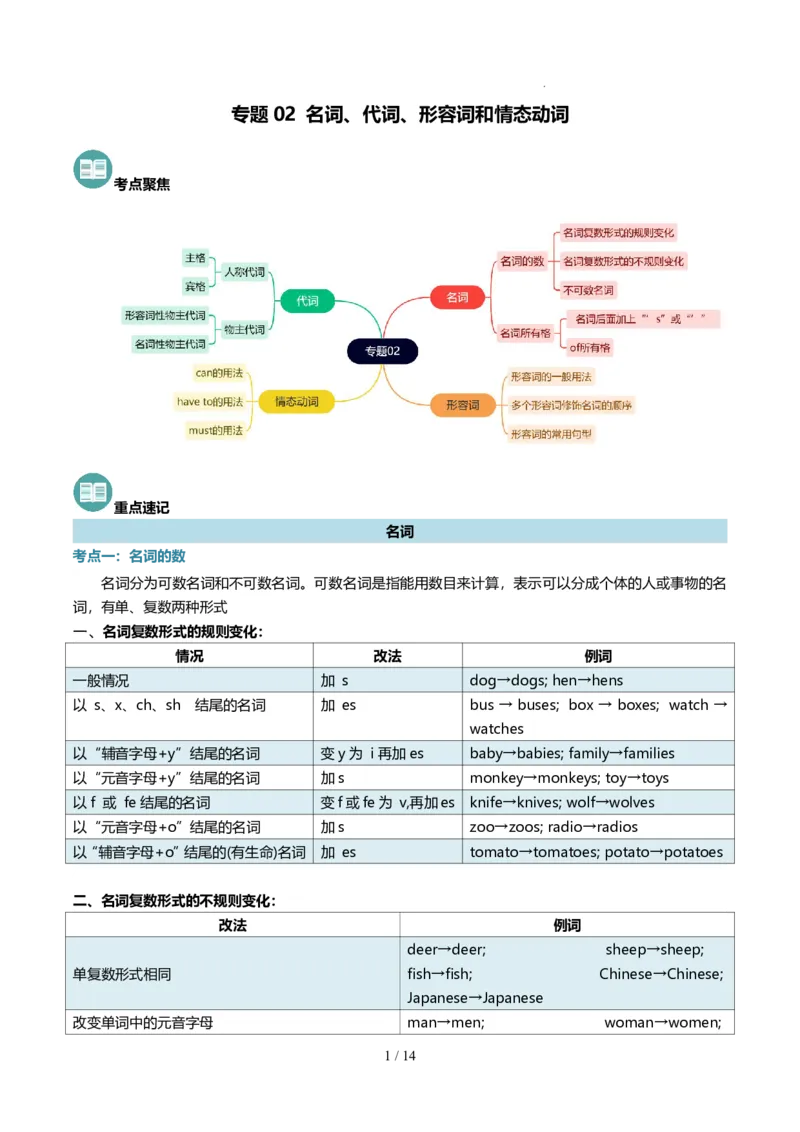
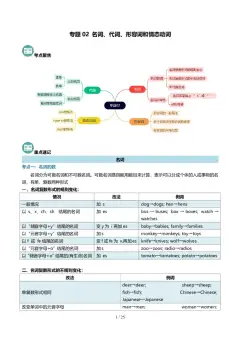
考点聚焦
重点速记
名词
考点一:名词的数
名词分为可数名词和不可数名词。可数名词是指能用数目来计算,表示可以分成个体的人或事物的名
词,有单、复数两种形式
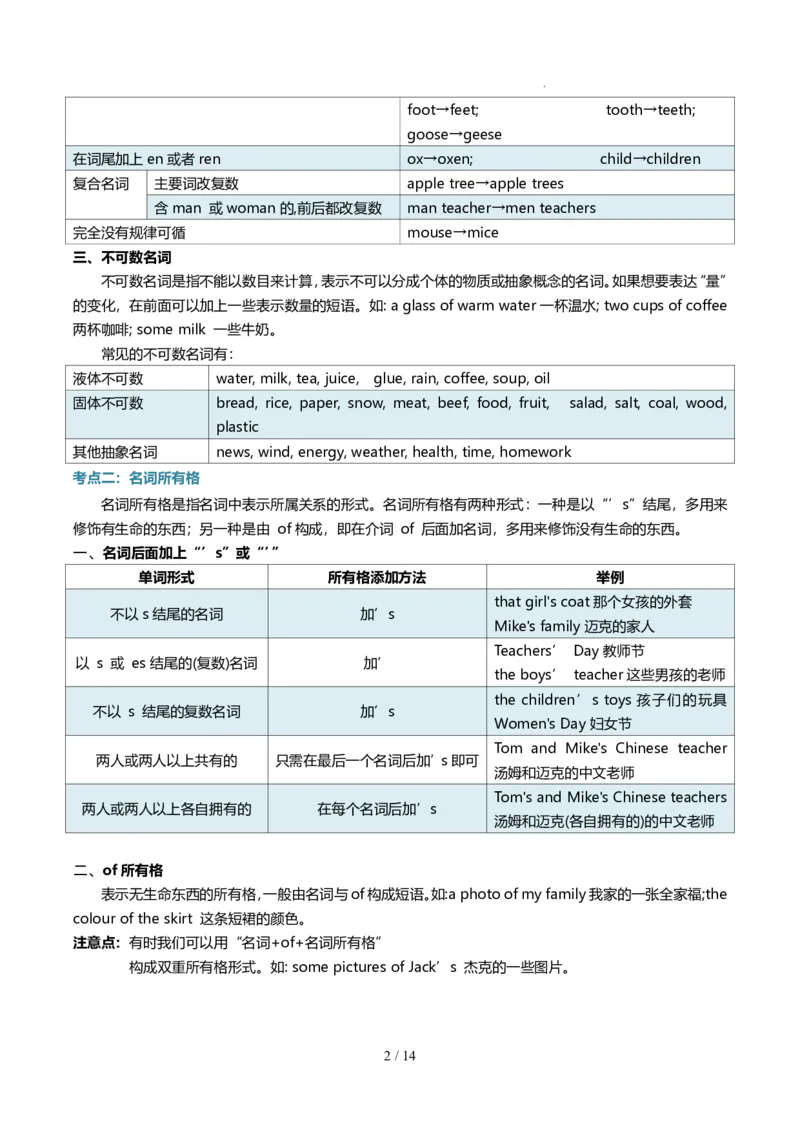
一、名词复数形式的规则变化:
情况
改法
例词
一般情况
加s
dog→dogs; hen→hens
以s、x、ch、sh
结尾的名词
加es
bus →buses; box →boxes; watch →
watches
以“辅音字母+y”结尾的名词
变y 为i 再加es
baby→babies; family→families
以“元音字母+y”结尾的名词
加s
monkey→monkeys; toy→toys
以f 或fe 结尾的名词
变f 或fe 为v,再加es
knife→knives; wolf→wolves
以“元音字母+o”结尾的名词
加s
zoo→zoos; radio→radios
以“辅音字母+o”结尾的(有生命)名词
加es
tomato→tomatoes; potato→potatoes
二、名词复数形式的不规则变化:
改法
例词
单复数形式相同
deer→deer;
sheep→sheep;
fish→fish;
Chinese→Chinese;
Japanese→Japanese
改变单词中的元音字母
man→men;
woman→women;
2 / 14
学科网(北京)股份有限公司
foot→feet;
tooth→teeth;
goose→geese
在词尾加上en 或者ren
ox→oxen;
child→children
复合名词
主要词改复数
apple tree→apple trees
含man 或woman 的,前后都改复数
man teacher→men teachers
完全没有规律可循
mouse→mice
三、不可数名词
不可数名词是指不能以数目来计算,表示不可以分成个体的物质或抽象概念的名词。如果想要表达“量”
的变化,在前面可以加上一些表示数量的短语。如: a glass of warm water 一杯温水; two cups of coffee
两杯咖啡; some milk 一些牛奶。
常见的不可数名词有:
液体不可数
water, milk, tea, juice,
glue, rain, coffee, soup, oil
固体不可数
bread, rice, paper, snow, meat, beef, food, fruit,
salad, salt, coal, wood,
plastic
其他抽象名词
news, wind, energy, weather, health, time, homework
考点二:名词所有格
名词所有格是指名词中表示所属关系的形式。名词所有格有两种形式:一种是以“’s”结尾,多用来
修饰有生命的东西;另一种是由of 构成,即在介词of 后面加名词,多用来修饰没有生命的东西。
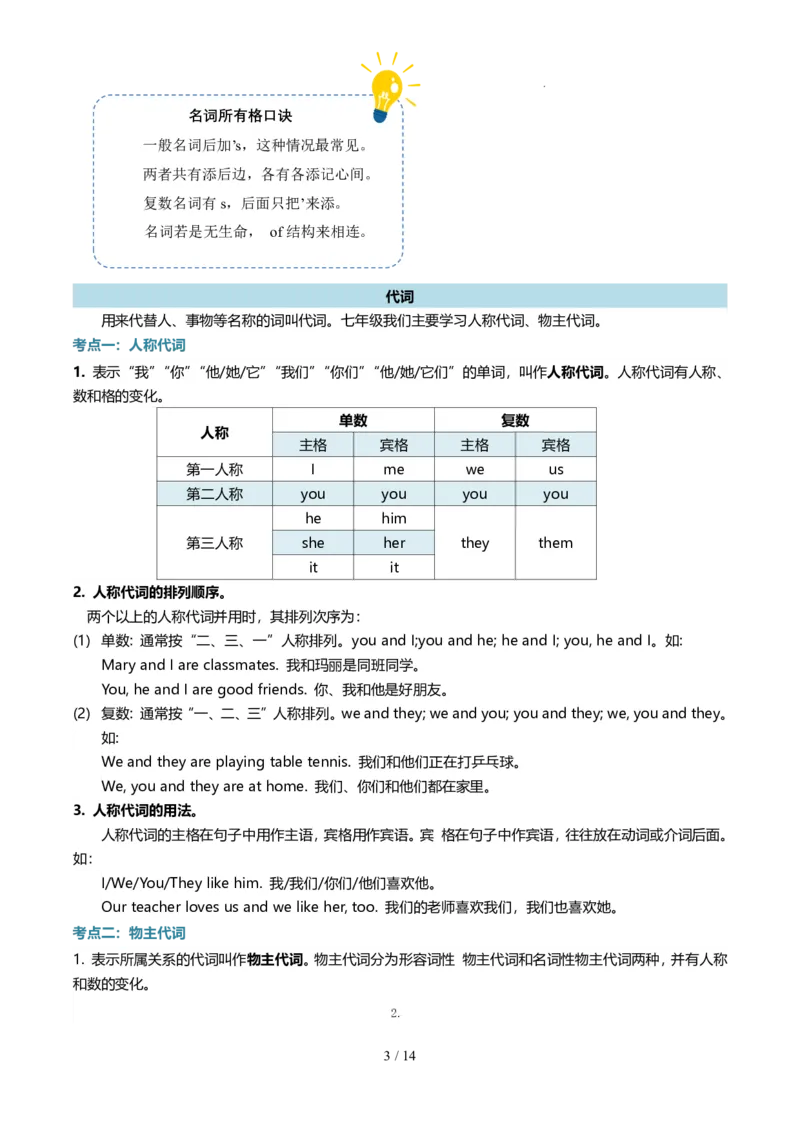
一、名词后面加上“’s”或“’”
单词形式
所有格添加方法
举例
不以s 结尾的名词
加’s
that girl's coat 那个女孩的外套
Mike's family 迈克的家人
以s 或es 结尾的(复数)名词
加’
Teachers’ Day 教师节
the boys’ teacher 这些男孩的老师
不以s 结尾的复数名词
加’s
the children’s toys 孩子们的玩具
Women's Day 妇女节
两人或两人以上共有的
只需在最后一个名词后加’s 即可
Tom and Mike's Chinese teacher
汤姆和迈克的中文老师
两人或两人以上各自拥有的
在每个名词后加’s
Tom's and Mike's Chinese teachers
汤姆和迈克(各自拥有的)的中文老师
二、of 所有格
表示无生命东西的所有格,一般由名词与of 构成短语。如:a photo of my family 我家的一张全家福;the
colour of the skirt 这条短裙的颜色。
注意点:有时我们可以用“名词+of+名词所有格”
构成双重所有格形式。如: some pictures of Jack’s 杰克的一些图片。
3 / 14
学科网(北京)股份有限公司
代词
用来代替人、事物等名称的词叫代词。七年级我们主要学习人称代词、物主代词。
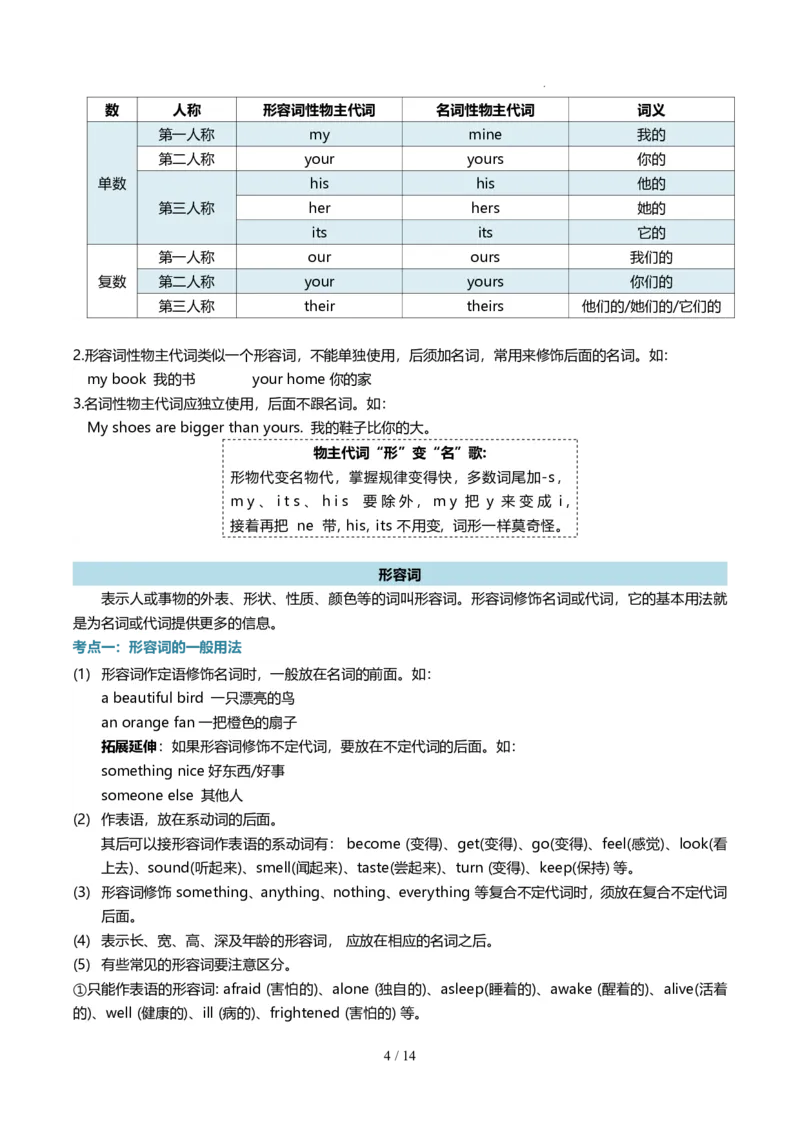
考点一:人称代词
1. 表示“我”“你”“他/她/它”“我们”“你们”“他/她/它们”的单词,叫作人称代词。人称代词有人称、
数和格的变化。
人称
单数
复数
主格
宾格
主格
宾格
第一人称
I
me
we
us
第二人称
you
you
you
you
第三人称
he
him
they
them
she
her
it
it
2. 人称代词的排列顺序。
两个以上的人称代词并用时,其排列次序为:
(1) 单数: 通常按“二、三、一”人称排列。you and I;you and he; he and I; you, he and I。如:
Mary and I are classmates. 我和玛丽是同班同学。
You, he and I are good friends. 你、我和他是好朋友。
(2) 复数: 通常按“一、二、三”人称排列。we and they; we and you; you and they; we, you and they。
如:
We and they are playing table tennis. 我们和他们正在打乒乓球。
We, you and they are at home. 我们、你们和他们都在家里。
3. 人称代词的用法。
人称代词的主格在句子中用作主语,宾格用作宾语。宾格在句子中作宾语,往往放在动词或介词后面。
如:
I/We/You/They like him. 我/我们/你们/他们喜欢他。
Our teacher loves us and we like her, too. 我们的老师喜欢我们,我们也喜欢她。
考点二:物主代词
1. 表示所属关系的代词叫作物主代词。物主代词分为形容词性物主代词和名词性物主代词两种,并有人称
和数的变化。
2.
名词所有格口诀
一般名词后加’s,这种情况最常见。
两者共有添后边,各有各添记心间。
复数名词有s,后面只把’来添。
名词若是无生命,of 结构来相连。
4 / 14
学科网(北京)股份有限公司
数
人称
形容词性物主代词
名词性物主代词
词义
单数
第一人称
my
mine
我的
第二人称
your
yours
你的
第三人称
his
his
他的
her
hers
她的
its
its
它的
复数
第一人称
our
ours
我们的
第二人称
your
yours
你们的
第三人称
their
theirs
他们的/她们的/它们的
2.形容词性物主代词类似一个形容词,不能单独使用,后须加名词,常用来修饰后面的名词。如:
my book 我的书
your home 你的家
3.名词性物主代词应独立使用,后面不跟名词。如:
My shoes are bigger than yours. 我的鞋子比你的大。
物主代词“形”变“名”歌:
形物代变名物代,掌握规律变得快,多数词尾加-s,
m y 、i t s 、h i s
要除外,
m y 把y 来变成i ,
接着再把ne 带, his, its 不用变, 词形一样莫奇怪。
形容词
表示人或事物的外表、形状、性质、颜色等的词叫形容词。形容词修饰名词或代词,它的基本用法就
是为名词或代词提供更多的信息。
考点一:形容词的一般用法
(1) 形容词作定语修饰名词时,一般放在名词的前面。如:
a beautiful bird 一只漂亮的鸟
an orange fan 一把橙色的扇子
拓展延伸:如果形容词修饰不定代词,要放在不定代词的后面。如:
something nice 好东西/好事
someone else 其他人
(2) 作表语,放在系动词的后面。
其后可以接形容词作表语的系动词有:become (变得)、get(变得)、go(变得)、feel(感觉)、look(看
上去)、sound(听起来)、smell(闻起来)、taste(尝起来)、turn (变得)、keep(保持) 等。
(3) 形容词修饰something、anything、nothing、everything 等复合不定代词时,须放在复合不定代词
后面。
(4) 表示长、宽、高、深及年龄的形容词,应放在相应的名词之后。
(5) 有些常见的形容词要注意区分。
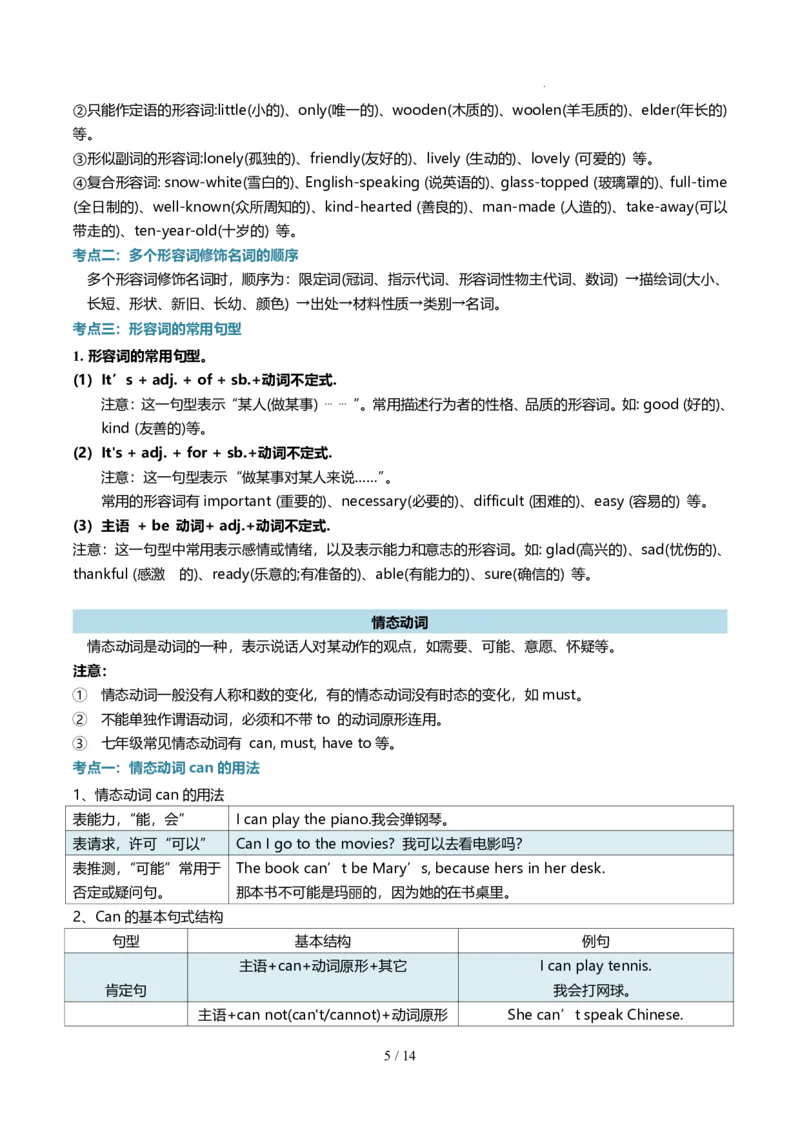
①只能作表语的形容词: afraid (害怕的)、alone (独自的)、asleep(睡着的)、awake (醒着的)、alive(活着
的)、well (健康的)、ill (病的)、frightened (害怕的) 等。
5 / 14
学科网(北京)股份有限公司
②只能作定语的形容词:little(小的)、only(唯一的)、wooden(木质的)、woolen(羊毛质的)、elder(年长的)
等。
③形似副词的形容词:lonely(孤独的)、friendly(友好的)、lively (生动的)、lovely (可爱的) 等。
④复合形容词: snow-white(雪白的)、English-speaking (说英语的)、glass-topped (玻璃罩的)、full-time
(全日制的)、well-known(众所周知的)、kind-hearted (善良的)、man-made (人造的)、take-away(可以
带走的)、ten-year-old(十岁的) 等。
考点二:多个形容词修饰名词的顺序
多个形容词修饰名词时,顺序为:限定词(冠词、指示代词、形容词性物主代词、数词) →描绘词(大小、
长短、形状、新旧、长幼、颜色) →出处→材料性质→类别→名词。
考点三:形容词的常用句型
1. 形容词的常用句型。
(1) It’s + adj. + of + sb.+动词不定式.
注意:这一句型表示“某人(做某事) ⋯⋯”。常用描述行为者的性格、品质的形容词。如: good (好的)、
kind (友善的)等。
(2) It's + adj. + for + sb.+动词不定式.
注意:这一句型表示“做某事对某人来说……”。
常用的形容词有important (重要的)、necessary(必要的)、difficult (困难的)、easy (容易的) 等。
(3) 主语+ be 动词+ adj.+动词不定式.
注意:这一句型中常用表示感情或情绪,以及表示能力和意志的形容词。如: glad(高兴的)、sad(忧伤的)、
thankful (感激
的)、ready(乐意的;有准备的)、able(有能力的)、sure(确信的) 等。
情态动词
情态动词是动词的一种,表示说话人对某动作的观点,如需要、可能、意愿、怀疑等。
注意:
1
情态动词一般没有人称和数的变化,有的情态动词没有时态的变化,如must。
2
不能单独作谓语动词,必须和不带to 的动词原形连用。
3
七年级常见情态动词有can, must, have to 等。
考点一:情态动词can 的用法
1、情态动词can 的用法
表能力,“能,会”
I can play the piano.我会弹钢琴。
表请求,许可“可以”
Can I go to the movies? 我可以去看电影吗?
表推测,“可能”常用于
否定或疑问句。
The book can’t be Mary’s, because hers in her desk.
那本书不可能是玛丽的,因为她的在书桌里。
2、Can 的基本句式结构
句型
基本结构
例句
肯定句
主语+can+动词原形+其它
I can play tennis.
我会打网球。
主语+can not(can't/cannot)+动词原形
She can’t speak Chinese.
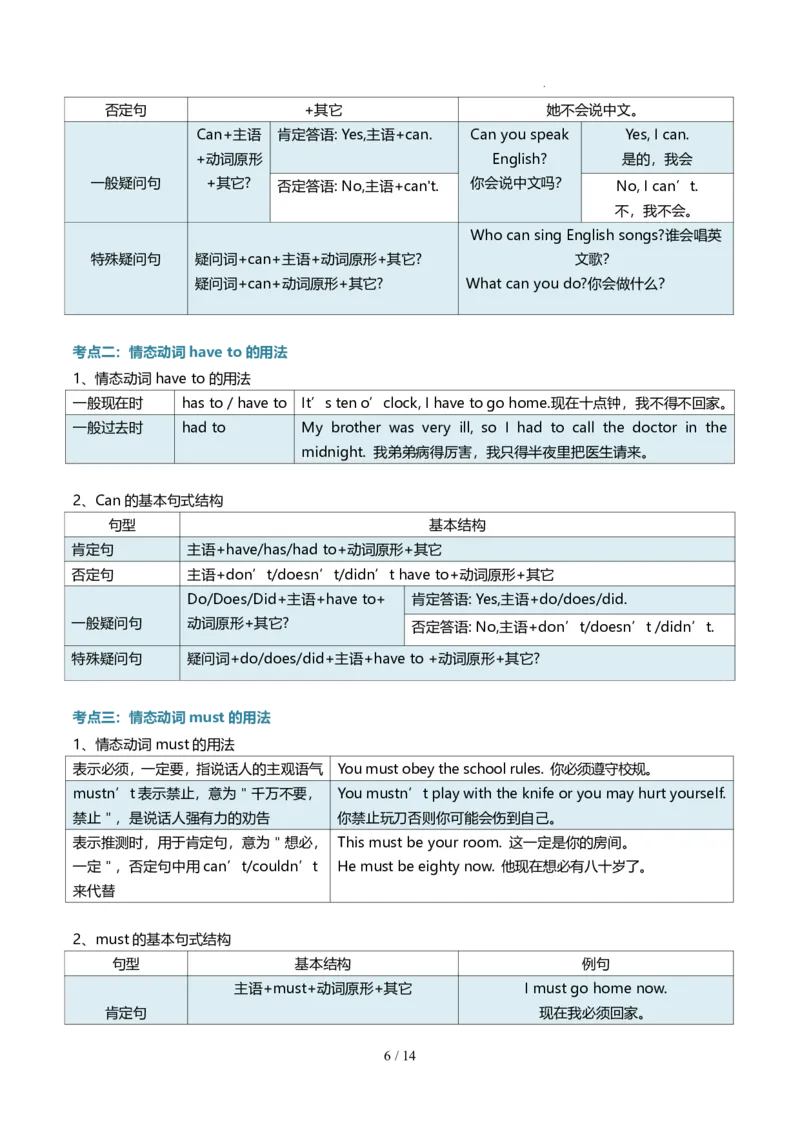
6 / 14
学科网(北京)股份有限公司
否定句
+其它
她不会说中文。
一般疑问句
Can+主语
+动词原形
+其它?
肯定答语: Yes,主语+can.
Can you speak
English?
你会说中文吗?
Yes, I can.
是的,我会
否定答语: No,主语+can't.
No, I can’t.
不,我不会。
特殊疑问句
疑问词+can+主语+动词原形+其它?
疑问词+can+动词原形+其它?
Who can sing English songs?谁会唱英
文歌?
What can you do?你会做什么?
考点二:情态动词have to 的用法
1、情态动词have to 的用法
一般现在时
has to / have to
It’s ten o’clock, I have to go home.现在十点钟,我不得不回家。
一般过去时
had to
My brother was very ill, so I had to call the doctor in the
midnight. 我弟弟病得厉害,我只得半夜里把医生请来。
2、Can 的基本句式结构
句型
基本结构
肯定句
主语+have/has/had to+动词原形+其它
否定句
主语+don’t/doesn’t/didn’t have to+动词原形+其它
一般疑问句
Do/Does/Did+主语+have to+
动词原形+其它?
肯定答语: Yes,主语+do/does/did.
否定答语: No,主语+don’t/doesn’t /didn’t.
特殊疑问句
疑问词+do/does/did+主语+have to +动词原形+其它?
考点三:情态动词must 的用法
1、情态动词must 的用法
表示必须,一定要,指说话人的主观语气
You must obey the school rules. 你必须遵守校规。
mustn’t 表示禁止,意为"千万不要,
禁止",是说话人强有力的劝告
You mustn’t play with the knife or you may hurt yourself.
你禁止玩刀否则你可能会伤到自己。
表示推测时,用于肯定句,意为"想必,
一定",否定句中用can’t/couldn’t
来代替
This must be your room. 这一定是你的房间。
He must be eighty now. 他现在想必有八十岁了。
2、must 的基本句式结构
句型
基本结构
例句
肯定句
主语+must+动词原形+其它
I must go home now.
现在我必须回家。
7 / 14
学科网(北京)股份有限公司
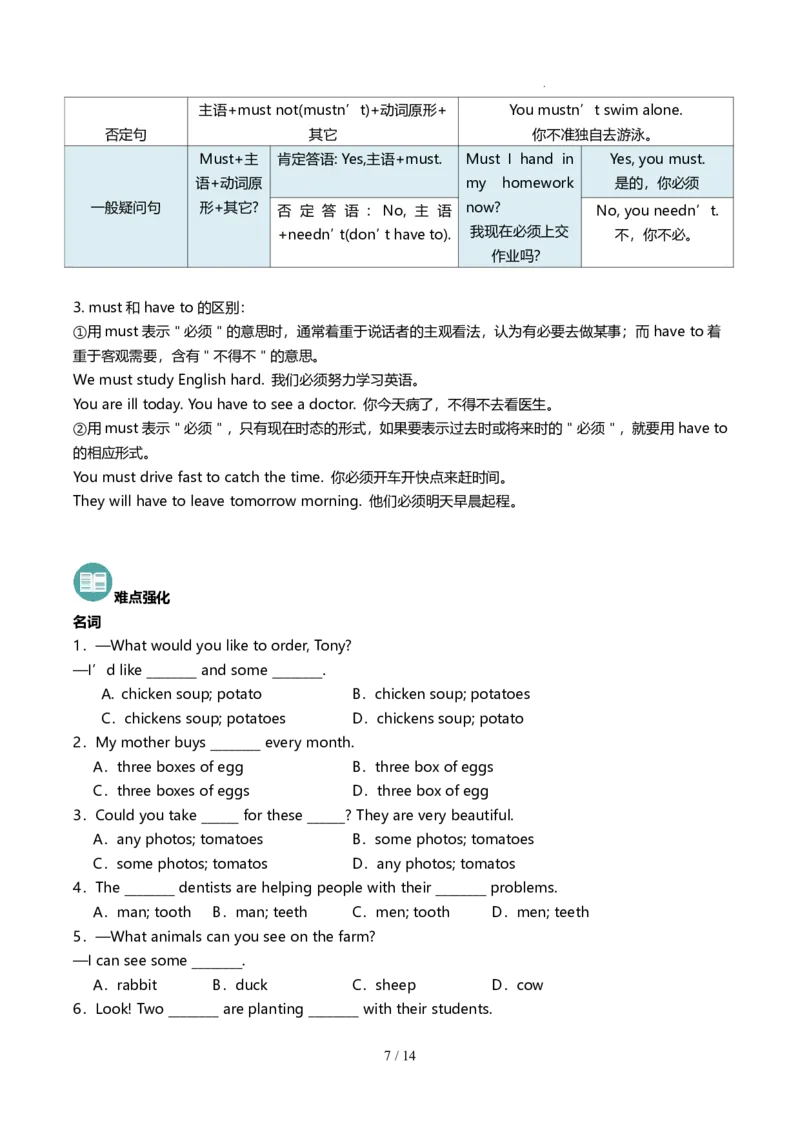
否定句
主语+must not(mustn’t)+动词原形+
其它
You mustn’t swim alone.
你不准独自去游泳。
一般疑问句
Must+主
语+动词原
形+其它?
肯定答语: Yes,主语+must.
Must I hand in
my
homework
now?
我现在必须上交
作业吗?
Yes, you must.
是的,你必须
否定答语:
No, 主语
+needn’t(don’t have to).
No, you needn’t.
不,你不必。
3. must 和have to 的区别:
①用must 表示"必须"的意思时,通常着重于说话者的主观看法,认为有必要去做某事;而have to 着
重于客观需要,含有"不得不"的意思。
We must study English hard. 我们必须努力学习英语。
You are ill today. You have to see a doctor. 你今天病了,不得不去看医生。
②用must 表示"必须",只有现在时态的形式,如果要表示过去时或将来时的"必须",就要用have to
的相应形式。
You must drive fast to catch the time. 你必须开车开快点来赶时间。
They will have to leave tomorrow morning. 他们必须明天早晨起程。
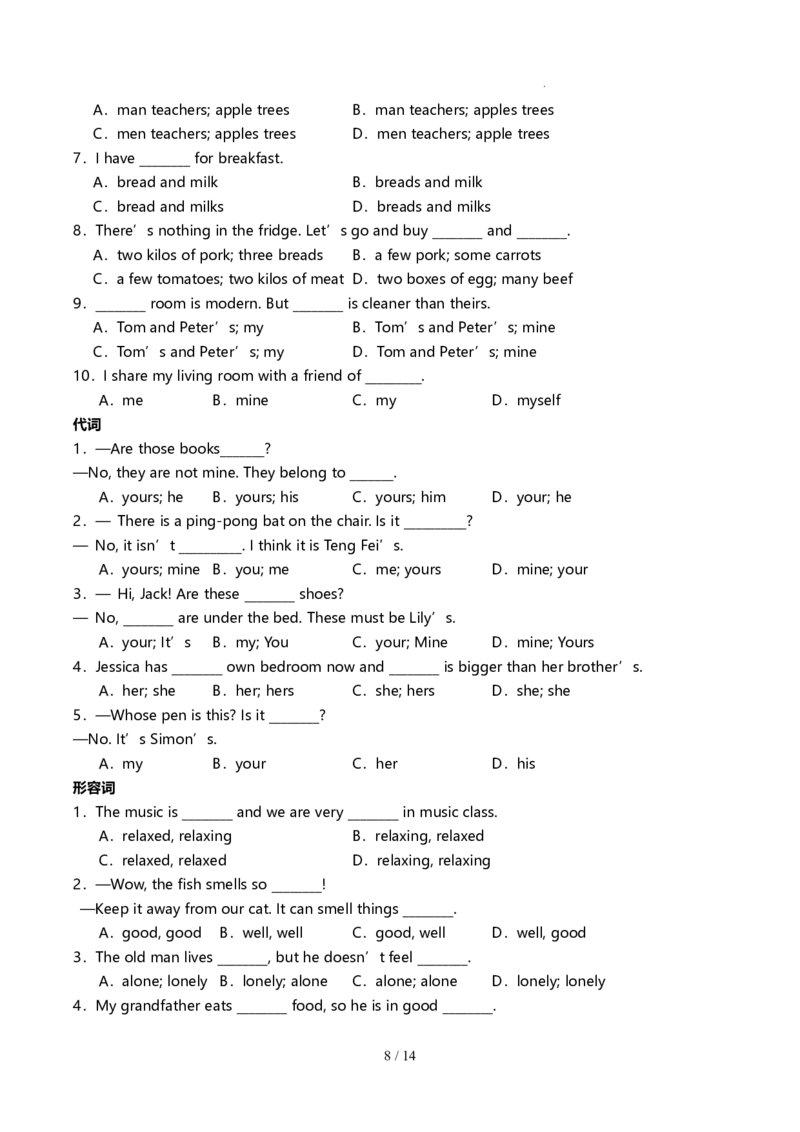
难点强化
名词
1.—What would you like to order, Tony?
—I’d like ________ and some ________.
A. chicken soup; potato
B.chicken soup; potatoes
C.chickens soup; potatoes
D.chickens soup; potato
2.My mother buys ________ every month.
A.three boxes of egg
B.three box of eggs
C.three boxes of eggs
D.three box of egg
3.Could you take ______ for these ______? They are very beautiful.
A.any photos; tomatoes
B.some photos; tomatoes
C.some photos; tomatos
D.any photos; tomatos
4.The ________ dentists are helping people with their ________ problems.
A.man; tooth
B.man; teeth
C.men; tooth
D.men; teeth
5.—What animals can you see on the farm?
—I can see some ________.
A.rabbit
B.duck
C.sheep
D.cow
6.Look! Two ________ are planting ________ with their students.
8 / 14
学科网(北京)股份有限公司
A.man teachers; apple trees
B.man teachers; apples trees
C.men teachers; apples trees
D.men teachers; apple trees
7.I have ________ for breakfast.
A.bread and milk
B.breads and milk
C.bread and milks
D.breads and milks
8.There’s nothing in the fridge. Let’s go and buy ________ and ________.
A.two kilos of pork; three breads
B.a few pork; some carrots
C.a few tomatoes; two kilos of meat D.two boxes of egg; many beef
9.________ room is modern. But ________ is cleaner than theirs.
A.Tom and Peter’s; my
B.Tom’s and Peter’s; mine
C.Tom’s and Peter’s; my
D.Tom and Peter’s; mine
10.I share my living room with a friend of _________.
A.me
B.mine
C.my
D.myself
代词
1.—Are those books_______?
—No, they are not mine. They belong to _______.
A.yours; he
B.yours; his
C.yours; him
D.your; he
2.— There is a ping-pong bat on the chair. Is it __________?
— No, it isn’t __________. I think it is Teng Fei’s.
A.yours; mine
B.you; me
C.me; yours
D.mine; your
3.— Hi, Jack! Are these ________ shoes?
— No, ________ are under the bed. These must be Lily’s.
A.your; It’s
B.my; You
C.your; Mine
D.mine; Yours
4.Jessica has ________ own bedroom now and ________ is bigger than her brother’s.
A.her; she
B.her; hers
C.she; hers
D.she; she
5.—Whose pen is this? Is it ________?
—No. It’s Simon’s.
A.my
B.your
C.her
D.his
形容词
1.The music is ________ and we are very ________ in music class.
A.relaxed, relaxing
B.relaxing, relaxed
C.relaxed, relaxed
D.relaxing, relaxing
2.—Wow, the fish smells so ________!
—Keep it away from our cat. It can smell things ________.
A.good, good
B.well, well
C.good, well
D.well, good
3.The old man lives ________, but he doesn’t feel ________.
A.alone; lonely
B.lonely; alone
C.alone; alone
D.lonely; lonely
4.My grandfather eats ________ food, so he is in good ________.
9 / 14
学科网(北京)股份有限公司
A.health; healthy
B.healthy; healthy
C.health; healthy
D.healthy; health
5.Winter in the north of China is often ________.
A.snowed
B.snows
C.snowing
D.snowy
情态动词
1.Peter, ________ eat in class and we ________ eat in the classroom.
A.doesn’t; can’t
B.don’t; can’t
C.can’t; can’t
D.don’t; don’t
2.— It’s too hot. ________ I swim in the lake near our home, mum?
—No, you ________. It’s so dangerous. You’d better go to the swimming pool.
A.Could; couldn’t
B.Need; mustn’t
B.C.Must; needn’t
D.Could; can’t
3.— Peter, ________ you play the piano?
— No, I can’t, but I can play the guitar.
A.should
B.can
C.must
D.need
4.—_________ we bring our mobile phones to class?
—No, we can’t. We must keep them in the locker.
A.Can
B.Must
C.Need
D.Should
5.It’s Sunday. Joe ________ go to school tomorrow.
A.has to
B.have to
C.doesn’t have to
D.don’t have to
6.—Must he ________ at school now?
—No, he ________.
A.get; needn’t
B.arrive; mustn’t
B.C.get; can’t
D.arrive; doesn’t have to
7.He gets up late today, so he _______ take the next bus.
A.must
B.can
C.may
D.has to
8.—Can we bring our phones to class?
—No, you ________.
A.can’t
B.mustn’t
C.must
D.can
9.You ________ stay in bed for three days, or your leg won’t get well.
A.must
B.can
C.mustn’t
D.can’t
10.—________ I come back before five o’clock?
—No, you ________. But you can’t be back later than seven o’clock.
A.Must; needn’t
B.May; mustn’t
B.C.Can; needn’t
D.Can; mustn’t
复习提升
10 / 14
学科网(北京)股份有限公司
真题感知
1.(2024·西藏·中考真题)There are many famous ________ in the Chinese history.
A.woman hero B.women heroes
C.women hero
D.woman heroes
2.(2024·西藏·中考真题)________ father works in the police station.
A.Eric and Helen’s
B.Eric and Helen
C.Eric’s and Helen D.Eric’s and
Helen’s
3.(2024·四川·中考真题)My mother’s birthday is coming, and I will buy a gift for ________.
A.she
B.hers
C.her
D.herself
4.(2024·西藏·中考真题)It takes ________ 23 minutes to get to the library by subway.
A.she
B.he
C.her
D.his
5.(2024·北京·中考真题)My friends and I like sports. ________ often play basketball together after
school.
A.We
B.I
C.They
D.You
6.(2024·江苏淮安·中考真题)—Oh! I forgot to bring ________ ruler.
—Don’t worry. I can share mine with you.
A.I
B.me
C.my
D.mine
7.(2024·内蒙古呼和浩特·中考真题)—Who left this bottle in the lab?
—It’s ________, sir. I’ll be careful with my things from now on.
A.my
B.mine
C.yours
D.your
8.(2024·四川雅安·中考真题)—Amy, there is a book on the floor. Is it ____________?
—No, it’s not mine. My book is on the desk.
A.you
B.yours
C.your
D.yourself
9.(2024·天津·中考真题)When ________ parents went away on business, I looked after ________.
A.my; myself
B.my; mine
C.me; myself
D.me; mine
10.(2024·河北·中考真题)—Mary, is this your sister’s smartwatch?
—No, ________ is pink.
A.his
B.mine
C.hers
D.yours
11.(2023·上海·中考真题)Joyce felt ________ when she won the first prize for handwriting.
A.please
B.pleased
C.pleasure
D.pleasantly
12.(2023·西藏·中考真题)Chinese folk music sounds ________. I like it very much.
A.bad
B.badly
C.beautiful
D.beautifully
13.(2022·上海·中考真题)These strawberries look _______. I’d like to buy some for my father.
A.happily
B.lovely
C.softly
D.properly
14.(2022·辽宁阜新·中考真题)Most people don’t like eating lemons because they taste ________.
A.lovely
B.sweet
C.delicious
D.sour
15.(2022·广西梧州·中考真题)—It will be ________ this afternoon.
—Well, we’d better take an umbrella, or we will get wet.
11 / 14
学科网(北京)股份有限公司
A.rainy
B.cloudy
C.windy
D.sunny
16.(2024·四川广元·中考真题)—I wonder if these are Jane’s glasses.
—They ________hers. She doesn’t wear glasses.
A.are
B.might be
C.must be
D.can’t be
17.(2024·江苏淮安·中考真题)— ________ you show me how to play the violin, Suzy?
— No problem.
A.Can
B.Should
C.Must
D.Need
18.(2024·江苏镇江·中考真题)With the help of modern technology, now people ________ enjoy the
proudest moment when China’s first astronaut Yang Liwei entered space.
A.may
B.can
C.should
D.must
19.(2024·江苏宿迁·中考真题)Although the little boy is only 6 years old, he _______ do DIY well with
his special mind.
A.can
B.can’t
C.must
D.mustn’t
20.(2024·北京·中考真题)— Bill, ________ I use your ruler?
— Of course you can. Here you are.
A.can
B.must
C.need
D.should
21.(2024·吉林长春·中考真题)Lili ________ be at home. She has gone to the farm to pick apples.
A.mustn’t
B.can’t
C.must
D.can
22.(2024·四川雅安·中考真题)—Is that your friend Laura over there?
—No, it ____________ be Laura. She has gone to Shenzhen.
A.must
B.mustn’t
C.can
D.can’t
23.(2024·河北·中考真题)—Look! Is that girl Alice?
—No, it ________ be her. She is on a tour in Beijing now.
A.can
B.can’t
C.must
D.mustn’t
24.(2024·四川遂宁·中考真题)—Tina, is that our math teacher Mr. Wang?
—It ________ be Mr. Wang. He has gone to Beijing.
A.must
B.mustn’t
C.can’t
D.can
25.(2024·江苏连云港·中考真题)Modern medicine is developing quickly and now most eye
problems _________ be cured.
A.can
B.must
C.should
D.need
26.(2024·内蒙古呼和浩特·中考真题)—Must I come before 6:00 tomorrow morning?
—No, you ________. The meeting will begin at 8:00.
A.mustn’t
B.needn’t
C.can’t
D.shouldn’t
27.(23-24 七年级上·河北沧州·期末)My brother is ill. He ________ stay at home.
A.has to
B.needs
C.have to
D.need to
28.(23-24 七年级上·广东广州·期末)It’s already 10 o’clock now. I ________ return home. It’s too
late.
A.can
B.have to
C.may
D.could
12 / 14
学科网(北京)股份有限公司
29.(24-25 七年级上·上海浦东新·期中)Mum, the fish you cooked tastes so ________. I’d like to eat
more.
A.bad
B.badly
C.nice
D.nicely
30.
(23-24 七年级下·湖北武汉·期中)It’s best to keep away from a dog even if (即使) it looks ________,
especially when the owner isn’t around.
A.quickly
B.safely
C.friendly
D.happily
提升专练
1.—What kind of dumplings would you like, Linda?
—I’d like ________ and ________ dumplings.
A.chicken; cabbage
B.chicken; cabbages
C.chickens; cabbages
D.chickens; cabbage
2.Tomorrow will be the ________ fourteenth birthday. All the friends of________ will go to the party.
A.twins’; theirsB.twin’s; theirs
C.twins’; their
D.twins’; they
3.— Is this a photo of ________ ?
—Yes. He is reading. It is really a good habit of ________ to read books before going to bed.
A.your cousin’s; him
B.your cousin; him
C.your cousin’s; his
D.your cousin; his
4.—I sit between Jim and Mary.
—That’s to say, your seat is between ________.
A.Jim and Mary B.Jim’s and Mary C.Jim’s and Mary’s
D.Jim and Mary’s
5.We need to buy some ________ and two ________ for the dinner party.
A.beef; kilo of potatoes
B.beefs; kilos of potato C.beefs; kilos of potatoes
D.beef; kilos of potatoes
6.—Is this ________ book?
—No, it’s not mine. It’s ________.
A.your; Tom’s B.yours; Tom’s
C.your; Tom
D.yours; Tom
7.The forests are the home to wild animals. We shouldn’t _________ for wood or money.
A.cut down it
B.cut down them
C.cut it down
D.cut them down
8.—Whose badminton rocket is that?
—It doesn’t belong to _________. Mine is on the table.
A.my
B.me
C.I
D.myself
9.Our English teacher not only teaches ________ English and she is also a friend of ________.
A.our; us
B.our; ours
C.us; us
D.us; ours
10.Tom is a friend of _______. _______ often play together.
A.me; We
B.my; Us
C.mine; We
D.mine; Us
11.—Is this your tennis racket?
—No, it isn’t. I think it belongs to my sister Mary. ________ has “M” on it.
A.He
B.His
C.Hers
D.Her
13 / 14
学科网(北京)股份有限公司
12.—Whose book is this? Is it yours, Lucy?
—No, it isn’t. It’s ________.
A.his
B.he
C.her
D.she
13.________ room is on the third floor and ________ is on the fifth floor.
A.Theirs; ours
B.Theirs; our
C.Their; ours
D.Their; our
14.—Are the two ping-pong bats Lisa’s?
—No. The red one is _________ and the black is _________.
A.her, my
B.hers; my
C.hers; mine
D.her; mine
15.The new neighbour seems ________ and everyone in the neighbourhood likes her.
A.nicely
B.politely
C.friendly
D.beautifully
16.He is in good ________ because he has a ________ lifestyle.
A.health; healthy
B.healthy; health
C.healthy; healthy
D.health; health
17.The company thought of many ways to make the bike ________.
A.lightly
B.light
C.lighting
D.to light
18.My brother ______ play basketball, but he can swim very well.
A.can’t
B.doesn’t
C.isn’t
D.don’t
19.—Jim, ______ you swim?
—Yes. I can swim like a fish.
A.may
B.must
C.should
D.can
20.— ________ we bring our phones to class?
—No, we can’t. We must keep them in our lockers.
A.Must
B.May
C.Can
D.Will
21.—________ we feed the animals in the zoo?
—No, we can’t. It’s not good for them.
A.May
B.Can
C.Must
D.Should
22.—Mom, can I play basketball with my friends tomorrow?
—Yes, you can. But you ________ be back before 6 p.m.
A.can
B.may
C.would
D.must
23.Students ________ follow the school rules. For example, they ________ bring mobile phones to
class.
A.may; needn’t
B.can; mustn’t
C.must; can’t
D.should; don’t have to
24.—May I go to the cinema, Mum?
—Certainly, but you ________ be back by 10 o’clock.
A.can
B.may
C.must
D.could
25.You _______ cross the road when the light is red.
A.must
B.have to
C.mustn’t
D.don’t have to
14 / 14
学科网(北京)股份有限公司
26.—Would you come to the party tomorrow?
—I’d love to, but I’ll ______ prepare for my exam.
A.can
B.must
C.have to
D.should
27.—Must I tell him everything?
—No, you ________. He knows everything.
A.don’t have to
B.mustn’t
C.must
D.have to
28.My sister is ill. She ________ stay home.
A.has to
B.need to
C.have to
D.needs
29.Mrs Green _________ wash the clothes by herself, because the washing machine can help her.
A.hasn’t to
B.don’t have to
C.doesn’t have toD.has to
30.On school days, we must wear school uniforms, but on weekends we ________.
A.must
B.mustn’t
C.have to
D.don’t have to