文档文本内容
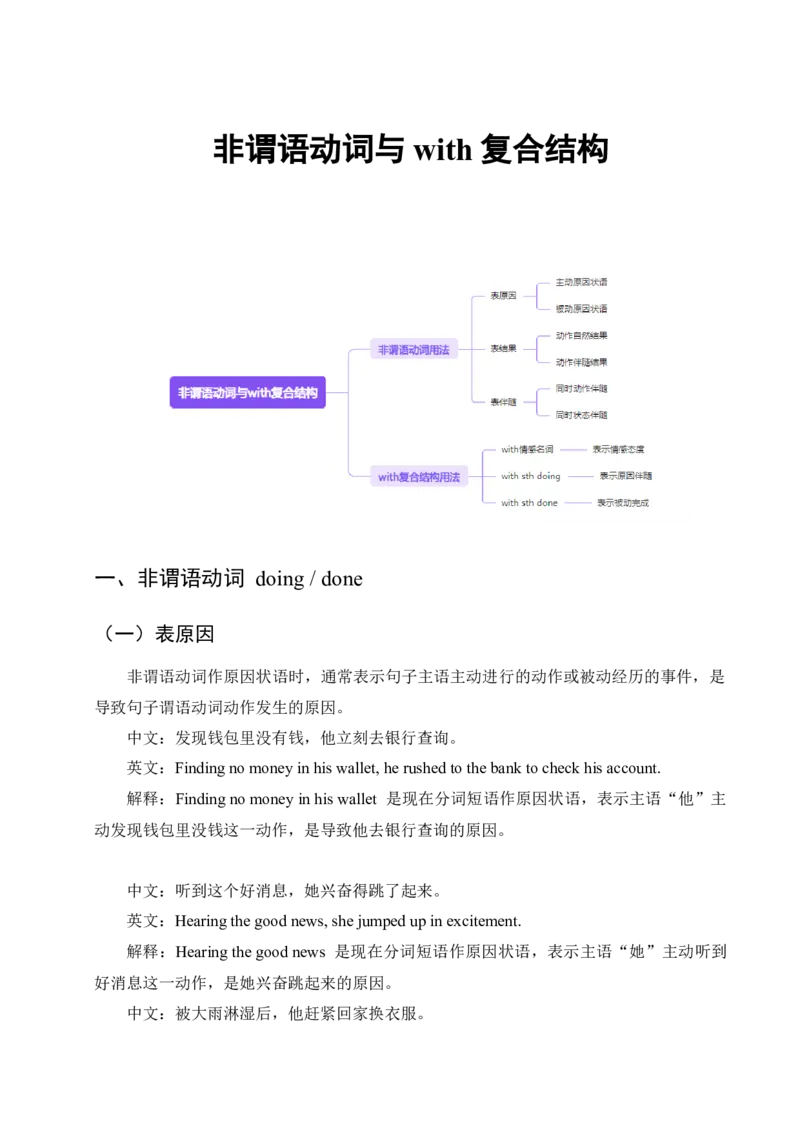
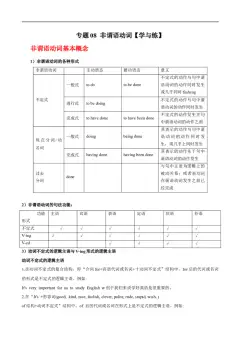
非谓语动词与 with 复合结构
一、非谓语动词 doing / done
(一)表原因
非谓语动词作原因状语时,通常表示句子主语主动进行的动作或被动经历的事件,是
导致句子谓语动词动作发生的原因。
中文:发现钱包里没有钱,他立刻去银行查询。
英文:Finding no money in his wallet, he rushed to the bank to check his account.
解释:Finding no money in his wallet 是现在分词短语作原因状语,表示主语“他”主
动发现钱包里没钱这一动作,是导致他去银行查询的原因。
中文:听到这个好消息,她兴奋得跳了起来。
英文:Hearing the good news, she jumped up in excitement.
解释:Hearing the good news 是现在分词短语作原因状语,表示主语“她”主动听到
好消息这一动作,是她兴奋跳起来的原因。
中文:被大雨淋湿后,他赶紧回家换衣服。英文:Soaked by the heavy rain, he hurried home to change his clothes.
解释:Soaked by the heavy rain 是过去分词短语作原因状语,表示主语“他”被动被
大雨淋湿这一状态,是导致他赶紧回家换衣服的原因。
中文:看到孩子们在雨中玩耍,她决定加入他们。
英文:Seeing the children playing in the rain, she decided to join them.
解释:Seeing the children playing in the rain 是现在分词短语作原因状语,表示主
语“她”主动看到孩子们在雨中玩耍这一动作,是她决定加入他们的原因。
中文:因为被老师表扬,他感到非常自豪。
英文:Praised by the teacher, he felt very proud.
解释:Praised by the teacher 是过去分词短语作原因状语,表示主语“他”被动被老
师表扬这一状态,是导致他感到自豪的原因。
(二)表结果
非谓语动词作结果状语时,通常表示句子谓语动词动作完成后产生的自然结果或伴随
结果。
中文:他跑得太快,结果摔倒了。
英文:He ran so fast that he ended up falling.
解释:ended up falling 是动名词短语作结果状语,表示他跑得太快这一动作导致的自
然结果是他摔倒了。
中文:她努力学习,最终取得了优异的成绩。
英文:She studied hard, resulting in excellent grades.
解释:resulting in excellent grades 是现在分词短语作结果状语,表示她努力学习这一
动作产生的最终结果是取得了优异的成绩。
中文:天气突然变冷,导致许多人感冒。
英文:The sudden drop in temperature led to many people catching a cold.
解释:led to many people catching a cold 是动名词短语作结果状语,表示天气突然变冷这一动作导致的结果是许多人感冒。
中文:他忘记了时间,结果错过了会议。
英文:He forgot the time, ending up missing the meeting.
解释:ending up missing the meeting 是动名词短语作结果状语,表示他忘记时间这一
动作导致的结果是错过了会议。
中文:她提前完成了任务,赢得了老板的表扬。
英文:She finished the task ahead of schedule, earning her boss's praise.
解释:earning her boss's praise 是现在分词短语作结果状语,表示她提前完成任务这一
动作产生的结果是赢得了老板的表扬。
(三)表伴随
非谓语动词作伴随状语时,通常表示句子谓语动词动作发生时同时存在的另一个动作
或状态。
中文:他一边听音乐,一边做作业。
英文:He did his homework, listening to music at the same time.
解释:listening to music at the same time 是现在分词短语作伴随状语,表示他在做作
业的同时,还存在听音乐这一动作。
中文:她坐在窗边,看着外面的风景。
英文:She sat by the window, watching the scenery outside.
解释:watching the scenery outside 是现在分词短语作伴随状语,表示她坐在窗边的同
时,还在进行看着外面风景的动作。
中文:他走进房间,手里拿着一本书。
英文:He walked into the room, holding a book in his hand.
解释:holding a book in his hand 是现在分词短语作伴随状语,表示他走进房间的同
时,手里还拿着一本书这一状态。
中文:她微笑着,向大家打招呼。英文:She smiled and greeted everyone.
解释:smiled 是谓语动词,greeted everyone 是伴随动作,表示她在微笑的同时,还
在向大家打招呼。
中文:他站在那里,眼睛盯着黑板。
英文:He stood there, staring at the blackboard.
解释:staring at the blackboard 是现在分词短语作伴随状语,表示他站在那里的同
时,眼睛还在盯着黑板。
二、with 复合结构
(一)with + 情感名词
with + 情感名词构成的短语,通常用来修饰动词或句子,表示说话者的情感或态度。
中文:带着感激之情,他向她道谢。
英文:With gratitude, he thanked her.
解释:With gratitude 是介词短语作状语,修饰动词 thanked,表示他道谢时带有感激
的情感。
中文:她满怀期待地打开了礼物。
英文:With anticipation, she opened the gift.
解释:With anticipation 是介词短语作状语,修饰动词 opened,表示她打开礼物时满
怀期待。
中文:他带着歉意,向朋友解释:了一切。
英文:With an apology, he explained everything to his friend.
解释:With an apology 是介词短语作状语,修饰动词 explained,表示他向朋友解释:
时带有歉意。
中文:她带着喜悦的心情,分享了这个好消息。
英文:With joy, she shared the good news.
解释:With joy 是介词短语作状语,修饰动词 shared,表示她分享好消息时带着喜悦的心情。
中文:他带着无奈,接受了这个结果。
英文:With resignation, he accepted the outcome.
解释:With resignation 是介词短语作状语,修饰动词 accepted,表示他接受结果时带
着无奈的情感。
(二)with + sth + doing
with + sth + doing 构成的复合结构,表示“随着……正在做某事”,通常用来表示原
因、结果或伴随状态。
中文:随着春天的到来,花园里开满了鲜花。
英文:With spring arriving, the garden was full of blooming flowers.
解释:With spring arriving 是 with 复合结构作原因状语,表示随着春天到来这一动
作的发生,导致花园里开满了鲜花。
中文:他坐在沙发上,电视还在播放。
英文:He sat on the sofa, with the TV still playing.
解释:with the TV still playing 是 with 复合结构作伴随状语,表示他坐在沙发上的同
时,电视还在播放。
中文:随着夜幕降临,城市的灯光逐渐亮起。
英文:With night falling, the city lights gradually lit up.
解释:With night falling 是 with 复合结构作原因状语,表示随着夜幕降临这一动作
的发生,城市的灯光逐渐亮起。
中文:她走进房间,门自动关闭。
英文:She walked into the room, with the door closing automatically.
解释:with the door closing automatically 是 with 复合结构作伴随状语,表示她走进
房间的同时,门自动关闭。中文:他离开时,灯还亮着。
英文:He left with the light still on.
解释:with the light still on 是 with 复合结构作伴随状语,表示他离开时,灯还处于
亮着的状态。
(三)with + sth + done
with + sth + done 构成的复合结构,表示“随着……被……”,通常用来表示原因、
结果或伴随状态,强调被动完成的动作或状态。
中文:所有准备工作完成后,他们开始了实验。
英文:With all the preparations completed, they began the experiment.
解释:With all the preparations completed 是 with 复合结构作原因状语,表示所有准
备工作被完成这一被动状态是他们开始实验的原因。
中文:信件寄出后,他松了一口气。
英文:With the letter sent, he let out a sigh of relief.
解释:With the letter sent 是 with 复合结构作原因状语,表示信件被寄出这一被动动
作是他松了一口气的原因。
中文:作业完成后,孩子们出去玩了。
英文:With the homework done, the children went out to play.
解释:With the homework done 是 with 复合结构作原因状语,表示作业被完成这一
被动状态是孩子们出去玩的原因。
中文:饭菜准备好后,大家围坐在一起。
英文:With the meal prepared, everyone sat down together.
解释:With the meal prepared 是 with 复合结构作原因状语,表示饭菜被准备好这一
被动状态是大家围坐在一起的原因。
中文:任务完成后,他感到非常轻松。
英文:With the task completed, he felt very relaxed.解释:With the task completed 是 with 复合结构作原因状语,表示任务被完成这一被
动状态是他感到轻松的原因。