【灿烂六月·高考金8 卷】
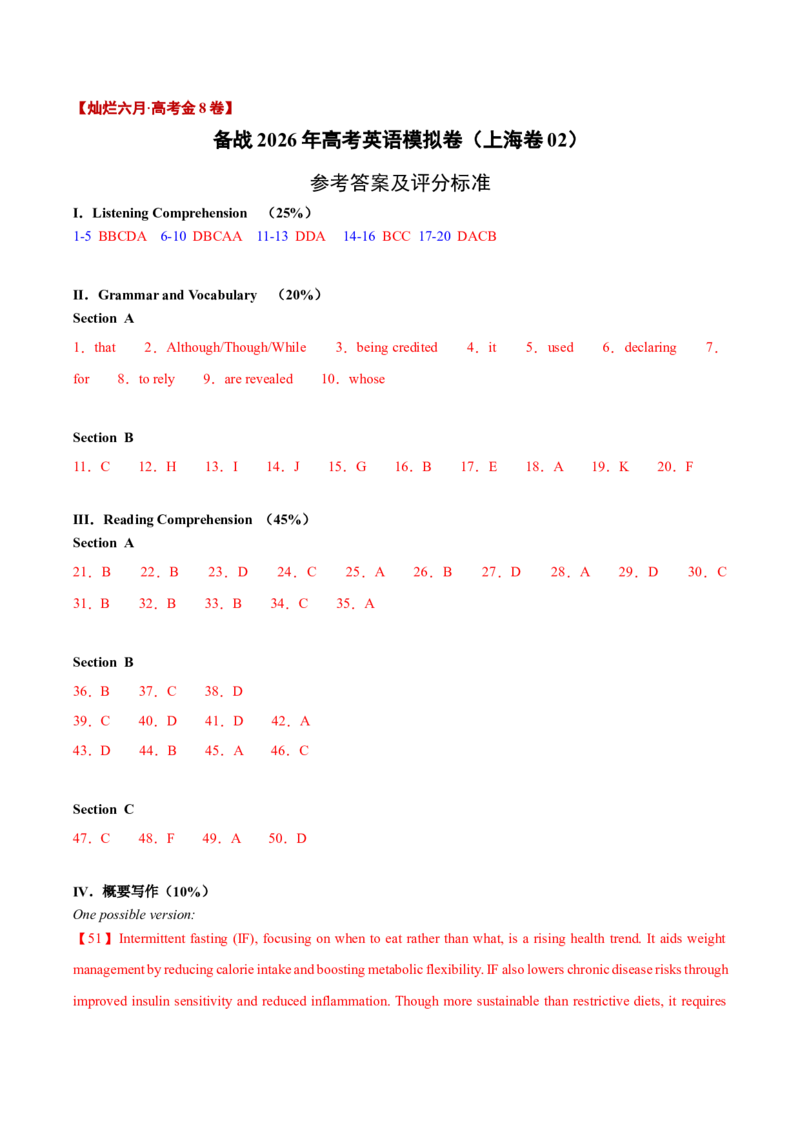
备战2026 年高考英语模拟卷(上海卷02)
参考答案及评分标准
I.Listening Comprehension  (25%)
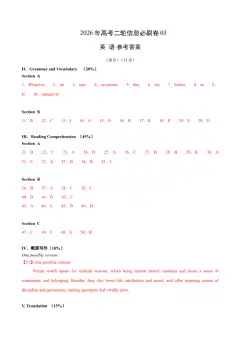
1-5 BBCDA   6-10 DBCAA  11-13 DDA    14-16 BCC  17-20 DACB
II.Grammar and Vocabulary  (20%)
Section A
1.that    2.Although/Though/While    3.being credited    4.it    5.used    6.declaring    7.
for    8.to rely    9.are revealed    10.whose
Section B
11.C    12.H    13.I    14.J    15.G    16.B    17.E    18.A    19.K    20.F
III.Reading Comprehension (45%)
Section A
21.B    22.B    23.D    24.C    25.A    26.B    27.D    28.A    29.D    30.C

31.B    32.B    33.B    34.C    35.A
Section B
36.B    37.C    38.D
39.C    40.D    41.D    42.A
43.D    44.B    45.A    46.C
Section C
47.C    48.F    49.A    50.D
IV.概要写作(10%)
One possible version:
【51】Intermittent fasting (IF), focusing on when to eat rather than what, is a rising health trend. It aids weight
management by reducing calorie intake and boosting metabolic flexibility. IF also lowers chronic disease risks through
improved insulin sensitivity and reduced inflammation. Though more sustainable than restrictive diets, it requires
caution for certain groups, necessitating professional advice before adoption.
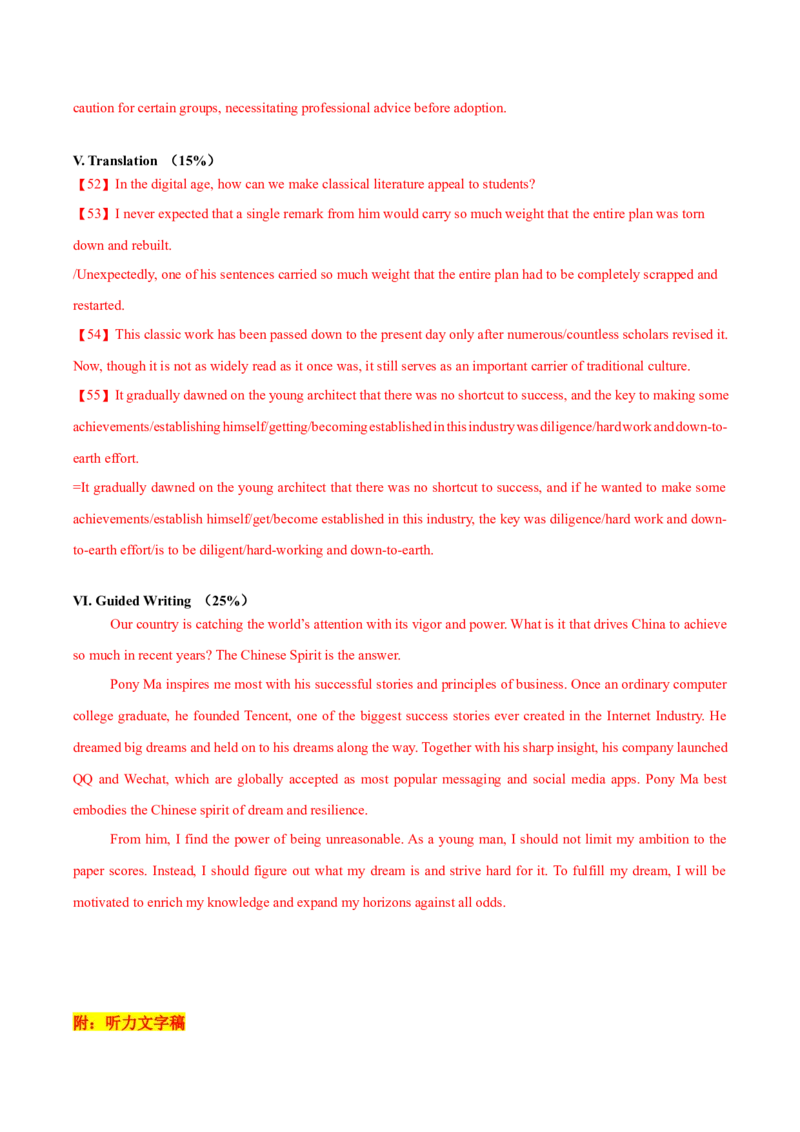
V. Translation (15%)
【52】In the digital age, how can we make classical literature appeal to students?
【53】I never expected that a single remark from him would carry so much weight that the entire plan was torn
down and rebuilt.
/Unexpectedly, one of his sentences carried so much weight that the entire plan had to be completely scrapped and
restarted.
【54】This classic work has been passed down to the present day only after numerous/countless scholars revised it.
Now, though it is not as widely read as it once was, it still serves as an important carrier of traditional culture.
【55】It gradually dawned on the young architect that there was no shortcut to success, and the key to making some
achievements/establishing himself/getting/becoming established in this industry was diligence/hard work and down-to-
earth effort.
=It gradually dawned on the young architect that there was no shortcut to success, and if he wanted to make some
achievements/establish himself/get/become established in this industry, the key was diligence/hard work and down-
to-earth effort/is to be diligent/hard-working and down-to-earth.
VI. Guided Writing (25%)
Our country is catching the world’s attention with its vigor and power. What is it that drives China to achieve
so much in recent years? The Chinese Spirit is the answer.
Pony Ma inspires me most with his successful stories and principles of business. Once an ordinary computer
college graduate, he founded Tencent, one of the biggest success stories ever created in the Internet Industry. He
dreamed big dreams and held on to his dreams along the way. Together with his sharp insight, his company launched
QQ and Wechat, which are globally accepted as most popular messaging and social media apps. Pony Ma best
embodies the Chinese spirit of dream and resilience.
From him, I find the power of being unreasonable. As a young man, I should not limit my ambition to the
paper scores. Instead, I should figure out what my dream is and strive hard for it. To fulfill my dream, I will be
motivated to enrich my knowledge and expand my horizons against all odds.
附:听力文字稿
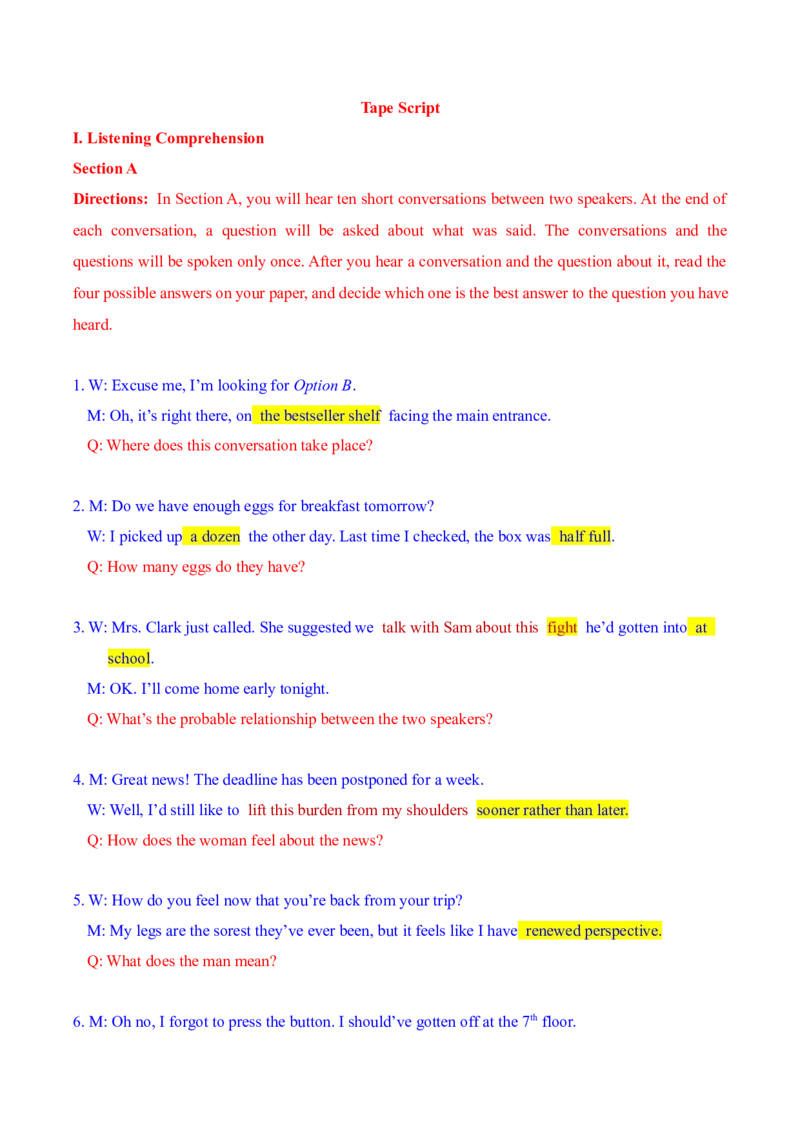
Tape Script
I. Listening Comprehension
Section A
Directions: In Section A, you will hear ten short conversations between two speakers. At the end of
each conversation, a question will be asked about what was said. The conversations and the
questions will be spoken only once. After you hear a conversation and the question about it, read the
four possible answers on your paper, and decide which one is the best answer to the question you have
heard.
1. W: Excuse me, I’m looking for Option B.
M: Oh, it’s right there, on the bestseller shelf facing the main entrance.
Q: Where does this conversation take place?
2. M: Do we have enough eggs for breakfast tomorrow?
W: I picked up a dozen the other day. Last time I checked, the box was half full.
Q: How many eggs do they have?
3. W: Mrs. Clark just called. She suggested we talk with Sam about this fight he’d gotten into at
school.
M: OK. I’ll come home early tonight.
Q: What’s the probable relationship between the two speakers?
4. M: Great news! The deadline has been postponed for a week.
W: Well, I’d still like to lift this burden from my shoulders sooner rather than later.
Q: How does the woman feel about the news?
5. W: How do you feel now that you’re back from your trip?
M: My legs are the sorest they’ve ever been, but it feels like I have renewed perspective.
Q: What does the man mean?
6. M: Oh no, I forgot to press the button. I should’ve gotten off at the 7th floor.
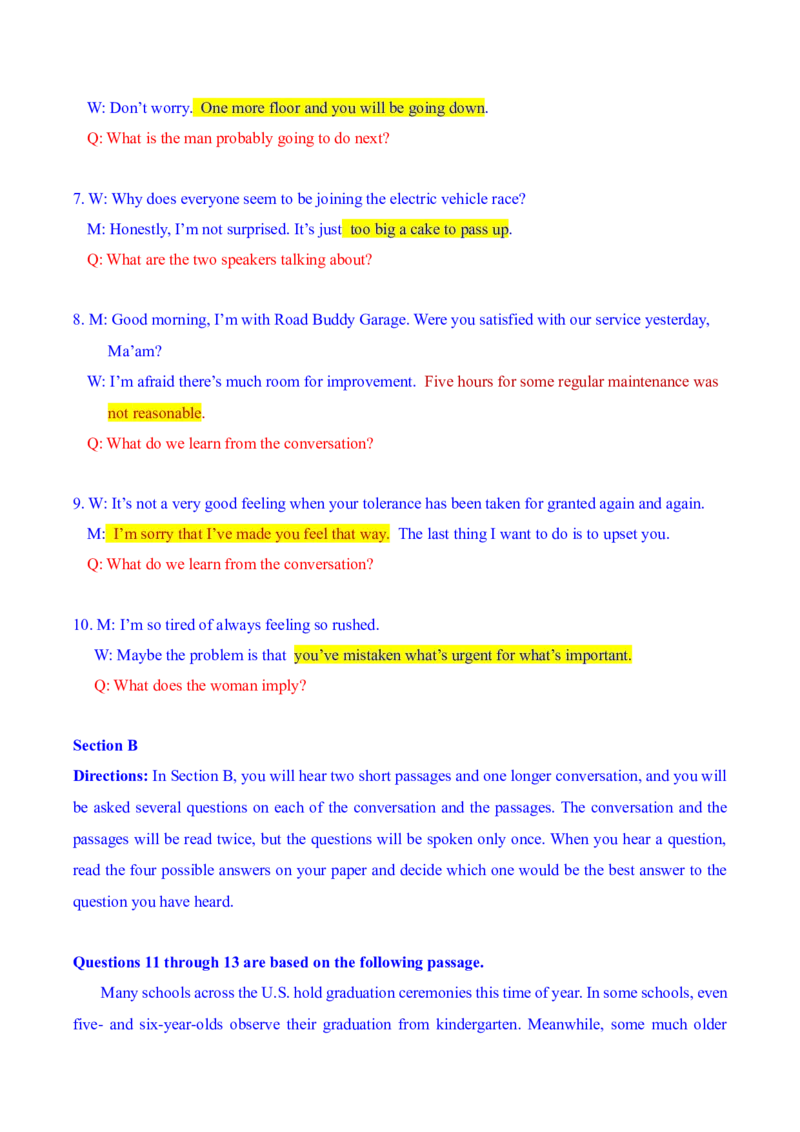
W: Don’t worry. One more floor and you will be going down.
Q: What is the man probably going to do next?
7. W: Why does everyone seem to be joining the electric vehicle race?
M: Honestly, I’m not surprised. It’s just too big a cake to pass up.
Q: What are the two speakers talking about?
8. M: Good morning, I’m with Road Buddy Garage. Were you satisfied with our service yesterday,
Ma’am?
W: I’m afraid there’s much room for improvement. Five hours for some regular maintenance was
not reasonable.
Q: What do we learn from the conversation?
9. W: It’s not a very good feeling when your tolerance has been taken for granted again and again.
M: I’m sorry that I’ve made you feel that way. The last thing I want to do is to upset you.
Q: What do we learn from the conversation?
10. M: I’m so tired of always feeling so rushed.
W: Maybe the problem is that you’ve mistaken what’s urgent for what’s important.
Q: What does the woman imply?

Section B
Directions: In Section B, you will hear two short passages and one longer conversation, and you will
be asked several questions on each of the conversation and the passages. The conversation and the
passages will be read twice, but the questions will be spoken only once. When you hear a question,
read the four possible answers on your paper and decide which one would be the best answer to the
question you have heard.
Questions 11 through 13 are based on the following passage.
Many schools across the U.S. hold graduation ceremonies this time of year. In some schools, even
five- and six-year-olds observe their graduation from kindergarten. Meanwhile, some much older
people are graduating too. Meet 70-year-old Jerry Reid, who just graduated from the University of
Virginia. He earned a bachelor’s degree.
Mr. Reid might not look like the average college student; his hair is definitely grayer. But still, his
age is easy to forget. Other college peers know him as one of their own. He joined a men’s group on
campus. He sang songs along with many other students. Mr. Reid’s school friends say they can talk to
him just about anything.
About a half century ago, in his twenties, Mr. Reid was not in school. Instead, he was racing cars
and chasing girls. But he says his friend Bill invited him to parties held in universities. “Bill told me
what a terrible life I had unless I came up here and went to school with him,” said Reid. That was in
1963. Mr. Reid says it took him 48 years to take that advice. In 2011, he entered college. His professor,
Luke Wright, says Mr. Reid influences students. He opened the minds of the young adults and showed
them that life does not end at 40. Instead, the 70-year-old college graduate believes that getting older
can be the beginning of a dream.
“Remember that the path you left waits for you. It’s there. It’s yours. All you must do is to get out
of your own way and get back to it. And that’s exactly what I did,” said Mr. Reid. He says that he and
his wife Susan would take some time off now to enjoy his college degree. Then, he’ll continue his
studies for his graduate degree.
(Now listen again.)
Questions:
11. Which of the following is true of Mr. Reid?
12. Which of the following words best describes Mr. Reid?
13. What lesson can we learn from the story of Jerry Reid?
Questions 14 through 16 are based on the following passage.
Every day, the alarm clock announces the start of another busy weekday in the morning. We jump
out of bed, rush into the shower, into our clothes and out the door with hardly a moment to think.
    The way most of us spend our mornings is exactly opposite to the conditions that promote flexible,
open-minded thinking. Imaginative ideas are most likely to come to us when we’re unfocused. The
stress slows down the speed with which signals travel between neurons, making inspiration less likely
to occur. And while we all should read a lot about what’s going on in the world, it would not make us
feel good for sure, so put that news website or newspaper aside until after the day’s work is done.
     So what would our mornings look like if we wanted to fully prepare ourselves for creative problem-
solving? We’d set the alarm a few minutes early and lie awake in bed, following our thoughts where
they lead. We’d stand a little longer under the warm water of the shower, stopping thinking about tasks
in favor of a few more minutes of relaxation. We’d take some deep breaths on our way to work, instead
of complaining about heavy traffic. And once in the office — after we get a cup of coffee—we’d click
on links not to the news of the day but to the funniest videos the internet has to offer.
(Now listen again.)
Questions:
14. When are we most creative according to the passage?
15. Which of the following is true about newspapers?
16. What does the speaker suggest we should do before working in the morning?

Questions 17 through 20 are based on the following longer conversation.
M: We’ll talk about something that foreigners always say when they visit Britain. It’s “Why are
the British so cold?” And they’re talking about the British personality—the famous British “reserve.”
It means that we aren’t very friendly, we aren’t very open.
W: So do you think it’s true?
M: It’s a difficult one. So many people who visit Britain say it’s difficult to make friends with British
people. They say we’re cold, reserved, unfriendly ...
W: I think it’s true. Look at Americans or Australians. They speak the same language, but they’re
much more open. And you see it when you travel. People—I mean strangers—speak to you on the
street or on the train. British people seldom speak on the train or the bus. Not in London,
anyway.
M: “Not in London.” That’s it. Capital cities are full of tourists and are never very friendly. People
are different in other parts of the country.
W: Not completely. I met a woman once, an Italian. She’s been working in Manchester for two years,
and no one—not one of her colleagues—had ever invited her to their home. They were friendly to
her at work, but nothing else. She couldn’t believe it. She said that would never happen in Italy.
M: You know what they say—“an Englishman’s home is his castle.” It’s really difficult to get inside.
W: Yeah. It’s about being private. You go home to your house and your garden and you close the
door. It’s your place.
M: That’s why the British don’t like flats. They prefer to live in houses.
W: That’s true.
(Now listen again.)
Questions:
17. What do foreigners generally think of British people according to the man?
18. What may British people typically do on the train, according to the woman?
19. What does the woman say about the Italian woman working in Manchester?
20. Why do British people prefer houses to flats?