第1页/共16页
学科网(北京)股份有限公司
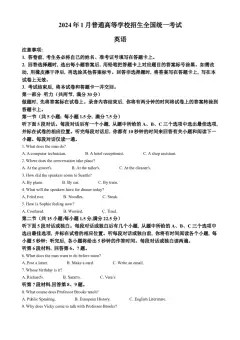
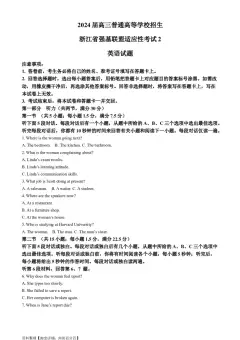
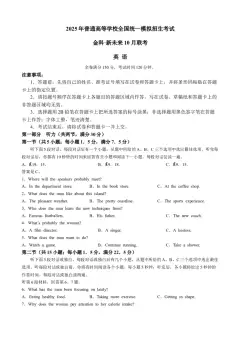
2024 年1 月普通高等学校招生全国统一考试
英语
注意事项:
1. 答卷前, 考生务必将自己的姓名、准考证号填写在答题卡上。
2. 回答选择题时, 选出每小题答案后, 用铅笔把答题卡上对应题目的答案标号涂黑。如需改
动, 用橡皮擦干净后, 再选涂其他答案标号。回答非选择题时, 将答案写在答题卡上, 写在本
试卷上无效。
3. 考试结束后, 将本试卷和答题卡一并交回。
第一部分 听力(共两节, 满分30 分)
做题时, 先将答案标在试卷上。录音内容结束后, 你将有两分钟的时间将试卷上的答案转涂到
答题卡上。
第一节(共5 小题; 每小题1.5 分, 满分7.5 分)
听下面5 段对话。每段对话后有一个小题, 从题中所给的A、B、C 三个选项中选出最佳选项,
并标在试卷的相应位置。听完每段对话后, 你都有10 秒钟的时间来回答有关小题和阅读下一
小题。每段对话仅读一遍。
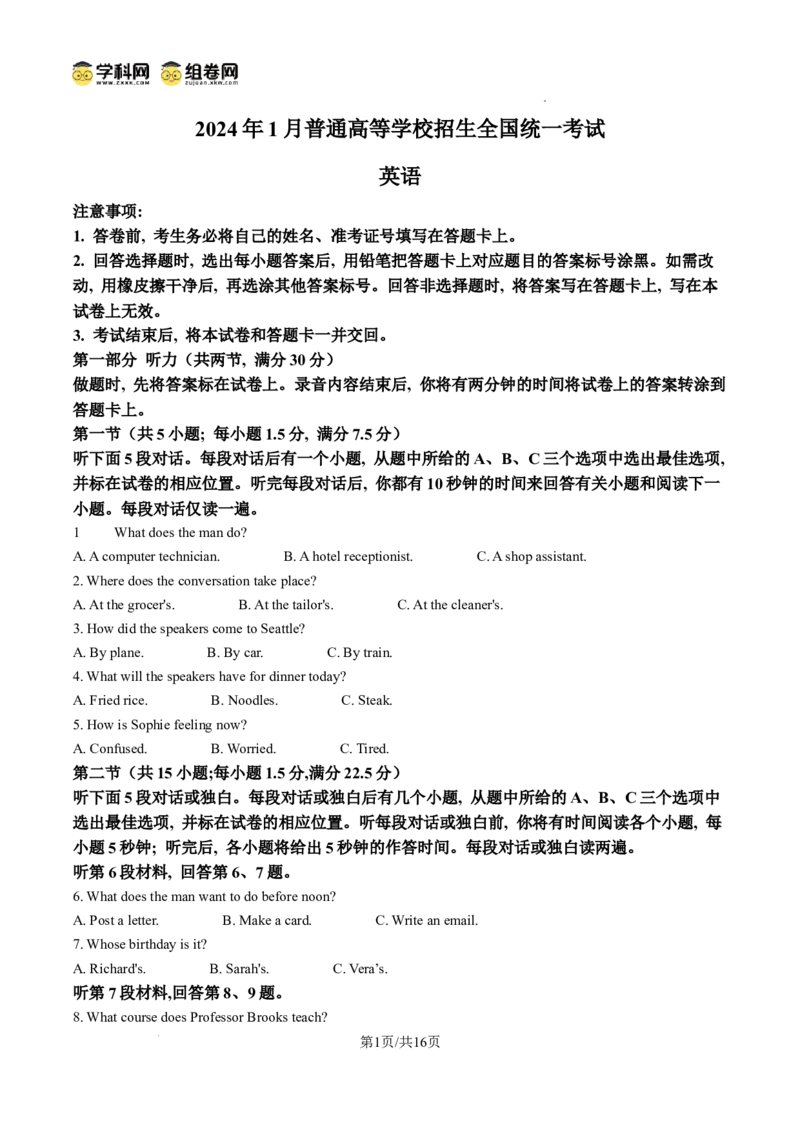
1
 What does the man do?
A. A computer technician.         B. A hotel receptionist.         C. A shop assistant.
2. Where does the conversation take place?
A. At the grocer's.         B. At the tailor's.         C. At the cleaner's.
3. How did the speakers come to Seattle?
A. By plane.         B. By car.         C. By train.
4. What will the speakers have for dinner today?
A. Fried rice.         B. Noodles.         C. Steak.
5. How is Sophie feeling now?
A. Confused.         B. Worried.         C. Tired.
第二节(共15 小题;每小题1.5 分,满分22.5 分)
听下面5 段对话或独白。每段对话或独白后有几个小题, 从题中所给的A、B、C 三个选项中
选出最佳选项, 并标在试卷的相应位置。听每段对话或独白前, 你将有时间阅读各个小题, 每
小题5 秒钟; 听完后, 各小题将给出5 秒钟的作答时间。每段对话或独白读两遍。
听第6 段材料, 回答第6、7 题。
6. What does the man want to do before noon?
A. Post a letter.         B. Make a card.         C. Write an email.
7. Whose birthday is it?
A. Richard's.         B. Sarah's.         C. Vera’s.
听第7 段材料,回答第8、9 题。
8. What course does Professor Brooks teach?


第2页/共16页
学科网(北京)股份有限公司
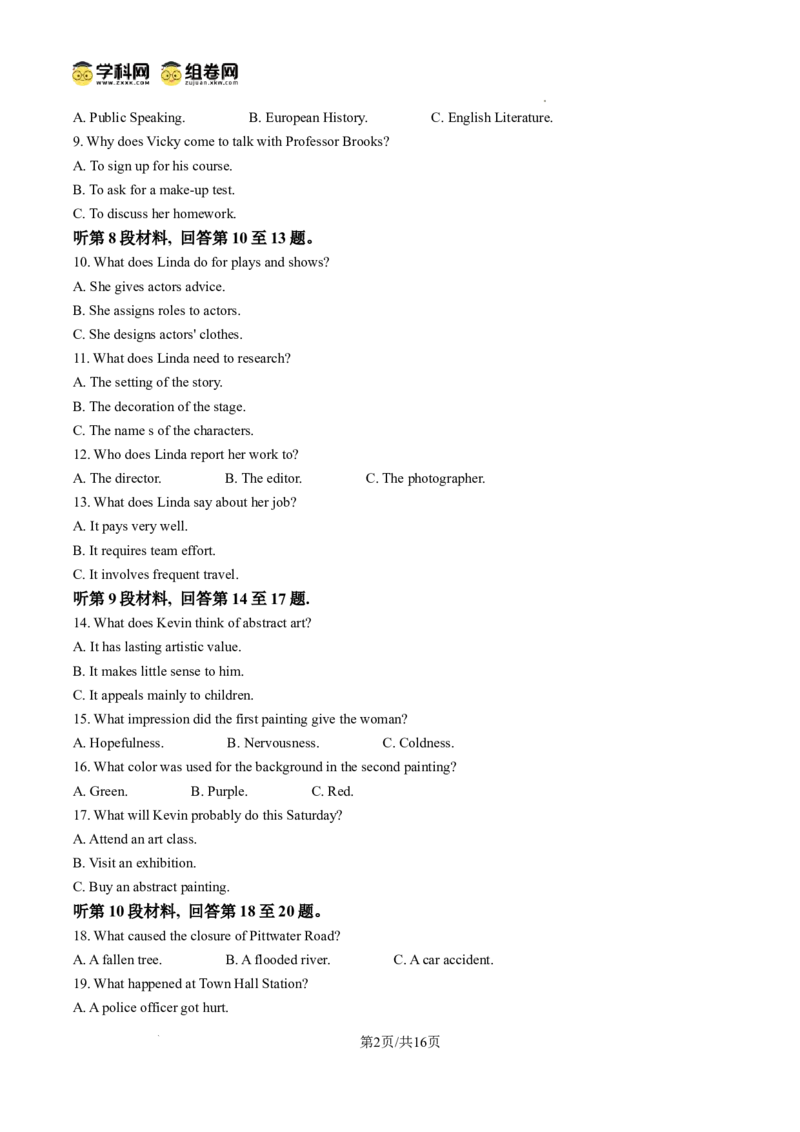
A. Public Speaking.         B. European History.         C. English Literature.
9. Why does Vicky come to talk with Professor Brooks?
A. To sign up for his course.
B. To ask for a make-up test.
C. To discuss her homework.
听第8 段材料, 回答第10 至13 题。
10. What does Linda do for plays and shows?
A. She gives actors advice.
B. She assigns roles to actors.
C. She designs actors' clothes.
11. What does Linda need to research?
A. The setting of the story.
B. The decoration of the stage.
C. The name s of the characters.
12. Who does Linda report her work to?
A. The director.         B. The editor.         C. The photographer.
13. What does Linda say about her job?
A. It pays very well.
B. It requires team effort.
C. It involves frequent travel.
听第9 段材料, 回答第14 至17 题.
14. What does Kevin think of abstract art?
A. It has lasting artistic value.
B. It makes little sense to him.
C. It appeals mainly to children.
15. What impression did the first painting give the woman?
A. Hopefulness.         B. Nervousness.         C. Coldness.
16. What color was used for the background in the second painting?
A. Green.         B. Purple.         C. Red.
17. What will Kevin probably do this Saturday?
A. Attend an art class.
B. Visit an exhibition.
C. Buy an abstract painting.
听第10 段材料, 回答第18 至20 题。
18. What caused the closure of Pittwater Road?
A. A fallen tree.         B. A flooded river.         C. A car accident.
19. What happened at Town Hall Station?
A. A police officer got hurt.


第3页/共16页
学科网(北京)股份有限公司
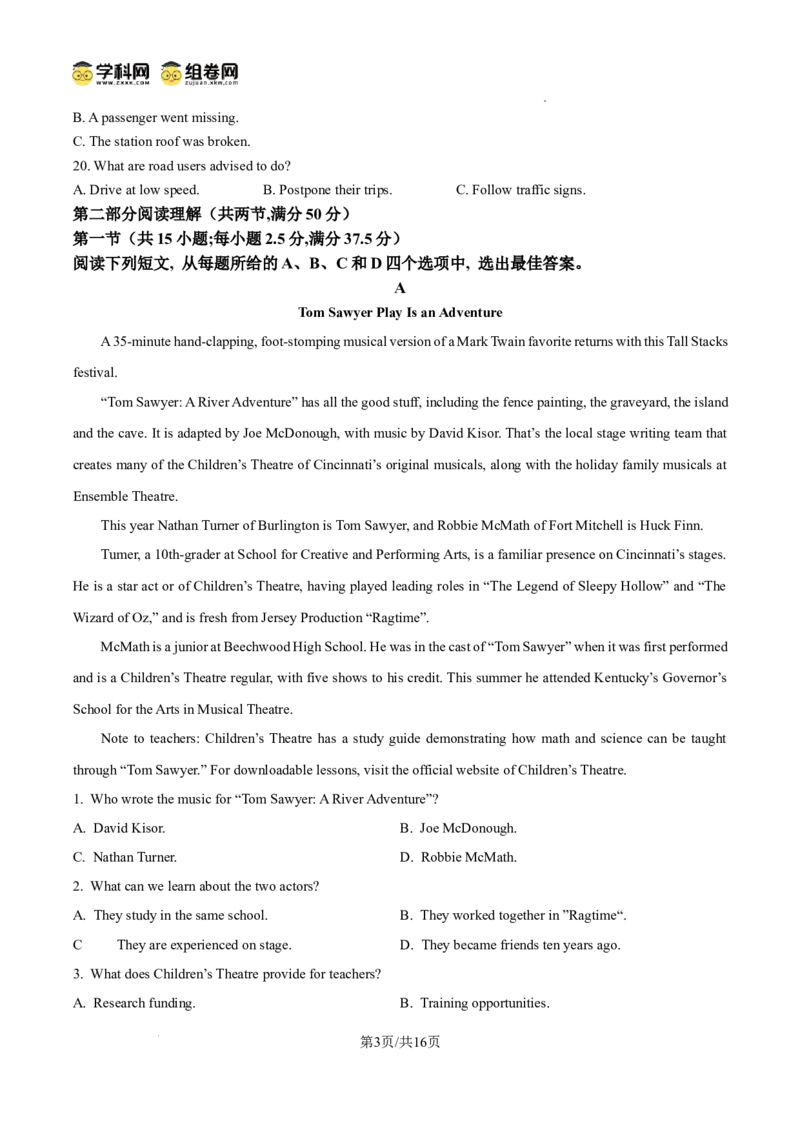
B. A passenger went missing.
C. The station roof was broken.
20. What are road users advised to do?
A. Drive at low speed.         B. Postpone their trips.         C. Follow traffic signs.
第二部分阅读理解(共两节,满分50 分)
第一节(共15 小题;每小题2.5 分,满分37.5 分)
阅读下列短文, 从每题所给的A、B、C 和D 四个选项中, 选出最佳答案。
A
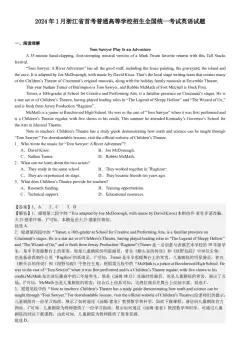
Tom Sawyer Play Is an Adventure
A 35-minute hand-clapping, foot-stomping musical version of a Mark Twain favorite returns with this Tall Stacks
festival.
“Tom Sawyer: A River Adventure” has all the good stuff, including the fence painting, the graveyard, the island
and the cave. It is adapted by Joe McDonough, with music by David Kisor. That’s the local stage writing team that
creates many of the Children’s Theatre of Cincinnati’s original musicals, along with the holiday family musicals at
Ensemble Theatre.
This year Nathan Turner of Burlington is Tom Sawyer, and Robbie McMath of Fort Mitchell is Huck Finn.
Tumer, a 10th-grader at School for Creative and Performing Arts, is a familiar presence on Cincinnati’s stages.
He is a star act or of Children’s Theatre, having played leading roles in “The Legend of Sleepy Hollow” and “The
Wizard of Oz,” and is fresh from Jersey Production “Ragtime”.
McMath is a junior at Beechwood High School. He was in the cast of “Tom Sawyer” when it was first performed
and is a Children’s Theatre regular, with five shows to his credit. This summer he attended Kentucky’s Governor’s
School for the Arts in Musical Theatre.
Note to teachers: Children’s Theatre has a study guide demonstrating how math and science can be taught
through “Tom Sawyer.” For downloadable lessons, visit the official website of Children’s Theatre.
1. Who wrote the music for “Tom Sawyer: A River Adventure”?
A. David Kisor.
B. Joe McDonough.
C. Nathan Turner.
D. Robbie McMath.
2. What can we learn about the two actors?
A. They study in the same school.
B. They worked together in ”Ragtime“.
C
 They are experienced on stage.
D. They became friends ten years ago.
3. What does Children’s Theatre provide for teachers?
A. Research funding.
B. Training opportunities.


第4页/共16页
学科网(北京)股份有限公司
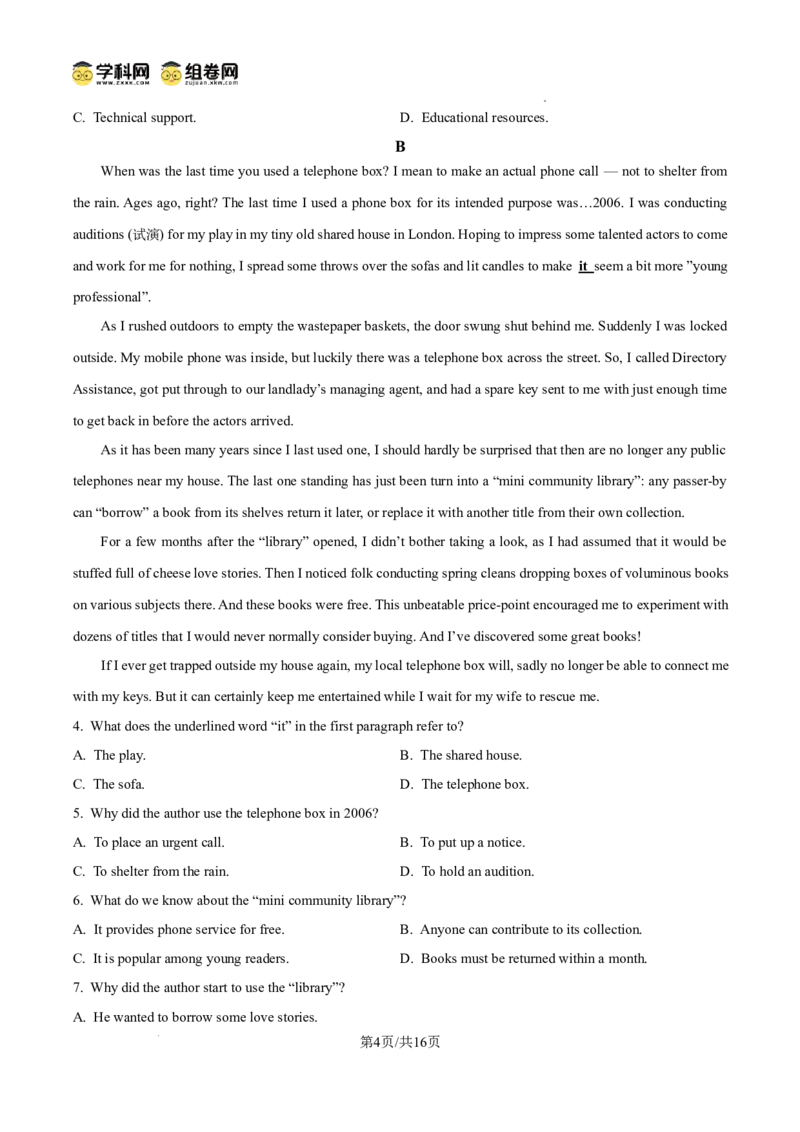
C. Technical support.
D. Educational resources.
B
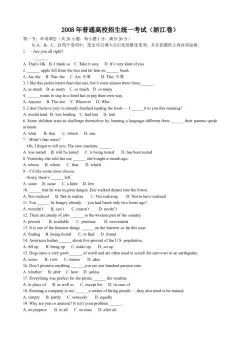
When was the last time you used a telephone box? I mean to make an actual phone call — not to shelter from
the rain. Ages ago, right? The last time I used a phone box for its intended purpose was…2006. I was conducting
auditions (试演) for my play in my tiny old shared house in London. Hoping to impress some talented actors to come
and work for me for nothing, I spread some throws over the sofas and lit candles to make it seem a bit more ”young
professional”.
As I rushed outdoors to empty the wastepaper baskets, the door swung shut behind me. Suddenly I was locked
outside. My mobile phone was inside, but luckily there was a telephone box across the street. So, I called Directory
Assistance, got put through to our landlady’s managing agent, and had a spare key sent to me with just enough time
to get back in before the actors arrived.
As it has been many years since I last used one, I should hardly be surprised that then are no longer any public
telephones near my house. The last one standing has just been turn into a “mini community library”: any passer-by
can “borrow” a book from its shelves return it later, or replace it with another title from their own collection.
For a few months after the “library” opened, I didn’t bother taking a look, as I had assumed that it would be
stuffed full of cheese love stories. Then I noticed folk conducting spring cleans dropping boxes of voluminous books
on various subjects there. And these books were free. This unbeatable price-point encouraged me to experiment with
dozens of titles that I would never normally consider buying. And I’ve discovered some great books!
If I ever get trapped outside my house again, my local telephone box will, sadly no longer be able to connect me
with my keys. But it can certainly keep me entertained while I wait for my wife to rescue me.
4. What does the underlined word “it” in the first paragraph refer to?
A. The play.
B. The shared house.
C. The sofa.
D. The telephone box.
5. Why did the author use the telephone box in 2006?
A. To place an urgent call.
B. To put up a notice.
C. To shelter from the rain.
D. To hold an audition.
6. What do we know about the “mini community library”?
A. It provides phone service for free.
B. Anyone can contribute to its collection.
C. It is popular among young readers.
D. Books must be returned within a month.
7. Why did the author start to use the “library”?
A. He wanted to borrow some love stories.


第5页/共16页
学科网(北京)股份有限公司
B. He was encouraged by a close neighbour.
C. He found there were excellent free books.
D. He thought it was an ideal place for reading.
C
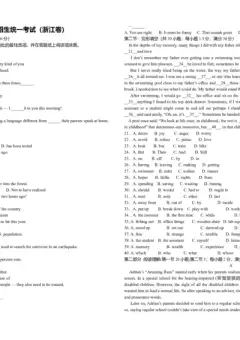
On September 7, 1991, the costliest hailstorm (雹暴) in Canadian history hit Calgary’s southern suburbs. As a
result, since 1996 a group of insurance companies have spent about $2 million per year on the Alberta Hail
Suppression Project. Airplanes seed threatening storm cells with a chemical to make small ice crystals fall as rain
before they can grow into dangerous hailstones. But farmers in east-central Alberta — downwind of the hail project
flights — worry that precious moisture (水分) is being stolen from their thirsty land by the cloud seeding.
Norman Stienwand, who farms in that area, has been addressing public meetings on this issue for years.
“Basically, the provincial government is letting the insurance companies protect the Calgary-Edmonton urban area
from hail,” Mr. Stienwand says, “but they’re increasing drought risk as far east as Saskatchewan.”
The Alberta hail project is managed by Terry Krauss, a cloud physicist who works for Weather Modification
Inc. of Fargo, North Dakota. “We affect only a very small percentage of the total moisture in the air, so we cannot
be causing drought.” Dr. Krauss says. “In fact, we may be helping increase the moisture downwind by creating
wetter ground.”
One doubter about the safety of cloud seeding is Chuck Doswell, a research scientist who just retired from the
University of Oklahoma. “In 1999, I personally saw significant tornadoes form from a seeded storm cell in
Kansas,” Dr. Doswell says. “Does cloud seeding create killer storms or reduce moisture downwind? No one really
knows, of course, but the seeding goes on.”
Given the degree of doubt, Mr. Stienwand suggests, “It would be wise to stop cloud seeding.” In practice,
doubt has had the opposite effect. Due to the lack of scientific proof concerning their impacts, no one has
succeeded in winning a lawsuit against cloud-seeding companies. Hence, private climate engineering can proceed
in relative legal safety.
8. What does the project aim to do?
A. Conserve moisture in the soil.
B. Forecast disastrous hailstorms.
C. Prevent the formation of hailstones.
D. Investigate chemical use in farming.
9. Who are opposed to the project?
A. Managers of insurance companies.
B. Farmers in east-central Alberta.
C. Provincial government officials.
D. Residents of Calgary and Edmonton.
10. Why does Dr. Doswell mention the tornadoes he saw in 1999?


第6页/共16页
学科网(北京)股份有限公司
A. To compare different kinds of seeding methods.
B. To illustrate the development of big hailstorms.
C. To show the link between storms and moisture.
D. To indicate a possible danger of cloud seeding.
11. What can we infer from the last paragraph?
A. Scientific studies have proved Stienwand right.
B. Cloud-seeding companies will continue to exist.
C. The doubt about cloud seeding has disappeared.
D. Private climate engineering is illegal in Canada.
D
The Stanford marshmallow (棉花糖) test was originally conducted by psychologist Walter Mischel in the late
1960s. Children aged four to six at a nursery school were placed in a room. A single sugary treat, selected by the
child, was placed on a table. Each child was told if they waited for 15 minutes before eating the treat, they would be
given a second treat. Then they were left alone in the room. Follow-up studies with the children later in life showed
a connect ion between an ability to wait long enough to obtain a second treat and various forms of success.
As adults, we face a version(版本) of the marshmallow test every day. We’re not tempted (诱惑) by sugary
treats, but by our computers, phones, and tablets — all the devices that connect us to the global delivery system for
various types of information that do to us what marshmallows do to preschoolers.
We are tempted by sugary treats because our ancestors lived in a calorie-poor world, and our brains developed
a response mechanism(机制) to these treats that reflected their value — a feeling of reward and satisfaction. But as
we’ve reshaped the world around us, dramatically reducing the cost and effort involved in obtaining (获取)
calories, we still have the same brains we had thousands of years ago, and this mismatch(不匹配) is at the heart of
why so many of us struggle to resist (抵抗) tempting foods that we know we shouldn’t eat.
A similar process is at work in our response to information. Our formative (有重大影响的) environment as a
species was information-poor, so our brains developed a mechanism that prized (高度重视) new information. But
global connectivity has greatly changed our information environment. We are now endlessly bombarded (轰炸)
with new information. Therefore, just as we need to be more thoughtful (深思熟虑的) about our caloric
consumption (热量消耗), we also need to be more thoughtful about our information consumption, resisting the
temptation of the mental “junk food” in order to manage our time most effectively.
12. What did the children need to do to get a second treat in Mischel’s test?
A. Take an examination alone.
B. Show respect for the researchers.
C. Share their treats with others.
D. Delay eating for fifteen minutes.
13. According to paragraph 3, there is a mismatch between ______.
A. the calorie-poor world and our good appetites
B. the shortage of sugar and our nutritional needs
C. the rich food supply and our unchanged brains
D. the tempting foods and our efforts to keep fit


第7页/共16页
学科网(北京)股份有限公司
14. What does the author suggest readers do?
A. Absorb new information readily (欣然地).
B. Use diverse information sources.
C. Be selective information consumers.
D. Protect the information environment.
15. Which of the following is the best title for the text?
A. Eat Less, Read More
B. The Bitter Truth about Early Humans
C. The Marshmallow Test for Grownups
D. The Marshmallow Test for Children.
第二节(共5 小题;每小题2.5 分,满分12.5 分)
根据短文内容, 从短文后的选项中选出能填入空白处的最佳选项。选项中有两项为多余选项。
In the past few years, online learning has become a significant part of the university and college experience.
___16___ But are all online courses created equal? How can you be sure that digital learning is right for you? ___17___
We interviewed students and professors to get their advice about online courses.
The most obvious advantage of online learning is that you can study anywhere and anytime. ___18___ “I
think a point that many people lose sight of is how easy it can be to fall behind schedule,” says graduate student
Amanda Bindman. Before choosing to study online, consider whether you’re a self-motivated learner and if the
material seems interesting enough to keep you going.
The tip that comes up most often is simple: build online courses into your weekly schedule, just like what you
would do with in person courses. ___19___ He noted that his online students usually end up with lower grades. It
is so easy to let an online course slide, but your grades will suffer as a result. Be sure to schedule set times to watch
your lectures, read materials and contribute to online discussion boards.
 ___20___ A social connection is often a big part of learning. There are things you can do to ease this problem.
Jessica Pink, an undergraduate student, suggests taking online courses with a friend, so you can motivate each other
to stay on track. You can also find students on the class discussion board to organize a study group, or schedule in-
person meeting s with your professor to discuss course concepts.
A. But that doesn’t mean there aren’t deadlines.
B. Your motivation should be your main concern.
C. Do you know that online courses are also part of your education?
D. Professor Alex Davidson teaches the same course in person and online.
E. The chief complain t about online courses is that they lack human interaction.
F. If you take an online course, what can you do to ensure the best possible grade?
G
 A survey found that 29 percent of college students registered for online courses.
第三部分 语言知识运用(共两节, 满分30 分)


第8页/共16页
学科网(北京)股份有限公司
第一节(共15 小题; 每小题1 分, 满分15 分)
阅读下面短文, 从短文后各题所给的A、B、C 和D 四个选项中, 选出可以填入空白处的最佳
选项。
While taking a 20-hour train ride along the edge of the Taklimakan Desert in northwestern China, I had the kind
of humbling, educational, and above all else, wonderful ____21____ with a local that all travelers long for. A young
Chinese man ____22____ me on the train. My ____23____ friend spoke virtually no English, so I happily took
the ____24____ to practice my Chinese.
Over several hours, he would tell me about how he had ____25____ a two-year professional school to quickly find
a job ____26____ highways in order to help support his family. Perhaps the most ____27____, however, was the
fact that this man spent hours studying every day after hard physical labor. Without batting an eye, he would
____28____ a translated Emerson passage before asking about the literary influence of American ____29____ as
a whole. ”And what do you all learn about Russian authors?” I ____30____ him asking at one point.
It would have been easy to ____31____ my assumptions about this highway builder who had never been more
than a few hundred miles from home. But this highly informed, ____32____ , and admirable person prevented me
doing so. In the course of a couple of hours, he ____33____ me just how much one can gain from ____34____ with
an open mind, and a willingness to ____35____ with locals from all walks of life.
21. A. experiment
B. encounter
C. competition
D. appointment
22. A. treated
B. saved
C. lectured
D. approached
23. A. true
B. so-called
C. new
D. long-lost
24. A. chance
B. advice
C. trouble
D. right
25. A. visited
B. financed
C. attended
D. founded
26. A. building
B. sweeping
C. checking
D. guarding
27. A. typical
B. obvious
C. natural
D. remarkable
28. A. publish
B. quote
C. сорy
D. download
29. A. writers
B. historians
C. workers
D. students
30. A. anticipate
B. imagine
C. recall
D. catch
31. A. look into
B. rely on
C. go over
D. deal with
32. A. well-behaved
B. multi-skilled
C. warm-hearted
D. self-educated
33. A. asked
B. warned
C. showed
D. promised
34. A. traveling
B. reading
C. searching
D. teaching
35. A. cooperate
B. side
C. negotiate
D. engage


第9页/共16页
学科网(北京)股份有限公司
第二节(共10 小题; 每小题1.5 分, 满分15 分)
阅读下面短文, 在空白处填入1 个适当的单词或括号内单词的正确形式。
The shelves in most supermarkets are full of family-size this and multi-buy that. However, if you’re shopping
for one, buying extra ____36____ (benefit) from price reductions doesn’t make sense. Either your shopping is then too
heavy to carry home ____37____ you can’t use what you’ve bought while it’s still fresh.
Of course, shops are not charities — they price goods in the way ____38____ will make them the most money. If
most of their customers are happy to buy larger quantities, that’s ____39____ they’ll promote. But that leaves the
solo (单独) customers out of pocket and disappointed.
Many supermarkets are no longer doing “buy one get one free” promotions because of the ____40____
(criticize) that they lead to waste. Consumers prefer money off individual items. However, though it’s nice to get a
few cents off a pack of sausages, it would help even more if they could sometimes ____41____ (offer) in smaller
packs. Even the biggest sausage fan doesn’t want to eat them every day.
If your supermarket sells loose produce, then buying smaller quantities is easier. Over the last two years, some
supermarkets ____42____ (start) selling chicken or salad in packs ____43____ (design) with two halves containing
separate portions (份). Then, when you use one section, ____44____ other stays fresh.
Who knows, perhaps some of the more forward-looking ____45____ (one) may yet come out with a whole
range of “just for you” pack sizes with special offers as well.
第四部分写作(共两节, 满分40 分)
第一节(满分15 分)
46. 请你写一篇短文向校英文报“Sports and Health”栏目投稿,向同学们推荐一项适合课间开展的运动,
内容包括:
1. 介绍这项运动;
2. 说明推荐理由。
注意:
1. 写作词数应为80 个左右;
2. 请按如下格式在答题卡的相应位置作答:
Stand Up and Exercise, Everybody!
____________________________________________________________________________________________
____________________________________________________________________________________________
____________________________________________________________________________________________
____________________________________________________________________________________________


第10页/共16页
学科网(北京)股份有限公司
____________________________________________________________________________________________
_______________
第二节(满分25 分)
47. 阅读下面材料,根据其内容和所给段落开头语续写两段,使之构成一篇完整的短文。
Eva spent the first week of high school trying to keep her head above water. One of the major headaches for her
was finding her way in the huge school building. It was a six-story building. On each floor, hallways stretched in four
directions, learning to classrooms, laboratories and teachers’ offices. Somewhere in the building, there was also a
library, a cafeteria and a gym.
Having a poor sense of direction, Eva found it impossible to get around in such a huge building. All the different
hallways and rooms were too much to think about, let alone commit to memory. She decided that she would memorize
where her classes were and then pretend that the rest of the place didn’t exist.
In her first PE class, Eva was shocked when Coach Pitt announced that everyone had to run one mile around the
track outside. She searched the faces of her classmates for signs of panic. There was nothing she feared more than
having to run a whole mile. To Eva, “a mile” was used to describe long distances. It was ten miles from her home to
her grandfather’s, and that always seemed like a long way, even in a car!
When Coach Pitt blew his whistle (哨子), Eva figured she would be left in the dust. However, while some of
her classmates edged ahead, others actually fell behind. “It’s just the beginning,” she thought. “I’ll come in last for
sure.”
Soon Eva began to breathe hard, with her heart pounding and legs shaking. Feeling desperate, Eva started using a
mind trick on herself. She stopped thinking about the word “mile”. Instead, she focused on reaching the shadow cast
on the track by an oak tree up ahead. Then she concentrated on jogging to the spot where the trace curved (拐弯).
After that, she tried to see if she could complete her first lap. One lap turned into two, then three, then four.
注意:
1. 续写词数应为150 个左右;
2. 请按如下格式在答题卡的相应位置作答。
When Coach Pitt said “Nice work!” to her at the finish line, Eva was surprised.
____________________________________________________________________________________________
____________________________________________________________________________________________
____________________________________________________________________________________________
____________________________________________________________________________________________


第11页/共16页
学科网(北京)股份有限公司
_______________________________________________________________________________________
Eva decided to use the same trick to deal with the school building.
____________________________________________________________________________________________
____________________________________________________________________________________________
____________________________________________________________________________________________
____________________________________________________________________________________________
_______________________________________________________________________________________


第12页/共16页
学科网(北京)股份有限公司
2024 年1 月普通高等学校招生全国统一考试
英语
注意事项:
1. 答卷前, 考生务必将自己的姓名、准考证号填写在答题卡上。
2. 回答选择题时, 选出每小题答案后, 用铅笔把答题卡上对应题目的答案标号涂黑。如需改
动, 用橡皮擦干净后, 再选涂其他答案标号。回答非选择题时, 将答案写在答题卡上, 写在本
试卷上无效。
3. 考试结束后, 将本试卷和答题卡一并交回。
第一部分 听力(共两节, 满分30 分)
做题时, 先将答案标在试卷上。录音内容结束后, 你将有两分钟的时间将试卷上的答案转涂到
答题卡上。
第一节(共5 小题; 每小题1.5 分, 满分7.5 分)
听下面5 段对话。每段对话后有一个小题, 从题中所给的A、B、C 三个选项中选出最佳选项,
并标在试卷的相应位置。听完每段对话后, 你都有10 秒钟的时间来回答有关小题和阅读下一
小题。每段对话仅读一遍。
1. What does the man do?
A. A computer technician.         B. A hotel receptionist.         C. A shop assistant.
2. Where does the conversation take place?
A. At the grocer's.         B. At the tailor's.         C. At the cleaner's.
3. How did the speakers come to Seattle?
A. By plane.         B. By car.         C. By train.
4. What will the speakers have for dinner today?
A. Fried rice.         B. Noodles.         C. Steak.
5. How is Sophie feeling now?
A. Confused.         B. Worried.         C. Tired.
第二节(共15 小题;每小题1.5 分,满分22.5 分)
听下面5 段对话或独白。每段对话或独白后有几个小题, 从题中所给的A、B、C 三个选项中
选出最佳选项, 并标在试卷的相应位置。听每段对话或独白前, 你将有时间阅读各个小题, 每
小题5 秒钟; 听完后, 各小题将给出5 秒钟的作答时间。每段对话或独白读两遍。
听第6 段材料, 回答第6、7 题。
6. What does the man want to do before noon?
A. Post a letter.         B. Make a card.         C. Write an email.
7. Whose birthday is it?
A. Richard's.         B. Sarah's.         C. Vera’s.
听第7 段材料,回答第8、9 题。
8. What course does Professor Brooks teach?


第13页/共16页
学科网(北京)股份有限公司
A. Public Speaking.         B. European History.         C. English Literature.
9. Why does Vicky come to talk with Professor Brooks?
A. To sign up for his course.
B. To ask for a make-up test.
C. To discuss her homework.
听第8 段材料, 回答第10 至13 题。
10. What does Linda do for plays and shows?
A. She gives actors advice.
B. She assigns roles to actors.
C. She designs actors' clothes.
11. What does Linda need to research?
A. The setting of the story.
B. The decoration of the stage.
C. The name s of the characters.
12. Who does Linda report her work to?
A. The director.         B. The editor.         C. The photographer.
13. What does Linda say about her job?
A. It pays very well.
B. It requires team effort.
C. It involves frequent travel.
听第9 段材料, 回答第14 至17 题.
14. What does Kevin think of abstract art?
A. It has lasting artistic value.
B. It makes little sense to him.
C. It appeals mainly to children.
15. What impression did the first painting give the woman?
A. Hopefulness.         B. Nervousness.         C. Coldness.
16. What color was used for the background in the second painting?
A. Green.         B. Purple.         C. Red.
17. What will Kevin probably do this Saturday?
A. Attend an art class.
B. Visit an exhibition.
C. Buy an abstract painting.
听第10 段材料, 回答第18 至20 题。
18. What caused the closure of Pittwater Road?
A. A fallen tree.         B. A flooded river.         C. A car accident.
19. What happened at Town Hall Station?
A. A police officer got hurt.


第14页/共16页
学科网(北京)股份有限公司
B. A passenger went missing.
C. The station roof was broken.
20. What are road users advised to do?
A
 Drive at low speed.         B. Postpone their trips.         C. Follow traffic signs.
第二部分阅读理解(共两节,满分50 分)
第一节(共15 小题;每小题2.5 分,满分37.5 分)
阅读下列短文, 从每题所给的A、B、C 和D 四个选项中, 选出最佳答案。
A
【1~3 题答案】
【答案】1. A    2. C    3. D
B
【4~7 题答案】
【答案】4. B    5. A    6. B    7. C
C
【8~11 题答案】
【答案】8
 C    9. B    10. D    11. B
D
【12~15 题答案】
【答案】12. D    13. C    14. C    15. C
第二节(共5 小题;每小题2.5 分,满分12.5 分)
根据短文内容, 从短文后的选项中选出能填入空白处的最佳选项。选项中有两项为多余选项。
【16~20 题答案】
【答案】16. G    17. F    18. A    19. D    20. E
第三部分 语言知识运用(共两节, 满分30 分)
第一节(共15 小题; 每小题1 分, 满分15 分)
阅读下面短文, 从短文后各题所给的A、B、C 和D 四个选项中, 选出可以填入空白处的最佳
选项。
【21~35 题答案】
【答案】21. B    22. D    23. C    24. A    25. C    26. A    27. D    28. B    29. A    30. C    31. B    32. D    33. C    34. A
35. D
第二节(共10 小题; 每小题1.5 分, 满分15 分)
【36~45 题答案】
【答案】36. to benefit
37. or    38. that##which


第15页/共16页
学科网(北京)股份有限公司
39. what    40. criticism
41. be offered
42. have started
43. designed
44. the    45. ones
第四部分写作(共两节, 满分40 分)
第一节(满分15 分)
【46 题答案】
【答案】
Stand Up and Exercise, Everybody!
Everybody! Are you tired of sitting in class all day? How about incorporating some physical activity into your
daily routine? One great option is the “Stand Up and Stretch” exercise. This simple routine involves standing up from
your desk, stretching your arms, legs and back, and taking a few deep breaths. It’s a quick and easy way to get your
blood flowing and re-energize your body and mind. This exercise is recommended for several reasons.
First, it helps to combat the negative effects of prolonged sitting, such as back pain and stiffness. Second, it can
improve your focus and concentration, making it easier to stay engaged in class. Lastly, it promotes a healthy and
active lifestyle, which is essential for overall well-being.
So, next time you feel a bit sluggish during class, remember to stand up and stretch! It’s a small change that can
make a big difference in your day.
第二节(满分25 分)
【47 题答案】
【答案】参考范文
When Coach Pitt said “Nice work!” to her at the finish line, Eva was surprised. Never in her wildest dream had
she imagined that she could achieve such an eye-catching score! Conquering this one mile was a milestone in her
running career! Amazingly, Coach Pitts’ positive recognition installed an enormous sense of achievement into her
heart. Enthusiastic cheers and thunderous applauses from her classmates kept her on the top of the world. Breathless
and exhausted, she realized that overcoming seemingly the toughest challenges just needed a smart strategy like her
mind trick. Her initial self-doubt gave way to self-confidence. Being a freshman, she tended to get lost in the 6-story
maze, leaving her so helpless. Staring at the towering teaching building, Eva came up with a good idea, with a smile
blooming across her face.
Eva decided to use the same trick to deal with the school building. No sooner had she returned to the confusing


第16页/共16页
学科网(北京)股份有限公司
maze than she set out to explore the first floor. Convinced that her mind trick would locate her in the school as soon
as possible, she came to a gym, which was well-equipped with various workout facilities. Next to the gym was a
cafeteria, which provided a wide range of foods and drinks. As Eva walked back to her classroom, she noticed that
she felt less overwhelmed by this huge complex. Time ticking away, Eva eventually got familiar with the vast maze
in the way she finished the one-mile run. One lap at a time did work! So did one floor a week! It dawned on her that
goals are easier to achieve in small steps.